
Crypto World
EU Message Scanning Is Live and End-to-End Encryption Could Be Next



Millions of EU citizens already send messages through systems that scan them. Vyara Savova, senior policy lead at the European Ethereum Institute, warns that end-to-end encryption sits next in line.
The current rules come from a derogation to the ePrivacy directive. Lawmakers extended that derogation in July 2026, and it now runs until April 2028.
EU Chat Control Already Reads Whole Messages
In an interview with BeInCrypto, Savova separated two files that critics often merge into one. The first lets providers scan voluntarily. The second would turn scanning into a legal duty.
Most large platforms already use the voluntary route. Therefore, EU message scanning is not a future risk for most users. It is a current default.
Savova explained how the mechanism works in practice.
“Basically what is happening is you have this possibility to scan voluntarily… messages for a specific type of content. But then in order for you to scan for a specific type of content, you still check the whole message.”
That distinction matters. A narrow legal purpose still requires broad technical access. Ethereum co-founder Vitalik Buterin made a similar point in July, when he called the revival a cybersecurity risk for everyone.
Why Encryption Sits Next in Line
Apps that use end-to-end encryption cannot comply with the same logic. Providers would first have to decrypt the traffic. As a result, the debate no longer stops at content moderation.
Savova framed the direction of travel bluntly.
“I would say people should already be worried, but it… has the potential to get much worse.”
Meanwhile, Brussels keeps widening its digital enforcement toolkit. Officials have also flagged VPNs as a loophole in age verification rules. Each file targets a different problem. Together, however, they point one way.
Crypto users face a specific exposure here. Wallet recovery flows, seed phrase backups, and trading group chats all travel over the same consumer apps. Savova noted that file storage falls inside the same scope, not just live chat.
Scale makes the difference. Voluntary scanning covers a narrow category of known material today. A mandate would apply the same machinery to every conversation, on every platform, without suspicion.
Subscribe to our YouTube channel to watch leaders and journalists provide expert insights
The Legal Line Nobody Has Drawn Yet
Marina Markezic, co-founder and executive director of the European Ethereum Institute, argues that the constitutional test has not changed. Digital access simply feels lighter than a physical search.
“But the legal principles and the principles that we have adopted over the years in… our constitutions are still standing. So no matter if it’s the access to our apartments, if it’s access to our communications…”
Supporters of the rules make the opposite case. Child protection groups argue that platforms already hold the data, so targeted scanning adds little new intrusion. European Commission officials have repeatedly said the goal stays limited to abuse material.
Still, the technical answer decides the outcome. Encryption either holds for everyone or breaks for everyone. Consequently, the next negotiation rounds in autumn will matter more than the language on paper.
Users can act now. Choosing apps that publish their encryption model, and moving sensitive files off consumer chat, both reduce exposure well before any final vote. Savova and Markezic plan to keep tracking the negotiations through the autumn rounds.
The post EU Message Scanning Is Live and End-to-End Encryption Could Be Next appeared first on BeInCrypto.

Gold continues to attract attention as investors search for a so-called safe haven in an increasingly uncertain global environment. Rising geopolitical tensions, currency volatility, central bank reserve shifts, and questions about long-term economic resilience have all pushed gold back into focus.
With prices reaching repeated record highs in 2025, many are now looking beyond the immediate rally and asking what comes next. This article breaks down the factors shaping gold’s trajectory and examines analytical gold price forecasts for 2026 to 2030.
Forecast Summary
2026
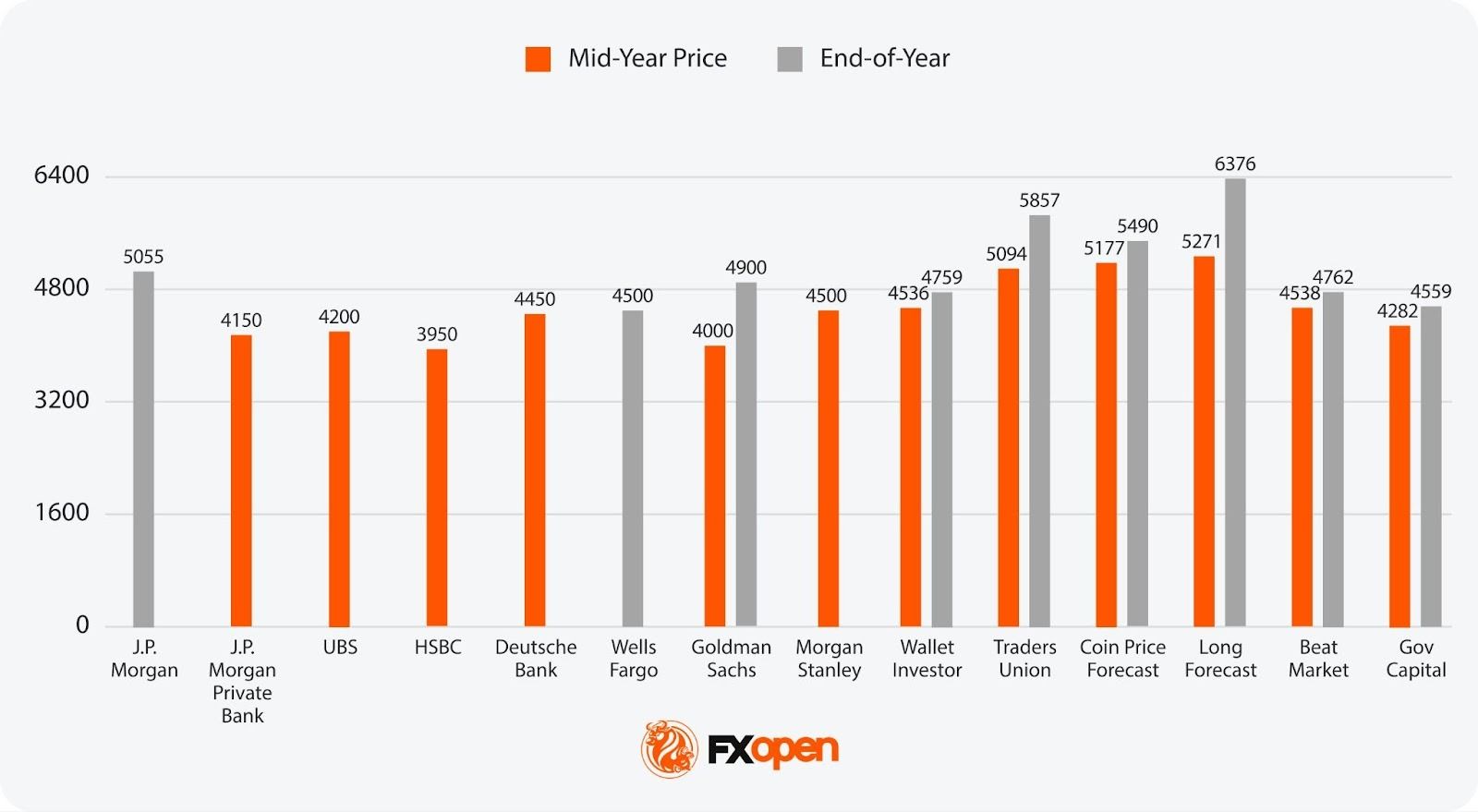
Predictions range from around $3,950 to $6,376, suggesting a broad possible outcome. The midpoint sits near the $4,500 level, with sentiment driven by interest rate cuts, slowing growth, and ongoing de-dollarisation.
2027
Outlooks extend between $4,579 and roughly $7,819. Many forecasters see gold pushing meaningfully higher as structural demand from institutions and emerging markets remains strong while supply growth stays limited.
2028
Estimates fall between $5,133 and $8,619. The gap reflects uncertainty around inflation persistence and global financial stability. Long-term projections lean bullish as miners struggle to increase production.
2029
Most projections fall between $5,710 and $8,504. Sources note that if geopolitical fragmentation or currency debasement accelerates, gold could outperform these expectations.
2030
Long-range forecasts suggest $5,900 to over $9,300, indicating a continued upward structural trend. Much of this depends on whether monetary policy remains loose and global reserve diversification continues.
Gold Price History
Gold has been a cornerstone of economic systems and wealth preservation for millennia. Revered for its scarcity and intrinsic value, the precious metal has been used as a form of currency, a symbol of wealth, and a reserve asset across different civilisations. Its unique qualities, such as durability and resistance to corrosion, have made it a preferred choice for monetary systems until the modern era introduced fiat currencies.
In the 20th century, gold retained its prominence through the establishment of the gold standard, where currencies were directly linked to gold reserves. Although this system was eventually abandoned, gold has continued to play a significant role as a store of value and a hedge against economic uncertainties, maintaining its relevance in global markets.
The journey of gold’s value over time is marked by significant fluctuations influenced by economic policies, global crises, and shifts in demand. Traders can observe how these various factors influenced the spot gold price (XAU/USD) CFDs on FXOpen’s TickTrader platform.
Post Bretton Woods and 1970s Inflation
The collapse of the Bretton Woods system in 1971 initiated a free float of currency values against gold, leading to a decade of volatility. The 1970s experienced a dramatic increase in the price of gold, fueled by inflation, geopolitical tensions, and energy crises, peaking at around $843 in 1980.
1990s Stabilisation and a Dip
The 1990s saw gold stabilising, then dipping to a low of approximately $253 per ounce in 1999 amidst a robust US economy and strong US dollar, diminishing gold’s attractiveness as an alternative investment. However, in the second half of 1999, the gold price recovered and fluctuated between $275 and $325 in late 1999 and early 2000.
2000s to Great Recession (2008-2010)
The early 2000s witnessed a gradual rise in prices, surging sharply during the Great Recession of 2008. Its appeal as a so-called safe-haven investment drove it from about $730 in October 2008 to ~$1,300 by October 2010.
European Debt Crisis (2010-2012)
Gold soared to new heights, reaching around $1,825 in August 2011, as concerns over the eurozone’s stability and global economic health spurred investor demand for the precious metal.
Post-2013 Economic Recovery
The period following 2013 saw gold decline by 29%, from around $1,695 in January 2013 to around $1,200 in December 2014, influenced by the Federal Reserve’s tapering of quantitative easing and a strengthening US dollar.
COVID-19 Pandemic (2020-2023)
The most notable event in the gold price over the last 5 years was the unprecedented global disruption caused by the COVID-19 pandemic. The pandemic led to a significant rise in the price of gold, which soared 27% from around $1,500 in January 2020 to over $2,000 by the summer of 2020. Prices consolidated between $1,700 and $1,900 before reaching new highs above $2,000 in late 2023.
Strong Performance 2024-2025 and Early 2026
Gold experienced a remarkable surge in 2024, driven by a combination of geopolitical tensions, economic uncertainty surrounding the US presidential election, and strong demand from emerging market central banks. By mid-December 2024, gold prices had climbed more than 30%.
Gold hit fresh records in early 2025 as markets reacted to escalating tariff announcements and renewed instability in Ukraine and the Middle East. March marked a turning point, with gold breaking above $3,000 for the first time after a series of selloffs in equities and bonds. So-called safe-haven positioning accelerated through April, and gold briefly touched $3,500 following an aggressive US trade action that triggered further volatility.
While the price ranged between April and September, momentum returned as the Federal Reserve signalled its first rate cut of the cycle, weakening the dollar and boosting gold demand from global investors as yields fell. By mid-October, gold peaked at $4,381, before surging to $4,550 by year-end.
The metal delivered one of its strongest annual performances on record, gaining roughly 65% amid dovish monetary policy expectations, heightened geopolitical tensions, and sustained central bank buying.
By 21 January 2026, XAU/USD had climbed further to $4,888, driven by escalating geopolitical risks, including US military action against Venezuela, unrest in Iran with the prospect of US involvement, and renewed rhetoric from Donald Trump regarding the takeover of Greenland.
Let’s now examine the factors that could influence gold prices in 2026 and the years ahead.
Analytical Gold Price Forecasts for 2026-2030
Is gold going up or down between 2026 and 2030? In this section, we’ll examine gold price predictions for the next 5 years from various algorithm-driven analytical resources.
The period from 2026 to 2030 is poised to be transformative for gold markets, influenced by a confluence of factors that could significantly impact gold prices. They collectively reflect a supportive environment for gold, potentially leading to elevated prices as the decade progresses.
Central Bank Diversification Away from the US Dollar
Central banks continued to play a major role in supporting gold demand through 2025, with reserve managers increasingly positioning gold as an alternative to the US dollar. Official sector buying exceeded 1,000 tonnes for the third year in a row in 2024, led by emerging markets such as China, Turkey, India, and Poland. Many of the institutions cited geopolitical risk, sanctions exposure, and concerns about US fiscal sustainability as major reasons for diversifying.
Surveys from the World Gold Council show this behaviour isn’t a short-term trend. By mid-2025, more than 70% of central bank respondents expected the share of gold in global reserves to continue rising over the next five years, while a similar proportion anticipated a gradual decline in the dollar’s dominance. Some reserve managers also highlighted the appeal of owning an asset with no counterparty risk, particularly as global debt levels increased and geopolitical blocs became more defined.
This shift contributes to the creation of a structural floor under gold prices in 2026 and beyond. With few signs of reversal, continued official-sector buying remains a supportive factor for analytical gold price forecasts in 2026 to 2030, especially if geopolitical fragmentation deepens and confidence in traditional reserve currencies weakens further.
Dollar Devaluation
The weakening of the US dollar’s purchasing power has become an increasingly influential factor in gold demand. While headline inflation cooled from its post-pandemic peak, the cumulative effect has been significant. Between 2021 and 2025, the dollar lost roughly 15–20% of its real spending value, depending on the inflation measure tracked. Everyday benchmarks such as housing, energy, and food costs rose sharply, highlighting the dollar’s deterioration as a store of value.
This erosion was echoed in gold-relative terms. In 2022, one ounce of gold cost around $1,700; by late 2025, it traded above $4,000. Put differently, the dollar now buys less than half the gold it did three years earlier. That decline reflects not only inflation but also reduced confidence in long-term dollar strength as government debt surpassed $38 trillion (Trading Economics) and global demand for US Treasury assets softened.
As purchasing power weakens, investors increasingly view gold as a more durable alternative to holding cash.
Geopolitical Tensions
Persistent geopolitical tensions are expected to sustain gold’s appeal as a so-called safe-haven asset. Conflicts such as those in Ukraine and the Middle East have already driven investors toward gold. The question of Greenland became one of the most critical geopolitical issues in early 2026. Additionally, potential new flashpoints, like heightened tensions between China and Taiwan, could further escalate global instability.
Analysts note that during periods of significant geopolitical upheaval, gold demand tends to rise as investors seek protection against economic and financial fallout. This pattern is expected to continue through 2030, supporting higher gold prices.
Monetary Policy and Interest Rates
Monetary policy remains one of the most important forward-looking drivers for gold. After an extended tightening cycle, major central banks, including the Federal Reserve and the ECB, entered 2025 signalling a transition toward easing. Markets now expect rate cuts to continue into 2026 as growth slows and labour market data softens. This shift matters for analytical gold price predictions in 2026 and beyond because lower interest rates reduce the relative appeal of yield-bearing assets, encouraging capital to move into non-yielding stores of value.
Real rates will be especially important. If inflation proves sticky while nominal rates fall, real yields could turn negative again, historically a strong tailwind for gold accumulation. Investors are already positioning for this scenario, particularly as government borrowing remains elevated and fiscal policy stays expansionary.
If the easing cycle accelerates or recession risks rise, gold demand may strengthen further. Conversely, a pause or reversal in rate cuts could temper upside momentum but is not currently the base case.
Economic Indicators
Economic indicators such as inflation, currency fluctuations, and global economic growth significantly influence gold prices. A potential slowdown in the US economy, coupled with a weaker dollar, may bolster gold prices. As the dollar depreciates, gold becomes more affordable for holders of other currencies, increasing its demand.
Additionally, high global debt levels and potential devaluation of currencies like the US dollar are prompting a shift to gold. These economic factors are expected to play a pivotal role in shaping gold prices through 2030.
Supply Constraints
Global mine supply is modest but demand is high. High operating costs continue to pressure producers, with average All-In Sustaining Costs climbing above $1,500 per ounce in 2025 due to fuel, labour, and equipment inflation.
New large discoveries are rare, and most new output comes from expansions of existing sites rather than fresh deposits. Several projects in West Africa and Latin America also faced delays linked to permitting, power shortages, and security risks.
With limited new supply and declining ore grades, analysts expect output growth to flatten and potentially contract late in the decade.
Gold Price Predictions for 2026
As we move into 2026, the expectations show a continuation of the upward trend, albeit with differences in the extent of growth anticipated by various sources.
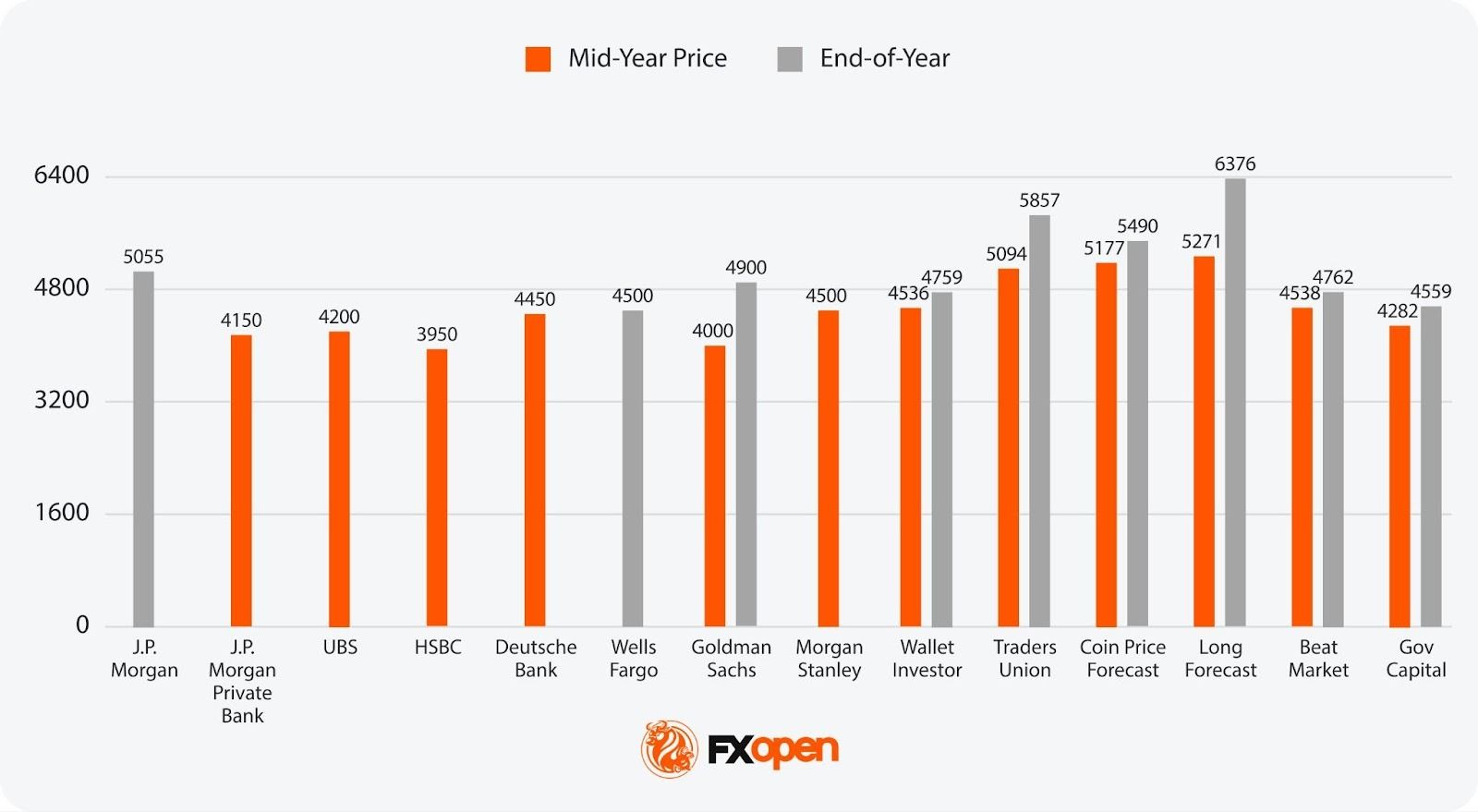
- Most Optimistic Projection for Mid-Year 2026: 5,271 (Long Forecast)
- Most Pessimistic Projection for Mid-Year 2026: 3,950 (HSBC)
- Most Optimistic Projection for End-of-Year 2026: 6,376 (Long Forecast)
- Most Pessimistic Projection for End-of-Year 2026: 4,500 (Wells Fargo)
J.P. Morgan Private Bank forecasts gold at $4,050–4,150 by mid-2026, supported by the Federal Reserve’s looser policy. At the same time, J.P. Morgan projects that the metal could average $5,055 per ounce by Q4 2026, citing robust investor interest and steady central bank purchases, which could reach about 566 tons per quarter. “Gold remains our highest conviction long for the year, and we see further upside as the market enters a Fed rate-cutting cycle,” stated Natasha Kaneva, Head of Global Commodities Strategy at J.P. Morgan.
Goldman Sachs projects gold to reach about $4,000 per ounce by mid-2026 and $4,900 by year-end, driven primarily by strong central bank demand and a more dovish Fed. Continued central bank buying will be the main driver of the uptrend. Daan Struyven, head of oil research at Goldman Sachs, stated, “We look for nearly 20% of additional price upside by the end of 2026, with our forecast at $4,900 per troy ounce by the end of ’26.” He noted that higher central bank purchases and the dovish Fed’s monetary policy will contribute to the rise.
Morgan Stanley offers the most bullish mid-year prediction from any bank here, forecasting that gold could reach around $4,500 per ounce by mid-2026, supported by strong demand from ETFs and ongoing central bank accumulation as uncertainty persists. While the outlook remains broadly positive, Morgan Stanley cautions that volatility, shifting investor allocation, or reduced central bank buying could limit upside.
Gold Price Predictions for 2027
The projections for 2027 illustrate a continued rising trend, with certain forecasters predicting substantial gains.
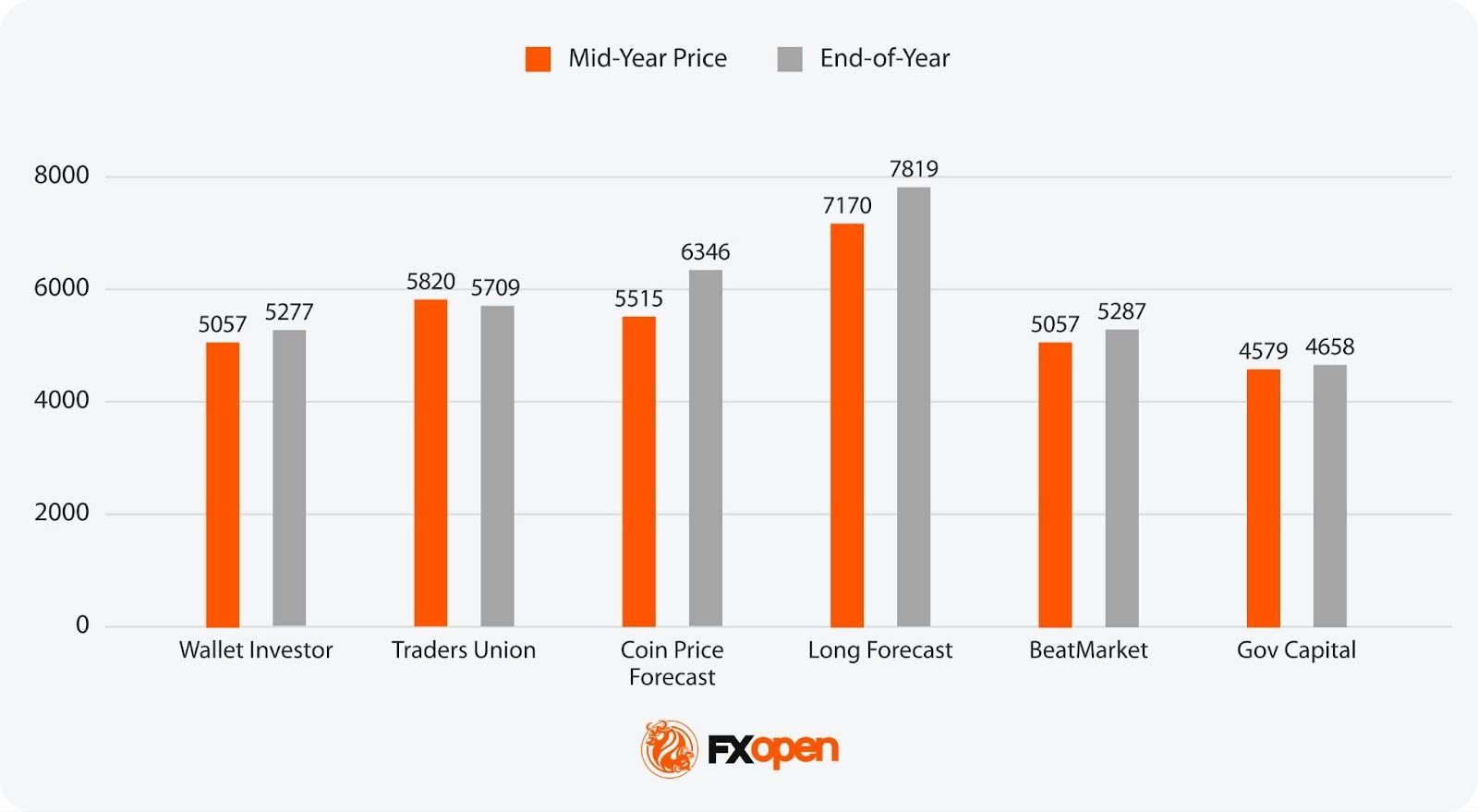
- Most Optimistic Projection for Mid-Year 2027: 7,170 (Long Forecast)
- Most Pessimistic Projection for Mid-Year 2027: 4,579 (Gov Capital)
- Most Optimistic Projection for End-of-Year 2027: 7,819 (Long Forecast)
- Most Pessimistic Projection for End-of-Year 2027: 4,658 (Gov Capital)
Gold Price Predictions for 2028
Looking towards 2028, the range of predictions indicates both caution and enthusiasm about gold’s value in the market.
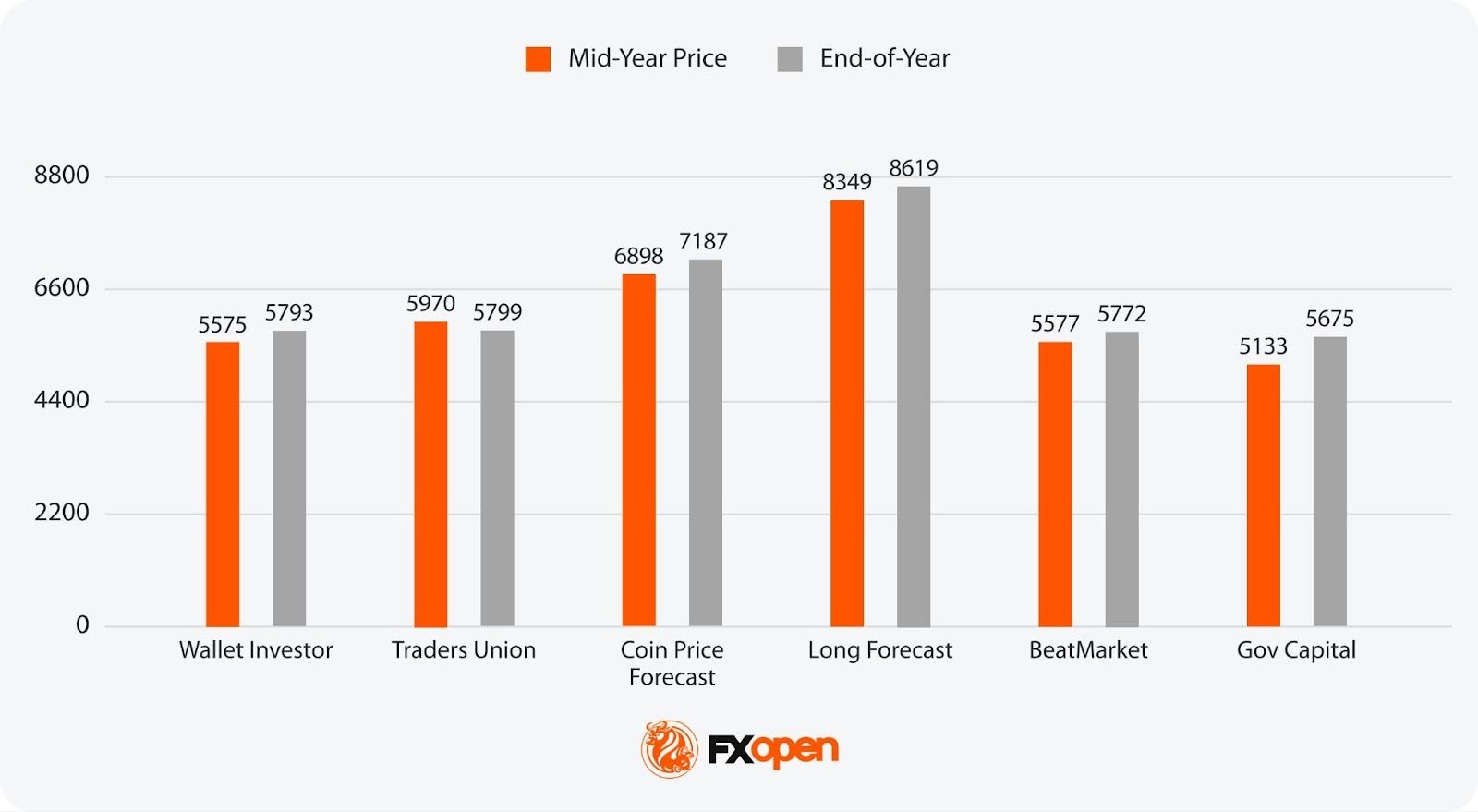
- Most Optimistic Projection for Mid-Year 2028: 8,349 (Long Forecast)
- Most Pessimistic Projection for Mid-Year 2028: 5,133 (Gov Capital)
- Most Optimistic Projection for End-of-Year 2028: 8,619 (Long Forecast)
- Most Pessimistic Projection for End-of-Year 2028: 5,675 (Gov Capital)
Gold Price Predictions for 2029
As we approach the end of the decade, forecasters remain optimistic about the yellow metal’s enduring value.
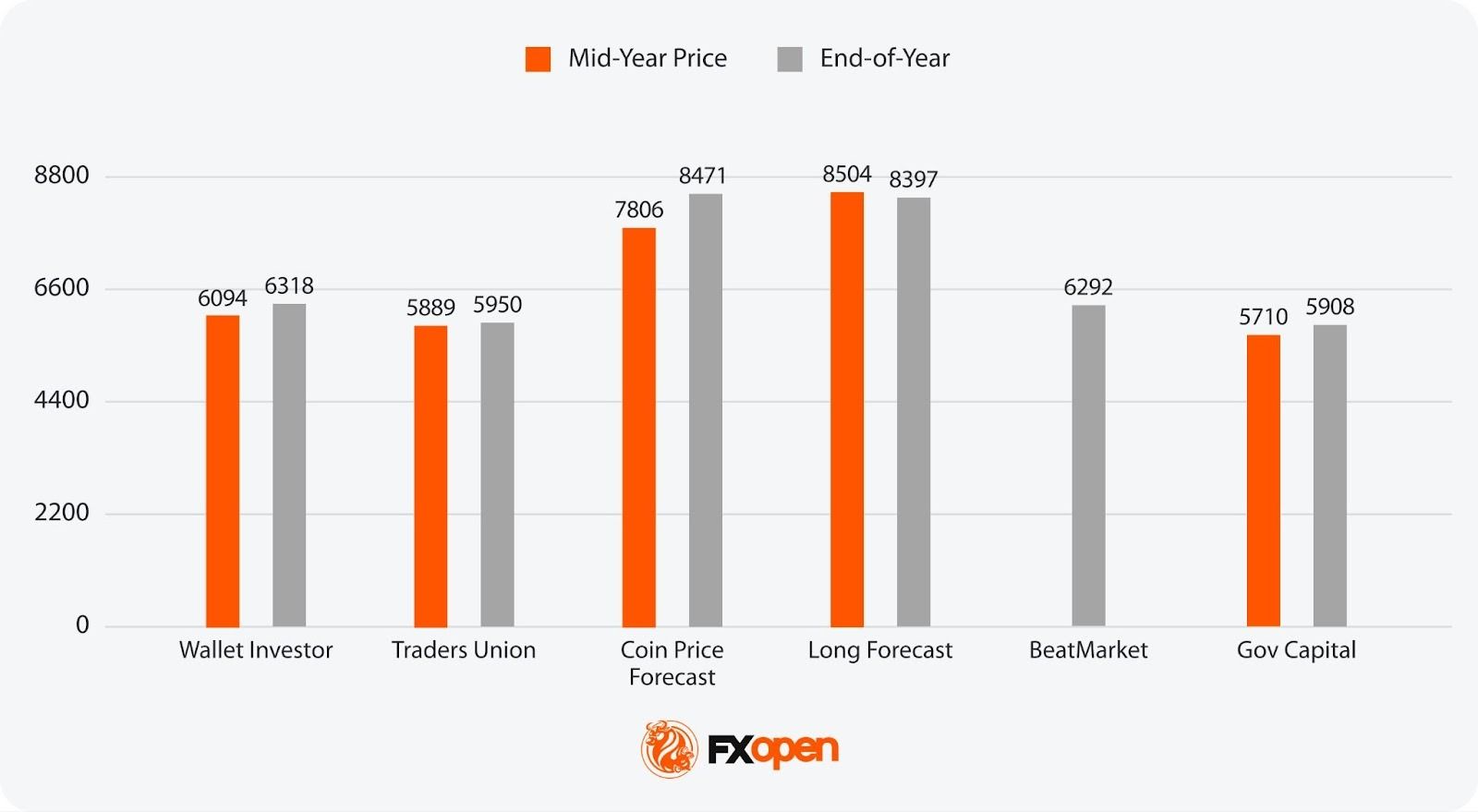
- Most Optimistic Projection for Mid-Year 2029: 8,504 (Long Forecast)
- Most Pessimistic Projection for Mid-Year 2029: 5,710 (Gov Capital)
- Most Optimistic Projection for End-of-Year 2029: 8,471 (Coin Price Forecast)
- Most Pessimistic Projection for End-of-Year 2029: 5,908 (Gov Capital)
Gold Price Predictions for 2030
Gold projections remain strongly bullish for the end of the decade, with only one source expecting a price below $6,000 by the end of the decade.
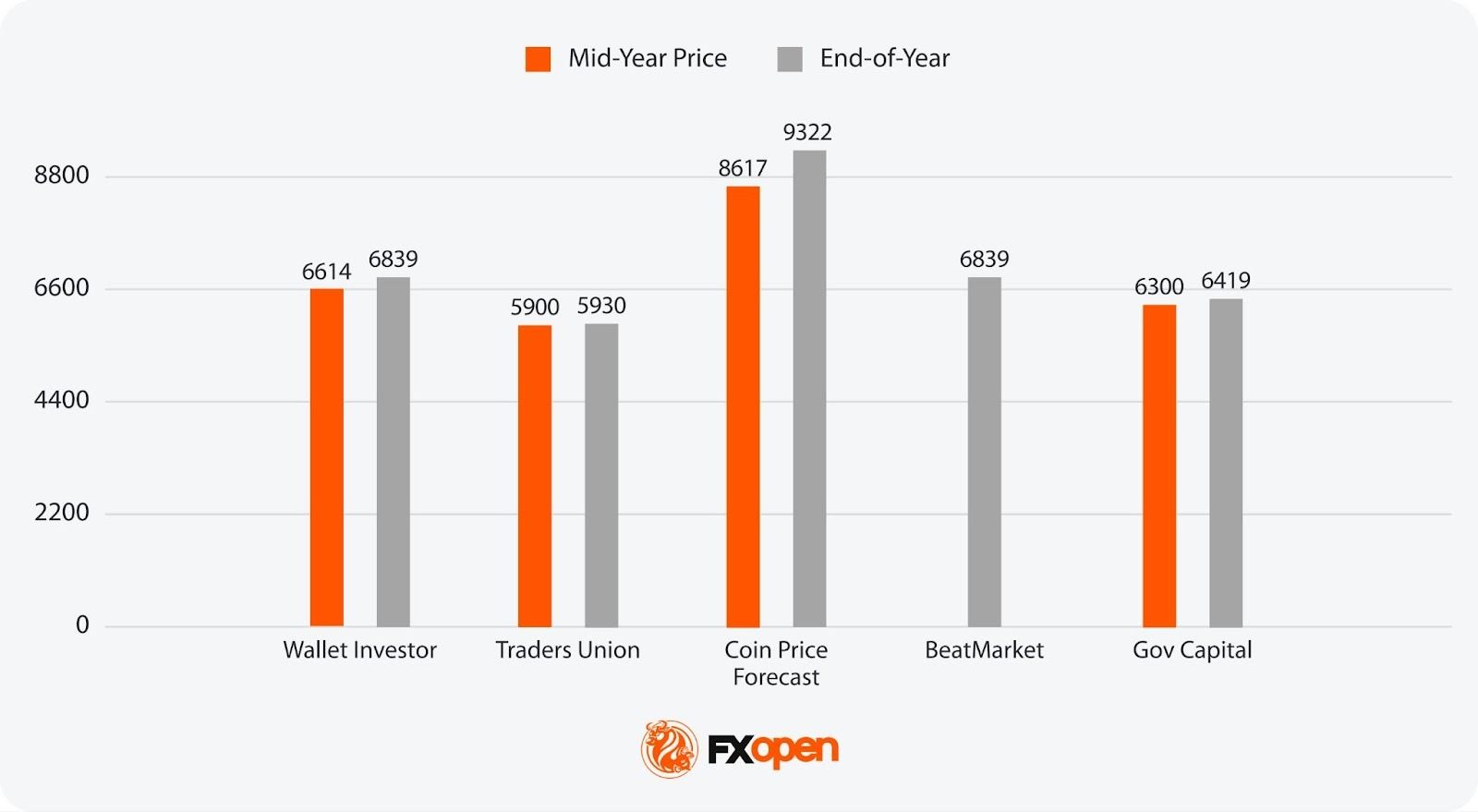
- Most Optimistic Projection for Mid-Year 2030: 8,617 (Coin Price Forecast)
- Most Pessimistic Projection for Mid-Year 2030: 5,900 (Traders Union)
- Most Optimistic Projection for End-of-Year 2030: 9,322 (Coin Price Forecast)
- Most Pessimistic Projection for End-of-Year 2030: 5,930 (Traders Union)
Factors That May Affect the Gold Price Over 10 Years
As we look towards gold prices 10 years from now, several macroeconomic factors could shape the gold projections over the next 10 years.
- Inflation: While many assume a direct correlation between inflation and gold, the relationship is complex and not as straightforward. Inflation can impact the metal, but other factors often mitigate its effects.
- Currency Fluctuations: Gold and the US dollar share an inverse relationship. As the dollar weakens, gold often rises, becoming more attractive to investors holding other currencies.
- Geopolitical Tensions: Conflicts and political instability historically drive investors towards gold as a so-called safe haven, potentially boosting its price during periods of heightened uncertainty.
- Interest Rates: Gold’s appeal can diminish with the expectation of rising interest rates, as higher yields on bonds and savings accounts compete with the non-yielding metal.
- Supply and Demand: The actions of large market players, including central banks and investment funds, significantly impact demand. Additionally, economic growth in countries like China and India may bolster demand for gold as an investment and reserve asset.
Advantages and Risks for Traders
Although analytical projections are optimistic, traders and investors should be cautious as the gold price movements are shaped by geopolitical, economic, and supply dynamics.
Advantages
- Safe-Haven Demand: Ongoing geopolitical risk remains one of the key drivers, with conflicts in Eastern Europe and the Middle East, plus rising US–China strategic tension, keeping demand elevated as investors seek protection during periods of market stress.
- Diversification: Central banks’ shift away from the US dollar suggests continued demand for gold, providing portfolio diversification in volatile currency markets.
- Inflation Hedge: With global debt levels climbing, gold’s historical role as a so-called safeguard against inflation remains relevant.
Risks
- Volatile Demand: Declining consumer demand in major markets like India and China due to economic shifts could impact gold prices.
- Regulatory Risks: Changes in taxation or import restrictions on gold in major markets could affect investment flows.
- Economic Recovery: A stronger-than-anticipated recovery in global economies or currencies, particularly the US dollar, may dampen gold demand.
The Bottom Line
Gold remains a vital asset in the global financial landscape, often viewed as a potential hedge against inflation, currency fluctuations, and economic uncertainty. Based on the analytical predictions for 2026-2030, evolving geopolitical events, central bank policies, and demand from investors will be the key factors, determining the gold market direction.
If you are looking to trade gold via CFDs, you can consider opening an FXOpen account and gain access to tight spreads and low commissions.
FAQ
What Will the Price of Gold Be in 2026?
Gold price future predictions vary, with estimates ranging from roughly $3,950 to above $6,000 depending on economic conditions, interest rates, and global stability. Many analysts view a price near $4,500 as a reasonable midpoint based on current momentum.
Will the Gold Price Go Down in 2026?
Short-term pullbacks are possible, especially if risk sentiment improves or monetary easing slows. However, most analytical outlooks still lean bullish, with geopolitical tension, high debt levels, and currency weakness providing support rather than downside pressure.
Will Gold Go Up in 2026?
Many analysts expect further upside if central banks continue cutting rates and inflation remains above target. Ongoing reserve diversification, a softer dollar, and continued geopolitical risk may extend gold’s multi-year upward trend.
What Drives the Price of Gold?
Major drivers include currency movements, real interest rates, inflation expectations, supply limitations, and investor sentiment. Central bank buying and geopolitical stress also play a significant role in shaping demand and long-term price direction.
This article represents the opinion of the Companies operating under the FXOpen brand only. It is not to be construed as an offer, solicitation, or recommendation with respect to products and services provided by the Companies operating under the FXOpen brand, nor is it to be considered financial advice.

A lot can change in the cryptocurrency markets within relatively small time windows, sometimes even hours. This is what took place over the past 24 hours.
Bitcoin stood sideways below $65,000, where it spent most of the past several weeks. It had calmed in a tight range between $62,000 and $65,000, as both boundaries were too strong to be overtaken.
However, it all changed suddenly on Wednesday afternoon. While the reasons are still widely debated, perhaps the US Treasury Department’s move and the White House crypto event are leading the speculation.
CryptoQuant’s CEO, though, outlined something different that might have caused the sharp uptick – OG whales. According to the prominent analyst, these highly important market participants opened massive longs at BTC’s price bottom of under $63,000 last week, and the asset took off within days.
As such, he determined that they “still know, or decide, when the Bitcoin bull run starts.”
Looks like OG whales still know, or decide, when the Bitcoin bull run starts.
Massive longs were opened at the bottom on exchanges last week, and now price is taking off. https://t.co/eJ0mBuvfGO pic.twitter.com/dxucxSOMA7
— Ki Young Ju (@ki_young_ju) August 20, 2026
In a separate tweet, Ki Young Ju outlined another positive change in the broader BTC landscape. He explained that the Bitcoin demand has turned positive in both spot and perpetual futures for the first time since October 2025 – a month in which the cryptocurrency charted its all-time high and subsequently experienced one of its worst crashes in history.
Although the scale remains modest, CQ’s executive continued, it would be reasonable to conclude that the bear market is over if it holds for another month.
The post Bitcoin’s 12% God Candle: Did OG Whales Just Kickstart the Next Bull Market? appeared first on CryptoPotato.

Dr. Andrea Maier realized a fundamental truth about herself when she was in medical school: She was fascinated by old age. As a child, she’d been awed by women of great age and power, like her grandmothers. Working with older patients, she was curious about the intricate cellular systems that either preserved or destroyed their bodies. “How can we maintain biology,” she asks now, “with the same care with which we might maintain a priceless work of art?”
In 2025, Maier helped open a new clinical trial center at National University of Singapore, where she is director of the Academy for Healthy Longevity, which will enable teams to run multiple long-term trials assessing the effects of supplements, exercise routines, and other lifestyle interventions for health span. Her groundbreaking body of clinical research investigating whether the various drugs and interventions that make mice live better, longer—including supplements like nicotinamide mononucleotide (NMN) and alpha-ketoglutarate (AKG)—translate into people has brought her to the forefront of longevity medicine worldwide.
Maier hopes the brand-new, state-of-the-art center will help generate the evidence needed to give longevity medicine a solid scientific base, and train a new generation of doctors on the science of longevity. She notes the center “is now too small again, because we have too many trials—which is great.”
In contrast to many other longevity studies, which tend to recruit people from the general population, Maier’s trials mainly enroll people whose biological age, measured by looking at age-linked alterations in various organs and tissues, is older than their chronological age. By doing this, she increases the chances that if a supplement, say, can help a subset of people, Maier and her will be able to see it in the results. “If somebody has very good vitamin D levels, which are optimal, why would I include that person in a vitamin D trial?” she says.
This is part of her vision for producing individualized, precision-medicine plans for patients, so people can zero in on interventions that match their biology. “Aging is so heterogeneous,” she says. Telling everyone to take a given molecule is a little like giving everyone diagnosed with cancer the same chemotherapy, or handing out insulin regardless of diabetes status, she says.
Maier’s PROMETHEUS trial, which investigated this tailored approach, involved specialized dietary and exercise advice, supplements, and cognitive behavioral therapy, among other interventions. An 8-week pilot protocol evaluating the effects on markers of muscle, cognitive, and immune function in 20 people produced “promising results.” Next, she and her team are planning a randomized controlled trial, which will allow the team to study whether the inventions have a beneficial effect on health over the course of a year.


Erald Ghoos, OKX Europe CEO, says U.S. crypto rules could blow new life into the market amid a rotation of capital from AI back to bitcoin.

Rapid7 has disclosed details of a large-scale cryptocurrency phishing operation dubbed “Operation Asterix,” designed to target people through phone and email lures that ultimately aim to extract crypto seed phrases. The campaign reportedly reached into datasets covering roughly 885,000 phone numbers across multiple regions, with the largest tranche tied to Germany.
In Rapid7’s investigation, the phishing workflow included targeting users connected to the Binance exchange, producing 5,576 accounts matched to exchange users that were queued for attack. The firm also found evidence of fake communications impersonating Crypto.com, highlighting how the operation blended vishing tactics with exchange-branded messaging.
Key takeaways
- Rapid7 traced Operation Asterix to a dataset of about 885,000 phone numbers, with Germany the largest source (316,002 numbers).
- The campaign identified 43,066 accounts tied to crypto exchange users and generated 5,576 Binance-matched targets for follow-on attacks.
- Attackers used fake Ledger, Trezor, and Exodus applications to pressure victims into revealing seed phrases.
- Rapid7’s artifacts suggest automated tooling, including “checker” logic for Kraken account validation, alongside AI-assisted components.
Operation Asterix: scale, filtering, and “hit rate”
Rapid7’s report describes Operation Asterix as a campaign built around “targeting” rather than indiscriminate spam. According to the firm, attackers matched 43,066 accounts to cryptocurrency users using data validated against the broader German dataset containing more than 316,000 mobile numbers. Rapid7 estimates this translates to an approximate “hit rate” of 13.6% for the validated matching process.
The company also points to recovered artifacts indicating a separate checker function aimed at bulk-validating phone numbers against accounts associated with Kraken. This matters because it suggests the operation was not limited to a single exchange or geography; instead, it used verification steps to determine which phone numbers were most likely to correspond to crypto users.
How victims were lured: impersonation and seed-phrase extraction
At the center of Rapid7’s findings is the social-engineering phase of the campaign. Analysts Anna Sirokova and Jan Recinsky write that the attackers attempted to move victims toward fake applications impersonating well-known self-custody brands, including Ledger, Trezor, and Exodus.
Rapid7 says victims were driven to these impersonation surfaces with the objective of obtaining seed phrases—an outcome that can permanently compromise funds if users enter them into attacker-controlled flows. The phishing operation also used direct contact channels: attackers reached out through fake support emails and phone inquiries designed to look legitimate.
Rapid7’s findings also emphasize the operational chain—how contact was established, which targets were selected, and how the campaign progressed toward data exfiltration. While the report focuses on observed behavior in artifacts recovered by the security team, the practical implication for users is straightforward: even when the message appears to come from a brand or support channel, the risk is highest when the interaction attempts to steer victims toward entering recovery information.
Binance and Crypto.com were among the exchanges impersonated
One of the most consequential elements in Rapid7’s disclosure is how the campaign narrowed down real exchange users. The report states that it identified 5,576 accounts matched to users on Binance that were queued for attack. Rapid7 also reports that recovered logs included fake emails impersonating Crypto.com.
For traders and long-term holders, this pairing of exchange-linked targeting with brand impersonation underscores a common problem: attackers often aim to compromise trust in familiar service identities. Rather than relying solely on generic phishing, Operation Asterix appears to have used verification steps and exchange references to increase the likelihood of a victim responding.
Rapid7’s account of the target composition further indicates that the campaign’s infrastructure included lists beyond Germany. The largest file contained 316,002 German mobile numbers, while additional directories reportedly covered phone numbers associated with regions including Hong Kong, Bulgaria, and the UK, alongside US and Canadian fintech-related lists and Ledger-related lists.
Broader crypto security context: a persistent human-layer threat
Operation Asterix lands in a wider pattern of crypto fraud that repeatedly exploits users rather than breaking underlying protocols. The article notes that, according to blockchain security company Hacken, phishing and social engineering drove most of the crypto industry’s losses in the first quarter, accounting for $306 million out of a reported total of $482 million lost.
This is consistent with earlier incidents referenced in the same material. For example, it points to a Trezor-related personal data breach involving its shipping provider ShipMonk reported in August, a separate Ethereum-related case in July where a crypto investor lost nearly $1 million after approving a malicious phishing token approval transaction, and a prior episode in November 2023 where a fake Ledger Live app placed on the Microsoft Store led to theft totaling $588,000 across 38 transactions.
Taken together, these examples reinforce that crypto users face two different—but overlapping—risk categories: technical compromise through malicious software and direct loss from social-engineering flows that trick users into granting access or revealing recovery material.
What to watch next
As Rapid7’s disclosure shows, campaigns like Operation Asterix increasingly combine datasets, exchange validation, and impersonation of popular self-custody brands—meaning the most urgent question for users isn’t only whether phishing exists, but whether attackers can improve their targeting accuracy. Investors should watch for follow-on reporting from security teams on the specific tooling and any indicators of compromise tied to the fake Ledger, Trezor, and Exodus lures, while continuing to treat unsolicited support messages and “wallet recovery” requests as high-risk until independently verified.




Unitree founder Wang Xingxing said humanoid robots will reach their “ChatGPT moment” in 2 to 10 years, a window spanning 2028 to 2036.
Wang spoke on Thursday at the World Robot Conference in Beijing, one day after his company went public. At the same event last year, he put the same breakthrough less than five years out.
Unitree CEO Says Robots Are Nearing Their ‘ChatGPT Moment’
Wang said the sector’s defining “ChatGPT moment” would come when a robot could enter an unfamiliar home and complete roughly 80% of everyday tasks based solely on text or voice instructions.
According to a CNBC translation of his Mandarin-language speech, Wang estimated that the milestone could arrive within two to three years if things move fast. However, a slower trajectory could push it out to five to 10 years.
“We are marching towards a ‘ChatGPT moment’ in embodied intelligence,” Wang said.
Wang He, founder of Chinese robotics startup Galbot, offered a closer timeline.
“With continued accumulation of data and further technological breakthroughs, we expect to reach the ‘ChatGPT moment’ for embodied intelligence by 2028,” he noted.
The commercial stakes are already visible. Morgan Stanley estimates that roughly 19,000 humanoid robots were shipped globally in the first half of 2026, a 272% increase from a year earlier. Chinese manufacturers accounted for 97% of those shipments.
The bank expects China’s humanoid shipments to reach 50,000 units this year, up sharply from 12,000 in 2025. Crypto capital is also watching that curve. Tether CEO Paolo Ardoino called Unitree the company to watch in robotics.
Follow us on X to get the latest news as it happens
Unitree Stock Pulls Back After IPO Surge
The comments came a day after Unitree made its Shanghai stock market debut. The stock opened 629% above its IPO price on Wednesday, as previously reported by BeInCrypto.
The rally lost some momentum on Thursday. Unitree shares closed at 687 yuan, down 19%, according to LSEG data cited by CNBC.
Nomura initiated coverage on Wednesday with a buy rating and a 370-yuan price target. The target sits now well below Unitree’s market price.
Subscribe to our YouTube channel to watch leaders and journalists provide expert insights
The post Unitree CEO Reveals When Robots Could Reach Their ‘ChatGPT Moment’ appeared first on BeInCrypto.
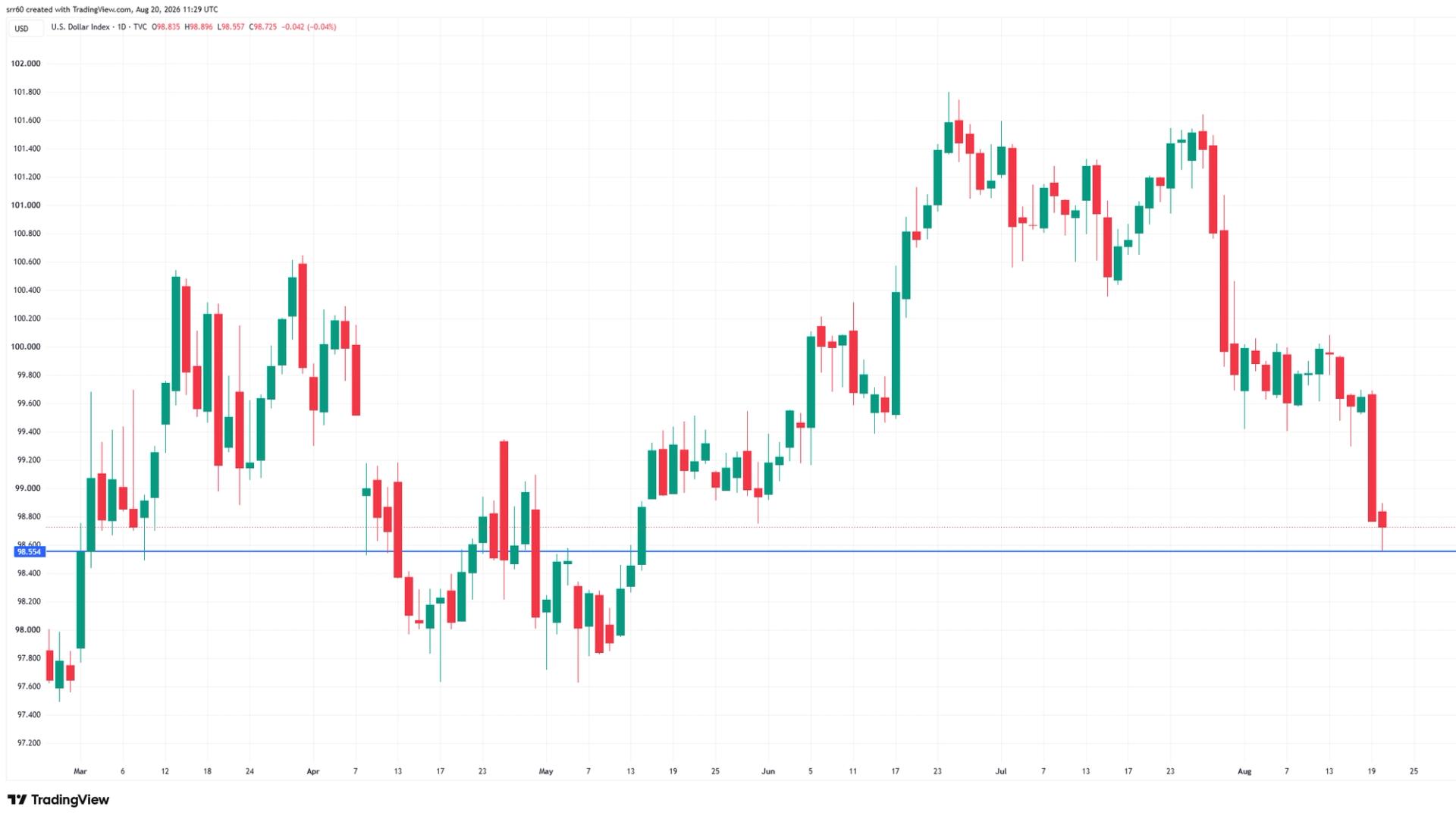
Your day-ahead look for Aug. 20, 2026


Disclosure: This article does not represent investment advice. The content and materials featured on this page are for educational purposes only.
Bitcoin’s move above $71,000 is renewing investor interest, while ASDeFi Cloud Mining offers a way to participate in mining without owning or managing ASIC hardware.
Summary
- Bitcoin breaks $71,000 as market momentum grows, prompting investors to explore cloud mining for passive income opportunities.
- BTC hits a nearly three-month high above $71,000, while investors seek alternatives to simply holding and trading Bitcoin.
- The surge highlights renewed momentum as ASDeFi offers investors a way to participate through cloud mining.
On August 20, the price of Bitcoin once again broke through the $71,000 mark, hitting a new high in nearly three months. The recent market rally has not only been driven by improved sentiment in the cryptocurrency market, but also by the U.S. Treasury’s expansion of its long-term Treasury bond buybacks and the liquidation of a large number of short positions, which have further amplified the market’s upward momentum.
For investors who have been following Bitcoin over the long term, the price breaking through $71,000 signifies that the asset’s value is once again drawing market attention, but it also raises another question:
Following Bitcoin’s rise, investors are turning their attention to opportunities beyond holding
The traditional approach to investing in Bitcoin is simple: buy BTC and wait for the price to rise. While this approach can yield solid returns during a bull market, investors often face long waiting periods during market volatility.
Furthermore, after BTC rises rapidly, new investors must consider whether the current price is already too high. As a result, some investors are seeking more ways to participate in the Bitcoin ecosystem. From trading and ETFs to custody, computing power, and crypto infrastructure, Bitcoin investment is no longer limited to simply “buying and selling.”
Bitcoin mining is becoming more specialized
In the past, individual investors could participate in mining simply by purchasing mining rigs. However, as competition in the network has intensified, costs such as mining rig procurement, electricity, cooling, space, network infrastructure, and equipment maintenance have become significant barriers to entry.
For the average investor, the challenge lies not only in understanding Bitcoin but also in managing the infrastructure required for mining. Therefore, ASDeFi Cloud Mining offers an alternative way to participate: by centrally managing computing power, equipment, and daily operations through the platform, users can participate in Bitcoin mining without having to purchase and deploy ASIC miners at home.
What is ASDeFi cloud mining?
Founded in 2020 and headquartered in the United Kingdom, ASDeFi primarily provides AI cloud computing power and cryptocurrency mining services. Through centralized management of computing power and automated operations, the platform allows users to participate in cryptocurrency mining via a web browser or mobile app without having to purchase mining equipment or deal with issues such as electricity, cooling, and maintenance. This model offers a way to participate in the Bitcoin ecosystem without relying on short-term price predictions.
How should the claim of “$5,000 in passive income per day” be interpreted?
“$5,000 per day” is a relatively high yield target and does not mean that ordinary investors will automatically earn this amount after signing up. Actual returns typically depend on factors such as hashrate, investment amount, contract terms, and the price of BTC.
Therefore, a more reasonable way to understand this is that ASDeFi can serve as a tool for some investors to explore ways to generate returns on cryptocurrency assets. Before participating, investors should familiarize themselves with the contract term, investment amount, yield calculation method, and withdrawal rules, and invest according to their own financial circumstances.
How to get started with ASDeFi Cloud Mining?
1. Register for a cloud mining account
Once registration is complete, users receive a free $15 bonus to purchase hashrate contracts, which will generate $0.60 in daily contract earnings.
2. Complete account information
Log in to the account dashboard and link a cryptocurrency wallet address to receive contract earnings.
3. Understanding computing power contracts
Go to the contracts page to view the amounts, terms, and earnings rules for different computing power contracts, and select the one that best fits your budget.
4. Start the service and view earnings
After completing the relevant configurations, the platform will run the computing power service according to the contract terms. Users can view their account earnings data and manage their earnings via the web or mobile app.
Current examples of computing power contract earnings:
| Contract | Purchase Amount | Term | Daily Return | Total Return |
| Daily Check-in Contract | $15 | 1 day | $0.60 | $15.60 |
| New User Experience Contract | $100 | 2 days | $4.00 | $108.00 |
| Basic Hashrate Contract No. A2317 | $500 | 5 days | $6.50 | $532.50 |
| Basic Hashrate Contract No. A2312 | $3,500 | 15 days | $54.25 | $4,313.75 |
| Stable Hashrate Contract No. S3189 | $10,000 | 25 days | $190.00 | $14,750.00 |
| Stable Hashrate Contract No. S3170 | $23,000 | 30 days | $425.50 | $35,765.00 |
What does BTC breaking through $71,000 mean?
BTC’s recent break above $71,000 is not only a significant price milestone but also reflects a shift in market sentiment following a prolonged correction. Massive liquidations of short positions have further fueled the rally, but this does not guarantee that BTC will continue to rise. Future prices may still be influenced by factors such as interest rates, U.S. dollar liquidity, ETF capital flows, regulatory policies, and global market risk appetite.
Conclusion
BTC has broken through the $71,000 mark, once again highlighting its prominence in the global cryptocurrency market. The recent price surge has been driven by factors such as improved liquidity, a rebound in market sentiment, and short-covering; however, this rapid rise also indicates that market volatility remains high.
For investors holding BTC long-term, in addition to monitoring price movements, it may be beneficial to explore cryptocurrency infrastructure such as cloud mining. Through centralized management of computing power resources and automated operations, ASDeFi offers an option for users who wish to participate in the cryptocurrency computing power ecosystem.
For more information, visit the official website and download the app.
Disclosure: This content is provided by a third party. Neither crypto.news nor the author of this article endorses any product mentioned on this page. Users should conduct their own research before taking any action related to the company.

Bitcoin price is changing hands near $72,000, and the Fear & Greed Index just jumped 16 points to 62, squarely in “greed” territory inline with our bullish analysis yesterday. This sentiment swing in 24 hours usually means something structural is shifting underneath the price action.
Following the run, a smaller-cap trading community token is quietly gaining traction while everyone’s eyes are on BTC’s next move, and it’s worth a closer look before the crowd catches on.
Crypto analytics firm Alternative confirmed the index reading today, noting it stood at 46 just a day prior. The trigger: BTC reclaimed $70,000 after the U.S. Treasury announced an expansion of its buyback program, a move that eased liquidity concerns and pulled risk appetite back into digital assets.
RSI has also pushed to 77.9 with a breakout above the upper Bollinger Band, which technically overheated, though a funding rate of just 0.01% suggests leverage isn’t stretched the way it typically is at cycle tops.
The rally follows a rough stretch earlier in August tied to a cold-wallet exploit and selling pressure from Strategy, the largest corporate BTC holder. BTC has clawed back above $64,000 and now flirts with $75,000 in under two weeks, which says something about how quickly sentiment can flip when macro tailwinds line up.
The question now is whether this is confirmation of a genuine trend shift or another greed-driven spike waiting to unwind. Here’s our Bitcoin price analysis for today.
Discover: The Best Token Presales
Bitcoin Price Analysis: Hit $75,000 This Week?
Bitcoin trades at $71,900, up 11% over the past 24 hours. Weekly gains have reached 13%, while monthly gains now stand at 13%. Trading volume has climbed to $64.19 billion, showing strong activity behind Bitcoin’s latest move. The market cap now sits near $1.44 trillion as BTC pushes back above $70,000.
MACD has turned bullish, while Bitcoin remains comfortably above its 200-day moving average. That combination points toward a recovering trend rather than a simple dead cat bounce.

The immediate battle now sits between $70,000 and $72,000. A clean break above $72,000 could put $76,000 back on the radar. For now, $68,000 remains the key support level. Holding above it keeps the current recovery intact, while a drop below $64,000 could expose $60,000 to $62,000.
The market is also watching ETF flows and spot demand for clues. If buying pressure keeps building, Bitcoin could have room to extend its latest breakout.
Trade Bitcoin Market on Kalshi and Get a $25 Signing-up Bonus
Maxi Doge Targets Early Mover Upside as Bitcoin Tests Key Levels
A BTC holder sitting on gains since the $64,000 bounce is probably feeling validated right now. But here’s the uncomfortable math: at a $1.4 trillion-plus market cap, a move from $72,000 to $76,000 is just under 5%. It’s solid, but not life-changing.
Now, early-stage tokens built around the same leverage-trading culture driving this rally offer a different risk profile entirely, for traders willing to accept that difference in maturity.
Maxi Doge ($MAXI) leans into that 1000x-leverage mentality directly, a 240-lb canine mascot built around gym-bro humor and holder-only trading competitions with leaderboard rewards.
The presale has raised $4.8 million at a current price of just $0.0002834, with dynamic APY staking live for early participants. A Maxi Fund treasury backs liquidity and partnerships, and the “never skip leg-day, never skip a pump” branding isn’t subtle, and it’s not trying to be.
Research Maxi Doge directly before deciding.
Discover: The Best Crypto to Diversify Your Portfolio
The post Bitcoin Price Analysis: The Green Candle is Not Stopping! appeared first on Cryptonews.

Dow Falls Nearly 350 Points as Walmart’s Weak Sales Growth Overshadows Earnings Beat Amid Rising Yields

Analytical Gold Price Predictions for 2026, 2027, and Beyond

Radio 2 Host Trevor Nelson Shares Brain Tumour Diagnosis





-

 Fashion6 days ago
Weekend Open Thread: Ann Taylor
-
 Sports7 days ago
This U.S. Amateur is a glimpse into golf’s future in more ways than you think
-
 Tech6 days ago
11 Ways to Rank Your Videos
-

 Sports5 days ago
Birmingham 2026: Day 6 Timetable for Irish Athletes
-
 NewsBeat5 days ago
Myanmar says over 300,000 Rohingya refugees verified for repatriation as exodus enters ninth year
-

 Politics5 days ago
SEQ Code: The Three Letter Boarding Pass Code That Could Give You The Worst Seat
-

 Tech2 days ago
Qwen3.8-27B runs frontier-class coding agents and reasoning locally, no cloud API required
-

 Tech7 days ago
DeepSeek Harness launches as open source rival to Claude Code, alongside V4-Pro on API with higher prices
-

 Crypto World5 days ago
Pi Network Protocol 27 endgame: last upgrade before what?
-

 Crypto World3 days ago
OCC Greenlights Trump Family Crypto Firm for Trust Charter
-

 Business2 days ago
SMA Solar Technology AG (SMTGY) Q2 2026 Earnings Call Transcript
-
 Tech5 days ago
Every fusion startup that has raised over $100M
-

 Fashion6 days ago
Weekly News Update, 8.14.26 – Corporette.com
-

 Business6 days ago
15 Ways to Make Money From Your Phone (2026 Guide)
-
 Entertainment6 days ago
10 Netflix Shows That Quietly Became Modern Classics
-

 Business5 days ago
Facebook Down Now? Users Report Login And Loading Problems As Outage Trackers Monitor Ongoing Issues
-
 Entertainment5 days ago
Marvel Studios Reveals New X-Men Cast Including Adam Driver and Sadie Sink
-

 Fashion6 days ago
Silver bangles for women – Newbridge Silverware
-

 News Videos10 hours ago
Don’t Leave Your Financial Future To Chance | August 19, 2026
-
 Business5 days ago
Monarch Mutual Fund set to enter MF space with maiden overnight fund; files draft with Sebi
You must be logged in to post a comment Login