
Crypto World
European banks pick Fireblocks for regulated euro stablecoin project



A group of 12 European banks led by Qivalis has chosen Fireblocks to provide infrastructure for a MiCA-compliant euro stablecoin.
Summary
- Qivalis and 12 European banks are building a MiCA-compliant euro stablecoin with Fireblocks infrastructure support.
- The euro token will target institutional settlement, treasury, and tokenized asset use across Europe.
- European banks are pushing local stablecoins as dollar-backed tokens continue dominating the global market.
The project is targeting a launch in the second half of 2026, pending approval from De Nederlandsche Bank under the European Union’s Markets in Crypto-Assets Regulation framework.
Qivalis said the token will be fully regulated and backed 1:1 with euros. The company plans to structure the product as an electronic money institution under Dutch supervision. The group includes bank-backed support from firms such as BBVA, BNP Paribas, ING, and UniCredit.
Fireblocks will supply the tokenization system, wallet infrastructure, and lifecycle management tools for the project. The platform will also support compliance functions such as identity verification and sanctions screening, which are central to regulated digital asset products in Europe.
A Fireblocks spokesperson said the project is being built as a ”regulated euro-native settlement instrument” for European institutions. The spokesperson added that the platform is designed to support issuance, custody, treasury management, and payment orchestration across several banking use cases.
Moreover, the planned stablecoin is intended for institutional uses such as settlement, treasury operations, and tokenized assets. The banks involved are aiming to provide a euro-denominated digital payment tool that can work across multiple business lines without relying on dollar-based stablecoins.
The move comes as European banks and companies step up efforts to build local digital payment infrastructure. The project also reflects a wider push to reduce dependence on dollar-denominated stablecoins, which still dominate global digital asset settlement and payments activity.
Europe responds to dollar stablecoin dominance
DeFiLlama data shows the global stablecoin market stands near $320 billion, with about 99% of supply tied to the US dollar. Euro-denominated stablecoins remain a small part of the market, which has pushed European institutions to back local alternatives under clear regulatory frameworks.
The project also comes as policymakers and regulators in Europe continue to raise concerns about the role of foreign-currency stablecoins in the region. The Bank for International Settlements recently repeated warnings that some dollar stablecoins may operate more like investment vehicles than money because of their short-term securities exposure.
Earlier this month, Bank of France first deputy governor Denis Beau called on the European Union to limit the use of non-euro stablecoins in everyday payments. Against that backdrop, the Qivalis-led initiative adds another effort to build a regulated euro stablecoin market with direct banking support and MiCA-compliant infrastructure.

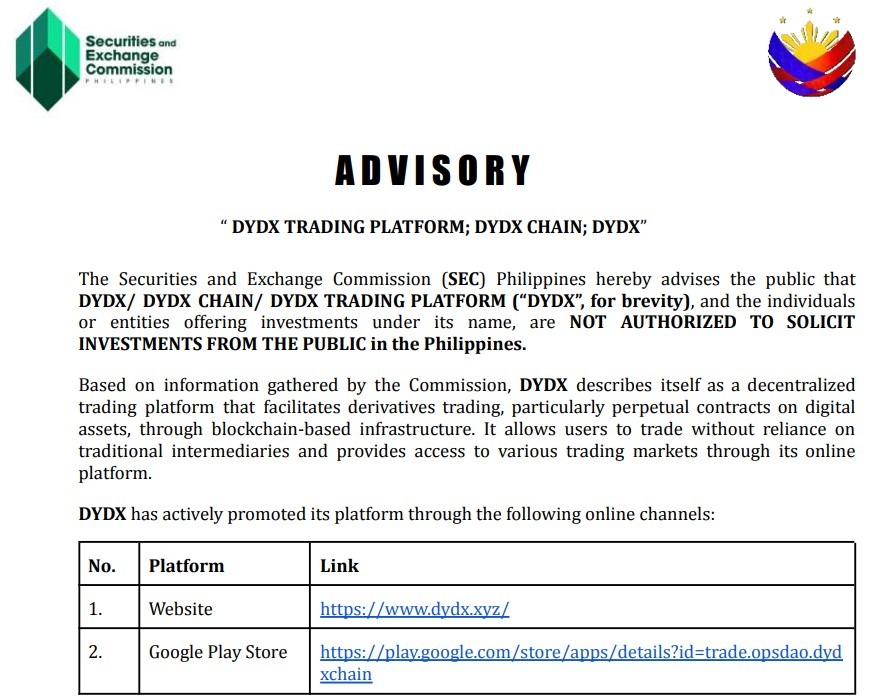
The Philippine Securities and Exchange Commission (SEC) has issued a public investor alert warning Filipinos not to invest in dYdX and six other crypto trading platforms, saying they are not registered or authorized to solicit investments in the country.
In a Facebook post on Tuesday, the SEC named dYdX, Aevo, gTrade, Pacifica, Orderly, Deriv and Ostium, stating that based on its findings, the platforms appear to be offering investments to the public in exchange for promised returns, profits or interest.
The regulator said none of the listed entities are registered with the Commission or hold the required authorization under its crypto-asset service provider (CASP) framework, which requires firms offering crypto-related services in the Philippines to obtain licenses and meet capital and operational requirements.
The SEC also warned that individuals promoting any of the listed platforms in the Philippines may face criminal liability under the Securities Regulation Code. Under Sections 28 and 73 of the law, violators could be fined up to 5 million Philippine pesos (about $89,000) or imprisoned for up to 21 years, or both.
The advisory highlights a broader shift toward stricter enforcement in the Philippines, where regulators have increasingly moved from warnings to access restrictions. On Dec. 24, 2025, Philippine regulators blocked Coinbase and Gemini as part of their broader crackdown on unlicensed CASPs.

Broader crackdown on unlicensed crypto operators
The latest advisory comes as Philippine regulators continue to step up enforcement against crypto platforms operating without local authorization.
In 2024, authorities moved to block access to Binance after a compliance deadline expired, with regulators also directing app stores to remove the trading platform’s app from users’ devices in the country.
Related: Cambodian lawmakers propose severe prison time for crypto scammers
The crackdown has since expanded to include other major platforms. In August 2025, the SEC issued an advisory naming 10 exchanges, including OKX, Bybit, KuCoin and Kraken, for offering crypto services without registration, warning that their activities exposed Filipino investors to risks.
While regulators have targeted unlicensed operators, compliant firms have continued rolling out crypto products. In 2025, PDAX partnered with Toku to enable stablecoin salary payouts, while digital bank GoTyme launched crypto services with Alpaca, allowing users to buy and hold digital assets within its app.
Magazine: Telegram avoids Philippines ban, yen carry trade going onchain: Asia Express
Crypto World
Bank of Korea’s new governor signals CBDC and bank token push, skips stablecoins in key address


Bank of Korea Governor Shin Hyun-song used his first address in office to prioritize central bank digital currencies (CBDCs) and bank-issued deposit tokens, while leaving out any mention of stablecoins as South Korea weighs new crypto rules.
Shin, who began his four-year term Tuesday, pointed to the bank’s ongoing retail CBDC and deposit-token pilot, Project Hangang, and its role in Project Agorá, a cross-border tokenization effort led by the Bank for International Settlements, according to news outlet Chosun.
He framed digital currency as part of a broader shift in central banking during a period of economic strain and slower domestic growth.
The absence of stablecoins from his remarks stood out. The issue has dominated policy debate in Seoul, with lawmakers considering the Digital Asset Basic Act, which would set rules for stablecoin issuance.
Shin had told lawmakers at his confirmation hearing that stablecoins could coexist with CBDCs and deposit tokens in a “supplementary and competitive” manner.
His speech also outlined a bank-led model where the central bank would issue a CBDC, while commercial banks would provide deposit tokens fully convertible into it. Shin has argued that any stablecoin issuance should begin with regulated banks.
Beyond payments, Shin signaled closer scrutiny of crypto markets and non-bank finance. He said the central bank would expand monitoring of cryptocurrencies and other nontraditional assets, and seek broader access to data to track financial risks.
Shin also pledged steps to modernize currency markets, including 24-hour foreign exchange trading and an offshore won settlement system.


Scammers are exploiting the Hormuz crisis amid the US-Iran war. Greek maritime risk firm MARISKS issued the scam warning on Monday.
According to the firm, fraudsters posing as Iranian authorities are messaging shipping companies whose vessels are stranded, demanding digital asset payments for supposed “safe-passage” clearance.
How the Scam Exploits Iran’s Real Crypto Toll Scheme
The scam draws plausibility from an actual policy announcement in Tehran. Iran recently stated that, during the two-week ceasefire, oil tankers transiting the Strait of Hormuz would be required to pay tolls of up to $2 million in cryptocurrency.
Hamid Hosseini, spokesperson for Iran’s Oil, Gas and Petrochemical Products Exporters’ Union, told the Financial Times that vessels must first submit cargo details via email to Iranian authorities. Following this, they will be issued a toll fee, reportedly payable in Bitcoin (BTC).
The fraudsters weaponize that legitimacy. According to MARISKS, unidentified actors approached shipping companies with messages demanding transit fees in Bitcoin or Tether (USDT), in exchange for so-called “clearance.” However, the firm stressed that “these specific messages are a scam.”
Their messages mimic bureaucratic language, citing Iranian Security Services checks and pre-agreed transit windows to appear authentic.
Follow us on X to get the latest news as it happens
“After providing the documents and assessing your eligibility by the Iranian Security Services, we will be able to determine the fee to be paid in cryptocurrency (BTC or USDT). Only then will your vessel be able to transit the strait unimpeded at the pre-agreed time,” read the message cited by MARISKS.
The fraud may already carry notable consequences. MARISKS believes that at least one vessel fired upon on Saturday had paid scammers.
Roughly 20% of global oil passed through Hormuz before the war. With hundreds of ships and around 20,000 seafarers now stranded in the Gulf, the disruption has created a broad and vulnerable pool of potential victims.
The scam adds to a broader surge in crypto-enabled crime. Industry data shows that April 2026 saw roughly $606 million in losses across 12 hacking incidents.
Subscribe to our YouTube channel to watch leaders and journalists provide expert insights
The post Crypto Fraudsters Target Stranded Seafarers With Fake Hormuz Toll Scheme appeared first on BeInCrypto.

TLDR:
-
- Starknet v0.14.2 introduces SNIP-36, enabling native in-protocol STARK proof verification on mainnet.
- STRK20 allows any ERC-20 token on Starknet to operate with encrypted balances and shielded transfers.
- strkBTC lets bitcoin holders access DeFi on Starknet without exposing their full wallet transaction history.
- SNIP-37 rebalances network economics by raising storage costs while lowering base L2 gas prices for users.
Starknet v0.14.2 is now live on mainnet, introducing native privacy infrastructure to the network. The upgrade adds in-protocol proof verification, enabling confidential transactions at the protocol level.
It also paves the way for STRK20 and strkBTC, two privacy-focused asset frameworks. Together, these changes position Starknet as a privacy-preserving rollup rather than a standard high-performance chain.
In-Protocol Proof Verification Changes How Starknet Handles Privacy
At the core of v0.14.2 is SNIP-36, which brings native proof verification to the protocol. Previously, verifying a STARK proof on Starknet required a smart contract, which was not practical.
STARK proofs are large, often containing tens of thousands of field elements. That size made them incompatible with the network’s maximum transaction limits.
Developers had no clean path forward under the old system. Splitting proofs across multiple transactions was slow, complex, and expensive.
The official release notes described the previous approach as “prohibitively slow, complex, and expensive.” With v0.14.2, transactions now reference off-chain execution proofs directly through new proof and proof_facts fields in the Invoke V3 transaction structure.
Starknet’s consensus layer handles verification natively under this new model. Users can now prove fund ownership or transfer rights without exposing their balance.
The protocol states that “privacy becomes as seamless as a standard transfer” with this native support in place. Transaction history also remains shielded from public view on the network.
This change removes the biggest barrier to practical privacy on Starknet. Without native support, any privacy solution would have been too slow and costly to deploy at scale.
STRK20 and strkBTC Are the First to Use the New Framework
STRK20 is a new framework that allows any ERC-20 token on Starknet to operate privately. Thanks to v0.14.2’s ability to verify S-two proofs, tokens can now support encrypted balances.
Per the release announcement, users can now “swap, stake, and send any ERC-20 token while keeping your financial footprint shielded.” This applies from day one of the framework’s availability.
strkBTC builds on this same infrastructure for bitcoin holders specifically. The upgrade allows BTC to be used in DeFi applications without exposing a user’s full bitcoin wallet history.
According to Starknet, the result gives bitcoin holders “hard money that is both private and productive.” This opens BTC participation across the broader BTCFi ecosystem on Starknet.
Both frameworks operate with a compliance layer in place. A third-party audit firm will hold a viewing key. Subject to valid legal or regulatory requests, that firm may share individual transaction data with relevant authorities.
Beyond privacy, v0.14.2 also addresses network economics through SNIP-37. The update raises storage costs while reducing base L2 gas prices.
SNIP-13 upgrades StarkGate token contracts to version 3.0.0, aligning ERC-20 events with industry standards and preparing for the decentralized validation phase outlined in SNIP-33.



Bitcoin has a well-earned reputation as a volatile asset that has historically doubled or halved in a matter of months. That may be changing.
Bitcoin’s 30-day realized volatility, currently 42%, has remained below 50% this month, according to TradingView data. Compare that with South Korea’s benchmark Kospi stock index, whose market capitalization is about twice the largest cryptocurrency’s, which hit 74% last week and is still around 51%. Another more volatile equity market is Pakistan, whose KSE 100 index is also around 51%.
Bitcoin’s volatility — a measure of how wildly prices have swung — has steadily declined in recent years, particularly since the introduction of spot ETFs in the U.S. in January 2024. These investment vehicles have increased institutional participation, bringing in more risk-managed capital flows that have helped dampen price swings.
The relative stability underscores its appeal as a geopolitical hedge, holding its value when macro forces like wars wreak havoc on traditional assets. BTC has historically outperformed gold, the S&P 500 and other traditional assets during wars, as River, a bitcoin-only financial institution, pointed out early this month.
Still, most major regional markets and their global counterparts exhibited less volatility than BTC in the period. Which raises the question: Why makes South Korea, the world’s 14th-largest economy, different?
Korean issues
The higher volatility in Korean stocks reflects, to a great extent, the gyrations in the cost of fossil fuel, which doesn’t really apply to bitcoin.
The Kospi fell from 6,340 points in late February to 5,000 by the end of March, before rebounding to record highs above 6,380 points.
The initial selloff occurred in the run-up to the war between Iran and the U.S.-Israeli coalition, which started Feb. 28, eventually leading to a closure of the Strait of Hormuz, a major oil supply route. This disruption and the resulting spike in oil prices hurt South Korea because the country imports nearly all its fossil fuels, including oil and natural gas from the Middle East.
Later, the index found its footing as the conflict eased and the two sides negotiated a temporary ceasefire, which is set to expire on Wednesday. Pakistan’s stock market saw similar swings, with its economy equally, if not more, exposed to energy market disruptions.
Throughout this time, bitcoin held relatively steady, trading mostly between $65,000 and $75,000, supported by renewed inflows into the U.S.-listed spot exchange-traded funds (ETFs).
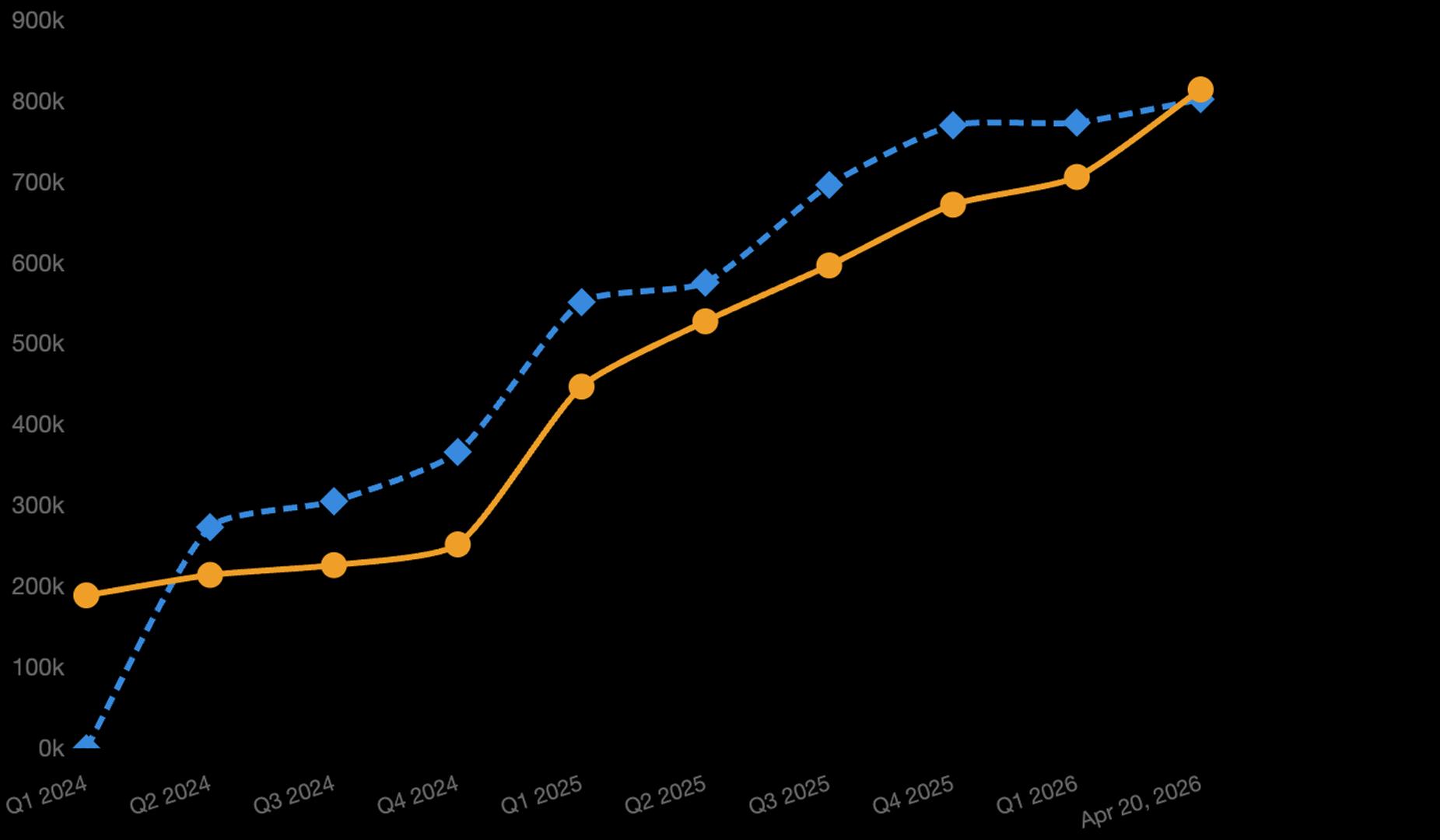
Strategy (MSTR), now holds more bitcoin than BlackRock’s iShares Bitcoin Trust (IBIT) for the first time since Q2 2024.
The world’s largest publicly traded BTC holder recently announced its third-largest bitcoin purchase on record, acquiring 34,164 BTC and bringing its total holdings to 815,061 BTC.
IBIT currently holds 802,824 BTC, leaving Strategy ahead by more than 12,000 BTC. While the gap is not anything meaningful in relative terms, it is symbolically important given IBIT’s rapid growth since launch. IBIT became the fastest ETF in history to reach $70 billion in assets, while IBIT ranks among BlackRock’s top revenue drivers.
Strategy held 189,150 BTC at the start of Q1 2024. IBIT surpassed it by early Q2 with roughly 273,000 BTC, compared with Strategy’s 214,400 BTC, a lead which it consistently maintained until now.
However, the two vehicles are fundamentally different. Strategy is an operating company that uses financial engineering, including at-the-market (ATM) equity issuance, convertible debt, and perpetual preferred securities, to accumulate bitcoin in a leveraged manner. IBIT, by contrast, is a spot ETF designed to passively track bitcoin’s price, offering investors straightforward exposure without leverage or corporate risk.
IBIT has gained around 55% since listing in January 2024, while Strategy has risen roughly 250%, driven by its leveraged structure.
Notably, Strategy accelerated accumulation during the recent market downturn, as bitcoin fell over 50% from its October all-time high, while adding nearly 80,000 BTC in 2026.
The perpetual preferred equity STRC has been a key differentiator for Strategy, providing a scalable source of capital that has funded a significant portion of its recent bitcoin accumulation.
Meanwhile, IBIT’s holdings remained relatively stable, with only a modest decline in assets under management.
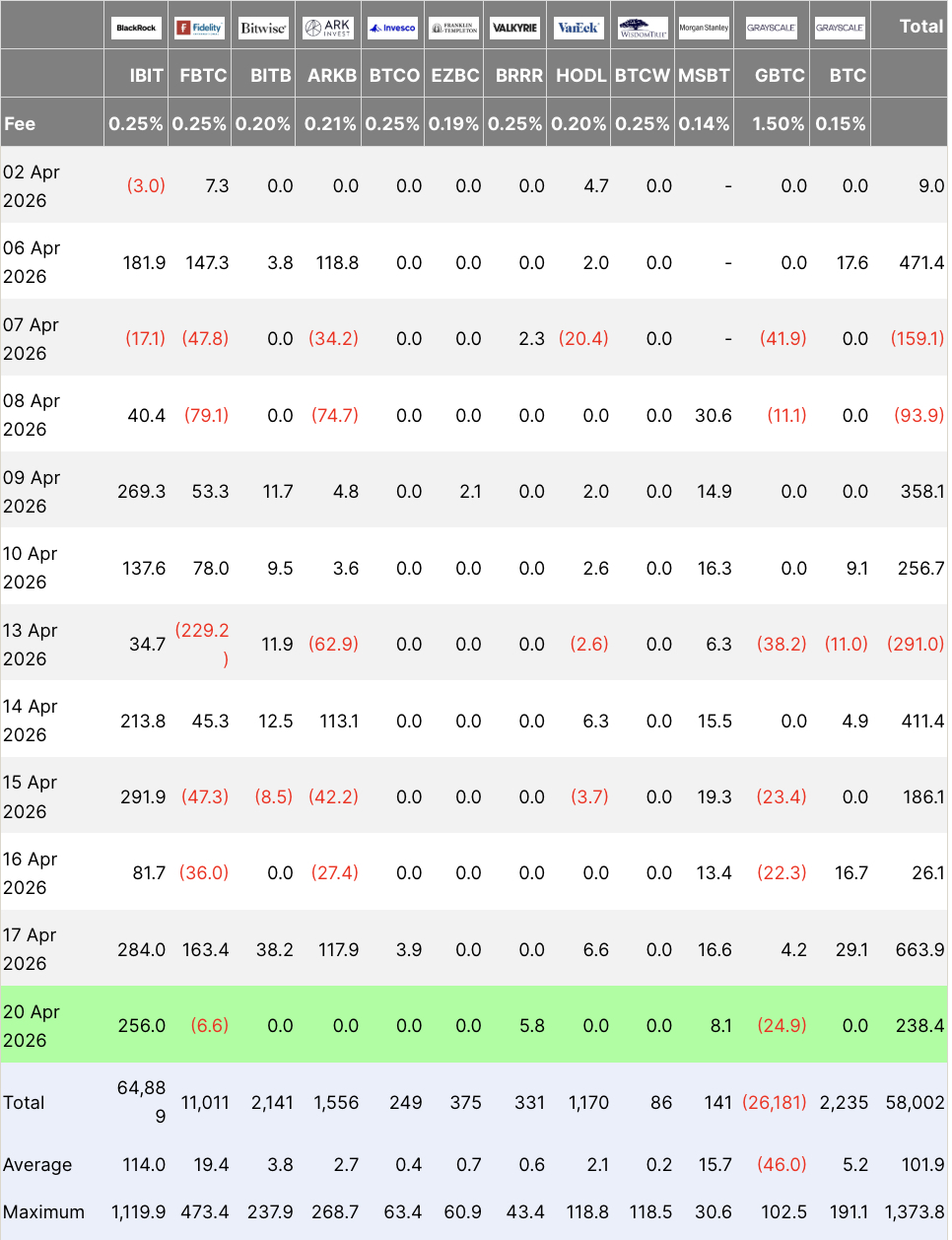
BlackRock just placed its biggest weekly prediction bet on Bitcoin as it is trading at above the $74,000 price support. BlackRock’s spot bitcoin ETF, IBIT, absorbed $871 million in net inflows last week, leading every crypto ETF on the board.
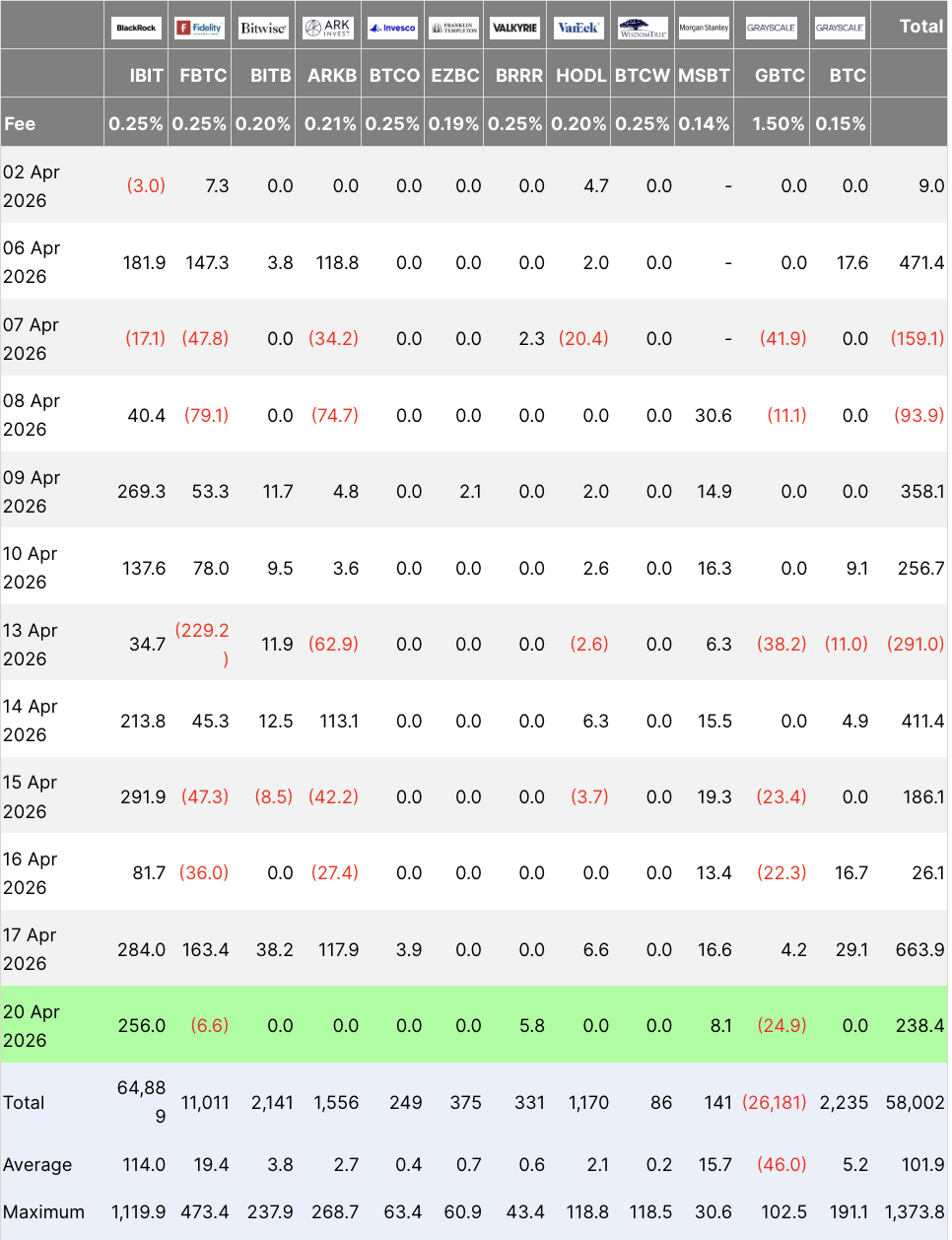
U.S. spot bitcoin ETFs collectively booked $1.9 billion in net inflows across the same five-day stretch, the strongest weekly haul since early February. The marquee single-session was April 17, when total ETF flows hit $663.89 million, with IBIT alone pulling in $283.96 million and Fidelity’s FBTC adding another $163 million.
Iran tensions dragged BTC briefly to $63,000 2 months ago before Saturday’s bid briefly reclaimed $78,000, with institutional buyers treating every dip as an entry.
Discover: The best pre-launch token sales
Bitcoin Price Prediction: Larry Fink’s $500,000 Target This Year?
Bitcoin’s technical setup looks constructive after the consolidation. Price is holding above $74,000, up 10% in a month, with bullish consolidation building since the peak. Key resistance sits at the $78,000, and a confirmed close above that can open the door to the $80,000 breakout level.
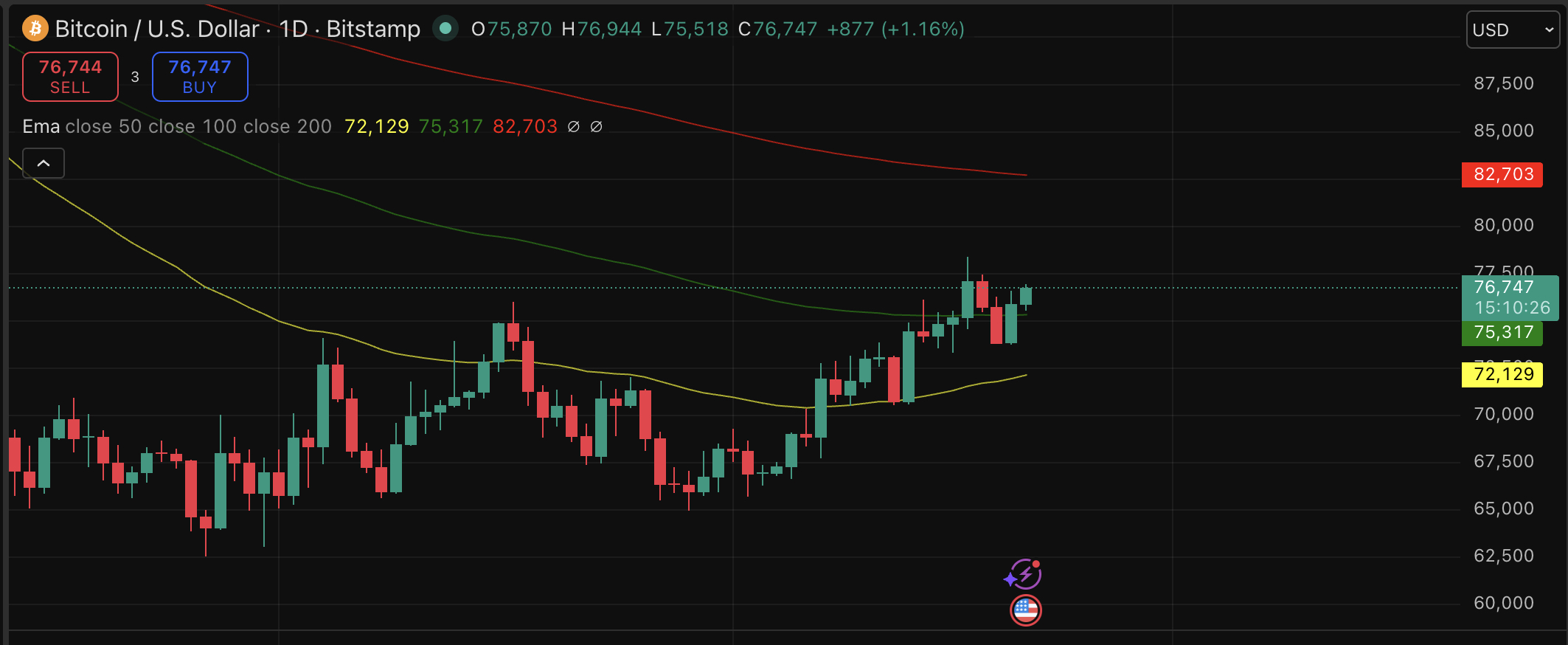
The Liquidity Oscillator is showing positive Rate-of-Change signals, consistent with the global M2 money supply reversal that has historically correlated with BTC rallies.
For Bitcoin price itself, if ETF inflows sustain above $500M weekly, BTC could clear $78,000 and target $80,000, then maybe $83,000 on M2 tailwinds. Bitwise CIO Matt Hougan has upgraded his 2026 target to $200,000+, citing ETF flows, MicroStrategy accumulation, and Trump’s pro-crypto executive order unlocking Wall Street participation.
BlackRock CEO Larry Fink reiterated a $500,000–$700,000 long-term price target in a recent Bloomberg interview, citing sovereign wealth funds weighing 2%–5% BTC portfolio allocations as a hedge against currency debasement. It’s a structural demand that doesn’t reverse on a single FOMC meeting or a Strait of Hormuz headline.
Discover: The best crypto to diversify your portfolio with
Bitcoin Hyper to Follow Bitcoin Path with Bigger Upside
Spot BTC is undeniably bullish right now, but the asymmetric upside that early Bitcoin investors enjoyed simply isn’t available anymore. Traders hunting for early-cycle leverage within the Bitcoin ecosystem are rotating attention to infrastructure plays building on top of BTC itself.
Bitcoin Hyper ($HYPER) is positioning as the first-ever Bitcoin Layer 2 with Solana Virtual Machine (SVM) integration, delivering sub-second finality and low-cost smart contract execution while preserving Bitcoin’s base-layer security.
The pitch is direct: solve Bitcoin’s core limitations (slow transactions, high fees, no programmability) without abandoning its trust model. The presale has raised $32 million at a current price of $0.0136789, with 36% staking available for early participants.
Features include a Decentralized Canonical Bridge for BTC transfers and high-speed transaction execution that the team claims outperforms Solana itself on latency, and the presale has drawn attention alongside the broader Bitcoin ETF inflow narrative.
The post Bitcoin Price Prediction: Blackrock Big Bitcoin Bet appeared first on Cryptonews.
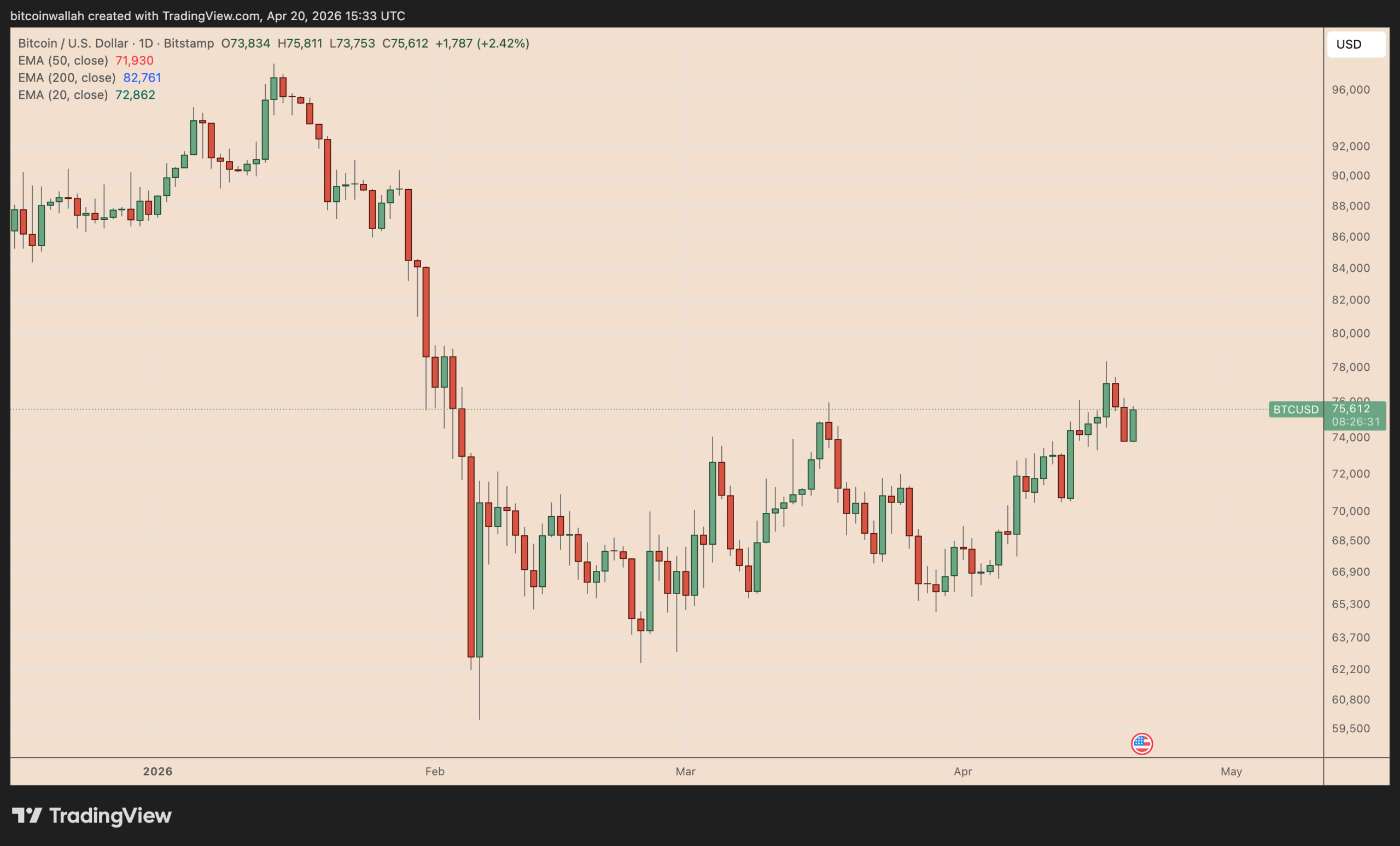
Bitcoin (BTC) rose 2.66% to around $75,800 on Monday after Strategy disclosed a $2.54 billion purchase, the company’s third biggest ever, and equivalent to about 2.5 months of new BTC supply.
However, several indicators suggest the rally may fizzle out.

Key takeaways:
-
Poor macro conditions can spark BTC price pullback if Strategy’s buying slows.
-
Bitcoin’s technical setup hints at a potential dip toward $67,000–$69,000.
Strategy may halt BTC purchases this week
Strategy funded most of its latest 34,164 BTC purchase through its preferred stock, Stretch (STRC), which generated over $2.17 billion through at-the-market share sales between April 13 and April 19.

That accounted for roughly 86% of the total amount spent, while sales of its Class A common stock, MSTR, added another $366 million.
STRC lets Strategy raise cash for Bitcoin when it trades at or above $100. Stronger prices mean easier fundraising and more BTC buying. In 2026, STRC enabled the purchases of 77,000 BTC, ten times more than all the ETFs combined, per River data.

But STRC has been trading below its $100 par value since April 15, which may limit Strategy’s ability to keep raising cash to purchase more Bitcoin this week.

In past episodes, pauses in Strategy’s Bitcoin purchases have coincided with BTC price slumps.
For instance, on average, BTC’s price has dipped by roughly 30% when STRC traded below its $100 par value.

A 30% dip will take Bitcoin’s price to $53,000 when measured from current levels.

The halt appears alongside weakening risk sentiment, with US stock indexes falling amid doubts over the US–Iran peace deal.

US President Donald Trump said it was “highly unlikely” he would extend the two-week truce if no agreement is reached before it expires on Wednesday.
Any signs of an extended Middle East conflict may weigh on BTC’s prices.
BTC flag pullback hints at $67,000–$69,000
Bitcoin’s current chart structure shows classic flag consolidation, with price now drifting toward the pattern’s lower boundary. This setup raises the risk of a pullback toward the $67,000–$69,000 region in April, if support gives way.

At the same time, downside may remain limited as the 20-day (green) and 50-day (red) EMAs continue to act as dynamic support levels. Holding above these averages would signal underlying demand, increasing the chances of a rebound.
Related: Adam Back says current demand is ‘almost’ enough to send Bitcoin to $1M
If that happens, BTC could attempt a breakout above the flag’s upper trend line, effectively invalidating the bearish setup.
Such a move would open the door for a recovery toward the 200-day EMA (blue), currently near $82,750.
As Cointelegraph reported, breaking the resistance near $78,000 is now a top priority for the bulls.
This article is produced in accordance with Cointelegraph’s Editorial Policy and is intended for informational purposes only. It does not constitute investment advice or recommendations. All investments and trades carry risk; readers are encouraged to conduct independent research before making any decisions. Cointelegraph makes no guarantees regarding the accuracy or completeness of the information presented, including forward-looking statements, and will not be liable for any loss or damage arising from reliance on this content.
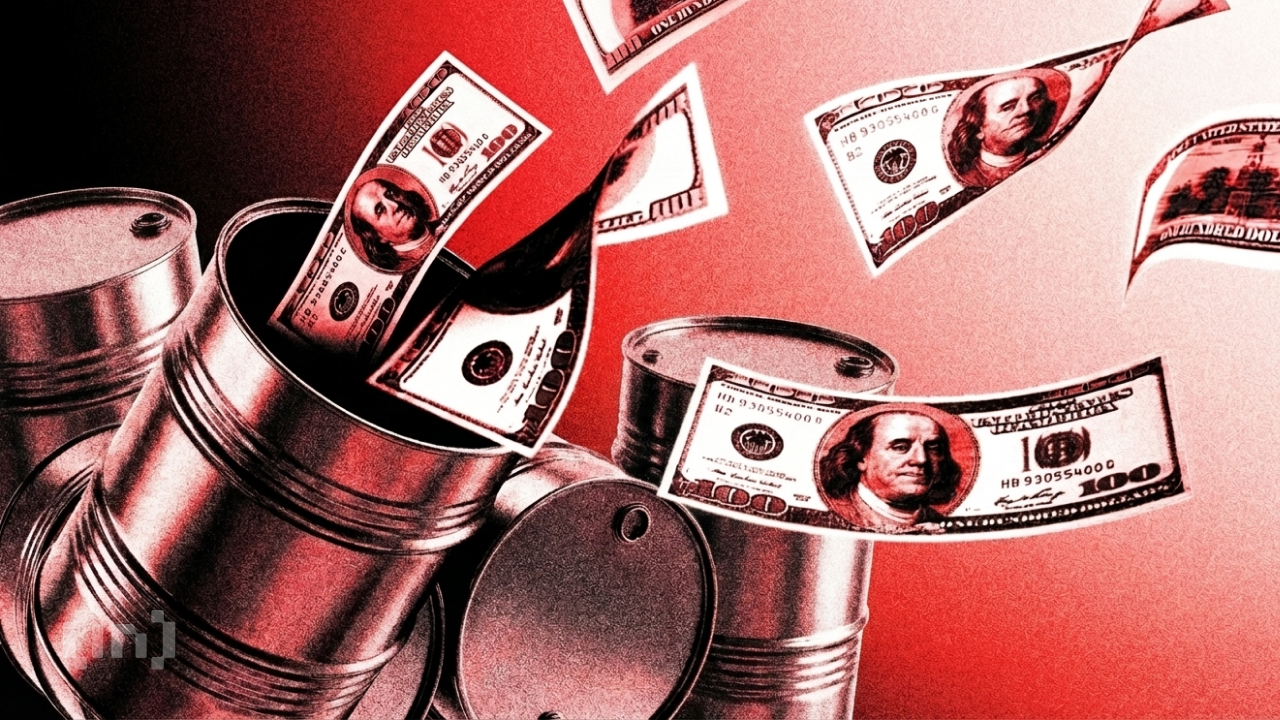
HFI Research has stated that the oil market has passed its breaking point, which was projected around mid-April
The analysis argues that these inventory draws will occur regardless of any reopening of the Strait of Hormuz, driven by structural and logistical constraints. This comes amid notable uncertainty around the diplomatic efforts to resolve the US–Iran war.
Why a Peace Deal May Not Reverse the Oil Market Shock
HFI explained that even with a US-Iran peace deal, oil market recovery would be delayed by logistical bottlenecks. An estimated 160 million barrels of floating storage in tankers would begin discharging. However, transit and offloading alone would take 30–40 days, with tanker turnaround requiring an additional 20 days.
Meanwhile, around 70 very large crude carriers (VLCCs) en route to load US crude for Asia face a much longer cycle. It would take 6–8 weeks for loading, 45–50 days for transit, and another 20–25 days to offload and return.
“In total, we will not see meaningful tanker traffic back in the Strait of Hormuz from this entourage for at least 3 months,” the blog read.
Follow us on X to get the latest news as it happens
Onshore constraints in the Middle East further complicate the recovery. The region holds 600 million barrels in onshore storage. Producers need roughly 200 million barrels drained before they can restart output.
That would take at least 100 VLCC. However, current tanker activity suggests this rebalancing may not occur until mid-to-late June at the earliest.
“Once the onshore crude storage drains, we need a steady flow of tankers coming to through the Strait of Hormuz to pick up crude. By this point, producers like Saudi, UAE, Kuwait, Qatar, Iraq, and Bahrain can restart. This process will take a few more weeks all but guaranteeing that the lack of supply continues,” HFI Research added.
The report highlighted that cumulative storage lost due to the closure already totals roughly 1 billion barrels, rising to 1.98 billion by the end of June.
According to HFI, given the limited commercially available crude to offset such losses, the market may require demand destruction to restore equilibrium. If the Strait remains closed beyond April, oil prices could move into uncharted territory, with traditional pricing mechanisms breaking down.
Subscribe to our YouTube channel to watch leaders and journalists provide expert insights
The post A US-Iran Peace Deal May Not Be Enough To Save the Oil Market Now: Here’s Why appeared first on BeInCrypto.
The hackers that stole $290 million in the KelpDAO exploit are beginning to launder their ill-gotten gains, according to onchain sleuth ZachXBT and data from Arkham.
Arkham shows that the wallet in control of the proceeds of the exploit sent two transfers of $117 million and $58 million on the Ethereum blockchain during European hours on Tuesday.
ZachXBT reported that a portion of the stolen funds has already begun moving across chains. Roughly $1.5 million was bridged from Ethereum to Bitcoin via Thorchain, alongside an additional $78,000 routed through the privacy protocol Umbra. North Korean hackers Lazarus Group have previously used protocols like Thorchain to launder funds.
Cross-chain routing and privacy tools are commonly used in the early ‘layering’ stage of laundering, suggesting the attacker may be preparing to further disperse the funds across multiple venues.
The KelpDAO exploit is one of the largest decentralized finance breaches in recent months, spurring a wave of negative sentiment across the DeFi sector and fears over contagion will spread to other blockchains.
Layer 2 network Arbitrum said Monday it had frozen $71 million in ether linked to the hack, a move that could pressure the exploiter to accelerate efforts to move and launder the remaining funds.
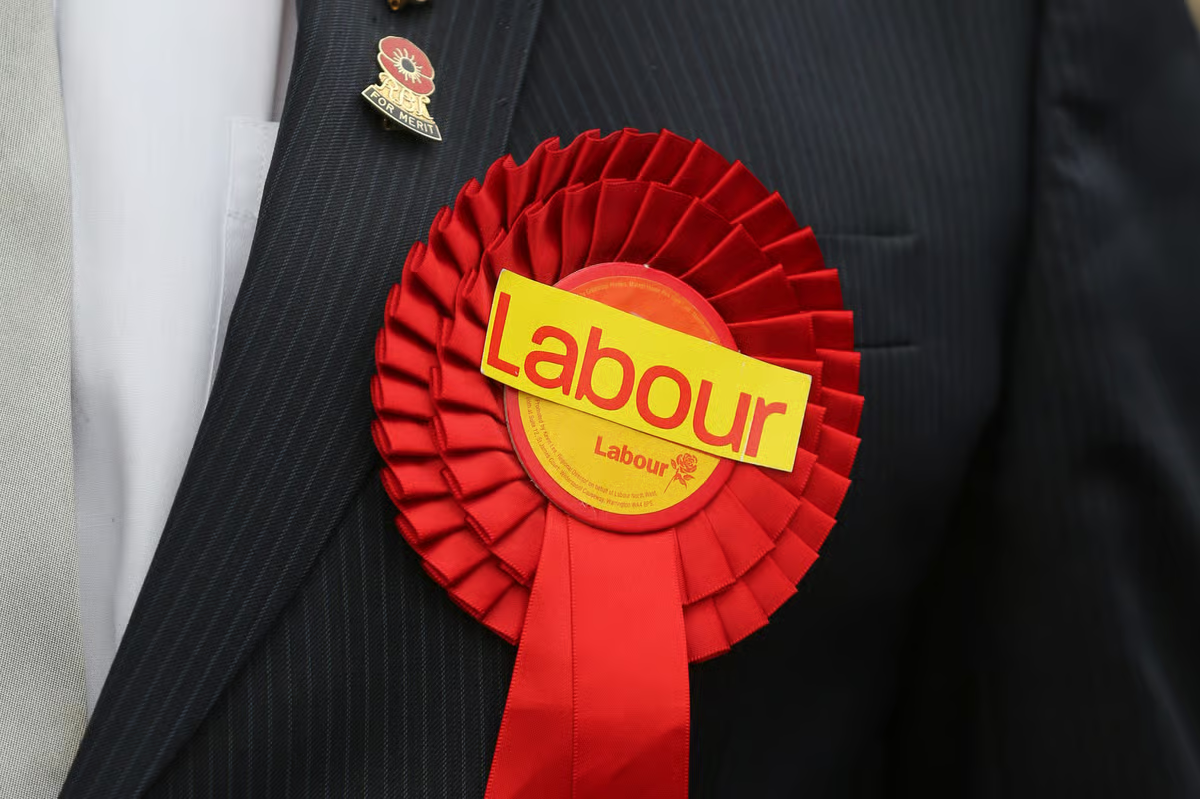
Senior London Labour figures charged after criminal investigation into alleged vote rigging

Two regional airlines to receive state funding amid rising costs

Philippine SEC Warns Against dYdX, Crypto Platforms

Manchester United reach agreement with Casemiro over contract clause amid transfer speculation

Steven Gerrard disagrees with Gary Neville over ‘shock’ Chelsea and Arsenal claim | Football

US brings back mandatory military draft registration


-

 News Videos6 days ago
Secure crypto trading starts with an FIU-registered
-

 Fashion4 days ago
Weekend Open Thread: Theodora Dress
-

 Sports4 days ago
NWFL Suspends Two Players Over Post-Match Clash in Ado-Ekiti
-

 Politics4 days ago
Palestine barred from entering Canada for FIFA Congress
-

 Business2 days ago
Powerball Result April 18, 2026: No Jackpot Winner in Powerball Draw: $75 Million Rolls Over
-

 Crypto World3 days ago
Russia Pushes Bill to Criminalize Unregistered Crypto Services
-

 Politics13 hours ago
Gary Stevenson delivers timely reminder to register to vote as deadline TODAY
-
 Business5 days ago
Creo Medical agree sale of its manufacturing operation
-

 Politics2 days ago
Zack Polanski demands ‘council homes not luxury flats for foreign investors’
-

 Tech2 days ago
Auto Enthusiast Scores Running Tesla Model 3 for Two Grand and Turns It Into Bare-Bones Go-Kart
-

 Tech5 days ago
‘Avatar: Aang, The Last Airbender’ Leaked Online. Some Fans Say Paramount Deserves the Fallout
-

 Crypto World3 days ago
Russia Introduces Bill To Criminalize Unregistered Crypto Services
-

 Tech6 days ago
Microsoft adds Windows protections for malicious Remote Desktop files
-
 Entertainment6 days ago
Dave Portnoy Slams Dianna Russini: ‘Makes Zero Sense’
-

 Crypto World6 days ago
X Launches New Cashtag Feature for Stocks and Crypto: X
-

 Sports7 days ago
Younger Than Sachin Tendulkar: Vaibhav Sooryavanshi Set To Make Historic India Debut
-

 Entertainment7 days ago
Prince Carter Brings Fans Front Row and Backstage at Boys 4 Life Tour
-

 Sports5 days ago
British climbers complete new route in Swiss Alps
-
 Crypto World6 days ago
Bitcoin surpasses halfway mark in current halving cycle
-
 Crypto World7 days ago
Paxos Labs Raises $12M to Launch Crypto Yield and Lending Platform
You must be logged in to post a comment Login