

Crypto World
Europe’s leading Bitcoin conference expands its cultural reach



Prague, Czech Republic, May 18, 2026 – BTC Prague, Europe’s premier Bitcoin conference, returns to the PVA Expo Prague on June 11-13, 2026. Entering its fourth edition, BTC Prague welcomes 8,500 attendees, uniting entrepreneurs, developers, investors, educators, and newcomers in the industry. This year, BTC Prague adds its new Bitcoin Living Masterclass track, a dedicated stage for talks on health, biohacking, financial sovereignty, AI, parenting, and more, from renowned experts in their fields on top of its best-in-class Bitcoin program.
Without abandoning its Bitcoin-only philosophy, BTC Prague now broadens its appeal, including a wider range of topics very much in vogue among the Bitcoin community. The result is a three-day program of keynotes, panels, debates, and networking across four different stages surrounded by Europe’s largest Bitcoin expo.
Building Bitcoin bridges: from Europe to the rest of the world
BTC Prague is a meeting point for those building Bitcoin’s future. More than a conference, it’s a festival for everyone. From the newly curious to die-hard advocates, the event’s setup is meant to unite the vastly different ideological, technical, and business enclaves that exist in Bitcoin. A BTC Prague ticket ensures people can interact with experiences and content made for and by the Bitcoin community.
- Main Stage: Talks focused on the deeper societal implications emerging from Bitcoin adoption
- GART Stage (Expo): Everything needed to learn and master the Bitcoin basics
- Anycoin Stage (Czech-only): Czech language speakers curated for a local audience
- VIP Stage: Limited-access sessions for VIP ticket holders
The 250+ speaker lineup features major names in the industry and beyond, such as:
- Michael Saylor, Executive Chairman, Strategy
- Jack Mallers, Founder & CEO, Strike & Twenty One
- Natalie Brunell, Author, Bitcoin is for Everyone
- Peter McCormack, Podcaster, filmmaker, and football club chairman
- Dr. Adam Back, CEO & Co-founder, Blockstream
- Roman Reher, Founder & CEO, Blocktrainer
- BTC Sessions, YouTube Educator
- Jeff Booth, Founding Partner, Ego Death Capital | Author, The Price of Tomorrow
- Marc Friedrich, Friedrich Vermögenssicherung GmbH, and best-selling author
- Dr. Jack Kruse, Neurosurgeon at Kruse Longevity Center
- Julian Liniger, Co-founder & CEO, Relai
- Efrat Fenigson, Journalist and host of “You’re The Voice” podcast
- And many more leading experts, developers, investors, and entrepreneurs
An Entire Week Dedicated to Bitcoin
Besides the main 3-day conference, BTC Prague 2026’s spirit extends well past that onto separate meetups, events, and parties happening in Prague that same week.
Freedom Tech Summit – June 10, 2026
The next step for BTC Prague’s dev/hack/day. This is a one-day deep dive for developers, builders, hackers, or freedom and privacy enthusiasts. Freedom Tech Summit is where the bleeding-edge of open source development comes to meet for innovative workshops, dev sessions, and talks.
Bitcoin Corporate Day – June 10, 2026
An invite-only event for investors, entrepreneurs, bankers, and high-level decision makers. Bitcoin Corporate Day brings together top executives, institutional figureheads, and Bitcoin thought leaders, breaking new ground for institutional Bitcoin adoption, capital markets, corporate finance, and more. This exclusive gathering is held at the prestigious Lobkowicz Palace.
The Bitcoin Expo
This year, the BTC Prague Expo features 100+ companies and a renewed floor plan suitable for Europe’s largest Bitcoin exhibition. Attendees from any experience level are welcome to see, try, or purchase Bitcoin-related products: everything from wallets to mining hardware, security tools, financial services, educational platforms, games, and more for only a €75 admission fee.
Don’t miss BTC Prague’s side events
BTC Prague is all about celebrating the Bitcoin community and culture. A plethora of separate, fully community-backed events are expected. This includes meetups, parties, workshops, hackathons, and even sports activities meant to take advantage of Prague’s distinct identity. Every Bitcoiner is welcome to organize their own celebrations.
Bitcoin networking for everyone
BTC Prague 2026 prioritizes accessibility and an unforgettable experience for everybody. This year, it brings back all the features loved by past attendees:
- Dedicated event app for networking, scheduling, and customizing your program.
- Ticket options for every budget, starting from €75, with packages for newcomers, enthusiasts, professionals, and VIPs.
- On-site chill zones, food trucks, and the annual afterparty let attendees take a proper break and enjoy a casual community-building environment.
VIP attendees get to enjoy the “ultimate Bitcoin experience” with access to a concierge-hosted lounge, front-row seating, and Michelin-star level dining and drinks. The VIP pass unlocks elevated comfort and access throughout the entire event venue.
Prague: still the Bitcoin capital of the world
Held in a city synonymous with freedom, Prague also reflects the Czech capital’s deep ties to Bitcoin’s history, from pioneering mining operations and software, to hardware wallet innovation and finance. Centrally located in Europe, Prague offers excellent infrastructure, affordability, and a thriving local Bitcoin scene, making it an ideal setting for an event of this scale and ambition.
Key event details
- Dates: 11th – 13st June 2026
- Location: PVA Expo centre, Beranových 667, 199 00 Prague, Czech Republic
- Tickets: Four tiers available: Bitcoin Expo only, 2-Day All Access, 3-Day All Access (adds Bitcoin Living Masterclass), VIP (access to everything + hospitality perks)
Partners
- General: Relai
- Gold: Bitmain, DASE, Firefish, Fulgur Ventures, GART, The Bitcoin Way, Trezor
- Silver: AmityAge, Anycoin, AsicExchange, BitBox, Bitwise, Braiins, Brainmarket, BullBitcoin, Cake Wallet, Citadel Garden, Coinsnap, EMCD, FractalEncrypt, Frostsnap, Glimpse, Invity, Mitochondriak, OCEAN, Próspera, Rewallet, Rootstock, Silent.Link, Strive, Tangem, Terahash, The Block Live Studio, Travala, Vexl
- Bronze: 21energy, 2fiat.com, ArchLending, Bespoke, Bitchair, Bitcoin Beach, BitcoinMat, Bitcredit, Bitronics, Bitsurance, BTC Map, BTCPay Server, Capital B, Citadel Vault, CKMA, Coconut, Foundation, KeychainX, KvaPay, Liberation Travel, MIM, Minotaur, Nomium, OBM Foreman, One Miners, Portu, Satoshi Silver, Seedor, Stamp Seed, Strike, Sygnum, ThorSwap, Tropic Square, Uminers, Vnish, Volcminer, Xapo Bank, XCE
- Copper Partners: AnchorVerse, Bitcare, Crypto Goodies, Electrum, Ledn, LifPay, Saturday Block
- Product partners: Beer of Satoshi, BitKit, CzechCrunch, Jednadvacet, Mattoni, Mercedes Hoffmann & Žižák, Opago, Pilsner Urquell, Prima & La Panna, Red Bull, Refyzio, Yubico
About BTC Prague
Launched in 2023, BTC Prague is now the largest and most prominent Bitcoin-only conference in Europe. It was created by a team of European Bitcoiners to foster learning, innovation, and real-world connections in the global Bitcoin ecosystem. The event is fully independent and focused solely on the Bitcoin protocol, its adoption, culture, and its future.
For tickets, speaker updates, and more information, visit www.btcprague.com.
Media kit & Brand Manual: https://design.btcprague.com/btc-prague; photo 1; photo 2; photo 3.
Media Contact
Sponsorship & exhibition inquiries
BTC Prague offers a unique appeal and exposure for any Bitcoin brand to gain direct exposure to thousands of attendees, A-list speakers, and online audience through bespoke sponsorship, exhibition, or marketing opportunities. For more information and how to apply, please contact martin@btcprague.com.

One fund manager has issued a stark warning: Bitcoin’s ongoing selloff may deepen as upcoming U.S. Treasury operations are expected to drain roughly $150 billion in liquidity from the financial system.
“In my experience, Bitcoin tends to be a better liquidity indicator than most other instruments. If the Treasury settlements are a drain on liquidity, then Bitcoin could be heading much lower,” said Michael Kramer, founder and CEO of Mott Capital Management, a registered investment advisory firm, in his latest market analysis note.
The U.S. Treasury regularly issues bonds and bills to finance government spending. When the Treasury sells new securities, it receives cash from investors, which is then moved into the Treasury’s account at the Federal Reserve. All else equal, this process pulls liquidity out of the banking system and reduces the amount of cash available for other investments. These periodic settlements can create temporary but meaningful liquidity drains, especially during heavy issuance periods.
According to Kramer, Treasury operations from May 28 to June 5 could result in a roughly $150 billion liquidity drain. This includes:
- $15 billion in T-bills settling on Thursday
- $47 billion in coupon settlements on Friday
- $68 billion on Monday
- $16 billion in T-bill settlements on Tuesday
- Another T-bill settlement on June 4 estimated between $5 billion and $15 billion
Markets, including crypto, tend to perform best when liquidity is abundant. When cash is pulled from the system, even temporarily, investors often turn more cautious, reducing appetite for risk assets like bitcoin.
Early signs of this pressure are already visible. Bitcoin has dropped about 11% since hitting highs above $82,500 earlier this month and was trading near $73,000 at press time. Kramer notes that the recent breakdown of key support near $75,000 is a clear signal that liquidity conditions are tightening.
While this doesn’t guarantee a deeper decline, it underscores an important point often overlooked in crypto circles: Bitcoin does not trade in a vacuum and macro forces like government borrowing and the resulting cash flows can quietly exert significant influence on prices.
For everyday investors, the key takeaway is simple. Sometimes the biggest driver of Bitcoin’s price isn’t a crypto-specific headline, it’s macro forces moving in the background.
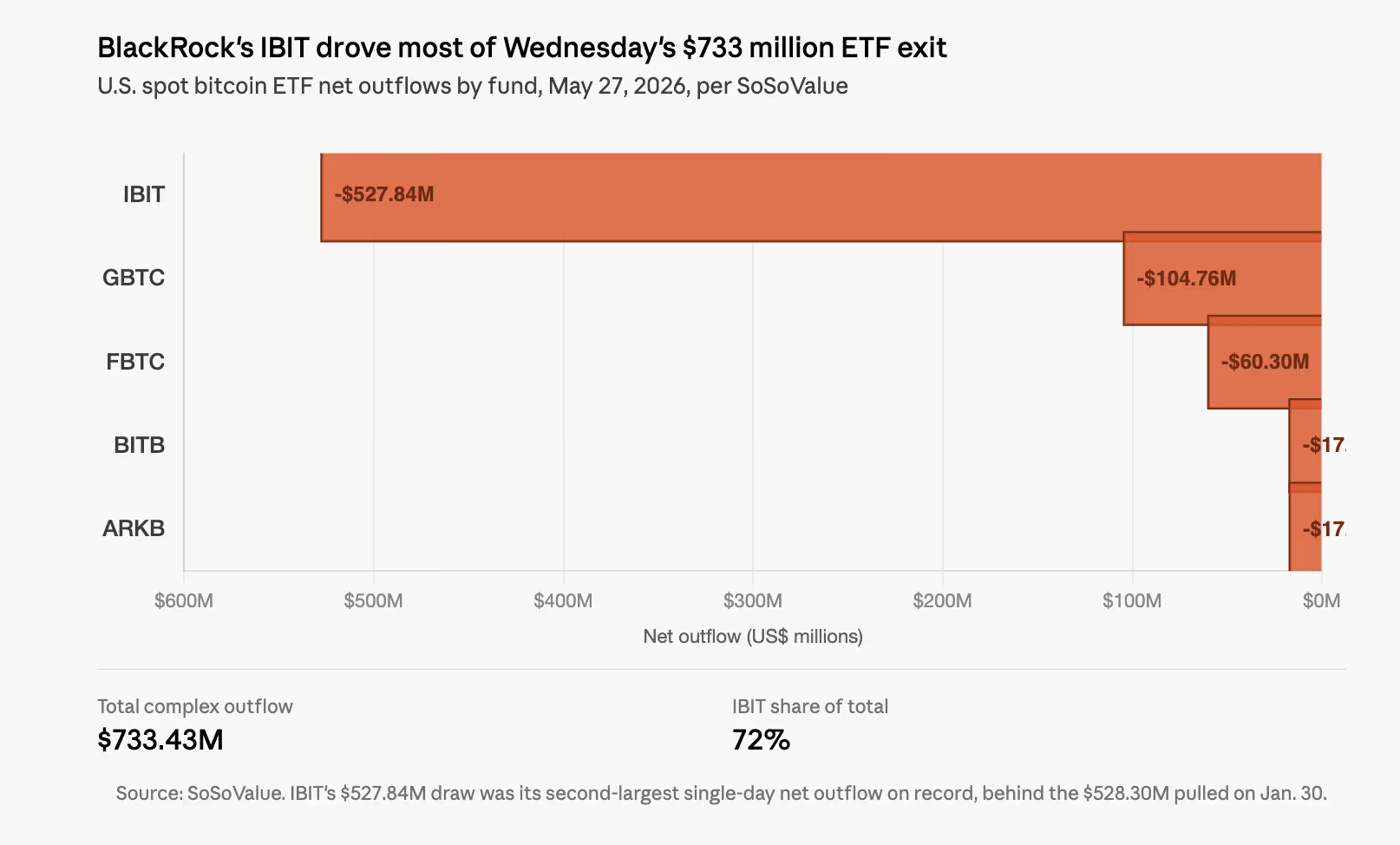
BlackRock’s iShares Bitcoin Trust shed $527.84 million on Wednesday, the second-largest single-day net outflow since the fund launched in January 2024, per SoSoValue data.
The figure missed the record by a razor-thin margin. IBIT’s biggest outflow on record remains the $528.3 million pulled on Jan. 30, which Wednesday’s draw came within about $500,000 of matching. The fund holds roughly $59 billion in assets and accounts for close to 4% of bitcoin’s total supply, making it the largest single vehicle for institutional bitcoin exposure.
The outflow was part of a broader exodus. The 11 U.S.-listed spot bitcoin ETFs lost a combined $733.43 million on Wednesday, with Fidelity’s FBTC shedding $60.30 million and Grayscale’s GBTC losing $104.76 million alongside the IBIT draw. The complex has now posted outflows for several consecutive sessions, with more than $2 billion withdrawn over the past two weeks.

The selling landed on the same day bitcoin broke below $73,000. The cryptocurrency traded at $72,978 in Asian hours Thursday, down 3.4% over 24 hours, after U.S. airstrikes on an Iranian military site near the Strait of Hormuz reignited a conflict markets had started to price out. The ETF outflows and the price drop fed each other, with redemptions forcing BlackRock and other issuers to sell the underlying bitcoin to settle investor exits.
The IBIT draw came a day after a separate eye-catching move in the fund. On Tuesday, a single investor sold $1.29 billion of IBIT shares in one dark-pool block trade, as CoinDesk reported.
A dark-pool trade is a privately negotiated transaction that lets large players move size without tipping off the broader market.
That block sale was not the same as a net outflow, since buyers can step in to absorb the volume, and IBIT’s actual net redemptions on Tuesday came to $192.44 million. But the two events together point to institutional players trimming bitcoin exposure as the macro backdrop turned.
The flow data has been pointing this way for weeks. ETF accumulation across the year had already thinned to a net of around 4,500 BTC, and May flipped from the steady buying of March and April into distribution, as reported on Wednesday. Bitcoin has dropped from above $82,000 on May 6 to under $73,000 now, and the ETF channel that drove the 2025 rally has spent the month pulling money the other way.
Whether the outflows reflect tactical de-risking amid Hormuz headlines or a deeper institutional pullback depends on what happens once the situation in the Middle East stabilizes. IBIT has gone through extended outflow streaks before during this cycle without a permanent reversal, with money returning each time the macro picture cleared.

U.S. authorities have charged a Google software engineer with insider trading, alleging he used unreleased internal information to place bets on Polymarket and profit substantially. The Department of Justice (DOJ) says Michele Spagnuolo executed 25 wagers totaling about $2.7 million on markets related to the most-searched individuals in 2025, earning roughly $1.2 million on those bets.
Separately, the Commodity Futures Trading Commission (CFTC) filed a twin complaint, levelling similar insider-trading allegations against Spagnuolo. The case spotlights ongoing scrutiny of prediction markets and the potential for sophisticated actors to exploit confidential information in ways that regulators consider prohibited.
In a broader regulatory frame, Congress has opened a probe into Polymarket and Kalshi, questioning how these platforms handle insider information and the risk that government officials could leverage privileged data to place bets. Manhattan U.S. Attorney Jay Clayton emphasized the long-standing principle that insiders cannot profit from confidential business information in public markets, a line echoed by the CFTC’s enforcement leadership as it seeks to curb abuse in the sector.
Key takeaways
- DOJ charges Google software engineer Michele Spagnuolo with insider trading tied to Polymarket bets, based on unreleased internal Google data; 25 bets totaling about $2.7 million, with $1.2 million in profits.
- The CFTC filed a parallel complaint, accusing Spagnuolo of commodities fraud, wire fraud and money laundering; potential penalties include restitution, disgorgement, civil penalties, and bans from trading or registration.
- The account behind the bets reportedly carried the alias “AlphaRaccoon,” which prosecutors say was later renamed to a wallet address and funneled funds through a decentralized swapping service and a privacy-protecting transfer service.
- The unfolding case comes as Congress launches a probe into Polymarket and Kalshi amid concerns that insider knowledge could influence market outcomes on federal events.
- Authorities stress that corporate insiders using confidential information to profit in markets is a long-standing enforcement priority, signaling continued scrutiny of prediction-market platforms.
Insider trading allegations tied to Google data
The DOJ’s filing unsealed on Wednesday centers on claims that Spagnuolo accessed unreleased internal information at Google and used it to bet on markets tied to the most searched individuals in 2025. Prosecutors say the suspect ran a Polymarket account under the handle “AlphaRaccoon,” which allegedly netted $1.2 million from bets on outcomes deemed unlikely by market pricing when Google released its data in December.
According to the court documents, discussions within Discord and X communities began in December about whether AlphaRaccoon pointed to a Google insider. Prosecutors further allege that the AlphaRaccoon username was subsequently changed to a wallet address, and that funds were moved to a decentralized crypto swapping service as well as to a privacy-focused transfer service to obscure transfers.
The DOJ charged Spagnuolo with commodities fraud, wire fraud and money laundering. If convicted on all counts, he could face a substantial prison term, with a maximum sentence that could reach up to 50 years in prison under applicable statutes.
Regulatory action mirrors a broader enforcement wave
In a parallel development, the CFTC filed a twin complaint that mirrors the DOJ’s insider-trading allegations. CFTC officials said the case underscores the agency’s mandate to police the use of inside information in prediction markets and other trading venues within its jurisdiction. The agency’s enforcement leadership framed insider trading as a significant threat to market integrity, particularly in emerging platforms that blend traditional markets with blockchain-based components.
As part of the CFTC’s action, the agency seeks full restitution for affected investors, disgorgement of ill-gotten gains, civil monetary penalties, and trading and registration bans for those found culpable. “The division is a cop on the beat in policing the illegal use of inside information in the prediction markets and other markets within the CFTC’s jurisdiction,” said David Miller, the CFTC’s director of enforcement. He added that authorities “will continue to take action to protect markets from insider trading and other forms of fraud, abuse and manipulation.”
Industry scrutiny intensifies: what this means for Polymarket and Kalshi
The charges arrive amid a climate of heightened congressional attention toward prediction-market platforms. Earlier this week, lawmakers launched a probe into Polymarket and Kalshi to examine how these services respond to insider-trading incidents and whether government officials might leverage privileged information for personal gain. The investigations reflect a tension between regulatory oversight and the perceived innovation thrust of crypto-native betting platforms, as lawmakers weigh safeguards against market manipulation and information asymmetry.
Past incidents have already raised questions about the security and governance of these platforms. In April, the Justice Department charged a U.S. soldier with using classified information to place a Polymarket bet tied to the U.S. government’s actions regarding Nicolás Maduro, underscoring the perceived elasticity of insider information in high-profile political events. These cases collectively emphasize that insiders—whether corporate staff or public officials—face serious legal exposure when confidential information is used for market advantage.
What happens next and what to watch
Key questions in the Spagnuolo case include the timing of court proceedings, the strength of the DOJ’s and CFTC’s evidentiary posture, and the potential for parallel civil actions or settlements. The DOJ has already signaled its intention to pursue a broad set of charges, while the CFTC’s complaint seeks remedies intended to deter similar behavior and restore market trust. The outcome could influence how prediction-market operators implement information-handling safeguards, disclosure protocols, and compliance measures going forward.
Investors and users should watch for any updates on how platforms are adapting to intensified scrutiny, including potential changes to user verification requirements, monitoring of large position builds around sensitive events, and the enforcement landscape that governs cross-border crypto-native markets with traditional regulatory touchpoints.
Readers should also keep an eye on the regulatory narrative surrounding insider information and market integrity. While this case centers on a single individual, the implications extend to platform operators, market participants, and policymakers as they navigate the balance between innovation and robust protections against manipulation.
What remains uncertain is how these developments will shape future enforcement priorities and platform governance. As investigations unfold, the broader market will be watching not only for the legal outcomes but also for the practical safeguards that could redefine how prediction markets operate within or alongside traditional financial oversight.
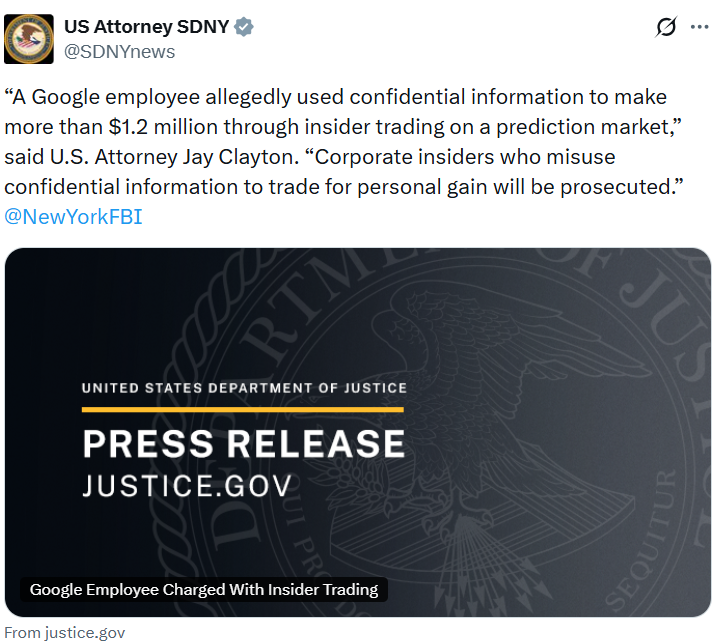
US authorities have charged a Google employee with allegedly using information from the company to make bets on Polymarket and profit $1.2 million.
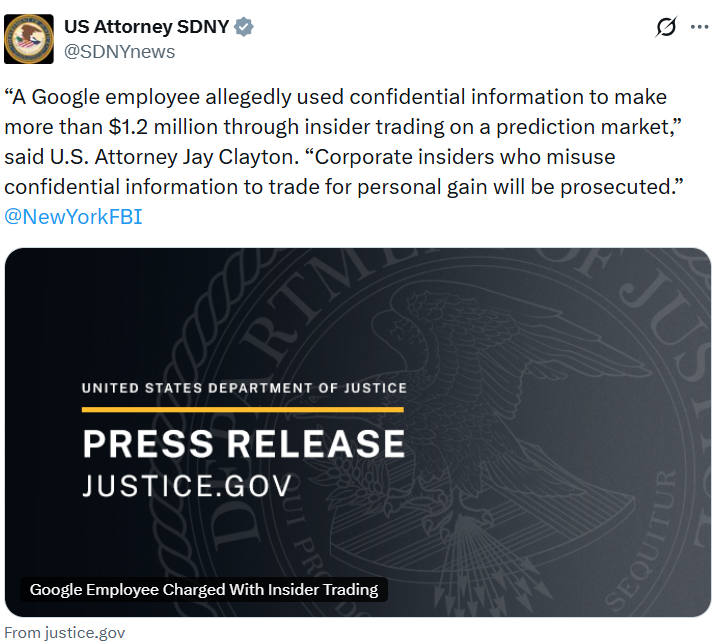
The Justice Department said on Wednesday that it unsealed charges against Google software engineer Michele Spagnuolo, accusing him of accessing unreleased internal information at Google and placing 25 bets worth $2.7 million on markets related to the most searched individuals on Google in 2025.
Prosecutors said Spagnuolo owned the Polymarket account “AlphaRaccoon”, which profited $1.2 million on “outcomes that the market treated as unlikely” when Google published information on the most searched individuals in December.
The Commodity Futures Trading Commission filed a twin complaint against Spagnuolo on Wednesday, making similar allegations of insider trading.
Prediction markets are facing growing scrutiny over insider trading, with Congress launching a probe into Polymarket and Kalshi on Friday, questioning the companies’ response to incidents of insider trading on the platform, with lawmakers concerned that government officials are using insider knowledge to make bets.
Manhattan US District Attorney Jay Clayton said in a statement that the charges “reinforce a decades-old message: Corporate insiders cannot use confidential business information to turn a profit in our markets.”
Source: US Attorney Southern District of New York
AlphaRaccoon account allegedly changed name
According to the court documents, communities on Discord and X started discussing the possibility that AlphaRaccoon was a Google insider in December. Soon after, the username was allegedly changed to a wallet address.
Prosecutors alleged that the funds in the AlphaRaccoon account were also sent to a decentralized crypto swapping service and to an unnamed transfer service that offers privacy protection for blockchain transactions
The Justice Department charged Spagnuolo with commodities fraud, wire fraud and money laundering, and could face a maximum sentence of 50 years in prison.
Related: Polymarket traders win $37K after Paris weather data glitch, raising suspicion
In its complaint, the CFTC seeks restitution, disgorgement, civil monetary penalties and trading and registration bans.
CFTC director of enforcement, David Miller, said in a statement that “the division is a cop on the beat in policing the illegal use of inside information in the prediction markets and other markets within the CFTC’s jurisdiction.”
Source: CFTC
“We will continue to take action to protect markets from insider trading and other forms of fraud, abuse and manipulation,” Miller added.
It comes after the Justice Department charged a US soldier in April with using classified information to place bets on the US capture of former Venezuelan president Nicolás Maduro.
Magazine: ETH bears growling, Tom Lee’s buying, XRP to ‘explode’: Market Moves


Stablecoin payments run through settlement and B2B rails, not consumer checkout, BridgerPay CEO Ran Cohen said.
Summary
- Cohen said real stablecoin demand sits in cross-border settlement, B2B payouts, and treasury, not retail checkout.
- He argued Mastercard’s $1.8 billion BVNK deal validates the rail rather than ending the case for neutral orchestration.
- Cohen expects stablecoins to scale across business flows over 18 months without displacing cards at the till.
Stablecoin payments are running through global settlement and B2B rails rather than consumer checkout pages, BridgerPay co-founder Ran Cohen said in an interview. Stablecoin transaction volume crossed $33 trillion in 2025.
Cohen’s view runs against the assumption that the surge will push “pay with USDC” buttons into mainstream e-commerce. Mastercard’s $1.8 billion BVNK deal, announced in March, has reframed the race as a contest over invisible plumbing.
Why BridgerPay sees the checkout button staying rare
“The demand and implementation is infrastructure-led, not checkout-led,” Cohen said. He pointed to cross-border settlement, B2B payouts, treasury, and liquidity management as the dominant use cases.
Pain points sharpen in emerging markets, he added, where local holidays and weekends slow SWIFT funding. Stablecoins reduce fees, settle near-instantly, and free up working capital across time zones.
Consumer checkout exists, Cohen said, but mostly inside crypto-native businesses, trading platforms, gaming, creator ecosystems, and select cross-border verticals.
“For the average mainstream merchant, stablecoins are not replacing cards at checkout,” he said. “Their main utility will be as a programmable settlement layer.”
Part of the reason is dispute resolution. Cards work because consumers understand chargebacks, refunds, and credit protections that stablecoins do not yet offer in any standardised form.
The framing matters because 2026’s largest deals all targeted infrastructure. Mastercard agreed to buy BVNK for up to $1.8 billion. Stripe paid $1.1 billion for Bridge in 2024.
How orchestration fits between Visa, Stripe and Circle
Cohen argued consolidation strengthens, rather than threatens, neutral orchestration layers. Merchants in cross-border flows rarely want to depend on one provider across every market.
“No single provider is perfect, not in cards, not in APMs, and not in stablecoins,” Cohen said. He said merchants want optionality across Circle, Tether, PayPal, banks, and regional providers as the stack matures.
That argument lines up with how the GENIUS Act rollout is reshaping merchant conversations. The Treasury, OCC, and FDIC have all issued rulemaking in early 2026, with final guidelines expected by July.
Cohen said the clarity is helping but operational complexity remains around state versus federal regimes, foreign issuers, and cross-border treatment of reserves.
Where agentic commerce changes the math
Cohen also flagged AI-agent payments as the next structural shift. Coinbase’s x402 protocol has processed more than 165 million agent transactions and roughly $50 million in cumulative volume.
“Machine-initiated payments can occur 24/7, be high-frequency, low-value, usage-based, and API-driven,” Cohen said. He said those economics do not fit card rails and will default to stablecoin settlement governed by programmable rules.
The orchestration layer, in his view, must evolve from routing a checkout payment to governing economic activity between humans, agents, merchants, and rails.
Cohen does not expect stablecoins to become the default consumer checkout method within 18 months. He does expect growth across settlement, treasury, B2B payouts, cross-border corridors, marketplaces, and agentic commerce.
Stablecoins, he said, are an addition to the payment stack, not a replacement for it.
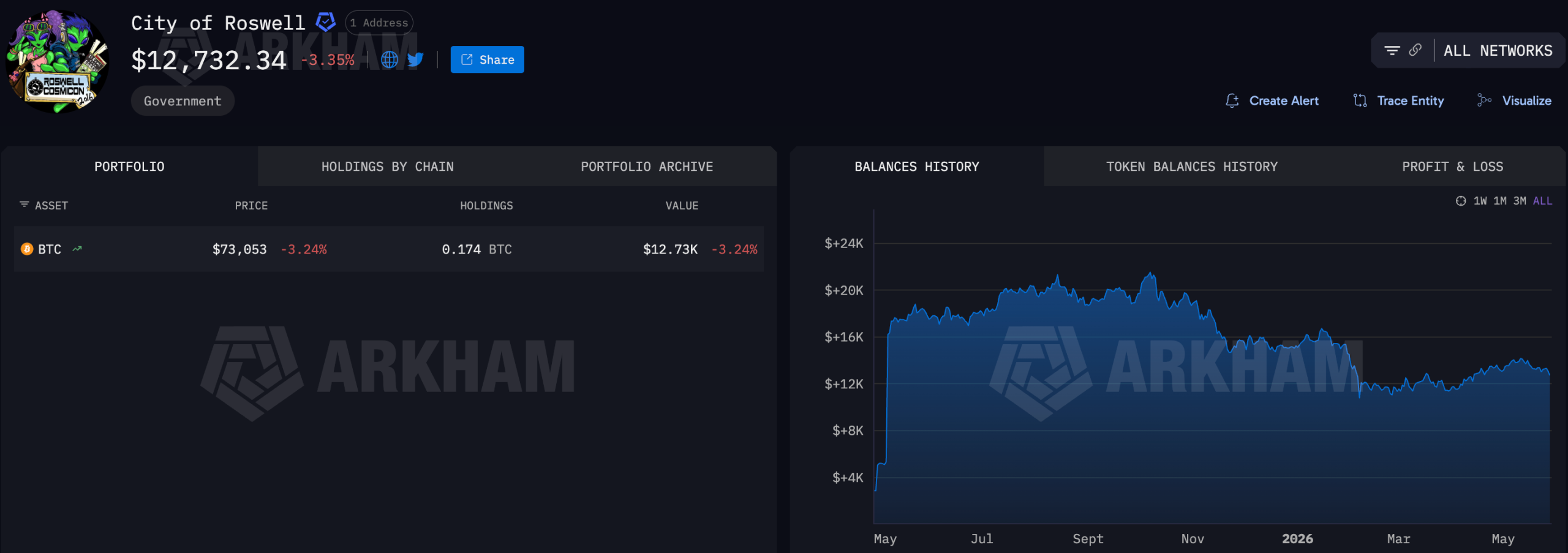
The City of Roswell, New Mexico, the small town synonymous with the 1947 Unidentified Flying Object (UFO) incident, now sits on a modest Bitcoin (BTC) stash. Blockchain analytics firm Arkham Intelligence flagged the holding in a public post this week.
The municipal wallet contains about 0.173 BTC, worth roughly $13,300 when Arkham revealed it. The funds arrived as donations last year and have stayed in a single address ever since, untouched by the city.
Inside Roswell’s On-Chain Stash
Arkham tagged the address as belonging to the City of Roswell and published its entity page through its intelligence tool. According to the firm, the donations were sent in 2025 and have stayed parked at the same address since.

The wallet has not pushed any funds out, suggesting either deliberate custody or simple inattention from city staff. Roswell officials have not commented publicly on who sent the Bitcoin or what they plan to do with it.
The town, home to 48,000 residents, has not flagged the holding in any public budget document. The dollar value Arkham cited reflects market levels at the time of the post and would shift with Bitcoin’s price.
A New Chapter for an Old UFO Story
Roswell’s link to extraterrestrial folklore dates back to July 1947, when a local rancher found metallic debris on his property. The Roswell Army Air Field initially described the wreckage as a flying disc. It retracted the statement the next day and called the find a weather balloon.
The town has built much of its identity, and most of its tourism economy, around alien iconography. The International UFO Museum and Research Center anchors a local industry built on the original story.
The Bitcoin holding adds a digital footnote to that lore. Arkham’s research team leaned into the framing, calling the donations a possible cypherpunk chapter in Roswell’s sci-fi history. Whether any of the senders identified themselves at the time remains unclear.
“Has the first extraterrestrial BTC stash been found?” Arkham teased.
Roswell joins a thin roster of US cities tied to on-chain Bitcoin activity. Miami’s Bitcoin adoption push leaned on a city-branded token rather than direct BTC custody. Most local governments hold no crypto at all.
At the federal level, the picture is larger. The Strategic Bitcoin Reserve order placed forfeited coins on the federal balance sheet. Arkham puts overall US government Bitcoin holdings near $24 billion.
Roswell’s stack is a rounding error against those figures. The story matters less for the amount than for the venue. The town is better known for tinfoil hats than treasury management.
The next question is whether Roswell ever spends the funds or leaves them to compound alongside its tourist economy. For now, the wallet sits where the donors left it, watched only by blockchain explorers and the occasional alien.
The post The UFO Capital of America Has a Bitcoin Wallet: Did Aliens Buy BTC? appeared first on BeInCrypto.

China’s Supreme People’s Court (SPC) said it will study new adjudication rules for virtual currency and cross-border finance cases as part of a broader effort to clarify how courts handle disputes in the digital economy. During a press briefing, Liu Guixiang, a Judicial Committee member of the SPC, said the court intends to formulate judicial interpretations on civil compensation involving insider trading and market manipulation “as soon as possible,” according to Yicai.
The SPC also signaled plans to develop judicial protection rules for artificial intelligence cases and data property rights, including disputes over data ownership, data transactions and AI-generated content. The move aims to establish clearer internal standards for deciding crypto- and AI-related civil disputes, potentially improving consistency amid a rising volume of such cases in China.
Observers note the timing aligns with broader regulatory signals and enforcement dynamics in the region. In a high-profile cross-border enforcement context, U.S. authorities reported the seizure of about $15 billion worth of Bitcoin in October 2025 in connection with investigations linked to illicit operations tied to Chen Zhi, founder and chairman of Cambodia’s Prince Group. The U.S. Department of Justice (DOJ) disclosed the action, underscoring ongoing global convergence around crypto-related enforcement. (Source: Justice.gov)
Key takeaways
- The SPC will study adjudication rules for virtual currencies and cross-border finance as part of formalizing digital-economy jurisprudence.
- The court plans to draft interpretations on civil compensation concerning insider trading and market manipulation.
- Judicial protection rules for AI cases and data property rights, including data ownership and AI-generated content, are under consideration.
- The initiative seeks to standardize crypto- and AI-related litigation, aiming for greater predictability for institutions, exchanges and fintech players.
- These judicial developments intersect with cross-border enforcement and regulatory dynamics shaping compliance and risk management for firms operating with or within China’s digital economy.
Adjudication rules for digital assets and cross-border finance
The SPC’s stated program signals an intent to extend civil-justice frameworks to digital assets and cross-border financial arrangements. By pursuing in-depth research and issuing judicial interpretations on civil compensation for insider trading and market manipulation, the court aims to provide clearer, more consistent standards for disputes in crypto markets and related financial activity. According to Yicai, Liu Guixiang emphasized the need for timely guidance to ensure uniform application across cases involving virtual currencies and cross-border transactions. The development could influence how courts allocate liability, interpret contractual terms in crypto agreements, and address fraud or manipulation allegations in cryptofinance contexts.
AI governance and data property rights in the courts
Parallel to crypto-adjudication work, the SPC’s focus on AI disputes and data-property rights highlights the judicial sector’s broader push to adapt to rapid tech-enabled disruption. The planned rules would address disputes over data ownership, data transactions and the protection of AI-generated content, potentially shaping licensing arrangements, data-sharing frameworks and IP rights in machine-generated outputs. As such, the reforms could affect technology providers, data platforms and enterprises relying on data-driven services, extending beyond crypto to the wider digital economy.
China’s crypto policy backdrop and CBDC trajectory
China’s long-standing stance toward cryptocurrencies is marked by a sequence of regulatory milestones. In December 2013, the People’s Bank of China (PBOC) banned financial institutions from offering Bitcoin-related services and stated that Bitcoin was not recognized as legal currency. In September 2021, a joint regulatory sweep by ten agencies—including the PBOC and securities regulators—issued a blanket ban on all crypto transactions, Bitcoin mining and initial coin offerings (ICOs) within the country. In February of the following year, authorities prohibited the issuance of unauthorized offshore yuan-pegged stablecoins and the unapproved tokenization of real-world assets (RWAs).
The regulatory environment has evolved alongside China’s broader push to deploy a state-controlled digital yuan. The government has approved commercial banks to participate in offering interest-sharing arrangements to clients holding the digital yuan, signaling a deliberate preference for a central bank digital currency (CBDC) framework over private stablecoins. This backdrop provides context for the SPC’s emphasis on formalizing adjudication rules as digital assets and AI technologies become more prevalent in the economy.
Enforcement backdrop and cross-border dimension
The period’s enforcement dynamics underscore the cross-border nature of crypto-related scrutiny. The DOJ’s action, as reflected in public reporting and official releases, illustrates how authorities pursue illicit networks with international footprints. The seizure of approximately $15 billion in Bitcoin in October 2025 relates to investigations into Chen Zhi’s operations and represents a salient example of how enforcement actions outside China intersect with domestic legal developments as the digital economy expands.
Closing perspective
China’s move to standardize adjudication around digital assets, AI and data rights signals a maturation of the domestic legal framework in step with a rapidly evolving digital economy. For institutions operating in or with China, forthcoming SPC interpretations will influence risk assessment, regulatory compliance, licensing considerations and cross-border cooperation. As enforcement and policy converge, staying aligned with evolving standards—especially around crypto disputes, data rights and AI governance—will be essential for robust compliance and strategic planning.


BlackRock IBIT saw $1.29 billion in shares cross a dark pool Tuesday, one of the largest blocks on record.
Summary
- A 29 million share IBIT block crossed off-exchange at 10:30 a.m. ET, dwarfing every other trade in the session.
- The print extended an eight-day outflow streak and pushed two-week US spot Bitcoin ETF redemptions to $2.26 billion.
- Bitcoin slipped about 1.4% during the flow before extending losses to around $74,800.
BlackRock IBIT saw $1.29 billion in shares cross a dark pool Tuesday, one of the largest blocks on record.
A nearly 29 million share block of the iShares Bitcoin Trust changed hands off-exchange at 10:30 a.m. ET, dwarfing every other IBIT trade of the session. Bloomberg analyst Eric Balchunas confirmed the print on X.
The crossing landed on the same day US spot Bitcoin ETFs lost another $333 million in net redemptions, tracked by SoSoValue. IBIT alone shed $192.4 million.
Why the IBIT block trade matters
“Confirmed.. 29 million share trade ($1.3b) of $IBIT executed at 1030am this morning,” Balchunas said on X. “Price unchanged today so mkt absorbed it well.”
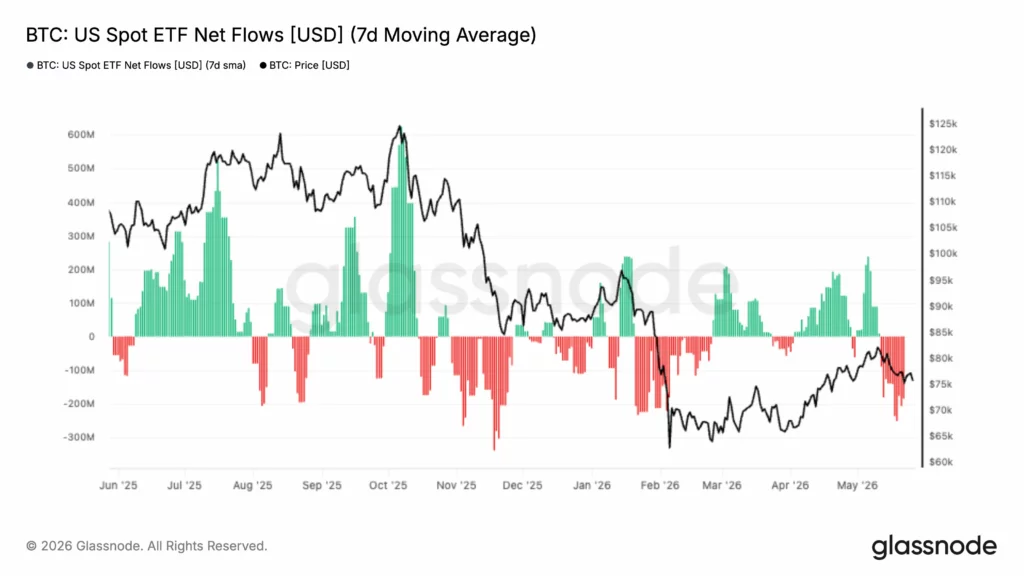
The trade extended an eight-session outflow streak for the fund. Investors have pulled $2.26 billion from US spot Bitcoin ETFs since May 14, according to SoSoValue data.
Dark pools let sellers offload large positions without hitting public order books, masking the full weight of a transaction from the open market. The mechanism limits price impact but signals heavy institutional repositioning.
Bitcoin held near $76,000 immediately after the print but slipped about 1.4% on lower timeframes before extending losses. The asset traded around $74,800 at press time.
How the move fits broader ETF flows
The Tuesday print was not the sharpest single-day exit of the run. IBIT shed $448 million on May 18, when total spot Bitcoin ETF outflows hit $648.64 million.
Crypto.news previously reported that BlackRock-linked Bitcoin sales reached $1.01 billion over the prior week, the firm’s largest weekly disposal since November 2025.
The redemption stretch reverses a six-week inflow streak that pulled $3.4 billion into US spot Bitcoin ETF products through early May, documented at the time.
What traders are watching next
Georgii Verbitskii, derivatives trader and TYMIO founder, said the market avoided a deeper decline because available supply was absorbed rather than because demand had returned.
“The reason the decline was not even deeper is that the market was still able to absorb a substantial amount of supply without a full liquidity breakdown,” Verbitskii said.
Shawn Young, chief analyst at MEXC Research, framed the print as portfolio adjustment rather than panic selling. He said the contained price reaction looked more like a large rebalance than a disorderly exit.
Macro pressure is compounding the flow picture. The CME FedWatch tool now prices a 99% probability the Federal Reserve holds rates at its June 17 meeting, removing a near-term catalyst for risk assets.
The total US spot Bitcoin ETF market still holds more than $98 billion in assets, with IBIT accounting for roughly 62% of the category. The product remains the largest Bitcoin ETF by net assets despite the recent drawdown.
Investor sentiment has also turned. The Fear and Greed Index slipped from 34 to 25, deeper into fear territory, as the dark pool trade and broader outflows reset expectations for the next leg.
Bitcoin price hovered near the $75,000 zone on Wednesday as volatility cooled and traders watched whether the latest support area could hold.
Summary
- Bitcoin price trades near $75K as lower volatility and weak spot demand limit buyer conviction.
- BTC faces pressure from Bitcoin ETF outflows and signs of lower institutional exposure in spot funds.
- Traders are watching $74,662 support, with $76,327 acting as the first recovery level near term.
(BTC) traded around $74,834 after sliding 2.02% over 24 hours, with intraday movement between $74,708 and $76,140. According to data from crypto.news, the market has lost part of the support that came from steady institutional buying earlier this year. Traders are now focused on whether $74,662 can act as short-term support. A daily break below that area could expose BTC to a move toward $73,000.
Bitcoin price nears $75K as volatility cools further
Bitcoin price’s move lower followed a reset in positioning after BTC failed to hold the low-$80,000 region. That zone became difficult to defend as spot buying slowed and short-term holders faced weaker profit margins.
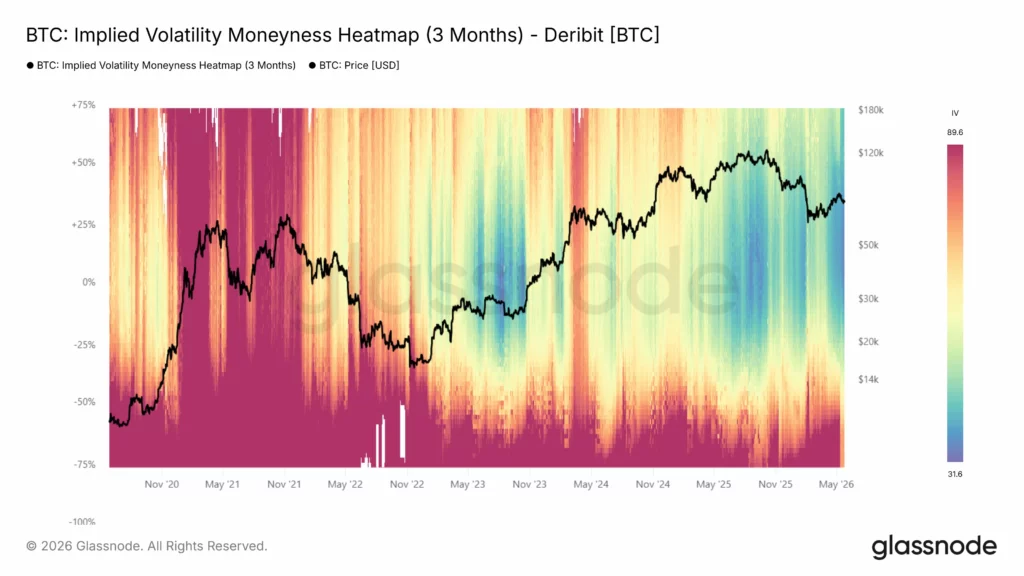
Glassnode’s recent market update reveals Bitcoin remains structurally resilient, but spot demand has weakened. The 30-day cost basis near $78,200 has turned into overhead resistance. That level now sits above spot price and may limit recovery attempts.
ETF demand has also lost strength after earlier support from institutional buyers. The 30-day change in U.S. spot Bitcoin ETF holdings has flattened in recent weeks, according to Glassnode. That reduces one key demand channel that helped BTC recover earlier in the quarter.
Bitcoin’s decline also came as traders tracked a large reported IBIT block sale. The sale added pressure to sentiment, but the current weakness is not linked to one event alone. ETF outflows, weak spot flows, and macro caution remain major factors behind the move.
Bitcoin price faces ETF pressure and weak spot demand
Bitcoin volatility is now important because the market sits close to a key liquidity zone. Traders are watching the $74,662 support area after BTC broke below its ascending channel. A daily close below that level could open a move toward $73,000.
The $76,327 area has become near-term resistance. A reclaim of that level could support a relief bounce, especially with RSI near oversold territory. However, weak spot demand limits any recovery unless ETF flows stabilize.
Macro conditions have also kept traders cautious. Higher yields, inflation concerns, and geopolitical risk have reduced appetite for risk assets. Bitcoin’s recent correlation with gold points to a market driven more by macro positioning than crypto-specific momentum.
The U.S.-Iran peace headlines gave stocks a lift, but Bitcoin failed to follow. Instead, BTC moved closer to commodities as oil dropped on hopes of the Strait of Hormuz reopening. That divergence kept traders focused on liquidity clusters below spot.
Traders watch $74K liquidity as BTC momentum slows
In a May 27 X post, trader Daan Crypto Trades said Bitcoin was struggling to choose between the equity rebound and commodity weakness, writing:
“$BTC is indecisive whether to join stocks or commodities today.”
The comment captured the split across markets as crypto failed to fully track the recovery in stocks.
Some traders remain bearish while BTC trades below short-term resistance. Others argue that the structure can stay constructive if the price holds above the trendline and horizontal support. The divide shows a market without strong conviction.
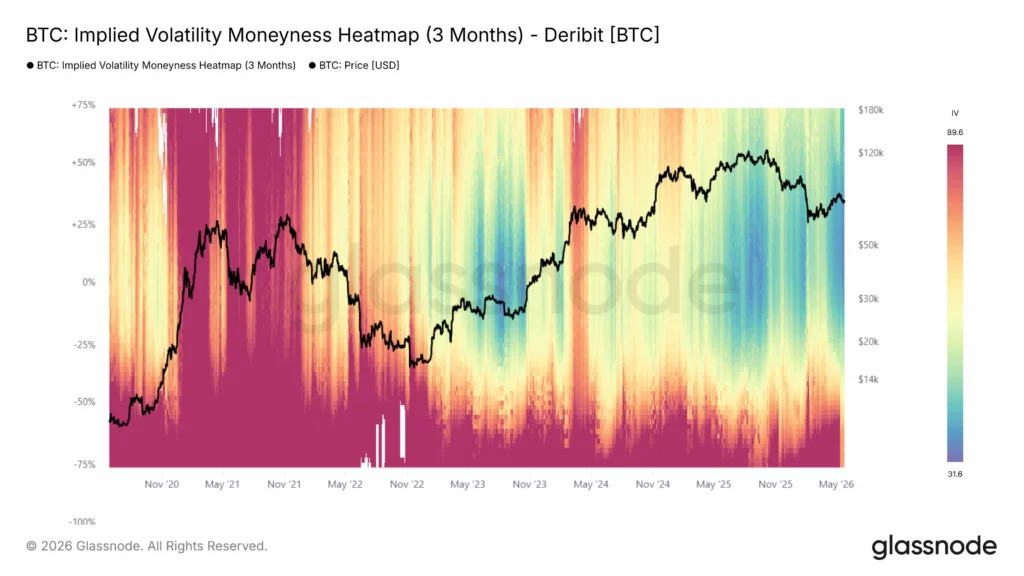
Options data adds another layer of caution. Glassnode data shows realized volatility has continued falling, while downside protection demand has returned. That setup can keep hedging flows active if BTC trades near short gamma zones around $75,000.
Bitcoin volatility may stay contained if support holds and ETF outflows ease. Still, price needs a stronger spot demand to move beyond a short bounce. Until then, traders are likely to watch $74,662 support and $76,327 resistance as the main near-term levels.
Disclosure: This content is provided by a third party. Neither crypto.news nor the author of this article endorses any product mentioned on this page. Users should conduct their own research before taking any action related to the company.

HIVE schedules Q4 and full-year 2026 results, earnings call to outline mining and AI compute performance
HIVE Digital Technologies Ltd., a publicly traded miner and data center operator, will publish its fiscal fourth-quarter and full-year 2026 results on June 1, followed by a webcasted earnings call on June 2 at 8:00 AM Eastern Time. The company, listed on the TSX and Nasdaq under the ticker HIVE, operates Bitcoin mining facilities and GPU-accelerated data centers across multiple jurisdictions.
Investors in listed mining companies will be watching HIVE closely. The company presents a hybrid business model that combines traditional proof-of-work Bitcoin mining with growing GPU-based hosting and AI compute services. That mix positions HIVE differently from pure-play miners, and the upcoming disclosure will be parsed for signs of how that strategy is translating into revenue and margin trends.
What investors will look for
While HIVE has not released financial figures ahead of the scheduled date, there are several operational and financial indicators market participants typically focus on for miners and data center operators:
- Bitcoin production and holdings – Quarterly BTC mined, the companys selling policy and changes in inventory are key for revenue recognition and balance sheet exposure to price volatility.
- Hash rate and capacity utilization – Changes in deployed ASICs, average network difficulty and effective hash rate provide insight into output capability and operational scale.
- Energy costs and sourcing – Miners margin heavily depends on power rates and availability. HIVE has emphasized low-carbon energy in its public materials, which can influence long-term operating costs and regulatory positioning.
- GPU hosting and AI compute revenue – Demand for GPU capacity from AI workloads has become a diversification avenue for several miners. The degree to which HIVE converts GPU deployment into recurring hosting revenue will be important for assessing revenue mix.
- Geographic performance – HIVE operates facilities in Canada, Sweden and Paraguay. Regional differences in power pricing, regulatory frameworks and uptime can materially affect results.
Strategic position and sector context
HIVE’s dual emphasis on hashrate services for Bitcoin and GPU-accelerated AI compute follows a broader industry trend where mining companies seek to diversify revenue streams amid cyclical crypto markets. GPU hosting can partially offset the volatility tied to BTC prices, by providing steady, contractual revenue from enterprise AI customers and cloud workloads. That said, GPU markets are competitive and capital intensive, and successful monetization depends on efficient deployment and strong client uptake.
For equity investors, HIVE and peers are often treated as barometers for several interlinked markets: the spot price of Bitcoin, the supply and utilization of mining hardware, and the emerging market for specialized AI compute capacity. Quarterly disclosures can influence sentiment across the miner cohort, particularly if companies adjust capital allocation between ASIC expansion and GPU deployment.
Governance, listings and leadership
HIVE trades on multiple exchanges, including the Toronto Stock Exchange and Nasdaq. The company has described itself publicly as an operator of Tier-I and Tier-III data centers and has highlighted energy sourcing as part of its operational narrative. Executive leaders named in prior corporate communications include Executive Chairman Frank Holmes and President and CEO Aydin Kilic. Management commentary on the earnings call will be closely watched for updates on strategy, capital spending plans and demand for GPU services.
Event access and disclosures
The company has said it will post the earnings release and a replay of the webcast on its investor relations website. Participation in the live call typically requires advance registration; registered participants receive dial-in details and the webcast link. As with most public companies, the formal financial statement and management discussion will provide the definitive view of performance for the period.
Implications for the market
Quarterly results from HIVE may have outsized relevance for several investor groups. Equity holders in mining firms will parse the report for operational efficiency and capital allocation between ASICs and GPUs. Bond and credit market participants and potential strategic partners may look for indications of stable hosting revenue that could underpin longer-term contracts. Finally, because mining companies often hold BTC on their balance sheets, results can influence both crypto market flows and the valuation multiples investors are willing to pay for miner equities.
Analysts and market commentators will also be watching for any commentary on supply chain dynamics for ASICs and GPUs, power procurement strategies, and regional expansion plans. These factors will help determine whether HIVE’s hybrid model offers a durable advantage against the backdrop of heightened demand for AI compute and the persistent cyclicality of crypto markets.
The companys full results and management commentary will be available after the scheduled release on June 1, and the earnings call on June 2 will provide additional colour on operational execution and strategic priorities.
How to follow
Investors and analysts can find the earnings release and webcast replay on HIVEs investor relations page. Those seeking the live discussion should register in advance to receive dial-in details and the webcast link.

Opinion: Parallel paths on track to converge

BTC could fall much lower as $150 billion Treasury operation nears

Starship V3 Debut, China’s New Crew, Goonhilly Sold, SpaceX Financial Details – Deep Space Updates


-

 Crypto World6 days ago
Blockchain.com files with SEC for U.S. IPO
-

 Fashion5 days ago
Holiday Weekend Open Thread – Corporette.com
-

 Crypto World6 days ago
Bitcoin Accumulation Weakens as BTC Realized Losses Hit $600M
-

 Tech3 days ago
Microsoft’s quiet Claude Code retreat and the real cost of enterprise AI
-

 Business6 days ago
Dell Technologies DELL Stock Surges 15% on AI Server Momentum and Analyst Upgrades in 2026
-

 Crypto World5 days ago
Robinhood crypto COO Tanya Denisova exits
-

 Business3 days ago
NYT Strands Answers May 24 2026 Revealed for Puzzle No. 812 Theme Summer Essentials
-

 Politics5 days ago
Makerfield: a tale of two social-media histories
-

 Crypto World6 days ago
Space X IPO Is ‘Bad News’ for Tech Stocks: But What About Bitcoin?
-

 Business6 days ago
Trump Invests $1M-$5M in Kura Sushi USA Chain With 27 California Locations
-

 Tech6 days ago
WhatsApp ads could make Irish debut after discussions with DPC
-

 Crypto World6 days ago
MicroStrategy’s Saylor Says Miners No Longer Set Bitcoin Price, Another Force Has Taken Over
-
Tech18 hours ago
The Samsung pay deal is the moment Korean unions changed register
-
 NewsBeat7 days ago
Charity run by Reform leader Malcolm Offord accused of ‘law breaking’ over Scottish registration
-
 Tech6 days ago
A 0.12% parameter add-on gives AI agents the working memory RAG can’t
-

 Crypto World6 days ago
AI infrastructure race heats up as IREN pitches full-stack strategy, WhiteFiber lands $160M deal
-
 Crypto World3 days ago
Nvidia (NVDA) CEO Calls on Super Micro to Strengthen Export Controls Amid Smuggling Probe
-

 Tech6 days ago
You Can Now Add ChatGPT To PowerPoint
-

 Tech3 days ago
Westone Audio and Etymotic Acquired by Fidelity Collective in Major IEM Market Move
-

 Sports6 days ago
2026 CJ Cup Byron Nelson leaderboard: Brooks Koepka finds putting stroke in Round 1
You must be logged in to post a comment Login