
Crypto World
Fake “Claude” Desktop App Distributes Crypto-Stealing Malware


A fake desktop application impersonating Anthropic’s Claude is reportedly being used as a delivery mechanism for RevStealer, a Windows malware strain designed to steal crypto-related data and other sensitive information. Researchers at Morphisec say the campaign has evolved beyond earlier distribution channels, including GitHub repositories and game-cheat themed sites, and that the “Claude Opus 5 Free Desktop” lure is now among the most prominent.
While the technical details are aimed at defenders, the operational choices behind RevStealer carry direct implications for users and anyone investing in or managing digital assets: the malware is built to avoid analysis, profile the infected machine, and then extract high-value information across browsers, password managers, wallet software, and even selected documents.
Key takeaways
- RevStealer is delivered via a fake “Claude Opus 5 Free Desktop” Windows app that impersonates Anthropic and offers supposed free access.
- The malware is designed to leave minimal traces and harvest browser data, cookies, password-manager records, VPN/remote-access settings, screenshots, and selected files.
- It targets more than 50 cryptocurrency wallets and can also capture messaging data and other credentials beyond crypto holdings.
- Before executing, it checks system characteristics consistent with real user environments and aborts if it detects signs of analysis or abnormal conditions.
- Curious about broader context: Morphisec’s report follows Kaspersky’s earlier identification of OkoBot, a separate framework aimed at crypto investors.
A Claude-themed lure masks a crypto-stealing payload
In a Monday report, cybersecurity firm Morphisec described how RevStealer has been distributed through multiple fronts, with earlier campaigns using GitHub repositories and game-cheat themed websites. The latest and most notable delivery method, the researchers said, is a project branded as “Claude Opus 5 Free Desktop” that impersonates Anthropic and promises free access to Claude.
From an attacker’s perspective, this approach is logical: it repackages a familiar consumer brand into a Windows installer or desktop program, lowering user skepticism and increasing the odds that victims will run the malicious payload.
Designed to extract high-value data from browsers, wallets, and more
Morphisec’s analysis portrays RevStealer as a multi-purpose stealer. The malware not only searches browser databases and cookies, but also looks for password-manager records and configurations tied to privacy and remote access. In addition, it targets VPN and remote-access settings and collects messaging data, which can reveal account recovery paths, authentication workflows, or direct access tokens.
For crypto users, the most significant operational detail is wallet targeting. Morphisec said RevStealer targets over 50 cryptocurrency wallets, positioning the malware to compromise both the user’s general credentials and the specific applications most likely to contain or facilitate asset management.
The report also notes that the malware can capture screenshots and selected documents. That matters because some users store seed phrases, backup codes, or operational instructions in non-wallet files—making document harvesting an extra layer of financial opportunity for attackers.
Execution gating: it tries to spot “analysis” before it acts
One of the more defensive-relevant elements of RevStealer, according to Morphisec, is the way it determines whether a machine resembles a real user environment. The malware checks available memory, the number of CPU cores, hostname and username information, and graphics hardware characteristics. It also monitors for debugging delays that are typical in malware analysis setups.
If the checks fail—if the system presents signals that look automated, instrumented, or otherwise atypical—RevStealer does not progress to the next stages of infection and malicious activity.
When the system passes, the malware decrypts its payload, stores it under a randomly generated name, and executes it covertly. This workflow is designed to reduce the chance that researchers can quickly identify the complete payload chain and to make behavioral detection harder when the malicious component only activates under specific conditions.
RevStealer follows a wider pattern of crypto-investor targeting
The Morphisec report arrives after earlier reporting by Kaspersky on a new malware framework targeting cryptocurrency investors called OkoBot. Kaspersky’s description, as referenced in Morphisec’s write-up, indicates that OkoBot can harvest crypto wallet files and browser data, steal user credentials, inject malicious extensions, and capture wallet application windows to help redirect or siphon assets.
Taken together, the two stories suggest a persistent trend: attackers are not limiting themselves to “wallet-only” theft. Instead, they are expanding into browser and credential ecosystems, then coupling that access with wallet application targeting and, in RevStealer’s case, extensive environmental checks to avoid discovery.
For investors, traders, and operators of digital asset infrastructure, this matters because compromises rarely begin in the wallet UI itself. The intrusion surface is often broader: downloadable “desktop” apps, browser states, stored credentials, and remote-access configurations that attackers can convert into the ability to act on funds.
What to watch next
With fake Claude desktop projects being used to deliver a stealer that targets both wallets and sensitive browsing credentials, users should watch for new impersonation campaigns and suspicious installers that promise free access to popular AI tools. On the defensive side, prioritizing endpoint protection, restricting execution of unknown binaries, and maintaining clean browser and password-manager hygiene may help reduce the odds that malware like RevStealer finds a usable environment before it can activate.

Ripple and SettleMint unveiled a new partnership on September 1. The deal merges custody, issuance, and lifecycle management into a single platform. Traditional finance firms now gain a simpler path toward digital asset adoption.
A Unified Platform for Institutions
SettleMint announced the collaboration in an official statement this week. The partnership links Ripple Custody with SettleMint’s Digital Asset Lifecycle Platform, known as DALP. Together, the two systems aim to accelerate tokenization adoption across the Asia Pacific region.
Fiona Murray, Ripple’s managing director for Asia Pacific, explained the strategic thinking behind the move. Institutions want to deploy digital assets without juggling separate systems for custody and governance. The combined platform gives them one foundation to build on and expand later.
Adam Popat, CEO of SettleMint, echoed that view in his own remarks. He described global capital markets as shifting fully on-chain in the current moment. As a result, custody and lifecycle management must now function as a single system rather than two.
Ripple’s Broader Institutional Strategy
Ripple continues to expand its custody infrastructure through several additional partnerships. The company has deepened ties with Securosys, Figment, and Chainalysis in recent months. These integrations aim to simplify how institutions secure digital assets, stablecoins, and real-world assets.
Ripple also plans to roll out the XRP Ledger v3.3.0 upgrade soon. The upgrade places tokenized real-world assets at the center of its roadmap. This step reflects Ripple’s wider strategy to court institutional capital through infrastructure improvements.
XRP itself traded higher following the announcement, rising more than one percent within 24 hours. The token moved between $1.36 and $1.40 during that window. Trading volume fell 16 percent, yet CME futures open interest still surpassed figures on Binance.
Regulatory Momentum Fuels Sector Growth
The partnership arrives as regulators reshape the tokenization landscape inside the United States. The SEC introduced tokenization innovation exemptions under the current administration this year. These changes encourage more institutions to seriously explore blockchain-based asset management.
The Depository Trust and Clearing Corporation also plans to launch its own tokenization service. That rollout is scheduled for October and adds further momentum to the sector. Multiple major players now compete to serve rising institutional demand for on-chain assets.
Financial firms increasingly need compliant infrastructure to manage complex ledger configurations safely. Custody providers must now handle growing volumes of tokenized assets without added risk. The Ripple-SettleMint partnership positions both companies to meet that rising demand directly.
Institutions across Asia Pacific stand to benefit most from this streamlined approach. Rather than managing multiple vendors, banks can now consolidate custody and issuance functions. This consolidation may lower operational costs while improving oversight of digital asset holdings.
The tokenization market continues to grow as traditional finance embraces blockchain technology further. Partnerships like this one signal a maturing industry ready for institutional-scale adoption. Ripple and SettleMint now join a growing list of firms building that infrastructure together.


Multiple crypto industry figures and CoinDesk staff received unexpected password reset emails on Tuesday, though there is no evidence yet that X itself has been breached.
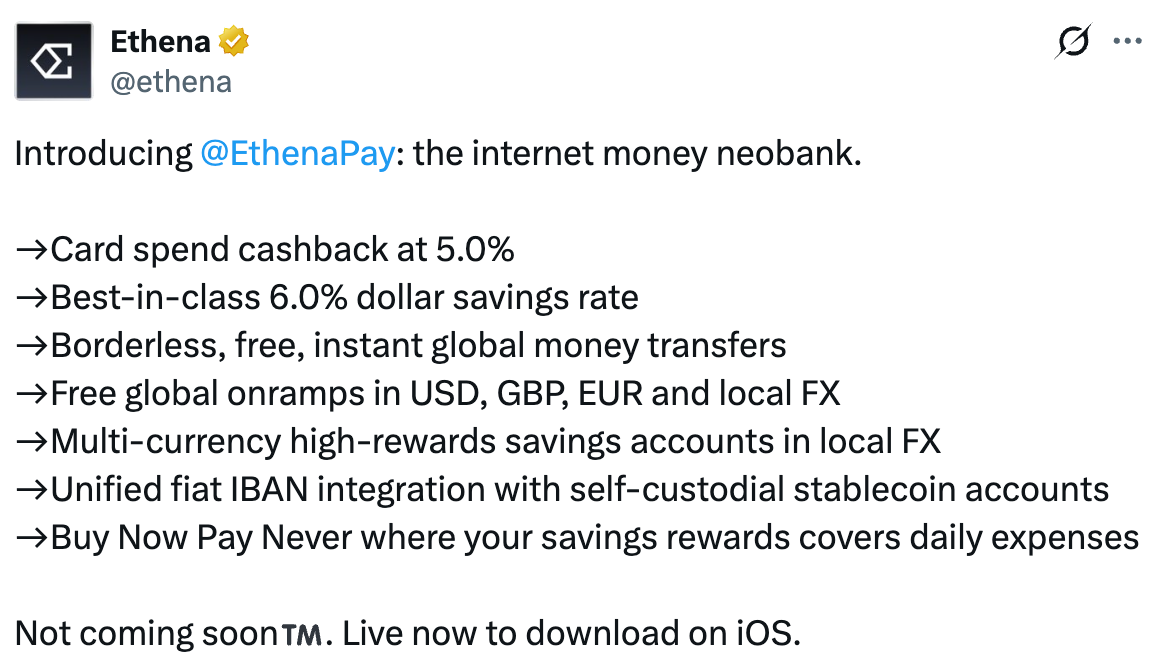
Ethena has launched a global money app built around its USDe synthetic dollar, expanding the crypto-native asset into everyday payments, savings and cross-border transfers.
According to Tuesday’s announcement, the self-custodial Ethena Pay app allows users to hold USDe through a dollar-denominated balance, earn as much as 6% in annualized rewards and spend funds through a payment card, while supporting fiat onramps.
The beta rollout includes 48 countries across Latin America, the Caribbean, Africa, Asia and other regions, though the initial rollout is limited to 400 users, with access set to expand weekly, Ethena said in a Tuesday thread on X. Avalanche will serve as the exclusive settlement layer for payments and transfers.
Source: Ethena
Users can deposit fiat or crypto, with funds converted into USDe (USDe). The app enables using IBAN details to move money to and from external bank accounts into local currencies. MoonPay-owned Iron provides backend infrastructure.
Ethena Pay is not initially available in the US, EU, Canada, Taiwan or South Korea, though Ethena expects to expand into those markets during the beta, subject to regulatory approval.
Related: Chelsea FC gets a stablecoin sponsor after UK FCA warning to clubs
Ethena’s USDe grows as ENA rallies
Ethena is an Ethereum-based protocol behind USDe, a synthetic dollar designed to maintain its value near $1 without relying on traditional banking infrastructure.
USDe uses crypto collateral alongside hedging strategies, including derivatives positions, to help maintain its peg. The asset has grown to a market capitalization of about $4.1 billion, making it the sixth-largest stablecoin, according to DefiLlama data.
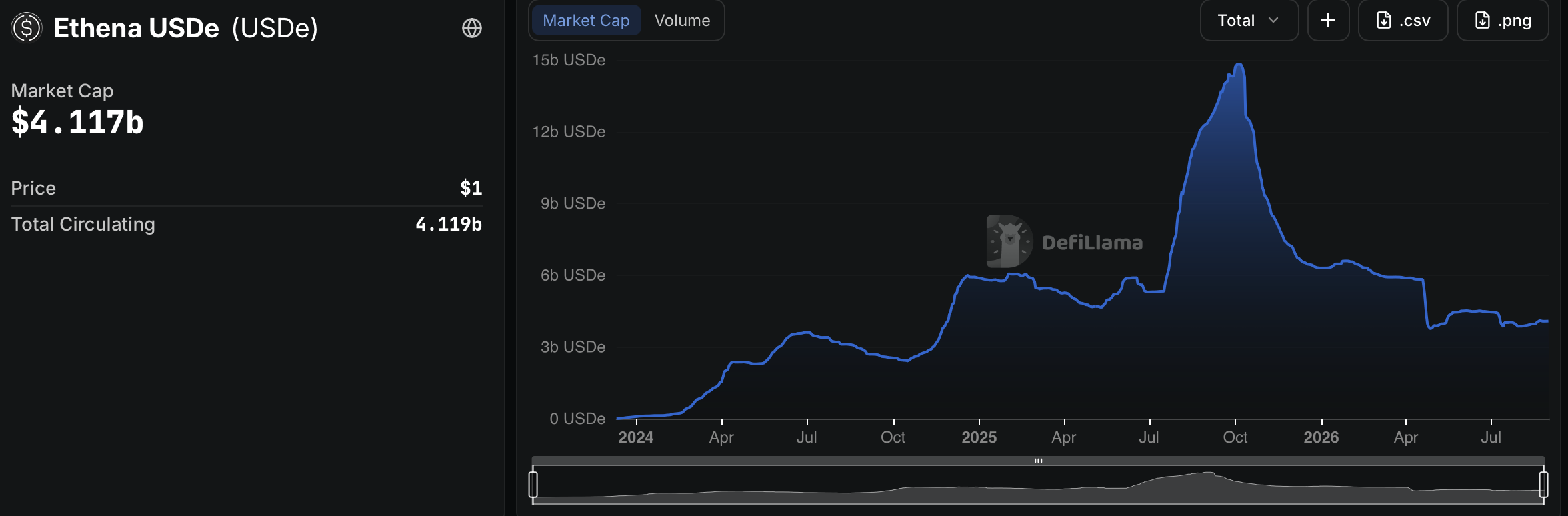
USDe market cap. Source: DefiLlama
Ethena also operates ENA, the protocol’s governance token, which has a market capitalization of roughly $1.5 billion. The token has rallied sharply over the past month, gaining about 68%, but remains well below its previous highs.
On Friday, the Ethena Foundation proposed directing 95% of the net revenue it receives from Ethena’s core businesses toward ENA buybacks once USDe’s circulating supply reaches $7.5 billion. ENA rose more than 10% following the proposal and gained 27% over the week.
The token recorded about $595 million in trading volume over the past 24 hours, up 16% from the previous day, and was trading around $0.16 on Tuesday, according to CoinGecko.
Magazine: Does the Bitcoin rally mean we haven’t wasted our lives in crypto?


A group of 21 major financial institutions plans to establish a new company to develop and issue stablecoins, offering another sign of traditional finance’s push into digital dollars as regulatory frameworks take shape.
The consortium, announced Tuesday, includes Bank of America, Goldman Sachs, Citi, Deutsche Bank, UBS, Santander, MUFG and Fidelity Investments. It plans to launch a US dollar-denominated stablecoin in the first half of 2027, subject to the company’s formation and other conditions.
According to the announcement, the group ultimately plans to expand into stablecoins denominated in other G7 currencies, with a euro offering identified as its next priority.
The consortium said its stablecoin will target wholesale, institutional and retail markets, including use cases such as cross-border payments and digital asset settlement. The initiative is intended to comply with both the US GENIUS Act and the European Union’s Markets in Crypto-Assets Regulation (MiCA), where applicable.
The venture builds on an initiative announced last October, when an initial group of 10 banks said they were exploring a 1:1 reserve-backed form of digital money available on public blockchains. The consortium has since more than doubled in size, bringing together financial institutions across North America, Europe, East Asia, the Middle East and Africa.
Related: Kast launches stablecoin-powered business platform after $80M raise
Banks deepen push into stablecoins
The move comes as stablecoins have grown considerably in recent years, with the passage of the GENIUS Act and MiCA creating clearer regulatory pathways for adoption.
Elsewhere, Singapore is considering allowing jointly issued cross-border stablecoins into its regulatory regime, according to a Tuesday announcement, revisiting its earlier decision to restrict the framework to domestic issuance.
Institutional interest was already taking shape in early 2025, when a Fireblocks survey of 295 executives found that 90% of respondents were using or planning to use stablecoins.
Since then, major financial institutions have expanded their presence in the sector. Societe Generale’s crypto subsidiary has issued euro- and dollar-denominated stablecoins, while Fidelity recently launched its US dollar-pegged FIDD stablecoin.
SocGens crypto subsidiary has issued euro- and dollar-denominated stablecoins, as has Fidelity, with its FIDD US dollar-denominated entry. Last month, Standard Chartered backed a Hong Kong dollar stablecoin venture.
Related: SEC sends crypto custody rule overhaul to White House for review
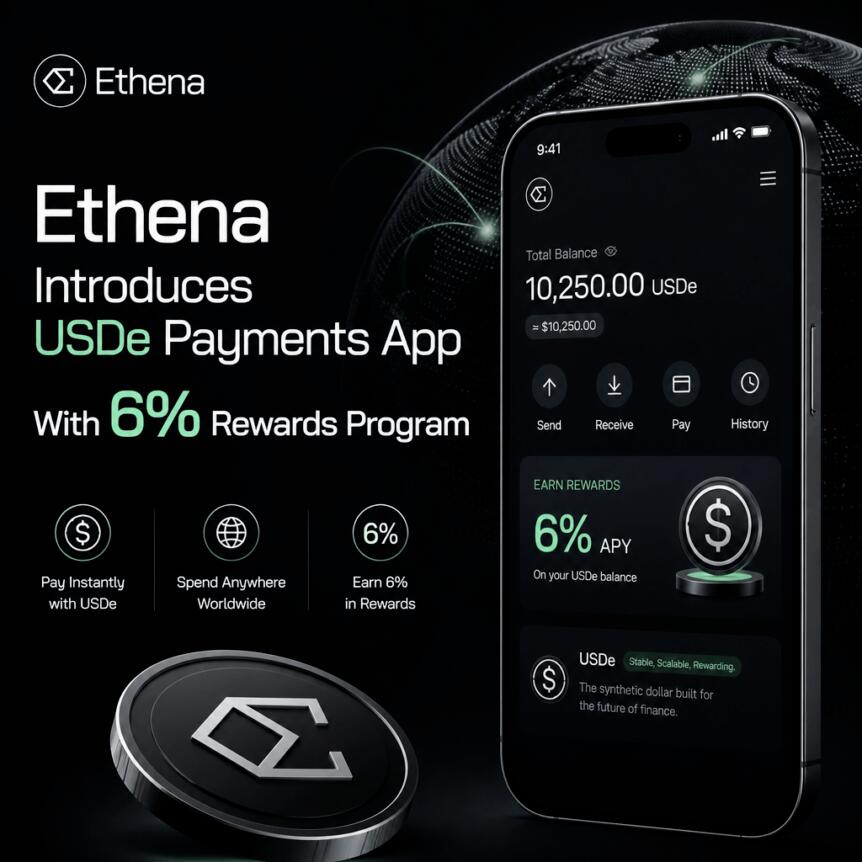
Ethena has rolled out Ethena Pay, a global “money app” designed to bring its USDe synthetic dollar into everyday use—covering payments, savings and cross-border transfers. The announcement positions USDe less as a tradeable stablecoin and more as a mechanism for day-to-day value storage and movement.
According to Ethena’s update posted on X, the self-custodial app will let users hold USDe via a dollar-denominated balance, earn up to 6% annualized rewards, and spend using a payment card. The beta rollout is set to begin with limited access—initially 400 users—before expanding weekly across a broad set of regions.
Key takeaways
- Ethena Pay is a self-custodial app built around USDe for payments, savings and transfers.
- Users can deposit fiat or crypto, with funds converted into USDe (USDe) for a dollar-denominated balance.
- The beta begins with 400 users and expands weekly; Ethena targets 48 countries at launch.
- Avalanche is named as the exclusive settlement layer for payment and transfer flows.
- Ethena Pay is not initially available in the US, EU, Canada, Taiwan, or South Korea, with expansion tied to regulatory approval.
Ethena Pay turns USDe into a daily-use wallet
Ethena’s pitch with Ethena Pay is straightforward: users should be able to hold USDe like a cash-like balance and use it for commerce and transfers without relying on traditional banking infrastructure. In the beta, Ethena says users can deposit fiat or crypto, after which funds are converted into USDe (USDe).
The app also supports movement between external banking systems. Ethena states that the product can use IBAN details to move money to and from external bank accounts into local currencies, effectively framing USDe as the routing layer for cross-border activity.
Infrastructure for the onramp/offramp components is partly handled by Iron, which Ethena describes as being owned by MoonPay. This is relevant for users because it points to a practical bridge between conventional fiat rails and a synthetic stablecoin-based balance rather than requiring fully crypto-native onboarding for everyone.
Beta geography and rollout pace
Ethena says the beta rollout will cover 48 countries, spanning Latin America, the Caribbean, Africa, Asia and other regions. However, the initial distribution is narrow: access is limited to 400 users at the start.
That staged approach matters for risk management and operational testing, particularly for a product combining self-custody, fiat conversion, card-based spending and cross-border transfer workflows. The weekly expansion schedule suggests Ethena intends to validate demand and reliability while broadening coverage gradually.
There is also clear geographic constraint in the initial release. Ethena states that Ethena Pay is not initially available in the US, EU, Canada, Taiwan or South Korea. Ethena expects to expand to those markets during the beta period, but only “subject to regulatory approval,” highlighting that the technical rollout is not the only gating factor.
Avalanche settlement for payments and transfers
One of the more concrete architectural decisions in Ethena’s announcement is the choice of Avalanche as the exclusive settlement layer for payments and transfers within Ethena Pay. For users, that implies that while USDe is the value unit being held and moved, the underlying settlement mechanism for the app’s transaction flows will be handled through Avalanche, not directly through Ethereum’s base layer.
For developers and investors, this signals an intent to treat USDe as a payments-focused asset that can interoperate with non-Ethereum execution environments at the settlement layer. It also reduces a common friction point—where stablecoin-based payment products often get bogged down in settlement throughput, latency, or cost considerations tied to a single blockchain choice.
USDe growth and what it means for Ethena’s expansion
Ethena is an Ethereum-based protocol underpinning USDe, a synthetic dollar designed to keep its value close to $1 without depending on traditional banking reserves. USDe maintains its peg using a combination of crypto collateral and hedging strategies, including derivatives positions, according to Ethena’s documentation.
As USDe expands beyond trading and into payments, size and adoption become more than marketing talking points. DefiLlama data shows USDe has reached a market capitalization of approximately $4.1 billion, which DefiLlama ranks as the sixth-largest stablecoin.
Ethena’s growth story is paired with movement in its governance token. Ethena operates ENA, which has a market capitalization of roughly $1.5 billion, according to the figures cited in the underlying reporting. ENA has reportedly rallied sharply over the past month, up about 68%, though it remains below earlier highs.
On Friday, the Ethena Foundation proposed directing 95% of the net revenue it receives from Ethena’s core businesses toward ENA buybacks once USDe’s circulating supply reaches $7.5 billion. After that proposal was made, ENA rose more than 10%, and was reported to gain 27% over the week.
Market activity around ENA has also been notable. The article notes ENA trading volume of about $595 million over the past 24 hours, up 16% from the previous day, with CoinGecko data placing its price around $0.16 on Tuesday.
While Ethena Pay is about real-world utility for USDe, the token mechanics matter because they can shape investor expectations around how Ethena may fund growth and align token incentives. The buyback proposal, tied to a specific USDe supply threshold, also creates a clear milestone that readers can watch as a proxy for how quickly the ecosystem is scaling.
What to watch as Ethena Pay expands
For now, the biggest open question is how quickly Ethena can convert a crypto-native stablecoin economy into mass-friendly payment and transfer usage while operating within regulatory limits. As the beta expands weekly from the initial 400 users across the planned 48 countries, the rollout to excluded markets—particularly the US, EU, Canada, Taiwan and South Korea—will likely be the next major indicator of whether Ethena can scale Ethena Pay beyond the initial geography.

Retsky recently met a child who kept his head down through a series of introductory questions. “I didn’t even see his face yet,” she says. Pizza or tacos? No enthusiasm. Then she asked about horror movies. “Finally, he lifted his head,” she says. “I got to actually see the kid I was working with.”
Find an organic opening
There’s no need to formally schedule your child’s weekly lesson. Announcing that every Tuesday at 7 p.m. is now Teach Your Parent Night is an excellent way to transform a fun idea into homework.
Instead, treat “once a week” as a reminder to notice one natural opening. If your child is drawing, building, cooking, playing a game, practicing a dance, or excitedly recounting something they learned, get curious. Try: “Wait, how did you do that?” or “I don’t know how that works. Can you show me?”
For younger kids, concrete activities are often easiest. Ask them to show you how to draw a monster, build a LEGO house, make a play-dough pizza, or perform a favorite dance. School-age kids might teach you a basketball rule, explain the strategy behind a video game, or demonstrate how they created something. With teenagers, Anderson-Kahl suggests asking: “What’s something kids your age understand that adults don’t?” They might explain a slang term, a piece of technology, a social-media controversy, or why millions of people are refreshing the TikTok feed of a creator you’ve never heard of.

Bitcoin rose 25% in August, its strongest monthly gain since November 2024. The asset briefly crossed $80,000 last week but has since settled near $78,000. The rally, nonetheless, has renewed interest among retail players in one of crypto’s key markets.
In fact, new data suggests that South Korean investors are staging a comeback.
Korean Risk Appetite
Data shared by CryptoQuant revealed that the Korea Premium recently flipped positive after recording its longest period of negative readings. The analytics platform added that this shift from negative to positive territory “has typically been followed by a positive trend.”
The gap between BTC prices on Korean exchanges and global markets is known as the “kimchi premium” and is widely viewed as an important indicator to gauge retail investor sentiment across Asia and local market demand.
Rachael Lucas, an analyst at BTC Markets, stated,
“Korean retail tends to buy aggressively in risk-on phases and capital controls mean that buying shows up as a price gap rather than arbitrage flow. Historically, discount-to-premium crossings have preceded stronger bitcoin returns over the following weeks.”
Bitcoin ETF Road Ahead
But while retail demand appears to be returning, access to regulated Bitcoin investment products remains limited in the country. CryptoQuant founder Ki Young Ju believes that the next stage of BTC’s current cycle could be driven by institutional demand and exchange-traded funds outside the US. It is important to note that South Korea still lacks a spot Bitcoin ETF, while retail investors cannot buy foreign ETFs and local companies cannot open exchange accounts to purchase BTC.
According to Young Ju, the market has so far been largely shaped by US adoption, but institutional participation could expand across the world through deeper stablecoin liquidity and real-world asset infrastructure.
A July report by CryptoPotato revealed that Japan is getting closer to allowing Bitcoin ETFs, as the country gears up for its first product, potentially launching in 2028 if planned regulatory changes move ahead. Lawmakers had approved amendments that bring crypto assets under the Financial Instruments and Exchange Act, while the Financial Services Agency is working on changes to investment-fund rules that would allow investment trusts and ETFs to hold digital assets directly.
If approved, a spot Bitcoin ETF would give investors in Asia a simpler way to gain exposure to BTC. The development could be particularly relevant for South Korea, where Japan’s financial policy has often served as a reference point.
More on Bitcoin and a big PlanB statement can be found in our dedicated market video below:
The post Bitcoin’s Korea Premium Flips Positive After Its Longest Losing Streak appeared first on CryptoPotato.
X accounts were hit on Tuesday by password reset emails nobody asked for. One user’s inbox shows eight emails landing in three minutes. X says it has found no breach.
The emails are real, coming from X itself, not from fake senders. Attackers are pointing X’s own recovery form at public usernames, over and over.
Follow us on X to get the latest news as it happens
Major Hack Attempt on X
X answered through Mridul Singhai, a product engineer at the company. He gave a motive, denied a breach, and apologized.
Attackers appear to believe that, now that XMoney is widely available, they can gain unauthorized access to accounts. We are actively investigating the issue and, so far, have found no evidence of any breaches. We apologize for the multiple emails and appreciate your patience…,” wrote Singhai.
That was the company’s only word on it. The main X account, X Support, and X Money all stayed silent.
The motive fits the calendar. X Money began peer-to-peer payments for US Premium subscribers in late June. Deposits sit at Cross River Bank, with federal insurance of up to $10 million.
So an X login is now also a bank login. That changes the math. A stolen profile can promote a fake token. A stolen wallet can be emptied.
No leak has been confirmed. Attacks like this usually run on old email lists that circulate on criminal markets for years.
How X Users Can Stop the Reset Spam
X’s recovery form accepts a username on its own. Usernames are public. That is the whole opening.
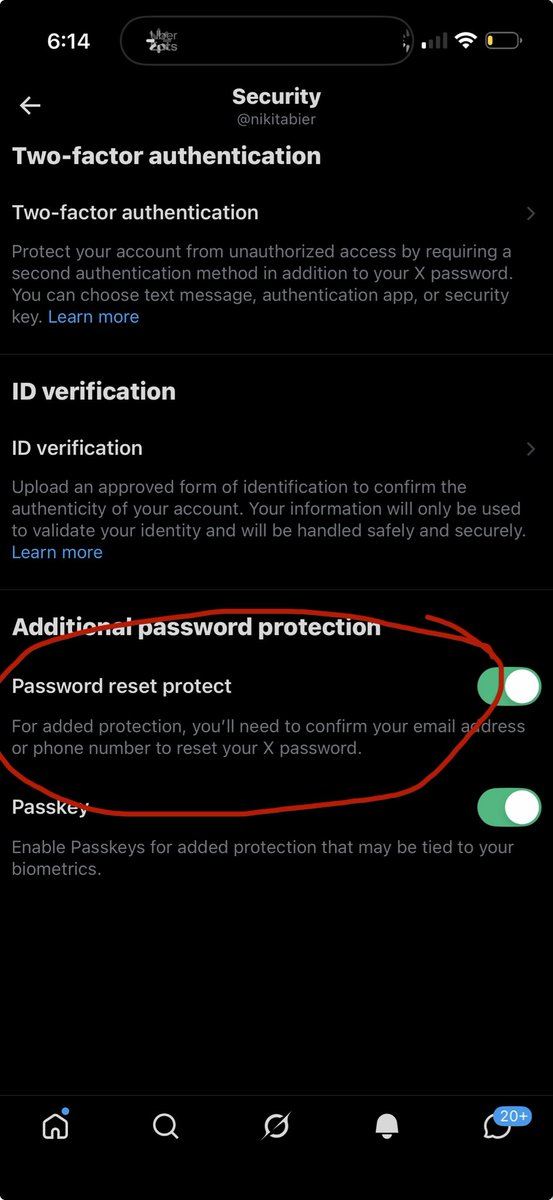
The fix already exists: X’s help pages tell anyone receiving resets they “did not request” to turn on Password reset protection. The form then demands the email or phone on file first.
Nikita Bier, formerly head of product at X, posted the toggle on Tuesday. His screenshot passed 85,000 views by the afternoon.

“Just turn this on,” Bier noted.
Two more layers help:
- Use an authenticator app rather than text messages, and add a passkey, which ties login to your device.
- Leave the emails alone, because fake 2FA prompts have drained crypto wallets before.
X has been here before, albeit from the inside. In July 2020, attackers talked their way past staff and reached an internal admin tool. They swapped confirmation emails and forced resets on 130 accounts, taking $118,000 in Bitcoin.

This time the attackers are outside, using a public form. The target has not changed. Neither has the advice on hardening X accounts.
Whether X rate-limits the form or leaves this to users is still open.
The post X (Twitter) Alert: Major Password Reset Attack Breaks Out appeared first on BeInCrypto.


- REAL Finance expands $ASSET access to eligible Kraken EU users.
- $ASSET supports fees, staking, security, and governance on REAL Finance.
- REAL Finance targets over €3.5 billion in assets for European tokenization.
REAL Finance has expanded access to its native $ASSET token in Europe after the token became available to eligible users through Kraken EU.
The move gives European participants broader access to the token as REAL Finance continues developing infrastructure for tokenized real-world financial assets.
The Sofia, Bulgaria-based company said the expanded availability builds on $ASSET’s existing presence on Kraken and extends access through the exchange’s European Union operations.
$ASSET serves several functions within the REAL Finance network.
The token is used to pay transaction fees, participate in staking, support network security, and take part in onchain governance.
The expansion comes as demand for infrastructure supporting tokenized financial assets develops across European markets.
Network targets institutional RWA market
REAL Finance is developing a Layer 1 blockchain focused on tokenized real-world financial assets.
Its infrastructure is designed to support financial products throughout their lifecycle, including issuance, management, distribution and settlement.
The network is also working with regulated financial institutions and infrastructure providers as it builds its European institutional ecosystem.
One of its partners is Wiener Privatbank, an Austrian bank regulated by the Austrian Financial Market Authority (FMA).
According to REAL Finance, Wiener Privatbank supports custody, reserve management, asset structuring and institutional distribution within the ecosystem.
The companies are targeting more than €3.5 billion in assets for tokenization through the REAL Finance ecosystem.
The project’s broader infrastructure is intended to connect regulated financial institutions, custodians and other counterparties with blockchain-based financial markets.
For REAL Finance, the listing on Kraken EU provides another route for eligible European users to access $ASSET while the company works to expand the institutional applications of its blockchain infrastructure.
REAL Finance focuses on Onchain Capital Markets
REAL Finance CEO Ivo Grigorov said Europe remains an important market for the company as it develops infrastructure connecting regulated institutions with blockchain-based capital markets.
“Europe is a key market for REAL Finance as we build the infrastructure connecting regulated financial institutions with onchain capital markets,” said Grigorov. “Expanding access to $ASSET through Kraken EU gives more participants in the region a way to engage with the network as that institutional ecosystem grows.”
The company said its infrastructure covers tokenized financial assets from issuance and custody through settlement and potential secondary-market utility.
The broader focus is on creating an institutional onchain capital markets ecosystem for the tokenization, management and settlement of real-world financial assets.
With $ASSET now available to eligible users through Kraken EU, REAL Finance is seeking to combine greater token accessibility with the continued development of its European institutional network.
The company’s strategy remains centered on bringing regulated financial assets and associated capital-market activities onchain.


Allbirds, a once-popular shoe brand, rebranded to Smartbird – an AI company – a few months ago, and the stock soared.
While shares had been slowly – and then quickly – deteriorating since the brand’s IPO, on news of this pivot, they quickly shot up to over $20 overnight, an increase of over 800%.
But in a situation that is darkly reminiscent of the infamous Long Blockchain Company, Smartbird’s share price has since collapsed to the exact same price it was before becoming an AI company, and the future looks bleak.
What was Allbirds?
Full disclosure: I own a pair of Allbirds [editor note: I also have owned several pairs and enjoyed them]. They’re great. They look snazzy, in a casual sense. They’re a lovely, warm, wet sand-yellow. I bought mine on a trip to Tokyo; I can even recall the sales pitch.
The Allbirds store was mostly empty, and I wasn’t hunting for a new pair of shoes. But the rows and rows of Allbirds called to me. The Japanese saleswoman started her initial spiel about how the shoes were sourced from high-quality, sustainable materials. Finally, perhaps in an act of desperation, she told me, “You can throw them in the washing machine and they will look just like new.”
I was sold.
I love my Allbirds. I generally use slip-ons and the best part of my Allbirds is that they aren’t slip-ons. They’re real shoes with heel and arch support. I can walk for miles and my feet don’t hurt, and, lastly, the saleswoman wasn’t lying: I wash them and they look like new.
But despite never hearing about Allbirds before this moment in Japan, I was late to the game. It turned out, in fact, that I was showing up for the fleeting encore performance right before the dramatic end of the show.
What happened to the shoe company?
The short story is that, after a brief moment of explosive sales years and years ago, to the point that the C-suite could take the company public, no one wanted to buy Allbirds anymore. Revenue fell through the floor, the stock died, and the company desperately needed to pivot.
The longer story goes something like this:
Allbirds was celebrated by Silicon Valley elites and politicians and was even a media darling, largely due to its campaign of using sustainable materials. Before going public, the brand was pushing hundreds of millions in revenue every year and was considered a fashion icon at the time, along with the likes of Lululemon, focusing on casual, cozy clothes.
Fashion is a fickle mistress. Allbirds IPOed at the peak of consumer interest in the brand, and the stock tumbled basically forever after day one. Allbirds remained focused on sustainable materials, shoes, and their direct-to-customer sales model. To put it bluntly, an inability to change killed Allbirds.
After being valued at $4 billion on IPO day, it only took two years for the company to lose over 85% of that valuation.
This year, Allbirds sold off its footwear IP and merchandise to American Exchange Group for a measly $39 million – a massive fall from grace. In general, American Exchange Group buys failing clothing companies and licenses and distributes them after purchase, owning such well-known brands as bebe, Rocawear, Ed Hardy, and Rampage.
So, while the shoes will likely no longer be seen in global retail stores, they’re still available online. It’s unclear if quality will remain the same or if American Exchange Group will need to cut costs significantly to make the brand profitable again.
As for why a pivot to AI? It helps that the company is steeped in Silicon Valley culture and was invested in early by the biggest names in tech at the time, along with private equity funds.
With America in the midst of an AI boom, it makes sense for the company, which remains publicly listed despite years of price action in the doldrums and poor returns, to try and jump on the biggest hype train around before it’s completely left the station.
What does Smartbird do?
Bluntly: nothing yet. But maybe they will do something related to artificial intelligence soon?
Their latest quarterly financial documents put forward stark realities about headwinds the company faces, from “fac(ing) intense competition from larger, more experienced and significantly better-capitalized companies” to the fact that “[Smartbird] may be unable to implement [an AI Infrastructure Business] successfully or at all.”
The once fashion miracle story is now looking for a second miracle, this time related to AI infrastructure. Whether it can stumble upon that miracle is yet to be seen, but post-pivot it’s looking downright ugly for Smartbird: since hitting a peak of just over $24 on April 15th, Smartbird has shed 90% of its value, now trading around $2.50.
The CEO released a lengthy, optimistic letter to shareholders in August. There are no specifics or timelines, but they seem to be targeting every industry and all sizes of customer.
Allbirds’ mantra used to be pretty clear, if overly optimistic: “Create better things in a better way.” Smartbird’s new slogan is more ambiguous and certainly not optimistic, if it suggests any personality at all: “Built for AI, managed for you.”
Got a tip? Send us an email securely via Protos Leaks. For more informed news and investigations, follow us on X, Bluesky, and Google News, or subscribe to our YouTube channel.

Briton rescued in Nepal nearly a week after deadly floods swept through country

Chobani funneling $1.2 billion into Allentown campus

Ripple, SettleMint Team Up to Streamline Tokenized Asset Custody

Weekend Open Thread – Corporette.com

Weekend Open Thread: Brooks Brothers

London Mayor Sadiq Khan handed a peerage by Keir Starmer alongside 15 other Labour figures… just days before the PM leaves No10

You Will NEVER Guess Who Just Bought XRP The Crypto Market And Bitcoin Are Aiming To 20x In Price

83-Minute Finance Masterclass If You’re in Your 20s & 30s (All Secrets Revealed) @financewithsharan
![Everyone Wants a Bitcoin Pullback. History Says They Don't Get One [Kalshi Live Trading]](https://wordupnews.com/wp-content/uploads/2026/09/1788281404_maxresdefault-80x80.jpg)
Everyone Wants a Bitcoin Pullback. History Says They Don’t Get One [Kalshi Live Trading]
-

 Crypto World7 days ago
SpaceX stock could rise 75% to $240, JPMorgan says
-

 Fashion4 days ago
Weekend Open Thread: Maeve – Corporette.com
-

 Crypto World5 days ago
Bitcoin’s 22% rally now needs real demand to outlast Treasury liquidity boost
-

 Crypto World6 days ago
Warsh Jackson Hole keynote puts financial innovation first
-

 Business5 days ago
Salesforce Stock Soars 19% as Blowout Earnings and Agentforce AI Growth Silence Software Skeptics
-

 Crypto World6 days ago
Elon Musk Grok Bot Promise: We Will Make You Whole if AI Loses Your Money
-

 Business5 days ago
Apple Confirms September 9 Keynote and Reveals Its Full Pre-Order Schedule
-

 Crypto World7 days ago
Did Trump Just Move SpaceX Stock With One Truth Social Post?
-

 Business4 days ago
Onto Innovation Stock: AI’s Next Bottleneck Is Yield (NYSE:ONTO)
-
 NewsBeat6 days ago
Lindsay Clancy jury braces for closing arguments as judge tells court: ‘You’ve heard all the evidence’ – Live updates
-

 Business6 days ago
Walmart takes aim at younger shoppers with new fashion brand
-

 Crypto World4 days ago
Bitcoin price tests $82K resistance as Brandt stays long
-

 Crypto World6 days ago
NVIDIA revenue hits $96.2B as AI demand doubles
-

 Business7 days ago
Thailand’s Eastern Economic Corridor Capital City (EECiti): Key Developments and Investment Opportunities
-

 Business4 days ago
iPhone 18 Pro Pre-Orders Could Shift to Saturday as Apple Reportedly Avoids September 11 Anniversary
-

 NewsBeat7 days ago
Trump’s trade truce with China faces test with Iran effort
-
 Crypto World6 days ago
Nvidia Q2 Earnings Reveal $96.2 Billion Beat, So Why Is NVDA Falling?
-
 Tech3 days ago
Hugging Face built a $4.5 billion empire on free AI models. Now Nvidia is buying it for $12.9 billion
-

 Tech6 days ago
Claude Cowork gets its own browser that doesn’t touch your tabs, bookmarks, or saved passwords
-

 Crypto World5 days ago
Truflation calls for Fed rate cut after PCE forecast
You must be logged in to post a comment Login