

Crypto World
Fed’s Waller warns inflation may force new hikes, rattling risk assets



Federal Reserve Governor Christopher Waller warned that stubborn inflation and surging energy costs now outweigh labor market risks, signaling that rate hikes are “back on the table” and jolting expectations that had been primed for cuts a few months ago.
Summary
- Waller said US CPI hit 3.8% in April with energy prices up 17.9% as oil climbed above $100 per barrel
- Core PCE inflation rose to 3.3%, its highest level in more than two years, while unemployment held at 4.3% and GDP grew 2%
- He urged dropping the Fed’s “easing bias” and said rate increases cannot be ruled out if inflation does not abate soon
In a speech described as “hawkish” by Wall Street Journal economics correspondent Nick Timiraos, Waller argued that “inflation is not headed in the right direction” and that the balance of risks has shifted away from the labor market and toward price stability.
Why is Waller calling for an end to the Fed’s easing bias?
He pointed to April’s 3.8 percent year on year consumer price index reading and a 17.9 percent jump in energy costs, which he tied to Middle East conflicts that have pushed oil above $100 per barrel and filtered into gasoline, transport and production costs across the economy.
On the Fed’s preferred core PCE gauge, which strips out food and energy, Waller noted that inflation has climbed to 3.3 percent, the highest level in more than two years, even as unemployment holds around 4.3 percent and real GDP grows near 2 percent.
“Based on this recent data, I would support removing the ‘easing bias’ language in our policy statement to make it clear that a rate cut is no more likely in the future than a rate increase,” Waller said, in comments relayed by Bloomberg TV’s Annmarie Hordern.
At the same time, he stopped short of demanding an immediate move, with ZeroHedge highlighting his line that he does not think the Fed “should consider hikes in the near future,” framing his stance instead as a live threat if inflation refuses to cool.
Timiraos summed up the shift by saying Waller “comes across as quite troubled by recent inflation developments,” and reported that the governor believes markets are still underpricing the risk that higher energy prices will prove more persistent than investors expect.
What could Waller’s hawkish turn mean for Bitcoin and crypto?
For crypto markets, Waller’s warning hits the same macro channel that has powered Bitcoin’s biggest moves this year, with traders toggling between “higher for longer” yields and recession‑driven rate cuts as they price digital assets against real rates and the dollar.
Earlier this spring, Bitcoin rallied back above $70,000 as a Trump brokered two week ceasefire with Iran and hopes of policy easing sent risk assets surging, a pattern covered when Bitcoin (BTC) steadied while Iran briefly reopened the Strait of Hormuz even as oil markets stayed tight.
More recently, crypto traded in lockstep with Middle East headlines and Fed repricing, with crypto market outlook reports noting how every twist in US Iran tensions and Hormuz blockade threats fed directly into bets on inflation, energy and the path of rates.
If Waller’s shift from a dovish bias to a posture where hikes are explicitly “back on the table” convinces markets that the next move could be up rather than down, higher real yields and a stronger dollar would usually pressure both gold and crypto, just as bullion slid below $4,500 as traders raised the odds of another Fed move.
At the same time, persistent 3.8 percent headline inflation and 3.3 percent core PCE also reinforce the long running narrative of Bitcoin as an alternative hedge against US policy slippage, a theme that resurfaced when Bitcoin reclaimed $70,000 on ceasefire relief even as bond markets priced in a more volatile rate path.
The near term impact is likely to be higher volatility as macro desks reprice the Fed curve into year end and algorithmic flows lean against risk assets on any uptick in rate hike odds, a dynamic that has repeatedly amplified intraday swings across spot Bitcoin, leveraged crypto derivatives and related tokens whenever Fed officials pivot their tone.

Crypto World
Iren (IREN) Stock Surges on Jefferies Buy Rating: AI Infrastructure Play Gains Momentum

TLDR
- Jefferies launched coverage of Iren (IREN) with a Buy recommendation and $79 price objective; shares were hovering near $58.11.
- The stock rallied approximately 5% during premarket hours Thursday after the bullish analyst report.
- Analysts emphasized IREN’s approximately 6 gigawatt land portfolio and fully integrated GPU cloud infrastructure.
- The firm has secured a five-year, $9.7 billion agreement with Microsoft and a $3.4 billion Nvidia AI cloud partnership, aiming for $3.1 billion in yearly recurring revenue.
- Revenue at IREN surged 105% in the trailing twelve-month period as the business shifted from cryptocurrency mining operations to AI infrastructure services.
Shares of Iren (IREN) gained approximately 5% during Thursday’s premarket session following Jefferies’ initiation of coverage featuring a Buy recommendation and a price objective of $79. Trading around $58.11 when the coverage began, the target represents potential upside of roughly 36%.
Jefferies analyst Jonathan Petersen spearheaded the coverage launch, emphasizing IREN’s standing as a fully integrated AI cloud infrastructure company backed by an extensive powered land portfolio spanning approximately 6 gigawatts.
The investment firm underscored IREN’s strategic partnerships with Microsoft and Nvidia as fundamental pillars supporting the bullish thesis. Combined, these agreements are projected to generate $3.1 billion in recurring annual revenue.
The Microsoft partnership encompasses a five-year arrangement valued at $9.7 billion for Nvidia GB300 GPU infrastructure, centered at IREN’s 200 MW Childress location. The deal structure features a $1.9 billion advance payment alongside $3.65 billion in GPU financing carrying approximately 6% interest.
According to Jefferies, this framework enables IREN to recover its $8.8 billion capital outlay during the contract period, delivering unlevered internal rates of return above 20%.
Additionally, IREN maintains a distinct $3.4 billion AI cloud partnership with Nvidia. Jefferies noted these strategic relationships position IREN alongside industry players like CoreWeave (CRWV) and Nebius (NBIS) in the competitive landscape.
Transformation From Cryptocurrency Mining to AI Cloud Services
IREN originally operated predominantly as a Bitcoin mining operation. The organization has successfully transitioned into a vertically integrated AI cloud infrastructure provider, a transformation Jefferies characterized as a “compelling strategic pivot.”
Revenue climbed 105% during the trailing twelve months, demonstrating the velocity of this operational shift.
Controlling its own real estate and data center facilities provides IREN with operational agility to accommodate diverse customer requirements — ranging from powered shell environments to comprehensive GPU cloud implementations, according to Jefferies.
Geographic Growth Into European and Australian Markets
Beyond its current operations in the United States, IREN recently finalized the purchase of Ingenostrum, S.L., operating as Nostrum Group, a Spanish AI data center developer. This transaction delivers approximately 490 megawatts of secured, grid-connected capacity and represents IREN’s inaugural expansion into Europe.
IREN has also executed a transmission connection agreement for a projected 800 MW data center facility in Bundey, South Australia — anticipated to rank among the largest data center installations across the Asia-Pacific geography.
After the Australian development announcement, B. Riley elevated its price target on IREN to $96 while maintaining a Buy rating. Macquarie reaffirmed an Outperform stance with a $90 price objective.
Needham has adopted a more conservative perspective, reducing its financial estimates for IREN based on expectations of a slower AI cloud revenue acceleration extending through calendar year 2026 and diminished forecasts for Bitcoin-related contributions.
The stock has delivered approximately 493% returns over the preceding twelve-month period.

US President Donald Trump took it to his social media platform Truth Social to declare that oil has begun flowing, jobs are at record levels, and prices in the US are dropping, which will increase affordability.
While there are some controversies about the last few statements, oil prices are indeed dropping now, with USOIL dipping below $73 per barrel.

Today’s decline to $73 and just under it means that USOIL has dropped by roughly 40% since the peak after the war broke out at almost $120 per barrel. However, its price is yet to reach the lows before the US and Israel started the war against Iran.
Trump also said Iran “can never have a nuclear weapon,” which will make the world safer, as part of the Iran-US deal that is reportedly agreed to, but it’s still not signed.
The POTUS also bragged that the “stock markets are roaring, jobs are at records, and prices are dropping (affordability). He explained that the US is “strong, safe, and respected like never before.” He ended his statement with, “YOU’RE WELCOME!”
It’s worth noting that the US CPI numbers for the past two months hit multi-year highs, so the decline in prices and rising affordability have yet to be proven. The US stock market is close to its record level, but not quite there.
Bitcoin’s price, on the other hand, has followed USOIL’s path south in the past 24 hours. Yesterday’s decline was mostly attributed to the US Fed refusing to change the rates and the new Chairman’s hawkish stance.
Today, though, BTC dipped once again to $63,600 after Trump’s statement went live. Although it rebounded to $64,200 immediately, it was stopped once again and now sits well below $64,000.
The post Trump Says ‘You’re Welcome’ as Oil Is Flowing and Prices Are Dumping appeared first on CryptoPotato.


U.S. regulators have proposed requiring certain payment stablecoin issuers to verify customer identities under a new rule issued as part of the GENIUS Act framework.
Summary
- U.S. regulators have proposed requiring certain payment stablecoin issuers to adopt customer identification programs similar to those used by banks and credit unions.
- The proposed GENIUS Act rule would require issuers to verify customer identities while treating permitted payment stablecoin issuers as financial institutions under the Bank Secrecy Act.
- Regulators said secondary market stablecoin transactions generally would not trigger customer identification requirements, limiting the rules to direct relationships between issuers and customers.
The Federal Reserve Board said Thursday that it is seeking public comment on a joint proposal that would require covered stablecoin issuers to maintain effective Customer Identification Programs, or CIPs.
The proposal was issued alongside the Financial Crimes Enforcement Network, the Federal Deposit Insurance Corporation, the Office of the Comptroller of the Currency, and the National Credit Union Administration.
An 117-page notice published by the agencies said the rule would implement provisions of the Guiding and Establishing National Innovation for U.S. Stablecoins Act, known as the GENIUS Act. The proposal would formally treat permitted payment stablecoin issuers as financial institutions under the Bank Secrecy Act and require them to maintain customer identification procedures.
Comments on the proposal will be accepted for 60 days after publication in the Federal Register.
Rule would apply bank style identity checks to stablecoin issuers
The agencies said permitted payment stablecoin issuers would need to collect and verify customer information before opening an account relationship. Required information would generally include a customer’s name, address, date of birth or formation, and identification number.
The proposal would require issuers to adopt risk-based procedures designed to establish a reasonable belief that they know the true identity of each customer. Regulators said those procedures should take into account an issuer’s size, business model, customer base, account types, and methods used to open accounts.
“This is the next step to ensure that permitted payment stablecoin issuers are fully integrated into Bank Secrecy Act regulations,” NCUA Chairman Kyle Hauptman said, adding that the proposal mirrors existing customer identification requirements used by credit unions and sets standards for identifying and verifying account holders.
“It sets clear standards for identifying and verifying account holders and safeguards the interests of credit unions and their members. By establishing robust customer identification requirements, we are reinforcing our commitment to preventing money laundering and terrorist financing in our financial system.”
The proposal follows earlier NCUA rulemakings related to payment stablecoins. The agency said it issued a proposed rule last month covering operational and risk management standards for licensed payment stablecoin issuers and released a separate proposal in February 2026 governing applications from issuers under its jurisdiction.
Regulators exclude most secondary market transactions
The proposed rule draws a distinction between direct dealings with a stablecoin issuer and transactions that occur elsewhere in the market.
Regulators said customer identification requirements would apply when a user establishes a formal relationship with a permitted payment stablecoin issuer through activities such as issuance, redemption, custody, reserve management, or other authorized services.
The agencies also proposed that simply holding or transferring a payment stablecoin would not create an account relationship with the issuer. The document states that secondary market activity, including transfers between users and transactions conducted through intermediaries, generally would not trigger customer identification obligations for the stablecoin issuer.
The agencies said applying customer identification requirements to every stablecoin transfer could be impractical because issuers often do not have direct relationships with users participating in secondary market transactions.
The proposal arrives days after a bipartisan group of U.S. senators urged the Treasury Department to preserve a role for state regulators under the GENIUS Act. In a June 16 letter to Treasury Secretary Scott Bessent, lawmakers led by Senator Cynthia Lummis asked Treasury to provide clearer guidance on how states can obtain certification for their own stablecoin regulatory frameworks.
The GENIUS Act allows issuers with no more than $10 billion in outstanding stablecoins to operate under certified state regulatory regimes. The customer identification proposal states that its requirements would apply not only to federally supervised issuers but also to stablecoin issuers operating under eligible state frameworks established under the law.
Crypto World
International Business Machines (IBM) Stock Slides 4% Following Accenture Revenue Warning

Key Takeaways
- IBM shares declined more than 4% in Thursday’s premarket session following Accenture’s reduced fiscal 2026 revenue outlook
- Accenture revised its annual sales forecast to $71.76B–$72.46B, lowering the previous upper target of $73.16B
- Despite Accenture posting Q3 EPS of $3.80 that surpassed projections, its $18.7B quarterly revenue fell short of the $18.745B analyst forecast
- According to GF Value metrics, IBM trades at approximately 9.9% above fair value at $262.35, carrying a GF Score of 78/100
- IBM’s Q2 financial results are scheduled for release on July 22, with Wall Street projecting $3.00 EPS and $17.85B in revenue
Shares of International Business Machines experienced a significant decline Thursday morning after Accenture revised downward the upper limit of its fiscal 2026 revenue forecast, creating headwinds across the IT services industry.
International Business Machines Corporation, IBM
IBM’s premarket price stood at $251.01, reflecting a 4.32% decline for the session. The stock had previously closed at $262.35 on June 17, marking a 3.1% drop from the day before.
The downturn wasn’t the result of IBM-specific developments. Rather, market participants reacted to Accenture’s adjusted financial projections.
Accenture tightened its annual revenue forecast to between $71.763 billion and $72.460 billion, reducing the prior high-end estimate of $73.157 billion. Market analysts had anticipated $74.006 billion for the full year.
This type of forecast adjustment typically creates downstream effects among industry competitors — and IBM became a casualty of that sector-wide pressure.
From a profitability standpoint, Accenture exceeded expectations on earnings. The company delivered Q3 diluted EPS of $3.80, surpassing the $3.69 analyst estimate. However, quarterly revenue of $18.700 billion narrowly missed the $18.745 billion consensus figure, and the forward-looking guidance adjustment triggered the sector weakness.
Accenture CEO Julie Sweet highlighted robust artificial intelligence demand, citing 104 client agreements worth $100 million or more year-to-date through Q3, representing 13% growth. The firm also revealed intentions to acquire majority ownership in Dragos while purchasing runZero and NetRise outright, expanding its operational technology cybersecurity capabilities.
IBM’s Q2 Financial Release Approaches on July 22
IBM’s quarterly financial disclosure is set for July 22. Wall Street consensus calls for EPS of $3.00 alongside revenue of $17.85 billion for the second quarter.
During Q1, IBM delivered EPS of $1.91, exceeding the $1.81 projection. Revenue reached $15.92 billion, topping the $15.66 billion consensus estimate. This performance extended IBM’s streak of surpassing EPS forecasts to eight consecutive quarters — a pattern investors will monitor closely in the upcoming report.
Current Valuation Analysis
GuruFocus estimates IBM’s GF Value at $238.63, indicating the stock traded at approximately a 9.9% premium relative to this fair value calculation when priced at $262.35.
IBM’s present P/E ratio of 23.2x registers modestly below its five-year median of 24.4x. The forward-looking P/E stands at 21.1x.
The company’s GF Score of 78/100 indicates above-average positioning versus industry peers, with profitability representing the strongest metric at 8/10. Financial strength registers at 5/10, while momentum scores 4/10 — the latter aligning with Thursday’s negative price action.
Notably, insider transaction records show zero activity over the preceding three-month period.
IBM’s 52-week trading range spans from $212.34 to $332.46, positioning Thursday’s premarket level of $251.01 in the lower portion of that spectrum.
The next significant market-moving event for IBM arrives on July 22.
Bitcoin lending platform Ledn has expanded its services to include Tether Gold (XAUt), allowing investors to hold the tokenized asset and borrow against it in much the same way they can borrow against Bitcoin.
Ledn announced Thursday that clients can use XAUt as collateral for loans instead of selling their holdings for cash. Under the company’s existing lending model, client collateral is held one-to-one and is not rehypothecated, lent out or used to generate yield.
Loans are issued and repaid in Tether’s USDT or USAt stablecoins and can be repaid at any time without scheduled monthly payments. Tether launched USAt in the United States in January as a stablecoin designed to comply with the GENIUS Act.
The launch expands the range of digital assets that can be used as loan collateral, giving investors another way to access liquidity without triggering a taxable sale. While Bitcoin-backed lending has become a common feature of the crypto market, the addition of tokenized gold reflects growing efforts to bring real-world assets into digital asset financial services as gold prices hover near record highs.
The new products are rolling out across most jurisdictions where Ledn operates but are not currently available in Canada or the European Union.
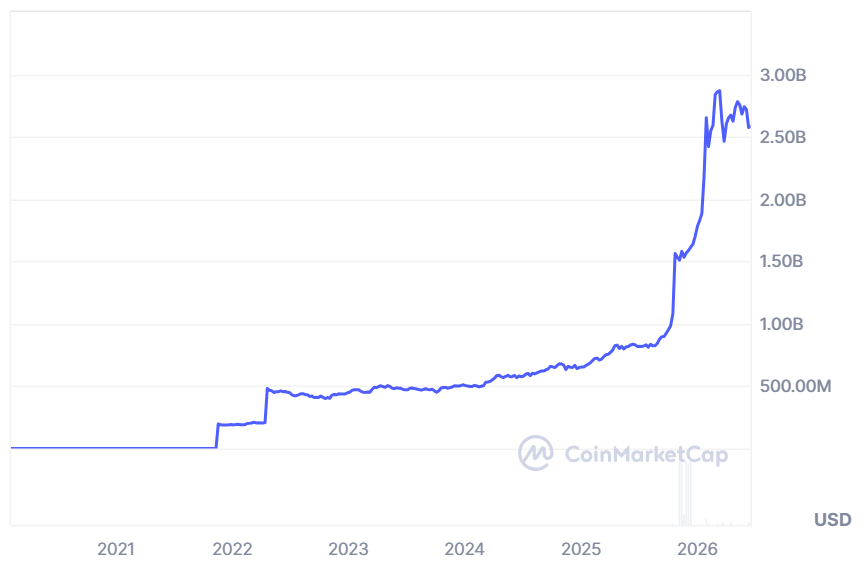
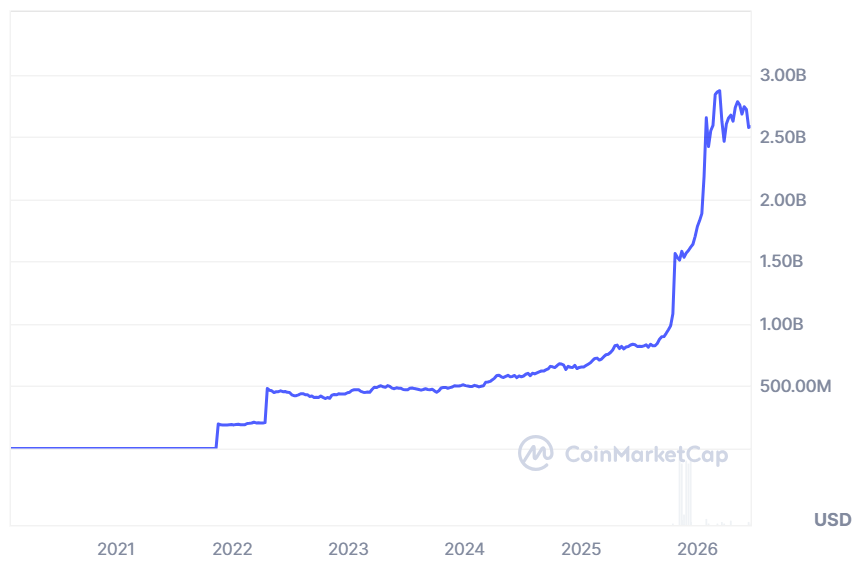
The market capitalization of Tether Gold peaked at around $2.89 billion. Source: CoinMarketCap
Related: Tether makes $150M investment in Gold.com in latest gold play
Tokenized commodities gain traction in RWA market
The announcement comes as commodities play an increasingly prominent role in the tokenization market. According to a recent Token Terminal report, tokenized financial assets have surpassed $43 billion, with commodities accounting for nearly 17% of the market.
Unlike commodity derivatives and futures, tokenized assets such as gold are backed by the underlying asset, giving holders direct ownership while enabling faster transfers and trading on blockchain networks.
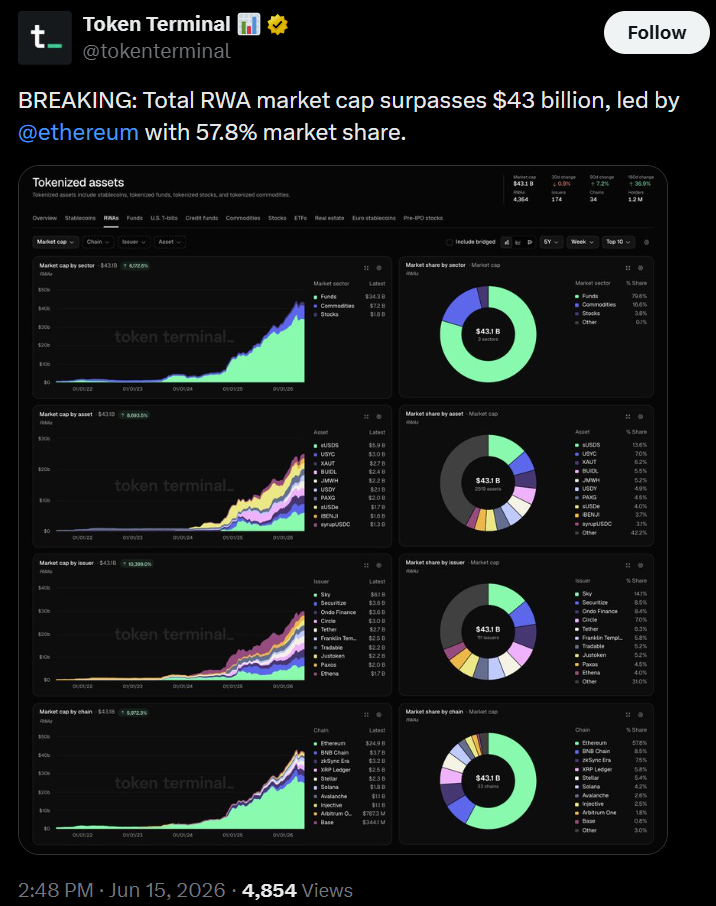
Commodities account for a bigger share of the tokenization market.
Source: Token Terminal
Tether Gold benefited from this year’s rally in bullion prices, with the token’s market capitalization expanding as gold climbed to record highs above $5,600 per troy ounce. The precious metal has since pulled back to around $4,300 an ounce but remains up on the year.


Google, for example, has warned organizations to begin preparing for the transition to post-quantum cryptography and has been integrating quantum-safe cryptographic standards into parts of its infrastructure with a 2029 completion target. The U.S. National Institute of Standards and Technology (NIST) has been leading efforts to standardize post-quantum algorithms and has set timelines for the eventual retirement of certain legacy cryptographic systems.
Within crypto, several major ecosystems have elevated quantum preparedness as a strategic priority. The Ethereum Foundation earlier this year announced a dedicated post-quantum security initiative aimed at researching migration paths for blockchain’s vast ecosystem of wallets, applications and validators. Solana developers likewise published proposals exploring how users and the network could transition to quantum-resistant cryptography if the threat becomes more immediate.
The Algorand Foundation noted that blockchain networks need to begin making preparations well before a so-called “Q-Day,” the hypothetical moment when a quantum computer becomes capable of breaking the cryptography currently used to secure digital assets.
The foundation said its roadmap builds on work it began in 2022, extending those efforts to the rest of the protocol, with the goal of achieving what Algorand describes as broad quantum resilience by the end of 2027. The foundation said it expects to reach that milestone before NIST retires certain legacy cryptographic standards and three years ahead of a timeline set by the U.S. National Security Agency for national security systems.


- Solana price sits at around $71 with strong resistance at $75.95.
- Indicators and EMAs show a bearish market trend.
- Weekly gains contrast with weak momentum and extreme fear sentiment.
Solana price continues to trade in a tight range around the low $70s, with the asset struggling to reclaim the $72 level.
At the time of writing, SOL was trading near $71.26, after a mild 24-hour decline of about 0.7%.
Despite a stronger weekly rebound of roughly 10%, the broader market pattern still shows clear resistance overhead and weakening momentum across multiple technical indicators.
Over the past 24 hours, the Solana price has remained trapped between $70.69 and $74.24, without a decisive trend forming.
Technical structure still favours sellers
Looking at the charts, Solana (SOL) remains under pressure from a layered resistance structure formed by major moving averages.
Recent price movements show that SOL has only managed to reclaim the 10-day exponential moving average (EMA), while the 20-day, 50-day, 100-day, and 200-day EMAs are all positioned above the current price level.

This configuration confirms that the broader trend remains bearish, as rallies continue to encounter resistance before reaching higher momentum zones.
The most immediate technical barrier is located at $75.95, a level that must be cleared to signal a potential shift in trend direction.
If this level is broken, projections place the next resistance at $83.32.
On the downside, structural support is clearly defined at $62.40.
A breakdown below $62.40 would expose the Solana price to deeper losses, extending the current corrective phase and potentially triggering accelerated selling pressure.
Notably, the daily Relative Strength Index (RSI) is positioned at 44.38, reflecting a neutral condition and suggesting indecision in short-term price direction.
However, the weekly RSI has dropped to around 33.07, placing it near the oversold territory and signalling that while selling pressure has been persistent over a longer timeframe, we could see some bullish recovery soon.
The overall market sentiment remains weak
Sentiment conditions continue to reflect caution across the broader market.
The Fear and Greed Index is positioned near 15, a level typically associated with extreme fear.
Such an environment often coincides with defensive positioning, reduced risk appetite, and lower conviction in upward price movements.
Derivative market data also supports this cautious outlook, with the funding rates remaining negative in recent sessions, while short positioning has increased relative to long exposure.

In addition, the long-to-short ratio has remained below equilibrium levels, indicating that traders are still leaning toward downside protection rather than sustained bullish positioning.
At the same time, Solana has recorded modest institutional inflows, including small allocations into Solana ETFs totalling just over $1 million.

However, these inflows remain limited in size and have not been sufficient to offset broader bearish positioning in derivatives markets.

Key Highlights
-
CoinMENA partners with Standard Chartered for enhanced UAE fiat payment infrastructure
-
Partnership improves funding channels, settlement mechanisms, and operational clarity
-
Standard Chartered broadens services to licensed UAE digital asset platforms
-
CoinMENA strengthens client fund safeguards through enhanced banking infrastructure
-
UAE digital asset platforms increasingly compete on regulated fiat access and settlement quality
The UAE’s digital asset sector has secured another significant banking partnership as CoinMENA announced collaboration with Standard Chartered for fiat payment infrastructure. This arrangement enhances local currency accessibility for platform users and verified partners. The development demonstrates how banking relationships increasingly influence competitive dynamics among licensed digital asset platforms.
CoinMENA Enhances Fiat Payment Infrastructure
Through this partnership, CoinMENA will leverage Standard Chartered’s banking systems to facilitate fiat entry and exit points across the UAE. The platform will implement protected client fund accounts alongside virtual account-based payment mechanisms. Consequently, users can expect improved visibility into funding movements and enhanced settlement workflows.
This collaboration provides CoinMENA with more robust banking foundations as digital asset oversight continues developing throughout the region. The arrangement enables accelerated funding processes, improved transaction monitoring, and enhanced clarity for authorized counterparties. Accordingly, this partnership extends beyond simple payment access to deliver comprehensive operational infrastructure.
CoinMENA functions within an ecosystem where fiat connectivity remains critical for crypto platforms. While users engage with digital assets through blockchain networks, exchanges require traditional banking for local currency operations. Consequently, dependable banking partnerships enhance platform credibility, market liquidity, and user satisfaction.
Standard Chartered Expands Support for Licensed Digital Asset Platforms
Standard Chartered’s involvement illustrates how established financial institutions can facilitate regulated digital asset operations without directly operating trading venues. The institution will deliver payment processing and account management infrastructure rather than proprietary cryptocurrency trading platforms. This model enables banks to participate in sector expansion while maintaining distinct operational frameworks.
The UAE has developed among the region’s most dynamic digital asset ecosystems through comprehensive licensing frameworks and regulatory oversight. Authorities have enabled virtual asset service providers, payment processors, stablecoin initiatives, and financial technology operators. Nevertheless, these enterprises require established banking relationships to achieve meaningful scale.
CoinMENA benefits from this evolution because regulated infrastructure now carries equal importance to platform capabilities. Robust fiat connectivity enables exchanges to accommodate retail customers, high-net-worth individuals, and institutional participants. Simultaneously, Standard Chartered reinforces its presence within UAE digital finance infrastructure development.
UAE Digital Finance Landscape Grows More Competitive
The CoinMENA partnership emerges as additional fintech operators advance their UAE market strategies. Revolut recently obtained Stored Value Facilities and Retail Payment Services authorizations from the UAE Central Bank. These regulatory approvals position the company toward potential market entry.
Revolut intends to deliver multi-currency accounts, payment cards, domestic transactions, and cross-border transfers within a unified application. Its market presence could intensify competition across payments and international money movement. However, these licenses do not necessarily indicate authorization for virtual asset trading activities within the UAE.
CoinMENA advances into this competitive environment equipped with strengthened bank-supported infrastructure for fiat operations. The partnership demonstrates how digital asset platforms require robust compliance frameworks, settlement systems, and client fund governance to achieve sustainable growth. Ultimately, UAE digital finance increasingly depends on regulated infrastructure rather than speculative market momentum.
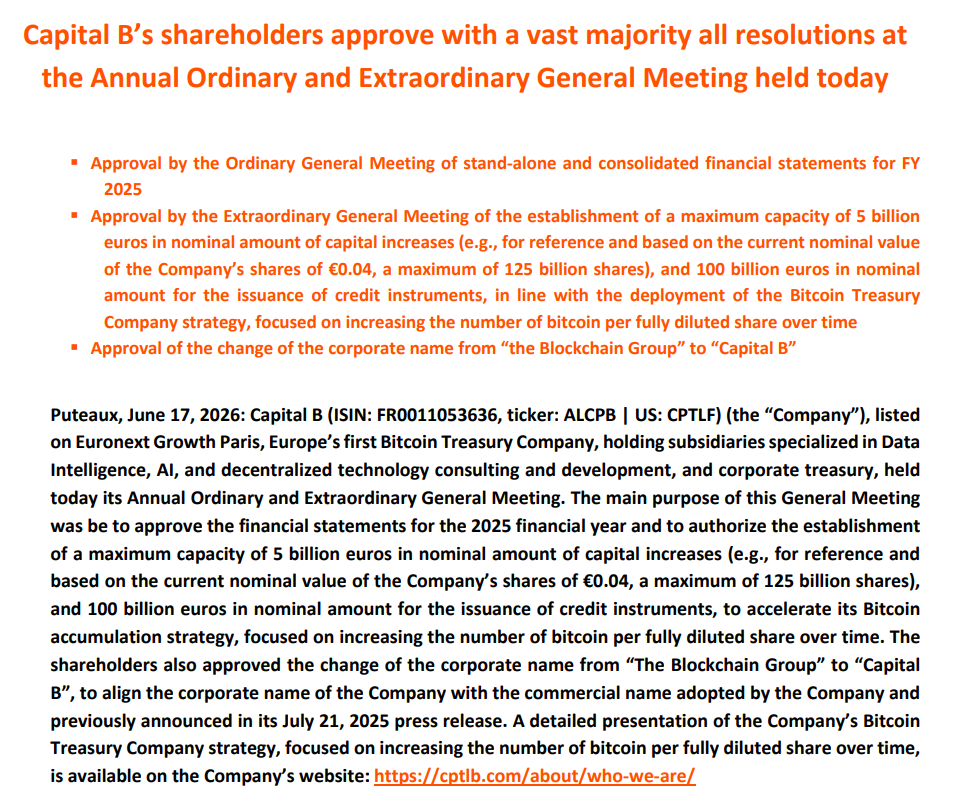
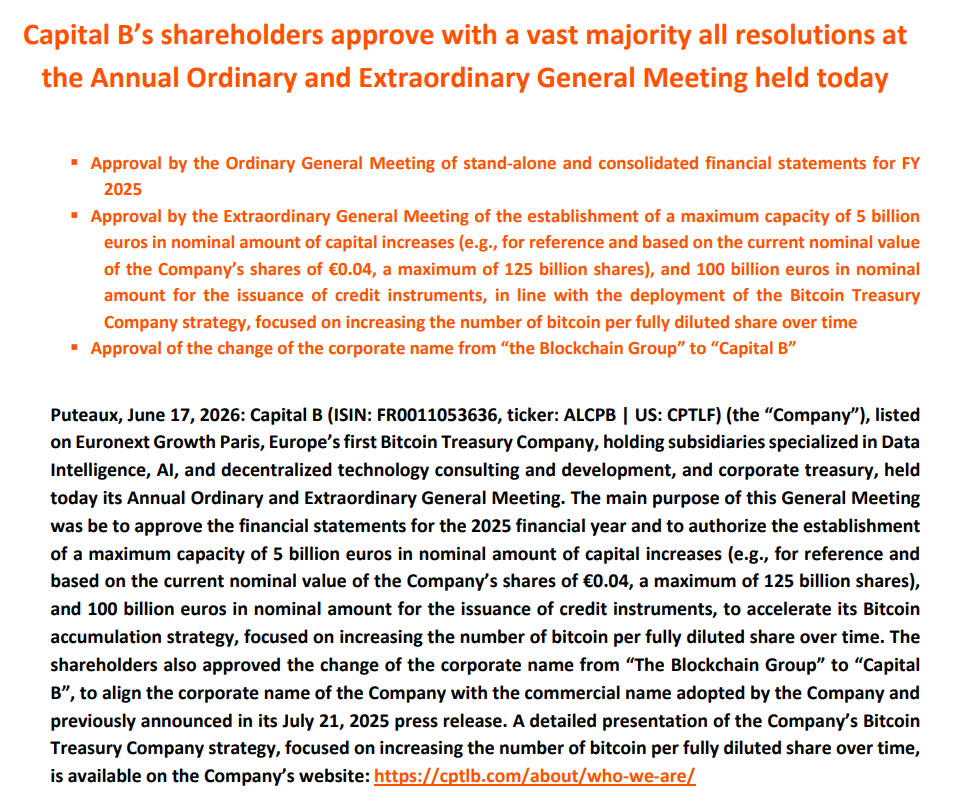
France-listed Bitcoin treasury company Capital B’s shareholders approved authorizations allowing the company to raise up to 105 billion euros ($120.4 billion) to fund future Bitcoin purchases.
Over 95% of shareholders approved the establishment of up to 5 billion euros in capital increases, equivalent to as many as 125 billion new shares at the current nominal value, as well as the issuance of up to 100 billion euros in credit instruments, Capital B announced on Wednesday.
The company said the issuance of the new capital instruments will “accelerate its Bitcoin accumulation strategy, focused on increasing the number of Bitcoin per fully diluted share over time.”
During its general meeting on Wednesday, Capital B reported 300.65 million in total shares with voting rights. If fully exercised, issuing 125 billion in new shares would result in existing shareholders being diluted to about 0.24% of the company’s ownership.
Shareholders also approved changing the company’s name from The Blockchain Group to Capital B, aligning its corporate name with the commercial brand adopted in 2025.
Source: Capital B
Capital B shares were little changed following the announcement, according to Yahoo Finance data.
Crypto treasury companies take different approaches
Capital B is Europe’s second-largest Bitcoin treasury company, holding 3,139 BTC, currently valued at $200 million. It ranks behind Germany-based Bitcoin Group SE, which holds 3,604 Bitcoin, currently worth $230 million, Bitcoin Treasuries data shows.
To date, Capital B said it raised about $325 million in capital, following its $17.8 million raise from strategic investors, including Blockstream CEO Adam Back and Paris-based asset manager TOBAM.
Related: Mystery Bitcoin burn destroys 107 BTC worth about $8.5M
The fundraising initiative contrasts with moves by some treasury companies to reduce or actively manage their Bitcoin exposure.
On May 28, France-based semiconductor company Sequans Communications said it had concluded its previously announced crypto treasury strategy. The company held 658 Bitcoin and said it would “monetize remaining holdings over time,” which led to a share price increase of about 14.5%.
Magazine: Bitcoin, the ‘canary in the coal mine,’ XRP transaction demand falls 91.5%: Market Moves
Crypto World
Ethereum News: ETH Developers Hit Near Record Highs Even as ETH Dumped Below $1,750, Is the Network Stronger Than the Price Suggests?
Ethereum News: ETH price is sitting near $1,750, down roughly 1.4% in the last 24 hours, and the bears are clearly running the short-term narrative.
But strip out the price action, and something more durable is happening underneath. Developer growth tells a story that the chart currently refuses to.
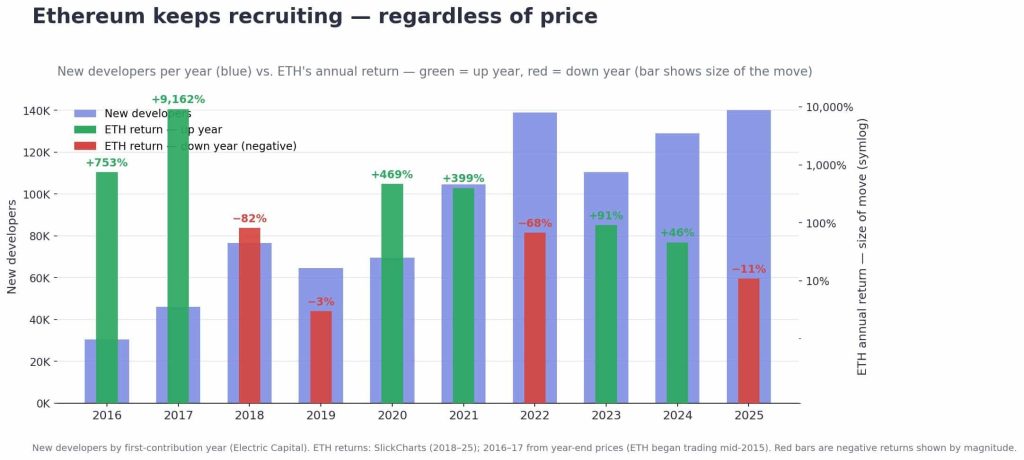
New developers building on Ethereum have climbed from approximately 30,000 in 2016 to nearly 140,000 in 2025, and crucially, that growth did not pause during the brutal drawdowns.
When ETH dropped 82% in 2018, roughly 77,000 new developers joined the network anyway. When ETH shed 68% in 2022, new developer additions hit approximately 139,000, one of the strongest cohort years on record.
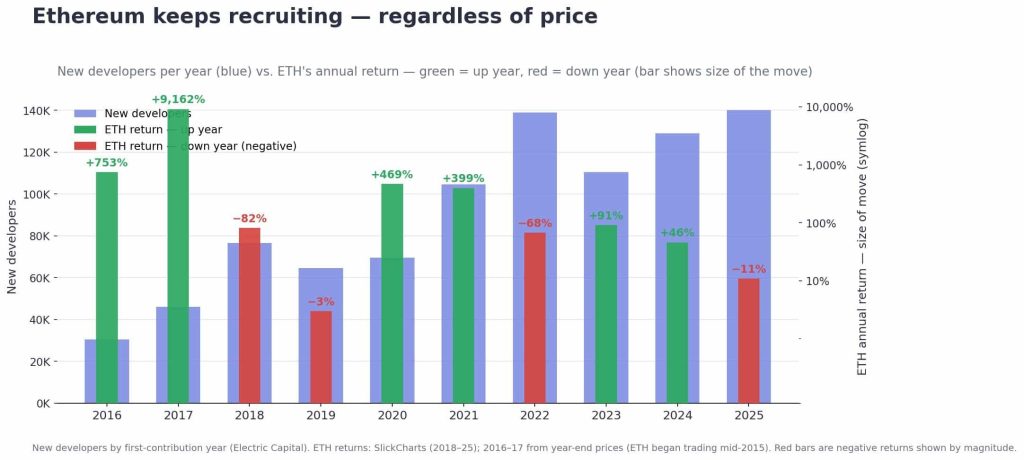
Even now, with ETH down around 11% year-to-date, developer intake remains close to that same 140K ceiling. Block production has also stabilized near the 7,000-blocks-per-day range since approximately 2023, regardless of where spot price traded.
The gap between price performance and network health is widening. That divergence is worth taking seriously before the next macro catalyst forces a re-rating. Upcoming protocol decisions and FOMC positioning will likely be the near-term triggers that determine which way that gap closes.
Ethereum News: Can ETH Price Reclaim $2,000 or Is a Drop to $1,500 the More Likely Path?
The technical setup is uncomfortable. ETH broke below a key demand zone, and Yahoo Finance’s technical analysis marks $1,700 as the line in the sand, with the path to $1,400 largely unobstructed if that level fails.
Overhead resistance compounds the problem. The 50-day EMA sits near $2,194 and the 200-day EMA near $2,510, and both have capped every recent bounce attempt.
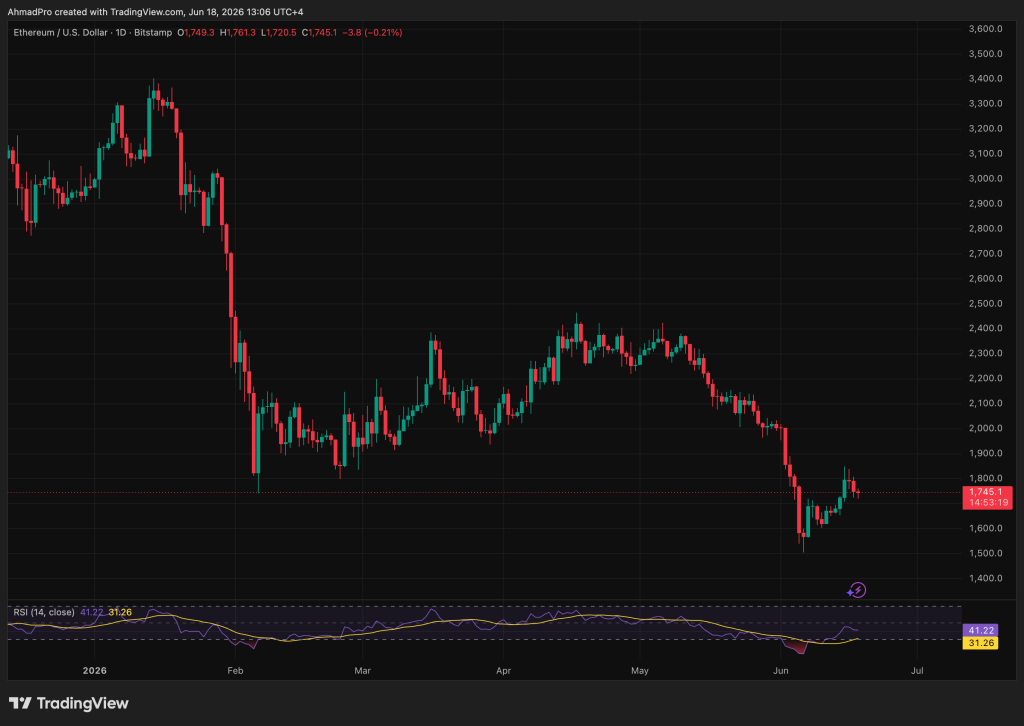
If $1,700 holds as weekly support, macro sentiment stabilizes after FOMC, and ETH reclaims $2,000 within two to three weeks on renewed risk appetite.
However, if $1,700 fails on a daily close, derivatives pressure accelerates the slide toward $1,400-$1,500. Liquidation cascades, not fundamentals, have been the primary driver of recent drawdowns, the flush could move fast rather than gradual.
Standard Chartered and other institutional desks still hold constructive multi-year ETH price targets, which keeps the capitulation thesis incomplete until on-chain accumulation data turns materially bearish.
LiquidChain Could Replace Ethereum For Smart Traders In The Future and Here is Why
When Ethereum bleeds, it tends to flush speculative capital out of the broader ecosystem, and that capital often rotates into early-stage infrastructure plays with asymmetric upside profiles that large-cap ETH can no longer offer at current market cap.
The question is where that rotation lands. Whale accumulation patterns during ETH weakness suggest sophisticated money is positioning in infrastructure, not exiting crypto entirely.
LiquidChain (LIQUID) is an L3 infrastructure project positioning itself as a cross-chain liquidity layer that fuses Bitcoin, Ethereum, and Solana liquidity into a single execution environment.
The core proposition, deploy once, access all three ecosystems, directly addresses the fragmentation problem that costs Ethereum developers time and TVL every cycle.
Key architecture features include a Unified Liquidity Layer, Single-Step Execution, Verifiable Settlement, and a Deploy-Once Architecture designed to reduce cross-chain overhead.
The presale is currently priced at $0.01471 per $LIQUID with $852,080.07 raised to date. As with any early-stage presale, liquidity and execution risk are real — this is not a liquid position and vesting schedules matter.
That said, for traders who want infrastructure exposure without riding ETH’s current technical uncertainty, Visit LiquidChain’s full presale terms here.
The post Ethereum News: ETH Developers Hit Near Record Highs Even as ETH Dumped Below $1,750, Is the Network Stronger Than the Price Suggests? appeared first on Cryptonews.
Iren (IREN) Stock Surges on Jefferies Buy Rating: AI Infrastructure Play Gains Momentum

UK drivers warned over facing fines for forgetting key dates
Trump Says ‘You’re Welcome’ as Oil Is Flowing and Prices Are Dumping


-

 Business4 days ago
No Jackpot Winner as $257 Million Prize Rolls Over to $269 Million Monday Draw
-

 Fashion6 days ago
Weekend Open Thread: Tuckernuck – Corporette.com
-

 Crypto World7 days ago
Oppenheimer backs SpaceX as $70 billion retail frenzy builds
-

 Crypto World7 days ago
Markets Rally as SpaceX IPO Looms Amid Iran Tensions and Inflation Surge
-
Crypto World4 days ago
Zimbabwe Requires Crypto Businesses to Register Annually Under New FIU Regulations
-

 Crypto World5 days ago
Bitget enters Argentina’s regulated crypto market through PSAV registration
-

 Tech6 days ago
NanoClaw integrates JFrog registries to secure AI agent downloads
-

 Tech6 days ago
This Week In Security: Microsoft On Microsoft, Register Your Domains, Linux On ARM, And FreeBSD Joins The File Cache Club
-

 NewsBeat7 days ago
El Nino has formed in the Pacific and could set records, forecasters say
-
 Tech7 days ago
Dutton Ranch star claims they ‘didn’t see any disruption’ on set following Chad Feehan’s exit from Yellowstone spinoff fueled by Taylor Sheridan clash rumors
-
 Entertainment7 days ago
Donnie Wahlberg & More Heat Up Las Vegas at Circa’s Barry’s Downtown Prime
-
 Tech7 days ago
Opendoor Ends India Operations, Fueling a Bigger Conversation About AI and Outsourcing
-

 Politics7 days ago
Belfast burns, while Met chief points finger at Iran and Russia
-

 NewsBeat6 days ago
FBI searches office of Ohio voter registration group
-

 Business7 days ago
AT&T: Verizon's 27% Outperformance Sets Up A Solid Entry Point
-
 Tech7 days ago
Anthropic is spending $150M to embed 1,000 AI fellows inside nonprofits. No degree required.
-

 Politics7 days ago
Modi thanks Trump for wishes as US attacks Indian seafarers
-
 Entertainment7 days ago
‘The Pitt’s Fan-Favorite Doctor Confirms Noah Wyle Gave His Blessing to Return [Exclusive]
-
 Crypto World7 days ago
Ripple and Bitso Bring MXNB Stablecoin to XRP Ledger
-

 Tech7 days ago
Klipsch Heritage First Listen at High End Vienna 2026: Rebellion, OJAS and Klipschorn Bring the Horns
You must be logged in to post a comment Login