

Crypto World
HYPE Price Explodes as ETF Inflows and SpaceX Perps Boost Hyperliquid

Hyperliquid’s native cryptocurrency, HYPE, is one of today’s best performers, charting a double-digit move as trading activity accelerates across multiple verticals.
At the time of this writing, HYPE is trading at around $72, very close to its all-time high.
This marks an increase of around 10% in the past 24 hours, lining it up as one of the best performers during the period. The move is driven by accelerated ETF buying and fresh momentum around its ecosystem, fueled by the success of SpaceX perps trading.
ETF Demand Adds Fresh Optimism
ETF data from SoSoValue suggests that regulated products around HYPE are becoming a powerful part of the token’s market structure. The three products currently listed and operated by Bitwise, 21Shares, and Grayscale hold a combined total of $209M worth of HYPE, accounting for around 1.4% of its total market capitalization.
During this fresh rally, net inflows over the past 24 hours surpass $17 million, bringing the cumulative total to $171M, suggesting strong structural interest in Hyperliquid’s underlying cryptocurrency.

By contrast, BTC ETFs recorded outflows of around $64M, suggesting risk appetite is shifting towards altcoins, a trend further supported by positive flows into ETH, SOL, and XRP ETFs.
SpaceX Perps Strengthen the HIP-3 Narrative
The other key driver is Hyperliquid’s growing role in non-crypto markets through HIP-3.
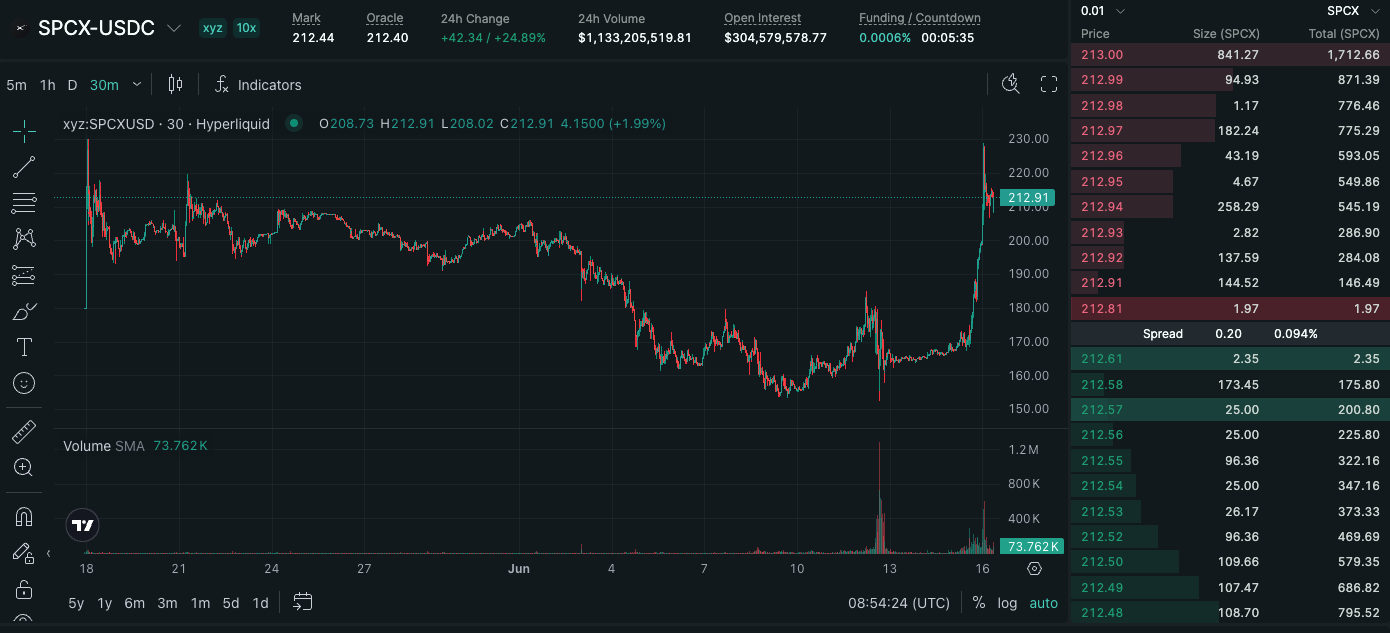
As seen in the chart below, SPCX-USDC is currently trading with a 24-hour trading volume of more than $1.12 billion. Open interest is approaching $300 million, while the contract trades near $212.
This follows broader market attention around SpaceX-linked perpetuals. In fact, during the initial burst after the listing, SPCX became the most-traded asset on the venue, with trading exceeding $1.3 billion.
This adds more weight to the idea that Hyperliquid can host liquid markets far beyond standard crypto pairs. Previous examples include gold and oil. After all, it has become one of the preferred exchanges to trade oil with crypto.
The post HYPE Price Explodes as ETF Inflows and SpaceX Perps Boost Hyperliquid appeared first on CryptoPotato.


Robinhood is reducing its workforce by 10% as part of a company-wide restructuring effort aimed at improving efficiency and execution, CEO Vlad Tenev said in an internal message shared by the company on X. The move is expected to impact roughly 290 employees out of approximately 2,900 full-time staff.
The announcement lands as Robinhood recently reported weaker-than-expected first-quarter results, with crypto trading described as a major drag due to sharply lower volumes year over year. Even so, the company framed the layoffs as a proactive step taken from a position of strength, citing record trading activity across multiple products.
Key takeaways
- Robinhood plans to cut 10% of its full-time workforce, expected to affect about 290 employees, while also closing a small number of remaining open roles.
- The company says the restructuring involves “flattening” its organizational structure and reducing management layers to improve performance and focus.
- Robinhood estimates $28 million in restructuring-related charges, including employee severance and benefits, plus share-based compensation costs, to be recognized in Q2 2026.
- Despite weak Q1 results, Robinhood points to record month-to-date average daily trading volumes across equities, options, and prediction markets.
- Crypto trading remains a key variable for transaction-based revenue, with Cointelegraph previously reported volumes down around 50% year-on-year.
A 10% cut tied to “flattening” the organization
Robinhood confirmed the layoffs on Tuesday via a statement on X attributed to the company, where CEO Vlad Tenev told staff that it would reduce its workforce by 10% of full-time employees. In his remarks, Tenev emphasized the need to avoid a “heavily-layered organization” as Robinhood attempts to scale its mission, and he urged teams to continuously raise their performance bar.
The rationale echoed restructuring explanations seen across the broader financial sector, and particularly among crypto-adjacent businesses that have faced cost pressure and shifting market conditions. Cointelegraph noted similar approaches from major crypto companies, including Coinbase’s workforce reduction and Block’s earlier job cuts tied to operational efficiency and organizational streamlining.
For investors and users, the key point is that this is not presented as a reaction solely to short-term earnings softness. Robinhood instead frames the change as an execution upgrade—one intended to make the organization faster and more accountable as trading activity moves through different market cycles.
How many jobs are affected, and what the company expects to cost
According to a Robinhood spokesperson speaking to Cointelegraph, the reduction is expected to affect about 290 employees. Robinhood currently has approximately 2,900 full-time employees, consistent with its reporting.
Robinhood previously reported about 2,900 full-time employees as of Dec. 31, 2025, according to its Form 10-K filing with the US Securities and Exchange Commission. In a separate Form 8-K filed on Tuesday, the company also stated that the reduction in force includes the closure of a small number of remaining open roles across the business.
Financially, Robinhood estimated total restructuring-related charges of about $28 million. The company said roughly $20 million would relate to employee severance and benefits, with about $8 million tied to share-based compensation costs. Robinhood expects to recognize these charges in the second quarter of 2026.
“Business has never been stronger,” despite soft results
In its announcement, Robinhood said it is taking the action from a position of business strength. The company cited June month-to-date average daily trading volumes reaching record levels across equities, options, and prediction markets.
Tenev described the company’s position as “never been stronger,” and suggested the workforce reduction is intended to improve execution and sharpen organizational focus. Robinhood also said it would continue hiring selectively, invest in top-tier talent, and “utilize frontier technologies” to improve performance.
While the company did not explicitly tie the restructuring to artificial intelligence initiatives, it did indicate an ongoing commitment to modernizing how work is done—language that will likely be watched closely by both job seekers and market participants as Robinhood’s cost structure evolves.
Crypto volumes remain a pressure point for transaction revenue
Even with Robinhood’s claims of strong trading activity in other areas, its first-quarter performance did not meet analyst expectations. Cointelegraph reported that crypto trading was a key contributor to that miss, pointing to volumes down roughly 50% year-on-year. That matters because crypto is closely linked to transaction-based revenue, which can swing noticeably when retail activity cools or volatility changes.
The broader implication for readers is that Robinhood’s financial outcomes may continue to depend on how quickly crypto markets stabilize relative to other parts of the platform. The company’s ability to offset crypto softness with momentum in equities, options, and emerging products such as prediction markets could determine whether this restructuring translates into more resilient earnings.
At the same time, the layoffs themselves may influence how Robinhood allocates resources across product lines. If transaction activity is uneven across categories, cost control becomes more than an internal efficiency exercise—it becomes a strategic hedge against future volatility in specific revenue streams.
What to watch next
Investors should monitor Robinhood’s next quarterly update for whether the $28 million restructuring charges and the “flattened” operating model improve operating leverage, and whether crypto volumes recover enough to narrow the gap between trading strength in other markets and continued weakness in digital assets.
Crypto World
BlackRock Launches BITA, a Covered-Call Bitcoin ETF Designed to Generate Monthly Income


BlackRock this week listed the iShares Bitcoin Premium Income ETF (BITA) on Nasdaq, extending its spot-bitcoin franchise into structured-income territory by overlaying a covered-call strategy on top of its flagship IBIT fund. The fund began trading on June 9, with bitcoin priced at $61,825.37 per… Read the full story at The Defiant
Crypto World
Unusual Machines (UMAC) Invests $30M in Powerus (PUSA) to Strengthen Drone Supply Chain

Key Takeaways
- Shares of Powerus surged 6.8% Tuesday following news of a $30 million strategic equity investment from Unusual Machines (UMAC).
- This capital injection strengthens an already established manufacturing and supply partnership between both drone industry players.
- Unusual Machines provides NDAA-compliant drone components that Powerus integrates into autonomous and counter-drone platforms.
- Both companies are working toward establishing a robust, domestically-sourced defense autonomy supply chain.
- Meanwhile, Powerus remains engaged in a pending merger agreement with Aureus Greenway Holdings (PUSA) that has yet to finalize.
Shares of Powerus jumped 6.8% during Tuesday’s trading session after Unusual Machines (UMAC) revealed it had committed $30 million in strategic equity capital to the autonomous drone manufacturer.
This investment expands upon a pre-existing commercial arrangement between the two entities. Powerus has been procuring drone hardware and critical components from Unusual Machines to support its autonomous flight systems and counter-drone technologies.
Trading on NYSE American, Unusual Machines specializes in producing NDAA-compliant drone components domestically. This compliance designation is critical—it certifies that the parts satisfy stringent U.S. federal acquisition requirements for defense applications.
Andrew Fox, CEO of Powerus, highlighted the strategic nature of the partnership. “As our operations expand, both organizations benefit from a dependable, domestically anchored supply chain,” Fox stated.
Allan Evans, who leads Unusual Machines as CEO, emphasized Powerus’s rapid growth trajectory. “Their expansion requires reliable domestic suppliers and adequate working capital to maintain momentum,” Evans remarked. “This investment demonstrates our belief in their leadership and strategic direction.”
Building Infrastructure for Rapid Growth
The deal is structured as a direct equity investment without mandatory purchase commitments. Powerus faces no obligation to procure specific volumes from Unusual Machines, and each company maintains operational independence.
Their mutual objective centers on developing a U.S.-centric defense autonomy supply infrastructure. As Powerus expands its manufacturing footprint, Unusual Machines naturally becomes a more integral supplier—creating a symbiotic business relationship.
Brett Velicovich, who co-founded Powerus, emphasized the urgency driving this partnership. “The security challenges our clients confront are rapidly advancing, and addressing them demands a supply chain that’s domestically rooted, operationally resilient, and capable of scaling,” Velicovich explained.
Having Unusual Machines as both supplier and strategic investor, he noted, enables Powerus to accelerate its domestic production capabilities.
Additional Developments at Powerus
Separately, Powerus continues navigating a proposed business combination with Aureus Greenway Holdings (PUSA). That transaction remains pending and subject to customary closing requirements.
The $30 million investment from Unusual Machines operates independently of the merger process and does not modify its structure or expected timeline, according to current disclosures.
UMAC stock declined 2.45% during the session, while Powerus (PUSA) traded up 0.67% at press time.



Coinbase (COIN) said it plans to introduce tokenized stocks backed one-for-one by underlying U.S. equities, joining the growing competition among crypto firms and traditional financial companies to bring stocks onto blockchain networks.
In a post on X on Tuesday, the exchange said “the first real, 1:1 backed tokenized stocks are coming,” allowing users to own, trade, hold and redeem the securities onchain while automatically receiving dividends.
The announcement comes ahead of a product event scheduled for 3 p.m. ET Tuesday, in which the company, best known as a crypto exchange, is expected to unveil a series of offerings spanning trading and financial services.
“For the first time, these are real 1:1 backed tokenized stocks you can trust,” CEO Brian Armstrong said in a statement. “You own an actual piece of the company onchain.”
Armstrong said the products differ from many existing tokenized stock offerings, which are often structured as derivatives or synthetic exposures rather than direct ownership interests.
“Other current solutions are some form of derivative or IOU — not real ownership,” he said. “Our tokenized stocks will give all the benefits of true ownership (e.g. dividend upside), with all the benefits of tokenized assets.”
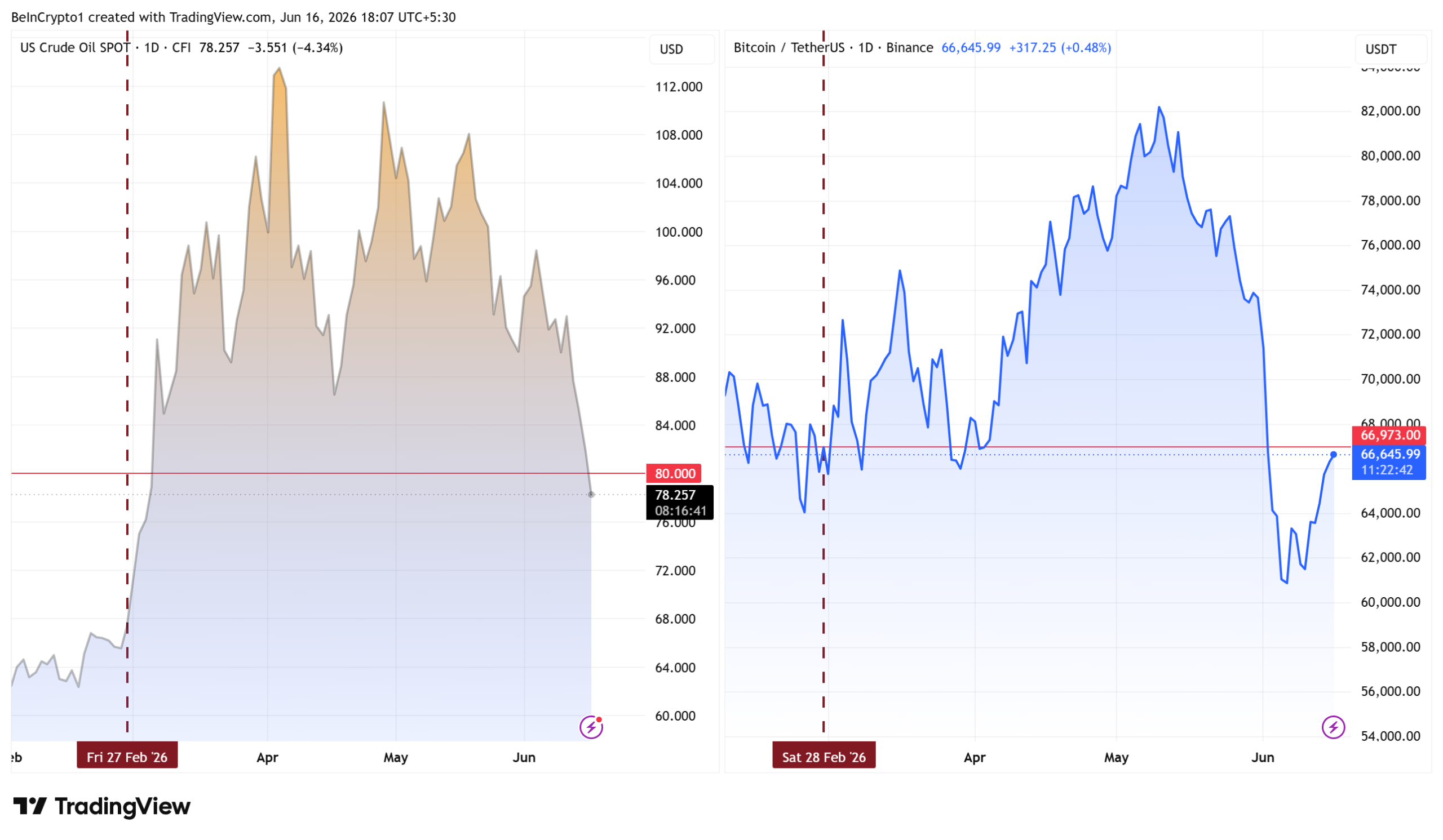
West Texas Intermediate (WTI) crude fell below $80 a barrel on Tuesday, its first drop below that level in nearly 4 months, as hopes for a US-Iran framework deal eased concerns about global oil supply.
The slide in energy prices is reshaping risk appetite across markets. Bitcoin (BTC) held near $66,650, while one major bank argues that lower oil prices strengthen the case for a fresh crypto uptrend.

Iran Deal Hopes Pull Oil Off Its Highs
WTI traded around $78 on Tuesday, down more than 4% on the day. The benchmark had spiked above $100 earlier in 2026 during the height of the Iran conflict. Bitcoin fell under $100,000 during that same standoff, when Iran threatened to close the Strait.
Traders are now pricing in a possible Strait of Hormuz reopening, the chokepoint that handles about 20% of global petroleum consumption, according to the EIA.
A framework agreement could let Iranian exports resume and ease the supply crunch.
Lower energy costs also reduce inflation pressure. That gives the Federal Reserve more room to cut, a backdrop that fuels Fed rate cut bets and tends to favor risk assets like crypto.
Standard Chartered Sees Confirmation in Falling Oil
Geoffrey Kendrick, Standard Chartered’s head of digital assets research and a BeInCrypto Experts Council member, said the three signals he wanted to see before turning more bullish have now appeared.
He had flagged them after a recent Bitcoin price analysis tied to the conflict.
“All three confirmatory signals I had mentioned below as wanting to see have worked…” Geoffrey Kendrick, stated.
Follow us on X to get the latest news as it happens
Kendrick pointed to three developments:
- MicroStrategy, the largest corporate holder of Bitcoin, bought 1,587 BTC for about $100 million last week.
- US spot ETFs then drew $85.85 million on Friday, their strongest day in a month, even as the funds still closed the week with net redemptions.
- Oil kept breaking lower.
According to Kendrick, Bitcoin’s price breaking above the $83,000 region from early May will be the next critical confirmation.
He has set a year-end target of $100,000.
Bitcoin still trades well below its October record near $126,000, and its recent price action has drawn talk of lower highs.
A move above the early May peak around $83,000 would mark the next test for the rotation thesis.

“There has been a lot of chat about BTC making lower highs. So breaking above the USD83k region from early May will be the next critical confirmation needed,” Kendrick added.
That rotation holding depends on the US-Iran peace deal reaching a clean signing.
The post Oil Price Falls Below $80 After Nearly 4 Months, Bitcoin to $70,000 Next? appeared first on BeInCrypto.

For decades, companies have turned to futures markets to manage uncertainty. Airlines hedge fuel costs. Farmers hedge crops. Manufacturers hedge metals.
Now a startup wants to bring that same financial machinery to artificial intelligence.
Silicon Data, a company that tracks pricing across cloud providers and GPU marketplaces, has partnered with CME Group to launch what could become the world’s first futures contracts tied to the computational power needed to run AI, allowing companies to hedge against fluctuations in the cost to train and run AI models. The contracts are still awaiting regulatory approval.
Early signs suggest investor interest is quickly emerging. Within days of Silicon Data’s announcement with CME Group, asset managers including ProShares and Rex Shares filed proposals for exchange-traded funds tied to the proposed contracts, including leveraged and inverse products.
Founder and CEO Carmen Li believes the market could eventually rival some of the world’s largest commodity markets.
“I think it will be larger” than oil futures, Li said in an interview, adding that energy demand tied to running artificial intelligence will eventually surpass all other energy uses, combined.
Like jet fuel
The idea stems from a simple observation: AI companies increasingly depend on compute in the same way airlines depend on jet fuel.
Most companies don’t own the high-end graphics processing units, or GPUs, that power modern AI systems. Instead, they rent access through cloud providers and a growing ecosystem of so-called neoclouds. As demand for AI infrastructure surges, the cost of that compute can fluctuate, making it difficult for businesses to forecast expenses.
“Right now we’re at a high point of uncertainty,” said Seoyoung Kim, a finance professor at Santa Clara University. “A lot of people don’t know how much computing power they’ll need in the next year, and a lot of suppliers of that computing power right now don’t know how many GPUs and to what capacity they should order and the manufacturers, like Nvidia, they don’t know how much they should produce.”
Silicon Data has built a series of GPU price indexes that track the hourly rental cost of specific chips across providers. The company hopes those benchmarks can serve as the foundation for a futures market, much as West Texas Intermediate crude oil underpins energy derivatives.
Like any futures market, compute contracts will need both buyers and sellers. Companies worried about rising compute costs would seek protection from higher prices, while providers with large amounts of capacity could hedge against the risk of prices falling.
Silicon Data’s benchmarks have already begun appearing in high-profile corporate disclosures. SpaceX, for example, referenced the company’s GPU rental-rate data in its prospectus to go public.
Speculators coming in
Not everyone in the market would be looking to hedge risk. As with other futures markets, compute contracts would also draw speculators — traders with no direct need for GPU capacity but a view on where compute prices are headed.
Proponents argue that speculators play an important role in building liquidity and improving price discovery. Critics counter that speculation can amplify volatility and disconnect prices from underlying demand.
“Speculators are a very important piece of the ecosystem as well,” Li said. “You need natural hedgers. You need market makers. You need speculators. They have opinion. They want to express their opinion, which is perfectly fine.”
The Harvard MBA said traders who believe they have insight into future supply-and-demand dynamics should be able to express those views through the market, helping establish prices for the broader industry.
The ProShares and Rex Shares filings for ETFs are contingent on regulatory approval of the futures market. Still, they suggest some investors already view AI compute as a potentially tradable asset class rather than simply a technology input.
Benchmarking AI compute cost
Unlike a barrel of oil, AI compute is not a standardized physical commodity. Silicon Data said there are more than 50 different configurations of Nvidia’s H100 chip alone, with prices varying based on processors, memory, networking, utilization rates and data center location.
For the proposed futures market to work, traders need confidence that a single benchmark can accurately represent those variations.
“What we do is normalize the prices coming to our platform every day to a base H100 case,” Li said. “It’s a very complicated normalization step, even before the index calculation step.”
Kim, the Santa Clara finance professor, noted that standardization has always been a challenge for futures markets. Corn futures, for example, specify the exact grade of corn that can be delivered under a contract. Compute markets face a similar task: defining precisely what buyers and sellers are trading.
“The CFTC is going to want to know exactly what the product is,” Kim said. Contract specifications, settlement procedures and benchmark construction are all likely to face scrutiny before the market can launch, she said.
— CNBC’s Charlotte Morabito contributed to this story.
Crypto World
Binance Reportedly Denied MiCA By Greece, No EU License for the World’s Largest Exchange
Binance, the world’s largest crypto exchange, is poised to lose its ability to serve EU clients after its Greek MiCA license application faces rejection, Reuters reported on June 16, 2026.
Two sources familiar with the matter told Reuters that Greece’s Hellenic Capital Market Commission (HCMC) is set to turn down the application. The decision, if finalized, would block Binance from operating across the 27-nation bloc once MiCA’s transitional period ends on July 1, 2026.
Major Regulatory Setback for Binance
Under the EU’s Markets in Crypto-Assets (MiCA) framework, a single license grants passporting rights for seamless operations across member states.
Without approval, unlicensed platforms must halt services to avoid enforcement actions, fines, or blacklisting by national regulators.
Binance submitted its application in January 2026 through a Greek subsidiary, citing the country’s skilled workforce and security advantages.
Co-CEO Richard Teng highlighted these strengths in February, expressing confidence in meeting the deadline.
“Greece’s labour force and security profile gave it the edge over larger financial centres… The license is pretty standard throughout Europe, so we have to think through many other factors, whether it’s social, whether it’s talent pool, safety and security issues. Greece is where we think will be a good base for us to expand in Europe.”
Follow us on X to get the latest news as it happens
Binance Pushes Back
A Binance spokesperson reportedly told Reuters the exchange “has worked constructively with regulators over the past 18 months” and believes it has met all MiCA requirements.
The company noted that HCMC completed its review and found the application compliant, adding that “HCMC has given no formal indication of the contrary.”
HCMC declined to comment, citing confidentiality rules.
Europe represents a significant market for Binance. The looming cutoff comes amid heightened regulatory scrutiny on global crypto platforms.
Competitors with approved MiCA licenses, such as Coinbase and Kraken, stand to gain users seeking compliant trading venues.
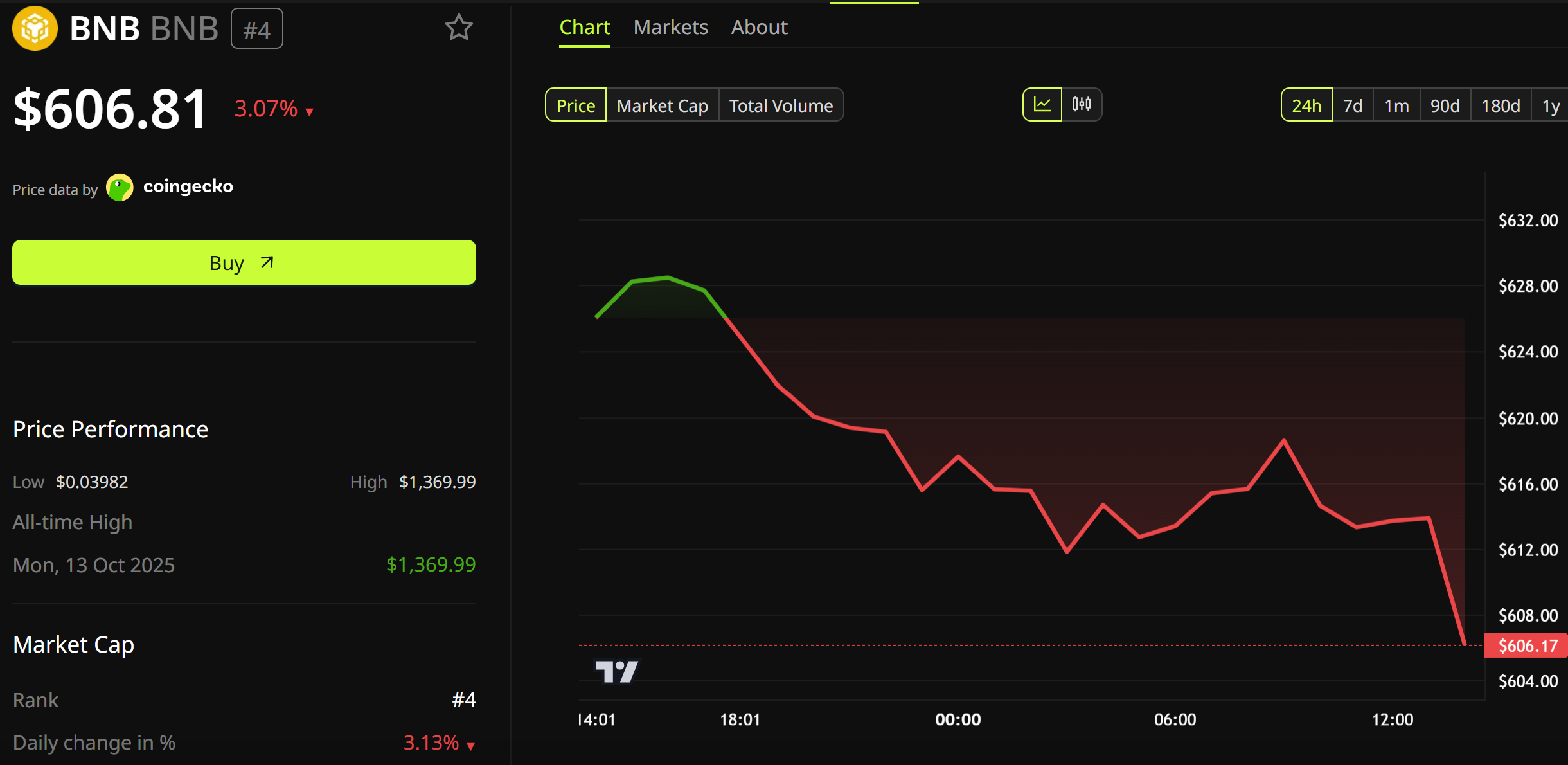
BNB token and broader crypto markets may face short-term volatility as traders digest the news.

No formal rejection has been announced yet.
Binance continues engaging with regulators, while EU users should monitor platform updates regarding deposits, trading, and withdrawals after July 1.
An official HCMC decision or Binance appeal could still shift the outcome in the coming days.
The post Binance Reportedly Denied MiCA By Greece, No EU License for the World’s Largest Exchange appeared first on BeInCrypto.

Bitcoin retreated to around $66,000 after Tuesday’s Wall Street open as broader equity markets pushed higher. The move underlined a growing split between crypto and traditional risk assets, even as a reported U.S.–Iran peace development supported stocks and weighed on crude oil.
While U.S. WTI crude slid to three-month lows—a backdrop that typically benefits risk sentiment—traders appeared unwilling to press fresh bullish bets on BTC. Multiple analysts pointed to $70,000 as the key upside area for this leg, while others argued that the market may be entering a sell zone or even getting “lured” into positions that fail to materialize.
Key takeaways
- BTC fell back to roughly $66,000 after the Wall Street open, despite strong gains in U.S. equities.
- Shares received a boost alongside reports of U.S.–Iran progress, while oil prices hit three-month lows.
- Trading analysis cited $70,000 as a likely near-term upside target, with expectations for rangebound behavior.
- On-chain and derivatives commentary highlighted risks around liquidity-driven moves, including areas around $68,000 and a sell zone concept from a trader.
- CoinGlass data showed $230 million in short liquidations over the prior 24 hours at the time of writing.
Stocks lead, oil softens, but BTC fails to keep pace
According to TradingView data cited in earlier market commentary, BTC’s price action cooled after it had reached its highest level in nearly two weeks. The broader risk-off/risk-on picture appeared mixed: investors pushed into equities after headlines around U.S.–Iran peace plans, while crude oil weakened sharply.
In its latest newsletter The Market Mosaic, Mosaic Asset Company said that confirmations from both sides and other negotiation parties were contributing to a spillover effect in markets. The firm connected the drop in energy prices to a tailwind for equities, pointing to the usual dynamic where oil and longer-dated bond yields fall together—factors that can reinforce stock momentum.
“That’s leading to a spillover effect in the stock market, where oil prices and longer-dated bond yields are both pulling back. A negative correlation between stocks and oil prices means the drop in energy prices is a tailwind for equities.”
Crypto reverts to its range—traders eye $70,000
Despite the equity-led optimism, Bitcoin showed what traders described as divergence from other risk assets. Daan Crypto Trades wrote on X that BTC had moved back “into its range,” adding that he would not be surprised to see consolidation for “a few more weeks at least,” especially as summer typically brings lower liquidity and volatility.
“I would not be surprised if we hang around this big area for a few more weeks at least. Especially with Summer coming up and lower liquidity/volatility.”
Another trader, Roman, similarly framed $70,000 as the level to watch for completing a bounce. In his X post, he said he was “still eyeing the 70k level for our bounce to be completed,” while noting that hourly timeframes looked favorable and that there were no apparent issues to stop the move.
“Still eyeing the 70k level for our bounce to be completed.”
That combination—range expectations plus a defined upside target—helps explain why BTC could slip even while other markets advanced. In practice, traders appeared more focused on near-term technical levels than on extending directional exposure.
Debate over support strength and the role of liquidity
Some market analysis has questioned whether $60,000 is truly strong long-term support, with Cointelegraph earlier reporting that the bear market may still be too young to conclude a full reversal. That critique contrasts with the more tactical approach from other traders who emphasized how order-book dynamics and liquidity can shape short-term price behavior.
Killa, for example, suggested that market makers and trading algorithms may have encouraged traders to bet on lower lows that never arrive, characterizing the pattern as a “market psyop.” In the same line of discussion, he referenced order-book liquidity data.
“Just another classic market psyop,” they summarized alongside a chart of order-book liquidity data.
Liquidations spike as $230M in shorts exit
Derivatives activity added another layer to the caution around follow-through. According to CoinGlass liquidation data, crypto saw $230 million in short liquidations over the prior 24 hours at the time of writing.
Liquidation events can be double-edged for traders. While they may clear crowded positions and relieve downward pressure temporarily, they can also signal that leverage was aggressively harvested—after which price can stall or reverse as new buyers hesitate.
Lennaert Snyder pointed to this type of dynamic in his commentary. He said price was entering a “high-time frame sell zone,” and he referenced $68,000 as the target for Tuesday. Snyder added that liquidity below 63.6K looked “too juicy” to avoid, but he preferred a push upward first for a “quality short,” suggesting he was waiting for a better entry rather than chasing immediate downside.
“The liquidity sub 63.6K looks too juicy to not mitigate, but for the quality short I’d prefer that push to the upside first,” he wrote.
Looking ahead, traders are likely to monitor whether BTC can break through $70,000 with sustained momentum—or whether liquidation-driven flows and “sell zone” expectations cap the rebound. With equities supported by macro headlines and oil acting as a changing variable for risk sentiment, the key uncertainty is whether crypto can align with broader market direction, or continue trading as a more self-contained range where liquidity dictates the next move.
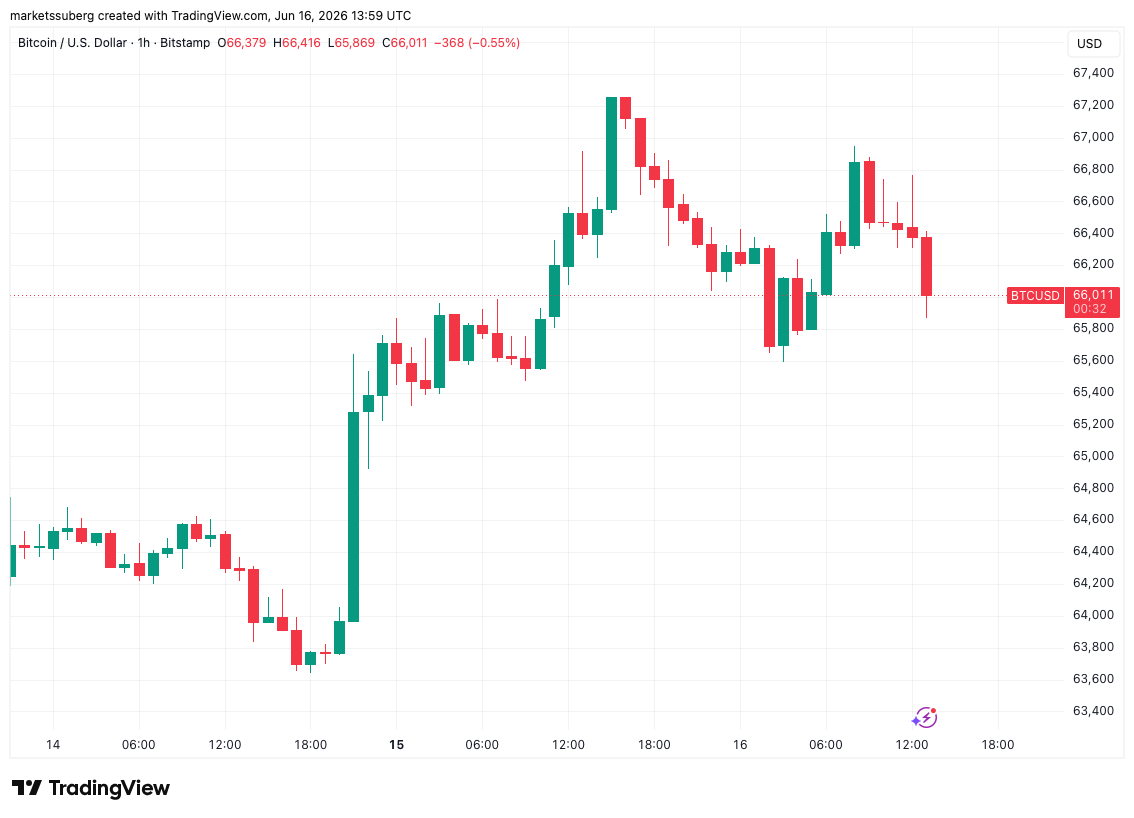
Bitcoin (BTC) dropped back to $66,000 after Tuesday’s Wall Street open as stocks locked in fresh gains.
Key points:
- Bitcoin cools its rebound, even as stock continue higher on US-Iran peace plans.
- Oil prices hit their lowest levels in three months, but crypto struggles to leverage the tailwinds.
- BTC price takes still see $70,000 as the limit for the current push higher.
BTC price dips with oil as stocks head out in front
Data from TradingView showed BTC price action coming off its highest levels in nearly two weeks.
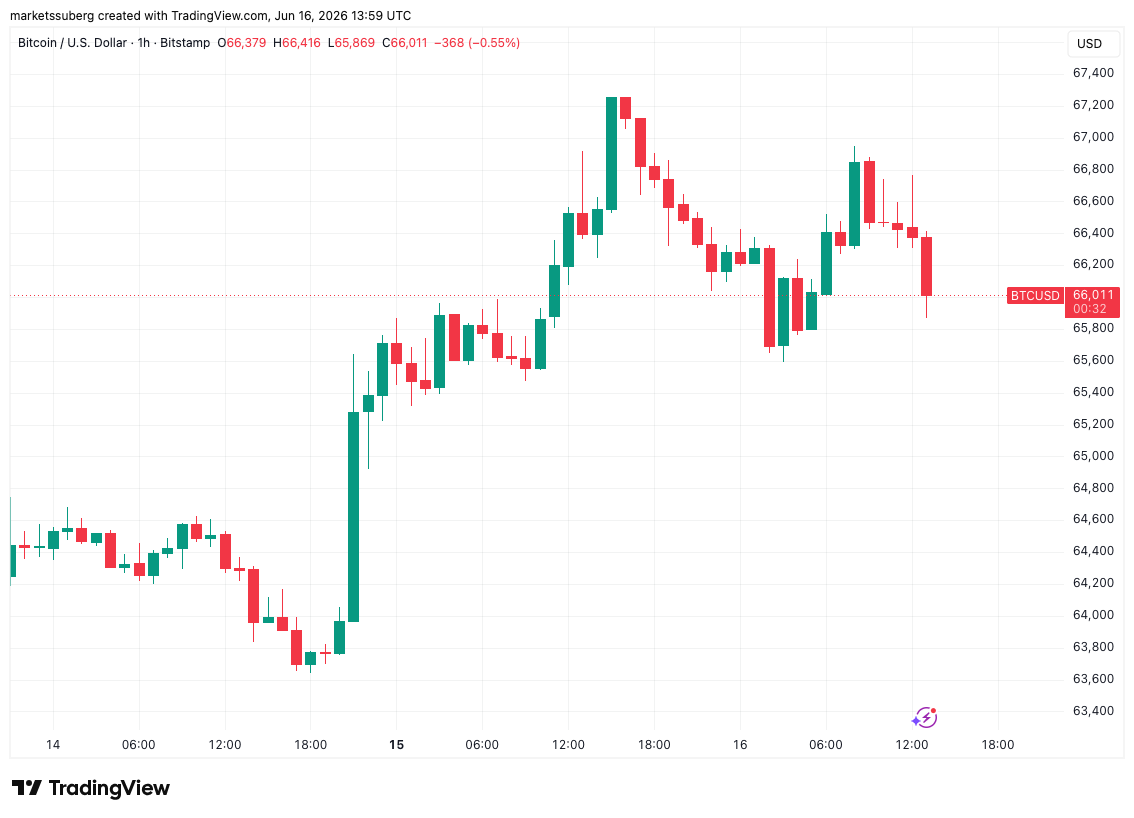
BTC/USD one-hour chart. Source: Cointelegraph/TradingView
Hopes that a US-Iran peace deal would go ahead kept equities bullish, with the S&P 500 adding over 1.5% on the day, while US WTI crude oil hit three-month lows.
“News of an peace deal between the U.S. and Iran has made headlines frequently in the past. But this time, both sides along with other parties involved with negotiations are confirming the deal,” trading resource Mosaic Asset Company wrote in the latest edition of its regular newsletter, The Market Mosaic.
“That’s leading to a spillover effect in the stock market, where oil prices and longer-dated bond yields are both pulling back. A negative correlation between stocks and oil prices means the drop in energy prices is a tailwind for equities.”
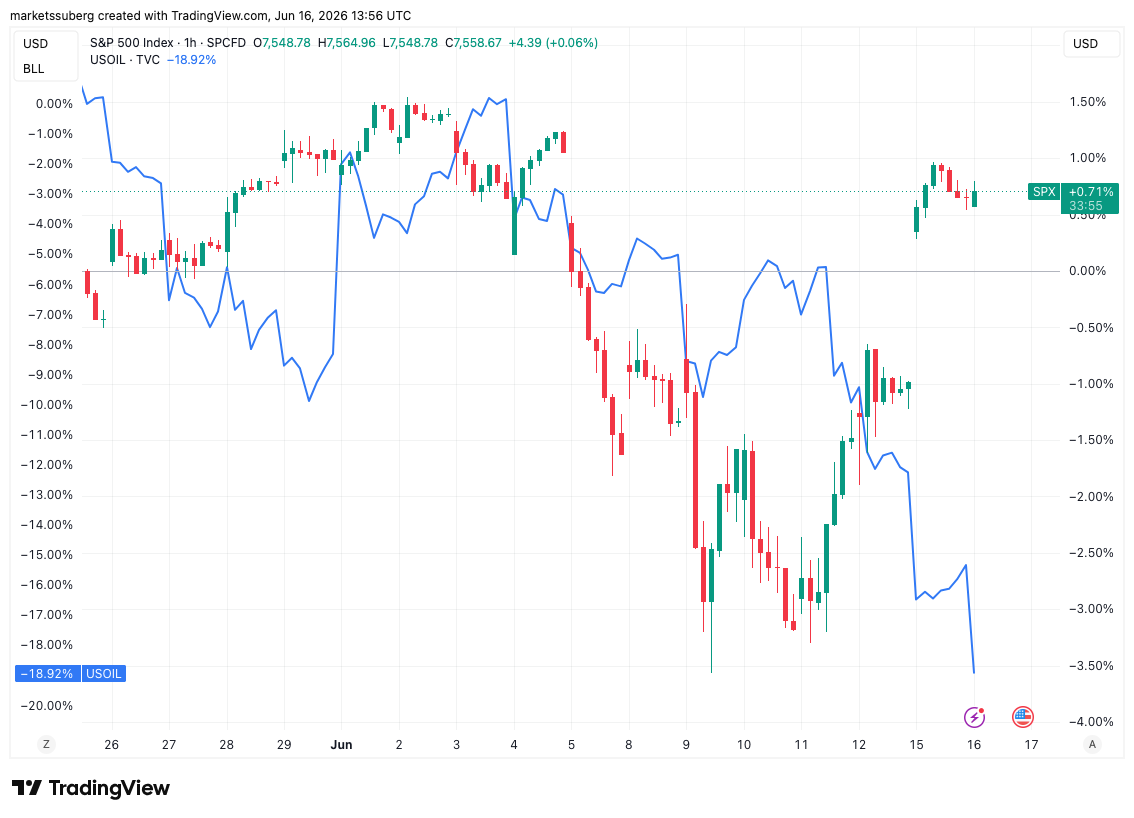
S&P 500 vs. WTI crude oil one-hour chart. Source: Cointelegraph/TradingView
Bitcoin nonetheless brought back its own divergence from other risk assets, and traders avoided bets on major BTC price upside.
“$BTC Has moved up further back into its range,” Daan Crypto Trades wrote in his latest analysis on X.
“I would not be surprised if we hang around this big area for a few more weeks at least. Especially with Summer coming up and lower liquidity/volatility.”
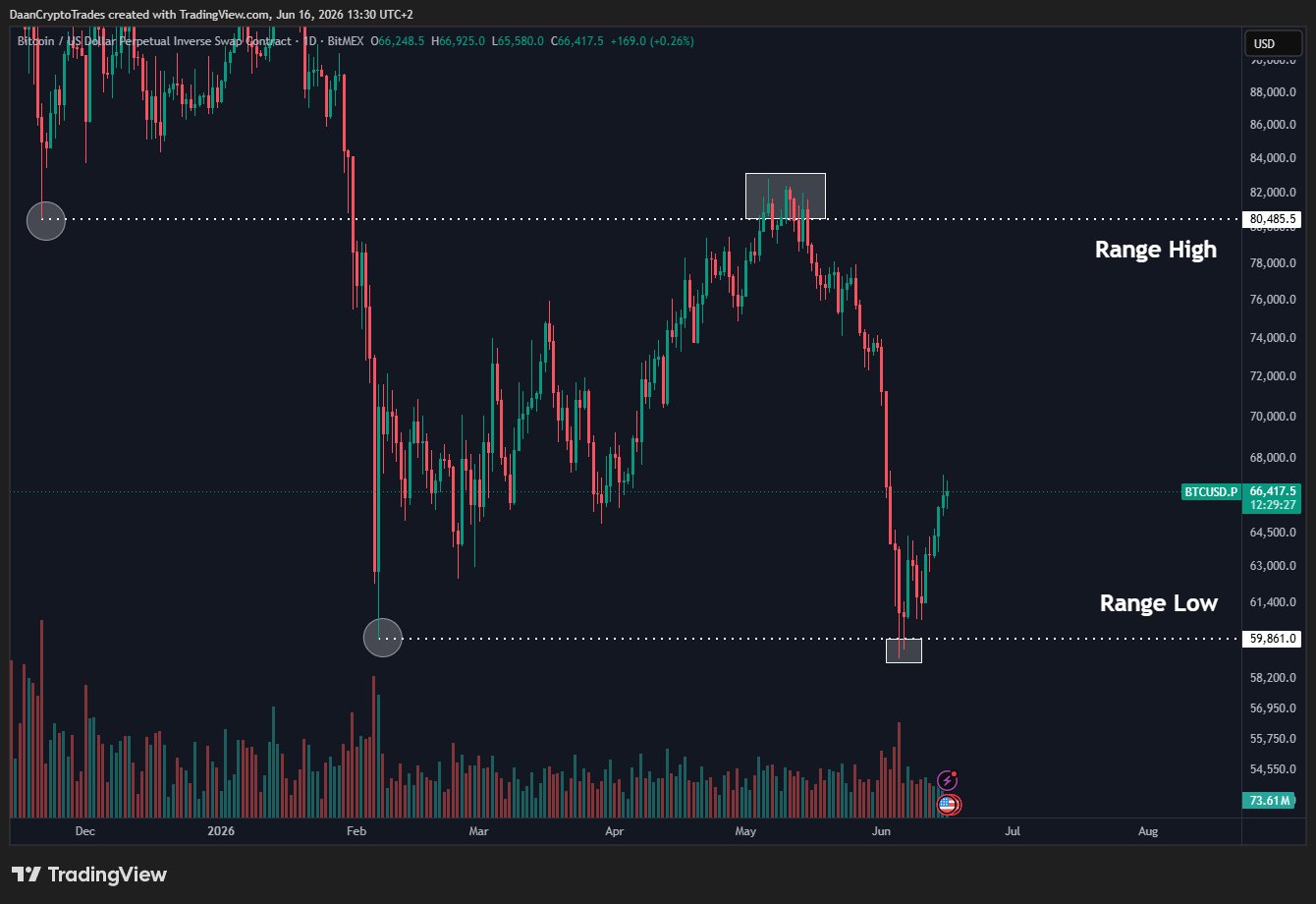
BTC/USDT perpetual contract one-day chart. Source: Daan Crypto Trades/X
Trader Roman joined those putting the area around $70,000 as a likely local top target.
“Still eyeing the 70k level for our bounce to be completed.,” he told X followers.
“Hourly TFs look good to continue a bit higher. There aren’t any ‘issues’ that I see yet to stop this bounce.”
Bitcoin trader calls “classic market psyop”
As Cointelegraph reported, other market analysis has cast doubt over the strength of $60,000 as long-term support, arguing that the bear market is too young to be over yet.
Related: Bitcoin analysis warns over BTC price rejection as $67K approaches
Countering this, trader Killa suggested that both market makers and trading algorithms had lured traders into betting on new lows that would never come.
“Just another classic market psyop,” they summarized alongside a chart of order-book liquidity data.
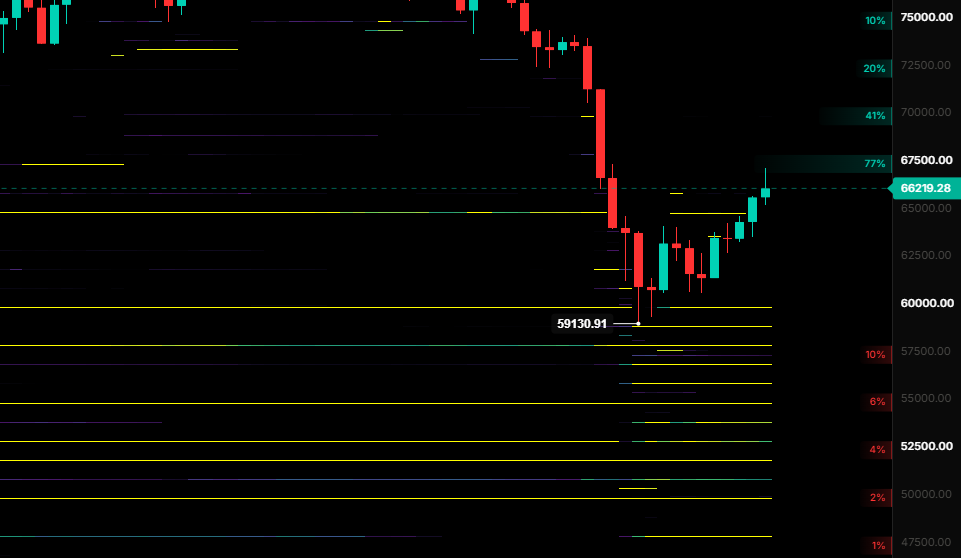
BTC/USD order-book liquidity data. Source: Killa/X
Data from CoinGlass put 24-hour crypto short liquidations at $230 million at the time of writing.
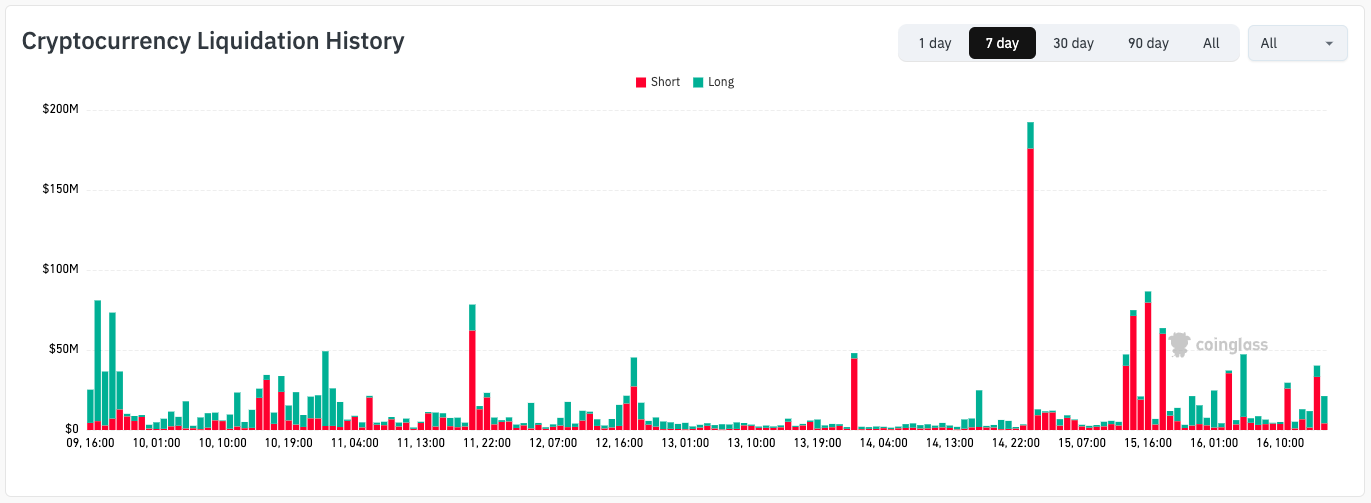
Cryptocurrency liquidation history (screenshot). Source: CoinGlass
Commenting, trader Lennaert Snyder said that price was headed into a “high-time frame sell zone,” targeting $68,000 for Tuesday.
“The liquidity sub 63.6K looks too juicy to not mitigate, but for the quality short I’d prefer that push to the upside first,” he wrote on X.
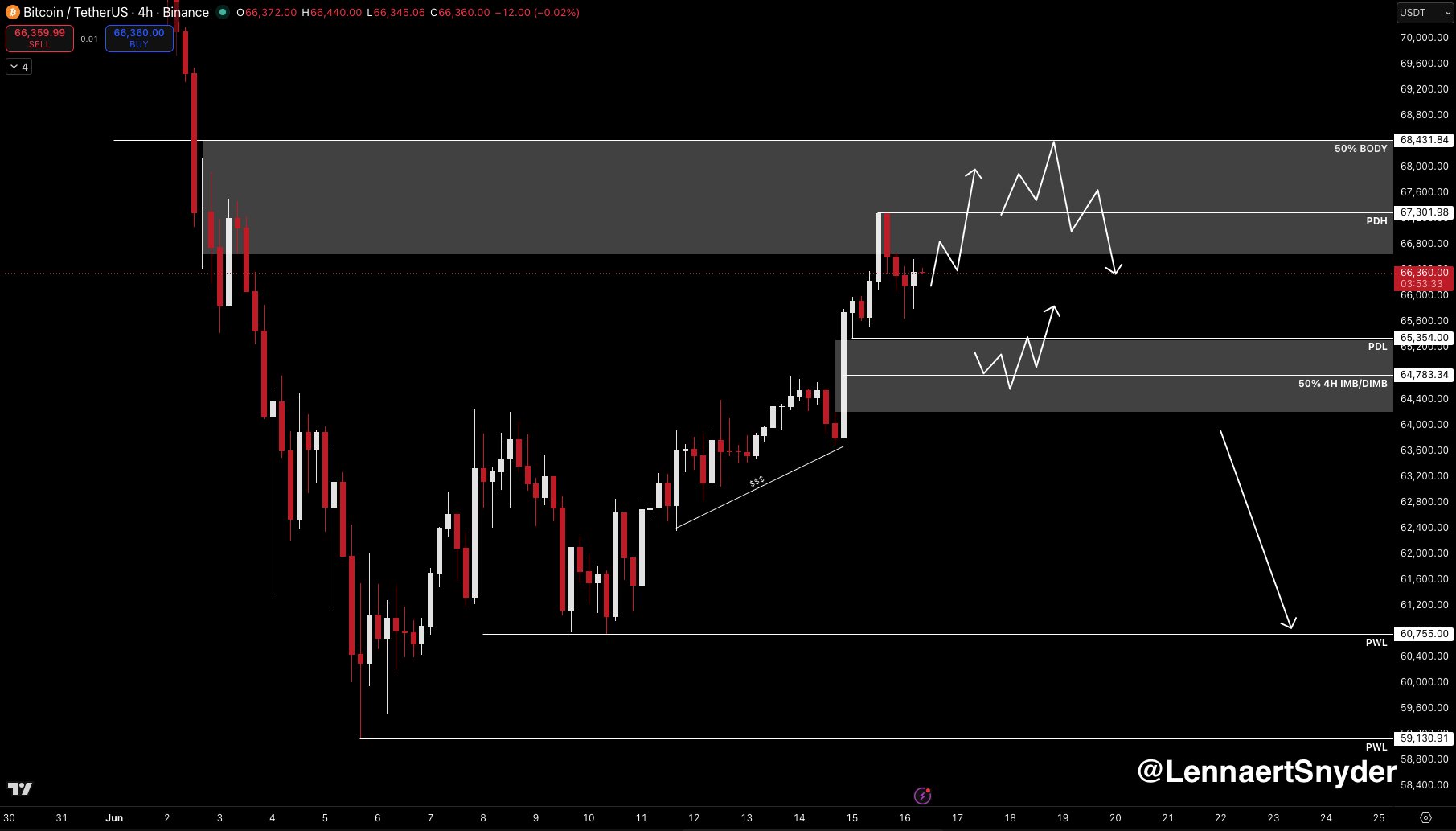
BTC/USDT four-hour chart. Source: Lennaert Snyder/X

Standard Chartered just reaffirmed its crypto prediction with 2030 bombastic targets. Bitcoin at $500,000, Ethereum at $40,000, and unexpectedly Uniswap at $100. ETH is currently trading near $1,800, while BTC sits above $66,000. Uniswap is at $3 after a 12% jump today.
Geoffrey Kendrick, Standard Chartered’s Global Head of Digital Assets Research, recently cut his 2026 targets. BTC to $100,000 from $150,000, ETH to $4,000 from $7,500, and flagged a credible path to $50,000 BTC and $1,400 ETH before any recovery materializes.
The Amazon analogy for ETH is pointed: in 2001, Amazon’s stock fell from $113 to $6 while every internal business metric kept improving. Kendrick’s argument is that ETH is in that same window right now. The bank separately frames 2026 as “the year of Ethereum,” expecting ETH to begin outperforming BTC as DeFi, stablecoins, and tokenization volumes compound.
The UNI call is the most aggressive: a $100 price target by 2030, with a graded ladder starting at $6.50 in 2026 and stepping up every year through the decade.
Discover: The Best Crypto to Diversify Your Portfolio
Can ETH, BTC, and UNI Reach Standard Chartered Crypto Prediction? Realistically
Start with the bear case, because Kendrick laid it out explicitly. BTC could re-test $50,000, and ETH could slide to $1,400 before any sustained recovery. The ETH/BTC ratio has already dropped 37% from August highs, and on that metric alone, the Amazon comparison carries weight: on-chain activity is at records even as price bleeds if we consider this year’s performance.

The 200-week SMA for ETH sits as a critical longer-term support reference; historically, breaches of that level have marked generational buy zones rather than structural breakdowns.
For BTC, $60,000 is still the psychological and technical line the bears need to hold. If macro headwinds ease, and outflow starts to go green again, BTC could run above $70,000 in the short term.

UNI’s ladder from $6.50, $20, $40, $65, to $100 implies 40x from the levels at initiation. That’s a high-beta DeFi bet contingent on DEX volume growth and potential fee-switch execution.
Standard Chartered, in its crypto prediction, argues UNI could outperform both BTC and ETH across the decade, which is a strong claim worth watching against on-chain DEX market share data quarter by quarter.
Discover: The Best Token Presales
Bitcoin Hyper Targets Early-Stage Upside While BTC Navigates Key Support
Here’s the practical tension: even if Standard Chartered’s 2030 targets prove correct, BTC at $66K and ETH at $1,800 with near-term downside flagged to $50K, and $1,400 means the asymmetry at these prices is compressed relative to the multi-year horizon.
Established large-caps with nine-figure daily liquidity don’t move 40x from current levels in a cycle. Early-stage infrastructure plays carry a different risk-reward profile entirely, which is where the Bitcoin Layer 2 sector is drawing capital right now.
Bitcoin Hyper ($HYPER) is positioning directly in front of that infrastructure narrative. It’s the first Bitcoin Layer 2 with Solana Virtual Machine (SVM) integration. The pitch is sub-second smart contract execution on top of Bitcoin’s security layer, outperforming Solana’s own throughput on transaction latency while preserving BTC’s trust model.
The presale has raised closer to $33 million at a current price of $0.01368, with staking live for presale participants. Features include a Decentralized Canonical Bridge for BTC transfers and high-speed, low-cost execution that directly addresses Bitcoin’s three structural limitations: slow finality, high fees, and no native programmability.
Research Bitcoin Hyper here before the presale closes.
The post Standard Chartered Crypto Prediction: $40K ETH, $500K BTC, and $100 UNI appeared first on Cryptonews.

‘The Pitt’s Patrick Ball on the “Alchemy” of Mel and Langdon [Exclusive]

Newscast – How Will The Social Media Ban Change Children’s Lives?

AI may be messing with home prices


-

 Business2 days ago
No Jackpot Winner as $257 Million Prize Rolls Over to $269 Million Monday Draw
-

 Crypto World5 days ago
Oppenheimer backs SpaceX as $70 billion retail frenzy builds
-

 Fashion4 days ago
Weekend Open Thread: Tuckernuck – Corporette.com
-

 Crypto World5 days ago
Markets Rally as SpaceX IPO Looms Amid Iran Tensions and Inflation Surge
-
 Crypto World2 days ago
Zimbabwe Requires Crypto Businesses to Register Annually Under New FIU Regulations
-

 Tech4 days ago
NanoClaw integrates JFrog registries to secure AI agent downloads
-
 Sports7 days ago
Bangladesh beat Australia after 20 years in ODIs, register only their second win over six-time world champions | Cricket News
-

 Tech4 days ago
This Week In Security: Microsoft On Microsoft, Register Your Domains, Linux On ARM, And FreeBSD Joins The File Cache Club
-

 Crypto World3 days ago
Bitget enters Argentina’s regulated crypto market through PSAV registration
-

 Business6 days ago
Thailand Ranks Second Worldwide for AI Adoption Growth, Microsoft Reports
-
 Tech5 days ago
Dutton Ranch star claims they ‘didn’t see any disruption’ on set following Chad Feehan’s exit from Yellowstone spinoff fueled by Taylor Sheridan clash rumors
-

 NewsBeat5 days ago
El Nino has formed in the Pacific and could set records, forecasters say
-

 Politics5 days ago
Politics Home | Healey Resignation Is “Colossal Failure Of Government”, Says Former Labour Defence Secretary
-

 Tech6 days ago
‘This is Seattle’s position on AI’: City Council votes unanimously to pause big new data centers
-
 Entertainment5 days ago
Donnie Wahlberg & More Heat Up Las Vegas at Circa’s Barry’s Downtown Prime
-

 Sports5 days ago
First Time Since 1971: Australia Register Historic Low In ODI Cricket
-
 Tech5 days ago
Opendoor Ends India Operations, Fueling a Bigger Conversation About AI and Outsourcing
-

 Politics5 days ago
Belfast burns, while Met chief points finger at Iran and Russia
-

 Business5 days ago
AT&T: Verizon's 27% Outperformance Sets Up A Solid Entry Point
-

 NewsBeat4 days ago
FBI searches office of Ohio voter registration group
You must be logged in to post a comment Login