
Crypto World
Hyperliquid Gets Dedicated Fiber Market Data via DoubleZero


DoubleZero has launched a dedicated market data feed for Hyperliquid, giving professional trading firms access to the decentralized exchange’s full order book over fiber rather than through its public APIs.
The feed includes Hyperliquid’s native perpetual futures and markets operated by trade[XYZ], which uses Hyperliquid’s infrastructure to offer perpetual contracts tied to assets including oil, gold and silver. The Hyperliquid feed was developed with validator operators and ecosystem partners including Hyperion DeFi, MAVAN and Kinetiq.
DoubleZero said the service delivers a continuous, ordered stream of market data for market makers, quantitative trading firms, and proprietary trading firms that need faster, more consistent order book updates.
Previously, firms seeking a complete view of Hyperliquid’s order book had to assemble the data themselves through public API responses or operate their own Hyperliquid nodes. DoubleZero said changes to Hyperliquid’s public APIs have reduced the frequency and depth of updates available through them.
DoubleZero operates a global fiber network designed to move data quickly between participants in blockchain networks and other distributed systems. Hyperliquid is the third venue available through its Edge market-data service, following Solana and prediction market Kalshi.
Related: Bitwise launches first Lighter ETP amid Hyperliquid rivalry
Onchain market infrastructure starts to resemble traditional exchanges
Hyperliquid’s market data infrastructure is beginning to resemble what traditional electronic exchanges use as professional trading moves onchain, according to Hyperion DeFi CEO Hyunsu Jung.
Jung told Cointelegraph that CME, Nasdaq and other major exchanges distribute professional market data over dedicated networks, allowing automated trading firms to receive a consistent stream of ordered data at high speeds.
“Hyperliquid data can now be consumed through the same basic model: publish once, distribute simultaneously over dedicated fiber,” he said.
However, significant differences remain. Traditional exchanges allow trading firms to place their systems close to the infrastructure that processes trades, while Hyperliquid executes trades onchain. DoubleZero’s service only delivers market data; it does not place or execute trades for firms.
“So the convergence is not Hyperliquid becoming CME,” Jung said. “It is onchain markets adopting the market-data infrastructure that professional trading firms already use.”
“It does not eliminate latency differences,” Jung said. “A firm in Tokyo will still have a physical advantage over one in New York.”
Magazine: Kyle Samani predicts SOL flippening, claims ‘no one’ uses ETH

Cardano’s ADA rose toward $0.26 as the Cardano Foundation and Fireblocks announced plans to add full support for tokens issued on the network by March 2027.
Summary
- Fireblocks plans to let its institutional clients custody, send, and receive Cardano Native Tokens.
- ADA traded near $0.247 on Sep. 24 after reaching about $0.251 during the day.
- The daily chart puts $0.262 in view if ADA clears resistance near $0.26.
- Support sits near $0.236 on the daily chart and $0.235 on the 4-hour chart.
Fireblocks plans to add Cardano token support by March 2027
The Cardano Foundation and Fireblocks said on Sep. 24 that Cardano Native Tokens, or CNTs, will become standard assets on the Fireblocks platform. Banks, exchanges, payment companies and fintechs using the platform will be able to custody, send and receive the tokens under its existing security and policy controls.
Fireblocks has supported Cardano’s native coin, ADA, since 2021. The planned addition covers other assets issued on Cardano, including tokens that use the Cardano Token Registry standard, known as CIP-26, and the network’s onchain metadata standard, CIP-68. According to the announcement, handling those tokens has required extra manual steps until now.
The companies expect support to become available by March 2027. They also plan to assess further integrations with Cardano’s decentralized finance ecosystem during 2027.
Cardano Foundation CEO Frederik Gregaard said access through infrastructure institutions already used could help issuers of stablecoins and tokenized assets on Cardano reach those firms.
“Institutions rarely adopt a new asset on its own. Adoption happens through trusted infrastructure.”
The announcement concerns planned access to Cardano-based tokens. It does not report new token issuance, institutional purchases of ADA or a completed platform rollout.
ADA price faces another test near $0.26
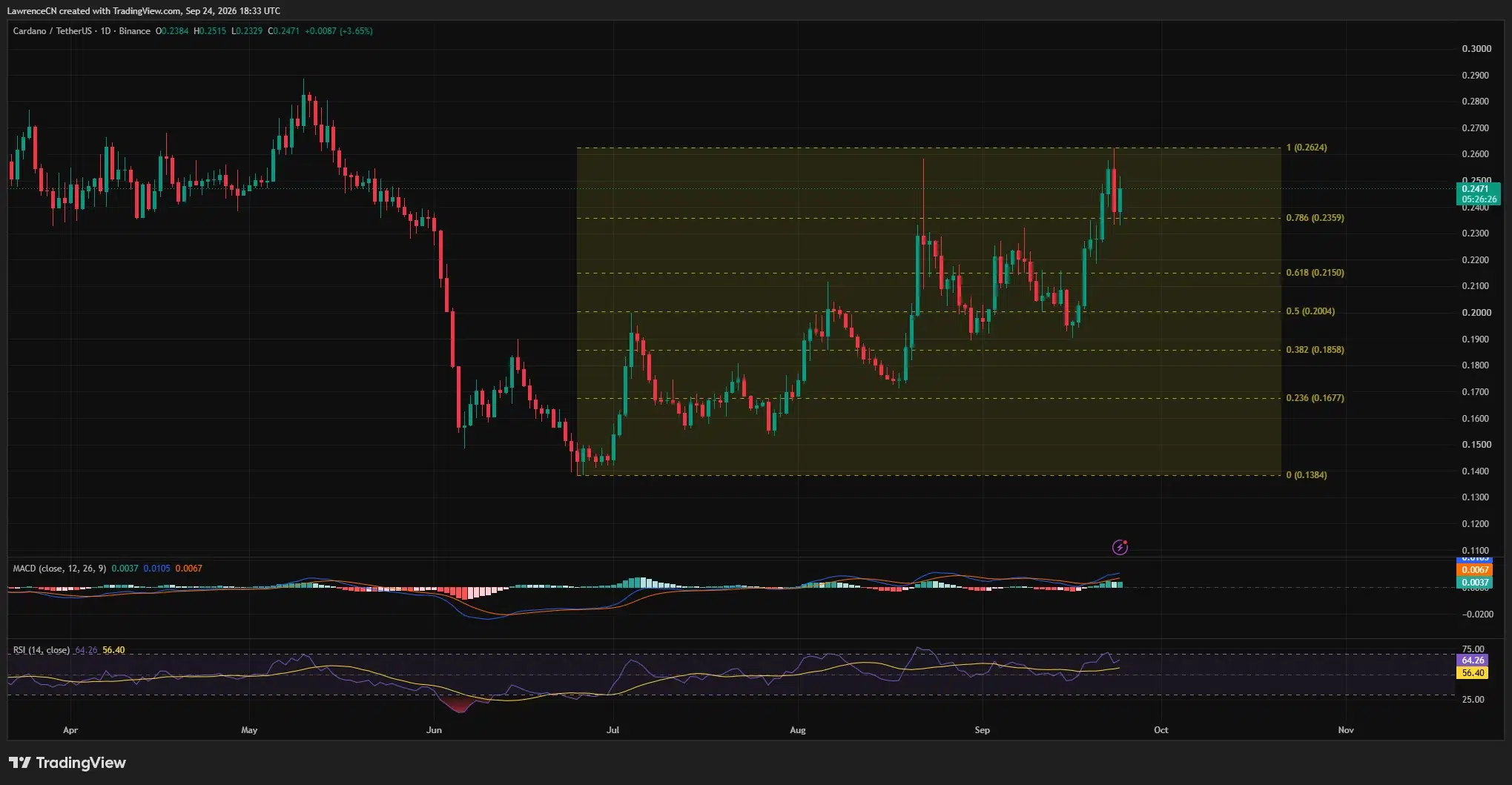
TradingView’s ADA/USDT daily chart showed ADA near $0.247 late on Sep. 24, up about 3.65% for the day. Price had reached roughly $0.251 before pulling back, leaving the recent high around $0.26 as the next level to watch.
A Fibonacci retracement drawn from the chart’s June low near $0.138 to the recent high near $0.262 places the 78.6% level at $0.2359. ADA was trading above that level at the time of the chart. A move through the recent high would put $0.262 back in focus, while a drop below $0.236 would take price beneath the retracement level.
The daily relative strength index stood near 64, above its average of about 56. The moving average convergence divergence indicator was also positive, with its MACD line above the signal line. Both readings reflected the recent advance, though ADA had yet to clear the high used in the retracement.
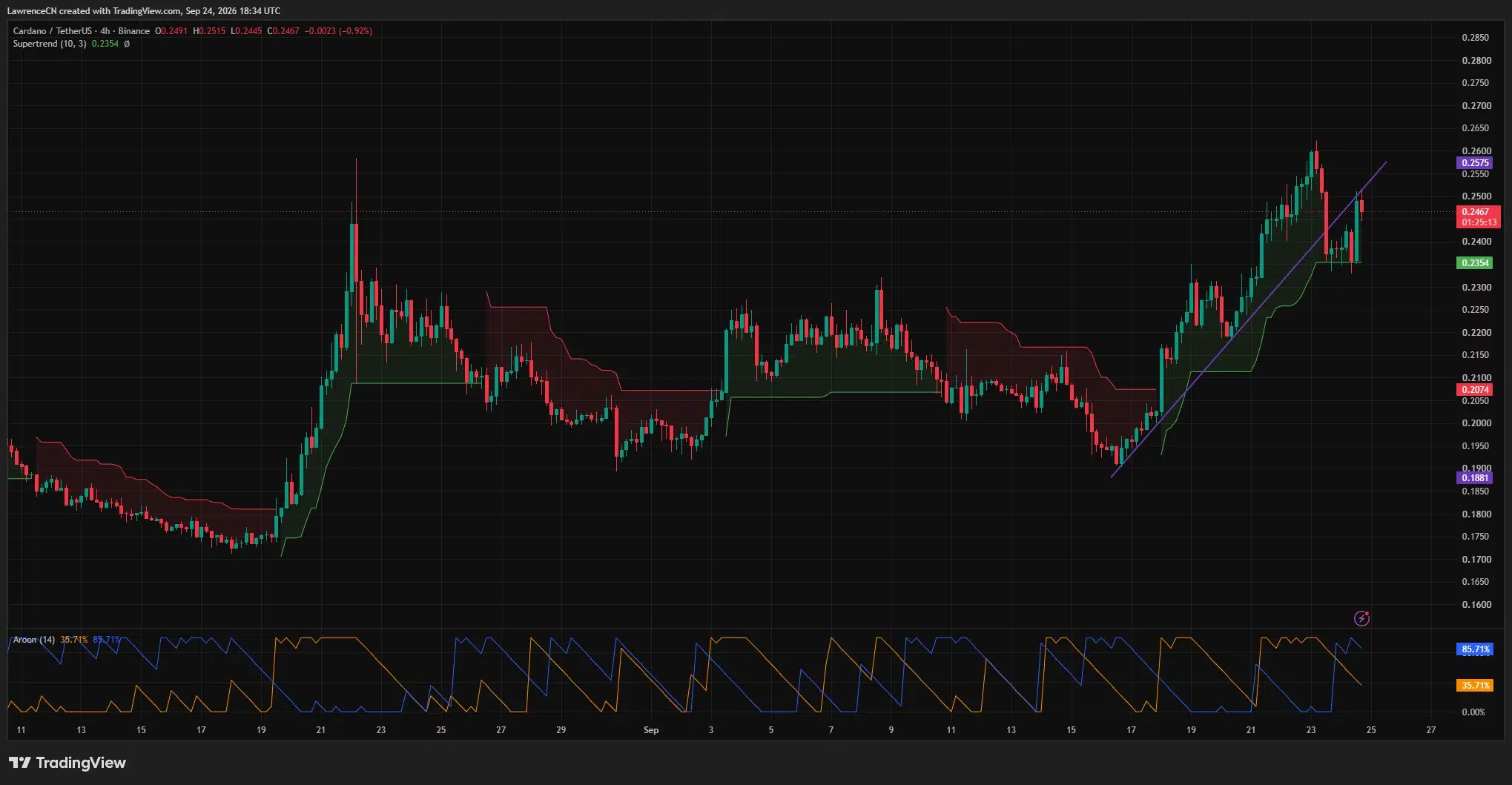
On the 4-hour chart, ADA had retreated from a move above $0.26 before recovering to around $0.247. The Supertrend indicator remained below price near $0.2354. A rising trendline on the chart pointed toward the $0.25 area, making a sustained move above that level relevant to another test of the recent peak.
Liquidation levels cluster on both sides of ADA
CoinGlass’s 24-hour ADA liquidation heatmap showed a bright band near $0.252, just above the price at the end of the chart. Other visible bands sat around $0.242 and $0.236, with a larger group of levels lower down near $0.23.
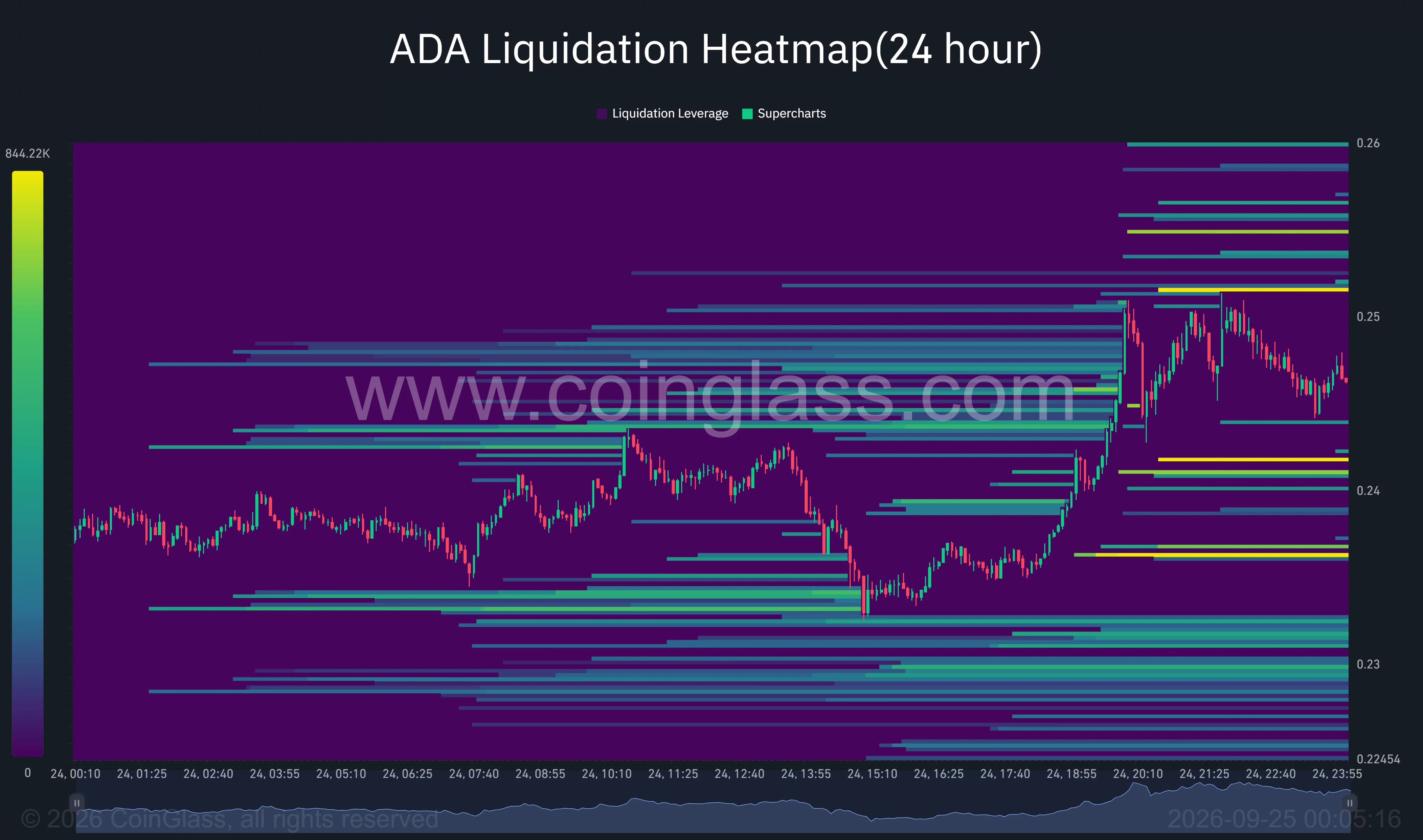
Those bands show where leveraged positions could face liquidation if price reaches them; they do not establish where ADA will trade next. The nearby $0.252 band also falls below the recent high around $0.26, so ADA would need to pass both areas to confirm a stronger breakout on the displayed charts.
The Fireblocks rollout gives Cardano token issuers a timetable for access to institutional custody and transfer tools, including firms serving the US market. For ADA holders, the nearer test remains technical: whether price can regain $0.25 and break above $0.26 while holding the $0.235–$0.236 support area on a pullback.
Disclosure: This article does not represent investment advice. The content and materials featured on this page are for educational purposes only.

The war in Gaza has been a major focus for world leaders addressing the U.N. in New York this week.
U.N. Secretary-General António Guterres, whose nearly decade-long tenure leading the international body comes to an end at the start of next year, said during his address on Tuesday that Gaza has experienced “a scale of killing and destruction unlike anything I have witnessed in all my years as Secretary-General.” He added that Israel’s “violence, displacement and settlement expansion” raised the “specter of ethnic cleansing.”
Trump said the war in Gaza was over. He took credit for ending it, “saving untold thousands of lives,” and brokering the return of the remaining hostages held in Gaza. But key elements of the peace agreement Trump helped broker in October 2025—including Hamas’ disarmament, a long-term plan for governing Gaza, and the delivery of humanitarian aid—remain largely stalled.
Other world leaders called for greater international action over the continuing suffering in Gaza. French President Emmanuel Macron asked “what is our credibility worth if we remain inactive on Gaza?” during his speech on Tuesday. British Prime Minister Andy Burnham said the same day: “We will not stand by as the horrific suffering continues to grow and the prospect of a two-state solution, the best hope for peace and stability for both nations, comes under attack.”
Crypto World
Crypto exchange Bitget says $352 million affected in a hack, claims user funds are ‘safe’

Crypto exchange Bitget had $351.6 million dollars exposed to a system breach on Thursday, CEO Gracy Chen announced in a social media post.
In a post on X, Chen said that Bitget’s cold wallets and user funds were safe, and that there were “unauthorized transfers from some of our hot wallets.” The exchange maintains a “user protection fund” that had over $464 million in it, she said.
“Cold wallets remain fully secure. Bitget operates a three-tier wallet architecture — the breach contained only a portion of the hot wallet and warm wallet layers,” she added.
Deposits and trading remain online, she said, but the exchange is “temporarily” pausing withdrawals until it can finish a security review.
Onchain data and independent blockchain researchers had earlier flagged unusual wallet movements, initially reporting that around $183 million in digital assets had moved from wallets labeled as belonging to the exchange.
Emmett Gallic, an analyst at blockchain analytics firm Arkham Intelligence, said in an X post that the transactions involved three Bitget hot wallets and one cold wallet across multiple blockchains, with the funds consolidated into a single address. The assets included ETH, BNB, AVAX and USDT0, according to his analysis.

Cointelegraph is committed to providing independent, high-quality journalism across the crypto, blockchain, AI, and fintech industries.
All news, reviews, and analyses are produced with full journalistic independence and integrity. For more details on our standards and processes, please read our Editorial Policy.

DoubleZero has launched a dedicated fiber-based market data feed for Hyperliquid, aiming to give professional trading firms a more reliable way to consume the decentralized exchange’s full order book. Instead of relying on Hyperliquid’s public APIs, participants can access an ordered, continuous stream of market data over a private network connection—an approach designed for market makers and quantitative desks that prioritize speed and consistency.
The feed covers Hyperliquid’s native perpetual futures markets and also markets run by trade[XYZ], which uses Hyperliquid’s infrastructure to offer perpetual contracts linked to assets including oil, gold, and silver. DoubleZero says the service was developed alongside validator operators and ecosystem partners such as Hyperion DeFi, MAVAN, and Kinetiq.
Key takeaways
- DoubleZero’s Hyperliquid feed delivers the full order book via a fiber network, avoiding the limitations of public API updates.
- The service supports Hyperliquid native perps and trade[XYZ]-hosted markets, including perpetuals tied to oil, gold, and silver.
- DoubleZero cites reduced update frequency and depth in Hyperliquid’s public APIs as a key reason firms may need a dedicated data stream.
- Hyperion DeFi CEO Hyunsu Jung frames the development as “onchain markets adopting” the professional market-data distribution model, not as a direct replacement for traditional exchange infrastructure.
A dedicated order book feed for onchain venues
For many professional traders, the challenge with onchain venues is not just execution—it’s the quality and cadence of market data. DoubleZero’s new offering is positioned as an alternative to stitching together order book views from public API responses or from running one’s own nodes.
In its announcement, DoubleZero said that firms previously seeking a complete picture of Hyperliquid’s order book had to aggregate public data themselves or operate Hyperliquid infrastructure. It also argued that changes to Hyperliquid’s public APIs have reduced both the frequency and the depth of the updates available through those endpoints.
The DoubleZero feed is designed to address that gap. According to DoubleZero, it provides a continuous, ordered stream of market data intended for market makers and quantitative and proprietary trading firms that depend on fast, consistent order book refreshes.
Built with ecosystem partners and validator operators
DoubleZero did not present the initiative as a solo effort. It said the Hyperliquid feed was built with input and support from validator operators and ecosystem partners in the broader onchain ecosystem, including Hyperion DeFi, MAVAN, and Kinetiq.
The feed’s scope is also broader than a single venue’s flagship product. In addition to Hyperliquid’s native perpetual futures markets, it includes perpetual markets operated by trade[XYZ]. Those contracts are linked to assets such as oil, gold, and silver—showing that the data pipeline is intended to serve professional participants operating across multiple perpetual offerings within the Hyperliquid ecosystem.
DoubleZero further said the infrastructure is part of its wider “Edge” market-data service, which is already available for other venues. The Hyperliquid feed is presented as the third location offered through that service, after Solana and prediction market operator Kalshi.
Closer to traditional exchange data distribution—without pretending it’s identical
Hyperion DeFi CEO Hyunsu Jung described the direction of travel as convergence in the market-data layer rather than the trading model. In comments to Cointelegraph, Jung compared DoubleZero’s fiber-based distribution to how traditional electronic exchanges deliver professional market data.
Jung explained that exchanges such as CME and Nasdaq distribute professional data through dedicated networks, enabling automated trading firms to receive a consistent, ordered stream with high speed. In that sense, he said, Hyperliquid data can now be consumed through a similar fundamental model: “publish once, distribute simultaneously over dedicated fiber.”
However, he stressed the important differences remain. Traditional exchanges allow firms to reduce latency by placing trading systems physically closer to the exchange infrastructure that processes orders. Hyperliquid’s execution happens onchain, which means placement advantages still operate at the level of physics and connectivity.
As Jung put it, the “convergence is not Hyperliquid becoming CME.” Instead, onchain markets are adopting market-data infrastructure patterns that professional traders already use. At the same time, he cautioned that the move does not eliminate latency differences—such as the advantage a firm in Tokyo may still hold over a firm in New York.
Why this matters for professional traders and market makers
Dedicated order book data feeds can be consequential for firms that treat the order book as the primary signal. When update cadence slows or when public endpoints provide less depth, traders face a trade-off: either accept higher uncertainty in their models or invest additional effort into alternative data paths.
DoubleZero’s positioning suggests the latter option is becoming more practical as onchain venues mature. By distributing ordered market data over fiber rather than through public API calls, the service aims to deliver the predictability that quantitative systems often require to manage strategies, risk controls, and routing decisions.
It also highlights a shift in how professional onchain participation may evolve. Instead of relying solely on “build your own stack” approaches—such as running nodes or aggregating public data—firms can increasingly buy into infrastructure layers designed specifically for low-latency, consistent streaming.
For investors and observers, the broader takeaway is that the competitive edge between trading venues may increasingly depend not only on smart contract execution or liquidity incentives, but on the surrounding operational tooling: data transport, ordering guarantees, and the practical latency realities of trading systems.
What readers should watch next is how widely this approach is adopted across onchain venues and whether additional venues follow the same pattern of dedicated, ordered distribution. Equally important is whether Hyperliquid’s public API changes continue to push more high-frequency and market-making activity toward fiber-based or provider-managed data channels.


Bitget said unauthorized transfers affected a limited number of hot wallets, while cold wallets and most platform assets remained unaffected.

Bitcoin has reached an eight-month high before retreating toward $85,000, as U.S. spot ETFs have drawn about $1.7 billion in two days and futures traders have added more than $2 billion in new positions.
Summary
- U.S. spot Bitcoin ETFs took in $999 million on Sep. 21 and $714.7 million on Sep. 22.
- BTCS adviser Wojciech Kaszycki sees a rally that began with spot demand but is attracting leverage.
- He puts the next test at $90,000, where holders may sell after recovering earlier losses.
- Kaszycki says treasury companies should pace purchases and avoid borrowing against their Bitcoin.
Wojciech Kaszycki, strategy adviser to Warsaw-listed Bitcoin treasury company BTCS S.A., told crypto.news that ETF inflows, futures open interest and funding rates together give a clearer picture of the rally than price alone. In his assessment, cash buying supported the initial move, while borrowed positions have started to accumulate on top of it.
“Simple test: who is buying, and with what money,” Kaszycki said. He described ETF demand as cash entering funds, while leveraged futures positions can be closed by force if prices turn against traders.
The distinction has become more pressing after Bitcoin reached $87,392 on Sep. 21, its highest price since Jan. 29, according to Bitfinex Alpha. By Sep. 24, it had fallen back toward $84,000, even as U.S. spot Bitcoin ETFs recorded another day of net inflows.
Bitcoin ETF buying has outpaced the rise in open interest
Kaszycki said he looks first for ETF inflows that continue over weeks, rather than a single large trading day. He then compares the change in futures open interest with Bitcoin’s price: if outstanding contracts grow much faster than the price, more of the advance may depend on borrowed money. Funding rates show what traders are paying to keep long positions open.
For the latest move, he cited about $1 billion of U.S. spot ETF inflows on Monday and $700 million on Tuesday. Bitfinex reported the more precise daily totals as $999 million on Sep. 21 and $714.7 million on Sep. 22. Its report on Bitcoin’s buyer range also placed a large concentration of recent purchases between $85,000 and $86,500.
Kaszycki estimated that open interest was up about 7% over a month, with funding around 8% on an annualized basis. He called the funding rate positive but not excessive, while warning that the balance could change if traders keep adding leverage faster than cash buyers enter the market.
“Spot-led start, with leverage now climbing on top,” he said. “That second part is what I’ll be watching next week.”
He contrasted the current setup with August, when, in his account, a rally faded as ETF buying paused. Kaszycki said open interest fell and funding approached zero in early September before the latest fund inflows arrived.
Since Tuesday’s inflow, U.S. funds have recorded another positive session: SoSoValue data cited in coverage of the five-day ETF streak put Sep. 23 net inflows at $346.98 million. Bitcoin nevertheless pulled back from above $87,000, showing that fund subscriptions and the spot price need to be assessed separately.
A move through $90,000 would meet selling, Kaszycki says
Kaszycki sees $90,000 as both a round-number trading level and a test of whether spot buyers can absorb sales. He said holders who bought Bitcoin between $90,000 and $110,000 last year may use a return to that range to sell near their purchase prices. Investors who bought around $63,000 in August may also take profits.
Short liquidations could push Bitcoin higher as traders buy back contracts to close losing positions, he said, but such buying ends once those positions have been cleared. In his view, holding a price above $90,000 would require continuing ETF subscriptions and purchases through corporate or over-the-counter channels.
“What happens to spot flows in the two weeks after we touch it is the story,” Kaszycki said.
For U.S. investors, the daily ETF figures offer one visible measure of demand through listed products. They do not, on their own, identify the end investors placing orders or establish when the funds acquired the underlying Bitcoin. A Sep. 24 examination of buyers after the Fed hike found that the funds took in about $2.65 billion across five sessions through Sep. 23, after losing $746.3 million over Sep. 15 and 16.
Bitcoin treasury purchases depend on the financing price
For companies that hold Bitcoin, Kaszycki favors scheduled purchases over attempts to time each rally or pullback. He said BTCS carries out most of its larger purchases over the counter with market makers. When trading becomes fast, the company reduces the size of individual orders and spreads them out rather than stopping its buying program.
He also described selling put options below the market as one approach BTCS uses: the company receives a premium if the option expires without a purchase, or buys coins at the option’s agreed price if it is exercised. The result depends on the contract terms and Bitcoin’s price at expiry.
Kaszycki placed particular weight on how a listed company pays for additional coins. In his view, issuing shares to buy Bitcoin makes sense only when the shares trade above the value of the Bitcoin the company already holds. Issuing equity below that value, he argued, can reduce the Bitcoin attributable to each existing share.
U.S. treasury companies provide a recent example of the financing choices investors can examine. Strive said it used proceeds from SATA preferred stock to fund a $36.6 million purchase of 469 BTC between Sep. 8 and Sep. 11, according to a report on its treasury purchase. The transaction raised its reported holdings to 25,000 BTC.
Futures liquidations can reach corporate holders quickly
Kaszycki said fund transactions and futures liquidations operate on different schedules. U.S. ETF activity runs through trading-day processes, while leveraged crypto positions can be liquidated within minutes at any hour. A sharp futures sell-off can therefore lower the market value of a corporate Bitcoin holding even when the company has not borrowed against its coins.
Debt-funded companies face a second pressure in his assessment: a falling Bitcoin price reduces the value of their holdings while a declining share price can make new capital harder to raise. He advised companies to avoid margin, perpetual futures and borrowing against their Bitcoin on terms that can trigger a rapid demand for repayment.
“If you must hedge, use options where the maximum loss is the premium you paid,” Kaszycki said. He added that liquidations of other traders’ positions can still force an unleveraged company to record a lower market value for its Bitcoin holdings.

Strive has generated an estimated $85.88 million through sales of its SATA preferred stock over three trading sessions, enough to buy about 1,002 Bitcoin at prices recorded by BitcoinTreasuries.net.
Summary
- BitcoinTreasuries.net estimates that SATA sales raised $85.88 million from Sep. 21 to Sep. 23.
- Its estimated Bitcoin figure is based on trading data, not a confirmed Strive purchase.
- Strive last reported holding 26,355 BTC after buying 1,355 BTC in the prior week.
- Strategy bought 950 BTC in its latest reported week while using cash to repurchase STRC shares.
BitcoinTreasuries.net’s SATA tracker estimates how many shares Strive issues through its at-the-market program by examining trading volume while SATA is at or above its $100 stated value.
It then estimates net proceeds after sales commissions and divides that amount by Bitcoin’s price during the session. The tracker’s figure is therefore an estimate of potential buying power; Strive’s next disclosure would establish any actual purchase and its cost.
Strive’s SATA sales are estimated at $85.88 million
For Sep. 21, the tracker estimates that Strive sold about 284,000 SATA shares and received $27.69 million in net proceeds. At an average Bitcoin price of $86,001, that sum would cover approximately 321.97 BTC.
The largest of the three estimated sessions came on Sep. 22. BitcoinTreasuries.net puts net proceeds at $36.08 million from roughly 370,000 shares, equivalent to about 418.27 BTC at an average price of $86,266.
On Sep. 23, estimated sales of another 226,700 shares produced $22.11 million. The tracker calculates that the proceeds could buy 261.43 BTC at an average price of $84,556. Together, the three daily estimates come to $85.88 million and 1,001.67 BTC.
Those daily share counts are estimates of issuance through the program, rather than a count confirmed in a new company filing. BitcoinTreasuries.net says it calibrates its model against Strive’s subsequent disclosures. Its method also separates potential SATA issuance from ordinary trading between investors, which does not send money to Strive.
The distinction matters because proceeds raised on a given day need not pay for a Bitcoin trade on that same day. Strive also holds cash and can use more than one source of funding. An estimated BTC equivalent should not be added to the company’s reported holdings before Strive discloses a purchase.
Strive’s last filing put its treasury at 26,355 BTC
Strive’s most recent reported acquisition covered Sep. 14 through Sep. 18, when it bought 1,355 BTC for approximately $107.7 million at an average of $79,475 per coin. The purchase lifted its disclosed balance from 25,000 BTC to 26,355 BTC. At the time, its SATA shares outstanding increased by 786,194, while cash and equivalents rose to approximately $229.6 million.
Chief Executive Matt Cole described how Strive raised capital during that reporting period. “Warrant exercises began last week, generating $21.2M in gross proceeds,” he wrote on X. “Including those proceeds, 57.7% of total capital raised came from SATA proceeds.”
The company had reached 25,000 BTC a week earlier after acquiring 469 BTC for approximately $36.6 million. Strive said proceeds from SATA funded that purchase. Its Sep. 14 filing also showed that SATA shares outstanding rose by 402,541 during the period, while its effective common share count increased by 34,206.
Earlier in September, Strive added 1,375 BTC for approximately $109 million. That purchase took its balance to 24,531 BTC, following an acquisition of 1,800 BTC in late August. The successive company filings show completed purchases; the Sep. 21–23 tracker readings concern a later period for which the supplied figures remain estimates.
Strategy bought Bitcoin while repurchasing STRC
Strategy, the largest public corporate Bitcoin holder, disclosed a different use of its cash in the week ended Sep. 20. According to its SEC filing, it bought 950 BTC for $75.7 million at an average price of $79,670, taking its holdings to 846,000 BTC. Strategy reported an aggregate acquisition cost of about $63.8 billion, or $75,416 per coin.
During the same week, Strategy spent $174 million repurchasing approximately 1.77 million shares of its STRC preferred stock. As crypto.news reported on Sep. 21, Strategy made no sales through its at-the-market programs for that period. It paid for both the Bitcoin and the STRC repurchases from existing USD Cash, which fell from roughly $1.30 billion to $1.05 billion.
A week without new STRC issuance does not establish that Strategy can no longer raise money through its securities programs. Its earlier filing showed that it sold MSTR common shares at the end of August and directed $369.7 million of the proceeds toward 4,603 BTC. The Sep. 20 filing establishes only how Strategy financed its latest reported transactions.
Strive also owns Strategy’s preferred stock. Its filings showed a holding of 505,000 STRC shares through Sep. 18, valued at approximately $49.7 million on that date. Strive’s own preferred shares, SATA, carried a 13% annualized dividend rate for September, compared with 12% for STRC, according to the companies’ disclosures reviewed in earlier preferred-stock coverage.
U.S. investors can check the next SEC disclosures
Both Strive’s ASST common shares and SATA preferred shares trade on Nasdaq, according to its SEC filing. The securities give U.S. investors different claims on the same company: common shareholders own equity, while SATA holders have the preferred rights set out in its terms. Strive reports changes in its Bitcoin balance, cash, and outstanding share counts in its filings.
The next Strive filing can establish whether the company bought Bitcoin after Sep. 18 and how many SATA shares were outstanding at the end of the new reporting period. Its last filing also recorded 505,000 STRC shares held and $229.6 million in cash and equivalents as of Sep. 18.
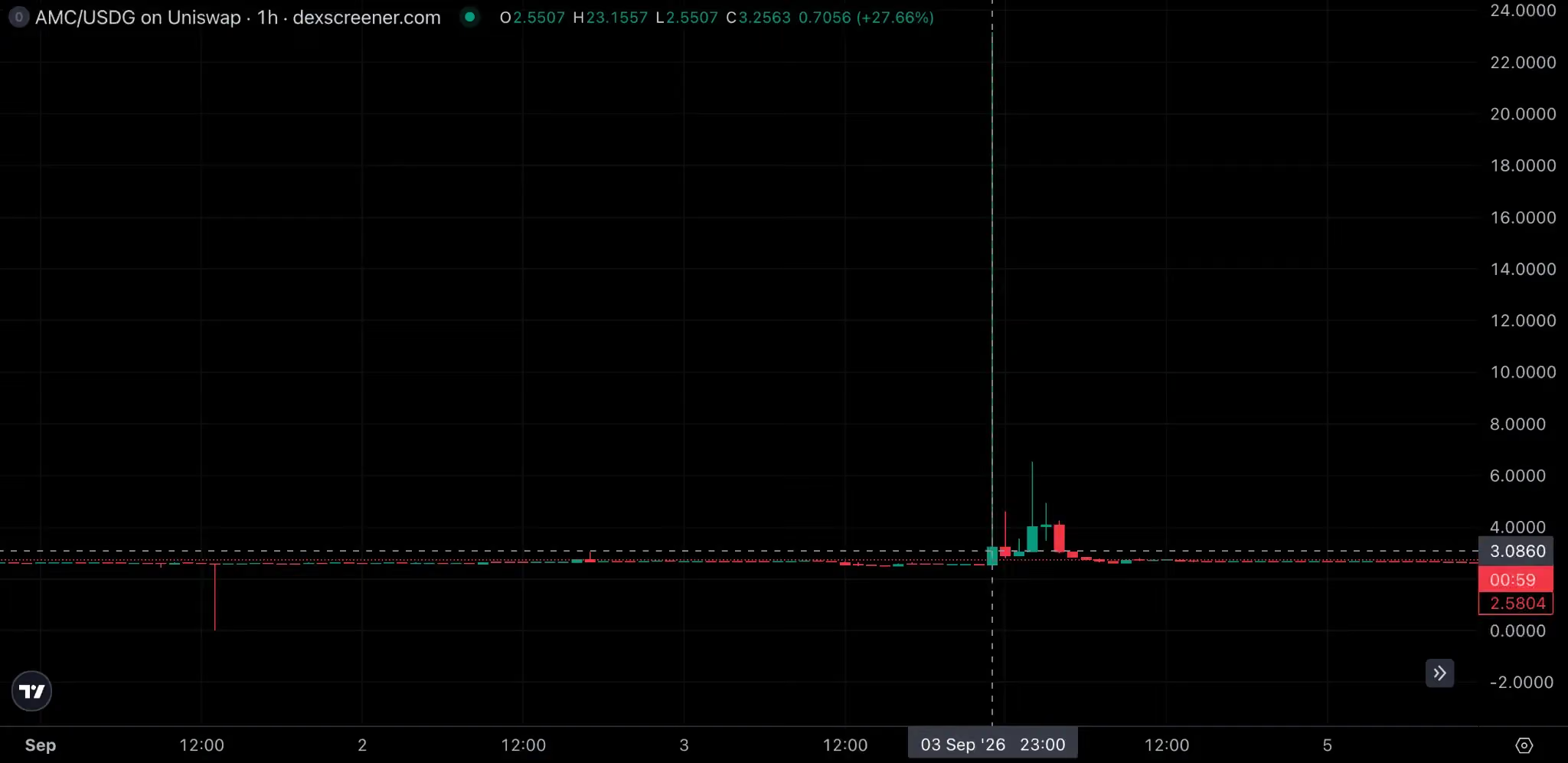
However, a different picture emerges when the underlying market is closed. Leading up to midnight on Thursday, September 3, Robinhood’s AMC token went from $2.55 to as high as $23.16, which is nine times the $2.54 AMC had closed on NYSE seven hours earlier, before coming back down to $3.26 within the same hour. Volume through the pool during the hour was $10.5 million.

Wrapped tokens such as Robinhood’s AMC are often structured as claims against offshore issuers, which collateralize the tokens with the underlying shares. Theoretically, if the issuer ensures that underlying stock positions and the claims are matched 1:1, the price should align, but in practice, the two instruments are traded separately and can thus diverge. Arbitrageurs, such as high-frequency trading firms and market-making desks, step in to keep markets in line, lock in arbitrage profits, and close any dislocations. The same mechanism keeps depositary receipts aligned with their underlying shares, and ETFs with their net asset value.
In Robinhood’s case, however, the Jersey issuer names only one authorized participant able to create and redeem. The spike fell well inside the hours when it was permitted to do so, but the participant did not mint or burn any tokens at the time. Onchain data shows 47 mints on Friday, Sept. 4, every one between noon and 7 p.m. ET, comfortably inside the cash session, half a day after the token had depegged and recovered.

They may not even have to maintain offchain versions of the records if the firm is using a private network. If the blockchain is public and permissionless, the document said, the regulated business “should establish systems and controls that enable it to retain and produce such records under any circumstances, including in the event of an emergency or other disruption to the network.”
The CFTC has been hurrying to erect new policies, whether by stating an updated, crypto-friendly view on existing regulations or writing new rules. The process has been especially urgent after the U.S. Senate’s failure last week to advance the Digital Asset Market Clarity Act that would have set up a U.S. regulatory regime for the industry, including granting the CFTC powers over the crypto spot markets — which remains a regulatory hole for the sector.
“I’m pleased to see staff update these frequently asked questions consistent with the agency’s ongoing efforts to provide regulatory clarity for the crypto industry,” CFTC Chairman Mike Selig said in a statement.
Read More: CFTC sends crypto rules to White House to review as Congress stalls on Clarity Act

Bose QuietComfort Ultra Headphones 2nd Gen Review: Still the Best for Noise Cancelling?

This Is Still Not a Pipe: Magritte’s influence examined in a hoot of show

Deficit reduction could lower inflation and interest rates, CRFB finds

Weekend Open Thread – Corporette.com

Weekend Open Thread: Talbots – Corporette.com

Memory prices are slowing because buyers ran out of money

The Reality of Trading#stockburner#stockmarket #tradermindset #crypto #shortvideo #learning #live

SHANNON SHARPE BLACKBALLED BY NFL AGENTS AFTER PREACHING FINANCIAL LITERACY TO PLAYER’S

UNANG PAGKIKITA PERO NAG AWAY AGAD SILA BOSS JOHN AT SHESHE | Queen Money
-
 Fashion6 days ago
Weekend Open Thread: Talbots – Corporette.com
-

 Tech4 days ago
Researchers escape OpenAI Codex sandbox to run commands on host
-

 Crypto World2 days ago
Goldman Sachs and Deutsche Bank Agree: The S&P 500 Rally Isn't Over
-

 Crypto World4 days ago
Who Needs CLARITY Anyway? ARB Could See 70X Increase: Hodler’s Digest
-

 Crypto World6 days ago
Circle launches Arc Studio AI agent for building onchain apps
-

 Fashion11 hours ago
8 iPhone Accessories That Add Personality
-

 Crypto World7 days ago
Mortgage and refinance interest rates today, Thursday, September 17, 2026
-
 NewsBeat6 days ago
Trump says US has reached an agreement to take permanent control of Greenland’s security
-

 Crypto World6 days ago
Trading Bitcoin on Robinhood? Why 2% Spread Has Traders Worried
-

 Crypto World6 days ago
Bitcoin price breaks channel as RSI climbs to 63
-

 Business4 days ago
Analog Devices (ADI) Bets $1.35 Billion on Chips that Let Machines Think for Themselves
-

 Tech3 days ago
Google’s $899 Googlebook is a bet that you’ll buy a new laptop for Gemini
-

 Crypto World4 days ago
Coinbase, Robinhood, Circle Seen as Tokenized-Stock Winners
-

 Tech5 days ago
Trump suggests rebranding AI with a new name, says he’s also creating an AI Force
-
 Business2 days ago
Oil Price Today (September 23): Crude oil below $100 on hopes of US-Iran talks. What did Trump say?
-

 Crypto World6 days ago
World Money launches in 150+ countries with Stripe
-

 Crypto World6 days ago
Silver prices recover quickly, hitting weekly high today
-

 Crypto World2 days ago
Trump-Xi Polymarket Odds for Handshake Hit 50%
-

 Crypto World23 hours ago
Bitcoin Threatens Sub-$84,000 Breakdown as Long Liquidations Spike
-

 Entertainment2 days ago
These 17 Fall Amazon Dresses Seriously Look Like Anthropologie
You must be logged in to post a comment Login