

Crypto World
Hyperliquid Launches Prediction Markets for Offchain Events

Decentralized exchange (DEX) Hyperliquid launched canonical prediction markets for offchain events, as the platform starts expanding beyond perpetual futures.
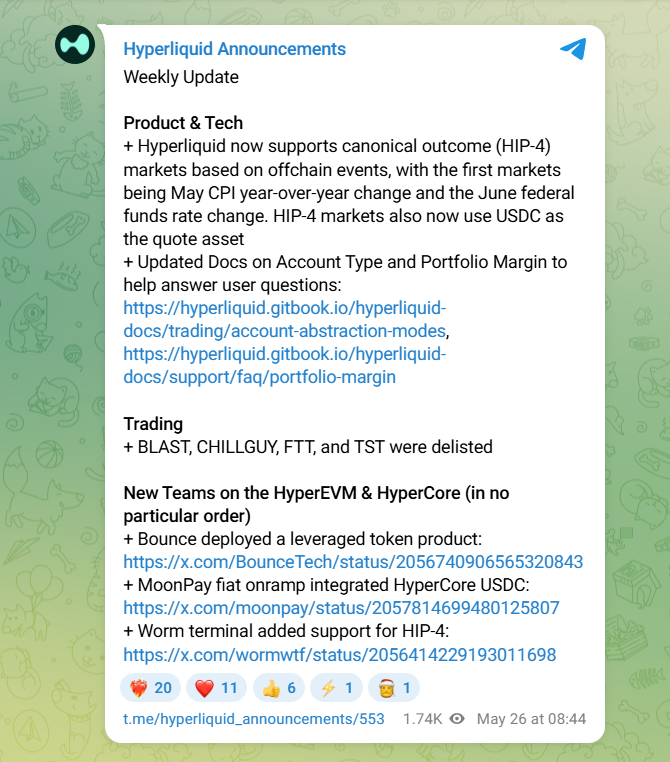
Validators run automated newsfeed software that publishes the markets and votes on deployment and settlement, Hyperliquid said in a Monday Telegram post.
The markets are built on Hyperliquid’s HIP-4 and use Circle’s USDC (USDC) as the quote asset. Hyperliquid said the first markets will open based on the May Consumer Price Index (CPI) year-over-year change and the June federal funds rate decision.
The launch puts prediction markets inside Hyperliquid’s existing trading stack, allowing users to trade event outcomes alongside spot and perpetual futures rather than moving collateral to a separate platform.
The rollout adds weight to a thesis advanced by Delphi Digital that Hyperliquid is evolving from a perp DEX into a broader onchain financial venue.
“What’s different now is that the stack is finally mature enough for true crypto superapps (aggregated giants) to exist without being limited to the wallet form factor,” Delphi said in a December research report.
The HYPE token’s price soared by 20% when Hyperliquid first announced plans to launch prediction market functionalities, Cointelegraph reported in February.
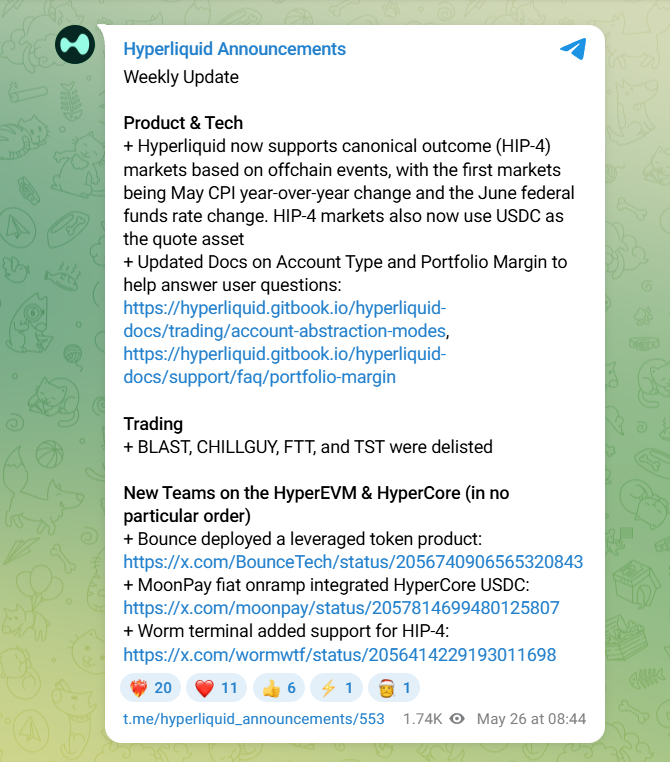
Hyperliquid announces the launch of canonical prediction markets. Source: Hyperliquid Telegram Channel
Is Hyperliquid crypto’s next “super-app”?
Hyperliquid’s expanding functionalities are making it the crypto industry’s next “super-app,” according to Matt Hougan, chief investment officer at crypto asset manager Bitwise. He wrote in a May 19 report:
“Hyperliquid has become the ‘super-app’ Atkins envisioned—a ‘non-SEC regulated platform’ offering investors exposure to “a variety of asset classes.”
Hougan added that the Hyperliquid (HYPE) token is “one of the most mispriced assets in crypto today,” despite outperforming the wider crypto market since the start of 2026. He argued that investors are mispricing it, valuing it only as a perp DEX rather than a financial “super-app.”
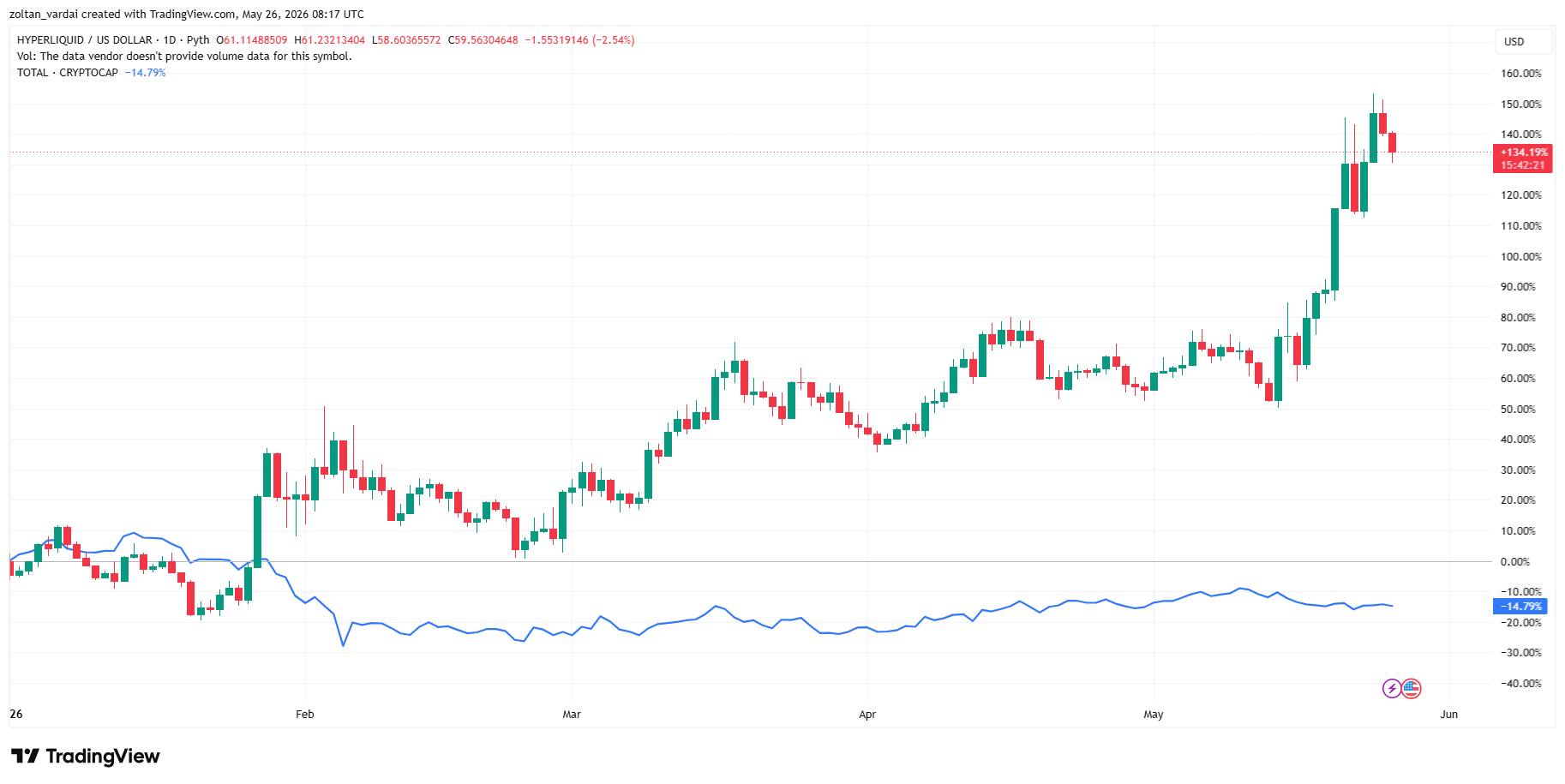
HYPE & Total Crypto Market Capitalization, year-to-date chart for 2026. Source: Cointelegraph/TradingView
Since the beginning of the year, the HYPE rose more than 134% while the total crypto market capitalization fell by around 14%, TradingView data shows.
Related: Polymarket team says user funds safe as exploit losses climb above $600K
Hyperliquid is currently the fifth-largest protocol by weekly fees and generated over $11 million in fees during the past week, according to DefiLlama data.
In the month leading up to May 10, Hyperliquid generated $50.95 million in revenue, all of which went directly to token holders with zero spent on incentives.
Magazine: The legal battle over who can claim DeFi’s stolen millions

Bankless co-founder David Hoffman said he sold his ETH after reassessing the long-running “ETH is money” thesis.
Summary
- Hoffman sold his ETH after saying the asset’s money thesis has largely played out now.
- He remains bullish on Ethereum, but says apps and L2s may capture more value directly.
- Related crypto.news coverage shows stablecoins, L2 fixes, and ETH treasuries still driving activity across Ethereum.
In a May 26 X post, Hoffman wrote that Ethereum has earned its current market position, but he sees less room for ETH to receive a new structural rerating from the market.
Hoffman said the sale does not mean he has turned bearish on Ethereum. He said he remains bullish on the network and its ecosystem, while arguing that only part of that growth may flow back to ETH itself. He framed the decision as a capital allocation move after concluding that “the ‘ETH is money’ thesis has played out.”
Ethereum growth may not flow directly to ETH
Hoffman’s argument centers on how Ethereum creates value. He said the network supports applications, layer-2 networks, stablecoins, tokenized assets, and DeFi, but its open-source design gives much of that value back to the ecosystem.
In his view, Ethereum can grow as infrastructure even if ETH does not capture all of that growth as an asset.
He also pointed to stablecoins as part of that shift. As previously reported in April, Ethereum’s stablecoin supply had reached a record $180 billion, giving the network close to 60% of global stablecoin supply. That supports network use, but it also shows how Ethereum can strengthen dollar-based payment rails rather than only ETH demand.
Meanwhile, as crypto.news reported, Vitalik Buterin said the Ethereum Foundation will sell less ETH under a leaner long-term plan focused on security, privacy, openness, and censorship resistance.
L2 activity remains central to the debate
The same value-capture question also appears across Ethereum’s layer-2 roadmap. Hoffman said L2 teams needed freedom to move fast, but also needed stronger ties to the broader Ethereum economy and brand. His point was that Ethereum’s rollup strategy helps scaling, but may leave more margins with L2s and applications.
As previously reported by crypto.news, Gnosis, Zisk, and the Ethereum Foundation launched the Ethereum Economic Zone at EthCC to address L2 fragmentation. The framework targets more than 20 L2s securing about $40 billion in value and aims to standardize ETH as gas across participating networks.
ETH treasuries show another side of demand
Hoffman’s sale comes as some public companies keep building Ethereum-linked treasury strategies. Crypto.news reported that SharpLink secured inclusion in the Russell 2000 and Russell 3000 indexes, with the move tied to its Ethereum treasury business and broader institutional crypto exposure.
That contrast gives the story its market angle. One Ethereum-native voice has moved away from ETH as a personal holding, while some companies continue to build financial products around the asset.
Hoffman’s position sits between those two views: Ethereum can keep growing, but ETH may no longer offer the rerating he once expected.
The timing also lands during a wider Bankless transition. As crypto.news reported on May 21, Bankless faced backlash over reported staff cuts, while co-founder Ryan Sean Adams said the media brand’s first era had ended. Hoffman’s ETH sale now adds another marker to that shift.
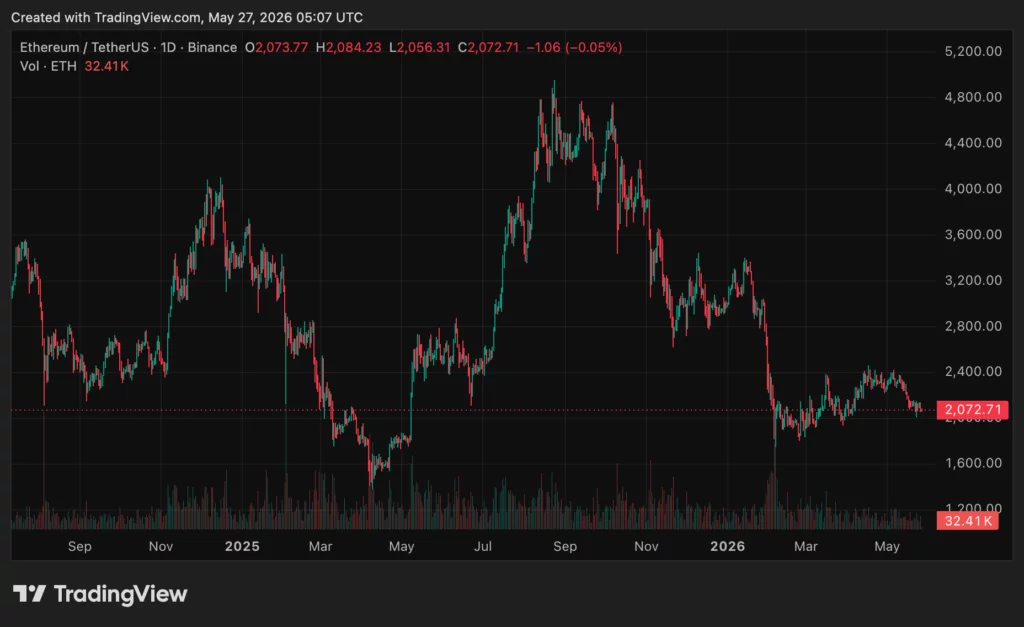
Meanwhile, Ethereum (ETH) traded near $2100 at the time of reporting, indicating 1% decline in the past 24 hours and 2% decline in the past week, based on crypto.news data.
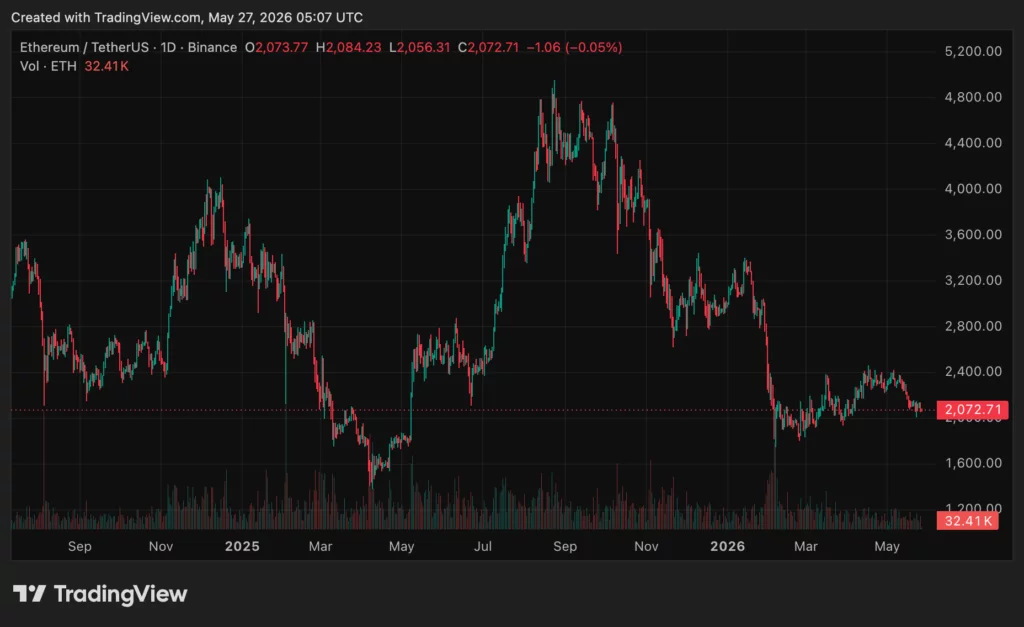

Crypto investor ‘DeFi Dad’ said on Tuesday that once Ether prices reach $5,000, it will take off, mirroring the price action Bitcoin saw almost a decade ago.
The last cycle “was so off for ETH, despite all that’s been built on Ethereum,” he said, citing major institutional involvement, stablecoins, and ETFs.
“Fundamentals clearly needed time to catch up with price, and we over-corrected as we normally do in crypto.”
ETH to $20K or $1,500?
He forecast ETH could rise tenfold to around $20,000 in the next bull market by mirroring Bitcoin’s 2017 fractal patterns, with explosive gains in 2027 to 2028 following the current bear market.
DeFi Dad took 12 months of fractals from BTC price action in 2017 when it exploded from $2,000 to $20,000 to map out what 12 months of price action might look like for Ethereum after the market has bottomed.
However, that market bottom is still looming, and analyst ‘Chain Mind’ predicted that ETH would dump back to the $1,500 level if current support is lost.
ETH IS GOING TO DUMP HARD SOON?
This is the crucial moment for ETH:
Hold = we are going up
Break = dump to ~$1,500 levelsMeans the next daily close decides the next major ETH move.
Notifs on, I’ll update you on this pic.twitter.com/q22p7ssg9d
— 𝗖𝗛𝗔𝗜𝗡 𝗠𝗜𝗡𝗗
(@0xChainMind) May 25, 2026

This would be a “trendline reset,” sending prices back to October 2023 and April 2025 levels when Ether crashed to long-term support at $1,500.
“This is the crucial moment for ETH,” the analysts said.
Analyst Alex Marzell observed that support above $2,050 is still holding, but predicted a pullback to February levels if it were to break.
“If ETH loses this area convincingly, the move toward the $1,800 support zone could accelerate fast.”
Ethereum FUD is currently at peak levels following an exodus from the Ethereum Foundation and from long-term network proponents, such as David Hoffman of Bankless, who threw in the towel and sold all of his ETH.
ETH Price Outlook
Spot prices are reacting to the negative sentiment, trading lower on the day as ETH failed to hold above $2,100.
The asset fell to an intraday low of $2,060 during the Wednesday morning trading session, and has lost almost 10% over the past fortnight.
It has been consolidating for four months but appears to be heading toward the lower bound of the channel, below the psychological $2,000 level.
The post Massive $20K Bull Market For Ethereum Coming, But $1,500 Could Come First: Analysts appeared first on CryptoPotato.
Crypto World
South Korea’s KOSPI Hits New High After 100% Rally: Is Korean Retail Forgetting Bitcoin?
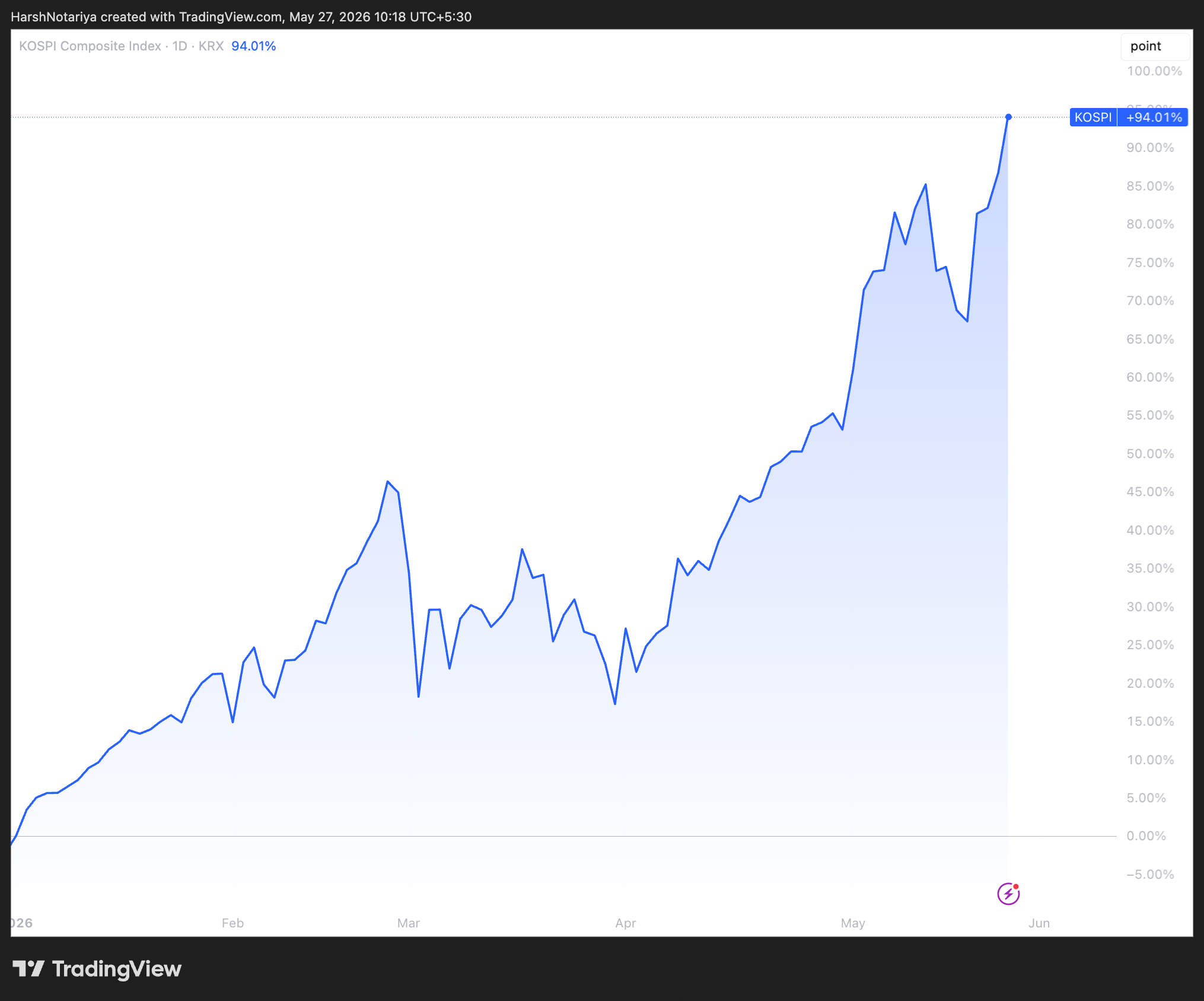
South Korea’s KOSPI surged 4.56% to a fresh all-time high of 8,457 on Wednesday, officially doubling year-to-date in 2026. Samsung Electronics and SK Hynix powered the move, the two chipmakers that already represent roughly half of the index.
The benchmark added around $220 billion in market value in a single session and roughly $900 billion in May alone.
Memory Stocks Go Vertical
The KOSPI is now up roughly 100% year-to-date, after Samsung Electronics jumped 6.5% and SK Hynix added 9.5% on Wednesday. The two chipmakers control around 42% of the index, lifted by AI memory chip demand.
“Everything memory related has gone straight vertical,” market commentator Heisenberg observed.
JPMorgan recently raised its KOSPI target to 9,000, with a bull case of 10,000.

Asian retail is doubling down. The 2x Leveraged SK Hynix ETF in Hong Kong has pulled in $1.3 billion year-to-date and tripled to $8 billion in assets in three months, the world’s largest single-stock leveraged ETF, the Kobeissi Letter reported.
A 2x Samsung ETF has matched those flows. Together, the two ETFs now eclipse comparable leveraged products on Tesla and Microsoft, with SK Hynix and Samsung accounting for nearly 50% of the $4.5 trillion KOSPI.
“Asian retail investors are rushing into leveraged chip stock bets like never before,” The Kobeissi Letter remarked.
Korean Crypto Pays the Opportunity Cost
Earlier, the same retail base used to anchor Korea’s Bitcoin (BTC) market. Upbit and Bithumb handle around 96% of Korean crypto volume.
But now, Korean crypto volumes have crashed roughly 80% as won liquidity has rotated into equities. The kimchi premium recently sat near negative 2.19%, signaling weak local demand for BTC.

Past KOSPI corrections triggered a reverse rotation back to Korean exchanges. On May 15, the KOSPI breached 8,000 intraday before crashing 8.4% in a single session. That reversal wiped roughly $370 billion in market value and briefly nudged Korean crypto volumes higher.
President Lee Jae-myung’s won-pegged stablecoin push and Bitcoin spot ETF pledge add a structural pull on the other side. A consortium of eight banks is preparing a regulated KRW stablecoin under the Digital Asset Basic Act. Kookmin, Shinhan, and Woori lead the group.
The motivation is concrete. Korean crypto exchanges sent roughly $40 billion overseas in Q1, with stablecoins making up half of that capital flight. A domestic won-backed token would let regulators keep more of that liquidity onshore.
With KOSPI now stretched 100% in five months on borrowed money, any unwind would land on a deep base. Korea counts nearly 10 million crypto investors, more than 30% of the population. A failed defense of 8,000 could change the tape fast. A pause in chip orders or a sharp won move sends retail back to Bitcoin and Korean altcoins.
The post South Korea’s KOSPI Hits New High After 100% Rally: Is Korean Retail Forgetting Bitcoin? appeared first on BeInCrypto.

Base, the Ethereum layer-2 blockchain from crypto exchange Coinbase, has launched a tool to connect Base accounts to artificial intelligence agents for blockchain operations.
Base said on Tuesday that its new Base MCP (Model Context Protocol) allows users to ask AI agents such as Anthropic’s Claude or OpenAI’s ChatGPT to transfer funds, swap tokens, check balances, review transaction history, and use supported apps within the ecosystem.
The tool lets users manage their crypto directly from an AI model’s chat interface and can also interact with crypto protocols such as Morpho, Moonwell, Uniswap, Aerodrome, Avantis, Bankr and Virtuals, said Base.
The AI agent proposes an action in the chat, then the Base wallet opens in a new window where users can confirm or cancel the transaction. The agent does not have access to private keys, and every action must be confirmed by the user.
Agentic payments have been touted as the next major use case for crypto, as backers argue AI models will have issues accessing the banking system and will need to use digital assets to transact.
Base said that every transaction the agent proposes goes through the same review flow users see for any Base account request, with asset changes simulated before a user confirms.
Lincoln Murr, head of AI Product for Coinbase, told Fortune that “unlike siloed agentic wallets that only live in a terminal, your Base Account travels with you — trades, history, and portfolio sync whether you’re in-agent or in the Base App.”
Base MCP will also expand the adoption of the Coinbase x402 protocol, an agentic AI payment standard the company launched in May 2025.
Related: Fireblocks launches agentic payment support, joins x402 Foundation
Murr described MCP as a “nice wrapper” on top of APIs. Together with x402, it enables a new micro-transaction economy where agents can make tiny payments in crypto.
However, that economy is currently in its early stages, with x402 processing just $1.1 million in volume over the past 30 days, according to x402scan.

X402 statistics over the past 30 days. Source: x402scan
The use of AI agents for crypto payments has its detractors, with a recent research paper from Google and leading universities saying that AI agents should be treated as an untrusted system component.
The researchers said that AI agents should clearly distinguish between instructions and untrusted data to avoid attackers duping the agent by hiding malicious instructions.
Earlier this week, the developer platform Socket discovered malware targeting crypto developers by injecting hidden instructions to hijack AI coding assistants.
Magazine: Polymarket seeks Japan entry, Harvard dumps entire ETH position: Hodler’s Digest


Britain has imposed sanctions on several crypto-related firms and financial networks linked to Russia, including entities registered in the United Arab Emirates and Georgia, as part of a new crackdown on sanctions evasion tied to Moscow’s war economy.
Summary
- Britain sanctioned crypto firms and financial networks linked to Russia, including entities registered in the UAE, Georgia, and Kyrgyzstan.
- UK authorities said the Kremlin-backed A7 network was used to bypass sanctions, route payments, and support Russia’s war-related procurement activity.
- Earlier this year, Britain moved to dissolve Zedxion after investigations linked the exchange to roughly $1 billion in IRGC-connected transactions.
According to the UK government, the latest sanctions package freezes assets connected to the Kremlin-backed A7 network and blocks British firms from maintaining correspondent banking relationships or processing payments involving the targeted entities.
British authorities said the network had been used to move funds through foreign financial systems, support procurement activity, and bypass restrictions imposed after Russia’s invasion of Ukraine.
Alongside traditional financial institutions, the measures also cover crypto exchanges and companies operating Russia-focused payment platforms. A Kyrgyz bank and several businesses registered in the UAE and Georgia were included in the action, while multiple individuals tied to the network also faced sanctions.
In a statement released on Tuesday, UK Home Secretary Yvette Cooper said Britain was working with allied countries to “expose, disrupt and dismantle” financial channels supporting Russia’s military operations in Ukraine.
“We will continue to act fast and decisively, alongside our allies, to expose, disrupt, and dismantle these networks, and ensure those enabling Russia’s aggression face consequences,” said Cooper.
The action arrives as Western governments continue tightening oversight of crypto platforms accused of facilitating restricted transactions involving sanctioned states and entities.
Britain expands scrutiny of crypto payment networks
British officials described the sanctioned entities as part of what they called “shadow financial systems” operating outside traditional compliance frameworks.
According to the UK government, the A7 network played a role in rerouting transactions and maintaining access to foreign banking infrastructure despite existing sanctions.
Meanwhile, Britain has recently stepped up investigations into crypto firms allegedly linked to Iran and Russia-linked financial flows.
Earlier in March, Companies House moved to dissolve crypto exchange Zedxion after authorities concluded that information submitted during incorporation was “misleading, false or deceptive.”
The Organized Crime and Corruption Reporting Project previously reported that Zedxion’s listed director, Elizabeth Newman, was likely a fabricated identity. According to the investigation, the platform also used stock photographs in promotional materials tied to the supposed executive profile.
Separate analysis published by blockchain intelligence firm TRM Labs found that Zedxion and its affiliated platform Zedcex processed roughly $1 billion connected to Iran’s Islamic Revolutionary Guard Corps.
TRM Labs said those transactions accounted for about 56% of the exchanges’ total volume before rising to nearly 87% in 2024, when IRGC-linked flows reached around $619.1 million.
Russian fuel restrictions remain under phased implementation
The sanctions package was announced less than a week after Britain delayed a planned ban on diesel and jet fuel imports refined from Russian crude in third countries. UK authorities said the postponement was intended to reduce supply pressure rather than soften the country’s position on sanctions enforcement.
British officials maintained that the fuel restrictions would still move forward under what they described as a phased implementation process. At the same time, London has continued targeting payment networks, shell entities, and cross-border financial systems that authorities believe help Russia maintain trade and procurement activity despite international restrictions.
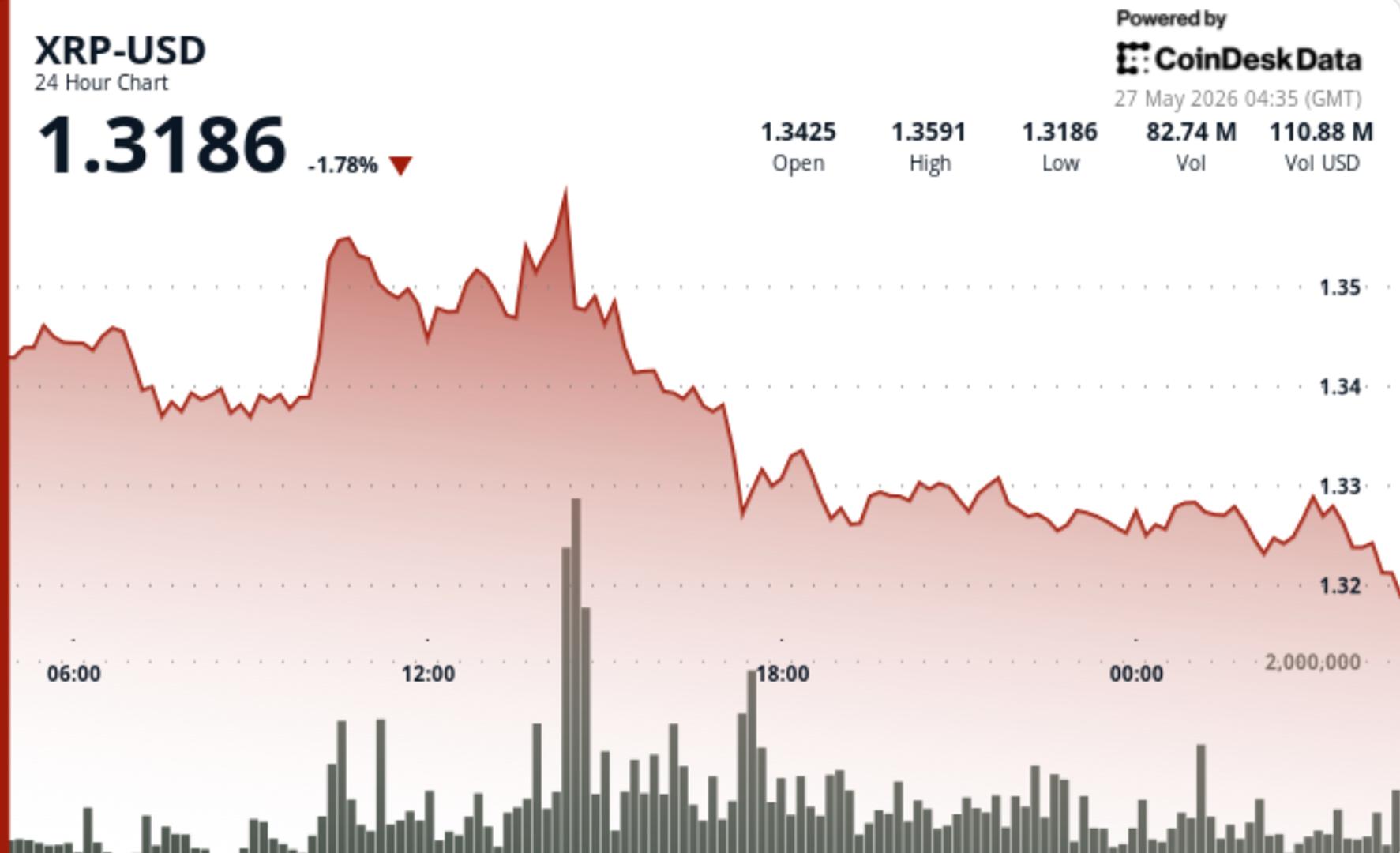
XRP keeps moving in circles around the same range that has controlled price action for months, and the latest failed breakout near $1.36 only reinforced how difficult it has become for buyers to build sustained momentum. The market is still compressing underneath resistance, though the lack of aggressive selling below $1.30 also suggests larger holders are not fully stepping away yet.
News Background
• Sentiment across crypto markets weakened during the session, with fear-driven positioning rising to the highest levels in roughly three weeks.
• On-chain data still showed XRP leaving major exchanges, a pattern some traders interpret as longer-term accumulation rather than active distribution.
• Analysts also continued highlighting a larger symmetrical triangle structure that has compressed XRP price action since early 2025.
Price Action Summary
• XRP traded between $1.3039 and $1.3429 before settling near $1.32 during the May 27 session.
• The largest volume event came during a failed breakout attempt near $1.36, where more than 62M XRP traded before price reversed lower.
• Late-session selling pushed XRP briefly below $1.324 before buyers stabilized the move near support into the close.
Technical Analysis
• XRP remains stuck inside a tightening consolidation structure between roughly $1.30 and $1.38.
• Repeated failures near $1.36 continue reinforcing that area as the market’s main resistance zone.
• Momentum still looks weak in the short term after price failed to reclaim broken support levels near $1.337.
• At the same time, support near $1.30 continues holding despite multiple retests, keeping the broader compression structure intact for now.
What traders should watch
• $1.30 remains the key support floor. Losing it would likely shift focus toward deeper downside targets in the mid-$1.20 range.
• $1.36-$1.38 stays the critical breakout zone XRP needs to clear before momentum can improve meaningfully.
• The longer the range tightens, the higher the odds of a sharper volatility expansion once price finally breaks out of consolidation.


Crypto has embedded itself in finance and politics. Now it is making a mark in sports. With the FIFA World Cup 2026 days away, firms are racing to secure a spot on football’s biggest stage.
No crypto company sits among FIFA’s seven global partners or eight official 2026 sponsors. The action has instead migrated to national federations, ad campaigns, prediction markets, and FIFA’s own blockchain experiments.
National Teams Carry the Crypto Sponsorship Story
Several federations have live crypto-linked sponsorships heading into the tournament. Argentina dominates the list. The Argentine Football Association (AFA) has stitched together a series of crypto and fintech regional deals.
LBank signed a multi-year partnership in September 2025 to become the regional sponsor of the Argentine National Team. The cryptocurrency exchange also launched a $100 million price pool.
In March 2026, Ant International, a global digital payment, digitisation, and financial technology provider, became an Official Sponsor of the Argentine National Football Team for the Asia region.
“This agreement unites the reigning FIFA World Cup Champions with one of the world’s most innovative financial technology providers. Through this partnership, Ant International secures comprehensive marketing rights to launch strategic activations across its brand portfolio, including Alipay+, Antom, Bettr and WorldFirst, by leveraging the intellectual property of the AFA and the world-class players of the Argentine National Football Team,” the press release read.
The next month, Nexo was named as the Official Regional Digital Asset Partner. BTCC, ATFX, and Deepcoin secured regional partner status. Socios.com remains the exclusive issuer of the $ARG fan token.
Notably, Chiliz/Socios.com has official partnerships with the federations of several qualified teams, and several national-team tokens have been designed.
One Prediction Market Makes The List
Crypto firms missed the official FIFA sponsor tier, but ADI Predictstreet broke through in a separate category. FIFA picked ADI Predictstreet as the Official Prediction Market Partner of the 2026 World Cup.
The deal marks FIFA’s first-ever global partner in the prediction market category. ADI Predictstreet is deployed on ADI Chain’s institutional-grade blockchain infrastructure.
Polymarket and Kalshi also continue competing without FIFA rights. The World Cup winner contracts continue to gain traction across both platforms.
Follow us on X to get the latest news as it happens
Ticket Giveaways, and More
Federation-linked sponsors and crypto platforms are increasingly rolling out World Cup-themed promotions to attract users and boost engagement.
As part of its partnership, Nexo announced a global giveaway campaign offering fans a chance to win tickets to Argentina’s FIFA World Cup matches, alongside signed national team jerseys for both new and existing users.
Similarly, Deepcoin has its “Champion Glory” campaign, featuring signed memorabilia, limited-edition merchandise, match attendance opportunities, and offline fan viewing events tied to football icons.
Meanwhile, Crypto.com offered select users in Europe and Australia a chance to win FIFA World Cup 2026 Category 1 match tickets, five nights of accommodation, and matchday transport through its Visa Card promotion.
Beyond exchange-led campaigns, the TRUMP Coin ecosystem also introduced a members-only initiative. The current headline offering is a 3-day VIP experience with a private suite for the FIFA World Cup 2026 Final in New Jersey, available to the top 19 leaderboard holders.
FIFA’s Own Crypto Play
FIFA itself has also moved deeper into blockchain. In May 2025, the federation announced the development of its own dedicated blockchain network on Avalanche. It is a custom Layer-1 designed for digital collectibles and global fan engagement.
FIFA Collect, the digital collectibles platform, was also migrated to the new chain. Moreover, FIFA President Gianni Infantino has also floated the concept of a “FIFA Coin” or “FIFA Token” on more than one occasion.
He pitched the idea at the White House Crypto Summit in March 2025 and revisited it at the World Liberty Forum at Mar-a-Lago in February 2026.
The 2026 World Cup arrives without a top-tier crypto FIFA partner. Yet the industry’s footprint is wider. From Argentina’s stacked sponsor roster to FIFA’s own blockchain, crypto is no longer just sponsoring football. It is building infrastructure inside the sport. Whether this presence translates into lasting fan engagement will define the next cycle.
Subscribe to our YouTube channel to watch leaders and journalists provide expert insights
The post Crypto is All Over the 2026 World Cup, Just Not as an Official FIFA Sponsor appeared first on BeInCrypto.


Base has launched Base MCP, a new tool that connects Base Accounts to AI agents and lets users manage crypto actions through chat.
Summary
- Base MCP lets AI agents swap, transfer, and track wallets from chat with user approvals.
- The tool supports Uniswap, Morpho, Moonwell, and other Base apps while private keys stay protected.
- Related x402 growth shows Coinbase expanding AI payments despite fresh security and malware concerns.
The Coinbase-backed Ethereum layer-2 network said the tool can support transfers, token swaps, balance checks, transaction reviews, and x402 payments.
The launch comes as Coinbase expands its role in AI-driven crypto payments. The news angle is clear: Base is trying to make crypto wallets easier to use through AI agents, while keeping user approval at the center of each transaction.
Base MCP brings wallets into AI chat
Base MCP works with AI clients that support Model Context Protocol, including ChatGPT, Claude, Codex, and Cursor. Once connected, users can ask an AI agent to track portfolios, send funds, swap tokens, check transaction history, and use supported Base apps from the same chat flow.
The system does not give the AI agent direct control over private keys. When an agent proposes a transaction, Base Account opens a separate review window where the user can confirm or reject the action. Base said every transaction shows expected asset changes before approval.
Base adds DeFi apps to AI agent access
At launch, Base MCP includes skill plugins for Moonwell, Morpho, Uniswap, Avantis, Bankr, Aerodrome, and Virtuals. These integrations allow AI agents to help users explore lending markets, manage liquidity, execute swaps, review token launches, and interact with on-chain perps markets.
Base said developers can also build custom plugins that return unsigned transaction details to Base MCP. The user still signs through Base Account, which keeps final approval outside the AI agent’s hands. That setup may help limit some wallet risks, but it still depends on clear prompts, safe plugins, and careful user review.
x402 links Base MCP to AI payments
Base MCP also supports x402 payments, which are designed for small payments by AI agents and web services. According to Base documentation, AI assistants can pay x402-enabled APIs with USDC on Base or Base Sepolia.
Coinbase has been building this stack through x402 and Agentic.market. As previously reported by crypto.news, Agentic.market lets autonomous agents find and buy services using USDC, while earlier x402 activity had reached about 165 million settled transactions across more than 480,000 agents at launch.
Moreover, AWS added Coinbase x402 to Amazon Bedrock AgentCore Payments, letting AI agents pay for services in USDC. Stripe’s x402 support on Base and AllUnity’s agentic payment layer using Coinbase’s x402 standard.
Security concerns remain part of the rollout
Base says “nothing happens onchain without your explicit approval,” and says its MCP server never holds or accesses user private keys.
Still, AI-agent security remains under scrutiny. A recent report citing researchers from Google, Meta, Gray Swan AI, EmbraceTheRed, and universities said AI agents should be treated as untrusted system components and should separate trusted instructions from untrusted data.
The warning followed another security case in which Socket reported a malware campaign targeting crypto and AI developers through malicious software packages. That report said attackers were trying to steal wallet data, SSH keys, cloud credentials, and API keys.
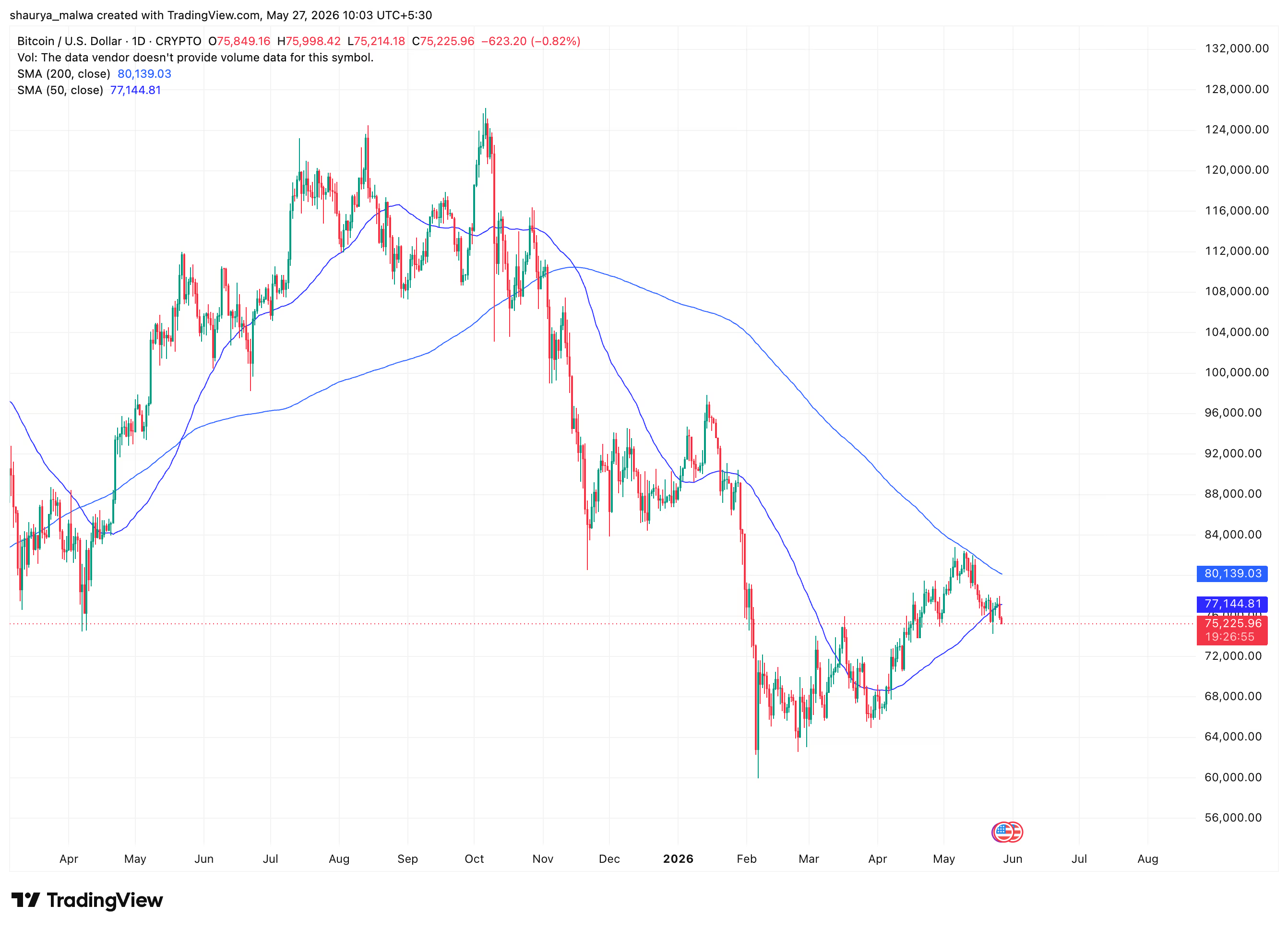
Bitcoin slid to $75,498 in Asian hours Tuesday, leaving crypto markets out of step with the equity rally that pushed global stocks to record highs overnight.
XRP, ether, and Solana were each down as much as 1% in the past day, per CoinDesk data, while Zcash (ZEC) dropped 9% to $564, the biggest single move among the top 15. Hyperliquid (HYPE) bucked the cohort at $59.99, up 1.4% on the day and now sitting just behind Dogecoin on market cap. Tron (TRX) is the quiet performer of the past week, climbing steadily as the rest of the majors held narrow ranges.
What traders are now watching is a setup forming on the bitcoin chart. FXPro analyst Alex Kuptsikevich said in an email the price is finding support near the rising 50-day moving average, while the 200-day moving average briefly acted as resistance earlier in May.
The two lines are on track to cross in the coming weeks, a setup known as a golden cross, which is generally read as a bullish signal. A break of either moving average before the cross could set the direction for crypto markets through the next several weeks, he said.

The flow data has been less encouraging. Spot bitcoin ETFs in the U.S. saw $1.74 billion in withdrawals over the past two weeks, per CryptoOnchain. Retail traders have been adding leverage in the meantime, a combination that has historically preceded sharp liquidation cascades when the market turns against the crowd.
The pattern is showing up at the same time the broader market is asking which asset gives the signal first. Joel Kruger, market strategist at LMAX Group, said ether remains the critical chart to watch, with repeated failures ahead of $2,400 reinforcing the importance of that resistance band.
A decisive daily close above $2,400 would mark a major technical shift and likely bring renewed institutional participation, Kruger said.
The U.S. Securities and Exchange Commission added another piece to the institutional puzzle on Monday, approving the listing of options on a bitcoin index calculated from BTC prices across multiple exchanges. It is the first instrument of its kind, with existing crypto options on U.S. stock exchanges limited to those tied to spot ETF shares.
Equities went the other way overnight, meanwhile.
The MSCI All Country World Index rose for a sixth straight day to a record. South Korea’s Kospi is up about 100% on the year, making it the best-performing major equity gauge globally. Micron Technology jumped 19% in U.S. trading to cross $1 trillion in market value, joining SK Hynix in the chip stocks at that level. Brent crude slipped 1.5% to $98 on signs of progress in U.S.-Iran negotiations. Treasury yields edged lower, with the 10-year at 4.47%.
Bitcoin’s lag behind equities has been one of the cleanest market signals of the past month. Whether that gap closes through a chip-led equity pullback or a bitcoin catch-up depends on which side of the moving average crosses first.
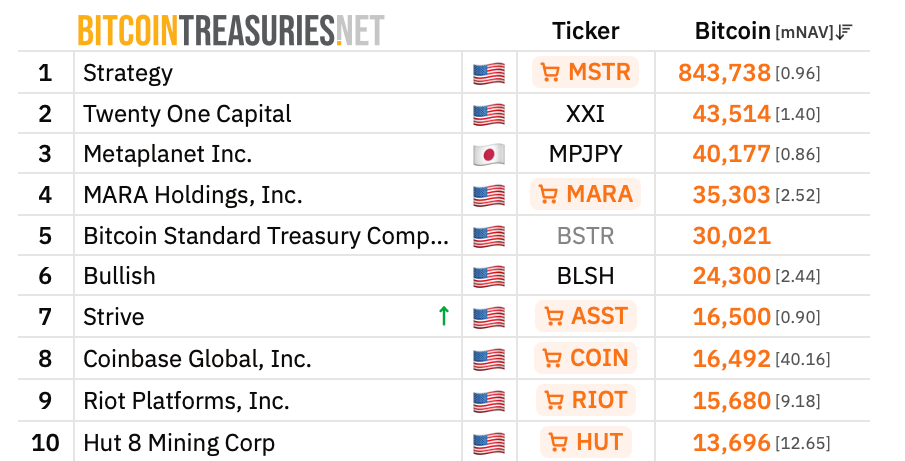
Strive purchased 1,109 Bitcoin between May 19 and May 22, increasing its holdings to 16,500 BTC, according to a Tuesday SEC filing.
The company said it held about $93.3 million in cash and cash equivalents as of May 22, alongside roughly $50.1 million in fair value tied to its holdings of Strategy’s Stretch preferred stock product, STRC. The Dallas, Texas-based company also said it is evaluating refreshed at-the-market stock sale programs that could fund additional Bitcoin (BTC) purchases.
Strive boosted its Class A common shares outstanding by more than 2.2 million shares during the period, while its SATA preferred stock count rose by about 515,000 shares, reflecting continued use of equity-linked financing tied to its Bitcoin treasury strategy.
The filing follows Strive’s announcement earlier this month that it would start paying daily dividends on its SATA preferred shares at a 13% annualized rate beginning in June. The company described SATA as the first listed US security designed to distribute dividends every business day. It also announced it had eliminated all outstanding debt.
Strive is an asset manager founded by former US presidential candidate and current Republican gubernatorial candidate in Ohio Vivek Ramaswamy that has increasingly adopted a Bitcoin treasury strategy similar to Strategy.
Data from BitcoinTreasuries.NET shows the company now ranks as the seventh-largest public corporate Bitcoin holder, with roughly $1.3 billion in BTC on its balance sheet.
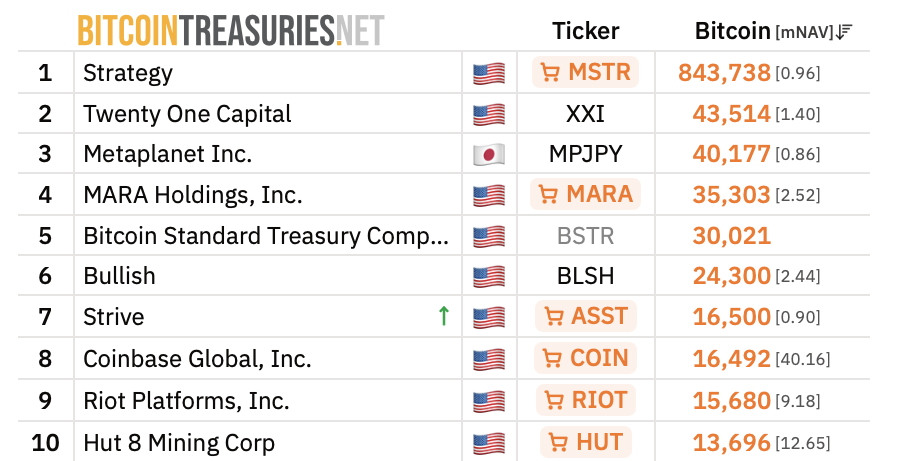
Top 10 Bitcoin treasury companies. Source: BitcoinTreasuries.NET
Related: Saylor’s Strategy scoops $2B Bitcoin, holdings reach 843,738 BTC
Yield-bearing securities viewed as digital credit
Strive’s SATA product is part of a growing class of yield-bearing securities tied to corporate Bitcoin treasury strategies, an asset class that issuers are describing as “digital credit.”
Strategy, the world’s largest corporate Bitcoin holder, currently offers multiple preferred securities tied to its Bitcoin-focused capital structure, including Stretch (STRC), Stride (STRD), Strife (STRF) and Strike (STRK).
STRC has emerged as the dominant Bitcoin-linked preferred security issued by the company. Launched in July 2025, the security currently carries a variable dividend yield of about 11.5%, according to company data. Shareholders will vote next week on a proxy proposal to pay dividends on the shares twice a month.
Earlier this month, STRC recorded a record $1.53 billion in daily trading volume, with chairman Michael Saylor describing the product as Strategy’s primary vehicle for funding Bitcoin purchases in 2026.
SATA currently has a market capitalization of about $332 million, according to BitcoinTreasuries.net data, compared with more than $10 billion for Strategy’s STRC.
Speaking Tuesday on the Coin Stories podcast, Strive Chief Risk Officer Jeff Walton said BTC-backed securities could reshape traditional financial markets and credit systems.
“You can start to rethink and reimagine what money looks like, reimagine what credit looks like,” Walton said, adding that the idea was “so simple it seems like it shouldn’t work,” which he said contributes to skepticism around the emerging sector.
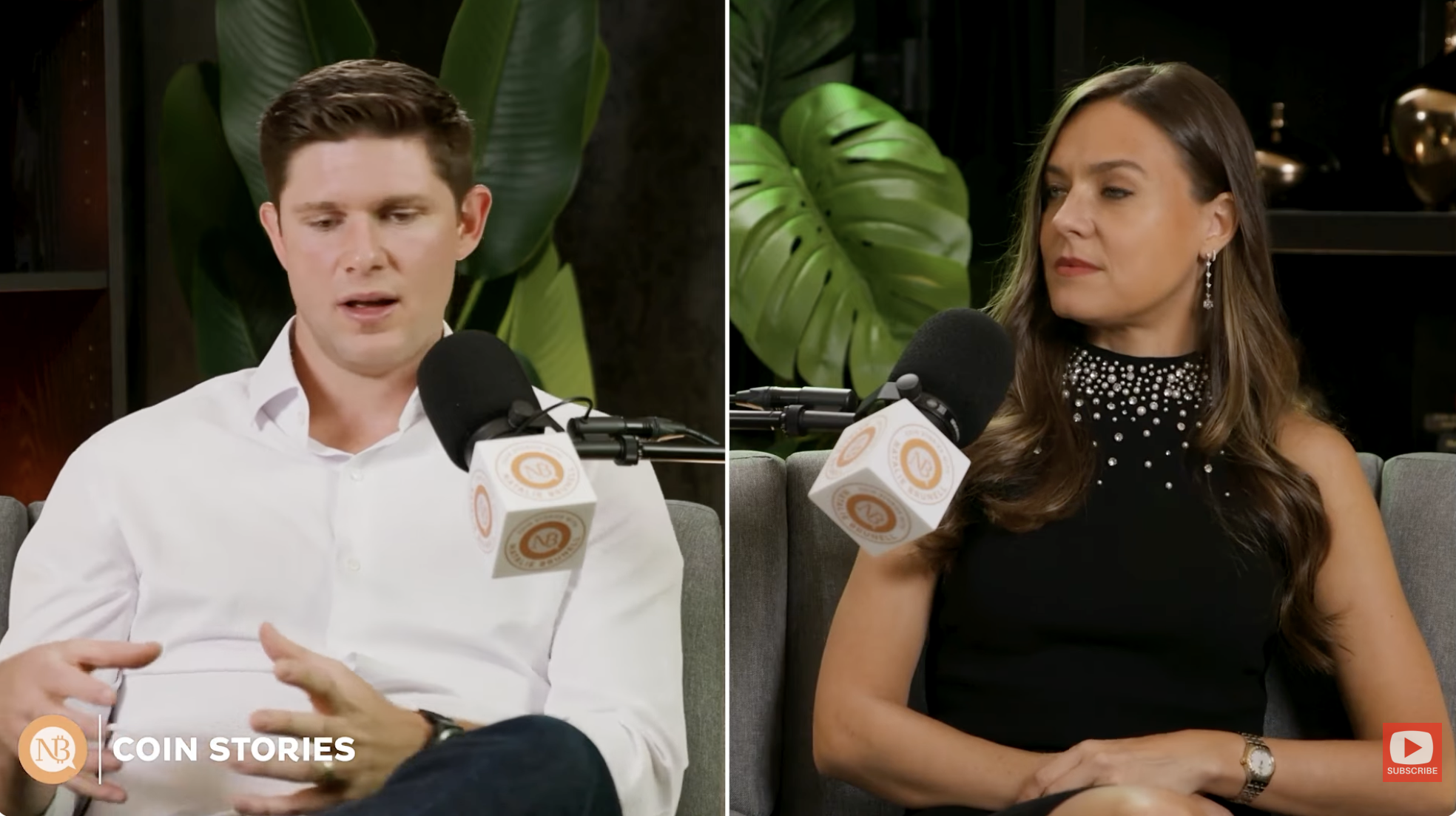
Jeff Walton speaking with Natalie Brunell.
Source: Coin Stories
Magazine: 5 tech predictions the mainstream media got horribly wrong

Dmitry Bivol’s trainer makes it clear who they are targeting after Eifert defence: “He talks a lot”

Trump administration wants nuclear startups to use plutonium for their reactors

SWIFT Is Dead & Ripple CEO On XRP Ledger Bond Settlement


-

 Crypto World5 days ago
Blockchain.com files with SEC for U.S. IPO
-

 Fashion4 days ago
Holiday Weekend Open Thread – Corporette.com
-

 Business5 days ago
Dell Technologies DELL Stock Surges 15% on AI Server Momentum and Analyst Upgrades in 2026
-

 Crypto World5 days ago
Bitcoin Accumulation Weakens as BTC Realized Losses Hit $600M
-

 Crypto World4 days ago
Robinhood crypto COO Tanya Denisova exits
-

 Crypto World5 days ago
Space X IPO Is ‘Bad News’ for Tech Stocks: But What About Bitcoin?
-

 Politics4 days ago
Makerfield: a tale of two social-media histories
-

 Business2 days ago
NYT Strands Answers May 24 2026 Revealed for Puzzle No. 812 Theme Summer Essentials
-

 Tech2 days ago
Microsoft’s quiet Claude Code retreat and the real cost of enterprise AI
-

 Crypto World5 days ago
MicroStrategy’s Saylor Says Miners No Longer Set Bitcoin Price, Another Force Has Taken Over
-

 Tech5 days ago
WhatsApp ads could make Irish debut after discussions with DPC
-
 Tech5 days ago
A 0.12% parameter add-on gives AI agents the working memory RAG can’t
-

 Crypto World5 days ago
AI infrastructure race heats up as IREN pitches full-stack strategy, WhiteFiber lands $160M deal
-

 Tech5 days ago
You Can Now Add ChatGPT To PowerPoint
-
 Crypto World2 days ago
Nvidia (NVDA) CEO Calls on Super Micro to Strengthen Export Controls Amid Smuggling Probe
-
 NewsBeat6 days ago
Charity run by Reform leader Malcolm Offord accused of ‘law breaking’ over Scottish registration
-

 Business5 days ago
Trump Invests $1M-$5M in Kura Sushi USA Chain With 27 California Locations
-

 Tech2 days ago
Westone Audio and Etymotic Acquired by Fidelity Collective in Major IEM Market Move
-

 Sports5 days ago
2026 CJ Cup Byron Nelson leaderboard: Brooks Koepka finds putting stroke in Round 1
-

 Crypto World6 days ago
Exa Labs raises $250 million in funding led by a16z
You must be logged in to post a comment Login