

Crypto World
Invesco Files for Tokenized Stablecoin-Reserve Money Market Fund Built on Superstate Rails

Invesco, the asset manager with $2.45 trillion under management, filed with the U.S. Securities and Exchange Commission to launch a money market fund whose shares are recorded as tokens on public blockchains and that is designed to hold the reserves to back stablecoins. The filing for the Invesco… Read the full story at The Defiant

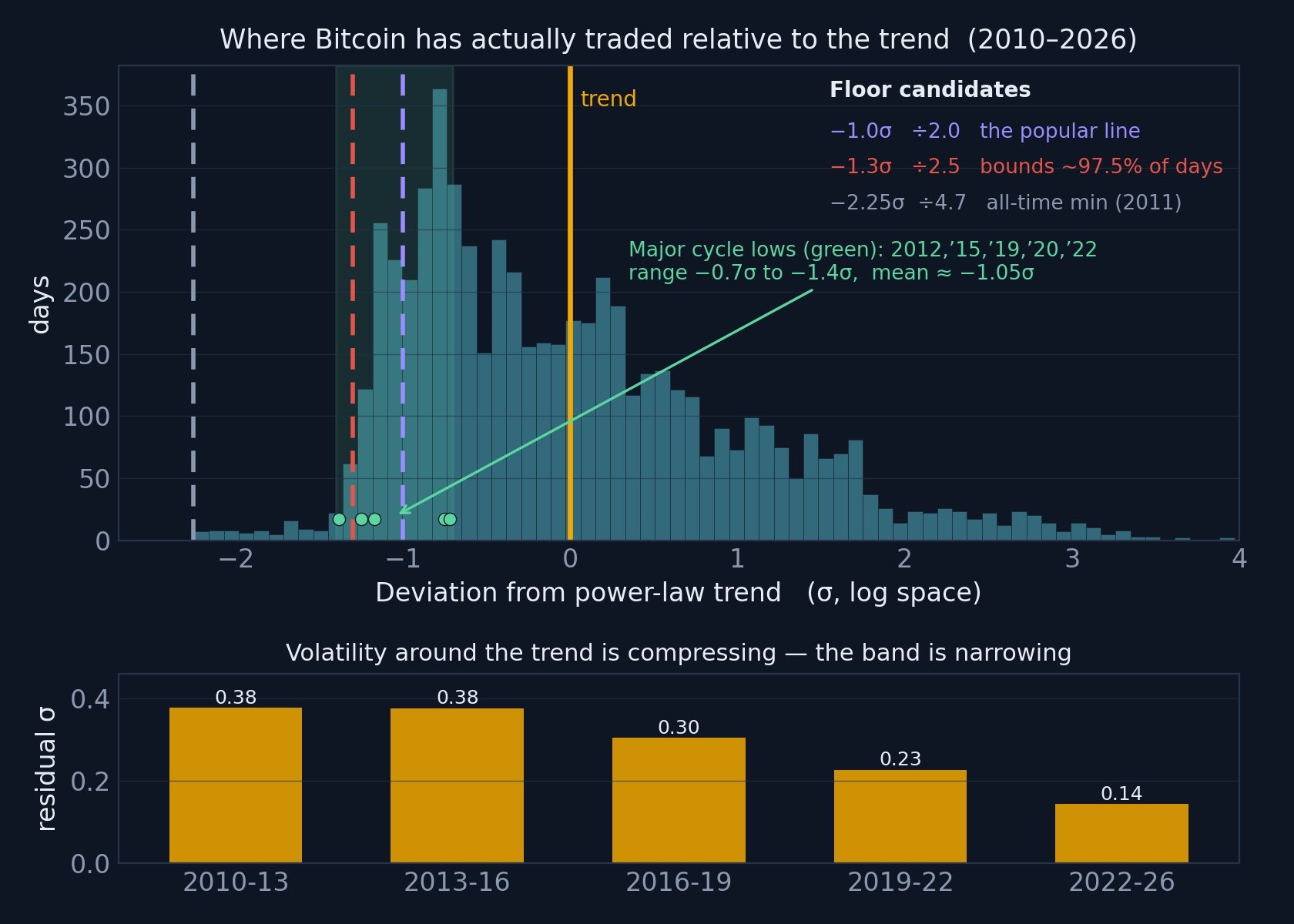
Bitcoin’s (BTC) drop to $58,000 has pushed the price into a zone that long-term power-law models have historically associated with cycle bottoms. The data does not confirm a bottom range, though it shows BTC trading in a price range that has repeatedly marked major lows since 2014.
Derivatives data and liquidation levels highlight $55,000 as the next key support level and the $65,000-$68,000 range as the next major upside area of interest.
Bitcoin power-law puts $58,000 in historical range
Giovanni’s Bitcoin power-law model places the network’s long-term trend price near $135,000, making the recent drop to $58,000 roughly 54% below the all-time high and 1.22 standard deviations beneath that trend.
According to the analyst, the key takeaway is straightforward: the previous cycle lows in 2012, 2015, 2019, 2020, and 2022 all fell within a similar statistical range. By that measure, the latest decline falls within a territory that has historically marked the deep bear-market lows rather than a break in Bitcoin’s long-term growth path.
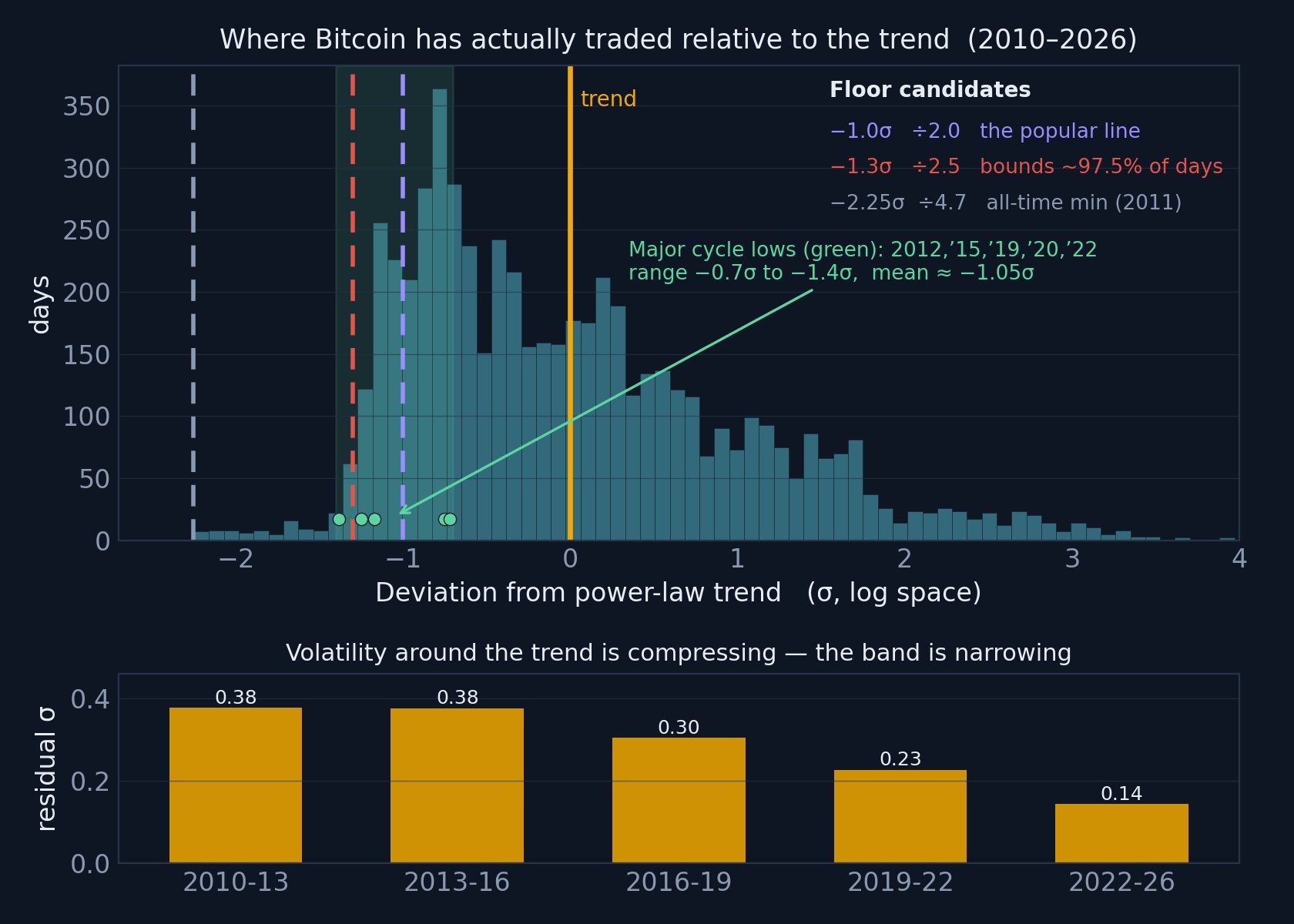
Bitcoin price deviation based on the power-law trend. Source: X
The model estimates the commonly referenced “-1σ” support near $68,000, while the stronger historical floor sits closer to $55,000. Giovanni also noted that Bitcoin would need to trade below roughly $17,000 for more than a year before the power-law itself could be considered invalid.
A second metric points in the same direction. Bitcoin’s power-law quantile has fallen to 6.2%, indicating the asset is cheaper than roughly 94% of its historical observations when measured against the power-law model. The chart highlights similar readings during the 2015, 2020, and 2023 cycle lows, with the current market now revisiting that historically rare valuation zone.
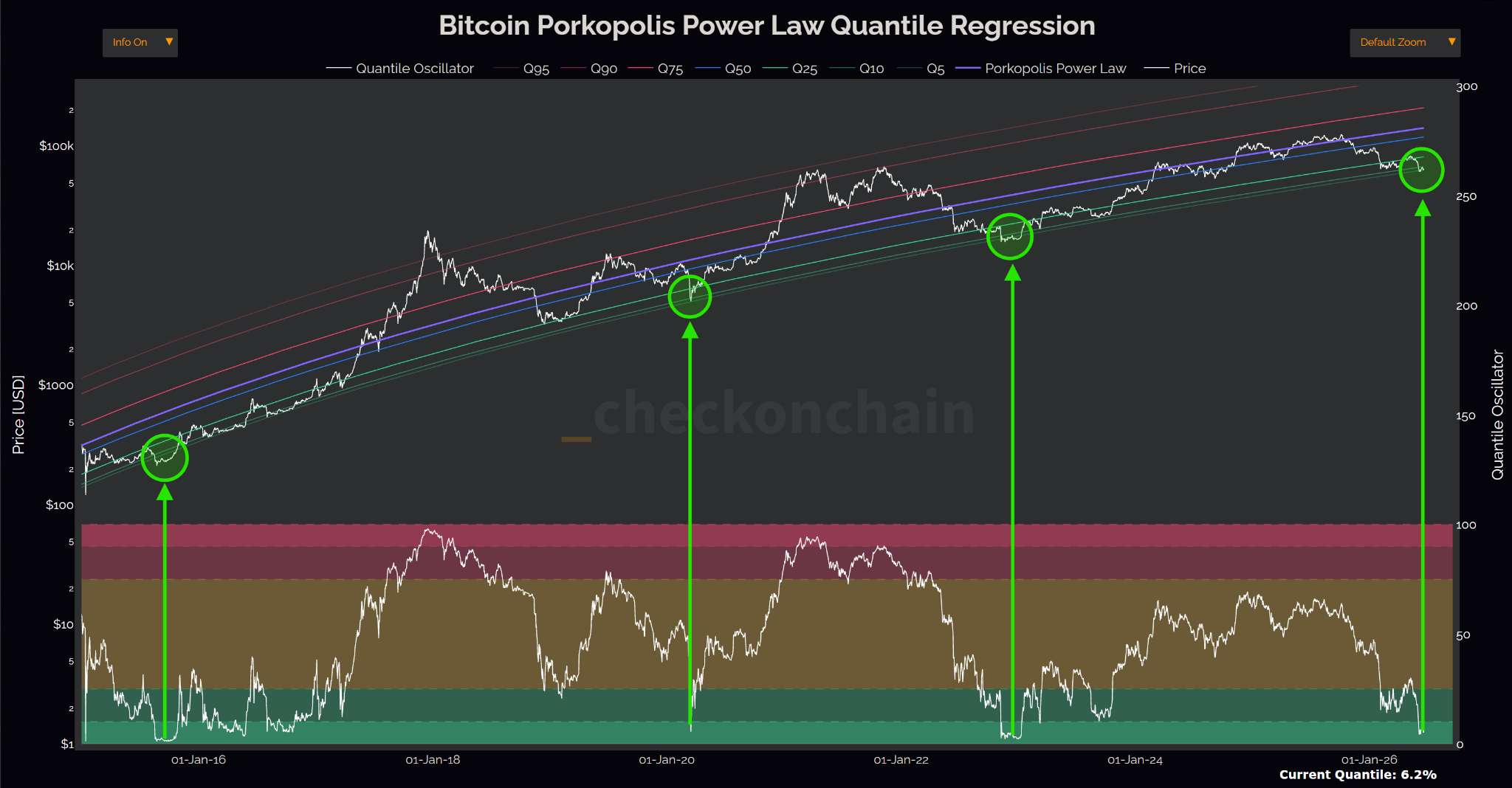
Bitcoin power-law quantile regression chart. Source: Checkonchain
Related: Bitcoin drops to $58K on high US PCE inflation as trader sees ‘manipulation’
Key BTC price levels to watch
Bitcoin fell to a new yearly low of $58,000 after aggressive selling swept through Binance. The hourly taker sell volume reached $2.1 billion, followed by another $1.9 billion in the next hour after the New York market open, marking the exchange’s largest hourly sell pressure since May 4.
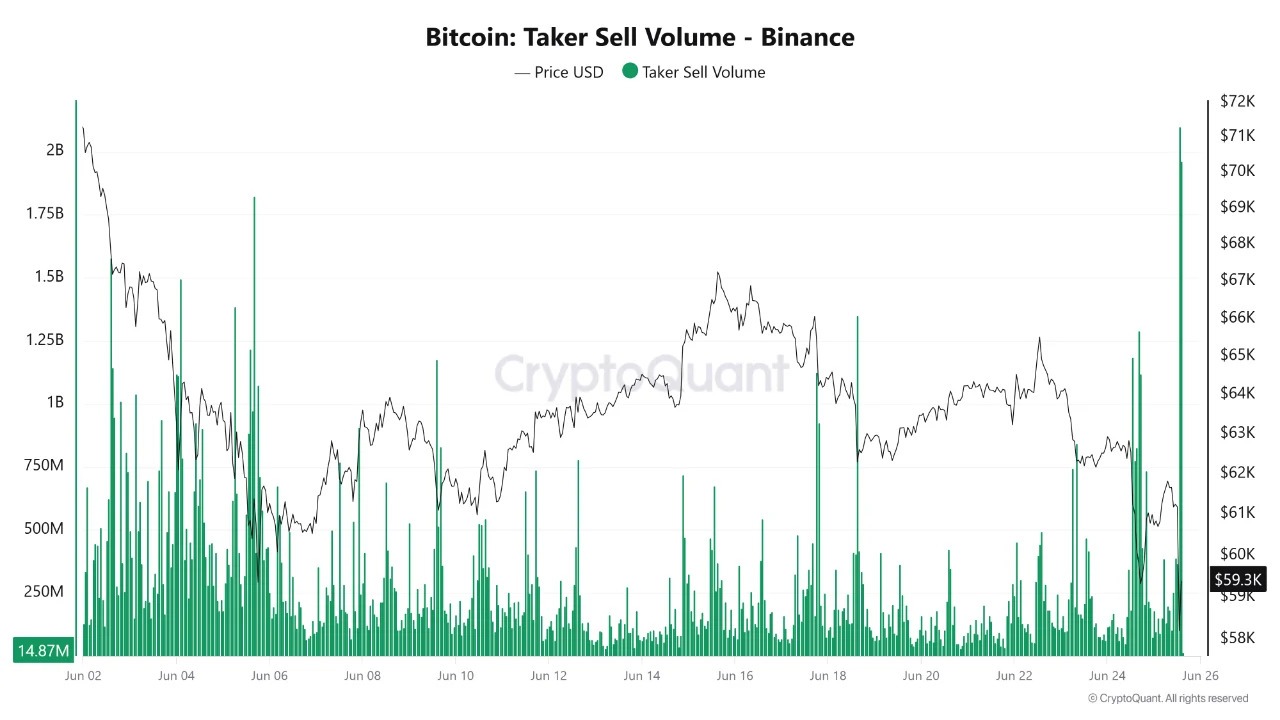
Bitcoin taker sell volume on Binance. Source: CryptoQuant
The flush liquidated more than $300 million in long BTC positions before the price rebounded toward $60,000. That level now carries added significance. A daily close back above $60,000 preserves the developing relative-strength index (RSI) bullish divergence across the one-hour, four-hour, and daily time frames which signals that selling momentum is fading even as the price prints lower lows.
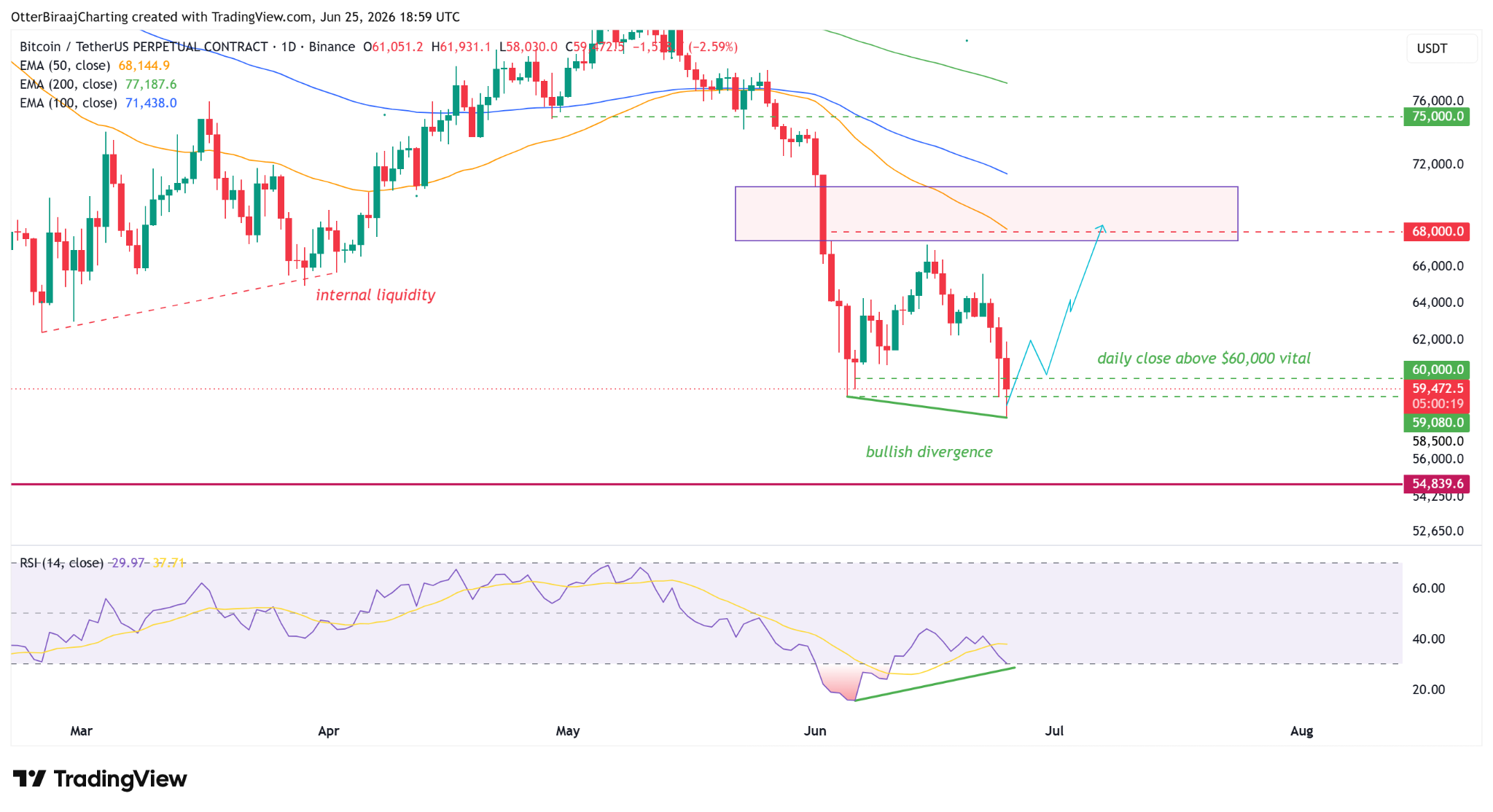
BTC/USDT, one-day chart. Source: Cointelegraph/TradingView
Futures trader Byzantine General shared a similar outlook, saying the move to $58,000 cleared out leveraged longs while drawing in fresh short sellers. In his view, a daily close above $60,000 would strengthen the case that Bitcoin has printed a local bottom for now.
That would also shift attention toward a large pocket of upside liquidity. More than $4 billion in short liquidations cluster near $65,000, compared with about $1 billion below $55,000, creating a four-to-one imbalance. A relief rally could then target internal liquidity near $68,000, where a daily fair-value gap adds another area of interest for traders.
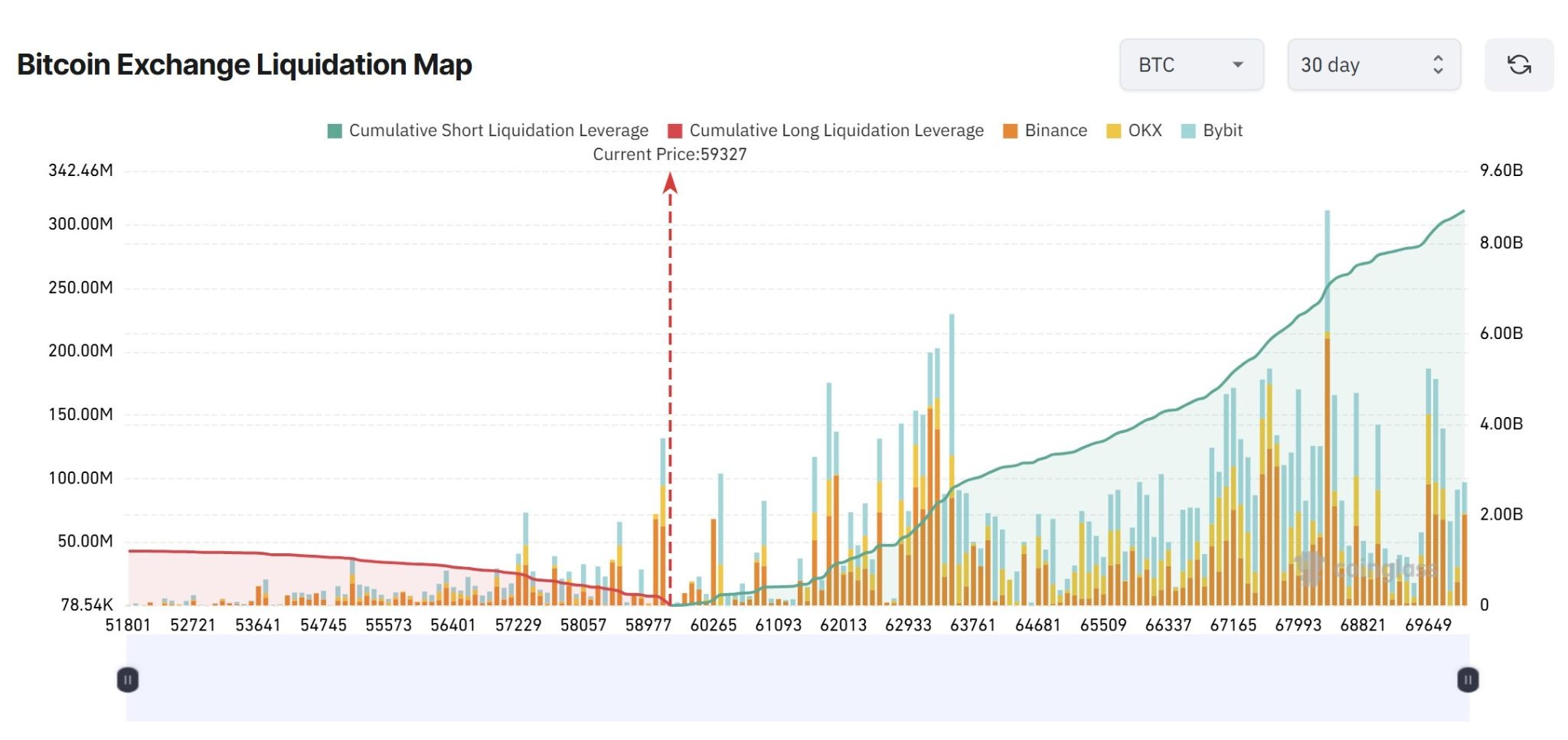
BTC liquidation map. Source: CoinGlass
Meanwhile, a daily close below $60,000 reinforces the bearish bias on both the short-term and long-term charts. The next area of interest then shifts to $55,000, where Bitcoin’s September 2024 weekly range low converges with its realized price near $54,000.
The realized price, which tracks the average cost basis of all onchain coins, has historically provided support at every major Bitcoin bear-market bottom since 2014. That trend makes the $54,000-$55,000 region a key level for traders to watch if selling pressure continues.
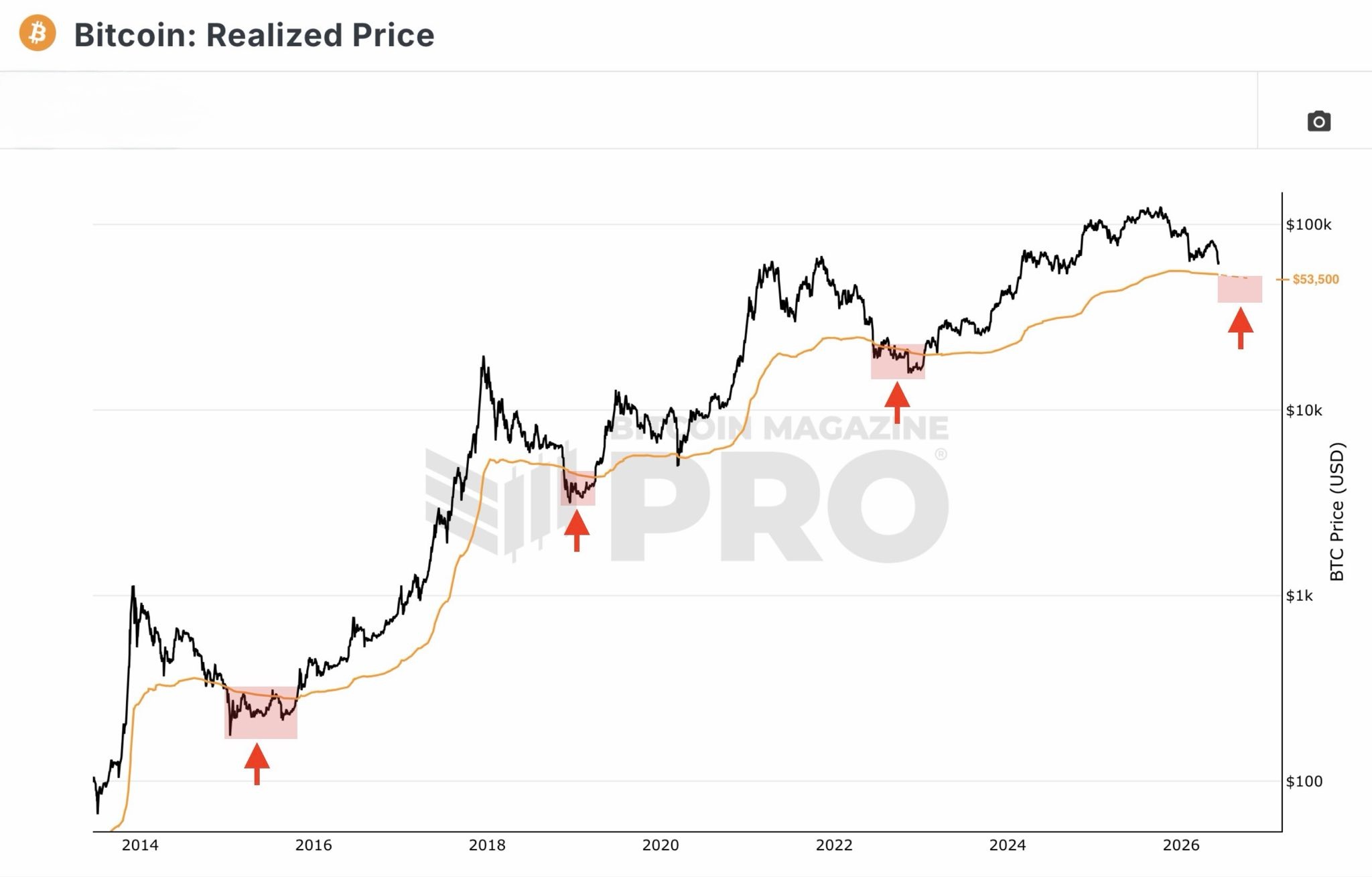
Bitcoin’s realized price. Source: X
Related: Bitcoin drop to $58K brings out bears: Is BTC’s next stop below $50K?
Crypto World
Solstice and Tensorx to Buy $1 Billion in AI Infrastructure to Support EU Sovereign AI Demand

[PRESS RELEASE – London, United Arab Emirates, June 25th, 2026]
Solstice to launch aiUSX, a yield-bearing asset that lets companies help finance the buildout with the capital they already hold for AI.
TensorX and Solstice today announced a partnership to finance European sovereign AI infrastructure. TensorX and Solstice will work together to create a facility with up to $1 billion in capacity to finance AI hardware and data-center build-out to meet rising demand for sovereign compute across the EU. Solstice will provide the onchain financing for that buildout and will launch aiUSX, a potential yield asset that opens the same infrastructure lending to companies holding capital for AI.
TensorX owns and operates a fleet of NVIDIA GPUs and delivers AI models in EU data centres with zero data retention, predictable pricing with best-in-class performance. The company works with AI startups and enterprises across the EU block with plans to expand into other global jurisdictions.
“Europe wants AI that can run on its own terms, on its own soil, without handing its data to someone else’s cloud on the world stage,” said Tim Grant, Executive Chairman of TensorX. “Meeting that accelerating demand takes hardware, and a lot of it. The billion dollars going into GPUs and data center capacity is the first step, and we expect to keep buying as demand grows. Solstice gives us a financing partner that can keep pace with this incredibly fast moving market.”
aiUSX: Financing the AI Buildout With Capital Companies Already Hold
Companies hold growing piles of cash and stable assets for their AI spend while inference bills climb. These two pools sit apart, and the cash earns nothing while it waits. aiUSX closes that gap. The capital a company sets aside for AI goes into aiUSX, which opens access to the AI-infrastructure lending Solstice finances, the same deals large institutions fund. The company takes the position of an infrastructure lender without becoming one or underwriting anything itself; for example, USD.ai has brought capital to AI hardware across the wider buildout. At launch, aiUSX will be capped at $5 million, with yield generated by the lending it gives access to. The capital stays liquid and redeemable, and what it earns goes toward the cost of inference later.
“Every company is turning into an AI company, and every one of them watches its inference bill climb,” said Ben Nadareski, CEO of Solstice. “aiUSX puts the money they set aside for AI to work in the meantime. They get access to the kind of AI-infrastructure lending that used to sit with large institutions, the capital stays liquid, and what it earns goes toward inference later. It is treasury management for the AI era.”
“Sovereign AI is one of the biggest infrastructure buildouts of this decade, and it runs on capital as much as it runs on chips,” said Stuart Connolly, CIO of Deus X Capital. “TensorX builds the compute, Solstice brings the financing, and aiUSX lets more companies take part in funding it. Both companies are in the Deus X Capital ecosystem, which is why we’re uniquely positioned to deliver this to the market.”
About Solstice
Solstice is an onchain settlement and yield protocol and part of the Deus X Capital ecosystem. Its dollar-denominated asset, USX, and its treasury products provide institutions and businesses with capital that remains liquid and productive. Solstice has a three-year audited track record and more than $500 million in total value locked.
About TensorX
TensorX is a sovereign AI infrastructure company based in Dublin. It buys and operates AI hardware and data-center capacity across the EU, connects clients to private compute, and keeps prompts and data on European infrastructure with full data residency and zero retention.
The post Solstice and Tensorx to Buy $1 Billion in AI Infrastructure to Support EU Sovereign AI Demand appeared first on CryptoPotato.
Crypto World
SecondFi Exploit Drains 374 Cardano Wallets, Over 16 Million ADA Stolen in Coordinated Attack

TLDR:
- The SecondFi exploit drained 374 Cardano wallets across four attack events between June 21–23, 2026.
- Approximately 16 million ADA worth $2.4M was stolen by two identified attackers across three automated waves.
- Emergency rescue efforts secured around 129 million ADA, with a dedicated restoration fund already established.
- Affected wallets are permanently compromised; users must avoid independent seed phrase restoration or asset migration.
Cardano’s largest wallet provider, SecondFi, suffered a major security breach between June 21 and 23, 2026. The SecondFi exploit drained funds from 374 wallet addresses across four separate attack events.
Approximately 16 million ADA, valued at around $2.4 million, was compromised. EMURGO, a co-founding entity of Cardano, has since stepped forward with a formal incident update, outlining recovery measures and committing to full reimbursement for all affected users.
Attack Scope and Attacker Identification
The SecondFi exploit unfolded in three automated waves, each targeting multiple wallets in rapid succession. Forensic analysis identified two distinct threat actors responsible for the breach. Attacker A operated across Waves 1 and 2, draining 171 wallets through coordinated automated batches.
SecondFi publicly disclosed the attacker addresses for full community transparency. Attacker A used three collection wallets and a central fee address, all linked to a single stake key. Attacker B operated independently in Wave 3, sweeping 203 additional wallets in a separate automated run.
According to SecondFi’s post on X, over 4 million ADA linked to Attacker B remains in one flagged collection address.
That address is currently under active monitoring and investigation by the team. Law enforcement and relevant authorities have been notified as part of the formal incident response.
The speed and coordination of the attack pointed to a premeditated, multi-actor operation. Security analysts described it as a highly sophisticated enterprise rather than an opportunistic breach.
Emergency Response and Asset Recovery
Following the initial discovery on June 22nd, SecondFi activated emergency response protocols immediately. Engineering teams isolated the exploit vector and deployed remediation measures to prevent further exposure. The platform was moved into maintenance mode as a containment step.
A leading external security firm, along with additional independent partners, was brought in to conduct a full code-level audit.
SecondFi confirmed it will not resume normal operations until those reviews are complete. That position reflects a deliberate effort to prioritize user safety over operational speed.
Through emergency rescue measures, SecondFi successfully secured approximately 129 million ADA as part of broader containment efforts.
All recovered assets are currently held securely while the recovery process continues. A dedicated restoration fund has already been established to support reimbursement.
EMURGO confirmed in its statement that wallet address mapping has been completed, allowing recovery to move into the next phase. Affected users will receive direct guidance through official channels on the steps required to safely restore access.
Critical Warnings for Affected Users
SecondFi issued a firm security warning to all affected wallet holders following the breach. Compromised wallets must be treated as permanently compromised at the address and private key level. Simply restoring a seed phrase in another wallet application will not eliminate the security risk.
Users are strongly advised not to independently move assets or attempt to migrate compromised wallets on their own.
Taking unilateral action could expose them to further loss or secondary exploits. The official recovery process is the only safe path forward for affected accounts.
SecondFi and EMURGO confirmed that a structured, verification-based claim process is being developed. While that process may take additional time, it is designed to ensure accuracy and security throughout. Affected users are directed to follow @secondfiapp on X for all official updates.
The incident drew a coordinated response from across the Cardano ecosystem. Founding entities, partners, and community members mobilized quickly to support containment efforts. That collective response helped limit broader network risk during a critical period.



Bitcoin could be approaching a major turning point after a rare combination of onchain indicators flashed signals that have historically coincided with market bottoms, according to Chris Sullivan, co-founder and portfolio manager at digital asset hedge fund Hyperion Decimus.
In a recent report, the hedge fund explained that four proprietary onchain signals have aligned only five times during bitcoin’s 15-year history. Each previous occurrence marked a cycle bottom, although Sullivan cautioned that this time still lacks final technical confirmation.
“We have literally like every box checked, except for a final pattern,” Sullivan said in an interview with CoinDesk. “Either we have to break above the $82,000 pivot to confirm, or we have one final low, call it between $54,000 and $57,000. Perhaps a wick to $48,000 to capitulate. One of those two conditions we expect to happen in the next 90 days.”
If either scenario unfolds, Sullivan believes bitcoin could quickly diverge from broader financial markets. The crypto asset is trading at $59,386 after losing 23% over the past month, extending its divergence from U.S. equities, which had climbed to record highs before also coming under pressure this month.
Bitcoin options traders remain heavily positioned for downside protection, with both crypto-native and exchange-traded fund investors showing elevated demand for downside hedges, according to new research by Anchorage Digital’s head of research, David Lawant.
The report analyzed options activity across Deribit, BlackRock’s iShares Bitcoin Trust (IBIT) and Strategy (MSTR), saying the three markets together provide a broader view of crypto-native, institutional and retail investor sentiment than any single options market alone.
Both Deribit and IBIT options markets showed elevated put skew, indicating traders are paying a premium for downside protection rather than positioning for further gains. The report found defensive positioning ranked in the 82nd percentile of IBIT’s history and the 84th percentile of Deribit’s five-year history.
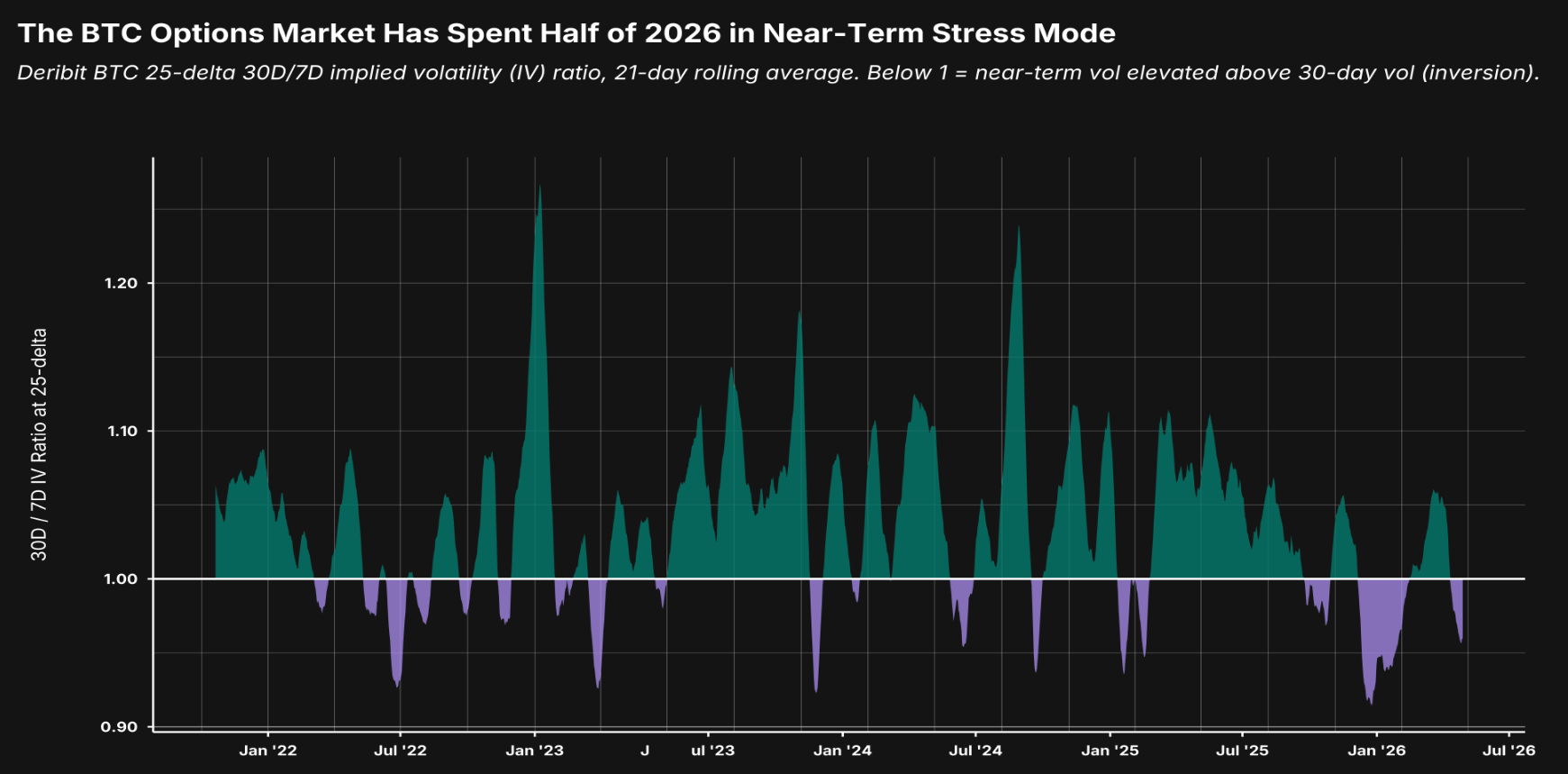
Anchorage also found that Bitcoin (BTC) options markets have spent nearly half of 2026 pricing higher implied volatility over the next week than over the next month, an unusual inversion that has historically been episodic and short-lived. The report attributed the pattern to a succession of macroeconomic, geopolitical and crypto-specific catalysts that have kept traders focused on near-term risks.
Bitcoin options 30-day/7-day implied volatility ratio. Source: Anchorage Digital report
Taken together, the findings suggest options traders remain focused on managing near-term risks rather than positioning for a clear directional move. Lawant said he is watching for one-month implied volatility to once again exceed one-week implied volatility, a shift he said would indicate markets are becoming more comfortable looking beyond immediate risks.
Related: Bitcoin price is down over 40% since STRC launched: Is Strategy ‘fine’?
Options market not signaling Strategy crisis
The analysis from Anchorage Digital also suggests investors remain cautious but are not pricing a severe downside scenario for Strategy despite recent weakness in the company’s preferred and common shares.
Strategy’s perpetual preferred stock, STRC, fell as low as $82.53 on June 22, or about 17% below its $100 par value, before partially recovering after the company disclosed it had increased its fiat reserves to $1.3 billion. As of Thursday, it was trading around $77, roughly 23% below par.
The weakness has extended beyond STRC. Strategy’s common shares (MSTR) were down about 78% over the past year and traded around $87 on Thursday, according to Yahoo Finance data.
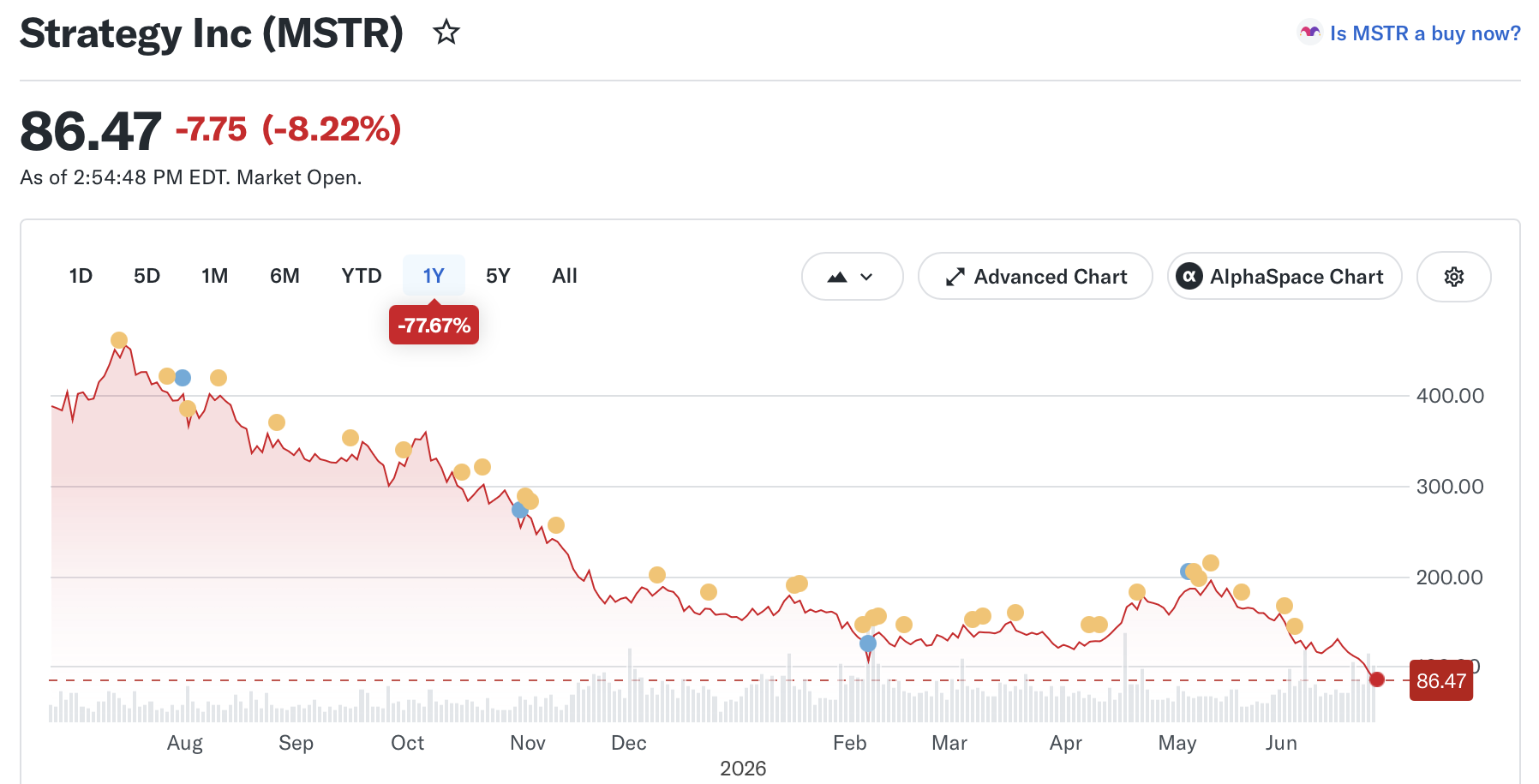
Strategy stock. Source: Yahoo Finance
Despite the sell-off, Anchorage found that Strategy’s options market remains well below stress levels seen during previous market corrections. While traders continue to hedge against downside risk, put skew has not reached levels typically associated with fears of forced deleveraging or a broader crisis, according to the report.
Strategy, led by Executive Chairman Michael Saylor, pioneered the corporate Bitcoin treasury model in 2020 and remains the world’s largest corporate holder of Bitcoin, with 847,363 BTC on its balance sheet.
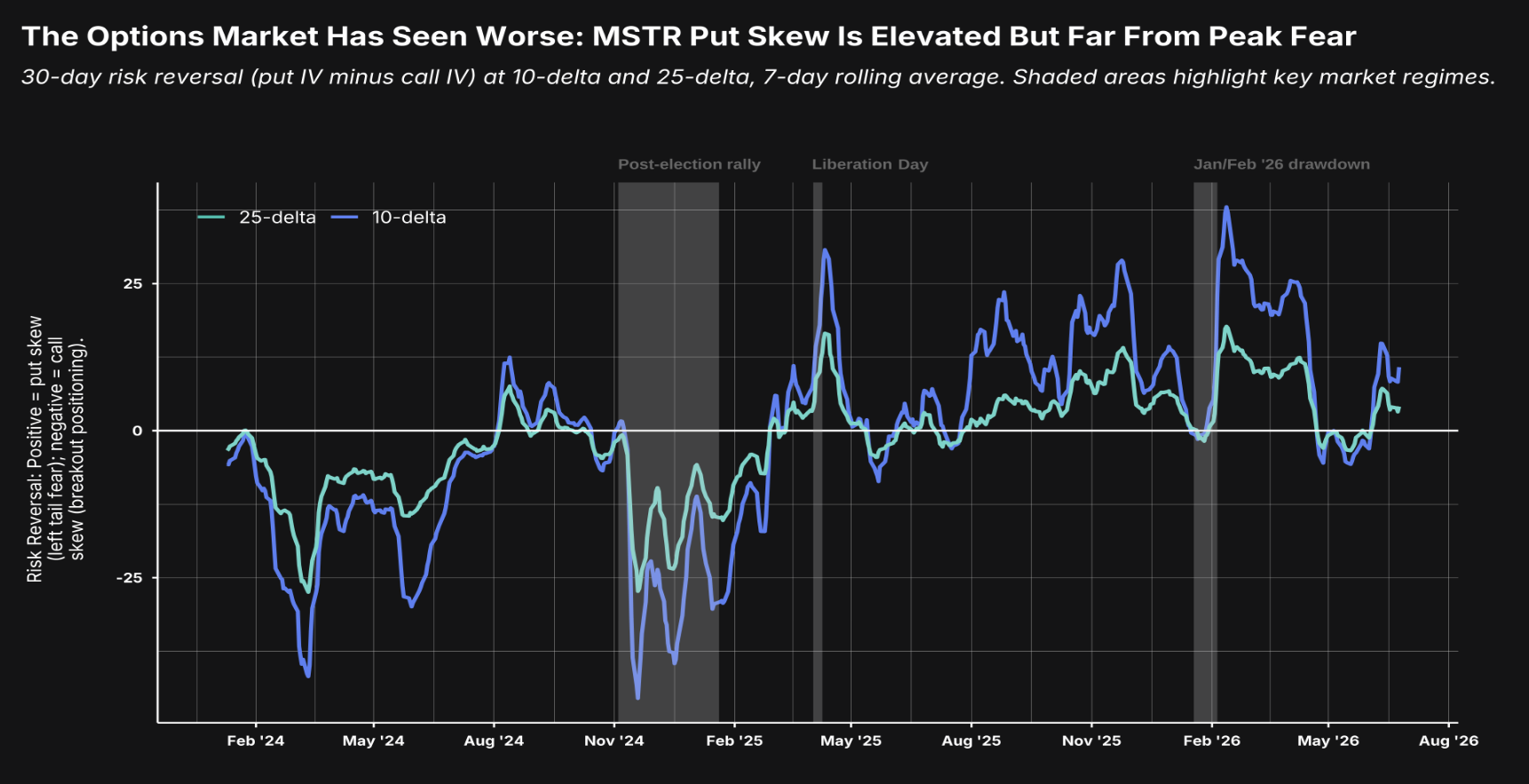
30-day risk reversals in Strategy (MSTR) options markets. Source: Anchorage Digital report
Magazine: Bitcoin decouples from tech stocks, Ether eyes ‘selling wave’: Market Moves
Key takeaways:
- Surging spot Bitcoin ETF outflows and a put-heavy options expiry point to fading institutional demand.
- Risk-reward shifts toward tech stocks, leaving crypto traders to seek catalysts beyond macroeconomic tailwinds.
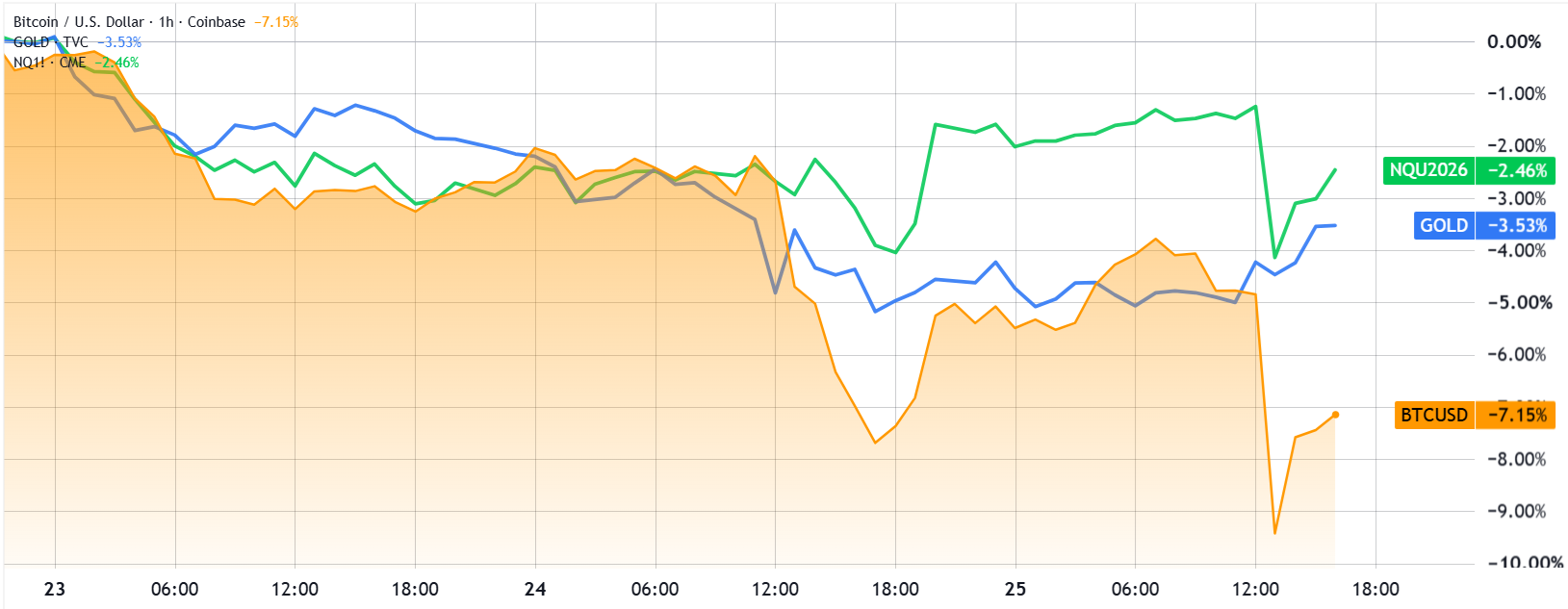
Bitcoin (BTC) traded down 9% in three days, hitting its lowest level since September 2024. The $58,000 retest triggered over $1 billion in liquidations across bullish BTC leveraged positions. Despite a modest recovery to $59,500, Bitcoin traders remain uneasy as the S&P 500 index and gold prices fully erased their intraday losses.
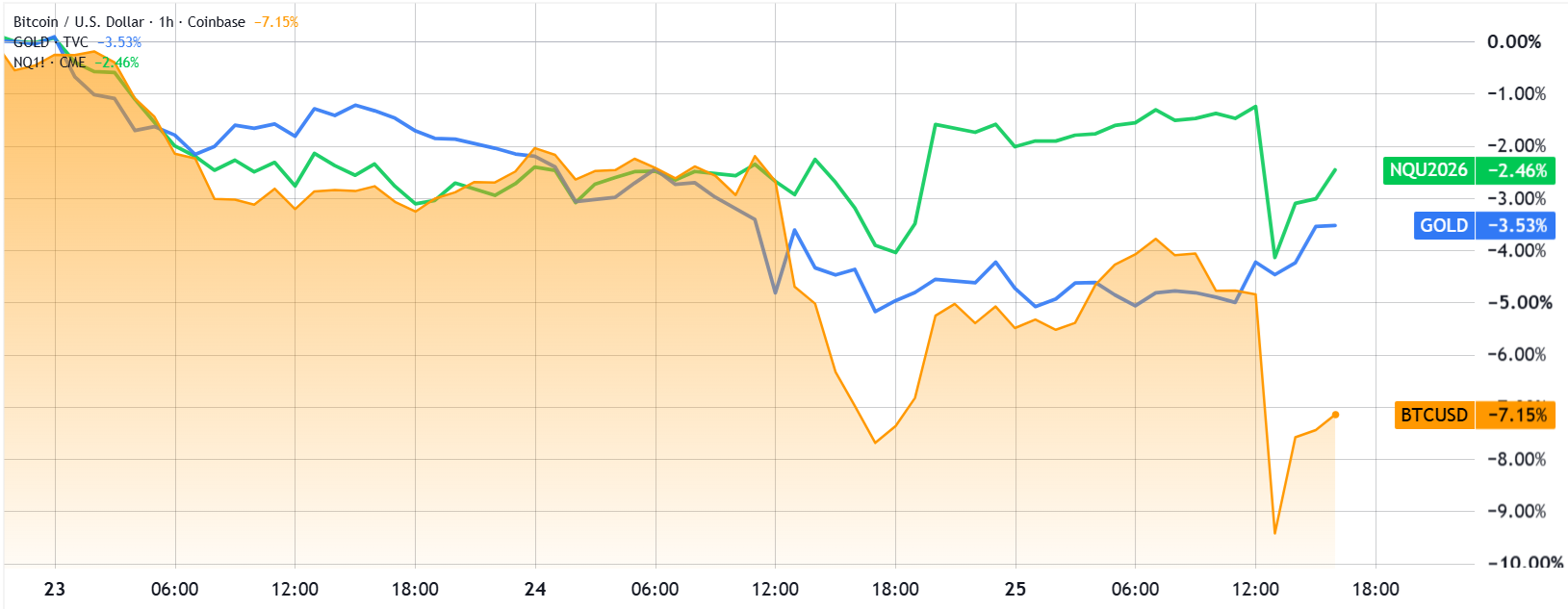
Bitcoin/USD (orange) vs. gold/USD & Nasdaq 100 futures (green). Source: TradingView
The market downturn on Thursday lined up with the release of the US Personal Consumption Expenditures index, which showed a 4.1% increase in May from the prior year. Yet as Crude Brent oil prices pulled back to $75 from $95 just one month earlier, investors grew more confident that inflation had peaked. As a result, the cash freed up by lower energy costs is boosting the stock market.
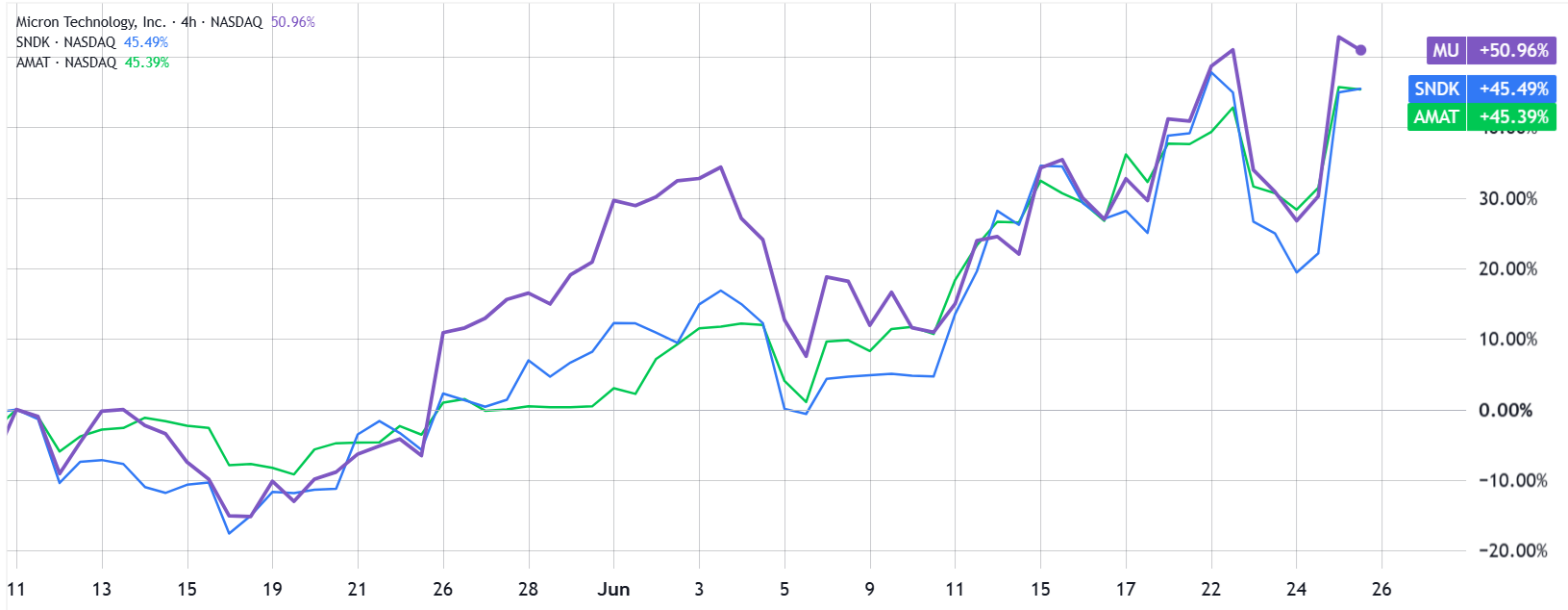
Shares of Micron, Sandisk, Applied Materials. Source: TradingView
The tech sector kept delivering strong surprises, with Micron Technology (MU) jumping 16% after solid quarterly earnings and Sandisk (SNDK) riding along with an 18% gain. Applied Materials (AMAT) rose 10% thanks to its new chipmaking tools. Investors’ renewed faith in the sector also mirrors the US government administration’s recent emphasis.
Fixed income offers a more compelling hedge alternative
Even if Bitcoin does not directly compete with the artificial intelligence sector, traders’ risk-reward views have likely tilted toward stocks. This shift followed the US government taking a 9.9% stake in Intel, proposing $2 billion for quantum computing firms, opening federal lands for data center projects, and setting a framework for “frontier models” releases.
Investors worried about inflated AI valuations after Elon Musk’s SpaceX (SPCX) shares fell 32% from their peak can find comfort in 5-year US Treasuries yielding 4.15%. Demand for non-yielding assets like Bitcoin faded as traders now see an 80% chance of US interest rate hikes by December, up from 68% a month ago, according to the CME FedWatch Tool.
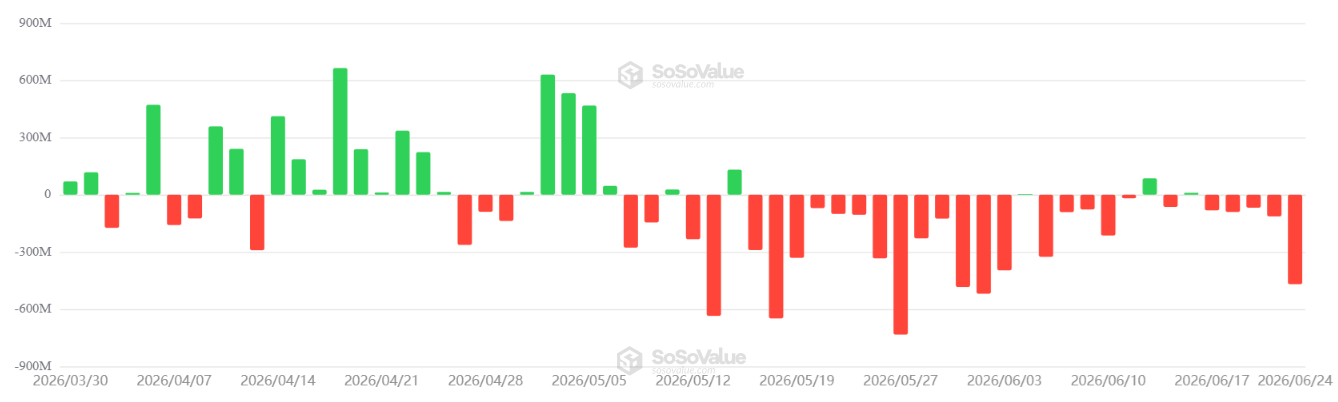
US-listed spot Bitcoin ETFs daily net flows, USD. Source: SoSoValue
Bitcoin’s appeal also took a hit from the massive $469 million net outflows in spot BTC exchange-traded funds (ETFs) on Wednesday. The metric serves as a key proxy for institutional demand. Sentiment worsened further as Strategy (MSTR) now sits on a huge unrealized loss after buying $64.1 billion worth of Bitcoin since 2020.
Related: 21shares trims 2026 crypto forecasts despite institutional adoption gains
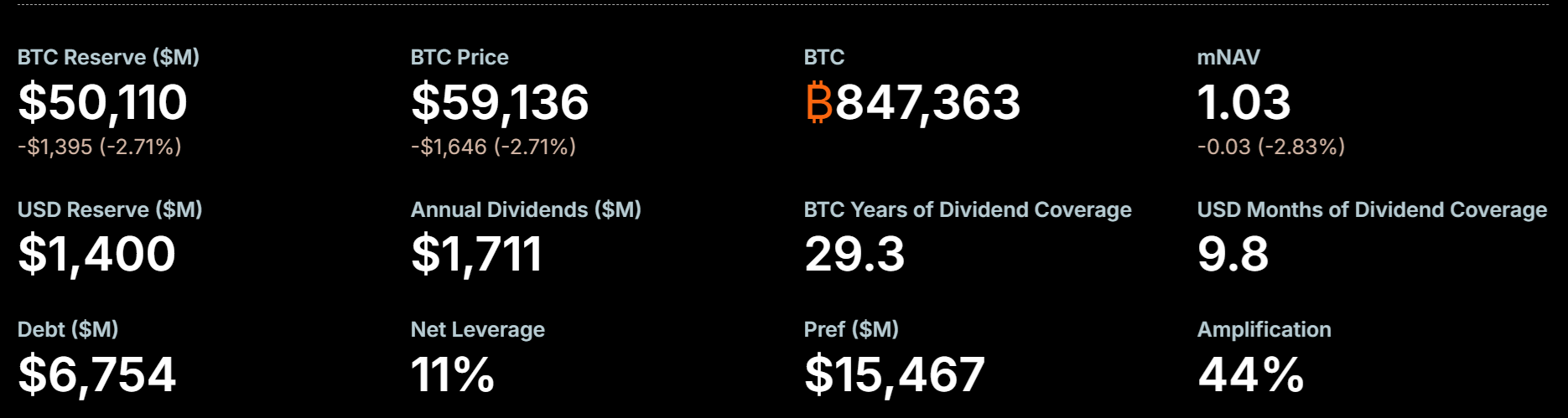
Strategy (MSTR) Bitcoin reserves and cash position, USD. Source: Strategy
The upcoming $13 billion Bitcoin options expiry on Friday heavily favors put (sell) instruments. Most neutral-to-bullish strategies will likely expire worthless, since 78% of call (buy) options are priced at $72,000 or above. Put options open interest on Deribit will exceed call options by $3.4 billion.
Bitcoin’s price momentum shows little tie to stocks due to heavy ETF outflows, a bearish options expiry skew and Strategy’s mounting unrealized losses. Bitcoin traders must now hunt for unique catalysts beyond equity market tailwinds to spark a turnaround.

DeXe (DEXE) has recorded a major increase in on-chain activity as the protocol continues to rank among the strongest-performing large-cap crypto assets in recent months.
According to data shared by Santiment, DEXE recorded 18 whale transactions worth over $100,000 and 298 active addresses, both all-time highs. The network also added 86 new wallets, which is its strongest wallet growth in seven months.
DEXE in the Spotlight
The surge in activity has come alongside a strong market performance for DEXE, whose market capitalization has risen more than 600% over the past four months. Santiment attributed the move to growing interest in DeXe’s DAO governance infrastructure, increasing speculation about broader protocol adoption, as well as rising spot accumulation as more tokens have reportedly moved off exchanges.
The analytics firm said that the latest on-chain data appears to be supporting the price rally rather than reacting to it. New wallets are entering the network at the fastest pace seen in months, while active participation and whale transactions have both reached record levels.
This combination of rising user activity, network growth, and large transactions may indicate genuine engagement within the ecosystem instead of purely speculative trading, as investors continue to assess whether DeXe’s expanding governance ecosystem can maintain its current momentum, Santiment added.
DEXE Outperforms Bitcoin
DEXE was trading near $23.5 at the time of writing, up nearly 36% this month. One factor that may have helped drive the rally was support from MEXC. The crypto exchange recently added the token to its futures market and allowed traders access to leverage of up to 50x. Over the past 24 hours alone, it rose by 4%.
The latest gains came despite a broader market sell-off. Bitcoin briefly fell to $59,000, which happens to be its lowest level since early June, before recovering to around $61,700 by Thursday morning.
Meanwhile, pseudonymous CryptoQuant analyst CW said that DEXE continues to test its “final major sell wall.” A breakout above this resistance zone would likely coincide with DEXE setting a new all-time high. CW also added that once the token clears this final barrier, there would be little overhead resistance left, which would potentially allow the rally to continue without significant selling pressure.
The post DEXE Defies Market Slump With Record Whale Transactions and User Growth appeared first on CryptoPotato.

Bitcoin slid below the $60,000 mark on Thursday, a move that drew attention to fresh downside technical risk and underscored how sensitive crypto remains to swings in broader financial markets. The drop followed weakness in megacap technology stocks, which dampened overall risk appetite and added pressure to BTC as it approached another critical psychological level.
From a charting perspective, the selloff has also helped activate multiple bearish patterns. Analysts say the combination of a breakdown below $60,000 and the completion of two separate setups on lower timeframes increases the odds of a move toward—and potentially through—the $54,000 area in the coming days.
Key takeaways
- BTC’s break below $60,000 has wiped out its June gains and triggered fresh technical downside scenarios.
- A four-hour “rounded top” structure appears to have completed, with a projected target just under $54,000.
- On the daily chart, a bear-flag breakdown points to the same $54,000 zone, strengthening the bearish case.
- Glassnode’s MVRV pricing bands align with the $54,000 area as an important potential support level.
Why $60,000 losing momentum matters
On Thursday, BTC/USD fell as much as 4.8% and traded down to an intraday low near $58,000, according to the market moves referenced in coverage of Bitcoin’s weakness. Importantly for traders, that decline did not stop at a minor dip—by moving below $60,000, Bitcoin broke a widely watched psychological threshold.
With the broader market in a fragile posture, that kind of level loss often changes how participants position. Instead of treating the area as “support to defend,” many traders reframe it as a level that must now be reclaimed to prevent further downside follow-through.
Rounded top breakdown points to a repeat target
The most direct technical argument for additional selling comes from the four-hour chart. Coverage notes that the price action completed what appears to be a rounded top pattern on that timeframe. In technical analysis, a rounded top forms when upward momentum gradually weakens, eventually shifting the asset from an uptrend into a downtrend that resembles an inverse “U” shape.
The pattern’s signal becomes actionable when the market breaks below the structure’s “neckline,” the support area that marks the base of the formation. After that breakdown, analysts typically estimate a downside objective by measuring the distance from the top of the formation to the neckline and projecting that same distance downward from the breakdown point.
Using that method, the measured downside target for Bitcoin is described as sitting just under $54,000, implying roughly an 8.9% drop from current prices at the time of reporting. The key point for readers is not the exact precision of the number, but the directional clustering: if multiple independent setups converge on the same zone, traders often treat that area as the next likely “decision point” on the chart.
Daily bear-flag adds weight to the $54,000 zone
To make the bearish case stronger, the article also points to confirmation from the daily chart via a bear-flag breakdown. Bear flags generally emerge after a sharp decline, followed by a period of consolidation that resembles a flagpole-and-flag structure. When price later breaks out downward from that consolidation, the pattern is often treated as implying that the prior down-move can extend.
In this case, the bear-flag breakdown is stated to project an identical move toward the $54,000 zone. That matters because it reduces the probability that $54,000 is merely a one-off technical estimate. Instead, two different pattern frameworks—rounded top on one timeframe and bear flag on another—are both pointing to the same region, which tends to attract concentrated positioning from market participants who follow chart-based signals.
On-chain confirmation: MVRV bands highlight potential support
Beyond pure price patterns, the coverage also turns to on-chain analysis from Glassnode, focusing on MVRV pricing bands. MVRV compares Bitcoin’s current market price with its realized price—the average price at which coins last moved on-chain. Put simply, these bands are often used to gauge whether BTC is trading in unusual profit or loss territory relative to where holders last established their cost basis.
As of Wednesday, the article states that Bitcoin traded near $60,997, while the 1.0 MVRV band—shown in green—sat around $53,390. That level closely matches the technical downside target near $54,000. When on-chain bands and chart objectives overlap, it can suggest a confluence area where demand might emerge, particularly if sellers start to encounter holders sitting at less favorable positioning.
However, the same framework also warns that a deeper decline could bypass that support. The article notes that if selling intensifies, Bitcoin could test the 0.8 MVRV band (shown in blue) near $42,700. Historically, it says, major bear-market bottoms have tended to form around that lower band—where unrealized losses become more extreme and capitulation risk rises.
For investors and active traders, this creates a more structured “map” of scenarios: $54,000 is framed as a near-term target and potential support test, while the $42,700 area is presented as a lower-bound zone to watch if the market fails to stabilize before then.
Readers should watch for whether Bitcoin can reclaim and hold above $60,000 after the breakdown, since that would challenge the bearish pattern narratives. If BTC instead keeps pressing lower, the next key question becomes whether $54,000 holds as a confluence support area—or whether conditions deteriorate enough to push price toward the deeper MVRV band levels.
Crypto World
Chicago Fed’s Goolsbee says inflation is too high; Williams sees price pressures easing
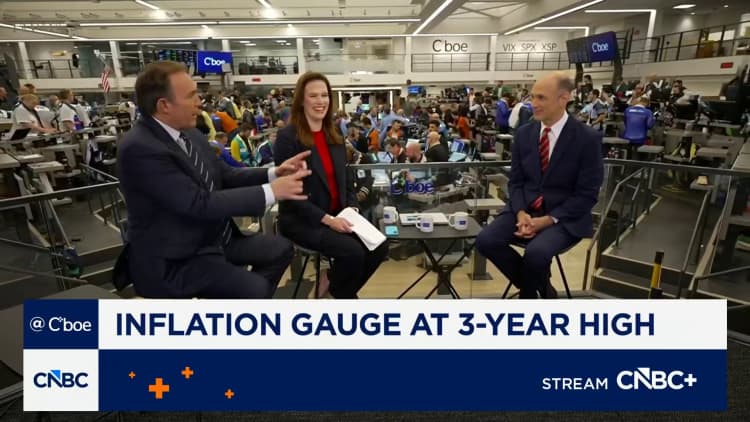

Two Federal Reserve officials on Thursday indicated some optimism on inflation, though neither indicated a likelihood that interest rates will change anytime soon.
Chicago Federal Reserve President Austan Goolsbee said Thursday that inflation is still trending the wrong way though there have been a few bright spots. A little later in the afternoon, New York Fed President John Williams said he expects inflation readings to start trending lower.
In a live CNBC interview from his home district, Goolsbee declined to speculate on where he thinks interest rates are headed. However, he said he remains squarely focused on inflation, in remarks that reflected sentiment new Fed Chairman Kevin Warsh expressed a week ago.
“You have seen now little bit of improvement on this services inflation, and I’ve been identifying that as something that we would want to see,” Goolsbee said from the trading floor of the Cboe. “But right now, as between the two sides of the Fed’s mandate, the inflation side and the job market side, clearly the problem’s on the inflation side.”
The comments came hours after the Commerce Department reported that core inflation as gauged by the Fed’s preferred benchmark, the personal consumption expenditures price index, stood at 3.4% in May, its highest since October 2023.
Price increases were fairly evenly distributed, with goods rising 0.4% and services up 0.5%, the most since January. On the goods side, much of the gain was driven by energy, which jumped 6.5%, while services was pushed higher by transportation services, a sector sensitive to gas prices and which accelerated 0.8%.
Markets expect the Fed could raise its benchmark rate in September, but Goolsbee wouldn’t commit to where he would stand. He said he “applauded” Warsh’s move to discourage such “forward guidance” from the Fed’s communication. The Federal Open Market Committee’s post-meeting statement was dramatically shorter than the norm, and the forward guidance language was removed.
“Let’s streamline, let’s take some forward guidance out of there. Let’s not speculate about the rate path,” he said. “I think it’s healthy that we have those resets.”
Goolsbee dispelled the notion of rancor within the Fed now that Warsh has taken over. He noted that the two were “foxhole bodies” during the global financial crisis, when Warsh was helping devise rescue programs and Goolsbee was a senior economic advisor in the Barack Obama White House.
“He comes in with new ideas. He’s a serious guy. You saw in the press conference that that he comes with a different style,” Goolsbee said. “Before I was ever at the Fed, and since I’ve been at the Fed, I’ve been uneasy with the use of forward guidance and speculating about the future of rates on a routine basis.”
Williams sees reason for hope
Williams, the New York Fed leader, said that he expects inflation readings to start trending lower though he is happy with interest rates at their current level.
The influential policymaker’s first remarks since last week’s meeting indicate less concern about inflation though still not enough to talk about cuts.
“Given the elevated level of inflation, it is imperative that we restore it to our 2 percent longer-run goal on a sustained basis,” Williams said in remarks at the Crane Money Fund Symposium in Jersey City, New Jersey. “The current stance of monetary policy is well positioned to do that.”
Williams cited three reasons he thinks inflation will ease: the waning impact from tariffs; hopes that the Iran war is nearing an end so energy prices will ease; and the expectation that shelter inflation will slow as rent increases moderate.
Inflation, he said, will drop to 3.5% this year from its current 4.1%, and “continue on a glide path” back down to the Fed’s 2% target by 2028.
“Like the World Cup tournament, the economy can take surprising and unpredictable turns,” he said. “One thing that is certain is my unwavering commitment to supporting maximum employment and bringing inflation down to our 2 percent longer-run goal on a sustained basis.”
The FOMC next meets July 28-29, with markets expecting about a 30% chance of a hike, according to the CME Group’s FedWatch. Goolsbee is a nonvoting participant at FOMC meetings this year but will get a vote in 2027. Williams is a permanent voter.
TLDR:
- Uniswap’s no-code tool lets teams launch onchain token auctions from a browser in four simple steps.
- The Continuous Clearing Auction spreads bids across blocks, removing bot sniping and last-second advantages.
- Aztec’s CCA raised $59M from 17,000 bidders across 191 countries, clearing 60% above its floor price.
- Cap Labs’ $CAP auction closed 5.5x oversubscribed at a $106M FDV, pulling in $16.4M in commitments.
Uniswap has rolled out a no-code token auction tool within its Web App, enabling teams to configure and run onchain token sales directly from a browser.
The feature is built on Uniswap’s Continuous Clearing Auction mechanism, which processes bids across multiple blocks.
All winning bidders pay the same final clearing price. The move positions Uniswap as a direct competitor to platforms like Pump.fun in the token-launch market.
How the Continuous Clearing Auction Works
The Continuous Clearing Auction conducts price discovery entirely onchain without resolving in a single block. Bids accumulate over multiple blocks, each clearing at a price carried forward from the previous one. This structure removes the speed advantage that typically favors bots and last-second snipers.
Bidders set a total budget and a maximum price per token during the process. Tokens are distributed to participants whose bids remain competitive as each block clears. Every successful bidder pays the same final clearing price at the end of the auction.
Uniswap previously described the CCA mechanics through a post on Aztec’s token sale. That auction raised $59 million from 17,000 bidders across 191 countries. It cleared at a price 60% above Aztec’s floor, demonstrating strong demand discovery through the mechanism.
Once a CCA closes, liquidity routes automatically into a Uniswap pool. Projects therefore get both price discovery and a bootstrapped trading pair from a single workflow. This end-to-end flow reduces the technical steps teams previously needed to manage separately.
Track Record and What the Tool Offers Teams
The CCA mechanism already has a verified track record before the no-code interface launched. Cap Labs’ $CAP auction drew 1,002 unique bids and closed 5.5x oversubscribed. It cleared at a $106 million fully diluted valuation, pulling in $16.4 million in total commitments.
STRATO also ran a CCA that became the fourth largest in Uniswap’s history. Both auctions ran before Uniswap made the no-code setup available to teams. The results show the mechanism can attract meaningful participation even without simplified tooling.
The no-code flow now guides teams through four steps: adding token information, configuring the auction, customizing the liquidity pool, and launching.
Uniswap posted a walkthrough of the setup sequence on Wednesday. A dedicated @UniswapAuctions account also tracks live auctions and outcomes in real time.
The tool lowers the barrier for projects that previously needed developer resources to run token launches. Teams can now manage the entire process from a browser with no code required.
As token launch competition grows, Uniswap’s onchain-native approach offers a structured alternative to existing platforms.
Blake Lively’s ‘Approachable’ Image ‘Tarnished,’ Expert Reveals

Jio Financial ka Block Deal #shorts #trending

Ryanair makes major child seating charge change for families


-

 Fashion6 days ago
Weekend Open Thread: Miami – Corporette.com
-

 Entertainment5 days ago
Renter of Home in Anne Heche Crash Denies Settlement With Son
-
 Sports2 days ago
Two goals and an assist by sheer aura: Cristiano Ronaldo just entered the World Cup chat
-

 Tech3 days ago
Microsoft accidentally kills epic Outlook email threads
-

 Business5 days ago
Soccer-U.S. defends Iran World Cup travel restrictions, says discussions ongoing
-

 Politics6 days ago
Andy Burnham and the meaning of Makerfield
-

 NewsBeat6 days ago
Keir Starmer Allies Question His Chances For No 10
-

 Tech3 hours ago
A Look At A Gaggle Of Transputer Boards
-
Crypto World2 days ago
Bitcoin (BTC) Dips Below $62K, Ethereum (ETH) Plunges 6% Daily: Market Watch
-

 Crypto World2 days ago
Securitize Wraps Roubini's SEC-Registered ETF as Dubai VARA Digital Security
-
Business2 days ago
Entergy settles forward sale agreements, raises $672 million in cash proceeds
-
 Business6 days ago
Wall Street Week Ahead: Investors see Micron earnings as pulse check of AI rally momentum
-
 Crypto World6 days ago
Can Charles Hoskinson Really Rescue Cardano?
-

 Crypto World6 days ago
HIVE shares jump as $220M AI deal speeds Bitcoin mining pivot
-

 Crypto World6 days ago
Jake Chervinsky accuses CME of protecting derivatives monopoly
-

 Entertainment6 days ago
Jose Alvarado Wants Taylor Swift at More Knicks Games
-
 Tech4 days ago
Signal’s Meredith Whittaker says AI chatbots ‘are not your friends’ and calls Copilot agents a backdoor
-

 Sports10 hours ago
India vs Bangladesh LIVE Score, Women’s T20 World Cup: Bangladesh Opt To Bat; India Enter ‘Do-Or-Die’ Stage As Semi-Final Race Heats Up
-

 Tech3 days ago
Nearly 7,000 fake Amazon domains registered ahead of Prime Day 2026, researchers warn
-

 Sports7 days ago
FIFA World Cup 2026: Canada beat 9-men Qatar 6-0 to register first ever win | FIFA World Cup 2026
You must be logged in to post a comment Login