

Crypto World
Japan logistics giant plans JPYC payments for 2,300 partners



Japanese logistics group AZ-COM Maruwa Holdings plans to introduce the yen-backed JPYC stablecoin for payments to about 2,300 partner carriers and independent drivers, according to a Nikkei report cited by Crypto Briefing.
Summary
- AZ-COM Maruwa plans JPYC payments for 2,300 logistics partners in Japan’s first large corporate rollout.
- The logistics group will invest ¥1 billion in JPYC while forming a business partnership directly.
- JPYC is gaining wider use through retail trials, lending projects, and emerging payment infrastructure nationwide.
The move is “expected to become Japan’s first large-scale corporate use of JPYC.”The company also plans to invest ¥1 billion in JPYC and form a business partnership with the stablecoin issuer. The rollout would move JPYC beyond retail tests and crypto services into routine business payments across a large logistics network.
AZ-COM Maruwa brings JPYC into logistics payments
AZ-COM Maruwa Holdings operates third-party logistics, transportation, warehousing and delivery services in Japan. Its planned use of JPYC would cover outsourcing and other payments made to a broad network of transport partners, including individual truck drivers.
The reported ¥1 billion investment also ties the logistics group directly to JPYC’s growth. The companies have not yet disclosed a detailed rollout schedule or explained how each partner will receive, hold or convert the tokens. Those operating details will determine how widely drivers and carriers use JPYC instead of immediately redeeming it for yen.
JPYC began issuing its regulated yen-backed stablecoin on October 27, 2025. The token maintains a one-to-one link with the yen and uses bank deposits and Japanese government bonds as reserve assets. It operates on public blockchain networks and can be issued or redeemed through JPYC EX.
The AZ-COM Maruwa plan follows other attempts to move JPYC into daily payments. As reported by crypto.news, Lawson plans to test JPYC payments at a Tokyo convenience store in August through a point-of-sale system. The trial will let customers pay using a smartphone-linked payment system.
Japan’s stablecoin market adds more use cases
JPYC is also expanding into financial products. As reported by crypto.news, Metaplanet and JPYC recently began studying Bitcoin-backed credit products that could use JPYC for lending and settlement. The project is examining how Bitcoin collateral and yen-denominated stablecoin liquidity could work together. Payment infrastructure is developing at the same time.As reported by crypto.news, LINE NEXT plans to support JPYC through Unifi Pay, a stablecoin payment service scheduled for a wider launch in the third quarter. The service is designed to let users in Japan top up local stablecoins from bank accounts after identity checks.
The logistics rollout would differ from smaller consumer pilots because it involves thousands of businesses and independent drivers receiving payments through the same stablecoin system. If implemented at the reported scale, it would test JPYC’s ability to handle regular corporate settlement rather than isolated retail purchases.
Japan is also tightening rules around stablecoin reserves as adoption grows.Japanese regulators have set conditions for government bonds held as reserve assets. JPYC has said it plans to keep most reserve proceeds in Japanese government bonds and the remainder in bank deposits.
AZ-COM Maruwa’s planned rollout therefore arrives as JPYC moves into retail payments, lending experiments and broader payment infrastructure. The ¥1 billion investment adds a direct corporate commitment, while the proposed payments to 2,300 logistics partners would provide one of the clearest tests yet of whether a regulated yen stablecoin can work in everyday business settlement.



South Korea’s financial authorities have investigated 40 crypto market manipulation cases since the country’s user-protection law took effect in 2024, referring more than 30 to investigative agencies.
The Financial Services Commission’s Chairman shared the figures to mark the law’s second anniversary. The cases exposed 25 suspects across two years of enforcement.
Korea’s Virtual Asset User Protection Act Marks 2 Years of Enforcement
South Korea passed the Virtual Asset User Protection Act on July 19, 2024. The measure gave regulators dedicated tools to punish abuse in the crypto market.
The Financial Services Commission then built a specialized investigation unit. It later added digital forensics and refined the operation of the penalty surcharge system.
That buildout produced roughly 40 completed investigations. Regulators also referred more than 30 confirmed cases to investigative agencies for prosecution.
“Financial authorities plan to keep strengthening efforts to stamp out unfair trading in the virtual asset market, including using AI to improve the efficiency of market surveillance and investigations,” the notice read.
Follow us on X to get the latest news as it happens
Average illicit gains reached about 1.4 billion won per case. Meanwhile, eight cases ranged from 500 million to 5 billion won, and one exceeded 5 billion won.
Regulators also imposed penalties of 125% to 165% of illicit gains in two cases. The authorities framed the results as a base for rebuilding market trust.
However, regulators signaled the work is far from finished. They plan to introduce account and bank-account payment suspension powers to block hidden proceeds.
A reporting and reward system for unfair trading is also under review for the second-phase legislation. Authorities intend to expand AI-based market surveillance alongside these measures.
Subscribe to our YouTube channel to watch leaders and journalists provide expert insights
The post South Korea Cracks Down on 40 Crypto Manipulation Cases Since the 2024 Law appeared first on BeInCrypto.


Allbridge Core has paused its cross-chain stablecoin protocol after a security incident on Solana that PeckShield estimated at about $1.65 million.
Summary
- Allbridge paused Core after a Solana exploit drained about $1.65 million, according to PeckShield estimates.
- The attacker used a $1.12 million USDC flash loan to quickly distort stablecoin pool rates.
- Allbridge urged liquidity providers to withdraw while investigators traced funds moved from Solana to Ethereum.
The protocol told users with funds in affected liquidity pools to withdraw while its team investigates. PeckShield also said the attacker moved the stolen assets from Solana to Ethereum.
The incident appears to involve manipulation of Allbridge Core’s USDC/USDT liquidity pool. Onchain Lens said the attacker used a $1.12 million USDC flash loan from Kamino, changed the pool balance through rapid swaps and withdrew liquidity at distorted rates. The exact loss figure remains under review, with Onchain Lens describing more than $1.1 million extracted and PeckShield estimating the broader exploit at about $1.65 million.
Allbridge pauses Core and warns liquidity providers
“Allbridge Core is experiencing a security incident,” the team said in its public notice. It added that the protocol had been paused as a precaution while the investigation continued. The project also issued a direct warning: “If you have liquidity in affected pools, please withdraw now.”
Allbridge said the attack left some pools temporarily out of balance. That imbalance created an arbitrage window that allowed some traders to profit from unusual pricing. The team asked anyone who benefited to consider returning funds to a recovery address. It said returned assets would go toward compensating affected liquidity providers. At the time of writing, the notice did not give a reopening date or publish a technical report.
In addition, according to Onchain Lens, the attacker borrowed $1.12 million in USDC through a flash loan from Kamino. The attacker then carried out rapid USDC and USDT swaps that changed the ratio inside the Allbridge stablecoin pool. After the pool price moved, the attacker withdrew liquidity using the distorted rate and repaid the flash loan within the same transaction.
Flash loans allow users to borrow and repay funds in one blockchain transaction without posting normal collateral. In this case, the loan itself was not described as the vulnerability. Instead, the borrowed liquidity allegedly gave the attacker enough capital to move the pool ratio and extract value before the transaction ended. PeckShield later said the stolen funds were bridged from Solana to Ethereum.
Allbridge faces another bridge security incident
The latest Allbridge Core exploit follows an earlier attack against the project. As crypto.news previously reported, Allbridge suffered a separate exploit in April 2023 after an attacker manipulated the swap price of a BNB Chain pool. The loss was estimated at about $573,000, and the project later recovered roughly $465,000 after offering the attacker a white-hat reward.
The new incident also comes during another active period for cross-chain security breaches. In May,the Verus-Ethereum bridge lost more than $11.5 million in an attack linked by researchers to missing validation checks. A separate crypto.news report said Transit Finance lost about $1.88 million in another cross-chain protocol exploit. Allbridge has not said whether the Solana incident shares technical similarities with those attacks.
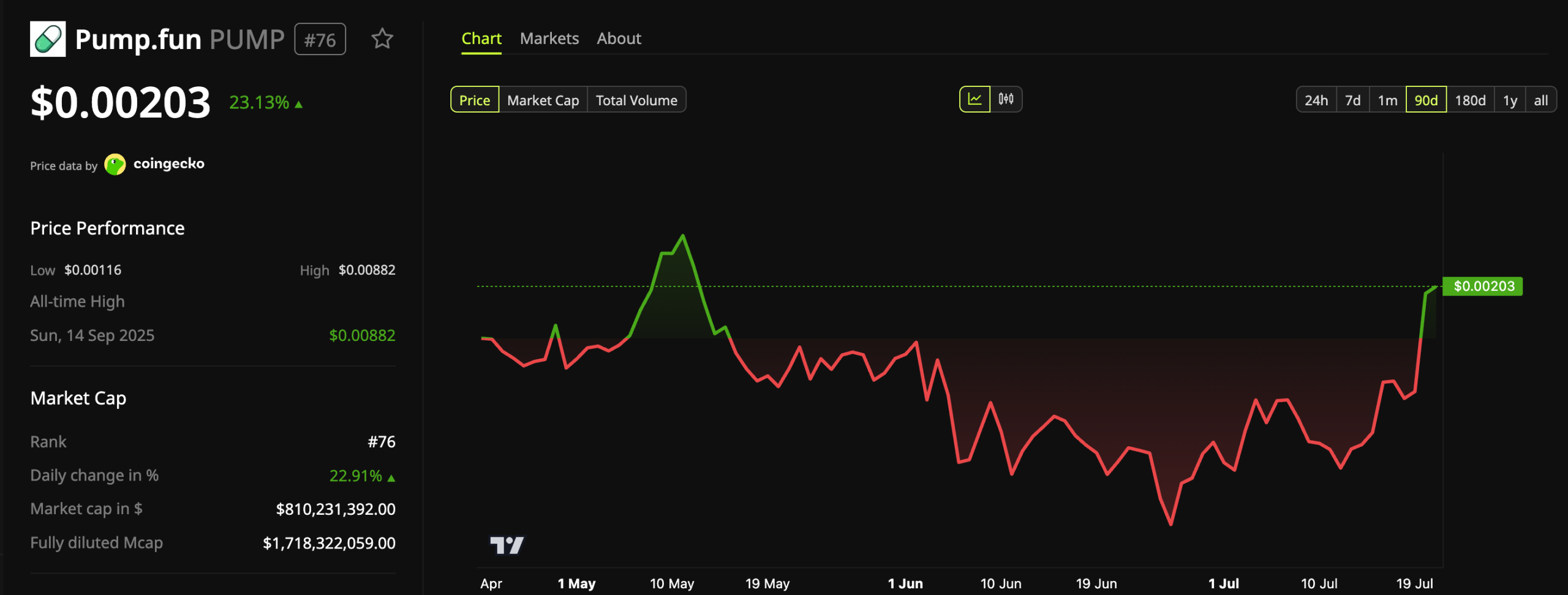
Pump.fun (PUMP) token’s price climbed to a two-month high on Monday as crypto trader Ansem disclosed a new position in the token and laid out a bullish case for the Solana (SOL) launchpad.
The move extended a rally that began Sunday, when PUMP jumped from about $0.0016 to $0.0019 as a viral meme coin drove attention towards the platform.
PUMP Rally Rolls Into Second Day After Top Trader Ansem Buys In
Sunday’s gains coincided with a meme coin frenzy around Jimothy The Raccoon (JIMOTHY). The token climbed 186% in 24 hours to a market cap of nearly $11 million.
The rally carried into Monday. PUMP jumped more than 23% and ranked as the top gainer among the 100 largest cryptocurrencies on CoinGecko.
The token reached an intraday high of $0.00207, its strongest level since May 12. It traded at $0.00203 at press time.

The surge came after Ansem said he bought PUMP on the reclaim of former support near $0.001675.
Follow us on X to get the latest news as it happens
The trader tied his bullish thesis to Solana reclaiming retail activity this cycle.
“thesis: making 30-40M a month during bear market for onchain, believe that SOL will dominate retail activity again this cycle and Pump.fun will be most likely beneficiary of this activity if that happens,” he said.
Ansem also suggested a large token airdrop could reignite on-chain activity, drawing comparisons with Jito (JTO) and Jupiter’s (JUP) distributions in late 2023, which helped drive trading volumes across the Solana ecosystem.
“also just hard for me to believe that they don’t want the token to do well as they own a meaningful amount of it which just started unlocking & their entire business is centered around allowing retail to speculate on tokenization,” Ansem added.
Lastly, he identified that a drop to $0.0014 as the point at which his thesis would be invalidated.
Subscribe to our YouTube channel to watch leaders and journalists provide expert insights
The post Pump.fun Token Hits 2-Month High as Ansem Reveals PUMP Buy appeared first on BeInCrypto.

Crypto markets remained relatively flat over the weekend with low volatility and total capitalization hovering around $2.3 trillion.
Nevertheless, military action in the Middle East has continued with the US Central Command reporting on Sunday that it was conducting a new wave of strikes against Iran for the ninth consecutive night.
“The strikes will continue degrading Iranian military capabilities used to attack commercial vessels and civilian mariners transiting the Strait of Hormuz,” it stated.
Meanwhile, crude oil prices jumped again, with WTI hitting $85 and Brent topping $90, and US stocks continued to cool last week as inflationary pressures returned.
Economic Events July 20 to 24
There are no economic reports due on Monday or Tuesday, and weekly jobless claims are out on Thursday. Friday sees the release of the S&P Purchasing Manager’s Index (PMI) reports for manufacturing and services, which generally reflect changes in economic growth conditions.
This week’s data will signal whether the economy remains as robust as some recent figures have shown, following last week’s below-forecast CPI inflation reports.
“It appears that the disinflationary trend that began in 2023 has indeed remained intact,” Elmar Voelker, analyst at LBBW, said in a note, according to the WSJ. “Given this context, there is little to suggest that US monetary policymakers will decide to raise the benchmark interest rate at their next meeting.”
The CME Fed Watch Tool currently predicts an 85.6% probability that rates will remain unchanged during the central bank’s next meeting on July 29.
Key Events This Week:
1. ADP Employment Change data – Tuesday
2. Tesla, $TSLA, Alphabet, $GOOGL, Report Earnings – Wednesday
3. Initial Jobless Claims data – Thursday
4. Intel, $INTC, Reports Earnings – Thursday
5. July S&P Global Manufacturing PMI data – Friday
6. July…
— The Kobeissi Letter (@KobeissiLetter) July 19, 2026
This week also has some big tech earnings reports with Alphabet (Google) and Tesla releasing second-quarter figures.
Crypto Market Outlook
Crypto markets have moved very little over the past 24 hours, with Bitcoin hovering around $64,700. The asset remains tightly range-bound between support at $62,000 and resistance just above $65,000.
Ethereum prices have also done very little, hovering around $1,870 but not giving up recent gains. BTC closed another weekly candle above the 200-week moving average, its long-term trend indicator.
“To really get this interesting, you want to see a strong push higher now to retrace that last leg down and get back above the Weekly 200 EMA,” said analyst ‘Daan’. “Until then, we’re just caught in this $60K choppy price range.”
The post 3 Macro Events That Could Shake Crypto Markets This Week appeared first on CryptoPotato.
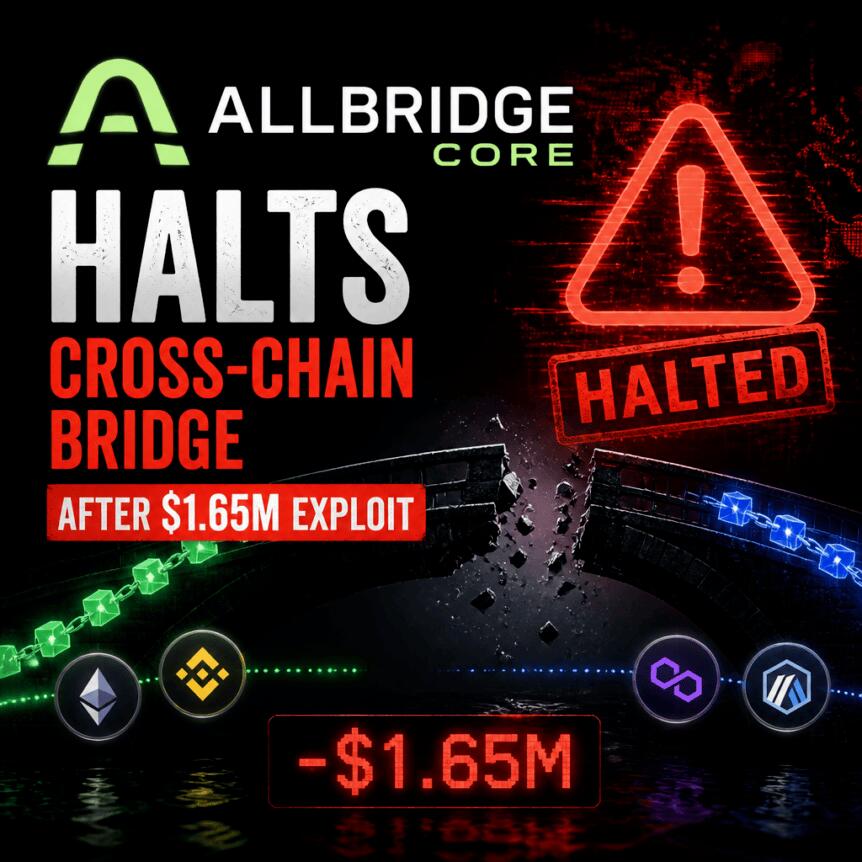
Allbridge, the firm behind the cross-chain stablecoin bridge Allbridge Core, has paused its protocol after a reported security incident on Sunday that investigators and on-chain analysts say resulted in roughly $1.65 million being drained. The company said the pause is a precaution while it investigates, and it urged users with liquidity in impacted pools to withdraw.
According to Allbridge Core’s own announcement on X, the exploit affected Allbridge Core’s deployment on Solana. Monitoring accounts cited in the incident also claim the attacker moved funds from Solana to Ethereum and then funneled proceeds into privacy-related pools, illustrating how quickly bridge exploits can turn into multi-chain extraction events.
Key takeaways
- Allbridge Core has paused its protocol following a reported cross-chain stablecoin bridge incident affecting its Solana deployment.
- The incident reportedly involved ~$1.65 million drained, with on-chain monitoring suggesting the attacker bridged funds from Solana to Ethereum.
- Liquidity providers were urged to withdraw from affected pools to limit exposure while the team investigates.
- On-chain analysis points to a flash-loan and rate-manipulation pattern that allowed the attacker to profit from a temporary pool imbalance.
- Bridge exploits are recurring: multiple reported attacks have hit different bridge systems since May, highlighting structural risk across the sector.
Allbridge Core pauses after Sunday incident
Allbridge said in a Sunday post on X that Allbridge Core was “experiencing a security incident” and that it had paused the protocol while it investigates. The firm added a direct instruction to users: if they have liquidity in affected pools, they should withdraw immediately.
The breach was reported to involve Allbridge Core’s Solana deployment. CertiKAlert later posted that the stolen funds had already been bridged from Solana to Ethereum before moving into privacy pools, according to the monitoring thread referenced by reporting shared on social media.
While the company did not provide additional technical details in the initial communication, the operational response—pausing the protocol and prompting LP withdrawals—suggests that Allbridge recognized ongoing risk rather than treating the event as a fully contained, already-resolved failure.
What on-chain reports say happened
On-chain analytics highlighted a specific mechanism consistent with recent DeFi bridge exploitation patterns. According to Onchain Lens, the attacker made a $1.12 million USDC flash loan from Kamino. The attacker then used rapid USDC/USDT swaps to distort the exchange rate inside the Allbridge Core stablecoin pool.
The same reporting indicates the attacker took advantage of the manipulated pricing by withdrawing liquidity at unfavorable-to-others rates. After extracting the difference created by the temporary imbalance, the attacker reportedly repaid the flash loan and retained the profit from the rate disruption.
Allbridge Core’s own follow-up language, as reflected in the incident discussion, referenced a “pool imbalance” that created a “temporary positive arbitrage window.” The company also suggested that if anyone took advantage of the window, they should consider returning funds, with any returned amounts intended to support compensation for affected liquidity providers.
Why this kind of bridge attack keeps repeating
This incident did not occur in isolation. The reporting notes that it is at least the sixth attack targeting a cross-chain bridge since May. Bridges are frequently attacked because they manage large pools of assets across networks—assets that back bridged tokens on the destination chain. If an attacker can manipulate pricing, liquidity, or settlement logic, the bridge’s pooled reserves can amplify losses.
In practice, these attacks often combine speed (to exploit temporary state changes) with cross-chain movement (to break the attacker’s funds away from any single environment). Sunday’s event appears to align with that playbook: on-chain monitoring suggested stolen value moved from Solana to Ethereum before being moved into privacy pools, underscoring the challenge for recovery once funds change hands across chains.
The case also highlights a persistent tension for investors and LPs: even when bridge designs rely on liquidity pools and token accounting rather than direct custodian control, attackers can still reach profit by exploiting assumptions around swap paths, price discovery, and pool invariants—especially when flash loans are available.
Allbridge Core isn’t new to flash-loan style exploits
Allbridge Core’s Sunday incident is not the company’s first exposure to flash-loan-driven manipulation. Earlier coverage and related documentation indicate that in April 2023 Allbridge was exploited for about $573,000 through a flash loan attack on Allbridge’s pool on BNB Chain.
That earlier event, as described in an analysis of the hack, involved an attacker acting as both liquidity provider and swapper, exploiting a flaw in smart contract logic that allowed them to manipulate swap prices. The outcome included drains denominated in BUSD and USDt, totaling roughly $573,000 based on the figures cited in the underlying analysis.
With Sunday’s report pointing to a similar exploitation pattern—flash loan funding, fast swaps, pool imbalance, then liquidity withdrawals—the renewed incident raises a practical question for LPs: even if a team responds by pausing the protocol, what controls exist to prevent the same class of risk from reappearing under different market conditions or on different deployments?
Cross-chain bridge attacks remain a sector-wide problem
Broader reporting shows that cross-chain bridges have faced repeated pressure from exploits across multiple ecosystems in recent months. In June, for example, Taiko urged users to withdraw assets from its bridges after a $1.7 million exploit, later reopening its bridge 11 days after completing a recovery plan. Weeks earlier, Secret Network was reportedly exploited through an “infinite mint” bug that created unbacked versions of Axelar-wrapped assets, resulting in a $4.67 million incident. Other widely reported bridge failures included Gravity Bridge, Verus Bridge, and Butter Network.
Together, these cases reinforce an important takeaway for anyone using or providing liquidity to bridge-related systems: cross-chain infrastructure concentrates both technical complexity and financial value, and the attack surface expands as protocols integrate multiple chains, wallets, swap venues, and liquidity mechanisms.
Readers should watch closely for two things next: whether Allbridge Core can determine the full scope of the impacted liquidity pools on Solana and any related deployments, and whether the team’s investigation leads to specific changes that reduce the likelihood of similar flash-loan-driven pool imbalances recurring.


The upgrade reduces smart contract execution costs while laying the groundwork for Ouroboros Leios, a major scalability upgrade expected later this year.
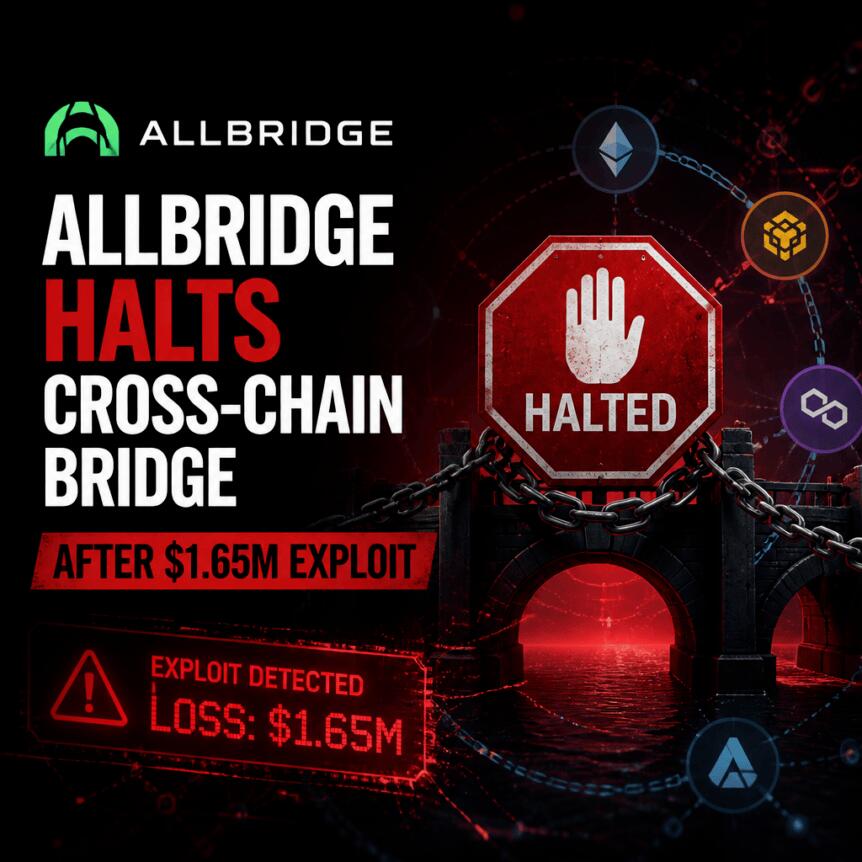
Allbridge, the company behind the cross-chain stablecoin bridge Allbridge Core, has temporarily paused the protocol after a reported security incident drained $1.65 million on Sunday. The disruption specifically impacted Allbridge Core’s Solana deployment, while the attacker reportedly moved the stolen funds onward to Ethereum and then into privacy-oriented pools.
In a post on X, Allbridge said it paused the protocol “as a precaution” while it investigates and urged users to withdraw liquidity from any affected pools. The episode adds to a growing list of cross-chain bridge exploits earlier this year, highlighting how attackers continue to target bridge-controlled liquidity that can become valuable once manipulated.
Key takeaways
- Allbridge Core paused operations after a $1.65 million reported incident affecting its Solana deployment.
- The attacker allegedly bridged funds from Solana to Ethereum before moving them into privacy pools, according to monitoring reports shared on X.
- Onchain analysis reported the use of a $1.12 million USDC flash loan to distort stablecoin pool pricing.
- Allbridge previously faced a flash-loan related exploit on BNB Chain in 2023, underscoring a recurring risk pattern in bridge liquidity pools.
- This incident follows multiple bridge attacks since May, reinforcing that cross-chain liquidity remains a persistent target for criminals.
Protocol pause after Solana-to-Ethereum theft
Allbridge Core’s pause was prompted by what the company described as a “security incident.” According to Allbridge’s statement on X, the protocol was stopped as a precaution while the team investigates and assesses exposure.
The company specifically advised: if users have liquidity in impacted pools, they should withdraw. That kind of guidance is typical after bridge-related exploits because the attacker’s impact can extend beyond the initial theft—particularly if pool pricing was manipulated and remaining liquidity becomes temporarily mispriced.
Monitoring information shared publicly points to a fast-moving sequence. An alert posted by CertiKAlert indicated the funds were already bridged from Solana to Ethereum after the incident, before the attacker reportedly routed value into privacy pools.
How the attacker reportedly manipulated stablecoin liquidity
Onchain Lens reported a detailed mechanism behind the event: the attacker allegedly took a $1.12 million USDC flash loan from Kamino, then executed rapid USDC/USDT swaps that disrupted the Allbridge Core stablecoin pool’s exchange rate.
Those trades reportedly created a window where the pool imbalance could be exploited. The attacker then withdrew liquidity at rates distorted by the manipulation, repaying the original flash loan and keeping the difference between what was withdrawn and what was effectively required to settle the loan.
Allbridge later referred to the outcome in its own communications. The company said the “pool imbalance created a temporary positive arbitrage window” and added that anyone who benefited should consider returning funds. It also stated returned value would go toward compensating affected liquidity providers.
For investors and traders, the practical takeaway is that bridge exploits are not only about the amount ultimately stolen. Price distortion and temporary arbitrage dynamics can lead to secondary effects—such as losses for liquidity providers who remain exposed after the initial manipulation, unless the protocol is paused and withdrawal guidance is followed.
A flash-loan pattern tied to recurring bridge vulnerabilities
This was not the first time Allbridge Core faced flash-loan style pressure. The company and its infrastructure have been hit before: in April 2023, Allbridge was exploited on the BNB Chain via a flash loan against a pool there, according to a technical analysis published by SolidityScan.
That earlier incident reportedly involved an attacker acting as both liquidity provider and swapper while exploiting business logic in a smart contract. The mechanism allowed the attacker to manipulate swap prices, which led to reported drains of $289,900 in BUSD and $290,900 in USDt.
While each bridge deployment and asset routing can differ, the continuity in tactics—flash loans combined with liquidity pool price manipulation—signals a broader vulnerability class. In many cross-chain designs, bridges rely on liquidity pools to support issuance and redemption of bridged assets. If pool accounting and swap logic can be influenced within a single transaction sequence, attackers may generate profit without needing long-term capital exposure.
The near-term uncertainty for users is how thoroughly Allbridge Core investigated the precise smart contract paths involved on Solana and whether any additional pools—or liquidity routes—were affected beyond the reported $1.65 million figure.
Cross-chain bridges targeted since May
This Allbridge Core incident lands in the middle of a broader streak of reported bridge attacks. Earlier coverage from Cointelegraph detailed how multiple protocols urged user withdrawals or paused bridge services following exploits, reflecting how quickly damage can spread when attackers identify liquidity weaknesses.
In June, Cointelegraph reported that Taiko, an Ethereum layer-2 network, urged users to withdraw assets after attackers exploited one of its bridge protocols and stole $1.7 million. Taiko later reopened its bridge 11 days later after completing a four-step recovery plan.
Weeks before that, Cointelegraph reported that Secret Network was exploited via an “infinite mint” bug in a vulnerable smart contract. That incident reportedly resulted in $4.67 million in unbacked Axelar-wrapped assets.
Other bridge failures mentioned in recent reporting include Cointelegraph’s reports on the Gravity Bridge halting after a reported $54 million exploit, the Verus Bridge reportedly being exploited for millions, and Butter Network losing most of its value after a reported quadrillion token mint exploit.
Taken together, the pattern is consistent: bridge systems concentrate liquidity, and that liquidity often translates into high payoff for attackers who can manipulate pricing, mint/burn mechanics, or settlement logic across chains. When protocols respond with pauses and user-withdrawal instructions, they are effectively trying to limit further exposure while remediation work is underway.
For users, the next watchpoints are straightforward: whether Allbridge Core confirms the full scope of affected pools, when the protocol restarts (if it does), and what safeguards are described in the aftermath—especially around pool invariants and flash-loan-resistance. Until those details are clear, liquidity providers should assume that temporary pricing distortions may not fully resolve without an operational pause.
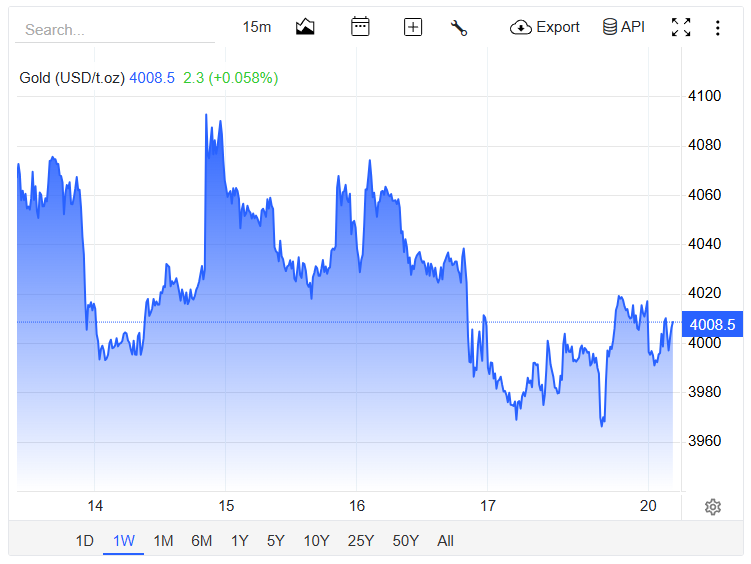
Gold managed to capture $4,000 an ounce Monday after spending the weekend just under that key psychological price point. Brent crude surged past $90 a barrel, and Federal Reserve officials pushed for a July rate hike.
The metal posted a 2.5% weekly loss last week. Gold briefly broke below $4,000, a level it first breached in late June for the first time since November 2025.
Oil Shock Reignites Inflation Fears
The US carried out a ninth consecutive night of strikes against Iran. Two American personnel died in Jordan, and allies reported fresh Iranian attacks Sunday.
The fighting pushed oil prices past $90 a barrel, reviving inflation fears just as June’s data showed cooling prices.
Meanwhile, Cleveland Fed President Beth Hammack joined a growing chorus of officials that argued interest rates may need to rise again. The comments set up a contentious debate at Kevin Warsh’s next meeting, with Warsh already signaling little patience for backsliding.
He told the House Financial Services Committee the Fed has
“no tolerance for persistently elevated inflation”
A Bear Market for Metals
COMEX speculators raised net long gold positions to 119,147 contracts in the week to July 14, CFTC data showed. That build suggests traders still expect further upside.

Gold’s pullback follows broader bear-market signals across precious metals. Silver has also seen a sharp pullback, and gold’s war-hedge performance has been uneven through the conflict.
Oil-driven war risk usually boosts gold’s safe-haven appeal. Here, the same oil spike is fueling rate-hike bets that punish non-yielding bullion instead. That dynamic could offset some safe-haven demand from the Gulf conflict.
Whether gold breaks below $4,000 again may depend on this week’s Fed comments and oil prices.
The post Gold Price Holds Above $4,000: Will Oil Surge Push It Lower? appeared first on BeInCrypto.


Kalshi has added three million new users during the 2026 FIFA World Cup, the prediction market platform told CNBC. Trading volumes across the platform also surged alongside the tournament.
More than $1.2 billion has traded on Kalshi’s contract predicting the World Cup winner, a record for a single market on the platform. That market closed Sunday, when Spain beat Argentina in the final, 1-0.
A Marketing Blitz Built for the World Cup
Kalshi leaned on soccer’s global reach to fuel the surge. Vijay Viswanathan, associate dean of integrated marketing communications at Northwestern University, said football’s presence in nearly every country gives it an addressable market few other events can match.
The platform partnered with ADI Predictstreet, FIFA’s official prediction market sponsor, for stadium co-branding deals during the tournament. Meanwhile, it also worked with OpenAI to surface its odds inside ChatGPT searches, alongside campaigns featuring soccer stars Luka Modric and Jose Mourinho, plus a partnership with the Argentina national team.
Kalshi CEO Tarek Mansour said the strategy prioritizes speed and relevance over volume alone.
“Our volumes are where the news is at.”
— Tarek Mansour, CNBC
Prediction Markets Still Face Regulatory Concerns
Despite the popularity, and the boom from the World Cup, predictions markets carry regulatory risk. Sports event contracts remain caught in a dispute between the federal government and several states, which argue the contracts function as sports betting. That fight has already produced a CFTC lawsuit against Kentucky this year.
In contrast, Brian Sung, a partner at law firm Haynes Boone, said the marketing push does not sway how courts might rule, but it shapes how regulators and the public view prediction markets.
Other bettors have felt the swings too. One Polymarket trader lost $11.6 million on World Cup wagers in early July, while rapper Drake has a five million dollar wager riding on Sunday’s final.
Kalshi now faces a familiar test. Volume drops on days without matches, a pattern Mansour said has repeated after past major events.
He expects fresh catalysts, not a slowdown, to keep prediction market volume climbing once the World Cup ends.
The post Kalshi Adds 3 Million Users During FIFA World Cup Boom appeared first on BeInCrypto.
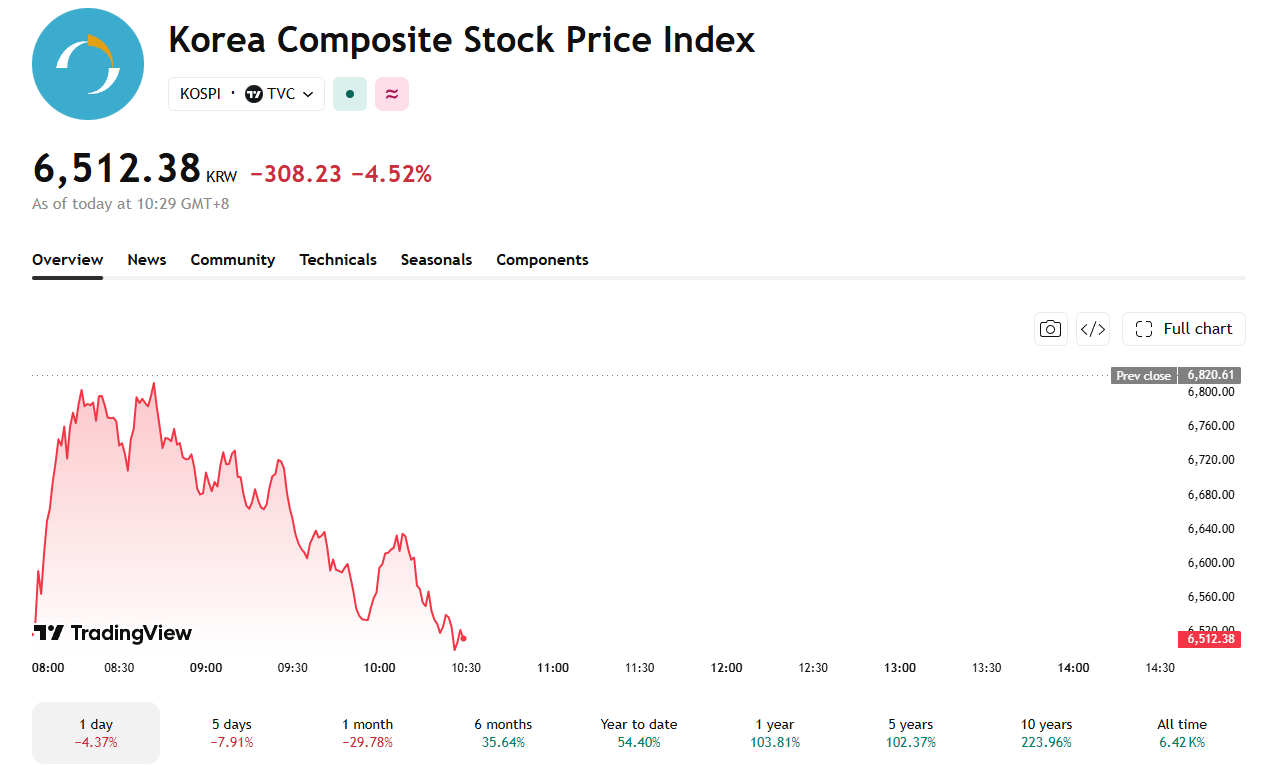
South Korea’s KOSPI index reopened lower on July 20, its first session since Friday’s Constitution Day holiday. The index slid as low as 6,498 points before paring some losses.
The drop pushed the index more than 25% below its June peak, meeting the threshold for a technical bear market. Chip-sector jitters compounded with an escalating US-Iran conflict to drive the slide.
Chip Stocks Swing Hard on Reopening
Samsung Electronics and SK Hynix stock both opened down more than 5% before foreign investors moved in. The Philadelphia Semiconductor Index shed 4.3% while Korean markets stayed shut for the holiday last Friday. Rising competition from Chinese AI models added further pressure on the memory chip trade.

Foreign investors net bought 278.4 billion won ($187.1 million) in early trading, concentrated in electronics stocks. Retail investors net sold 300.8 billion won over the same window. Han Ji-young, a researcher at Kiwoom Securities, said the decline reflects how far leading stocks have fallen.
“Since July, the KOSPI has dropped by about 25% from its peak, entering a technical bear market. A sharp decline of 30–40% in leading stocks such as Samsung Electronics, SK Hynix, and Samsung Electro-Mechanics is amplifying the sense of decline.”
Won Slides as Middle East Risk Builds
The won-dollar rate opened at 1,488.3, extending its slide while oil prices climbed on fears that the conflict could disrupt the Strait of Hormuz. The stronger dollar added to import-price pressure already building after the Bank of Korea’s first rate hike since 2023.
Analysts see this week’s US hyperscaler earnings as the next catalyst. Alphabet reports July 22, with Microsoft, Meta, and Amazon following before month’s end. Their capital spending outlooks could determine whether chip stocks find a floor or extend the slide.
The post KOSPI Falls Over 4% as Trading Resumes After Holiday, Deepening Bear Market appeared first on BeInCrypto.

South Korea Cracks Down on 40 Crypto Manipulation Cases Since the 2024 Law

‘House of the Dragon’ Goes Full-On Horror With a Murder Mystery Twist

The world’s most expensive and biggest money counter


-
 NewsBeat4 days ago
London Mayor Sadiq Khan handed a peerage by Keir Starmer alongside 15 other Labour figures… just days before the PM leaves No10
-

 Fashion2 days ago
Weekend Open Thread – Corporette.com
-

 Politics2 days ago
The House | The City of London can help the new chancellor deliver growth in every postcode
-

 Politics5 days ago
Young campaigners urge incoming PM to act on outdoor junk food ads
-

 Crypto World4 days ago
CFTC blocks Kalshi from unwinding Michigan trades after court order
-

 Business4 days ago
Nvidia Stock Slips After Big Tuesday Rally as Huang Confirms Vera Rubin Chip Is Now in Production Today
-
 Crypto World3 days ago
Two July Windows Left: The CLARITY Act’s Senate Fight and What Failure Means
-

 Crypto World2 days ago
Ripple Payments Joins MiCA With 14 Firms, Does It Mean Anything For XRP?
-

 Politics16 hours ago
Democrats look to World Cup watch parties to register thousands of voters
-

 Crypto World2 days ago
Ripple wins EU-wide access as ESMA adds it to MiCA register
-
 Entertainment5 days ago
Disney’s Most Ambitious Failed Star Wars Attraction Is Coming to SDCC
-

 Business4 days ago
Palantir Shares Rise After Expanded Nvidia Partnership and Fresh Analyst Upgrades Ahead of Earnings Day
-

 Crypto World3 days ago
Injective Submits SEC Transfer-Agent Registration to Onchain Ownership Records
-

 Tech6 days ago
Get Your ESP32 Sunny Side Up With This Solar Dev Board
-

 News Videos5 days ago
XRP BOMBSHELL… XRP OMBOARDED FOR TRANSACTIONS!!!
-

 NewsBeat3 days ago
Registration is now open for March for Men with Kev 2026
-

 Tech5 days ago
Dark Secrets Emerge When Jailbreaking LLMs
-
 Sports4 days ago
New Cornerback Enters Vikings Trade Rumor Mill
-

 News Videos3 days ago
Money | Class 12 Economics | CBSE Board Exam 2026-27
-

 Business3 days ago
Banco Bilbao Vizcaya Argentaria, S.A. (BBVA) Discusses Global Macro Environment and Economic Outlook for Core Markets Transcript
You must be logged in to post a comment Login