
Crypto World
Justin Sun Blasts WLFI Token Unlock Proposal as ‘World Tyranny’

TRON founder escalates feud with Trump-linked DeFi project, alleging coercion and frozen voting rights.
World Liberty Financial’s freshly posted governance proposal to unlock 62.3 billion WLFI tokens drew an immediate broadside from TRON founder Justin Sun, who published a lengthy rebuttal onX, calling the plan “World Tyranny, Not World Liberty Financial.”
Sun, who invested $75 million in the Trump family-backed DeFi venture, accused the team of engineering the vote so that dissenters are punished, as holders who vote against the proposal see their tokens locked indefinitely with no unlock path, while large holders like himself have been frozen out of the process entirely.
“I personally hold approximately 4% of the voting power, yet my tokens have been frozen and I am forced out of this voting process,” Sun wrote. “The outcome was determined before the vote even began.”
The proposal, announced by WLFI on Tuesday, would place early supporter tokens on a two-year cliff followed by a two-year linear vest. Founders, team members, and advisors would face a longer five-year schedule, with 10% of their allocation permanently burned on passage. Holders who do not opt in remain locked indefinitely. WLFI called the plan “one of the strongest long-term governance alignment signals in DeFi.”
Sun sees it differently. He called the vote “a performance where the police have already barricaded the doors of parliament” and pointed to what he described as a deeper structural problem: the WLFI smart contracts are ultimately controlled by a 3-of-5 anonymous multisig and a single anonymous guardian address that can blacklist any wallet. Voters, meanwhile, must complete identity verification to participate.
“Your voters must register, submit to scrutiny, and be vetted — while your dictators won’t even show their faces,” Sun wrote.
Feud Erupts Into Open War
The response caps a week of escalation between the two sides. Tensions boiled over on Sunday after Sun accused WLFI of embedding a hidden blacklisting function in the token contract and called the team’s actions illegitimate. WLFI fired back, threatening legal action. “See you in court pal,” the project’s official X account posted.
Sun demanded that whoever was operating the account identify themselves. “As the largest investor in this project, I demand that those responsible come forward by name, instead of hiding in the shadows.”
The clash followed days of scrutiny over WLFI’s treasury operations. The Defiant previously reported that WLFI deposited 5 billion of its own governance tokens into Dolomite, a lending protocol co-founded by WLFI’s chief technology officer, and borrowed roughly $75 million in stablecoins, some of which were routed to Coinbase Prime.
Sun’s wallet containing more than 500 million WLFI tokens has been frozen since September 2025, when the project blacklisted his address after on-chain analysts flagged transfers routed through HTX, his crypto exchange. WLFI alleged Sun breached his investor agreement. Sun has maintained that the freeze was unjustified.
Token in Freefall
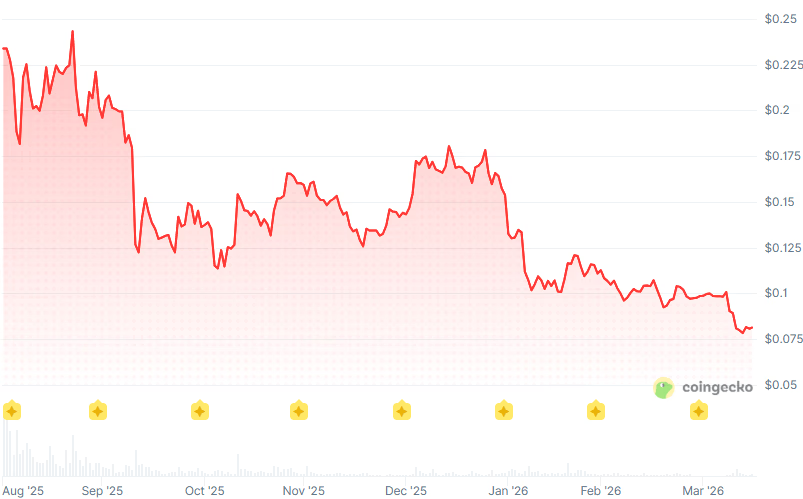
WLFI was trading around $0.08 on Tuesday, down roughly 75% from its all-time high and near its all-time low of $0.077 hit last week. The token’s market cap has fallen to approximately $2.5 billion.

Sun closed his statement by calling on all WLFI holders to “see this proposal for what it truly is” and to “reserve all legal rights of recourse.”
This article was written with the assistance of AI workflows. All our stories are curated, edited and fact-checked by a human.

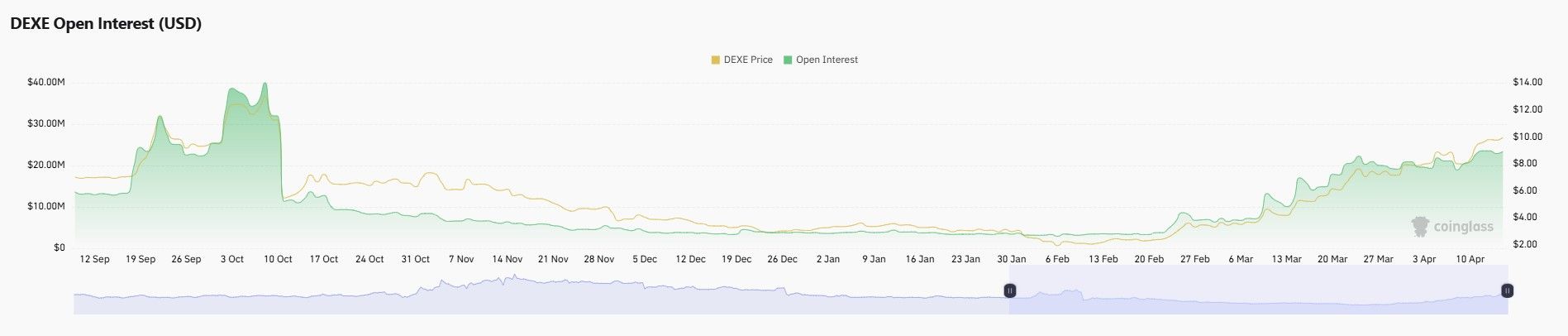
DeXe (DEXE) surged 22% on April 15, 2026, pushing to $12.19 and entering a resistance zone that capped the token’s October 2024 rally. Open interest across all exchanges has recovered to approximately $20 million, up from near-zero levels recorded in January 2026.
The move places DEXE directly at the 0.5 Fibonacci retracement level on the weekly chart. That threshold now determines whether the recovery from January lows continues toward $15 or stalls under concentrated selling pressure.
Open Interest Climbs Back Toward Pre-Correction Levels
DEXE open interest peaked at roughly $39 million in early October 2024 before collapsing alongside price. The liquidation wave erased most leveraged exposure. By late January 2026, open interest had fallen to approximately $5 million, per Coinglass data.
Since February 2026, open interest has rebuilt steadily alongside price, reaching approximately $20 million as of April 15. When OI and price rise together, it may signal fresh capital entering the market rather than a short squeeze closing out losing positions.
For this signal to remain constructive, OI would need to hold above $15 million on any near-term retracement. A drop back below that level would suggest today’s move attracted primarily spot buyers without durable derivatives-backed conviction.
Weekly Fibonacci and Bollinger Bands Create a Decisive Threshold
The weekly chart shows DEXE trading at $12.21, pinned to the 0.5 Fibonacci retracement at $12.17. This level marks the midpoint of the token’s full range between the $0.14 all-time low and the $24.20 all-time high.
A Bollinger Band expansion on the weekly timeframe suggests price is pushing toward the upper band after months of contraction inside a tightening range. However, a declining volume trendline drawn across the weekly chart from October 2024 remains intact.
Price has outpaced volume participation. It suggests the current move may require broader buying to confirm a genuine breakout rather than a temporary spike.
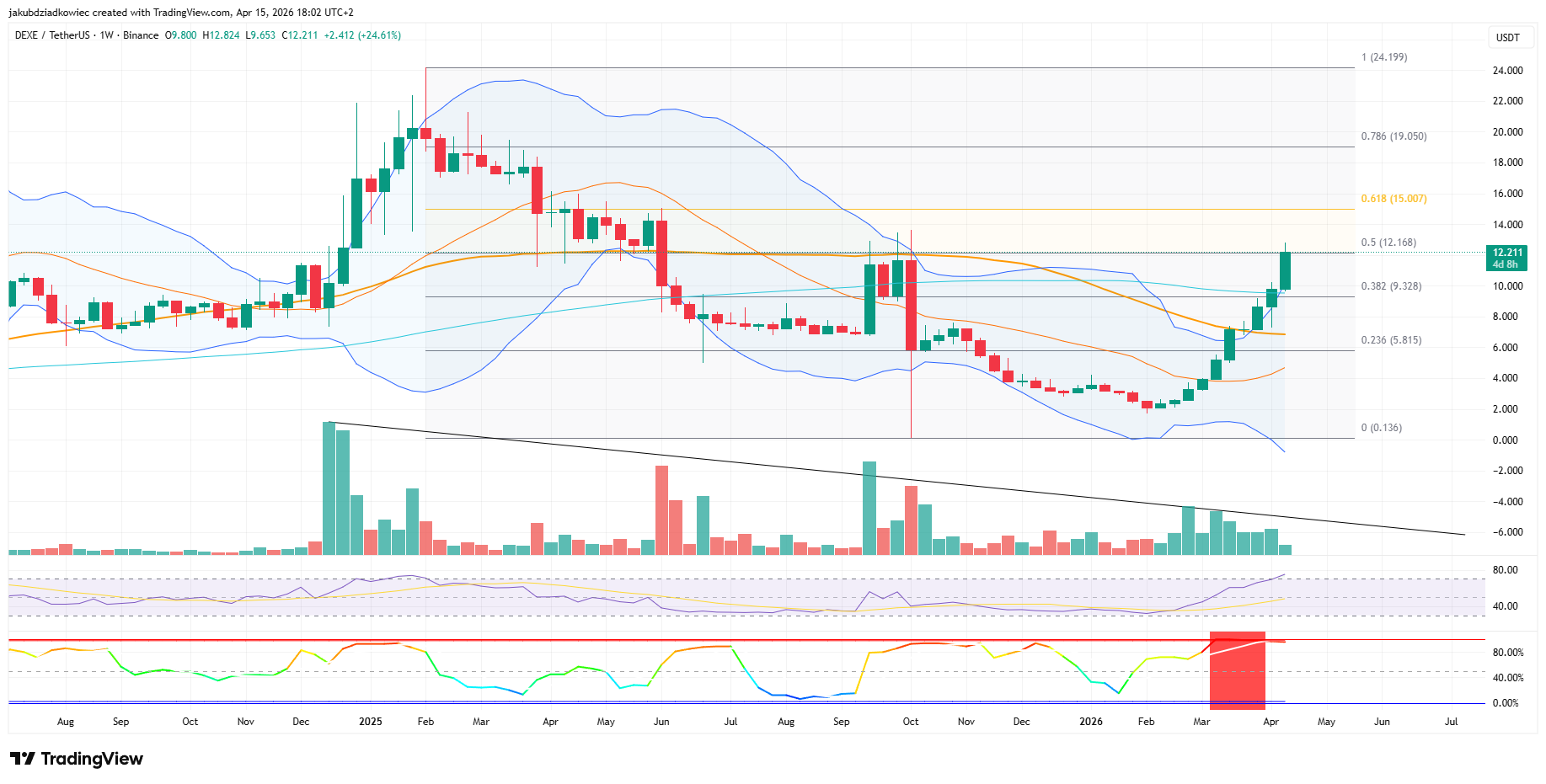
The RSI panel, which had been flagged as oversold in early 2026, has recovered to a neutral-to-bullish position. A confirmed weekly close above $12.17 would set the 0.618 retracement at $15.01 as the next target, the level highlighted in yellow on the chart.
DEXE Price Prediction — $15 Target Hinges on Clearing $13.50
The daily chart shows DEXE entering a red resistance zone spanning approximately $12.50 to $13.50. This zone previously capped the October 2024 rally and is now being tested following a multi-month recovery from the January 2026 lows near $2.50.
Today’s candle opened at $9.97 and reached an intraday high of $12.82. It marks one of the strongest single-session advances of the entire 2026 recovery. A daily close above $13.50 would flip this resistance into support and open the path toward $15.01, aligning with the weekly 0.618 Fibonacci target.
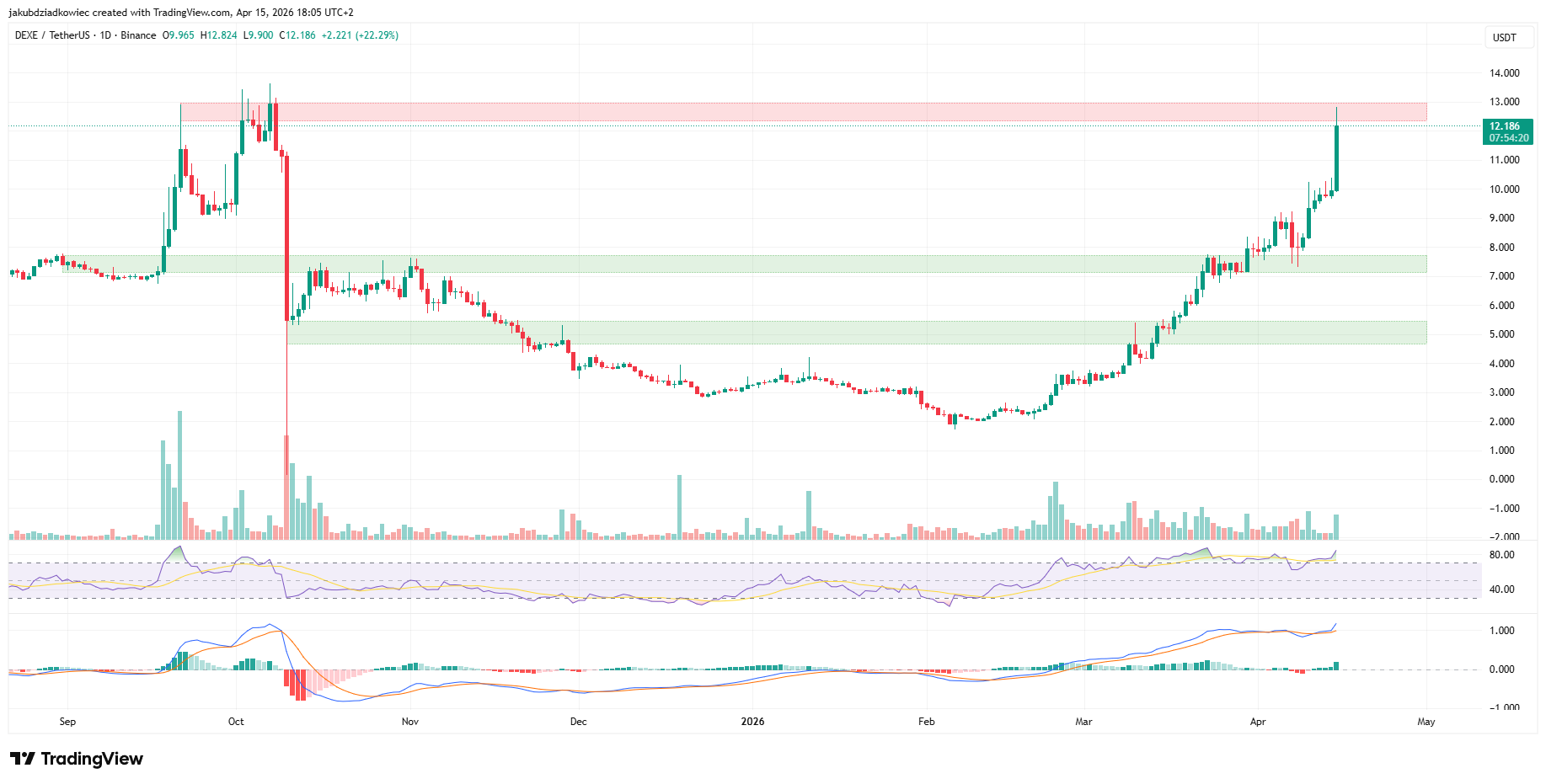
On the downside, a rejection from the red zone would likely send DEXE back toward the upper green support band between $7.00 and $7.80. That zone held price on multiple daily closes throughout the February and March 2026 consolidation.
A deeper pullback would find support in the lower green band between $4.80 and $5.30.
Given the pace of today’s advance, the RSI is likely extended on the daily timeframe. This raises the probability of short-term consolidation before any sustained move above $13.50.
Whether DEXE holds above the red zone or gets rejected will determine whether the recovery from January lows extends toward the mid-$15 range or resets for another base-building phase.
The post DeXe Joins the Altcoin Rally, Price Hits Nearly 1-Year High appeared first on BeInCrypto.
Key takeaways:
-
Institutional ETH accumulation remains robust as Ether ETFs and Bitmine Immersion lead a healthy, spot-driven recovery.
-
Lackluster DApp revenue and negative ETH funding rates suggest that traders are skeptical of the rally.
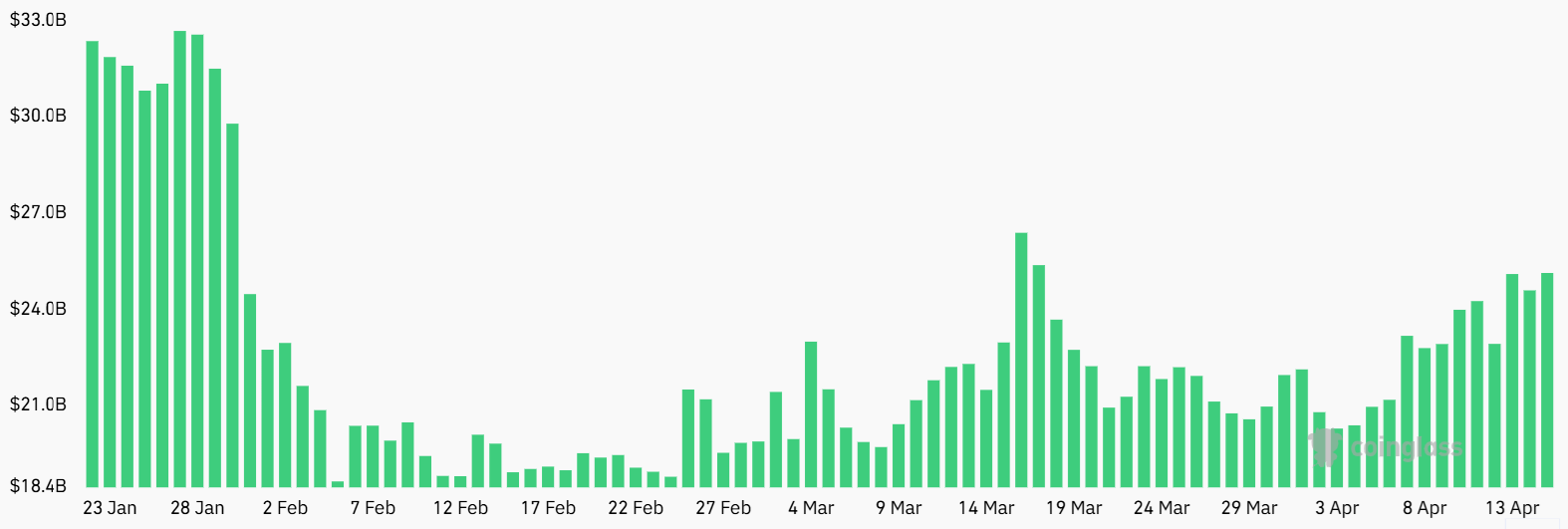
Ether (ETH) price managed to sustain above $2,300 on Wednesday, distancing itself from the $1,940 lows seen on March 29. The recent rally has caused ETH futures open interest to reach $25.4 billion, indicating increased demand for leveraged positions. The movement suggests a potential turn in momentum for ETH bulls after 10 weeks of failed attempts to reclaim the $2,400 level.

To determine whether the shift in positioning is driven by bulls, one must assess the ETH futures funding rate. The ETH perpetual futures funding rate has failed to hold above 5% since Friday, indicating a lack of confidence among bulls.

The metric has dipped below 0% multiple times, indicating excess demand for bearish leveraged positions. Under neutral conditions, the indicator should range between 5% and 10% to compensate for the cost of capital.
Still, one could argue that such data reinforces that Ether’s recent rally to $2,350 has been sustained by spot demand.

US-listed Ether spot exchange-traded funds (ETFs) accumulated $248 million in net inflows over the past 10 days, validating the thesis of healthy spot-driven Ether bullish momentum. In parallel, the digital asset treasury company Bitmine Immersion (BMNR US) announced the acquisition of $312 million worth of ETH. Bitmine now holds 4.87 million ETH, equivalent to $11.46 billion.
While institutional accumulation is generally a positive sign, Bitmine’s ETH holdings are trading 13% below their acquisition cost, according to CoinGecko data. Similarly, US-listed Ether ETF assets under management stood at $13.7 billion on Wednesday, down from $20.5 billion three months prior. Ether’s failure to reclaim $2,400 also happened as the S&P 500 index jumped to a new all-time high on Wednesday.
Weak Ethereum network activity, increased competition
Part of investors’ reduced appetite for cryptocurrencies can be pinned to the declining activity in decentralized applications (DApps). Almost every corner of the cryptocurrency industry has been negatively impacted by the 2026 bear market, including memecoin token launch platforms, synthetic derivatives trading, collateralized lending, digital collectibles, decentralized exchanges and cross chain bridges.
The few positive highlights, including prediction markets and real-world assets, had no impact on Ethereum network activity. Investors are starting to question whether ETH is well-positioned to capture an eventual surge in demand for DApps, given the emergence of competing blockchains focused on solving specific issues, such as Hyperliquid and Plasma.

Related: ETH/BTC ratio hits 10-week high as Ether outpaces Bitcoin–Are new price highs next?
Ethereum’s weekly DApps revenue has plummeted to $11 million per week, down from $24 million in early February. The primary reason for investors to accumulate ETH is the expectation of higher onchain processing demand and the subsequent burn mechanism, which creates incentives for long-term holding.
Despite the increased demand for ETH futures, derivatives metrics failed to flip bullish. Among the potential causes are the losses in Ethereum strategic reserve companies and increased competition in the DApps industry.
This article is produced in accordance with Cointelegraph’s Editorial Policy and is intended for informational purposes only. It does not constitute investment advice or recommendations. All investments and trades carry risk; readers are encouraged to conduct independent research before making any decisions. Cointelegraph makes no guarantees regarding the accuracy or completeness of the information presented, including forward-looking statements, and will not be liable for any loss or damage arising from reliance on this content.
Bitcoin (BTC) has demonstrated notable resilience amid the US-Iran war, climbing over 12% since February 28. As uncertainty grips global markets, one question continues to dominate investor sentiment: has Bitcoin already found its bottom, or is more downside still ahead?
In an interview with BeInCrypto, Benjamin Cowen, CEO of Into The Cryptoverse and former NASA researcher, weighed in on where the market may be headed next.
When Will Bitcoin Bottom?
Cowen explained that Bitcoin’s cycle timing has remained remarkably consistent. He noted that, measured against the two previous cycles, Bitcoin topped within one week of when those earlier cycles peaked.
Based on this pattern, Cowen expects the bottom to arrive roughly a year after the top.
“The base case has to just simply be that it’ll bottom when the other two cycles bottom, which is about a year after the top most likely scenario is October of 2026,” Cowen told BeInCrypto.
He acknowledged a scenario where Bitcoin could bottom as early as May. But for that to happen, there would need to be a massive capitulation event well below what historical midterm years typically produce.
As long as Bitcoin’s year-to-date returns remain within the standard deviation band of prior midterm years, Cowen sees no reason to pivot from the October thesis.
“And if you look at the year-to-date ROI of Bitcoin in 2026 and you compare it to the average of prior midterm years, you throw in a standard deviation on that average. As long as we’re within this band, it’s hard to assume that we’re going to exit the band, especially this early in the midterm year,” he explained.
Subscribe to our YouTube channel to watch leaders and journalists provide expert insights
The outlook aligns with other market analysts’ views. Joao Wedson, CEO of Alphractal, observed that Bitcoin’s cycle top occurred 534 days after the April 2024 halving, the shortest cycle peak compared to the previous one.
Based on this decaying pattern across cycles, his analysis suggests the market bottom could emerge roughly 912 to 922 days after the halving, pointing to a timeframe in late September or early October 2026.
Estimates from CryptoQuant broadly support this view, with models indicating a potential bottom between June and December 2026, and September through November as the most probable window.
Why This Cycle Topped on Apathy, Not Euphoria
One of Cowen’s key observations is that while Bitcoin’s peak in the current cycle aligns with previous timelines, it emerged under very different conditions.
He noted that in 2017 and 2021, Bitcoin peaked amid widespread retail euphoria. This, in turn, triggered a rotation into altcoins after it topped.
This time, social interest in crypto has been trending down since 2021. Bitcoin topped on apathy, and as a result, the usual altcoin rotation did not materialize.
“This is a cycle where Bitcoin topped on apathy rather than euphoria, and the only other time it topped on apathy was actually back in 2019. When you top on apathy, you don’t get that same rotation,” he mentioned.
Follow us on X to get the latest news as it happens
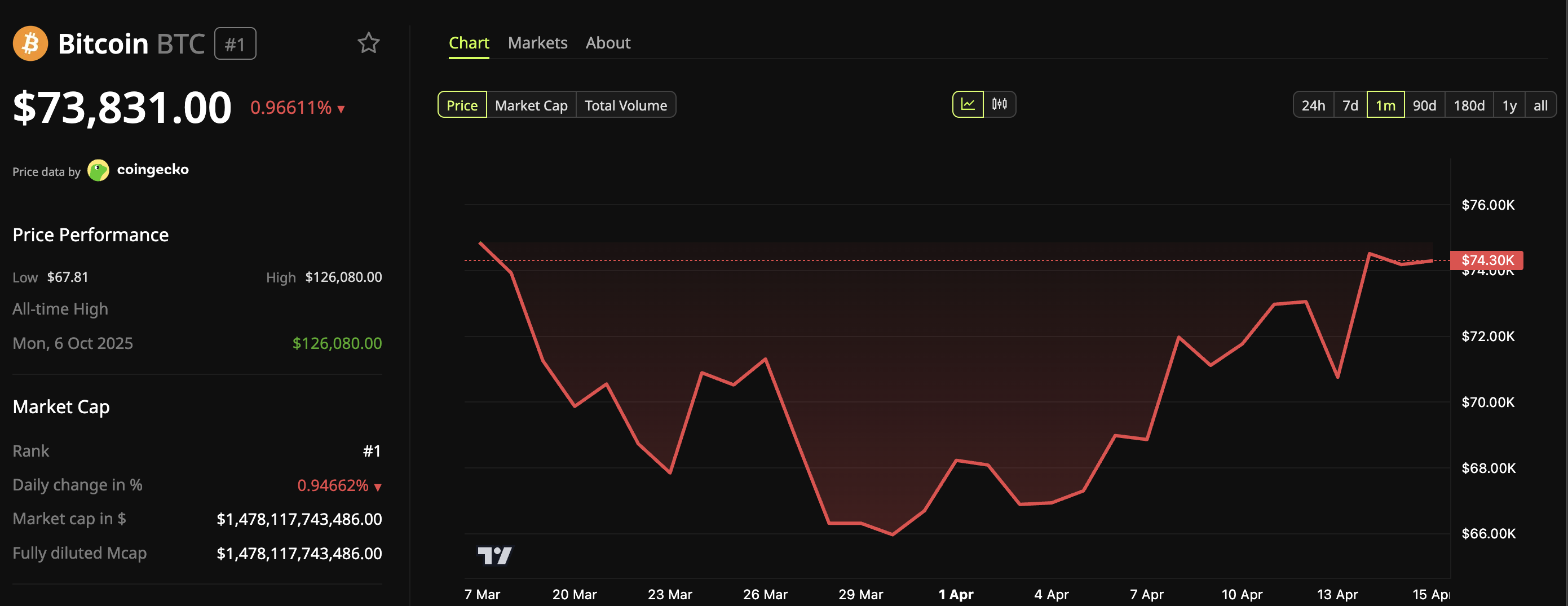
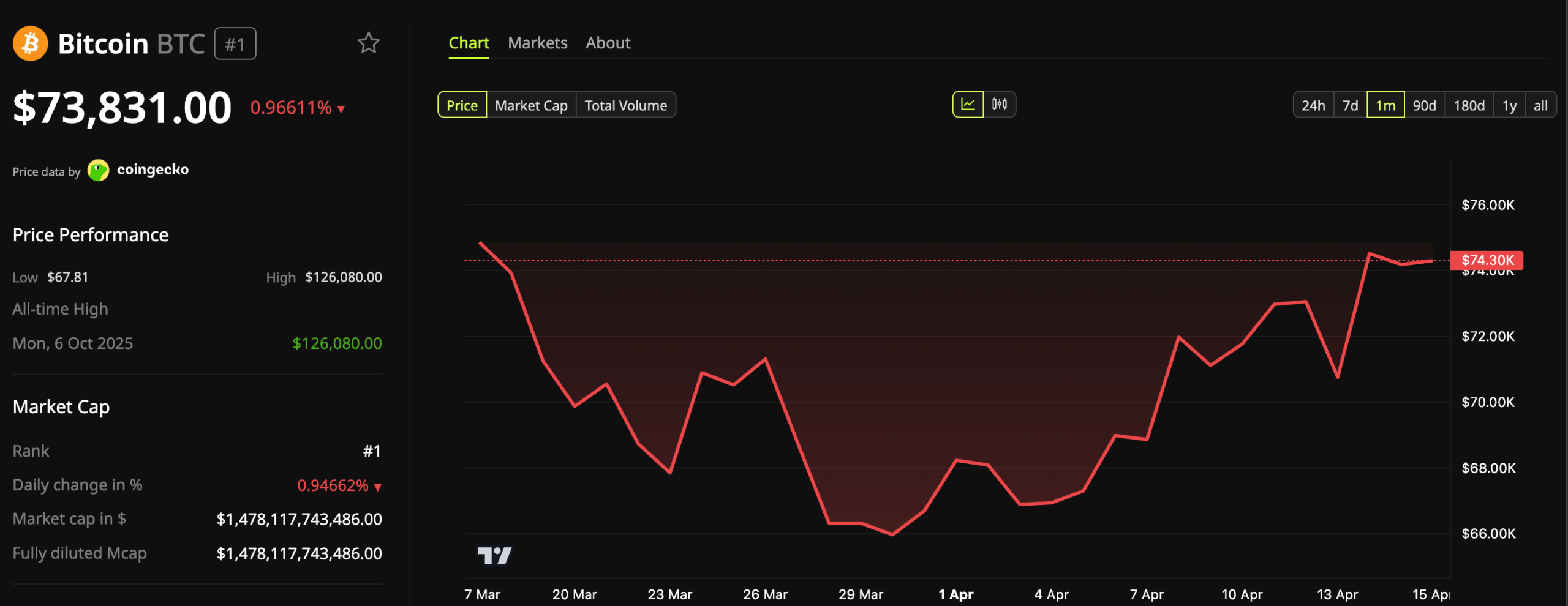
Overall, Cowen maintained his view that the four-year cycle remains intact. Bitcoin is currently trading at $73,831, still more than 40% below its October 2025 all-time high near $126,000. If Cowen’s analysis holds, further downside may still be ahead before the cycle finds its floor.
The post When Will Bitcoin Price Bottom Out? Benjamin Cowen Predicts appeared first on BeInCrypto.
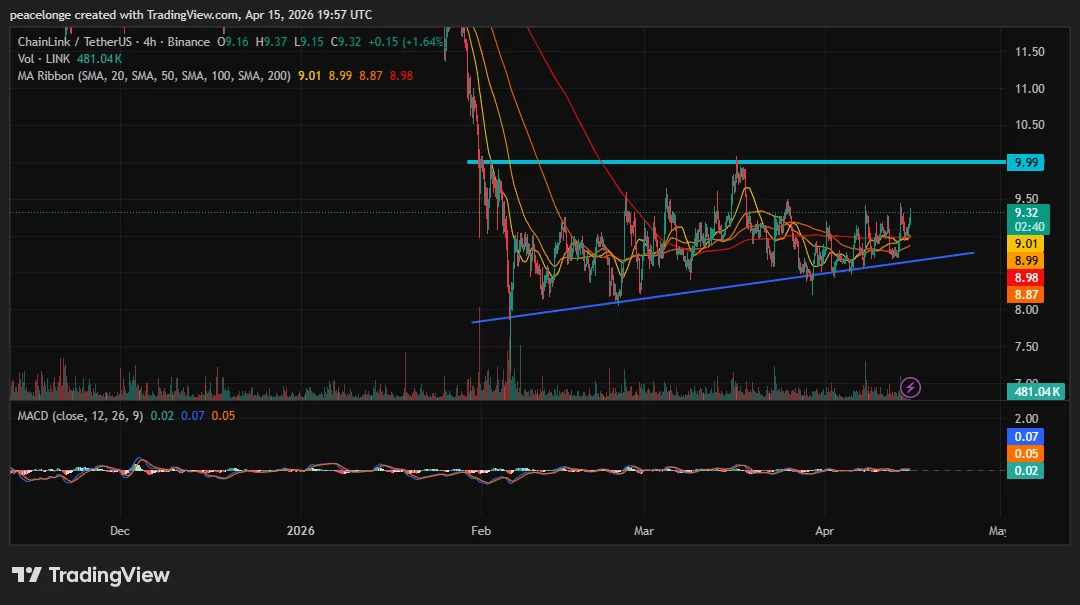
Chainlink price is at $9.32 on April 15, up 1.64% on the 4H session, after clearing all four SMAs simultaneously for the first time since the February decline, with the ribbon compressed into a $0.14 band before the breakout and the 4H MACD holding a positive crossover above the zero line.
Summary
- Chainlink price is at $9.32 on April 15, +1.64% on the 4H chart, after breaking above a compressed four-SMA ribbon where SMA 20 at $9.01, SMA 50 at $8.99, SMA 100 at $8.87, and SMA 200 at $8.98 all converged within a $0.14 range.
- The 4H MACD (12,26,9) has printed a bullish crossover with the histogram at +0.02, the MACD line at 0.07, and the signal at 0.05, with both lines above zero, confirming momentum acceleration rather than simple exhaustion reduction.
- A 4H close above the annotated $9.99 resistance confirms a breakout and opens the $10 to $11 zone; a return close below the SMA 20 at $9.01 signals the breakout has failed and extends the consolidation.
Chainlink (LINK) price is at $9.32 on April 15, up 1.64% on the 4H Binance chart, as price has broken above a fully compressed SMA ribbon consisting of SMA 20 at $9.01, SMA 50 at $8.99, SMA 100 at $8.87, and SMA 200 at $8.98. The four moving averages converged into a $0.14 range before the breakout, a degree of compression that is unusual across timeframes and typically precedes a significant directional expansion. The 4H volume of 481.04K LINK confirms active participation in the move rather than a lowvolume drift above the ribbon.
The breakout comes as an ascending trendline from the February 2026 lows continues to hold below, connecting successive higher lows across the recovery from the nearterm bottom. Price has been above this trendline throughout the current advance and the trendline has absorbed each pullback during April without a confirmed 4H close below it.
SMA ribbons compress when the rate of price change equalizes across multiple timeframes, producing a coillike structure where all moving averages converge toward a single price cluster. The compression in the Chainlink 4H ribbon, where four SMAs converged within $0.14 of each other, represents one of the tightest SMA clusters recorded for LINK in the current cycle. When price breaks above a fully compressed ribbon on volume, as Chainlink has done on April 15, the compression typically resolves into a directional expansion in the direction of the breakout.
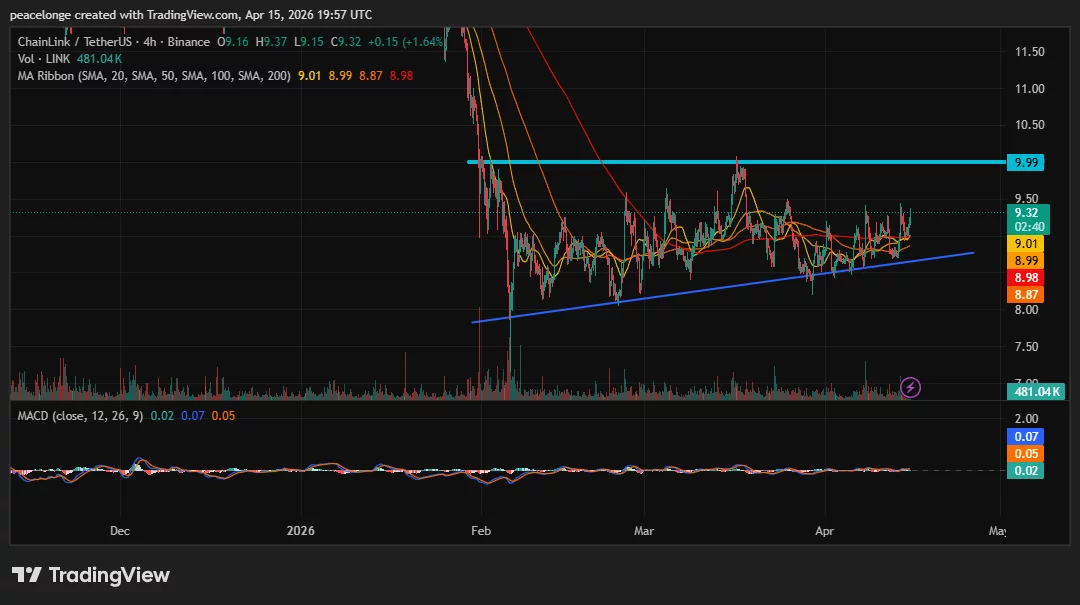
The 4H MACD (12,26,9) has confirmed a bullish crossover with the MACD line at 0.07 and signal at 0.05, both above zero. The histogram at +0.02 is positive and expanding. A MACD crossover that occurs with both lines above the zero line is a stronger signal than a subzero crossover, because it reflects genuine upward acceleration rather than a slowdown in selling pressure. Solana and XRP printed subzero MACD crossovers on April 14; the Chainlink 4H crossover occurring above zero distinguishes the quality of the current momentum signal.
Analysts at FXStreet noted on April 10 that Chainlink’s Open Interest-Weighted Funding Rate turned positive at 0.0042%, with traders building long positions as the token tested the SMA cluster. The positive funding rate maintained through a period of broader market uncertainty confirms the long bias in LINK derivatives has persisted through the consolidation and into the current breakout attempt.
Key Levels: Support, Resistance, and Price Targets
The compressed SMA cluster between $8.87 and $9.01 is now the support zone. A 4H close back below $9.01 returns price inside the ribbon and indicates the breakout has failed. A 4H close below $8.87, the SMA 100 and floor of the ribbon, is the full invalidation level and would shift the structure back to ranging.
The annotated horizontal resistance at $9.99 is the immediate target and the level that has capped multiple 4H rallies since February. A confirmed 4H close above $9.99 clears this ceiling and opens the $10 to $11 zone as the primary bull case target. An extended move through $11 brings the $12 area into focus, where the 200-day EMA on the daily chart sits.
Invalidation: a 4H close below $8.87.
On-Chain and Market Data Context
Coinglass data shows Chainlink open interest at $361.55 million, with 24-hour futures volume of $361.51 million. The near-equal ratio of open interest to daily futures volume indicates active position turnover rather than static exposure, suggesting traders are actively repositioning around the breakout level. Approximately $42,599 in Chainlink futures positions were liquidated in the past 24 hours, a small figure confirming the move is not driven by a short squeeze. A breakout built on genuine buying rather than forced short covering historically produces more durable price continuation.
Chainlink controls approximately 64% of the oracle market, with over $41 billion in total value secured and a $644 million buyback program supporting longterm token demand.
If LINK maintains 4H closes above the SMA ribbon cluster at $8.87 to $9.01 and the ascending trendline holds, a test of the $9.99 annotated resistance is the primary nearterm target. A confirmed close above it opens $10 to $11 as the extended bull case.

CoreWeave, a publicly traded AI cloud infrastructure provider, announced a $6 billion deal with quantitative trading firm Jane Street to power its trading and research operations with CoreWeave’s AI-focused cloud compute. In a separate move, Jane Street bought $1 billion worth of CoreWeave Class A common stock at $109 per share. The news lifted CoreWeave’s stock modestly, with shares trading around $119.04 after the announcement and up about 1.5% for the session, according to Yahoo Finance.
The agreement arrives just days after CoreWeave revealed a partnership with Anthropic to run Claude AI models on its infrastructure, underscoring the company’s rapid pivot from crypto mining to high-performance AI compute.
CoreWeave’s strategic shift, which has positioned the company as a leading player in what Bernstein researchers describe as the “neocloud” — GPU-powered cloud services tailored for AI workloads — highlights how miners and crypto-focused operators are repurposing assets to tap growing demand for AI computing power in a climate of tightening crypto margins.
Key takeaways
- Jane Street’s $6 billion AI cloud agreement with CoreWeave signals robust demand for GPU-accelerated compute in quantitative trading and research.
- The $1 billion equity investment at $109 per share cements a long-term alliance and injects strategic capital into CoreWeave’s expansion.
- Market reaction was modest but positive, with CoreWeave’s shares rising about 1.5% to the low-$120s range after the news.
- The Anthropic deal, announced a week earlier, reinforces CoreWeave’s role as a preferred compute backbone for leading AI developers powering large language models like Claude.
- Analysts at Bernstein describe CoreWeave as a standout in the neocloud space, supported by a diversified revenue base and prominent AI model providers already using its platform.
Jane Street’s AI compute pact: scale, scope, and implications
At the core of the announcement is a multi-year, multi-facility arrangement in which Jane Street will leverage CoreWeave’s data-center footprint to run its trading and research workloads. The announcement notes that compute will be sourced from several CoreWeave facilities, illustrating a broad deployment rather than a single-site reliance. While terms other than the $6 billion compute commitment remain undisclosed, the scale signals Jane Street’s intent to anchor its research and execution capabilities in a GPU-optimized cloud environment tailored to AI and data-intensive tasks.
The arrangement aligns with a broader industry trend where quantitative trading desks increasingly seek cloud-native, GPU-accelerated infrastructure to run complex simulations, backtests, and AI-driven research. CoreWeave has positioned itself as a fit-for-purpose provider in this space, differentiating itself from traditional cloud players by focusing on high-performance GPU workloads that underpin modern AI and ML models.
According to CoreWeave’s own disclosure, the collaboration will leverage the company’s emerging neocloud framework, which Bernstein describes as GPU-driven cloud services built specifically to power AI workloads. This is a key element in understanding why major AI and finance players are gravitating toward CoreWeave: the underlying compute is designed for the heavy lifting demanded by model training, inference, and data-intensive research tasks.
Equity investment deepens the alliance
In conjunction with the compute deal, Jane Street also expanded its stake in CoreWeave by purchasing $1 billion of Class A common stock at $109 per share. The combination of a sizable equity investment and a long-term compute agreement not only strengthens Jane Street’s access to CoreWeave’s hardware and software stack but also signals confidence in CoreWeave’s ability to scale its AI cloud offerings across diverse customer segments.
Market observers will watch how this equity infusion influences CoreWeave’s capital structure and growth trajectory as it accelerates its data-center expansion and product development efforts. The immediate stock move—while modest—reflects investor recognition of a potentially meaningful shift in CoreWeave’s revenue mix toward AI compute contracts alongside on-demand services.
AI compute and the neocloud thesis
CoreWeave’s pivot from crypto mining to AI cloud computing began years before many peers embraced AI-centric infrastructure. Analysts from Bernstein have highlighted CoreWeave’s ahead-of-the-curve positioning in the “neocloud” segment, a term they use to describe GPUs-based cloud providers optimized for AI workloads. The firm’s assessment suggests that CoreWeave has developed a high-quality commercial base relative to competitors such as IREN and Nebius, with a diversified mix of contract-based and on-demand revenue streams.
Among the evidence cited by Bernstein is CoreWeave’s widespread adoption among leading AI model providers. The company has stated that nine of the top 10 AI model developers now leverage its platform, reflecting deep engagement across the AI ecosystem. This broad footprint helps explain the market’s receptivity to the Jane Street deal and the Anthropic partnership, collectively reinforcing CoreWeave’s central role in the AI compute market.
The Anthropic collaboration, announced just days before the Jane Street deal, positioned Claude AI, Anthropic’s flagship model, to run on CoreWeave’s infrastructure. That partnership mirrors a broader industry pattern: AI developers are seeking dependable, scalable compute backbones capable of handling the demanding workloads of large-language models as they scale commercially.
For observers, these developments highlight a meaningful shift in the capital allocation and strategic priorities of AI infrastructure players. CoreWeave’s ability to translate early-mover advantages in the neocloud niche into multi-faceted revenue streams — including long-term compute commitments and equity stakes from major customers — could help it navigate a competitive landscape that features both traditional cloud giants and specialized GPU-focused operators.
From crypto mining to AI compute: what changes, what remains uncertain
CoreWeave’s transformation reflects a broader trend in which crypto-mining infrastructure operators repurpose assets to support high-performance computing and AI workloads. The company’s narrative has shifted from crypto mining to AI compute leadership, a move that appears to be gaining traction given the scale of the deals and the caliber of customers joining its ecosystem. Earlier reporting in the industry has highlighted this transition as a strategic hedge against crypto market volatility and shrinking margins.
Industry observers have pointed to CoreWeave’s long-standing emphasis on GPU-accelerated workloads as a differentiator, positioning it to capture a growing share of enterprise AI compute demand. Bernstein’s analysis suggests that CoreWeave’s commercial machine stands out among neocloud peers, a dynamic that could sustain growth as AI adoption accelerates across finance, tech, and enterprise segments. Still, several uncertainties linger: how deeply CoreWeave’s reliance on marquee clients extends, how competition evolves among GPU-centric cloud providers, and how macro shifts in AI model licensing and deployment affect long-term demand for dedicated AI compute capacity.
For investors and builders, the key takeaway is that CoreWeave’s dual-track strategy — large-scale compute agreements with premier trading firms and strategic equity partnerships with those same customers — could yield a more resilient revenue base. The company’s continued expansion of data-center capacity, its ability to attract top AI developers, and its execution in the neocloud niche will be critical to watch as AI workloads continue to escalate in scale and sophistication.
What to watch next
Market participants will be watching how CoreWeave scales its data-center footprint to accommodate increasing demand from both financial services and AI developers. The pace of expansion, the retention of high-profile customers, and the company’s ability to maintain favorable terms across long-duration compute contracts will be important indicators of its trajectory. Additionally, any further partnerships in the AI space and potential updates on the rollout of Claude and other models on CoreWeave’s infrastructure will help clarify how the neocloud thesis plays out in practice. Investors should monitor regulatory developments around AI compute, potential shifts in cloud pricing, and how CoreWeave’s balance sheet evolves as it funds growth through both debt and equity financings.


Two suspects were arrested in San Francisco after allegedly firing at OpenAI CEO Sam Altman’s home early Sunday morning, the second attack on the property in three days, as federal and local prosecutors escalate charges against a separate suspect from an earlier Molotov cocktail incident.
Summary
- Amanda Tom, 25, and Muhamad Tarik Hussein, 23, were arrested April 13 after a Honda sedan stopped outside Altman’s North Beach property and a round was allegedly fired from the passenger window.
- Days earlier, 20-year-old Daniel Moreno-Gama was charged with attempted murder after throwing a lit incendiary device at Altman’s home before moving on to threaten to burn down OpenAI’s headquarters.
- Moreno-Gama was carrying a three-part manifesto detailing anti-AI beliefs and listing names and addresses of AI executives, board members, and investors.
OpenAI CEO Sam Altman’s San Francisco home was targeted for a second time in three days on April 13, when a Honda sedan carrying two people stopped outside the property on Lombard Street and a shot was allegedly fired from the passenger window. The San Francisco Police Department arrested Amanda Tom, 25, and Muhamad Tarik Hussein, 23, who were booked on charges of negligent discharge of a firearm. Three firearms were seized from their home following a warrant.
No injuries were reported in either incident.
The first attack occurred in the early hours of April 10, when 20-year-old Daniel Moreno-Gama, a Texas resident, allegedly threw a lit Molotov cocktail at the driveway gate of Altman’s home, setting it on fire. He then walked to OpenAI’s Mission Bay headquarters and struck the glass doors with a chair while threatening to “burn it down and kill anyone inside.” He was arrested at the scene.
The FBI described the first attack as “planned, targeted and extremely serious.” Federal and local prosecutors charged Moreno-Gama with attempted murder of both Altman and his security guard, attempted arson, possession of an unregistered firearm, and attempted destruction of property by means of explosives. The US Attorney for the Northern District of California said domestic terrorism charges may also follow.
Who Was Behind the First Attack
Moreno-Gama was found carrying a document that detailed his opposition to artificial intelligence and explicitly named Altman as a target. The manifesto stated his belief that AI posed a risk of human extinction and listed the names and addresses of multiple AI executives, board members, and investors. He had reportedly published similar views on a personal Substack prior to the attack.
His public defender said he appeared to have experienced an “acute mental health crisis.” Altman posted a photo of his family on his blog shortly after the first attack, writing that he “underestimated the power of words and narratives” and calling for de-escalation of AI-related rhetoric.
The Broader Pattern of Anti-AI Violence
The two incidents at Altman’s home are part of a wider pattern of hostility toward AI infrastructure. A city councilman in Indianapolis was shot at 13 times after voicing support for a data center project. A town near St. Louis voted out its entire incumbent council after approving a data center. Experts have drawn parallels to the Luddite backlash of the Second Industrial Revolution.
The attacks come as OpenAI sits at the center of a high-stakes race in enterprise AI, where it has been losing ground to Anthropic across key corporate accounts, while simultaneously finalizing an AI cybersecurity product for limited partner release. The company is valued at over $850 billion and is targeting an IPO this year.
“There is no place in our democracy for violence against anyone, regardless of the AI lab they work at or side of the debate they belong to,” OpenAI said in a statement following the first attack.

TLDR
- Bitdeer increased its self-mining hashrate to 70 EH/s in March 2026 and led peers by computing power.
- Bitdeer produced 661 self-mined bitcoins in March, marking a 480% increase from the previous year.
- The company expanded its total hashrate under management to 78.1 EH/s by the end of March.
- Bitdeer controls about 225,000 self-owned mining rigs out of 262,000 machines under management.
- The firm is scaling toward 3.0 gigawatts of global energy capacity across active and planned sites.
Bitdeer expanded its self-mining capacity to 70 EH/s in March 2026 and led global peers by compute power. The company produced 661 self-mined bitcoins during the month, marking a 480% increase year over year. It also increased total hashrate under management to 78.1 EH/s, while advancing its AI infrastructure business.
Bitdeer Expands Fleet and Energy Capacity
Bitdeer reported 661 self-mined bitcoins in March 2026, up 480% from last year. The company raised its self-mining hashrate to 70 EH/s during the month. It stated that this level made it the largest miner by computer power.
Earlier, Bitdeer reported 71 EH/s in total hashrate under management at year-end. At that time, its self-mining capacity stood at 55.2 EH/s. Now, the total managed hashrate has increased to 78.1 EH/s, including hosted machines.
The firm controls about 225,000 self-owned rigs out of 262,000 machines under management. It also continues expanding toward 3.0 gigawatts of global energy capacity. This figure includes both active operations and projects in the pipeline.
The global Bitcoin hashrate stands at about 855 EH/s, according to The Block data. Although the network recorded a quarterly decline, capacity remains elevated compared to past levels. Bitdeer increased deployed power even as network conditions shifted.
The company also advanced its AI Cloud operations during March. It reported AI Cloud utilization of 94%, up from 64% in February. Annual run rate for AI Cloud reached about $43 million, rising 105% month over month.
Matt Kong, Chief Business Officer, addressed the update. He said, “This momentum underscores both the scale of the market opportunity and our ability to execute effectively.” The company confirmed continued deployment of high-performance AI infrastructure.
Bitdeer continues introducing new mining hardware into its fleet. It finalized assembly plans for the SEALMINER A4 series, which reports efficiencies near 9.45 J/T. In February, it launched the SEALMINER DL1 Air series for Scrypt-based networks.
CleanSpark and Canaan Report March Output
CleanSpark produced 658 bitcoins in March and raised its year-to-date total to 1,799 BTC. The company reported an operating hashrate of 50 EH/s at month-end. It also recorded an average operating hashrate of 47.3 EH/s.
The firm deployed 224,473 mining machines across its portfolio. Its fleet achieved a peak efficiency of 16.07 J/Th. Management stated that the average monthly hashrate increased by 11% during the quarter.
CleanSpark controls more than 1.8 gigawatts of power, land, and data centers in the United States. Of that total, it currently utilizes 808 megawatts. CEO Matt Schultz confirmed expansion efforts into AI and high-performance computing.
He said the company is making “headway toward securing our first hyperscale customer.” The firm continues discussions with potential AI infrastructure clients. It maintains focus on both mining output and data center utilization.
Canaan reported production of 89 BTC in March. Its crypto holdings reached 1,808 BTC and 3,952 ETH at month-end. The company deployed 10.97 EH/s, excluding 4.4 EH/s from a joint venture.
Canaan purchased Cipher Mining’s 49% equity interest in three West Texas facilities in February. Its global installed power capacity reached 266.3 megawatts. Joint ventures contributed another 120 megawatts to total capacity.
CEO Nangeng Zhang commented on the update. He said, “We continued to grow our deployed hashrate and installed power capacity.” The company added over 10 megawatts during March.

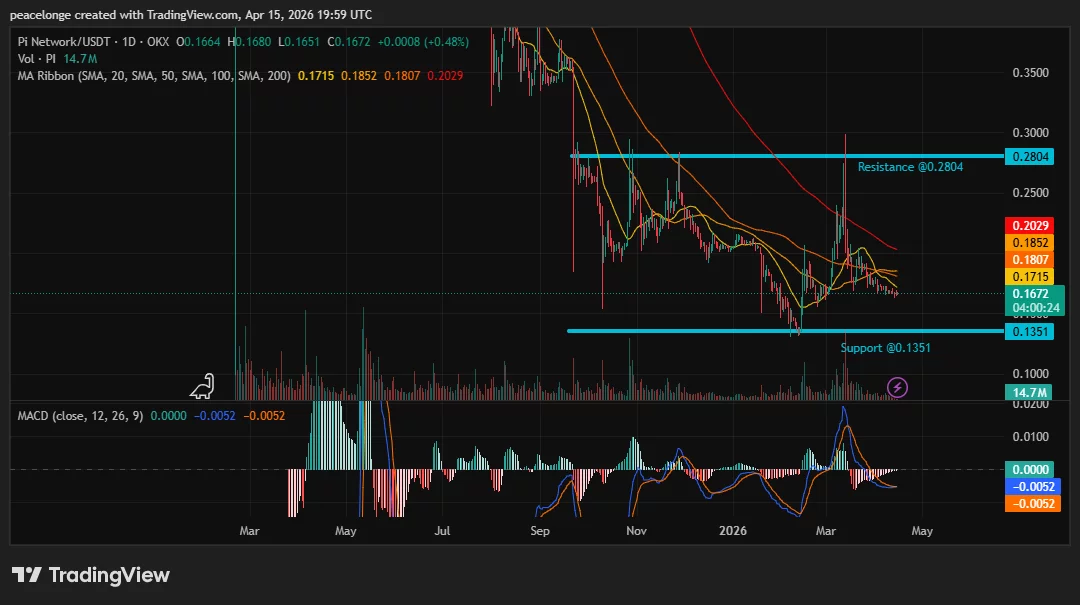
Pi Network price is trading at $0.1672 on April 15, with the daily MACD histogram printing at exactly 0.0000 for the first time since the February all-time low, raising the question of whether the extended bearish phase that carried price from the $2.99 peak to the $0.1351 floor is finally losing its downward force.
Summary
- Pi Network price is at $0.1672, +0.48%, on April 15, as the daily MACD histogram reads 0.0000 for the first time since the $0.1351 all-time low on Feb. 11, marking the first pause in bearish momentum expansion during the current downleg.
- The daily SMA ribbon remains fully bearish with all four moving averages stacked above price: SMA 20 at $0.1715, SMA 50 at $0.1852, SMA 100 at $0.1807, and SMA 200 at $0.2029.
- A daily close above the SMA 20 at $0.1715 is the first recovery signal and opens $0.20 as the nearterm target; the annotated resistance at $0.2804 is the extended objective, while a daily close below $0.1351 invalidates the support thesis entirely.
Pi Network (PI) price is at $0.1672 on April 15, up 0.48% on the session, as the daily chart posts the first MACD histogram reading of exactly 0.0000 since the Feb. 11 all-time low at $0.1351. The flattening of the histogram at zero does not confirm a reversal on its own, but it marks the first session since the all-time low where the force of the downtrend has mathematically paused, occurring as price stabilizes directly above the annotated structural floor. The 24-hour volume stands at 14.7M PI, reflecting the consolidation conditions that have held since the bounce off the all-time low.
The full SMA ribbon remains bearish. SMA 20 at $0.1715, SMA 50 at $0.1852, SMA 100 at $0.1807, and SMA 200 at $0.2029 form sequential overhead resistance. None of the four averages have been reclaimed on a daily close since price broke below them in the fourth quarter of 2025. The key variable now is whether the MACD histogram moves from zero into positive territory, which would signal that momentum has shifted from deceleration to acceleration in the bull direction.
The MACD (12,26,9) on the Pi Network daily chart has printed a histogram reading of 0.0000 on April 15, with the MACD line at -0.0052 and the signal at -0.0052. Both lines remain below zero, confirming the macro trend is still bearish. The histogram reaching zero from below means the gap between the MACD and signal lines has collapsed to nothing, a necessary precondition before any bullish crossover can occur. In prior PI trading cycles, histogram readings approaching zero from the negative side have preceded short-term recoveries toward the nearest SMA resistance level.
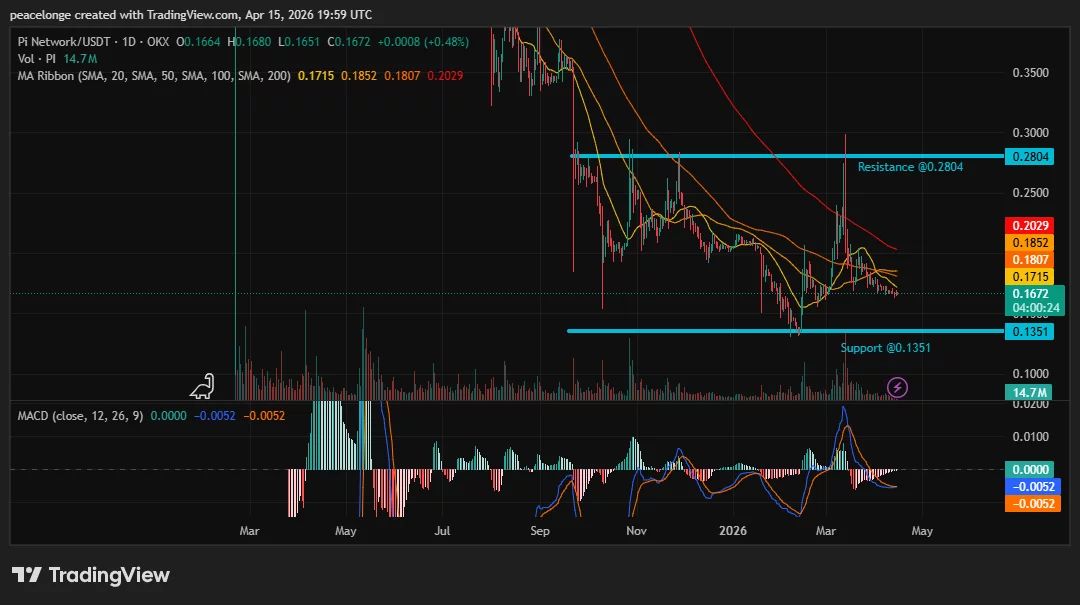
The signal arrives at the most structurally significant level on the chart. The $0.1351 all-time low, set on Feb. 11, 2026, is the annotated support floor on the daily chart. It has held without a daily close below it since that date. Price bouncing repeatedly from this level while the MACD contracts toward zero describes the conditions for a potential base-building setup, conditional on the SMA 20 being reclaimed.
Pi Network completed its mainnet upgrade to Protocol v21 on April 14, introducing performance enhancements as the foundational step toward smart contract support via Protocol v23.0, scheduled for May 18. The v22.1 node upgrade deadline falls on April 22, the next milestone on the road to that smart contract launch.
Key Levels: Support, Resistance, and Price Targets
The $0.1351 all-time low is the structural floor. A daily close below it has not occurred since Feb. 11 and would expose uncharted territory with no prior chart reference below that level.
On the upside, the SMA 20 at $0.1715 is the immediate resistance and the first level a recovery must clear. A daily close above $0.1715 opens $0.20, which has capped multiple recovery attempts in 2026. The annotated horizontal resistance at $0.2804 is the extended bull case target if $0.20 is cleared and held on a daily close. The SMA 50 at $0.1852 sits between $0.1715 and $0.2804 and represents the midpoint resistance in any recovery sequence.
Invalidation: a daily close below $0.1351.
On-Chain and Market Data Context
Approximately 230 million PI tokens are scheduled to unlock over the next 30 days, adding consistent sell pressure to any technical recovery attempt. A single whale address has accumulated approximately 350 million PI, becoming the network’s sixth-largest holder, a signal of conviction accumulation at structural support even as the unlock schedule weighs on spot price.
Analyst @kwalaintel (40.2K followers on X) flagged that Pi faces “a major structural headwind” from daily token unlocks, identifying the supply and demand tension as the key variable that technical patterns alone cannot resolve. If the MACD histogram moves from zero into positive territory on a daily close, the SMA 20 at $0.1715 becomes the primary nearterm target, with $0.20 as the level that would confirm a sustained recovery attempt is underway.
TLDR
- Rakuten Wallet confirmed it will list Shiba Inu and support trading against the Japanese yen.
- The platform will allow users to buy Shiba Inu using Rakuten Points and Rakuten Cash.
- Shiba Inu will connect to more than five million merchant locations through Rakuten Pay.
- Rakuten Pay currently serves about 44 million users across Japan.
- Rakuten Wallet postponed the April 15 launch date and will announce a new schedule soon.
Shiba Inu (SHIB) is entering Japan’s retail payment space through Rakuten Wallet’s upcoming platform expansion. The company confirmed it will list the token and connect it to its payment network. However, the rollout has faced a delay, and Rakuten will confirm a new date.
Shiba Inu Listing Expands Access Across Rakuten Ecosystem
Rakuten Wallet announced it will list Shiba Inu alongside XRP and XLM. The exchange will enable SHIB trading against the Japanese yen. It will also integrate SHIB into Rakuten’s payment infrastructure.
The company stated that users can purchase SHIB with Rakuten Points and Rakuten Cash. This feature links the token to more than five million merchant locations nationwide. As a result, SHIB will function within Rakuten Pay’s retail system.
Rakuten Pay currently serves about 44 million registered users across Japan. Therefore, the listing will expose Shiba Inu to a broad consumer base. Shibizens, a Shiba Inu-focused X account, said the move marks “a direct entry into daily payments.”
Reports indicate that over $23 billion worth of Rakuten Points circulate within the loyalty network. Users will now earn and spend SHIB through this points ecosystem. Consequently, Rakuten connects digital assets with its established rewards infrastructure.
Market Reaction and XRP, XLM Pairings Confirmed
Rakuten Wallet confirmed that it will list XRP and XLM with SHIB. The platform plans to support trading pairs denominated in Japanese yen. However, the company postponed the initial April 15 launch date.
A community member known as Kuro shared the update on social media. Kuro stated that Rakuten Wallet will publish the revised schedule on its official website. Therefore, users must wait for confirmation before trading begins.
Ahead of the planned listing, Shiba Inu reached $0.000006 on April 14. At press time, SHIB traded at $0.0000005834, down 0.02% in 24 hours. The token also recorded a 2.42% weekly decline.
Despite the short-term dip, SHIB price trades above its 50-day moving average of $0.00000584. Analysts identified the $0.000006 to $0.0000062 range as immediate resistance. Price action near this zone reflects limited upward momentum.
Rakuten Wallet stated that it will announce the new listing date soon. Until then, SHIB remains available on other exchanges but awaits activation on Rakuten’s platform. The company will publish further updates through its official channels.


A conservative U.S. political action committee backed by the Solana Policy Institute — the Sentinel Action Fund — has committed to a massive advertising spend on the political opponent of former Senator Sherrod Brown, a Democrat and prominent crypto skeptic who is trying to return to Washington in this year’s Ohio Senate election.
Sentinel and its affiliated nonprofit, Right Vote, committed $8 million to Jon Husted, the Republican named to fill Vice President JD Vance’s seat, according to a Wednesday statement. The committee accused his opponent, Brown, who had been the chairman of the Senate Banking Committee prior to losing his seat in 2024, of having “stood in the way of pro-innovation policies when it comes to digital assets.”
The super PAC is partially funded by the Solana Institute and crypto venture firm Multicoin Capital, in addition to several high-profile financial figures such as Blackstone CEO Stephen Schwarzman, Ken Fisher of Fisher Investments, AQR Capital Management co-founder Cliff Asness and Paul Singer, the billionaire co-CEO of hedge fund Elliott Management who has a stake in Michael Saylor’s bitcoin behemoth, Strategy.
The leading donor to the PAC, though, is a nonprofit, Townsend Six Corp., which was established in late 2024 and backed by an $8 million contribution from an unidentified donor.
The Ohio election will be among the hotly contested Senate battles that decide the majority of that chamber for next year. While the lineup of open seats had been a difficult one for Democrats, the slip in Republican popularity during the administration of President Donald Trump has given Democrats a chance to retake that majority.
While polling last year had indicated that Husted had a strong lead over Brown, more recent polls have shown the race going neck and neck.
Sentinel joins the crypto industry’s leading PAC, Fairshake, and this month’s newly emerging Fellowship PAC, as entities supporting pro-digital assets candidates. When Brown was defeated in the 2024 elections, Fairshake had devoted $40 million to his opponent.
The Solana Policy Institute donated a total of $750,000 to the Sentinel Action Fund. The group, however, has split its party allegiances in its campaign spending. It gave $2 million to Republican congressional PACs and $1.5 million to Democratic PACs with opposing aims, according to Federal Election Commission records.
If Democrats win the Senate, House of Representatives or both, it could shift the course of crypto legislation, though the industry has amassed significant bipartisan support in Congress and is likely to add more names in the November midterm elections.

DeXe Joins the Altcoin Rally, Price Hits Nearly 1-Year High

Boston Dynamics’ Robot Dog Can Now Read Gauges, Spot Spills, and Reason

Arsenal: Mikel Arteta wanted fire but Gunners limp to semis – does style matter?


-

 Politics5 days ago
US brings back mandatory military draft registration
-
 Sports5 days ago
Man United discover Nico Schlotterbeck transfer fee as defender reaches Dortmund agreement
-

 Fashion5 days ago
Weekend Open Thread: Veronica Beard
-

 Politics6 days ago
Malcolm In The Middle OG Turned Down ‘Buckets Of Money’ To Appear In Reboot
-

 Politics3 days ago
World Cup exit makes Italy enter crisis mode
-

 Crypto World6 days ago
Canary Capital Files SEC Registration for PEPE ETF
-

 Business5 days ago
Tesla Model Y Tops China Auto Sales in March 2026 With 39,827 Registrations, Beating Cheaper EVs and Gas Cars
-

 Crypto World2 days ago
The SEC Conditionalises DeFi Platforms to Be Avoided for Broker Registration
-

 Crypto World2 days ago
SEC Signals Exemption for Crypto Interfaces From Broker Registration
-

 News Videos16 hours ago
Secure crypto trading starts with an FIU-registered
-
 NewsBeat3 days ago
Pep Guardiola and Gary Neville agree over Arsenal title problem that benefits Man City
-

 Business6 days ago
OpenAI Halts Stargate UK Data Centre Project Over Energy Costs and Copyright Row
-

 Business4 days ago
Ireland Fuel Protests Enter Day 5 as Blockades Spark Shortages and Government Prepares Support Package
-

 Politics6 days ago
LBC Presenter Mocks Trump Over Iran War Failures
-

 Crypto World5 days ago
Federal judge blocks Arizona from bringing criminal charges against Kalshi
-
 NewsBeat4 days ago
JD Vance announces ‘no agreement’ with Iran over nuclear weapons fear
-

 Crypto World2 days ago
SEC Proposes Certain Crypto Interfaces Don’t Need to Register as Brokers
-

 NewsBeat2 days ago
Trump and Pope Leo: Behind their disagreement over Iran war
-

 Tech6 days ago
A version of Windows 10 released a decade ago is now eligible for additional security patches
-

 Business5 days ago
IMF retains floor for precautionary balances at SDR 20 billion
You must be logged in to post a comment Login