
Crypto World
KelpDAO sues LayerZero and CEO over $292M rsETH bridge exploit


KelpDAO filed a lawsuit against LayerZero and its co-founder, blaming the universal bridge protocol for the largest exploit of this year, which drained $292 million and triggered one of the largest DeFi runs in crypto history, according to a post on X on Thursday.
“The exploit was a direct result of LayerZero’s failures, including a failure to disclose weaknesses and risks inherent in LayerZero’s own technology,” KelpDAO said.
KelpDAO, a decentralized liquid staking protocol on Ethereum, also accused LayerZero of failing to prevent infiltration of its security infrastructure, claiming that this allowed attackers to exploit the universal bridge’s alleged weaknesses.
“Rather than take responsibility, over the last few months, LayerZero and Mr. Pellegrino publicly blamed us for their failures,” KelpDAO said.
Pellegrino immediately responded that he would see them in a Canadian court.
“Evercrest (KelpDAO) filed a notice of civil claim today in BC (British Columbia, Canada) against myself and LZ (LayerZero),” Pellegrino said. “The claim continues to be meritless. I will meet them in Vancouver and defend myself accordingly.”

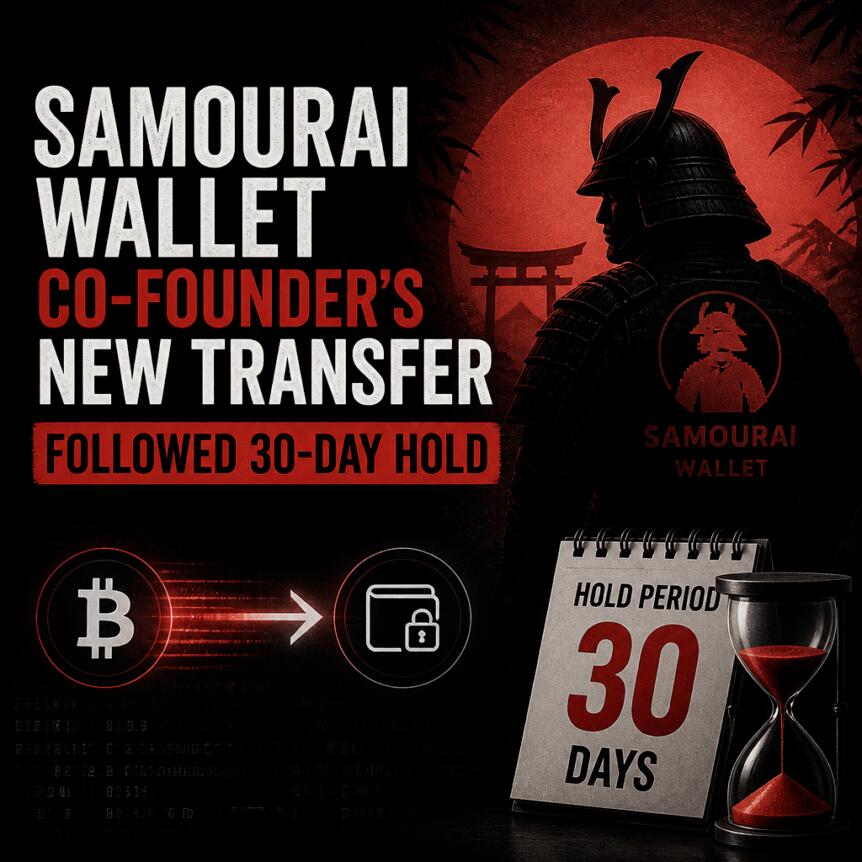
Samourai Wallet co-founder Keonne Rodriguez says he is facing yet another prison transfer after a drug treatment program at FCI McKean was deactivated, threatening the availability of the rehabilitation program he had been counting on to potentially shorten his sentence.
Rodriguez, who is serving a five-year federal term following a guilty plea tied to an alleged unlicensed money-transmitting business, said on X that McKean’s warden told program participants that Rodriguez and roughly 70 others would be moved to institutions where treatment would still be available. He entered the program because completing it could reduce his sentence by up to a year.
Key takeaways
- Keonne Rodriguez says FCI McKean shut down the drug treatment program he relied on for possible sentence reduction.
- Rodriguez claims McKean officials told program participants—him and about 70 others—that they would be transferred to facilities where treatment remains available.
- The transfer risk comes alongside broader U.S. legislative efforts to clarify whether non-custodial crypto developers should be treated as financial intermediaries.
- Congressional momentum for the CLARITY Act has stalled recently after a failed Senate effort to advance the bill.
Rehabilitation disruption at FCI McKean
Rodriguez said the most recent setback began when the program at FCI McKean was deactivated. He wrote that McKean’s warden informed the group that he and dozens of other participants would be moved to different federal facilities where treatment is still offered.
According to Rodriguez, his decision to enter the program was driven by the potential sentencing benefit: completing the treatment could, he said, reduce his term by as much as a year. With the program turned off at McKean, the practical question for him is whether the next facility will keep the promised pathway to sentence reduction within reach.
Earlier, Rodriguez described the movement between prisons as far more punishing than the distance might suggest. In a letter published by The Rage, he called the transition from FPC Morgantown to McKean the “absolute worst 30 days” of his life and said his request to make the roughly four-hour trip himself was denied.
From Morgantown to a “federal transfer” flow
Rodriguez’s account depicts a system built around transfers rather than continuity of routine. He said inmates leaving Morgantown were placed in ankle shackles and handcuffs attached to waist chains. He then described being taken by bus to an airport and flown to the Federal Transfer Center in Oklahoma City.
At the Federal Transfer Center, Rodriguez said he was housed with prisoners from different security classifications and spent much of his time locked in a cell. He described the experience in stark, prison-era language, saying he wondered whether “all the circles of hell” were contained within the federal transfer facility.
He also said that eventually he was assigned a cell with an inmate serving a murder sentence and that he was given only part of a foam mattress. Rodriguez stated that the setup left part of his body resting on a metal bunk overnight.
Rodriguez later faced another major procedural milestone: he is serving time after pleading guilty in a case involving Samourai Wallet’s operations. The U.S. Department of Justice said in a release that Rodriguez and co-founder William Lonergan Hill transmitted more than $237 million in criminal proceeds through the service.
Sentencing context and what Rodriguez claims is at stake
Rodriguez is currently serving a five-year sentence, and he has been vocal about conditions and the operational uncertainty that comes with prison transfers. The new claim about McKean’s treatment program matters because it directly affects whether he can stay enrolled in a structured course that, he says, could reduce his sentence.
His account also underscores a broader reality for incarcerated people: even when rehabilitation is available at one facility, a change in programming can force a relocation—sometimes on short notice—where eligibility and access may differ.
Rodriguez’s statements also echo a theme that has repeatedly appeared in federal criminal cases involving crypto: the practical consequences of how a defendant’s sentence interacts with institutional rules, program availability, and transfer logistics.
Legislative backdrop: developer protections still unresolved
The prison news arrives while lawmakers continue wrestling with how U.S. rules apply to crypto developers, particularly in situations where developers do not control users’ assets.
According to a recent report on the CLARITY Act, the latest Senate draft retained provisions intended to protect non-controlling developers from certain money-transmission requirements under the Bank Secrecy Act. However, the legislative effort has not advanced smoothly: Cointelegraph reported that the Senate failed to advance the CLARITY Act on Sept. 15 after a procedural vote fell short of the 60 votes needed to move the legislation forward.
That contrast—ongoing legal uncertainty for developers in Washington alongside Rodriguez’s real-world account of how institutions can change course—highlights a persistent issue for the industry: while policy debates continue, compliance expectations remain uneven, and the consequences can extend well beyond code and into enforcement and sentencing.
The CLARITY Act’s stalled progress means that questions about regulatory treatment—especially around whether certain developer behaviors could be interpreted as financial intermediation—remain unresolved for the moment. Even if the bill’s drafting language includes protective measures, the key uncertainty for builders and users is whether legislation will actually move, and how any final framework would be applied.
For Rodriguez, the immediate thing to watch is whether his next facility preserves access to the treatment program he says could reduce his sentence. More broadly, industry readers should monitor how the CLARITY Act debate evolves in the Senate, because the outcome will shape how investors, developers, and compliance teams plan for what the law requires.


Key takeaways
- Uniswap retreated after climbing to an intraweek high of approximately $10.95.
- UNI’s weekly RSI has entered overbought territory at around 73.
- A correction could target $7.83, while losing that support may expose $6.91.
Uniswap (UNI) could decline toward $7.80 over the coming weeks after its latest rally lost momentum near a major resistance area.
An overbought weekly Relative Strength Index (RSI), a rejection below the $11.51 Fibonacci level and a concentration of leveraged long positions below the market all point to an elevated risk of a correction.
UNI traded near $9.11 on September 25 after reaching an intraweek high of roughly $10.95. Although its longer-term technical structure has improved, the token may need to cool further before attempting another sustained advance.
UNI Rally Loses Momentum Below $11.50
Uniswap’s recent rebound brought the price close to the 0.786 Fibonacci retracement level at approximately $11.51. That area represented an important upside target following UNI’s breakout above a long-term descending resistance trendline.
However, the token failed to reach or break the level convincingly. Sellers emerged around $10.95, pushing the price back toward $9.11 and leaving a substantial upper wick on the developing weekly candle.
A long upper wick typically signals that buyers drove the price higher during the period but could not hold those gains. While this pattern does not guarantee a reversal, it indicates that selling pressure has increased near the recent high.
The rejection is especially relevant because it occurred close to major Fibonacci resistance. Unless UNI can reclaim the $10.95-$11.51 region, traders may treat the latest move as an unsuccessful breakout attempt rather than the beginning of another sustained rally.
Overbought RSI raises correction risk
Momentum indicators also suggest that Uniswap’s advance may be becoming stretched. UNI’s weekly RSI has risen to around 73, placing it above the traditional overbought threshold of 70.
An overbought RSI does not automatically mean that a sell-off is imminent. During strong trends, cryptocurrencies can remain overbought for extended periods while prices continue rising. Nevertheless, UNI’s previous sharp weekly rallies have frequently been followed by consolidation or multi-week corrections as traders lock in profits.
The combination of an elevated RSI, resistance near $11.51, and the recent upper wick strengthens the possibility of a short-term pullback.
The first major technical target on the downside is the 200-week exponential moving average at approximately $7.83. A decline from $9.21 to that level would represent a correction of about 15%.
If buyers defend the $7.80-$7.85 area, UNI could establish a higher low and prepare for another attempt at $11.50. Losing that support, however, would expose the 100-week EMA near $6.91.
Despite these near-term risks, Uniswap’s broader chart remains healthier than it was earlier in the year. UNI is still trading above several important weekly moving averages and has broken through a long-term descending resistance line. A pullback to $7.83 could therefore function as a retest of support rather than the start of a larger bearish reversal.
Derivatives positioning creates an additional source of downside pressure. CoinGlass data shows a significant cluster of leveraged long positions around $8.87 on Binance’s UNI/USDT market.
Approximately $5.16 million in liquidation leverage is concentrated near that price. If UNI falls toward $8.87, the move could expose an estimated $10.35 million in cumulative long liquidations.
When a leveraged long position is liquidated, the exchange closes it automatically by selling the underlying exposure. If many positions are forced to close in a short period, that selling can accelerate the decline and trigger further liquidations at lower prices.
This dynamic makes $8.87 a potential liquidity magnet. A modest pullback toward that level could develop into a sharper move if forced selling overwhelms available demand.
The liquidation heatmap also identifies short-position liquidity above the current market, meaning that an unexpected rally could still generate a short squeeze. However, the larger concentration of vulnerable longs immediately below the price makes the downside risk more pressing in the near term.

Can UNI recover toward $11.50?
Uniswap’s next move may depend on whether buyers can protect the $8.87 liquidity zone and the stronger technical support around $7.83.
A successful defense of these levels would preserve the improving weekly structure and leave UNI positioned for another test of $11.50. A decisive weekly close above that resistance would weaken the correction scenario and could open the door to higher targets.
Conversely, a liquidation-driven decline below $8.87 would increase the probability of a move toward the 200-week EMA at $7.83. If that floor also breaks, the 100-week EMA near $6.91 would become the next significant downside level.
For now, UNI’s longer-term recovery remains intact, but overbought momentum and crowded leveraged positioning suggest that volatility—and potentially a 15% correction—could come first.

According to Bloomberg, the Trump administration is weighing an initiative aimed at encouraging the use of dollar-backed stablecoins outside the United States, framing the push as a way to strengthen the dollar’s role as the world’s reserve currency.
The report, citing people familiar with the plans, says the US government could support stablecoin projects by partnering through joint ventures with private-sector firms. The effort could involve multiple agencies, including the Treasury Department, the State Department, and the US International Development Finance Corporation (DFC). Bloomberg reported the details on Wednesday.
Key takeaways
- Bloomberg reports a potential US government initiative to promote overseas adoption of dollar-backed stablecoins.
- The proposed approach would reportedly rely on joint ventures with private-sector firms, potentially involving multiple federal agencies.
- US officials have repeatedly tied stablecoin expansion to strengthening dollar dominance and increasing demand for US Treasurys.
- The plan arrives as other regions accelerate digital infrastructure work, including CBDC pilots and cross-border payment platforms.
Why stablecoins are part of US dollar strategy
The reported initiative highlights a broader policy theme: dollar-backed stablecoins are increasingly viewed by senior US officials not only as financial technology, but also as infrastructure that can reinforce the dollar’s global settlement role.
In February 2025, venture capitalist David Sacks—who at the time served as the White House crypto and AI czar—argued that stablecoins could “extend the dollar’s dominance internationally,” and potentially “generate trillions of dollars” in additional demand for US government debt. Earlier Cointelegraph coverage connected these claims to the administration’s stance on stablecoin regulation and the dollar economy. Earlier coverage from Cointelegraph noted how officials framed the relationship between stablecoin growth and US Treasury demand.
That linkage has also appeared in subsequent statements by Treasury leadership. In July 2025, US Treasury Secretary Scott Bessent said the GENIUS Act—legislation that created a federal regulatory framework for payment stablecoins—could strengthen the dollar’s status as a reserve currency, broaden access to the dollar economy, and increase demand for US Treasurys. Cointelegraph previously reported on this framing, including the argument that stablecoin rules are designed to “cement” US dollar prominence. Cointelegraph’s analysis also highlighted concerns that the rules’ treatment of foreign issuers remained unclear.
GENIUS implementation continues as the government considers a wider push
While the overseas initiative is still at the consideration stage, the administration’s domestic stablecoin work has continued in parallel. The Treasury Department has been moving forward with implementation of the GENIUS Act, including rulemaking focused on how payment stablecoins can be issued, offered, and sold.
On Aug. 17, the Treasury issued a notice of proposed rulemaking seeking public comment on provisions that would govern issuance, offering, and sale of payment stablecoins. Cointelegraph reported on the move, and the reporting noted Bessent’s comments that the rules would help “cement” the US dollar’s status as the world’s reserve currency.
For investors and market participants, that matters because overseas adoption would likely require a predictable compliance framework—especially for the kinds of projects that would be eligible for public-private support. A government-linked push could also change competitive dynamics abroad by accelerating distribution partnerships and expanding the set of jurisdictions where dollar stablecoins can be used for settlement and retail payments.
Global competition: CBDCs and cross-border pilots advance elsewhere
The potential US push for dollar-backed stablecoins comes amid rapid movement in other parts of the world to modernize payments, including central bank digital currency efforts and cross-border experimentation.
Cointelegraph noted that China’s digital yuan is used in Project mBridge, a platform designed for cross-border CBDC transactions. Earlier coverage from Cointelegraph described how participating institutions have treated mBridge as a practical sandbox for multinational settlement use cases.
In Europe, the European Central Bank is preparing a 12-month digital euro pilot expected to begin in the second half of 2027, according to Cointelegraph. That reporting underscored how the euro area is building a timeline for experimentation with a digital euro that could eventually influence cross-border payments and merchant settlement preferences.
Against that backdrop, a US initiative promoting dollar stablecoins overseas would be entering a competitive environment where governments are exploring multiple settlement rails—CBDCs, tokenized assets, and stablecoin-based payment networks. The key uncertainty is whether the US will prioritize stablecoin issuance and compliance standards, partnerships and distribution, or targeted support for specific cross-border use cases.
What remains unclear—and what to watch next
Bloomberg’s report suggests the US government could use joint ventures with private-sector firms to help drive adoption of dollar-backed stablecoins internationally, with Treasury, State, and the DFC among the agencies that may be involved. However, details on how such arrangements would be structured, which jurisdictions would be targeted, and what regulatory constraints would apply are not provided in the available reporting.
Cointelegraph said it reached out to the US Treasury, the DFC, and several US-based stablecoin companies for comment but did not receive a response before publication.
Readers should watch for follow-on disclosures—especially any indication of which stablecoin activities could receive support, how the initiative would interact with GENIUS implementation, and whether the administration’s goal of increasing US Treasury demand translates into specific, measurable policy outcomes.
Bitcoin investors have done it.
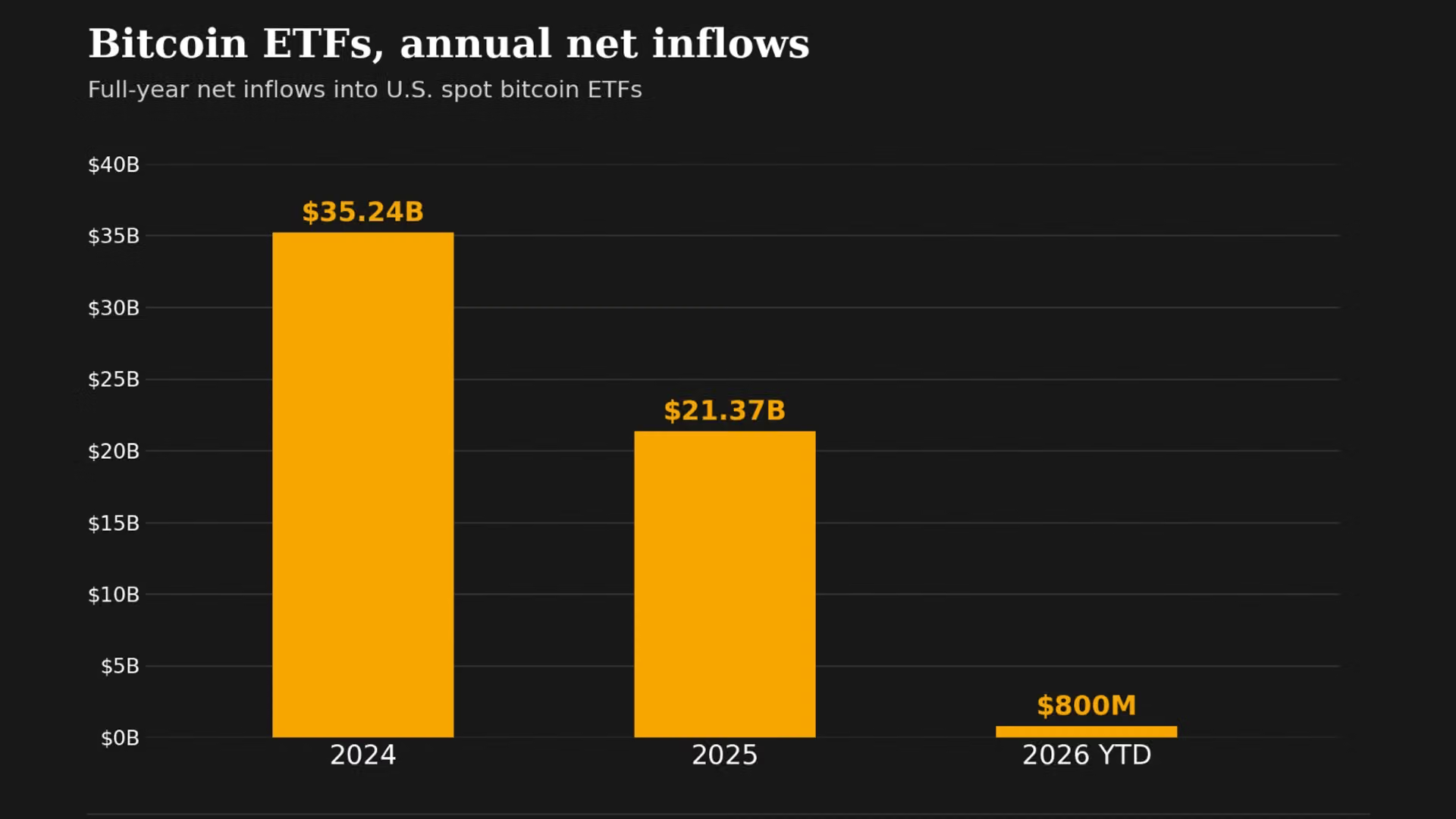
They’ve poured billions into U.S.-listed spot bitcoin exchange-traded funds (ETFs) in recent weeks. The result: these ETFs now sit on nearly $800 million in net inflows for the year, according to data source SoSoValue. That’s a 180-degree turn from the red ink earlier this year.
Here’s how bad it got. On July 13, the same ETFs were down $5.8 billion for the year. That was the low point, according to data analyzed by CoinDesk.
The turnaround lines up with bitcoin’s price recovery to $85,000 from under $58,000 in early June. That price rise, combined with the ETF inflows, has convinced some analysts a new bull run is already underway.
Nearly $4 billion of those inflows have come in since U.S. Treasury Secretary Scott Bessent’s August announcement of increased bond purchases, a liquidity management tool rolled out as bond yields surged to multi-year highs.
Still, there is much work to do for the bulls. At $800 million, net inflows for the year are still way smaller than $35.2 billion in 2024 and $21.4 billion in 2025.
Six-day winning streak
These ETFs have pulled in money for six straight days, even as bitcoin’s rally has stalled above $85,000 since Tuesday.

KelpDAO has filed a lawsuit against cross-chain protocol LayerZero following the roughly $292 million exploit of its rsETH bridge earlier this year, alleging that failures in LayerZero’s security infrastructure contributed to the attack.
KelpDAO said Friday that LayerZero failed to disclose risks in its technology or prevent attackers from compromising its infrastructure. It also alleged that LayerZero had reviewed and endorsed its deployment and configuration in writing before the exploit.
The lawsuit also names LayerZero co-founder and CEO Bryan Pellegrino.
“Our number one priority has always been and will remain the security of our users’ assets,” Kelp wrote. “But we also need to correct the record, and hold LayerZero and Mr. Pellegrino accountable for the harm they have caused us and the broader DeFi ecosystem.”
Pellegrino called the claim “meritless” and said he would defend the case in Vancouver.
The lawsuit escalates a months-long dispute over whether the loss was caused by the compromise of LayerZero’s infrastructure, KelpDAO’s bridge configuration, or both.
Cointelegraph contacted LayerZero for further comment, but did not receive a response before publication.
Kelp and LayerZero have disputed responsibility since April
The April 18 attack resulted in the theft of 116,500 rsETH, worth about $292 million at the time, from Kelp’s LayerZero-powered bridge.
In its final incident report, LayerZero said attackers compromised its internal nodes and caused its verifier to approve a forged cross-chain message. It argued that the loss was possible because Kelp’s bridge relied on a single LayerZero decentralized verifier network (DVN) as its only verification path.
Related: Recovery hopes fade as Kelp DAO hacker launders nearly all $220M in stolen funds
With no second independent verifier required, the bridge released the rsETH after receiving LayerZero’s verifier approved the forged message. LayerZero said it had recommended using multiple DVNs and subsequently stopped acting as the sole required verifier for applications.
Kelp has disputed LayerZero’s account of responsibility. In May, it said its DVN configuration had previously been discussed with LayerZero and “confirmed as secure,” while accusing LayerZero of failing to adequately warn it about the risks. Kelp subsequently announced plans to migrate the rsETH bridge to Chainlink’s Cross-Chain Interoperability Protocol.
Magazine: Winners and losers of the SEC’s new tokenized stocks rules
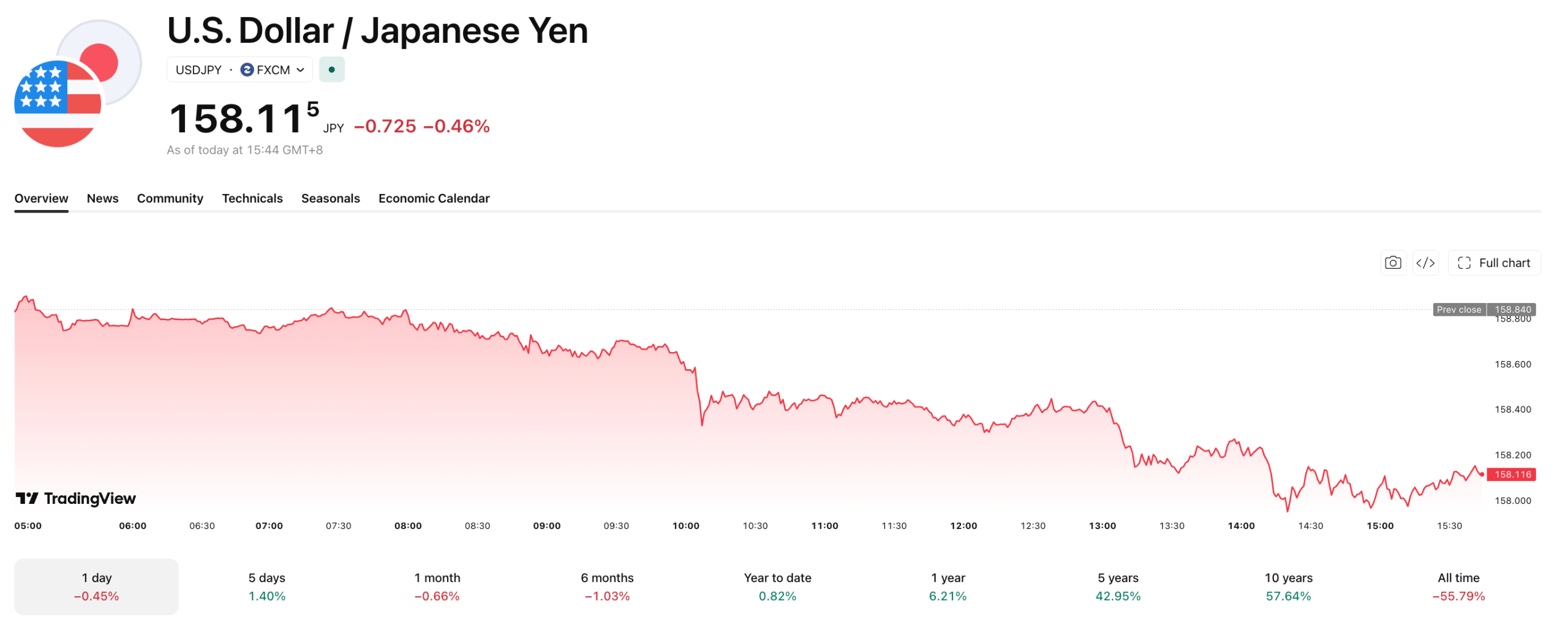
The Japanese yen posted its steepest daily gain in over two weeks on Friday, strengthening as much as 0.6% to 157.95 per dollar after Finance Minister Satsuki Katayama’s latest warning kept traders wary of intervention.
Katayama said US President Donald Trump raised concerns about the weak yen directly with Japanese Prime Minister Sanae Takaichi during a meeting in New York this week, a detail that adds unusual weight to Tokyo’s usual verbal warnings.
Why This Warning Hits Differently
Katayama’s comments follow a script Tokyo has used for months. What changes the calculation this time is the apparent involvement of the White House.
She added that she will keep coordinating with US Treasury Secretary Scott Bessent, who has separately signaled support for a stronger yen.
Moh Siong Sim, a strategist at Oversea-Chinese Banking Corp, framed the shift bluntly:
“Intervention risk should put a ceiling on further JPY weakness. More importantly, the JPY may be nearing a turning point as Trump’s concerns over its weakness point to deeper US-Japan coordination to support the currency.”

That marks a reversal from earlier this month’s rally, when the yen touched multi-month highs on bets on BOJ tightening. Renewed dollar strength since then has pushed USD/JPY back toward 160, reviving Friday’s intervention debate.
The 160 Line Traders Keep Watching
The dollar’s push toward 160 yen revives memories of this summer, when Japan and the US carried out their first coordinated yen-buying intervention since 1998. Japan spent a record 15.4 trillion yen, about $97.4 billion, defending the currency in the month through August 26.
Officials have stopped short of naming a trigger level, framing their concern instead around how fast and chaotic the yen’s swings become. But the market treats 160 as the threshold where intervention becomes likely again.
The post Yen's Best Day in Two Weeks: Is Intervention Risk Now the Real Ceiling? appeared first on BeInCrypto.

Bitcoin and Ethereum have remained near their recent highs as renewed talks between the United States and Iran have brought another proposal to reopen the Strait of Hormuz into focus, with lower oil prices potentially easing one of the pressures that has kept Treasury yields elevated.
Summary
- Iran has proposed a seven day plan to end hostilities and reopen the Strait of Hormuz before comprehensive nuclear talks begin with the United States.
- Bitcoin and Ethereum could benefit if a lasting reopening pushes oil prices lower and eases some of the inflation and Treasury yield pressure weighing on risk assets.
- Similar attempts to reopen Hormuz have raised market hopes several times in recent months before negotiations or agreements broke down.
- Bitcoin faces resistance around $86,700 to $87,400, while Ethereum would need to reclaim $2,700 before another attempt at the recent $2,789 high.
Iranian Foreign Minister Abbas Araghchi said Thursday that Tehran had proposed a seven day plan to Washington under which hostilities would stop before the Strait of Hormuz reopened and comprehensive negotiations over Iran’s nuclear program began.
The proposal, delivered through intermediaries, calls for an end to hostilities including in Lebanon, the release of at least $12 billion in frozen Iranian assets, sanctions waivers for Iranian oil and the lifting of the U.S. naval blockade. Iran would reopen the strait at the end of the seventh day if those conditions were met.
Araghchi said Tehran was ready to start implementing the plan as soon as Washington agreed. An American official familiar with the discussions described talks through mediators as positive and constructive, but said Washington would not rush into an agreement.
Markets have already shown some sensitivity to the possibility of progress. WTI crude fell more than 2.5% to around $89 a barrel on Sept. 22 after Iran signaled that Hormuz could reopen within a week, while Brent dropped below $98. Bitcoin was trading close to $86,000 at the time.
Bitcoin has since settled near $84,000 after reaching $87,392 earlier in the week. Ethereum has held around the $2,600 area following its recent rejection near $2,800.
Bitcoin and Ethereum face high yields despite recent gains
Any agreement between Washington and Tehran would arrive while crypto traders are dealing with a difficult U.S. macro backdrop.
The Federal Reserve raised its benchmark rate by 25 basis points on Sept. 16 to a range of 3.75% to 4%, saying inflation remained elevated even as economic activity continued to expand at a solid pace.
Bond yields have continued climbing since the decision. The U.S. 10 year Treasury yield reached 5.11% on Sept. 24, up from 4.96% a day earlier, while the 30 year yield moved to 5.40%. The 10 year real yield climbed to 2.76%.
Rising oil prices have been part of that pressure. Brent moved above $100 earlier in September as fighting around Iran raised concerns over energy supplies, while the prospect of another Fed rate hike has kept borrowing costs in focus.
Crypto.news previously reported that Bitcoin held near $84,000 as the 10 year Treasury yield approached 5.2% during trading on Sept. 24. Oil prices were rising at the same time, while Fed officials kept another rate hike on the table.
Bitcoin has so far absorbed much of that pressure. U.S. spot Bitcoin ETFs recorded roughly $2.65 billion in net inflows over five sessions through Sept. 23, while wallets holding between 100 and 1,000 BTC accumulated 113,950 BTC from July 15 through Sept. 23.
The five day ETF inflow streak included $346.98 million on Sept. 23 after nearly $999 million on Sept. 21 and $714.7 million the following day.
Exchange balances have moved in the same direction. More than 13,800 BTC left Binance on a net basis in one day, the largest daily outflow from the exchange since 2023, while Bitcoin remained above $84,000.
Ethereum has followed a similar recovery, though its latest rally stalled below $2,800. ETH traded near $2,675 on Sept. 23 after reaching roughly $2,789, while U.S. spot Ethereum ETFs received $162.2 million on Sept. 22 and another $105 million the following session.
The token remained above its longer term four hour moving averages during the pullback, with Ethereum holding above its 50, 100 and 200 period averages even after losing the shorter 20 period average.
Why traders have heard Hormuz reopening plans before
The latest negotiations are not the first attempt this year to reopen the Strait of Hormuz.
Washington and Tehran reached a 14 point memorandum of understanding in June that declared an end to the war and provided for commercial vessels to resume using the waterway. Iran was expected to facilitate safe passage without charges for 60 days while the two countries worked toward a final agreement.
The arrangement soon began to break down.
Tehran interpreted the agreement as recognizing its authority to manage traffic through Hormuz, while Washington and Gulf states maintained that commercial vessels should have unrestricted passage without Iranian control.
By July, Iran had fired on vessels it said were using an unauthorized route and declared the strait closed again. Washington revoked a license allowing Iranian oil sales on July 7, while Tehran accused the United States of violating the memorandum. President Donald Trump subsequently described the initial ceasefire as over.
Attempts to restore traffic continued through the summer.
Iran said in August that it was preparing another set of conditions for reopening the strait after mediators approached Tehran. Officials discussed a shipping corridor with Oman, but Iran tied a full reopening to an end to the war, removal of sanctions, compensation and the lifting of what it described as a U.S. blockade.
Ceasefire arrangements announced in April and June had both been intended to restore maritime traffic but failed to hold, according to Reuters.
The latest proposal therefore resembles parts of the June arrangement but compresses the timetable. The earlier memorandum gave Washington and Tehran as long as 60 days to negotiate a final agreement. Araghchi’s new plan would reopen Hormuz after seven days and move directly into comprehensive nuclear negotiations.
What happens to Bitcoin and Ethereum if Hormuz reopens?
A lasting reopening could affect Bitcoin and Ethereum primarily through oil prices, inflation expectations and Treasury yields.
Before the war began in February, roughly one fifth of global oil and liquefied natural gas shipments passed through the Strait of Hormuz. Shipping through the waterway has remained heavily disrupted since then.
Restoring regular traffic would remove some of the supply uncertainty that has supported crude prices during the conflict. The initial market response to Iran’s Sept. 22 signal offered an early example, with WTI dropping more than 2.5% and Brent falling below $98.
Lower energy prices could, in turn, reduce one source of inflation pressure at a time when the Fed has returned to raising rates.
The relationship has already worked against crypto during periods of renewed fighting. On Sept. 2, Ethereum fell below $2,400 as fresh U.S. Iran strikes pushed Brent toward $95 and the 10 year Treasury yield above 4.8%. ETH reached an intraday low of $2,356 during the session.
Conditions became more restrictive later in the month as oil moved above $100 and Treasury yields crossed 5%. Ethereum traded near $2,475 on Sept. 15 before recovering after the Fed decision and the subsequent crypto rally.
A sustained decline in oil following a Hormuz reopening would not guarantee lower interest rates. The Fed’s Sept. 16 statement said inflation remained elevated, while domestic spending, productivity and capital investment remained firm.
It could, however, remove part of the energy pressure that has complicated the inflation outlook. A decline in inflation expectations and Treasury yields would reduce the return available on government debt, changing one of the macro conditions that has recently worked against Bitcoin and Ethereum.
Bitcoin’s first major test would remain the $86,700 to $87,400 area, where the latest rally stalled. The previous range high near $82,000 has become an important level below the market, while the $80,000 area sits beneath it as the former upper boundary of Bitcoin’s earlier trading range.
A move back through $87,400 alongside falling oil and Treasury yields would put the January yearly open near $87,722 back into focus. Continued ETF demand would provide another source of spot buying after the recent five session inflow run.
Ethereum would first need to recover $2,700 before challenging the recent $2,789 high and resistance around $2,800. Its latest pullback left support around $2,648, followed by liquidity near $2,630 and the larger $2,532 to $2,550 area.
Another failed deal could keep oil and yields in focus
The opposite setup remains possible given the fate of previous agreements.
Iran’s seven day proposal requires Washington to lift its naval blockade, provide sanctions relief and release frozen Iranian assets before Hormuz is reopened. The United States has acknowledged constructive discussions through mediators but has not accepted those conditions.
A renewed breakdown in negotiations could leave shipping restrictions in place and restore some of the geopolitical premium recently removed from crude.
Bitcoin has already shown that higher yields can interrupt its rallies even when underlying spot demand remains firm. After reaching $87,392 on Sept. 21, BTC retreated toward $84,000 as Treasury yields moved higher, despite consecutive ETF inflows and continued accumulation among larger wallets.
Ethereum faces a similar macro constraint after failing to hold its move toward $2,800. The nearest downside levels remain around $2,648 and $2,630, while a deeper decline would bring the $2,532 to $2,550 area back into view.
Araghchi said Iran was prepared to begin implementing the seven day plan once Washington agreed and suggested reaching an agreement before the U.S. midterm elections would be preferable. Mediated communication between the two sides continued after his meeting with U.S. envoy Steve Witkoff and Jared Kushner in New York, while Iranian officials said further meetings could take place in the coming days.
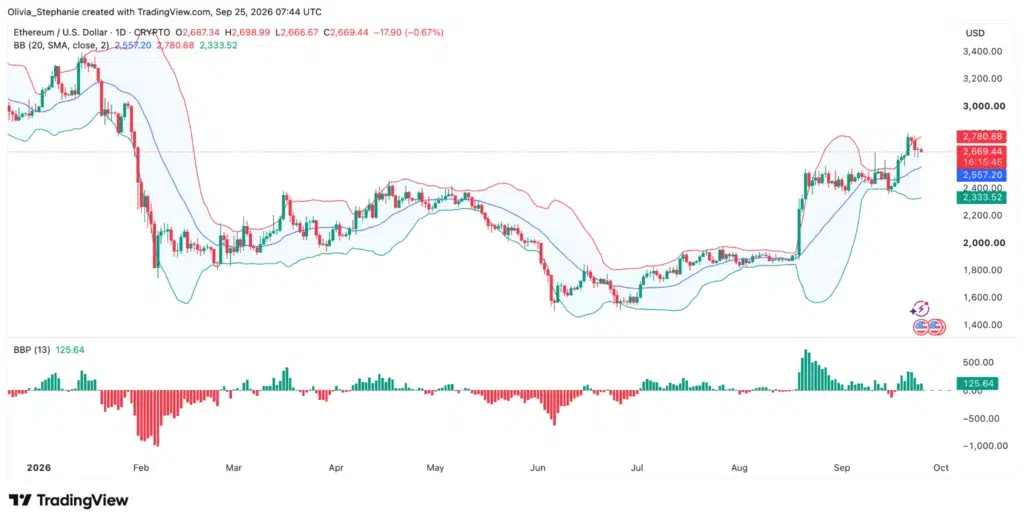
Ethereum has held near $2,667 after pulling back from the $2,800 region, while ETF inflows and exchange withdrawals continue as traders assess whether the recent breakout can survive.
Summary
- Ethereum trades near $2,667 after retreating from $2,800, while seven-day gains remain firmly positive overall.
- U.S. spot Ethereum ETFs attracted $66.01 million, extending their net inflow streak to five sessions.
- $2,540 remains the key breakout support as analysts assess whether Ethereum can retest $3,000 next.
- Binance stablecoin netflows rose sharply while Ethereum exchange netflows turned negative during the latest pullback.
- BBP remains positive near 124.67, while Ethereum stays above its $2,557 Bollinger Band midpoint.
CoinGecko data show ETH closed around $2,687 on September 24 after reaching $2,775 on September 21. At the time of writing, Ethereum traded at $2,666.63, down 0.78% over 24 hours but up 7.90% over seven days, with a market capitalization near $326.3 billion.
The pullback followed a steep recovery from below $2,400 earlier in September. ETH approached $2,800 before sellers stopped the advance, bringing the former breakout area around 2,530–2,540 back into focus.
Why is Ethereum price struggling below $2,800?
Ethereum’s first problem sits around the recent high. The $2,530–$2,540 region previously acted as resistance and could now serve as support after the breakout. Analyst Wealthmanager placed a potential retest near $2,539, while the larger upside projection near $3,391 remains conditional on ETH holding support and clearing several resistance levels.
The supplied daily chart gives buyers some technical support. ETH remains above the 20-day Bollinger Band midpoint at $2,557.52. The upper band stands near $2,781.85, close to the region where the latest rally stalled, while the lower band sits around $2,333.18.
Bull Bear Power remains positive at approximately +124.67. Buyers therefore retain an advantage on that indicator, although the latest positive bars have contracted from their recent highs. Momentum has cooled as ETH moved away from the upper Bollinger Band.
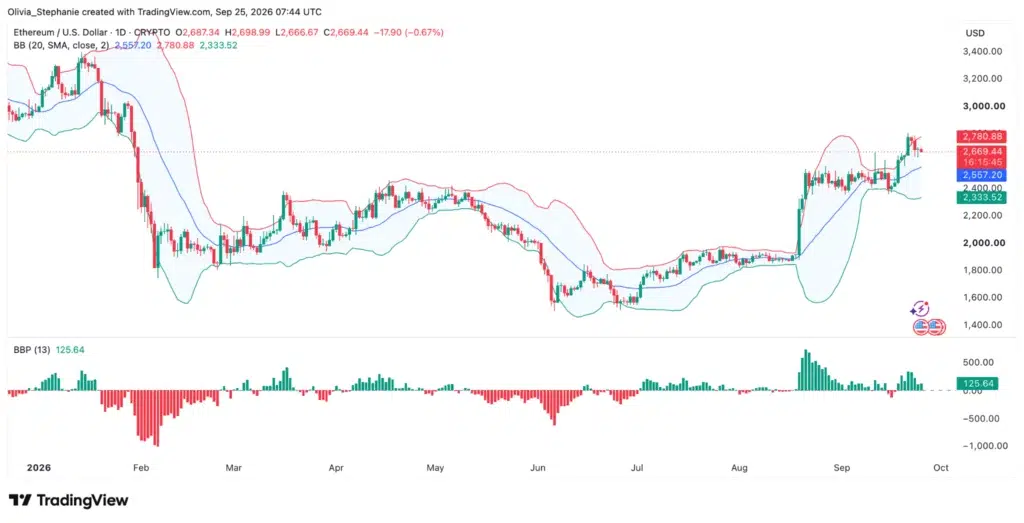
As crypto.news reported in its Ethereum $2,800 rejection analysis, ETH remained above its longer 4-hour moving averages even after falling below $2,700. The 100-period moving average stood near $2,540.49, almost directly inside the breakout support zone now being watched.
That analysis placed the 4-hour 200-period moving average near $2,499.93. A deeper decline through the 2,530–2,540 region would therefore bring the $2,500 area into view before the much lower Bollinger support around $2,333.
Can ETF inflows keep the Ethereum breakout intact?
U.S. spot Ethereum ETFs have continued attracting money even as ETH retreated from its recent high. SoSoValue data showed $66.1 million in net inflows on September 24, extending the streak to five consecutive trading sessions.
BlackRock’s ETHA led the session with $26.8 million, followed by Fidelity’s FETH with $21.5 million. Grayscale’s Ethereum Mini Trust drew another $17.8 million. No U.S. spot Ether ETF recorded a net outflow during the session.
Across the five-session run, the funds accumulated $746.5 million. The sequence included $270 million on September 21, $162.2 million on September 22, $104.5 million on September 23 and $66.1 million the following session.
The declining daily inflow totals show that ETF demand has remained positive while slowing from the strongest session. Fund flows measure subscriptions into regulated products and do not establish whether ETH will hold any particular technical level.
Ethereum’s rejection near $2,800 occurred while institutional ETF demand stayed positive. As crypto.news previously reported in its analysis of Ethereum ETF inflows during the $2,800 rejection, the September 21 and 22 sessions alone drew $432.2 million before ETH fell below $2,700.
Exchange flows show ETH leaving as stablecoins enter Binance
CryptoQuant contributor CryptoOnchain reported another pattern beneath the pullback. Ethereum exchange netflow moved from +138,174 ETH on September 18 to -138,247 ETH on September 23, meaning the observed flow changed from net deposits to net withdrawals as the price retreated from $2,775.35.
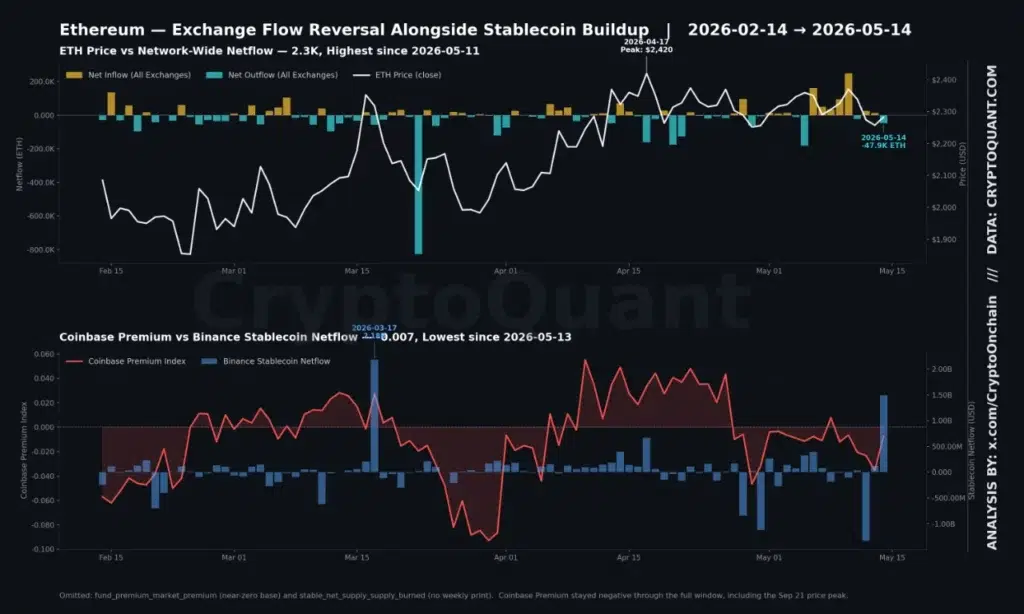
At the same time, CryptoOnchain reported that Binance stablecoin netflow averaged approximately $107.98 million per day during the week ending September 23, up 552% week over week. The analyst described one possible reading as capital positioning for re-entry, though that interpretation remains “unverified.”
A separate CryptoQuant post from the same analyst reported an average daily Binance USDT-on-Ethereum netflow of $80.8 million in the week ending September 21, the highest reading in its six-month comparison window. Binance’s total stablecoin reserve stood at $43.59 billion in that dataset.
CryptoOnchain’s September 23 dataset found that the Coinbase Premium Index remained negative, ranging from -0.01 to -0.09 during the observed period. Under that measure, U.S. Coinbase spot activity did not lead the move toward the September 21 high.
The staking rate moved in the opposite direction, rising from 35.30% to 35.71% during the same period, according to the analyst. Staking changes occur more slowly than daily price action, so the rise does not establish a direct cause for ETH’s latest rebound.
Will Ethereum reach $3,000 before a deeper correction?
The immediate upside test remains 2,781–2,800. The upper Bollinger Band sits around $2,781.85, while recent spot trading failed to sustain a move through the same region. Regaining it would leave $3,000 as the next large psychological level identified across several analyst setups.
RektProof’s scenario projects that ETH “could” approach $3,000 before rotating lower toward equal lows around $2,300. The analyst places heavier resistance between $3,000 and $3,200. Such a path remains a forecast, not a confirmed price target.
Wealthmanager’s chart uses a more aggressive conditional target near $3,391 if ETH successfully holds $2,540 and clears $2,800 and $3,000. IncomeSharks has separately mapped a deeper liquidity sweep toward 2,100–2,200 before a potential recovery toward 3,400–3,500. Neither path has been confirmed by current price action.
Leverage creates another risk around the support zone. Analyst Celal Kucuker warned that heavy long positioning “could” produce a liquidation-driven decline of approximately 20% if support fails and forced selling accelerates. The scenario would weaken if buyers defend support and ETH recovers.
More immediate liquidation data place the first pressure points much closer to the market. Crypto.news reported liquidation bands around $2,650 and $2,630 after ETH’s September 23 reversal, with another concentration around $2,700.
For the current chart, $2,557.52 remains the Bollinger midpoint, while the 2,530–2,540 region combines former breakout resistance with the 4-hour 100-period moving average. A recovery would first face 2,781–2,800 before the 3,000–3,200 resistance range identified by the analyst charts.
Disclosure: This article does not represent investment advice. The content and materials featured on this page are for educational purposes only.
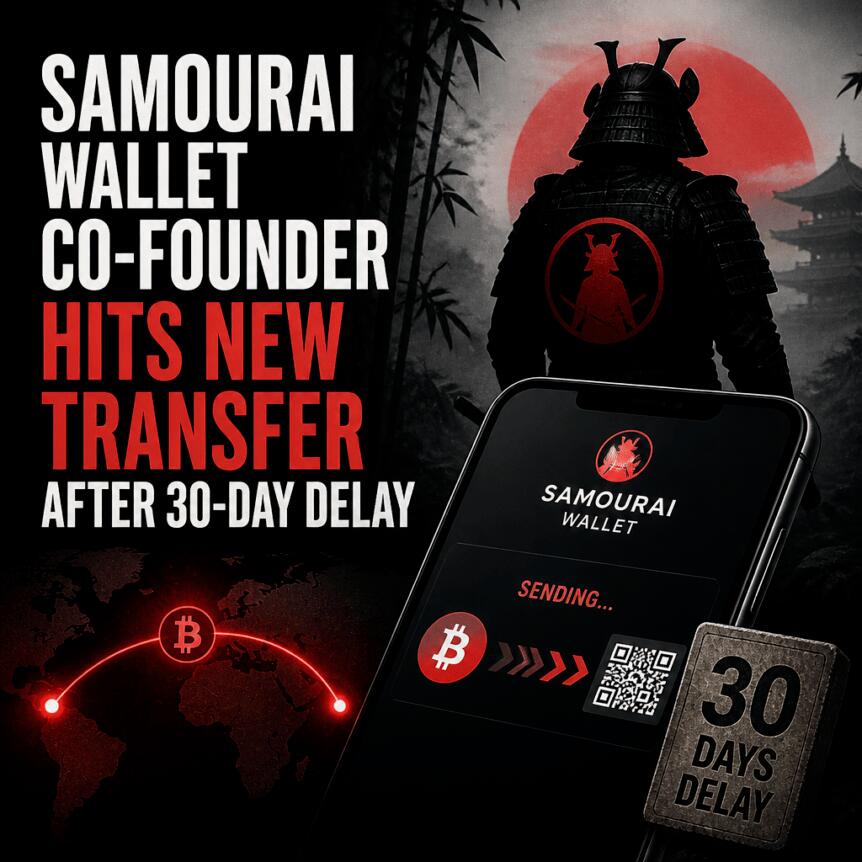
Samourai Wallet co-founder Keonne Rodriguez says inmates at FCI McKean have been told that he and about 70 other participants will be transferred to different facilities after a drug treatment program was deactivated. Rodriguez made the claim on X, adding that he had entered the program because completing it could reduce his sentence by up to a year.
The situation comes as Rodriguez—who is serving a five-year term for his role in an unlicensed money-transmitting business—continues to navigate prison transfers while his case remains entangled with broader U.S. policy debates over whether developers who do not control users’ funds can be treated as financial intermediaries.
Key takeaways
- Rodriguez says FCI McKean deactivated a drug treatment program tied to sentence-reduction eligibility for him and roughly 70 other participants.
- He reported that a prior transfer from FPC Morgantown to McKean proved far longer and harsher than expected, with travel that he said he was not allowed to do himself.
- The federal government states Rodriguez and Samourai co-founder William Lonergan Hill transmitted more than $237 million in criminal proceeds through the service.
- In Congress, the CLARITY Act framework aimed at protecting non-controlling crypto developers from certain money-transmission obligations has stalled after a Senate procedural vote failed.
FCI McKean program ended; another transfer expected
Rodriguez said on X that the warden at FCI McKean informed program participants that he and 70 others would be moved to facilities where treatment is still available. He framed the transfer as a setback to his attempt to continue the drug treatment program.
Rodriguez entered the program because completing it could reduce his sentence by up to a year, according to his account. With the program deactivated at McKean, the practical next question for investors and crypto builders is what this means for Rodriguez’s ability to stay on track for any sentence-reduction pathway—especially since transfers can disrupt schedules, eligibility, and continuity of care.
Rodriguez describes a harsher-than-expected transfer from Morgantown
In a letter published by The Rage, Rodriguez characterized his initial move from FPC Morgantown to McKean as the “absolute worst 30 days” of his life. He said his request to make the approximately four-hour trip himself was denied, and he described the process as far more drawn out.
According to Rodriguez, inmates leaving Morgantown were placed in ankle shackles and handcuffs attached to waist chains before being transported by bus to an airport and flown to the Federal Transfer Center in Oklahoma City. He said that once at the transfer center, he was held with prisoners from different security classifications and spent most of his time locked in a cell.
Rodriguez also wrote about the conditions at the Federal Transfer Center, including that he wondered whether the “all the circles of hell” were contained within the facility. He later said he was assigned a cell with an inmate serving a murder sentence and that he received only part of a foam mattress, leaving part of his body to rest on a metal bunk overnight.
Conviction and sentence: what prosecutors said Samourai did
Rodriguez is serving a five-year sentence after pleading guilty to conspiring to operate an unlicensed money-transmitting business. Cointelegraph previously reported on the case’s broader developments surrounding a petition and related legal efforts, including coverage that ties Rodriguez’s sentence to Samourai’s operation.
Separately, the U.S. Department of Justice said in a sentencing announcement that Rodriguez and co-founder William Lonergan Hill transmitted more than $237 million in criminal proceeds through the service. The government’s framing focused on the transmission of criminal funds rather than on any claim that users retained full control or that developers were outside the flow of money.
For readers following crypto policy, that legal characterization helps explain why the debate over “developer protections” is central to the sector’s risk outlook: it highlights the potential gap between how software is built (and who controls assets) and how prosecutors may describe the service’s economic function.
CLARITY Act pause leaves developer protections in limbo
Rodriguez’s case has unfolded alongside congressional efforts intended to reduce compliance risk for crypto developers who do not control users’ assets. Those efforts are reflected in the CLARITY Act framework, which has sought to clarify that non-controlling developers should not necessarily be treated as financial intermediaries subject to money-transmission requirements under the Bank Secrecy Act.
According to Cointelegraph’s coverage, the latest Senate CLARITY Act draft retained Blockchain Regulatory Certainty Act provisions designed to protect non-controlling developers from certain money-transmission obligations. However, the Senate failed to advance the CLARITY Act on Sept. 15 after a procedural vote fell short of the 60 votes needed to move the legislation forward.
That legislative stall matters to builders and businesses because it increases uncertainty around how federal agencies and courts could interpret developer involvement going forward—especially in cases where software tools, even without direct user asset control, are alleged to have facilitated illicit financial activity.
What to watch next
Rodriguez’s reported transfer after the deactivation of drug treatment at FCI McKean will likely be the immediate development to follow, because sentence-reduction eligibility can hinge on program continuity. At the same time, the broader policy question—whether the Senate will revive and pass the CLARITY Act to better define developer obligations—remains unresolved, leaving crypto firms to plan under continued legal ambiguity.
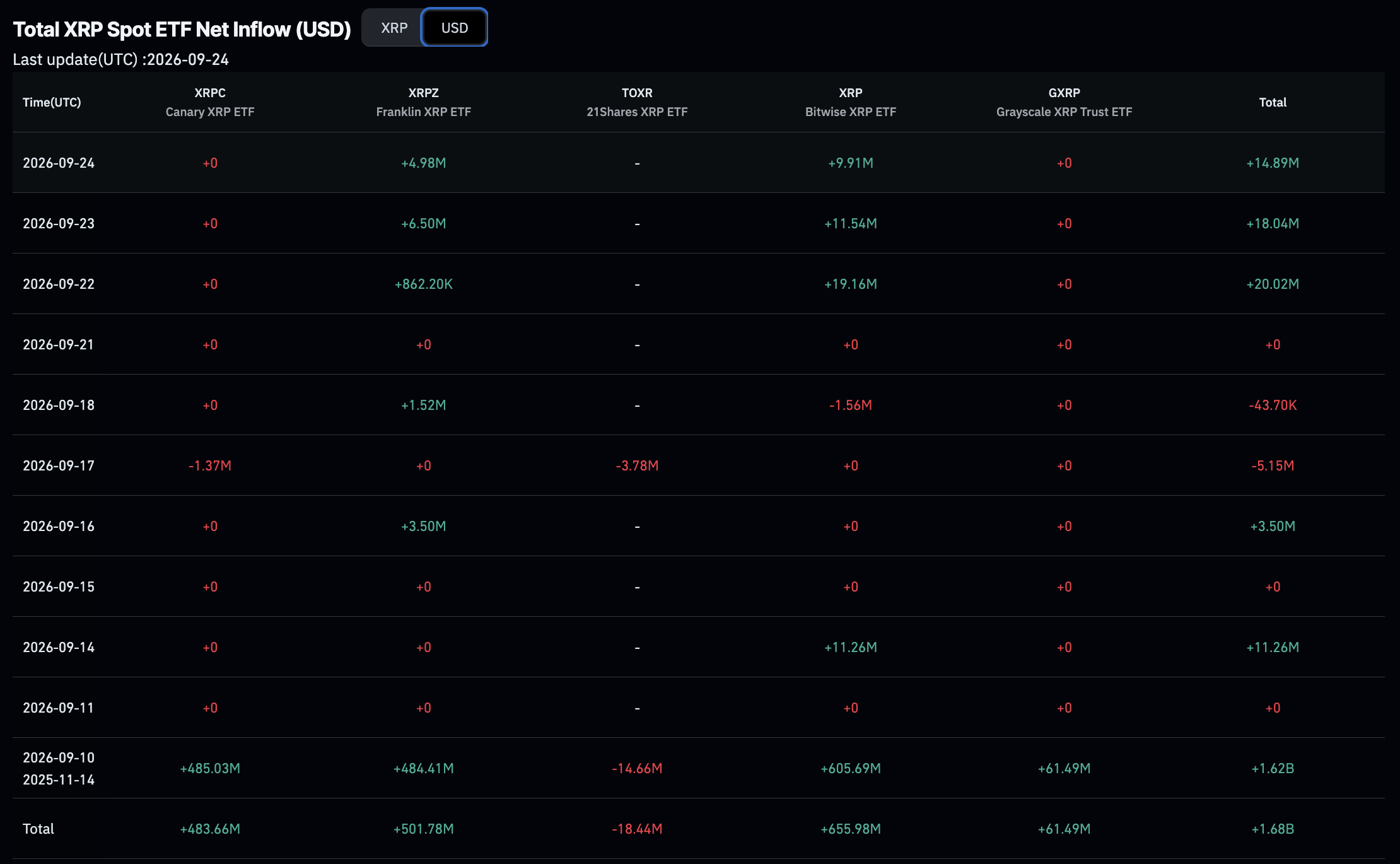
XRP price trades at $1.53, up by a marginal 1.5% on the day, and is still sitting on one of the strongest weekly charts among large-cap tokens, shrugging off bearish prediction. Zoom out to seven days, and the picture changes dramatically. Gains in the 17-18% range put XRP ahead of most of the top-10 field.
The move has been driven by real inflows. Spot ETF products tied to XRP pulled in $1.73 billion, and total ETF assets under management now sit near $1.7 billion. Absa’s launch of institutional digital asset custody with Ripple expanded regulated access across Africa.
Meanwhile, the CFTC’s ongoing work on new crypto asset rules keeps compliance-driven capital watching the token closely. Community chatter has flagged a double-top forming near $1.55-$1.60, a pattern that makes technical traders nervous even when the fundamental backdrop looks constructive.
Broader crypto markets remain risk-on this week, but XRP’s own volatility tells a cautionary tale: a reported 15.8% surge on September 23 was followed almost immediately by a 6.9% pullback the next day. That whipsaw sets the stage for the technical breakdown below.
Earn $50 and Enter $300K Prize Draw on EdgeX
XRP Price Prediction: Can Ripple Hit $1.63 This Week?
XRP is changing hands at $1.53, almost flat on the session after a volatile week that saw the price swing between $1.45 and $1.55. Daily volume has run near $4.5 billion, evidence that liquidity hasn’t dried up despite the choppiness.
The token holds above its MA-20, MA-50, and long-term MA-200, a generally constructive technical posture, with the Ichimoku Kijun line at $1.50 acting as immediate support. Momentum readings are mixed but lean positive: MACD signals buy, RSI sits in buy territory, yet ADX and CCI register neutral, and Stochastic RSI flags an oversold condition.

Bull case: a clean break above $1.60-$1.63 opens a path toward $1.66 and eventually $1.83.
Base case: consolidation inside the $1.4642-$1.6359 corridor, which carries a modeled 78% probability of resolving upward.
Bear case: a decisive loss of the $1.4642-$1.4800 support zone exposes $1.40-$1.41.
For a deeper breakdown of the resistance structure and Binance reserve trends shaping this setup, see this XRP price prediction analysis of the $1.63 test. Traders should treat $1.63 as the line that separates continuation from another round of chop.
Trade XRP on Bybit and Get a Chance to Win Our $1,000 USDT Airdrop
Maxi Doge Targets Early Mover Upside as XRP Tests Key Levels
XRP holders riding this week’s rally already have their answer on the upside. A breakout above $1.63 likely means single-digit percentage gains from here, not a multiple. That’s the reality of trading a token with XRP’s market cap.
Whale flows and futures positioning covered in this bullish October outlook for XRP support the near-term case, but anyone chasing outsized returns is looking in the wrong place. Early-stage presales are where that asymmetry still exists.
Maxi Doge ($MAXI) is building exactly that kind of setup on Ethereum. The project has raised $4.8 million at a current presale price of $0.000284, with dynamic APY staking live for early participants. Its identity leans hard into gym-bro meme culture, a 240-lb canine mascot channeling 1000x leverage energy.
Holder-only trading competitions with leaderboard rewards, and a Maxi Fund treasury earmarked for liquidity and partnerships. The tagline says it plainly: never skip leg-day, never skip a pump.
Research Maxi Doge’s presale now before the funding window closes.
Discover: Best Crypto IPO this September
The post XRP Price Prediction: Weekly Gains Lead Crypto Market, But Can XRP Clear $1.63? appeared first on Cryptonews.

Commodore 128 Becomes Marine Vessel Tracker

‘Extraterrestrial’ – Norway fawn over Erling Haaland as Man City star reaches latest milestone
Advanced flower capital director buys $92,635 in common stock




-

 Fashion7 days ago
Weekend Open Thread: Talbots – Corporette.com
-

 Crypto World2 days ago
Goldman Sachs and Deutsche Bank Agree: The S&P 500 Rally Isn't Over
-

 Tech4 days ago
Researchers escape OpenAI Codex sandbox to run commands on host
-

 Fashion22 hours ago
8 iPhone Accessories That Add Personality
-

 Crypto World4 days ago
Who Needs CLARITY Anyway? ARB Could See 70X Increase: Hodler’s Digest
-

 Crypto World6 days ago
Circle launches Arc Studio AI agent for building onchain apps
-
 NewsBeat6 days ago
Trump says US has reached an agreement to take permanent control of Greenland’s security
-

 Crypto World6 days ago
Trading Bitcoin on Robinhood? Why 2% Spread Has Traders Worried
-

 Tech6 days ago
Trump suggests rebranding AI with a new name, says he’s also creating an AI Force
-

 Crypto World6 days ago
Bitcoin price breaks channel as RSI climbs to 63
-

 Business4 days ago
Analog Devices (ADI) Bets $1.35 Billion on Chips that Let Machines Think for Themselves
-

 Tech4 days ago
Google’s $899 Googlebook is a bet that you’ll buy a new laptop for Gemini
-

 Crypto World4 days ago
Coinbase, Robinhood, Circle Seen as Tokenized-Stock Winners
-

 Crypto World2 days ago
This Bearish Netflix Stock Trade Can Cash In On Video Streaming Giant’s Woes
-
 Business2 days ago
Oil Price Today (September 23): Crude oil below $100 on hopes of US-Iran talks. What did Trump say?
-

 Crypto World3 days ago
Trump-Xi Polymarket Odds for Handshake Hit 50%
-

 Crypto World6 days ago
World Money launches in 150+ countries with Stripe
-

 Crypto World1 day ago
Crude Oil Prices Pressured by Diplomatic Hopes in the Middle East
-

 Crypto World7 days ago
Silver prices recover quickly, hitting weekly high today
-

 Entertainment2 days ago
These 17 Fall Amazon Dresses Seriously Look Like Anthropologie
You must be logged in to post a comment Login