
Crypto World
KelpDAO sues LayerZero over $292M rsETH exploit


KelpDAO has sued LayerZero and co-founder Bryan Pellegrino in British Columbia over the April 18 exploit that drained 116,500 rsETH worth approximately $292 million.
Summary
- KelpDAO filed a British Columbia lawsuit against LayerZero and CEO Bryan Pellegrino over April’s exploit.
- The April attack drained 116,500 rsETH worth approximately $292 million from KelpDAO’s LayerZero bridge infrastructure.
- KelpDAO alleges LayerZero failed to disclose technology risks and secure infrastructure later compromised by attackers.
- LayerZero says KelpDAO’s one-of-one verifier configuration created the single failure point enabling forged cross-chain messages.
- Pellegrino called the lawsuit meritless and said he will defend himself and LayerZero in Vancouver.
KelpDAO said on September 24 that Evercrest Technologies Inc., the legal entity behind Kelp, filed the action to address what it describes as failures connected to LayerZero’s infrastructure. Kelp’s current terms identify Evercrest Technologies Inc. as the company providing the Kelp application.
The complaint, according to KelpDAO’s public account, alleges that LayerZero failed to disclose weaknesses and risks in its technology and failed to stop attackers from penetrating security infrastructure used by its verifier. No court has ruled on those allegations.
Pellegrino disputes the case. He called the claims “meritless” and said he would defend himself and LayerZero in Vancouver. Current reporting confirms the civil claim names both LayerZero and Pellegrino personally.
KelpDAO says LayerZero approved its bridge setup
KelpDAO’s case centers partly on the configuration of the rsETH bridge. The protocol says LayerZero had reviewed and approved its deployment and configuration in writing before the April exploit, contradicting LayerZero’s later argument that Kelp created a dangerous single-verifier setup.
LayerZero has given a different account. In its April incident statement, the company said Kelp used a 1-of-1 Decentralized Verifier Network, or DVN, leaving no separate verifier capable of rejecting a false cross-chain message. LayerZero said it had previously recommended verifier diversification and described the configuration as a single point of failure.
Kelp pushed back days after the attack. As crypto.news reported in its coverage of the dispute over LayerZero’s default configuration, Kelp said its bridge followed LayerZero’s documented defaults and relied on LayerZero-operated infrastructure. LayerZero maintained that Kelp had manually moved to the 1-of-1 configuration.
Pellegrino later said Kelp originally used multi-DVN or DeadDVN defaults before changing the rsETH deployment. Kelp has disputed LayerZero’s description of the discussions and now says its lawsuit will rely on written records showing LayerZero reviewed the setup.
LayerZero’s own infrastructure was compromised
The parties disagree over responsibility, but LayerZero’s final incident report confirms that attackers penetrated infrastructure operated by LayerZero Labs before the rsETH bridge released the funds.
LayerZero published its detailed report in May, saying the intrusion began on March 6 when an attacker socially engineered a LayerZero developer and obtained session credentials. The attacker then entered LayerZero’s RPC cloud environment and altered internal RPC nodes used by the LayerZero Labs DVN.
During the April 18 attack, the compromised nodes supplied false blockchain information while attackers launched a denial-of-service attack against external RPC providers. LayerZero’s DVN then signed a forged message because its available information indicated that the message was valid.
Kelp’s Ethereum bridge subsequently released 116,500 rsETH even though no corresponding burn had occurred on the source chain. Chainalysis described the event as an attack on off-chain verification infrastructure, not a smart contract vulnerability in Kelp’s rsETH token contract.
A second attempt sought another 40,000 rsETH, then worth roughly $95 million to $100 million, but Kelp had paused its contracts before the forged packet could execute. The pause occurred roughly 46 minutes after the successful drain.
As crypto.news reported in its LayerZero incident report coverage, LayerZero responded by ending support for 1-of-1 DVN configurations and moving affected applications toward multi-verifier setups. The company said its updated security model requires more independent verification paths.
Lawsuit follows months of competing blame
KelpDAO’s newly filed action turns a public technical dispute into a civil court case. Kelp says LayerZero and Pellegrino spent months placing responsibility on Kelp after infrastructure controlled by LayerZero was compromised.
LayerZero has maintained that the attacker could not have stolen the rsETH if Kelp had required multiple independent DVNs. Its May report said a hardened configuration requiring separate verifiers to agree would have stopped one compromised verifier from authorizing the forged message.
Security researchers have documented both parts of the failure. Blockaid found that LayerZero’s sole DVN authenticated the false cross-chain message and that the absence of a second verifier allowed it to reach Kelp’s Ethereum adapter.
Chainalysis reached a similar technical finding while focusing on the compromised infrastructure. Its investigation found attackers manipulated LayerZero-operated RPC nodes feeding the DVN and forced the verifier to rely on those nodes by disrupting external providers.
LayerZero and several researchers have attributed the attack to North Korea-linked TraderTraitor, associated with the Lazarus Group. LayerZero’s final report said Mandiant, CrowdStrike and independent researchers reached that attribution.
As crypto.news reported in its coverage of the Lazarus attribution, the finding came from LayerZero’s investigation and associated security work. The lawsuit concerns responsibility between Kelp and LayerZero for the conditions that allowed the exploit; the attribution does not resolve that civil dispute.
Kelp has moved rsETH away from LayerZero
Kelp began changing its bridge infrastructure while recovery work continued. In May, it announced a migration of rsETH cross-chain transfers from LayerZero’s OFT framework to Chainlink CCIP.
Crypto.news reported that Kelp moved rsETH toward Chainlink CCIP as the disagreement with LayerZero continued. Pellegrino disputed Kelp’s account of the original bridge configuration during that migration process.
By May 25, Kelp said it had transferred the final 20,373.72 rsETH tranche needed for its operational recovery plan. Minting, redemptions and rewards had resumed, while bridging services reopened after earlier asset transfers restored backing to the affected structure.
The recovery involved other DeFi platforms because the attacker had used stolen rsETH as collateral. Aave, Kelp and other participants organized a recovery process after the theft created losses in lending markets. As crypto.news previously reported, Kelp committed 2,000 ETH to the rsETH recovery effort as part of that process.
The civil case now moves into British Columbia’s court process. Under the province’s Supreme Court Civil Rules, a defendant generally has 21 days to respond after service in Canada, 35 days after service in the U.S., or 49 days when served elsewhere, unless the court orders another deadline. Pellegrino has publicly said he intends to contest the action in Vancouver.

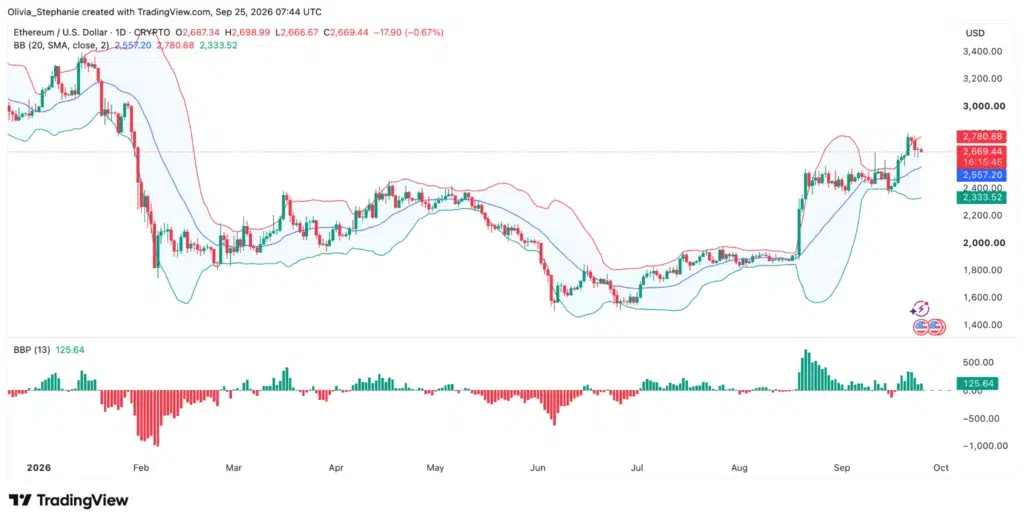
Ethereum has held near $2,667 after pulling back from the $2,800 region, while ETF inflows and exchange withdrawals continue as traders assess whether the recent breakout can survive.
Summary
- Ethereum trades near $2,667 after retreating from $2,800, while seven-day gains remain firmly positive overall.
- U.S. spot Ethereum ETFs attracted $66.01 million, extending their net inflow streak to five sessions.
- $2,540 remains the key breakout support as analysts assess whether Ethereum can retest $3,000 next.
- Binance stablecoin netflows rose sharply while Ethereum exchange netflows turned negative during the latest pullback.
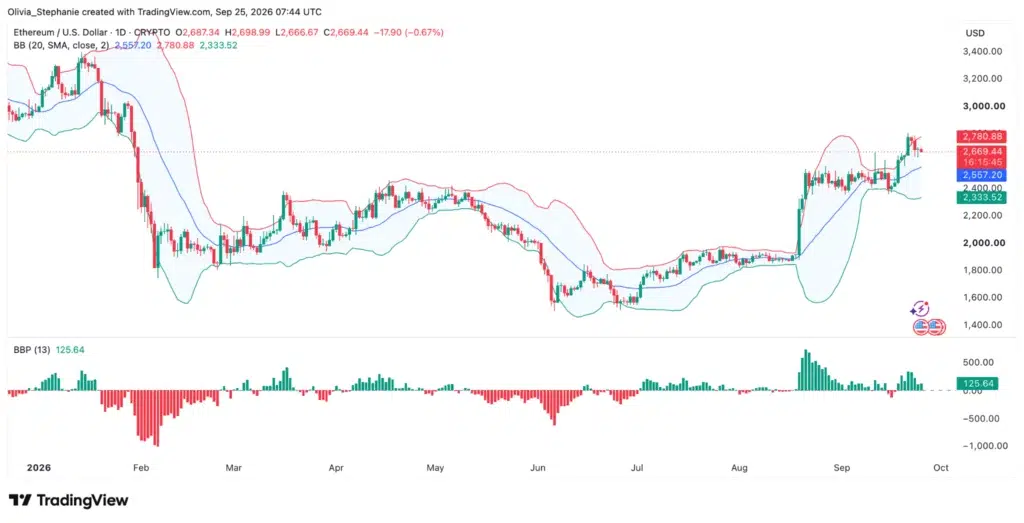
- BBP remains positive near 124.67, while Ethereum stays above its $2,557 Bollinger Band midpoint.
CoinGecko data show ETH closed around $2,687 on September 24 after reaching $2,775 on September 21. At the time of writing, Ethereum traded at $2,666.63, down 0.78% over 24 hours but up 7.90% over seven days, with a market capitalization near $326.3 billion.
The pullback followed a steep recovery from below $2,400 earlier in September. ETH approached $2,800 before sellers stopped the advance, bringing the former breakout area around 2,530–2,540 back into focus.
Why is Ethereum price struggling below $2,800?
Ethereum’s first problem sits around the recent high. The $2,530–$2,540 region previously acted as resistance and could now serve as support after the breakout. Analyst Wealthmanager placed a potential retest near $2,539, while the larger upside projection near $3,391 remains conditional on ETH holding support and clearing several resistance levels.
The supplied daily chart gives buyers some technical support. ETH remains above the 20-day Bollinger Band midpoint at $2,557.52. The upper band stands near $2,781.85, close to the region where the latest rally stalled, while the lower band sits around $2,333.18.
Bull Bear Power remains positive at approximately +124.67. Buyers therefore retain an advantage on that indicator, although the latest positive bars have contracted from their recent highs. Momentum has cooled as ETH moved away from the upper Bollinger Band.
As crypto.news reported in its Ethereum $2,800 rejection analysis, ETH remained above its longer 4-hour moving averages even after falling below $2,700. The 100-period moving average stood near $2,540.49, almost directly inside the breakout support zone now being watched.
That analysis placed the 4-hour 200-period moving average near $2,499.93. A deeper decline through the 2,530–2,540 region would therefore bring the $2,500 area into view before the much lower Bollinger support around $2,333.
Can ETF inflows keep the Ethereum breakout intact?
U.S. spot Ethereum ETFs have continued attracting money even as ETH retreated from its recent high. SoSoValue data showed $66.1 million in net inflows on September 24, extending the streak to five consecutive trading sessions.
BlackRock’s ETHA led the session with $26.8 million, followed by Fidelity’s FETH with $21.5 million. Grayscale’s Ethereum Mini Trust drew another $17.8 million. No U.S. spot Ether ETF recorded a net outflow during the session.
Across the five-session run, the funds accumulated $746.5 million. The sequence included $270 million on September 21, $162.2 million on September 22, $104.5 million on September 23 and $66.1 million the following session.
The declining daily inflow totals show that ETF demand has remained positive while slowing from the strongest session. Fund flows measure subscriptions into regulated products and do not establish whether ETH will hold any particular technical level.
Ethereum’s rejection near $2,800 occurred while institutional ETF demand stayed positive. As crypto.news previously reported in its analysis of Ethereum ETF inflows during the $2,800 rejection, the September 21 and 22 sessions alone drew $432.2 million before ETH fell below $2,700.
Exchange flows show ETH leaving as stablecoins enter Binance
CryptoQuant contributor CryptoOnchain reported another pattern beneath the pullback. Ethereum exchange netflow moved from +138,174 ETH on September 18 to -138,247 ETH on September 23, meaning the observed flow changed from net deposits to net withdrawals as the price retreated from $2,775.35.
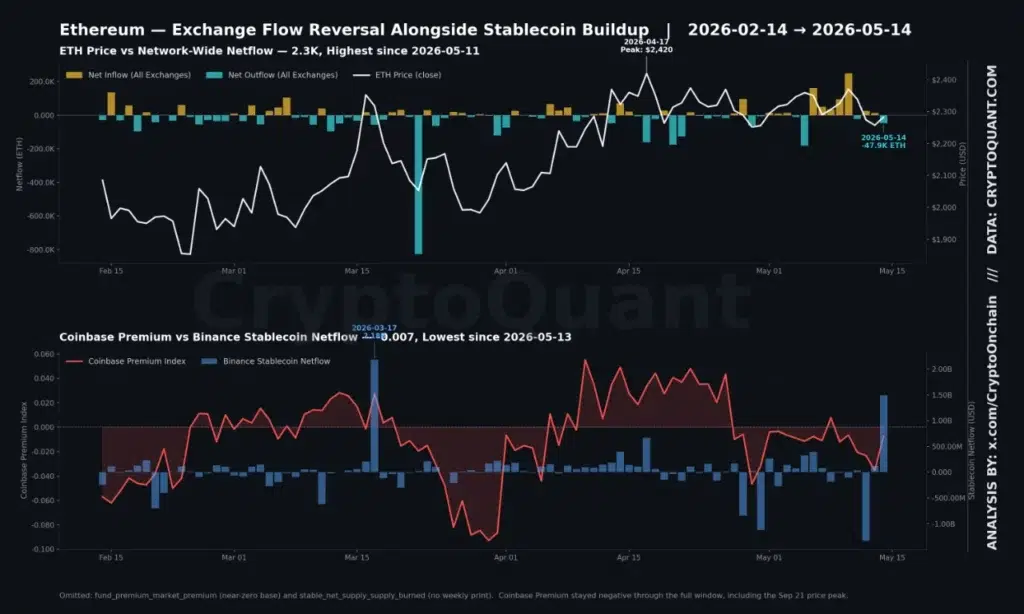
At the same time, CryptoOnchain reported that Binance stablecoin netflow averaged approximately $107.98 million per day during the week ending September 23, up 552% week over week. The analyst described one possible reading as capital positioning for re-entry, though that interpretation remains “unverified.”
A separate CryptoQuant post from the same analyst reported an average daily Binance USDT-on-Ethereum netflow of $80.8 million in the week ending September 21, the highest reading in its six-month comparison window. Binance’s total stablecoin reserve stood at $43.59 billion in that dataset.
CryptoOnchain’s September 23 dataset found that the Coinbase Premium Index remained negative, ranging from -0.01 to -0.09 during the observed period. Under that measure, U.S. Coinbase spot activity did not lead the move toward the September 21 high.
The staking rate moved in the opposite direction, rising from 35.30% to 35.71% during the same period, according to the analyst. Staking changes occur more slowly than daily price action, so the rise does not establish a direct cause for ETH’s latest rebound.
Will Ethereum reach $3,000 before a deeper correction?
The immediate upside test remains 2,781–2,800. The upper Bollinger Band sits around $2,781.85, while recent spot trading failed to sustain a move through the same region. Regaining it would leave $3,000 as the next large psychological level identified across several analyst setups.
RektProof’s scenario projects that ETH “could” approach $3,000 before rotating lower toward equal lows around $2,300. The analyst places heavier resistance between $3,000 and $3,200. Such a path remains a forecast, not a confirmed price target.
Wealthmanager’s chart uses a more aggressive conditional target near $3,391 if ETH successfully holds $2,540 and clears $2,800 and $3,000. IncomeSharks has separately mapped a deeper liquidity sweep toward 2,100–2,200 before a potential recovery toward 3,400–3,500. Neither path has been confirmed by current price action.
Leverage creates another risk around the support zone. Analyst Celal Kucuker warned that heavy long positioning “could” produce a liquidation-driven decline of approximately 20% if support fails and forced selling accelerates. The scenario would weaken if buyers defend support and ETH recovers.
More immediate liquidation data place the first pressure points much closer to the market. Crypto.news reported liquidation bands around $2,650 and $2,630 after ETH’s September 23 reversal, with another concentration around $2,700.
For the current chart, $2,557.52 remains the Bollinger midpoint, while the 2,530–2,540 region combines former breakout resistance with the 4-hour 100-period moving average. A recovery would first face 2,781–2,800 before the 3,000–3,200 resistance range identified by the analyst charts.
Disclosure: This article does not represent investment advice. The content and materials featured on this page are for educational purposes only.
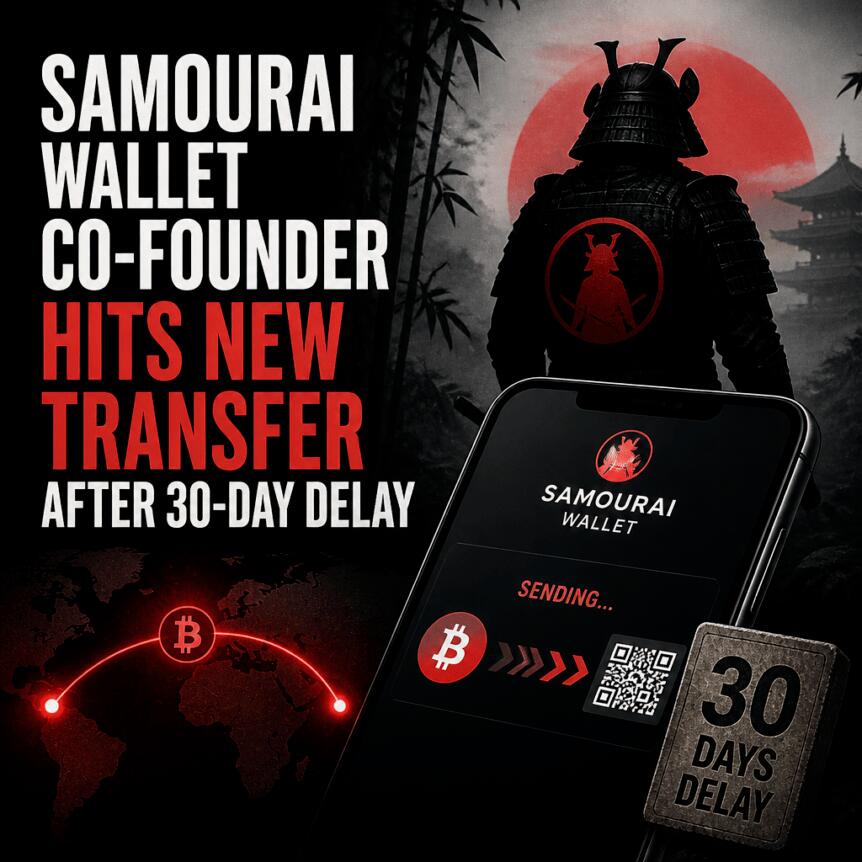
Samourai Wallet co-founder Keonne Rodriguez says inmates at FCI McKean have been told that he and about 70 other participants will be transferred to different facilities after a drug treatment program was deactivated. Rodriguez made the claim on X, adding that he had entered the program because completing it could reduce his sentence by up to a year.
The situation comes as Rodriguez—who is serving a five-year term for his role in an unlicensed money-transmitting business—continues to navigate prison transfers while his case remains entangled with broader U.S. policy debates over whether developers who do not control users’ funds can be treated as financial intermediaries.
Key takeaways
- Rodriguez says FCI McKean deactivated a drug treatment program tied to sentence-reduction eligibility for him and roughly 70 other participants.
- He reported that a prior transfer from FPC Morgantown to McKean proved far longer and harsher than expected, with travel that he said he was not allowed to do himself.
- The federal government states Rodriguez and Samourai co-founder William Lonergan Hill transmitted more than $237 million in criminal proceeds through the service.
- In Congress, the CLARITY Act framework aimed at protecting non-controlling crypto developers from certain money-transmission obligations has stalled after a Senate procedural vote failed.
FCI McKean program ended; another transfer expected
Rodriguez said on X that the warden at FCI McKean informed program participants that he and 70 others would be moved to facilities where treatment is still available. He framed the transfer as a setback to his attempt to continue the drug treatment program.
Rodriguez entered the program because completing it could reduce his sentence by up to a year, according to his account. With the program deactivated at McKean, the practical next question for investors and crypto builders is what this means for Rodriguez’s ability to stay on track for any sentence-reduction pathway—especially since transfers can disrupt schedules, eligibility, and continuity of care.
Rodriguez describes a harsher-than-expected transfer from Morgantown
In a letter published by The Rage, Rodriguez characterized his initial move from FPC Morgantown to McKean as the “absolute worst 30 days” of his life. He said his request to make the approximately four-hour trip himself was denied, and he described the process as far more drawn out.
According to Rodriguez, inmates leaving Morgantown were placed in ankle shackles and handcuffs attached to waist chains before being transported by bus to an airport and flown to the Federal Transfer Center in Oklahoma City. He said that once at the transfer center, he was held with prisoners from different security classifications and spent most of his time locked in a cell.
Rodriguez also wrote about the conditions at the Federal Transfer Center, including that he wondered whether the “all the circles of hell” were contained within the facility. He later said he was assigned a cell with an inmate serving a murder sentence and that he received only part of a foam mattress, leaving part of his body to rest on a metal bunk overnight.
Conviction and sentence: what prosecutors said Samourai did
Rodriguez is serving a five-year sentence after pleading guilty to conspiring to operate an unlicensed money-transmitting business. Cointelegraph previously reported on the case’s broader developments surrounding a petition and related legal efforts, including coverage that ties Rodriguez’s sentence to Samourai’s operation.
Separately, the U.S. Department of Justice said in a sentencing announcement that Rodriguez and co-founder William Lonergan Hill transmitted more than $237 million in criminal proceeds through the service. The government’s framing focused on the transmission of criminal funds rather than on any claim that users retained full control or that developers were outside the flow of money.
For readers following crypto policy, that legal characterization helps explain why the debate over “developer protections” is central to the sector’s risk outlook: it highlights the potential gap between how software is built (and who controls assets) and how prosecutors may describe the service’s economic function.
CLARITY Act pause leaves developer protections in limbo
Rodriguez’s case has unfolded alongside congressional efforts intended to reduce compliance risk for crypto developers who do not control users’ assets. Those efforts are reflected in the CLARITY Act framework, which has sought to clarify that non-controlling developers should not necessarily be treated as financial intermediaries subject to money-transmission requirements under the Bank Secrecy Act.
According to Cointelegraph’s coverage, the latest Senate CLARITY Act draft retained Blockchain Regulatory Certainty Act provisions designed to protect non-controlling developers from certain money-transmission obligations. However, the Senate failed to advance the CLARITY Act on Sept. 15 after a procedural vote fell short of the 60 votes needed to move the legislation forward.
That legislative stall matters to builders and businesses because it increases uncertainty around how federal agencies and courts could interpret developer involvement going forward—especially in cases where software tools, even without direct user asset control, are alleged to have facilitated illicit financial activity.
What to watch next
Rodriguez’s reported transfer after the deactivation of drug treatment at FCI McKean will likely be the immediate development to follow, because sentence-reduction eligibility can hinge on program continuity. At the same time, the broader policy question—whether the Senate will revive and pass the CLARITY Act to better define developer obligations—remains unresolved, leaving crypto firms to plan under continued legal ambiguity.
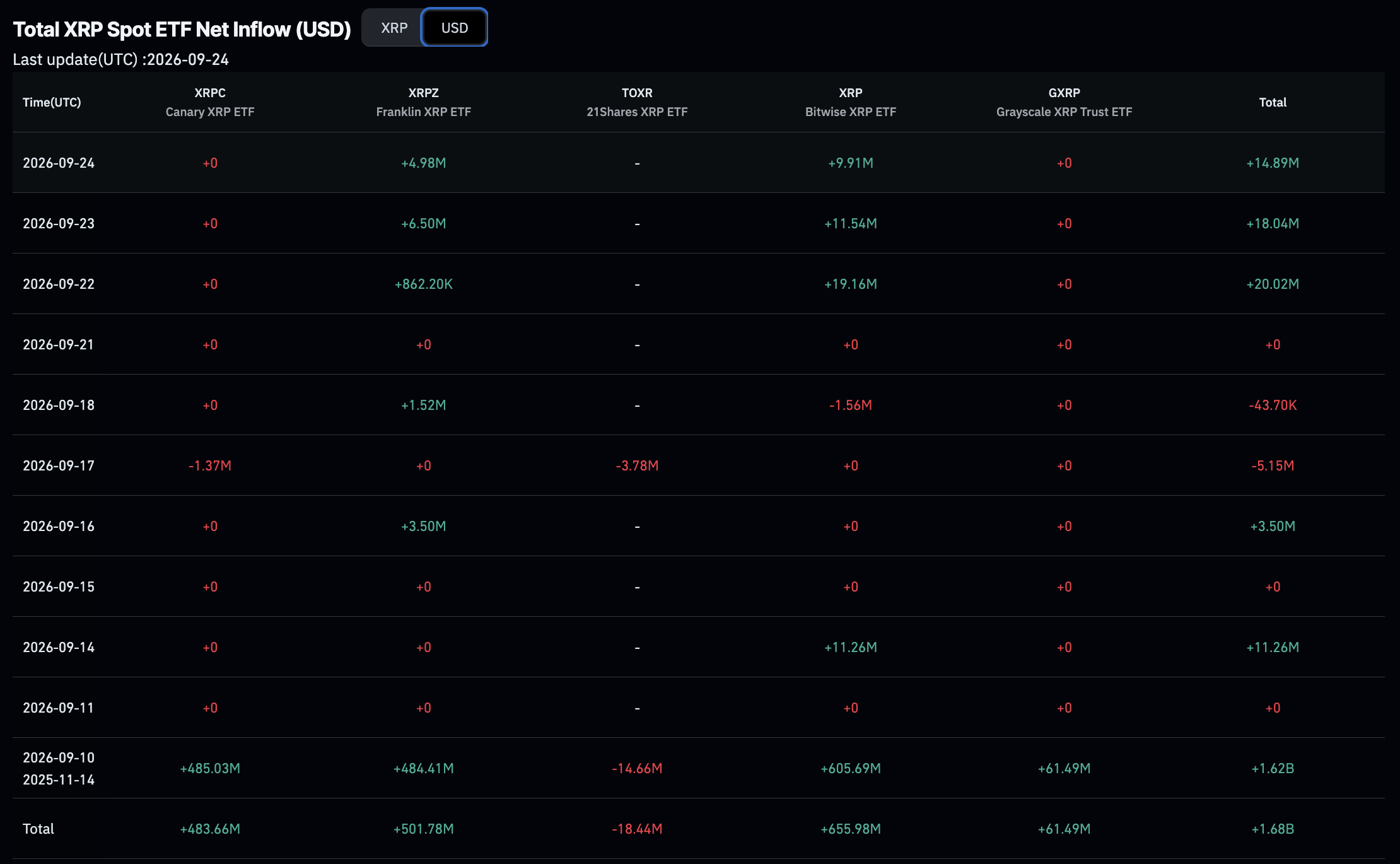
XRP price trades at $1.53, up by a marginal 1.5% on the day, and is still sitting on one of the strongest weekly charts among large-cap tokens, shrugging off bearish prediction. Zoom out to seven days, and the picture changes dramatically. Gains in the 17-18% range put XRP ahead of most of the top-10 field.
The move has been driven by real inflows. Spot ETF products tied to XRP pulled in $1.73 billion, and total ETF assets under management now sit near $1.7 billion. Absa’s launch of institutional digital asset custody with Ripple expanded regulated access across Africa.
Meanwhile, the CFTC’s ongoing work on new crypto asset rules keeps compliance-driven capital watching the token closely. Community chatter has flagged a double-top forming near $1.55-$1.60, a pattern that makes technical traders nervous even when the fundamental backdrop looks constructive.
Broader crypto markets remain risk-on this week, but XRP’s own volatility tells a cautionary tale: a reported 15.8% surge on September 23 was followed almost immediately by a 6.9% pullback the next day. That whipsaw sets the stage for the technical breakdown below.
Earn $50 and Enter $300K Prize Draw on EdgeX
XRP Price Prediction: Can Ripple Hit $1.63 This Week?
XRP is changing hands at $1.53, almost flat on the session after a volatile week that saw the price swing between $1.45 and $1.55. Daily volume has run near $4.5 billion, evidence that liquidity hasn’t dried up despite the choppiness.
The token holds above its MA-20, MA-50, and long-term MA-200, a generally constructive technical posture, with the Ichimoku Kijun line at $1.50 acting as immediate support. Momentum readings are mixed but lean positive: MACD signals buy, RSI sits in buy territory, yet ADX and CCI register neutral, and Stochastic RSI flags an oversold condition.

Bull case: a clean break above $1.60-$1.63 opens a path toward $1.66 and eventually $1.83.
Base case: consolidation inside the $1.4642-$1.6359 corridor, which carries a modeled 78% probability of resolving upward.
Bear case: a decisive loss of the $1.4642-$1.4800 support zone exposes $1.40-$1.41.
For a deeper breakdown of the resistance structure and Binance reserve trends shaping this setup, see this XRP price prediction analysis of the $1.63 test. Traders should treat $1.63 as the line that separates continuation from another round of chop.
Trade XRP on Bybit and Get a Chance to Win Our $1,000 USDT Airdrop
Maxi Doge Targets Early Mover Upside as XRP Tests Key Levels
XRP holders riding this week’s rally already have their answer on the upside. A breakout above $1.63 likely means single-digit percentage gains from here, not a multiple. That’s the reality of trading a token with XRP’s market cap.
Whale flows and futures positioning covered in this bullish October outlook for XRP support the near-term case, but anyone chasing outsized returns is looking in the wrong place. Early-stage presales are where that asymmetry still exists.
Maxi Doge ($MAXI) is building exactly that kind of setup on Ethereum. The project has raised $4.8 million at a current presale price of $0.000284, with dynamic APY staking live for early participants. Its identity leans hard into gym-bro meme culture, a 240-lb canine mascot channeling 1000x leverage energy.
Holder-only trading competitions with leaderboard rewards, and a Maxi Fund treasury earmarked for liquidity and partnerships. The tagline says it plainly: never skip leg-day, never skip a pump.
Research Maxi Doge’s presale now before the funding window closes.
Discover: Best Crypto IPO this September
The post XRP Price Prediction: Weekly Gains Lead Crypto Market, But Can XRP Clear $1.63? appeared first on Cryptonews.


US spot Bitcoin ETFs drew $191 million Thursday as daily inflows slowed for a third day, lifting year-to-date net flows to $787 million.

Samourai Wallet co-founder Keonne Rodriguez faces another prison transfer after the drug treatment program at FCI McKean was deactivated, he said Wednesday.
Rodriguez said on X that McKean’s warden told program participants that Rodriguez and 70 others would be moved to facilities where treatment remains available. He entered the program because completing it could reduce his sentence by up to a year.
In a letter published by The Rage, Rodriguez called his earlier journey from FPC Morgantown to McKean the “absolute worst 30 days” of his life. He said his request to make the roughly four-hour trip himself was denied.
Rodriguez is serving a five-year sentence after pleading guilty to conspiring to operate an unlicensed money-transmitting business. The Justice Department said he and Samourai co-founder William Lonergan Hill transmitted more than $237 million in criminal proceeds through the service.
A four-hour drive became 30 days in transit
Rodriguez said inmates leaving Morgantown were placed in ankle shackles and handcuffs attached to waist chains before being taken by bus to an airport and flown to the Federal Transfer Center in Oklahoma City.
Related: Samourai Wallet co-founder spends Christmas Eve recounting first day in prison
At the facility, Rodriguez said he was held with prisoners from different security classifications and spent most of his time locked in a cell. At one point, he wrote that he wondered whether “all the circles of hell” were contained within the federal transfer facility.
Rodriguez said he was eventually assigned a cell with an inmate serving a murder sentence and was given only part of a foam mattress, leaving part of his body resting on a metal bunk overnight.
Developer protections remain uncertain after CLARITY setback
The case unfolded alongside congressional efforts to protect developers who do not control users’ assets from being treated as financial intermediaries.
The latest Senate CLARITY Act draft retained Blockchain Regulatory Certainty Act provisions protecting non-controlling developers from certain money-transmission requirements under the Bank Secrecy Act.
The Senate failed to advance the CLARITY Act on Sept. 15 after a procedural vote fell short of the 60 votes needed to move the legislation forward.
Magazine: Winners and losers of the SEC’s new tokenized stocks rules

Magic Eden has faced reports of a possible contract exploit after unusual transactions showed thousands of NFTs being sold for 0 ETH, although one account involved in the activity has claimed the transfers are part of a whitehat operation.
Summary
- Magic Eden faces reports of a possible contract exploit after thousands of NFTs were reportedly sold for 0 ETH.
- NFT trader Cirrus warned users to revoke approvals after spotting the unusual activity, but said it could potentially involve a whitehat.
- Pseudonymous user Quit later claimed the transfers were a whitehat operation and said assets held at the identified wallet would be returned.
- Magic Eden has not yet confirmed an exploit or disclosed how many NFTs or wallets may have been affected.
NFT trader Cirrus first flagged the activity on Sept. 25, saying NFTs were showing sales originating from Magic Eden and that the marketplace’s contract may have been exploited.
Cirrus later warned users who had previously interacted with Magic Eden to remove their approvals after observing someone selling thousands of NFTs to themselves for 0 ETH. The trader noted at the time that the activity could potentially be linked to a whitehat.
Magic Eden had not released an official statement confirming an exploit at the time of writing, leaving the nature and scale of the incident unclear.
Possible whitehat says NFTs are safe
Shortly after the warning, pseudonymous X user Quit claimed the activity was a whitehat operation.
Quit said assets held at 0x71cf3f5724bD2B72Ef6464992aCd26216DE7fe33 were safe and would be returned once they were no longer considered at risk.
No confirmation from Magic Eden has established that the address belongs to an authorized whitehat or that the transactions were carried out as part of a coordinated recovery effort.
Details about the vulnerability that may have allowed the transactions, how many wallets were affected and the total value of NFTs moved have not yet been disclosed.
Magic Eden had ended EVM marketplace support
The unusual Ethereum NFT activity comes months after Magic Eden changed its marketplace operations.
Crypto.news previously reported that Magic Eden ended support for its Bitcoin and EVM based NFT marketplaces earlier this year while retaining its Solana marketplace.
Magic Eden’s own support documentation states that EVM marketplace support ended on March 9. The company said listings, bids and offers on its EVM marketplace were offchain and would stop being visible or actionable after the shutdown.
The platform continues to support its Solana marketplace, while its current products include Packs, which can contain NFTs from Ethereum collections. Magic Eden says NFTs revealed through Packs can be traded on the marketplace.
Magic Eden has yet to say whether the activity reported on Sept. 25 affected any of those services or involved contracts associated with its discontinued EVM marketplace.
(This is a developing story.)

The US 10-year Treasury yield has reached 5.2% during trading, raising questions about whether crypto can hold its recent gains while another Federal Reserve rate hike remains possible and a major US digital asset bill is stalled.
Summary
- The 10-year Treasury yield reached 5.2% during trading on Sept. 24 as oil prices rose and Fed officials kept another rate hike in view.
- Bitcoin traded near $84,000 after retreating from $87,000, while recent ETF inflows showed that demand had continued despite higher yields.
- The Senate has yet to advance the CLARITY Act, leaving crypto firms waiting for legislation as the SEC and CFTC pursue separate rules.
The US Treasury recorded a 10-year yield of 5.18% on Sept. 24, up from 5.11% a day earlier. The 30-year yield closed at 5.47%, its highest level since 2004. The 10-year yield reached 5.20% during the session before ending below that level.
Bitcoin traded around $84,000 after retreating from the $87,000 area earlier in the week. The pullback has been limited so far, but higher bond yields have arrived at a time when investors are watching whether recent buying through US spot Bitcoin funds will continue.
Why are Treasury yields rising?
Oil prices climbed on Sept. 24 after a Houthi missile attack on Saudi Arabia renewed concerns about supply. Brent crude futures settled at $106.60 a barrel, up $3.52, while West Texas Intermediate crude finished at $94.61, up $2.45. Prices eased from their intraday highs following reports of US-Iran discussions about reopening the Strait of Hormuz.
Higher energy costs have kept inflation in focus for the Federal Reserve. Philadelphia Fed President Anna Paulson said on Sept. 24 that underlying inflation was running around 2.5% to 3%, above the central bank’s 2% target. Paulson supported last week’s quarter-point rate hike and said modest further tightening may be warranted if economic conditions develop as she expects.
New York Fed President John Williams described another hike before the end of the year as a reasonable expectation, though he said the decision would depend on incoming data. The Fed raised its benchmark rate to a range of 3.75% to 4.00% on Sept. 16, and its latest projections indicated that another increase could follow this year.
Recent economic figures have done little to settle the question. Initial claims for unemployment benefits fell to 197,000 in the week ended Sept. 19, according to the Labor Department. S&P Global’s preliminary US composite purchasing managers’ index rose from 56.0 in August to 58.4 in September, pointing to the fastest growth in business activity in more than five years.
The Census Bureau estimated that August new home sales rose 6.4% from July. Its stated margin of error was wider than the reported monthly change, so that estimate alone does not establish a firm rise in housing demand.
Can crypto hold up while bond yields climb?
A 10-year Treasury yield near 5.2% gives investors a higher return on US government debt at the same time that further Fed tightening remains under discussion. Bitcoin’s response has been mixed. It rallied after the Sept. 16 rate hike and moved above $82,000 this week, but later fell back from the $87,000 area.
As previously reported by crypto.news, wallets holding 100 to 1,000 BTC had accumulated 113,950 BTC between July 15 and Sept. 24. US spot Bitcoin exchange-traded funds recorded their fifth consecutive session of net inflows on Sept. 23. Both figures point to buying during the rally, though neither establishes how investors will respond if yields continue to rise.
Demand through the funds has varied considerably this month. Bitcoin ETFs ended the Sept. 14 to Sept. 18 week with roughly $6.1 million in net inflows despite taking in $433 million on its final trading day. The subsequent run of positive sessions accompanied Bitcoin’s move higher. HashKey Group senior researcher Tim Sun said short-term ETF flows often follow Bitcoin’s price instead of reliably predicting its next move.
Buying after the Fed decision came from several parts of the market, including spot investors, ETF buyers and traders closing short positions. The rally showed that last week’s rate increase did not prevent Bitcoin from gaining. Its retreat from $87,000 leaves the durability of that demand open to another test as Treasury yields rise.
US shares offered little indication of a broad selloff on Sept. 24. The S&P 500 slipped 0.02%, the Nasdaq Composite gained 0.01% and the Dow Jones Industrial Average fell 0.31%, despite the rise in borrowing costs.
Regulatory uncertainty remains another pressure point
Higher Treasury yields are testing demand for crypto just as the industry faces a longer wait for US market rules. The Senate failed to advance the Digital Asset Market Clarity Act on Sept. 15, with 49 senators voting for the procedural motion and 50 against. It needed 60 votes to proceed. The bill would define how the Securities and Exchange Commission and the Commodity Futures Trading Commission oversee digital asset markets.
The vote did not stop Bitcoin’s subsequent rally, but it left firms and investors without the legislation they had expected Congress to consider. Seven Senate Democrats reopened negotiations after the vote, though no new vote has been secured. Fireblocks US policy director Jessica Martinez said companies would continue developing products without the bill, while legislation would give them rules with more staying power than agency decisions.
Regulators have continued work as the market weighs the prospect of another Fed hike. The CFTC submitted proposed crypto market rules for White House review on Sept. 18, a step that precedes any commission vote or public comment period. The SEC has issued an exemption for certain tokenized securities activity. Neither action resolves the Senate bill, leaving the timing of a federal market structure law unsettled while crypto investors assess higher yields.
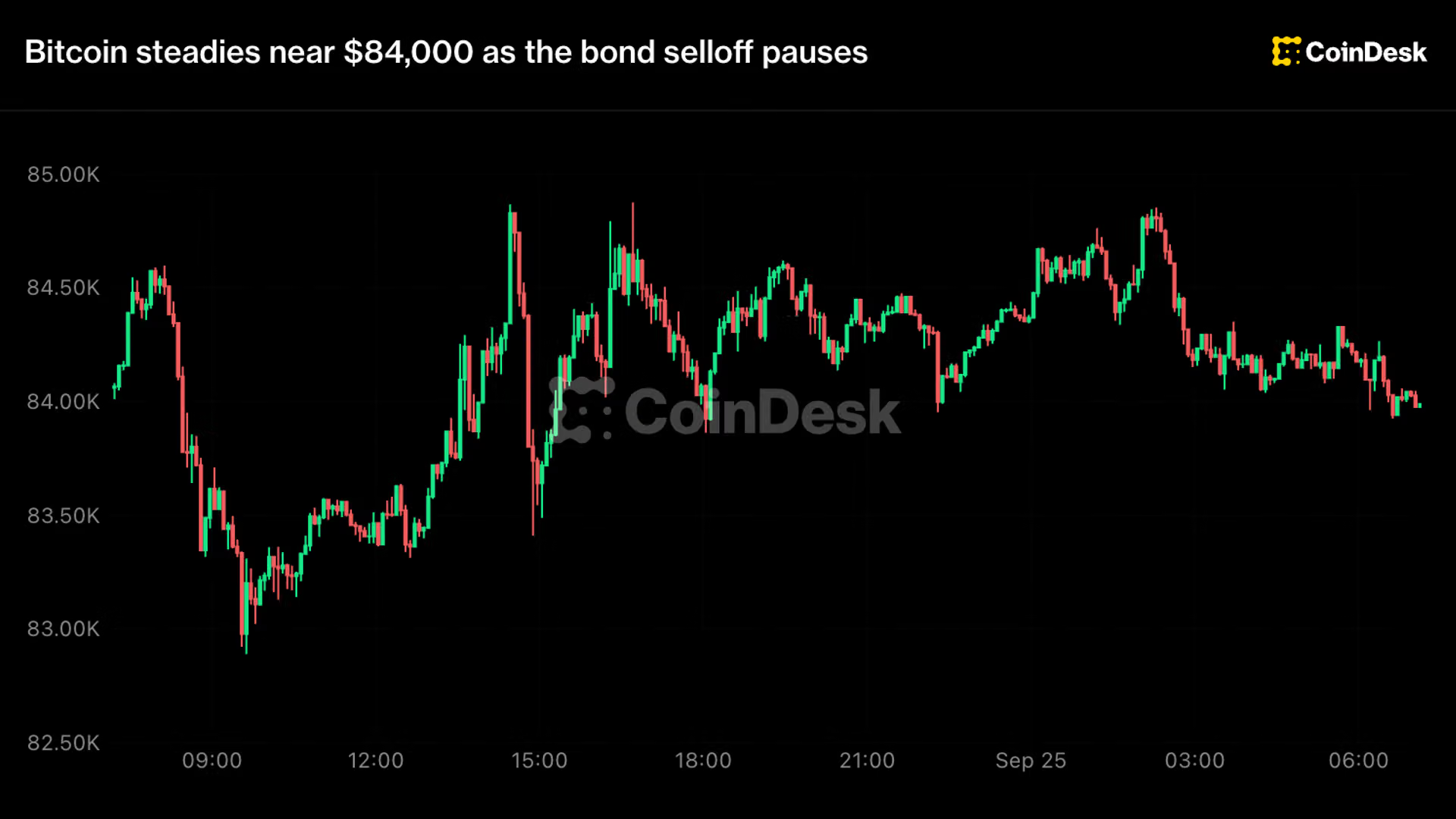
Bitcoin traded just above $84,000 on Friday, flat over 24 hours after falling below that level on Wednesday, CoinDesk data show. Most major tokens moved less than 2%. Smaller names did the running, with ONDO up 27% to about 54 cents and Quant up 39% to nearly $100.
Bonds found a floor in Asia. The 10-year Treasury yield slipped two basis points to 5.17% after jumping more than 20 basis points over the previous two sessions, and Brent fell 1% to about $105 a barrel on reports that Washington and Tehran are exploring a phased deal to reopen the Strait of Hormuz.
FxPro chief market analyst Alex Kuptsikevich reads bitcoin’s drop as a stall short of the target technical traders had projected for the rally that began in mid-August.
“As with the overall market capitalisation, the leading cryptocurrency encountered resistance near a previously significant support level. However, BTC failed to complete the Fibonacci extension pattern to 161.8% of the impulse that began in mid-August in a single move. Despite the pullback, the ongoing, unfinished nature of the uptrend suggests it may be a temporary pause on the way up,” he said in a note.
“It is worth remembering that in 2021, Bitcoin lost over 50% from its peak before reaching new highs. Similarly, today, a decline to $70K may be painful for short-term speculators, but it does not undermine the bullish outlook,” he added.
Bitcoin heads into Friday’s Deribit expiry below $85,000, the strike carrying one of the largest blocks of call options.
Bitcoin has held near $84,000 after twice failing to sustain moves above $87,000, while ETF inflows, whale accumulation and falling exchange balances continue beneath the price consolidation.
Summary
- Bitcoin trades near $84,400 after rejecting $87,000, while seven-day gains remain above ten percent currently.
- U.S. spot Bitcoin ETFs drew $191 million September 24, extending net inflows to six sessions.
- Large entities accumulated 30,269 BTC over 96 hours as Bitcoin corrected from highs, Martinez says.
- CryptoQuant data show Binance recorded 13,800 BTC net outflows in one day, largest since 2023.
- BBP remains positive near 4,790, while neutral CMF shows no clear buying-flow confirmation yet.
CoinGecko shows Bitcoin near $84,403 at the latest check, with a 24-hour range between $82,941 and $84,843. BTC has gained roughly 10.3% over seven days, keeping most of its rebound from last week’s low near $75,000.
The current pause follows a sharp reversal from September 16, when the Federal Reserve raised its target rate by 25 basis points to 3.75%–4.00%. One day earlier, Senate cloture on the CLARITY Act failed 49–50, short of the 60 votes needed to advance the bill.
BTC briefly traded close to $75,000 around those events before recovering above $80,000 and reaching $87,392 on September 21. The price has since retreated toward $84,000, leaving traders to assess whether demand behind the rebound remains strong enough for another attempt higher.
Why is Bitcoin price holding near $84K?
Bitcoin’s latest rejection came from the 86,000–87,000 zone, which has now stopped the price more than once. Crypto.news previously identified the $86,700 Bitcoin resistance and $82,000 support setup after the asset returned from its eight-month high.
Rekt Capital said BTC needs to stay above roughly $82,000, or successfully retest the level during another correction, to avoid falling back into its former 60,000–80,000 trading range. Bitfinex separately identified 85,000–86,500 as a dense buyer cost area after the latest rally.
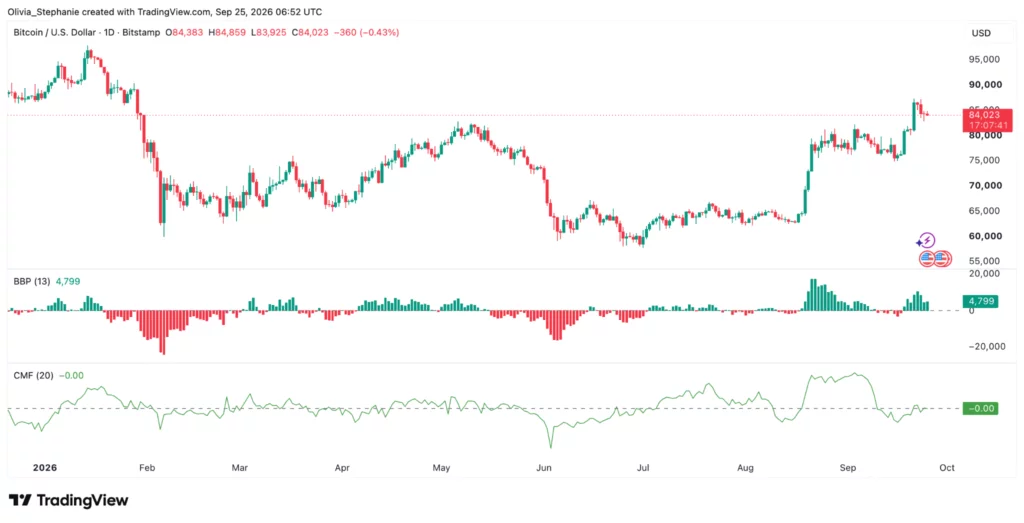
The chart’s Bull Bear Power reading remains near +4,790. A positive BBP figure means bulls still exert more pressure than bears, though the latest histogram bars have fallen from their recent peak. Momentum therefore remains positive but weaker than during the surge through $82,000.
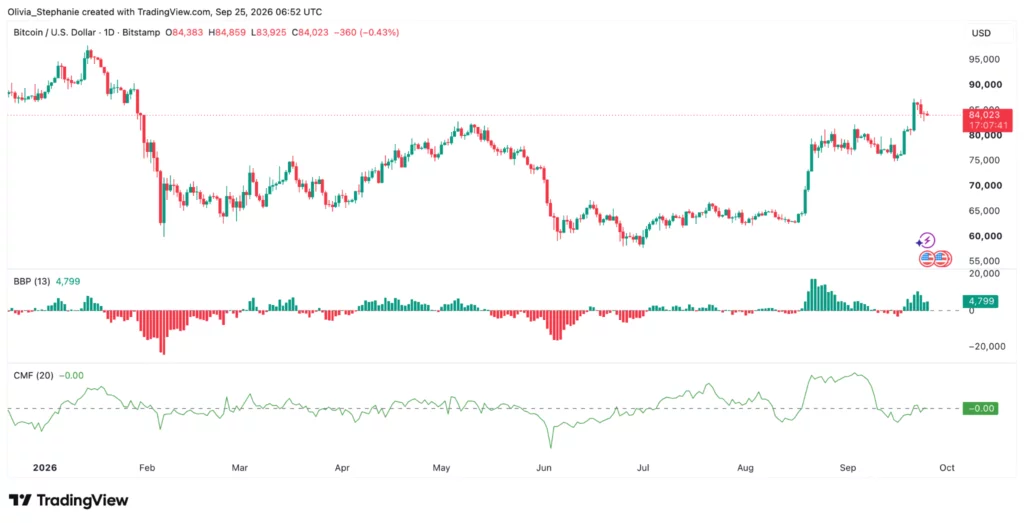
Chaikin Money Flow gives a less aggressive reading. CMF sits around 0.00 after recovering from negative territory, leaving buying and selling pressure close to balanced. A sustained move above zero would provide stronger volume-based evidence of accumulation, while another move below zero would show capital flow weakening as BTC tests support.
The combination leaves price momentum stronger than money flow. BBP continues to favor buyers, but CMF has not confirmed persistent buying pressure behind the move toward $87,000.
ETF inflows continue even as BTC consolidates
U.S. spot Bitcoin ETFs recorded another $191 million in net inflows on September 24, extending their positive streak to six trading sessions, according to SoSoValue data. BlackRock’s IBIT led the session with approximately $163 million, while Fidelity’s FBTC received $12.86 million.
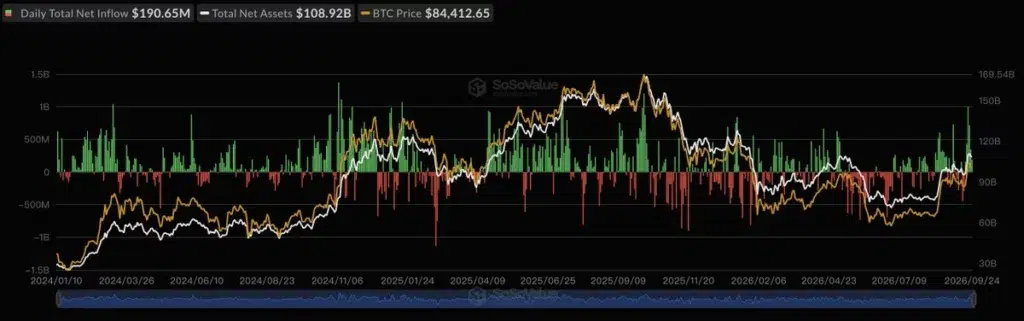
The latest figure follows much larger subscriptions earlier in the week. Funds received approximately $999 million on September 21, $714.7 million on September 22 and $346.98 million on September 23.
ETF flows had moved in the opposite direction around the Fed meeting. U.S. funds lost approximately $746.3 million across September 15 and 16 before demand returned, according to crypto.news’ analysis of who bought Bitcoin after the Fed rate hike.
The September 24 inflow brings the current streak to six sessions even though BTC has pulled back from $87,000. SoSoValue data reported through current coverage put cumulative U.S. spot Bitcoin ETF inflows near $57.41 billion, with net assets around $108.9 billion.
Are Bitcoin whales buying the pullback?
Large-holder activity has stayed active during the retreat. Crypto analyst Ali Martinez reported that large entities accumulated approximately 30,269 BTC during a 96-hour period, worth roughly $2.57 billion at the prices used in his calculation.
His estimate covers a period when Bitcoin fell around 5.24%, from approximately $87,400 to $82,800. The accumulation figure comes from on-chain wallet analysis and does not establish the identities of the entities buying the coins.
A separate Santiment dataset showed sustained accumulation before the latest correction. Wallets holding 100–1,000 BTC added 113,950 BTC between July 15 and September 23, increasing their combined holdings to roughly 5.24 million BTC.
Wallet cohorts do not map directly to individual investors. One institution may control several addresses, while exchanges, custodians and funds can consolidate or separate holdings. The figures document changes in wallet balances without proving who ultimately owns each position.
Binance outflows add another signal below $87K
Exchange balances have moved in the same direction as large-wallet accumulation. CryptoQuant contributor Darkfost reported more than 13,800 BTC in net withdrawals from Binance during a single day, the exchange’s biggest daily net outflow since 2023.
Recent Binance netflows have averaged around negative 2,000 BTC per week, while the exchange’s Bitcoin holdings fell from approximately 705,000 BTC to 685,000 BTC within four days. Darkfost interpreted the withdrawals as accumulation because coins leaving an exchange may be moved into personal or institutional custody.
Exchange withdrawals do not prove that holders will keep their BTC or that prices must rise. Coins can leave an exchange for custody transfers, collateral use, over-the-counter transactions or other purposes. Darkfost’s interpretation remains an analyst assessment of the flow data.
CryptoQuant contributor Amr Taha reported a similar pattern across several venues from September 22 through September 24. His figures put combined negative netflows from Binance, Coinbase, Kraken and Bitfinex at roughly $2.52 billion over the three-day period.
The reported flows included approximately $1.57 billion in combined withdrawals on September 22, $438 million the following day and $511 million on September 24. The withdrawals continued while Bitcoin slipped from roughly $87,400 toward $84,000.
Is a Bitcoin breakout coming before October?
The first technical hurdle remains the same area that rejected BTC twice this week. A recovery through roughly $86,700 would return Bitcoin to the upper end of its recent range, while $87,392 remains the latest eight-month high. Crypto.news’ Bitcoin ETF and $86,000 breakout analysis previously identified returning fund demand and short covering as contributors to the rally.
October seasonality provides another data point, though historical returns cannot establish the next move. CoinGlass data tracks Bitcoin’s monthly performance, while historical records show October finished higher in 10 of the 13 years from 2013 through 2025.
Ali Martinez has cited the same 10-of-13 record while describing the approaching month as a possible “Uptober.” The pattern remains backward-looking: Bitcoin broke the streak in October 2025, when the asset finished the month around 3.9% lower.
The Federal Reserve’s next scheduled policy meeting is October 27–28. Its September statement said inflation remained elevated when officials raised the federal funds target range to 3.75%–4.00%.
Disclosure: This article does not represent investment advice. The content and materials featured on this page are for educational purposes only.
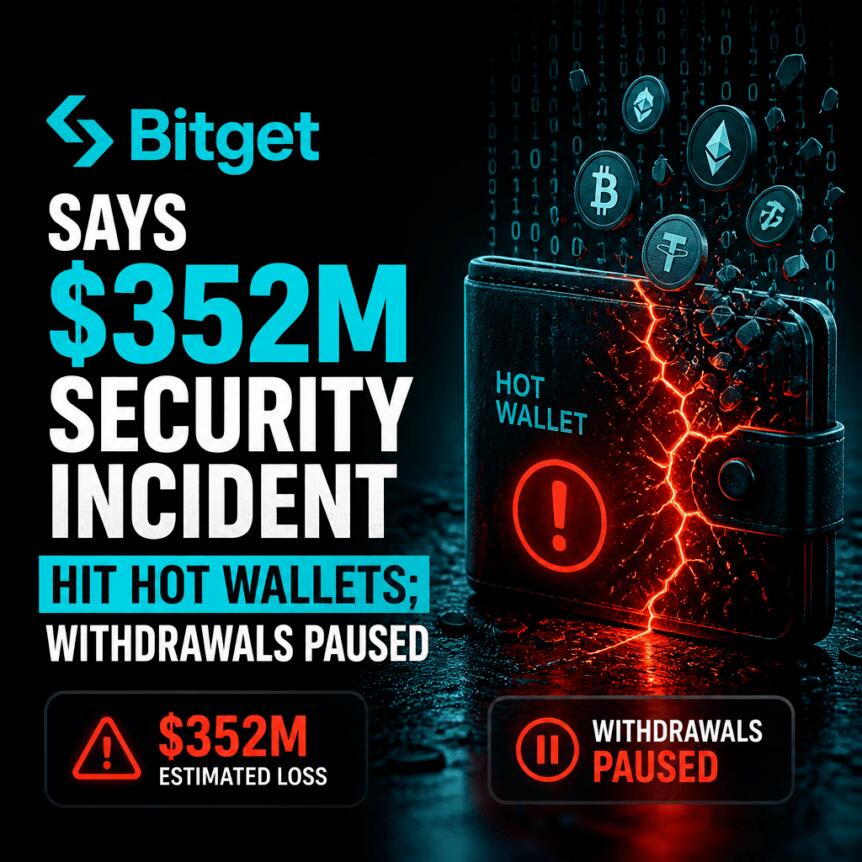
Crypto exchange Bitget has confirmed that it detected unauthorized transfers tied to a security breach and has temporarily suspended withdrawals while it investigates. The exchange said the incident impacted assets totaling about $351.6 million, affecting a limited set of hot-wallet holdings.
Bitget reported that its systems identified the suspicious activity at 18:31 UTC on Thursday, triggering emergency response measures. In an effort to contain the damage, the company said the breach was limited to certain hot and warm wallet layers, while cold wallets remained secure.
Key takeaways
- Bitget says unauthorized transfers impacted approximately $351.6 million and were traced to a limited number of hot wallets.
- The exchange temporarily suspended withdrawals and is conducting a security review after detecting activity at 18:31 UTC.
- CEO Gracy Chen said affected funds were primarily concentrated on Ethereum, with other networks including XRP Ledger, Avalanche, BNB Smart Chain, and Arbitrum also involved.
- Bitget stated that user balances remain accurate and that deposits and trading continue normally.
- Chen said affected assets are more than covered by Bitget’s User Protection Fund, which the exchange says holds more than $464 million.
Unauthorized transfers detected in hot-wallet layers
In a statement posted on X, Bitget said its security monitoring systems detected unauthorized transfers originating from a small number of hot wallets. The firm linked the activity to emergency response procedures initiated immediately after the alert, with the incident date and time cited as 18:31 UTC on Thursday.
Speaking directly in a live Q&A, CEO Gracy Chen emphasized that the breach was contained to a portion of the exchange’s hot and warm wallet infrastructure. She also said Bitget’s cold wallets were not compromised.
According to Chen, the stolen or affected assets included Ether (ETH), XRP (XRP), USDt (USDT), USDC (USDC), Avalanche (AVAX), BNB (BNB), and USDT0 (USDT0) on Arbitrum. She attributed the largest concentration of observed stolen funds to Ethereum.
Multiple chains involved, with Ethereum the main concentration
Chen named several networks as affected, including Ethereum, the XRP Ledger, Avalanche, BNB Smart Chain, and Arbitrum. While Bitget highlighted Ethereum as the primary venue for the observed stolen funds, the exchange also reported activity across other ecosystems, suggesting the attacker or attackers operated across multiple wallet and chain configurations rather than a single isolated target.
Bitget’s communications also acknowledged how early onchain reporting differed from later disclosures. Chen said early onchain monitoring captured a smaller amount than what Bitget later reported because the incident extended beyond the Ethereum activity reflected in those initial traces. That distinction matters for traders and users because estimates of breach scope can change as investigators widen the analysis window and broaden the search beyond the first chain clusters detected.
Withdrawals paused; deposits and trading continue
Bitget said it has temporarily suspended withdrawals as part of its security review. Chen indicated that she expected withdrawals to resume within hours or days, framing the pause as a precaution while the exchange verifies controls and assesses the extent of the unauthorized movement.
At the same time, Bitget told users that account balances remain accurate. The exchange also said deposits and trading are operating normally, a key operational detail for customers who might otherwise anticipate a full platform halt during a security incident.
The exchange said it has flagged addresses associated with the transfers and has reached out to law enforcement as well as onchain security firms, aligning with the typical process exchanges follow in response to suspected theft—identify suspect sources, trace downstream movements, and coordinate takedown or mitigation efforts where possible.
User Protection Fund to cover affected assets
Beyond containment and monitoring, Bitget addressed customer risk directly by referencing its User Protection Fund. Chen said the affected funds are more than covered by the fund, which the exchange stated currently holds more than $464 million.
Bitget also said it would provide hourly updates to reflect its ongoing investigation. In addition, the exchange committed to publishing a full incident report within 24 hours, including a root-cause analysis and corrective actions. For users and market participants, those deliverables are especially important: a clear explanation of what allowed unauthorized transfers to occur—such as weaknesses in wallet controls, key management, operational procedures, or monitoring—can determine whether the incident is isolated or indicative of a broader systemic risk.
As the investigation progresses, readers should watch for whether Bitget’s promised incident report supports its claim that only hot and warm wallet layers were impacted, and whether the exchange’s address flagging results in measurable mitigation on-chain. The next few updates will likely clarify the exact mechanism of compromise and confirm when withdrawals resume.

Will Ethereum price rally as ETFs post 5 days of inflows?

Woman Allegedly Killed Husband With Box Cutter, Coffee Mug

Tom Cruise Opens Up About Digger Transformation And Prosthetics




-

 Fashion7 days ago
Weekend Open Thread: Talbots – Corporette.com
-

 Crypto World2 days ago
Goldman Sachs and Deutsche Bank Agree: The S&P 500 Rally Isn't Over
-

 Tech4 days ago
Researchers escape OpenAI Codex sandbox to run commands on host
-

 Fashion21 hours ago
8 iPhone Accessories That Add Personality
-

 Crypto World4 days ago
Who Needs CLARITY Anyway? ARB Could See 70X Increase: Hodler’s Digest
-

 Crypto World6 days ago
Circle launches Arc Studio AI agent for building onchain apps
-
 NewsBeat6 days ago
Trump says US has reached an agreement to take permanent control of Greenland’s security
-

 Crypto World6 days ago
Trading Bitcoin on Robinhood? Why 2% Spread Has Traders Worried
-

 Crypto World6 days ago
Bitcoin price breaks channel as RSI climbs to 63
-

 Business4 days ago
Analog Devices (ADI) Bets $1.35 Billion on Chips that Let Machines Think for Themselves
-

 Tech5 days ago
Trump suggests rebranding AI with a new name, says he’s also creating an AI Force
-

 Tech4 days ago
Google’s $899 Googlebook is a bet that you’ll buy a new laptop for Gemini
-

 Crypto World4 days ago
Coinbase, Robinhood, Circle Seen as Tokenized-Stock Winners
-

 Crypto World2 days ago
This Bearish Netflix Stock Trade Can Cash In On Video Streaming Giant’s Woes
-
 Business2 days ago
Oil Price Today (September 23): Crude oil below $100 on hopes of US-Iran talks. What did Trump say?
-

 Crypto World3 days ago
Trump-Xi Polymarket Odds for Handshake Hit 50%
-

 Crypto World6 days ago
World Money launches in 150+ countries with Stripe
-

 Crypto World1 day ago
Crude Oil Prices Pressured by Diplomatic Hopes in the Middle East
-

 Crypto World7 days ago
Silver prices recover quickly, hitting weekly high today
-

 Entertainment2 days ago
These 17 Fall Amazon Dresses Seriously Look Like Anthropologie
You must be logged in to post a comment Login