

Crypto World
Kraken Launches Bitcoin Yield Product


Crypto exchange Kraken has launched a non-custodial Bitcoin product, giving a 2.5% yearly yield, adding to the company’s yield product offerings amid a rising investor demand for crypto reward products.
Kraken unveiled the product on Wednesday with the support of crypto yield infrastructure provider Veda, which said the offering seeks to remove “the headaches that come with wrapping Bitcoin, moving assets, or managing a crypto wallet.”
Kraken’s offering comes as Bitcoin (BTC) holders’ demand for yield products has risen, but have seen limited development as the Bitcoin blockchain does not have mechanisms for users to generate yield compared to blockchains such as Ethereum and Solana.
“Many Bitcoin holders on Kraken have made it clear they want simple ways to earn on the Bitcoin they already plan to hold,” Kraken Earn product director John Zettler said in a statement.

Source: Kraken
About 10 hours after the launch, Veda said the Bitcoin yield product had passed $30 million worth of Bitcoin deposits from 4,000 unique wallets.
Kraken’s three stablecoin yield products that it launched in January have exceeded around $245 million in customer deposits and generated over $2.2 million in yield since launching on Jan. 26.
Related: Coinbase, Apex Group tokenize Bitcoin Yield Fund on Base
Kraken’s product generates yield from Bitcoin by swapping it to Kraken Wrapped Bitcoin (kBTC), a token replicating Bitcoin’s price, which crypto platform Sentora then allocates across crypto lending platforms such as Aave, Morpho and Tydro.
The product is non-custodial, meaning only depositors can withdraw or transfer their funds. Withdrawals are estimated to take five days to process, and the service providers take a 25% performance fee on rewards.
Magazine: Big Questions: Do we really only need 2–5 cryptocurrencies?

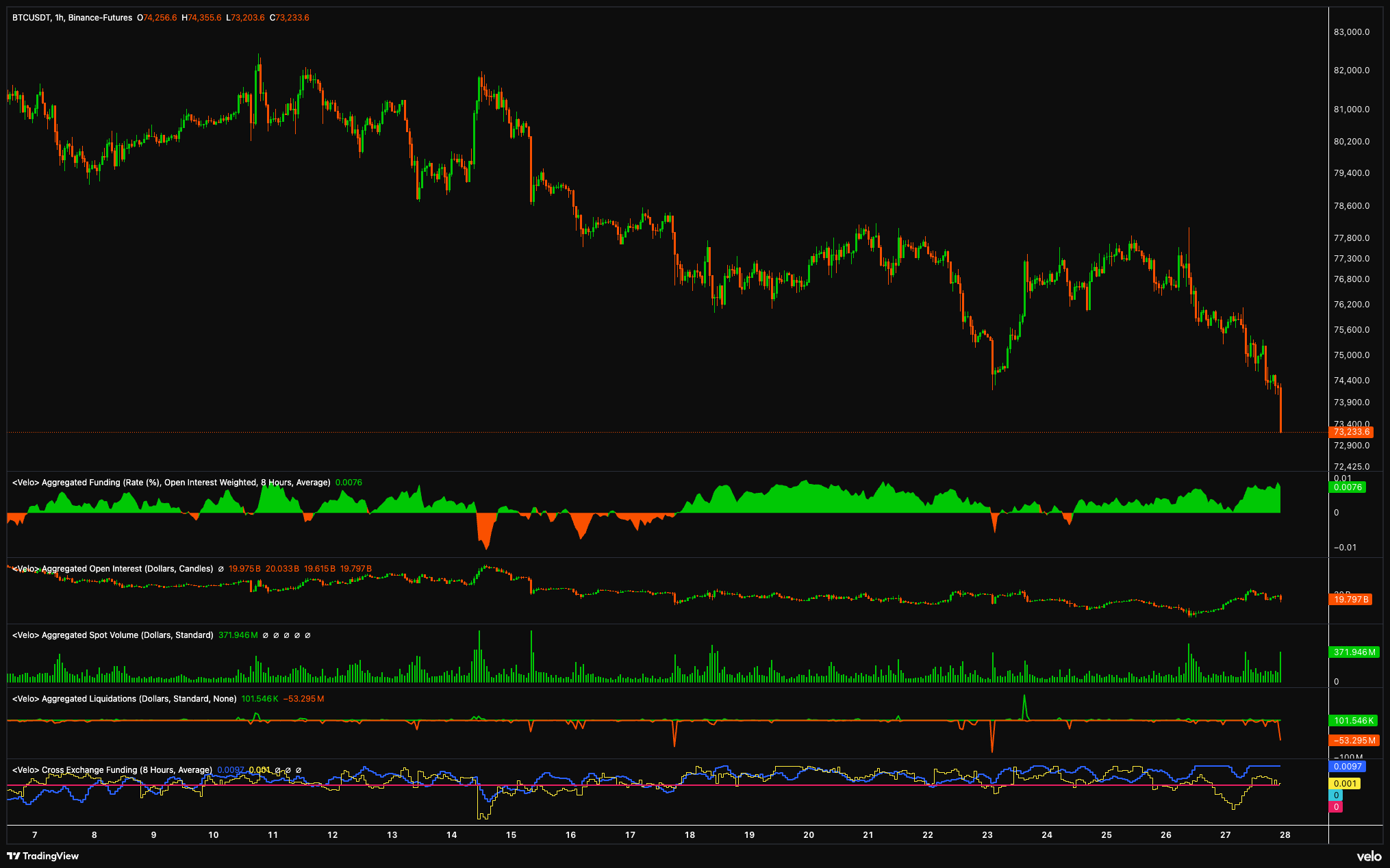
Bitcoin’s (BTC) rising funding rate and aggregated open interest suggest bullish investors are opening longs in an attempt to defend the range lows and an important support at $70,000, but another day of spot ETF outflows has investors concerned that the institutional stance on BTC is shifting.
As shown in the chart below, Bitcoin open interest remains relatively stable despite the day-over-day selling, further re-enforcing the view that long positions are either topping up to stay open or newly created. The cross-exchange funding rates (the last indicator at the bottom of the chart) are also mostly positive to neutral, indicating a long-leaning bias among investors.
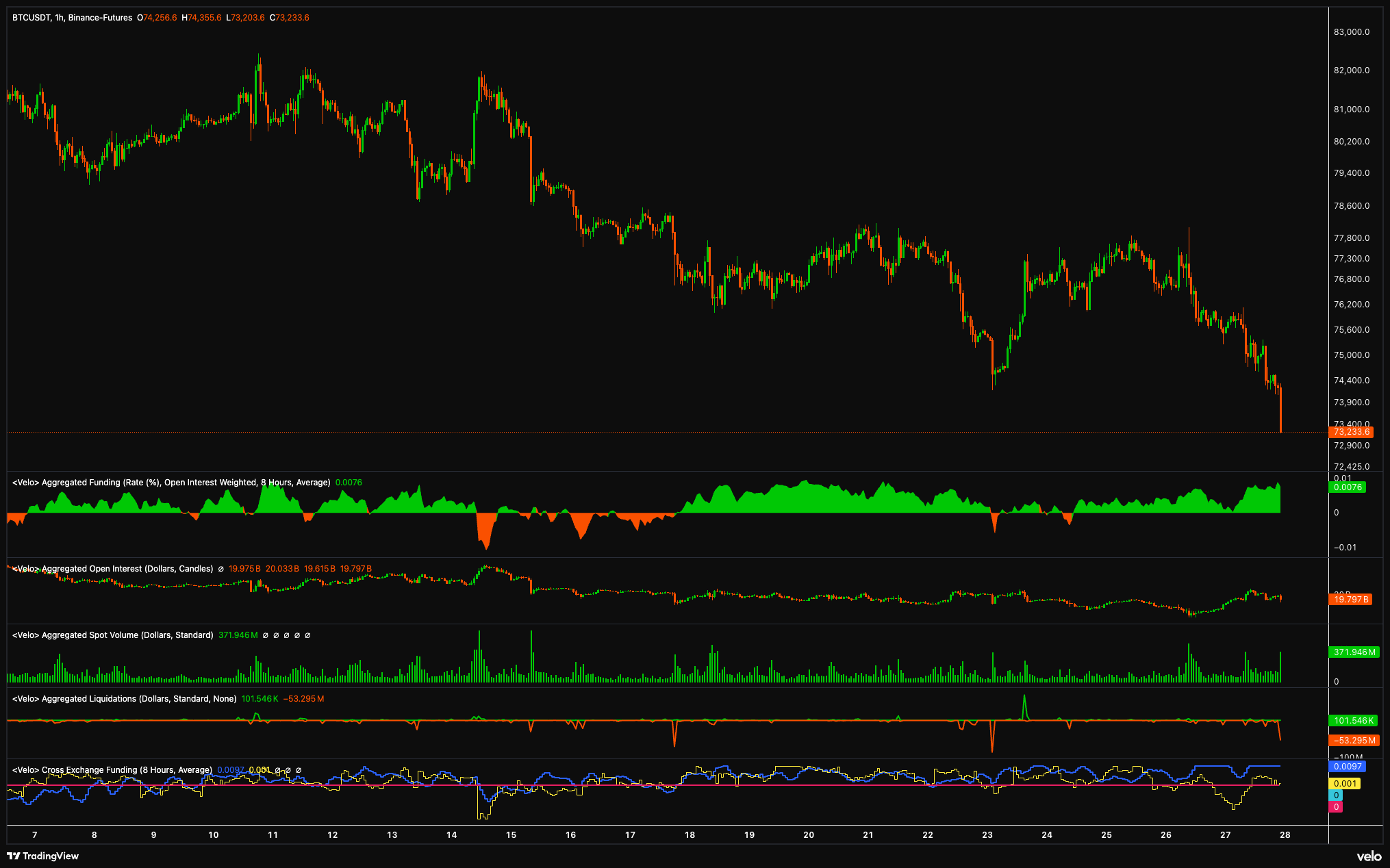
BTC/USDT one-hour chart. Source: Velo.xyz
Prior to the drop to $73,000, liquidations remained within norms of BTC’s intra-day range percentage-wise, suggesting that this week’s price action is a continuation of the current consolidation rather than early confirmation of a higher-timeframe trend change.
One important point to consider is “who” is propping BTC up. Hyblock’s True Retail Longs & Shorts Accounts indicator shows retail investors increasingly viewing corrections as dip-buying opportunities.
Hyblock analysts said that,
“Long exposure now sits near 62%, a level where retail traders have historically been vulnerable to getting trapped. Over the last three months, backtested 15-minute data shows that when retail long positioning was above 62%, BTC posted positive returns 82% of the time seven days later, with a median forward return of 3.6% across 1,459 occurrences.”
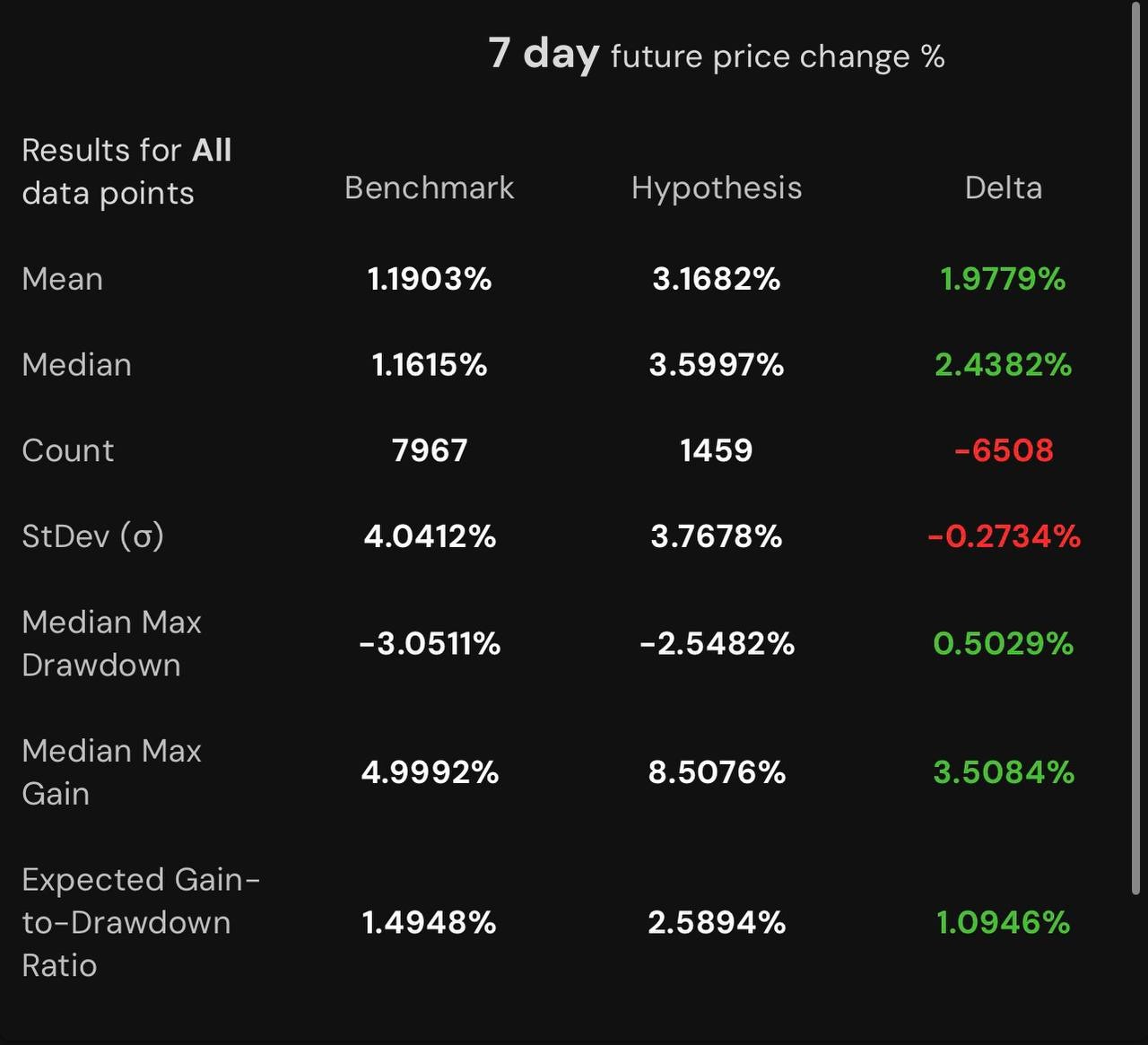
True retail longs and shorts accounts’ 7-day future price change %. Source: Hyblock
Related: Bitcoin miner inflows to Binance soar as BTC struggles to hold uptrend: Is $70K next?
ETF outflows, negative Coinbase premium counters spot and perp traders’ efforts
According to Bitfinex analysts, Bitcoin investors are “cautious heading into Thursday’s (May 29) Personal Consumption Expenditures (PCE) report for April.”
The analysts said,
“Since 15 May, futures open interest (OI) has fallen sharply following a price correction that has seen BTC fall over 10 percent from recent highs above $82,000. Bitcoin’s aggregated global OI has now dropped back below $55 billion, the lowest reading since 11 April, and is down 14 percent from when BTC was trading above $80,000.”
On Wednesday, outflows from spot Bitcoin ETFs topped $200 million, while cumulative outflows over the past 7 days exceeded $1.5 billion. In addition to the reversal in ETF flows, Bitfinex pointed to the negative Coinbase premium as a “significant warning sign.”
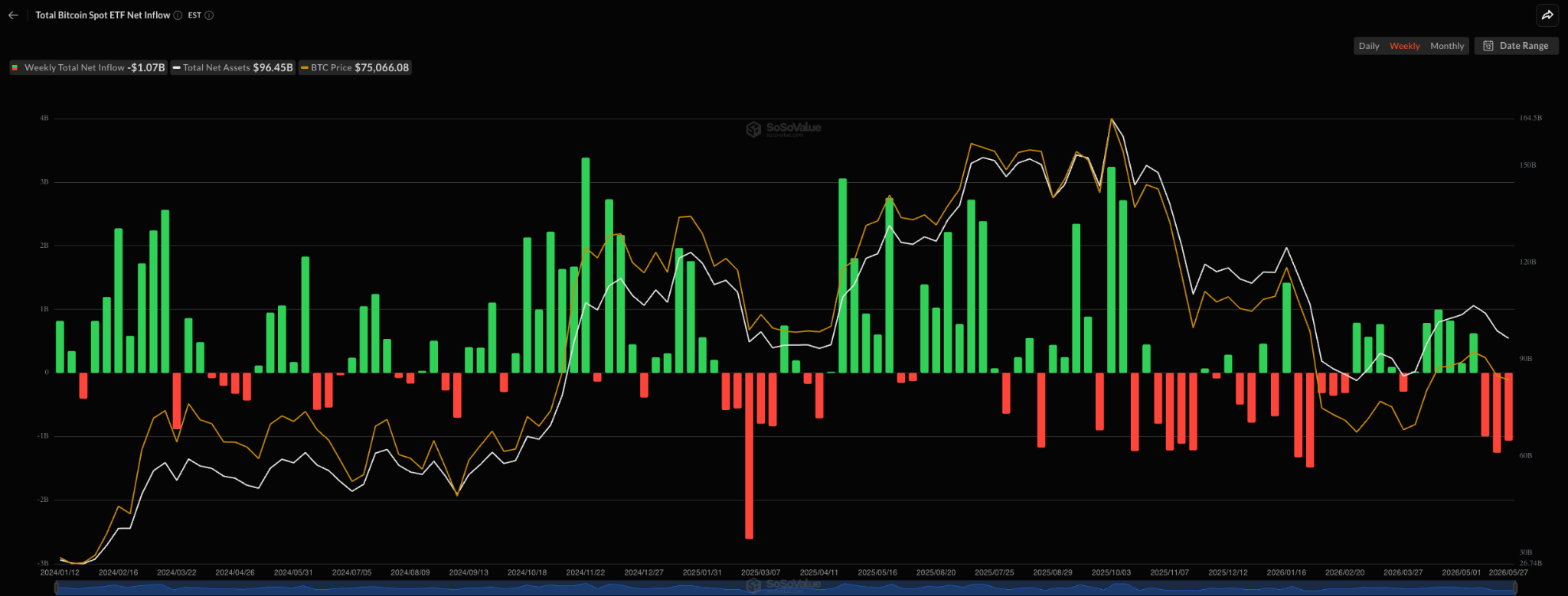
Spot Bitcoin ETF weekly flows. Source: SoSoValue.com
“In the post-ETF landscape, this reflects a structural reality: direct US spot demand on Coinbase has been largely displaced by indirect institutional demand via ETFs, structured products, and over-the-counter desks.”
The analysts noted that even while Bitcoin price is “in an uptrend on the lower timeframes since the breakout” from $72,000, “the continuation set-up is absent.”
“A strong uptrend is typically driven via the spot tape, which would mean persistent negative funding rates and a persistent positive Coinbase premium. The opposite is the case at present.”


Banca Sella crypto services gain Bank of Italy approval under MiCA, with custody and transfer tools planned for institutions by 2026.
Summary
- Banca Sella crypto services gained approval under MiCA rules in Italy.
- The bank will focus on custody and transfers for selected clients.
- The planned rollout is expected by the end of 2026.
Banca Sella crypto services are moving closer to launch after the Italian lender received authorization from the Bank of Italy under Europe’s MiCA framework. The approval allows the bank to offer custody and transfer services for crypto assets.
The rollout will focus on selected corporate and institutional clients, not broad retail trading. The bank expects to launch the service by the end of 2026, adding another regulated banking player to Europe’s digital asset market.
Banca Sella Crypto services move ahead under MiCA rules
Banca Sella crypto services cleared an important regulatory step after the bank completed the notification process with the Bank of Italy. Under MiCA, banks can follow a notification route when they plan to offer crypto asset services. This gives regulated lenders a clearer path than non-bank crypto firms.
The approval covers custody, receipt, and transfer of digital assets. These functions allow the bank to hold crypto assets for clients and move them between approved accounts. The model keeps the first phase narrow and controlled.
Banca Sella has not announced plans to offer direct crypto buying or selling. That detail matters because it separates the service from a full exchange platform. Instead, the bank appears focused on infrastructure support for clients already operating in regulated markets.
Andrea Tessera, Managing Director of Digital Banking at Banca Sella, described the approval as a major step. He said it aligns with Europe’s wider shift toward new digital models.
Banca Sella crypto services target selected clients
Banca Sella crypto services will not begin as a mass-market retail product. The bank has pointed to selected target groups, with corporate and institutional clients expected to take priority. This approach reduces operational risk during the first stage.
Digital asset custody is likely to be the core service. In practice, this means Banca Sella will manage secure storage for crypto assets. It will also support transfers when clients need to move those assets.
That structure fits the needs of institutions more than casual traders. Companies and financial firms often need regulated custody before they can hold digital assets at scale. They also need clear settlement and transfer processes.
The Bank of Italy approval also gives the project stronger credibility. In Europe, MiCA approval helps reduce uncertainty around compliance. It also places crypto services within a common legal framework across the region.
Banca Sella has worked around digital finance before this approval. The bank joined the Bank of Italy Fintech Milano Hub pilot in 2022. That earlier involvement helped position it within Italy’s developing fintech environment.
Digital asset custody fits broader European Banking push
Banca Sella’s move comes as European banks take slower but clearer steps into digital assets. Many lenders are avoiding speculative trading products. Instead, they are building custody, settlement, and token infrastructure.
This reflects a practical shift in the market. Banks can support crypto asset use without exposing clients to open trading risks. Custody and transfer services also match existing banking strengths.
Banca Sella is also linked to wider European stablecoin work. The bank is a founding member of Qivalis, a consortium involving 37 banking members. The group is working on a euro-based stablecoin project.
That involvement suggests the bank’s crypto strategy is not isolated. It sits within a broader move by European lenders to prepare for tokenized money and digital settlement. This may become more important as MiCA adoption expands.
The service could also make Banca Sella one of Italy’s early banking examples under MiCA. Its launch may guide how other banks approach digital asset custody. The final test will come when the bank begins serving clients by the end of 2026.
Key Takeaways
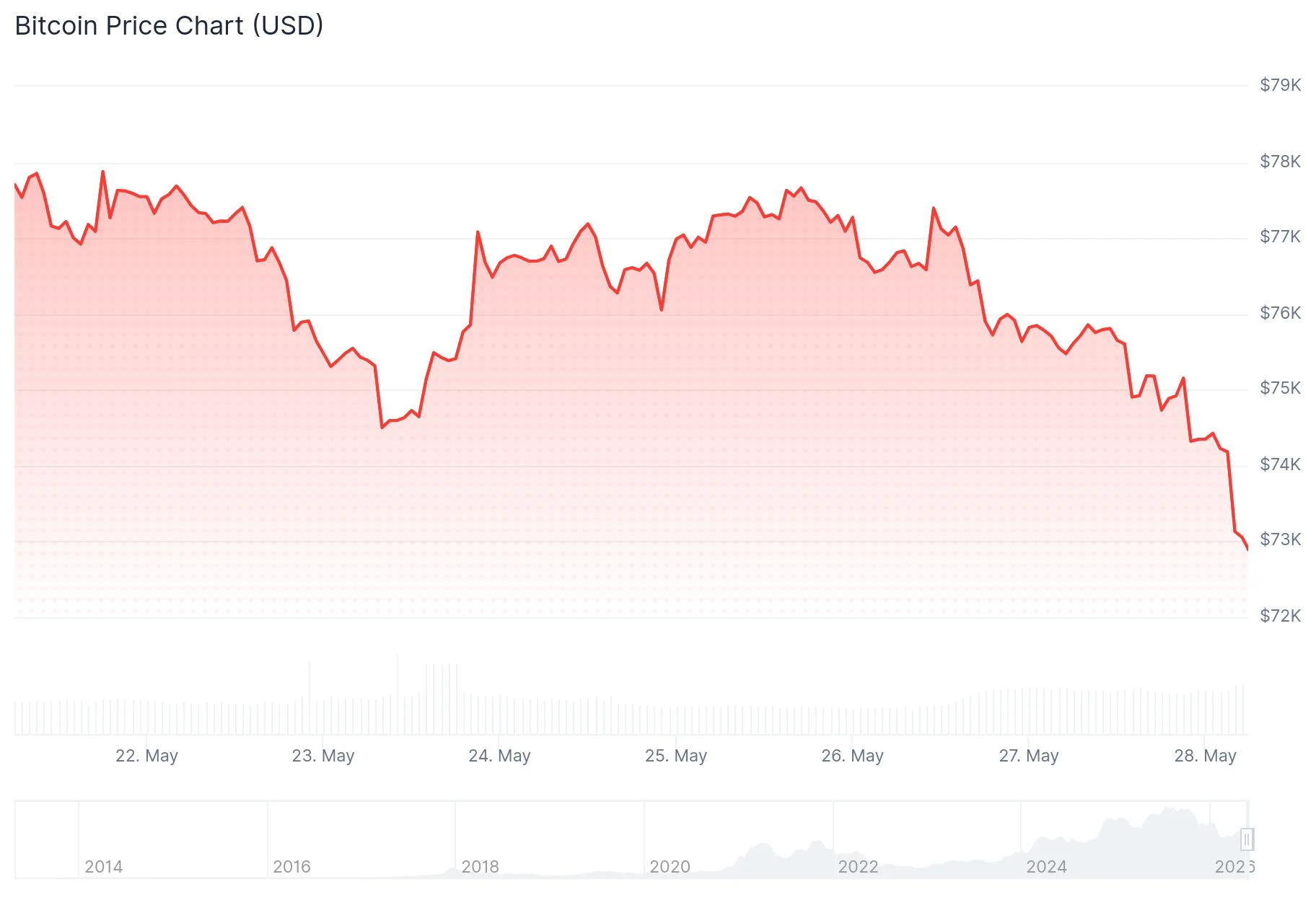
- Bitcoin plummeted beneath the $73,000 threshold following U.S. military strikes targeting an Iranian installation near the strategically vital Strait of Hormuz.
- Approximately $1 billion worth of leveraged cryptocurrency positions faced forced liquidation within a single trading day, with long positions comprising 93–94% of losses.
- BlackRock’s Bitcoin ETF experienced $527.8 million in withdrawals, contributing to an aggregate $733.4 million exodus from Bitcoin spot ETFs on May 27.
- Ondo token plummeted more than 11% during the session, extending its decline to 25% from the May 22 high.
- The aggregate cryptocurrency market capitalization contracted 1.66% to reach $2.43 trillion, erasing over $40 billion in value.
Military strikes conducted by the United States against Iranian targets created ripple effects across international financial markets on Thursday, with Bitcoin experiencing one of its most pronounced single-session declines in recent memory. The convergence of escalating geopolitical conflict and substantial institutional capital withdrawal drove the wider cryptocurrency ecosystem toward a crucial technical threshold.
Bitcoin Experiences Sharp Decline Amid Escalating Middle East Conflict
Bitcoin was changing hands at approximately $72,978 during Asian trading sessions on Thursday. This represented a 3.4% decline across the previous 24-hour period and a more substantial 6.3% downturn over the preceding seven-day window.
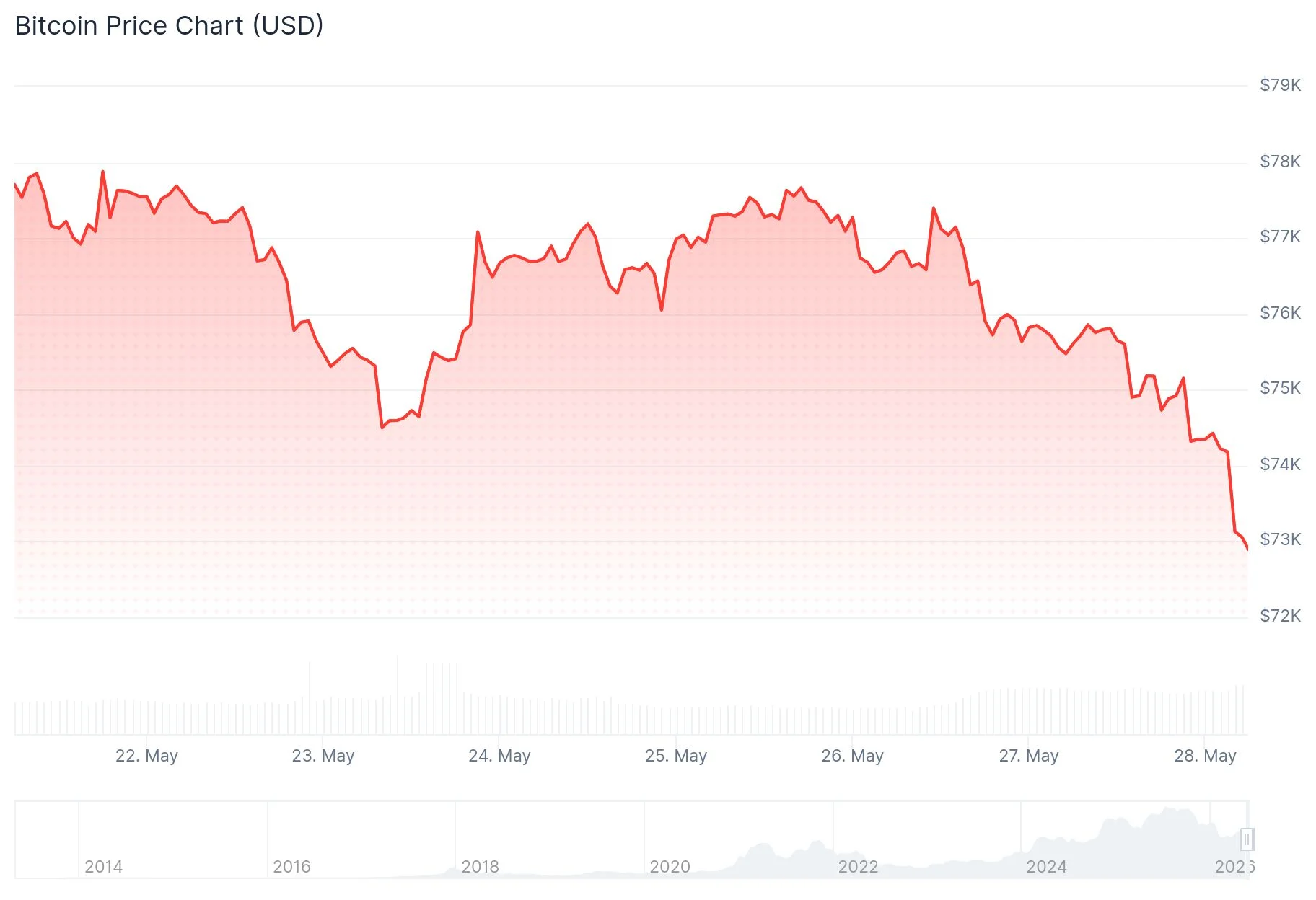
The catalyst behind the selloff was a U.S. Central Command military operation targeting an Iranian military facility positioned near the strategically important Strait of Hormuz. U.S. military forces additionally intercepted four Iranian attack drones that were launched toward a commercial maritime vessel. According to a U.S. official, the military response was characterized as defensive in nature and designed to preserve an existing ceasefire arrangement established the previous month.
Iranian forces retaliated by launching strikes against the airbase from which the U.S. operations originated, based on statements attributed to the Islamic Revolutionary Guard Corps. Kuwait also confirmed it was addressing hostile missile and drone activity within the broader region.
During a cabinet meeting, President Donald Trump emphasized that the strait would continue operating without restrictions. “It’s international waters,” he stated. “The strait’s going to be open to everybody.”
The military developments reversed weeks of growing market optimism surrounding potential ceasefire progress. Bitcoin had maintained support above the $74,000 level despite multiple earlier headlines concerning Iran. Thursday’s strikes shattered that support zone.
Ethereum declined 4.2% to settle at $1,976, falling beneath the psychologically significant $2,000 threshold. Solana retreated 3.5% to $80.57, XRP decreased 3.6% to $1.28, and Dogecoin shed 3.2% to reach $0.0979. Hyperliquid stood as the sole major token maintaining a weekly gain, despite experiencing a 4.5% daily decline.
Institutional ETF Withdrawals Intensified Downward Momentum
Institutional capital flight amplified the market downturn. Bitcoin spot exchange-traded funds registered net withdrawals totaling $733.4 million on May 27. BlackRock’s flagship Bitcoin fund alone witnessed $527.8 million in single-day outflows.
This institutional selling directly contributed to the liquidation avalanche. Bitcoin represented $386 million of the forced position closures, with Ethereum accounting for $246 million. The most substantial individual liquidation involved a $15.34 million Bitcoin position on the Hyperliquid platform.

According to CoinGlass analytics, $958.8 million in aggregate liquidations affected 167,706 individual traders during the 24-hour measurement period. Approximately 93% of these liquidations involved long positions — market participants who had wagered on continued price appreciation.
Broader Altcoin Performance and Technical Market Structure
The total cryptocurrency market capitalization contracted 1.66% to $2.43 trillion, eliminating roughly $40.91 billion in value. This positions the market precisely at the 0.618 Fibonacci retracement level of the rally spanning late March through the May peak of $2.72 trillion.
Ondo emerged among the session’s worst performers, tumbling over 11%. This extended a 25% deterioration from its May 22 peak of $0.47.
On the Bitcoin technical chart, prices settled between the 0.5 Fibonacci level at $73,871 — which had already been breached — and the 0.618 level at $71,765. Selling volume accompanying the most recent bearish candles diminished relative to earlier phases of the decline, potentially signaling that downward momentum may be moderating near this technical zone.
A daily closing price beneath $71,765 would establish a pathway toward the $68,766 support zone. Conversely, a recovery surpassing $75,978 would reestablish the trajectory toward $78,584.
The velocity of Thursday’s liquidation cascade indicates traders were positioned for continued recovery when market dynamics reversed course unexpectedly.

Crypto World
Ethereum (ETH) Crashes Below $2,000 as Iran Tensions Trigger $1B Crypto Liquidation Wave
Key Takeaways
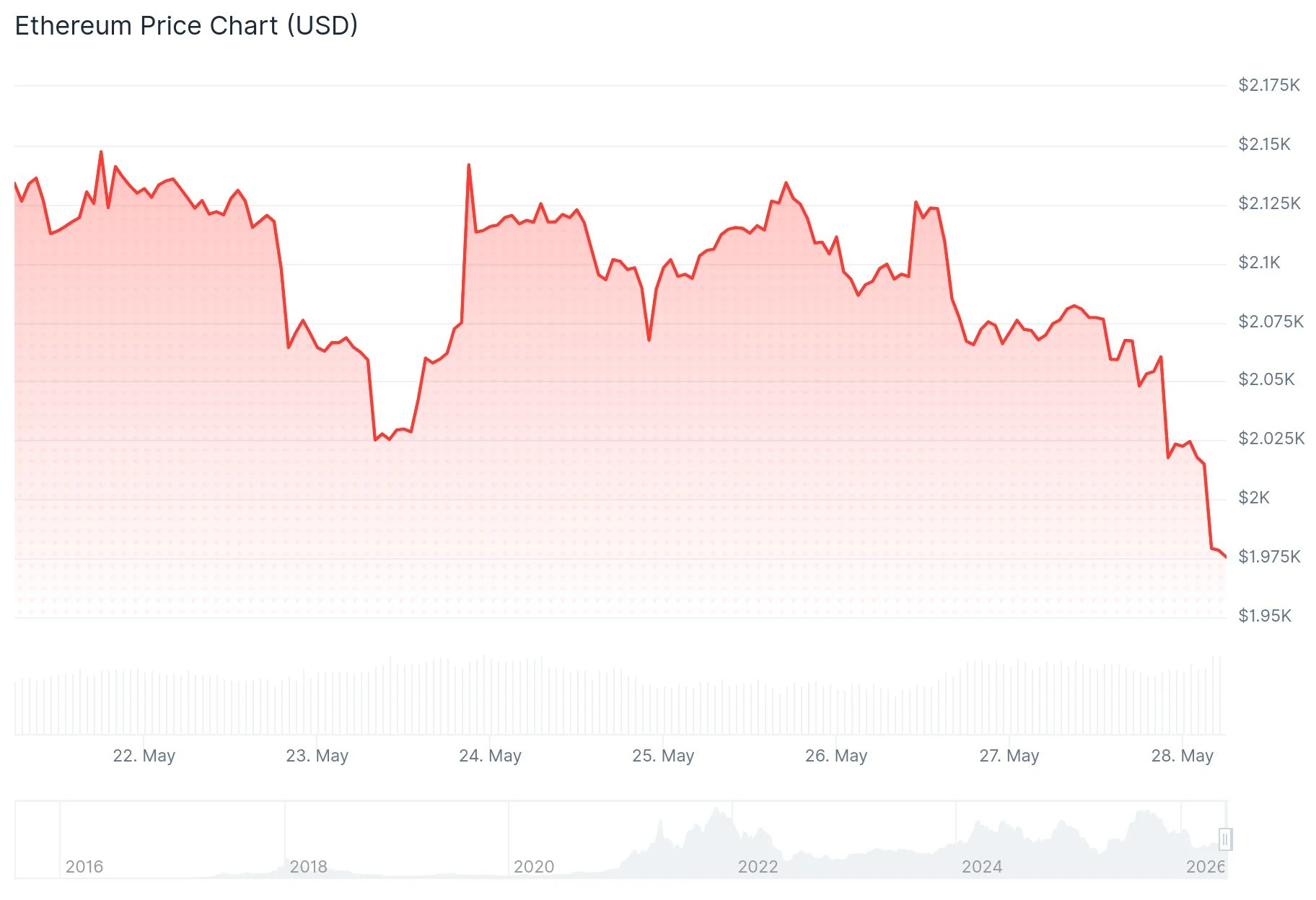
- Ethereum plummeted beneath the $2,000 threshold following U.S. military action against Iran, sparking widespread crypto market turmoil and approximately $1 billion in forced liquidations.
- Betting markets now assign a 63% probability that ETH will decline to $1,500, reflecting a 13% increase over the past seven days.
- Spot Ethereum ETFs have experienced eleven consecutive sessions of net capital withdrawal, accumulating close to $500 million in outflows.
- Technical analyst Ali Martinez indicates ETH must recapture the 200-week SMA positioned at $2,500 and surge past $3,100 to establish bullish momentum.
- The total value locked within Ethereum’s DeFi ecosystem has contracted 55% from its August 2025 zenith to approximately $116 billion.
Ethereum has pierced through the psychologically significant $2,000 threshold and is currently changing hands around $1,976 following an aggressive market downturn initiated by American airstrikes targeting an Iranian military installation positioned near the strategically vital Strait of Hormuz.
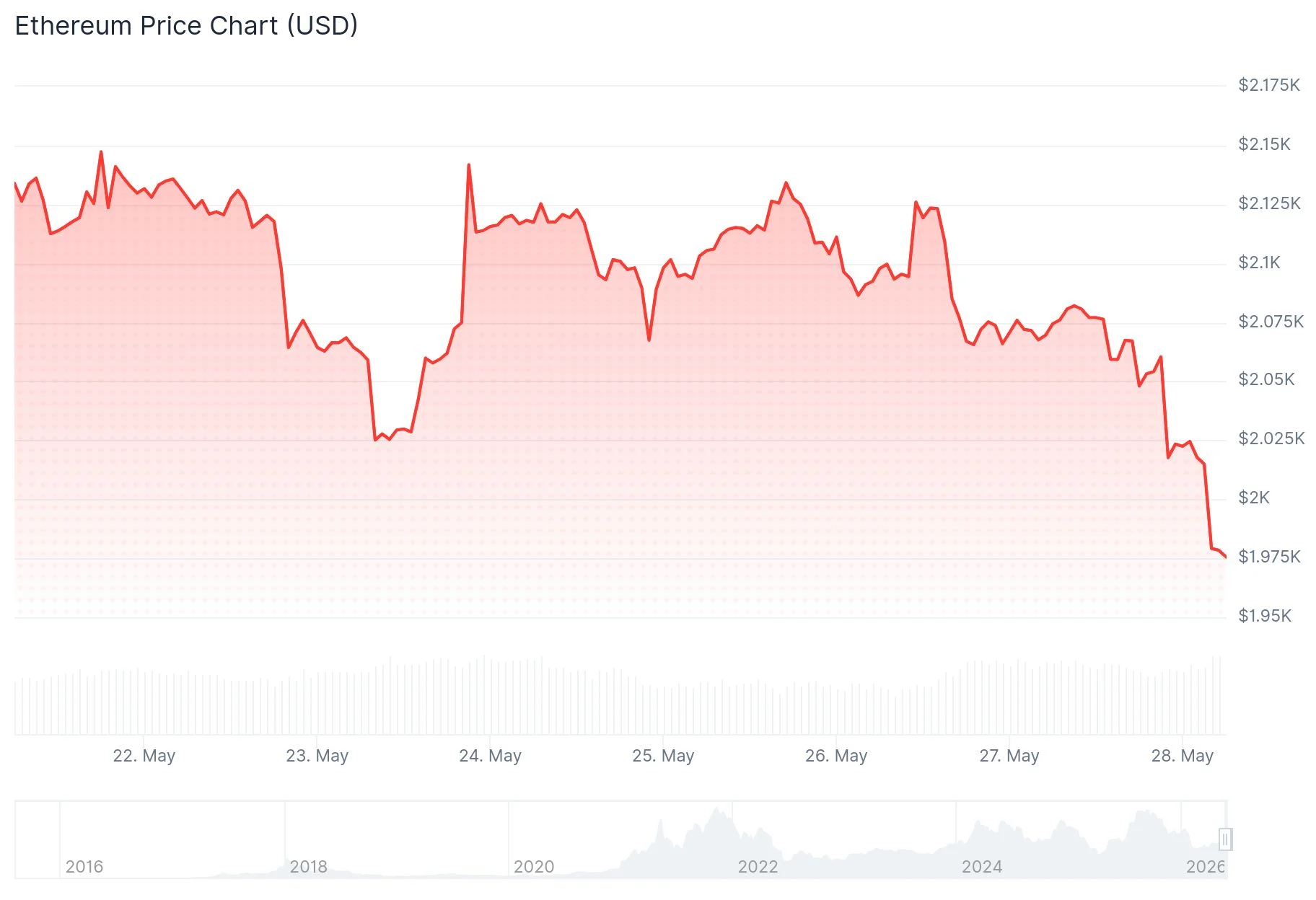
The military action precipitated a sweeping decline across risk-sensitive assets globally. Bitcoin tumbled beneath the $73,000 threshold, registering a 3.4% decline over a 24-hour period. Ether experienced a steeper 4.2% correction, while Solana, XRP, and Dogecoin recorded comparable percentage losses.
This dramatic price movement eliminated approximately $1 billion worth of leveraged trading positions. According to CoinGlass analytics, $958.8 million in aggregate liquidations occurred within a single day, affecting 167,706 individual traders. Bitcoin-related liquidations dominated at $386 million, with ether accounting for $246 million. Bullish long positions comprised 93% of the total losses.

The most substantial individual liquidation involved a $15.34 million Bitcoin position executed on the Hyperliquid exchange platform.
Bearish Momentum Targets $1,500 Level
Market sentiment surrounding Ethereum has undergone a dramatic negative shift. Data from the Myriad prediction market platform indicates that the probability of ETH declining to $1,500 currently stands at 63%, representing an increase exceeding 13% within the previous seven-day period. Polymarket assigns a 51% likelihood that ETH will revisit the $1,500 price point sometime during 2026.
Cryptocurrency technical analyst Ali Martinez outlined that Ethereum requires two critical developments to reverse its bearish trajectory: successfully reclaiming the 200-week simple moving average positioned near $2,500, and achieving a decisive breakthrough above the 50-week SMA hovering around $3,100. Martinez emphasizes that without accomplishing these technical milestones, establishing a durable upward trend remains impossible.
Martinez additionally identified $1,850 as Ethereum’s most crucial support threshold. According to his analysis, a weekly candle closing beneath this level could potentially trigger a downward cascade toward $1,560, with further deterioration possibly reaching $1,070.
Persistent ETF Capital Flight and Deteriorating Blockchain Metrics
Ethereum-based exchange-traded funds are currently experiencing their eleventh consecutive trading session of net capital outflows. Approximately $500 million has exited these investment vehicles during this extended period, based on data compiled by Farside Investors.
Blockchain activity indicators have similarly deteriorated. The total value locked across Ethereum’s decentralized finance ecosystem has declined to roughly $116 billion, representing a 55% contraction from the August 2025 peak of $258 billion. Secondary scaling solutions including Arbitrum, zkSync, and Linea have all registered diminishing liquidity levels.
Open interest metrics for ETH futures contracts have retreated from recent elevated levels, while perpetual swap funding rates have maintained neutral to marginally negative readings across major derivatives platforms.
From a technical perspective, ETH is currently trading beneath its 20-day, 50-day, 100-day, and 200-day exponential moving averages. The Relative Strength Index registers near 36.
A bearish pennant formation visible on daily timeframe charts suggests a potential downside objective near $1,800 should ETH breach support at $2,060. BitMine Immersion Technologies maintains a position exceeding $11 billion in ETH following a $230 million acquisition last week, though this institutional accumulation has failed to stimulate broader market demand.
ETH presently trades 59% below its historical peak of $4,946 established in August 2025.
Nium and Circle Technology Services have announced a partnership to link USDC-based settlement with local-currency payouts for institutions moving money across borders.
Summary
- Nium joined Circle Payments Network as a global payout partner, giving institutions access to payouts across more than 190 countries and 100 currencies.
- The partnership connects USDC-powered settlement with Nium’s last-mile delivery through local bank accounts, wallets, and cards.
- Circle’s institutional stablecoin services have expanded after Luxembourg approval, with support for USDC, USDG, and EURI.
Nium said the deal brings it into the Circle Payments Network as a global payout partner, giving financial institutions on CPN access to Nium’s payout infrastructure in more than 190 countries and 100 currencies.
Nium joins Circle payments network
Under the partnership, Nium said that institutions using CPN can route payments via Circle’s network into Nium’s payout system with a single integration. The company said the setup includes FX optimization and smart routing, which reduces the need for firms to manage several local payout providers across different markets.
Circle said its network provides regulated USDC-powered settlement with compliance controls for institutional users. Nium said its role is to handle last-mile delivery in local currencies through bank accounts, wallets, and cards.
The companies said the partnership is designed to solve a long-running problem in cross-border payments, where fast settlement does not always lead to reliable local delivery. Through CPN, Nium said that institutions can avoid maintaining funds in multiple prefunded accounts across multiple payment corridors.
Stablecoin settlement meets local payouts
Prajit Nanu, founder and CEO of Nium, said the partnership combines Circle’s regulated settlement instrument with Nium’s payout reach.
“Traditional and on-chain payment rails are converging, and that convergence demands infrastructure that banks, fintechs, and global enterprises can rely on at scale,” Nanu said.
Circle chief commercial officer Kash Razzaghi said financial institutions are looking to stablecoins to address payment problems that have remained costly and slow for years.
“Through our partnership with Nium and their integration into Circle Payments Network, we are extending USDC from a settlement instrument into a complete payments flow,” Razzaghi said.
Circle expands regulated stablecoin services
The partnership comes as Circle continues to expand its institutional stablecoin services. As previously covered by crypto.news, Circle rolled out stablecoin settlement services for institutions after securing regulatory approval in Luxembourg.
According to the report, the expansion followed Circle’s April 15 registration as a Crypto Asset Service Provider with Luxembourg’s financial regulator. The approval allows regulated conversion between fiat currencies and stablecoins for institutional clients.
Support currently includes Circle’s USDC, Paxos-issued USDG, and Banking Circle’s euro-pegged EURI token. Banking Circle first introduced EURI in August 2024 before adding more stablecoin settlement options.
Banking Circle said its infrastructure serves more than 750 payment firms, financial institutions, and marketplaces. The company also said it processes more than €1.5 trillion, or about $1.7 trillion, in annual transaction volume.
Kirit Bhatia, Banking Circle’s chief digital asset officer, said stablecoins are “a natural extension” of the bank’s existing systems. In the same release, Bhatia said stablecoins can help lower costs and improve settlement efficiency.
One fund manager has issued a stark warning: Bitcoin’s ongoing selloff may deepen as upcoming U.S. Treasury operations are expected to drain roughly $150 billion in liquidity from the financial system.
“In my experience, Bitcoin tends to be a better liquidity indicator than most other instruments. If the Treasury settlements are a drain on liquidity, then Bitcoin could be heading much lower,” said Michael Kramer, founder and CEO of Mott Capital Management, a registered investment advisory firm, in his latest market analysis note.
The U.S. Treasury regularly issues bonds and bills to finance government spending. When the Treasury sells new securities, it receives cash from investors, which is then moved into the Treasury’s account at the Federal Reserve. All else equal, this process pulls liquidity out of the banking system and reduces the amount of cash available for other investments. These periodic settlements can create temporary but meaningful liquidity drains, especially during heavy issuance periods.
According to Kramer, Treasury operations from May 28 to June 5 could result in a roughly $150 billion liquidity drain. This includes:
- $15 billion in T-bills settling on Thursday
- $47 billion in coupon settlements on Friday
- $68 billion on Monday
- $16 billion in T-bill settlements on Tuesday
- Another T-bill settlement on June 4 estimated between $5 billion and $15 billion
Markets, including crypto, tend to perform best when liquidity is abundant. When cash is pulled from the system, even temporarily, investors often turn more cautious, reducing appetite for risk assets like bitcoin.
Early signs of this pressure are already visible. Bitcoin has dropped about 11% since hitting highs above $82,500 earlier this month and was trading near $73,000 at press time. Kramer notes that the recent breakdown of key support near $75,000 is a clear signal that liquidity conditions are tightening.
While this doesn’t guarantee a deeper decline, it underscores an important point often overlooked in crypto circles: Bitcoin does not trade in a vacuum and macro forces like government borrowing and the resulting cash flows can quietly exert significant influence on prices.
For everyday investors, the key takeaway is simple. Sometimes the biggest driver of Bitcoin’s price isn’t a crypto-specific headline, it’s macro forces moving in the background.
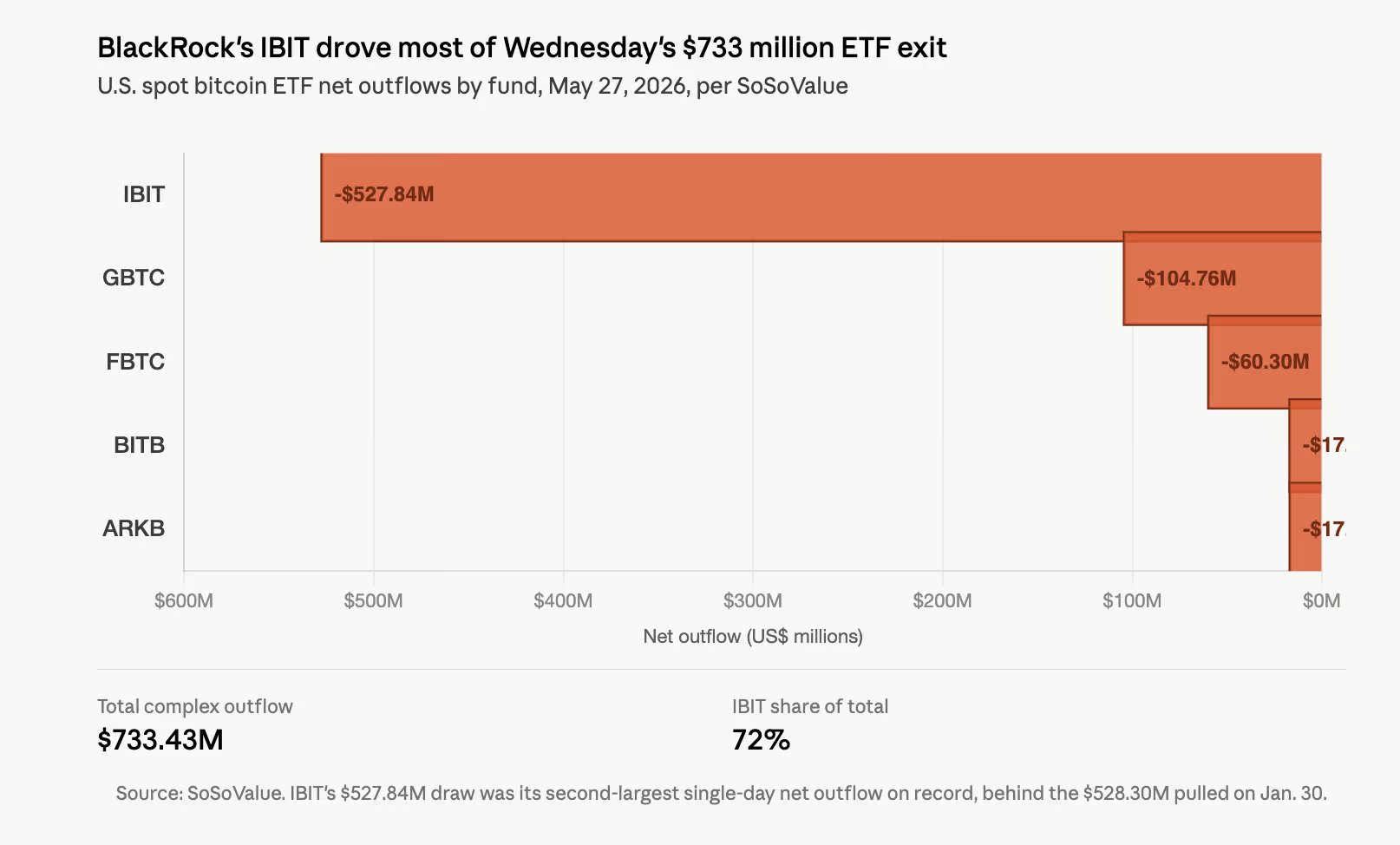
BlackRock’s iShares Bitcoin Trust shed $527.84 million on Wednesday, the second-largest single-day net outflow since the fund launched in January 2024, per SoSoValue data.
The figure missed the record by a razor-thin margin. IBIT’s biggest outflow on record remains the $528.3 million pulled on Jan. 30, which Wednesday’s draw came within about $500,000 of matching. The fund holds roughly $59 billion in assets and accounts for close to 4% of bitcoin’s total supply, making it the largest single vehicle for institutional bitcoin exposure.
The outflow was part of a broader exodus. The 11 U.S.-listed spot bitcoin ETFs lost a combined $733.43 million on Wednesday, with Fidelity’s FBTC shedding $60.30 million and Grayscale’s GBTC losing $104.76 million alongside the IBIT draw. The complex has now posted outflows for several consecutive sessions, with more than $2 billion withdrawn over the past two weeks.

The selling landed on the same day bitcoin broke below $73,000. The cryptocurrency traded at $72,978 in Asian hours Thursday, down 3.4% over 24 hours, after U.S. airstrikes on an Iranian military site near the Strait of Hormuz reignited a conflict markets had started to price out. The ETF outflows and the price drop fed each other, with redemptions forcing BlackRock and other issuers to sell the underlying bitcoin to settle investor exits.
The IBIT draw came a day after a separate eye-catching move in the fund. On Tuesday, a single investor sold $1.29 billion of IBIT shares in one dark-pool block trade, as CoinDesk reported.
A dark-pool trade is a privately negotiated transaction that lets large players move size without tipping off the broader market.
That block sale was not the same as a net outflow, since buyers can step in to absorb the volume, and IBIT’s actual net redemptions on Tuesday came to $192.44 million. But the two events together point to institutional players trimming bitcoin exposure as the macro backdrop turned.
The flow data has been pointing this way for weeks. ETF accumulation across the year had already thinned to a net of around 4,500 BTC, and May flipped from the steady buying of March and April into distribution, as reported on Wednesday. Bitcoin has dropped from above $82,000 on May 6 to under $73,000 now, and the ETF channel that drove the 2025 rally has spent the month pulling money the other way.
Whether the outflows reflect tactical de-risking amid Hormuz headlines or a deeper institutional pullback depends on what happens once the situation in the Middle East stabilizes. IBIT has gone through extended outflow streaks before during this cycle without a permanent reversal, with money returning each time the macro picture cleared.

U.S. authorities have charged a Google software engineer with insider trading, alleging he used unreleased internal information to place bets on Polymarket and profit substantially. The Department of Justice (DOJ) says Michele Spagnuolo executed 25 wagers totaling about $2.7 million on markets related to the most-searched individuals in 2025, earning roughly $1.2 million on those bets.
Separately, the Commodity Futures Trading Commission (CFTC) filed a twin complaint, levelling similar insider-trading allegations against Spagnuolo. The case spotlights ongoing scrutiny of prediction markets and the potential for sophisticated actors to exploit confidential information in ways that regulators consider prohibited.
In a broader regulatory frame, Congress has opened a probe into Polymarket and Kalshi, questioning how these platforms handle insider information and the risk that government officials could leverage privileged data to place bets. Manhattan U.S. Attorney Jay Clayton emphasized the long-standing principle that insiders cannot profit from confidential business information in public markets, a line echoed by the CFTC’s enforcement leadership as it seeks to curb abuse in the sector.
Key takeaways
- DOJ charges Google software engineer Michele Spagnuolo with insider trading tied to Polymarket bets, based on unreleased internal Google data; 25 bets totaling about $2.7 million, with $1.2 million in profits.
- The CFTC filed a parallel complaint, accusing Spagnuolo of commodities fraud, wire fraud and money laundering; potential penalties include restitution, disgorgement, civil penalties, and bans from trading or registration.
- The account behind the bets reportedly carried the alias “AlphaRaccoon,” which prosecutors say was later renamed to a wallet address and funneled funds through a decentralized swapping service and a privacy-protecting transfer service.
- The unfolding case comes as Congress launches a probe into Polymarket and Kalshi amid concerns that insider knowledge could influence market outcomes on federal events.
- Authorities stress that corporate insiders using confidential information to profit in markets is a long-standing enforcement priority, signaling continued scrutiny of prediction-market platforms.
Insider trading allegations tied to Google data
The DOJ’s filing unsealed on Wednesday centers on claims that Spagnuolo accessed unreleased internal information at Google and used it to bet on markets tied to the most searched individuals in 2025. Prosecutors say the suspect ran a Polymarket account under the handle “AlphaRaccoon,” which allegedly netted $1.2 million from bets on outcomes deemed unlikely by market pricing when Google released its data in December.
According to the court documents, discussions within Discord and X communities began in December about whether AlphaRaccoon pointed to a Google insider. Prosecutors further allege that the AlphaRaccoon username was subsequently changed to a wallet address, and that funds were moved to a decentralized crypto swapping service as well as to a privacy-focused transfer service to obscure transfers.
The DOJ charged Spagnuolo with commodities fraud, wire fraud and money laundering. If convicted on all counts, he could face a substantial prison term, with a maximum sentence that could reach up to 50 years in prison under applicable statutes.
Regulatory action mirrors a broader enforcement wave
In a parallel development, the CFTC filed a twin complaint that mirrors the DOJ’s insider-trading allegations. CFTC officials said the case underscores the agency’s mandate to police the use of inside information in prediction markets and other trading venues within its jurisdiction. The agency’s enforcement leadership framed insider trading as a significant threat to market integrity, particularly in emerging platforms that blend traditional markets with blockchain-based components.
As part of the CFTC’s action, the agency seeks full restitution for affected investors, disgorgement of ill-gotten gains, civil monetary penalties, and trading and registration bans for those found culpable. “The division is a cop on the beat in policing the illegal use of inside information in the prediction markets and other markets within the CFTC’s jurisdiction,” said David Miller, the CFTC’s director of enforcement. He added that authorities “will continue to take action to protect markets from insider trading and other forms of fraud, abuse and manipulation.”
Industry scrutiny intensifies: what this means for Polymarket and Kalshi
The charges arrive amid a climate of heightened congressional attention toward prediction-market platforms. Earlier this week, lawmakers launched a probe into Polymarket and Kalshi to examine how these services respond to insider-trading incidents and whether government officials might leverage privileged information for personal gain. The investigations reflect a tension between regulatory oversight and the perceived innovation thrust of crypto-native betting platforms, as lawmakers weigh safeguards against market manipulation and information asymmetry.
Past incidents have already raised questions about the security and governance of these platforms. In April, the Justice Department charged a U.S. soldier with using classified information to place a Polymarket bet tied to the U.S. government’s actions regarding Nicolás Maduro, underscoring the perceived elasticity of insider information in high-profile political events. These cases collectively emphasize that insiders—whether corporate staff or public officials—face serious legal exposure when confidential information is used for market advantage.
What happens next and what to watch
Key questions in the Spagnuolo case include the timing of court proceedings, the strength of the DOJ’s and CFTC’s evidentiary posture, and the potential for parallel civil actions or settlements. The DOJ has already signaled its intention to pursue a broad set of charges, while the CFTC’s complaint seeks remedies intended to deter similar behavior and restore market trust. The outcome could influence how prediction-market operators implement information-handling safeguards, disclosure protocols, and compliance measures going forward.
Investors and users should watch for any updates on how platforms are adapting to intensified scrutiny, including potential changes to user verification requirements, monitoring of large position builds around sensitive events, and the enforcement landscape that governs cross-border crypto-native markets with traditional regulatory touchpoints.
Readers should also keep an eye on the regulatory narrative surrounding insider information and market integrity. While this case centers on a single individual, the implications extend to platform operators, market participants, and policymakers as they navigate the balance between innovation and robust protections against manipulation.
What remains uncertain is how these developments will shape future enforcement priorities and platform governance. As investigations unfold, the broader market will be watching not only for the legal outcomes but also for the practical safeguards that could redefine how prediction markets operate within or alongside traditional financial oversight.

US authorities have charged a Google employee with allegedly using information from the company to make bets on Polymarket and profit $1.2 million.
The Justice Department said on Wednesday that it unsealed charges against Google software engineer Michele Spagnuolo, accusing him of accessing unreleased internal information at Google and placing 25 bets worth $2.7 million on markets related to the most searched individuals on Google in 2025.
Prosecutors said Spagnuolo owned the Polymarket account “AlphaRaccoon”, which profited $1.2 million on “outcomes that the market treated as unlikely” when Google published information on the most searched individuals in December.
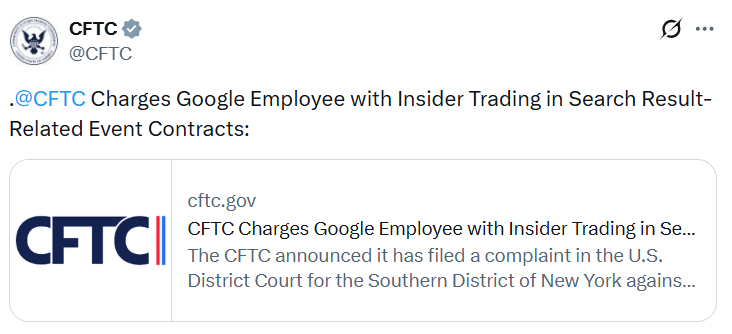
The Commodity Futures Trading Commission filed a twin complaint against Spagnuolo on Wednesday, making similar allegations of insider trading.
Prediction markets are facing growing scrutiny over insider trading, with Congress launching a probe into Polymarket and Kalshi on Friday, questioning the companies’ response to incidents of insider trading on the platform, with lawmakers concerned that government officials are using insider knowledge to make bets.
Manhattan US District Attorney Jay Clayton said in a statement that the charges “reinforce a decades-old message: Corporate insiders cannot use confidential business information to turn a profit in our markets.”

Source: US Attorney Southern District of New York
AlphaRaccoon account allegedly changed name
According to the court documents, communities on Discord and X started discussing the possibility that AlphaRaccoon was a Google insider in December. Soon after, the username was allegedly changed to a wallet address.
Prosecutors alleged that the funds in the AlphaRaccoon account were also sent to a decentralized crypto swapping service and to an unnamed transfer service that offers privacy protection for blockchain transactions
The Justice Department charged Spagnuolo with commodities fraud, wire fraud and money laundering, and could face a maximum sentence of 50 years in prison.
Related: Polymarket traders win $37K after Paris weather data glitch, raising suspicion
In its complaint, the CFTC seeks restitution, disgorgement, civil monetary penalties and trading and registration bans.
CFTC director of enforcement, David Miller, said in a statement that “the division is a cop on the beat in policing the illegal use of inside information in the prediction markets and other markets within the CFTC’s jurisdiction.”
Source: CFTC
“We will continue to take action to protect markets from insider trading and other forms of fraud, abuse and manipulation,” Miller added.
It comes after the Justice Department charged a US soldier in April with using classified information to place bets on the US capture of former Venezuelan president Nicolás Maduro.
Magazine: ETH bears growling, Tom Lee’s buying, XRP to ‘explode’: Market Moves


Stablecoin payments run through settlement and B2B rails, not consumer checkout, BridgerPay CEO Ran Cohen said.
Summary
- Cohen said real stablecoin demand sits in cross-border settlement, B2B payouts, and treasury, not retail checkout.
- He argued Mastercard’s $1.8 billion BVNK deal validates the rail rather than ending the case for neutral orchestration.
- Cohen expects stablecoins to scale across business flows over 18 months without displacing cards at the till.
Stablecoin payments are running through global settlement and B2B rails rather than consumer checkout pages, BridgerPay co-founder Ran Cohen said in an interview. Stablecoin transaction volume crossed $33 trillion in 2025.
Cohen’s view runs against the assumption that the surge will push “pay with USDC” buttons into mainstream e-commerce. Mastercard’s $1.8 billion BVNK deal, announced in March, has reframed the race as a contest over invisible plumbing.
Why BridgerPay sees the checkout button staying rare
“The demand and implementation is infrastructure-led, not checkout-led,” Cohen said. He pointed to cross-border settlement, B2B payouts, treasury, and liquidity management as the dominant use cases.
Pain points sharpen in emerging markets, he added, where local holidays and weekends slow SWIFT funding. Stablecoins reduce fees, settle near-instantly, and free up working capital across time zones.
Consumer checkout exists, Cohen said, but mostly inside crypto-native businesses, trading platforms, gaming, creator ecosystems, and select cross-border verticals.
“For the average mainstream merchant, stablecoins are not replacing cards at checkout,” he said. “Their main utility will be as a programmable settlement layer.”
Part of the reason is dispute resolution. Cards work because consumers understand chargebacks, refunds, and credit protections that stablecoins do not yet offer in any standardised form.
The framing matters because 2026’s largest deals all targeted infrastructure. Mastercard agreed to buy BVNK for up to $1.8 billion. Stripe paid $1.1 billion for Bridge in 2024.
How orchestration fits between Visa, Stripe and Circle
Cohen argued consolidation strengthens, rather than threatens, neutral orchestration layers. Merchants in cross-border flows rarely want to depend on one provider across every market.
“No single provider is perfect, not in cards, not in APMs, and not in stablecoins,” Cohen said. He said merchants want optionality across Circle, Tether, PayPal, banks, and regional providers as the stack matures.
That argument lines up with how the GENIUS Act rollout is reshaping merchant conversations. The Treasury, OCC, and FDIC have all issued rulemaking in early 2026, with final guidelines expected by July.
Cohen said the clarity is helping but operational complexity remains around state versus federal regimes, foreign issuers, and cross-border treatment of reserves.
Where agentic commerce changes the math
Cohen also flagged AI-agent payments as the next structural shift. Coinbase’s x402 protocol has processed more than 165 million agent transactions and roughly $50 million in cumulative volume.
“Machine-initiated payments can occur 24/7, be high-frequency, low-value, usage-based, and API-driven,” Cohen said. He said those economics do not fit card rails and will default to stablecoin settlement governed by programmable rules.
The orchestration layer, in his view, must evolve from routing a checkout payment to governing economic activity between humans, agents, merchants, and rails.
Cohen does not expect stablecoins to become the default consumer checkout method within 18 months. He does expect growth across settlement, treasury, B2B payouts, cross-border corridors, marketplaces, and agentic commerce.
Stablecoins, he said, are an addition to the payment stack, not a replacement for it.

Fox News Anchor Highlights Trump’s Recent Threat

Art in exile on show at London’s Iranian Contemporary Art Biennale

GCHQ draws up plans for world-first national AI cyber defence system


-

 Crypto World7 days ago
Blockchain.com files with SEC for U.S. IPO
-

 Fashion6 days ago
Holiday Weekend Open Thread – Corporette.com
-

 Crypto World6 days ago
Bitcoin Accumulation Weakens as BTC Realized Losses Hit $600M
-

 Tech3 days ago
Microsoft’s quiet Claude Code retreat and the real cost of enterprise AI
-

 Business6 days ago
Dell Technologies DELL Stock Surges 15% on AI Server Momentum and Analyst Upgrades in 2026
-

 Crypto World5 days ago
Robinhood crypto COO Tanya Denisova exits
-

 Business4 days ago
NYT Strands Answers May 24 2026 Revealed for Puzzle No. 812 Theme Summer Essentials
-

 Politics6 days ago
Makerfield: a tale of two social-media histories
-

 Crypto World6 days ago
Space X IPO Is ‘Bad News’ for Tech Stocks: But What About Bitcoin?
-

 Business6 days ago
Trump Invests $1M-$5M in Kura Sushi USA Chain With 27 California Locations
-

 Tech6 days ago
WhatsApp ads could make Irish debut after discussions with DPC
-
 Crypto World6 days ago
MicroStrategy’s Saylor Says Miners No Longer Set Bitcoin Price, Another Force Has Taken Over
-
Tech19 hours ago
The Samsung pay deal is the moment Korean unions changed register
-
 NewsBeat7 days ago
Charity run by Reform leader Malcolm Offord accused of ‘law breaking’ over Scottish registration
-
 Tech6 days ago
A 0.12% parameter add-on gives AI agents the working memory RAG can’t
-

 Crypto World6 days ago
AI infrastructure race heats up as IREN pitches full-stack strategy, WhiteFiber lands $160M deal
-
 Crypto World3 days ago
Nvidia (NVDA) CEO Calls on Super Micro to Strengthen Export Controls Amid Smuggling Probe
-

 Tech6 days ago
You Can Now Add ChatGPT To PowerPoint
-

 Tech3 days ago
Westone Audio and Etymotic Acquired by Fidelity Collective in Major IEM Market Move
-

 Sports6 days ago
2026 CJ Cup Byron Nelson leaderboard: Brooks Koepka finds putting stroke in Round 1
You must be logged in to post a comment Login