
Crypto World
LayerZero among bridges Lazarus using to launder loot



Laundering of the proceeds from Saturday’s $290 million rsETH hack is well and truly underway, and state-sponsored North Korean hacking collective Lazarus Group is suspected to be behind the theft, given the commingling of funds with other TraderTraitor-related hacks, BTC Turk and ByBit.
As with previous incidents, the culprits have taken to funneling vast volumes through blockchain bridges. The tools used so far even include LayerZero, the bridging protocol from which the $290 million rsETH were originally stolen.
Read more: DeFi sector in $14B meltdown as $290M rsETH hack fallout burns Aave
The efforts began shortly after Arbitrum’s Security Council rescued over 30,000 ether (ETH), slashing the hackers’ realized profit from $245 million to around $175 million.
One on-chain analyst, who goes by “Specter,” claims to have tracked over 1,600 transactions via 370 addresses in the first 12 hours of laundering. That’s an average of one transaction every 25 seconds.
As of Wednesday morning, they tallied $116 million as having been laundered to bitcoin (BTC), with another wallet currently holding $61 million still to go.
Read more: DeFi plays the blame game
Mixed reactions
The projects behind the bridges themselves have responded differently to the ill-gotten gains flowing through their tech.
Privacy protocol Umbra acknowledged that $800,000 worth of ETH had passed through its system. While the project underlined its inability to stop illicit use of its autonomous smart contracts, it did put its own hosted front end into “maintenance mode.”
THORChain, as usual, washed its hands of responsibility, with varying degrees of diplomacy.
Read more: Vultisig founder says DPRK-linked Bybit transactions are ‘legitimate’
Specter estimates that 99% of the laundered funds flowed through THORChain, whose dashboard shows over $100,000 of affiliate fees earned on Tuesday.
While THORChain’s bridging infrastructure is decentralized across a network of 95 active nodes, affiliate fees come from use of its front end. Blockchain investigator Tanuki42 puts the recent fees at more than double year-to-date revenue.
In attempting to defend THORChain’s inability to prevent illicit use, founder JP let slip that the protocol held an admin key for many years.
Read more: DeFi karma: Garden hacked for $11M after bridging Lazarus’ loot
No let up
The DeFi sector has faced two catastrophic hacks so far this month, with combined losses of well over half a billion dollars.
On top of this, a slew of smaller incidents also continue to batter community morale.
While DeFi users and developers alike are still reeling from the fallout of Saturday’s incident, just last night a further $3.5 million was lost.
Read more: Inside the $280M Drift hack: weeks of setup, minutes to drain
Since the hack, Volo has provided two separate updates, informing users it had recovered $500,000, and then 19.6 BTC ($1.3 million).
As if near constant multi-million dollar hacks weren’t enough to worry about, ongoing phishing campaigns continue to hook victims.
In a span of just 11 hours, four victims reportedly lost almost $600,000 to the same drainer contract.
Got a tip? Send us an email securely via Protos Leaks. For more informed news and investigations, follow us on X, Bluesky, and Google News, or subscribe to our YouTube channel.



Sameer Group CEO Syed Sameer is offering to broker a private deal to unfreeze Justin Sun’s blacklisted WLFI tokens, drawing backlash from retail holders shut out of negotiations.
Summary
- Sameer Group CEO Syed Sameer has publicly offered to broker a deal to unfreeze Justin Sun’s blacklisted WLFI tokens.
- The outreach comes after Sun filed a federal lawsuit against World Liberty Financial in California over allegedly locked tokens.
- Retail investors are already pushing back, calling the proposal unfair if it benefits Sun but not the broader WLFI community.
Syed Sameer, CEO of Sameer Group LLC, has put himself forward as an institutional mediator in the escalating fight between Justin Sun and World Liberty Financial (WLFI) over frozen WLFI tokens.
Tagging Sun directly, Sameer wrote that as “one of the largest institutional $WLFI holders alongside Aryam 1 & Aqua 1 ($300M+ combined), we are ready and willing to broker a fair resolution to your situation and have your tokens unlocked.”
The offer landed hours after Sun announced, “Today, I filed a lawsuit in California federal court against World Liberty Financial to protect my legal rights as a holder of $WLFI tokens,” stressing that he “remain[s] an ardent supporter of President Trump and his Administration’s efforts to make America crypto friendly.”
Sameer framed his proposal as a fast track compared with courtroom escalation, saying his UAE institutional partners could “facilitate this equitably and quickly through our established channels while avoiding a lengthy litigation process,” and inviting Sun to discuss terms via DM, Signal, or email.
Crucially, Sameer later clarified that the intervention targets blacklisting, not vesting mechanics.
Responding to community criticism, he wrote, “This is specifically about unfreezing / whitelisting Sun’s tokens – they are blacklisted and not just locked,” and then corrected himself: “Sorry – I meant unfrozen / reversing the blacklisting of his tokens. This has nothing to do with locks / vesting schedule.”
That distinction hasn’t calmed the backlash. One user argued, “That’s unfair resolution who will mediate for other community members their token are unjustly locked with authoritarian governance,” while another said, “The proposal is horrible 2 year cliff is not needed,” accusing WLFI’s vesting setup of being a “scam” that “no one in the community deserves nor voted for.”
Others zoomed out to the optics. Critics mocked the spectacle of “the world biggest scammer” being scammed and institutions trying to clean it up; another replied that WLFI “wouldn’t need to contact 3rd part intermediaries if WLFI kept their promise… Unlocked = unlocked Not back door locked via hidden code…,” highlighting fears of hidden control logic in the contract.
Sameer, who describes himself on X as managing “$650M+ AUM” and an institutional partner of the Solana Foundation, is effectively offering a private, big‑holder backchannel to resolve Sun’s claim while the rest of the WLFI community watches from the cheap seats. Whether that becomes a template — where large, politically connected token holders negotiate bespoke fixes while smaller investors are left to litigate or cope — will decide if this episode reads as pragmatic damage control or as the latest example of two‑tier justice in crypto.

Pudgy Penguins’ PENGU token is posting double-digit gains while memecoins start popping up in every crypto feed. Trading near $0.0086, PENGU is outperforming Bitcoin by flying past 10% today. The move follows a cluster of ecosystem catalysts as Bitcoin pushes back toward $78,000.
The rally arrives on the back of the Visa Pengu Card launch last month, the Pudgy Party gaming rollout since last year, and whale accumulation visible in on-chain data. The NFT sales are also up 23% week-over-week, and trading volumes hit $736 million at peak.
What's your victory dance when you win a game in Pudgy Party? — Pudgy Party (@PlayPudgyParty) April 20, 2026
Drop it below using a Pudgy Penguins GIF pic.twitter.com/xWh1qezJBp
Meanwhile, Bitcoin’s $78,000 level triggered $418 million in liquidations, more than $286 million from short sellers caught leaning the wrong way, compressing spreads and amplifying upside velocity across high-beta assets. PENGU, with a 30% volume-to-market-cap ratio, sits squarely in that category.
Discover: The best pre-launch token sales
Can PENGU Crypto Hit Double to $0.016 This Week?
PENGU is currently consolidating at $0.008-$0.009, having defended the 20-day EMA at $0.0061 through multiple tests. The RSI reading is 55, neutral, which leaves room for continuation without an immediate technical rejection.
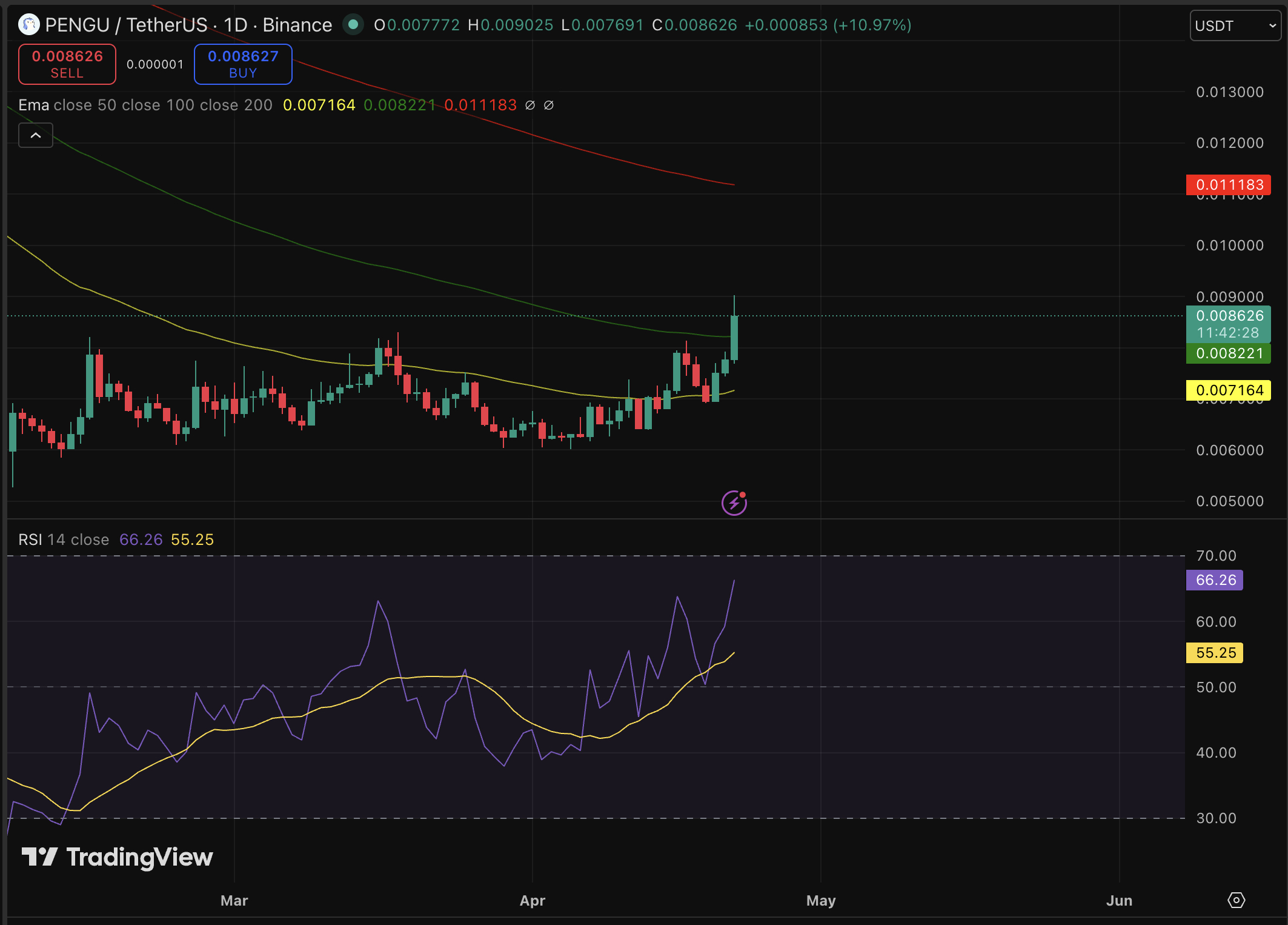
Volume on the latest leg is almost crossing $200 million, a figure that signals institutional-scale participation, not just retail rotation. The critical resistance sits at $0.009, very close to the current level.
The community describes “steady accumulation” nearing that test, with the price action characterized by gradual higher lows rather than volatile spikes, the fingerprint of whale buying rather than momentum chasing.
Utility memecoins that combine social traction with on-chain accumulation have repeatedly shown the capacity to compress resistance zones quickly once volume confirms.
For PENGU, a clean break above $0.009 might open the path to $0.016–$0.019 resistance, with analysts targeting $0.021–$0.045 on a sustained breakout. The 870,000+ holder base and 100 billion-plus social views give PENGU a demand floor most meme tokens simply lack.
Discover: The best crypto to diversify your portfolio with
Bitcoin Hyper Targets Early Mover Upside as PENGU Tests Key Resistance
PENGU’s 7-day gain of 25% is compelling, but at its current market cap, capturing a 10x from here requires a substantially different bet than entering when accumulation was just beginning. That gap between now and the early stage is exactly where some traders are redirecting attention.
Bitcoin Hyper is currently in presale at $0.0136, having raised $32 million, a figure that reflects serious capital formation without yet reaching the price discovery phase.
The project’s core is structurally gold. It’s positioned as the first Bitcoin Layer 2 with Solana Virtual Machine integration, delivering sub-second transaction finality while inheriting Bitcoin’s security. That means fast, low-cost smart contracts executed on Bitcoin’s trust layer, breaking the traditional tradeoff between programmability and security.
Staking is live with a high 36% APY, giving presale participants yield exposure while the project develops. The presale has been gaining traction in parallel with Bitcoin’s recent rebound toward $78,100, suggesting macro momentum is feeding early-stage interest.
Research Bitcoin Hyper before the presale closes.
The post Penguins Can Fly: PENGU Crypto Notes Huge Gain as Utility Memecoin Heats Up appeared first on Cryptonews.


CFTC‑regulated prediction market Kalshi is wiring Pyth’s oracle and Pyth Pro feeds into its new commodities hub, using first‑party prices to settle gold, oil, gas, and grain event contracts.
Summary
- CFTC‑regulated prediction market Kalshi has selected Pyth as the contract settlement data source for its new commodities center.
- The integration covers gold, silver, Brent crude, natural gas, copper, corn, soybeans, and wheat, with Pyth Pro feeding direct market data to Kalshi’s market makers.
- Pyth and Kalshi frame the move as laying infrastructure for event contracts across commodities today, and indices, stocks, and FX next.
Pyth Network is extending its oracle footprint into the heart of regulated prediction markets, becoming the settlement data provider for Kalshi’s newly launched commodities hub.
Kalshi, which operates as a CFTC‑regulated event exchange in the US, said it has integrated Pyth as the reference price source for commodity‑linked contracts covering gold, silver, Brent crude oil, natural gas, copper, corn, soybeans, and wheat.
In an announcement, Kalshi said Pyth will “power settlement prices for our commodities center,” adding that the integration is meant to “support continuous trading and reliable settlement” for its event contracts tied to underlying commodity levels.
The platform’s new commodities hub expands existing oil and precious‑metals markets into a broader suite that now also includes agricultural products and base metals, offering traders yes/no contracts on questions like whether crude or wheat will breach specific price thresholds within a given time window.
Pyth, for its part, is using the deal to push deeper into institutional‑grade data services. Alongside the public oracle feeds, the project’s Pyth Pro product will provide direct market data access to Kalshi’s market makers, who need low‑latency pricing to quote tight markets and manage risk on fast‑moving commodities.
According to Pyth contributors, Pyth Pro is designed as a subscription layer delivering “institutional‑grade market data across cryptocurrencies, equities, fixed income, commodities, and foreign exchange,” built on first‑party price contributions from exchanges and market makers
The Kalshi integration will start with commodities but is expected to extend that model to additional asset classes, with Pyth saying it plans to expand coverage to indices, single‑name stocks, and FX pairs used in future Kalshi contracts.
The partnership also tightens the feedback loop between TradFi‑style event contracts and on‑chain infrastructure.
Pyth has pitched itself as “the largest first‑party financial data protocol,” with over 2,000 real‑time feeds spanning digital assets, equities, ETFs, FX, and commodities; Kalshi, as “the leading CFTC‑regulated event exchange,” now effectively becomes both a consumer of that data for settlement and a producer of event‑probability data that can itself be streamed onchain.

The European Union’s Markets in Crypto Assets Regulation (MiCA) transition period is entering its final stretch, placing significant pressure on smaller crypto firms to secure authorization or winding down regulated services for EU clients. The deadline hits July 1, marking the end of the longest grandfathering window and triggering a hard stop for non-compliant providers across the bloc.
Industry early movers, such as United Kingdom–based CoinJar, have publicly noted MiCA’s maturation dynamics: obtaining authorization in Ireland in 2025, they view the regime as a necessary step toward a compliant, investor-protective market. Yet voices from markets like Poland caution that thousands of virtual asset service providers (VASPs) could face a regulatory cliff as deadlines approach, foreshadowing a period of rapid consolidation and market reconfiguration in Europe.
Under MiCA, the July 1 deadline represents decisive enforcement for the most capital-intensive and governance-heavy requirements. The regime includes an 18-month grandfathering period, but the window is uneven across member states, and several national regimes have already tightened or closed their doors to non-authorized operators. For smaller entities and hybrid projects, the regime is perceived as a potential breaking point rather than a gradual ramp-up.
The costs associated with authorization, governance upgrades, and ongoing reporting are raising the barrier to entry at a time when MiCA leaves a narrow lane for narrowly defined, fully decentralized services outside its scope. In practice, this is shaping a market where compliance-first players gain a competitive edge, and noncompliant actors either partner with regulated entities or exit the EU market altogether.
Regulators emphasize that MiCA aims to balance innovation with investor protection through proportionate obligations, but the policy’s ultimate effect on Europe’s crypto ecosystem remains uncertain. A statement from European Union supervisory bodies indicates that the transitional rules were designed to support innovation while preserving fair competition and investor safeguards. The question remains whether MiCA will underpin Europe as a trusted crypto hub or push parts of the sector toward offshore or offshore-like jurisdictions.
Key takeaways
- The MiCA transitional regime culminates on July 1; providers operating without a MiCA license must stop serving EU clients, regardless of size.
- The longest grandfathering window is 18 months, but national implementations and enforcement timing vary, increasing compliance complexity for smaller operators.
- Authorization costs, governance upgrades, and ongoing reporting obligations are creating a higher barrier to entry, incentivizing consolidation among EU VASPs and hybrids.
- MiCA’s scope excludes only a narrow band of fully decentralized services, leaving many DeFi projects in a regulatory gray area and prompting firms to adjust architectures and access points.
- Industry leaders anticipate a shift toward larger exchanges, custodians, and regulated gateways, with potential relocation of activity to more permissive jurisdictions outside Europe for smaller teams.
MiCA transition: implications for EU VASPs and market structure
Polish founders and market participants emphasize that MiCA’s cost and organizational demands leave limited room for smaller players. When Ari10 secured a MiCA license in the Netherlands in February, its founder noted that among roughly 2,000 registered VASPs in Poland, only his group had obtained MiCA authorization to date. The implication is clear: many local firms may be compelled to close or relocate activities to jurisdictions with more favorable regulatory environments. This pattern aligns with industry observations from other markets where licensing barriers have previously driven consolidation and exit of smaller operators.
Industry voices argue that the MiCA framework effectively channels activity toward larger, more capable entities capable of meeting governance, reporting, and capital requirements. This dynamic mirrors historical licensing waves in other jurisdictions, where rigorous post-licensing compliance has favored established custodians and large exchanges. At the same time, proponents contend the regime promotes a healthier market by encouraging credible actors and reducing the prevalence of opaque, undercapitalized ventures.
For those operating at the fringe of the regulated perimeter—hybrid models, experimental projects, or on-chain protocols—MiCA tests new approaches: how to deliver access for EU users through regulated intermediaries while preserving decentralization’s core design. Altura, a DeFi platform cited by industry participants, is exploring structures that keep core functionality on-chain while routing regulated access through compliant exchanges, custodians, and wallets. The practical challenge is how to classify and treat DeFi architectures once upgraded or modified to meet MiCA’s requirements, particularly where there is not an obvious operator or where upgradeability could influence control over outcomes.
DeFi in the gray zone: interpretation and risk
MiCA’s Recital 22 provides an exemption for fully decentralized services, but real-world application remains contested. Analysts argue that many DeFi systems operate as hybrids, with governance, upgradeability, and potential operator influence shaping outcomes. As such, DeFi projects face a spectrum of regulatory risk: some structures might sit outside MiCA’s scope in theory, but practical governance and on-chain dependencies could invite scrutiny. The debate underscores a broader risk: ambiguity surrounding what constitutes “decentralized enough” to avoid MiCA’s reach.
Industry practitioners assert that the current framework creates uncertainty for innovative models that prioritize user sovereignty and on-chain logic. If the landscape remains ambiguous, there is a clear incentive to centralize certain functions through regulated intermediaries or relocate development activities to jurisdictions with more permissive interpretations of decentralization. In this context, the decentralization exemption is a critical but unsettled hinge of MiCA’s long-term impact on innovation within Europe’s crypto ecosystem.
Regulators and the centralization debate
EU supervisors frame MiCA as a measure designed to enable a cohesive, risk-aware market that still supports innovation. An ESMA spokesperson stressed that the framework aims to ensure fair competition and robust investor protection, with the transitional period structured to give existing providers time to comply. The regulator also highlighted that obligations scale with risk, so smaller participants are not expected to meet the same standards as systemically important players. In this view, MiCA’s architecture reduces regulatory arbitrage and promotes a uniform standard across cross-border activities.
However, not all regulators share the same pace or approach. Malta’s Financial Services Authority (MFSA), for example, has warned against rushing toward centralized supervision of major cross-border crypto activities before MiCA’s practical implementation has fully matured in smaller markets. Local knowledge and proportionate oversight are cited as essential to effective supervision, particularly where market dynamics and consumer protection needs differ from larger, more integrated economies. These tensions reflect a broader debate about how to balance central oversight with the realities of diverse member states and emerging products.
In evaluating MiCA’s trajectory, observers note a tension between the desire for a unified, passportable regulatory regime and the risk of over-centralization that could stifle innovation or push activities offshore. The debate also intersects with cross-border regulatory differences, licensing regimes, and the evolving stance of EU authorities toward stablecoins, banking integration, and compliant on-ramps and off-ramps for crypto services.
MiCA as a filter, not a threat: practical consequences for firms
Some industry participants frame MiCA not as an existential hurdle but as a filter that raises the bar for quality, resilience, and investor protection. The path to scale in Europe is now clearly tied to a compliant, scalable, and auditable operation across the EU single market. For established players, MiCA offers a clear passport to grow across member states; for smaller teams, the regime signals a need to partner with regulated entities or migrate to jurisdictions with lighter or differently structured regimes. In this sense, MiCA’s design may concentrate market power toward those with the resources to meet the standards, while compelling experimentation and activity to seek alternatives elsewhere if the regulatory cost becomes prohibitive.
As regulatory monitoring intensifies, market participants should watch how national authorities implement the transition, how DeFi classifications evolve, and how cross-border supervision will interact with local licenses. The evolving policy environment will influence licensing pipelines, partner ecosystems, and the geographic distribution of crypto activities across Europe and beyond.
Closing perspective
With the July 1 deadline approaching, MiCA’s transitional framework is rapidly shaping Europe’s crypto market structure. Regulators emphasize proportionate requirements and investor protection, but the practical outcomes—consolidation, relocation, and evolving DeFi classifications—remain dynamic. For policymakers, market participants, and observers, the next phase will reveal how well a centralized supervisory approach can coexist with innovation-led growth, and whether MiCA’s balance of risk and opportunity will sustain Europe as a credible, globally integrated crypto hub.
As noted in discussions surrounding the regime, ongoing observations of enforcement, licensing activity, and cross-border supervision will be critical to assess MiCA’s real-world impact. Authorities and firms alike will be watching how the final transition unfolds, including the interpretation of decentralization exemptions and the practical application of proportionate requirements to a diverse ecosystem of players.

Key Highlights
- Infosys unveiled a strategic alliance with OpenAI aimed at revolutionizing enterprise software development processes
- OpenAI’s Codex and additional models will be embedded into Infosys’s Topaz Fabric agentic services platform
- The collaboration includes Microsoft as a key supporting technology partner
- Target implementation areas span software engineering, legacy infrastructure updates, DevOps automation, and digital commerce
- INFY shares trade at $14.07, approximately 24.6% beneath its GF Value estimate of $18.65
Infosys (INFY) revealed a strategic alliance with OpenAI, with backing from Microsoft (MSFT), designed to enable enterprise customers to rapidly implement AI solutions across their organizations. The announcement came on April 22, 2026.
This collaboration will embed OpenAI’s advanced technology — notably its Codex model — directly into Infosys Topaz Fabric, the firm’s established agentic AI services infrastructure.
CEO Salil Parekh characterized the initiative as transitioning clients “from pilots to performance,” indicating an emphasis on production-ready, scalable AI implementations rather than proof-of-concept experiments.
The strategic partnership concentrates on four primary domains: software engineering operations, modernization of legacy infrastructure, DevOps process automation, and e-commerce platforms.
Updating legacy systems represents a critical challenge for major corporations, many of whom continue operating on infrastructure developed several decades prior.
This announcement positions Infosys directly within an intensifying competition among global IT services providers seeking partnerships with premier AI model developers.
With operations spanning more than 50 countries and a market capitalization approaching $57 billion, Infosys possesses the organizational reach to deploy these capabilities across an extensive customer portfolio.
Examining the Stock Valuation
INFY stock stood at $14.07 when the partnership was announced. Based on GuruFocus analysis, the stock’s GF Value — representing an intrinsic value calculation — stands at $18.65, indicating potential appreciation of roughly 24.6% from present price levels.
The company’s trailing twelve-month P/E ratio registers at 19.46x, significantly lower than its five-year median of 26.97x, suggesting the stock may be undervalued compared to historical trading patterns.
Infosys achieves an impressive 96 out of 100 on GuruFocus’s GF Score, earning maximum 10/10 scores in both profitability and growth categories.
Its financial strength receives a 9/10 rating, indicating what market analysts characterize as robust balance sheet fundamentals.
Price Momentum Shows Weakness
Notwithstanding these robust fundamental metrics, Infosys’s momentum score registers only 4/10 — signaling the stock has experienced limited positive price action in recent periods.
Insider transaction data reveals zero buying or selling activity during the past three months, suggesting a neutral perspective from company leadership.
INFY stock declined 1.88% on the announcement date, a relatively minor retreat that could reflect general market trends rather than specific concerns about the partnership announcement.
The alliance with OpenAI expands an expanding portfolio of AI-centered initiatives among leading IT services firms attempting to maintain competitive positioning as customers increasingly require sophisticated AI-powered solutions.
Infosys has not made public the financial terms associated with this collaboration.



Onramp, the Austin-based bitcoin custody and advisory firm, launched Onramp Finance on April 21, 2026, a unified platform combining cash management, bitcoin brokerage across all 50 states, bitcoin IRAs, direct gold ownership, and a spending card into a single interface.
The core question the launch raises: as institutional Bitcoin demand continues to accelerate, is the real infrastructure gap not custody or price exposure, but the fragmented financial rails surrounding long-term BTC holders?
- Platform launch: Onramp Finance went live April 21, 2026, consolidating banking, brokerage, custody, and retirement into one interface.
- Yield and rewards: Cash accounts offer up to 5% rewards funded by Onramp; spending card returns up to 1.5% cash back.
- Custody infrastructure: Multi-provider model spans BitGo, Coinbase, Coincover, and Tetra, with insurance through Lloyd’s of London.
- Genesis Program: Capped at 210 participants; requires a minimum 2 BTC deposit and a qualifying trade of at least $100 within 30 days.
- Target market: Long-term wealth builders and high-net-worth individuals treating bitcoin as a multi-decade holding, not a speculative trade.
Discover: The best crypto to diversify your portfolio with
How Onramp Finance Actually Works – and What the Architecture Signals
The platform organizes its services around three functions: earning, accumulating, and spending.
Users park cash in accounts earning up to 5% in Onramp-funded rewards, discretionary, not guaranteed interest, then route funds into bitcoin or gold, with cash-back rewards from the spending card redeployable into those same asset buckets.
Custody sits on a multi-institution model spanning BitGo, Coinbase, Coincover, and Tetra, with Lloyd’s of London providing insurance coverage.
That architecture eliminates single-point-of-failure risk that has historically plagued exchange-based custody, a direct structural response to the collapses that defined 2022.
The Genesis Program layers early-adopter incentives on top: no-fee custody vault for one year, early product access, and direct contact with company leadership, all for a minimum 2 BTC deposit and a qualifying $100 trade within 30 days.
Slots fill in trade-execution order, capped at 210 participants.
CEO Michael Tanguma framed the launch around long-horizon wealth principles rather than market timing.
His position is unambiguous: “Sound financial planning has always rested on a few simple ideas. Live on less than you make. Put the rest into things that hold their value. Pass them on intelligently.” That framing matters – it signals Onramp is explicitly not competing for the active-trader segment.
Discover: The best pre-launch token sales
The post Onramp Launches New Bitcoin Finance Platform for BTC-Native Services appeared first on Cryptonews.
Crypto World
Top 4 Energy Stocks to Watch in 2026: Exxon (XOM), ConocoPhillips (COP), Chevron (CVX), and Cheniere (LNG)

Key Highlights
- Exxon Mobil generated $52 billion in operating cash flow and $28.8 billion in earnings for 2025, driven by expansion in Guyana and the Permian Basin
- ConocoPhillips is allocating $12 billion for capital expenditures in 2026 and pursuing $1 billion in cost savings through Marathon Oil merger synergies
- Cheniere Energy is projecting record-breaking LNG shipments in 2026 and has authorized a buyback program exceeding $10 billion extending to 2030
- Chevron posted Q4 2025 profits of $2.8 billion, increased its quarterly dividend by 4%, and plans share buybacks ranging from $10 billion to $20 billion in 2026
- Wall Street analysts favor Cheniere and ConocoPhillips most strongly, with both stocks receiving nearly unanimous buy recommendations
Investors seeking long-term exposure to the energy sector are closely monitoring four major players heading into 2026. Exxon Mobil, ConocoPhillips, Cheniere Energy, and Chevron represent distinct investment approaches within the energy landscape, spanning traditional oil production to natural gas export infrastructure.
Each company brings substantial asset portfolios, reliable cash generation capabilities, and strategic expansion roadmaps. Below is a detailed examination of their recent performance and current Wall Street perspectives.
Exxon Mobil
Exxon stands as a global energy titan with operations spanning upstream oil and gas, downstream refining, and petrochemical manufacturing. This diversified structure provides greater stability compared to companies focused solely on exploration and production.
The company delivered annual earnings of $28.8 billion for 2025. Operating cash flow reached $52.0 billion during the same period.
Shareholder distributions totaled $37.2 billion, comprising $17.2 billion in dividend payments and $20.0 billion allocated to stock buybacks.
Strategic growth remains centered on operations in Guyana and the Permian Basin. The company has simultaneously emphasized structural efficiency improvements designed to maintain profitability during commodity price downturns.
Analyst consensus leans positive. According to MarketBeat data, the stock carries 10 buy ratings, 11 hold ratings, and zero sell recommendations.
ConocoPhillips
ConocoPhillips operates exclusively in upstream exploration and production. This concentrated business model creates more direct correlation between the company’s financial performance and crude oil price fluctuations.
Full-year 2025 earnings reached $8.0 billion. The company has budgeted approximately $12 billion for capital investments throughout 2026.
Management is pursuing $1 billion in combined capital and operational cost reductions this year. This efficiency initiative stems partly from integrating Marathon Oil following its recent acquisition.
The company maintains an extensive portfolio of U.S. shale resources while adhering to a disciplined capital allocation framework that prioritizes shareholder returns.
Wall Street sentiment is decidedly favorable. MarketBeat reports 17 buy recommendations, 9 hold ratings, and 1 sell rating.
Cheniere Energy
Cheniere diverges from traditional oil producers by focusing on liquefied natural gas exports. The company represents a distinct value proposition within the broader energy sector.
For 2026, management has projected consolidated adjusted EBITDA between $6.75 billion and $7.25 billion. Distributable cash flow estimates range from $4.35 billion to $4.85 billion.
The company anticipates achieving record LNG export volumes in 2026 and has authorized a shareholder buyback program surpassing $10 billion through the end of the decade.
In February, Cheniere submitted regulatory filings for a Stage 4 expansion at its Corpus Christi terminal, which would add 24 million tonnes per annum of liquefaction capacity. Approval would significantly enhance the company’s export capabilities.
Cheniere commands the strongest analyst support among these four companies. MarketBeat shows 17 buy ratings, 2 hold ratings, and zero sell recommendations.
Chevron
Chevron merges large-scale production capabilities with financial strength and a reliable dividend history.
The company reported fourth-quarter 2025 earnings of $2.8 billion, with adjusted earnings of $3.0 billion. Quarterly operating cash flow totaled $10.8 billion.
Adjusted free cash flow for the quarter reached $4.2 billion, while full-year 2025 production volumes hit company records.
Chevron implemented a 4% dividend increase and previously raised its 2026 free cash flow forecast to $12.5 billion. The company’s 2026 share repurchase authorization spans $10 billion to $20 billion.
Future growth initiatives center on Permian Basin operations and Guyana development, the latter contingent on completing its pending Hess Corporation acquisition.
MarketBeat data reflects 18 buy ratings, 5 hold ratings, and 3 sell ratings, positioning Chevron with a moderate buy consensus.
Investment Takeaways
Each of these four energy companies demonstrated solid operational and financial performance throughout 2025 and enters 2026 with predominantly positive analyst sentiment. Cheniere and ConocoPhillips enjoy the strongest Wall Street endorsements, while Exxon and Chevron appeal to investors seeking more diversified portfolios with reduced volatility. The choice among these stocks ultimately depends on individual investor preferences regarding oil production exposure, natural gas export potential, or integrated energy operations.
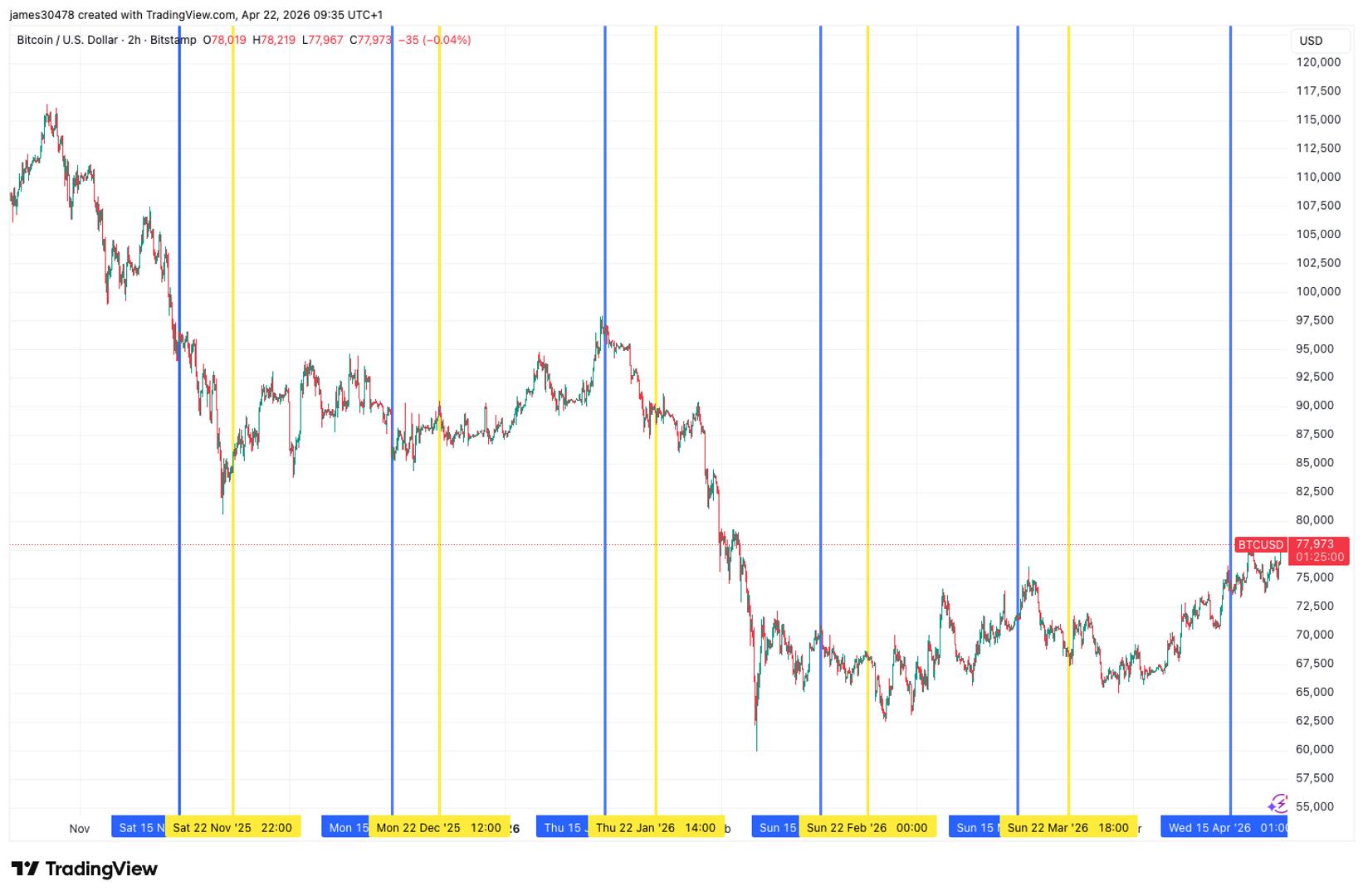
Strategy’s (MSTR) perpetual preferred stock, STRC, is now one week past its April 15 ex-dividend date. With bitcoin now at $79,000 this marks the first time in six months that BTC has risen in the week following the payout event.
At the time of the ex-dividend date, bitcoin was around $75,000, highlighting continued strength in BTC despite the typical post dividend adjustment in STRC. STRC over the past few months has served as an aggressive funding instrument for the company’s bitcoin purchases.
Like most dividend paying securities, STRC declines on its ex-dividend date by approximately the value of the payout, since new buyers are no longer entitled to receive it.
Following that drop, the shares tend to recover gradually, often taking about two weeks to move back toward their $100 par value. STRC is currently trading at $99.47.
This recovery is important because once the stock returns to par, Strategy the largest publicly traded company holding bitcoin, can utilize its at the market (ATM) program, issuing new shares at and use the proceeds to buy additional bitcoin.
Strategy shares are more than 9% higher on Wednesday at $178 at the time of writing, with the company likely tapping its common stock ATM program to fund additional bitcoin purchases.
Strategy disclosed the third largest bitcoin purchase ever of 34,164 BTC, while the price initially stayed within its $75,000 range.
However, the bitcoin rally appears driven in part by positioning. Perpetual futures funding rates remain negative, meaning short sellers are paying long positions to hold their trades, a signal that bearish sentiment still dominates.
As prices rise in that environment, shorts are forced to close positions, creating a short squeeze that accelerates gains.
At the same time, a persistent Coinbase premium, where bitcoin trades slightly higher on the U.S. exchange than offshore platforms, points to steady spot demand.

Volo Protocol, a liquid staking platform on Sui crypto, was exploited on April 22, 2026, for approximately $3.5 million across its WBTC, XAUm, and USDC vaults, the protocol’s first material security breach in its 18-month history.
The team has pledged to absorb the losses in full, and roughly $28 million in TVL across unaffected vaults remains secure after a rapid vault freeze contained the breach.
The core question this raises isn’t whether Volo failed; it did. The question is whether this represents a Volo-specific implementation flaw or a structural signal about risk in Sui’s rapidly scaling DeFi ecosystem, which crossed $1.2 billion in chain-wide TVL just before this incident.
- Exploit scale: $3.5 million drained from Volo Protocol’s WBTC, XAUm, and USDC vaults on April 22, 2026
- Protocol context: Volo is a Sui-based liquid staking platform with ~$31.5 million total TVL prior to the incident; ~$28 million in unaffected vaults confirmed secure
- Team response: Volo team pledged to absorb all user losses; vaults frozen within hours of detection to prevent further exposure
- On-chain trace: Approximately $500,000 of stolen funds traced on-chain; Volo working with on-chain investigators and the Sui Foundation on recovery
- Ecosystem impact: SuiLend confirmed all deposits, lending, and withdrawals operate normally; no cross-protocol contagion confirmed
- Watch item: Volo’s forthcoming post-mortem report identifying root cause – classified as a Sui network security vulnerability – and the timeline for compensation mechanism disclosure
Discover: The best crypto to diversify your portfolio with
How the Volo Exploit Unfolded, and What It Exposed on Sui Crypto
The failure classification matters before the sequence: Volo’s team has described the root cause as a vault-specific vulnerability rather than a protocol-wide architectural flaw, which is why $28 million in adjacent vaults remained untouched.
That’s not a minor footnote; it determines whether this is a bounded implementation error or a systemic exposure across similar platforms.
— Volo (@volo_sui) April 21, 2026
 Security Incident Update – Volo Protocol
We want to address our community directly and transparently about a security incident that occurred earlier today. Rest assured, Volo is prepared to absorb any loss.
What happened:
An exploit resulted in the removal of approximately…
The three compromised vaults, WBTC, XAUm, and USDC, were drained for a combined $3.5 million. The attack vector has not yet been made fully public pending investigation, and the team has not confirmed whether the flaw involved smart contract logic, oracle manipulation, or another mechanism.
Volo’s post-mortem will attribute the root cause to a Sui network security vulnerability, though the specifics remain unverified until that report publishes.
The response timeline is the clearest positive signal available: Volo detected the breach, froze all vaults, and alerted ecosystem partners within hours, limiting exposure to the three affected pools.
On-chain investigators, including ZachXBT, identified approximately $500,000 in traced funds moving to the attacker’s wallet addresses shortly after the breach. The Sui Foundation has been looped in for recovery coordination.
Recovery Update – Volo Vaults
Since our initial response, we have moved aggressively to recover stolen funds.
Working closely with ecosystem partners, we have successfully frozen ~$500K of assets that were part of the breach.
Stay tuned, we will continue to share updates… https://t.co/lHjxZ58bdW— Volo (@volo_sui) April 21, 2026
The structural lesson here echoes a pattern visible across recent DeFi exploit incidents: vault-specific architecture, while designed to isolate risk, can create concentrated exposure points that bypass broader protocol safeguards. Whether that isolation worked in Volo’s favor, containing damage to $3.5 million rather than the full $31.5 million TVL, is one of the few unambiguous positives in this incident.
Discover: The best pre-launch token sales
The post SUI Crypto DeFi Protocol Volo Exploited as Team Commits to Absorbing User Losses appeared first on Cryptonews.
Polymarket announced early access for perpetual futures trading, while The Information reported that Kalshi is planning a similar product launch.
The two largest prediction market platforms by trading volume are both moving into perpetual futures trading, per reports arriving within hours of each other on Tuesday, April 21.
Polymarket’s move is official. The on-chain prediction marketplace posted on X Tuesday evening: “Perps are coming to Polymarket.” The platform is accepting early access sign-ups for the product, which will allow traders to take leveraged long or short positions on assets including BTC, stocks, and gold without a fixed expiration date.
Separately, The Information reported on Tuesday morning that Kalshi plans to launch crypto trading, beginning with perpetual futures, citing people familiar with the matter.
According to the report, Kalshi will start with crypto perps and may expand to perps tied to other asset classes over time.
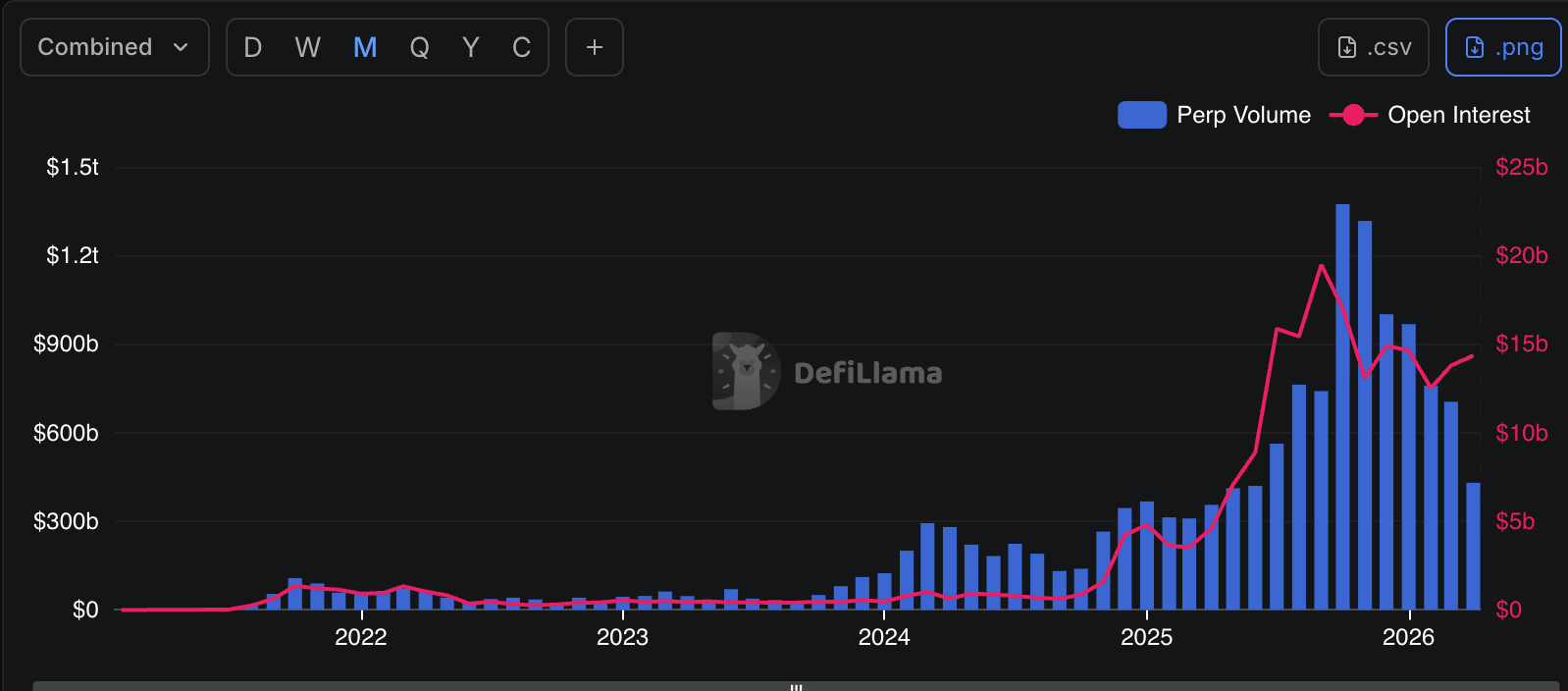
Perp trading has exploded in popularity over the past year, notably on decentralized platforms, mostly led by Hyperliquid. But centralized platforms, led by Binance, still dominate in terms of volumes and open interest, per CoinGecko data.

Commodity Futures Trading Commission Chairman Michael Selig said last month that the agency plans to allow regulated perpetual futures in the United States, to attract trading volume back from offshore platforms.
The Information’s report notes that Kalshi recently secured a CFTC margin trading license, positioning it to offer the product.
The move would put both Polymarket and Kalshi in more direct competition with both centralized and on-chain exchange platforms, several of which, like Coinbase, have begun adding prediction markets.
Combined monthly trading volumes on Kalshi and Polymarket last month reached over $23 billion, an all-time high. Since the start of this year, both platforms have consistently seen near or over $2 billion in trades each week, per Token Terminal data.
Regulatory Questions
The launches come amid rapid regulatory change for the sector. The CFTC launched a sweeping review of prediction markets in March, after Chair Selig clarified that the agency thinks such platforms should be regulated federally, not by each state. At the same time, both platforms continue to face state-level legal pressure, as gambling is a state-regulated activity in the U.S. and multiple states have alleged that the platforms need gambling regulator licenses to operate in the state.
This article was written with the assistance of AI workflows. All our stories are curated, edited and fact-checked by a human.

Steve! #finance #business #kodak

Women’s Six Nations: Millie David to start for Red Roses against Wales

Syed Sameer steps in as power broker in Justin Sun–WLFI standoff

Manchester United reach agreement with Casemiro over contract clause amid transfer speculation

Steven Gerrard disagrees with Gary Neville over ‘shock’ Chelsea and Arsenal claim | Football

US brings back mandatory military draft registration


-

 Fashion5 days ago
Weekend Open Thread: Theodora Dress
-

 Sports5 days ago
NWFL Suspends Two Players Over Post-Match Clash in Ado-Ekiti
-

 Politics5 days ago
Palestine barred from entering Canada for FIFA Congress
-
Entertainment3 days ago
NBA Analyst Charles Barkley Chimes in on Ice Spice McDonald’s Fiasco
-

 Business3 days ago
Powerball Result April 18, 2026: No Jackpot Winner in Powerball Draw: $75 Million Rolls Over
-

 Politics3 days ago
Zack Polanski demands ‘council homes not luxury flats for foreign investors’
-

 Crypto World5 days ago
Russia Pushes Bill to Criminalize Unregistered Crypto Services
-

 Tech4 days ago
Auto Enthusiast Scores Running Tesla Model 3 for Two Grand and Turns It Into Bare-Bones Go-Kart
-

 Politics2 days ago
Gary Stevenson delivers timely reminder to register to vote as deadline TODAY
-

 Tech7 days ago
‘Avatar: Aang, The Last Airbender’ Leaked Online. Some Fans Say Paramount Deserves the Fallout
-
 Business6 days ago
Creo Medical agree sale of its manufacturing operation
-

 Business7 hours ago
Rolls-Royce Voted UK’s Most Iconic Trade Mark as IPO Register Hits 150
-

 Crypto World5 days ago
Russia Introduces Bill To Criminalize Unregistered Crypto Services
-
 Crypto World4 days ago
Kelp DAO rsETH Bridge Hack Drains $292M as DeFi Losses Top $600M in Two Weeks
-

 Sports7 days ago
British climbers complete new route in Swiss Alps
-

 Tech7 days ago
Ford EV and tech chief leaving automaker
-

 Sports6 days ago
“Felt Much Better Today”: Josh Hazlewood Opens Up On His Recovery Win Over LSG
-

 Entertainment7 days ago
Ruby Rose Accuses Katy Perry Of Sexual Assault, Police React
-

 Business6 days ago
Cheaper Doritos and Lays helps PepsiCo win back struggling snackers
-
 Entertainment6 days ago
Clavicular Says Streaming May Not Work Without Substances
You must be logged in to post a comment Login