
Crypto World
Litecoin (LTC) token has its moment as network activity booms: Crypto Daily


Litecoin , the cryptocurrency considered silver to bitcoin’s gold, and one that’s often missing from day-to-day crypto discussions, has bucked the broader market weakness over the past 24 hours.
LTC currently ranked 24th largest by market cap, has gained nearly 8% to $66 in 24 hours, the highest since January. Prices are up 37% this month, the best performance since November 2024, according to CoinDesk.
Bitcoin , meanwhile, has dropped 3% in 24 hours and is only up 6% for the month. ETH, XRP, SOL and other top 10 coins show a similar performance profile, lagging well behind LTC.
The exact reason for LTC’s outperformance is unclear as of now. The Litecoin Foundation attributed it to increased economic activity on the network.
“Yesterday over $1 Billion of value, over 17M Litecoin, moved across the Litecoin network in 24 hours. This is the Adjusted Economic Volume or “payments” as @ForceXHQ denotes. While not a daily high for the year, that would be $2.51B in 24hrs back in May, it’s a massive percentage of LTC’s market cap. A clear sign as to the activity on chain and its growing use case,” the foundation said on X.

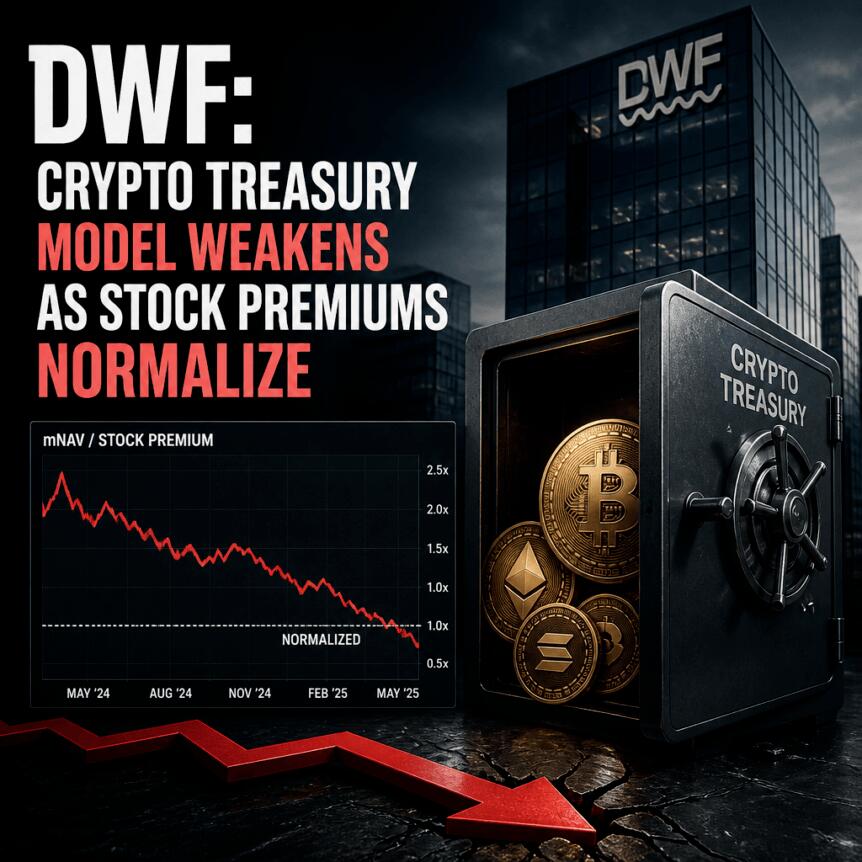
Digital asset treasury (DAT) companies—publicly traded firms that hold cryptocurrencies and finance additional crypto buys by trading at a premium to their holdings—are losing the advantage that once made the model attractive to investors, according to a report from DWF Ventures released this week.
DWF found that among the 20 largest DATs by assets under management, only four trade above their holdings’ value. When the market stops paying that premium, the financing mechanism behind the strategy can weaken, making it harder for these companies to expand without diluting shareholders.
Key takeaways
- According to DWF Ventures, only four of the 20 largest DATs by assets under management trade above an mNAV of 1, indicating a premium over their crypto holdings.
- The report points to broad discounts as evidence that investors are paying less for public “crypto exposure” than they did when the model was new.
- DWF says the mNAV premium investors historically paid tends to have peaked when the strategy drew the most attention and leveraged Bitcoin demand was strongest.
- Separately, Sequans Communications has exited its Bitcoin treasury position entirely after selling its remaining 314 BTC, illustrating how companies may unwind when the model stops working.
Premiums fade for the largest treasury funds
DWF Ventures’ analysis centers on mNAV, a measure designed to compare a company’s market value to the value of its cryptocurrency holdings. The firm reported that just four of the 20 largest DAT companies trade with mNAV above 1—meaning their market capitalization exceeds the value of their crypto assets.
The four companies identified by DWF are Bit Digital, Strive, Hyperliquid Strategies, and BitMine. For the rest of the cohort, the market values their equity below the value of the crypto they hold, signaling that the typical “equity premium” narrative is no longer broadly supported.
DWF attributes this shift to investor behavior: where earlier demand helped these stocks command premiums, current discounting suggests capital markets participants are less willing to pay extra for crypto exposure through a treasury structure rather than simply owning the underlying asset.
The strategy’s origin—and why performance has mattered
DAT branding grew around a model associated with Michael Saylor’s Strategy, which pioneered the Bitcoin treasury approach in 2020. As DWF notes, once that blueprint became widely known, many DAT stocks began to underperform a simpler alternative: holding Bitcoin directly.
Even for companies that did manage to outperform in certain periods, DWF says the edge over holding the cryptocurrency itself has generally been small. That matters because the treasury thesis does not rely only on asset price exposure—it relies on being able to access capital efficiently. When the market no longer offers a premium, the structural advantage can evaporate.
DWF also highlights that the premiums investors paid for DAT stocks were not constant over time. The firm points to a pattern where the “equity premium to NAV” was strongest when investor attention surged and leverage demand for Bitcoin was elevated.
Where the premium peaked—and what the market is now signaling
According to DWF, the premium cycle appears tied to timing and market conditions. The report states that the strategy’s premium investors paid generally peaked when the approach was new and attracting fresh interest.
As an example, DWF cites Strategy’s mNAV peak in late 2024 during Bitcoin’s rally, when demand for leveraged BTC exposure was strong. The broader inference is that DAT valuations may improve when markets are eager to buy more Bitcoin exposure—especially through structures that can, at least in theory, expand holdings over time using equity issuance.
However, the latest data suggests those conditions have changed. DWF’s findings describe a market that is increasingly unwilling to price treasury companies above their crypto holdings, leaving less room for the strategy to compound through incremental capital raises.
Exits and earlier warnings about a “model break”
The new DWF report arrives as another example of treasury model unwinding comes into view. Earlier this week, French semiconductor company Sequans Communications disclosed it has sold its remaining 314 BTC, completing an exit that began with a redemption of convertible debt in May. After the sale, Sequans reported it holds no cryptocurrency on its balance sheet.
While Sequans’ disclosure is specific to its own balance sheet, it fits a broader theme raised in prior research: if DAT stocks trade at discounts to NAV, the economics of raising new equity to buy more crypto can become counterproductive.
DWF is not alone in making that case. In September 2025, Standard Chartered raised concerns about an “mNAV collapse” even as Bitcoin and crypto markets were rising, warning that such a shift could prompt consolidation among DAT firms. Galaxy Digital also sounded a similar note, arguing that the DAT model “critically depends on a persistent equity premium to NAV.”
The logic is straightforward. When shares trade at a premium to the value of holdings, companies can issue stock and use the proceeds to acquire additional crypto without diluting existing shareholders’ stake relative to NAV. But if shares trade below NAV, new fundraising becomes more dilutive and can undermine the central mechanism that makes the strategy attractive.
Galaxy research analyst Will Owens captured the risk succinctly, writing that “if the premium collapses, or worse, flips to a discount, the model begins to break.”
That concern has become more relevant during the current market backdrop. The article notes Bitcoin moved from a record high of more than $126,000 in October to below $60,000 before recovering to around $86,000. Even with the rebound, the relationship between crypto prices, leverage demand, and treasury-company valuation premiums appears to have weakened compared with earlier phases of the cycle.
What investors should watch next
With DWF showing that most of the largest DAT firms now trade below the value of their crypto holdings, the key question for shareholders is whether any renewed equity premium emerges as leverage demand and market sentiment improve—or whether discounts persist, forcing more companies to restructure, dilute, or exit treasury strategies entirely.
Crypto World
No More ‘Trump Avenue’: Canada’s Capital Votes to Rename Residential Street Amid Tense Trade War

Canada is seeking to further strengthen ties overseas by becoming the European Union’s first “associate member”—a goal European Commission president Ursula von der Leyen has vowed to help make a reality. The proposed arrangement, the details of which have yet to be ironed out, would likely deepen cooperation on trade, defense, AI, and Arctic security.
Carney made his pledge to E.U. lawmakers when he addressed the European Parliament in Strasbourg, France, on Sept. 17. Touting closer ties with the bloc, he said “Europe and Canada are stronger together” and insisted “we are not fair-weather allies, we believe that our prosperity grows when it is shared.”
During Carney’s trip to Europe, Canada applied to join the British-led Joint Expeditionary Force military coalition—a force launched in 2014 and made up of 10 North Atlantic NATO member states that conduct rapid-response and security operations.
Juneau warns that despite Carney’s current push to diversify trade and defense away from the U.S., the results of these deals may take a long time to truly stand up, as “in practice, diversifying trade and security relationships is measured in years and decades.”
Sequans Communications has sold its remaining 314 Bitcoin, completing its exit from a Bitcoin treasury strategy that once saw the semiconductor company hold more than 3,200 BTC.
On Thursday, the French semiconductor company said the exit follows the redemption of its convertible debt in May and will allow it to refocus on its core cellular internet-of-things (IoT) and software-defined radio businesses.
CEO Georges Karam said the company used Bitcoin sales to eliminate its convertible debt and strengthen its balance sheet, leaving Sequans with no cryptocurrency holdings and no outstanding debt beyond government-financed research and development obligations.
Sequans launched its Bitcoin treasury strategy in June 2025 after announcing a $384 million sale of equity securities and convertible secured debentures. At the time, Karam called Bitcoin “a premier asset and a compelling long-term investment.”
The company began reducing its holdings less than six months later, selling 970 BTC in November to redeem half its convertible debt. By May 2026, Sequans said it was “no longer pursuing” the treasury strategy and would monetize its remaining Bitcoin over time.
Related: REX launches 2x leveraged ETF tied to Bitcoin treasury firm Strive
Bitcoin treasury exits mount in 2026
A growing number of digital asset treasury companies have abandoned or scaled back their accumulation strategies in 2026 amid the crypto bear market.
In late July, Matthew Sigel, head of digital assets research at VanEck, identified at least nine companies that had fully liquidated or abandoned their Bitcoin and crypto treasury strategies in 2026, alongside several others that had reduced their holdings.
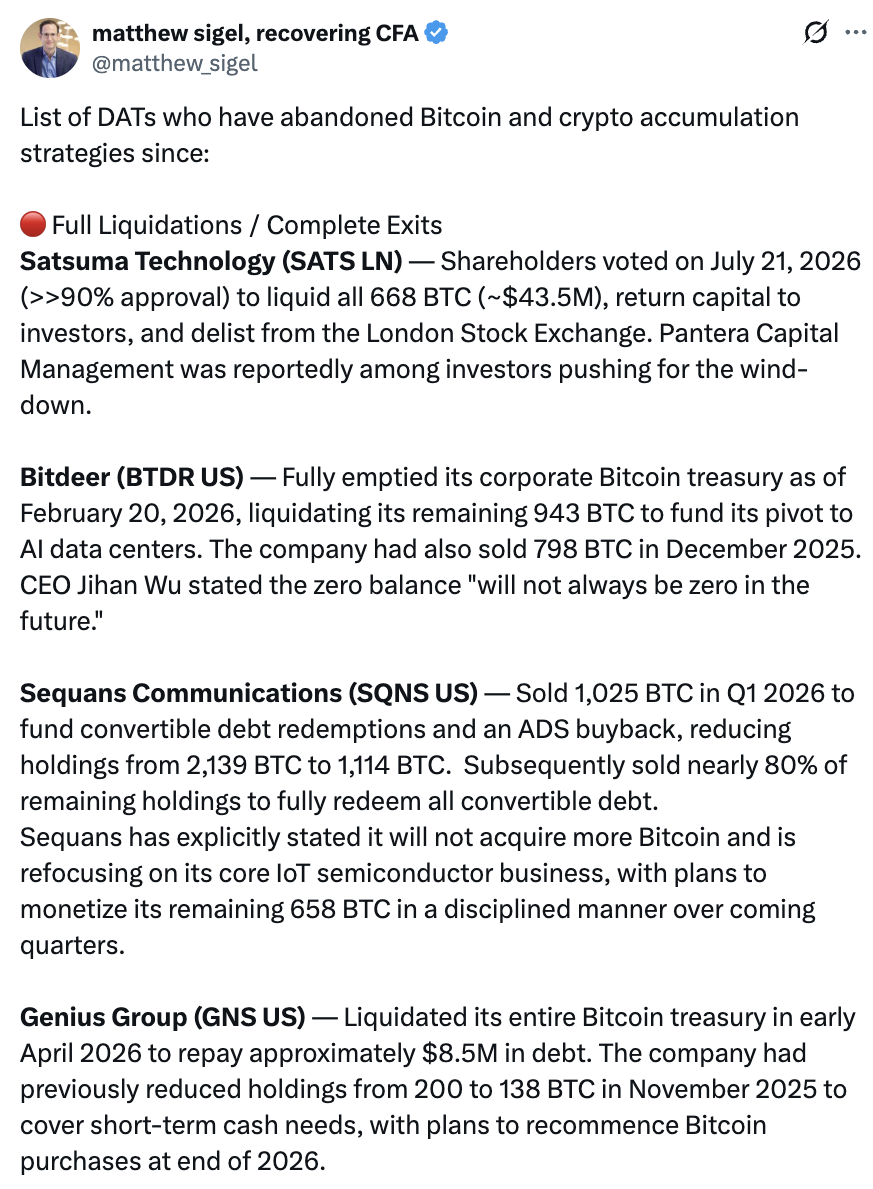
Source: Mathew Sigel
UK-listed Satsuma Technology was among the more drastic reversals. In July 2025, the company raised 100 million British pounds ($135 million) through convertible loan notes to expand its Bitcoin treasury, in what Cointelegraph reported at the time was a UK record for a Bitcoin treasury raise.
A year later, shareholders voted overwhelmingly to return substantially all of the company’s capital and cancel its listing. The board subsequently authorized the closure of its trading activities and the sale of its entire 669 BTC position.
Other companies to fully liquidate their Bitcoin holdings this year include Bitdeer, Genius Group and Prenetics. MARA Holdings and Empery Digital have also made substantial sales without abandoning their treasury strategies altogether.
The companies cited by VanEck’s Sigel exited or reduced their holdings for a range of reasons, including debt repayments, working capital needs, shareholder returns and shifts in business strategy.
Magazine: Big Questions: Does Satoshi actually own 1.1 million Bitcoin?
U.S. and Iranian negotiators are discussing a phased agreement to end the war, according to a Reuters headline.
The deal would include a reopening of the Strait of Hormuz, and D.C. lifting its economic blockade of Iran.
The major obstacle in talks, according to Reuters, citing Iranian, regional, and Western sources, is neither side wanting to be the first to surrender its leverage. Thus, the phased approach — Iran reopening the Strait in exchange for the Trump administration to potentially give the Iranian government access to frozen assets.
For the moment, the news has sent oil lower by nearly $2 per barrel, though it’s still up 2% for the day. That’s easing interest rates by a couple of basis points, with the Nasdaq trimming an earlier 0.8% decline to just 0.2%.
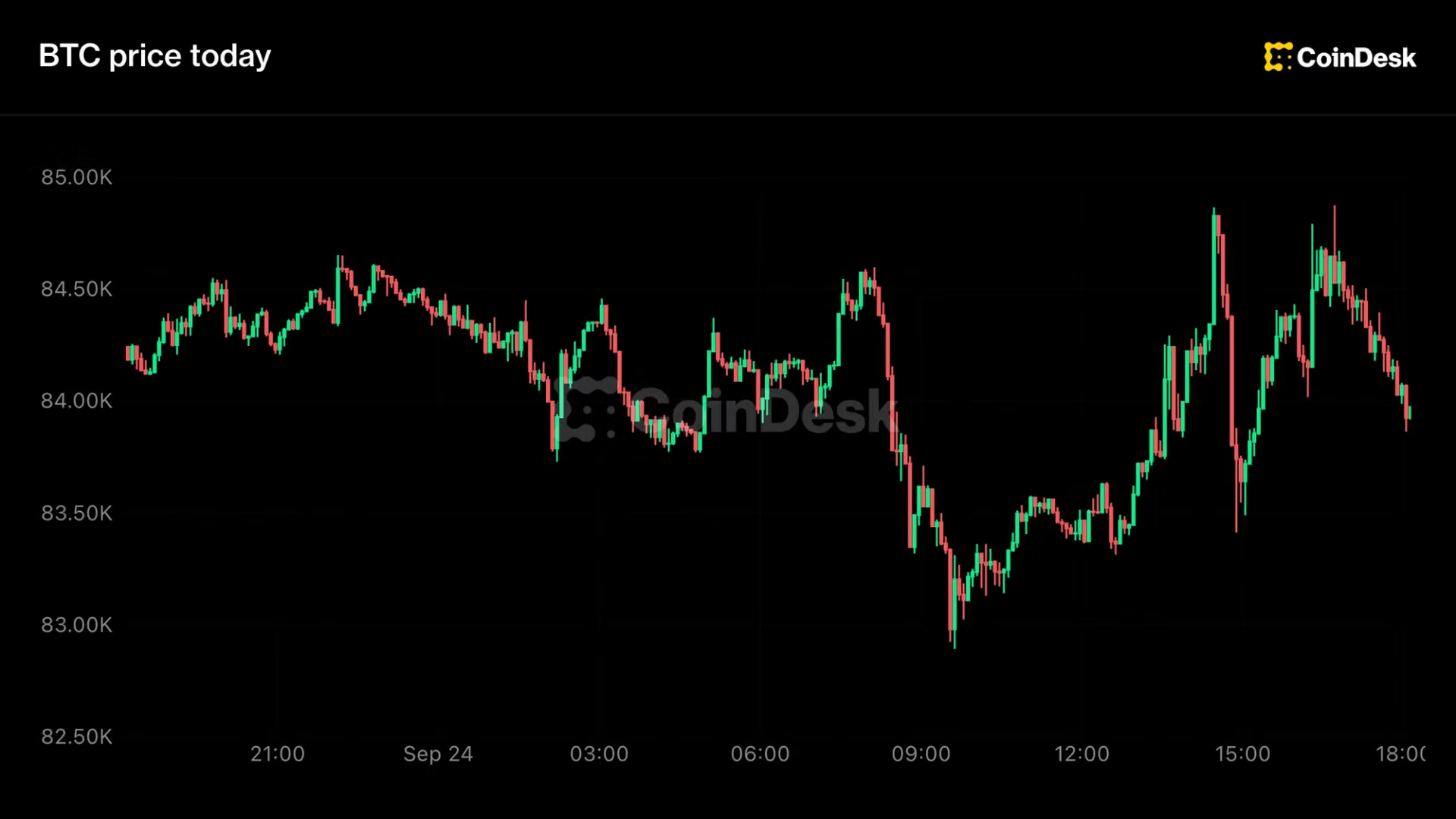
Bitcoin has bounced a bit, now trading at $84,600, up 0.5% over the past 24 hours.
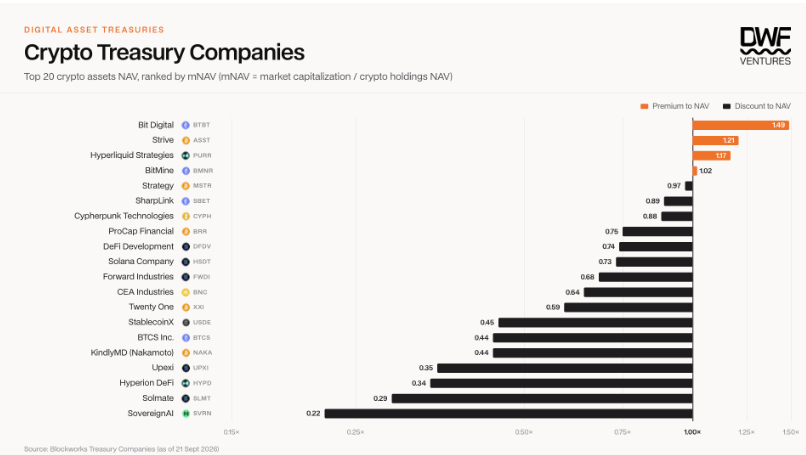
The crypto treasury model has largely lost its early advantage, with most digital asset treasury (DAT) companies no longer commanding the premiums that allowed them to raise capital and accumulate more crypto without diluting existing shareholders, according to a new report from DWF Ventures.
The report, published Thursday, found that only four of the 20 largest DATs by assets under management trade above an mNAV of 1, meaning their market value exceeds the value of their crypto holdings. They are Bit Digital, Strive, Hyperliquid Strategies and BitMine.
The widespread discounts suggest investors are no longer willing to pay the same premium for crypto exposure through publicly traded companies.
Since Michael Saylor’s Strategy pioneered the Bitcoin treasury model in 2020, most DAT stocks have underperformed simply holding the underlying crypto asset, according to DWF. Even among the DAT stocks that have outperformed, DWF found that the advantage over simply holding the cryptocurrency has generally been small.
The report comes as Sequans Communications, a French semiconductor company that launched a Bitcoin treasury strategy last year, disclosed that it sold its remaining 314 BTC, completing an exit it began by redeeming its convertible debt in May. Sequans now holds no cryptocurrency on its balance sheet.
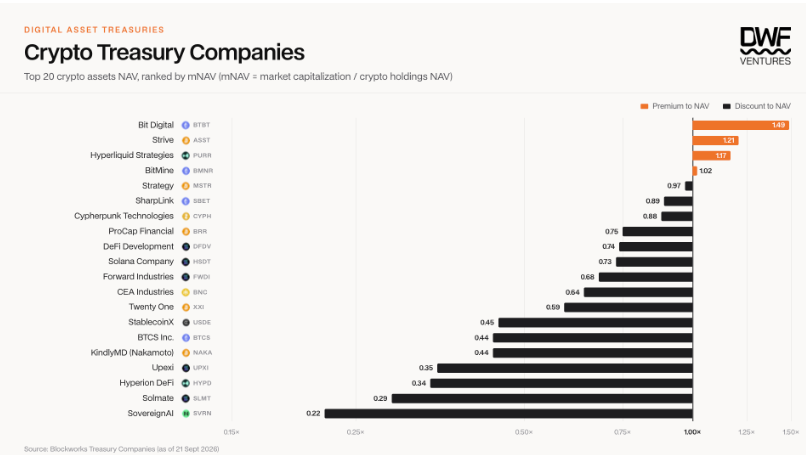
According to DWF, the premium investors paid for DAT stocks generally peaked when the strategy was new and attracting investor attention. Strategy, for example, saw its mNAV peak in late 2024 during Bitcoin’s rally, when demand for leveraged BTC exposure was strong.
Related: Strategy unveils $44.1B capital-raising capacity to buy more Bitcoin
DAT warnings predate the latest downturn
DWF isn’t the only firm to warn about falling mNAVs. Standard Chartered raised the issue in September 2025, when Bitcoin and the broader crypto market were booming, warning that an “mNAV collapse” could lead to widespread consolidation among digital asset treasury companies.
Galaxy Digital sounded a similar warning last year, arguing that the DAT model “critically depends on a persistent equity premium to NAV.”
That premium allows companies to issue shares and use the proceeds to buy more crypto without diluting existing shareholders’ holdings. If shares instead trade below NAV, raising equity to buy more crypto can become dilutive and undermine the strategy’s core financing mechanism.
“If the premium collapses, or worse, flips to a discount, the model begins to break,” Galaxy research analyst Will Owens wrote.
The model has proved harder to sustain this year, with Bitcoin falling from a record high of more than $126,000 last October to below $60,000 before recovering to around $86,000.
Magazine: Bitcoin treasury firms can outperform BTC… but is the risk worth taking?

The attorney general’s office has also ordered Spektor to forfeit cash, cryptocurrency and personal property with an estimated value of more than half a million dollars and make restitution of almost $16 million.
The investigation into Spektor’s criminal activities revealed he laundered the digital assets by swapping them across multiple crypto exchanges and consolidating them at “cash-out points.” He then converted them into other cryptocurrencies and placed bets, before converting them into cash with which he purchased gift cards or additional digital assets.
“Coinbase and most other companies will never call customers or ask to transfer crypto to a ‘safe wallet’. Don’t trust caller ID, sender names or lookalike domains that can be spoofed,” Gonzalez said, adding that scammers rely on urgency and pressure, so “never move money in a rush.”

The European Securities and Markets Authority (ESMA) said it would make AI, tokenization and other emerging technologies relevant to finance a new supervisory priority from 2027.
“Firms are increasingly using AI and tokenized products in day-to-day financial services to gain market share,” the financial watchdog said in a report released Wednesday, explaining why it is focusing on these two areas initially. “Technological innovation brings benefits but also risks,” it added.
Under its new supervisory program, the ESMA and national regulators across the European Union will examine how regulated firms use artificial intelligence and tokenized products in their core activities, rather than only in back-office operations.
The initiative, called “Innovation with investor safeguards,” will focus on building regulators’ ability to supervise new technology and ensuring firms have proper governance, reliable data and client-aligned outcomes.
The European Central Bank (ECB) has also recently announced several moves in the tokenization and stablecoin sectors of cryptocurrency. Earlier this week, the ECB said it plans to invest a small portion of its reserves in tokenized securities, giving it direct exposure to blockchain-based financial markets. T

Ondo Finance has launched three onchain portfolio tokens based on investment strategies developed by BlackRock, giving eligible investors outside the United States access to each portfolio through a single token.
Summary
- Three portfolios offer high-income, diversified-growth, and high-growth strategies developed by BlackRock for Ondo.
- Ondo says the tokens provide economic exposure to their underlying baskets and can be transferred between wallets.
- The products are initially available to eligible investors outside the United States.
- ONDO traded near $0.497 on CoinGecko, up about 18% over 24 hours at the time checked.
Ondo Finance announced the launch on Sep. 24, naming the products Ondo Intelligent Portfolios. BlackRock developed the three opening strategies for Ondo, while Ondo Global Markets issues the portfolio tokens. Each token gives its holder economic exposure to a basket of underlying assets, according to the companies’ launch statement.
BlackRock strategies cover three investment approaches
Ondo lists BLKHIon as its high-income portfolio, BLKDIGon as its diversified-growth portfolio and BLKGRWon as its high-growth portfolio. The company says each has assets and target weights set at launch, with rebalancing scheduled at fixed intervals. Investors can inspect the portfolios’ holdings, weights, and rebalances onchain.
The income strategy gives investors a way to hold a basket focused on bonds through one token. The two growth strategies use different allocations for investors seeking exposure across multiple assets, according to Ondo’s product descriptions. The portfolios can include exposure tied to stocks, bonds, and Bitcoin exchange-traded funds, depending on the strategy. A buyer receives the Ondo portfolio token rather than direct ownership of every security whose value the basket tracks.
Ondo says the tokens can move between supported wallets and be used in decentralized finance applications. Although transfers can take place around the clock, investors should distinguish the ability to trade a portfolio token from the trading hours of the U.S.-listed securities whose prices feed into it.
Lisa O’Connor, BlackRock’s global head of Model Portfolio Solutions and co-chief investment officer for Global Solutions, described the arrangement as a new way to deliver established portfolio strategies through digital infrastructure. BlackRock developed the strategies for Ondo’s products; Ondo issues the tokens and operates the onchain offering.
The supplied report describes seven model portfolios in Ondo’s rollout, including BlackRock’s three. Ondo’s Sep. 24 announcement specifically identifies the three BlackRock-based portfolios as the first to launch and says it intends to add more portfolios over time.
U.S. investors cannot access the opening portfolios
For American investors, the immediate distinction is access. Ondo says its new portfolio products are for eligible non-U.S. investors in permitted jurisdictions. Its launch materials describe economic exposure through tokens, while eligibility and local restrictions determine who can buy them.
The restriction is consistent with Ondo’s existing stock-token distribution. In coverage of Ondo’s NEAR launch, crypto.news reported on Sep. 22 that U.S. persons could not access Ondo Stocks under its current product terms, even though the tokens track U.S.-listed companies and ETFs. The NEAR integration initially made 20 tokenized assets available to eligible users, including products linked to Tesla, Nvidia, Apple and the Invesco QQQ Trust.
Ondo has also been developing a separate route for U.S. securities activity through Oasis Pro Markets, its registered broker-dealer and alternative trading system. The availability of that U.S. infrastructure does not change the stated non-U.S. eligibility for the newly announced portfolio tokens.
Ondo builds on stock tokens and BlackRock fund launches
The portfolio product follows several moves involving the underlying assets and the systems used to tokenize them. On Sep. 21, Ondo and Alpaca introduced an arrangement under which approved institutions can contribute existing stocks or ETFs and receive corresponding Ondo Stocks tokens. As reported in the conversion coverage, the service operates on Ethereum and BNB Chain, requires accounts with both firms, and grants access case by case.
A portfolio token serves a different purpose: it gives exposure to a basket rather than a single referenced stock or ETF. Ondo says holders can see the basket’s constituents and weights onchain. Its existing stock products provide some of the individual tokenized assets that can be assembled into portfolios.
BlackRock added tokenized money market products in August. One placed tokenized shares of an existing Treasury-based liquidity fund on Ethereum; another was designed for institutional stablecoin reserve management. In reporting on BlackRock’s European rollout, the outlet also covered tokenized share classes for institutional cash funds introduced with JPMorgan’s Kinexys platform. Those fund-share products have a different structure from the new Ondo portfolio tokens, which Ondo issues to provide economic exposure to baskets based on BlackRock’s strategies.
ONDO price rises as the company faces a control dispute
At the time checked, CoinGecko priced ONDO at about $0.497, up approximately 18% over 24 hours and 34% over seven days. The token’s 24-hour range ran from about $0.406 to $0.511. The price move coincided with the portfolio announcement and other recent Ondo developments; the market data alone does not establish which event drove the gain.
Meanwhile, Ondo remains involved in a dispute over its leadership and ownership following founder Nathan Allman’s death in May. Ondo confirmed his death in a June statement, when Ian De Bode said he was taking over as CEO. CoinDesk reported in September that Allman’s mother, other family members and an early investor were involved in court proceedings concerning the estate and control of the company. The competing claims remain allegations in the reported filings.
Crypto World
Zcash (ZEC) Slips 8% Daily: Here’s Why One Analyst Believes the Price Could Crash to $200
The popular privacy coin has stunned the crypto community after its price exploded by over 2,600% over the past year. Its market capitalization briefly exceeded $25 billion, making it one of the 10 biggest digital assets.
The main catalysts for its impressive rally included the broader market’s resurgence, the debut of the ZEC ETP in Europe, the launch of a spot Zcash ETF, and other factors. However, the crypto sector has seen a substantial correction over the last 24 hours, dragging the privacy coin down with it, and some analysts think the bull run may now turn into a violent crash.
Is the Rally Over?
Earlier this week, ZEC surpassed $1,600 for the first time since 2016. And while many expected the upswing to continue, the whole market headed south, and now the privacy token is worth roughly $1,470 (per CoinGecko).
X user Crypto Patel noted that ZEC has already delivered an “extraordinary move,” adding that anyone who accumulated during 2024-2025 has witnessed a massive return.
At the same time, the analyst warned people to be highly cautious in the $1,600-$2,000 range, claiming that a cup-and-handle structure suggests this could mark the local top. The market observer argued that ZEC has started showing signs of “extreme extension from a psychological perspective” following the major rally.
Crypto Patel then shared a long-term prediction that is clearly bearish. They believe that if the current cycle eventually enters a distribution and downtrend phase, the price could dump below $500 in the next 1-3 years. The analyst made an even grimmer forecast, envisioning a collapse to $200 if the long-term structure completely reverses.
For their part, X user Zayn recently revealed that they made $30,000 after opening a short position on ZEC. They later said the paper profit has risen above $60,000, calling it one of their “biggest wins this year” and wondering whether to keep the position open until they potentially make $100K.
Are the Bulls Coming Back?
ZEC’s recent correction shouldn’t be directly interpreted as the end of the overall upward trajectory. After all, the asset has been on a tear for quite some time, and pullbacks are an inevitable part of the whole move.
Meanwhile, some investors have started abandoning centralized platforms and shifting into self-custody solutions after a period of flocking into exchanges. The latest development is clearly bullish, as it reduces immediate selling pressure and could open the door to a rebound.

The post Zcash (ZEC) Slips 8% Daily: Here’s Why One Analyst Believes the Price Could Crash to $200 appeared first on CryptoPotato.

UK bank Revolut has revealed that its customers data was breached twice this month after the firm’s former third-party US broker, DriveWealth, suffered a social engineering attack.
The breach, revealed today by both Revolut and DriveWealth, happened on September 4 and September 5, and reportedly saw names, emails, ages, genders, citizenship information, postal addresses, and employment details compromised.
Earlier this month, Revolut revealed that hackers used an Italian government email to gain access to the company’s data.
Read more: Revolut faces $3M ransom demand after data breach, report
The newly-revealed breach does not include data from affected European Economic Area customers past 2023.
Neither Revolut nor DriveWealth disclosed how many users were impacted or what happened during the social attack.
Revolut stressed that core infrastructure, funds, and accounts weren’t impacted.
Negotiations with Revolut ‘didn’t go as planned’
Reported ransom demands following the email attack ranged from $760 million in BTC, to just $3 million in XMR days later.
However, the hacker now claims that “negotiations didn’t go as planned” and has published the so-called “Italy Files,” which include the data of 680 crypto whales.
Journalist Jason Mikula noted that the hacker is selling the data 10x cheaper than their ransom, suggesting “the group is struggling to monetize the data they have exfiltrated.”
They are also supposedly offering impacted users, including Mt. Gox CEO Mark Karpelès, the opportunity to pay to prevent their information from being leaked.
Got a tip? Send us an email securely via Protos Leaks. For more informed news and investigations, follow us on X, Bluesky, and Google News, or subscribe to our YouTube channel.

TeamGroup’s 32GB T-Force Vulcan ECO DDR5 RAM kit is $50 off

EL QUINTO MATRIMONIO ES GRATIS | CHAPA TU MONEY

Heywood crash LIVE as air ambulance lands after young boy hit by car and man arrested – latest updates




-

 Fashion6 days ago
Weekend Open Thread: Talbots – Corporette.com
-

 Tech4 days ago
Researchers escape OpenAI Codex sandbox to run commands on host
-

 Crypto World2 days ago
Goldman Sachs and Deutsche Bank Agree: The S&P 500 Rally Isn't Over
-

 Crypto World4 days ago
Who Needs CLARITY Anyway? ARB Could See 70X Increase: Hodler’s Digest
-

 Crypto World6 days ago
Circle launches Arc Studio AI agent for building onchain apps
-
 NewsBeat6 days ago
Trump says US has reached an agreement to take permanent control of Greenland’s security
-

 Crypto World7 days ago
Mortgage and refinance interest rates today, Thursday, September 17, 2026
-

 Crypto World6 days ago
Trading Bitcoin on Robinhood? Why 2% Spread Has Traders Worried
-

 Fashion7 hours ago
8 iPhone Accessories That Add Personality
-

 Crypto World6 days ago
Bitcoin price breaks channel as RSI climbs to 63
-

 Business4 days ago
Analog Devices (ADI) Bets $1.35 Billion on Chips that Let Machines Think for Themselves
-

 Tech3 days ago
Google’s $899 Googlebook is a bet that you’ll buy a new laptop for Gemini
-

 Crypto World4 days ago
Coinbase, Robinhood, Circle Seen as Tokenized-Stock Winners
-

 Tech5 days ago
Trump suggests rebranding AI with a new name, says he’s also creating an AI Force
-
 Business2 days ago
Oil Price Today (September 23): Crude oil below $100 on hopes of US-Iran talks. What did Trump say?
-

 Tech7 days ago
GPT-6 Astra Reached the Nether in Minecraft, Lost Its Stash to a Creeper, and Farmed Potatoes for Hours
-

 Crypto World6 days ago
World Money launches in 150+ countries with Stripe
-

 Crypto World6 days ago
Silver prices recover quickly, hitting weekly high today
-

 Crypto World20 hours ago
Bitcoin Threatens Sub-$84,000 Breakdown as Long Liquidations Spike
-

 Crypto World2 days ago
Trump-Xi Polymarket Odds for Handshake Hit 50%
You must be logged in to post a comment Login