
Crypto World
Lumber Falls for 10 Straight Sessions as US Housing Cracks Widen

Lumber futures have fallen for 10 consecutive sessions, their longest losing streak since December 2024. The lumber price trades near $586 after a sharp rejection from the $650 resistance zone.
The slide matters well beyond the timber trade. Lumber demand tracks US homebuilding almost one to one, and the streak arrived while builder confidence sits near multi-year lows.
Why Lumber Price Is Falling Despite a Supply Squeeze
Barchart data shows lumber has closed lower for 10 straight days, a streak unseen since December 2024. Two weeks ago, however, the market told the opposite story.
Futures touched $650 per thousand board feet on July 28, a 12-month high. The rally had gained over 30% from December lows as supply shocks piled up.
The Wall Street Journal reported that steep duties on Canadian lumber, wildfires, and sawmill closures had cut supply and lifted prices. More than 900 wildfires burned across Western Canada, the source of most US softwood imports.
Combined duties near 35% also add roughly $10,000 to the cost of a new American home, according to the NAHB. Nevertheless, prices collapsed the moment demand weakness took over.
US construction spending on single-family projects fell 3.3% year-over-year in June, per TradingEconomics. Therefore, a market falling this hard against a constrained supply base points to demand destruction, not oversupply.
US Housing Market Cracks Keep Widening
The demand rot shows up across housing data. The NAHB/Wells Fargo Housing Market Index (HMI) fell to 34 in July, its 15th straight month below 50. That is the longest weak stretch since 2012.
Meanwhile, 37% of builders cut prices in July, at an average discount of 6%. Robert Dietz, chief economist at the NAHB, described the pressure directly in the group’s July report.
“Affordability remains the home building industry’s primary challenge.”
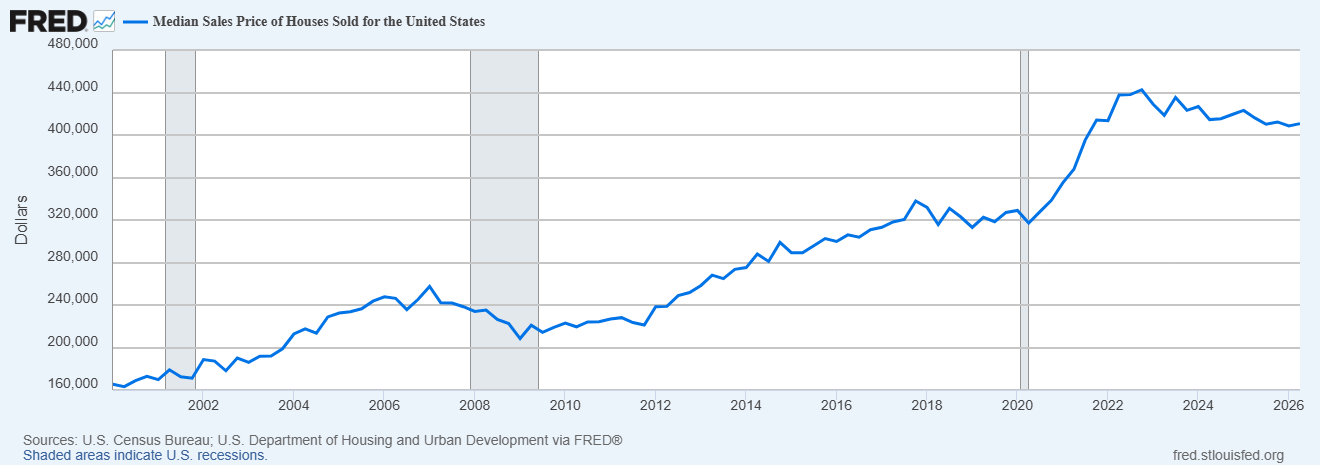
Slower-moving data confirms the trend. The median sales price of US homes peaked near $440,000 in late 2022, according to FRED. It has since drifted to roughly $410,000, the longest stretch of price weakness since 2008.

Residential construction absorbs an estimated 70% to 80% of North American wood demand. Consequently, lumber acts as a real-time gauge of housing health, and it now joins other unusual indicators flashing late-cycle warnings. Prediction markets have already lifted US recession odds this year.
Lumber Price Prediction Hinges on $580 Support
On the daily chart, lumber broke down from the $650 resistance region after repeated failures in late July. The decline also cut through an ascending trendline that had supported the market since December 2025.
Lumber trades at $585.75 at the time of writing, down 0.9% on the day and pressing the $580 support zone. If buyers defend this area, the setup may favor a relief bounce.

The daily Relative Strength Index (RSI) sits in oversold territory at its lowest since September 2025, when a durable rebound followed. However, the broken trendline near $590 may now act as resistance and cap any recovery.
Level
Role
$650
Major resistance and July rejection zone
$590
Broken trendline, potential resistance
$580
Immediate support under test
$565
Next support if $580 breaks
In contrast, a decisive close below $580 would expose the next support at $565, about 3.5% lower. That zone has stopped several sell-offs since late 2025.
Beyond the chart, the main catalyst remains the Federal Reserve. Expected rate cuts could pull mortgage rates lower and revive builder demand for wood. A deeper housing slowdown, meanwhile, could ripple into risk assets, including crypto.
The next several sessions should reveal whether oversold conditions spark a rebound or the housing warning grows louder.
The post Lumber Falls for 10 Straight Sessions as US Housing Cracks Widen appeared first on BeInCrypto.

Uniswap Labs' launchpad passed Pons on daily token launches within a day of opening on Robinhood Chain, according to onchain data, taking the lead from a product that settles every trade on Uniswap's own automated market maker. Uniswap now runs a product in the same category as applications built… Read the full story at The Defiant

July was the month the market caught its breath. After a June defined by a hawkish Fed surprise, a broken ETF cycle, and one of Bitcoin’s worst monthly candles in years, July delivered the opposite script: a steady grind higher, a World Cup campaign that closed out on schedule, a tennis debut at Wimbledon, and a security backdrop across the industry that made Zoomex’s transparency stack more relevant than ever. The month proved that recovery, like the drawdown before it, tests infrastructure just as hard as a crash does.
Zoomex by the Numbers
Against that backdrop, Zoomex’s value proposition stayed exactly where it was in June: sub-10ms execution, a dual liquidity pool architecture blending internal depth with aggregated external liquidity, and a minimalist interface built to hold up when volatility spikes in either direction. The platform continues to serve over 3 million registered users across 35-plus regions, with a catalogue spanning 700-plus trading pairs across Perpetual USDT, Inverse Perpetuals, Spot, tokenized equities, and now Predict Market contracts.
July’s test looked different from June’s. Rather than a single violent liquidation event, the month asked Zoomex’s infrastructure to hold up through a slower, choppier grind higher punctuated by a contentious Fed decision and an industry-wide spike in security incidents elsewhere. Zoomex’s regulatory stack, Canada MSB, US MSB, US NFA, and Australia AUSTRAC, stayed unchanged and fully active through it, and the platform’s Hacken security audits and Proof of Reserves framework remained the answer to a month where trust, not just speed, was the thing being tested across the sector.
What Zoomex Shipped in July
World Cup Predict Market Series Reaches Its Finale
Zoomex closed out its five-part World Cup Edition X Space series, part of the Zoomex World Cup Impact Pledge, with back-to-back episodes featuring some of football’s biggest names. England goalkeeper David James joined the third episode on July 9.

It was followed by Argentina legend and two-time Olympic gold medalist Javier Mascherano for the #ZOOMEXFootballAMA episode on July 14 hosted from Boston hours before the quarterfinals kicked off.

The series wrapped with a World Cup Final Panel featuring Fernando Llorente in late July. Each episode carried a charity component: Zoomex committed 1,000 USDT per episode to a cause chosen by that episode’s football guest, rising by an additional 5,000 USDT whenever the guest’s match prediction landed.

Zoomex Debuts at Wimbledon 2026
Zoomex extended its sports footprint beyond football and Formula 1, marking its first entry into elite tennis through partnerships with three professional players, Felix Gill, James Duckworth, and Roman Safiullin, timed to Wimbledon 2026.
Alongside the sponsorship, Zoomex launched a dedicated tennis Predict Market and a Grand Slam Trading Challenge, letting users trade to earn Lottery Tickets toward Wimbledon prizing while forecasting match outcomes and key moments as the tournament played out, extending the same Elite Access Platform positioning that has anchored its football and racing partnerships all year.
Home Race Week With Ollie Bearman
Zoomex’s Formula 1 partnership stayed active through the sport’s own headline week, as Silverstone hosted the British Grand Prix with Haas driver, Zoomex partner, and local favorite Ollie Bearman racing in front of a home crowd.

The platform marked the occasion with dedicated content around Bearman’s Silverstone weekend, keeping the F1 partnership visible alongside the month’s football and tennis campaigns rather than treating it as a one-off from earlier in the year.
Regulatory Watch: July’s Countdown Redefines Crypto’s Rulebook

Zoomex closed out July’s regulatory coverage by tracking the CLARITY Act’s stalled momentum, updated text was out and a floor vote was targeted before the August recess, but an ethics dispute kept blocking the final step, dropping the odds of 2026 passage sharply. Against that backdrop, MiCA continued cementing its position in Europe as the only fully operational framework.
Macro Meets Crypto: When the Regime Flips

Zoomex broke down how July inverted the macro playbook that had defined crypto trading through 2025 and early 2026. Instead of tariffs weakening the dollar and the Fed inching rates lower, July brought a strengthening dollar and a new Fed chair talking hikes instead of cuts, forcing traders to rewrite the script mid-cycle.
Grid Trading on Zoomex: How to Profit From Sideways Markets

With July’s price action defined by a choppier, range-bound grind rather than a clean trend, Zoomex published a breakdown of its Contract Grid tool, designed specifically for markets that drift sideways for days or weeks without a decisive move.
Zoomex Predict World: Turning Crypto Markets, Sports, and Global Events Into Live, Tradable Charts

Alongside the World Cup campaign, Zoomex’s Predict Market kept broadening its scope through July, letting users trade not just match outcomes but geopolitical and macro questions from the same interface, from Venezuela-related political scenarios to speculation around a potential Russian nuclear test by a set 2026 deadline. The mix reinforced the product’s core pitch: one prediction venue spanning sports, crypto price action, and world events, rather than a football-only campaign tool.
Zoomex Monthly On-Chain Report: June 2026

Rounding out coverage carried over from June, Zoomex published its monthly on-chain report highlighting a pivotal month for the platform’s on-chain footprint, marked by a dramatic surge in exchange trade volume, sustained multi-chain asset growth, and a diversified pattern of capital flows.
CEX Security Architecture: How Your Funds Are Protected on Zoomex

Zoomex closed the month’s editorial output with a deep dive into its 7-layer security architecture, framed against the industry’s track record of exchange failures, from the FTX collapse to the Bybit exploit that resulted in $1.5 billion in losses in early 2025, positioning Zoomex’s safeguards as the counterpoint to that history.
World Cup Prediction Market Campaign Wraps Up
The World Cup Prediction Market Campaign that opened in mid-June ran through July 18, giving users a full month of task-based Lucky Spin draws for World Cup tickets, gift boxes, airdrop rewards, and trading vouchers before closing out alongside the tournament itself, with Zoomex flagging heating competition on the leaderboard as the window narrowed.
Discord Rewards Campaign
From July 15 to July 25, Zoomex ran a Discord-based promotion offering USDT bonuses, limited community roles, and priority access, with a $500 prize pool for top participants, extending the platform’s community engagement beyond X and into Discord for the first time this cycle.
July Airdrop Carnival
Running from June 30 through July 31, the July Airdrop Carnival targeted new users with tiered onboarding rewards, including up to $770 in combined bonuses and airdrops and a fixed-term product offering competitive fixed-term yield options, structured around KYC completion, deposit tiers, and trading activity, before rolling directly into the August Summer Airdrop at month’s end.
Conclusion
July was the month the macro backdrop finally caught up with crypto, and Zoomex’s response was to keep building rather than retreat. A live Prediction Market timed to the World Cup, a full tokenized equities suite answering the AI rotation directly, two World Cup campaigns running in parallel, and a five part charity series pairing football culture with real donations. Not a pause. Continued output through the sharpest drawdown of the year.
The macro numbers explain why that mattered: Bitcoin down roughly 18% for the month, $2 trillion wiped out across risk assets in minutes on June 17, and the Fear & Greed Index sitting in Extreme Fear for most of the back half of the month. Zoomex’s sub-10ms execution infrastructure and dual liquidity pool architecture were built for exactly this kind of stress, and the platform’s regulatory stack, FINTRAC, FinCEN, NFA, AUSTRAC, FATF Travel Rule, stayed unchanged and fully active through it.
No platform token. No VC entanglements. No user funds at risk.
June confirmed what May suggested: reliability compounds precisely when markets don’t cooperate, and the platforms still shipping through a hawkish Fed surprise and an $18 billion monthly drawdown are the ones building for the World Cup final and beyond, not just for the next bull run.
About Zoomex
Founded in 2021, Zoomex is a global cryptocurrency trading platform focused on derivatives trading. The platform serves over 3 million users across 35+ countries and regions, offering access to 700+ trading pairs. Built around easy to use, transparency, fairness, and speed, Zoomex provides a clear and efficient trading experience for users worldwide.
Through its high-performance matching engine, clear asset and order displays, and transparent fee and rule mechanisms, Zoomex helps users better understand their account status, order execution, trading costs, and results. Zoomex maintains registrations, licenses, and regulatory statuses across multiple jurisdictions, including the U.S. MSB, Canada MSB, U.S. NFA, and Australia AUSTRAC, and has completed security audits conducted by blockchain security firm Hacken. The platform also continues to strengthen its trust framework through Proof of Reserves, Security & Transparency, Compliance Information, and Fees / Rules Transparency initiatives.
Beyond trading, Zoomex builds a refined brand experience through elite sports partnerships, including the TGR Haas F1 Team, World Cup-winning goalkeeper Emiliano Martínez, and world-class tennis events such as Wimbledon. The values of speed, precision, discipline, fair play, and rule-based execution are closely aligned with Zoomex’s approach to derivatives trading.
At Zoomex: Easy to Use. Transparent balance. Fair access to your earnings.
Frequently Asked Questions
What is Zoomex? Zoomex is a global crypto derivatives platform founded in 2021, serving over 3 million users across more than 35 countries and regions with 700+ trading pairs.
How does Zoomex work? Zoomex operates through a high-performance matching engine with transparent asset and order displays, allowing users to execute trades and track outcomes with full visibility into their balances and results.
What can you trade on Zoomex? Zoomex offers 700+ trading pairs spanning cryptocurrencies such as BTC, ETH, and SOL, as well as stock-linked contracts like NVDA and AAPL and gold exposure through XAUT.
How does Zoomex compare to other exchanges? Zoomex differentiates itself by not issuing a platform token, avoiding venture capital or incubation deals, and holding security certifications from Hacken alongside regulatory licenses in multiple jurisdictions, positioning the platform around transparency and fund safety rather than token incentives.
Where is Zoomex headquartered? Zoomex operates as a global cryptocurrency exchange with regulatory registrations including Canada MSB, U.S. MSB, U.S. NFA, and Australia AUSTRAC, reflecting its multi-jurisdictional compliance approach.
Is Zoomex available in my country? Zoomex serves users across more than 35 countries and regions. Availability can vary by local regulation, so traders should check the official Zoomex website for country-specific access and requirements.
The post Zoomex Monthly Transparency Report: July 2026 appeared first on BeInCrypto.

If you look up on any given night, you might be able to see a few meteors each hour under optimal conditions. But meteor showers, which take place when Earth’s path intersects with the dusty trails that comets and asteroids leave behind, are special because you can see many more “falling stars” in that same amount of time.
The Perseid meteor shower occurs around the same time each year, typically starting in mid-July and lasting until late August, when our planet passes through debris from a comet called Swift-Tuttle. During this shower, you may be able to see up to 100 meteors per hour under the right conditions, according to astronomers.
NASA describes the Perseids as “swift and bright meteors,” saying that they “frequently leave long ‘wakes’ of light and color behind them as they streak through Earth’s atmosphere.”
When can you best see it?
The Perseid meteor shower is already underway. But your best chance of seeing the most meteors will come when it’s at its peak level of activity, which is set to occur the night of Aug. 12 into Aug. 13, according to NASA.


Michael Saylor said ChatGPT helped him design the preferred stock financing model that enabled Strategy to raise about $15 billion for its Bitcoin-focused balance sheet.
Summary
- Saylor credited ChatGPT with helping develop Strategy’s preferred stock financing structure.
- Strategy raised about $15 billion through the securities and related capital-market activity.
- The company reported holding 842,138 BTC as of Aug. 2 after selling 1,638 BTC.
- Saylor said workers should use AI to extend their abilities rather than compete with automation.
ChatGPT helped shape Strategy’s financing plan
Strategy Executive Chairman Michael Saylor said he used ChatGPT to explore and develop a preferred stock financing model tied to the company’s Bitcoin strategy, according to an Aug. 6 Fortune report.
Saylor discussed the process during an interview with The Diary of a CEO. He said the AI chatbot helped him examine financing structures that Strategy later used to raise billions of dollars from investors.
“AI helped me create $15 billion,” Saylor said.
The figure reflects capital raised through Strategy’s preferred stock products and related financing rather than revenue generated directly by ChatGPT. The AI tool helped Saylor work through the structure, while investors, underwriters and company executives carried out the offerings.
Strategy has built a group of Bitcoin-backed preferred securities, including STRC, STRK, STRF and STRD. The products give investors different combinations of dividends, volatility and exposure to the company’s Bitcoin-heavy balance sheet.
Saylor urges workers to ‘harness the robots’
Saylor said AI is changing how individuals and companies create value. In his view, workers should focus on asking better questions and using machines to pursue ideas that would otherwise require more time or expertise.
“Don’t try to outwork the robots,” he said.
His comments frame AI as a tool that can expand human decision-making rather than merely replace repetitive work. Saylor argued that future entrepreneurs would gain an advantage by combining human judgment and creativity with the speed of AI systems.
The claim also provides a practical example of generative AI being used in U.S. corporate finance. However, ChatGPT-generated proposals still require legal, accounting, and regulatory review before a publicly traded company can use them to sell securities.
Strategy’s preferred shares carry different dividend obligations and risk profiles. Their performance remains closely connected to the company’s ability to manage its capital structure and its large Bitcoin position.
Strategy adjusts its Bitcoin treasury policy
Saylor’s comments come as Strategy has shown greater flexibility in managing its Bitcoin holdings.
An Aug. 3 Securities and Exchange Commission filing showed that the company sold 1,638 BTC for approximately $104.73 million between July 27 and Aug. 2. Strategy used $52.4 million to fund preferred stock dividends and $52.3 million to repurchase STRC shares.
The sale reduced Strategy’s holdings to 842,138 BTC as of Aug. 2. The company reported an aggregate purchase cost of $63.51 billion and an average acquisition price of $75,419 per Bitcoin.
On Aug. 5, Lookonchain identified another transfer of 1,030 BTC, worth roughly $66.14 million, from wallets it associated with Strategy. Strategy had not confirmed that the transfer represented another sale, and no later SEC filing had reduced its reported holdings when this article was prepared.
Strategy expands beyond Bitcoin financing
Strategy is also adding employee benefits as it develops its broader corporate operations. On Aug. 5, the company joined the Invest America Business Pledge and committed to contributing $250 annually to Trump Accounts for eligible children of its U.S. employees.
Eligible children born on or after Jan. 1, 2025, will also receive a one-time $1,000 company contribution matching the U.S. government’s initial deposit.
The next test for Strategy will be whether its preferred stock model can continue attracting investors while supporting dividend payments and protecting its Bitcoin holdings. Saylor’s account of using ChatGPT shows how AI influenced the model’s design, but its long-term performance will depend on capital-market demand, Bitcoin prices and Strategy’s execution.
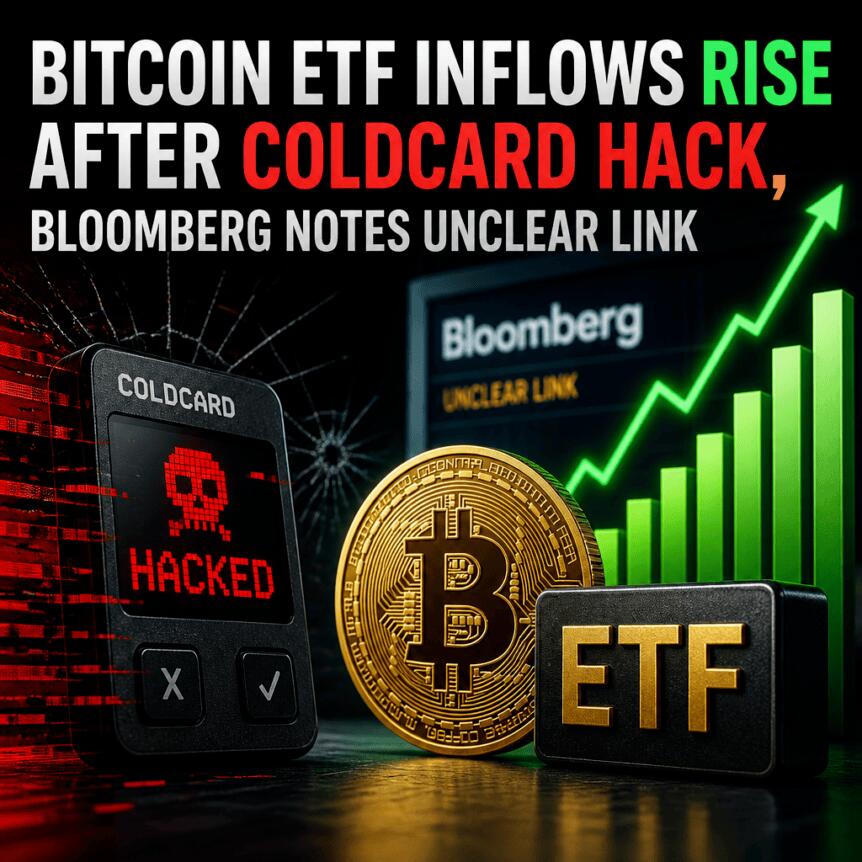
Spot Bitcoin ETFs have seen a notable acceleration in demand over the past week, according to Bloomberg ETF analyst Eric Balchunas. Several major funds reported inflows on every trading day since a Coldcard wallet vulnerability exploit became public—an overlap that has sparked renewed discussion about whether some investors are reconsidering self-custody in favor of regulated products.
Balchunas’ tally attributes roughly $620 million in cumulative inflows to BlackRock’s iShares Bitcoin Trust (IBIT), Fidelity’s Wise Origin Bitcoin Fund (FBTC), Bitwise’s Bitcoin ETF (BITB), ARK 21Shares Bitcoin ETF (ARKB), and Defiance Daily Target 2X Long MSTR ETF (MSBT). His observations echo earlier streak reporting from Cointelegraph, which covered an ETF inflow run reaching similar magnitudes.
Key takeaways
- Bloomberg’s Eric Balchunas says multiple spot Bitcoin ETFs recorded daily inflows for the entire stretch since the Coldcard exploit.
- Balchunas estimates the combined inflows at roughly $620 million across named funds.
- TRM Labs linked the Coldcard incident to theft of more than $116 million in Bitcoin from over 5,200 wallet addresses.
- The timing has intensified debate over the relative operational risks of self-custody versus ETF custody through institutional providers.
- Crypto security concerns are evolving alongside more sophisticated cyberattacks, including AI-assisted exploits highlighted by industry reporting.
ETF inflow streak lines up with Coldcard exploit fallout
The current inflow momentum centers on a simple pattern: funds that track spot Bitcoin exposure have continued bringing in net new capital day after day following the weekend Coldcard exploit. Balchunas’ post on X points to inflows at IBIT, FBTC, BITB, ARKB and MSBT every trading day since the incident, totaling about $620 million.
While the overlap is striking, Balchunas was careful to avoid claiming causation. He said on X that the connection is unknown—adding that, “long-term I can’t imagine there aren’t some who migrate over.” That framing matters: investors may already be rotating toward ETFs for accessibility and compliance reasons, but the Coldcard event appears to have sharpened attention on how custody failures can materialize even when users follow “best practice” assumptions.
For readers, the key question is whether this is a temporary spike tied to headlines—or evidence of a more durable shift toward ETF custody. The only way to judge that will be to watch whether inflows persist if attention on the exploit fades, or whether the streak breaks.
What happened in the Coldcard incident, and why it resonated
The Coldcard exploit involved a vulnerability affecting certain wallet devices, leading to significant losses. According to blockchain intelligence firm TRM Labs, the incident drained more than $116 million worth of Bitcoin from over 5,200 wallet addresses.
That scale is part of why the debate has reignited across the industry. Self-custody has traditionally been framed as a way to reduce reliance on intermediaries. But security research and real-world incidents have repeatedly shown that self-custody is not a single risk level—it’s a system of risks spanning device firmware, user setup, operational processes, and the broader ecosystem that supports hardware wallet usage.
The Coldcard episode thus serves as a reminder that hardware wallet users can still be exposed when flaws exist below the user interface—particularly when vulnerabilities emerge that can be exploited without requiring the user to willfully do something unsafe.
Self-custody vs. exchange custody: CZ revives the “statistical safety” argument
The ETF timing has also fed into broader arguments about whether self-custody is truly “safer” on a population basis. Binance co-founder Changpeng “CZ” Zhao commented on the ongoing discussion, suggesting that storing crypto on centralized exchanges may be “statistically safer” than self-custody, pointing to data from analyst Willy Woo. CZ’s reasoning is based on the visibility of losses: exchange-related incidents are easier for observers to detect and document, while self-custody failures (including hacks and lost funds) may go unreported or be harder to quantify.
In a post on X, CZ noted that “Hack data is easier to collect on the CEX side, usually major news. It is harder on the self-custody side, where hacks, lost coins, etc are often not reported.”
The practical implication isn’t that all custody models are equally reliable. Instead, it highlights an asymmetry in measurement: even if self-custody failures occur frequently, the public record can undercount them relative to highly visible exchange events. For investors deciding how to allocate Bitcoin exposure, this creates a problem of incomplete information—one reason ETFs continue to attract interest as a middle path between direct custody and exchange-managed holding.
Cyber risk is shifting, and custody debates are following
The Coldcard exploit arrives as concerns about rapidly escalating cyber threats become harder to ignore. Industry reporting cited by Cointelegraph points to increasing AI-assisted attack capabilities, where adversaries can identify and exploit vulnerabilities faster than defenders can patch them.
For example, Cointelegraph reported that Bitcoin swap service Boltz suspended its non-custodial bridge, citing a steady rise in AI-assisted exploits that were enabling attackers to move faster than the team could remediate issues. While that incident is not the same as the Coldcard hardware vulnerability, it reinforces a larger theme: attackers are increasingly benefiting from automation and speed—meaning the security burden on individuals and small teams can become disproportionately heavy.
That matters for custody decisions because self-custody security is often treated as a “set and forget” activity. In reality, device maintenance, software/firmware updates, environment hygiene, and broader operational discipline all require ongoing attention. If the threat landscape is accelerating, the gap between what users can comfortably manage and what attackers can probe may widen.
How investors should think about the ETF streak from here
Even if the Coldcard timing played a role in investor behavior, it may not be the only driver of ETF flows. ETFs already offer regulated access, standardized custody arrangements with institutional-grade processes, and simplified onboarding compared with direct device ownership and operational management.
The next test is persistence. Readers should watch whether daily inflows continue beyond the immediate news cycle and whether new inflow streaks emerge alongside future security incidents. If inflows remain strong while headlines fade, it would suggest that some capital is moving for structural reasons. If inflows taper quickly, the streak may reflect near-term sentiment shifts rather than a lasting change in custody preferences.

Ripple’s cross-border token has fallen by 65% over the past year, while Pi Network’s PI and Cardano’s native cryptocurrency have crashed by around 73% over the same period. This has happened amid a prolonged bear market that has caused the entire market to bleed heavily.
Yet, many analysts believe that a new bull run may begin in the coming months, while the four-year cycle supports their theories. On that note, we asked three of the most popular AI-powered chatbots whether XRP, PI, or ADA will perform best when everything starts booming again.
XRP’s Chances
According to Perplexity, Ripple’s cryptocurrency has the cleanest risk-adjusted setup to outperform during the next bull run. The chatbot claimed the asset is quite trending among institutional investors and noted that it is perhaps the most popular among the trio.
“XRP is favored to deliver the most consistent, risk-adjusted gains among the three, with a realistic path to new cycle highs if ETF and payments narratives stay hot,” it added.
Perplexity also reminded that Ripple’s legal battle with the US Securities and Exchange Commission (SEC) has long been resolved, and that the absence of regulatory uncertainty can only benefit XRP during a potential market uptrend.
Additionally, it highlighted the company’s global expansion, major investments, and strategic partnerships inked over the past several months that have solidified its presence in the financial and crypto sectors. One of the biggest acquisitions came in April 2025 when Ripple purchased the prime broker Hidden Road for $1.25 billion.
Examples of its broader international growth include the collaboration with the South Korean KBank, which plans to use Ripple’s network and infrastructure, as well as the entity’s ability to secure a MiCA license and continue its operations in the European Union.
ADA’s Potential
ChatGPT agreed with Perplexity that XRP has the strongest institutional foundation. It noted that it is the largest cryptocurrency of the three with deeper liquidity but at the same time argued that it might find it difficult to achieve larger returns than ADA in a future bull run.
OpenAI’s platform claimed that Cardano’s token could be the best overall bet after noting that a huge chunk of the total supply is already in circulation, which makes the risk of dilution less than with XRP and PI.
It predicted that in an “extreme euphoria” case, ADA could skyrocket to as high as $5. It is important to mention that the asset has enjoyed a solid revival over the past week, with its price rising by roughly 17%. Its positive performance comes on the back of whale accumulation and renewed interest from traders, while many analysts think a much more substantial upswing could be on the way.
PI: The Moonshot Bet
Google’s Gemini claimed that XRP and ADA both have chances to rally hard during the next bull run, yet it set its attention on Pi Network’s cryptocurrency.
It said the controversial project has one of the largest community bases in the crypto world, adding that it has the potential to experience a whopping 100x explosion should it solve its ecosystem issues and get listed by the leading exchanges.
Recall that Binance hinted at such a move last year but has not yet done so. Coinbase, Bybit, and many other well-known names also prefer to stay away from PI at the moment.
The post XRP vs PI vs ADA: 3 AIs Speculate Which Will Perform Best in the Next Bull Market appeared first on CryptoPotato.

An open-pit copper mine at Asarco’s Mission Mine Complex in Sahuarita, Arizona, US, on Friday, March 6, 2026.
Rebecca Noble | Bloomberg | Getty Images
Copper surged to a record high Thursday, but the latest rally comes against a more mixed growth backdrop, making the once-reliable gauge of economic health, “Dr. Copper,” harder to read.
U.S. copper futures climbed to around $6.90 a pound Thursday, extending a rally in a metal used for construction, electronics, transportation and even AI applications. It then retreated to end the session after touching the new high.
But instead of simply indicating stronger global growth, today’s record price could be reflecting a combination of constrained supply, heavy grid investment, uncertainty around U.S. tariffs and rising demand for electrification.
In the past, the metal was seen as a gauge on whether global economic activity was ramping up.
“The underpinning story of elevated copper prices has been data center and power grid demand to support the rapid AI industry expansion,” William Osnato, Barchart director of commodity data research and analysis, told CNBC in an email, adding that surge in copper demand is “more acute and not the traditional broad economic growth that supports copper.”
Copper’s price surge is also due to its limited supply and mining it is an expensive business and setting up new mines can take about 10 years, which can also slow down supply of the red metal.
Michael Widmer, Bank of America’s head of metals research told CNBC that the move wasn’t really driven by copper demand but really driven by copper supply.
Widmer said there is not a lot of mine supply growth and supply disruptions have been creating additional constraints. Mine growth has been weak, with disruptions in Chile, the world’s biggest single copper producer. Heavy snow, rainfall and high winds have disrupted mining operations in the region.
Potential U.S. Section 232 tariffs and China’s crackdown on the availability of scrap copper have also tightened global supplies in 2026. Last year in June, President Donald Trump signed a proclamation to impose 50% tariffs on imports of semi-finished copper products and copper-intensive derivative products.
Demand for copper has remained firm and is also closely tied to increased electrification rather than an economic boom.
In the first half of this year, China’s grid investment was up 13% year over year and the country recently announced an ambitious plan to invest approximately $574 billion in power grid upgrades.
Thursday’s move, however, came only after the news that Democratic Republic of Congo was officially banning copper and cobalt concentrates exports to encourage more domestic processing.
Osnato said supply disruptions have been pushing consumers to pull metal out of London Metal Exchange warehouses and this is driving up refining costs.
“It is definitely a new situation for Dr. Copper,” he said.

Crypto analyst Ali Martinez said on August 6 that Ethereum’s recent move above a major MVRV pricing level could open the way toward a $3,000 target.
The market watcher’s view is based on historical on-chain patterns that have previously appeared before major ETH recoveries, though resistance levels remain ahead.
Ethereum Reclaims MVRV Level as Analysts Watch $3K Target
“ETHEREUM IS HEADING TO $3,000,” Martinez announced in a post on X.
He said the asset turned bullish after breaking above its 0.8 MVRV Pricing Band near $1,800 and explained that this level has historically acted as a point where ETH goes from weakness into recovery phases.
The move followed an earlier July 6 post from the analyst, where he had identified $1,800 as the level Ethereum needed to clear. At the time, ETH was testing that area as resistance, with a successful daily close above it expected to increase the chances of a move toward its Realized Price.
In his August 6 post, Martinez confirmed that the world’s second-largest cryptocurrency had since reclaimed the MVRV as support. According to him, similar recoveries over the last six years have often led Ethereum toward, or above, its Realized Price, which currently sits near $2,300.
He also pointed to an MVRV Momentum golden cross that formed after ETH’s recovery, with previous signals of this type being followed by rallies of 50%, 166%, 74%, and 113%. The metric compares Ethereum holder profitability with its 160-day moving average and is used by analysts to track shifts between selling periods and recovery phases.
The asset was trading around $1,900 at the time of writing after rising 1.6% in the last 24 hours. It has gained almost 7% over the last 30 days but remains down more than 47% over the last year. ETH reached an all-time high near $4,950 in August 2025 and is still around 62% below that level.
According to Martinez, the $3,000 area is the next major target if buying pressure continues. The analyst pointed to on-chain transaction data showing more than 10 million ETH previously changed hands around that price, making it a major resistance zone.
Market Watches Ethereum’s Breakout Attempt
Other traders have also focused on Ethereum’s recovery, with trader Ted Pillows saying it could move toward $2,000 if it holds the $1,800 region following an 18.5% jump in July, adding that the fact that there was spot buying activity was a positive sign.
Michaël van de Poppe also said holding $1,800 could lead to a move above $2,000 and then toward $2,300.
Some traders believe a stronger ETH move could improve sentiment across the wider market, possibly affecting the next phase for altcoins, although that depends on whether Ethereum can continue breaking through resistance levels.
For now, Martinez’s $3,000 forecast relies on ETH maintaining its MVRV breakout and continuing the pattern seen in previous cycles. According to him, the next areas traders should be watching are around $1,980 to $2,080, followed by the $2,773 region he had mentioned in a previous update.
The post Analyst Forecasts Ethereum Rally to $3K After Key On-Chain Breakout appeared first on CryptoPotato.


Within the span of just six days, immigration enforcement agents fatally shot two more people, Lorenzo Salgado Araujo in Texas and Johan Sebastián Durán Guerrero in Maine. Their deaths are not an aberration, they’re an indictment: President Donald Trump’s mass deportation machine is deadly and wreaks havoc on American streets every day.
Juiced by tens of billions in funding from Congress, the Trump Administration has amassed thousands of law enforcement personnel and deployed them in a nationwide “surge”—with a public mandate to deport one million people per year, regardless of the chaos their actions cause in American streets. These latest shootings, which Immigrations and Customs Enforcement (ICE) now admits took the lives of people who weren’t even their intended targets, reveal the sloppy, reckless, and cruel results of the Trump Administration’s unprecedented arrest escalation.
The New York Times reports that six other people have been fatally shot by Immigration and Customs Enforcement (ICE) since the start of President Trump’s second term, as the agency pursues aggressive arrest quotas. Without change, this pattern of reckless enforcement threatens to become the go-to playbook for immigration enforcement for years to come.
A new report from the ACLU only provides more clarity on ICE’s track record of lawlessness, as ICE and the agents working for it are operating under new norms that put people in danger, undermine our basic freedoms, and are already changing the nature of American life for the worse. Through a detailed accounting of more than 1,200 enforcement incidents across eight states in 2025, the report found that immigration agents routinely used violence and the threat of physical force against those they encountered to compel immediate obedience to their commands, not because they faced serious threats to their own safety.
Our report identifies 418 times agents shoved, tackled, or pinned people; 76 times they pulled people from cars; 130 times they brandished weapons and 69 times, they verbally threatened to use weapons or force; 361 times they pepper-sprayed or used other chemical irritants on people; and 81 times they used tactics so dangerous that they’re sharply prohibited by many law enforcement agencies because they’re deadly, such as chokeholds and grabbing people by the neck.
When armed officers begin encounters with force as a default tactic, it puts lives at risk. A minor stop, confusion, or an attempt to drive away can become deadly in seconds. Injury and death are not just accidents—they are risks created by the method of enforcement itself. The dangers have only magnified as immigration agents moved their operations into the spaces of everyday public life—where people live, work, commute and go to school—exposing anyone who may happen to be in the vicinity to the disruption and violence. For instance, children are often caught in the cross-hairs. We identified more than 200 who were detained or subjected to law enforcement misconduct, including 32 U.S. citizen children.
In this way, violent immigration enforcement isn’t just a threat to public safety, it’s a threat to the very cornerstone of our democracy. Research from the ACLU identified 782 people who were watching, documenting, protesting, or otherwise bearing witness and were targeted, detained, or subject to law enforcement misconduct. This, we determine, is an attack on the First Amendment, effectively suppresses free speech, and threatens to roll back civil liberties.
These findings should worry all Americans. The Trump Administration has turned the nation’s largest federal law enforcement agencies into a kind of paramilitary force, threatening the rights and safety of communities across the country. In the brutal and swift pursuit of its ambition to achieve 100 million deportations—approaching a third of our nation’s population—this deportation force has fundamentally reshaped American life.
The White House should de-escalate its enforcement surge. But without serious, lasting reform, everyday places will remain danger zones for immigrants and U.S. citizens alike, and deaths and serious injuries will continue. It’s time to replace ICE, an agency that was conceived about a quarter century ago and has proven reckless and unaccountable, with a new system designed to manage immigration effectively. We must bring our neighbors and loved ones out of the shadows, and on a path to citizenship and to undisputed, full protection under our laws. This new agency should be charged with a mission to keep families together, support all our communities to thrive, and uphold our rights—not attack them.
Mr. Salgado Araujo and Mr. Durán Guerrero are not the first people to be killed by ICE agents, but they must be the last.


MetaMask has launched Agent Wallet, a self-custodial product that lets AI agents execute on-chain transactions while operating within limits set by users.
Summary
- Agent Wallet supports autonomous transactions across EVM-compatible networks and Hyperliquid.
- Users can impose spending caps, protocol restrictions, and risk settings before an agent begins operating.
- Eligible transactions receive up to $10,000 in monthly Transaction Protection, subject to MetaMask’s terms.
- The wallet supports AI development tools including Claude Code, Codex, Cursor and OpenClaw.
MetaMask Agent Wallet gives AI agents controlled access
MetaMask announced the wider launch of Agent Wallet on Thursday after introducing the product to roughly 200 early-access users in June.
The wallet targets traders and developers who use AI agents to monitor markets, identify opportunities and execute on-chain strategies. Supported activities include token swaps, perpetual futures trading, prediction market positions and liquidity provisioning.
Agent Wallet works with Claude Code, Codex, Cursor, OpenClaw, Hermes and OpenCode. Users can deploy agents across Hyperliquid and supported Ethereum Virtual Machine networks, according to MetaMask.
Unlike systems that give an AI model unrestricted wallet access, Agent Wallet lets users establish rules before funding the account. These include daily spending limits, approved protocols and broader risk preferences.
“This security-first model is why Agent Wallet is built around rules, not blind delegation,” MetaMask said. “The agent can act, but it acts inside the user’s boundaries.”
Users remain in control of their private keys and can export their secret recovery phrase, preserving the wallet’s self-custodial structure.
Guard Mode and Beast Mode offer different controls
Agent Wallet includes two operating settings based on how much autonomy a user wants to give an AI system.
Guard Mode is the default option. Transactions that exceed spending limits, interact with unapproved protocols, or violate another wallet policy pause for human approval through two-factor authentication. Users can review and approve the request through MetaMask Mobile or an email link.
Beast Mode reduces the number of approval interruptions for experienced traders and developers. Security checks remain active, while transactions identified as potentially malicious still require human authorization.
The wallet also uses gas abstraction. Agents can transfer or swap tokens without holding the network’s native asset to cover transaction fees. MetaMask instead settles the fee using the asset being moved.
“Agents can transfer and swap without holding a chain’s native token for gas; MetaMask settles the network fee in the token being moved.”
Transaction protection covers eligible losses up to $10K
Supported EVM transactions pass through simulation, threat scanning, and MetaMask’s Smart Transactions protection against maximal extractable value risks before reaching the blockchain.
Transactions that clear these checks may qualify for up to $10,000 in Transaction Protection coverage per month if they still result in a loss. The protection is subject to eligibility requirements and does not mean every trading loss, failed strategy, or unsupported transaction will receive reimbursement.
The distinction matters because autonomous trading remains exposed to market volatility, smart-contract failures, and incorrect instructions. Wallet-level limits can restrict what an agent is authorized to do, but they cannot eliminate every financial or technical risk.
MetaMask said the system is designed to prevent AI agents from overriding user policies, reducing reliance on the agent interpreting each instruction correctly.
MetaMask joins the race for AI-powered finance
The launch places MetaMask in competition with other crypto companies developing payment and trading infrastructure for autonomous software.
U.S.-based Coinbase introduced Agentic Wallets in February, giving AI systems programmable tools to spend, earn, and trade with built-in guardrails. MoonPay has also expanded MoonAgents, including a Telegram-based interface for managing crypto through natural-language commands.
Agent Wallet also extends MetaMask’s move beyond a standard browser wallet. In June, the company launched Money Account, a self-custodial account built around mUSD that combines variable DeFi yield, trading and card spending through one balance.
MetaMask has not introduced a native token alongside Agent Wallet. Adoption will instead depend on whether traders and developers are willing to give autonomous systems limited authority over real on-chain capital.

Chelsea and Fulham MP to stand down at next election after 19 years

Mortgage rates rise to 6.69%: Freddie Mac

Uniswap's New Launchpad Out-Launched Pons On Its First Day On Robinhood Chain

Renter of Home in Anne Heche Crash Denies Settlement With Son

No Jackpot Winner as $257 Million Prize Rolls Over to $269 Million Monday Draw

Weekend Open Thread: Staud – Corporette.com

Crypto Gold Live Trading 5 AUG | Market Trader | #goldtrading #cryptotrading #bitcoin

Trump HUMILIATES Himself as BOMBSHELL Filing EXPOSES Financial SECRETS!!

Trump’s Oval Office Stunt COLLAPSES As Disastrous Financial Truth Surfaces
-

 Fashion6 days ago
Weekend Open Thread: Wit & Wisdom
-

 Politics6 days ago
Meta enters AI-training agreement with far-right ‘propaganda rag’ Newsmax
-

 Politics4 days ago
Zack Polanski: an incitement to murder Nigel Farage?
-

 Crypto World5 days ago
MicroStrategy Post-Earnings CLARITY Act Push Could Add New Catalyst for Its Stock
-

 Crypto World6 days ago
XRP Ledger v3.3.0 brings five institutional features
-

 Sports7 days ago
Seema Kaliramna Wins Discus Throw Bronze, Takes India’s CWG Medals Tally To 17
-

 Crypto World6 days ago
New York sues Kalshi over prediction market gambling
-

 Crypto World4 days ago
Crypto PAC spending tops $2M in Michigan House race
-

 Business4 days ago
DTCR: Deleveraging And A Hedge Fund Collapse Point To A Possible AI Bottom
-

 Business6 days ago
Trump Announces Hamas Disarmament Agreement as Iran Strikes Kuwait Air Base and US Attacks Pause Overnight
-
 Crypto World6 days ago
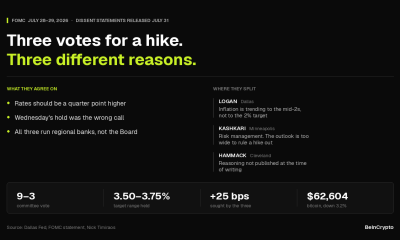
3 Fed Officials Just Explained Their Rate Hike Vote: Is Inflation Winning?
-

 Tech5 days ago
ESET tracks rise in malicious AI skills and adaptable malware
-

 Tech6 days ago
Gemini Spark can now use Chrome logins and saved passwords to run errands on your behalf
-

 Tech6 days ago
Building A Reproduction PlayStation Motherboard
-

 Sports5 days ago
France Cricket implodes: letters hidden in a drawer and a board at war
-
Crypto World4 days ago
XRP Ledger urges node upgrade after manifest flood
-

 Crypto World6 days ago
Moneyflip CEO charged in $40K murder-for-hire plot
-
 Sports6 days ago
Bruno Fernandes decision made as Man United ‘discuss’ striker transfer option
-

 News Videos5 days ago
Financial Crash Expert: The 90-Day Collapse Timeline They Are Desperately Hiding.
-

 NewsBeat7 days ago
Spain sending troops as thousands enter enclave of Ceuta from Morocco
You must be logged in to post a comment Login