

Crypto World
May 27 Price Outlook: BTC, ETH, BNB, XRP, SOL, DOGE, HYPE, ZEC, ADA, XMR

Bitcoin is under renewed pressure, slipping below the $75,000 mark as institutional sentiment appears to shift. Fresh data show net outflows from BTC exchange-traded funds (ETFs) accumulating since mid-May, while on-chain signals add to a growing narrative of cautiousness among large players. In parallel, a notable spot buyer activity was observed on the downside, with a prominent whale reportedly accumulating BTC on successive days. The confluence of ETF flows, valuation gaps versus equities, and stubborn resistance at key price levels is shaping a fragile near-term outlook for the market.
According to Farside Investors, BTC ETFs posted net outflows totaling about $1.88 billion since May 15, underscoring a waning appetite from some institutional entrants. Glassnode, meanwhile, highlighted persistent net outflows from BTC ETFs on nearly every trading day since May 7, suggesting supply continued to press on the market even as some buyers remained eager to step in at lower prices. The divergence between supply and demand in this window is a focal point for traders watching how institutions reallocate risk in a volatile environment.
Beyond ETF dynamics, BTC’s valuation picture has drawn attention. Bitwise recently noted that the asset is trading below its long-term valuation benchmark, a frame that historically has corresponded with heightened volatility and ripples through risk markets. Its market-value-to-realized-value (MVRV) ratio sits around 1.42, a level that, in historical context, has been associated with elevated risk when paired with broader asset valuations. By comparison, the current gap between BTC’s valuation and US tech stocks is often highlighted as substantial—an indicator of how BTC’s pricing is diverging from traditional equity benchmarks. For some observers, the widening delta with tech equities signals a risk tilt that could amplify if demand from mainstream funds remains tepid.
On-chain observations added another layer to the narrative. Notably, a well-known figure in the space flagged a steady stream of accumulation on the downside. Blockstream CEO Adam Back commented on X that a BTC whale has been purchasing around 450 BTC per day for more than eight days using a time-weighted average price approach, signaling an active demand presence when prices dip. While large buyers may suggest a floor in the near term, the combination of inflows and reserve-building is not yet enough to confirm a sustained turnaround without sufficient follow-through from other market participants.
Against this backdrop, traders are weighing the near-term chart setup for BTC and a handful of marquee altcoins. The immediate question remains whether the support zone around $76,000 to $74,289 will hold, or if price action will slip further to test lower supports near $70,500, where demand could re-emerge. Conversely, a bounce off that zone could renew momentum toward the mid-$80,000s, with a potential run at $82,000 and then $84,000 if bulls regain traction above recent resistance.
Key takeaways
- BTC ETFs registered net outflows totaling roughly $1.88 billion since May 15, signaling a renewed wave of institutional selling pressure and a potential reluctance to chase higher prices in the near term.
- On-chain signals and a prominent whale buy program suggest pockets of demand exist at lower levels, but they have yet to translate into a broad market reversal.
- The current BTC MVRV ratio sits at about 1.42, with Bitwise noting a valuation gap versus tech equities that underscores a broader market dislocation between BTC and traditional risk assets.
- Near-term price action hinges on BTC’s ability to defend the $76k–$74k area; a breakdown could open a path toward the $70k range, while a bounce could renew upside toward the $82k–$84k zone.
- Across major altcoins, the market presents a mixed technical picture, with several assets trading at critical levels that will determine whether risk assets can stabilize or resume their downtrend.
Technical mosaic across major assets
Bitcoin (BTC)
The current setup suggests bears are attempting to seize control after a test of the 20-day exponential moving average near $77,431. A decisive move below the $76,000–$74,289 support band could tilt the short-term advantage to the bears, potentially leading BTC toward the $70,500 area, where buyers have historically stepped in. If, however, price strengthens and sustains above the 20-day EMA, the rally could resume toward the $82,000 level and then to roughly $84,000, where a fresh push could be required to extend a sustained uptrend.
Ethereum (ETH)
ETH has struggled to reclaim the key pivot around $2,000, which has served as a psychological baseline for bulls. A breakdown below this level could open a slide toward the $1,916–$1,750 zone. On the flip side, a sustained move above the moving averages would signal renewed strength and could push ETH toward the $2,465 mark, with the next hurdle near the upper boundary of its current range.
BNB
BNB is clinging to the 20-day EMA near $652, but bears remain vigilant around the $636 level, which coincides with the 50-day simple moving average. A breakdown could take the price down to the $610 target and then toward $570. If buyers defend the moving averages and push higher, the bulls’ target would shift toward $687, with possible advances to $730 and eventually to $790 if momentum accelerates.
XRP
XRP continues its gradual drift toward the $1.27 support, with a strong defense likely required at that level. The chart shows resistance forming around the 20-day EMA at roughly $1.37 and the shape of a downtrend line cap. A failure to defend $1.27 could see XRP testing $1.11 and possibly $1.00. A decisive close above the downtrend line, however, would open the path toward $1.61, marking a potential trend shift.
Solana (SOL)
SOL remains trapped between the $82.65 support and the 20-day EMA near $86.42. A break below the support could propel SOL toward $76, while a rally above the moving average would keep the trading range intact for the near term, with a potential move back toward the upper end of the range around $98.
Dogecoin (DOGE)
Dogecoin has struggled to sustain a move above the 20-day EMA near $0.10, leaving downside risk on the table. A break below $0.10 could retest the $0.09 support, with a breach of that level opening the risk of a slide toward $0.08. Conversely, a close above the 20-day EMA would suggest continued range-bound action between roughly $0.09 and $0.12, with a break above $0.12 needed to re-ignite a climb toward $0.14 and beyond.
Hyperliquid (HYPE)
HYPE pulled back from a recent breakout at around $64.93, suggesting profit-taking among shorter-term traders. The near-term question is whether buyers can arrest the pullback near $59.41 and flip it into support. A successful defense could spur a rally toward $77, but a break below $59.41 risks a deeper correction toward the 20-day EMA at about $52.14 and, beyond that, toward the 50-day simple moving average near $44.92.
Zcash (ZEC)
ZEC has retreated from the $690 level, with sellers eyeing a hold below the 20-day EMA near $571. A sustained slip could push the price toward the mid-$400s, with a path toward $486 and then $457 likely if downside momentum remains intact. A break above the $690 level would be a notable outlier and could signal a fresh bullish phase.
Cardano (ADA)
ADA continues to trade below its moving averages, signaling ongoing bearish pressure. A test of the $0.22 support area remains a key risk, while any recovery faces potential resistance near the $0.25 level and the 20-day EMA. A decisive move above $0.31 or below $0.22 would likely define the next major leg for ADA, potentially keeping it in a $0.22–$0.31 range for some time.
Monero (XMR)
XMR has been carving an ascending-channel path, implying that near-term buyers hold the edge. A bounce off the 50-day SMA around $378 has kept buyers engaged, but a break above the downtrend line would be needed to target higher resistance. Conversely, a turn lower and a break below the 50-day SMA would suggest renewed selling pressure toward the channel’s support line.
Across these assets, market participants are watching for how near-term support and resistance interact with the macro backdrop. The ETF outflow narrative, combined with on-chain and volatility signals, points to a market that could remain rangebound in the near term while vulnerable to outsized moves if key levels are breached.
What comes next could hinge on a delicate balance: continued ETF outflows that could constrain upside, yet selective accumulation by buyers at specific price levels that may provide short-term support. Investors will want to monitor whether BTC can defend the $76k zone and whether ETH or XRP can reclaim near-term moving averages, as these moves often set the tone for broader risk appetite in the sector.
Readers should keep an eye on how new inflows or withdrawals in BTC ETFs interact with on-chain behavior and macro risk sentiment. While the near-term path remains uncertain, the most important milestones to watch include the $76k–$74k support zone for BTC, the $2,000 level for ETH, and the notable resistance levels around the 20-day moving averages for several top assets.
This article was originally published as May 27 Price Outlook: BTC, ETH, BNB, XRP, SOL, DOGE, HYPE, ZEC, ADA, XMR on Crypto Breaking News – your trusted source for crypto news, Bitcoin news, and blockchain updates.


Key Takeaways
- A Goldman Sachs analysis indicates that Nvidia and Micron may collectively contribute approximately one-third of total S&P 500 earnings expansion in 2026.
- Companies benefiting from AI infrastructure buildout are projected to fuel close to 50% of S&P 500 EPS expansion in both 2026 and 2027.
- Nvidia’s position stems from surging AI accelerator demand, while Micron’s growth links to memory needs for expanding AI models and data center operations.
- The investment bank highlighted increasing depreciation expenses from massive hyperscaler capital spending as a potential headwind to profit growth, especially by 2027.
- Analyst consensus shows 45.4% potential upside for NVDA with a price target of $306.46, whereas MU faces a 21.6% downside projection.
A recent Goldman Sachs analysis has positioned two semiconductor titans as critical drivers of S&P 500 profit expansion for 2026, with projections that are commanding attention across Wall Street.
According to Goldman Sachs forecasts issued on May 27, Nvidia and Micron are poised to deliver approximately one-third of the S&P 500’s total earnings growth this year.
This represents a remarkable concentration of earnings power within just two corporate entities.
Goldman’s comprehensive analysis suggests that AI infrastructure beneficiaries collectively will drive approximately half of S&P 500 earnings per share expansion across 2026 and 2027. This category encompasses not only semiconductor manufacturers but extends to technology hardware providers, industrial companies, and utility firms capitalizing on the data center construction boom.
NVDA stock declined 1.14% during the trading session, while MU advanced 1.25%.
Nvidia’s central role in this narrative is clear-cut. The appetite for AI accelerators — specialized GPUs that enable model training and inference operations — has remained robust. The company has established itself as the primary choice for organizations expanding AI capabilities.
Micron’s contribution, though receiving less attention, carries equal significance. As artificial intelligence models expand in scale and data center operations intensify, high-bandwidth memory requirements escalate proportionally. This represents Micron’s strategic opportunity.
Goldman’s research emphasizes that the impact extends beyond the semiconductor sector. Utilities and industrial companies connected to data center infrastructure development are also capturing earnings benefits as the infrastructure expansion continues.
Potential Headwinds Identified by Goldman
The outlook isn’t without complications. Goldman explicitly cautioned that hyperscale cloud platforms are deploying substantial capital toward AI infrastructure, creating costs that persist over time. Depreciation expenses associated with this spending will begin pressuring earnings, particularly as 2027 approaches.
This represents a meaningful consideration. Today’s substantial capital investment generates future accounting expenses that could diminish portions of Goldman’s projected earnings acceleration.
Insider trading patterns at Nvidia merit attention as well. During the past three months, company insiders offloaded $163.7 million in shares without any recorded purchases. While not inherently alarming, this activity provides relevant context.
Analyst Sentiment and Projections
When examining analyst preferences between these stocks, a significant divergence emerges.
NVDA holds a consensus Wall Street price target of $306.46, suggesting 45.4% appreciation potential from present levels. Micron’s analyst consensus, conversely, indicates 21.6% downside risk.
Nvidia maintains a GF Score of 96 out of 100, achieving perfect 10/10 rankings in both profitability and growth categories. Its current P/E ratio stands at 32.17x, reflecting the valuation premium investors have assigned given its earnings momentum.
While Goldman Sachs’ AI infrastructure investment thesis encompasses numerous companies, Nvidia and Micron represent the most direct semiconductor beneficiaries of this secular trend.



Orca, one of the biggest decentralized exchanges on Solana, is launching new infrastructure aimed at bringing regulated real-world assets onchain, as crypto firms push deeper into tokenized stocks, commodities and other traditional financial products.
The Solana-based platform said Wednesday it had rolled out “permissioned pools,” a system that allows only approved investors to trade certain tokenized assets. The setup is focused on the U.S. market and is designed for issuers that need to comply with securities laws, including identity checks and investor eligibility requirements.
Streamex, a company focused on tokenizing commodity-based assets, will be the first issuer to use the new system, according to Orca. The company said in a press release shared with CoinDesk that its tokenized gold-linked security, GLDY, will be the first regulated asset to trade through Orca’s new infrastructure.
The launch marks an expansion for Orca beyond pure crypto trading and into infrastructure for tokenized financial assets. This comes as crypto companies increasingly focus on tokenizing traditional financial assets, a market many in the industry see as a major growth opportunity.
Under the new setup, investors must complete know-your-customer (KYC) checks before they can buy, hold or trade regulated tokens. Issuers can also decide who is eligible to access their assets, with Orca’s system automatically enforcing those rules onchain.
The trading pools run on Orca’s existing liquidity infrastructure, while the exchange’s interface will show users whether an asset has restrictions and whether they qualify to trade it.
“Orca has spent five years building the liquidity infrastructure that Solana’s market structure runs on,” said Orca CEO Michael Hwang in a press release. “As tokenized equities, funds and real-world assets arrive onchain at exponential rates, issuers need more than a place to list.”
Read more: Solana-Based DEX Orca’s Native Token Skyrockets 92% as Upbit Announces Listing
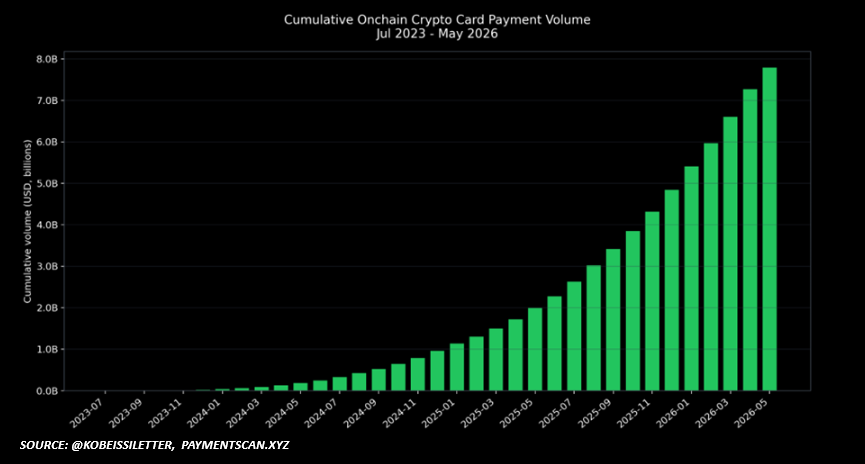
Monthly payment volume on crypto-linked debit and credit cards is up about 230% over last year, amid a proliferation of crypto-related payment products.
Cumulative volume on crypto-linked payment cards reached $7.8 billion this month, according to The Kobeissi Letter, a market research publication.
Payments giant Visa is capturing about 90% of crypto card transactions through partnerships with onchain native companies like Jupiter Global, analysts at The Kobeissi Letter said.
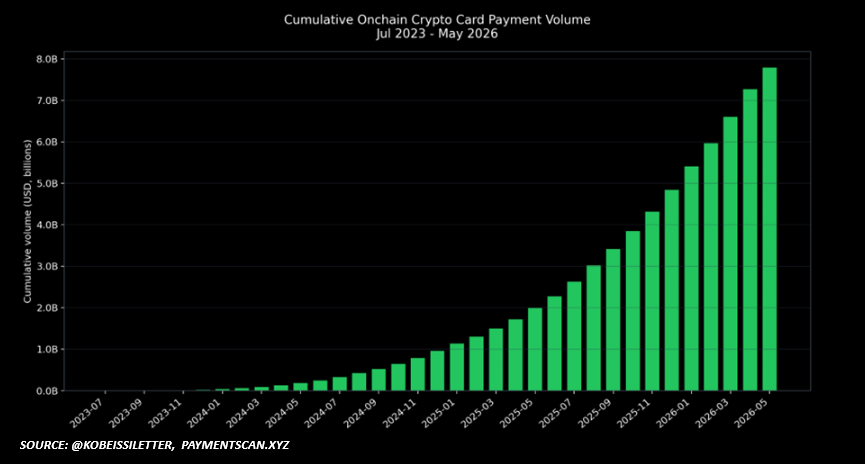
Cumulative crypto card volume between 2023 and 2026.
Source: The Kobeissi Letter
Jupiter Global is the payments project launched by the team behind the Jupiter decentralized crypto exchange on the Solana network. The Kobeissi Letter added:
“Crypto card adoption has rapidly accelerated in 2026 due to growing access to stablecoins as a payment rail through crypto cards. In other words, more people can now spend stablecoins like fiat by using crypto cards, further driving adoption.”
The growth of crypto payment cards highlights how digital assets, particularly stablecoins, are becoming integrated into the traditional financial system without displacing incumbent payment providers like Mastercard and Visa.
Related: Solayer launches Visa-compatible card for USDC payments
Crypto cards are powering everyday payments around the globe
Crypto exchange OKX launched a stablecoin payments card for customers in Europe in January 2026, which operates on the Mastercard network.
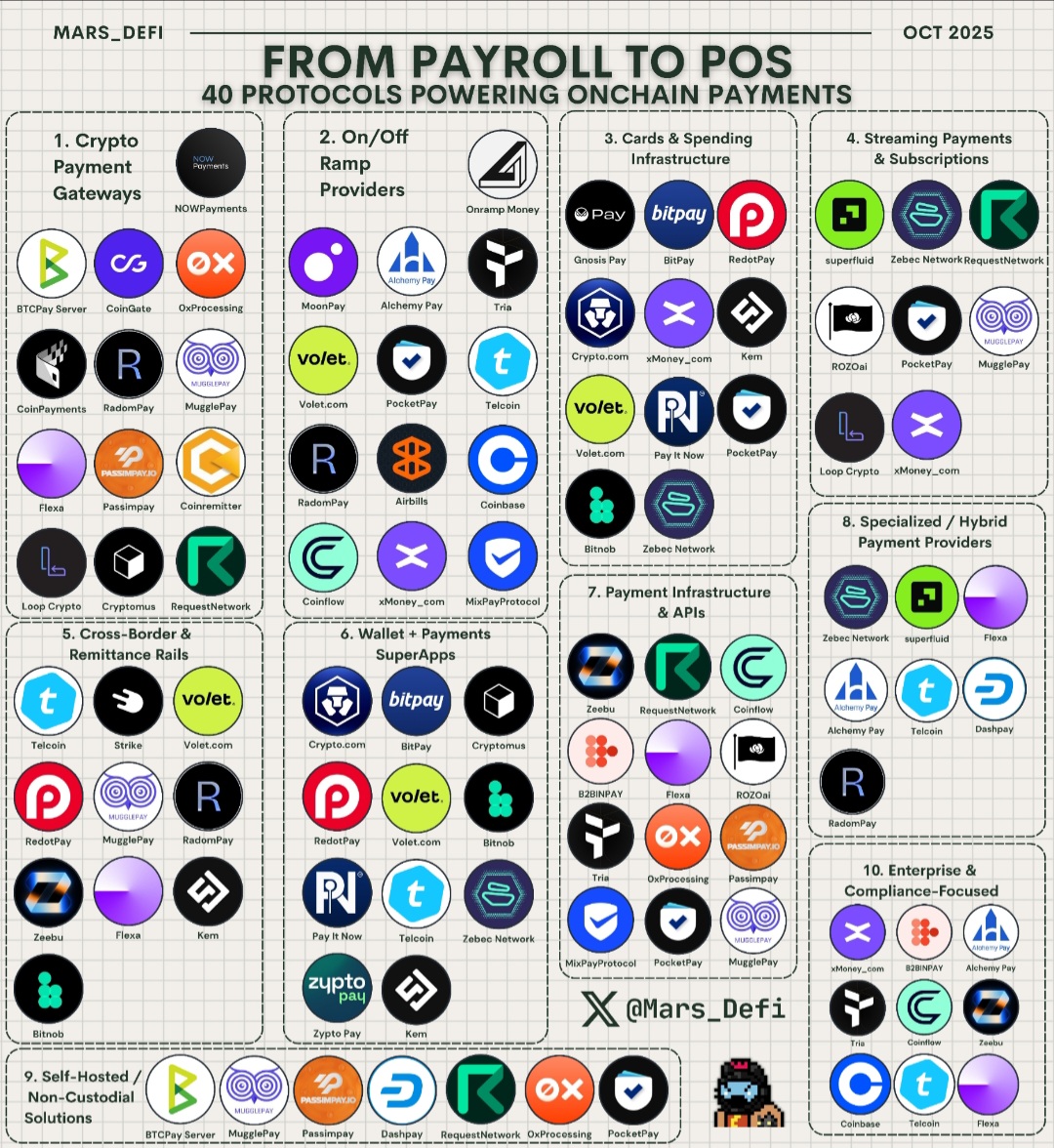
Crypto protocols and platforms helping facilitate onchain payments products. Source: Mars DeFi
Grocery store purchases were the top spending category and accounted for about 26% of all OKX card transactions in January, while restaurants accounted for 18% of the total transaction volume, according to data from OKX.
Online shopping was the third-biggest spending category, accounting for about 13% of the total transaction volume for the month.
“When crypto pays for lunch, payment adoption is real. For years, critics pointed to a lack of everyday utility as crypto’s weak point: great as a speculative asset, less useful as actual money,” the OKX team said.
In March, Visa and Bridge, a fintech company owned by payments company Stripe, announced plans to roll out stablecoin-linked payment cards in over 100 countries.
Initially, 18 countries were supported, including Argentina, Colombia, Ecuador, Mexico, Peru and Chile, with plans to expand the product into the Asia-Pacific (APAC), Africa, and Middle East regions by the end of 2026.
Magazine: Guide to the top and emerging global crypto hubs: Mid-2026
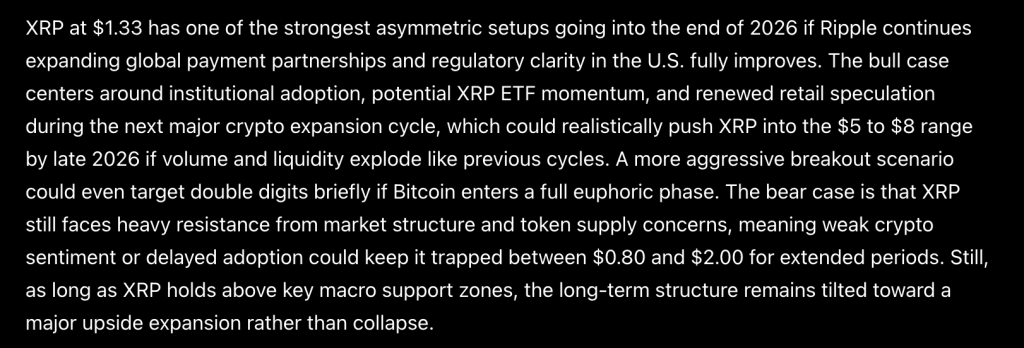
ChatGPT is swinging big on XRP, Sam Altman’s AI predicts a path to $5 to $8 by late 2026, with a wildcard double-digit scenario on the table if Bitcoin enters full euphoric mode, all from a current price of $1.33.
The asymmetry here is what makes the call interesting. ChatGPT is not just throwing a number out; it is pointing to a specific convergence of tailwinds that have been building quietly under the surface.
Ripple keeps expanding its global payment partnerships, US regulatory clarity is improving in a way that was unthinkable 2 years ago, and institutional adoption is no longer a talking point but an actual trend with ETF momentum behind it.

When retail speculation layers on top of that during the next major crypto expansion cycle, ChatGPT’s argument is that volume and liquidity could explode in a way that mirrors previous cycles, and in previous cycles, XRP moved in ways that made people feel stupid for not holding it.
The double-digit scenario is the tail risk that XRP holders dream about. It requires Bitcoin going full parabolic and dragging the altcoin market into a genuine euphoric phase, but ChatGPT acknowledges it as a realistic if unlikely outcome rather than dismissing it outright.
The bear case is the one XRP has been living in for most of 2026. Heavy resistance from market structure, token supply pressure from escrow releases, and weak broader sentiment could keep XRP pinned between $0.80 and $2.00 for an extended stretch.
That range has been its prison for months, and without a macro catalyst or a Ripple-specific headline, there is no obvious escape hatch.
XRP Price Prediction: From $1.33 to $8, Here Is What Needs to Break First
XRP is trading at $1.33 on the daily, and the chart has a clear roadmap drawn right on it. Price has been locked in a tight consolidation between $1.20 support and $1.60 resistance since February, and every attempted move in either direction has been met with the same response, a snap back to the middle of the range.
The $1.20 support zone is the line in the sand. It has been tested multiple times and held, but it is not a fortress; it is a floor that gets weaker every time it gets touched.
A clean breakdown below it opens the door to the $0.80 level ChatGPT mentioned in the bear case, and that would be a damaging structural shift.

On the upside the sequence is laid out plainly on this chart. $1.60 is the first wall, and it has rejected price convincingly. Above that $2.40 is the next meaningful target, then $3.10, then $3.64 which lines up with the prior cycle high.
Each of those levels represents a real supply zone where sellers from previous rallies are sitting and waiting. Getting through all of them to reach $5 requires sustained momentum that this chart has not shown in a long time.
RSI is at 39.03 with the signal line at 44.64, and that is the most bearish RSI setup in this entire series. RSI sitting nearly 6 points below its signal line, dipping toward oversold territory at 39, is telling you that selling pressure is quietly building even as price holds the range.
It is not a collapse signal yet, but it is not a base-building signal either. For the $1.60 breakout that kicks off the whole sequence to happen, RSI needs to stop making lower readings and curl back above 44, then 50.
Right now the momentum picture and the price picture are telling 2 very different stories, and usually the momentum picture wins.
Discover: The best crypto to diversify your portfolio with
ChatGPT AI Predicts Bitcoin Hyper to Outperform XRP by 1000x
Bitcoin has a ceiling that most people have stopped questioning.
No native smart contracts. No high-speed execution. No programmability that does not require leaving the network entirely. Every developer who has tried to build something meaningful on Bitcoin has eventually migrated to Ethereum or Solana because the infrastructure demanded it.
Bitcoin Hyper is building the reason to stay.
The project combines a Bitcoin Layer 2 with Solana Virtual Machine integration, which means developers get the execution speed and programmability of Solana without giving up the security foundation that makes Bitcoin the most trusted network in crypto. Fast transactions, low fees, and full smart contract support sitting directly on top of Bitcoin’s security layer.
The gap it is targeting has existed since Bitcoin launched. Nobody has cleanly solved it yet.
The presale is at $0.013679 with over $32 million raised and staking incentives available for early participants.
Large cap returns at Bitcoin’s current market cap require billions in new inflows to move the needle meaningfully. Early stage infrastructure plays operate on completely different math. The entry is earlier, the upside is larger, and the execution risk is real. That is always the tradeoff at this stage of the lifecycle.
The question is not whether the gap exists. It clearly does. The question is whether this is the project that closes it.
The post Sam Altman ChatGPT AI Predicts Shocking XRP Price By End of 2026 appeared first on Cryptonews.
Crypto World
Cash App Enables USDC Transfers on Solana, Ethereum, Polygon, and Arbitrum With Zero Fees

TLDR:
- Cash App users can now send and receive USDC on Solana, Ethereum, Polygon, and Arbitrum at zero fees.
- Block Inc. keeps Bitcoin as its core focus, with stablecoins seen only as a bridge to Bitcoin adoption.
- The total stablecoin market supply has crossed $300 billion, driven largely by Tether’s continued growth.
- Major payment networks Visa and Mastercard are also expanding stablecoin capabilities across their platforms.
Cash App has expanded its crypto offerings by enabling USDC stablecoin transfers. Block, Inc.’s popular payment platform now allows its 59 million monthly active users to send and receive USDC on Solana, Ethereum, Polygon, and Arbitrum.
The move marks one of the platform’s most notable crypto upgrades since it first added Bitcoin support. Transactions run from users’ existing USD balances with no added fees or extra setup required.
Cash App Opens USDC Transfers With No Extra Fees
Block, Inc. Bitcoin Product Lead Miles Suter announced the upgrade on X. He confirmed that Cash App customers can now move USDC across four major blockchain networks. The process requires no separate wallet and no management of multiple chains.
Suter went further to explain how seamless the experience would be for users. “Everything runs from your existing USD balance. No separate wallet, no managing multiple chains, no extra setup, and importantly no fees,” he wrote in a post. This removes a common barrier that has kept many users away from crypto transfers.
Cash App is operated by Block, Inc., co-founded by Twitter creator Jack Dorsey. The company has historically kept its crypto features limited to Bitcoin-related tools. This USDC expansion represents a meaningful shift in the platform’s product direction.
Circle, the issuer of USDC, is the largest U.S.-based stablecoin provider. The partnership between Cash App’s infrastructure and Circle’s stablecoin brings regulated digital dollar transfers to a wide retail audience. This adds credibility and compliance to the new feature.
Stablecoin Growth Pushes Payment Platforms Into the Space
The broader payment industry is also moving toward stablecoin integration. Major networks like Visa and Mastercard are actively expanding their stablecoin capabilities. Banks and fintechs across the sector are investing in or exploring similar products.
The total stablecoin supply has recently crossed $300 billion. Tether’s USDT added over $5 billion in the past month alone. Meanwhile, USDC, USDe, and PYUSD together saw supply drop by roughly $4.2 billion in the same period.
Despite the USDC expansion, Block’s leadership has not shifted focus away from Bitcoin. Suter described Bitcoin as “Money 2.0,” fiat currency as “Money 1.0,” and stablecoins as the bridge connecting the two. He sees USDC as a stepping stone rather than a destination.
Suter made Block’s long-term priority clear in a direct statement online. “Making Bitcoin Everyday Money remains my top goal at Cash App, Square, Bitkey and Block,” he said, adding that Block remains “singularly focused on bitcoin becoming the native currency of the internet.”
The company continues to support Bitcoin-first products, including the Bitkey hardware wallet, the Proto mining unit, and the Spiral open-source research arm.
Crypto World
Mastercard secures New York BitLicense to support stablecoin and digital payment infrastructure
Mastercard has received a BitLicense from the New York State Department of Financial Services (NYDFS), giving the payments giant approval to operate digital asset activities under one of the strictest crypto regulatory frameworks in the United States.
The company announced Wednesday that Mastercard Transaction Services (U.S.) LLC secured the license as part of its broader push into blockchain-based payments and settlement infrastructure.
The approval comes as major financial firms deepen their involvement in stablecoins and tokenized payments, betting that blockchain networks could lower costs and speed up global money movement.
“Clear regulatory frameworks play an important role in building trust and confidence as new forms of digital value move from experimentation toward practical application,” Jorn Lambert, Mastercard’s chief product officer, said in a statement.
New York’s BitLicense framework, introduced in 2015, requires crypto firms to meet strict standards around capital reserves, cybersecurity, compliance and consumer protection. Companies operating under the license also face ongoing regulatory oversight from NYDFS.
The regime has often been criticized by crypto firms for its high compliance costs and lengthy approval process, though supporters argue it gives institutions clearer rules for operating digital asset businesses.
Mastercard joins a relatively small list of firms to recently receive the license. Crypto financial services company Galaxy obtained a BitLicense earlier this month, following Strike’s approval in March, alongside two dozen other firms to receive a virtual currency license since the regime’s launch a decade ago.
The move aligns with Mastercard’s growing focus on stablecoin infrastructure. In March, the company agreed to acquire stablecoin payments firm BVNK for $1.8 billion, a deal analysts viewed as a sign that stablecoins are becoming part of mainstream financial infrastructure rather than remaining a niche crypto product.
Stablecoins — digital tokens pegged to fiat currencies like the U.S. dollar — are increasingly used for cross-border payments, treasury operations and business-to-business settlements because blockchain transfers can settle around the clock and often faster than traditional banking rails.
Mastercard said the BitLicense approval supports its strategy around digital currencies, including stablecoins and tokenized deposits, while maintaining the compliance and operational standards used across its global payments network.
“As digital and traditional financial systems continue to evolve, Mastercard remains focused on advancing interoperability, reliability and trust across the payments ecosystem,” the company said.
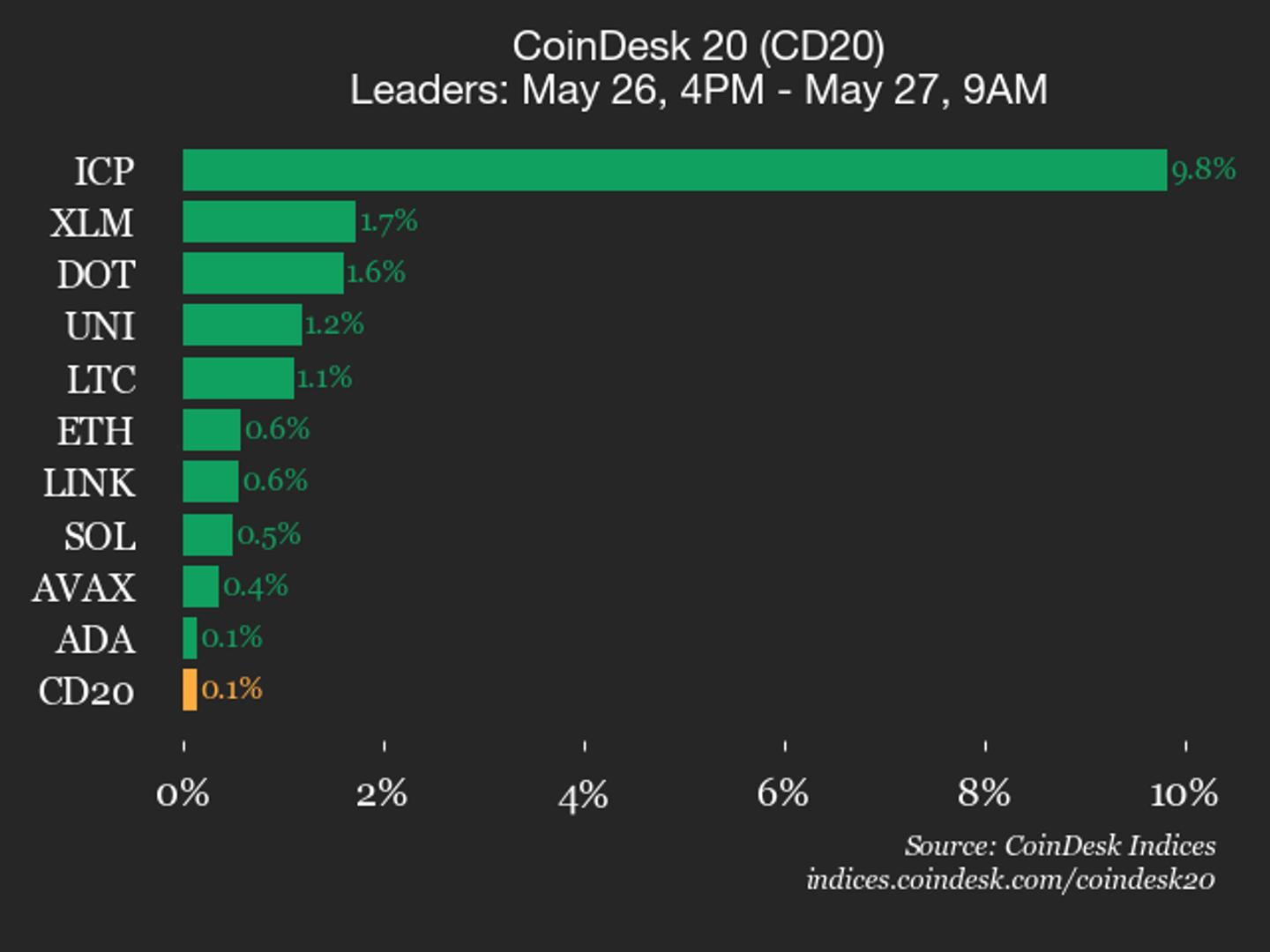
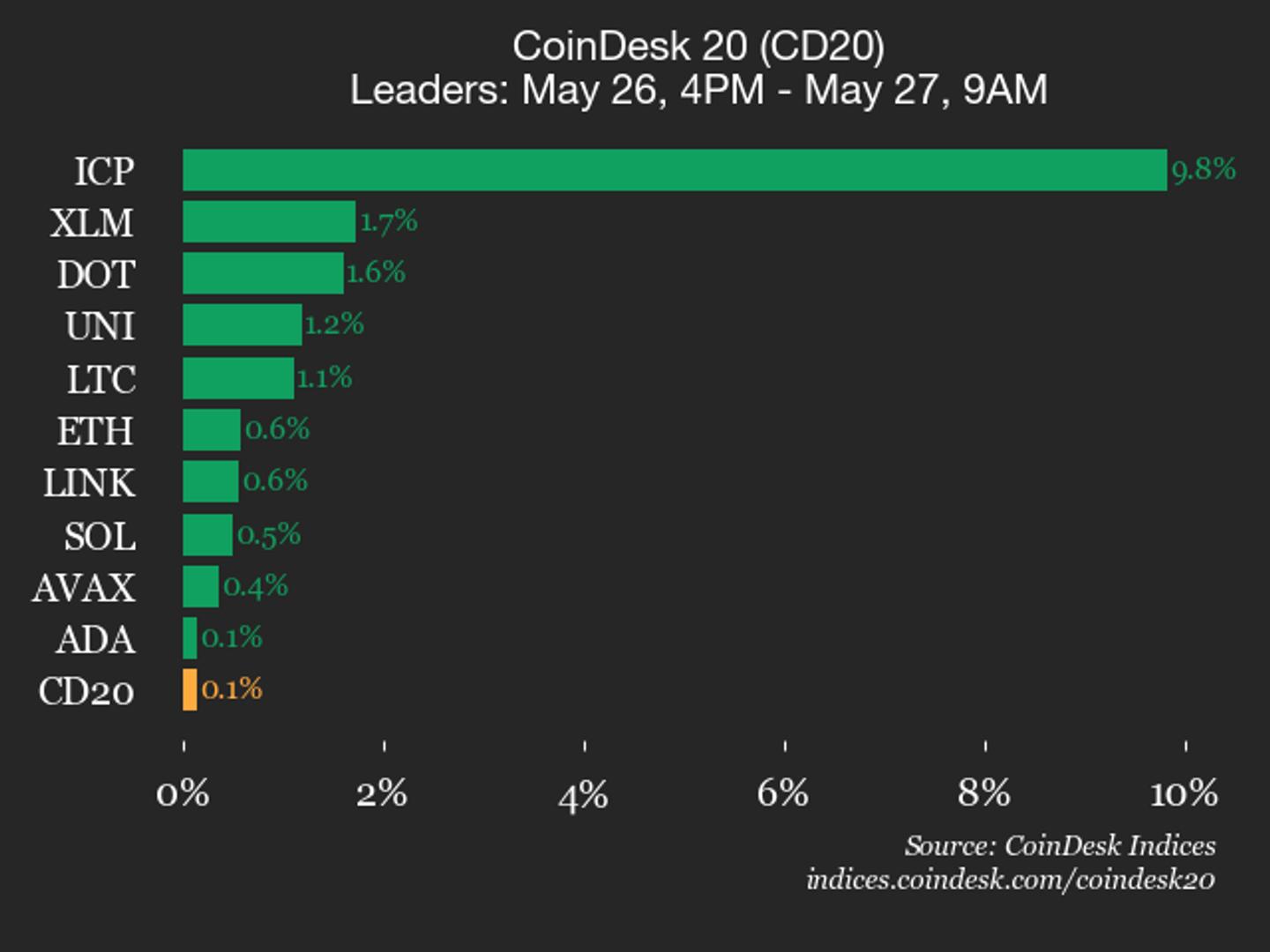
Stellar (XLM), up 1.7%, joined Internet Computer (ICP) as a top performer.
Crypto World
Ripple Price Prediction: XRP Slides Toward Critical $1.20 Support as Bears Stay in Control
XRP is trading at $1.33 as May draws to a close. It is quietly slipping to its lowest levels since March without any particular catalyst. The move is just a slow, grinding drift lower that has characterized the altcoin’s performance throughout the second half of the month.
The $1.20 support band is the closest it has been in weeks, and the 100-day moving average has been surrendered once again. The XRP/BTC pair is also testing its recent low and has looked increasingly fragile.
Ripple Price Analysis: The USDT Pair
Against USDT, the cryptocurrency is just below the upper boundary of the descending channel. The 100-day moving average at approximately $1.40 is now an overhead resistance after being surrendered during the May rollover, and the 200-day moving average continues to decline around $1.60.
The RSI is also hovering around 40, a soft reading with no sign of a floor forming.
The $1.20 demand zone is now close by, which makes the next few daily closes genuinely consequential. A potential breakdown below $1.20 would mark the first breach of that level since the February wick, potentially triggering a further crash toward the $0.60 zone. On the other hand, any recovery attempt first needs to reclaim $1.40 and the 100-day moving average to suggest a genuine recovery could form.

The BTC Pair
The XRP/BTC pair is trading at 1,760 sats and is pressing the pink horizontal support level, which marks the recent low near 1,730 sats.
The price has struggled to sustain a modest recovery above 1800 sats. The RSI oscillating between 30 and 60 throughout May, without any sustained directional move, reflects a pair in exhausted equilibrium rather than clear directional momentum.
The 100-day moving average at approximately 1,900 sats and the 200-day moving average near 2,050 sats remain the dynamic recovery targets on both sides of the critical 2,000 supply zone.
Below, the lower channel boundary and the demand area near 1,500 sats are the next potential targets if the recent low breaks down. As things stand, XRP is expected to continue underperforming BTC, as the market remains largely unoptimistic about Ripple.

The post Ripple Price Prediction: XRP Slides Toward Critical $1.20 Support as Bears Stay in Control appeared first on CryptoPotato.
Several major cryptocurrency exchanges warned users this week that transfers involving HTX could face additional compliance checks after the United Kingdom sanctioned the exchange over alleged ties to Russian financial networks.
The U.K. government added HTX to its Russia sanctions list as part of a broader package targeting entities accused of helping sanctions evasion and illicit financial activity linked to Moscow.
British authorities said they had “reasonable grounds to suspect” HTX provided financial services connected to sanctioned entities including crypto exchange Garantex and the A7 network, whose A7 LLC issues the ruble-pegged A7A5 stablecoin.
The Foreign Office said the A7 network had used a Kyrgyz bank and a major cryptocurrency exchange to channel an estimated $1.5 billion back into Russia. The A7 network claimed to have moved more than $90 billion last year, the Foreign Office said, roughly half of Russia’s annual military expenditure.
The designation carries immediate practical consequences. U.K. financial institutions are now barred from doing business with the exchange and may face penalties for interacting with crypto transactions that pass through it.
U.K.-registered virtual asset service providers are legally required to freeze funds connected to the designated entities, blockchain analytics firm Elliptic said, and the sanctions extend to restrictions on correspondent banking relationships and payments involving HTX.
Following the announcement, exchanges including Binance, OKX, Bybit and Bitget issued notices warning users about heightened scrutiny tied to HTX-related transactions.
Bitget said it updated its sanctions screening systems and warned that transactions involving sanctioned entities or linked addresses could face rejection, restrictions or account termination.
Binance, meanwhile, said transactions involving HTX “may be subject to additional compliance review” as part of its sanctions controls.
OKX separately warned users who previously engaged in arbitrage trading between HTX and OKX that continued transfers between the platforms after the sanctions action could trigger additional scrutiny on their accounts.
Bybit also cautioned that deposits or withdrawals involving HTX-linked addresses may face added anti-money laundering and risk-control checks.
“Users are advised to avoid using HTX-related addresses when interacting with Bybit and to ensure that all account activities remain compliant with local laws and platform policies,” Bybit wrote.
HTX rejected the U.K.’s claims it helped Russia’s financial infrastructure, even saying it has refused a listing application for the A7A5 stablecoin.
“To clarify, the listed entity Huobi Global S. A. is distinct from the online HTX exchange,” the company said. “While Huobi Global S.A. will work with relevant UK authorities to understand the basis for the action and to address any concerns promptly, the designation does not and should not have any impact on the online HTX exchange.”
TLDR:
- Nium joins Circle Payments Network as a global payout partner across 190+ countries and 100 currencies.
- Financial institutions can now access USDC settlement and last-mile fiat payouts through a single integration.
- The partnership reduces prefunding requirements across corridors while adding real-time onchain transaction tracking.
- CPN has reached $8.3 billion in annualized volume, reflecting rising institutional adoption of USDC-based rails.
Circle Payments Network (CPN) has added Nium as a global payout partner, linking USDC settlement with last-mile delivery across more than 190 countries.
The partnership gives financial institutions on CPN direct access to Nium’s payout infrastructure in 100 currencies through a single integration.
This move addresses a long-standing gap between fast stablecoin settlement and reliable local currency delivery worldwide.
Nium Joins CPN to Streamline Cross-Border Payments
Financial institutions using CPN can now route payments directly through Nium’s real-time payout rails. This removes the need to manage multiple local providers across different corridors.
Institutions gain access to Nium’s full country and currency portfolio without building separate integrations for each market.
The partnership also brings integrated FX optimization and smart routing to CPN transactions. Funds can be converted and delivered efficiently without institutions sourcing individual providers.
This reduces both operational complexity and the capital tied up in prefunding accounts across multiple corridors.
Prajit Nanu, Founder and CEO of Nium, pointed to the broader shift happening across the payments industry. “Traditional and onchain payment rails are converging, and that convergence demands infrastructure that banks, fintechs, and global enterprises can rely on at scale,” he said.
Nanu added that the deal combines Circle’s regulated settlement instrument with Nium’s global payout reach for a more seamless cross-border experience.
The partnership targets a key challenge that has long slowed institutional adoption of stablecoin rails. Bridging fast, transparent settlement with dependable last-mile delivery has remained difficult at scale. CPN and Nium now tackle both sides of that equation through one connected network.
USDC Settlement Meets Real-Time Last-Mile Delivery
Circle brings regulated USDC-powered settlement to the partnership, with built-in compliance and a governed network for institutional use.
Nium handles the final step, delivering funds in local currency into accounts, wallets, and cards worldwide. Together, the two companies offer a unified foundation for end-to-end global payments.
Kash Razzaghi, Chief Commercial Officer at Circle, explained what the integration means for institutions exploring stablecoin payments. “Financial institutions are increasingly looking for ways to use stablecoins to solve persistent payments pain points,” he said.
Razzaghi added that the Nium integration extends USDC from a settlement instrument into a complete payments flow, offering greater speed, transparency, and capital efficiency.
CPN has reached $8.3 billion in annualized transaction volume, based on trailing 30-day activity as of March 31, 2026.
Circle notined that CPN participants can expect faster end-to-end payments, reduced prefunding across corridors, and local fiat payouts through a single integration. That figure reflects growing institutional demand for USDC-based payment infrastructure.
Institutions on CPN can also track transactions in real time through onchain transparency. This visibility supports both payment operations teams and compliance functions managing multi-jurisdiction reporting.
The Nium integration marks a broader step in CPN’s growth as a governed network for institutional stablecoin payments at scale.

What a Good Agency Onboarding Process Looks Like
Nvidia (NVDA) and Micron (MU) Set to Power 33% of S&P 500 Profit Expansion in 2026

James Toney sums up Floyd Schofield’s chances of beating Gervonta Davis as fight ordered


-

 Crypto World6 days ago
Blockchain.com files with SEC for U.S. IPO
-

 Fashion5 days ago
Holiday Weekend Open Thread – Corporette.com
-

 Crypto World6 days ago
Bitcoin Accumulation Weakens as BTC Realized Losses Hit $600M
-

 Tech2 days ago
Microsoft’s quiet Claude Code retreat and the real cost of enterprise AI
-

 Business5 days ago
Dell Technologies DELL Stock Surges 15% on AI Server Momentum and Analyst Upgrades in 2026
-

 Crypto World5 days ago
Robinhood crypto COO Tanya Denisova exits
-

 Politics5 days ago
Makerfield: a tale of two social-media histories
-

 Business3 days ago
NYT Strands Answers May 24 2026 Revealed for Puzzle No. 812 Theme Summer Essentials
-

 Crypto World5 days ago
Space X IPO Is ‘Bad News’ for Tech Stocks: But What About Bitcoin?
-

 Business6 days ago
Trump Invests $1M-$5M in Kura Sushi USA Chain With 27 California Locations
-

 Crypto World6 days ago
MicroStrategy’s Saylor Says Miners No Longer Set Bitcoin Price, Another Force Has Taken Over
-

 Tech6 days ago
WhatsApp ads could make Irish debut after discussions with DPC
-
Tech11 hours ago
The Samsung pay deal is the moment Korean unions changed register
-
 NewsBeat6 days ago
Charity run by Reform leader Malcolm Offord accused of ‘law breaking’ over Scottish registration
-

 Crypto World5 days ago
AI infrastructure race heats up as IREN pitches full-stack strategy, WhiteFiber lands $160M deal
-
 Crypto World3 days ago
Nvidia (NVDA) CEO Calls on Super Micro to Strengthen Export Controls Amid Smuggling Probe
-
 Tech5 days ago
A 0.12% parameter add-on gives AI agents the working memory RAG can’t
-

 Tech2 days ago
Westone Audio and Etymotic Acquired by Fidelity Collective in Major IEM Market Move
-

 Tech6 days ago
You Can Now Add ChatGPT To PowerPoint
-

 Sports6 days ago
2026 CJ Cup Byron Nelson leaderboard: Brooks Koepka finds putting stroke in Round 1
You must be logged in to post a comment Login