

Crypto World
Major crypto exchanges increase transfer scrutiny with HTX over UK sanctions



Several major cryptocurrency exchanges warned users this week that transfers involving HTX could face additional compliance checks after the United Kingdom sanctioned the exchange over alleged ties to Russian financial networks.
The U.K. government added HTX to its Russia sanctions list as part of a broader package targeting entities accused of helping sanctions evasion and illicit financial activity linked to Moscow.
British authorities said they had “reasonable grounds to suspect” HTX provided financial services connected to sanctioned entities including crypto exchange Garantex and the A7 network, whose A7 LLC issues the ruble-pegged A7A5 stablecoin.
The Foreign Office said the A7 network had used a Kyrgyz bank and a major cryptocurrency exchange to channel an estimated $1.5 billion back into Russia. The A7 network claimed to have moved more than $90 billion last year, the Foreign Office said, roughly half of Russia’s annual military expenditure.
The designation carries immediate practical consequences. U.K. financial institutions are now barred from doing business with the exchange and may face penalties for interacting with crypto transactions that pass through it.
U.K.-registered virtual asset service providers are legally required to freeze funds connected to the designated entities, blockchain analytics firm Elliptic said, and the sanctions extend to restrictions on correspondent banking relationships and payments involving HTX.
Following the announcement, exchanges including Binance, OKX, Bybit and Bitget issued notices warning users about heightened scrutiny tied to HTX-related transactions.
Bitget said it updated its sanctions screening systems and warned that transactions involving sanctioned entities or linked addresses could face rejection, restrictions or account termination.
Binance, meanwhile, said transactions involving HTX “may be subject to additional compliance review” as part of its sanctions controls.
OKX separately warned users who previously engaged in arbitrage trading between HTX and OKX that continued transfers between the platforms after the sanctions action could trigger additional scrutiny on their accounts.
Bybit also cautioned that deposits or withdrawals involving HTX-linked addresses may face added anti-money laundering and risk-control checks.
“Users are advised to avoid using HTX-related addresses when interacting with Bybit and to ensure that all account activities remain compliant with local laws and platform policies,” Bybit wrote.
HTX rejected the U.K.’s claims it helped Russia’s financial infrastructure, even saying it has refused a listing application for the A7A5 stablecoin.
“To clarify, the listed entity Huobi Global S. A. is distinct from the online HTX exchange,” the company said. “While Huobi Global S.A. will work with relevant UK authorities to understand the basis for the action and to address any concerns promptly, the designation does not and should not have any impact on the online HTX exchange.”

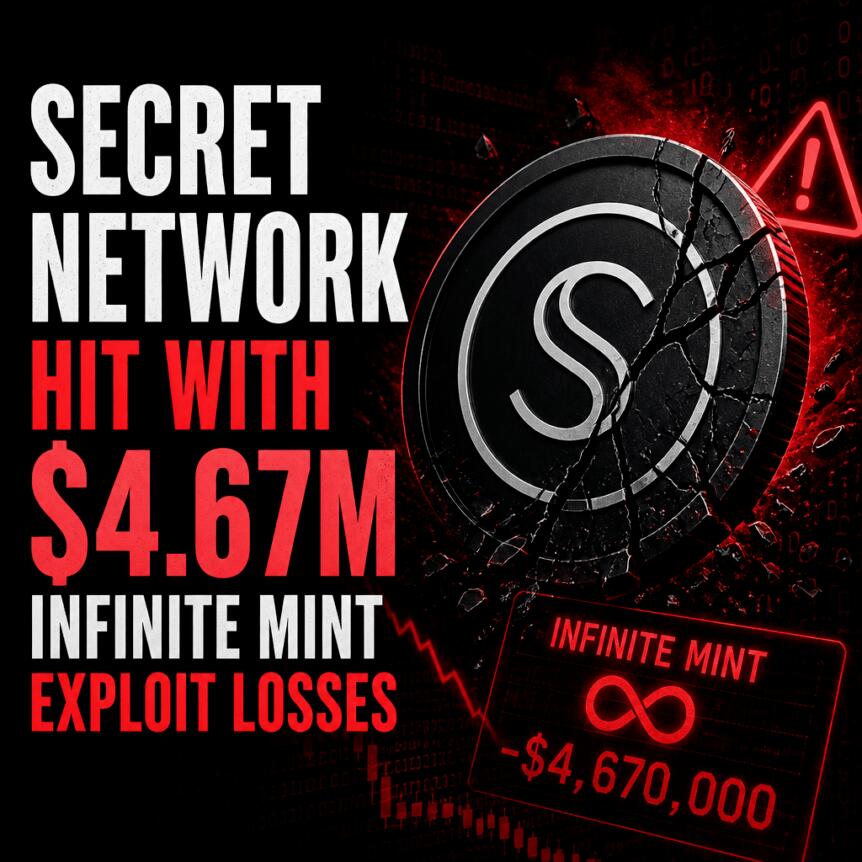
An attacker exploited an “infinite mint” vulnerability in a smart contract on Secret Network to create wrapped versions of Axelar-backed assets without the normal backing. According to Common Prefix, the resulting loss reached $4.67 million, with the incident first occurring on June 10 and later being detected on June 17 after irregularities surfaced during a failed cross-chain transfer.
The exploit relied on a flaw in how inbound transfers were handled: the contract minted genuine saTokens without verifying that the tokens being deposited originated from a legitimate source. After discovery, the attacker redeemed the forged saTokens through Axelar’s standard routes, draining the real wrapped assets held in escrow. Common Prefix reported the issue on Friday, citing on-chain findings and the sequence of redemptions.
Key takeaways
- An “infinite mint” bug on Secret Network allowed unbacked Axelar-wrapped assets (saTokens) to be minted.
- The vulnerability stemmed from missing verification of the inbound transfer source before minting, enabling forged deposits to produce real tokens.
- Common Prefix estimates the exploit’s impact at $4.67 million, with detection coming a week after the June 10 attack.
- The attacker redeemed saTokens back to the underlying assets held in escrow, then moved proceeds to Ethereum and split holdings across multiple wallets.
- Axelar said its network and IBC were not compromised, and that the affected contract was not developed or maintained by Axelar.
How the Secret Network “infinite mint” unfolded
The Secret Network incident centered on a smart contract that minted Axelar-wrapped tokens (saTokens) tied to assets held in escrow. Common Prefix’s analysis indicates the contract did not verify the source of inbound transfers prior to minting. As a result, deposits that were forged over an attacker-controlled channel could trigger minting of genuine saTokens without corresponding backing assets.
Common Prefix said the attacker then redeemed those Axelar-wrapped saTokens back through legitimate channels. Because the real wrapped assets were stored in escrow, the redemption process allowed the attacker to withdraw the backed collateral that should have corresponded to the issued tokens. In short, the breach converted what should have been a “wrapped claim” into an extractable withdrawal by breaking the token-to-collateral link at the minting stage.
Assets targeted and the size of the exploit
Common Prefix reported that multiple Axelar-wrapped tokens were minted without backing. The affected set included saUSDT, saUSDC, saDAI, saWETH, saWBTC, saWBTC? and saBNB, as well as sawstETH (as listed in Common Prefix’s report). The firm estimated the total exploit impact at $4.67 million.
Secret Network is a privacy-focused layer-1 blockchain in the Cosmos ecosystem. Axelar, meanwhile, is an interoperability network designed to connect different blockchain ecosystems. The incident highlights the risk that can arise when wrapped assets and cross-chain messaging rely on correct validation logic—especially when minting depends on the integrity of inbound transfer proofs.
Discovery, attacker movement, and where funds ended up
While the exploit happened on June 10, Common Prefix said it wasn’t detected until June 17. The delayed discovery was linked to a failed cross-chain transaction that returned an “insufficient funds” error involving the drained account. That error drew attention to the fact that tokens had likely been minted without sufficient backing.
After redemption, Common Prefix reported that the attacker moved the stolen assets to Ethereum and converted the proceeds to Ether (ETH). The firm also said the attacker split the funds across roughly 30 wallets, eventually depositing with exchanges including KuCoin, ChangeNow, and HitBTC—details that matter for monitoring and potential recovery efforts, since multi-wallet distribution can slow down tracing and enforcement.
Secret Network and Axelar respond: what was and wasn’t compromised
Secret Network posted a security incident warning, advising holders of Axelar-bridged saXXX tokens on Secret that the backing for those tokens was affected and that their funds may be lost. The warning, published after the incident became public, focused on user risk rather than suggesting that all tokens on Secret were compromised.
Axelar addressed the incident separately after “some confusion” circulated around the breach. In a post on Saturday, Axelar stated that neither Axelar nor IBC was compromised. It also said the exploited token smart contract was not developed, deployed, or maintained by Axelar, and that Axelar’s firewalling helped prevent broader impact across chains. For users and builders, the distinction matters: it suggests that the failure was contained to the contract logic on Secret’s side of the integration rather than a systemic breach across the broader Axelar interoperability stack.
Why this case fits a broader pattern of bridge and wrap exploits
Common Prefix placed the Secret Network hack in the context of a busy month for crypto exploits. According to DeFiLlama data cited in the article, crypto protocol hacks and exploits now number at least 22 for the month, reflecting continued pressure on cross-chain infrastructure and token-wrapping mechanisms.
Earlier this month, Cointelegraph reported major losses tied to other cross-chain incidents, including Humanity Protocol and Syscoin Bridge, which lost $32 million and $8 million, respectively. Together, these cases underscore a recurring theme: cross-chain systems can fail at multiple layers—message validation, escrow accounting, wrapped-token minting, and redemption logic—meaning that a vulnerability in one link can lead to direct fund drains if the surrounding checks are incomplete.
For investors and traders, the practical implication is that token “existence” on a destination chain does not always guarantee collateral backing. In the Secret Network incident, the tokens were minted in a way that broke that assumption, turning wrapped representations into potentially uncollectible claims. For developers, the bigger lesson is straightforward: minting logic that depends on inbound data must treat verification as part of the core security model, not an optional step.
Looking ahead, users holding affected saTokens on Secret should monitor Secret Network’s incident updates and any follow-on recovery or remediation announcements. Meanwhile, builders integrating interoperability routes should watch closely for contract-level fixes and updated validation requirements—because as this exploit shows, a single missing verification step can propagate into real withdrawals from escrow even when the interoperability provider itself insists it was not compromised.


Eli Ben-Sasson, cofounder of StarkWare and a founding scientist of Zcash, has shared his view on the recent debate around the Ethereum Foundation.
Summary
- Eli Ben-Sasson said Ethereum should weigh merit and technology more heavily than ecosystem alignment debates.
- His comments followed Foundation exits and warnings about core development funding pressure within coming months.
- StarkWare’s past choices on STARKs, Cairo and zkVM were once viewed as misaligned by critics.
His comments came as Ethereum faces questions over leadership changes, funding pressure and the role of layer-2 teams in the wider ecosystem.
Ben-Sasson said he was not joining criticism of the foundation and was not claiming that Ethereum is near its end. He also said he was not trying to defend the foundation by saying everything was fine. “Ethereum has many strengths, and it also has its politics,” he wrote.
StarkWare history frames his point
Ben-Sasson said StarkWare’s first paid project in 2019 and 2020 focused on a post-quantum secure, scalable ZK-STARK system for Ethereum. He said the work aimed to help Ethereum scale and become more ready for future quantum security risks.
He also pointed to StarkWare’s later choices, including STARKs, Cairo, zkVM work, native account abstraction and Bitcoin scaling. He said those choices were not always popular and were sometimes viewed as “misaligned.” Ben-Sasson said he was glad the team made them because he sees them as the right technical decisions.
Exits and funding worries add pressure
His comments came during a tense period for the Ethereum Foundation. As previously reported by crypto.news, Hsiao-Wei Wang stepped down as co-executive director and board member after returning from a sabbatical. Her exit followed other staff changes and came after Tomasz Stańczak also left a co-executive director role.
The debate also includes funding concerns. Former Ethereum Foundation contributor Trent Van Epps warned that Ethereum core development could face a funding gap within three to nine months. He linked that risk to spending cuts and the end of the Client Incentive Program. Tom Lee later rejected that warning, saying there was “zero chance” of such a crisis.
Merit versus alignment becomes the issue
Ben-Sasson’s main point centered on how Ethereum should judge teams and ideas. He said the ecosystem placed too much weight on whether teams appeared aligned or misaligned. He argued that technical merit should matter more than social labels or political positioning.
“As part of the ecosystem and supporter of all things crypto, I hope the new system that will arise will give a lot of weight to merit and technology, and less for alignment,” Ben-Sasson wrote.
He added that he would want to work more closely with that system if it moved in that direction.
That framing also answers past complaints that StarkWare moved outside Ethereum’s preferred path. In his view, useful engineering can start outside consensus and still become part of the broader stack later. The post did not propose a formal governance plan for the wider ecosystem.
His comments place StarkWare’s experience inside a wider Ethereum governance debate. Layer-2 teams depend on Ethereum, but they also make independent technical choices. That can create tension when foundation priorities, roadmap work and community expectations do not move at the same pace.
Toss Bank has signed a memorandum of understanding with the Solana Foundation to test blockchain-based global remittance and settlement infrastructure.
Summary
- Toss Bank will test Solana-based remittance and settlement infrastructure before broader digital asset reviews begin.
- The partnership arrives as South Korea prepares new rules for virtual asset transfer services nationwide.
- Crypto.news reported similar stablecoin remittance tests by KB Financial, Western Union and SBI Remit recently.
The agreement was signed in Seoul on June 19 and disclosed on June 22, according to Digital Today.
The bank called the deal the first direct one-to-one strategic partnership between a South Korean internet-only bank and the Solana Foundation. The two sides will study how the Solana network can support overseas transfers, payments and later digital asset services.
Remittance test leads cooperation
The first area of work will be a proof of concept for global remittances and settlement. Toss Bank plans to test whether stablecoins can make overseas transfers faster and easier while keeping the service close to existing banking flows.
Toss Bank said the cooperation covers a joint review of blockchain-based payment and settlement models. It will also assess future financial services linked to stablecoins, digital assets and tokenized assets. Park Jin-hyeon, head of strategy at Toss Bank, said the deal was a “starting point” for applying blockchain-based financial infrastructure to services the bank already runs.
South Korea rules shape timing
The timing links the Toss Bank plan to South Korea’s changing digital asset rules. As crypto.news recently reported, South Korea is considering whether fintech firms should join a new licensing regime for cross-border virtual asset transfers due to take effect in December.
That policy shift may matter for banks and fintech firms testing blockchain remittances. Approved firms could offer blockchain-based overseas transfers and foreign exchange services under formal oversight. Toss Bank said it will review its plans while responding to domestic moves to legislate stablecoin-related rules.
Stablecoin pilots move into banking
The Toss Bank deal follows other bank-linked stablecoin tests in Asia. As crypto.news earlier reported, KB Financial tested won stablecoin issuance, offline QR payments, merchant settlement and Vietnam remittances. The Vietnam transfer finished in under three minutes and cut fees by about 87%, according to that report.
Meanwhile, stablecoin remittance trials are also expanding beyond Korea. As previously reported by crypto.news, Japan’s SBI Remit partnered with Fasset to build cross-border stablecoin infrastructure for remittances, payments and settlements across international markets.
Toss has already shown interest in blockchain beyond remittances. Crypto.news reported in April that the broader Toss group had been weighing a custom Layer 1 or Layer 2 blockchain and a native token for its “Money 3.0” stablecoin strategy. The Solana MOU gives Toss Bank a separate path to test public blockchain infrastructure before any broader rollout.
Solana gains payment use case
For Solana, the partnership adds another financial institution to its payments and stablecoin work. As crypto.news reported in May, Western Union launched USDPT on Solana, using the network for a regulated payment stablecoin tied to settlement and future customer services.
Lily Liu, chair of the Solana Foundation, said the partnership could help create a “new standard” for faster and smoother global remittances by combining bank trust with blockchain efficiency. The statement places the project inside a broader market shift toward stablecoin settlement, where banks, payment firms and fintech companies are testing faster cross-border rails.
The MOU does not mean Toss Bank has launched a live stablecoin remittance service. It starts with testing and feasibility reviews. The main questions now are whether the proof of concept can meet Korean regulatory standards, reduce transfer friction and fit into Toss Bank’s existing financial services. No public launch date has been announced yet.


Bitcoin started the week drifting near $64,000, sitting out a rally in Asian equities as the US and Iran moved closer to a lasting peace deal.
The token traded around $63,996 on Monday, down 0.4% over 24 hours and 2.2% on the week, per CoinDesk data. The rest of the market was mixed. Solana rose 3.7% on the week to $74 and tron added 2.2%, while ether held roughly flat at $1,733. The losses ran deeper down the board, with BNB off 4.2% on the week, XRP down 4.3% to $1.13 and dogecoin the weakest major, off 6.5%. Hyperliquid’s HYPE, the standout of early June, fell 5% on the day and has cooled to a 1.9% weekly gain.
The macro backdrop turned friendlier without pulling crypto along. The US and Iran agreed on a roadmap toward a final peace deal within 60 days, and Brent crude slid 1.7% to about $79 a barrel.
An MSCI gauge of Asian stocks rose 0.6%, led by a technology rally tied to continued optimism over artificial intelligence, while US futures were softer, with S&P 500 contracts down 0.5%.


The first session of high-level US-Iran talks concluded in Switzerland on Monday. Mediators from Qatar and Pakistan confirmed a roadmap toward a final deal within 60 days under the framework of the Islamabad Memorandum of Understanding.
The joint statement confirmed the creation of a High-Level Committee providing political oversight, with chief negotiators leading dedicated working groups on nuclear issues, sanctions, and dispute resolution.
The parties also formed a communication line to prevent incidents and ensure safe commercial passage through the Strait of Hormuz. A de-confliction cell involving the US, Iran, and Lebanon will enforce the termination of military operations there. Technical talks continue through the remainder of the week at Burgenstock.
What to Expect When Markets Open
The statement resolves the sharpest fear heading into Monday’s session. A reported Iranian walkout on Sunday had raised Black Monday fears across oil and crypto, keeping traders on edge into the open.
Oil is the most direct read. The Strait of Hormuz communication line, confirmed explicitly in the joint statement, is the detail markets will price most aggressively. When the original June 14 memorandum was announced, oil fell over 12% and the Dow Jones hit a record high. A credible, institutionalized Hormuz mechanism could extend that oil price relief.
Equities should follow, with lower energy costs easing inflation expectations and improving the earnings outlook. That same macro channel feeds crypto. Bitcoin has tracked risk sentiment tightly throughout the conflict, rising on de-escalation and selling off on fresh strikes, with BTC holding near $64,200 ahead of Monday.
The ceiling on any rally remains the Federal Reserve. The Fed’s hawkish hold on June 17 erased post-MoU gains across stocks and crypto. The Lebanon de-confliction cell is the geopolitical tripwire to watch, Iran’s Foreign Minister Abbas Araghchi called it the “first real test” of the agreement, and any renewed fighting there is the fastest path back to risk-off across all asset classes.
The post US-Iran Agree on 60-Day Deal Roadmap: Markets Open Monday appeared first on BeInCrypto.


Cardano founder Charles Hoskinson has defended recent AI content tests after users criticized an AI-generated post shared through Input Output’s X account.
Summary
- Hoskinson said AI agents could help Cardano scale updates, community tasks and Midnight City activity.
- Midnight City uses autonomous agents to test privacy views for users, auditors and regulators alike.
- The debate followed backlash over AI-generated influencer content shared through Input Output’s X account recently.
The discussion followed his June 20 post titled “AI Slop, IOG X, and the Future of Marketing,” where he addressed how the team is testing new tools for communication.
Hoskinson said the AI-generated influencer came from work around Midnight City and was shared in good faith. He said the goal was to show what new systems can do, not to replace people or mislead the community. The response showed that parts of the Cardano audience remain careful about synthetic media.
Midnight City becomes test ground for agents
Midnight City is an interactive simulation tied to the Midnight Network. It uses autonomous AI agents that work, trade and create economic activity inside a digital city. The project lets users watch activity through different views, including public, auditor and regulatory lenses.
The platform also serves as a testing area for privacy tools. Midnight Network uses zero-knowledge technology and selective disclosure to protect data while still allowing approved parties to see needed information. This design supports the project’s wider pitch around private but compliant blockchain activity.
Marketing plans move toward AI agents
Hoskinson said Cardano and Midnight cannot rely only on human teams if the user base grows by millions.
“We’re going to need agents and AI to be able to organize and sort all that out and broadcast on a regular basis what’s going on in Midnight City,” he said.
He also linked the discussion to OpenClaw, an open-source AI agent platform. Hoskinson described AI agents as tools that could support community management, media updates and broadcasting. He said the team is watching “where the future is going with AI CMOs” and lifelike content systems.
Cardano context and next steps
The comments come as Midnight remains one of the main projects connected to Cardano’s next phase. Crypto.news earlier reported that Midnight launched its federated mainnet on March 31, 2026, with a privacy model built around programmable disclosure. The network also uses NIGHT for governance and DUST for transaction costs.
Cardano has faced a harder market backdrop in recent weeks. As previously reported by crypto.news, ADA fell below $0.20 earlier this month, hitting its lowest level in more than five years.
Meanwhile, at press time, the token traded at $0.16, indicating over 2% decline in the past 24 hours (per crypto.news market data). That price pressure has kept attention on whether Midnight can bring more builders, users and activity to the ecosystem.
Hoskinson said the team will keep testing AI standards as Midnight City grows. “It’s why it’s one of our most important projects,” he said, adding that the team plans to explore where the technology goes next. He also said agentic trading and affiliate relationships could help bring more users to Midnight.
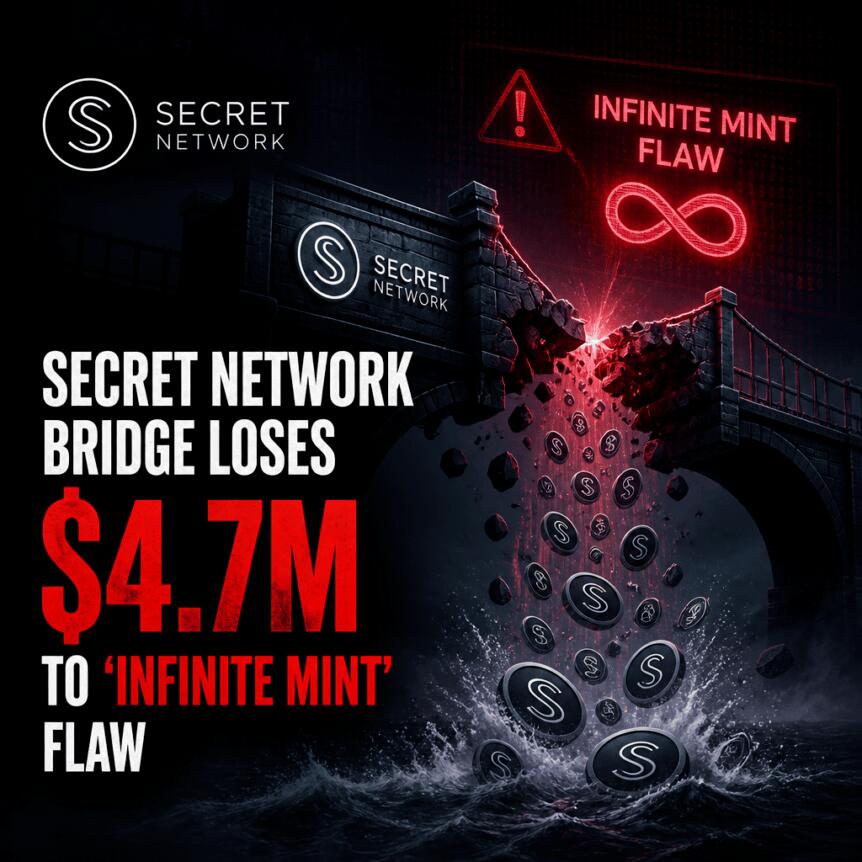
An attacker exploited an “infinite mint” vulnerability in a smart contract on the Secret Network, creating wrapped Axelar assets without proper backing. The incident resulted in a reported $4.67 million loss, according to blockchain research firm Common Prefix.
The breach occurred on June 10 but was identified a week later, on June 17, after a failed cross-chain transaction triggered an “insufficient funds” error tied to the drained account, Common Prefix said in a report released Friday. The funds were then routed to Ethereum and distributed across multiple wallets before being moved to exchanges, the firm added.
Key takeaways
- Common Prefix attributes the $4.67 million exploit to an infinite-mint flaw in a Secret Network contract that minted unbacked Axelar-wrapped tokens.
- The issue was traced to missing verification of the source of inbound transfers before minting, allowing forged deposits on an attacker-controlled channel.
- Wrapped assets affected included saUSDT, saUSDC, saDAI, saWETH, saWBTC, saWBNB and sawstETH.
- Secret Network said holders of Axelar-bridged saXXX tokens may face loss, while both Secret and Axelar emphasized that Secret’s token SCRT and Axelar’s infrastructure were not directly compromised.
How the exploit worked on Secret’s Axelar bridge
Secret Network is a privacy-focused layer-1 blockchain built on the Cosmos ecosystem. Axelar, meanwhile, is designed to enable interoperability between different blockchain networks. The exploit targeted a smart contract handling Axelar-wrapped assets on Secret, where wrapped “saTokens” are expected to represent collateral held in escrow.
Common Prefix reported that the contract failed to verify the provenance of inbound transfers before minting. As a result, the attacker could “forge” deposits over an attacker-controlled channel, triggering the minting of “genuine saTokens with no assets backing them,” the firm said.
After minting, the attacker redeemed the Axelar-wrapped assets back through legitimate channels. Common Prefix said the redemption drained the real Axelar-wrapped assets held in escrow, converting the unbacked representations into backed value.
Timeline and discovery: from June 10 to June 17
While the exploit itself took place on June 10, the crucial indicator of trouble appeared later. Common Prefix said the breach was discovered on June 17 after a cross-chain transaction failed due to an “insufficient funds” error connected to the account that had been drained.
This delay matters for users because it highlights how bridge or escrow-related systems can continue operating normally—or at least not immediately signal obvious failures—until specific downstream actions surface the shortfall. In practice, that can mean the window between minting and detection may be long enough for assets to be redistributed before investigators fully connect the dots.
Where the stolen funds went
Common Prefix reported that after exploiting the wrapped tokens, the attacker moved the assets to the Ethereum blockchain and converted them to Ether (ETH). The firm also said the attacker split the proceeds among roughly 30 wallets.
Those wallets were then used to move funds into exchanges, including KuCoin, ChangeNow, and HitBTC, according to the report. The multi-wallet approach is a common tactic in laundering activity, aimed at complicating tracing by breaking up transaction flows and distribution patterns.
Which tokens were affected—and what Secret said to users
The affected Axelar-wrapped assets minted without backing included saUSDT, saUSDC, saDAI, saWETH, saWBTC, saWBNB and sawstETH. Common Prefix emphasized that the backing of these tokens was compromised, meaning token holders may not be able to redeem them for their intended collateral.
On Saturday, Secret Network issued a security notice stating that holders of Axelar-bridged saXXX tokens on Secret should expect their backing to be affected and that their funds “may be lost.”
Secret’s own native token, Secret (SCRT), was not reported as impacted by the incident. However, the notice underscores that this was not a general compromise of the network itself, but a targeted weakness in the minting path for specific bridged assets.
Axelar’s response: not compromised, firewall contained impact
Axelar acknowledged the incident on Saturday after “some confusion” emerged around the breach. In its statement, Axelar said neither Axelar nor IBC (Inter-Blockchain Communication) was compromised.
Axelar added that the exploited token smart contract “was not developed, deployed, or maintained by Axelar,” and that Axelar’s firewalling prevented the impact from spreading to other chains.
For investors and builders, the distinction is significant: it narrows the likely source of failure to the contract logic on the Secret side rather than Axelar’s core interoperability infrastructure. Even so, cross-chain systems remain tightly coupled through assumptions about escrow, message integrity, and minting verification—exactly where this exploit appears to have broken those assumptions.
Part of a wider wave of protocol attacks
This breach arrives amid a broader pattern of cross-chain and protocol exploitation. Common Prefix noted it is among a series of hacks and exploits occurring this month, with at least 22 incidents reported by DeFiLlama’s ongoing hack tracking.
Within that same recent period, other reported bridge-related losses included Humanity Protocol and Syscoin Bridge, which earlier this month suffered reported losses of $32 million and $8 million respectively, according to coverage referenced in Common Prefix’s context.
While each event has its own root cause, the recurring theme is similar: many of the highest-value failures occur where bridging logic meets asset accounting—especially when systems mint representations based on messages or deposits that are not strongly authenticated end-to-end.
Going forward, users holding affected saTokens should watch for further announcements from Secret and for any guidance on whether and how remaining balances can be redeemed. The key open question is how quickly and completely the affected minting pathway can be audited and patched—because in cross-chain ecosystems, even small verification gaps can translate into real, backed-value drains once an attacker finds a redemption route.
An attacker has used an “infinite mint” bug in a vulnerable smart contract on the Secret Network to create unbacked, wrapped versions of Axelar-wrapped assets, resulting in a $4.67 million exploit.
The exploit happened on June 10 but was discovered a week later on June 17, after a failed cross-chain transaction caused by an “insufficient funds” error in the drained account was detected, blockchain research firm Common Prefix reported on Friday.
The attacker redeemed the Axelar-wrapped assets (saTokens) back over legitimate channels to drain the real Axelar-wrapped assets held in escrow because the smart contract did not verify the source of the inbound transfer before minting, so “deposits forged over an attacker-controlled channel minted genuine saTokens with no assets backing them,” Common Prefix said.
It is the latest in a series of crypto protocol hacks and exploits this month, which now number at least 22, according to DeFiLlama. The Secret Network was one of the largest, behind the Humanity Protocol and Syscoin Bridge, which lost $32 million and $8 million, respectively, earlier this month.
The Secret Network is a privacy-focused, layer-1 blockchain built on the Cosmos ecosystem, and Axelar is a decentralized interoperability network that connects different blockchain ecosystems.
The Axelar-wrapped assets minted without backing in the exploit included saUSDT, saUSDC, saDAI, saWETH, saWBTC, saWBNB and sawstETH.
Related: Aztec Connect’s abandoned smart contract exploited for $2.1M
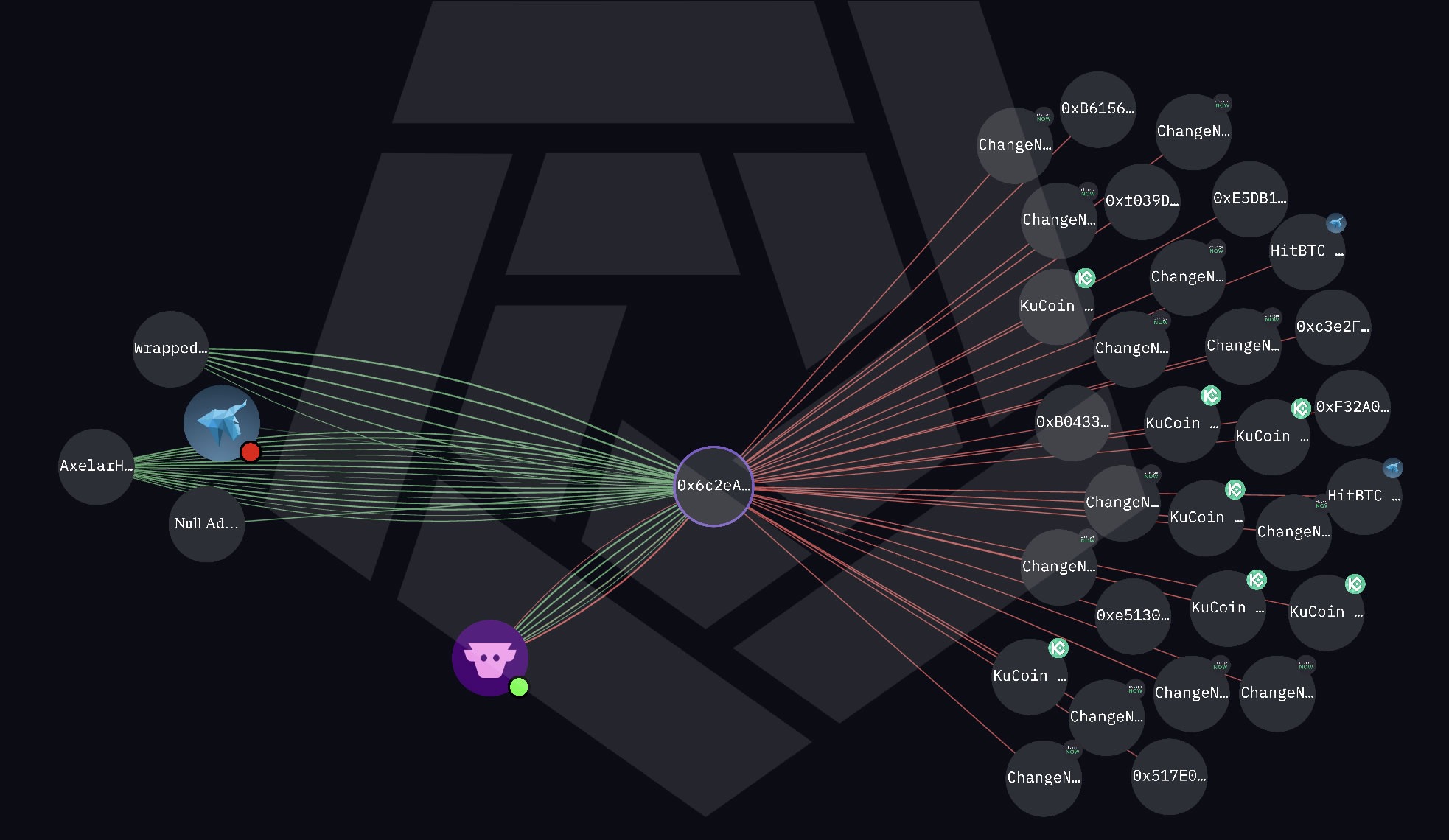
The attacker moved the exploited assets to the Ethereum blockchain and converted them to Ether (ETH). They then split the haul between around 30 wallets, eventually depositing the funds into exchanges including KuCoin, ChangeNow, and HitBTC, according to Common Prefix.
“If you hold Axelar-bridged saXXX tokens on Secret, please be aware their backing was affected, and your funds may be lost,” the Secret Network said on Saturday.
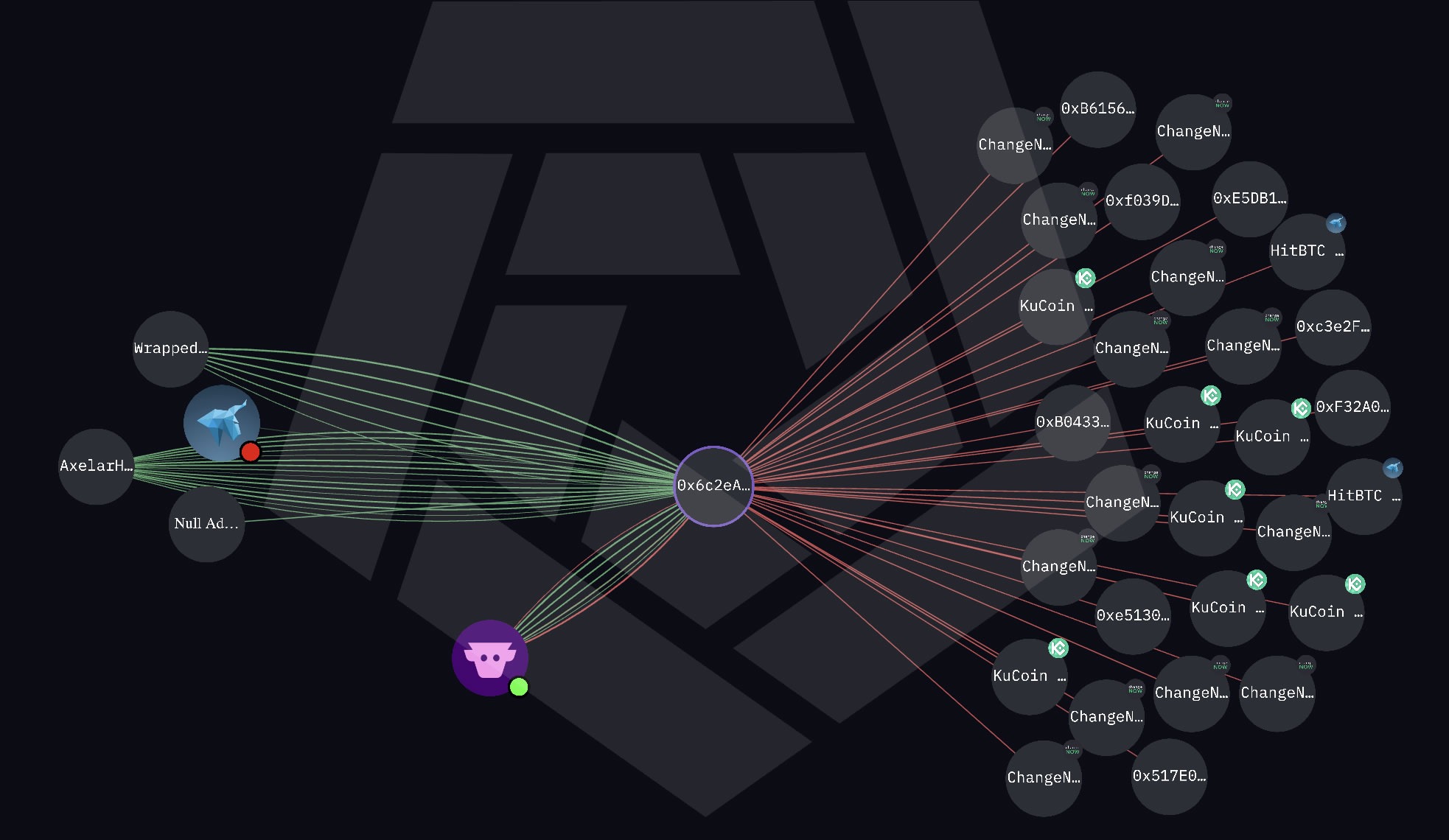
Stolen funds split into multiple wallets for obfuscation. Source: Common Prefix
The Secret Network’s token, Secret (SCRT), was not impacted by the incident, but it remains down 99% from its 2021 all-time high, currently trading at $0.058. Axelar’s native token, Axelar (AXL), is in a similar state, trading at $0.045, down 98% from its 2024 peak.
Axelar posted a confirmation on Saturday following “some confusion” around the incident.
“Neither Axelar nor IBC [Inter-Blockchain Communication] was compromised. The exploited token smart contract was not developed, deployed, or maintained by Axelar. Axelar’s firewalling prevented the impact from spreading to other chains,” it said.
Magazine: Bitcoin decouples from tech stocks, Ether eyes ‘selling wave’: Market Moves


Senator Cynthia Lummis wrote on X: developers should not need lawyers to know if their code is legal. The CLARITY Act, she argues, is the fix.
The Digital Asset Market Clarity Act has recently cleared two major legislative hurdles, passing the House in July 2025 with a 294-134 bipartisan vote before the Senate Banking Committee advanced it 15-9 in May 2026. The bill now sits on the Senate Legislative Calendar awaiting a floor vote.
When Writing Code Became a Federal Risk
The case that brought this debate into focus is that of Roman Storm, a co-founder of Tornado Cash, an open-source privacy protocol built on Ethereum (ETH).
On August 6, 2025, following a four-week trial, a jury found Storm guilty of conspiracy to operate an unlicensed money transmitting business. The jury was deadlocked and unable to reach a verdict on the two more serious charges: conspiracy to commit money laundering and conspiracy to violate sanctions.
The charge carries a maximum sentence of five years in prison.
The conviction turned on a contested legal question that the CLARITY Act is aiming to address. Tornado Cash provides an open-source protocol that breaks the link between senders and recipients of cryptocurrency in order to enhance privacy. Once deployed, neither the platform itself nor its creators ever took custody of the assets at issue.
Storm’s defense argued that holding a developer liable for what independent users do with self-executing code sets a dangerous precedent. The case asked whether writing and deploying open-source privacy software can expose its creator to criminal liability for how others use it, and after the verdict, that question remains only partially resolved.
The Tornado Cash case was not isolated. The SEC issued a Wells Notice to Uniswap Labs in 2024, alleging the primary developer of the world’s largest decentralized exchange protocol was operating an unregistered broker-dealer.
The Commodity Futures Trading Commission (CFTC) separately pursued the Ooki DAO developers, arguing that participating in open-source governance made individual contributors personally liable for how end-users interacted with the platform.
What the CLARITY Act Changes for Developers
The CLARITY Act addresses this directly through Section 604, drawn from the Blockchain Regulatory Certainty Act (BRCA). The provision codifies a principle from FinCEN’s 2019 guidance: that developers and infrastructure providers who do not take custody or control of user funds are not money transmitters under federal law.
Writing open-source software, running a node, or validating transactions would not trigger Bank Secrecy Act obligations.
More than 60 CEOs and founders across the industry, including executives from Coinbase, Uniswap, Kraken, a16z crypto, and Paradigm, signed a letter to Senate leadership in June calling on the full Senate to pass the bill with the developer protections intact, describing Section 604 as a non-negotiable condition of their support.
The post Lummis Says CLARITY Act Will End Crypto Developer Prosecution for Writing Code appeared first on BeInCrypto.
Taiko lost roughly $1.7 million on Monday after an attacker compromised the chain-state verification mechanism.
The latest hack adds to the growing list of attacks targeting crypto networks in 2026.
Taiko Becomes Latest of 20-Plus Crypto Hacks This June
Taiko runs as an Ethereum-equivalent-based rollup that settles its activity back to the mainnet. Earlier today, Blockaid flagged an ongoing exploit in a post on X (formerly Twitter).
Taiko confirmed the compromise in a security notice and warned that bridge security assumptions could no longer be trusted.
Follow us on X to get the latest news as it happens
Meanwhile, on-chain data shared by Lookonchain shows the attacker has already started cashing out. The wallet moved 1.99 million TAIKO, worth about $189,000, to MEXC. The same address still holds 870.8 ETH valued at nearly $1.52 million.
Taiko said it is working with its Security Council and ecosystem partners to contain the incident. In addition, Taiko signaled that it may take technical and legal action against the attacker.
The team has asked centralized exchanges to suspend TAIKO deposits until it issues an official all-clear.
“We strongly advise all users to withdraw their funds from all bridges deployed on Taiko immediately,” the team said.
Meanwhile, it also shared 4 attacker addresses:
- 0x7506DeA0c38ca0B55364B22424374c5A1ae1B76a
- 0x5fbc60a12bc6635e7d587d8dac52e4b1388b4990
- 0x3cc936b795a188f0e246cbb2d74c5bd190aecf18
- 0x9108828e30f2de407aadb0af677b4a9228e4acd4
Historically, bridges have ranked among crypto’s costliest weak points, and 2026 has been no exception. A tracker from DefiLlama counts more than 20 crypto hacks in June alone.
The published addresses of attackers give investigators a trail to follow as funds move. Whether Taiko can recover the stolen assets may hinge on how fast exchanges freeze the flagged wallets.
Subscribe to our YouTube channel to watch leaders and journalists provide expert insights
The post Taiko Exploit Adds to June Tally of Over 20 Crypto Hacks appeared first on BeInCrypto.

Secret Network Hit With $4.67M Infinite Mint Exploit Losses

HBO’s ‘House of the Dragon’ Begins Its Penultimate Act With an Explosive Season 3 Premiere

‘We have 18 properties between three of us’: Could your landlord be a sex worker?


-
 Crypto World7 days ago
Crude Oil Plunges Over 4% as US-Iran Agreement Reopens Hormuz Strait
-

 Fashion2 days ago
Weekend Open Thread: Miami – Corporette.com
-
 Tech5 days ago
The Adder At The Heart Of Intel’s 8087 FPU
-
 Business2 days ago
Wall Street Week Ahead: Investors see Micron earnings as pulse check of AI rally momentum
-

 Crypto World2 days ago
HIVE shares jump as $220M AI deal speeds Bitcoin mining pivot
-

 Sports3 days ago
FIFA World Cup 2026: Canada beat 9-men Qatar 6-0 to register first ever win | FIFA World Cup 2026
-

 Business1 day ago
MHP SE 2026 Q1 – Results – Earnings Call Presentation (OTCMKTS:MHPSY) 2026-06-20
-

 Crypto World2 days ago
Jake Chervinsky accuses CME of protecting derivatives monopoly
-

 Business3 days ago
Brexit cost 6% of UK economy, Bank of England company data suggests
-

 Crypto World4 days ago
Anthropic’s Dario Amodei Urged AI Unity at G7, Even as US Banned His Models
-

 Business1 day ago
Soccer-U.S. defends Iran World Cup travel restrictions, says discussions ongoing
-
 Crypto World2 days ago
Can Charles Hoskinson Really Rescue Cardano?
-

 Tech4 days ago
Weeks Of In-The-Field Testing And A Verdict
-

 Tech4 days ago
Adobe adds its AI assistant to Premiere, Illustrator and InDesign
-

 Entertainment1 day ago
Renter of Home in Anne Heche Crash Denies Settlement With Son
-

 Politics2 days ago
Andy Burnham and the meaning of Makerfield
-
 Crypto World4 days ago
Iren (IREN) Stock Surges on Jefferies Buy Rating: AI Infrastructure Play Gains Momentum
-

 Tech3 days ago
Instagram Now Lets You Add A Unique Caption To Each Carousel Slide
-

 Politics3 days ago
BBC Reporter Discusses Cross Party Criticism Of Trumps Iran Deal
-

 News Videos3 days ago
Nightcore – MONEY ON THE DASH (Soft Rock Version) (Lyrics)
You must be logged in to post a comment Login