
Crypto World
MiCA CASP tracker makes EU crypto licences searchable



The MiCA Crypto Alliance launched its MiCA CASP Tracker on Aug. 5, turning public authorisation data from the European Securities and Markets Authority into a searchable directory for crypto users, businesses and compliance teams.
Summary
- MiCA Alliance launched a searchable tracker covering authorised crypto providers listed in ESMA’s official register.
- Users can filter firms by country, regulator, company name, authorisation date, and licensed services online.
- Ten regulated services include custody, trading platforms, exchanges, order execution, advice, portfolio management, and transfers.
- ESMA republishes its interim register weekly, with the latest available file dated July 31, 2026.
- Unauthorised providers must stop onboarding clients, while consumers should verify firms through ESMA’s authoritative register.
The tool allows users to check whether a company appears in ESMA’s Markets in Crypto-Assets register and review the services it may legally provide. Each profile can show the firm’s name, Legal Entity Identifier, home country, national regulator, authorisation date and approved service categories.
MiCA tracker makes ESMA data easier to search
ESMA currently publishes its interim MiCA register through downloadable files. The latest version was dated July 31. The regulator says it republishes the data weekly after receiving updates from national competent authorities.
Moreso, the new tracker adds search and comparison functions. Users can filter records by company, country, regulator or authorised service. This can help a customer distinguish between a firm approved for custody and one permitted to operate a trading platform, exchange assets or execute client orders.
The MiCA Regulation defines ten regulated crypto services. They cover custody, trading platform operation, crypto-to-fiat exchange, crypto-to-crypto exchange, order execution, token placement, order transmission, advice, portfolio management and asset transfers.
A company’s appearance in the register does not mean every product it offers falls under MiCA. ESMA has said crypto lending and borrowing are not covered by the regulation’s service list. The Alliance also excludes firms operating only under other rules, including businesses handling financial instruments under MiFID.
July deadline makes licence checks more urgent
The tracker arrives after MiCA’s main transition period ended on July 1. ESMA instructed unauthorised providers to stop accepting new EU clients, opening accounts and marketing covered services. Firms winding down may only take actions needed to transfer assets or close customer positions.
However, ESMA also told consumers to verify providers through its official register. Customers using unauthorised platforms do not receive MiCA safeguards, including protections covering client assets. As crypto.news reported, the deadline required firms without authorisation to secure approval or wind down covered services.
Licensing activity has continued since the deadline. ESMA added BNY’s Belgian unit and 14 other providers in a late-July update. The additions included banks, payment companies and crypto businesses.
ESMA remains the authoritative source
The MiCA Crypto Alliance stressed that its tracker is an independent research tool rather than an official regulatory database. It uses publicly available ESMA information and plans to update as new authorisations appear. However, the Alliance states that the ESMA register remains the authoritative record.
This distinction matters because ESMA says its weekly register may not immediately reflect information already held by national regulators. The database can also retain withdrawn authorisations while recording their effective end dates. Users should therefore check the authorisation status and exact approved services rather than treating a listing as blanket approval.
The tracker’s next test will be how quickly it reflects ESMA’s weekly updates, licence withdrawals and changes to approved services. It offers a simpler starting point for verification, but final checks should still be completed through ESMA and the relevant national regulator.

Crypto World
Dogecoin (DOGE) Crashes to a 3-Year Low, Yet Analysts Expect a Big Move Up Ahead: Details

The biggest meme coin is deep in the red on a monthly scale, performing much worse than leading cryptocurrencies, such as Bitcoin (BTC) and Ethereum (ETH), over that period. Moreover, it collapsed to its lowest level since the autumn of 2023 before slightly regaining some of the losses.
Nonetheless, optimism among analysts is running high, with many expecting a strong rebound in the short term.
Major Bullish Signal
As of press time, DOGE trades below $0.07, boasting a market capitalization of around $10.8 billion. This positions it as the 10th-biggest cryptocurrency, yet its decline over the past few years is more than evident.
X user Ash Crypto noted that the meme coin recently plunged to a three-year low of roughly $0.067 and is down 90% from its all-time high. The analyst also told their more than two million followers that DOGE’s monthly Relative Strength Index (RSI) has reached its most oversold level since the 2022 market bottom.
Such a development is usually interpreted as a bullish signal, as it points to seller exhaustion, meaning the downtrend is potentially losing strength. Conversely, overbought territory is considered a warning for a possible impending correction. MikybullCrypto also touched upon the matter, envisioning a rise to a new historical peak during the next bull run:
“You don’t remain bearish at this current macro support level. The most oversold level in RSI. $1 is coming next during its bullish reversal.”
Is DOGE Waking up?
Another positive comment came from Ali Martinez. The renowned analyst revealed that weekly active DOGE addresses have jumped 16%: from around 38,000 toward the end of July to roughly 44,000 as of now, indicating a sharp increase in on-chain activity.
This can be interpreted as a bullish signal, as it shows that more users are returning to the network, which often strengthens momentum and can support a potential upward move.
Not long ago, Martinez chipped in again, revealing that DOGE’s TD Sequential indicator has flashed buy signals on the monthly, weekly, 3-day, and daily charts. He described this as a rare setup that could be a precursor to a major price rally.
The post Dogecoin (DOGE) Crashes to a 3-Year Low, Yet Analysts Expect a Big Move Up Ahead: Details appeared first on CryptoPotato.
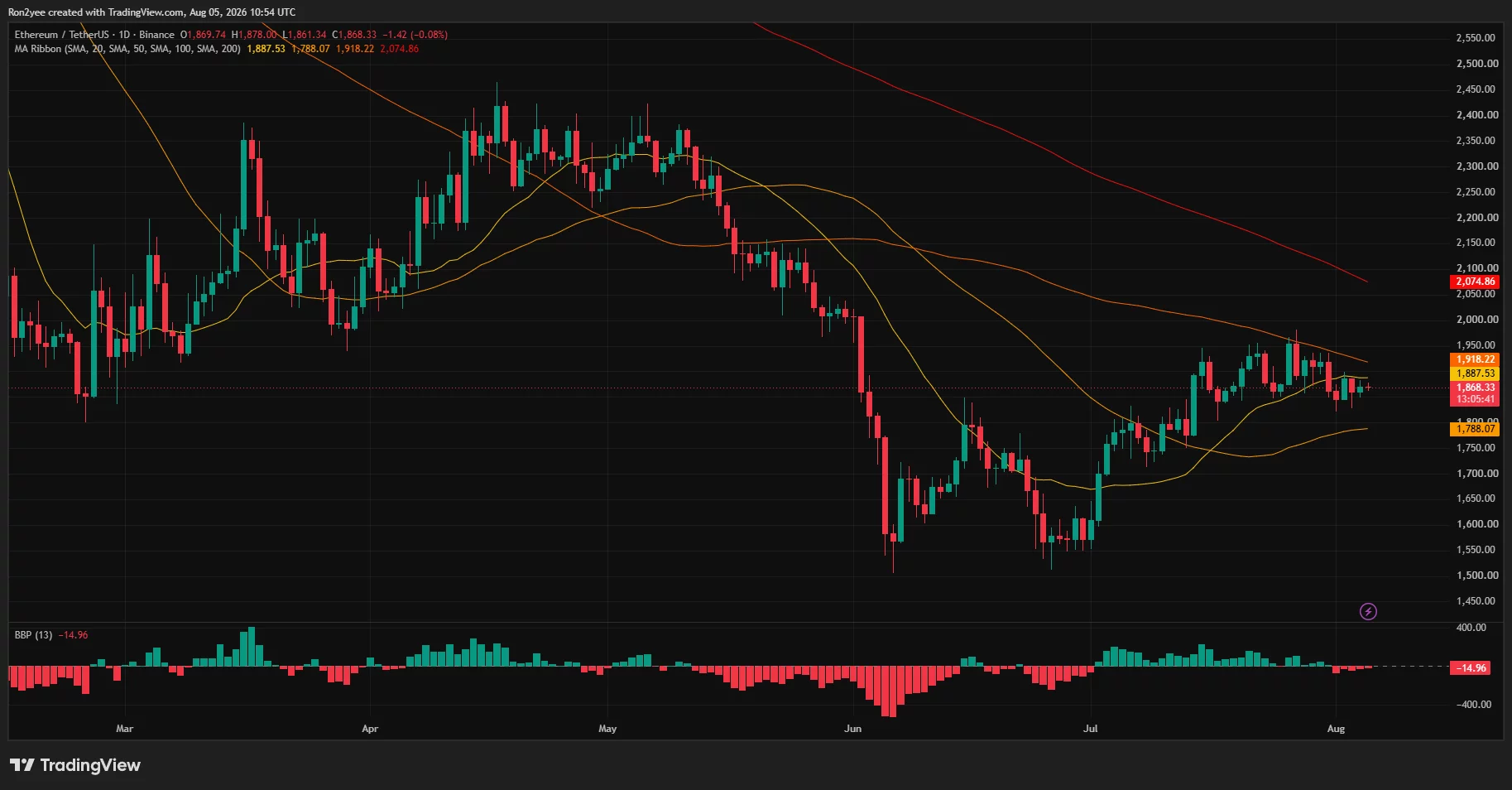
Ethereum price traded near $1,868 on Aug. 5 as it compressed below a descending trendline, while debate over EIP-8361 added a new variable to the market outlook.
Summary
- Ethereum price remains below $1,900, with the daily chart showing resistance between $1,887 and $1,918.
- A 4-hour descending channel places $1,875 as the first breakout level for buyers.
- Liquidation clusters near $1,900 and $1,940 could accelerate an upside move if resistance breaks.
- EIP-8361 would gradually burn validator rewards, reaching a 100% burn rate at a 50% staking ratio.
Ethereum price struggles below $1,900
According to data from crypto.news, Ethereum (ETH) price was trading at $1,868 at the time of writing, little changed over the previous 24 hours. The price has repeatedly failed to hold above $1,900 since late July, leaving the psychological $2,000 level out of reach.
The daily chart shows ETH trading below its 20-day simple moving average at $1,887.53. The 100-day SMA at $1,918.22 creates another resistance level, while the 200-day SMA remains higher at $2,074.86.
That structure leaves Ethereum below three of its four major moving averages. ETH is still holding above the 50-day SMA at $1,788.07, however, preserving the recovery that began after the June sell-off near $1,500.
The Bull Bear Power indicator has slipped to minus 14.96. The negative reading suggests sellers retain a small advantage, although the indicator remains far above the deeply negative levels recorded during the June decline.
ETH approaches a descending-channel breakout
The 4-hour chart places Ethereum near the upper boundary of a descending channel that has guided price lower since the July 27 peak near $1,975.
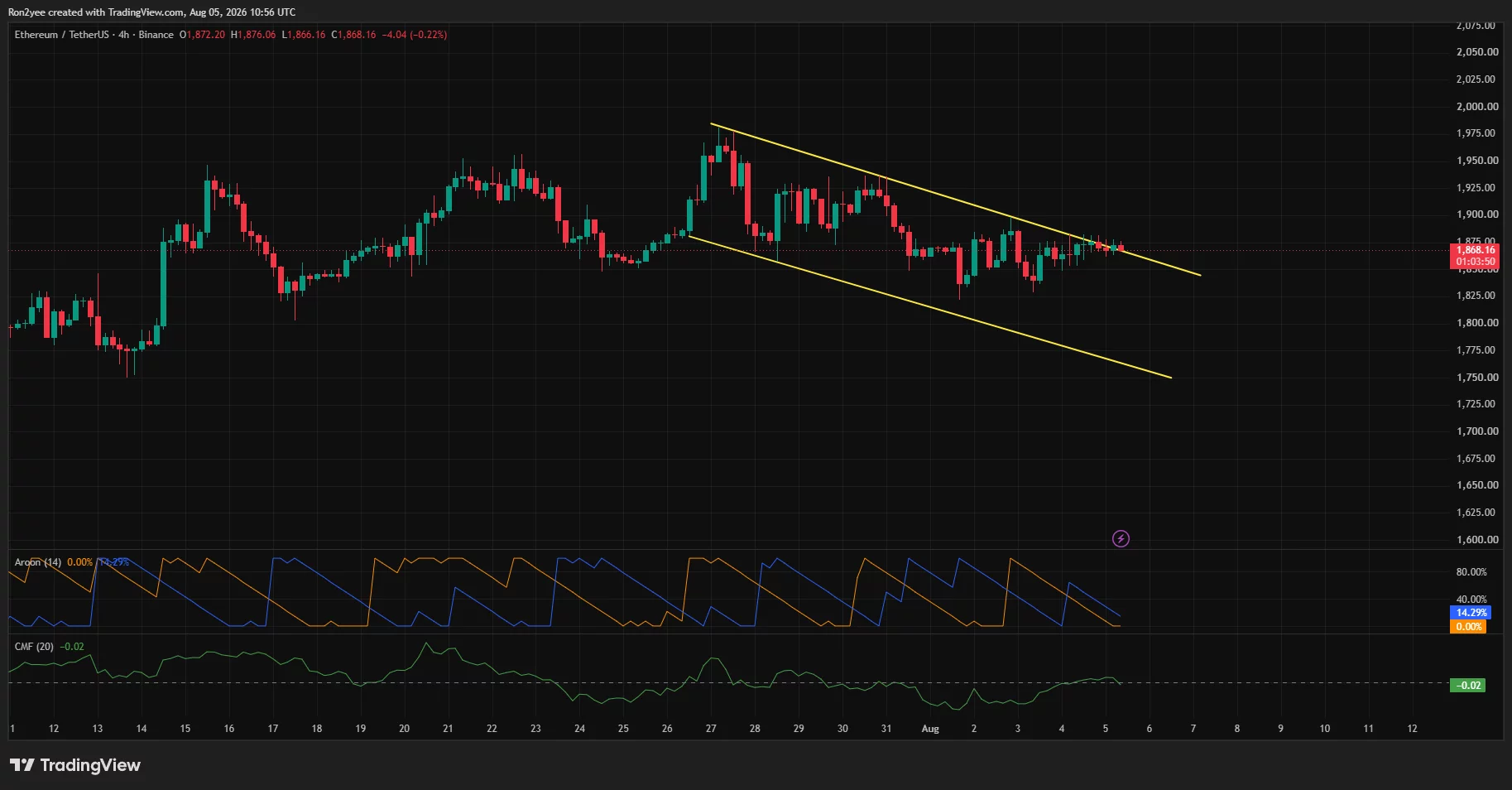
The immediate breakout area sits between $1,875 and $1,885. A 4-hour close above the channel and the daily 20-day SMA would give buyers an opportunity to retest $1,900.
Momentum remains weak rather than decisively bearish. The Aroon Up reading stands at 14.29%, while Aroon Down is at 0%. Both readings being near the bottom of their range indicate that neither side has established a strong short-term trend.
Chaikin Money Flow is slightly negative at minus 0.02. That points to modest net selling pressure and shows that ETH has yet to attract the sustained capital inflows needed for a clean breakout.
Failure to clear the channel could send Ethereum back toward $1,850. Below that, the 50-day SMA around $1,788 and the psychological $1,800 level form the main support zone.
Liquidation levels could pull ETH toward $1,940
CoinGlass’ one-week liquidation heatmap shows several pools of leveraged positions above Ethereum’s current price.
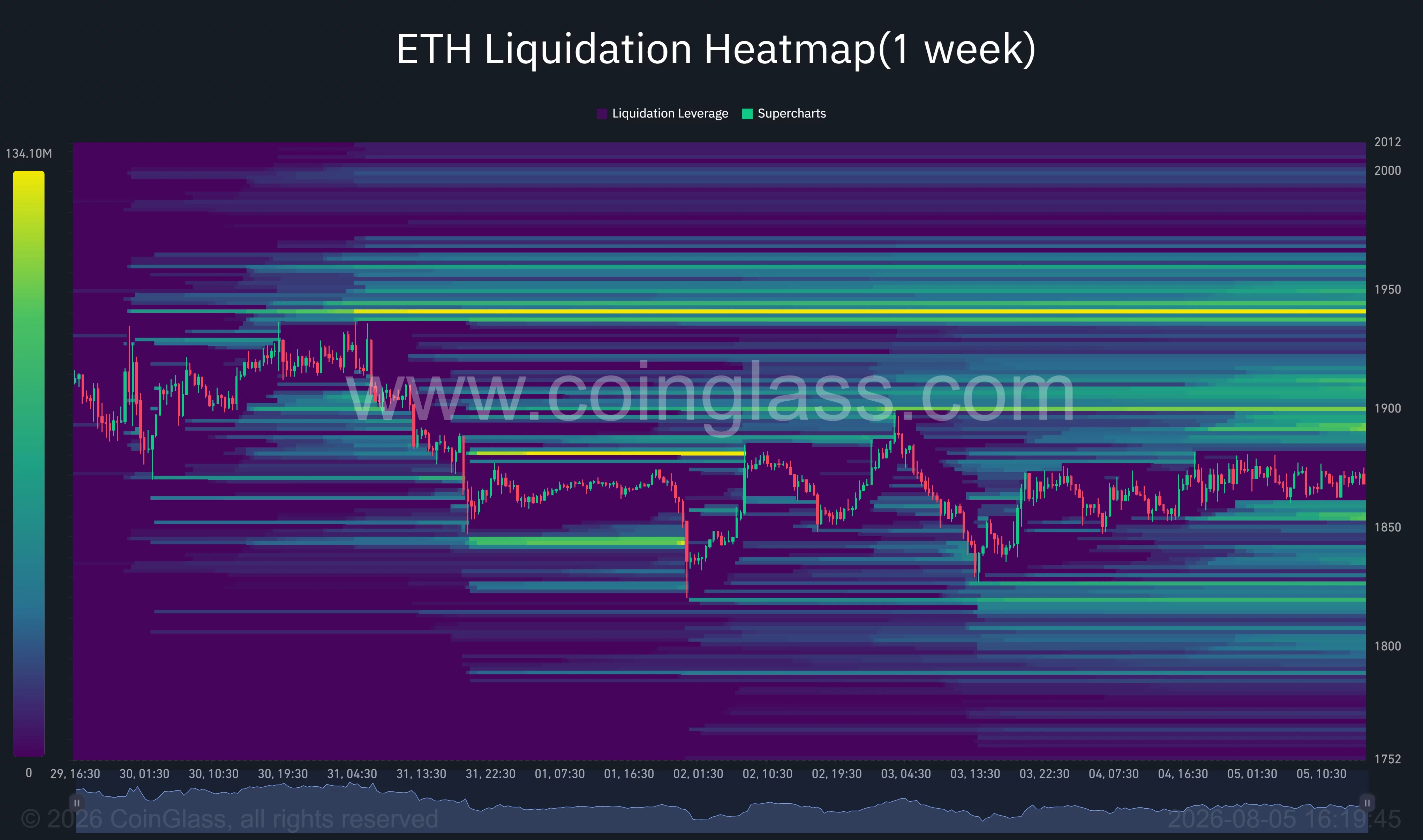
Liquidity has accumulated around $1,890 to $1,905, with a much larger concentration near $1,940. These levels could act as short-term price magnets if ETH breaks above its descending trendline.
A move through $1,940 would open the way toward $1,975 and $2,000. However, the daily 100-day SMA at $1,918 must first be reclaimed for the bullish setup to gain credibility.
Liquidity is also visible below the market around $1,850, $1,820 and $1,800. A rejection below $1,900 could therefore trigger long liquidations and pull ETH toward the lower clusters before another recovery attempt.
Analyst Michaël van de Poppe identified $1,800 as the decisive support level. He expects a break above $2,000 to place $2,300 to $2,500 within reach.
“ETH holds a crucial support level at $1,800,” van de Poppe said. “A breakout to $2,000+ is simply on the horizon.”
EIP-8361 brings staking rewards into focus
The technical test comes as Ethereum developers debate EIP-8361, a draft proposal designed to taper consensus-layer issuance as the share of staked ETH increases.
The proposal would burn a progressively larger share of validator rewards. At a 50% staking ratio, all newly issued consensus rewards would be burned instead of paid to validators. Transaction fees and maximal extractable value would remain separate sources of validator income.
EIP-8361 is not a hard cap on how much ETH can be staked. Instead, it seeks to remove the issuance-based incentive to keep staking once the ratio approaches 50%. The proposal remains under discussion and has not been approved for a network upgrade. Six authors, including Ethereum Foundation researcher Justin Drake, submitted the draft on Aug. 4.
The plan has divided members of the Ethereum ecosystem. Aave founder Stani Kulechov argued that developers should prioritize privacy and Ethereum’s role in the financial system instead of adjusting staking issuance.
Ted Pillows supported that view, writing:
“ETH should be focused on capturing more value and scaling the network. Build a valuable, scalable flywheel, not spend time talking about reducing staking fees.”
The proposal could support ETH’s long-term supply outlook by limiting new issuance, but it does not provide an immediate price catalyst. Its near-term effect remains largely tied to market expectations and the debate over validator incentives.
Can Ethereum reclaim $2,000?
Ethereum’s first bullish confirmation would be a 4-hour close above $1,885, followed by a daily move through the $1,918 to $1,940 resistance range.
Clearing those levels could trigger short liquidations and allow ETH to retest $1,975 and $2,000. A sustained break above $2,000 would then bring the 200-day SMA at $2,074 into focus.
The bearish scenario begins with another rejection below $1,900. Losing $1,850 would expose $1,820 and $1,800, while a daily close below the 50-day SMA at $1,788 would weaken the broader recovery structure.
For US investors, Ethereum’s ability to reclaim $2,000 will depend more on spot demand, broader risk appetite and institutional flows than on EIP-8361 alone. The proposal may shape ETH’s longer-term issuance policy, but price must first escape its short-term descending channel.
Disclosure: This article does not represent investment advice. The content and materials featured on this page are for educational purposes only.

Spot Bitcoin ETFs in the United States continued drawing attention from investors, posting net inflows of $211.5 million on Tuesday, after $170 million of inflows the prior day, according to SoSoValue data. The renewed demand comes as a high-profile Coldcard hardware wallet incident is prompting fresh debate over how safely digital assets are protected—especially in comparison with regulated, institutional custody.
The inflow rebound also aligns with early reassessment of the potential impact of the Coldcard hack. Galaxy Research has estimated the incident could have affected up to 7,300 addresses and may have led to roughly $130 million in suspected Bitcoin losses for users of the hardware wallet, based on its own analysis shared on social media.
Key takeaways
- SoSoValue reports spot Bitcoin ETFs pulled in $170 million on Monday and $211.5 million on Tuesday, signaling a return of daily demand.
- BlackRock’s iShares Bitcoin Trust (IBIT) led the recovery with $111 million in inflows on Monday and $170 million on Tuesday, per Farside Investors data.
- Galaxy Research estimates the Coldcard incident may have impacted as many as 7,300 addresses, with suspected losses around $130 million.
- Bloomberg Intelligence’s Eric Balchunas said the custody narrative could shift as investors compare institutional safeguards with smaller crypto players.
- Bitcoin was broadly stable as traders weighed custody concerns alongside other selling pressure, including a reported 1,638 BTC sale by Strategy.
Spot Bitcoin ETFs rebound as capital returns
ETF flows suggest demand is not confined to a single fund—though the largest products remain the main drivers. Farside Investors data shows IBIT led Monday and Tuesday inflows, contributing $111 million on Monday and $170 million on Tuesday.
Fidelity’s Wise Origin Bitcoin Fund (FBTC) followed with approximately $33 million in inflows on Monday and around $20 million on Tuesday. Invesco Galaxy Bitcoin ETF (BTCO) recorded $6.7 million in inflows on Monday—its first positive daily flow since July 1—according to Farside.
For investors, the timing matters. Coldcard-related headlines are reintroducing risk questions that many ETF investors previously treated as settled through regulated custody frameworks. When inflows rise during a period of heightened security discourse, it can be interpreted as a renewed preference for products where asset protection is managed within established financial systems.
Galaxy Research keeps the Coldcard impact in focus
Galaxy Research has been one of the most prominent groups tracking the Coldcard incident, with estimates that attempt to quantify both exposure and potential losses. In posts shared by Galaxy Research personnel, including firmwide research head Alex Thorn, the analysis has highlighted possible affected addresses and the scale of suspected stolen funds linked to users of the device.
While the figure of “up to 7,300 addresses” and roughly “$130 million” in suspected losses are estimates rather than confirmed outcomes for every impacted user, the essential point is that the hack underscores the operational risks that come with self-custody—particularly for hardware wallet users who expect their security model to hold under real-world conditions.
The ETF market’s ability to absorb investor worry depends on how quickly investors can translate those risks into a decision. Tuesday’s strong inflow data suggests many were willing to do exactly that, at least in the short term.
Custody debate: when “institutional” starts to look like a feature
Bloomberg Intelligence ETF analyst Eric Balchunas argued that the Coldcard hack could push some investors toward Bitcoin ETFs by changing how custody is perceived. In a Tuesday post on X, Balchunas framed traditional custodial responsibility as increasingly attractive—suggesting that what some in crypto culture once dismissed as a “bug” (reliance on legacy financial institutions) may appear like a “feature” once investors compare those systems to the realities of security failures elsewhere.
Balchunas also pointed to additional ETF-market shifts that are affecting investor expectations around the product landscape, including the closure of Hashdex’s spot Bitcoin ETF and a planned reverse split for BlackRock’s Ethereum ETF, according to related reporting and a regulatory filing referenced in the original discussion.
For market participants, these changes matter because product availability and investor access can influence where flows ultimately land. Even if the Coldcard incident is the immediate catalyst for attention, the broader structure of the ETF market—what exists, what’s closed, and what changes operationally—affects whether risk-off moves translate into reduced exposure or reallocations within the ETF suite.
Bitcoin price holds steady as traders weigh selling pressure
Bitcoin remained relatively stable as traders processed both the Coldcard incident and other potential sources of pressure. At the time of publication, BTC traded around $64,113, down about 0.8% over the prior seven days, according to CoinGecko, with the period’s low falling below $62,500.
Alongside custody headlines, observers also cited additional selling activity, including a reported 1,638 BTC sale by Michael Saylor’s Strategy. That adds another layer to how traders may interpret ETF inflows: if ETFs are attracting new capital while other wallets are still moving coins, price stabilization can occur even without immediate net buying pressure overwhelming other flows.
Not all analysis has treated the Coldcard-related movement risk as negligible. Some commentators argued that moving or converting stolen funds could be more difficult because blockchain transactions are publicly visible. In an X post, commentator Shagun suggested that large transfers would likely draw scrutiny from blockchain researchers, exchanges, and other market actors.
What to watch next
Investors will likely keep an eye on whether spot Bitcoin ETF inflows persist beyond the current rebound and whether any further incident-related assessments clarify the true extent of the Coldcard exposure. Separately, traders may watch on-chain behavior for signs of how any stolen funds move—because the custody story may change again depending on whether attackers can liquidate quickly or face increased friction.

And innovators are applying technology to problems that public health and health care have struggled to solve at scale. While it is too early to call them success stories, they are steps in the right direction. This month, the Coalition for Health AI launched PULSE, bringing public health agencies at state, tribal, local, and territorial levels together with technology companies to test responsible use cases of generative AI ranging from biosurveillance to multilingual communication. OpenAI and Anthropic are providing access to their technology, and lessons from participating health departments will be shared so others can build on what works. Akido is using AI to help street medicine teams care for hard-to-reach populations, using technology to increase the number of patients each clinician can see while maintaining strong retention in care and addressing public health concerns such as substance use. Jimini Health is using technology-enabled AI models made for mental health to extend care between visits, engaging patients between sessions while giving clinicians visibility into progress and allowing clinicians to prioritize what the models work on with patients.
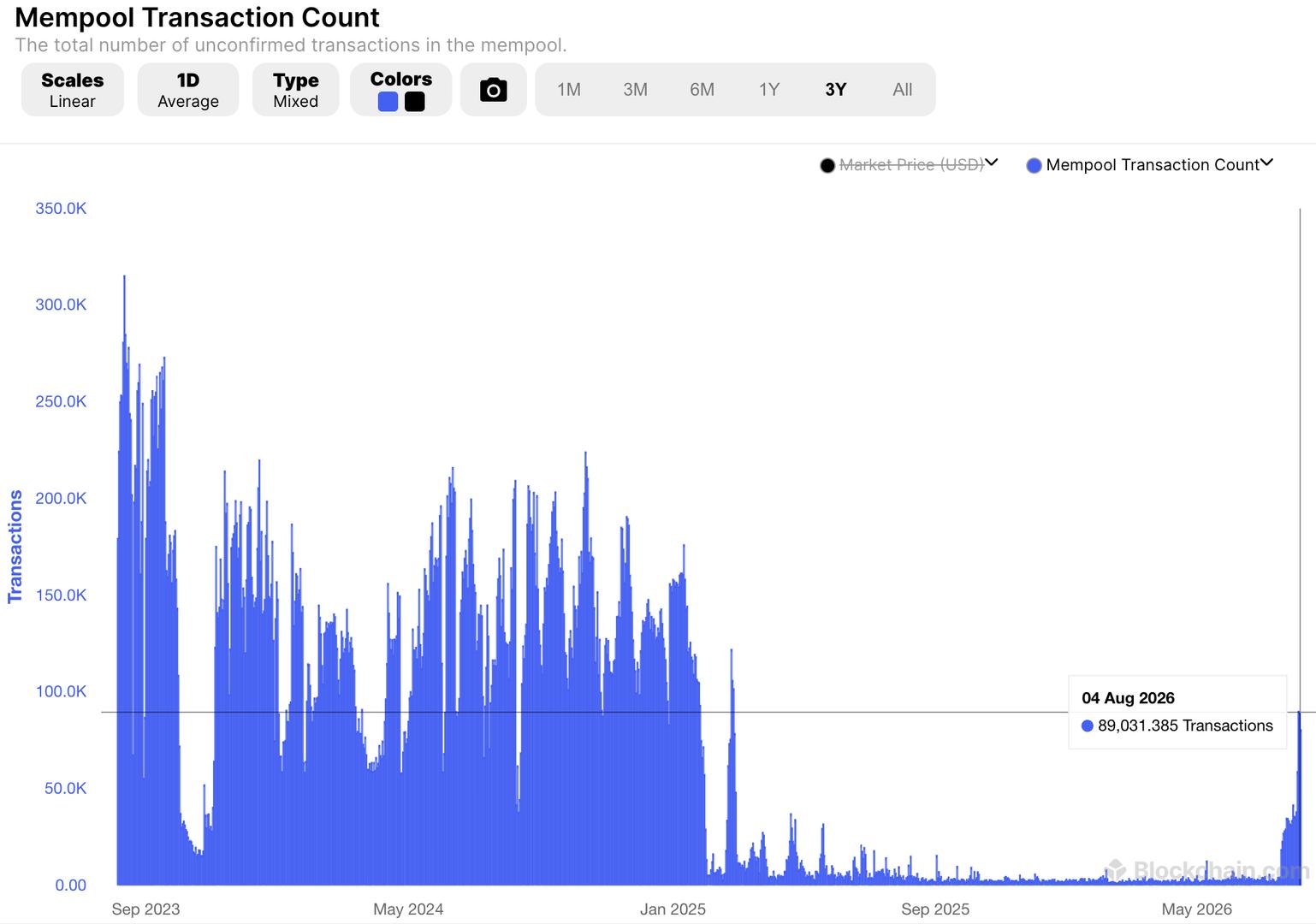
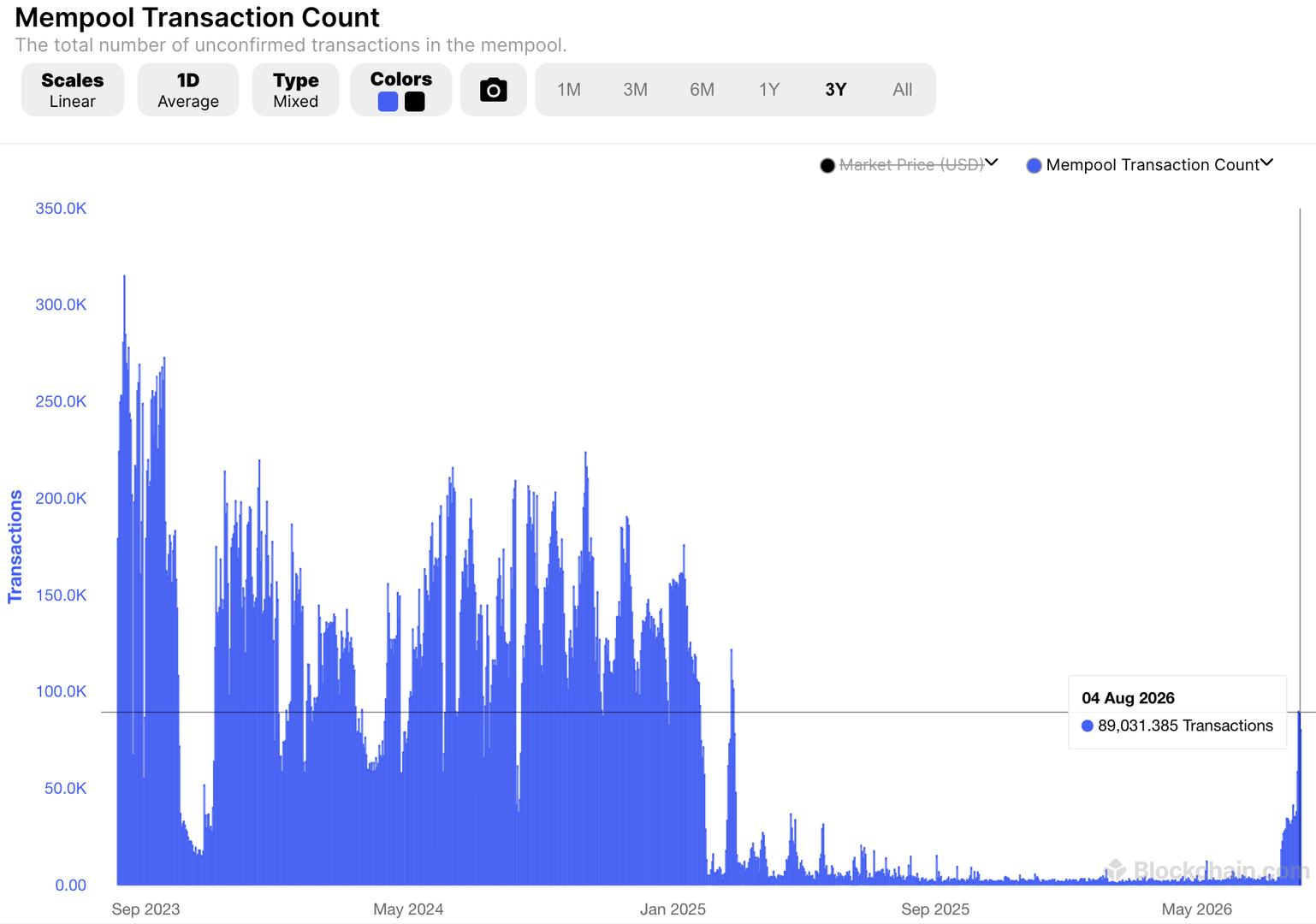
Increasing network activity is often said to support valuations for the network’s native coin, bitcoin . So far, the token has neither rallied nor dropped significantly and remains boxed in the recent range of $62,000–$65,000.
Analysts continue to point to the fate of the Clarity Act as the immediate catalyst while citing longer-duration government bond yields as a more macro and longer-lasting one.
“CLARITY is still the immediate policy binary. The Senate has a three-day window before its August 10 recess, while the implied probability of passage by year end has fallen to 23% from around 75% in mid-May. A push to attach prediction-market restrictions adds another process risk,” analysts at Marex said.
Meanwhile, Bitfinex said the bullish macro case for bitcoin could collapse if the real or inflation-adjusted yield on the U.S. 10-year Treasury note tops 2.5%.
“The 10-year real yield has not stayed above 2.5% since before Bitcoin existed, so there is no price history above that line. It is now at 2.41%, nine basis points below,” the exchange said.
Stay alert!
Read more: For analysis of today’s activity in altcoins and derivatives, see Crypto Markets Today . For a comprehensive list of events this week, see CoinDesk’s “Crypto Week Ahead.”


Key takeaways
- Ethereum traded sideways as mixed on-chain activity reflected uncertainty among investors.
- Whale wallets holding 10,000–100,000 ETH accumulated a net 130,000 ETH over the past week.
- Smaller wallet cohorts collectively reduced their holdings by approximately 360,000 ETH.
Ethereum (ETH) continued trading sideways on Tuesday as whale accumulation was offset by selling among smaller wallet cohorts and subdued institutional demand.
On-chain indicators reflect mixed sentiment, with larger investors returning to accumulation while other holders reduce their exposure near break-even prices.
Ethereum whales accumulate 130,000 ETH
Wallets holding between 10,000 and 100,000 ETH added a net 130,000 ETH over the past week. The increase marked the cohort’s first significant inflow in almost three weeks.
The renewed whale accumulation suggests that some large investors view Ethereum’s current price range as an opportunity to increase their holdings.
However, selling among smaller investors outweighed those purchases, limiting ETH’s ability to establish a clear upward trend.
Wallets holding between 1,000 and 10,000 ETH reduced their combined balance by approximately 230,000 ETH after remaining relatively stable during the previous two weeks.
Investors holding between 100 and 1,000 ETH also sold roughly 130,000 ETH. This cohort has steadily reduced its Ethereum holdings throughout the year.
Together, the two groups recorded net outflows of approximately 360,000 ETH over the past week—nearly three times the amount accumulated by whale wallets.
Ethereum’s Spent Output Profit Ratio hovered between 0.98 and 1.01 during the past week.
SOPR measures whether recently transferred assets were moved at a profit or loss. A reading near one indicates that most investors sold close to their acquisition price.
The data suggests that many holders may be exiting Ethereum positions once prices return to break-even levels rather than waiting for a sustained recovery.
Ongoing geopolitical uncertainty and the Federal Reserve’s moderately hawkish position may be contributing to the cautious sentiment across financial markets.
Ethereum’s Exchange Netflow remains negative, meaning more ETH is still leaving exchanges than entering them. However, the indicator has risen from approximately -34,000 ETH to -4,000 ETH since mid-July.
Negative exchange flows are typically viewed as constructive because withdrawals reduce the amount of ETH immediately available for sale. The movement toward zero suggests that this bullish spot-market pressure is weakening, although only gradually.
The slowdown comes amid reports that the wider cryptocurrency market is experiencing some of its lowest trading volumes since November 2023. Weak activity indicates that investors remain reluctant to take a strong directional position.
Net Realized Losses also increased on Monday, suggesting that most ETH moved at the start of the week was transferred at a loss.ins Weak
Institutional demand for Ethereum remains subdued. US spot ETH exchange-traded funds attracted $27.42 million in net inflows last week.
However, the products returned to negative territory on Monday, recording combined net outflows of $11.42 million.
The reversal highlights inconsistent institutional demand and provides limited support for a sustained ETH price recovery.
Ethereum trapped between key moving averages
Ethereum recorded $17.77 million in liquidations over the past 24 hours, including $11.77 million in short positions.
On the daily chart, ETH remains trapped between the 50-day Exponential Moving Average at $1,851 and the 20-day EMA at $1,869. This narrow range reinforces the neutral short-term outlook.
The 100-day EMA at $1,931 and a previously broken ascending trend line near $1,948 present additional resistance.
The Relative Strength Index stands near 51, reflecting balanced momentum between buyers and sellers. Meanwhile, the Stochastic oscillator near 29 suggests momentum is stabilizing following the recent pullback rather than developing a decisive trend.
A daily close above the 20-day EMA at $1,869 could allow ETH to challenge the 100-day EMA at $1,931 and the former trend-line support near $1,948.
Further buying pressure could bring resistance at $1,961 into focus. A sustained breakout above this area would expose higher targets at $2,172 and $2,431.

On the downside, immediate support lies at the 50-day EMA of $1,851, followed by the horizontal level at $1,809.
A decisive break below $1,809 would weaken the neutral structure and could send ETH toward $1,701. More substantial selling pressure could expose the deeper support level at $1,507.

The press release stated that the individual, later identified as Jeanine John Taele, 38, was seen wandering around the golf course while wearing an earpiece and taking photographs and videos of federal agents’ security-planning activities.
Taele returned to the golf course Sunday afternoon, prompting staff to alert federal agents, according to the press release, which alleged that Taele approached the federal agents and claimed the State Department hired him as part of a security detail.
Agents then contacted the Los Angeles County Sheriff’s Department, according to the U.S. Attorney’s Office press release. When they arrived at the club, the Sheriff’s Department deputies learned that Taele was wanted in connection with a 2025 robbery case out of El Segundo, Calif., before they detained him.
Deputies found a magazine with ammunition from Taele’s pants pocket, the U.S. Attorney’s Office said, adding that a subsequent search of his pick-up truck in the golf club’s parking lot yielded a loaded pistol, an additional loaded magazine, a pair of binoculars, and a badge that read, “security protection agent.”


Circle has announced that its Arc blockchain will launch on the public mainnet on Sept. 16, with BlackRock, DTCC, Mastercard, Visa, Standard Chartered, and other global financial institutions serving as founding validators.
Summary
- Circle has scheduled the public mainnet launch of its Arc blockchain for Sept. 16 with BlackRock, DTCC, Visa and other financial institutions joining as founding validators.
- BlackRock plans to deploy its BUIDL tokenized money market fund on Arc while DTCC is preparing to integrate DTC tokenized assets with the network from the second half of 2027.
- Arc is operating on a private mainnet with more than 100 institutional and ecosystem participants ahead of its public launch.
- Circle will introduce AI developer tools, tokenized asset management services and a composable application framework alongside the network’s launch.
According to Circle, Arc is currently running on a private mainnet with more than 100 institutional and ecosystem participants, ahead of its public mainnet launch scheduled for Sept. 16.
The company said BlackRock, The Depository Trust & Clearing Corporation (DTCC), Galaxy, Global Payments, ICE, Mastercard, MoneyGram, SBI Group, Standard Chartered, Sumitomo Corporation and Visa will join Circle as the network’s founding validators, helping secure and govern the blockchain from launch.
Arc launches with financial institutions as validators
Circle said the validator model is designed around institutions that are also building on the network rather than relying on independent operators. According to the company, the structure is intended to meet the operational, compliance and security requirements expected of financial market infrastructure while supporting open blockchain applications.
The announcement also confirms that Arc has moved into a private mainnet phase after earlier operating through a public testnet. Circle had previously said more than 100 organizations, including banks, asset managers and blockchain companies, were testing the network before launch.
Mastercard Chief Product Officer Jorn Lambert said the future of payments will depend on different payment rails and forms of value working together rather than a single network. He said Mastercard’s role as a founding validator aligns with its work to connect blockchain-based payment systems with traditional financial infrastructure.
MoneyGram Chairman and CEO Anthony Soohoo said the company joined Arc because it views compliant blockchain infrastructure as necessary for stablecoins to support real-world money movement. Standard Chartered Global Head of Transaction Services and Digital Assets Ole Matthiessen said institutional adoption of digital assets requires infrastructure that satisfies regulatory and operational standards, adding that the bank views Arc as infrastructure for secure onchain financial applications.
Visa Global Head of Growth Product and Partnerships Rubail Birwadker said the company expects trusted blockchain infrastructure to support the expansion of onchain payments and confirmed Visa will participate as a network validator.
BlackRock and DTCC plan Arc integrations
Circle also detailed several institutional integrations expected to accompany Arc’s public mainnet launch.
BlackRock plans to deploy its BlackRock USD Institutional Digital Liquidity Fund (BUIDL) on Arc using the network’s native USDC integration. According to Circle, institutional investors will be able to subscribe, redeem and deploy fund assets within a single onchain environment.
Robert Mitchnick, BlackRock’s Global Head of Digital Assets, said the deployment aligns with the growing role of stablecoins in financial markets.
“Stablecoins and tokenized assets are inextricably linked within the future of financial market infrastructure. Purpose-built rails like Arc can support faster settlement, improved collateral mobility, and broader institutional adoption of digital assets.”
Circle is also collaborating with DTCC to enable tokenization of assets held at The Depository Trust Company (DTC) on Arc beginning in the second half of 2027.
According to the company, the integration is intended to let market participants use third-party applications on Arc for stablecoin-native settlement outside of DTC while referencing DTC-tokenized assets. Circle added that the assets will continue to provide investors with the same rights and protections as traditionally held securities.
The company said the planned integration supports DTCC’s multi-chain strategy, which focuses on accelerating settlement, extending trading hours, improving asset mobility and reducing operational costs through distributed ledger technology.
Arc expands ecosystem before public mainnet
Circle said several decentralized finance protocols, payment providers, exchanges and wallet companies are preparing to support the network when it launches.
According to the announcement, Aave, Aerodrome, FalconX, Galaxy, GSR, Keyrock, Morpho, Nonco, Uniswap and XFX are expected to provide borrowing, trading and liquidity services on Arc.
Payment providers including Rain, Thunes and Wirex are preparing to route stablecoin payment and settlement activity through the network. Circle also listed Binance Wallet, Chainlink, Fireblocks, Kraken, Ledger, MetaMask, Uniswap Labs and Upbit among wallet and infrastructure providers expected to support access to USDC, custody services and cross-chain asset transfers.
Jeremy Allaire, Circle’s co-founder, chairman and CEO, said the combination of institutional validators and more than 100 enterprise and ecosystem builders already operating on Arc’s private mainnet positions the blockchain for its Sept. 16 public launch.
Arc builds on earlier institutional roadmap
The latest announcement extends Circle’s institutional strategy for Arc that has been developing throughout the year.
In May, Circle launched the Arc blockchain initiative alongside a $222 million ARC token presale that valued the network at $3 billion on a fully diluted basis. At the time, the company described Arc as a public blockchain built for institutional finance with USDC serving as its native gas token, alongside features including sub-second finality, EVM compatibility and opt-in privacy.
Circle later introduced Arc Privacy, a confidential smart contract engine that allows businesses to keep selected transaction data and contract activity private while preserving access for compliance reviews and audits. According to the company, the technology is intended for institutional workflows such as treasury management, payroll, lending, tokenized assets and consumer payments.
Earlier in April, Circle also published a multi-stage quantum resilience roadmap for Arc. The company said quantum-resistant wallets and signature schemes would be available when the network launches, with additional protections for validators, infrastructure and off-chain systems planned in later phases.
Circle said it will introduce additional products alongside the Sept. 16 public mainnet launch, including a composable application framework for common onchain workflows, AI-assisted developer tools, services for issuing and managing tokenized real-world assets, and interfaces designed for developers, users and autonomous software agents operating on the Arc network.

Key takeaways
- Pi Network is testing a breakout from a short-term triangle near $0.085.
- RoboPay has added Pi Network as a payment partner for robot-based services.
- PI futures Open Interest increased to $8.82 million, indicating steady speculative demand.
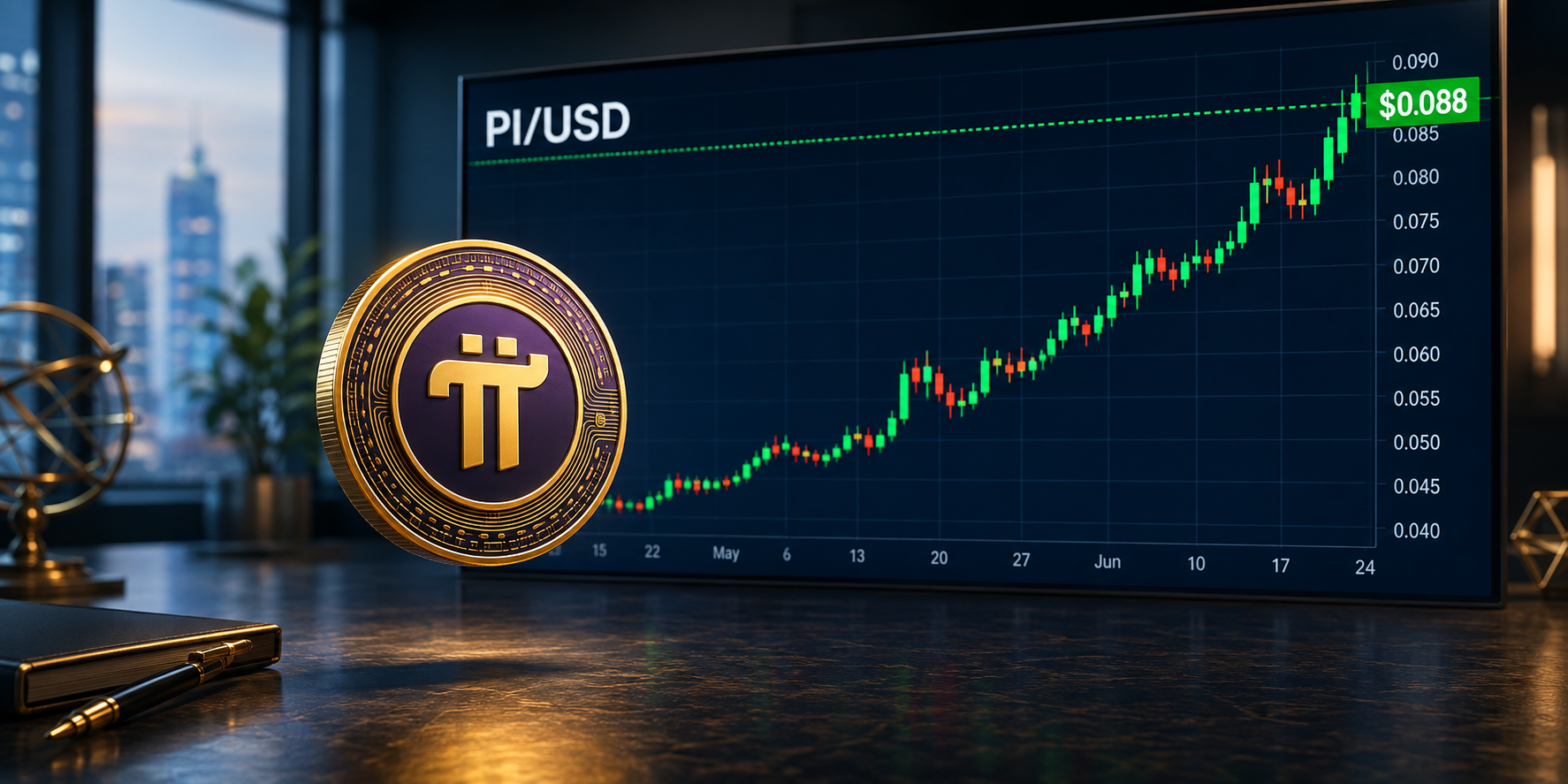
Pi Network (PI) edges higher on Wednesday as the token attempts to break out of a short-term triangle pattern near $0.085.
The recovery comes amid improving momentum indicators, steady derivatives demand, and a new payment partnership with RoboPay. However, PI remains confined within a broader falling channel and must overcome resistance near $0.09 to establish a stronger bullish trend.
RoboPay adds Pi Network as payment partner
Fabric Foundation announced on Wednesday that Pi Network had joined RoboPay as a payment partner.
The integration will allow Pi users to pay for robot-powered services using PI tokens. Potential applications include deliveries, security patrols, inspections, and services performed by humanoid robots.
The partnership represents another potential real-world use case for PI and could support adoption if the services gain traction among Pi Network users.
However, the longer-term effect will depend on the scale of RoboPay’s operations, user demand and the availability of supported services.
Speculative demand for Pi Network remains relatively stable this week. CoinAnk data shows that PI futures Open Interest increased to $8.82 million on Wednesday from $8.51 million the previous day.
The increase indicates that the value of active perpetual futures contracts is rising as traders build new positions. While this signals growing market participation, Open Interest alone does not reveal whether those positions are predominantly bullish or bearish.
Pi Network tests triangle resistance
PI is extending its modest recovery and testing the upper resistance trend line of a short-term triangle pattern near $0.085.
The triangle has developed within a larger descending channel, meaning the token remains under pressure from the broader bearish structure. An additional downtrend line near $0.09 strengthens the resistance zone immediately above the current price.
A confirmed breakout from the smaller triangle would improve the near-term outlook, but PI must surpass the wider resistance cluster near $0.09 to restore a more convincing bullish trend.
The Moving Average Convergence Divergence and its signal line are trending modestly higher, pointing to early signs of improving upside momentum.
Meanwhile, the Relative Strength Index has recovered to 44. Although it remains below the neutral 50 level, its upward movement indicates that bearish momentum is beginning to fade.
The indicators support a mildly bullish short-term bias but do not yet confirm that buyers have regained full control.
A decisive close above the overhead trend lines around $0.09 could strengthen PI’s recovery and bring the 127.2% Fibonacci extension at $0.0961 into focus.

Clearing that level would provide further evidence that the short-term trend is shifting in favor of buyers.
If PI fails to break above the triangle and descending-channel resistance, the token could retreat toward the record low of $0.07. This support area is reinforced by the 161.8% Fibonacci extension at $0.0679.
A sustained break below that zone would invalidate the developing recovery and signal a continuation of the broader downtrend.


Boerse Stuttgart Digital and institutional crypto trading firm Tradias have completed their merger after receiving regulatory approval for the required ownership control procedure, creating a combined digital asset business with about 300 employees.
Summary
- Boerse Stuttgart Digital and Tradias have completed their merger after securing regulatory approval, creating a digital asset business with about 300 employees.
- The combined company will provide institutional trading, custody, staking and tokenization services while Tradias continues as the trading brand.
- The merger builds on Boerse Stuttgart’s institutional crypto expansion, including its partnership with DekaBank and the rollout of its Seturion settlement platform.
- Tradias contributes trading and market making across more than 150 digital assets and serves banks, brokers and government institutions across Europe.
An announcement released on Wednesday said the deal, first unveiled in February, has now closed following completion of the required ownership control procedure, bringing the two regulated crypto businesses under a single structure focused on institutional clients across Europe.
The combined company will operate under the Boerse Stuttgart Digital name, while Tradias will continue as the dedicated brand for trading services. Together, the business will offer trading, custody, staking and tokenization services for banks, brokers and other financial institutions.
Operations will be managed from Frankfurt and Stuttgart, supported by teams in Athens, Beirut, Berlin, Dubai, Madrid, Milan and Ljubljana. Tradias founder Christopher Beck and Boerse Stuttgart Digital managing director Ulli Spankowski have been appointed co-chief executives of the merged business.
Financial terms of the transaction were not disclosed.
Institutional crypto services expand under one business
By combining their operations, Boerse Stuttgart Digital and Tradias are bringing together regulated trading infrastructure with custody and digital asset services already used by several European financial institutions.
Boerse Stuttgart Digital counts institutions including DZ Bank, DekaBank, Intesa Sanpaolo and Société Générale-FORGE among its clients. Tradias, meanwhile, provides trading and market-making services covering more than 150 cryptocurrencies and other digital assets while serving customers including flatexDEGIRO, dwpbank and European government institutions.
Earlier this year, DekaBank partnered with Boerse Stuttgart Digital to launch cryptocurrency trading services for institutional investors. At the time, the bank relied on Boerse Stuttgart Digital’s regulated brokerage and custody infrastructure after the company secured authorization under the European Union’s Markets in Crypto-Assets framework, while DekaBank itself operated with crypto custody approvals from the European Central Bank and Germany’s financial regulator, BaFin.
The institutional focus has continued as European banks gradually add digital asset services under the MiCA regulatory framework.
Boerse Stuttgart has continued building tokenization infrastructure
The merger follows a series of projects by Boerse Stuttgart Group aimed at expanding blockchain-based financial infrastructure beyond cryptocurrency trading.
Last September, the group introduced Seturion, a blockchain settlement platform built for cross-border trading of tokenized assets across Europe. The platform supports both public and private blockchains and allows settlement using central bank money or on-chain digital currencies while connecting banks, brokers, trading venues and tokenization platforms through a shared infrastructure.
Boerse Stuttgart said when Seturion launched that the platform could reduce settlement costs by as much as 90% while giving financial institutions access to tokenized asset trading without requiring each participant to obtain a dedicated distributed ledger technology license.
More recently, Seturion added Société Générale, SG-FORGE and flatexDEGIRO as participants in its settlement network. The expansion brought tokenized structured securities, MiCA-compliant euro and dollar stablecoins, and retail brokerage order flow onto the platform, extending its role in regulated digital securities settlement across Europe.
Nasdaq’s European trading venues are also expected to connect with the settlement network, according to Boerse Stuttgart’s earlier announcement.
Tradias strengthens the group’s trading capabilities
Tradias adds an established institutional trading business to Boerse Stuttgart Digital’s existing regulated infrastructure.
The company offers trading and market-making across more than 150 digital assets and has built relationships with brokers, banks and public sector institutions in Europe. Keeping the Tradias name for trading services allows the merged business to preserve its existing market presence while integrating the companies under a single digital asset organization.
With approximately 300 employees across multiple European and international offices, the combined operation now brings together regulated trading, custody, staking and tokenization services within one institutional platform while continuing to serve existing banking, brokerage and financial market clients.

Prime Video’s Forgotten Revenge Thriller Is Now Taking Over the Streaming

Girl On Couch, Billen Ted – Man In Finance (Lyrics)

‘Inconsolable’ family lose everything as fires destroy Greece home days before leaving UK


![Cardi B - Money [Official Music Video]](https://wordupnews.com/wp-content/uploads/2026/02/1770603085_hqdefault-80x80.jpg)

-

 Business7 days ago
Why Trees Belong on the Risk Register
-

 Fashion5 days ago
Weekend Open Thread: Wit & Wisdom
-

 Politics5 days ago
Meta enters AI-training agreement with far-right ‘propaganda rag’ Newsmax
-

 Politics7 days ago
Reform UK betrays West Mids residents by running from party pledges
-

 Politics3 days ago
Zack Polanski: an incitement to murder Nigel Farage?
-

 Crypto World4 days ago
MicroStrategy Post-Earnings CLARITY Act Push Could Add New Catalyst for Its Stock
-

 Crypto World4 days ago
XRP Ledger v3.3.0 brings five institutional features
-

 News Videos6 days ago
Bitcoin Enters the 3rd Stage of the Bear Market
-

 Politics6 days ago
Luke Littler’s dominance sparks GOAT debate
-

 Sports5 days ago
Seema Kaliramna Wins Discus Throw Bronze, Takes India’s CWG Medals Tally To 17
-

 Crypto World4 days ago
New York sues Kalshi over prediction market gambling
-

 Crypto World3 days ago
Crypto PAC spending tops $2M in Michigan House race
-

 Tech7 days ago
Gemini can now summarize the messiest comment threads in Google Docs
-

 Business5 days ago
Trump Announces Hamas Disarmament Agreement as Iran Strikes Kuwait Air Base and US Attacks Pause Overnight
-

 Tech3 days ago
ESET tracks rise in malicious AI skills and adaptable malware
-

 Business2 days ago
DTCR: Deleveraging And A Hedge Fund Collapse Point To A Possible AI Bottom
-

 Tech5 days ago
Gemini Spark can now use Chrome logins and saved passwords to run errands on your behalf
-
 Tech5 days ago
Building A Reproduction PlayStation Motherboard
-
 Crypto World5 days ago
3 Fed Officials Just Explained Their Rate Hike Vote: Is Inflation Winning?
-

 Sports7 days ago
Sakshi, Arundhati Enter Boxing Semi-Finals. India Assured Of 18 Medals At CWG 2026
You must be logged in to post a comment Login