

Crypto World
Trump Administration’s Q1 2026 Crypto Stock Purchases: Coinbase (COIN), Strategy, and MARA Revealed in Federal Filings


TLDR
- President Trump’s securities transactions totaled between $220 million and $750 million during Q1 2026, according to federal ethics documents.
- Blockchain-related equities such as Coinbase, MARA Holdings, and Strategy featured prominently across numerous trades.
- Trump’s personal digital asset holdings through family trusts amount to at least $51 million.
- Close to 70 administration appointees maintain collective cryptocurrency positions valued above $193 million.
- Post-inauguration actions include an executive directive prohibiting CBDCs and creation of a Strategic Bitcoin Reserve containing more than 328,000 BTC.
Recently released federal ethics documents show President Donald Trump and key administration figures executed substantial trades in cryptocurrency-related equities throughout the opening quarter of 2026, concurrent with implementing crypto-favorable policies from Washington.
Key Details from Federal Disclosures
The information emerged through mandatory Form 278-T filings, which federal personnel must submit when conducting securities transactions exceeding $1,000. The documents catalog over 2,000 separate transactions spanning January through March 2026.
These regulatory submissions present value ranges rather than precise amounts. They neither reveal actual gains or losses nor identify the specific individuals authorizing each transaction.
Aggregate trading activity during this three-month window registered between $220 million and $750 million. Trump maintains his holdings via a family trust administered by his children. Evidence suggests certain reported activities resulted from broker-initiated decisions rather than Trump’s direct instructions.
Blockchain-associated companies featured in the filings included Coinbase, MARA Holdings, and Strategy. Documentation reveals nine distinct Coinbase acquisitions. A February 10 transaction carried a valuation ranging from $100,001 to $250,000.
Regarding MARA stock, two purchase entries appeared, each below $50,000. Strategy transactions numbered eight across January and February, encompassing both acquisitions and disposals. One Strategy purchase executed February 12 registered between $50,001 and $100,000.
Additional firms mentioned include Robinhood, SoFi Technologies, and Block, although specific valuation brackets for these positions remain undisclosed.
Cryptocurrency-related investments constituted a modest fraction of total disclosed activity. The comprehensive filing encompassed substantial positions in technology giants including Microsoft, Oracle, and Nvidia.
Digital Asset Holdings Across the Administration
Analysis conducted by The Washington Post examining financial disclosure submissions indicates approximately 70 Trump administration personnel and appointees maintain combined holdings of no less than $193 million in cryptocurrency and blockchain-connected investments.
Trump personally declared digital asset stakes worth at least $51 million. Vice President JD Vance reported Bitcoin holdings valued between $250,000 and $500,000. Health Secretary Robert F. Kennedy Jr. documented positions ranging from $1 million to $5 million. Ambassador-designate to Denmark Ken Howery leads all officials with digital assets worth at least $122 million.
Given the range-based reporting methodology, actual aggregate values likely exceed disclosed minimums substantially.
Trump’s family enterprise controls majority ownership in World Liberty Financial, a decentralized finance platform generating significant revenue streams. The TRUMP meme token, introduced in January 2025, temporarily achieved an $8.7 billion market capitalization before experiencing dramatic value decline.
Regulatory Initiatives Following Inauguration
Since assuming office, Trump issued an executive order prohibiting development of a United States central bank digital currency. Additionally, he created a Strategic Bitcoin Reserve, aggregating over 328,000 BTC from various federal departments—presently valued near $26 billion.
The Securities and Exchange Commission received instructions to withdraw or suspend enforcement actions targeting more than twelve cryptocurrency companies, marking a dramatic departure from the Biden administration’s aggressive regulatory stance adopted after FTX’s 2022 implosion.
Multiple appointees holding cryptocurrency investments simultaneously exercise regulatory jurisdiction over digital asset markets. Bill Pulte, leading the Federal Housing Finance Agency, recently mandated Fannie Mae and Freddie Mac recognize cryptocurrency as qualifying assets when evaluating mortgage loan risks.
Treasury Secretary Scott Bessent and Director of National Intelligence Tulsi Gabbard both confirmed they liquidated their cryptocurrency positions either prior to or immediately following their confirmations.



TLDR:
- XRP inflows to Binance from wallets holding over 1M tokens have declined sharply since the 2025 peak.
- On-chain data shows no extraordinary inflow spike, ruling out aggressive whale selling or profit-taking now.
- The current XRP price drop is tied to leverage liquidations and broad market weakness, not whale distribution.
- If Binance inflows stay low and demand holds, XRP could realistically revisit the $1.8 to $2.0 price range.
XRP exchange inflows to Binance have declined notably following the 2025 market peak, and on-chain data now points to reduced selling activity among large holders.
Transfers exceeding one million XRP dominated exchange inflow charts between 2021 and 2025, reflecting consistent participation from whale and institutional-scale addresses.
The recent pullback in these flows, despite a price retreat from the $3 region, suggests that major market participants are becoming less inclined to sell.
Whale Activity Shifts as Large-Scale XRP Transfers to Binance Drop
Historically, sharp spikes in the 100K–1M XRP and 1M+ XRP inflow categories have preceded major market downturns.
These surges typically signal that large holders are moving assets to exchanges ahead of selling. However, no such extraordinary spike currently appears at the far right of the inflow chart. This absence is a meaningful contrast to prior bear market conditions.
CryptoQuant analyst PelinayPA noted that the post-ETF approval period coincides with this drop in whale inflows. The reduced exchange activity suggests whales may be holding positions rather than distributing.
That behavioral shift stands out, especially given XRP’s recent price correction. It points to a market structure that differs from previous cycles.
The current price decline appears linked more to leverage liquidations and broader market weakness than to deliberate whale selling. In past severe downturns, exchange inflows rose aggressively as investors rushed to exit positions.
That pattern is not repeating now. The on-chain picture, therefore, does not support the narrative of widespread profit-taking at this stage.
Between 2021 and 2025, large-scale inflows remained consistently elevated, showing that whales actively used Binance as a distribution venue. The recent reversal of that trend is therefore notable.
It reflects a measurable change in behavior among the market’s largest participants. Whether this shift sustains depends on whether inflows stay suppressed in the weeks ahead.
Subdued Binance Inflows Could Reduce Selling Supply and Support XRP Price
PelinayPA stated in the analysis: “If Binance inflows remain subdued, the available selling supply could continue to decrease. Combined with stronger demand, this would make it easier for XRP to revisit the $1.8–$2.0 range.”
That projection rests on the assumption that the current low-inflow environment holds. Any renewed surge in the 1M+ XRP category would challenge that outlook.
XRP’s price stood at $1.11 at the time of writing, with a 24-hour trading volume of $1,754,706,743. The asset recorded a 5.12% decline over the past 24 hours and an 8.28% drop over the prior seven days. Despite these figures, the on-chain data does not yet reflect panic-driven selling from major holders.
Reduced exchange supply, when paired with sustained or growing demand, typically creates favorable conditions for price recovery.
The $1.8–$2.0 range cited in the analysis represents a plausible near-term target if inflows remain low. However, this structure remains sensitive to any sharp reversal in whale behavior. Traders and analysts will likely continue monitoring inflow trends closely.
As long as no renewed surge emerges in the 1M+ XRP inflow category, the current market structure may remain constructive. The broader market environment will also play a role in whether that structure holds.
For now, the declining inflow trend offers a data-backed case for cautious optimism. The next few weeks will clarify whether whales maintain their current stance.


Humanity Protocol has revealed that a compromised employee laptop enabled attackers to obtain control of bridge administration systems across Ethereum and BNB Smart Chain, resulting in the theft and minting of more than $36 million worth of H tokens.
Summary
- Humanity Protocol says a compromised employee laptop enabled attackers to seize bridge controls and steal more than $36 million in H tokens.
- Attackers allegedly compromised multisig keys on Ethereum and BNB Smart Chain, draining 141.2 million H and minting 200 million additional tokens.
- The project has halted bridge activity, is working with exchanges and police, and plans to release a full post-mortem report.
According to a statement shared with crypto.news by Humanity founder and CEO Terence Kwok, the June 8 incident was a coordinated attack that targeted the project’s bridge infrastructure on multiple networks.
“Last night, June 8, 2026, the Humanity was hit by a coordinated attack across Ethereum and BSC,” Kwok said.
Providing the first detailed explanation of how the breach occurred, Kwok said the attacker gained access after compromising an employee device.
“This was a result of a breach that happened after an employee’s laptop was compromised.”
The founder said three of the six Gnosis Safe owner keys controlling the Hyperlane bridge ProxyAdmin on Ethereum were compromised. Humanity Protocol said the attacker transferred ownership of the ProxyAdmin contract to a wallet under their control, upgraded the bridge contract to a malicious implementation, and moved approximately 141.2 million H tokens in a single transaction.
A similar compromise took place on BNB Smart Chain. According to Humanity Protocol, three of five Safe owner keys were compromised, allowing the attacker to seize control of the bridge’s ProxyAdmin contract, deploy a malicious implementation with an unlimited mint function, and mint 200,000,005 H tokens in two separate transactions.
The project currently estimates that more than $36 million has been stolen and sold across both chains.
Compromised multisig keys enabled bridge takeover
Fresh details from Humanity Protocol expand on earlier disclosures from the team, which had initially confirmed only that private keys linked to a Humanity Foundation member were compromised.
Earlier on June 9, on-chain analyst Specter reported that more than 17 wallets associated with Humanity Protocol had been drained. Initial estimates placed losses near $19 million before later blockchain analysis increased the figure to more than $30 million.
Blockchain data cited by Specter indicated that the attacker sold part of the stolen H tokens and converted a substantial portion of the proceeds into Ethereum. According to the analyst’s Telegram update, roughly $23.7 million had been swapped into ETH, while approximately $7.9 million remained in H tokens.
Separate monitoring from blockchain security firm Blockaid had previously suggested that an attacker obtained proxy administrator rights on BNB Smart Chain and minted additional H tokens.
Humanity Protocol’s latest incident report confirms that administrative control of the bridge infrastructure was seized and used to create new tokens on the network.
Questions about the exploit emerged as H experienced unusual trading activity ahead of a scheduled token unlock later this month.
As reported by crypto.news earlier, blockchain investigator ZachXBT had initially considered whether the reported key compromise could have been used to conceal insider selling. However, after reviewing the movement and laundering of stolen funds, he concluded that the available evidence supported Humanity Protocol’s explanation that the exploit stemmed from a genuine private key compromise rather than an insider theft scheme.
Humanity Protocol is scheduled to unlock additional tokens on June 25 under a revised investor vesting plan. Previous reporting by crypto.news showed that some early investors opted for a discounted immediate unlock instead of a longer vesting schedule.
Exchanges and police are assisting recovery efforts
Response efforts remain ongoing as Humanity Protocol works to contain the fallout from the attack and investigate the breach.
“We’ve now halted all deposits and withdrawals to the affected bridges and are working with all related parties, including exchanges, to minimize the impact,” Kwok said.
The project said it is coordinating with exchanges and security partners while conducting an internal investigation into the incident.
“We’re also working closely with the police to investigate this incident and recover some of the stolen funds,” Kwok added.
Market reaction to the exploit was severe. Trading data cited in previous reports showed H falling from its June 2 all-time high near $0.844 to around $0.123 after the attack, erasing most of the token’s earlier rally as trading volume surged above $605 million.
Despite the losses, Kwok said the team remains focused on recovering assets, identifying those responsible, and strengthening the project’s defenses.
“We’re committed to seeing this through by recovering what we can, holding those responsible accountable, and rebuilding our security from the ground up.”
Humanity Protocol said it plans to release a full post-mortem report once its investigation progresses further.
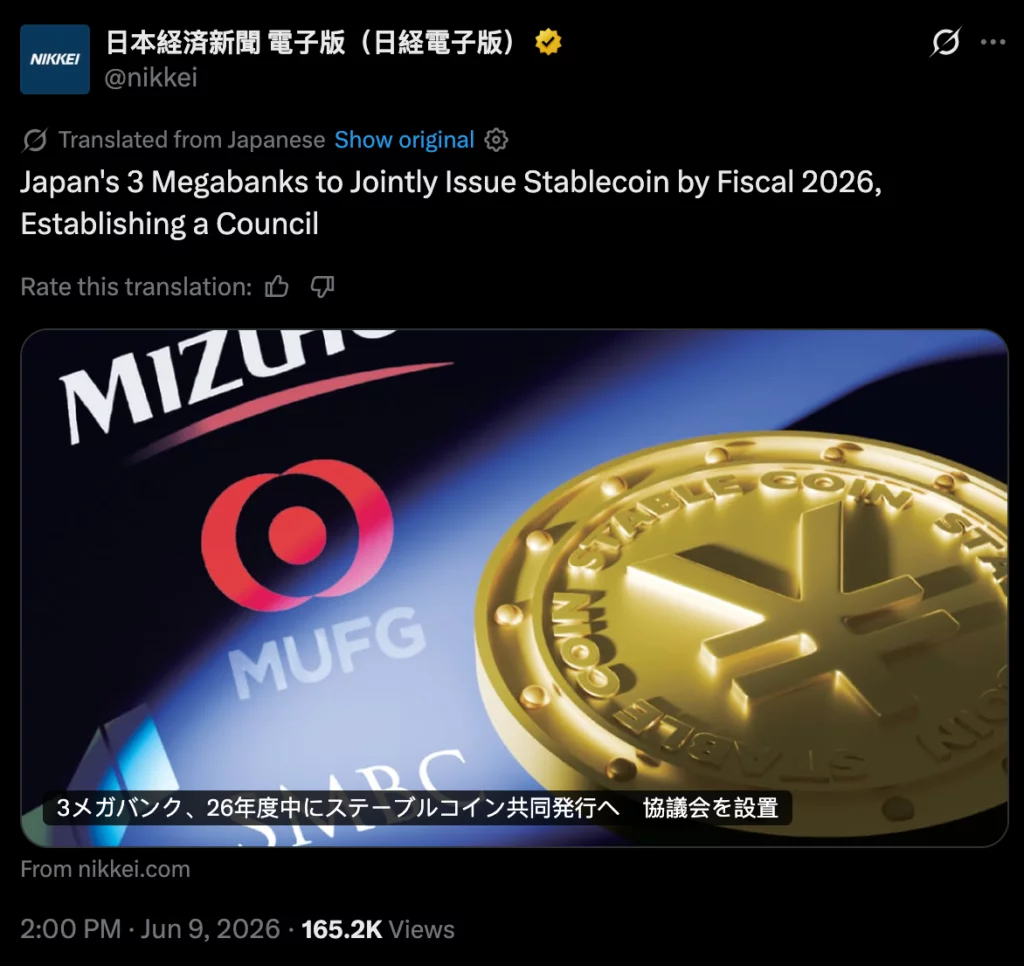
MUFG Bank, Sumitomo Mitsui Banking Corporation and Mizuho Bank plan to start live transactions with a jointly issued stablecoin during fiscal year 2026. Japan’s fiscal year ends in March 2027.
Summary
- Japan’s three megabanks target live stablecoin transactions within fiscal 2026 under a shared banking framework.
- A new council will examine issuance infrastructure, governance, operating rules, systems and future bank participation.
- The FSA-backed pilot tested corporate cross-border payments through a trust structure using Progmat’s blockchain infrastructure.
The banks signed a memorandum to create a voluntary council that will prepare the operating and governance framework. The project follows a regulatory pilot supported by Japan’s Financial Services Agency.
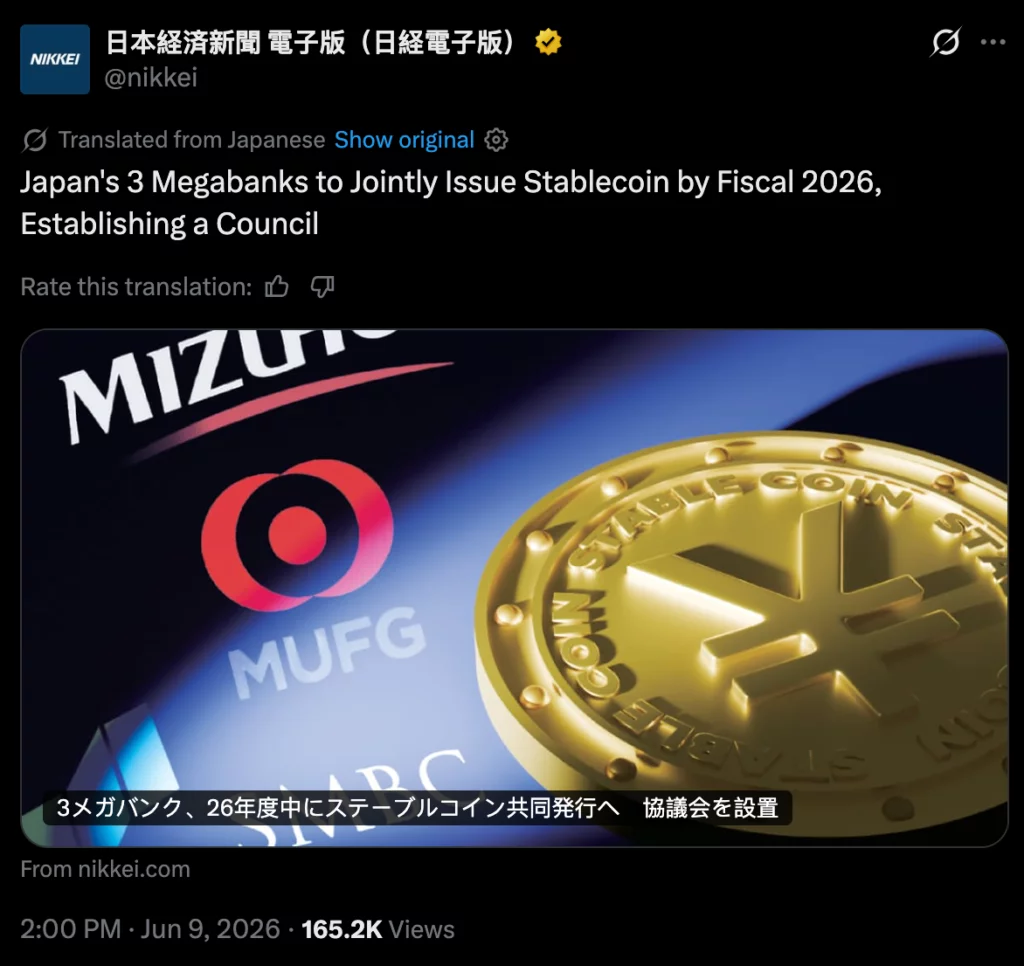
Three banks prepare joint stablecoin transactions
The banks will issue the stablecoin through a trust agreement. They will act as joint settlors, while a trust bank or a similar institution will serve as trustee.
The structure aims to let the banks share one issuance framework instead of developing separate tokens. The official statement did not provide the token’s issue size, blockchain network, retail access terms or precise rollout date.
“The three banks will accelerate their initiatives,” the joint statement said.
In addition, the council will examine issuance infrastructure, system design, governance and operating processes. It will also review Japanese laws and market conditions before live transactions begin.
MUFG, SMBC and Mizuho will establish the council first. The group may later work with other financial institutions and related companies that want to join the stablecoin framework.
The banks aim to support several payment uses rather than one limited test. However, they have not named the first commercial users or confirmed whether initial transactions will focus only on corporate payments.
FSA-backed pilot tested cross-border payments
The FSA supported the proof-of-concept in November 2025. The pilot examined joint stablecoin issuance and cross-border payments involving Mitsubishi Corporation’s Japanese and overseas offices.
Mitsubishi UFJ Trust and Banking Corporation handled the planned trust-based issuance structure. Progmat supplied the blockchain infrastructure, while the three banks developed requirements and assessment standards.
The pilot also reviewed legal compliance and user protection. Japan’s Payment Services Act allows stablecoins to operate as regulated electronic payment instruments when issuers meet the required structure and reserve rules.
Japan expands its yen stablecoin market
The joint bank project enters a market that already includes other regulated yen token plans. JPYC launched a yen-backed stablecoin in October 2025, while SBI Holdings and Startale have also prepared an institutional yen stablecoin.
Japan’s ruling Liberal Democratic Party has called for broader use of yen stablecoins, tokenized deposits and round-the-clock settlement. The plan also supports clearer rules for tax payments, wages and corporate uses.
The three-bank project could add a shared settlement route for major corporate clients. Its progress will depend on the council’s final design, regulatory review and connections with existing payment systems.


Anthropic released Claude Fable 5 on Tuesday, its most capable public model running on Mythos, as it pursues a fall listing it has already filed for confidentially alongside OpenAI, which filed Monday, and SpaceX.
Mythos is Anthropic’s most advanced tier of artificial intelligence models, and Fable is the first publicly released version of this powerful underlying architecture but it comes with strict built-in safety filters.
Bitcoin has spent the past week trading as the high-beta arm of the Nasdaq, sliding with chipmakers and Asian tech as the AI trade unwound. An Anthropic listing, after its $65 billion round at a $965 billion valuation, would hand index funds and retail traders a single AI-lab stock to pile into. Crypto already moves with the AI trade, and giving that trade its own ticker only tightens its grip.
AI-linked tokens caught a modest bid on Fable’s launch while bitcoin barely moved, because model releases are narrative for the sector’s small caps while the majors now trade on what the AI trade does to risk appetite, not on the models themselves.
Ripple has joined Water.org’s Get Blue campaign as its exclusive digital asset and payments partner.
Summary
- Ripple joins Get Blue as exclusive digital asset and payments partner supporting Water.org’s lending model.
- RLUSD will help Water.org move funds faster to microfinance partners serving families across emerging markets.
- Get Blue combines corporate donations with affordable loans for household water and sanitation improvements worldwide.
The blockchain company will provide seed funding and support fund transfers to local finance partners in emerging markets.
Water.org says more than two billion people lack safe water at home. The nonprofit, co-founded by actor Matt Damon and engineer Gary White, uses small loans to help families pay for water and sanitation systems.
Ripple brings RLUSD into the Get Blue campaign
Ripple said Water.org will use its U.S. dollar-backed RLUSD stablecoin to move funds to microfinance partners. Those organizations provide affordable financing for household pipes, pumps, toilets and other basic water systems.
The arrangement builds on Ripple’s existing support for Water.org through Ripple Payments. Water.org says the platform can reduce costs and shorten transfer times when sending capital to partners across different markets.
“We’re proud to join Water.org in support of Get Blue,” Ripple said.
Get Blue named Ripple alongside Amazon, Gap, Starbucks, Ecolab, AccuWeather and TikTok. The campaign first appeared at the World Economic Forum in January and is now moving into a wider consumer rollout.
Ripple-backed WaterCredit turns donations into affordable household loans
Get Blue directs corporate funding and consumer donations into Water.org’s WaterCredit model. Local financial institutions then provide small loans that families use to install safe water or sanitation services at home.
Water.org reports a 98% repayment rate for WaterCredit loans. Repaid funds can support more borrowers, allowing the same pool of capital to finance additional household projects over time.
“When brands join us, they invite their communities into this work,” Water.org CEO Gary White said.
The wider campaign links donations to everyday purchases and services. Gap contributes $5 from each item in its Get Blue collection. Starbucks will donate $0.25 from selected drinks between June 16 and July 7.
RLUSD expands beyond trading and settlement
Ripple launched RLUSD as a stablecoin backed by U.S. dollar deposits, short-term Treasuries and cash equivalents. It operates on the XRP Ledger and Ethereum and supports payments, settlement and other blockchain transactions.
The Water.org partnership adds another humanitarian use for the token. Ripple previously used RLUSD in a drought insurance pilot for pastoral communities in Kenya and committed $25 million to education groups in the U.S.
As crypto.news reported, the education funding supported DonorsChoose and Teach For America. Separate reporting covered RLUSD’s African expansion through Chipper Cash, VALR and Yellow Card for payments and treasury services.
The Get Blue partnership does not disclose how much RLUSD Water.org will receive or which countries will receive the first transfers. Ripple and Water.org have also not published transaction volumes or named the first microfinance recipients.
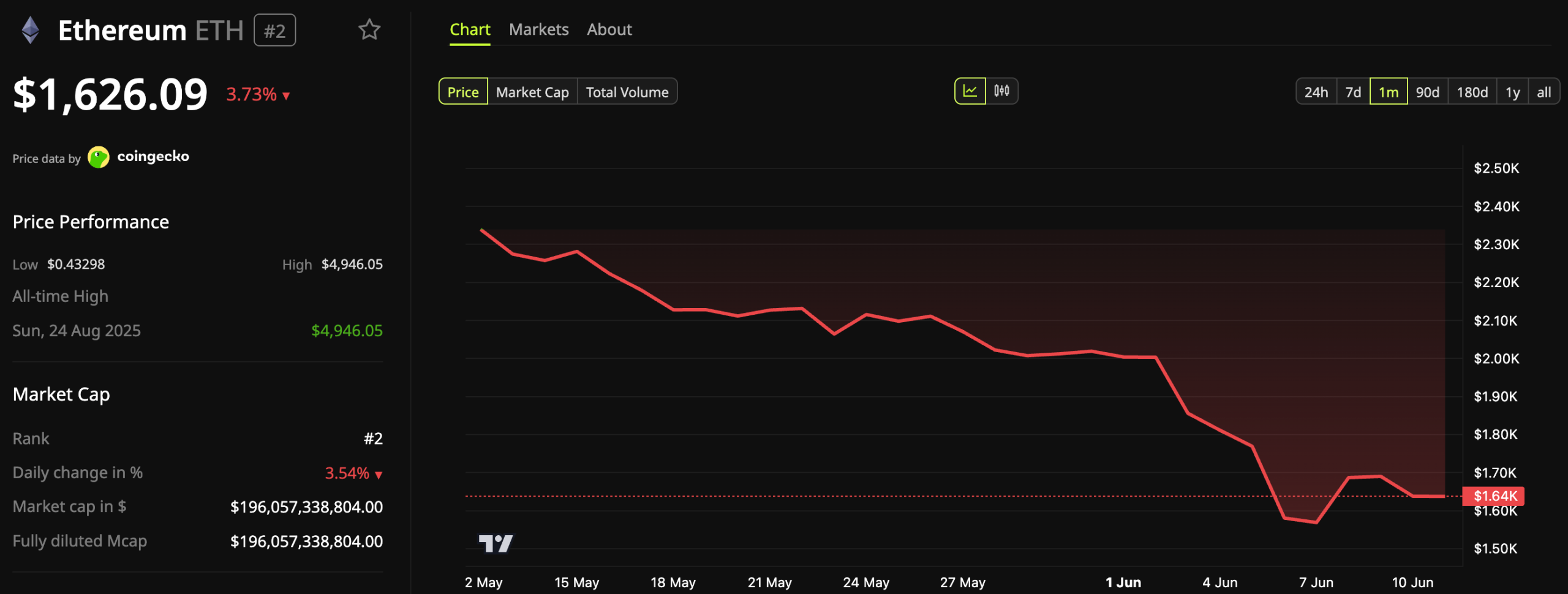
Ethereum (ETH) social sentiment has collapsed into an extreme fear zone as price continues to slip, down 12% over the past week. Bearish posts now dominate social media as the token trades near $1,626.

Santiment data shows the ratio of positive to negative commentary at one of its lowest levels this year. However, the firm suggested this is “where markets become most dangerous for bears.”
Ethereum Fear Reaches the Zone Where Bears Usually Get Trapped
Santiment reported that traders have largely written off Ethereum after months of underperformance against Bitcoin (BTC) and other large-cap assets.
The cryptocurrency re-entered the extreme fear zone on June 9, with the positive-to-negative commentary ratio near 1.09. The firm noted that this zone has historically acted as a buy signal.
Follow us on X to get the latest news as it happens

The contrast with April is stark. On April 22, the crowd flashed extreme greed with Ethereum above $2,400, which Santiment flagged as an ideal sell point. The token has since lost roughly 32% of its value.
“Historically, Ethereum has tended to rebound when social sentiment reaches extreme FUD levels because prices frequently move opposite to the crowd’s expectations. When traders become overwhelmingly convinced that an asset will continue falling, much of the selling pressure has already been exhausted,” the post read.
Sentiment is not the only flag. Trader Ash Crypto also pointed to another key signal. He compared the current breakdown to June 2022, when ETH collapsed before staging a reversal.
“Back in June 2022, ETH broke through every support level and crashed to $880. Everyone gave up on it. That turned out to be the exact bottom of the whole bear market,” he said.
He argued the current drop mirrors June 2022, sharing the same timing, breakdown, and chart structure. After peaking at $4,953 in August 2025, ETH has fallen sharply.
The price has broken below its weekly 200-day moving average at $2,471, leaving $1,500 as the next support to watch.
“Two ways this plays out: If ETH holds $1,500, this could play out exactly like June 2022. The people who bought that bottom made 5x over the next 18 months. If ETH falls below $1,500 on a weekly close, the next support is all the way down near $1,000. Nothing to stop the fall in between,” the analyst added.
ETF Outflows and Oversold Signals Cloud the Rebound Case
Despite these signals, ETH still faces real obstacles. Institutional demand remains weak. SoSoValue data shows ETH spot ETFs have logged outflows for 4 straight weeks, a sign that large investors are still pulling back.
Until those flows turn positive and hold, any rebound risks fade back into the wider downtrend.
Meanwhile, analyst Ardi warned that in prior bear markets, Ethereum bottoms formed after the weekly Relative Strength Index (RSI) broke below 30.
“Each time it spent consecutive weeks there, it marked quite literally the exact bottom of the cycle,” the analyst mentioned.
In 2018, after ETH slipped into the territory, prices dropped 63% from $205 to $75. In 2022, ETH dropped 65% from $2,200 to $750.
Ardi noted that ETH has not yet reached oversold territory, with prices below $1,700. Major macro support sits only 15% lower, leaving little cushion.
“If there is a positive to find, it’s that ETH has spent more time in the lower half of the oscillator this cycle than any prior 4-year period. So there is a small possibility that ETH bottoms without RSI deeply breaking that support in the first place,” Ardi added.
The analyst also noted that ETH never staged a true breakout this cycle. As a result, the chart may not require the same violent correction. Even so, Ardi said ETH typically bottoms only when nobody wants to own it, which, in both prior bear markets, meant oversold conditions.
Subscribe to our YouTube channel to watch leaders and journalists provide expert insights
The post Ethereum Fear Hits 2026 Extreme as History Points to a Rebound appeared first on BeInCrypto.

Kraken has been named the official crypto exchange supporter of the FIFA World Cup 2026, giving the crypto exchange a presence at one of the world’s largest sporting events.
The company said Tuesday that the partnership will include fan activations and product experiences throughout the tournament.
The 2026 World Cup is expected to be the largest in FIFA history, with an expanded field of 48 teams and 104 matches across 16 host cities in the United States, Mexico and Canada. FIFA projects the competition will attract a cumulative global audience of more than 6 billion viewers during its seven-week run.
The partnership places Kraken alongside some of FIFA’s longest-standing corporate sponsors, including Adidas, Coca-Cola, Visa and Hyundai-Kia.
The agreement also expands Kraken’s sports sponsorship efforts, which already include partnerships with Tottenham Hotspur, Atlético de Madrid, RB Leipzig and Atlassian Williams Racing.
The tournament kicks off on June 11 in Mexico City, where Mexico is scheduled to face South Africa at Estadio Azteca.

Source: Kraken
Related: Kraken offers SpaceX IPO access through xStocks
Prediction markets expand their sports presence
The partnership comes four years after the 2022 “Crypto Bowl,” when Coinbase, FTX, Crypto.com and eToro aired advertisements during Super Bowl LVI. Sports marketing activity across the crypto industry slowed following the collapse of FTX later that year and the broader market downturn.
While some digital asset companies have returned to major sporting events, their approach has been more measured. Coinbase aired its first Super Bowl commercial since 2022 during this year’s broadcast, while Crypto.com used the event to launch its AI-focused platform, ai.com.
At the same time, prediction markets, where users buy and sell contracts tied to the likelihood of specific outcomes, have expanded their presence in professional sports.
In November 2025, Polymarket became the official prediction market partner of UFC and Zuffa Boxing under a multiyear agreement that brought prediction market data into live events and broadcasts.

Source: UFC
In January, the company signed a multiyear agreement with Major League Soccer to become the league’s exclusive prediction market partner for MLS and the Leagues Cup. Major League Baseball followed in March, naming Polymarket its official prediction market exchange while signing a separate integrity agreement with the US Commodity Futures Trading Commission.
FIFA’s commercial roster also includes ADI Predict, a blockchain-based prediction market platform backed by Abu Dhabi institutions.
Magazine: Korea probes Polymarket users, crypto PACs sweep primaries: Hodler’s Digest, May 31- June 6
AI company Anthropic on Tuesday released the first public version of its powerful Claude Mythos model, called Fable 5, with some crypto users worried it could be used for malicious purposes, despite embedded guardrails.
Anthropic said last month that its Mythos model uncovered more than 10,000 high or critical-severity vulnerabilities in “systemically important software,” leading many to question if it should be publicly released.
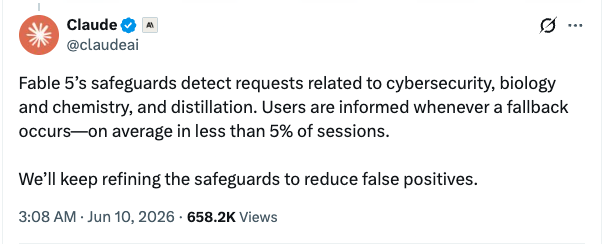
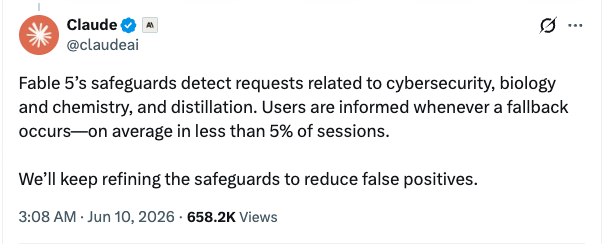
This was despite the company saying on Tuesday that Fable 5 was “made safe for general use,” and has safeguards that reroute some topics, such as cybersecurity, to a different model, Claude Opus 4.8
“Releasing a model this capable comes with risks. Without safeguards, Fable 5’s capabilities in areas like cybersecurity could be misused to cause serious damage,” it said.
Source: Claude
The guardrails have done little to reassure crypto users, with AI increasingly being used to attack crypto platforms. In April, the value of crypto stolen in hacks hit $629.7 million, the highest since February 2025, which analysts linked to the use of the technology.
Mythos release sparks warnings from crypto users
Simon Dedic, founder of the venture firm Moonrock Capital, posted to X on Tuesday that with Fable 5, the “cost and skill required to find exploitable flaws in smart contracts is about to drop to basically zero.”
“For DeFi, this should be a massive wake-up call. Unaudited protocols will become sitting ducks. Known exploits will get replayed on forks around the clock. Even small projects will get targeted simply because trying costs next to nothing now,” he added.
Related: AI agents with crypto could escape and become ‘unstoppable,’ experts warn
Dedic repeated calls online, suggesting that crypto users should protect themselves from the model, including revoking wallet approvals, removing as much value from protocols as possible and moving crypto to fresh hardware wallets.
Curve Finance co-founder Michael Egorov, however, said that the threat Claude Mythos posed to crypto was likely overblown as its success in finding bugs in other software might not translate to funding smart contract vulnerabilities in DeFi.
In May, Anthropic said Claude Mythos found thousands of critical vulnerabilities in important software through Project Glasswing. For open-source projects, which are central to how crypto protocols are managed, Mythos found around 6,200 high or critical-severity vulnerabilities in more than 1,000 projects it investigated.
Egorov argued that the software Mythos found vulnerabilities in had millions of lines of code, while smart contracts have a few thousand, “and both humans and ‘usual’ AI perfectly fit that code in context and can reason well about it.”
“I suspect we might not be having a wave of DeFi code hacks, but we may see a lot of things in OpSec [operational security] getting hacked (looking like multisig keys compromises) and supply chain attacks on frontend dependencies, and those are way less dangerous in true DeFi,” he said.
Meanwhile, Anthropic said a “small group” of cybersecurity and infrastructure providers would get access to Claude Mythos 5, the same model as Fable 5 but with safeguards lifted in some areas.
Magazine: AI-driven hacks could kill DeFi — unless projects act now


Bitcoin’s bounce off last week’s lows is rolling over, and gold is going down with it.
BTC changed hands at $61,233 on Wednesday, down 3% over 24 hours and 6.9% on the week, while gold fell 2% to below $4,200 an ounce. The market is betting on higher interest rates punishes anything that doesn’t pay one, and that is weighing on crypto and gold markets at once.
Ether fell 3.4% to $1,625 and solana dropped 4.1% to $64.24, according to CoinDesk data. XRP lost 4.3% to $1.12, while BNB and dogecoin each slid less than 3%. Hyperliquid’s HYPE was the worst of the majors again, down 10.2% on the day and 21.3% on the week to $55.52, the highest-beta name in the group as risk came off.
South Korea’s Kospi, the market most exposed to the artificial-intelligence trade through its chipmakers, tumbled 6.3%, leading a 2.5% drop in MSCI’s broad Asia-Pacific equity gauge and its fourth loss in five days. Nasdaq 100 futures pointed 0.8% lower after a volatile Wall Street session. Brent crude traded near $92 a barrel as renewed US strikes on Iran kept a bid under oil, and the 10-year Treasury yield rose to 4.54%.
Gold and bitcoin rarely fall in lockstep, as both are stores of value that pay no yield, so both lose their appeal when traders bet on higher rates, and that is what Wednesday’s US inflation report could force.
A hot reading would harden the case for new Federal Reserve Chair Kevin Warsh to keep rates higher for longer, draining liquidity from the assets that ran hardest on cheap money.
The bounce that ran into Monday was a short squeeze, not fresh buying, as over $500 million in bearish bets were liquidated in the highest such figures since April.
Some market watchers say spot demand never showed up behind it.
“Buyers have stepped in after the move lower, but spot demand has yet to return in a meaningful way,” said Diana Pires, chief business officer at sFOX, pointing to a run of US spot bitcoin ETF outflows that has kept institutional money cautious. When new demand isn’t broad enough to cover the selling, she said, rallies struggle to hold.
Watch whether bitcoin can hold a bid through the inflation print or keeps trading tick for tick with the Nasdaq. If gold steadies and bitcoin keeps falling, the case for it as a macro hedge thins further.

U.S.-based cybersecurity giant CrowdStrike warned Tuesday of increasing cyberattacks from China-based entities aimed at stealing artificial intelligence to narrow the tech gap with the U.S.
The Chinese entities accounted for more than 58% of state-sponsored targeted cyberattacks aimed at tech companies, especially their AI assets, CrowdStrike said in a report.
“China-nexus adversaries are escalating espionage against technology organizations to steal the AI capabilities and intellectual property they cannot build fast enough on their own,” CrowdStrike said in a statement.
The analysis covered events over the 12 months to March 31. U.S. restrictions on China’s access to AI training chips have restricted Beijing’s tech development, although homegrown AI models have sought to slash operating costs while offering nearly similar intelligence.
Chinese-affiliated cyberattacks targeted government communications in Southeast Asia and “maintained persistent access” to North American tech organizations by taking advantage of vulnerabilities, CrowdStrike said.
The Cyberspace Administration of China did not immediately respond to CNBC’s faxed request for comment.
Earlier this year, U.S. AI giants Anthropic and OpenAI complained that Chinese companies extracted competitive intelligence from the American tech companies. Analysts at the time cautioned that the boundaries of illicit behavior could be blurry.
Over the last several weeks, Anthropic has touted the cyber capabilities of its newest Mythos model and rolled out the tech to CrowdStrike and other companies. Anthropic on Tuesday released a public version of the model, called Claude Fable 5, which rankings firm Artificial Analysis said is “nearly 5 points ahead of any other lab’s best model.”
CrowdStrike said it also found North Korea-affiliated entities tried to infiltrate IT workforces across North America, Europe and Asia, primarily to generate revenue for the regime.
XRP Whale Inflows to Binance Decline as Selling Pressure Shows Signs of Easing

Disney Already Canceled The Movie That Could Have Saved Star Wars

Financial Instruments Revision | All Concepts + Imp Ques | CA Final FR Revision | CA Aakash Kandoi

HarrisX Poll Found 52% of Registered Voters Support the CLARITY Act

BloFin War of Whales 2026 Grand Prix opens registration for $5M trading championship

Blockchain.com files with SEC for U.S. IPO
Financial Instruments Revision | All Concepts + Imp Ques | CA Final FR Revision | CA Aakash Kandoi

The Rent vs Buy Truth Nobody Wants to Hear #shorts #realestate #money

Financial Means kya hota hai, C- #english #financial #finance #viral #englishvocabulary #dailyword
-

 Fashion5 days ago
Weekend Open Thread: Evereve – Corporette.com
-
 Crypto World5 days ago
Jensen Huang Approves Samsung, SK Hynix, and Micron for NVIDIA (NVDA) HBM4 Memory Supply
-

 Crypto World2 days ago
Anatomy of the June crypto crash: Fed, Iran, Saylor
-
 Entertainment3 days ago
The Best Mystery Series of All Time Is Surging on Streaming 30 Years After It Ended
-

 NewsBeat2 days ago
Alexander Zverev wins the French Open to finally earn a 1st Grand Slam title
-
Crypto World3 days ago
Senator Cynthia Lummis Calls CLARITY Act the Most Consequential Financial Legislation of This Generation
-

 Tech5 days ago
Microsoft launches MXC, an OS-level sandbox for AI agents, with OpenAI and Nvidia already on board
-

 Tech4 days ago
Suspicious Polyfill login prompts pop up on Toshiba, Muji websites
-

 Tech3 days ago
Microsoft unveils seven homegrown AI models in new bid for ‘long term self-sufficiency’
-
 Business3 days ago
The Pain Points Taking a Fragile Tech Rally Down a Notch
-
Crypto World5 days ago
LBank Surpasses 25 Million Users Worldwide as AFA Partnership Continues to Drive Global Growth
-

 Business5 days ago
(VIDEO) Justin Bieber Delivers Surprise Happy Birthday Serenade to Diners at Los Angeles Mexican Restaurant
-

 Crypto World3 days ago
Trump’s AI Ownership Plan Could Benefit Anthropic at OpenAI’s Expense
-
 Sports14 hours ago
Bangladesh beat Australia after 20 years in ODIs, register only their second win over six-time world champions | Cricket News
-

 Tech5 days ago
Meta steals a tactic from Tesla and builds data centers in tents
-

 Tech5 days ago
RCS Messages Between iPhone and Android Get End-to-End Encryption With iOS 26.5
-
 Crypto World2 days ago
Eli Lilly (LLY) Stock Surges 4% Following Breakthrough Sleep Apnea Trial Results
-

 Tech4 days ago
Von der Leyen’s AI envoy pick draws conflict-of-interest fire
-

 Tech4 days ago
Hackers now exploit SolarWinds Serv-U flaw to crash servers
-

 Tech2 days ago
Notion restores access to Anthropic after service disruption
You must be logged in to post a comment Login