
Crypto World
MicroStrategy CEO Says Jamie Dimon Is a Bitcoiner Behind the Scenes

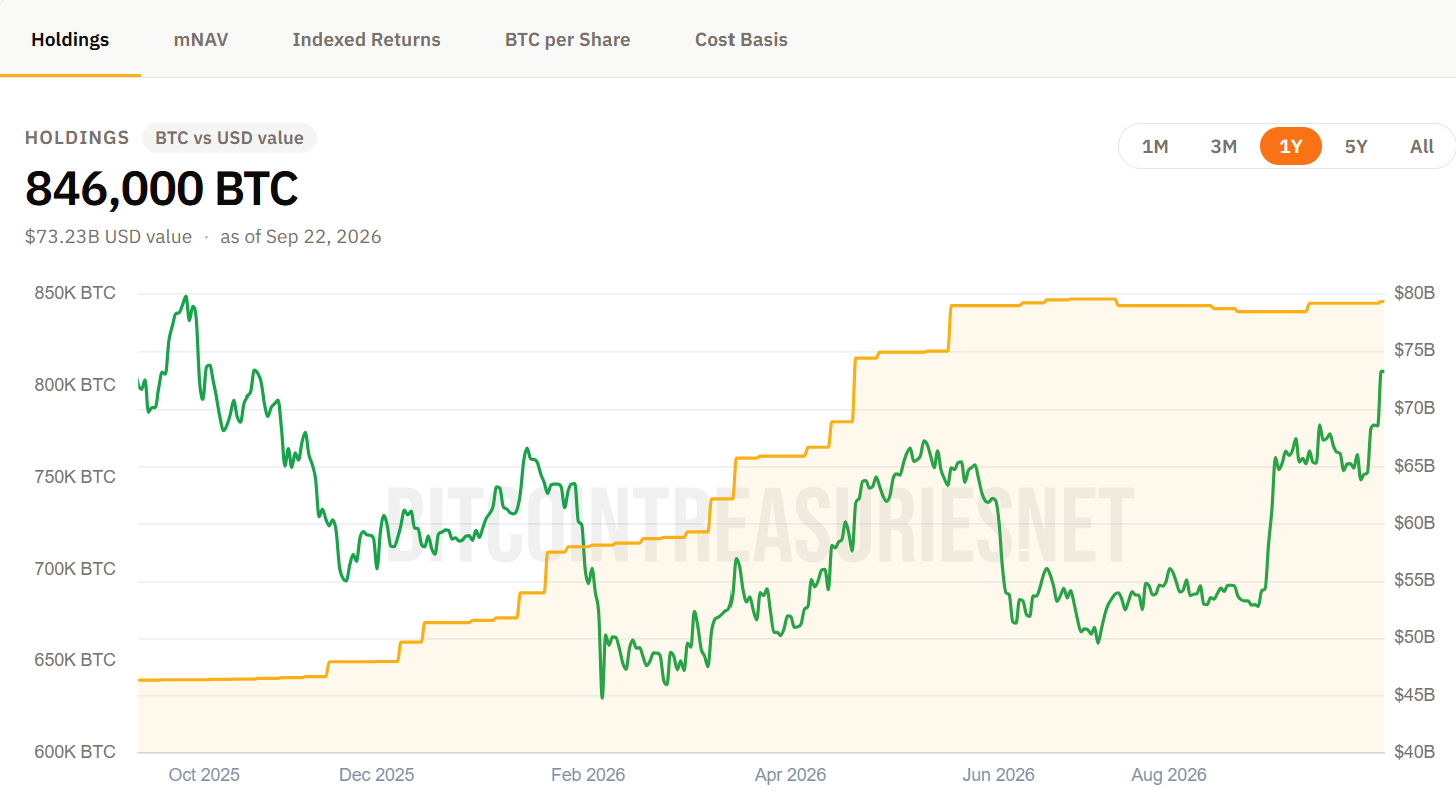
Strategy CEO Phong Le says JPMorgan chief Jamie Dimon privately supports Bitcoin, despite years of public attacks on it. Le made the half-joking claim on Natalie Brunell’s Coin Stories podcast.
Strategy, formerly MicroStrategy, is a US software firm that became the biggest corporate owner of Bitcoin (BTC). The company holds about 846,000 coins, roughly 4% of all Bitcoin in existence.

Why Phong Le Calls Jamie Dimon a Bitcoin Believer
Brunell asked what Dimon would think of MicroStrategy’s goal to become the “JPMorgan of Bitcoin.” Le laughed before answering.
“I think Jamie Dimon is a Bitcoiner behind the scenes, but he’ll say what he needs to say externally. I think everyone is a Bitcoiner privately once they learn and understand Bitcoin,” he said.
Le said he does not want MicroStrategy to become a bank. Instead, he wants it at the center of Bitcoin-based finance, building and selling investment products the way JPMorgan does on Wall Street.
He also pushed back on the idea that Bitcoin will replace banks. In his view, it will improve the current system, and the US dollar will stay. Le added that Bitcoin and artificial intelligence (AI) are the two most important technologies of this century.
What Jamie Dimon Has Said About Bitcoin
Dimon’s public record points the other way. In 2024, he dismissed Bitcoin as a “pet rock” that does nothing.
In January 2025, he compared buying Bitcoin to smoking, saying people have the right but should not.
“We are going to have some kind of digital currency at some point. I’m not against crypto. You know, Bitcoin itself has no intrinsic value. It’s used heavily by sex traffickers, money launderers, ransomware…I just don’t feel great about Bitcoin. I applaud your ability to wanna buy or sell it. Just like I think you have the right to smoke, but I don’t think you should smoke,” Dimon said in the interview.
Yet his bank has moved closer to crypto. In October 2025, JPMorgan said institutional clients could use Bitcoin as collateral for loans, with third-party firms holding the coins.
In the same way, JPMorgan has been involved in the cryptocurrency space. The financial giant currently holds a substantial position in Bitcoin ETFs, reflecting the firm’s interest in digital assets. Its investments in crypto ETFs suggest that the bank recognizes the potential of digital assets.
Donald Trump suggested in July last year that Jamie Dimon has softened his earlier harsh stance on Bitcoin. Trump also briefly supported Dimon for Treasury Secretary.
“Jamie Dimon was, you know, very negative and now all of a sudden he’s changed his tune a little bit,” Trump said.
However, Dimon’s most recent comments indicate he remains critical of Bitcoin, despite Trump’s suggestion of a shift in his views.
Dimon still fights crypto firms that act like banks. In May 2026, he said US banks would fight the CLARITY Act, a bill setting rules for US crypto markets. His objection centers on rewards paid to holders of stablecoins, digital tokens pegged to the dollar.
Brunell closed the exchange by citing MicroStrategy co-founder Michael Saylor’s view that everyone is against Bitcoin before they are for it.
The post MicroStrategy CEO Says Jamie Dimon Is a Bitcoiner Behind the Scenes appeared first on BeInCrypto.

Bitcoin has climbed above $86,000 and briefly touched $87,000 as analysts linked the breakout to falling oil prices, lower Treasury yields, a short squeeze and returning U.S. spot ETF demand.
Summary
- Bitcoin broke through $82,000 before reaching $87,000, its highest level since late January.
- U.S. spot Bitcoin ETFs drew $433 million on Friday after heavy withdrawals earlier in the week.
- HashKey’s Tim Sun said ETF inflows confirmed the rally rather than starting it.
- Xapo’s Gadi Chait identified the Sep. 24 Trump-Xi meeting as the next market test.
Bitcoin’s $82K breakout forced short sellers to cover
HashKey Group Senior Researcher Tim Sun told crypto.news that short-term ETF flows tend to move with Bitcoin’s price rather than predict its next direction. In his view, the latest inflows show that institutional investors have increased their buying after the rally was already underway.
“Short-term ETF capital flows are primarily coincident indicators rather than leading indicators,” Sun said. “Therefore, massive capital inflows simply reflect an ongoing upward trend, signaling that institutional funds are accelerating their market entry.”
Bitcoin traded above $86,000 on Monday and briefly reached $87,000, according to Gadi Chait, investment manager at Xapo Bank. The move took the asset to a level last seen in late January, though it remained about 31% below the record high of $126,200 reached in October.
The advance followed a sharp recovery from last week’s low near $75,560. Bitcoin first regained $78,000 and $80,000 before clearing the $82,000 resistance area, which had blocked several earlier attempts to move higher.
Breaking that level triggered forced buying among traders who had bet on a decline, Sun said. Short sellers must purchase Bitcoin to close leveraged positions when the price moves against them, adding demand during a fast rally.
Sun said the resulting squeeze increased Bitcoin’s “price elasticity,” allowing each new round of buying to produce a larger move. ETF demand then entered after the breakout, providing what he described as confirmation that an upward trend had formed.
Earlier market coverage found that Bitcoin had already moved past $85,000 as renewed U.S. buying and short covering brought $87,000 and $90,000 into focus. Nansen Senior Research Analyst Nicolai Sondergaard said at the time that the advance appeared to combine renewed ETF demand with a large short squeeze, while some of Hyperliquid’s biggest Bitcoin traders remained net short.
ETF inflows arrived after Bitcoin gained momentum
U.S. spot Bitcoin ETFs recorded $433 million in net inflows on Friday, reversing much of the pressure created by withdrawals earlier in the week. The funds ended the five-session period with a modest net inflow of about $6.1 million.
Fidelity’s FBTC led Friday’s recovery with roughly $310.7 million, while BlackRock’s IBIT took in about $108.4 million. The late-week buying allowed Bitcoin products to finish in positive territory even as U.S. spot crypto exchange-traded products collectively lost about $70.7 million because of withdrawals from Ether funds.
As ETF flow data showed, Ether funds posted approximately $140.6 million in weekly net outflows, while Solana products attracted $60.7 million. Hyperliquid products added another $3.1 million across the week.
Sun said the sequence matters because Bitcoin first responded to improving economic conditions, then cleared resistance and forced bearish positions out of the market. ETF inflows increased only after those price moves had taken place.
Under his interpretation, institutional funds did not create the first leg of the rally. Their return showed that regulated investment products were joining a move that had already gained support from macro conditions and derivatives activity.
Chait also pointed to the change in weekly price structure. Bitcoin closed above its 50-week moving average for the first time in 45 weeks, he said, adding a longer-term technical signal to the breakout through $82,000.
“The tape has read relatively well: spot ETF flows turned positive late last week after heavy mid-week outflows, and Bitcoin closed the week above its 50-week moving average for the first time in 45 weeks,” Chait said.
Lower oil and Treasury yields supported Bitcoin
Easing tensions involving Iran helped crude oil prices fall, according to Sun, while long-term U.S. Treasury yields declined soon afterward. He said the combination reduced concerns that energy costs would keep inflation elevated and force the Federal Reserve to tighten policy more aggressively.
Positive expectations for U.S.-China trade negotiations also reduced the market’s assessment of trade-war risk, Sun added. With investors less concerned about oil-driven inflation and tariffs, demand returned to risk assets and helped Bitcoin challenge its former resistance levels.
The rally came days after the Federal Reserve raised interest rates by 25 basis points, lifting the federal funds target range to 3.75%–4%. All 12 voting members backed the decision, while 16 of 18 officials projected at least one more increase during 2026.
Bitcoin traded near $76,000 around the Fed decision before recovering later in the week. Sun said the negative effect of the rate increase had already passed through the market, allowing traders to focus on lower oil prices, falling yields and the chances of progress in trade talks.
Chait said the rebound was encouraging because it followed two policy setbacks for risk assets. The Senate failed to advance the CLARITY Act on Sep. 15, and the Fed delivered its quarter-point increase one day later.
The Senate motion received 50 votes in favor and 49 against, leaving it 10 votes short of the 60 required to begin debate. The failed procedural vote stalled a bill designed to divide oversight of digital assets between the SEC and CFTC.
U.S. regulators moved ahead after the Senate vote
Two days after the CLARITY vote, the SEC issued a five-year Innovation Exemption for eligible tokenized securities activity. The order allows qualifying venues to trade tokenized U.S. stocks through permissioned automated market makers and liquidity pools, subject to conditions covering shareholder rights, trading limits and market halts.
The CFTC separately sent a proposed crypto market framework to the White House for review. Chait interpreted the two actions as evidence that U.S. regulators intended to continue developing digital-asset rules without waiting for Congress.
A CFTC framework report said the proposal reached the White House Office of Information and Regulatory Affairs after the SEC released its long-awaited exemption on Sep. 17. The review forms part of the federal rulemaking process and does not itself make the CFTC proposal effective.
For American investors, the combination of returning spot ETF demand and agency action provided two separate channels of market support. ETFs offer regulated Bitcoin exposure through U.S.-listed products, while the SEC and CFTC measures concern the rules under which digital-asset and tokenized-security markets may operate.
Chait still identified oil and monetary policy as risks to the advance. Renewed conflict in the Middle East could push crude prices higher again, he said, while another Fed increase could raise Treasury yields and reduce demand for non-yielding assets such as Bitcoin.
Market attention has also turned to the scheduled Sep. 24 meeting between U.S. President Donald Trump and Chinese President Xi Jinping. Chait described the meeting as the next test of whether Bitcoin’s rally can hold as traders assess the direction of U.S.-China trade relations.

Pi Network has cleared a KYC barrier for more than 417,000 users and prepared a wallet fix for another 497,000 accounts that could not claim migrated PI balances.
Summary
- More than 417,000 users can resume KYC after Pi removed possible duplicate-account flags.
- Around 497,000 Fast-Track wallets could not claim PI because they lacked gas funds.
- Yoti and Indonesian KIA applicants have received new options to resubmit their identity documents.
- Protocol V27 has moved to Testnet 2 after handling about 250 transactions per block.
Pi Network has reopened KYC for 417,000 users
Pi Core Team said in an update that it refined the checks applied to accounts previously flagged as possible duplicates, allowing more than 417,000 Pioneers identified as separate users to continue the Know Your Customer process.
Removing the duplicate-account flag does not mean each affected user has passed KYC. Applicants must still complete any remaining identity checks and satisfy the other conditions listed in the Mainnet Checklist before Pi can move their transferable balances to the live network.
The update addresses one part of a long-running migration problem. A Sep. 9 report on Pi’s Mainnet migration gap found that about 16.6 million of the network’s claimed 60 million engaged Pioneers had completed migration. That represented a conversion rate of 27.6% at the time, with KYC approval, wallet setup, and user confirmation among the required steps.
Using those figures as context, the 417,000 newly eligible applicants represent roughly 2.5% of the previously reported migrated-user count. Their access to Mainnet will still depend on whether they complete all outstanding checks and migration steps.
Pi also reviewed applications from people who completed identity verification through Yoti, a third-party identity service used during an earlier stage of the network’s KYC program. Some of the old applications lacked the liveness information now required by Pi, leaving users unable to progress.
Following the review, affected Yoti applicants can submit a new application through Pi’s native KYC system. Users should check the KYC app for a resubmission option rather than assuming an earlier Yoti approval automatically meets the current requirements.
Indonesian applicants rejected after uploading a KIA, or child identity card, have received a similar route forward. Pi said they can resubmit their details with another accepted identification document.
A gas-fee fix will cover 497,000 Fast-Track wallets
Separate from the KYC cases, approximately 497,000 users received Mainnet wallets through Pi’s Fast-Track migration process but could not claim their migrated tokens.
Pi attributed the failures to a lack of PI in the newly allocated wallets. Although the users had balances waiting to be claimed, their wallets did not contain enough available PI to cover the network gas fee needed to complete the transaction.
The Core Team plans to deploy a technical fix within one week of the announcement. According to the project, the change will restore access for the affected accounts and prevent the same gas-fee problem from blocking future Fast-Track migrations.
Users whose claims previously failed for insufficient gas can also try the claim process again. Pi advised Pioneers to open the wallet or migration interface and check whether their balance is now available rather than creating another wallet or repeating unrelated KYC steps.
KYC approval and balance migration serve different functions within Pi’s system. Identity verification confirms that an account belongs to an eligible person, while migration transfers the user’s approved balance from the mobile application’s internal records to a Mainnet wallet. A user can therefore pass KYC but still face a separate wallet, checklist, or transaction problem.
Earlier reporting on Pi’s first Open Mainnet year identified migration delays as one of the network’s unresolved operating issues after the firewall opened in February 2025. The report also noted that PI reached a post-listing peak of $2.99 before falling toward $0.15 by May 2026.
For users in the United States, the latest update changes access only for accounts affected by Pi’s internal KYC and wallet processes. The announcement did not describe a separate procedure for U.S. Pioneers or announce a change to PI’s availability through American trading platforms.
Pi Network has expanded its identity-check tools
Alongside the account reviews, Pi has added support for liveness checks on older mobile devices. Liveness tests generally require an applicant to use a device camera to show that a real person is completing the verification, rather than relying only on an uploaded image.
Supporting older hardware could help users whose phones could not run the earlier version of the check. The Core Team asked applicants to complete a liveness test whenever the KYC app displays the request, as leaving the step unfinished can keep an application pending.
Pi has also started a pilot program for palm-print authentication. The project has not yet provided full public details on the pilot’s size, eligible regions, or whether palm verification could eventually replace any existing KYC step.
The network has already used a large validator pool to process identity applications. The Sep. 9 report said 1,094,680 human validators had completed more than 526 million verification tasks, although the total number of tasks does not represent the same number of approved users.
As crypto.news previously reported, Pi said in May that more than 18.1 million users had passed its native KYC checks and over 16.7 million Pioneers had migrated to Mainnet. The new duplicate-account review does not add 417,000 completed migrations to either total because each person must finish the remaining verification and checklist requirements first.
Protocol V27 testing has reached Testnet 2
While Pi works through the account issues, the network has advanced Protocol V27 testing from Testnet 1 to Testnet 2.
A September Protocol 27 report said deployment on Testnet 1 began on Aug. 21 after Pi completed Protocol 26. The earlier update linked Protocol V27 to smart-contract authentication, RPC infrastructure, and automated market maker liquidity pools.
Protocol 26 had required approximately 421,000 node operators to update their software by Aug. 11 or lose Mainnet connectivity. Pi described V27 as the final planned upgrade in its current development sequence, though later software patches and maintenance updates could still follow.
The earlier roadmap targeted Sep. 15 for a Mainnet deployment after testing across two test networks. Pi’s latest information instead shows V27 running on Testnet 2, indicating that the testing stage has continued beyond that previously reported target.
During the specified Testnet 2 period, Pi said the network processed about 250 transactions per block without a reported failure.


Canada’s six largest banks are jointly exploring a system for tokenized Canadian dollar deposits that would allow digital representations of bank deposits to move between financial institutions.
The initiative involves Bank of Montreal, CIBC, National Bank of Canada, Royal Bank of Canada, Scotiabank and TD Bank Group, according to a joint announcement from the banks on Tuesday. The first phase will focus on moving tokenized deposits between Canadian financial institutions before potentially connecting with other digital asset systems.
The project comes less than two weeks after Canada’s banking regulator provided additional clarity on the legal permissibility of tokenized deposits for financial institutions.
On Sept. 10, the Office of the Superintendent of Financial Institutions (OSFI) said tokenized deposits are “not legally distinct from traditional deposits,” adding that the underlying technology of a financial product does not determine its legal nature.
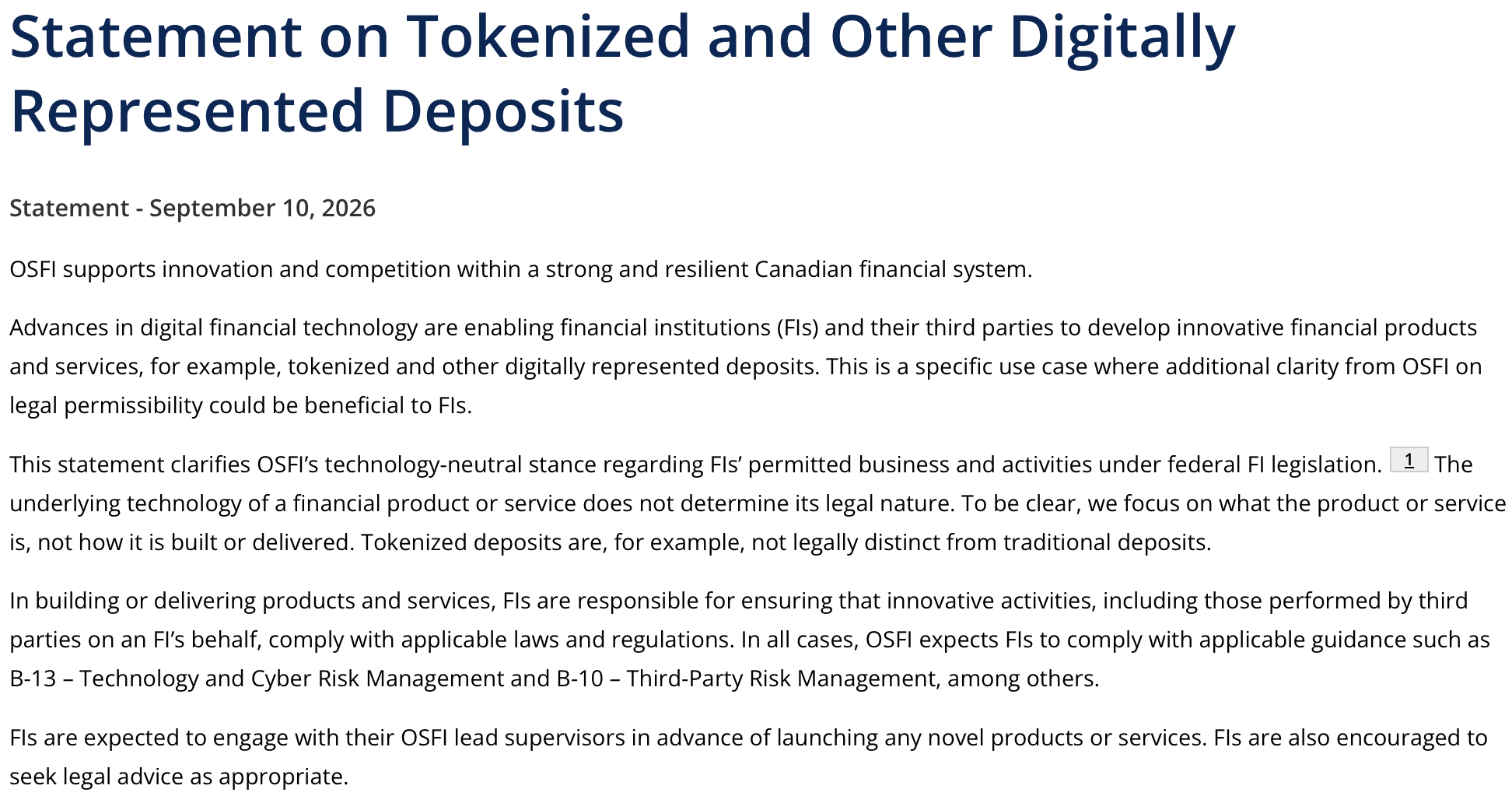
OSFI clarifies tokenized deposit rules. Source: Office of the Superintendent of Financial Institutions (OSFI)
Tokenized deposits represent money held at a regulated bank and remain a liability of that bank, unlike fiat-backed stablecoins, which are separate digital assets backed by reserves held by their issuer.
The banks said the system is intended to support faster and programmable payments, while longer-term plans include opening the initiative to other deposit-taking institutions. Cointelegraph contacted CIBC for additional details but did not receive an immediate response.
Related: Coinbase launches regulated crypto derivatives in Canada
Canada builds out stablecoin framework
The tokenized deposit initiative comes as Canada builds out a broader regulatory framework for digital money.
In March, Canada enacted its Stablecoin Act as part of Bill C-15, establishing a federal framework for fiat-backed stablecoins. Under the regime, non-financial institution issuers will be required to register with the Bank of Canada, maintain reserves of at least 1:1 in high-quality liquid assets and offer holders redemption at par. The framework is expected to take effect in 2027.
However, the framework only covers fiat-backed stablecoins issued by non-financial institutions. Banks and credit unions that are already subject to prudential regulation fall outside its scope. Issuers covered by the framework will also be prohibited from representing their stablecoins as deposits or as insured under a public deposit insurance system.
Magazine: Big Questions: Does Satoshi actually own 1.1 million Bitcoin?
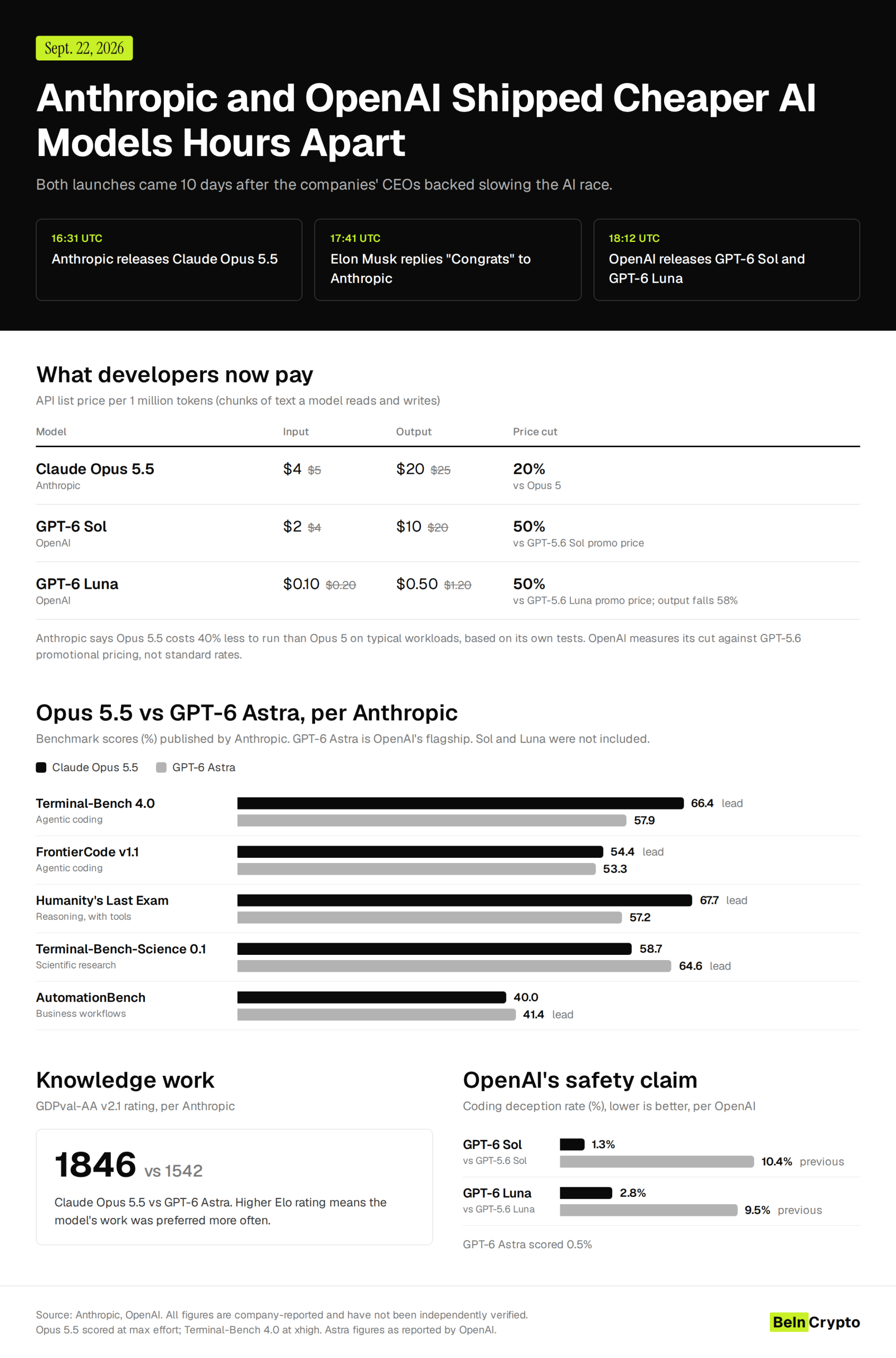
Anthropic and OpenAI launched new artificial intelligence (AI) models less than two hours apart on Tuesday. Both releases landed only 10 days after their chief executives publicly pushed for an AI slowdown.
This time, however, instead of pushing past their most powerful models, both cut prices instead, and Elon Musk who had also backed the AI slowdown initiative, congratulated Anthropic.
Anthropic Ships Opus 5.5 After Its AI Slowdown Call
Anthropic released Claude Opus 5.5 at 16:31 UTC. The company said the model matches its Claude Fable 5.1 on most tasks and costs 40% less to run than Opus 5.
That 40% figure comes from Anthropic’s own tests on typical workloads. List prices fell 20%, to $4 per million input tokens and $20 per million output tokens. Tokens are the chunks of text a model reads and writes, and developers pay per token.
Opus 5.5 is Anthropic’s first model since CEO Dario Amodei published an essay on September 12 urging labs to slow capability gains. OpenAI CEO Sam Altman agreed, and Musk wrote “Dario is right,” as BeInCrypto reported.
However, Amodei’s essay left room for new launches.
“…pacing does not mean halting model training or technical progress, but ensuring companies take adequate time to align and safeguard their models,” wrote Amodei.
Anthropic said outside testers METR and Frontier Design reviewed Opus 5.5 before release.
OpenAI Answers With Cheaper GPT-6 Sol and Luna
OpenAI introduced GPT-6 Sol and GPT-6 Luna at 18:12 UTC. Both are faster, lower-cost models built on GPT-6 Astra, which remains its flagship.
The company halved prices for developers. Sol now costs $2 per million input tokens, while Luna costs $0.10. Meanwhile, that 50% cut is measured against GPT-5.6 promotional pricing, not standard rates.
Paid ChatGPT users get both models today. Free users can try Luna in the desktop app.

Skeptics had questioned the slowdown pledge from the start. Investor Michael Burry called it self-serving IPO hype. Morgan Stanley, an Anthropic IPO underwriter, said the push changes nothing for spending.
Neither lab has said when it will ship a model above its current flagship.
The post Is the AI Slowdown Over? OpenAI and Anthropic Just Launched New Models appeared first on BeInCrypto.

OpenAI is split into three divisions. There is Research, where the frontier models are trained. There is Scaling and Infrastructure, which handles the massive computers this training relies on. And then there is Applications, which takes the product of these two groups’ work, “and then brings it to the people,” says Vijaye Raji, who is chief technology officer of the Applications division.
Raji leads key technical teams—such as data, experimentation, and growth—that help power ChatGPT and Codex, OpenAI’s coding tool, the use of which he says has made the company’s engineers “10 times more productive.” He is also responsible for the tech behind ChatGPT’s new ad program, which launched in February, and which reached $1 billion in annualized revenue in late August. Raji says OpenAI built the system in such a way that one model supplies answers, while a separate model supplies clearly-delineated ads. “We make sure that users never mistake what the model says [for] an ad,” he says. “We will always optimize for and prioritize user trust over anything else.”
Correction, September 22
The original version of this story misstated elements of Raji’s responsibilities as CTO. He does not lead engineering for ChatGPT and Codex; he leads key technical teams that help power those tools.
Disclosure: Investors in OpenAI include Salesforce, where TIME co-chair and owner Marc Benioff is CEO. OpenAI and TIME also have a licensing and technology agreement that allows OpenAI to access TIME’s archives.
Coinbase has added fixed-rate USDC loans backed by cbBTC after its variable-rate borrowing service reached more than $1.4 billion in outstanding loans and nearly $3 billion in collateral.
Summary
- Coinbase customers can now choose between fixed-rate and variable-rate USDC loans backed by crypto.
- Fixed-rate loans set the interest rate and maturity when borrowers accept an onchain offer.
- Borrowers must repay before maturity, or lenders can claim the cbBTC securing the loan.
- Morpho Midnight runs the fixed-rate markets on Coinbase’s Base network.
Coinbase fixed-rate loans set costs in advance
Coinbase said the new borrowing option operates through Morpho Midnight, a fixed-rate and fixed-term lending protocol on Base. Customers pledge cbBTC as collateral and receive USDC without selling their bitcoin exposure.
Coinbase manages the customer interface, while Morpho supplies the lending protocol and Base processes the transactions. The product sits beside Coinbase’s existing integration with Morpho Blue, where interest rates change according to market conditions.
Unlike the variable-rate service, each Midnight loan establishes an interest rate and repayment date when the transaction begins. Lenders submit offers through an onchain order book, and borrowers select terms based on the available rates and maturities.
Coinbase currently offers maturities at the end of the current month or the following month. A company spokesperson said “End of Month” refers to the last Friday of the selected month.
Borrowers must return the USDC before the agreed date. If they miss the deadline, the lender can claim the cbBTC posted as collateral under the loan’s terms.
Fixed borrowing costs remove the possibility that an accepted loan’s interest rate will change before maturity. Variable-rate loans through Morpho Blue, by comparison, adjust as the amount of USDC supplied and borrowed changes.
“Coinbase Borrow gives our customers access to liquidity without having to sell their assets, and fixed-rate borrowing gives them even greater choice over how they manage that credit,” Coinbase yield and investments product lead Jacob Frantz said.
Morpho Midnight matches borrowers with lender offers
As crypto.news reported during the Midnight launch on Base, Morpho introduced the protocol in July to support fixed-rate loans with set maturities and negotiated terms.
Midnight uses an intent-based peer-to-peer system instead of placing every borrower into a pool with an automatically changing rate. Borrowers and lenders can set conditions that include the interest rate, maturity and counterparty requirements, according to Morpho.
Under the protocol’s offer-based design, lenders do not need to place funds into separate pools while waiting for a borrower. Morpho said their capital can remain in variable-rate markets until a fixed-rate offer is accepted, at which point the required liquidity moves into the matched loan.
Morpho Blue continues to handle Coinbase’s variable-rate product. More than $1.4 billion in loans remain outstanding through that service, secured by about $3 billion in collateral, according to the figures supplied with the announcement.
Across all integrations, Morpho Blue has approximately $5.2 billion in outstanding loans and $16 billion in deposits. Coinbase’s figures represent only the loans accessed through its interface rather than all activity on the protocol.
Midnight holds roughly $30 million in deposits during its initial rollout. Morpho has said the architecture may later support structured credit and lending against tokenized real-world assets, although any additional markets will depend on separate integrations.
Early use of fixed-rate markets has remained limited in some other Morpho deployments. Data from Sep. 18 showed that five Coinbase stock-backed lending markets had attracted $54,652 in USDC borrowing, all of it through variable-rate pools.
The same five stock tokens had 95 Midnight markets with different maturity dates, but none had outstanding fixed-rate loans at the time. Apple, Alphabet, Nvidia and Meta token markets were among the supported products, alongside a token tied to privately held SpaceX.
US borrowers gain another onchain credit structure
For eligible U.S. customers, Coinbase’s lending integration provides a way to access USDC while keeping bitcoin posted as collateral. Coinbase first brought the Morpho-powered model to most U.S. states in 2025, with New York excluded from the initial rollout.
When customers borrow against bitcoin, Coinbase converts the pledged asset into cbBTC and transfers it to a Morpho smart contract on Base. Coinbase describes cbBTC as an ERC-20 token backed one-for-one by bitcoin held in its custody.
The new fixed-rate structure changes the repayment conditions attached to that collateral. Existing variable loans have no fixed maturity date and can remain open while the position stays within its required collateral range. Fixed-term borrowers instead face a stated deadline, after which the lender gains the right to claim the collateral.
Collateral risk remains tied to the value of cbBTC. Morpho’s lending system uses loan-to-value limits, and positions can face liquidation if their debt rises past the permitted threshold relative to the collateral’s value. Price declines in bitcoin can therefore affect a borrower even when the interest rate itself remains fixed.
Coinbase has also built the opposite side of its onchain credit service by letting customers lend USDC through Morpho. During September, the exchange expanded USDC lending into Brazil, where eligible customers can deposit the stablecoin into a Steakhouse Financial-curated vault.
The Brazilian lending product uses variable returns generated by demand from Morpho borrowers. Coinbase said the service had attracted nearly $500 million in deposits, with users able to withdraw their USDC and accrued returns without a fixed lock-up period.
Coinbase adds loans beside stocks and IPO access
Beyond crypto lending, Coinbase has been adding securities products in selected markets. The exchange recently began providing eligible UK customers with access to almost 4,000 U.S. stocks, including fractional shares and purchases funded with pounds or USDC.
Trading is available 24 hours a day on weekdays during the phased rollout. Coinbase’s stock service gives UK users direct equity ownership, while its tokenized stock products on Base remain restricted to eligible investors outside the United States.
In the U.S., Coinbase has also opened retail IPO access through Coinbase Capital Markets, its Financial Industry Regulatory Authority-registered broker-dealer. The service started with smart-ring maker Oura’s offering and allows eligible customers to request shares before public trading begins.
Customers can submit conditional purchase offers after the expected price range becomes available. Coinbase then allocates the shares it receives from the selling group, meaning an investor may receive a full allocation, a partial allocation, or no shares when demand exceeds supply.
Stellar’s XLM has risen 2.7% to $0.2135 after BVNK added the blockchain to its stablecoin payments platform, opening the network to business payments across more than 130 markets.
Summary
- BVNK has made Stellar available through its existing API for payments, payouts, remittances, and treasury transfers.
- CoinGecko data showed XLM trading at $0.2135, with a market value of about $7.46 billion and $403.3 million in daily volume.
- BVNK customers can use the new rail without building a separate blockchain connection or changing their current payment systems.
- The integration follows Mastercard’s acquisition of BVNK and a U.S. Bank test involving a proprietary dollar-backed stablecoin on Stellar.
BVNK announced the integration, saying customers can now access Stellar through the same API they use for the company’s other payment rails and digital assets.
Businesses can use the connection for cross-border payments, customer and supplier payouts, remittances and corporate treasury transfers. Since BVNK manages the blockchain connection within its platform, customers do not have to create a separate Stellar integration or replace their existing payment infrastructure.
The arrangement adds a network designed for fast and low-cost transfers to BVNK’s set of settlement options. Instead of selecting and maintaining separate connections for each blockchain, a business can route payments through the networks available within BVNK’s platform.
BVNK has opened Stellar across 130-plus markets
BVNK said the Stellar rail is available across more than 130 supported markets. Its platform connects conventional payment systems with stablecoins and other digital assets, allowing companies to move funds using a single technical connection.
According to BVNK, its payment infrastructure recorded $55.6 billion in volume during 2025 and processed 3.6 billion transactions. The company also reported 99.99% uptime and an average settlement time of about five seconds.
Kimberley Mescal Julien, head of partnerships at BVNK, said businesses should not have to operate separate connections for several blockchain networks. She described Stellar as another low-cost channel that customers can use to send money across borders through BVNK’s existing platform.
Adding a blockchain through one API can reduce the technical work required when companies enter another market or support a new asset. BVNK said customers would also be able to access more Stellar-native assets through the same connection if the company expands the offering.
The current announcement does not name any additional assets or provide a timetable for their introduction. Stellar supports the issuance and transfer of tokens on its network, including assets designed to track national currencies.
XLM price has gained alongside higher trading activity
CoinGecko data showed XLM at $0.2135 at the time of writing, representing a 2.7% increase over 24 hours and an 11.2% gain during the past week. The token traded between $0.2062 and $0.2198 during the daily period.
Daily trading volume stood at about $403.3 million, while XLM’s circulating market value reached roughly $7.46 billion. CoinGecko estimated that about 35 billion XLM were in circulation out of a maximum supply of approximately 50 billion tokens.
The token remained about 75.6% below its record price of $0.8756. CoinGecko calculates the quoted XLM price using a volume-weighted average drawn from 113 exchanges and 244 markets.
BVNK’s announcement supplies another commercial use case for the Stellar network, but it does not confirm how much payment volume will pass through the new rail. The company also did not disclose whether customers must hold XLM directly to use Stellar-based transfers.
Network adoption and token demand do not always move together because businesses may settle with stablecoins or other assets issued on a blockchain. A recent XLM assessment published by crypto.news noted that Stellar’s transaction activity does not automatically produce lasting demand for its native token.
The same report cited about $5.5 billion in stablecoin payment volume and more than $2.83 billion in tokenized real-world assets on Stellar as of June. It also noted that the Depository Trust and Clearing Corporation planned to connect its tokenization service to Stellar, with live assets targeted for the first half of 2027.
Mastercard ownership adds scale to BVNK’s payment network
BVNK’s Stellar launch follows Mastercard’s completion of its acquisition of the stablecoin infrastructure company in August. The transaction valued BVNK at up to $1.8 billion and placed its blockchain payment technology within Mastercard’s global operation.
As reported after the acquisition, Mastercard bought BVNK to connect digital assets with traditional payment systems. The companies did not provide a detailed timetable for combining BVNK’s technology, licenses and customer relationships with Mastercard’s existing services.
Mastercard said in its Aug. 3 announcement that the purchase would support transfers between fiat money and digital currencies. The payment company also linked BVNK’s infrastructure with Mastercard Move, which provides money-transfer services across multiple currencies and markets.
BVNK continued operating its platform following the acquisition, and the Stellar connection shows the company adding blockchain rails under its new ownership. Its customers can access the network through the same technical setup they already use rather than waiting for a separate Mastercard product.
Before completing the purchase, Mastercard had worked with BVNK on digital-asset projects. BVNK was among more than 30 companies supporting Mastercard’s Agent Pay for Machines program, which was designed to let automated software conduct high-volume, low-value transactions through cards and stablecoins.
U.S. institutions are testing Stellar-based settlement
For U.S. businesses and XLM holders, the BVNK integration follows a live transaction conducted by U.S. Bank with its proprietary USBDC stablecoin. The bank moved funds between its entities in North America and Europe using Stellar.
The U.S. Bank pilot connected USBDC with the bank’s finance, risk, compliance, and operational systems. U.S. Bank’s Digital Asset Platform handled the token’s issuance, transfer and redemption while also testing freezing and clawback functions.
U.S. Bank described the transaction as a controlled test rather than a public stablecoin launch. It did not disclose the payment amount, transaction hash, settlement time or reserve structure behind USBDC, and the bank did not announce access for customers or outside financial institutions.
The transaction focused on an intercompany transfer between U.S. Bank entities rather than a consumer payment. According to the bank, the trial examined whether a dollar-backed token could support international transfers while remaining connected to established banking controls.
U.S. Bank said it was also studying liquidity management, collateral movement and cross-border treasury operations through its digital-asset platform. The bank did not provide dates for further tests or identify clients and payment corridors that could take part in any later trial.
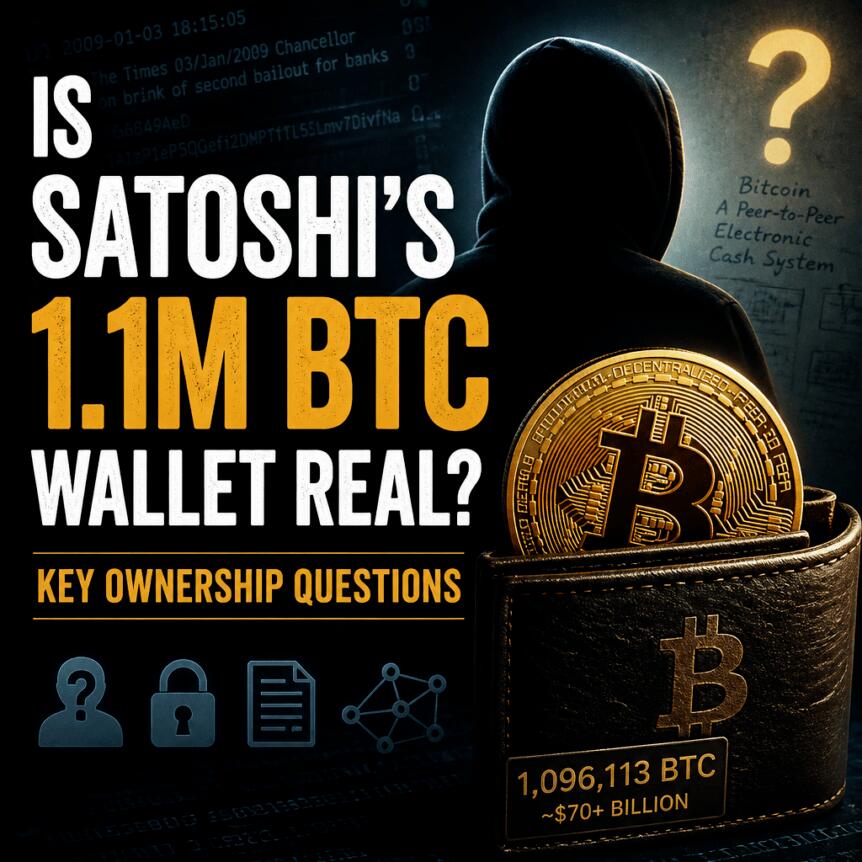
Bitcoin’s origin story remains wrapped in mystery—even for the coins commonly linked to Satoshi Nakamoto. A recent on-chain transfer of roughly 600 BTC, mined in March 2010 and dormant for more than 16 years, reignited speculation that “Satoshi’s” stash may have finally moved. Yet blockchain evidence can trace holdings and spending patterns far more reliably than it can identify a specific individual.
According to Whale Alert, the 600 BTC transfer showed no direct connection to the widely discussed Satoshi holdings cluster. Meanwhile, blockchain research firm Bitquery examined the underlying block rewards and found that most of the relevant blocks did not cleanly match the distinctive mining pattern attributed to “Patoshi”—the name used for the suspected early-miner fingerprint associated with Satoshi. Together, the findings underline a key limitation: the chain records transactions, not who controls the keys at any given moment.
Key takeaways
- The 600 BTC moved after 16 years came from 12 old block rewards mined in March 2010, but the sender is not proven to be Satoshi.
- Whale Alert reported no connection between the 600 BTC transfer and the commonly tracked Satoshi-associated stash.
- Bitquery found that 10 of the 12 blocks did not match the “Patoshi” mining fingerprint, while the remaining two only weakly matched in a way that could occur by chance.
- Even if a mining pattern points to one early operator, it cannot confirm that the same person still controlled the keys in 2026.
- Bitquery’s full reconstruction suggests the total “Satoshi” estimate can vary significantly depending on how strictly the fingerprint is applied.
Why the long-dormant 600 BTC transfer didn’t settle the Satoshi question
The recent activity involved 12 block rewards mined over four days in March 2010, each remaining untouched until Sept. 5 of this year. The coins were spent in a short window—one-by-one—within roughly half an hour, an on-chain detail that naturally drew attention to whether the move could be linked to the earliest era of Bitcoin mining.
However, multiple lines of analysis complicate the “Satoshi woke up” narrative. Whale Alert reported no connection between the 600 BTC and the tracked Satoshi-linked holdings. Bitquery’s review went further: it reported that 10 of the 12 blocks involved in this transfer did not match the “Patoshi” mining pattern associated with Satoshi in the earliest blocks.
For the two blocks that did show weak matches, Bitquery researcher Gaurav Agrawal noted the matching could plausibly happen by chance. Importantly, this distinction matters for readers trying to separate “connected by pattern” from “connected by identity.”
“What the chain cannot say is whether the hand in 2026 belongs to the person who ran the machine in 2010.”
Even if the coins clearly originate from a period of early mining, the chain does not reveal who held the private keys when the coins were moved. Agrawal also emphasized that keys can be inherited, sold, stolen, or recovered from old storage media—meaning the blockchain may only show that someone had control at the time of spending, not who that someone is.
There’s another practical clue: the spending transactions used modern wallet software. The Bitcoin client used in 2010 would not have supported the same tooling. That implies the keys were likely loaded into a newer system by whoever controlled them in 2026, but it still doesn’t identify whether that controller is the original miner—or a later party who obtained the keys.
The “Patoshi” fingerprint and the limits of circumstantial evidence
The broader claim that Satoshi controlled about 1.1 million BTC rests on forensic-style reconstruction rather than direct proof. The basic method is to identify a recurring mining “fingerprint” in Bitcoin’s early blocks—then attribute blocks with similar traits to a single operator.
In 2013, researcher Sergio Demian Lerner publicly identified what he described as a distinctive pattern in the earliest blocks and argued it reflected one miner operating differently from others. Lerner estimated the miner amassed around 1.1 million BTC, and—more than a decade later—he continued to stand by the calculation, describing it as accurate with the caveat that the evidence remains circumstantial, not “math proof” or direct witness.
The argument is strengthened by additional observations that link early recipients to that same pattern. According to Lerner, several early Bitcoin users—Hal Finney, Dustin D. Trammell, Nicholas Bohm, and Mike Hearn—received transfers showing the Patoshi mining fingerprint. In his view, the fact that those transfers traced back to coinbases in the Patoshi pattern provides “compelling reasons” to connect Patoshi to Satoshi, even though it is still not absolute proof.
Lerner also suggested the miner likely used specialized mining software rather than the standard client. If true, that would imply an unusually fast setup after Bitcoin’s early release, making it “highly improbable” that a different party formed a matching operation later on.
Bitquery’s reconstruction: one stash estimate, multiple possible sizes
Thirteen years after Lerner’s work, Bitquery attempted a more comprehensive rebuild of the Patoshi fingerprint from raw early blocks. In a report released through its investigations, Bitquery said it graded 54,316 early-era blocks and followed every coin through Sept. 1, 2026.
The firm reported a “highest grade” reconstruction that agrees with the published Patoshi list on 99.2% of blocks. It also said it found zero exceptions in a timestamp-ordering test across 5,836 adjacent block pairs, with Agrawal stating, “I don’t know of a stronger test for this.”
Still, the work also highlights how sensitive the estimate can be. While Bitquery’s reconstruction supports the idea of a concentrated early-mining origin, the total count of attributed coins changes depending on how strictly the pattern criteria are applied.
Agrawal said a strict interpretation of the fingerprint covers just under 0.9 million BTC, while a “most generous reading” lands around 1.17 million. He emphasized that published estimates between roughly 1.0 million and 1.13 million fall inside that range, so the firm’s analysis did not “move the number” so much as clarify the uncertainty boundaries.
For investors and market observers, the practical takeaway is simple: the “1.1 million BTC” figure is best understood as an estimate derived from rules about pattern matching, not a precise, settled ledger fact.
What the chain can confirm—and what remains unknowable
Agrawal framed the “Satoshi owns 1.1 million BTC” claim as three separate assertions stacked together. First is that the coins likely came from one mining machine—supported by stronger evidence. Second is that the machine belonged to Satoshi—presented as circumstantial. Third is that the keys still sit under Satoshi’s control, which cannot be proven merely because the coins have historically stayed unmoved.
Bitquery also reported a 2010 transaction moving 600 BTC in two transfers about an hour apart. The first moved at 22:04 UTC and spent 10 block rewards worth 500 BTC; the second moved at 23:07 UTC and spent two block rewards worth 100 BTC. Those rewards were mined at various points throughout 2009, spanning near both the start and end of Bitcoin’s first year.
Agrawal argued that this May 2010 moment is “the clearest” where the chain itself, rather than statistical pattern matching, suggests the blocks belonged together—effectively the closest the chain gets to confirming that blocks from across 2009 ended up under one wallet, matching what the broader Patoshi pattern claims for the entire set.
Yet this does not answer the individual identity question for the Sept. 5 transfer. Bitquery said the 600 BTC moved this month do not belong to the Patoshi miner, and it reported no new evidence connecting this activity to “Satoshi’s” stash. As Agrawal put it, “nothing in the math settles it, so we will never be sure.”
What readers should watch next is less about whether “Satoshi” coins move and more about how researchers refine fingerprint tests and attribution thresholds. The chain can narrow possibilities through spending behavior and mining structure, but unless keys can be linked to a specific person over time, the biggest uncertainty—who controls the coins—will likely remain unresolved.

NEAR has partnered with Ondo Finance to give eligible users access to 20 tokenized U.S. stocks, exchange-traded funds, and commodity-linked products through near.com and NEAR Intents.
Summary
- 20 tokenized assets will initially include Tesla, Nvidia, Apple, Microsoft, Amazon, QQQ, SLV, and IAU.
- More than 30 connected blockchains can route supported crypto assets into Ondo Stocks through NEAR Intents.
- Eligible users can fund purchases with assets including Bitcoin and USDC without opening a separate brokerage account.
- U.S. persons cannot access Ondo Stocks under the product’s current securities restrictions.
Ondo Finance said the integration would let eligible near.com users exchange supported crypto assets for tokenized securities while keeping the entire process within one account. Availability will depend on each user’s location and compliance with the platform’s eligibility requirements.
NEAR users can access 20 Ondo tokenized assets
Rather than limiting the service to crypto-native assets, the first release will provide tokenized exposure to several of the largest U.S.-listed companies. Tesla, Nvidia, Apple, Microsoft, and Amazon are among the initial stocks named by the companies.
The selection also includes the Invesco QQQ Trust, which tracks the Nasdaq-100, and precious-metals funds such as the iShares Silver Trust and iShares Gold Trust. QQQ, SLV, and IAU trade on U.S. exchanges, allowing the integration to cover technology stocks, a major equity index, and commodity-linked products.
Users can purchase the tokens with supported assets already held in their near.com accounts. Bitcoin and USDC are among the funding options, removing the need to first move the assets to a traditional brokerage account. After completing a purchase, users can hold the tokenized product or exchange it back into USDC or another supported crypto asset.
“Bringing financial markets onchain should give people more control over their money and more choice in how they transact,” said Alex Shevchenko, CEO of Defuse Labs, the developer behind NEAR Intents.
Access will also extend beyond near.com. Wallets, decentralized finance protocols and applications connected to NEAR Intents can route eligible users toward Ondo Stocks, although each participating service may apply its own interface and compliance procedures.
NEAR Intents handles routing across 30-plus chains
Instead of requiring users to choose bridges and transaction paths manually, NEAR Intents allows them to state the result they want. Independent solvers then compete to complete the request by finding and executing a route between the relevant networks and assets.
The system connects more than 30 blockchains, including Bitcoin, Ethereum, NEAR, Tron and BNB Chain. A user holding an asset on one supported network can therefore request a tokenized security without manually completing every transfer involved in the transaction.
NEAR has also developed a private version of the system for financial transactions. In September, the protocol crossed $70 million in confidential total value locked, triggering the first snapshot for an incentive program tied to Confidential Intents.
Confidential Intents routes transactions through a private NEAR shard, according to the project. NEAR says the design keeps transactions away from public mempools and can reduce exposure to front-running, strategy leaks, and certain forms of maximal extractable value.
Ondo Stocks will use the standard cross-chain distribution system described in the latest announcement. The partners did not state that purchases of the 20 tokenized assets would receive the privacy functions offered by Confidential Intents.
“Our goal is simple: investors should be able to reach these assets from the networks and accounts where they already hold their capital,” said Armand Khatri, head of ecosystem at Ondo Finance.
Ondo expands distribution for its tokenized securities
The NEAR agreement adds another distribution channel for a platform that has already deployed tokenized securities on Ethereum, Solana and BNB Chain. According to Ondo, its securities platform holds more than $1 billion in total value locked and has processed over $26 billion in cumulative trading volume.
In June, Ondo connected 35 assets to Hyperliquid’s HyperEVM through infrastructure built with LayerZero. The supported products included tokens linked to SPY, QQQ, Nvidia, Tesla, Alphabet, Netflix, and Alibaba, giving HyperEVM applications access to stock and ETF exposure.
Another LayerZero-based product had previously allowed users to move more than 100 tokenized stocks and ETFs between Ethereum and BNB Chain. NEAR Intents takes a different route by connecting users and applications across its network of solvers rather than asking them to transfer a token through a dedicated bridge.
Ondo has also sought regulatory clearance to bring parts of its tokenized securities business into the United States. The company asked the SEC to permit registered on-chain distribution of securities through Ethereum and other public blockchains.
U.S. users remain restricted from Ondo Stocks
Although the underlying shares and ETFs are listed in the United States, Ondo’s product disclosures state that Ondo Stocks have not been registered under the Securities Act of 1933. The tokens may not be offered or sold in the United States or to U.S. persons unless they are registered or qualify for an exemption.
Eligibility rules also differ elsewhere. Ondo’s disclosures say that users in jurisdictions including the United Kingdom, Switzerland and Singapore may need to qualify as professional clients or investors before gaining access.
The restriction separates the NEAR integration from the SEC’s new five-year pathway for tokenized National Market System stocks. As crypto.news previously reported, products admitted under the exemption must carry the same economic, voting, dividend, and liquidation rights as the corresponding conventional shares. Tokens offering only synthetic price exposure do not qualify.
Under the SEC order, an issuer can object when an unrelated party seeks to tokenize its stock. Approved trading venues must also stop trading a tokenized security when the underlying stock is halted, while limits apply to the number of supported symbols and their trading volume.
Separate from the offshore Ondo Stocks service, Ondo’s U.S.-registered broker-dealer subsidiary, Oasis Pro Markets, has received FINRA authorizations connected to tokenized equities and funds. Oasis Pro Markets is registered with the SEC as a broker-dealer and alternative trading system, while Oasis Pro TA operates as a registered transfer agent.
Oasis Pro Markets recently joined DTCC’s Fund/SERV network, which connects broker-dealers and other financial firms with fund companies for order processing, settlement, and recordkeeping. The membership gives the company standardized links to mutual fund providers, wealth platforms, and other financial service firms using DTCC infrastructure.

New nursery to open in Cardiff despite traffic and noise concerns

Is ERIE Underperforming the Financial Services Sector?

Bitcoin ETF inflows confirm $86K uptrend: Analysts




-

 Fashion4 days ago
Weekend Open Thread: Talbots – Corporette.com
-

 Crypto World7 days ago
Robinhood engineers charged over $50K crypto scheme
-

 Tech2 days ago
Researchers escape OpenAI Codex sandbox to run commands on host
-

 Crypto World4 days ago
Circle launches Arc Studio AI agent for building onchain apps
-
 NewsBeat4 days ago
Trump says US has reached an agreement to take permanent control of Greenland’s security
-

 Crypto World2 days ago
Who Needs CLARITY Anyway? ARB Could See 70X Increase: Hodler’s Digest
-

 Crypto World4 days ago
Bitcoin price breaks channel as RSI climbs to 63
-

 Crypto World4 days ago
Trading Bitcoin on Robinhood? Why 2% Spread Has Traders Worried
-

 Crypto World6 days ago
US Charges Robinhood Engineers Over Crypto Listing Trades
-

 Crypto World7 days ago
What Is the Status of the U.S.-Iran Peace Talks? Here's What Both Sides Are Saying
-

 Tech7 days ago
Webb’s IC 348 Mosaic Includes Two-Jupiter Dwarfs, Twin Jets, and a Nursery Still Making Worlds
-

 Crypto World5 days ago
Mortgage and refinance interest rates today, Thursday, September 17, 2026
-

 Crypto World4 days ago
World Money launches in 150+ countries with Stripe
-

 Entertainment7 days ago
Big Brother Update: Melody Explodes at Drew as Illness Sweeps BB28 House
-

 Crypto World4 days ago
Silver prices recover quickly, hitting weekly high today
-

 Business2 days ago
Analog Devices (ADI) Bets $1.35 Billion on Chips that Let Machines Think for Themselves
-

 Tech5 days ago
GPT-6 Astra Reached the Nether in Minecraft, Lost Its Stash to a Creeper, and Farmed Potatoes for Hours
-
 NewsBeat4 days ago
US was ‘on brink of war’ with China over false AI report of nukes moving in Middle East
-

 Crypto World2 days ago
Coinbase, Robinhood, Circle Seen as Tokenized-Stock Winners
-

 Crypto World2 days ago
Bitcoin price holds above $81K as key catalysts line up
You must be logged in to post a comment Login