
Crypto World
Mike Tyson, Tether CEO, Cathie Wood are among speakers at Trump’s ‘most exclusive’ crypto conference


A group of cryptocurrency executives, investors and public figures is set to speak Saturday at a private event hosted by U.S. President Donald Trump at his Mar-a-Lago club in Palm Beach, Florida.
The event, billed as “the most exclusive conference in the world,” started with Bill Zanker, co-founder of TRUMP memecoin and was followed by legendary boxer Mike Tyson, according to the speaker lineup seen by CoinDesk.
Other high-profile speakers include stablecoin issuer Tether’s CEO Paolo Ardoino, who is expected to address the link between financial inclusion and the U.S. dollar’s global role. Ark Invest founder Cathie Wood and crypto infrastructure provider Alchemy’s CEO Nikil Viswanathan will also speak at the conference, and each will focus on the overlap between artificial intelligence and crypto, a topic that has drawn increasing attention as both sectors expand.

Anchorage Digital CEO Nathan McCauley is scheduled to join a panel on the state of crypto and equities markets, while investor Anthony Pompliano of ProCap Financial is also set to appear on stage.

The lineup also includes traditional finance investors such as Tim Draper and Grant Cardone, as well as author Tony Robbins.
The event is touted as a major cryptocurrency and finance gathering tied to Trump’s broader push to support the digital asset industry since returning to the White House in January 2025. The conference website lists Trump as the keynote speaker and says attendance is limited to the top 297 holders of the $TRUMP token, a meme coin launched in his name.
This will mark the second time such an event has been hosted by the President. That previous dinner prompted Democratic lawmakers to lodge protests and raise concerns about Trump profiting off of his own crypto token while simultaneously championing legislation to support the industry and appointing regulators to oversee crypto.
Since taking over the Oval Office, Trump has backed several crypto-related projects, including the $TRUMP and $MELANIA meme coins, which are tied closely to the public profiles of the president and first lady rather than any underlying utility. Transaction fees generated from trading the coins have produced millions of dollars in revenue for entities linked to Trump and his family.
Nevertheless, since launching around Trump’s second inauguration, the $TRUMP token has fallen about 97% from its peak. The $MELANIA coin has dropped even further, down roughly 99% after a rapid rise and decline.
Read more: It could cost you up to $6 million to grab lunch with Donald Trump



The modern financial system was never designed for machines. It was built around the constraints of human life: geography, sleep cycles, paperwork, and physical presence. But as AI agents begin to act as economic participants, that human-centric design is starting to look less like a feature, and more like a bottleneck, said the co-founder of crypto firm Alchemy.
“You can argue that crypto was built for AI agents, not humans,” said Alchemy CEO and co-founder Nikil Viswanathan.
The mismatch is everywhere. Banks have operating hours because humans do. Payments are tied to countries because people live in them. Credit cards assume physical identity and presence, he said.
AI agents operate differently. They don’t sleep. They don’t live anywhere. They don’t walk into banks or carry cards. And increasingly, they don’t just assist with tasks, they transact.
“All transactions for agents are online. They’re inherently global,” Viswanathan, who will be speaking at Consensus Miami next month, told CoinDesk in an interview.
That’s where crypto starts to look less like an alternative financial system and more like the native infrastructure for a new kind of economic actor, he said.
Alchemy is a crypto infrastructure company that provides the underlying tools and services developers need to build blockchain-based applications. It offers APIs, node infrastructure, and data services that power everything from financial apps to non-fungible tokens (NFTs) and games, enabling companies to build and scale onchain products without managing the complexity of blockchain systems themselves.
Built for the wrong user
Traditional finance assumes friction. Paying someone in another country involves currency exchanges, intermediaries, delays and fees. For humans, that’s normal. But for AI agents, it’s unusable.
Agents need to transact seamlessly across borders, at any time, often in tiny increments. They need programmability, direct control over money via code, and systems that don’t depend on physical infrastructure or identity.
Crypto offers exactly that: a global, always-on financial layer where value moves as easily as data, he said.
“Crypto is the global infrastructure for money that agents need,” Viswanathan said.
Complexity flips
What has long made crypto difficult for humans, including seed phrases, private keys and interacting directly with code, is exactly what makes it powerful for machines, Viswanathan said.
Unlike humans, agents operate natively in code.
“Agents read in zeros and ones. That’s their native language,” he said. “That’s also the language of crypto.”
For years, crypto has tried to abstract itself into something more human-friendly. But its underlying architecture was never really built for humans in the first place.
Viswanathan compared the shift from crypto tools being built primarily for humans to crypto tools being used by AI agents to an earlier epochal shift from the postal system to the internet. While people once had to physically write out a letter, buy a stamp and mail it to share messages across the globe, communication in the modern era is much faster.
“Email is far more powerful than the postal system because it’s designed for computers,” Viswanathan said. “Crypto is similar.”
Agent-run financial system
Viswanathan said that moving forward, AI agents will sit on top of crypto infrastructure, handling complexity automatically, managing wallets, executing transactions and optimizing flows of capital in real time, letting people control their own funds more easily.
“You can write code to manage a crypto wallet,” Viswanathan said. “You can’t write code to manage a bank account in the same way.”
The result would be a financial system that is more global, more programmable, and more autonomous.
Viswanathan said he sees a layered future: traditional finance and crypto as the base, an agent layer operating on top and a human interface above that.
“Just like computers operate the internet and humans use it, agents will operate finance,” he said.
Read more: Sam Altman’s World project launches major upgrade to fight deepfakes and bots

TLDR:
- $HYPE holds near $41 as traders watch resistance, with breakout signals pointing toward further upside momentum.
- Whale positions exceed $3.66 billion on Hyperliquid, reflecting strong participation from large market players.
- Analysts project higher long-term targets for $HYPE, driven by platform growth and sustained trading demand.
- AI focus shifts in 2026 toward real-world use, with DeepSeek V4 advancing large context capabilities.
Hyperliquid’s native token $HYPE is drawing strong market attention after a sharp upward move linked to a key technical breakout.
Market activity remains elevated as traders track resistance levels, while broader discussions also shift toward practical developments in artificial intelligence.
Hyperliquid Rally Gains Momentum Amid Breakout Signals
The recent price movement in $HYPE has followed what traders describe as a breakout from a long-standing resistance trend. This shift has fueled expectations of further upside, supported by rising participation across the platform.
A widely shared post from market analyst JAVONMARKS on X noted that the breakout could push the token toward $0.5497 on a different trading pair. The tweet framed the move as part of a broader bullish structure forming after sustained resistance pressure.
At the same time, $HYPE trades near $41.18, holding relatively steady after recent volatility. Traders continue to monitor the $41.75 resistance level closely. A move above this point may open the path toward $50 in the near term.
Meanwhile, support remains firm around the $40 level. This range has acted as a key buffer during recent price swings. As a result, short-term positioning appears to depend heavily on how price reacts within this narrow band.
Large holders have also increased their exposure. Data shows whale positions exceeding $3.66 billion in open interest on the platform. This level of activity points to strong confidence among major participants.
In parallel, public forecasts from figures such as Arthur Hayes have added to market attention. Some projections suggest long-term targets near $150, based on platform revenue and user growth trends.
AI Sector Moves Toward Practical Adoption Phase
While crypto markets remain active, attention is also shifting toward developments in artificial intelligence. The narrative around AI is evolving as 2026 progresses, with more focus on real-world applications.
The release of DeepSeek V4 has drawn attention due to its expanded capabilities. The model features a 1-million token context window, marking a technical improvement over earlier versions.
This advancement reflects a broader transition within the sector. Industry discussions now center less on novelty and more on measurable outcomes. As a result, companies are expected to show clear use cases for AI deployment.
At the same time, the concept of autonomous agents is gaining traction. These systems aim to perform tasks rather than only generate content. This shift signals a move toward more functional and integrated AI tools.
However, caution is also emerging from policymakers. U.S. senators have warned financial leaders against relying too heavily on AI-driven projections. These concerns relate to economic decisions, including interest rate strategies.
Consequently, 2026 is often described as a testing phase for AI adoption. The focus is now on execution, reliability, and measurable performance. This approach contrasts with earlier periods driven by rapid innovation and market excitement.
Across both sectors, activity remains high, though narratives are becoming more grounded. Crypto markets respond to technical signals and liquidity flows, while AI development continues toward practical implementation.

Crypto World
Trump defends crypto legislation at private event featuring boxer Mike Tyson, Tether CEO
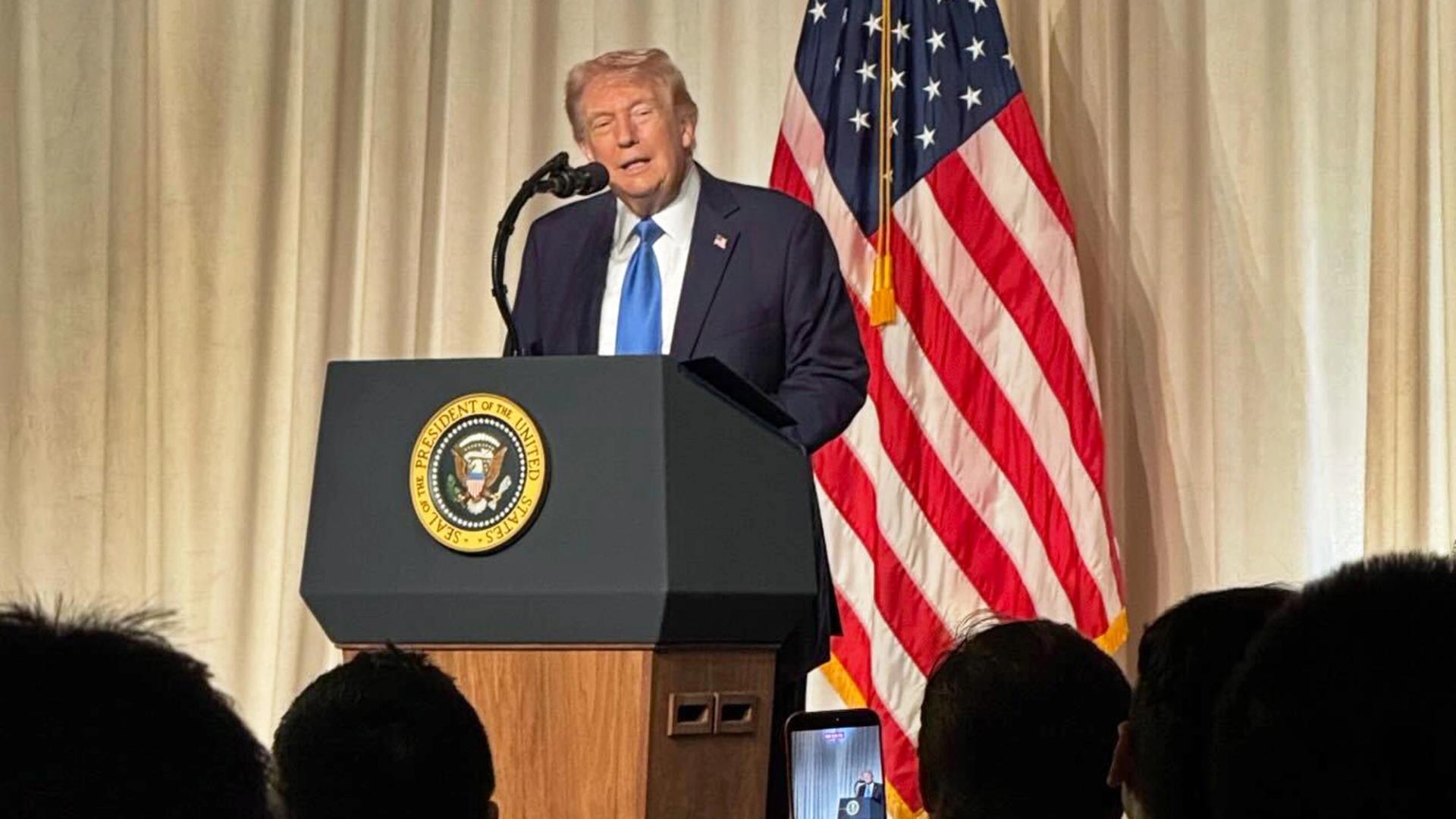
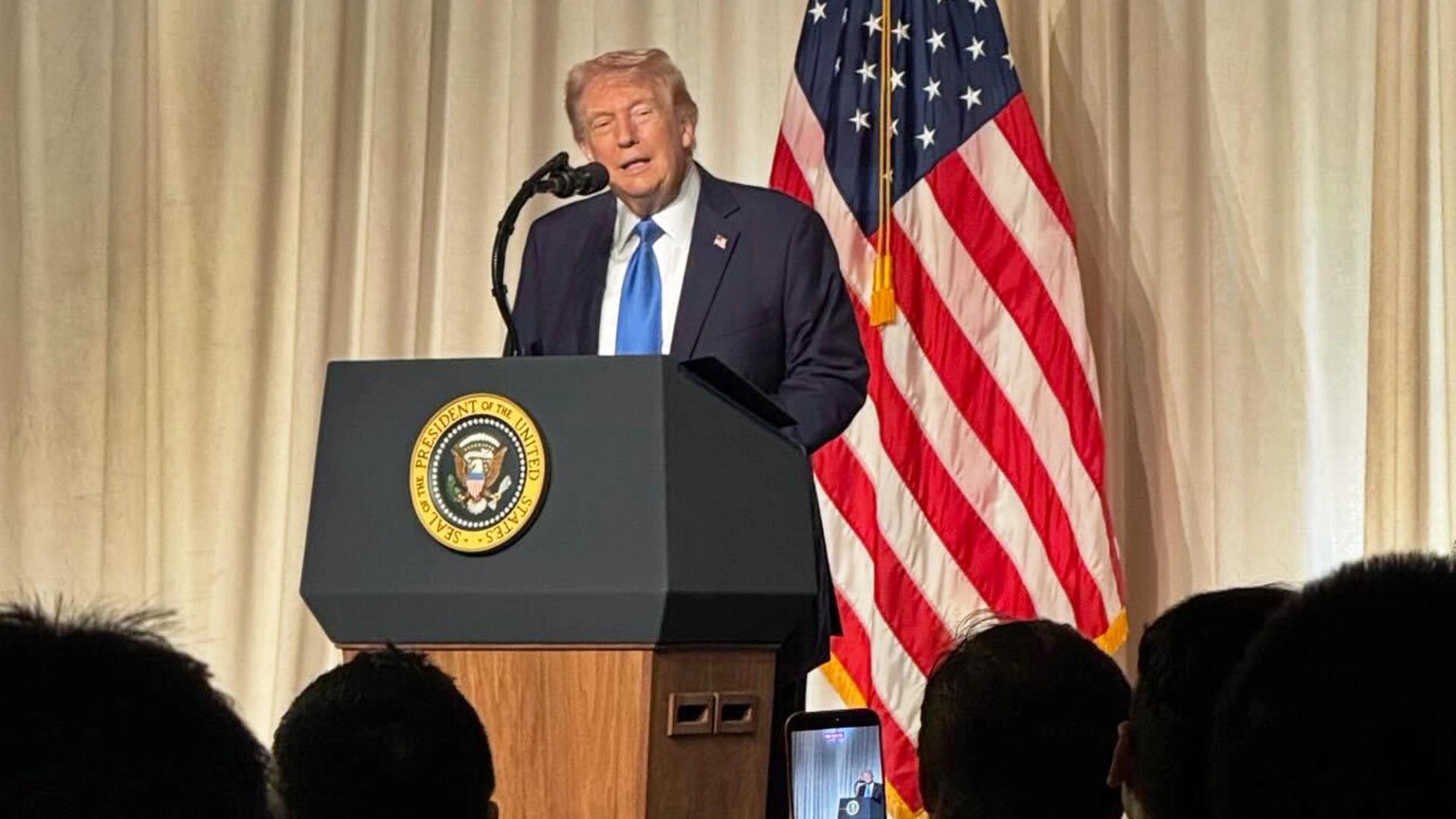
A few hundred of the top $TRUMP memecoin holders were treated to some personal time with U.S. President Donald Trump and his high-profile guests on Saturday at an event at his Florida club in which Trump warned bankers against getting in the way of crypto legislation.
Speaking at the private Mar-a-Lago gathering in Palm Beach, Florida, Trump took up the stance his White House crypto advisers had occupied on the Digital Asset Market Clarity Act, according to a person attending the conference. He pushed back against the bank lobbyists who’d stalled the legislation — the crypto industry’s primary policy aim.
The White House won’t let the banks ruin the crypto market structure legislation, Trump said at the event, a finance-focused gathering billed as “the most exclusive conference in the world.”
In negotiations over recent months, banking groups had won over some senators over their concerns about how U.S. regulations would pave the way for stablecoin rewards programs that the bankers argued could threaten their traditional deposit accounts. The objection derailed Senate progress on the effort to win a new U.S. regulatory regime for crypto, though recent discussions suggest the bill could still get back on track and has a potential path to survive a tightening lawmaking calendar this year. Trump has signaled that’s a priority.
The president’s event featured a roster of crypto executives and investors, including Tether CEO Paolo Ardoino, Ark Invest’s Cathie Wood and Anchorage Digital CEO Nathan McCauley. Boxer Mike Tyson was also in attendance.
Beyond crypto, Trump touched on foreign policy issues including Iran, Venezuela and NATO, which he described as a “paper tiger” that is “never there for us.”
As for the digital asset industry, Trump stuck to his usual script: “We are the leader in crypto. It’s become mainstream,” he said.
The conference comes as Trump continues to back crypto ventures tied to his name, drawing both industry support and political scrutiny. His close personal connections to digital assets businesses has been among the other sticking points on passing the Clarity Act, as Democratic negotiators have insisted that senior government officials, including the president, be banned from profiting off of the industry.
A previous event he appeared at for his memecoin investors last year touched off protests and Democratic criticism that his policy aims benefit his own business interests in an example of government corruption that needs to cease. He was also criticized for meeting privately with unnamed foreign business figures who’d effectively paid for their attendance.
TLDR:
- Dogecoin remains within Cycle 3 structure, reflecting past patterns of accumulation before major breakout phases
- Traders watch $0.10 resistance and $0.09 support levels as price nears a key directional decision zone
- Open interest near $1.3B and whale accumulation signal active positioning across derivatives markets
- Historical cycles suggest potential expansion phase could emerge between 2025 and 2026 timeframe
Dogecoin is drawing fresh market attention as traders assess its long-term cycle structure and current positioning. Recent technical commentary points to a potential turning point, with price behavior aligning with patterns observed in previous expansion phases.
Macro cycle structure signals a pivotal phase
A long-term analysis shared by Bitcoinsensus outlines the evolving structure of Dogecoin across three market cycles since 2014.
The chart maps repeating phases of accumulation, breakout, and consolidation, offering a structured view of price development over time.
In the tweet, Bitcoinsensus states that Dogecoin remains within a macro Cycle 3 structure that mirrors earlier setups.
The post notes that past cycles delivered strong expansions after similar bases, while also clarifying that historical comparison does not confirm future performance.
The chart shows Cycle 1 and Cycle 2 followed similar paths, each producing sharp rallies after long accumulation periods.
Cycle 2 recorded gains exceeding 5,500 percent before entering a cooling phase. Cycle 3, which followed the 2021 peak, reflects a larger expansion and a slower consolidation range.
Current price levels remain within a mid-range band, forming a structure with two possible paths. A bullish scenario suggests gradual upward movement toward prior highs.
A neutral path indicates extended sideways trading. As a result, Dogecoin continues to trade within a decisive range.
Short-term positioning adds to Dogecoin outlook
Another tweet from Cryptoman98 adds context to the near-term setup for Dogecoin. The post notes that open interest has reached about $1.3 billion, reflecting active participation across derivatives markets.
The same update states that large holders accumulated roughly 330 million coins, while top traders maintain a strong long bias. This positioning suggests preparation for upward movement, though price confirmation remains necessary.
Key technical levels are also in focus. The tweet points to repeated support around $0.09, supported by Ichimoku cloud structure.
A move above $0.10 could trigger upward pressure, while a drop below $0.09 may lead to further downside movement.
Meanwhile, the broader macro structure continues to frame expectations. The ongoing consolidation phase aligns with previous cycle behavior, where extended ranges preceded large price moves. Timing estimates from the chart suggest a potential shift between 2025 and 2026.
Across both analyses, Dogecoin remains in a phase where historical patterns and current positioning intersect. Market participants continue to monitor key levels as price approaches a potential breakout zone.
Crypto World
TRUMP Token Insiders Allegedly Dump $46M Worth of Tokens Amid Supply Concentration Concerns
TLDR:
- Over 15.54M TRUMP tokens worth roughly $46M were sent to OKX by team-linked wallets over three weeks.
- A splitter wallet broke large token chunks into smaller transfers within seconds to obscure the fund flow.
- One wallet handled 8.25M TRUMP tokens worth $23M, routing them directly to the OKX exchange hot wallet.
- A single wallet controls 76.75% of TRUMP’s total supply, leaving retail traders exposed to insider-driven price swings
On-chain data has revealed a systematic token offloading pattern tied to wallets linked to the TRUMP memecoin team.
Over three weeks, approximately 15,540,000 TRUMP tokens, valued at around $46 million, were sent to OKX. The activity traces back to a primary team wallet, moving through intermediary addresses before reaching the exchange.
One wallet alone controls 76.75% of the total supply, raising serious concerns about market stability and insider behavior.
Coordinated Wallet Activity Points to Structured Token Offloading
Blockchain analysts flagged a series of transactions originating from a known team wallet. The address 8bHec5JeptUGTwsbC3ycdXrK6uhR7w6hzuPnmzmxJMnv serves as the primary source of the funds.
From there, tokens move to a so-called “splitter” wallet at xcHFnzWgaw6YG3ZQsoDpEE7hVMChGQKv3paPfaxCPWG.
The splitter wallet breaks large token amounts into smaller chunks within seconds. This method distributes funds quickly across multiple addresses before they reach an exchange. The pattern appears structured rather than organic trading activity.
After splitting, tokens flow to a main dumping wallet at Hv1hqPhX3CG6jNu3MzRnfoEV6owPw1mhogtCyY16jPCZ. This address alone handled 8.25 million TRUMP tokens, worth roughly $23 million, sent directly to the OKX hot wallet.
Crypto analyst StarPlatinum flagged the activity on X, stating: “Wallets linked to the team have been systematically offloading tokens into exchanges sending a total of 15,540,000 TRUMP directly to OKX.” The analyst described the pattern as coordinated and deliberate.
Secondary Wallets and Supply Concentration Add to Market Risk
Two additional wallets were identified as part of the same offloading pattern. Addresses 9aiqyEUmwb63yUjwPHwY4jR68Pj5QsCQBGhYWRJEwXZA and C68a6RCGLiPskbPYtAcsCjhG8tfTWYcoB4JjCrXFdqyo consistently sent large TRUMP amounts to OKX. One of these wallets moved over one billion TRUMP tokens within just a few days.
All token flows eventually converge at 64CuV85HHCydAwxQMoXwZ9HXoyw5qE65NkiJxCtuFErF, identified as the OKX hot wallet.
Its outgoing distribution to thousands of smaller addresses confirms its exchange role. Once tokens arrive there, they become liquid and available for open-market sale.
Beyond the selling activity, supply concentration remains a core concern. A single wallet, HkykUVWTctptXZmRTWearMsH4SaQNmE4Ku3tMJe5v2mH, holds 76.75% of the entire TRUMP token supply. That level of concentration gives insiders near-total control over market conditions.
StarPlatinum concluded: “The market is entirely dependent on insider behavior. Don’t trust this chart token.” Retail participants remain exposed to price movements driven entirely by a small group of wallet holders.
Crypto World
Why investors are flocking to BlackRock’s bitcoin options to hedge against a wild global economy
Something notable happened on Friday, indicating the accelerating institutionalization of the bitcoin market, which has been pioneered by everyday people for years.
This is because options, or hedging instruments, linked to BlackRock’s bitcoin exchange-traded fund (ETF), IBIT, have grown slightly larger on Nasdaq than total bitcoin options trading on the offshore giant Deribit. It is particularly striking that IBIT options have, in just two years, closed the gap with Deribit’s bitcoin options market, which has been operating since 2016.
On Friday, the dollar value of open or active IBIT options contracts on Nasdaq, the so-called open interest (OI), was $27.61 billion, slightly higher than the $26.90 billion in Deribit’s bitcoin options, according to data tracked by decentralized crypto volatility protocol Volmex.
This milestone indicates that the regulated, institutional-grade bitcoin investment and derivatives infrastructure in the U.S. is no longer second fiddle to the offshore market. Moreover, a booming, regulated market in the U.S. could embolden more Wall Street institutions to explore digital assets, ultimately leading to more mature price discovery.
Deribit’s Global Head of Retail Sales and Business, Sidrah Fariq, described IBIT’s rise as a net positive for the broader crypto derivatives ecosystem.
“US retail can’t onboard platforms like Deribit, so iShares Bitcoin Trust (IBIT) options give them direct access to regulated leverage and options exposure. This is further supported by the current macro environment with supply chain uncertainty, energy shocks, and broader geopolitical risks, which naturally drives demand for hedging and options strategies,” Fariq told CoinDesk.
What are options?
Options are derivative contracts that give the purchaser the right to buy or sell the underlying asset at a predetermined price at a later date. Think of it as paying a token price to reserve the right to buy or sell the property at a pre-agreed specific price in the future. A call option gives the right to buy and represents a bullish bet, while a put option gives the right to sell.
Analysts use open interest as the measure of market size and participation – the higher the open interest, the deeper and more liquid the market.
Traders use options to hedge existing positions in the spot and futures markets, speculate on price direction, and generate additional income on coin/ETF holdings.
One of the most preferred income-generating strategies involving IBIT ETF and IBIT options is the covered call strategy. It allows investors to profit from BTC’s implied volatility by simultaneously holding the ETF and shorting IBIT calls at levels well above the ETF’s current market price.
Traders holding actual BTC have been doing this via Deribit for years.
Same in size but different in shape
The two markets, though, now match each other in scale but are positioned differently, revealing a lot about trader sentiment in each.

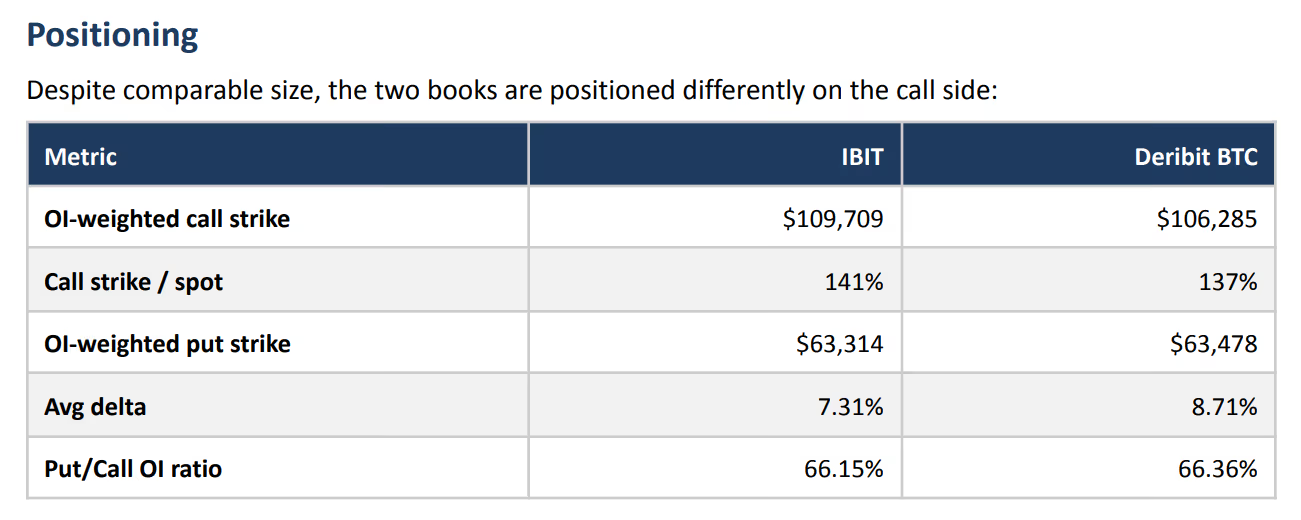
According to Volmex, the bulk of open interest in IBIT call options points to expectations of an ETF rallying to levels equivalent to BTC trading at $109,709 in the near-term. That’s roughly 41% higher than the current market price of $77,400.
Positioning in Deribit options is bullish but slightly measured, suggesting expectations of a rally to $106,000.
“Onshore call OI is concentrated roughly 4 percentage points further out-of-the-money than offshore, and the onshore average delta is slightly lower. This is consistent with onshore flow being dominated by retail upside speculation and systematic call overwriting programs, both of which concentrate OI in further-OTM strikes,” Volmex said in a report shared with CoinDesk.
ETF holders are more patient
Options have expiry dates – the point at which contracts are settled, depending on where IBIT or spot BTC is trading at that time.
Analysis of activity across both markets suggests that, on average, October 2026 expiries are preferred in IBIT, while August expiries dominate on Deribit.
“IBIT options are approximately two months longer-dated on an OI-weighted basis. The gap is roughly symmetric across puts and calls, suggesting it reflects the underlying holder base, longer-horizon ETF investors onshore versus more tactical positioning offshore, rather than asymmetric demand for protection or upside,” Volmex noted.
Lastly, IBIT’s implied volatility – a metric that measures expected swings in the BTC-linked ETF over the next four weeks – is higher than the implied volatility derived from Deribit’s BTC options.
Volmex attributes this premium to a structural quirk: Because ETF holders cannot easily short (express a bearish view) bitcoin directly, they buy put options as their only available hedge. This demand for put options is keeping IBIT’s implied volatility slightly elevated.
All things considered, IBIT’s rapid rise in the options market is striking and, in many ways, now appears to rival Deribit in scale. However, the two are not direct substitutes, as IBIT options primarily cater to regulated, onshore investors accessing bitcoin exposure through traditional brokerage channels, while Deribit remains the go-to place for global investors.
“I don’t see this as competition. If anything, it expands the market. As more participants get comfortable trading options via IBIT, it ultimately feeds into the broader ecosystem, and venues like Deribit benefit from increased sophistication and flow,” Fariq said.
Metaplanet just doubled down again, believing in its Bitcoin price prediction. The Japanese Bitcoin treasury firm announced its 20th bond issuance on Friday, raising ¥8 billion ($50 million) in zero-interest debt to fund further Bitcoin purchases, even as BTC trades near $77,800.
According to a Friday filing, EVO Fund, the Cayman Islands-based investor that has anchored every prior offering, fully subscribed to the latest issuance. The bonds carry zero interest, zero collateral, and zero guarantee, an unusual structure that functions as a rolling credit line, with each bond auto-redeemed as EVO exercises stock warrants in subsequent financing rounds.
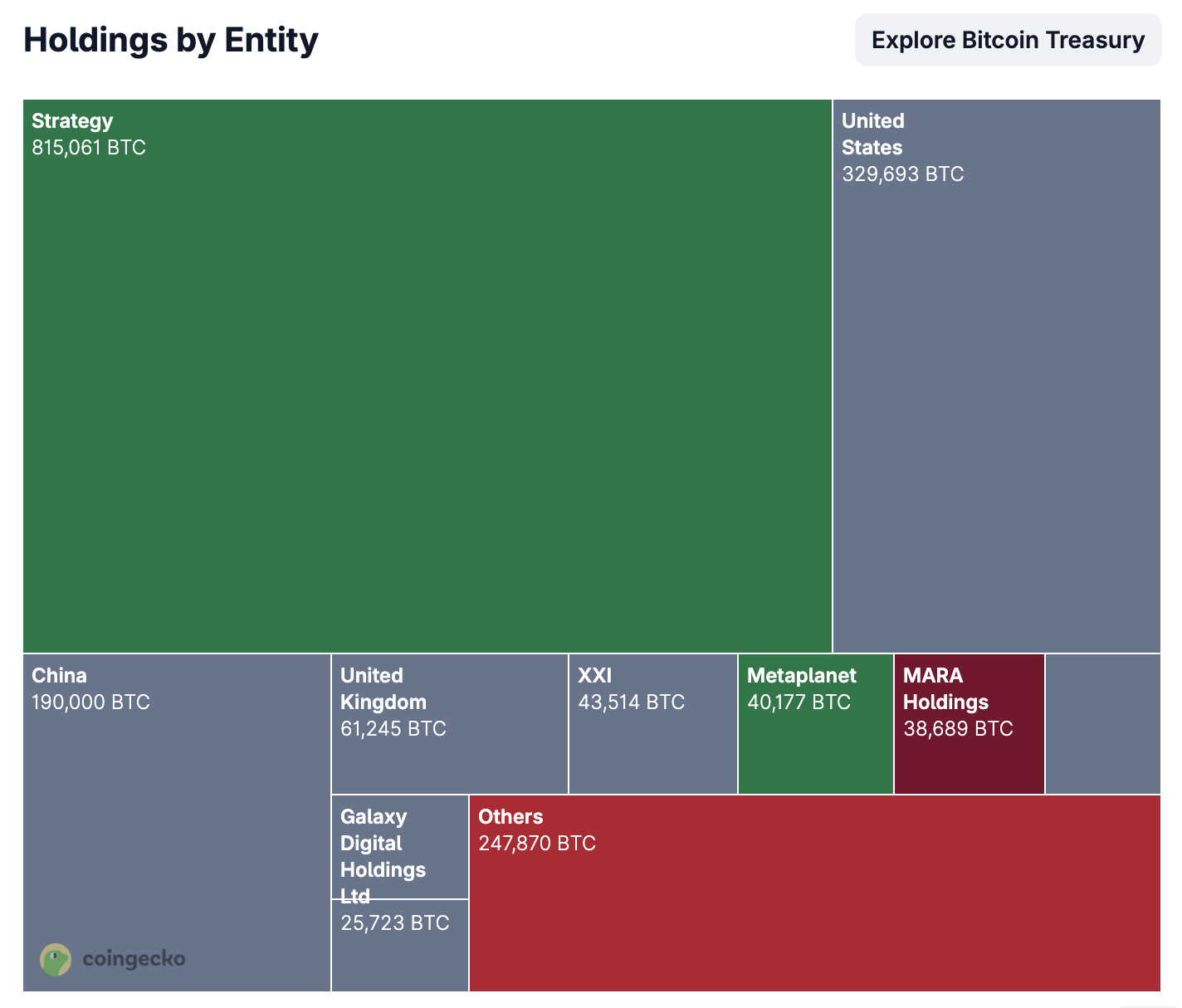
Metaplanet now holds 40,177 BTC, valued at $3.11 billion at the current price, making it the third-largest listed Bitcoin treasury globally. That stack came with a cost as the firm reported a $619 million net loss for fiscal 2025, driven almost entirely by unrealized Bitcoin markdowns.
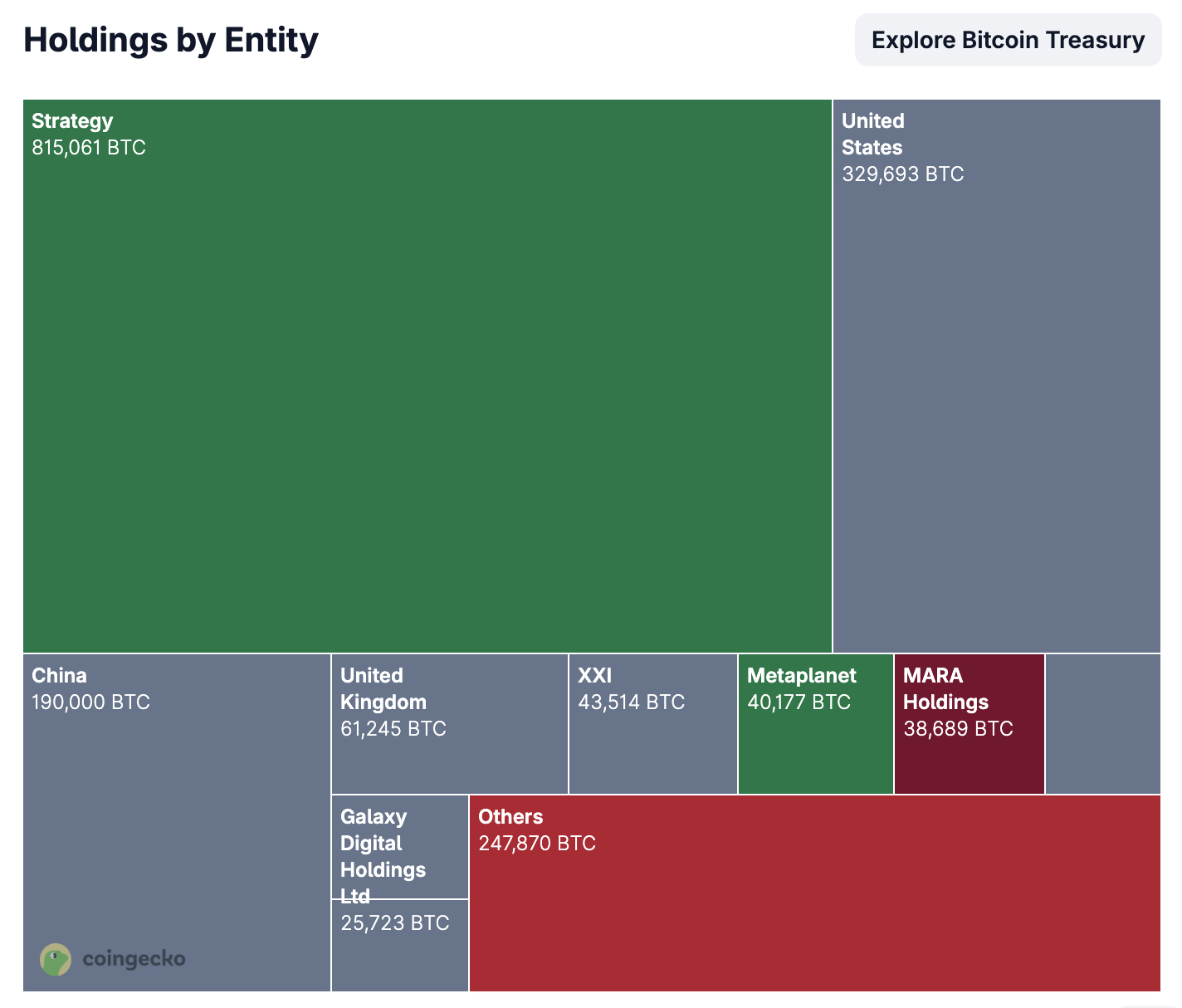
Metaplanet’s aggressive accumulation, 5,075 BTC added in Q1 alone, lands against a backdrop of recovering macro sentiment and renewed institutional interest.
Discover: The best crypto to diversify your portfolio with
Bitcoin Price Prediction: Reclaim $80,000 Next Week as Corporate Buying Pressure Builds?
Bitcoin’s 10% monthly gain to current levels $77,800 marks a meaningful recovery from the pressure tied to geopolitical tensions earlier this quarter, with analysts tracking a critical support band around $68,000 as the floor that needs to hold for any sustained rally thesis.
The technical setup is cautiously constructive. Price is recovering from a multi-month drawdown, and corporate accumulation events like Metaplanet’s bond issuance have historically reinforced institutional demand narratives, much as the BlackRock and Strategy accumulation cycles that preceded previous rallies.
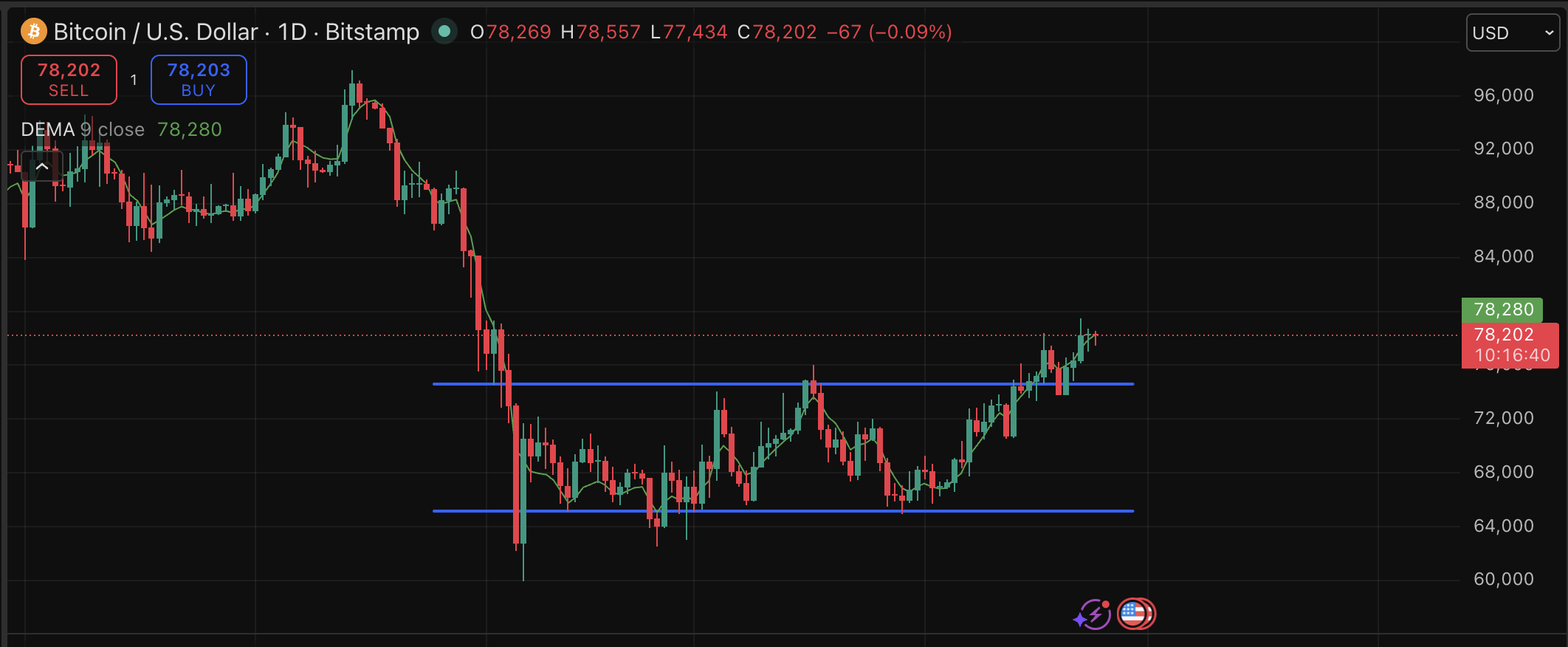
For next week, BTC needs to hold the $75,000 support, with accelerated institutional flows, for its price to retest $80,000 next week.
Macro catalysts, including policy signals from Washington, remain a wildcard that could accelerate any of these scenarios without warning. Metaplanet itself is targeting 100,000 BTC by 2026, which implies sustained buying pressure regardless of short-term price action.
Discover: The best pre-launch token sales
Bitcoin Hyper Targets Early Mover Upside as Bitcoin Tests Key Levels
Bitcoin here is a recovery story, but at a market cap measured in the trillions, the explosive percentage gains belong to an earlier chapter. Traders looking for asymmetric exposure to Bitcoin’s momentum are increasingly looking one layer down: at the infrastructure being built on top of it.
Bitcoin Hyper ($HYPER) positions itself at exactly that intersection. The project claims the title of the first-ever Bitcoin Layer 2 with Solana Virtual Machine (SVM) integration, a combination designed to bring sub-second finality and low-cost smart contract execution to the Bitcoin ecosystem without sacrificing Bitcoin’s underlying security.
Hyper is a project that grafts Solana’s speed onto Bitcoin’s trust layer, a combination that solves three of Bitcoin’s most persistent limitations: slow transactions, high fees, and limited programmability.
The presale has raised $32 million at a current price of $0.0136, with staking available at a high 30% APY for early participants. Feature highlights include a Decentralized Canonical Bridge for BTC transfers and high-speed SVM-powered smart contracts.
For traders who want to go beyond BTC spot exposure, research Bitcoin Hyper here.
The post Bitcoin Price Prediction: Metaplanet Raises $50 Million to Buy More BTC appeared first on Cryptonews.

Key Takeaways
- Advanced Micro Devices stock surged almost 14% Friday following Intel’s impressive Q1 earnings
- D.A. Davidson elevated AMD to Buy rating with a new $375 price target, up from $220
- Intel’s quarterly performance indicated strengthening CPU demand fueled by agentic AI adoption
- Jefferies analysts suggest AMD is capturing server market share from Intel
- AMD’s Q1 earnings report is scheduled for May 5
Shares of Advanced Micro Devices (AMD) delivered impressive gains Friday, surging nearly 14% to approximately $350 following Intel’s exceptional first-quarter earnings performance that energized the semiconductor sector.
Advanced Micro Devices, Inc., AMD
Intel’s quarterly results proved beneficial beyond its own stock price. The report signaled to investors that central processing unit demand is accelerating rapidly, positioning AMD as a prime beneficiary of this trend.
Gil Luria, analyst at D.A. Davidson, elevated his rating on AMD from Neutral to Buy while substantially increasing his price target from $220 to $375—a notable adjustment in a single research note.
Luria cited Intel’s earnings as the catalyst for his revised outlook. Intel delivered first-quarter revenue and profit figures that substantially exceeded Wall Street forecasts, with data center chip revenue showing particular strength.
The underlying catalyst? Agentic AI workloads. As artificial intelligence applications transition from training large language models to executing inference tasks—where models perform practical, real-world functions—CPUs have emerged as critical infrastructure components.
“We view Intel’s results as a precursor for a huge step-up for AMD’s CPU franchise,” Luria stated. He noted that the fundamental shift toward agentic AI is generating server CPU demand at unprecedented levels.
With demand projected to exceed supply availability, Luria also suggested AMD has opportunities to increase pricing throughout its CPU portfolio, potentially expanding profit margins and strengthening earnings capability.
AMD’s Competitive Position Against Intel
While Intel captured attention Friday with a 24% stock surge on its results, multiple analysts believe AMD may offer superior long-term investment potential.
Jefferies, which raised its Intel price target Thursday evening, indicated its strongest enthusiasm remains with AMD. The firm maintains a Buy rating and $300 price target on AMD, while keeping Intel at a Hold rating.
“INTC noted double-digit server unit growth with momentum extending into 2027, but AMD likely sees even better growth,” the Jefferies research team noted. They also highlighted AMD’s forthcoming Venice chips, anticipated in late 2026 or early 2027, as an important catalyst.
Morgan Stanley analyst Joseph Moore provided a more balanced perspective. Maintaining Equal Weight ratings on both companies, Moore suggested Intel’s earnings outperformance stemmed from supply limitations—not from Intel capturing market share from AMD.
Moore indicated the CPU “music is likely to keep playing for a while, as there is no indication that supply catches up to demand.”
Semiconductor Sector Momentum
AMD wasn’t the only chip stock posting substantial gains. Arm Holdings (ARM) also climbed nearly 15% Friday. Arm recently revealed intentions to manufacture its own CPU, intensifying competition with both Intel and AMD.
The PHLX Semiconductor Index advanced 4.5% during the session, marking its 18th consecutive positive trading day. The benchmark has climbed 43% in 2026 and more than 140% over the trailing 12 months.
AMD shares reached an intraday peak of $352.99 Friday, marking the stock’s highest level in over a year. The 52-week trading range extends from $91.87 to $352.99.
Advanced Micro Devices is scheduled to announce its first-quarter financial results on May 5, with an investor conference call commencing at 5:00 p.m. ET the same day.
TLDR:
- Solana Foundation is lending USDT to Aave for the first time to support the protocol’s ongoing recovery effort.
- Foundation Chair Lily Liu confirmed that the AAVE token will be integrated into the Solana network this weekend.
- The Solana Foundation has a history of deploying treasury funds to support DeFi protocols during critical recovery periods.
- Liu framed the cross-ecosystem move as a shared push toward open finance, using the phrase “DeFi United” on X.
Solana Foundation Chair Lily Liu has announced a new move to support DeFi ecosystem stability. The foundation is lending USDT to Aave for the first time as part of a broader recovery effort.
Liu also confirmed plans to bring the AAVE token to the Solana network this weekend. This marks a notable cross-chain gesture from one of crypto’s most active Layer 1 foundations.
Solana Foundation Steps Outside Its Own Ecosystem
The Solana Foundation has long used its treasury to support projects within the Solana network. However, this latest move signals a shift toward broader DeFi support. The foundation is now lending USDT directly into Aave, a leading Ethereum-based lending protocol.
Liu took to X to explain the rationale behind the decision. She wrote that economies do not exist in isolation and that Solana’s health depends on the health of all DeFi. That framing positioned the loan not as charity but as strategic ecosystem thinking.
The foundation has previously deployed treasury funds into Solana DeFi for several years. It also supported Tether’s recovery plan for Drift, a Solana-based trading platform. This Aave loan follows the same pattern of showing up during critical recovery periods.
AAVE Token Set to Launch on Solana This Weekend
Beyond the USDT loan, Liu confirmed that AAVE will be coming to the Solana network this weekend. This addition would make the governance token of one of DeFi’s largest protocols accessible on Solana. It also ties both announcements together under one broader strategy.
Bringing AAVE to Solana opens new opportunities for cross-chain liquidity and participation. Solana users would gain access to AAVE without leaving the network. That could drive additional trading volume and DeFi engagement on Solana.
Liu closed her post with the phrase “DeFi United,” framing the effort as a collaborative push across ecosystems. The Solana Foundation’s willingness to support a competitor’s recovery reflects a maturing approach to DeFi infrastructure. It treats the broader open finance movement as a shared goal rather than a zero-sum competition.

Key Takeaways
- AMD achieved record-breaking 2025 revenue totaling $34.6 billion featuring impressive data center expansion, whereas Intel reported $52.9 billion with no year-over-year movement
- The Data Center division at AMD generated $16.6 billion throughout 2025, propelled by EPYC server chip sales and AI-focused technologies
- Intel’s fiscal Q1 2026 revenue climbed 7% reaching $13.6 billion, though GAAP loss per share remained in negative territory at $(0.73)
- Analyst consensus positions AMD as a Moderate Buy with $296.44 average target price, whereas Intel carries a Hold rating at $72.98
- AMD represents the more reliable execution narrative; Intel remains positioned as a restructuring opportunity carrying greater risk
The semiconductor rivalry between Intel and AMD continues, yet 2025 market sentiment reveals starkly contrasting investor outlooks. One company demonstrates clear expansion momentum. The other represents a work-in-progress revival effort.
Let’s examine what the financial data reveals.
AMD’s Data Center Dominance
AMD delivered an exceptional 2025 performance. The semiconductor manufacturer announced all-time high annual revenue totaling $34.6 billion, achieving a 50% gross margin alongside $4.3 billion in net income. When measured on a non-GAAP basis, operating income reached $7.8 billion.
Advanced Micro Devices, Inc., AMD
The data center division emerged as the primary revenue catalyst. AMD’s Data Center operations generated $16.6 billion throughout 2025. This performance stemmed from accelerating demand for EPYC-branded server processors combined with the company’s artificial intelligence product portfolio.
AMD maintains diversified revenue streams beyond data centers. The Client and Gaming divisions contributed $14.6 billion combined, while Embedded products added another $3.5 billion. This multi-segment approach provides AMD with greater revenue stability compared to competitors dependent on narrower product categories.
Wall Street analysts have responded favorably. Among 40 analysts monitored by MarketBeat, 31 assign AMD a Buy recommendation and 1 rates it Strong Buy. The consensus 12-month price target stands at $296.44.
Intel’s Restructuring Journey
Intel maintains larger absolute revenue figures. The company’s full-year 2025 revenue totaled $52.9 billion, though this represented zero growth versus the prior year. Fourth-quarter revenue declined 4% to $13.7 billion.
The opening quarter of fiscal 2026 displayed modest progress. Revenue increased 7% year-over-year to $13.6 billion. However, Intel’s GAAP earnings per share remained in loss territory at $(0.73) for the period.
This persistent negative earnings position explains why Intel continues to be categorized as a “turnaround” opportunity rather than a “growth” investment by most market participants.
Intel retains significant advantages including operational scale, an established customer ecosystem, and strategic ambitions in contract chip manufacturing via its foundry operations. Yet investors are demanding these strategic initiatives deliver sustainable profitability before reassessing their outlook.
Analyst sentiment mirrors this cautious stance. Among 40 analysts tracking Intel, 25 assign a Hold rating, 11 recommend Buy, and 4 rate it Sell. The average price target stands at $72.98.
Intel’s latest quarterly results confirmed Q1 2026 performance: $13.6 billion revenue accompanied by a GAAP loss of $(0.73) per share.
Final Thoughts
These semiconductor competitors operate in overlapping markets while occupying dramatically different business trajectories. AMD currently demonstrates execution momentum. Intel leverages operational scale. Portfolio inclusion depends on whether investors prioritize demonstrated growth or restructuring upside potential.

Finance Influencers WON’T Tell You This TRUTH | Raj Shamani #shorts

Axis Bank Limited (AXBKY) Q4 2026 Earnings Call Transcript

Crypto is built for AI agents, not humans, according to Alchemy’s CEO

Manchester United reach agreement with Casemiro over contract clause amid transfer speculation

US brings back mandatory military draft registration

Steven Gerrard disagrees with Gary Neville over ‘shock’ Chelsea and Arsenal claim | Football


-

 Business6 days ago
Powerball Result April 18, 2026: No Jackpot Winner in Powerball Draw: $75 Million Rolls Over
-

 Politics6 days ago
Zack Polanski demands ‘council homes not luxury flats for foreign investors’
-

 Fashion1 day ago
Weekend Open Thread – Corporette.com
-

 Tech7 days ago
Auto Enthusiast Scores Running Tesla Model 3 for Two Grand and Turns It Into Bare-Bones Go-Kart
-
Entertainment6 days ago
NBA Analyst Charles Barkley Chimes in on Ice Spice McDonald’s Fiasco
-

 Politics5 days ago
Gary Stevenson delivers timely reminder to register to vote as deadline TODAY
-
Crypto World5 days ago
Bank of Hawai’i (BOH) Q1 2026: Net Income Drops to $57.4M as Net Interest Margin Expands
-

 Politics3 days ago
Making troops accountable for war crimes threatens US alliance, ex-SAS colonel warns
-

 Business3 days ago
Rolls-Royce Voted UK’s Most Iconic Trade Mark as IPO Register Hits 150
-

 Politics3 days ago
Disabled people challenge government SEND proposals over segregation concerns
-

 Politics3 days ago
Zack Polanski responds to home secretary’s taser threat
-

 Politics3 days ago
Starmer handler McSweeney to be dragged from shadows by Foreign Affairs Committee
-
Politics3 days ago
Wings Over Scotland | How To Get Away With Crimes
-
Crypto World7 days ago
Kelp DAO rsETH Bridge Hack Drains $292M as DeFi Losses Top $600M in Two Weeks
-

 Politics3 days ago
‘Iran is still a nuclear threat’
-

 Crypto World4 days ago
New York sues Coinbase, Gemini over prediction market offerings
-
 Crypto World4 days ago
Five Value Stocks with Recovery Potential in 2026: PayPal (PYPL), Nike (NKE), and More
-

 Business4 days ago
The Job Benefits Most Men Don’t Know to Negotiate
-

 Crypto World1 day ago
Michael Saylor says BTC winter is over. Market analyst disagrees, says bitcoin was in a pullback
-

 Politics6 days ago
Reform investigating candidate who ‘hates’ the NHS
You must be logged in to post a comment Login