
Crypto World
Netflix’s ‘A Different World’ Revival Has Less Spark But Loads of Heart


Her inner circle includes roommate Rashida Duvall (Alijah Kai, another standout), a driven scholarship student who calls herself “the Simone Biles of school” and whose eventual bond with Deborah echoes Whitley’s odd-couple friendship with her own Hillman roommate, Kim (Charnele Brown, who also guest stars). Hazel Henry (Kennedi Reece), whose church-girl innocence belies big ambitions, completes the trio. Among Shaquille’s boys are Kojo Achebe (Chibuikem Uche), whose aspirations of becoming a fashion designer don’t exactly thrill his strict African parents, and Amir Rodale (Jordan Aaron Hall), a formerly incarcerated student whose time in juvie continues to interfere with his life at Hillman. Amir is also the franchise’s first gay main character, an identity that Hall and the writers navigate with grace and ease.
It’s a reverent reinvention, one that the people behind the first Different World clearly support. (Jada Pinkett Smith, Joe Morton, Glynn Turman, and Jenifer Lewis are just a few of the other past stars who appear.) Without defaulting to the Very Special Episodes that worked better in primetime than they do in a binge-dropped streaming season, Pride engages with issues relevant to her young, Black characters, often letting themes develop across episodes. Allen’s groundbreaking storylines about apartheid protests, AIDS, and the censorship of rap lyrics have given way to ones that consider the stigma around learning disabilities, friction between African and Black American cultures, and HBCUs’ reliance on funding from an anti-DEI federal government. In one episode, a bomb threat forces students to realize the school they’d hoped would give them a four-year reprieve from racism is also uniquely vulnerable to it. Yet, true to its history, the show thoughtfully interweaves these topical beats into collegiate lives that revolve around schoolwork, romantic mess, friend-group drama, money troubles, dreams of the future.

Binance has scheduled Hyperliquid (HYPE) spot trading for Sept. 24 at 11:00 UTC, with three pairs opening as the token carries a market capitalization near $21 billion.
Summary
- Binance will open HYPE spot trading against USDT, USDC and TRY at 11:00 UTC Thursday.
- HYPE receives Binance’s Seed Tag, requiring eligible traders to complete risk quizzes every 90 days.
- Withdrawals are scheduled for September 25, while Binance charges zero BNB as HYPE’s listing fee.
- CoinGecko data puts HYPE’s September 24 market capitalization near $20.9 billion with billion-dollar daily volume.
- Hyperliquid generated $429.04 million through September 15, leading CoinGecko’s adjusted 2026 crypto revenue ranking overall.
Binance, in its Sept. 24 listing notice, announced HYPE/USDT, HYPE/USDC and HYPE/TRY as the initial spot markets. The exchange said deposits would become available one hour after its announcement, while withdrawals are expected to open at 11:00 UTC on Sept. 25. Binance set the listing fee at zero BNB.
Binance HYPE listing opens three spot pairs
Spot Algo Orders are scheduled to become available when HYPE trading starts at 11:00 UTC. Binance said Trading Bots and Spot Copy Trading would follow within 24 hours of the spot listing. Users running copy-trading portfolios can add the new pairs through Binance’s Personal Pair Preference settings.
Access to HYPE/TRY carries a separate restriction. Binance said the Turkish lira pair will only be available to customers with verified Binance TR accounts. TRY represents fiat currency in the listing and is not another digital asset.
Trading eligibility depends on location and account verification. Residents of the United States and its territories cannot trade the three new pairs through Binance, according to the exchange. The restricted list currently includes Canada, the Netherlands, Iran, North Korea, Syria and several other jurisdictions. Binance said the list may change in response to legal or regulatory requirements.
The listing gives HYPE another centralized spot venue while Hyperliquid remains focused heavily on on-chain trading. In related coverage, crypto.news reported that Coinbase added more than 290 Hyperliquid perpetual markets to its Base App in August, offering leverage of up to 50x to eligible users. U.S., U.K. and Canadian users were excluded from that product at launch.
HYPE Seed Tag adds a recurring risk quiz
Binance has attached its Seed Tag to HYPE, a designation the exchange uses for newer projects that it says may carry higher volatility and risk than other listed assets. Binance said HYPE “poses a higher than normal risk” and “will likely be subject to high price volatility.”
Users seeking access to Seed Tag tokens must complete Binance’s risk quiz every 90 days and accept its terms of use. The requirement applies through Binance Spot and Margin where supported, while a risk-warning banner appears on tagged token pages.
Binance introduced the Seed Tag in 2023 to replace its former Innovation Zone designation. Its guidance says tagged projects undergo periodic reviews covering trading volume, liquidity, development activity, network security, team commitment and responses to due-diligence requests.
The designation does not change the announced HYPE launch schedule. Binance said withdrawals are planned for Sept. 25 at 11:00 UTC but described that time as an estimate. The exchange directs users to its withdrawal page for the actual opening status.
HYPE enters Binance listing day near a $21 billion value
CoinGecko’s Sept. 24 data shows HYPE with a market capitalization of $20.91 billion and trading volume of roughly $1.13 billion. The token closed Sept. 23 at $93.98 after closing at $97.19 one day earlier. CoinGecko had not posted a Sept. 24 closing price at the time of its current daily snapshot.
The recent price history shows HYPE climbing rapidly during the preceding week. CoinGecko recorded a $76.92 close on Sept. 15, followed by $85.06 on Sept. 17 and $92.54 on Sept. 18. The token closed Sept. 20 at $93.64 before reaching $94.05 on Sept. 21.
An immediate post-announcement price move has been reported by third-party market coverage. BeInCrypto, citing TradingView’s HYPE/USD market on Coinbase, reported an increase of roughly 1.5% within ten minutes of Binance publishing the listing notice, with the move briefly approaching 1.9%. The figures describe a short intraday reaction and do not establish that Binance’s announcement caused subsequent HYPE price movements.
Recent activity has taken place alongside rising protocol revenue. As crypto.news reported in its coverage of Hyperliquid’s $429 million 2026 revenue lead, CoinGecko calculated $429.04 million in revenue from Jan. 1 through Sept. 15. The figure represented 12.62% of the $3.40 billion comparison pool used in CoinGecko’s adjusted ranking.
Hyperliquid remains first in normalized perp DEX volume
Current DeFiLlama data ranks Hyperliquid first among tracked perpetual DEXs by 24-hour normalized trading volume. Hyperliquid recorded approximately $7.42 billion, compared with $2.08 billion for Aster and $1.93 billion for Lighter. Its reported 30-day perpetual volume stood near $220 billion in the same dataset.
Open interest on Hyperliquid stood at approximately $9.06 billion, according to DeFiLlama. The platform accounted for more than half of the $15.30 billion in open interest shown across the tracked perpetual DEX market at the time of the snapshot. The figures change continuously with trading activity.
Hyperliquid’s own documentation states that perpetual and spot trading fees use volume-based tiers, while HYPE staking can reduce trading fees. Accounts linked to more than 500,000 staked HYPE qualify for the highest published 40% fee discount, while qualifying high-volume market makers can receive rebates reaching 0.003%.
Trading fees routed to Hyperliquid’s Assistance Fund are automatically converted into HYPE, according to the protocol’s documentation, with acquired tokens burned from supply. Crypto.news recently reported on Hyperliquid adding trailing stops to its perpetual markets, allowing trigger prices to follow favorable market moves before executing a market order after a specified retracement.
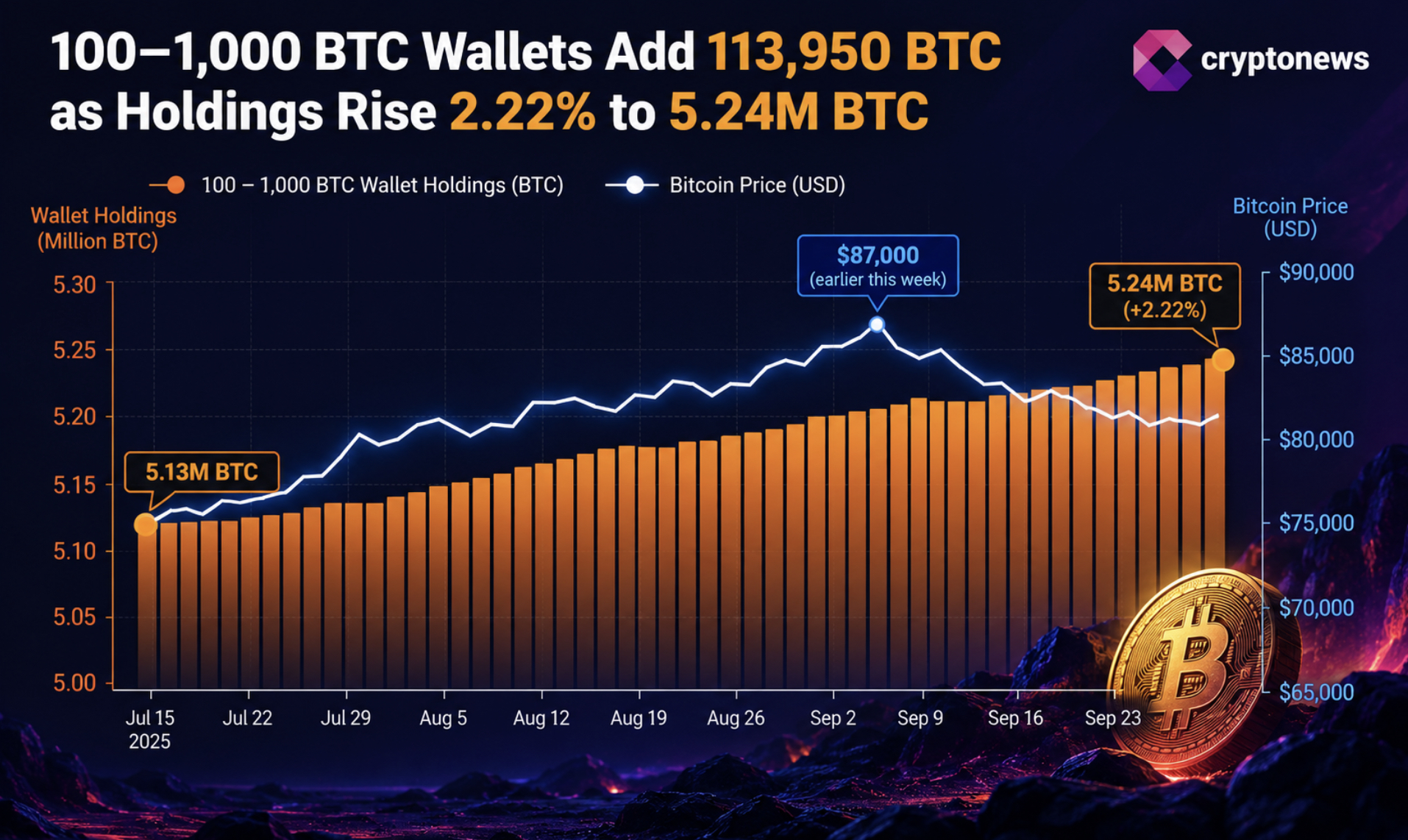
Wallets holding between 100 and 1,000 BTC have added 113,950 Bitcoin since July 15, lifting their combined holdings 2.22% to 5.24 million BTC, according to Santiment. The accumulation run coincides with Bitcoin price briefly tapping $87,000 earlier this week before retracing and stabilizing near $84,000.
Is this durable demand building a base for a breakout, or is it a squeeze-driven bounce that stalls the moment leverage unwinds?
Not everyone is convinced this move reflects a genuine shift in risk appetite. Trace Finance co-founder Bernardo Brites says that the speed of the recovery was partly a function of a short squeeze, and that the bigger question is where the new money is actually coming from.
“I wouldn’t read this as a broad return of risk appetite. Bitcoin rallying through a rate hike, $100 oil, and elevated yields suggests some investors are treating it as a hedge against inflation, fiscal and geopolitical risk rather than as a bet on easy money,” Brites said.
That framing matters for anyone reading the current resistance structure as a clean technical setup rather than a macro hedge trade layered on top of one.
Santiment has tracked this 100-to-1,000-BTC wallet cohort for five years, and its activity has historically aligned closely with market direction. Periods of heavy accumulation have often preceded or coincided with stronger price moves. The current data shows the cohort continued buying through the recovery, which at minimum indicates the rally isn’t being carried by retail flow alone.
Discover: Best Crypto IPO this September
What Bitcoin Needs to Breach the $88,000-$90,000 Resistance?
The technical picture underneath the whale and ETF data is straightforward. Bitcoin reclaimed its 365-day moving average near $80,500, a level it last broke back above in March 2023 – a move that preceded a much larger rally at the time. It also cleared the $76,000-$81,000 supply band that had capped price action for weeks.
That $88,000-$90,000 Bitcoin price band matters specifically because of where the coin supply sits, not because of round-number psychology. A large concentration of Bitcoin clustered in that range means sellers are likely to show up in size the closer the price gets to it, which is exactly why the $90,000 target is treated as the next real test.
Trade Bictoin on Bybit and Get a Chance to Win Our $1,000 USDT Airdrop
ETF Demand at the Bitcoin Price Resistance Test
The two-sided framing gives traders a concrete way to read what happens next rather than guessing. A continuation of ETF inflows alongside renewed stablecoin supply growth would, in our view, build a stronger base under the rally as it approaches resistance. A stall in either, particularly a fade in ETF demand while price sits below $88,000, leaves the move vulnerable to giving back gains as leveraged positioning unwinds.

CryptoQuant founder Ki Young Ju has separately argued this cycle is more likely to produce a 3-to-5x rally than a repeat of past 10x blow-offs, citing a maturing market and growing institutional participation as dampeners on extreme volatility.
That view doesn’t confirm where Bitcoin goes after $90,000; it simply lowers the bar for what counts as a strong outcome this cycle, a distinction worth keeping in mind while watching the longer-term structural recovery play out against this specific resistance test.
Earn $50 and Enter $300K Prize Draw on EdgeX
The post Mid-Sized Bitcoin Wallets Add 113,950 Bitcoin as Price Rally Nears Test appeared first on Cryptonews.

StarkWare says optimization efforts connected to its Quantum-Safe Bitcoin (QSB) work have driven down the estimated computational cost of constructing a quantum-resistant Bitcoin transaction to under $67—down from about $320 for the first QSB transaction demonstrated on mainnet in August. The latest figure, published in a Sept. 23 update and reflected on the Yukon QSB dashboard, suggests the benchmark cost has continued to edge lower to roughly $66.
While the QSB approach is designed to improve resilience against future quantum threats without requiring changes to Bitcoin’s consensus rules, StarkWare cautions that the new numbers are based on benchmark tests. The development nonetheless matters for anyone evaluating practical “emergency” defenses for large holders who may be most exposed if public keys are later compromised by quantum-capable machines.
Key takeaways
- StarkWare reports QSB transaction construction costs fell to about $66–$67 after a week of optimization.
- The cost decline follows the Quantum-Safe Bitcoin Optimization Challenge, which generated improvements across the benchmarked transaction-building steps.
- The earliest mainnet QSB demonstration required ~3,100 GPU-hours and cost around $320 in compute, excluding Bitcoin network fees.
- QSB is positioned as an “emergency” measure; StarkWare says broader, long-term protection likely still requires a consensus-layer soft fork.
- StarkWare emphasizes the latest optimizations are verified via benchmarks, not renewed full mainnet demonstrations.
From a $320 demo to a sub-$67 benchmark
StarkWare’s update ties the cost reduction to participant work in the Quantum-Safe Bitcoin Optimization Challenge, a collaborative effort involving Yukon Research and Eigen Labs. The initiative focused on reducing the GPU computation needed to prepare a QSB transaction.
In August, StarkWare said a QSB transaction was mined and confirmed on Bitcoin’s mainnet. According to that earlier account, the engineering effort behind the demonstration involved Tomer Giladi and submission via MARA’s Slipstream service. Preparing the transaction required approximately 3,100 GPU-hours across roughly 100 GPUs, translating to about $320 in compute cost, excluding network fees.
The new update describes how the challenge achieved a sharper efficiency gap. StarkWare reports that the competition produced 62 accepted improvements across two computational tasks required to build a QSB transaction. Based on benchmark testing, these changes reduced the estimated computing cost by about 79%—bringing it down to the current $66–$67 range shown on the Yukon dashboard.
Why QSB is framed as an “emergency” defense
The broader motivation for QSB is the risk that a sufficiently powerful quantum computer could break the elliptic-curve digital signatures Bitcoin relies on. If that future capability arrives, attackers could potentially steal coins whose public keys are exposed, making timing and practicality important for holders who need protection under constrained conditions.
StarkWare’s QSB design, first published by researcher Avihu Levy in April, aims to add hash-based protection against quantum attacks without changing Bitcoin’s consensus rules. That non-consensus approach is part of what makes QSB attractive as an add-on defense—particularly if consensus changes remain difficult or slow.
However, Levy previously characterized QSB as a “last resort measure,” citing cost, complexity, and limited applicability. StarkWare’s latest messaging continues that framing: even with a nearly 80% reduction, a few hundred dollars per transaction still signals that QSB remains closer to an emergency tool than a fully routine mechanism for all holders.
The challenge’s impact—and what remains unproven
The Optimization Challenge opened on Sept. 16, inviting developers, researchers, and AI agents to refine the software needed to generate QSB transactions more efficiently. StarkWare says the resulting improvements were accepted across two computational tasks that together determine the overall benchmark cost.
The key point for investors and builders is the distinction between benchmark performance and real-world transaction preparation at full scale. StarkWare’s update presents the new $66–$67 number as an estimated computational cost derived from performance tests. That means the update demonstrates algorithmic and engineering efficiency, but it does not, by itself, confirm that the most recent optimizations have been used to create and confirm additional QSB mainnet transactions.
Still, the direction of travel is meaningful: getting from roughly $320 to under $67 transforms the practicality of the technique for larger holders who may prioritize the ability to execute a protective transaction when conditions warrant it. In its Sept. 23 update, StarkWare argued that a construction costing a few hundred dollars is “a demo,” while costs closer to $67 are more plausible for emergency use by holders with significant balances—without requiring network rule changes.
Soft forks remain the long-term focus
QSB exists within a broader debate on how Bitcoin should prepare for quantum threats. StarkWare says it continues to favor a soft fork—a change to Bitcoin’s consensus rules—as a better “long-term answer” for wider, more reliable quantum protection across the ecosystem.
This matters because emergency add-ons, while potentially useful, are inherently narrower in scope: they do not automatically provide the systemic coverage that consensus-level changes can offer. The latest cost reductions therefore read less like a final end-state and more like progress toward making an interim strategy less prohibitive while the community works through governance, implementation, and security trade-offs for longer-range solutions.
For now, readers should watch the Yukon QSB dashboard for whether the benchmark estimates keep moving and whether the community follows up with additional mainnet demonstrations using the newly optimized construction pathways. The biggest open question remains whether benchmark gains translate into repeated, end-to-end operational readiness when real constraints—beyond compute estimates—come into play.

Citigroup has pushed its forecast for the Federal Reserve’s next interest rate cut to June 2027 after stronger US jobs data reduced concerns over the labor market, leaving Bitcoin and the crypto market facing the prospect of higher borrowing costs for longer.
Summary
- Citi now expects the Fed’s first rate cut in June 2027 after US employers added 162,000 jobs in August, well above forecasts.
- Bitcoin initially fell below $80,000 as stronger jobs data raised rate hike expectations, but later recovered above $86,000.
- Higher rates remain a pressure point for crypto, although ETF demand and short covering have helped Bitcoin withstand tighter Fed policy.
Reuters reported that Citi had previously expected the Fed to cut rates in October and December 2026 and again in January 2027. The bank has replaced those calls with three reductions in June, September and December 2027 after August payrolls came in well above forecasts.
US employers added 162,000 jobs in August, compared with economists’ expectations of 53,000, while the unemployment rate remained at 4.1%. The monthly payroll gain was the strongest since March, and the labor force participation rate rose by 0.2 percentage point.
Earlier employment figures were revised higher as well. July payrolls were changed to a gain of 21,000 from a previously reported loss of 23,000, while the June figure was raised by 11,000.
Citi economists Andrew Hollenhorst and Veronica Clark said the figures suggested Fed officials would see employment conditions as broadly stable and focus more closely on inflation.
“The unemployment rate was unchanged and labor force participation rebounded noticeably,” they wrote.
Strong jobs data changed Fed expectations and hit Bitcoin
The jobs report quickly reached the crypto market as traders raised their expectations for tighter monetary policy.
Bitcoin fell below $80,000 following the August employment data, reversing from an intraday high around $81,370 as markets repriced the outlook for US interest rates. As crypto.news previously reported, BTC was trading near $79,600 after the release, down around 1.5% over 24 hours.
Rate futures at the time placed a 61% probability on a Fed hike at the Sept. 15 to 16 meeting, up from 52% before the employment figures were released, according to Reuters.
The Fed has since delivered that increase. Policymakers raised the benchmark rate by 25 basis points on Sept. 16, taking the federal funds target range to 3.75% to 4%. It was the central bank’s first rate hike since July 2023.
New projections released with the decision showed that 16 of 18 Fed officials expected at least one more rate increase before the end of 2026.
Citi’s revised forecast now places the first expected cut roughly nine months after the September hike. The bank had previously been among the more dovish forecasters on Fed policy, with its earlier projections calling for three cuts between October 2026 and January 2027.
Higher rates remain a pressure point for Bitcoin and crypto
Bitcoin has repeatedly reacted to changes in US interest rate expectations this year as inflation, employment and energy prices changed the path investors expected the Fed to take.
A stronger labor market gives policymakers less reason to lower borrowing costs to support employment, while persistent inflation has kept attention on the other side of the Fed’s dual mandate.
Inflation has remained above the central bank’s 2% target for more than five years. Fed officials have consequently kept open the possibility of tighter policy if monthly inflation readings fail to show sufficient moderation.
That backdrop has already produced periods of pressure across crypto markets. Ahead of the September Fed meeting, the global crypto market lost more than 2% as the probability of a 25 basis point rate increase moved above 92%. Bitcoin fell below $76,000 during the move.
Treasury yields and the US dollar can compete with risk assets for capital when investors expect rates to remain elevated. Crypto assets do not generate interest simply from being held, while higher yields on government debt can give investors another place to park capital.
Market behavior since the Fed meeting, however, has not followed a simple higher rates equals lower Bitcoin pattern.
Bitcoin has recovered despite the Fed rate hike
Bitcoin briefly moved toward $75,000 after the Sept. 16 decision but later recovered, eventually climbing above $86,000 as ETF demand returned, Treasury yields eased and short sellers were forced to close bearish positions.
The cryptocurrency briefly touched $87,000 this week, its highest level since late January. US spot Bitcoin ETFs recorded $433 million in net inflows on Sept. 18 after heavy withdrawals earlier in the week.
HashKey Group senior researcher Tim Sun said ETF inflows confirmed the rally instead of starting it, while the move through $82,000 triggered short covering that helped carry BTC higher.
BitGo Research has similarly argued that Bitcoin absorbed the Fed hike better than might have been expected. Research chief Greg Cipolaro pointed to Bitcoin’s recovery following both the Fed decision and the failed Senate cloture vote on the CLARITY Act.
The interpretation remains a market view rather than proof that Bitcoin has become insulated from monetary policy. BTC’s rebound coincided with several developments, including renewed ETF demand, falling Treasury yields, lower oil prices and short covering, making it difficult to attribute the move to one factor.
Citi’s new rate path therefore arrives as Bitcoin trades in a different environment from the one immediately following the August employment report. Markets have already absorbed one Fed hike, while policymakers have signaled that another increase remains possible before year end.
Fed Governor Christopher Waller and New York Fed President John Williams have said they favor holding rates steady as long as inflation continues to moderate on a monthly basis. Waller and Fed Governor Michael Barr have left the door open to further increases if incoming figures fail to show continued progress on prices.
Citi now expects the first reduction in June 2027, followed by cuts in September and December, replacing the three reductions it had previously forecast between October 2026 and January 2027.

The Federal Reserve’s decision last week to raise interest rates for the first time since 2023 has stirred fears that the economy is moving into the later stages of the business cycle. Morgan Stanley sees something different: a “classic” mid-cycle environment that could increasingly favor large-cap, high-quality stocks as earnings season approaches.
“Stick with large cap quality stocks,” Morgan Stanley strategist Mike Wilson wrote in a Monday note reviewed by Business Insider.
Must Read
The bank identified 15 major stocks that fit its quality criteria and carry an “overweight” rating from its analysts, including chipmakers Nvidia (NASDAQ: NVDA) and Micron Technology (NASDAQ: MU), tech companies Apple (NASDAQ: AAPL) and SanDisk (NASDAQ: SNDK) and credit giants Visa (NYSE: V) and Mastercard (NYSE: MA).
The rest of the list spans several sectors, including consumer staples, retail, health care, technology, semiconductor equipment, software and travel.
Among them are Costco (NASDAQ: COST), Coca-Cola (NYSE: KO), Lam Research (NASDAQ: LRCX), Arista Networks (NYSE: ANET), Gilead Sciences (NASDAQ: GILD), Seagate Technology (NASDAQ: STX) and Booking Holdings (NASDAQ: BKNG), along with the beaten-down UnitedHealth (NYSE: UNH) and ServiceNow (NYSE: NOW), which was caught up in the broader software selloff earlier this year.
To make the cut, companies had to rank among the 1,000 largest stocks by market value, have higher earnings estimates than three months ago, place in the top third of Morgan Stanley’s quality screen and carry an “overweight” rating from the bank’s analysts.
What changes in mid-cycle
The focus on earnings reflects Morgan Stanley’s broader view of where the market is headed. The bank believes that the bull market still has room to run, but the companies leading it could change as the economic cycle matures. Wilson has previously described a shift away from the early-cycle environment, when economically sensitive, higher-risk companies benefited as earnings rebounded from depressed levels.
In the mid-cycle phase, strong earnings growth becomes more important as higher interest rates weigh on stock valuations. Wilson has pointed to the current combination of strong earnings growth and declining valuations as a sign that this shift is already underway.
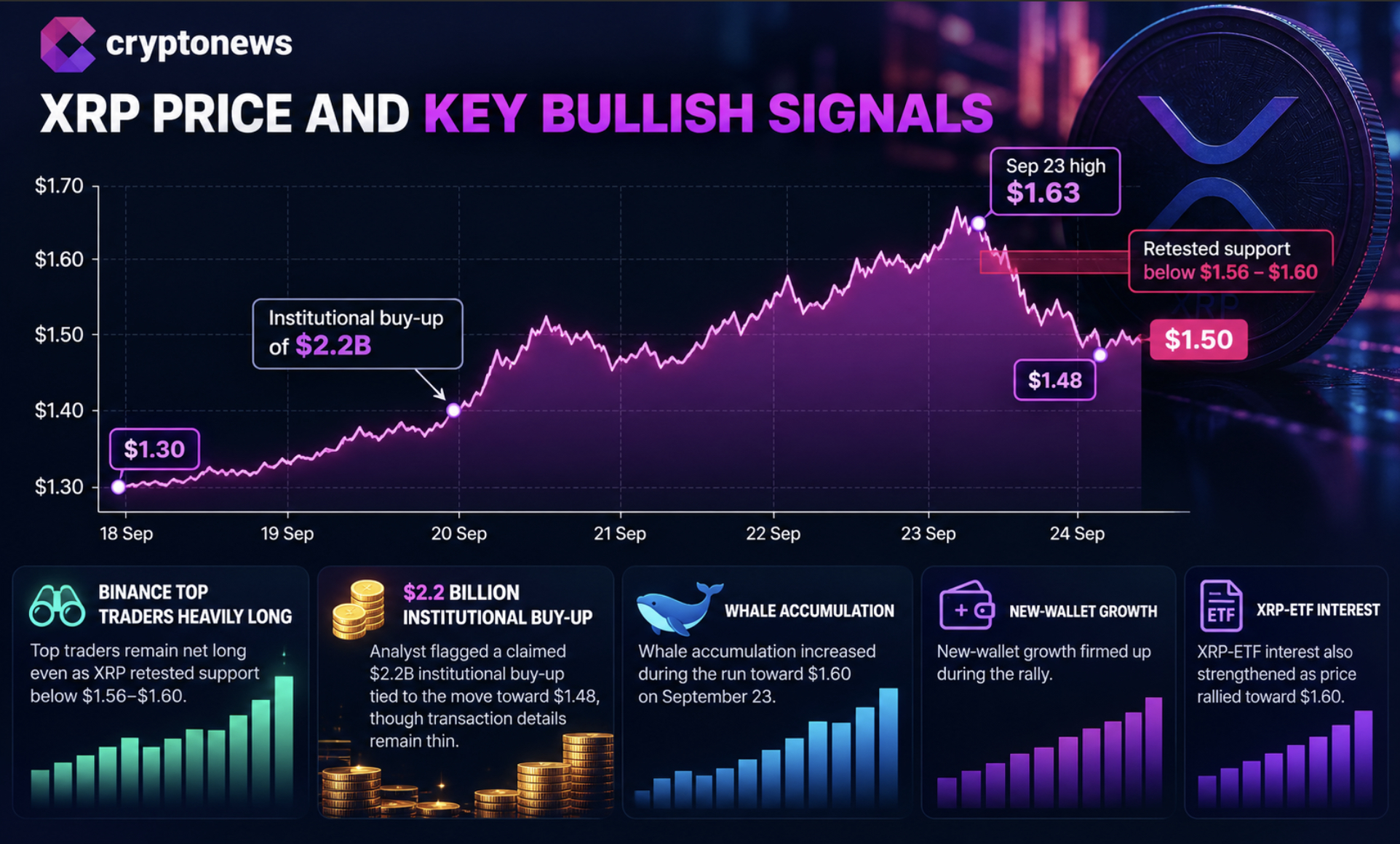
XRP is trading at $1.50, down 7.6% over the past 24 hours after reaching $1.63 during the period. Despite the pullback and a bearish price prediction, XRP remains up 15.1% over the past seven days, recovering sharply from its recent lows. XRP’s market cap currently stands at roughly $94.1 billion, below the $100 billion mark it briefly approached during the rally.
Binance’s top traders remain heavily long even as XRP retested support below the $1.56–$1.60 zone it broke through earlier in the week. Our analyst flagged a claimed $2.2 billion institutional buy-up tied to the move toward $1.48, though transaction details remain thin. Whale accumulation, new-wallet growth, and XRP-ETF interest all firmed up during the run toward $1.60 on September 23.
The broader tape isn’t helping. Treasury yields hit their highest level since 2007 this week on inflation worries, dragging the Dow, S&P 500, and Nasdaq lower, a risk-off signal that can weigh on crypto alongside token-specific factors.
Discover: Best Crypto IPO this September
XRP Price Prediction: Can Ripple Hit $1.70 This Week?
XRP’s current structure looks like a pullback after a breakout attempt, not a breakdown. Support sits at $1.50–$1.53, with deeper floors at $1.44–$1.45 and $1.35–$1.40 if selling accelerates. The 20-day EMA near $1.4171 is the level bulls need to defend to keep the broader trend intact.

- Bull case: a reclaim and hold above $1.56–$1.60 opens a path to $1.6999 and $1.8111, especially if ETF-related demand and whale accumulation persist into Ripple’s Swell 2026 conference.
- Base case: range-bound chop between $1.45 and $1.60 while the market digests macro noise.
- Bear case: a close below $1.44 invalidates the near-term bullish structure and puts $1.35–$1.40 back in play.
RSI data and historical rebound patterns suggest the pullback may be shallower than October seasonality implies. See the full RSI breakdown here. Open interest, funding rates, and ETF flow data add further context on whether leverage is set up for a squeeze or a flush.
Trade XRP on Bybit and Get a Chance to Win Our $1,000 USDT Airdrop
Maxi Doge Targets Early Mover Upside as XRP Tests Key Levels
Holding XRP through the October chop is a defensible position; the three bullish metrics (whale flows, futures positioning, ETF interest) argue the dip gets bought. But at a $90 billion-plus market cap, XRP isn’t delivering 10x moves from here. That kind of asymmetric upside now lives further down the risk curve, in presale-stage tokens still finding their price.
Enter Maxi Doge ($MAXI), a meme token built entirely around leverage-trading culture. Think a 240-lb canine mascot channeling “1000x leverage” energy, holder-only trading competitions with leaderboard rewards, and a Maxi Fund treasury backing liquidity and partnerships.
The presale has raised $4.8 million at a current price of just $0.000284, with dynamic APY staking live for early holders. The tagline sums up the pitch: never skip leg-day, never skip a pump.
Check the Maxi Doge presale details here.
Earn $50 and Enter $300K Prize Draw on EdgeX
The post XRP Price Prediction: October is a Weak Month for Ripple, But 3 Metrics Point Bullish appeared first on Cryptonews.


Strategic Shift to Proprietary IP and Direct-to-Consumer Ecosystem
Our analysts just identified a stock with the potential to be the next Nvidia. Tell us how you invest and we’ll show you why it’s our #1 pick. Tap here.
-
Management is transitioning the business model into a strategic closed loop, integrating proprietary IPs with direct-to-customer (D2C) channels to reduce reliance on volatile third-party distribution.
-
The company is deliberately prioritizing long-term IP asset value and perceived scarcity over short-term wholesale volume, viewing distribution as a reach tool rather than a loyalty driver.
-
Performance attribution for the fiscal year highlights the successful scaling of the proprietary IP ‘SIINONO’, which reached a near CNY 100 million annualized scale in under 12 months.
-
Operational priorities have shifted toward perfecting structural unit economics and D2C retail networks, which serve as both premium theaters for product presentation and incubators for new IP testing.
-
Management attributes the current bottom-line loss to a one-time non-cash market valuation adjustment and necessary upfront investments in design and brick-and-mortar expansion.
-
The ‘others’ IP category saw a 661% year-over-year surge, validating a diversified flywheel strategy intended to mitigate dependency on any single flagship IP.
Operational Refinement and Sustainable Profitability Mandate
-
The near-term strategic mandate focuses on driving toward sustainable profitability by aligning cost structures with stabilized revenue through disciplined expense optimization.
-
Management expects to close the gap between revenue and cost trends over time as they transition from aggressive deployment to maximizing same-machine efficiency in the Roboshop network.
-
Future inventory management will leverage real-time data from D2C stores and Roboshops to build predictive demand models, reducing the mismatch between production and market sell-through.
-
The company plans to capture peak tourist flows during the National Day Golden Week via the launch of a multilayered experiential cruise project at Hong Kong’s Central Pier.
-
Guidance assumes a continued challenging retail environment, with management refusing to resort to aggressive clearing measures that might undermine brand premium.
Non-Operating Adjustments and Structural Headwinds
-
A one-time non-operating loss was recorded due to market valuation adjustments, which management emphasized is non-cash and separate from core operations.
-
A goodwill impairment charge of CNY 124.1 million was recognized related to the Fastone acquisition, driven by lower-than-expected performance amid macro headwinds.
-
Channel inventory levels exceeded normal ranges due to a structural mismatch between the cooling macro environment and historical wholesale-led operating paces.
-
The company initiated a $20 million ADS repurchase program in June 2026, signaling confidence in long-term asset value despite current market volatility.
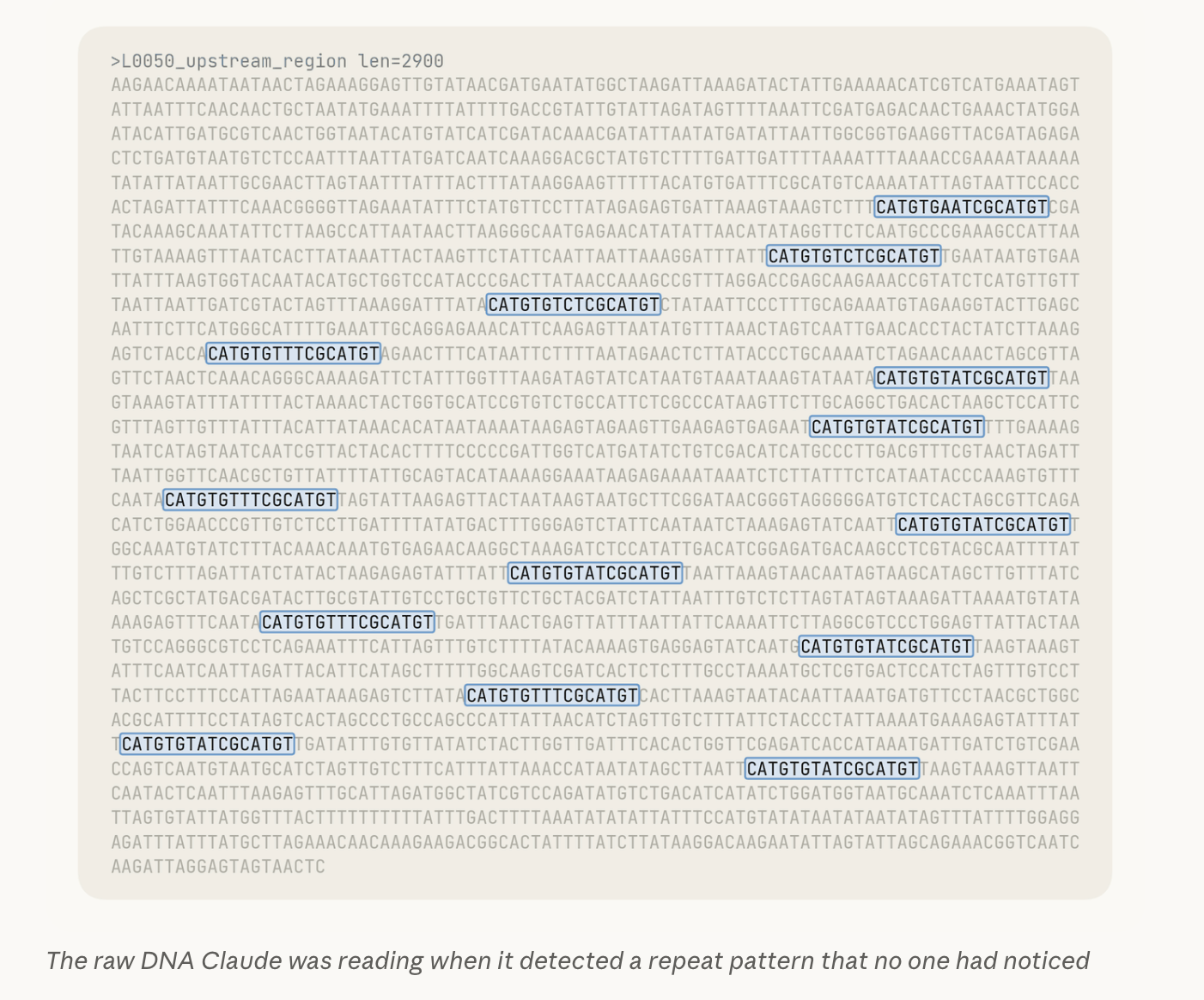
Anthropic says Claude has discovered a previously unknown enzyme system in the DNA of viruses that infect bacteria. Earlier studies had recorded the enzyme at its core but appear to have missed what surrounds it.
Anthropic published the findings on September 23. The findings stand as key evidence that AI can now spot patterns human experts overlooked. But what exactly does this discovery mean?
Why Should Anyone Outside a Lab Care?
Many discoveries that changed medicine began with a scientist noticing something odd in nature. Scientists’ use of restriction enzymes, found in bacteria, helped launch the biotechnology industry.
An enzyme from a Yellowstone hot spring became the basis for PCR. That DNA-copying method now sits behind much of modern medical testing.
Claude has now taken that noticing step with only broad direction from Anthropic’s scientists. Anthropic CEO Dario Amodei argues this fits a wider pattern. In 2023, AI models struggled with high-school math.
By late 2026, he says, they are beginning to solve some of the hardest open problems in the field. He believes AI for biology is on a similar curve.
If he is right, Amodei says faster discovery could reveal new drug targets and new kinds of treatments. It would not shorten clinical trials, but it could send far more promising candidates into the drug pipeline.
He has previously written that AI could help cure most diseases in 5 to 10 years. He calls that goal just barely possible.
For now, human scientists still run every experiment, and the new system’s function remains unknown.
What Exactly Is CRISPR?
Bacteria face constant attacks from viruses called bacteriophages, or phages. Many bacteria defend themselves with a system called CRISPR.
CRISPR works like a memory bank. Bacteria store short snippets of DNA from past invaders between repeating sequences, and scientists call that stretch an array.
Each snippet is copied into a short piece of RNA. That RNA then guides a protein to find and cut matching viral DNA if the same virus returns.
Scientists noticed CRISPR as an unusual repeat pattern in bacterial DNA. They later learned to swap in RNA guides of their own design, which made the system programmable and turned it into a gene-editing tool now used in medicine.
What Did Claude Find?
The system Claude found is built around a different kind of enzyme called a reverse transcriptase. It copies RNA back into DNA, and bacteria use many such enzymes to fight off viruses, according to Anthropic.
Researchers had already recorded this particular enzyme in a jumbo phage, an unusually large virus that infects bacteria. Earlier studies, however, appear to have overlooked the system’s defining features. Claude seems to be the first to spot them.
One is a partner protein whose job nobody knows yet. The other is a long array of evenly spaced DNA repeats, laid out much like a CRISPR array. CRISPR mostly sits in bacteria, while ART turns up mainly in the phages that infect them.
Anthropic calls the three-part setup array-associated reverse transcriptases, or ART. The Claude agent that spotted it logged its surprise as it read the raw DNA.
Follow us on X to get the latest news as it happens
How Did The Claude Agent Find It?
The agent was one of roughly 950 Claude agents working on the same search. Anthropic’s scientists launched it with one prompt, asking Claude to find new reverse transcriptases in a massive DNA database.
Over 21 hours, the agents used 210 million tokens, the small chunks of text that AI models process. They gathered more than 200,000 reverse transcriptases and picked out 3,500 new candidate systems.
The agents then narrowed that list to the 20 most compelling candidates and wrote up reports for human review. According to Anthropic, that kind of analysis can take an expert scientist weeks to months.
“While combing through the raw DNA sequence near the RT, the agent exclaimed: “[The DNA next to the RT] is spectacular: I can see by eye a tandem repeat array … that’s a CRISPR-like … repeat array?!”

The agent behind ART worked much as a human scientist would. It counted the repeats, measured their spacing, compared the layout with known systems, and checked the literature for earlier reports.
Anthropic’s scientists supplied only the prompt and did the lab work themselves. The agents used their own judgment to pick which leads were worth chasing.
That lab work took place at the company’s Bay Area facility, which does not handle pathogens that infect humans.
What Has the Lab Found So Far?
The first experiments at that lab offer an early hint about how ART might work. The team found that ART’s repeat array is turned into a set of distinct short RNAs.
That echoes CRISPR, where each short RNA acts as a guide pointing the system at a target. Anthropic says the result suggests something similar may be happening with ART.
ART’s combination of features is also rare. According to Anthropic, only a handful of other known systems share it.
All of them are programmable and can act on DNA, for example, by cutting, copying, or pasting it. Besides CRISPR, several are now being developed as tools.
However, Anthropic has not shown that ART can do any of this. The company says it does not yet know the system’s main function, and further experiments are underway.
What Does Anthropic’s CEO Make of It?
Amodei, Anthropic’s chief executive, said on X that the company suspects ART could be a new gene editing mechanism. In the post, he added that its function, usefulness, and significance are not yet clear.
“It’s easy to dismiss this as a one-off or curiosity, but we’ve repeatedly seen a pattern where AI performance in new intellectual domains goes from weak to superhuman in a matter of a few years,” he said.
Amodei noted that a Stanford team recently found a reverse transcriptase system with a non-coding array. According to him, it is in some ways similar to ART, but the two evolved independently.
Is This the Next CRISPR?
Feng Zhang, a CRISPR pioneer at MIT and the Broad Institute, reviewed the preprint, an early paper not peer-reviewed. He called the RNA-repeat arrays intriguing and worth further investigation.
Kevin Blake, a microbiologist at Washington University School of Medicine, was more skeptical. He told Al Jazeera that CRISPR in nature is very different from CRISPR, the technology.
He also noted that countless CRISPR-like sequences remain uncatalogued, because millions of bacterial species have yet to be studied.
“There’s nothing to indicate this is a rival to CRISPR-the-technology, or could be developed into any kind of therapeutic or practical application,” he commented.
Anthropic says further experiments are underway to work out how ART functions. The results should show whether its repeats point to a new programmable tool or a quirk of phage biology.
Subscribe to our YouTube channel to watch leaders and journalists provide expert insights
The post Claude Found a Novel Enzyme System Experts Missed, and Nobody Knows What It Does appeared first on BeInCrypto.
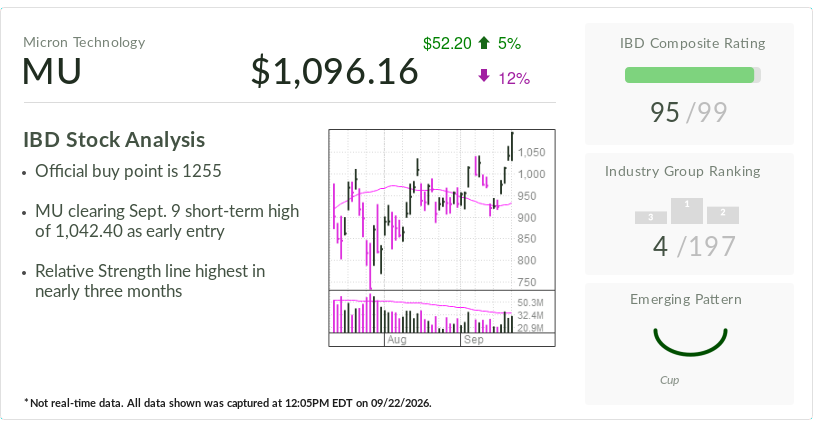
Micron Technology Micron Technology MU $ 1,096.16 $52.20 5% 12% IBD Stock Analysis Official buy point is 1255 MU clearing Sept. 9 short-term high of 1,042.40 as early entry Relative Strength line highest in nearly three months IBD Composite Rating 95/99 Industry Group Ranking 4/197 Emerging Pattern Cup Cup A cup-shaped pattern with no handle. Must be at least six…
Copyright ©2026 Investor’s Business Daily, LLC. All rights reserved. 87990cbe856818d5eddac44c7b1cdeb8
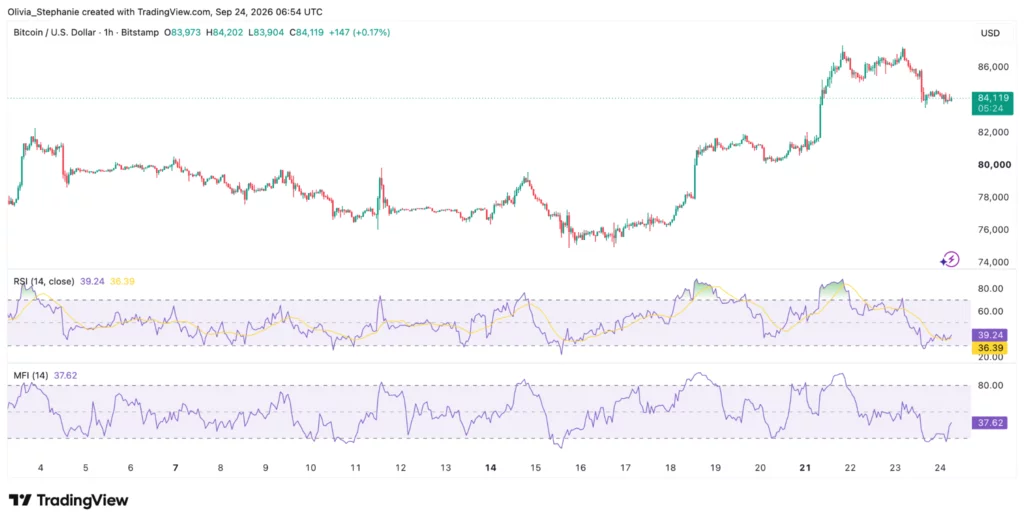
Bitcoin has traded near $84,000 on Sept. 24 after rejecting the $87,000 area, while 100–1,000 BTC wallets accumulated 113,950 BTC and U.S. spot Bitcoin ETFs extended their net inflow streak to five sessions.
Summary
- Bitcoin traded near $84,000 after retreating from $87,000 and meeting resistance around the $86,700 level.
- Wallets holding 100–1,000 BTC added 113,950 BTC since July 15, reaching roughly 5.24 million BTC.
- U.S. spot Bitcoin ETFs drew $346.98 million September 23, extending net inflows to five sessions.
- Binance Bitcoin open interest fell $500 million as leveraged traders reduced exposure after $87,000 push.
- Bitfinex placed a key buyer cost range between $85,000 and $86,500 after Bitcoin’s latest rally.
CoinGecko data showed Bitcoin at $83,863.54 during the latest check, down 3.8% over 24 hours but up 9.9% over seven days. Trading volume stood near $42.69 billion, while the asset’s market capitalization was approximately $1.685 trillion.
The pullback followed a run to $87,392 on Sept. 21, the highest print since Jan. 29, according to Bitfinex Alpha. In related crypto.news coverage of Bitcoin’s $83,600 Supertrend support test, BTC had already lost momentum after moving above $87,000 and falling back below $85,000.
Bitcoin price stays above Rekt Capital’s $82K support zone
Crypto analyst Rekt Capital said Bitcoin was meeting resistance around $86,700 after its breakout from the previous $60,000–$80,000 range. In a Sept. 23 post, the analyst described the resistance as “nothing too convincing for the time being,” while keeping attention on support below the market.
Rekt Capital said Bitcoin would need to remain above roughly $82,000, or successfully retest the area during a future dip, to stay positioned for bullish continuation. A later post placed the previous range high around $80,000 and said Bitcoin had not fully confirmed its breakout until that area had been tested as support. Both levels represent the analyst’s technical framework, not guaranteed price outcomes.
Meanwhile, on the one-hour chart, Bitcoin’s RSI stood at 39.38 while the Money Flow Index was 37.71. Both indicators remained below 50 after the pullback from the $86,000–$87,000 area, pointing to weaker short-term momentum without entering deeply oversold territory.
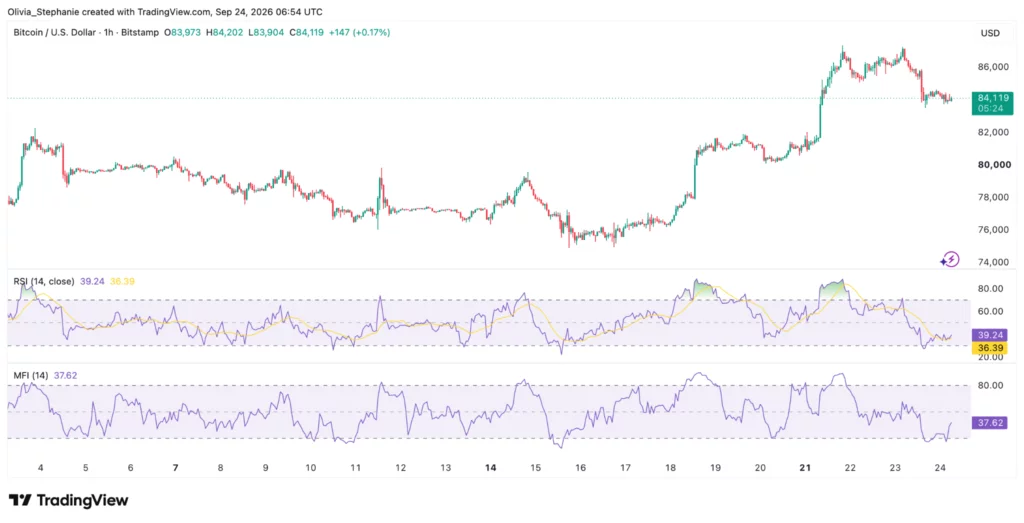
A separate crypto.news market analysis placed four-hour Supertrend support near $83,593 after Bitcoin fell from roughly $87,279.
Bitfinex Alpha described $85,000–$86,500 as a high-volume buyer cost area after the move to $87,392. Its Sept. 23 report said Bitcoin had reached a price area that separated lasting recoveries from failed rebounds during previous cycles, while continued ETF and corporate purchases remained part of its framework.
Bitcoin whales have added 113,950 BTC since July
Santiment posted that wallets holding between 100 and 1,000 BTC increased their combined balance by 113,950 BTC from July 15 through Sept. 23. The cohort’s holdings rose 2.22% to approximately 5.24 million BTC during the period. Independent reports citing the same Santiment dataset carried matching figures.
Santiment described the group as one of the wallet tiers that has tracked crypto market direction closely in its five-year analysis. The firm said accumulation by the cohort has often appeared before or during stronger price periods. Historical correlation, however, does not establish that changes in the group’s balances caused Bitcoin’s subsequent price moves.
Wallet data carries another limitation. An address does not represent a confirmed individual investor because one entity can control several wallets, while exchanges and custodians can move coins among addresses. The figures therefore document rising balances inside the 100–1,000 BTC cohort without proving that a known group of institutions or funds purchased the coins on the open market.
During the same period, Bitcoin recovered sharply from its July 1 low of $57,803, according to Bitfinex. The price reached $87,392 on Sept. 21 before retreating toward $84,000 this week.
U.S. Bitcoin ETF inflows have reached five straight sessions
SoSoValue-linked data reported $346.98 million in net inflows for U.S. spot Bitcoin ETFs on Sept. 23. BlackRock’s IBIT led with $166.29 million, followed by Fidelity’s FBTC at $143.24 million. Morgan Stanley’s MSBT received $32.41 million, while ARK 21Shares’ ARKB took in $5.04 million.
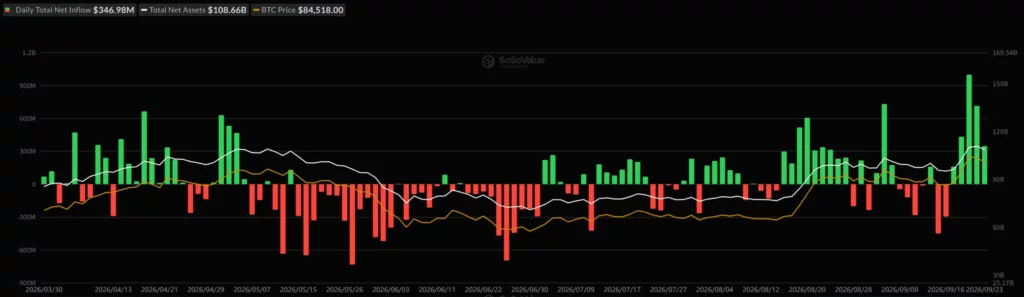
The Sept. 23 total extended the positive run to five trading sessions. The streak included $159.5 million on Sept. 17, $433 million on Sept. 18, approximately $999 million on Sept. 21 and $714.7 million on Sept. 22 before the latest $346.98 million reading. The five sessions brought combined net inflows to roughly $2.65 billion. Earlier crypto.news coverage examined Bitcoin ETF inflows during the move above $86,000.
Demand during the session extended beyond Bitcoin products. SoSoValue data showed U.S. spot Ether ETFs receiving $105 million on Sept. 23, led by BlackRock’s ETHA with $50.8 million and Fidelity’s FETH with $41.3 million. Grayscale’s ETH fund recorded approximately $4.1 million in net outflows.
Binance leverage has fallen faster than Bitcoin’s price
CryptoQuant analyst Amr Taha said Binance Bitcoin open interest fell from roughly $5.4 billion to $4.9 billion between Sept. 21 and Sept. 23. The $500 million reduction removed approximately 9.3% of outstanding positions while Bitcoin pulled back around 3.4% from the $87,000 area.
Taha reported that cumulative volume delta fell from nearly $3 billion to $1.48 billion over the same period, a decline of roughly 51%. He interpreted the combination of lower price, open interest and CVD as evidence that leveraged traders had reduced risk after Bitcoin failed to hold the push toward $87,000. The interpretation does not identify the individual traders behind the positions.
A separate CryptoQuant update dated Sept. 23 showed Binance BTC funding near 0.001%, close to neutral. Its author said funding around zero indicates that derivatives positioning has become less one-sided than during periods of aggressive leveraged-long activity.
Bitfinex, in its Bitcoin $85K buyer cost analysis, placed the next major cost area between $85,000 and $86,500, with the yearly open at $87,722 above it. The firm put the corporate treasury cohort’s average cost near $80,500 and said “a sustained move below $81,300,” particularly alongside ETF outflows, would challenge its reading of the breakout.
Disclosure: This article does not represent investment advice. The content and materials featured on this page are for educational purposes only.

Hitting the Financial Wall | Debt Numbers EXPLAINED

Danny Tommo arrested after migrant boat slashed in Channel

Bradesco: A Turnaround That Is Working, And Still Cheap Enough To Buy (NYSE:BBD)

Weekend Open Thread – Corporette.com

Weekend Open Thread: Talbots – Corporette.com

Memory prices are slowing because buyers ran out of money
Hitting the Financial Wall | Debt Numbers EXPLAINED

XRP 0% CAPITAL GAINS TAX !!!! TRUMP WHITE HOUSE $80 – $1000 !!!! BRICS PAY HIGH XRP PRICE UPDATE !!!

Rumus Bebas Finansial gaji Rp10.000.000 #investment #investasi #investing #cv
-
 Fashion6 days ago
Weekend Open Thread: Talbots – Corporette.com
-

 Tech3 days ago
Researchers escape OpenAI Codex sandbox to run commands on host
-

 Crypto World5 days ago
Circle launches Arc Studio AI agent for building onchain apps
-

 Crypto World3 days ago
Who Needs CLARITY Anyway? ARB Could See 70X Increase: Hodler’s Digest
-

 Crypto World1 day ago
Goldman Sachs and Deutsche Bank Agree: The S&P 500 Rally Isn't Over
-
 NewsBeat5 days ago
Trump says US has reached an agreement to take permanent control of Greenland’s security
-

 Crypto World5 days ago
Trading Bitcoin on Robinhood? Why 2% Spread Has Traders Worried
-

 Crypto World6 days ago
Mortgage and refinance interest rates today, Thursday, September 17, 2026
-

 Crypto World5 days ago
Bitcoin price breaks channel as RSI climbs to 63
-

 Tech3 days ago
Google’s $899 Googlebook is a bet that you’ll buy a new laptop for Gemini
-

 Business3 days ago
Analog Devices (ADI) Bets $1.35 Billion on Chips that Let Machines Think for Themselves
-

 Crypto World3 days ago
Coinbase, Robinhood, Circle Seen as Tokenized-Stock Winners
-

 Tech5 days ago
Trump suggests rebranding AI with a new name, says he’s also creating an AI Force
-

 Tech6 days ago
GPT-6 Astra Reached the Nether in Minecraft, Lost Its Stash to a Creeper, and Farmed Potatoes for Hours
-
 Business1 day ago
Oil Price Today (September 23): Crude oil below $100 on hopes of US-Iran talks. What did Trump say?
-

 Crypto World5 days ago
World Money launches in 150+ countries with Stripe
-

 Crypto World6 days ago
Silver prices recover quickly, hitting weekly high today
-

 Crypto World3 days ago
Bitcoin price holds above $81K as key catalysts line up
-
 NewsBeat6 days ago
US was ‘on brink of war’ with China over false AI report of nukes moving in Middle East
-

 Crypto World2 days ago
Meta Jumps 11% As Muse Shines and Investors Show an Appetite for Advancing AI
You must be logged in to post a comment Login