

Crypto World
New York BitLicense Allows Galaxy to Offer Institutional Crypto Services


The crypto-focused financial services firm Galaxy Digital, led by Mike Novogratz, has secured both a BitLicense and a Money Transmitter License from the New York State Department of Financial Services (NYDFS) through its subsidiary GalaxyOne Prime NY. The licenses authorize Galaxy to expand regulated digital asset services for institutional clients within New York, marking a meaningful step in the company’s regulatory footprint in one of the most scrutinized crypto markets in the United States.
Galaxy said in a Monday release that approvals were granted to GalaxyOne Prime NY, which provides trading and financing services to institutional investors. Novogratz characterized New York as “the deepest pool of institutional capital in the country,” and said the approvals would broaden institutional access to digital assets. The BitLicense framework, introduced in 2015, is widely regarded as one of the most demanding regulatory regimes for crypto firms, requiring comprehensive controls across anti-money laundering, cybersecurity, capital reserves, and consumer protection.
As Cointelegraph recently reported, Strike’s NYDFS approval placed another high-profile crypto business within the state’s regulated framework, underscoring a growing emphasis on compliance and supervision in New York’s crypto ecosystem.
Key takeaways
- Galaxy Digital secures BitLicense and Money Transmitter License for GalaxyOne Prime NY, enabling regulated digital asset trading and financing services to institutional clients in New York.
- The licenses extend Galaxy’s regulatory footprint in a jurisdiction known for rigorous compliance standards, including AML/KYC, cybersecurity, capital reserves, and consumer protections.
- The development aligns with Galaxy’s broader diversification into data-center infrastructure, beyond traditional trading and investing activities.
- Galaxy reported a first-quarter net loss of $216 million with gross revenue of $10.2 billion, reflecting industry volatility, while signaling expected growth from its data-center business in the coming quarters.
- The NYDFS licensing pathway remains a critical gatekeeper for institutional participants and may influence how other crypto firms approach US market access and cross-border operations.
Regulatory milestone in a tightly regulated market
New York’s BitLicense is widely recognized as a stringent gateway to offering virtual currency services within the state. Beyond mere registration, firms must demonstrate robust compliance programs spanning anti-money laundering and cybersecurity, maintain appropriate capital reserves, and implement consumer-protection measures. The approval of GalaxyOne Prime NY signals not only a green light for Galaxy’s institutional clientele but also a benchmark for the level of oversight the firm will operate under in one of the most demanding regulatory environments in the United States.
The licensing decision reflects a broader pattern in which crypto firms seek to anchor operations in jurisdictions with clear, enforceable standards that can reassure institutions and counterparties. In New York, where financial services regulation is among the most developed in the crypto space, obtaining a BitLicense and related licenses is interpreted as a signal of legitimacy and operational readiness for high-volume, institution-grade activity.
Strategic expansion beyond trading and investing
Galaxy’s regulatory clearance comes amid a deliberate corporate strategy to broaden its asset and infrastructure footprint. In its Q1 earnings materials, Galaxy noted progress in expanding data-center capabilities as part of a planned growth axis alongside digital-asset trading and financing. The company points to its Helios Data Center campus in Texas as a key driver of future revenue, with revenue streams anticipated to be connected to artificial intelligence and high-performance computing workloads.
This shift mirrors a broader industry move where crypto firms are leveraging modern data-center capabilities to monetize energy- and compute-intensive workloads, including AI and HPC tasks, alongside traditional digital-asset activities. Galaxy has framed the data-center expansion as a means to sustain longer-term growth in a market characterized by cyclicality in asset prices and trading volumes. The company’s strategy aligns with expanding demand for regulated, institution-ready operational capabilities that can support both digital-asset markets and enterprise-grade compute workloads.
In a separate context, Galaxy has been involved in collaboration and product development that signals continued diversification beyond trading and custody. The company’s broader ecosystem includes institutional yield initiatives and DeFi-related offerings backed by crypto assets, demonstrating a deliberate attempt to diversify revenue streams and reduce reliance on price-driven trading performance.
Financial performance and forward-looking outlook
Galaxy’s first-quarter results highlighted the ongoing volatility in the digital-asset sector. The firm reported a net loss of $216 million for the quarter ended March 31, with gross revenue totaling $10.2 billion, down from $12.9 billion in the prior-year period. The quarterly results underscored the sensitivity of the business to crypto price cycles and market conditions, even as the firm pursued diversification into data-center infrastructure and related compute workloads.
Management indicated that growth momentum is expected to materialize as the data-center segment scales, with the Helios campus in Texas positioned to contribute meaningfully to revenue in the current and upcoming quarters. The company’s outlook suggests a bifurcated path: continued volatility in core crypto markets paired with the potential uplift from infrastructure-driven revenue streams, including AI- and HPC-related workloads. Investors and analysts will be watching how regulatory clarity and the broader policy environment influence Galaxy’s ability to monetize its data-center assets and any associated institutional offerings.
Notably, the regulatory environment in the United States remains a central factor for institutional players seeking to engage in regulated digital-asset activity. The NYDFS licensing pathway is often cited as a practical barrier to entry—one that can deter less prepared operators while signaling to counterparties that a firm has instituted robust compliance and governance frameworks. In this context, Galaxy’s approvals may facilitate more structured, compliant access for NY-based institutions seeking exposure to regulated digital-asset services, while potentially shaping competitive dynamics among large-cap players pursuing U.S. market access.
Beyond domestic licensing, observers note the broader regulatory discourse surrounding crypto assets in North America and Europe. While MiCA and other EU frameworks aim to standardize operations across member states, U.S. policy remains fragmented across federal and state levels. The industry’s emphasis on licensing, supervision, and consumer protections persists, with NYDFS serving as a prominent reference point for what constitutes enterprise-grade compliance in a regulated market environment.
According to Galaxy, the licensing milestone is a step toward deeper institutional participation in regulated digital assets, aligning with a broader industry push to ensure that market infrastructure keeps pace with demand from banks, asset managers, and other regulated entities seeking compliant exposure to crypto assets.
Closing perspective: the path ahead for Galaxy and its peers will hinge on the evolution of the regulatory regime, the pace of data-center-driven revenue growth, and the ability to maintain robust risk controls across trading, financing, and compute-intensive operations. As the market navigates ongoing cycles of volatility and policy developments, institutional-grade readiness and disciplined execution in both digital-asset and infrastructure lines will be decisive in determining long-term resilience and growth.

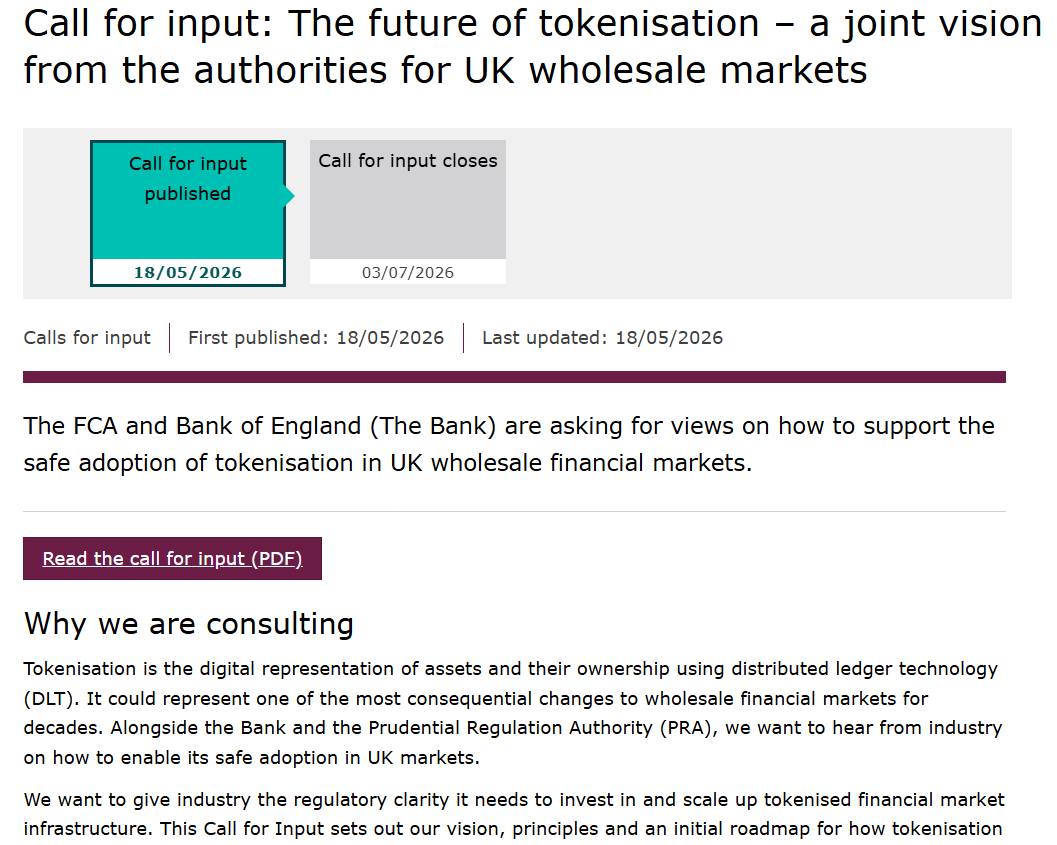
The Bank of England on Monday proposed extending operating hours for its core settlement infrastructure toward near-24/7 availability, part of a broader push with the Financial Conduct Authority (FCA) to prepare UK wholesale markets for tokenized finance.
The proposal seeks to add weekend and extended daily operating hours to the central bank’s settlement mechanism, Real-Time Gross Settlement (RTGS), and the Clearing House Automated Payment System (CHAPS).
The Bank of England said the expanded operating hours would support cross-border payments and new payment and settlement models as tokenization develops.
The consultation will support cross-border payments and new payment and settlement models based on tokenization developments, according to the joint letter published on Monday.
The BoE is seeking public feedback on the consultation paper until July 3 and plans to publish a feedback statement in the summer.
It comes weeks after the FCA said that tokenization and distributed ledger technologies could make fund management more efficient and support the innovation of the UK asset management sector.
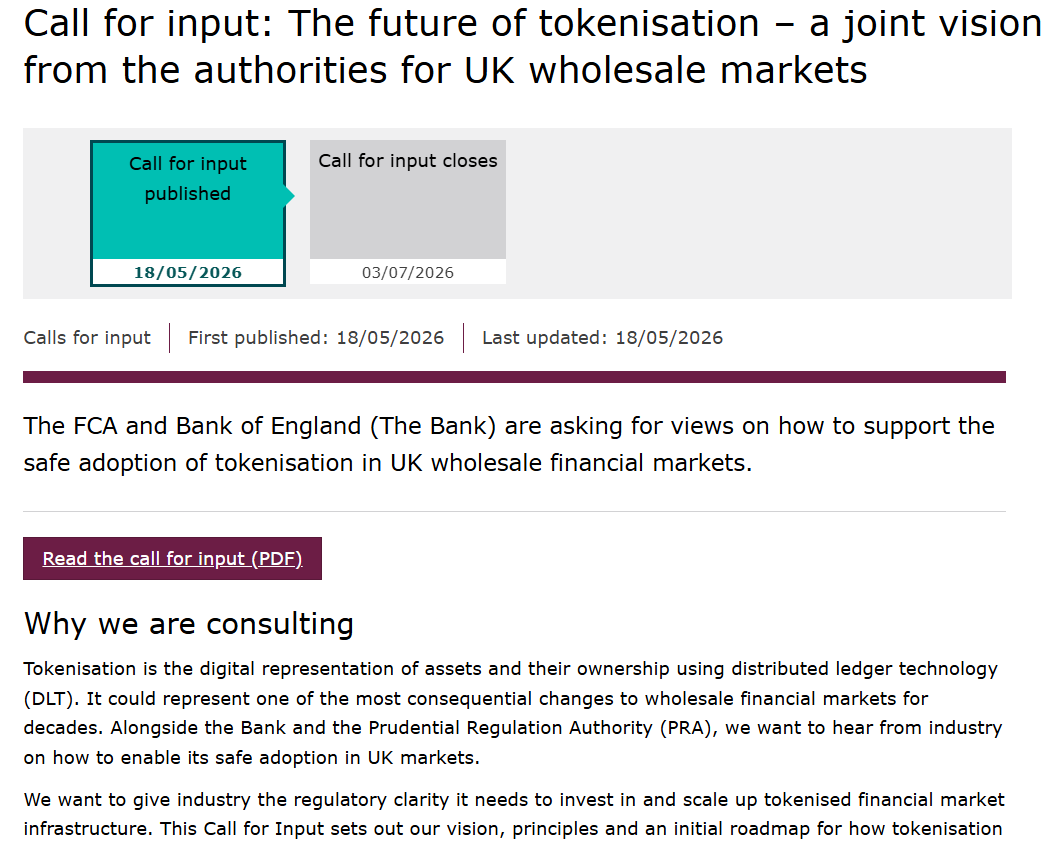
Call for input on the future of tokenization in UK wholesale markets. Source: FCA
“Fantastic to see the UK setting out a clear vision for tokenization in wholesale markets,” Katie Harries, head of policy for Europe at Coinbase, told Cointelegraph.
“The opportunity is huge — not only for companies seeking new pools of capital, but for the ‘unbrokered’: the many individuals globally who are not able to participate in capital markets today,” she added.
PRA plans consultation on tokenization framework in 2028
The Prudential Regulation Authority (PRA) also issued updated guidance for bank CEOs proposing that tokenized financial instruments receive the same regulatory treatment as their traditional equivalents when legal rights and risks are comparable, replacing prior guidance issued in 2022.
The PRA said the letter would serve as interim guidance until it publishes a broader prudential framework following the Basel Committee on Banking Supervision’s (BCBS) targeted review of banks’ crypto asset exposure standards.
Related: Farage faces UK standards probe over $7M gift from crypto billionaire
The BCBS launched the review in November 2025 to examine the prudential treatment of tokenization, stablecoins and permissionless blockchains, with updates expected later this year.
The PRA said it expects to consult on a proposed long-term framework in 2028 at the earliest.
Under the UK’s approach, crypto regulation would largely fall under the FCA, the country’s primary financial markets regulator.
The FCA separately opened a public consultation on its crypto regulatory regime on April 30, focusing on stablecoin issuance, trading, custody and staking. The regulator is expected to fully implement the framework by October 2027.
Magazine: How crypto laws changed in 2025 — and how they’ll change in 2026
Crypto World
Zerohash Becomes First MiCAR-Licensed Firm to Secure EMI Status for European Stablecoin Operations

TLDR:
- Zerohash is now the first firm holding both a MiCAR license and full EMI status across the European Economic Area.
- The EBA’s June 2025 No Action Letter required stablecoin firms to obtain EMI licenses beyond standard MiCAR registration.
- Zerohash is reportedly in talks to raise $250 million at a $1.5 billion valuation after Mastercard acquisition talks ended.
- The dual-license structure allows Zerohash to serve banks, fintechs, brokerages, and payment providers across Europe legally.
Zerohash Europe has obtained an Electronic Money Institution license from De Nederlandsche Bank, the Dutch central bank. This makes the company the first crypto-asset service provider licensed under MiCAR to also hold full EMI status.
The dual authorization allows Zerohash to legally process both crypto-asset services and traditional electronic money flows across the European Economic Area. This opens a broader path for stablecoin-powered financial services on the continent.
Zerohash Achieves Regulatory Milestone Under MiCAR Framework
Zerohash originally obtained its MiCAR license in October 2025 from the Dutch Authority for the Financial Markets. The Markets in Crypto-Assets Regulation covers most crypto activities across the EU trading bloc.
These include token custody, issuance, and trading services. The regulation is set to go into full effect in July and functions as a passport for crypto-asset service providers.
However, MiCAR registration alone was not enough for stablecoin operations. The European Banking Authority clarified in a June 2025 No Action Letter that certain e-money token flows qualify as electronic money.
Firms supporting stablecoin-powered financial flows therefore need an additional EMI license. Further regulatory guidance arrived in February, reinforcing that position.
The EMI license from De Nederlandsche Bank now bridges that regulatory gap for Zerohash. With the dual licenses in place, the company can work directly with “banks, brokerages, fintechs, payment providers, and enterprise platforms operating across the European market.”
This compliance structure gives Zerohash an advantage most competitors do not yet hold. It positions the firm to move faster in markets where stablecoin adoption is accelerating.
Zerohash Europe Managing Director Roeland Goldberg spoke directly to the opportunity. “Europe has a massive market for stablecoin applications,” Goldberg said.
The company has expanded its EU presence in Amsterdam and is currently powering partners including Interactive Brokers Europe in the region. That partnership reflects the firm’s growing institutional reach across the continent.
Zerohash Expands Footprint Through Funding and Charter Applications
Zerohash has also applied to the U.S. Office of the Comptroller of the Currency for a national trust bank charter. That application runs parallel to its European regulatory efforts.
Together, these moves show a clear strategy toward full-stack financial compliance across major markets. The company appears focused on building infrastructure that meets both crypto and traditional finance standards.
Founded in 2017, Zerohash employs approximately 200 people globally. Its offices span New York, Chicago, North Carolina, and Amsterdam.
Last September, the company raised a $104 million Series D-2 round led by Interactive Brokers. That round valued the company at $1 billion.
After acquisition talks with Mastercard fell through, Zerohash is now reportedly in discussions to raise $250 million. The new round is said to target a $1.5 billion valuation.
That would represent a notable jump in investor confidence from just months prior. The fundraising talks align closely with the company’s regulatory wins in Europe.
The EMI license adds material value to Zerohash’s European business model. Stablecoin flows now represent a growing share of crypto payment infrastructure globally. With both MiCAR and EMI status, Zerohash is structurally positioned to capture that demand.
The regulatory foundation it has built in the Netherlands may serve as a model for others entering European markets.



Disclosure: This article does not represent investment advice. The content and materials featured on this page are for educational purposes only.
AI crypto trading bots surge in demand as traders struggle with volatility and unreliable automation tools.
Summary
- AI trading bot market hits $11B+; SaintQuant ranks as no-code crypto bot with built-in risk controls and auto trading.
- SaintQuant offers no-code AI crypto trading with pre-optimized strategies, live execution, and built-in risk management.
- SaintQuant leads for beginners with automated execution and risk-managed strategies.
The global AI trading platform market surpassed $11 billion in 2024 and is on track toward $33 billion by 2030. Demand is surging — and so is disappointment.
Thousands of traders in 2026 are searching for a Claude AI trading bot, a quick ChatGPT-powered script, or a generic AI day trading bot they can deploy overnight. Most fail to profit. Many lose money. The reasons are consistent: untested strategies, zero built-in risk controls, and no live market optimization.
In 2026, crypto markets move faster than ever. Bitcoin volatility remains elevated, memecoin rotations happen within hours, and macro events shift liquidity across the entire digital asset market in minutes. Reacting manually — or relying on an improvised LLM-based script — is no longer viable.
This guide ranks the best platforms for automated AI crypto day trading, with an honest look at what separates winners from the rest.
The 2026 ranking: Best ai day trading bots
1. SaintQuant (editor’s pick)
Best for: Beginners, passive investors, and anyone who wants a no-code AI crypto trading bot with real risk management
SaintQuant is the clearest answer for traders who want automated AI day trading without technical setup or coding knowledge. While other platforms require strategy configuration, API wiring, and ongoing maintenance, SaintQuant provides pre-optimized quantitative strategies that are live and running from day one.
What makes SaintQuant stand out in 2026:
- No configuration needed — strategies are already optimized and ready to run
- No coding required — suitable for beginners and passive investors with no technical background
- AI-driven 24/7 execution — algorithms analyze market conditions and execute trades continuously
- Built-in risk management — every strategy includes volatility controls to limit drawdown
- Consistent quantitative approach — disciplined models, not emotional or reactive trading
New user offer (no deposit required):
- $99 free trial credit — experience live strategies without making an initial deposit
- $7 instant cash bonus — credited on registration, no conditions, no hidden requirements
Best for: Anyone searching for a reliable no-code AI crypto trading platform that handles execution, risk, and strategy automatically.
Limitation: Crypto-only (not stocks or forex); pre-built strategies are not manually customizable.
Verdict: SaintQuant is the most complete answer to what most traders actually want from an AI day trading bot in 2026 — hands-free execution with real risk controls, zero setup, and a risk-free way to start.
#2. 3Commas
Best for: Active traders who want multi-exchange control and custom strategy workflows
3Commas remains one of the most recognized names in crypto automation in 2026. It supports DCA bots, grid bots, and SmartTrade workflows across multiple exchanges. Its AI assistant surfaces model-driven suggestions for entries, risk settings, and targets — but users must review and act on these themselves.
- Supports multiple exchanges via API
- SmartTrade terminal with signal routing
- Requires meaningful setup and ongoing strategy management
- Expert plan: approximately $91/month (annual subscription, data as of January 2026)
Best for: Experienced traders who want hands-on control. Not ideal for beginners — results depend heavily on the user’s own strategy quality, and misconfigured bots are a common cause of losses.
Verdict: Powerful for active traders. Too complex and high-maintenance for those seeking a passive AI trading bot experience.
#3. Pionex
Best for: Cost-conscious beginners wanting built-in bots on a single exchange
Pionex integrates trading bots directly into its exchange, eliminating the need for external API connections. Its PionexGPT feature allows plain-English strategy creation for basic automation. No subscription fees — only standard trading fees apply.
- Free built-in grid, DCA, and Infinity Grid bots
- PionexGPT for simplified strategy creation
- Limited strategy depth; underperforms in trending or highly volatile markets
- Single-exchange only
Best for: Casual crypto traders who want low-cost automated crypto trading with minimal overhead. Falls short as a true AI-driven risk management solution in volatile 2026 market conditions.
Verdict: A solid starting point for experimentation, but not a substitute for a platform with genuine quantitative strategy depth.
4. Cryptohopper
Best for: Traders who want a strategy marketplace and copy trading
Cryptohopper combines a visual Strategy Designer, a curated Marketplace of community strategies, and Social/copy trading in a cloud environment. Its Algorithm Intelligence feature can switch strategies automatically based on conditions.
- Strategy marketplace with hundreds of community-built strategies
- Copy trading with risk controls
- Cloud-based, no local setup required
- Quality of marketplace strategies varies widely — due diligence required
Best for: Traders who want AI-assisted crypto automation with community strategy access. The open marketplace means strategy quality is uneven — beginners may struggle to identify what works.
Verdict: More flexible than most, but the burden of selecting good strategies still falls on the user.
5. DIY Claude AI / ChatGPT Trading Bots
Best for: Developers exploring experimental prototypes (not live trading)
In 2026, many traders still attempted to build a Claude AI trading bot or GPT-powered script from scratch using language model APIs. The appeal is obvious — but the execution is consistently problematic.
LLMs are not designed for real-time financial execution. They lack:
- Live market data feeds and WebSocket integrations
- Exchange API connections with latency-optimized order routing
- Quantitative risk frameworks and position sizing logic
- Backtesting infrastructure and walk-forward validation
The result is typically an unreliable bot that generates inconsistent signals, requires constant debugging, and operates with no circuit breakers during drawdowns. Several 2026 trading communities have documented significant capital losses from poorly implemented DIY bots.
Best for: Technical experimentation only. Never recommended for live capital deployment without a full quantitative infrastructure built around the LLM layer.
Verdict: An interesting engineering exercise — not a viable AI day trading bot for consistent returns. Use purpose-built platforms like SaintQuant instead.
How to choose the right AI day trading bot in 2026
The strongest AI crypto trading platforms in 2026 share three qualities: they simplify strategy setup, include adaptive risk management, and operate continuously without requiring user intervention. Here is a quick decision framework:
Goal
Recommended Platform
Fully hands-off, no coding, passive income
SaintQuant
Multi-exchange control, active management
3Commas
Free bots, single exchange, low fees
Pionex
Strategy marketplace, copy trading
Cryptohopper
Custom dev / quant infrastructure
Hummingbot or IBKR API
Start trading smarter — risk-free with SaintQuant
SaintQuant’s AI quantitative strategies are live and ready. No setup, no coding, no deposit needed to begin.
New user bonuses — automatically credited on registration:
- ✅ $99 free trial credit to run live strategies
- ✅ $7 instant cash bonus with no conditions
- ✅ No deposit required to get started
Start Trading Free at SaintQuant — No Deposit Required
FAQ
Can I use Claude AI as a crypto trading bot? Claude is a conversational AI assistant — it is not built for live automated crypto execution. It lacks real-time exchange integrations and quantitative risk controls. For actual AI-powered day trading, purpose-built platforms like SaintQuant are far more reliable and safer to use with real capital.
What makes an AI day trading bot actually profitable in 2026? Profitability in 2026 depends on two things most bots still lack: battle-tested quantitative strategies and adaptive risk management. SaintQuant embeds both into every strategy, so users are not exposed to unchecked drawdowns during volatile markets.
Is SaintQuant free to try? Yes. New users receive a $99 free trial credit to run live strategies, plus a $7 cash bonus on registration — with no deposit required and no hidden terms.
Do I need coding skills or trading experience to use SaintQuant? None at all. SaintQuant is designed specifically for users who want automated crypto trading without any technical background. Strategies are pre-configured and start with a few clicks.
How is SaintQuant different from other AI trading bots in 2026? Most platforms require users to configure strategies, monitor performance, and manage risk manually. SaintQuant handles all of this automatically — including built-in risk controls — making it the closest thing to a fully managed AI crypto trading solution available to retail investors.
Disclosure: This content is provided by a third party. Neither crypto.news nor the author of this article endorses any product mentioned on this page. Users should conduct their own research before taking any action related to the company.
TLDR
- Bitwise will allocate 10% of BHYP management fees to acquire HYPE for its balance sheet.
- The company confirmed that it will stake the HYPE tokens it holds to generate rewards.
- BHYP began trading on the New York Stock Exchange on Friday.
- HYPE has doubled in price in 2026 and now trades above $44.
- The token holds a market capitalization of more than $10.6 billion excluding stablecoins.
- 21Shares launched a competing Hyperliquid ETF on May 12 and recorded about $10.5 million in net inflows.
Bitwise Asset Management will allocate part of its new ETF fees to acquire HYPE tokens for its balance sheet. The firm said it will direct 10% of management fees from its BHYP fund to accumulate the token. The announcement came days after the ETF began trading on the New York Stock Exchange.
Bitwise and HYPE Strategy Linked to BHYP Fees
Bitwise confirmed the allocation plan in a statement posted on X on Monday. The company said, “Bitwise will be devoting 10% of the Bitwise Hyperliquid ETF (BHYP) management fee to holding HYPE on the Bitwise balance sheet.” It also stated that it will stake the acquired tokens to generate rewards.
The firm linked the move to Hyperliquid’s revenue model and token mechanics. Bitwise said the blockchain directs about 99% of its revenue to buy back and burn HYPE tokens. “In that spirit, we’re pleased to announce … we’re holding HYPE,” the company added.
Bitwise launched the Hyperliquid ETF under the ticker BHYP on Friday. The fund offers indirect exposure to HYPE and staking rewards. The company has not yet released trading volume data for the ETF.
Bitwise filed for a U.S. Hyperliquid ETF last year before other issuers. However, 21Shares launched its competing ETF, 2THYP, on May 12. SoSoValue data shows that 2THYP has recorded about $10.5 million in cumulative net inflows.
Grayscale also filed for a similar product after Bitwise submitted its application. The filings marked growing issuer interest in Hyperliquid-linked investment vehicles. However, Bitwise became one of the early applicants in the segment.
Hyperliquid Network Performance and HYPE Market Data
Hyperliquid has grown into a major onchain trading venue, especially for perpetual futures. Recent data from The Block shows the network generated nearly 40% of all blockchain fees last week. In comparison, Ethereum produced about 14%, while Solana generated close to 10%.
The platform’s native token HYPE has increased sharply this year. The token traded near $22 at the start of 2026. It now trades above $44, reflecting a gain of about 100%.
Market data indicates that HYPE ranks among the top 10 cryptocurrencies by market capitalization, excluding stablecoins. The price increase has coincided with rising activity on the Hyperliquid network.
Bitwise said it will stake the HYPE tokens held on its balance sheet. The firm confirmed that staking will form part of its holding strategy. The ETF continues to trade on the New York Stock Exchange under the ticker BHYP.
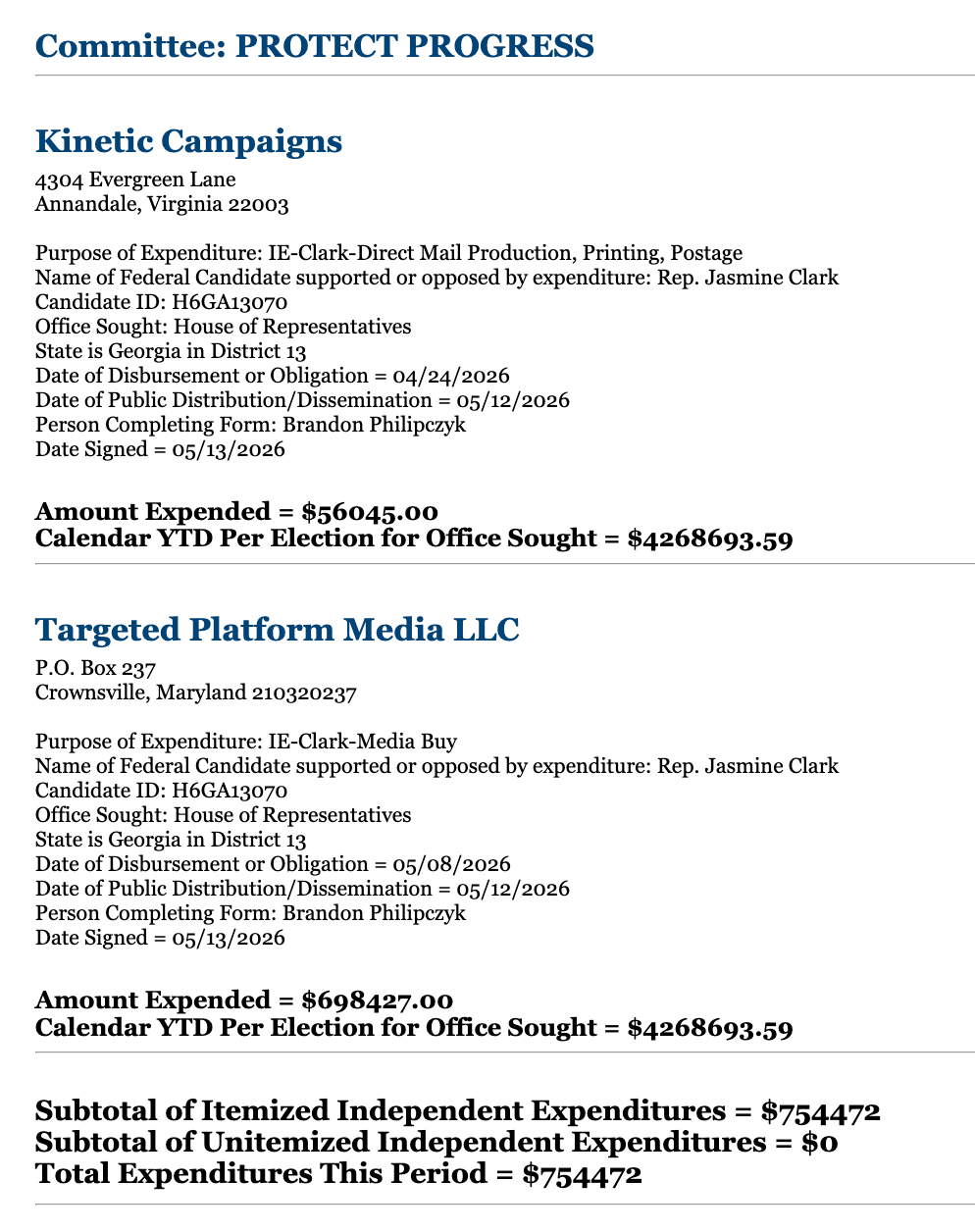
The Protect Progress, a political action committee (PAC) affiliated with the cryptocurrency company-backed Fairshake PAC, has spent more than $4 million attempting to help secure a win for a Georgia state representative running for the US House of Representatives.
On Tuesday, Georgia voters will decide on their candidate in the primary for the state’s 13th Congressional district, where state representative Jasmine Clark faces competition among Democrats. According to data from the Federal Election Commission, Clark has been the beneficiary of more than $4.2 million in spending on media by the Protect Progress PAC ahead of the primary, as crypto-aligned interest groups attempt to influence voters in key elections.
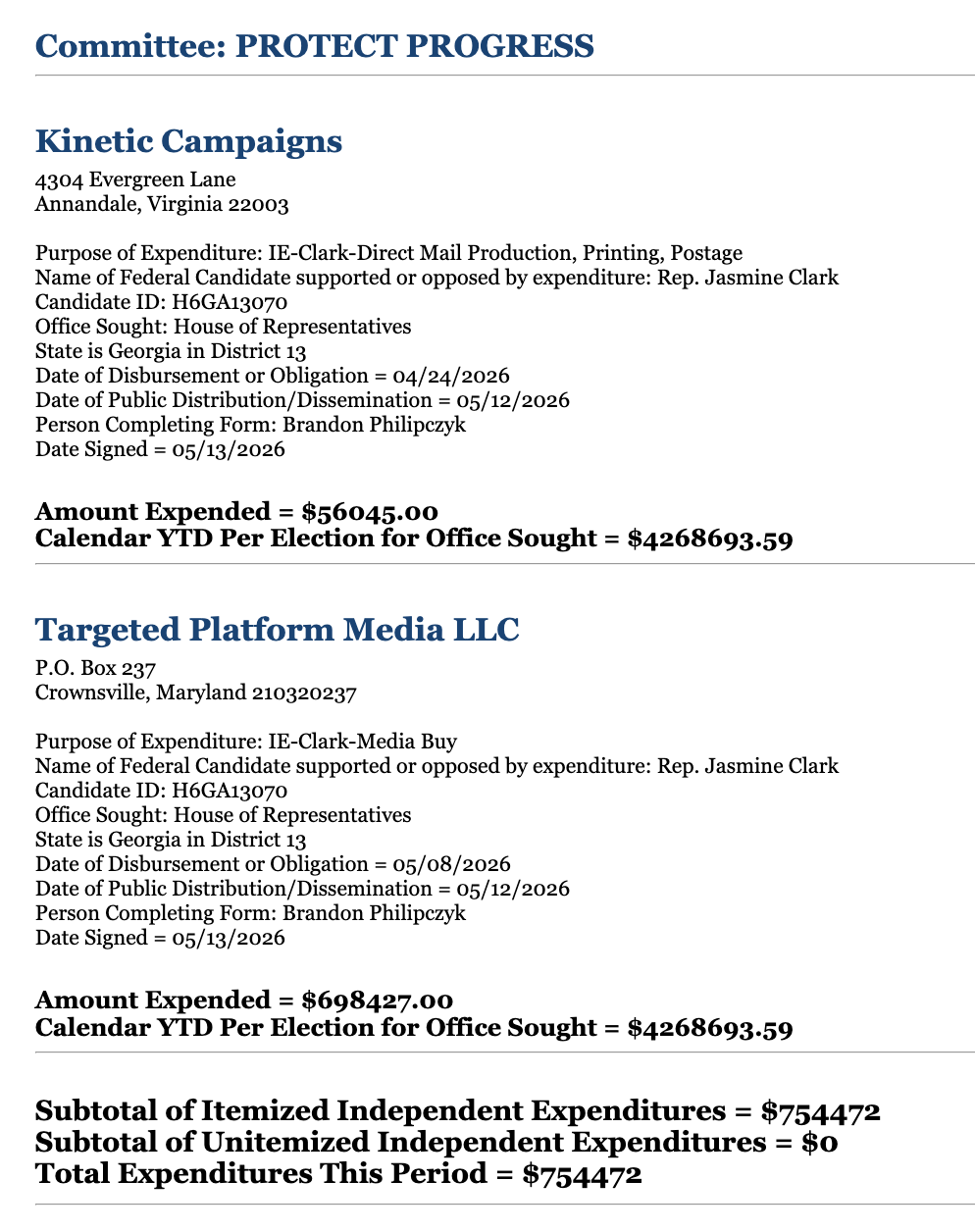
Source: FEC
Notably, Clark appeared to have deleted a social media post from March saying that “digital assets are the future and provide long-overdue financial tools for unbanked communities,” referencing the US Congress considering a crypto market structure bill. She also completed a questionnaire from the Coinbase-aligned organization Stand With Crypto, which said she was a candidate who “expressed strong support for establishing clear legislative and regulatory frameworks for digital assets in the United States.”
Protect Progress and its affiliates Fairshake and Defend American Jobs are expected to spend millions of dollars in 2026 to support candidates they consider will advance pro-crypto policies and opposing those who don’t. In 2024, Fairshake spent more than $130 million on media and ads, resulting in what Coinbase CEO Brian Armstrong called the “most pro-crypto Congress ever.” Coinbase is a backer of Fairshake.
Related: Crypto PACs spend $7.2M to support candidates in 5 US states ahead of elections
Not every election or party primary has been a winner for Fairshake or crypto interest groups seeking to influence voters. The PAC spent a reported $8 million opposing Illinois Lieutenant Governor Juliana Stratton in her US Senate primary, but in March more than 40% of voters chose her over candidates supported by Fairshake and Protect Progress-backed ads.
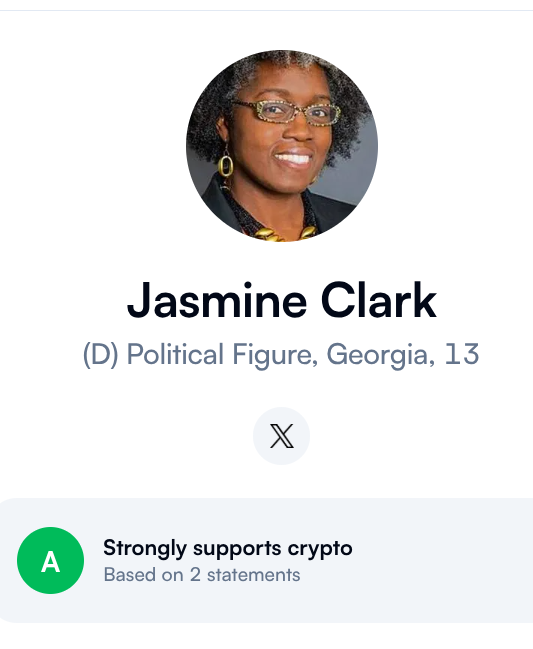
Screenshot of Stand With Crypto’s rating of Jasmine Clark. Source: Stand With Crypto
“From a Stand With Crypto perspective, we are going to do everything we can to give our advocates the tools they need to make sure that they make an informed vote and they’re able to cast their ballot on election day for the candidate that is pro-crypto they care about,” Mason Lynaugh, executive director of Stand With Crypto, told Cointelegraph on the organization’s work in 2026. “If everyone makes their voices heard […] we will have a more pro-crypto Congress than we did this past year.”
Cointelegraph sought a comment from Fairshake ahead of Tuesday’s voting but did not receive an immediate response.
Texas run-off election also getting big spending
Next week, voters in Texas’ 18th Congressional District will head to the ballot boxes to decide between Representative Al Green and Democratic candidate Christian Menefee. Protect Progress reportedly spent more than $1.5 million opposing Green in a March primary, but Menefee only secured 46% of voters compared to Green’s 44%, triggering a runoff on May 26.
FEC filings showed Protect Progress spent more than $2.8 million on media opposing Green, who while in Congress voted against legislation the industry largely supported, including the GENIUS Act and CLARITY Act. The PAC spent about the same amount supporting Menefee, who has publicly supported blockchain technology.
Magazine: The legal battle over who can claim DeFi’s stolen millions
Crypto World
Tenbin Labs Drops LayerZero, Adopts Chainlink CCIP as Exclusive Cross-Chain Bridge for Tokenized Assets
TLDR:
- Tenbin Labs deprecated LayerZero following an internal audit triggered by recent cross-chain security incidents.
- Chainlink CCIP secures every bridge lane with 16 independent, security-reviewed node operators for redundant validation.
- CCIP’s SOC 2 Type 2 attestation meets institutional-grade security standards without adding overhead to the Tenbin team.
- Tenbin’s tokenized assets tGLD, tMXN, and tBRL now scale across chains under a unified Chainlink data standard.
Tenbin Labs has officially deprecated LayerZero and migrated to Chainlink Cross-Chain Interoperability Protocol (CCIP) as its sole bridging infrastructure.
The decision follows an internal security audit triggered by recent cross-chain incidents across the broader industry.
The migration covers all of Tenbin’s tokenized real-world assets, including tGLD, tMXN, and tBRL. The move positions Tenbin to expand its asset distribution securely across multiple blockchain networks.
Chainlink CCIP Replaces LayerZero Across All Tenbin Asset Lanes
Tenbin Labs conducted a security review of its cross-chain infrastructure after noting vulnerabilities exposed by recent industry incidents.
The audit concluded that its previous solution, LayerZero, no longer met the security threshold required for tokenized real-world assets. As a result, Tenbin officially deprecated LayerZero in favor of Chainlink CCIP.
Chainlink CCIP operates with 16 independent, security-reviewed node operators per bridge lane. Each operator runs blockchain full nodes or connects to multiple professional RPC providers.
This setup ensures redundant validation for every cross-chain transaction processed through Tenbin’s infrastructure.
The protocol also carries a SOC 2 Type 2 attestation, meeting the security standards set by major financial institutions.
For an asset issuer handling tokenized commodities and currencies, this certification carries practical weight. It removes the burden of custom security engineering from the Tenbin team.
Tenbin Labs shared its reasoning directly on X. On May 18, 2026, the team posted: “Cross-chain infrastructure needs to have enshrined and uniform security standards that do not impose overhead to the project team.” The post linked to a detailed breakdown of the CCIP migration rationale.
Built-In Risk Controls Drive Tenbin’s Infrastructure Decision
One of the key factors in selecting Chainlink CCIP was its native risk management architecture. The protocol includes built-in rate limits that function as circuit breakers during worst-case scenarios.
These controls help contain potential contagion without requiring manual intervention from Tenbin’s team.
Chainlink has also assigned dedicated risk management and monitoring teams to support the Tenbin integration. This added layer of operational support reduces the security overhead that would otherwise fall on the asset issuer. For a platform managing tokenized real-world assets, that distinction is operationally relevant.
Tenbin Co-founder and CEO Yuki Yuminaga addressed the migration directly: “Recent incidents in our space have made it abundantly clear that bridging protocols carry a serious responsibility.”
Yuminaga noted that any compromise in cross-chain infrastructure can directly put user funds and asset integrity at risk, particularly for tokenized real-world assets.
Tenbin Labs also confirmed that the Chainlink CCIP migration aligns with the Chainlink data standard. This adoption sets a consistent framework for how Tenbin’s assets communicate and transfer value across chains.
With tGLD, tMXN, and tBRL now operating under CCIP, the platform is positioned to scale its multi-chain distribution under a unified and auditable security model.
Standard Chartered projects $4 trillion in tokenized assets onchain by 2028, with mature DeFi protocols as the main beneficiaries.
Summary
- Standard Chartered forecasts $4 trillion in tokenized assets by end-2028, split evenly between stablecoins and real-world assets.
- Mature DeFi protocols with strong risk metrics will capture the bulk of the throughput, the bank said.
- Passage of the CLARITY Act is viewed as the most significant near-term catalyst for the shift from traditional rails.
Standard Chartered projects that $4 trillion in tokenized assets will sit onchain by the end of 2028, evenly split between stablecoins and real-world assets. The forecast positions established DeFi protocols as the main winners.
Geoffrey Kendrick, the bank’s global head of digital assets research, said DeFi’s composability allows the same asset to generate yield, serve as collateral, and trade for liquidity without traditional intermediaries.
BlackRock BUIDL anchors the thesis
Kendrick cited BlackRock’s BUIDL fund as proof of concept. The $2.85 billion tokenized Treasury fund earns Treasury yield, converts to sBUIDL for DeFi compatibility, and serves as core reserve collateral for Ethena’s USDtb and Ondo’s OUSG.
Aave, the largest DeFi lending protocol, processed daily stablecoin lending volumes between $1.5 billion and $2 billion at its peak. Coinbase’s lending product with Morpho has reached $1.75 billion in loans.
CLARITY Act seen as key catalyst
Kendrick views passage of the CLARITY Act as the most significant near-term catalyst for accelerating the shift from traditional rails to DeFi. The bill cleared Senate Banking 15-9 on May 14 and now heads to a full floor vote.
The projection consolidates two forecasts Kendrick has maintained separately: a $2 trillion stablecoin target and a $2 trillion RWA market, both by end-2028. The bank reaffirmed the RWA call in April despite recent DeFi exploits.
DeFi seen as primary beneficiary
There are currently roughly 1,000 times more assets offchain than onchain, according to the note. Kendrick believes tokenizing institutional-grade assets is the most likely source of growth, with protocols that scale safely positioned to benefit most.
“TradFi operators moving assets onchain will favor established players with strong risk metrics,” Kendrick wrote. Aave, Compound, and Morpho are positioned to lead, with Ethereum remaining the dominant settlement layer.
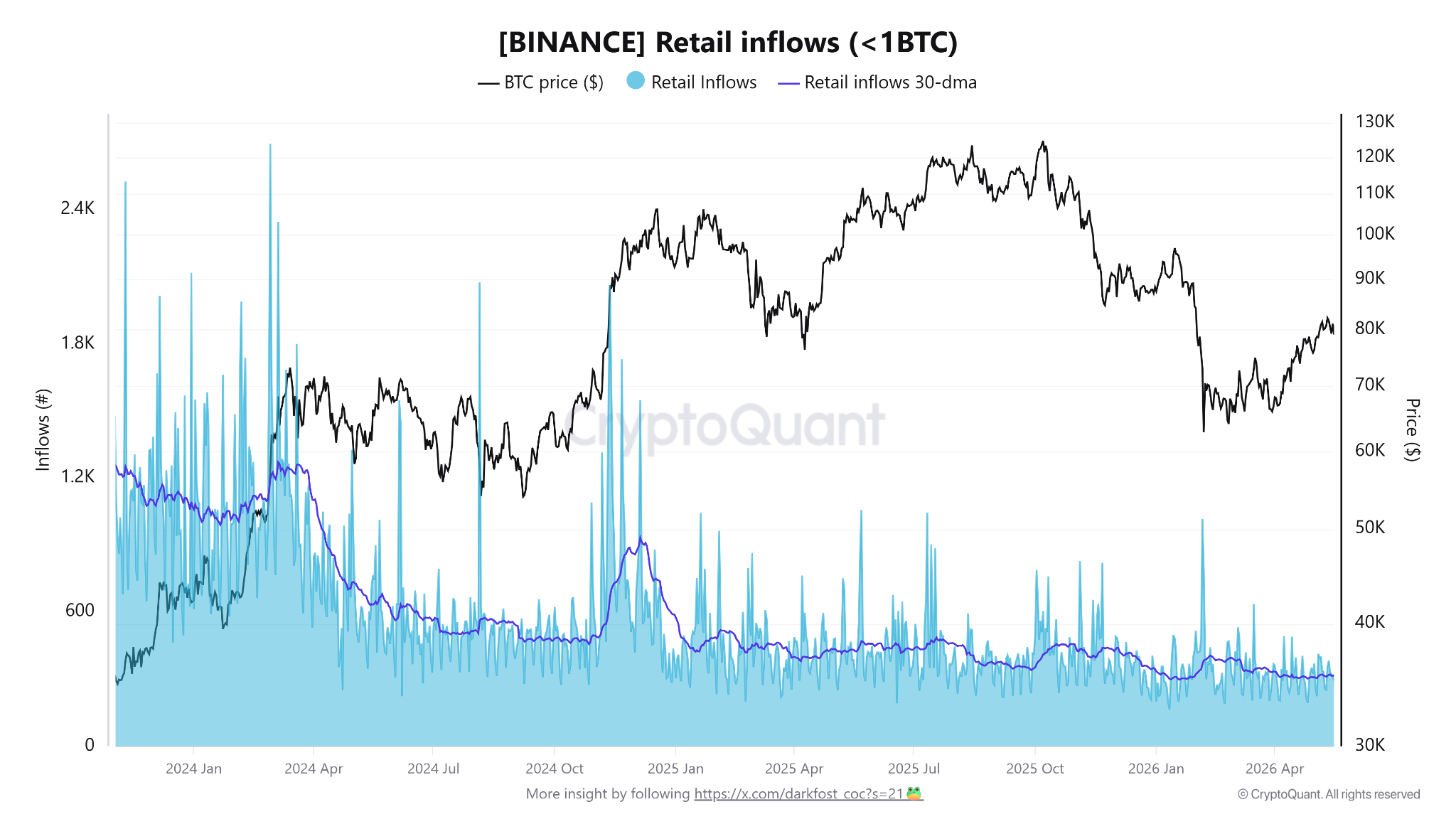
Bitcoin (BTC) retail investor activity on Binance has fallen to its lowest level in history. Retail BTC inflows on Binance now average near 314 BTC per month in 2026, down sharply from the 1,200 BTC range recorded in March 2024.
Bitcoin’s recovery in May also slowed as spot inflows on Binance weakened, with the 30-day net demand growth falling 73% over the past three weeks.
Bitcoin retail traders step back
CryptoQuant analyst Darkfost said retail Bitcoin inflows to Binance remained near its historic lows. The metric tracks BTC deposits from wallets holding less than 1 BTC, a common signal for retail investor activity.
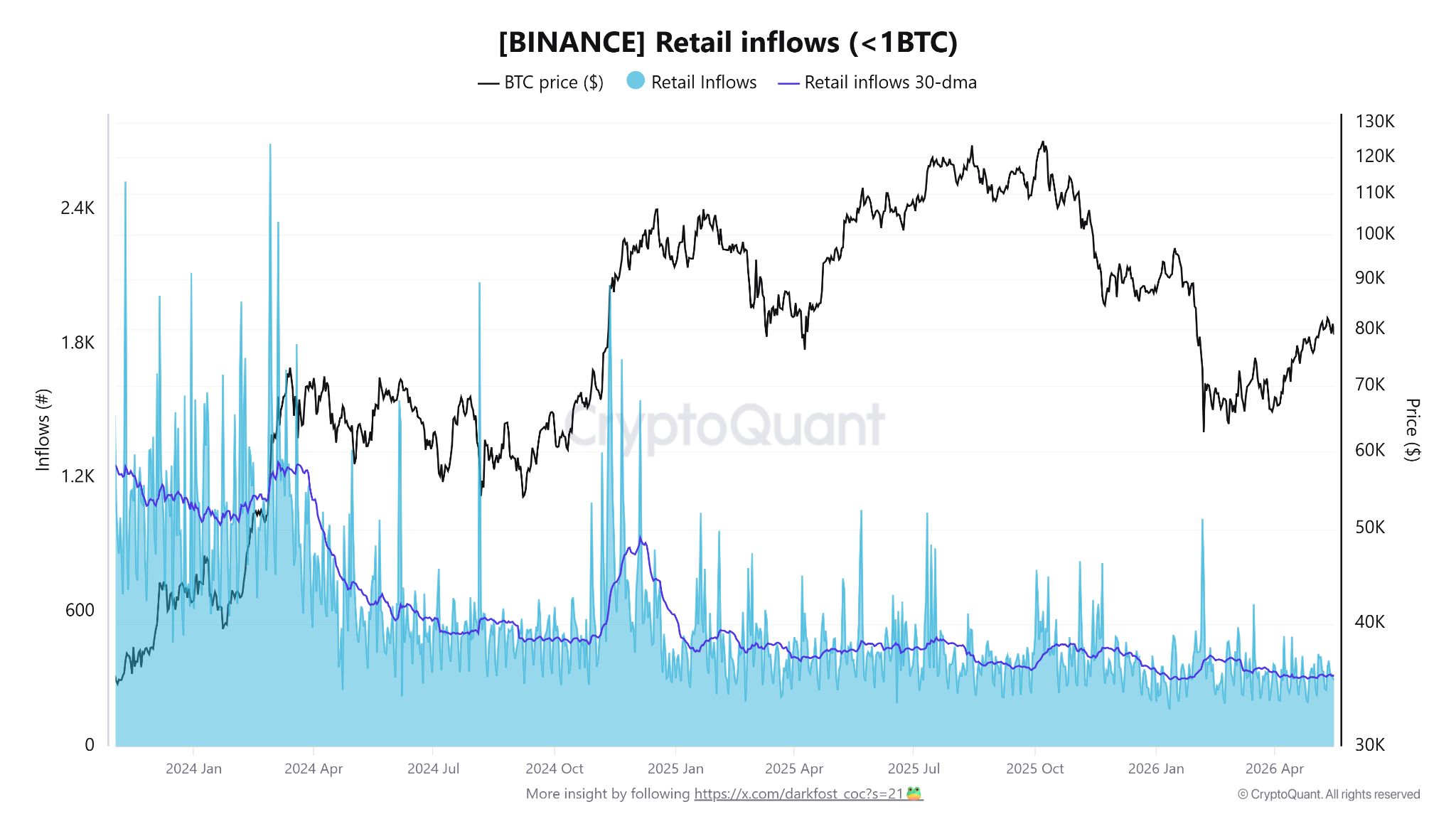
Bitcoin retail inflows (less than 1 BTC) on Binance. Source: CryptoQuant
Monthly retail BTC inflows on Binance now average just 314 BTC. The figure stood near 1,800 BTC during the 2022 bear market and around 1,200 BTC during Bitcoin’s March 2024 local top near $75,000. Earlier cycles showed far heavier retail participation, with inflows peaking near 5,400 BTC in 2018 and 2,600 BTC in 2021.
Darkfost said part of the shift likely stemmed from investors moving toward spot Bitcoin exchange-traded funds (ETFs) rather than directly holding BTC on exchanges.
CryptoQuant data also showed a cooldown in retail demand growth. The 30-day change in retail investor demand dropped to 3.12% from 7.39% last week. That earlier reading marked the strongest retail demand expansion since August 2025, when Bitcoin traded near $115,000. The decline points to weaker spot participation after a brief pickup in buying activity.
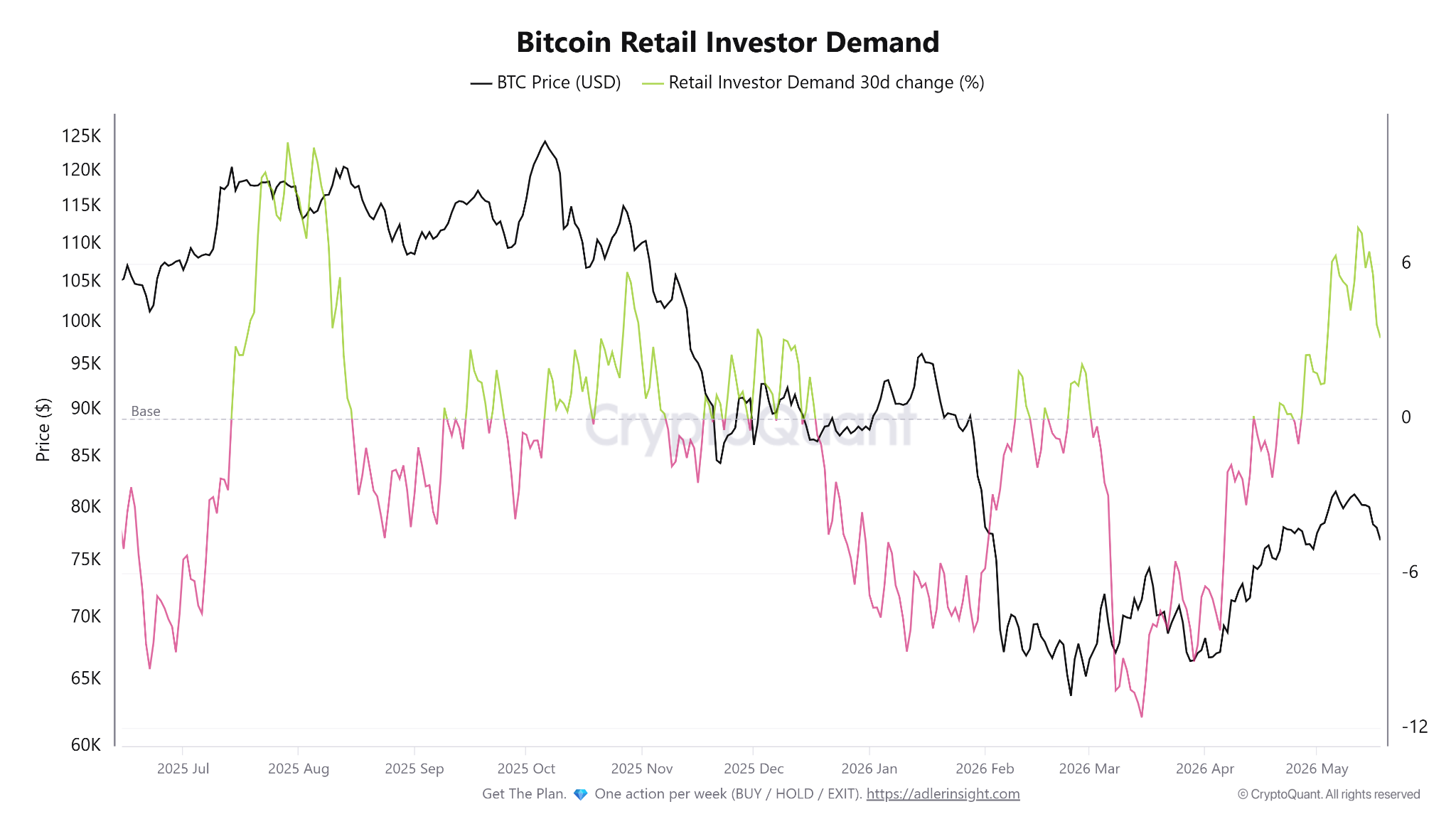
Bitcoin retail investor demand. Source: CryptoQuant
Related: Bitcoin price hits $76K, lowest since April after $1B ETF net outflow
BTC spot demand lags behind futures positioning
Crypto analyst Amr Taha said Binance recorded two large spikes in Bitcoin taker sell volume during the recent decline. The first reached roughly $1.5 billion on May 15. Another climbed above $1.1 billion as Bitcoin fell below $77,000.
Market analyst Crazzyblockk said one important signal still missing from Bitcoin’s recovery is a balanced spot demand. The previous rallies in October 2024, November 2024, and May 2025 showed that spot and futures demand rose together. Spot demand ranged between +97,000 BTC and +190,000 BTC during those price rallies, while the futures demand expanded alongside it.
The latest recovery showed a different pattern. BTC futures demand remained positive at +193,000 BTC over 30 days, while spot demand remained negative at -28,000 BTC and stayed below zero for 65 consecutive days. The total 30-day demand growth also fell from 232,000 BTC in early May to 62,000 BTC by May 16, recording a 73% decline.
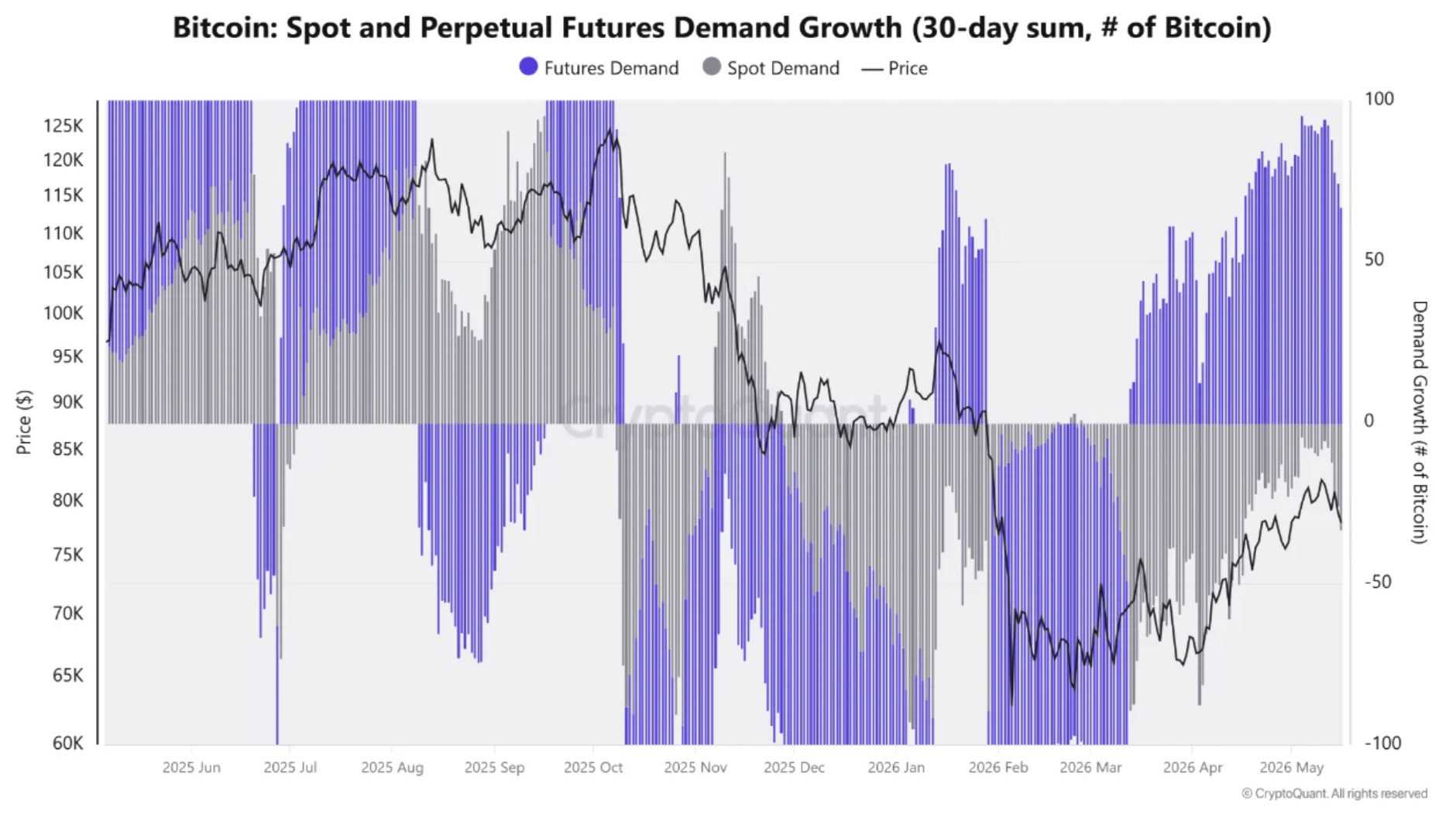
Bitcoin spot and futures demand growth (30-day sum). Source: CryptoQuant
Crazzyblockk also pointed to a sharp shift in Binance’s futures dominance last month. Binance previously controlled 40%-44% of global USDT-margined futures volume from October 2024 to March 2026.
In May 2026, Binance’s share dropped to 21.1% while OKX climbed to 26.3%, marking the first reversal in exchange leadership during the cycle.
Related: Price predictions 5/18: SPX, DXY, BTC, ETH, XRP, BNB, SOL, DOGE, HYPE, ADA
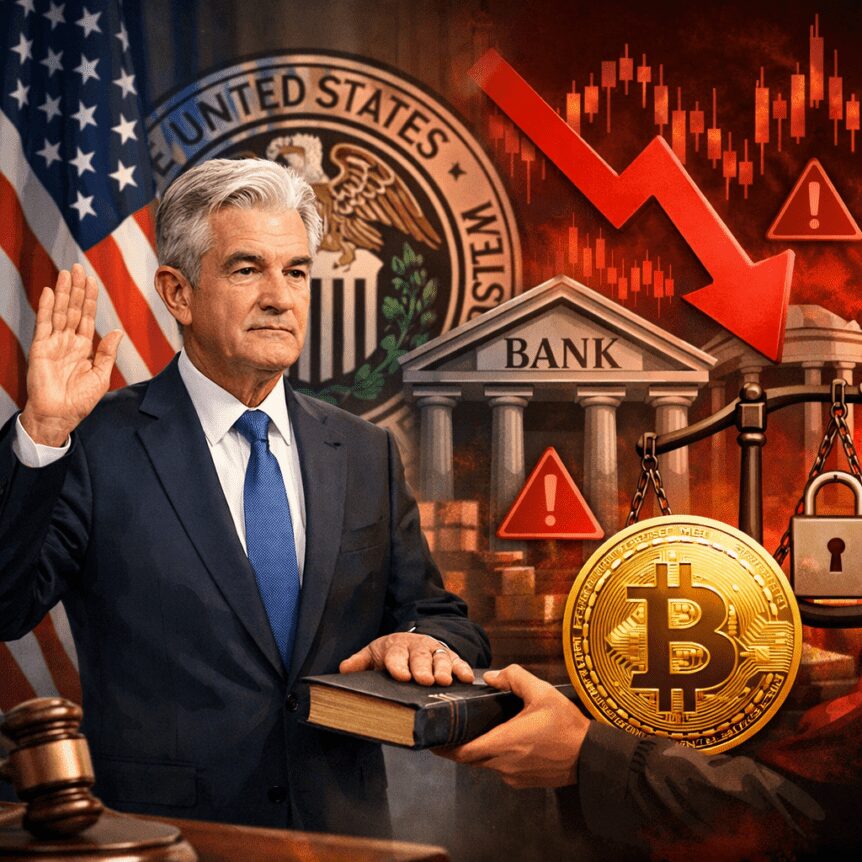
Kevin Warsh is poised to be sworn in as the next chair of the U.S. Federal Reserve Board of Governors this Friday, a transition that will place him at the center of monetary policy formation at a moment of heightened scrutiny over inflation, growth, and financial stability.
According to Cointelegraph, the Senate voted largely along party lines to confirm Warsh as the Fed’s new chair, succeeding Jerome Powell. The nomination comes as President Donald Trump has publicly pressed for a rate-cutting stance, a position that has fed ongoing debate about the Fed’s independence and its policy trajectory. In recent months, Trump publicly urged that the chair should be lowering interest rates, a stance that has intensified market and political discussion about looming shifts in policy direction.
With Warsh slated to assume the chair’s duties, synthetic market indicators have begun to price in divergent views on the policy path. Prediction-market platform Kalshi shows approximately 38.2% odds of the federal funds rate being lowered before 2027, a drop from roughly 96% observed in February. Meanwhile, CME Group’s FedWatch tool continues to signal a high probability that rates will remain at their current target of 3.50%–3.75% through the summer, with a 98.8% probability of no change through the end of June and more than 94% through July.
As the Fed chair, Warsh will wield substantial influence over policy deliberations and the setting of the federal funds rate, a task closely watched by financial markets, lenders, and institutions that rely on predictable policy signals. The next Federal Open Market Committee meeting is scheduled for June 16, providing a potential inflection point for policy if the new leadership signals a shift or confirms the status quo.
During Warsh’s confirmation hearing, concerns were raised about governance and potential conflicts of interest. Massachusetts Senator Elizabeth Warren argued that confirming Warsh could create opportunities for the Fed to direct favorable outcomes toward financial interests, citing the possibility of special accounts or bailouts tied to affiliations with private entities. Warsh disclosed assets exceeding $100 million ahead of the hearing, including holdings in AI and crypto-related ventures, a disclosure that has prompted ongoing discussions about independence, disclosure standards, and perception of risk within a central bank leadership role.
Key takeaways
- Kevin Warsh is set to be sworn in as the chair of the Federal Reserve Board, signaling a leadership transition with potential implications for monetary policy inference and regulatory posture.
- The confirmation vote in the Senate was described as largely along party lines, reflecting the broader political dynamics surrounding the central bank’s independence.
- Market expectations show a divide: Kalshi’s contract pricing indicates a 38.2% chance of a rate cut before 2027 (down from 96% in February), while CME FedWatch places a high probability on rate stability through mid-year and into summer.
- Warsh’s asset disclosure — reportedly more than $100 million, including investments in AI and crypto — has amplified discussions about governance, personal exposure, and conflict-of-interest risk for a central bank chair.
- Lawmakers are pressing for rapid CFTC nominations amid ongoing debates over crypto market structure, enforcement priorities, and the Digital Asset Market Clarity Act (CLARITY), underscoring the regulatory dimension of the evolving crypto landscape in parallel with traditional financial oversight.
Federal Reserve leadership and policy trajectory
The impending swearing-in of Warsh as Fed chair places him at the apex of a complex policy milieu that includes inflation dynamics, growth concerns, and financial stability considerations. While the Fed’s policy stance will ultimately be guided by the FOMC’s deliberations, leadership signals can shape the tempo of policy normalization or accommodation. The central bank operates with a mandate to maximize employment and price stability, and the appointment of a new chair often influences market interpretations of the committee’s appetite for rate adjustments or balance-sheet actions in the near term.
From a regulatory and compliance perspective, the transition underscores the importance of ensuring that chair-level commitments align with established institutional safeguards, independence norms, and robust governance practices. The ongoing dialogue around potential conflicts of interest and asset disclosures highlights the critical need for transparent governance frameworks within key U.S. financial authorities.
Market sentiment, risk assessment, and policy signaling
The divergence between prediction-market pricing and traditional probability tools reflects a broader ambiguity about the policy path under Warsh’s leadership. Kalshi’s pricing suggests a meaningful probability of a rate cut only beyond the near-term horizon, whereas the Fed’s own projections and futures markets continue to show a strong tilt toward policy stability in the coming months. This discrepancy matters in practice for institutions managing interest-rate risk, the pricing of secured funding, and risk-management frameworks that rely on forward-looking policy expectations.
Regulatory and institutional implications are evident in how market participants calibrate their capital planning, liquidity management, and lending practices. A shift toward a more aggressive rate-reduction stance could alter the pricing of risk across debt markets, impact leverage conditions for banks and nonbank lenders, and influence the valuation of income-oriented assets. Conversely, a confirmed stance of steady policy could reinforce the current macroeconomic assumptions underpinning credit markets and risk models.
Regulatory nominations, oversight, and the crypto-policy backdrop
Even as Warsh approaches the chair’s desk, lawmakers remain focused on the regulatory architecture governing financial markets, particularly the crypto sector. The CFTC’s leadership lineup has come under scrutiny amid debates about who should oversee innovative trading platforms and how rulemaking should evolve in tandem with digital asset market developments. Since December, the CFTC has been led by Michael Selig, with Acting Chair Caroline Pham replaced, and the regulator has taken a more assertive stance regarding platforms that host prediction markets and other digital-asset-related activity.
House lawmakers have urged the Trump administration to nominate a full slate of CFTC commissioners to address urgent regulatory issues and to provide clarity on rulemaking if the Digital Asset Market Clarity Act (CLARITY) were to become law. The evolving policy framework for crypto markets and the broader digital-asset ecosystem remains a dynamic area of federal regulation, with potential cross-border considerations and implications for licensing, enforcement, and market structure standardization.
According to Cointelegraph, these developments reflect a broader regulatory calibration: balancing innovation and investor protection, ensuring effective oversight of new trading venues, and aligning U.S. policy with a rapidly changing market landscape. The regulatory trajectory and the precise stance on crypto market infrastructure will be pivotal for exchanges, fintechs, and institutions seeking to operate within a coherent U.S. framework that can interface with international standards.
Institutional and compliance implications
The combination of a new Fed chair, ongoing questions about independence and disclosure, and the regulatory push around crypto markets creates a multifaceted environment for financial institutions. Banks and nonbank lenders alike must monitor policy signals that affect funding costs, capital adequacy planning, and risk governance. Compliance teams should prepare for potential shifts in disclosure requirements, governance expectations, and the regulatory posture toward digital assets, including how the CLARITY framework might influence licensing, reporting, and cross-border operations.
From a policy-history perspective, the Warsh appointment sits within a lineage of central-bank leadership where governance clarity and preemptive risk management are increasingly prioritized. The unfolding discussions about special accounts, bailouts, or other policy tools underscore the importance of maintaining a transparent framework that preserves independence while addressing public-interest concerns.
Closing perspective
As Warsh takes the helm, the key question is how quickly and in what direction monetary policy will respond to evolving macro forces and political considerations. Watch for signals from the Fed’s communications and the June 16 FOMC meeting, alongside ongoing Congressional and regulatory activity around crypto-market oversight. The coming weeks will illuminate how the new leadership balances independence, economic stability, and regulatory alignment in a rapidly changing financial landscape.
Galaxy Digital secured a BitLicense from New York on May 18 to offer regulated crypto services to institutions.
Summary
- Galaxy Digital’s subsidiary GalaxyOne Prime NY received a BitLicense and Money Transmission License from NYDFS on May 18, 2026.
- The approval allows Galaxy to offer regulated trading and custody to hedge funds, registered investment advisers, and family offices across New York State.
- Galaxy manages approximately $9 billion in client assets and New York now joins a regulatory footprint of more than 50 global licences.
Galaxy Digital announced on May 18 that the New York State Department of Financial Services granted its subsidiary GalaxyOne Prime NY both a BitLicense and a Money Transmission License.
The approvals authorise Galaxy to offer regulated digital asset trading and custody services to institutions across New York State, including registered investment advisers, hedge funds, and family offices on a platform managing approximately $9 billion in client assets.
“New York is home to the deepest pool of institutional capital in the country, and digital assets are no longer sitting at the edge of those allocations,” said Mike Novogratz, Galaxy’s founder and CEO, in a statement.
Galaxy Digital’s BitLicense and what it unlocks
Galaxy becomes only the second firm to receive a BitLicense in 2026, following bitcoin payments firm Strike, which secured NYDFS approval in March.
The framework, introduced in 2015, is one of the strictest crypto licensing regimes in the US, requiring capital minimums, ongoing compliance reviews, and cybersecurity oversight. Only around 40 companies have been approved since launch. New York now joins Galaxy’s regulatory network of more than 50 global licences.
As crypto.news reported, Galaxy research head Alex Thorn has been closely tracking institutional Bitcoin allocations throughout 2026. The New York BitLicense gives Galaxy’s trading and custody platform direct access to the institutions driving those flows, in a state that holds the largest concentration of hedge funds and investment advisers in the US.
Why New York matters for institutional crypto
BitLicense holders include Coinbase, Robinhood, Circle, and PayPal, making Galaxy’s approval a signal that NYDFS continues selectively admitting crypto firms. As crypto.news documented in its 2025 coverage of Galaxy’s Q2 results, the firm has been building out its data center and AI infrastructure alongside its digital asset platform.
The New York licence now opens one of the world’s largest institutional pools to a firm that generated record results in Global Markets last year and has expanded its data center operations significantly since.
Galaxy’s shares fell 2.36% to $28.91 in pre-market trading on Monday despite the approval, reflecting broader market weakness on the day.

Prince Harry Dealing With ‘Regrets’ Over Life Choices, Experts Say

Chelsea hires Xabi Alonso as new manager

A filmmaking tool or an existential threat: Cannes Film Festival weighs the rise of AI

Manchester United reach agreement with Casemiro over contract clause amid transfer speculation

US brings back mandatory military draft registration

Steven Gerrard disagrees with Gary Neville over ‘shock’ Chelsea and Arsenal claim | Football


-

 Crypto World3 days ago
BloFin War of Whales 2026 Grand Prix opens registration for $5M trading championship
-

 Fashion3 days ago
Weekend Open Thread: Theory – Corporette.com
-

 Crypto World3 days ago
E-Estate Announces 1 Year Live: Washington DC Summit as Real Estate Tokenization Enters Its Next Phase
-

 Tech4 days ago
Tech Moves: Microsoft AI leader jumps to OpenAI; former AI2 exec joins Meta; and more
-
Crypto World6 days ago
Bitcoin Suisse expands with Digital Asset License and Investment Business Act Registration Approval in Bermuda
-

 Politics6 days ago
Pakistan to enter Chinese capital market as war inflation bites
-

 Crypto World6 days ago
Bitcoin Suisse expands with Digital Asset License and Investment Business Act Registration Approval in Bermuda
-

 Crypto World4 days ago
Google’s Gemini AI Predicts Incredible Solana Price by the End of 2026
-

 Business3 days ago
H&R Real Estate Investment Trust (HR.UN:CA) Q1 2026 Earnings Call Transcript
-

 Tech3 days ago
Google reimburses Register sources who were victims of API fraud
-

 Sports3 days ago
Napoleonic enters 2026 Doomben 10,000 field via Abounding withdrawal
-

 NewsBeat6 days ago
Comment on Keir Starmer surviving the day as Prime Minister like a turd that wont flush
-

 Fashion6 days ago
The Best-Kept Makeup Secret for a More Defined Face
-
 Entertainment4 days ago
Zara Larsson Has Blunt Response To Chris Brown Diss
-

 Politics6 days ago
The Trial of Majid Freeman, Verdict
-
 Tech6 days ago
Why AI is making typography a boardroom conversation
-
 Crypto World5 days ago
Two AI Tokens Lead May Rally, But Risks Are Rising
-

 Politics6 days ago
Palestine’s flag becoming a regular sight at European football stadiums
-
 Crypto World6 days ago
Senate Approves Kevin Warsh to Federal Reserve Board Seat
-

 Entertainment7 days ago
Insides Reveal Taylor Swift’s Wedding Gown Chaos With 6 Dresses
You must be logged in to post a comment Login