
Crypto World
Nvidia, Palantir stocks sink amid growth, value rotation

Nvidia shares slid to their lowest level since December, falling roughly 20% from record highs as an accelerating rotation from growth to value pushed the world’s most valuable company into bear-market territory.
Similarly, Palantir stock dropped to $130 as crypto.news predicted before its earnings.
Summary
- NVIDIA share price dropped into a bear market on Thursday.
- There are signs that investors are dumping growth stocks.
- Technical analysis points to a drop to $150.
Why is Nvidia down?
The ongoing Nvidia stock crash mirrors that of other growth companies. For example, AMD, its key competitor, tumbled to $194, down 27% from its December high.
The software sector slid into a technical bear market, with the iShares Expanded Tech-Software ETF (IGV) down more than 20% as investor anxiety around AI disruption fueled what some are calling a “SaaSpocalypse.” Fears that autonomous AI agents could replace traditional software licenses have weighed on stocks such as Palantir, which continued to sink.
Wedbush analyst Dan Ives pushed back on the pessimism, calling the selloff a “software garage sale” and arguing the market is pricing in an unrealistic doomsday scenario. Ives said enterprise software remains deeply embedded, citing data security risks and migration costs. He named Palantir, Microsoft, Snowflake, Salesforce, and CrowdStrike as long-term winners despite the recent panic.
On the other hand
Value companies are doing well, with the Vanguard Value ETF and the Schwab U.S. Dividend ETF (SCHD) rising by nearly 10% this year. They are all trading at their all-time highs.
Nvidia stock has crashed as traders reflect on key concerns. For example, there are concerns about whether big-tech companies will continue their spending. These concerns accelerated after Microsoft’s report showed that its cloud revenue slowed in the fourth quarter. Its stock has dropped to $400, down by 27 from its all-time high.
Therefore, there is a risk that the company and other top hyperscalers will begin to pare back their spending to please investors concerned about return on investment.
NVIDIA stock has sunk as investors remain concerned about its Chinese business. A report by the Financial Times said that the Trump administration was still conducting a review on sales of H200 chips to China. Beijing has allowed ByteDance, Tencent, and Alibaba to buy 400k chips.
At the same time, Nvidia’s biggest customers are working on their own ASIC chips. Google is working on its TPU chips, while Amazon, Microsoft, and OpenAI are hoping to launch theirs soon. This development may lead to competition and lower sales in the long-term.
The next key catalyst for Nvidia’s stock price is its financial results, which will provide more information about its business. Analysts anticipate its revenue will come in at $67 billion, up over 50% from 2024. Its annual revenue is expected to exceed $500 billion by 2027 or 2028.
NVIDIA share price technical analysis
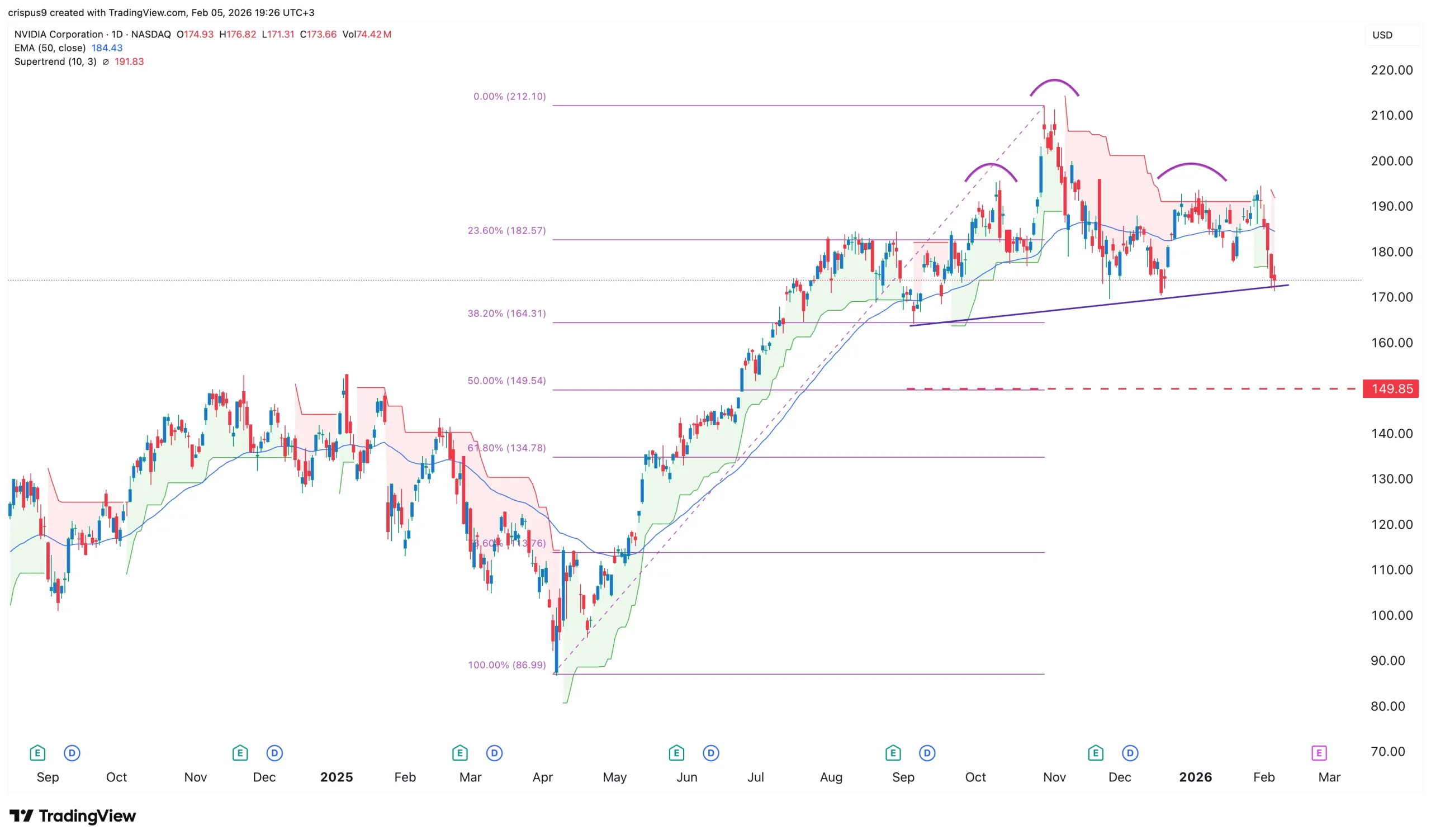
The daily chart shows that the NVDA share price is flashing red signals. It has formed a head-and-shoulders pattern and is now at the neckline. This is one of the most common bearish reversal sign.
It has moved below the 23.6% Fibonacci Retracement level. Also, it retreated below the 50-day moving average and the Supertrend indicator. Therefore, the most likely forecast is that it continues falling, potentially to $150, the 50% retracement level.


Key Takeaways
- Irish authorities and Europol successfully accessed a Bitcoin wallet inactive for almost ten years
- Approximately 500 BTC valued at roughly $35 million was transferred to Coinbase on March 24, 2026
- The cryptocurrency belonged to Clifton Collins, a convicted cannabis cultivator who concealed his private keys in a fishing rod container
- Authorities believed the keys were permanently lost when Collins’ possessions were disposed of in a landfill after his 2017 detention
- Law enforcement officials are confident the technique used can unlock the other 11 wallets containing over €330 million
The Criminal Assets Bureau (CAB) of Ireland, working alongside Europol, has gained access to a Bitcoin wallet that remained untouched for close to ten years. The wallet contained 500 BTC, currently valued at approximately $35 million, which was moved on-chain and deposited into Coinbase on March 24.
The cryptocurrency belonged to Clifton Collins, a Dublin resident who was found guilty of operating large-scale cannabis growing operations spanning several Irish counties over more than a decade. Before his criminal enterprise, Collins worked in security and beekeeping.
Between 2011 and 2012, Collins purchased 6,000 Bitcoin when the digital currency was trading for just a few dollars. He financed these acquisitions using profits from his cannabis business.
Collins divided his 6,000 BTC holdings evenly among 12 separate wallets, placing 500 BTC in each one. He printed all the private keys onto a single piece of paper and concealed this document inside a fishing rod case at his rented residence in Galway.
In 2017, law enforcement arrested Collins following the discovery of cannabis during a routine vehicle inspection. Subsequently, his landlord cleared out the property and discarded Collins’ belongings at a landfill site.
The fishing rod case containing the sole copy of the private keys was almost certainly destroyed in the process. Collins later indicated that a burglary at the property might have also played a role.
In 2020, an Irish High Court mandated the seizure of the Bitcoin. At the time, the 6,000 BTC was valued at approximately €53 million. Today, that same amount is worth roughly €360 million.
Despite the court’s ruling, CAB had no method to access the cryptocurrency without the private keys. Both law enforcement and Collins assumed the Bitcoin was irretrievably lost.
The Method Behind the Breakthrough
CAB and Europol have not revealed the specific method used to access the wallet. Europol stated only that it supplied “highly complex technical expertise and decryption resources.”
One hypothesis suggests Collins may have stored his keys in an encrypted file secured by a weak password, which investigators could have cracked using brute force techniques.
An alternative explanation is that Collins employed a defective tool to create all 12 key pairs. A compromised random number generator could have produced predictable keys, enabling investigators to recreate them.
Authorities reportedly have high confidence that the identical approach can be used on the other 11 wallets.
Outstanding Holdings
Collins still possesses 5,500 Bitcoin, currently worth approximately $389 million based on Arkham intelligence.
Should CAB successfully unlock all remaining wallets with the same methodology, recovering the complete 6,000 BTC would represent the largest single asset confiscation in the bureau’s operational history.
The 500 BTC transferred on March 24 represents the first verified access to any of Collins’ wallets since his apprehension nine years ago.

Key Takeaways
- XRP currently trades at $1.39, experiencing a 3.46% decrease over the past day
- Critical support remains intact at the $1.40 level following recent pullback
- Resistance zone between $1.45 and $1.50 represents the next hurdle for bulls
- The Relative Strength Index rests at 46, indicating subdued buying momentum
- Failure to hold $1.3850 support may trigger further downside toward $1.3620
XRP maintains its position near a crucial support threshold following sustained bearish pressure. The digital asset has retreated from recent peak levels and currently consolidates within the $1.40 vicinity.
Current market data shows XRP changing hands at $1.39. Daily trading volume reaches $3.16 billion while the total market capitalization stands at $85.87 billion, per CoinMarketCap statistics. The cryptocurrency has shed 3.46% of its value during the last 24-hour period.
The token previously surged beyond the $1.41 and $1.42 marks, ultimately reaching a session high of $1.4650. Following this peak, sellers emerged and forced the price below both $1.45 and $1.44 thresholds.
Price action breached the 61.8% Fibonacci retracement level calculated from the swing low of $1.3612 to the swing high of $1.4650. Demand materialized around $1.3850, coinciding with the 76.4% Fibonacci level, preventing additional downside movement.
Market analyst BitGuru observed on March 24 that XRP operates within what he identifies as a significant accumulation zone. His assessment indicates that price behavior follows a falling wedge pattern breakdown, with XRP potentially establishing support at the $1.40 level.
$XRP is moving inside a key accumulation zone after a long downtrend and recent falling wedge breakdown.
Price is now stabilizing around 1.40 support, showing signs of base formation. If buyers manage to push and hold above 1.45–1.50 resistance. pic.twitter.com/AFIZozlx3b
— BitGuru 🔶 (@bitgu_ru) March 24, 2026
Momentum Indicators Signal Cautious Sentiment
The Relative Strength Index currently registers approximately 46, remaining beneath the neutral 50 threshold. This positioning indicates that bearish forces continue to dominate market sentiment.
XRP also trades beneath its 20-day moving average positioned at $1.41 and significantly below the 200-day moving average at $2.09. The moving average configuration displays a bearish alignment.
MACD indicator lines remain horizontal within negative territory. The absence of a bullish crossover signal indicates that momentum has yet to shift toward buyer favor.
Critical Price Levels for Traders
Regarding upside potential, initial resistance emerges near $1.4250. Clearing this barrier would expose $1.44, followed by $1.4650.
A decisive breakout above $1.4650 could establish targets at $1.50 and subsequently $1.5250. Bulls must defend the $1.4250 level to sustain any upward trajectory.
Should XRP encounter rejection at higher levels, the initial support line sits at $1.40. Additional downside cushions exist at $1.3850 and $1.3620.
A daily close beneath $1.3620 may accelerate selling toward $1.35 or potentially $1.3320.
This trendline could offer a strong buying opportunity for $XRP! pic.twitter.com/rdyxCeal1s
— Ali Charts (@alicharts) March 20, 2026
Technical analyst Ali Charts shared on X that an important trendline may present a compelling accumulation opportunity for XRP, highlighting the present support region as a favorable entry zone.
XRP presently maintains levels above both $1.40 and the 100-hourly Simple Moving Average, with market participants adopting a cautious stance as they monitor developing price patterns.
TLDR:
- The Philippines imports 98% of its oil from Gulf nations, all directly disrupted by the ongoing Iran war conflict.
- Fuel prices have nearly tripled since February 28, with diesel hitting 130 pesos and LPG reserves lasting just 24 days.
- President Marcos signed Executive Order 110, granting authority over fuel rationing and essential goods distribution nationwide.
- Labor union KMU warned the emergency order could restrict worker strikes, with transport workers planning a two-day strike this week.
The Philippines has become the first country to declare a national energy emergency linked to the ongoing Iran war. President Ferdinand Marcos Jr. signed Executive Order 110 on Tuesday.
The order cites an imminent danger to the country’s energy supply stability. With roughly 45 days of fuel remaining on average, the government is moving quickly.
The declaration grants broad authority over fuel purchasing, rationing, and distribution of essential goods across the nation.
A Nation Running Low on Fuel
The Philippines imports 98% of its oil from the Gulf region. Its top three suppliers — Saudi Arabia, the UAE, and Iraq — are all caught up in the conflict.
Together, these three nations account for billions of dollars in annual oil exports to the Philippines. With the Strait of Hormuz effectively shut down, those supply lines have been severely disrupted.
Saudi Arabia has already cut oil exports to Asia for a second straight month. Meanwhile, the Philippines produces just 14,300 barrels of oil per day domestically.
The country consumes around 474,000 barrels daily, leaving a 97% gap between supply and demand. That gap is now at the center of a deepening national crisis.
As TFTC noted on X: “The Philippines just became the first country in the world to declare a national energy emergency over the Iran war. They have 45 days of fuel left.”
Energy Secretary Sharon Garin provided a detailed breakdown of current reserves. “Gasoline for 53 days, diesel for 46 days, jet fuel for 39 days, and LPG for just 24 days,” Garin stated. The 45-day figure represents the average across all petroleum products. These numbers have pushed the government toward emergency measures.
Fuel Prices Surge as Government Acts
Fuel prices in the Philippines have nearly tripled since the war began on February 28. Diesel, widely used across the country, has surged to nearly 130 pesos per liter.
Kerosene, a cooking fuel for lower-income households, has climbed to 145 pesos. Gasoline has now exceeded 90 pesos per liter, more than double pre-war levels.
In response, the government has introduced several conservation measures. Civil servants are now on a four-day workweek to cut fuel use.
Ferry services have also been reduced, and transport workers are receiving 5,000-peso subsidies. The country is also shifting temporarily to coal-fired power plants to reduce reliance on liquefied natural gas.
Labor unions, however, are not satisfied. The KMU, the Philippines’ largest labor coalition, described the executive order as an “admission” that the government failed to act sooner.
The group also warned that provisions in the order could be used to “restrict strikes and protests.” Transport workers are planning a two-day strike on Thursday and Friday in direct response to the crisis.


Robinhood has approved a share repurchase program worth $1.5 billion, according to a filing with the U.S. Securities and Exchange Commission on Tuesday. The company said it plans to execute the buyback over the next three years.
Summary
- Robinhood approved a $1.5 billion share buyback program to run over the next three years.
- HOOD closed down 4.7% Tuesday and remains nearly 39% lower so far in 2026 overall.
- Robinhood replaced its prior credit line with a new $3.25 billion JPMorgan revolving facility Tuesday.
According to the filing, the total includes $1.1 billion in new capacity. Robinhood rolled over the rest from an older repurchase plan. The company said the move reflects its capital plans as it continues to build new products and return value to shareholders over time.
Robinhood Chief Financial Officer Shiv Verma addressed the decision in a company statement. He said,
“Robinhood is a generational company with a massive long-term opportunity.” Verma also said, “This authorization reflects the confidence of our management team and board in our ability to continue delivering innovative products for customers and creating value for shareholders while returning capital over time.”
The company linked the program to its broader business strategy rather than to a short-term market move.
Robinhood shares closed Tuesday at $69.08, down 4.7% on the day. That marked the stock’s lowest closing price of the year. The shares later recovered slightly to $70.90 in after-hours trading.
The stock has fallen nearly 39% so far this year. It also stands 54.7% below its October peak of $152.46. The decline came during a weak period for both stocks and crypto, with broader macro concerns and the Iran war weighing on risk assets.
Credit facility expands while growth plans continue
Robinhood also said its unit, Robinhood Securities, entered a new $3.25 billion revolving credit facility with JPMorgan Chase. The new facility replaces a prior $2.65 billion line. It also includes an option to expand by up to $1.62 billion, which would bring the total capacity to $4.87 billion.
Even with pressure on its share price, Robinhood continues to push into crypto, tokenization, and adjacent financial products. The company launched the testnet for its Ethereum layer-2 network in February. Chief Executive Officer Vlad Tenev said the network processed 4 million transactions in its first week of public testnet activity.
Robinhood plans to launch the mainnet later this year to support tokenized equities, ETFs, and other traditional financial assets. Robinhood Ventures Fund has also invested about $35 million across Stripe and ElevenLabs.
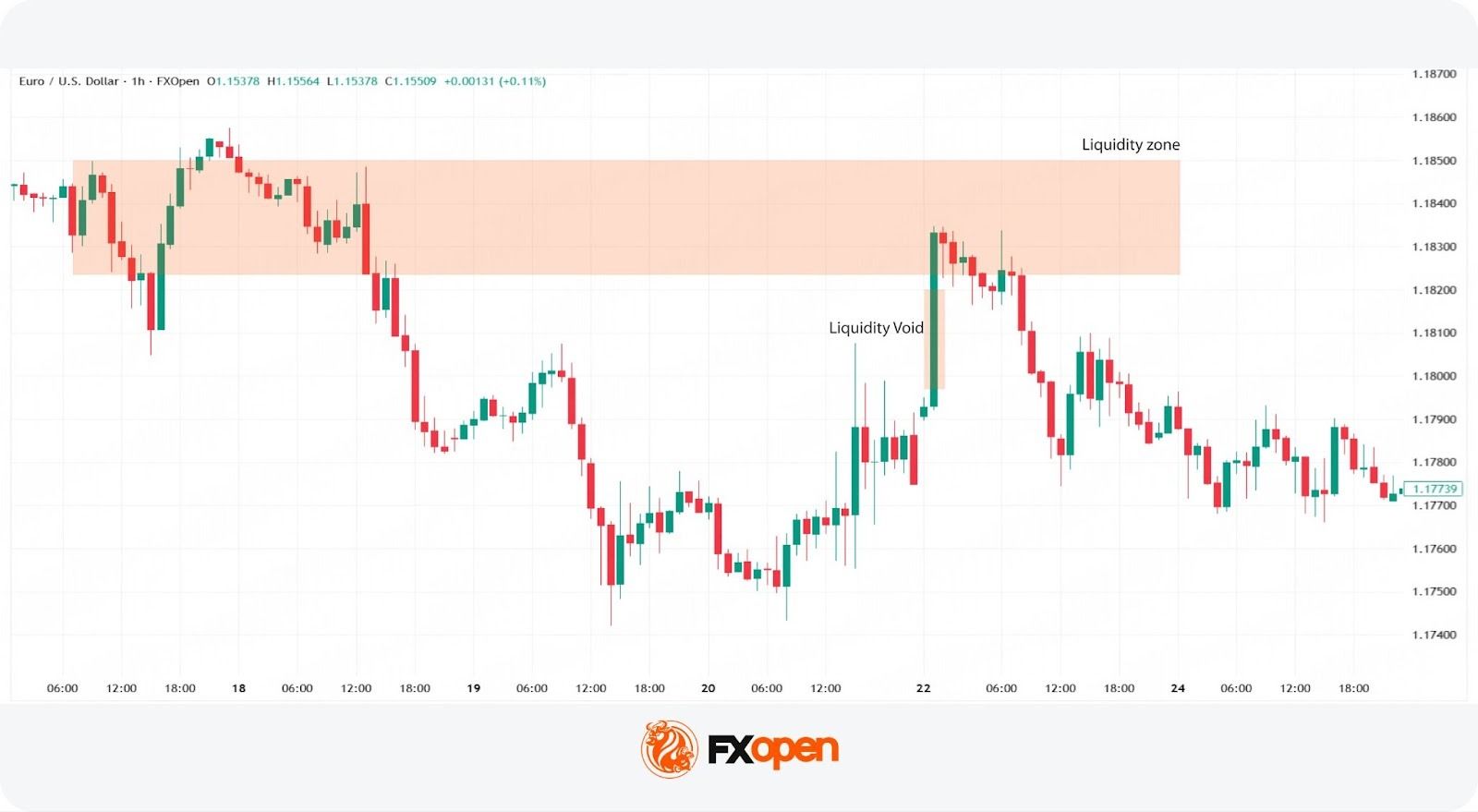
Liquidity zones are areas where large buy and sell orders cluster, often acting as support or resistance. Liquidity voids (or imbalances) are fast price moves where little trading occurred, and price often returns to fill them.
Traders use liquidity zones to identify entry and exit points, while liquidity voids may help anticipate retracements and continuation moves.
This article explains how liquidity zones and liquidity voids function in market structure and highlights their role on price charts.
Takeaways
- Liquidity zones = high trading activity (support/resistance)
- Liquidity voids = low activity (fast price moves)
- Price tends to:
- move towards liquidity
- return to fill voids
- Commonly used with:
- market structure
- volume analysis
Liquidity Zones vs Liquidity Voids
Liquidity zones and liquidity voids differ primarily in how order flow is distributed and how price behaves within each environment.
In liquidity zones, trading activity is elevated due to the presence of clustered orders around previous highs, lows, or consolidation ranges. This concentration of liquidity typically causes prices to slow down, rotate, or produce reactions, reinforcing their role as support and resistance areas.
In contrast, liquidity voids form during strong directional moves, leaving behind areas where little trading activity has previously occurred. As a result, when price revisits these regions, it often moves quickly due to the absence of significant opposing orders.
Liquidity zones are generally associated with reversal or breakout strategies, where traders anticipate interaction between buyers and sellers. Liquidity voids, however, are typically approached with mean reversion expectations, as the market tends to rebalance prior inefficiencies.
Understanding Liquidity in Trading
In trading, liquidity refers to how easily an asset can be bought or sold without significantly affecting its price. High liquidity means there are enough buyers and sellers at a given price level, facilitating smoother transactions. This concept is critical because it affects how quickly and at what price a trader can enter or exit positions.
Assets with high liquidity tend to have tighter spreads, which may reduce trading costs.
Conversely, assets with low liquidity can experience abrupt price movements due to limited order flow. Understanding liquidity may help traders make decisions.
These dynamics give rise to two important phenomena in trading: liquidity zones and voids. Liquidity zones are areas with a high concentration of trading activity, while liquidity voids represent gaps in the market where trading activity is sparse, each presenting unique conditions for trading strategies.
What Are Liquidity Zones in Trading?
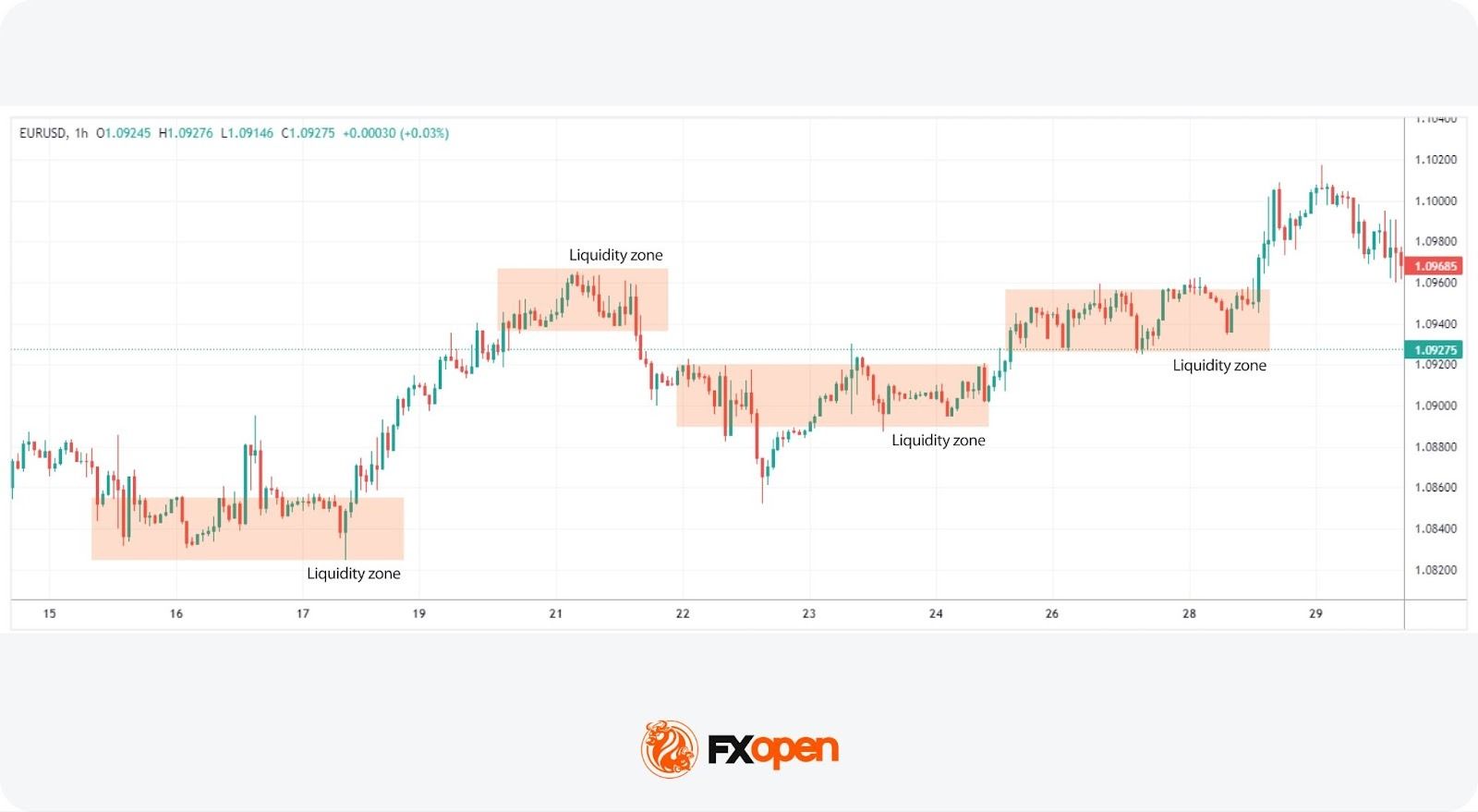
Liquidity zones (also called liquidity levels) are specific areas on a price chart where trading activity is highly concentrated. These zones indicate areas where large orders can be executed with minimal price impact.
Forex liquidity zones highlight areas where currency pairs tend to see higher activity.
These areas may be useful for identifying reversals or breakouts, providing reference points for entries and exits.
These zones often form around historical price levels where significant trading activity has occurred. They often act as magnets, attracting future price movement due to expected order flow. Liquidity levels are commonly associated with support and resistance. When price approaches these levels, traders can expect increased order flow, which may lead to clearer price reactions.
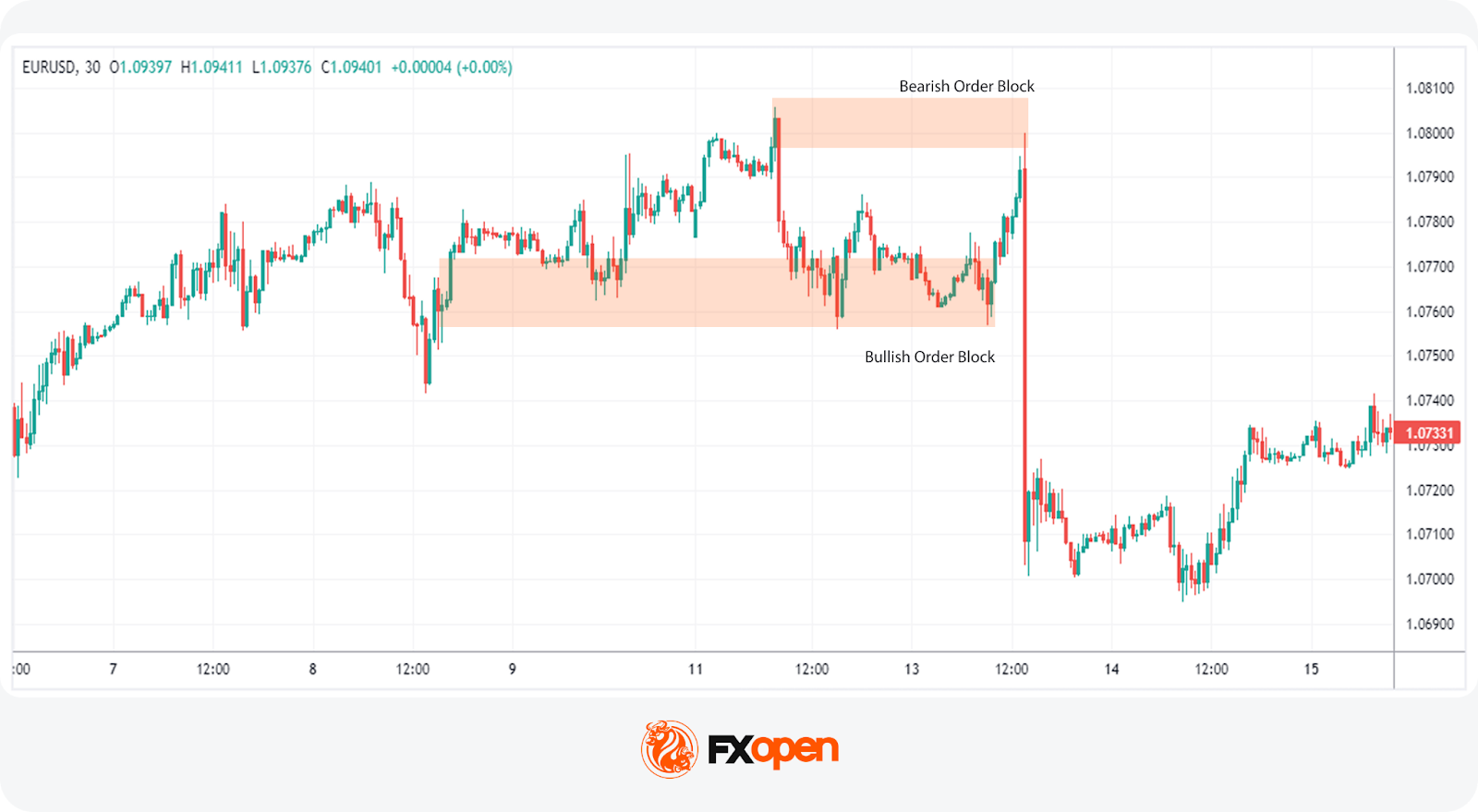
Liquidity Zones vs Order Blocks
How Traders Identify Liquidity Zones (With Examples)
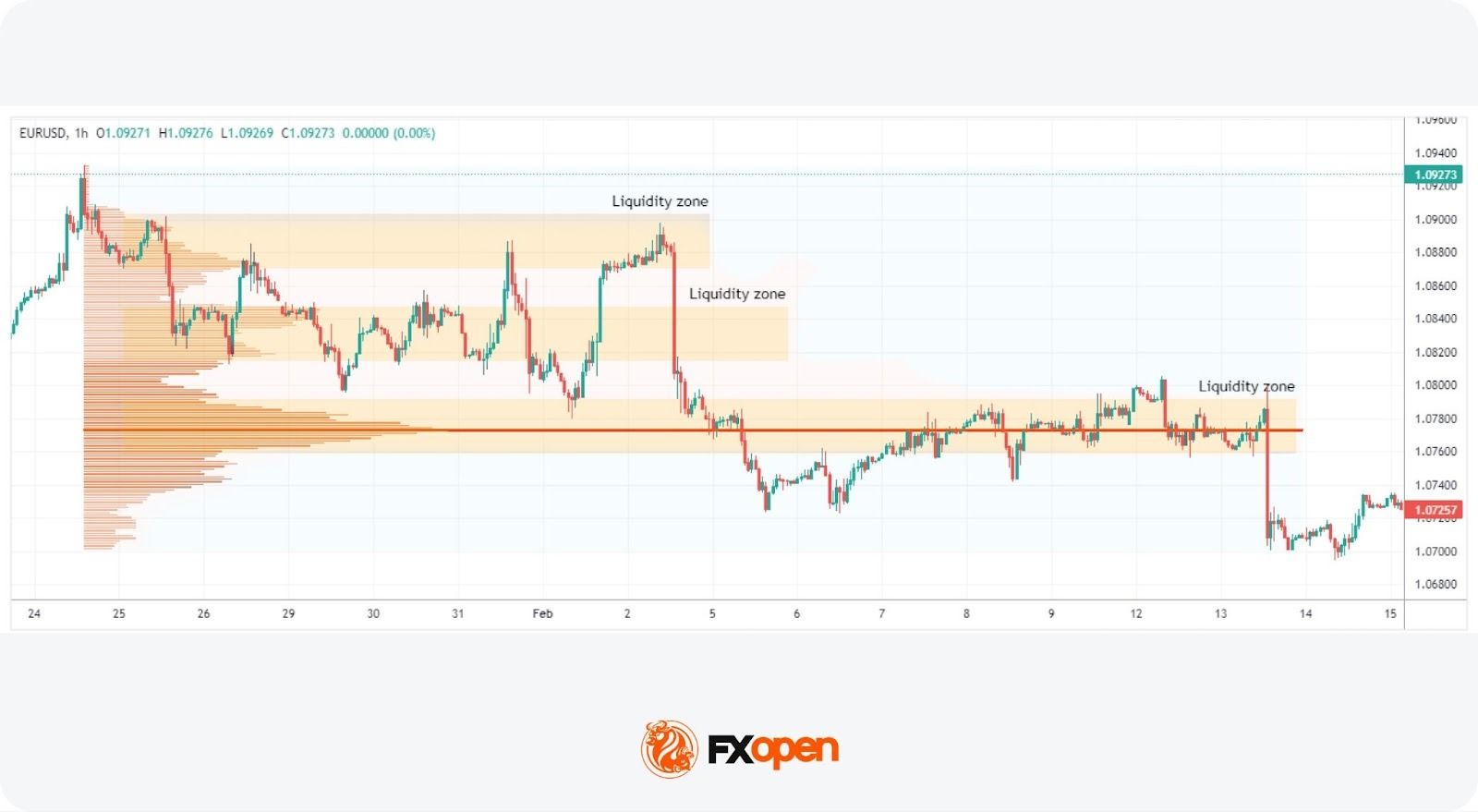
Traders identify liquidity zones using volume, price structure, and historical levels. Liquidity zone trading depends on accurately identifying areas where trading activity is concentrated. These levels highlight regions of high volume and may act as pivot points for price action.
Volume Profile
This approach uses the volume profile to show where most trading activity has occurred.
Unlike traditional indicators that display volume over time, the volume profile shows volume at specific price levels. This may help traders identify peaks in volume, highlighting areas of significant liquidity.
To use the volume profile tool as we have in the picture above, you can head over to FXOpen’s TickTrader trading platform and search for “Volume Profile Fixed Range” under the Indicators tab.
Price Consolidation Areas
Recognising zones where the price has consolidated for a notable period is another method. These areas represent a tug-of-war between buyers and sellers, resulting in a high volume of trades. Such levels often act as magnets for future price action, making them critical for liquidity area trading.
Previous Support and Resistance Levels
Historical support and resistance levels are invaluable for spotting zones. These are levels at which significant reversals or pauses in trend have occurred, indicating areas where large volumes of orders may accumulate. When price approaches these levels again, it often does so with increased trading activity, making them prime candidates for liquidity areas.
What Is a Liquidity Void (Imbalance)?
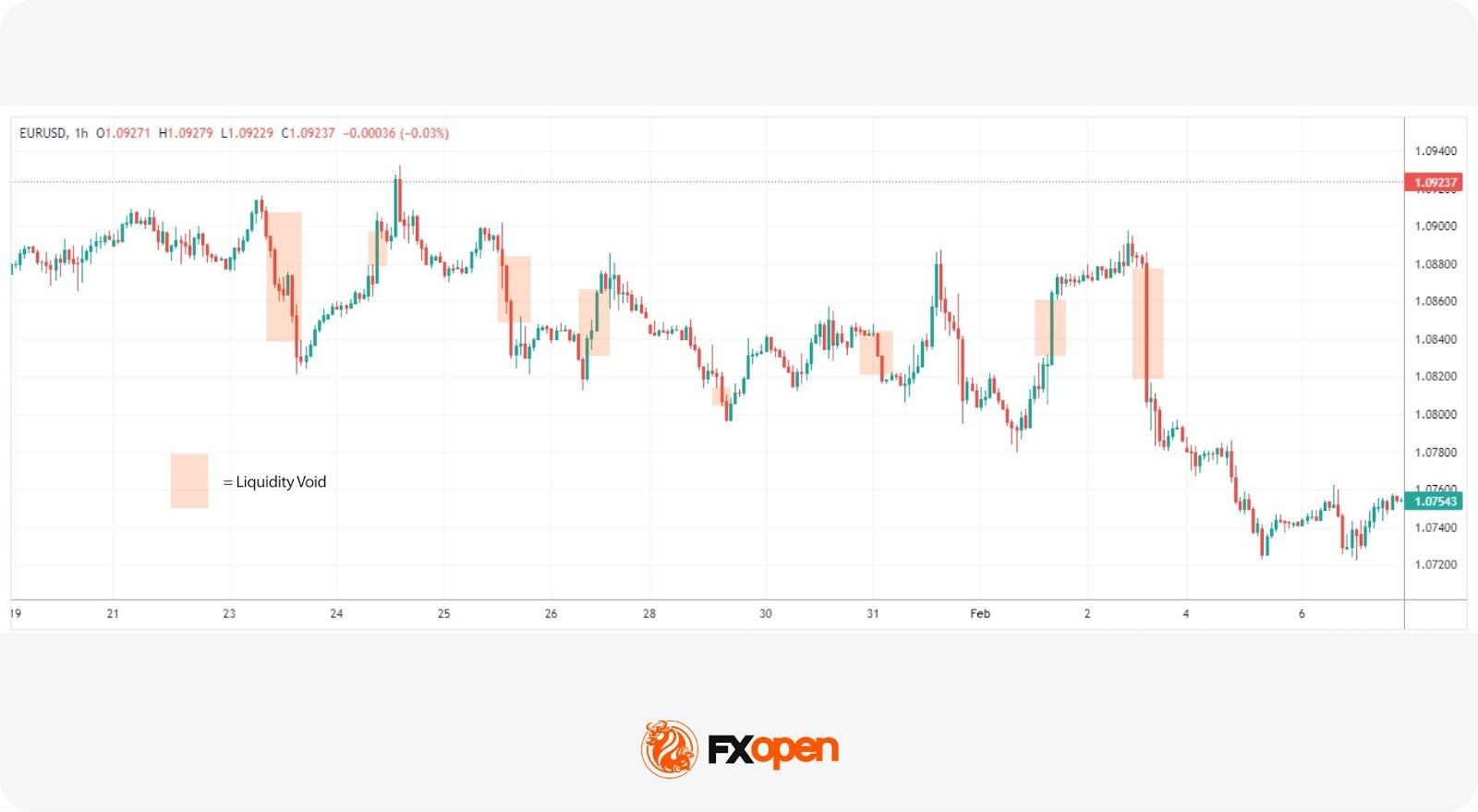
Liquidity voids (imbalances) are rapid price movements where little trading activity occurs between two levels. These gaps can lead to abrupt price changes and are often visible as sharp moves on a chart.
A liquidity void in forex signals an imbalance between buyers and sellers, causing prices to move quickly. This can result in sharp price movement as the market seeks a new equilibrium. These voids often occur after major news releases, during low-liquidity periods, or due to large institutional trades.
Their impact extends beyond the initial move. They represent areas where the market has not established a consensus price, which may lead to increased volatility later. Prices often return to these areas to “fill” the imbalance and restore balance in the market.
Traders navigate the increased volatility and unpredictability associated with these gaps but can also strategise to take advantage of the potential return to equilibrium.
How Traders Spot Liquidity Voids (Types of Liquidity Voids)
Liquidity voids can be classified based on where they appear in a trend. Liquidity voids in the forex market manifest in various forms, each with distinct characteristics and implications for traders. Understanding the different types of voids may support traders in navigating these challenging areas. Some notable types of liquidity voids are common, exhaustion, breakout, and runaway. Let’s take a look at them:
Common Liquidity Voids
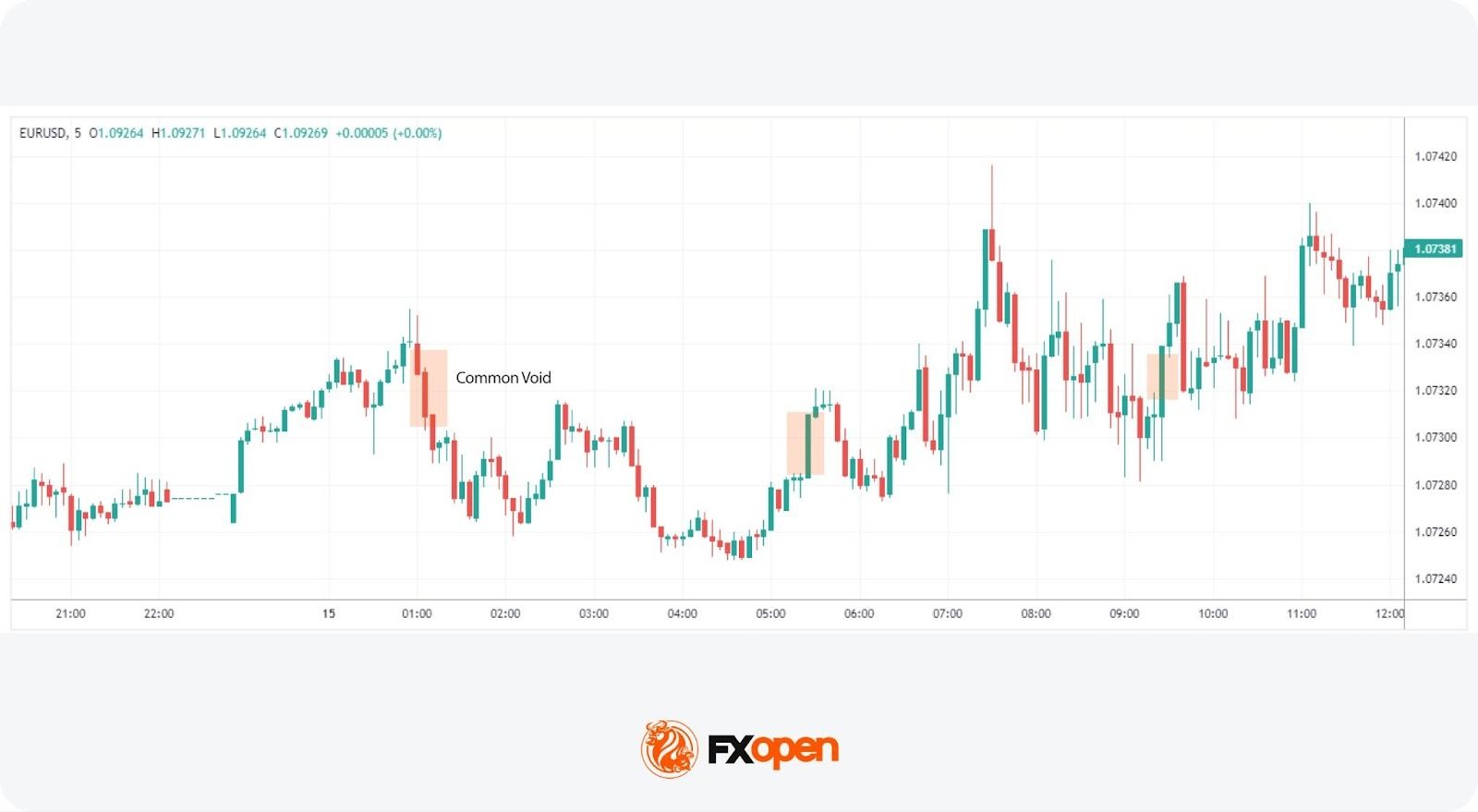
Common voids appear randomly across charts without any news or event trigger, forming from natural market ebb and flow. They don’t always carry significant analytical value but are still worth monitoring for risk management purposes.
Exhaustion Liquidity Voids
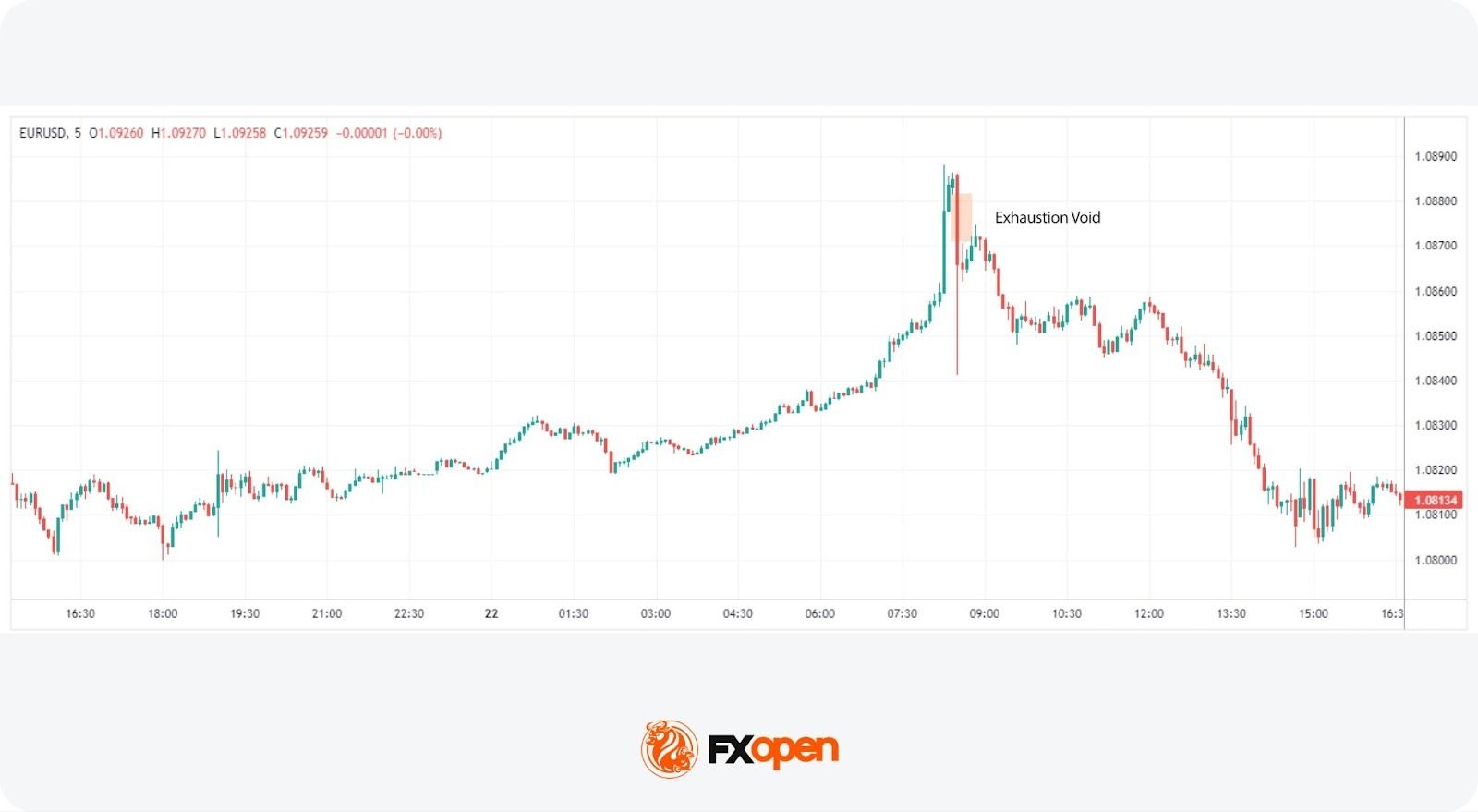
Exhaustion liquidity voids appear at the end of a trend when momentum fades and price makes a final push before reversing. Traders often watch for them as potential signals of a trend reversal.
Breakout Liquidity Voids
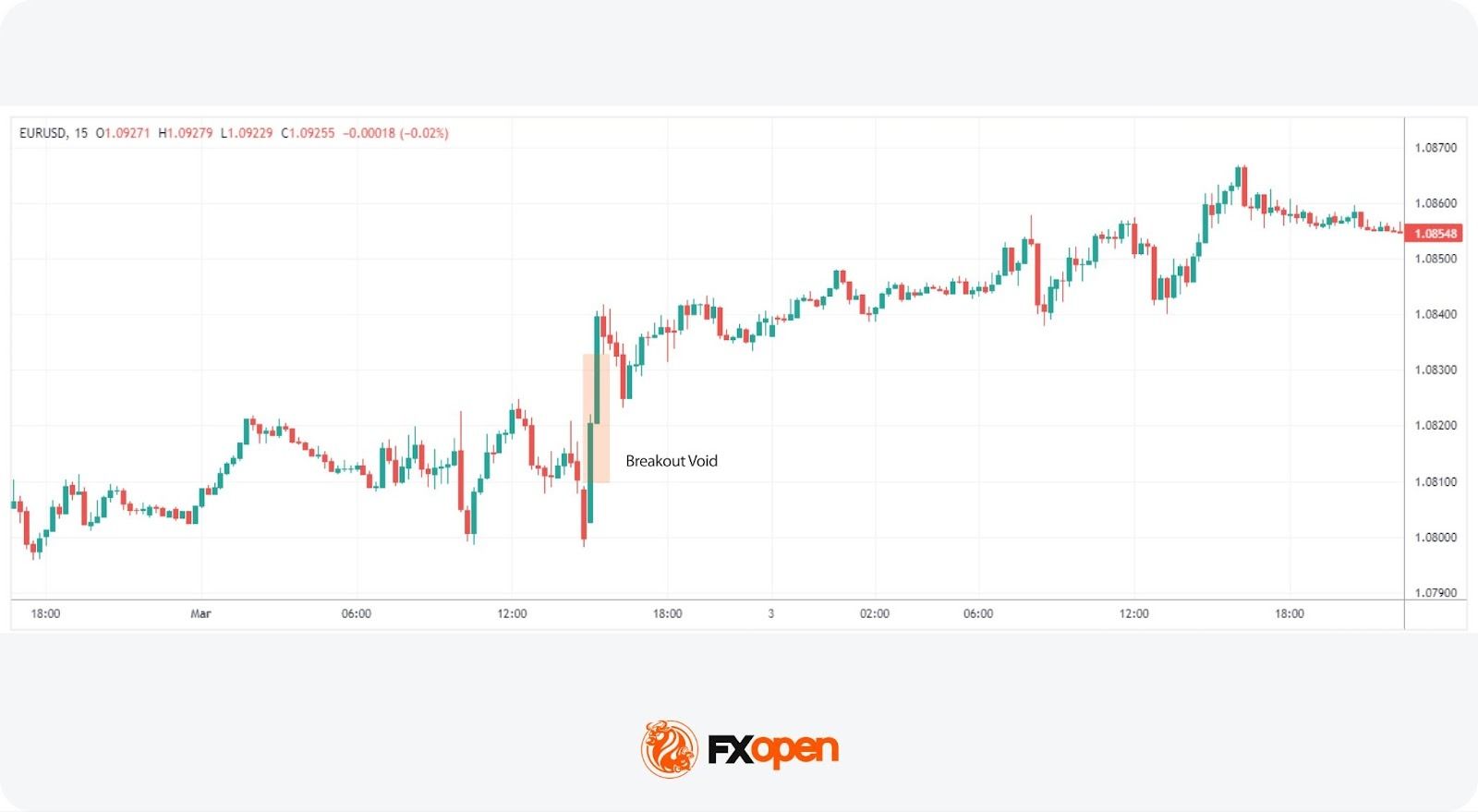
Breakout voids form when price breaks through a key support or resistance level with enough force to leave behind an imbalance. They often signal the beginning of a new trend.
Runaway Liquidity Voids
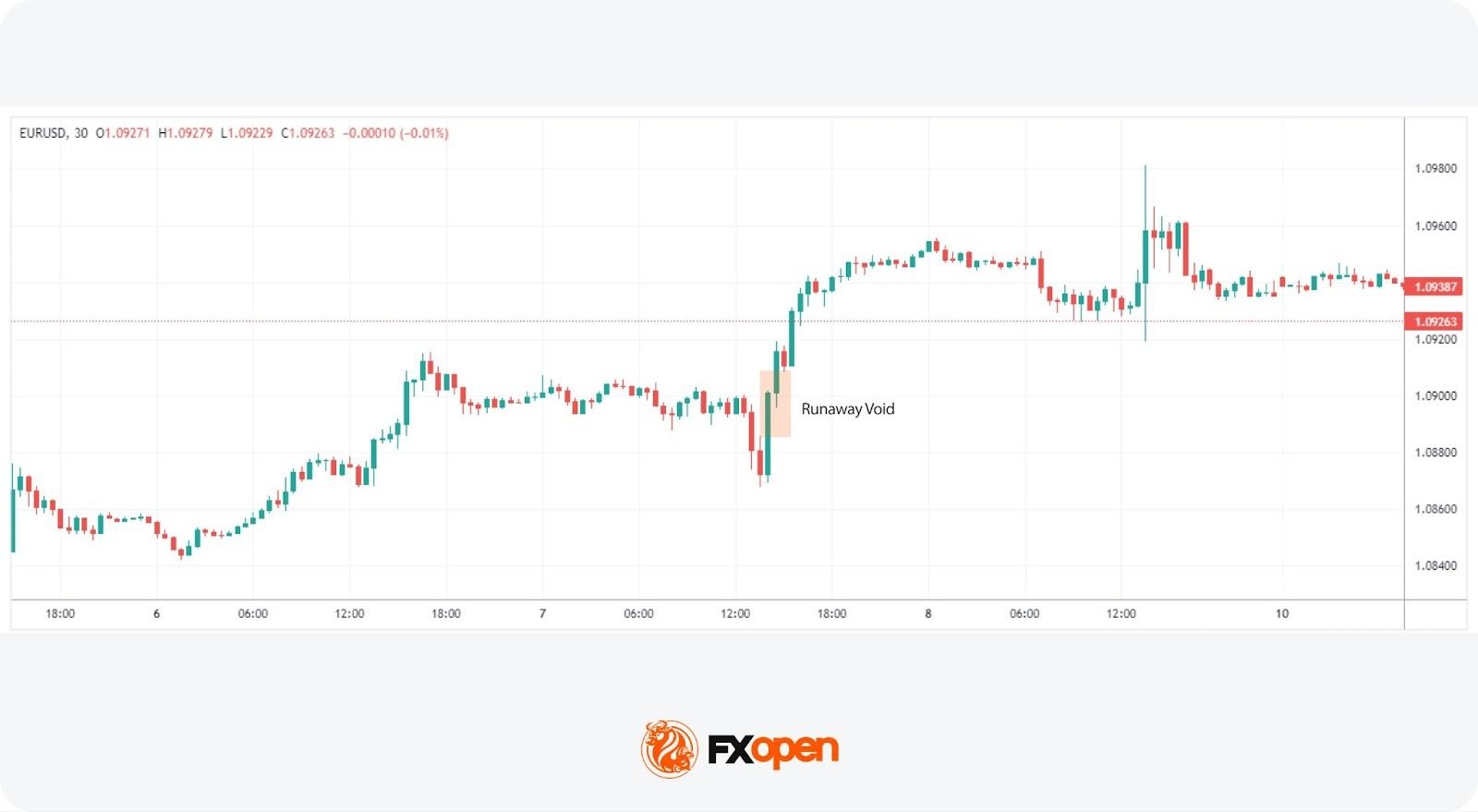
Runaway voids occur within an existing trend and signal its continuation. Price moves sharply in the trend’s direction, bypassing levels where liquidity would normally sit, which may support trend strength confirmation.
How Traders Use Liquidity Zones and Voids
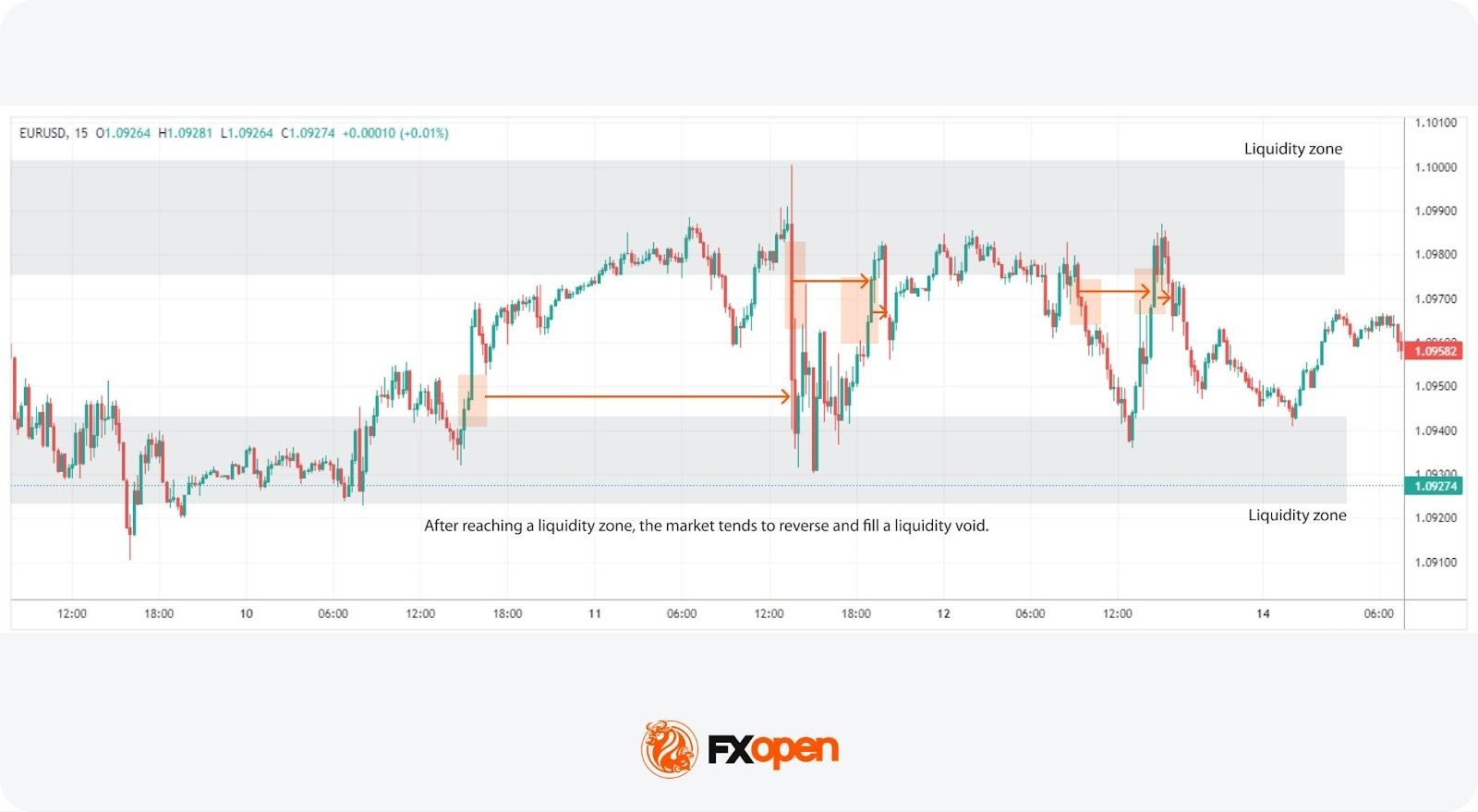
Liquidity zones and voids form the basis of several common trading approaches. Here’s how traders typically work with them.
Step 1: Identify a Liquidity Zone
Traders start by locating areas where price has repeatedly reacted, such as support and resistance levels or high-volume nodes on a volume profile. These clusters of resting orders act as magnets for price.
Step 2: Wait for a Price Reaction
Rather than acting immediately, traders watch how price behaves when it reaches the zone. Does it stall? Reverse? Push straight through? The reaction tells the story.
Step 3: Look for Confirmation
A reaction alone isn’t enough. Traders look for confirmation through candlestick patterns (like pin bars or engulfing candles) or a shift in market structure, such as a break of a recent swing high or low.
Step 4: Target Nearby Liquidity or a Void
Once confirmed, traders typically set targets at the next liquidity zone or unfilled void. Voids act as areas price is likely to move toward, since they represent unfinished business on the chart.
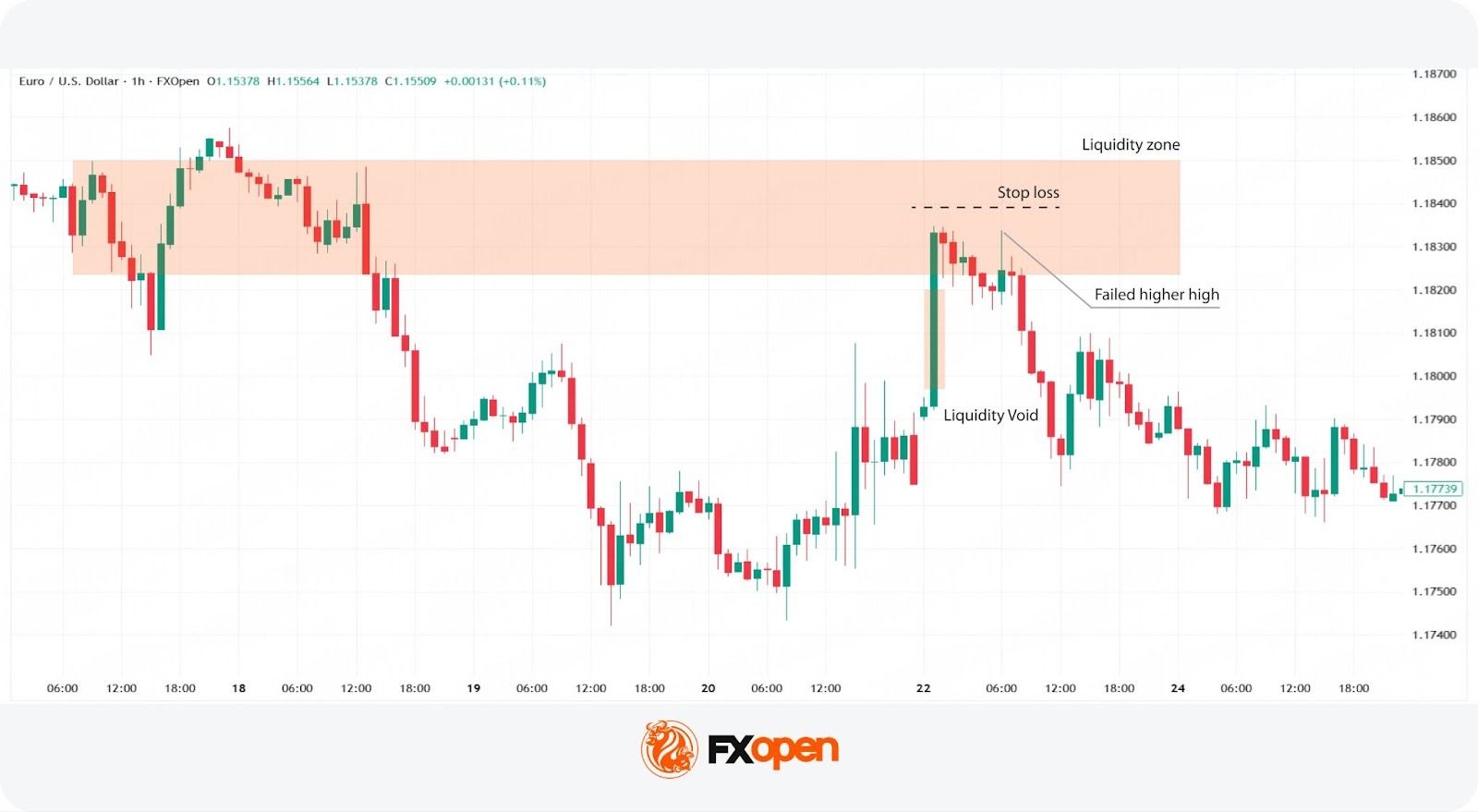
In this example, price moves into a liquidity zone, leaving a void behind it. Buyers attempt to push higher but fail, printing a long upper wick and signalling weakening momentum. Price then breaks below the established low and drops to fill the liquidity void left on the way up. A trader could have opened a sell position after the price broke below the low, set a stop-loss level above the nearest swing high, and closed the trade once the liquidity void was filled.
Limitations of Liquidity Zones and Voids
Understanding liquidity zones and voids provides traders with valuable insights into market dynamics, yet relying solely on these concepts comes with limitations. Here are some specific challenges to consider:
- Market Volatility: Market volatility can disrupt liquidity patterns, making historical levels less reliable.
- Influence of External Events: External events such as economic announcements can override expected behaviour.
- Timeframe Sensitivity: The relevance of zones and voids varies across timeframes, which may affect analysis.
- False Signals: These patterns can also produce false signals, leading to premature decisions.
The Bottom Line
Liquidity zones and voids may help explain how price moves within the forex market. They highlight areas of trading activity and imbalance, offering insight into potential price behaviour.
However, traders use them alongside other tools due to their limitations.
For traders seeking to apply these insights, opening an FXOpen account could provide a practical platform to explore and leverage the dynamics of liquidity in their trading across hundreds of tradable assets.
FAQs
What Are Liquidity Zones?
Liquidity zones are areas on a chart where buy and sell orders are concentrated, often acting as support or resistance. Traders monitor these levels to identify potential entry and exit points.
How Are Liquidity Zones Identified in Trading?
Liquidity zones are identified using tools such as volume profile, price consolidation, and historical support and resistance. These methods highlight areas where trading activity is concentrated.
How May Liquidity Zones Be Traded?
Liquidity zones are commonly used to identify potential entry and exit points. Traders monitor price reactions at these levels and may combine them with other tools to refine trading decisions.
What Are Liquidity Voids?
Liquidity voids are areas where price moves quickly due to low trading activity, creating an imbalance. Price often returns to these areas to “fill” the gap and restore market balance.
This article represents the opinion of the Companies operating under the FXOpen brand only. It is not to be construed as an offer, solicitation, or recommendation with respect to products and services provided by the Companies operating under the FXOpen brand, nor is it to be considered financial advice.
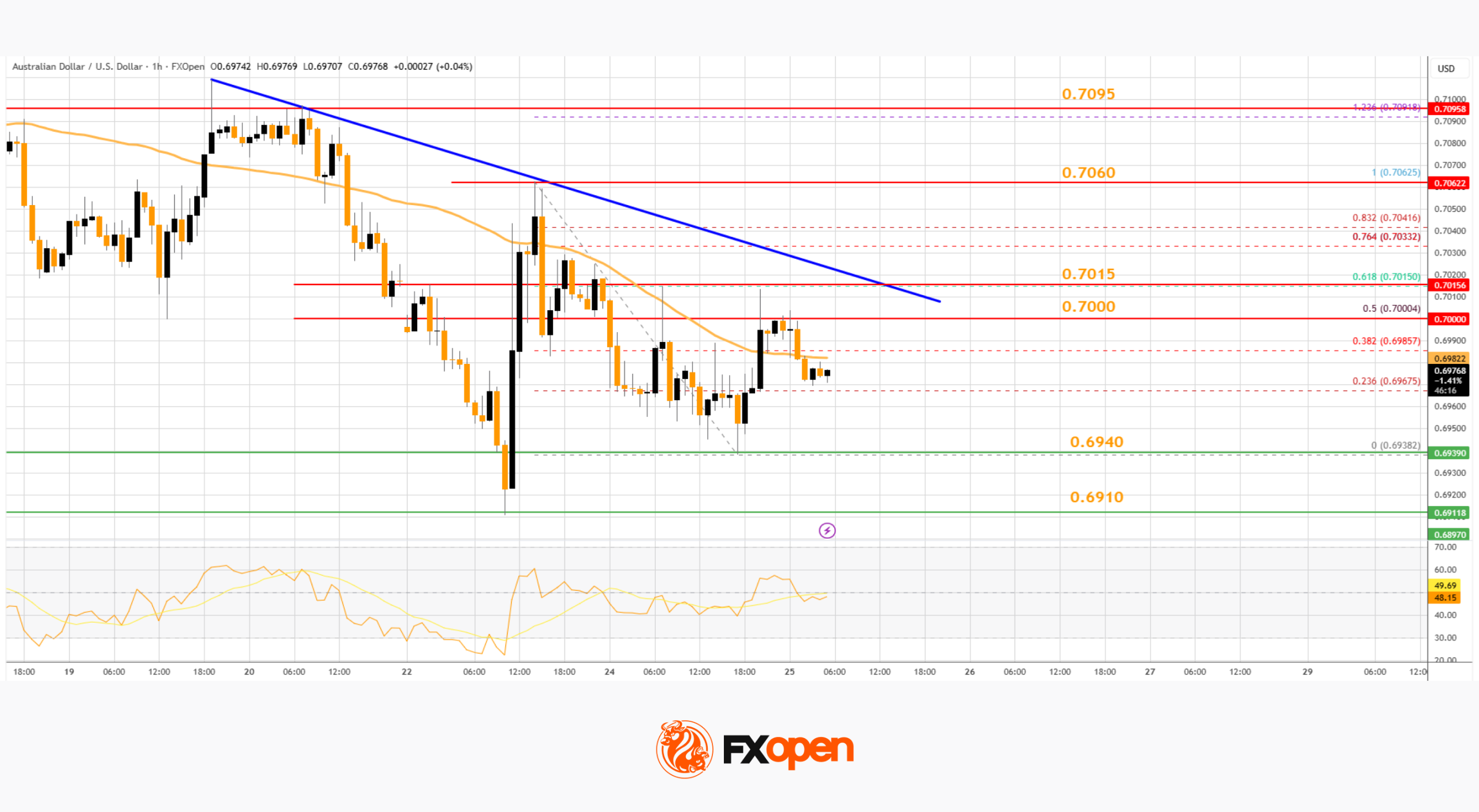
AUD/USD is attempting a recovery wave from 0.6910. NZD/USD is also correcting losses and might recover if there is a clear move above 0.5885.
Important Takeaways for AUD/USD and NZD/USD Analysis Today
· The Aussie Dollar found support near 0.6910 and is now recovering against the US Dollar.
· There is a key bearish trend line forming with resistance at 0.7015 on the hourly chart of AUD/USD at FXOpen.
· NZD/USD is attempting a recovery wave above 0.5800.
· There is a major bearish trend line forming with resistance near 0.5840 on the hourly chart of NZD/USD at FXOpen.
AUD/USD Technical Analysis
On the hourly chart of AUD/USD at FXOpen, the pair dipped from well above 0.7050. The Aussie Dollar declined below 0.7000, but the bulls were active near 0.6910 against the US Dollar.
The recent swing low was formed near 0.6938, and the pair is now correcting losses. There was a move above the 50% Fib retracement level of the downward wave from the 0.7062 swing high to the 0.6938 low.
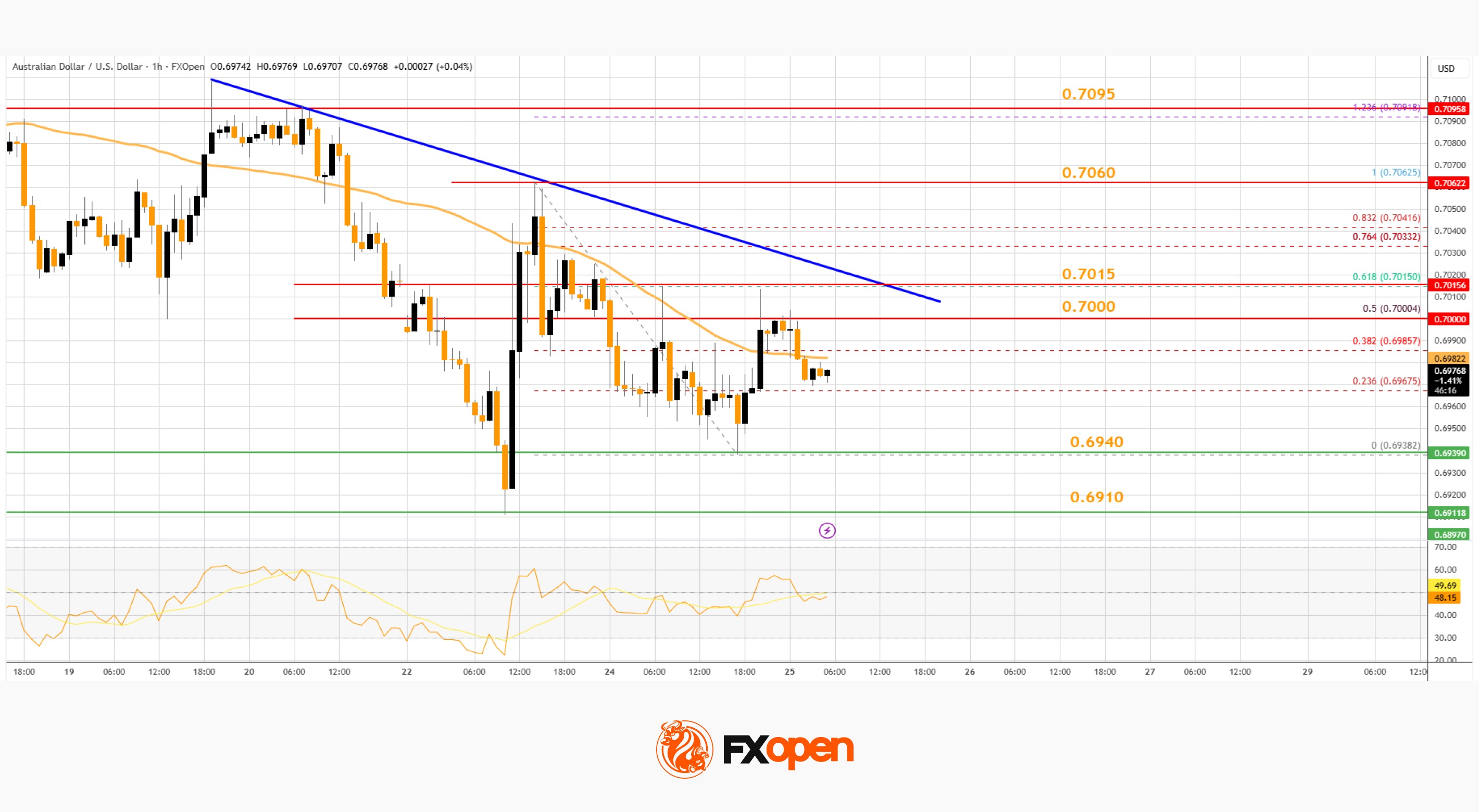
However, the bears are active near 0.7015 and the 61.8% Fib retracement. There is also a key bearish trend line near the same region. The pair is now trading below 0.7000 and the 50-hour simple moving average. On the upside, immediate resistance is 7000.
The first major hurdle for the bulls could be 0.7015. A clear upside break above 0.7015 could send the pair toward 0.7060. The next area of interest on the AUD/USD chart is near 0.7095, above which the price could rise toward 0.7120. Any more gains might send the pair toward 0.7150.
On the downside, initial support is near 0.6940. The key breakdown zone could be 0.6910 and 0.6900. Any more losses might send the pair toward 0.6840.
NZD/USD Technical Analysis
On the hourly chart of NZD/USD on FXOpen, the pair also followed a similar pattern and declined from the 0.5885 zone. The New Zealand Dollar gained bearish momentum and traded below 0.5850 against the US Dollar.
The pair even dropped below the 50-hour simple moving average and tested 0.5800. A low was formed near 0.5793, and the pair is now attempting a fresh increase. There was a move above the 50% Fib retracement level of the downward wave from the 0.5887 swing high to the 0.5793 low.
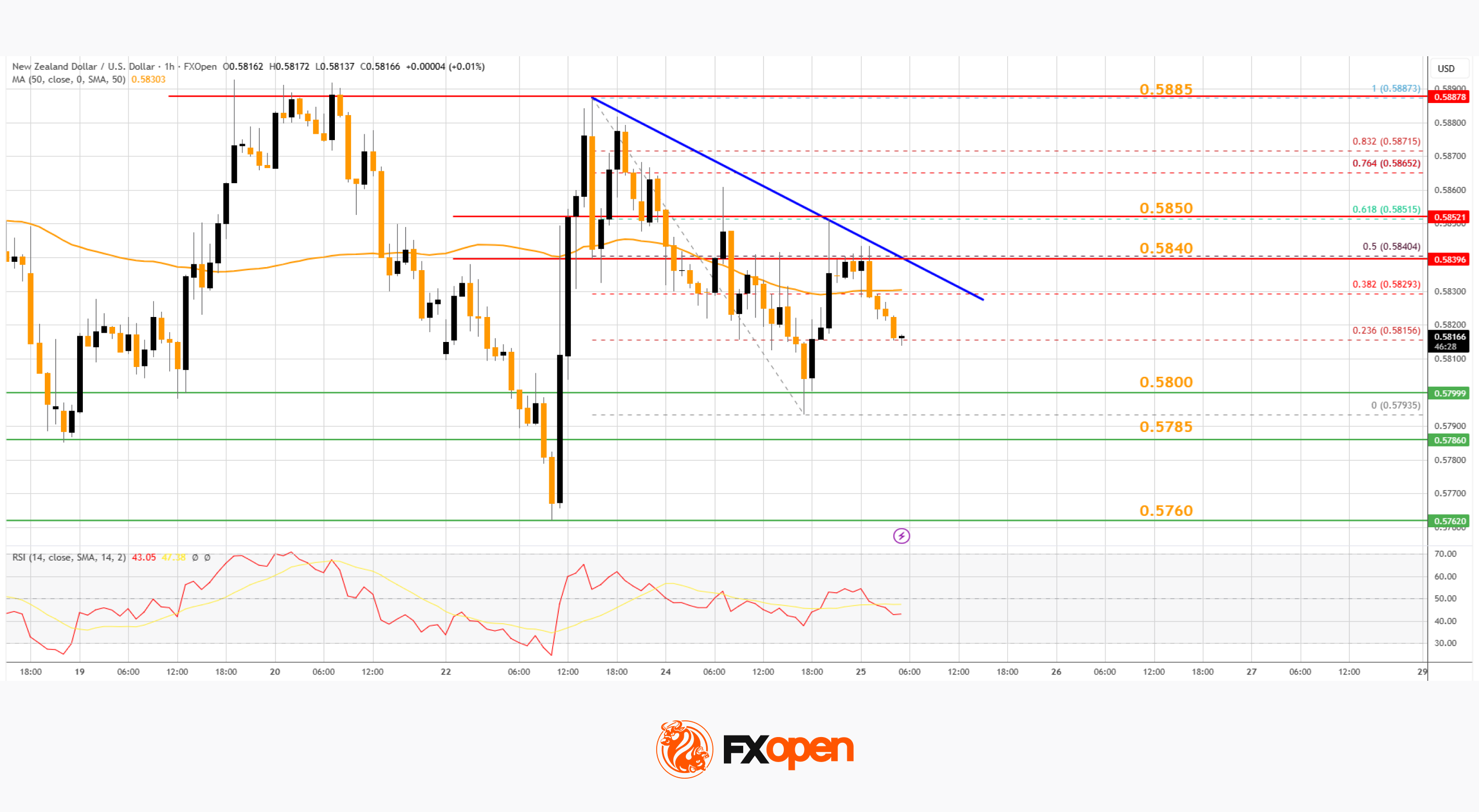
However, there was no close above the 50-hour simple moving average and the 61.8% Fib retracement. There is also a major bearish trend line forming with resistance near 0.5840.
On the upside, the pair is facing hurdles near the same trend line. The next key breakout zone sits near 0.5850. If there is a move above 0.5850, the pair could rise toward 0.5885. Any more gains might open the doors for a move to 0.5940.
On the downside, immediate support on the NZD/USD chart is near 0.5800. The next key area for the bulls might be 0.5785. If there is a downside break below 0.5785, the pair could extend the decline toward 0.5760. The main target for the bears below 0.5760 might be 0.5720.
Trade over 50 forex markets 24 hours a day with FXOpen. Take advantage of low commissions, deep liquidity, and spreads from 0.0 pips (additional fees may apply). Open your FXOpen account now or learn more about trading forex with FXOpen.
This article represents the opinion of the Companies operating under the FXOpen brand only. It is not to be construed as an offer, solicitation, or recommendation with respect to products and services provided by the Companies operating under the FXOpen brand, nor is it to be considered financial advice.

Key Highlights
- The board of directors greenlit a $1.5 billion share repurchase initiative, injecting $1.1 billion in fresh buyback authority into the existing program
- The share repurchase initiative is scheduled to span three years beginning in the first quarter of 2026
- Shares of HOOD declined 4.7% on Tuesday, closing at $69.08—the lowest level recorded in 2026
- The company’s brokerage arm secured an enhanced revolving credit line with JPMorgan, increasing it to $3.25 billion from $2.65 billion
- Year-to-date, HOOD has dropped approximately 39%, representing a 54.7% decline from its October peak of $152.46
Robinhood (HOOD) has greenlit a $1.5 billion share repurchase initiative even as its stock price continues its downward trajectory, reaching its weakest closing price of 2026 on the day of the announcement.
According to an 8-K filing submitted to the U.S. Securities and Exchange Commission, the board of directors authorized the repurchase program on Tuesday, March 24. The initiative introduces over $1.1 billion in additional buyback authorization, supplementing the remaining capacity from a prior program.
The financial services platform anticipates executing the share repurchases across approximately three years, commencing in the first quarter of 2026. The company maintains flexibility with no obligation to repurchase a predetermined amount.
Robinhood Chief Financial Officer Shiv Verma described the firm as “a generational company with a massive long-term opportunity,” stating that the authorization demonstrates the board’s belief in the company’s capacity to “continue delivering innovative products for customers and creating value for shareholders.”
Shares closed Tuesday’s trading session at $69.08, representing a 4.7% decline for the day. This marked HOOD’s weakest closing price in 2026. In extended trading, shares recovered slightly to $70.90.
Significant Retreat from October Peak
The stock has plummeted nearly 39% since the beginning of 2026 and has tumbled 54.7% from its record high of $152.46 reached in October. Macroeconomic headwinds and geopolitical uncertainty have pressured technology stocks and cryptocurrency-related equities alike.
Despite the challenging 2026 performance, HOOD remains approximately 43% higher compared to twelve months ago, buoyed by the platform’s strategic expansion into prediction markets, banking services, and cryptocurrency trading capabilities.
According to analyst sentiment tracker TipRanks, the average 12-month price target for HOOD stands at $123.85. Based on assessments from 16 Wall Street analysts, the consensus recommendation is classified as “strong buy.”
Share buyback programs are generally interpreted as management’s indication that the stock is trading below its intrinsic value—though investors appeared unimpressed by Tuesday’s announcement, as reflected in the day’s price action.
Enhanced Credit Line Provides Additional Financial Flexibility
In conjunction with the repurchase program disclosure, Robinhood Securities—the company’s registered brokerage entity—finalized an amended revolving credit arrangement with JPMorgan Chase as the lead arranger.
The credit facility was increased to $3.25 billion from its previous $2.65 billion limit. Additionally, the agreement includes provisions to potentially expand total commitments to as much as $4.875 billion, providing substantial liquidity flexibility.
Meanwhile, Robinhood continues advancing its cryptocurrency and tokenization strategy. The company released its Ethereum layer-2 blockchain network, Robinhood Chain, to public testnet in February.
Chief Executive Officer Vlad Tenev reported that the network handled 4 million transactions during its inaugural week on testnet. Robinhood Chain is designed to facilitate tokenized equities, exchange-traded funds, and other conventional financial products.
The mainnet deployment is scheduled for later in 2026.
HOOD concluded Tuesday’s regular trading at $69.08, with after-hours activity pushing the price modestly higher to $70.90.
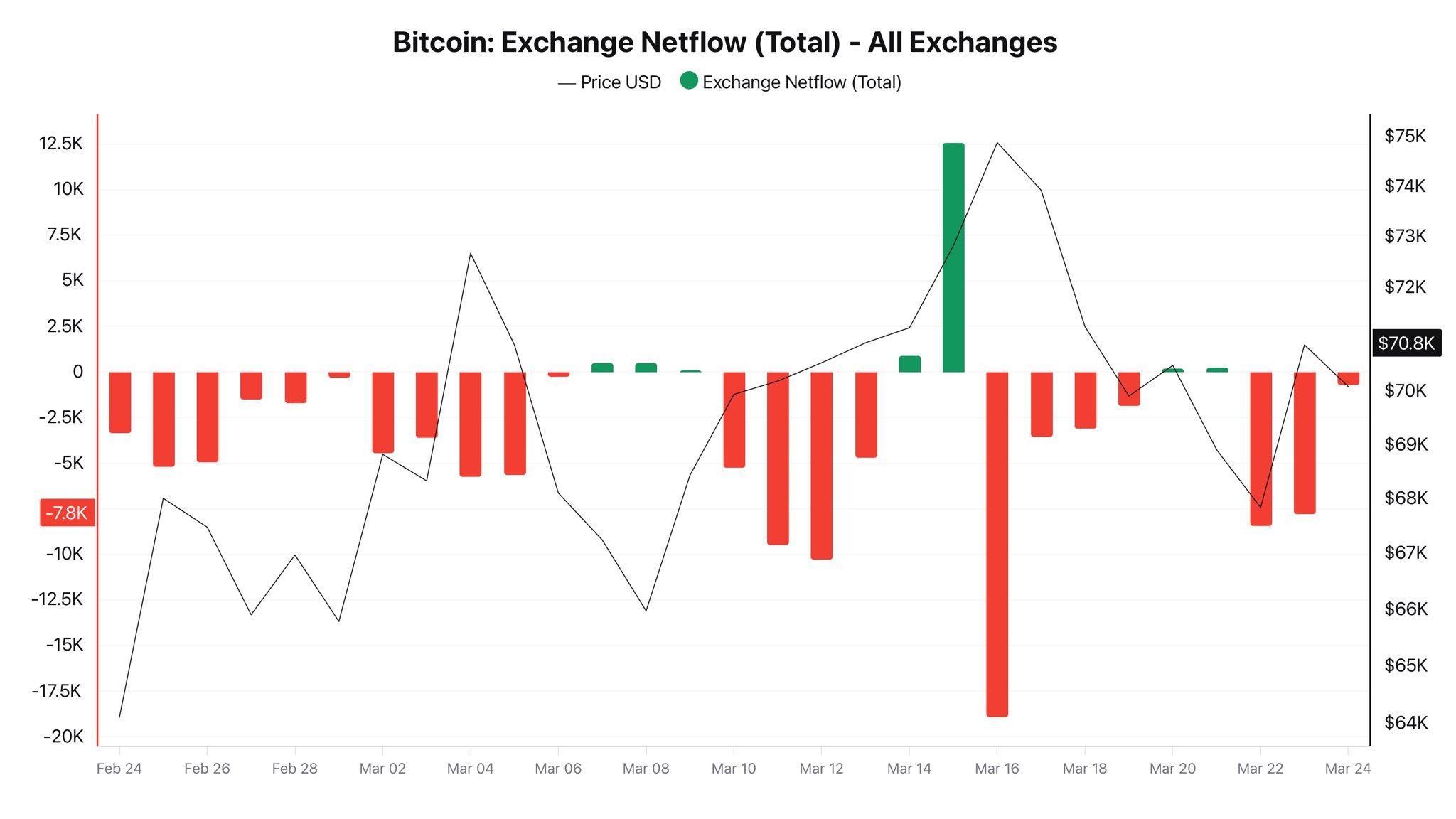
The net outflow of Bitcoin from exchanges over the past month suggests that investors have started to accumulate the cryptocurrency, according to a CryptoQuant analyst.
March has been largely dominated by Bitcoin (BTC) outflows from crypto exchanges, aside from one spike in inflows just before the asset tapped a six-week high of $76,000 on March 17, according to CryptoQuant data.
This negative net flow has remained present while Bitcoin “continues its liquidation phase,” the analyst known as Darkfost said on Wednesday.
“This persistent outflow suggests genuine accumulation by investors, who continue to buy and withdraw their BTC from exchange platforms,” he said.
Inflows to exchanges are generally bearish as investors prepare to exchange the asset for stablecoins, which adds to selling pressure, whereas outflows are often a sign of accumulation and a possible precursor to buying pressure.

Long-term accumulation rather than short-term speculation
The analyst added that the demand is not yet strong enough to restart a trend, “but it clearly indicates ongoing accumulation and is likely one of the factors behind the range formation that has been developing for several months now.”
Nick Ruck, director of LVRG Research, told Cointelegraph on Wednesday that the outflows signal “genuine long-term accumulation by investors rather than short-term speculation.”
The removal of Bitcoin from centralized platforms “showcases growing confidence in Bitcoin’s fundamentals amid current market conditions as holders indicate a lack of interest in selling to hedge against price volatility,” he added.
Related: Rising US Treasury yields, war in Iran, rising inflation risk pressure Bitcoin price
Jeff Mei, the chief operations officer at crypto exchange BTSE, told Cointelegraph that crypto has outperformed stocks and gold since the beginning of the Iran war, “so it’s no surprise that investors are accumulating Bitcoin.”
“Crypto was oversold in the weeks and months prior to the conflict, so it makes sense that it hasn’t sold off as hard as stocks have,” he added.
“This could also be an indication of Bitcoin emerging as a hedge against traditional stocks, as well as increased institutional ownership.”
Bitcoin makes higher highs, higher lows
Another indicator of potential trend formation is Bitcoin’s price making higher highs and higher lows, as it has done at least twice so far this month, according to TradingView.
In its weekly on-chain summary on Monday, Glassnode said that net unrealized profits and losses have improved slightly, “indicating a modest easing in unrealized losses across the market,” but cautioned that “sentiment is still under pressure despite tentative signs of stabilization.”
Magazine: Banks want to run Vietnam’s crypto exchanges, Boyaa’s $70M BTC plan: Asia Express

Non-crypto company Enlivex Therapeutics is expanding its exposure to Rain (RAIN), the token tied to a decentralized prediction market platform. The firm secured a $21 million debt facility from The Lind Partners to finance the purchase of additional Rain tokens and extend its option on a much larger tranche. In a Sunday move, Enlivex exercised an option to acquire about 3 billion RAIN tokens at a 62% discount for $10 million, and the agreement extends the right to purchase a further 272.1 billion RAIN tokens at the same price through December 2027. The financing is described by the company as a key component of its broader treasury strategy around Rain-linked assets.
Enlivex says the arrangement supports its operating plan while broadening its investor appeal through a diversified balance sheet. The Rain treasury’s value is closely tied to Rain’s decentralized prediction market platform, which operates with a built-in 2.5% fee that automatically buys back and burns RAIN tokens in an effort to bolster tokenomics through supply-demand dynamics.
Key takeaways
- Enlivex exercises an option to buy 3 billion Rain tokens at a 62% discount for $10 million, and extends the option to purchase an additional 272.1 billion RAIN tokens through December 2027.
- The Rain treasury gains exposure to tokens that participate in a platform whose fee mechanism triggers automatic buybacks and token burns, potentially impacting RAIN’s supply over time.
- Rain operates on the Ethereum Layer-2 Arbitrum network and has earned a spot in the top 10 prediction-market platforms by total value locked and fees, per DeFiLlama data.
- Enlivex also approved a $20 million share repurchase program, signaling a driver for shareholder value alongside its Rain exposure.
- Prediction markets have seen dramatic growth, with volumes rising roughly 1,200% to about $23.3 billion from February 2025 to February 2026, though Kalshi and Polymarket continue to account for the majority of trading activity (over 80%).
Enlivex’s Rain exposure deepens
Enlivex’s latest financing rounds out a longer-term treasury strategy centered on Rain. The company disclosed that it exercised the option to acquire 3 billion Rain tokens at a 62% discount for $10 million on Sunday, with a further option to purchase an additional 272.1 billion RAIN tokens at the same price extended through December 2027. The liability side of the arrangement comes in the form of a $21 million debt facility from The Lind Partners, a New York-based asset manager, enabling the purchases and the extended option window.
The move highlights a broader trend where traditional, non-crypto firms are incorporating digital asset holdings to bolster their balance sheets and diversify investor appeal. Enlivex’s executive chair, Shai Novik, framed the deal as a continuation of the company’s strategic commitment to Rain, stressing that the financing would fund both operations and the ongoing accumulation of Rain-based assets.
Rain’s own mechanics underpin the treasury strategy. The platform levies a 2.5% fee on trades, a portion of which is designated for automatic buybacks and burns of RAIN tokens. This mechanism is designed to influence the token’s supply-and-demand balance over time, potentially supporting price dynamics independent of broader market moves.
Treasury moves and corporate diversification
Alongside the Rain buys, Enlivex announced a $20 million share repurchase program. The buyback is positioned as a move to enhance shareholder value while the company pursues its core business in cell therapies for conditions such as knee osteoarthritis. The combination of debt-financed Rain acquisitions and a stock repurchase program underscores a strategic tilt toward capital management that some investors may view as a sign of confidence in Enlivex’s equity and liquidity position amid a turbulent market backdrop for small-cap biotech firms with non-traditional crypto exposures.
Rain’s link to Enlivex sits within a growing space where non-crypto enterprises seek crypto exposure as a hedge or growth lever. The dynamic also sits alongside ongoing policy and market scrutiny surrounding token-based treasuries, highlighting a need for disciplined risk management and transparent reporting as these cross-industry holdings mature.
Rain’s economics and market position
Rain’s token economics hinge on a built-in burn mechanism driven by a 2.5% platform fee that funds buybacks and token burning. This setup is intended to create a cyclical demand impulse for RAIN amid trading activity on the decentralized prediction market platform. The token’s price reaction following Enlivex’s disclosure reflects the market’s sensitivity to large treasury moves and token-asset exposure by non-crypto corporates.
Trading data from CoinGecko shows Rain fluctuating in the wake of the announcement. The token rose about 7% to around $0.009 before easing to roughly $0.0088, with the 24-hour change curling around flat to a 0.3% gain. Enlivex’s stock, ENVL, likewise moved little on the day—closing near $1.10 and edging higher to about $1.15 in after-hours trading—illustrating a market where traditional equities and crypto-tied instruments can move asynchronously on policy, earnings, and corporate strategy signals.
Rain’s market position is anchored on Arbitrum, an Ethereum Layer-2 network that hosts a growing ecosystem of decentralized finance and prediction-market protocols. DeFiLlama’s data shows Rain is among the top 10 prediction-market platforms by total value locked and fees over recent periods, reinforcing Rain’s relevance within the broader DeFi and forecasting sectors. In the wider market, Rain competes with established players like Kalshi and Polymarket, which together have historically accounted for a substantial share of prediction-market trading volumes.
Looking at the broader market backdrop, prediction markets have experienced a surge in activity. Data dashboards tracked by analytics platforms show volumes expanding roughly 1,200% year over year to reach about $23.3 billion between February 2025 and February 2026. That rapid growth underscores the potential long-term demand for decentralized forecasting tools, even as platform leadership remains concentrated among a handful of incumbents.
For investors and builders, the Enlivex development highlights several important considerations. First, the willingness of a non-crypto company to diversify into tokenized assets tied to a prediction market signals a potential shift in corporate treasury strategies, particularly if the token’s burn-and-buyback mechanics prove effective at sustaining demand. Second, the sustained liquidity and pricing of Rain will hinge on market depth and the ability of Rain-based platforms to attract meaningful trading volumes beyond a few lead markets. Third, regulatory and accounting implications of large, cross-asset treasury programs remain a critical area to monitor for both Enlivex and similar firms contemplating crypto-integration strategies.
Beyond the immediate deal, observers will watch for how Lind Partners structures the debt facility, how the Rain treasury evolves with ongoing buybacks, and whether the extended option window through 2027 translates into meaningful capital gains if Rain’s platform scales or if macro conditions dampen demand for prediction-market exposure. The next few quarters should reveal whether this cross-industry treasury experiment yields constructive outcomes for investors, token holders, and the broader market.
As Enlivex advances its Rain strategy, market participants will be watching for signals about liquidity in the Rain market, the sustainability of the buyback regime, and how Rain-backed treasuries perform relative to more conventional crypto exposures.
Enlivex’s activity with Rain continues to illustrate a growing trend where corporate treasuries experiment with decentralized finance instruments to diversify holdings, unlock potential upside, and align with an expanding ecosystem of prediction-market protocols on Layer-2 networks like Arbitrum. The coming months should clarify whether these treasury strategies can withstand market cycles and regulatory developments while delivering tangible value for both corporate actors and the broader Rain community.
Sources: GlobeNewswire press release on Enlivex’s debt financing and Rain-related updates; CoinGecko price data for RAIN and ENVL; DeFiLlama protocol rankings for Rain; Dune Analytics dashboards for prediction-market volumes.

Irish national police say they have cracked one of 12 Bitcoin wallets linked to a convicted drug dealer, years after they were confiscated and their access codes were thought to be gone forever.
Ireland’s Criminal Assets Bureau (CAB) said in a statement on Tuesday that it had “gained access to and seized a cryptocurrency wallet” containing 500 Bitcoin (BTC), worth more than $35 million, with the help of Europol’s European Cybercrime Centre.
“Europol hosted operational meetings at its headquarters in The Hague, the Netherlands and provided critical support to Bureau investigators and analysts with the provision of highly complex technical expertise and decryption resources vital to the success of the operation,” the CAB said.
The Irish Times reported on Tuesday that the wallet is one of 12 holding a total of 6,000 Bitcoin once owned by Clifton Collins, a drug dealer sentenced to five years in prison for growing and selling cannabis. The access codes were lost when the paper they were printed on disappeared.

Most of the time, losing a Bitcoin private key means there’s no way to recover it or crack the wallet; the funds are permanently inaccessible due to public-key cryptography.
Cointelegraph has contacted the CAB and An Garda Síochána for comment.
Wallet flagged as belonging to Collins moves 500 BTC
A wallet labeled “Clifton Collins: Lost Keys” by blockchain intelligence platform Arkham transferred 500 Bitcoin to Coinbase Prime on Tuesday, more than a decade after the coins were first deposited.
Arkham lists Collins as controlling 14 addresses with total holdings of 5,500 Bitcoin, valued at more than $391 million.

Collins was arrested in 2017 after police searched his car and found a stash of cannabis, according to the Guardian.
Related: Coinbase, Microsoft and Europol take down phishing service ‘Tycoon 2FA’
Police said Collins used proceeds from his drug operation to purchase 6,000 Bitcoin in late 2011 and early 2012, spreading the holdings across 12 wallets. He stored the wallet keys on a single sheet of A4 paper, hidden inside the aluminum cap of a fishing rod case at his rental home.
After his arrest and sentencing, Collins’ landlord cleared out his rental home and discarded his belongings. Collins, however, claimed the fishing rod case had been stolen before the landlord ever entered the property.
Magazine: Banks want to run Vietnam’s crypto exchanges, Boyaa’s $70M BTC plan: Asia Express

Middle East Conflict: Central Bank Forecast Changes

Francesca And Michaela’s Bridgerton Season 5 Storyline Will Celebrate ‘Queer Joy’

Connor McDavid nets Nos. 400, 401 as Oilers topple Mammoth


-
 Crypto World4 days ago
NIO (NIO) Stock Plunges 6.5% as Shelf Registration Sparks Dilution Worries
-

 Fashion5 days ago
Weekend Open Thread: Adidas – Corporette.com
-

 Politics5 days ago
Jenni Murray, Long-Serving Woman’s Hour Presenter, Dies Aged 75
-

 Crypto World3 days ago
Best Crypto to Buy Now: Strategy Just Spent $1.57 Billion on Bitcoin During Fear While Early Investors Quietly Enter Pepeto for 150x Potential
-

 News Videos7 days ago
RBA board divided on rate cut, unusually buoyant share market | Finance Report | ABC NEWS
-

 Crypto World3 days ago
Bitcoin Price News: Bhutan Sells $72 Million in BTC Under Fiscal Pressure, but the Smart Money Entering Pepeto Sees What the Market Does Not
-

 Politics7 days ago
The House | The new register to protect children from their abusers shows Parliament at its best
-

 Tech5 days ago
inKONBINI Lets You Spend Summer Days Behind the Register
-

 Crypto World7 days ago
Canada’s FINTRAC revokes registrations of 23 crypto MSBs in AML crackdown
-

 Sports2 days ago
Remo Stars and Kano Pillars Strengthen Survival Hopes in NPFL
-
 NewsBeat6 days ago
Residents in North Lanarkshire reminded to register to vote in Scottish Parliament Election
-

 News Videos7 days ago
PARLIAMENT OF MALAWI – PAC MEETING WITH REGISTRAR OF FINANCIAL ON AMARYLLIS HOTEL – INQUIRY LIVE
-

 Politics6 days ago
Gender equality discussions at UN face pushbacks and US resistance
-

 Business3 days ago
No Winner in March 21 Drawing as Prize Rolls to $133 Million for Next
-

 Business6 days ago
Who Was Alex Pretti? 5 Key Facts About the ICU Nurse Killed by Federal Agents in Minneapolis
-

 Sports2 days ago
Gary Kirsten Accuses Pakistan Cricket Board Of ‘Interference’, Mohsin Naqvi Responds
-

 Tech2 days ago
Give Your Phone a Huge (and Free) Upgrade by Switching to Another Keyboard
-

 Tech6 days ago
Inventec’s bizarre VeilBook laptop hides its touchpad under a sliding keyboard just to give cooling fans a little breathing room
-

 Sports5 days ago
2026 Kentucky Derby horses, odds, futures, preview, date: Expert who nailed 12 Derby-Oaks Doubles enters picks
-
Sports6 days ago
Vikings Free Agency Enters Phase 2 with Key Questions
You must be logged in to post a comment Login