

Crypto World
Ondo Rolls Out Blockchain-Based IVV ETF and Micron Stock Tokens in U.S. Markets


Quick Overview
-
Ondo introduces blockchain versions of IVV ETF and Micron stock following SEC guidelines.
-
Each digital token maintains 1:1 correspondence with traditionally custodied U.S. securities.
-
Broadridge integration enables proxy voting capabilities for token holders.
-
Platform leverages Ethereum infrastructure while maintaining regulated asset custody.
-
Initiative represents significant expansion of Ondo’s U.S. tokenized securities operations.
Ondo has introduced blockchain-based representations of BlackRock’s iShares Core S&P 500 ETF and Micron Technology stock for U.S. investors. The offering operates within a third-party custodial framework outlined by the SEC in January 2026. This development integrates tokenized U.S. securities into established regulatory and market infrastructure.
Ondo deploys tokenized S&P 500 ETF within U.S. regulatory framework
Ondo has released an Ethereum-based tokenized product tracking BlackRock’s iShares Core S&P 500 ETF. This offering mirrors IVV, a major exchange-traded fund benchmarked against the S&P 500 index. The actual ETF shares continue residing within conventional U.S. custodial arrangements.
Oasis Pro TA, operating as Ondo’s SEC-registered transfer agent subsidiary, creates the corresponding digital tokens. Every token maintains complete 1:1 correspondence with its underlying ETF shares. Qualified custodians secure the tokens, while traditional financial custodians safeguard the physical securities.
This architecture aligns with the SEC’s January 2026 guidance regarding tokenized securities. That guidance outlined an approach where third parties maintain securities while issuing associated crypto instruments. Ondo applied this regulatory blueprint to deliver an operational U.S. tokenized ETF offering.
Micron stock joins Ondo’s tokenized equity portfolio
Ondo has simultaneously introduced a tokenized representation of Micron Technology stock using identical structural principles. Micron shares remain within standard U.S. custody infrastructure. Token holders gain exposure through Ethereum-recorded ownership positions.
The Micron offering advances Ondo’s broader initiative into tokenized equities with full regulatory compliance. This approach eliminates offshore issuance requirements and functions independently of individual issuer sponsorship. Implementation occurs through pre-existing broker-dealer, transfer agent, and custody relationships.
Transfer restrictions operate via participating broker-dealers, custodians, and the transfer agent network. These mechanisms ensure token transactions align with prevailing regulatory standards. Consequently, Ondo bridges blockchain settlement capabilities with traditional U.S. securities frameworks.
Broadridge enables shareholder voting for tokenized equity owners
Broadridge facilitates the rollout by delivering governance infrastructure for tokenized equity participants. Token holders gain access to issuer communications and regulatory filings through conventional distribution channels. Additionally, they can exercise voting rights via ProxyVote.com for blockchain-recorded proxy votes.
Ondo indicates token holders obtain shareholder rights and safeguards comparable to traditional brokerage account owners. These privileges encompass issuer notifications and voting participation linked to underlying securities. This configuration strengthens tokenized securities’ integration with public market governance structures.
The initiative also provides context for Ondo’s comprehensive real-world asset approach. Beyond U.S. borders, its Global Markets infrastructure handles over $1 billion in tokenized securities. That platform encompasses more than 430 equities and ETFs across various supported jurisdictions.
Ondo has simultaneously grown through strategic collaborations in recent periods. In June, the company partnered with Exodus to establish Exodus Markets on Solana. This platform provides qualified users with tokenized stock, ETF, and real-world asset access.
This recent product launch positions Ondo more prominently within U.S. tokenization markets. The implementation merges Ethereum-based issuance with conventional custody, voting mechanisms, and compliance frameworks. This integration creates a more defined pathway for tokenized securities under current U.S. market regulations.


TLDR;
- Trump crypto earnings exceeded $1.4 billion, according to federal financial disclosures, with most income linked to World Liberty Financial and the TRUMP memecoin licensing business.
- Donald Trump said he does not actively manage his investments, explaining that external funds and blind trust arrangements oversee his personal finances rather than himself.
- Financial filings reveal more than $600 million came from TRUMP memecoin royalties and over $500 million originated from World Liberty Financial operations.
- Ethics experts continue debating whether blind trust protections remain effective when policies affecting digital assets overlap with businesses carrying the president’s own brand.
Trump crypto earnings have become a major talking point after newly released federal financial disclosures showed more than $1.4 billion in digital asset-related income. Speaking to reporters, President Donald Trump said he does not oversee his personal investments and relies on professional fund managers and blind trusts to manage his assets.
The disclosures indicate that most of the reported income came from businesses connected to the Trump family, including World Liberty Financial and licensing revenue tied to the TRUMP memecoin. The filings have renewed debate over ethics, financial transparency and potential conflicts involving cryptocurrency ventures.
Trump Crypto Earnings Driven by Memecoin and Financial Ventures
Federal financial disclosures filed with the U.S. Office of Government Ethics show that Trump reported more than $1.4 billion in digital asset income. According to the filing, over $600 million came from licensing and royalty agreements connected to the TRUMP memecoin.
World Liberty Financial generated more than $500 million of the reported income. The crypto project focuses on governance tokens and stablecoin products. Together, these businesses accounted for nearly all of the disclosed digital asset earnings.
Responding to questions, Trump said he does not actively monitor his investment portfolio. He explained that outside funds manage his assets and that he was not personally involved in day-to-day financial decisions. His remarks have become central to the discussion surrounding the latest disclosures.
Trump Crypto Earnings Fuel Ethics Debate Over Policy Decisions
The disclosures have intensified scrutiny from ethics experts and Democratic lawmakers. Critics argue that a blind trust is only effective if the beneficiary has no meaningful knowledge or influence over assets held within it. They also point to administration policies supporting digital asset innovation while businesses linked to Trump operate in the same industry.
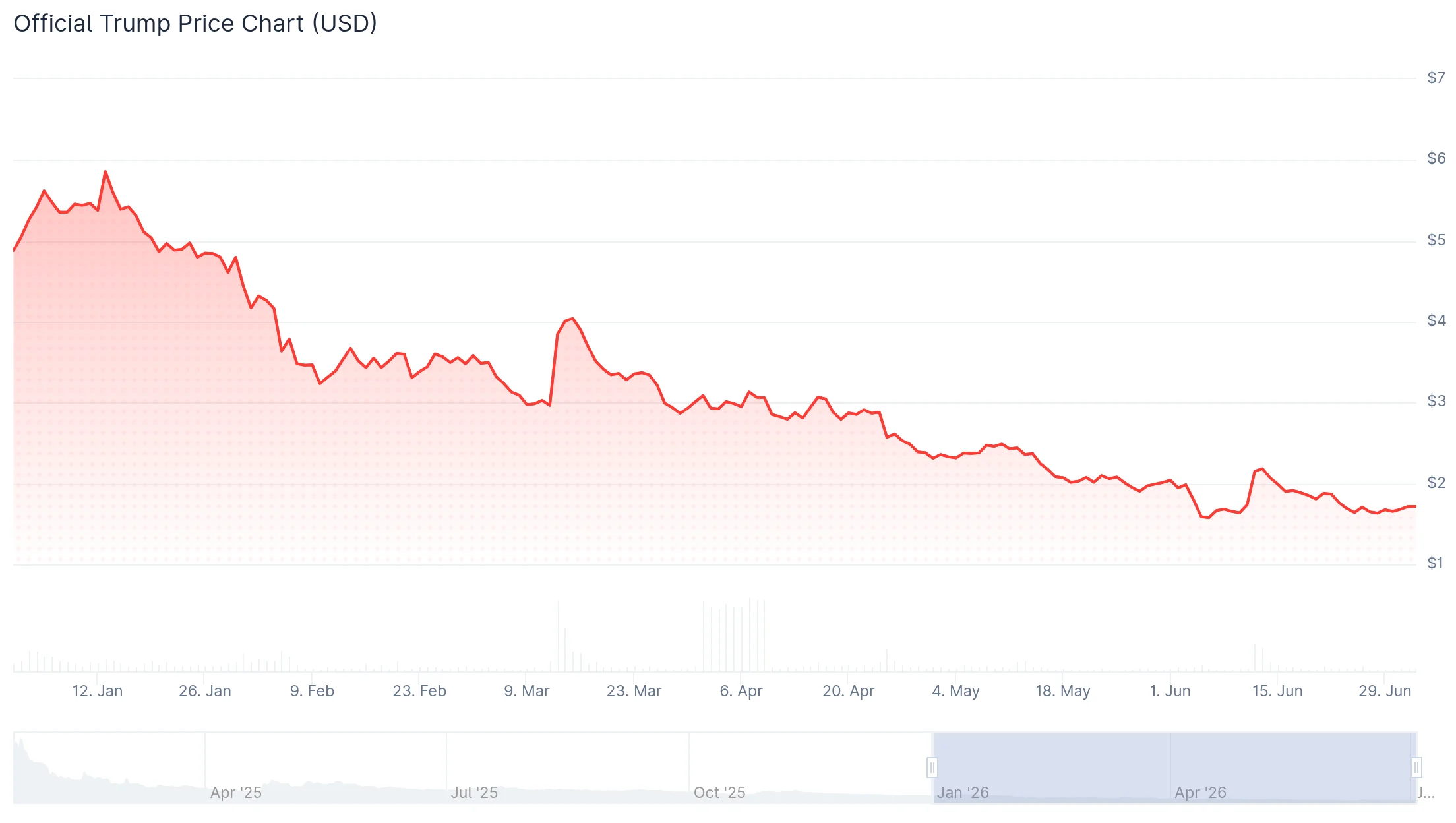
The TRUMP memecoin illustrates the divide between project revenue and investor outcomes. After reaching prices above $74 following its launch, the token later traded near $1.68. Market analysts estimate retail investors collectively lost billions during the decline, while Trump-linked businesses reported substantial earnings from licensing activity.
World Liberty Financial also experienced sharp price declines after its governance tokens entered the market. Additionally, a $500 million investment from a UAE-linked entity near Trump’s inauguration has drawn additional attention from ethics watchdogs.
The administration has defended its digital asset agenda, including support for stablecoin legislation through the proposed GENIUS Act. Opponents argue the overlap between crypto policymaking and family-linked business interests deserves closer examination, even though no official findings have alleged unlawful conduct.
Bitcoin has climbed more than 4% to briefly reclaim $62,000 after a weaker-than-expected U.S. jobs report reduced market expectations for another Federal Reserve rate hike this year.
Summary
- Bitcoin briefly climbed above $62,000 after weaker-than-expected U.S. payroll data reduced expectations for another Fed rate hike.
- Polymarket and CME FedWatch data showed traders lowering rate hike bets while increasing expectations that the Fed will hold rates steady in July.
- Analysts say Bitcoin must reclaim $62,500 to confirm a stronger recovery, though some still view the move as a relief rally.
According to the U.S. Bureau of Labor Statistics, the U.S. economy added 57,000 nonfarm payrolls in June, well below economists’ expectations of 115,000. The agency also revised May’s payroll figure lower by 43,000 jobs, ending a three-month stretch in which employment growth had consistently exceeded forecasts.
Meanwhile, the unemployment rate came in at 4.2%, slightly below the expected 4.3%, suggesting hiring has slowed even as the labor market remains relatively resilient.
The report sparked a rally across risk assets, with Bitcoin (BTC) surging from below $60,000 earlier in the week to more than $62,000 on July 2 before stabilizing near $61,655 at the time of writing, according to data from crypto.news. The recovery followed several sessions of weakness driven by fears that the Federal Reserve could tighten policy again after officials projected additional rate increases during last month’s policy meeting.
Softer jobs report has shifted Fed expectations
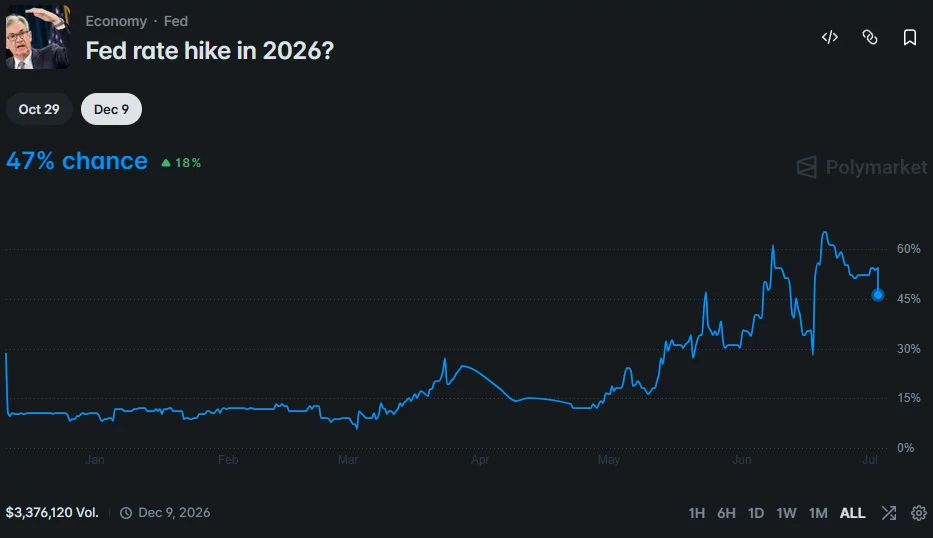
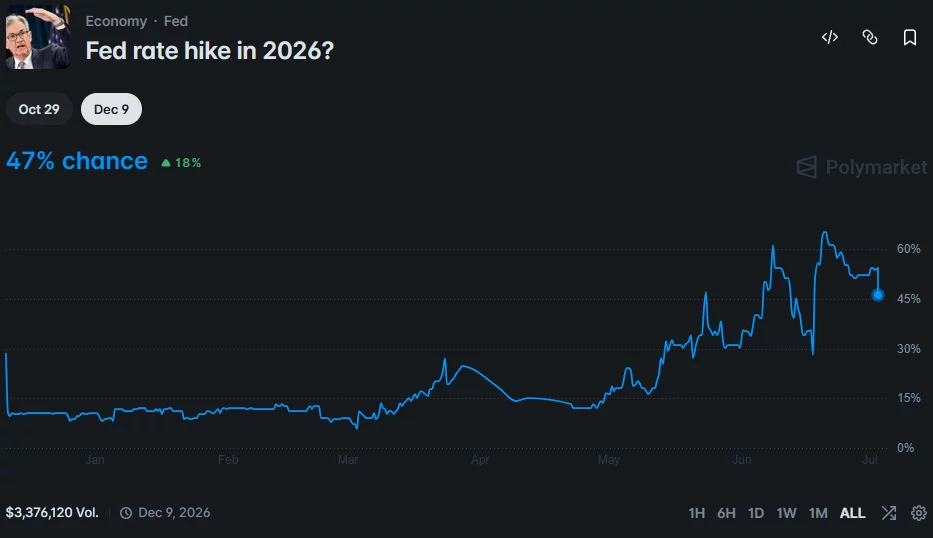
The latest labor market data immediately changed traders’ expectations for the remainder of the year. Polymarket data showed the probability of another Federal Reserve rate hike in 2026 dropping to 47%, down from 54% the previous day, as market participants reassessed the likelihood of further tightening if hiring continues to lose momentum.
The move is notable because policymakers struck a comparatively hawkish tone after the June Federal Open Market Committee meeting. Most Fed officials projected at least one additional rate increase before year-end in their updated economic forecasts, while several policymakers expected more than one hike.
Market sentiment also received support from comments made a day earlier by Federal Reserve Chair Kevin Warsh at the ECB Forum. Although Warsh declined to outline the future path of monetary policy, he said inflation risks were easing, remarks that investors interpreted as reducing the urgency for another rate increase.
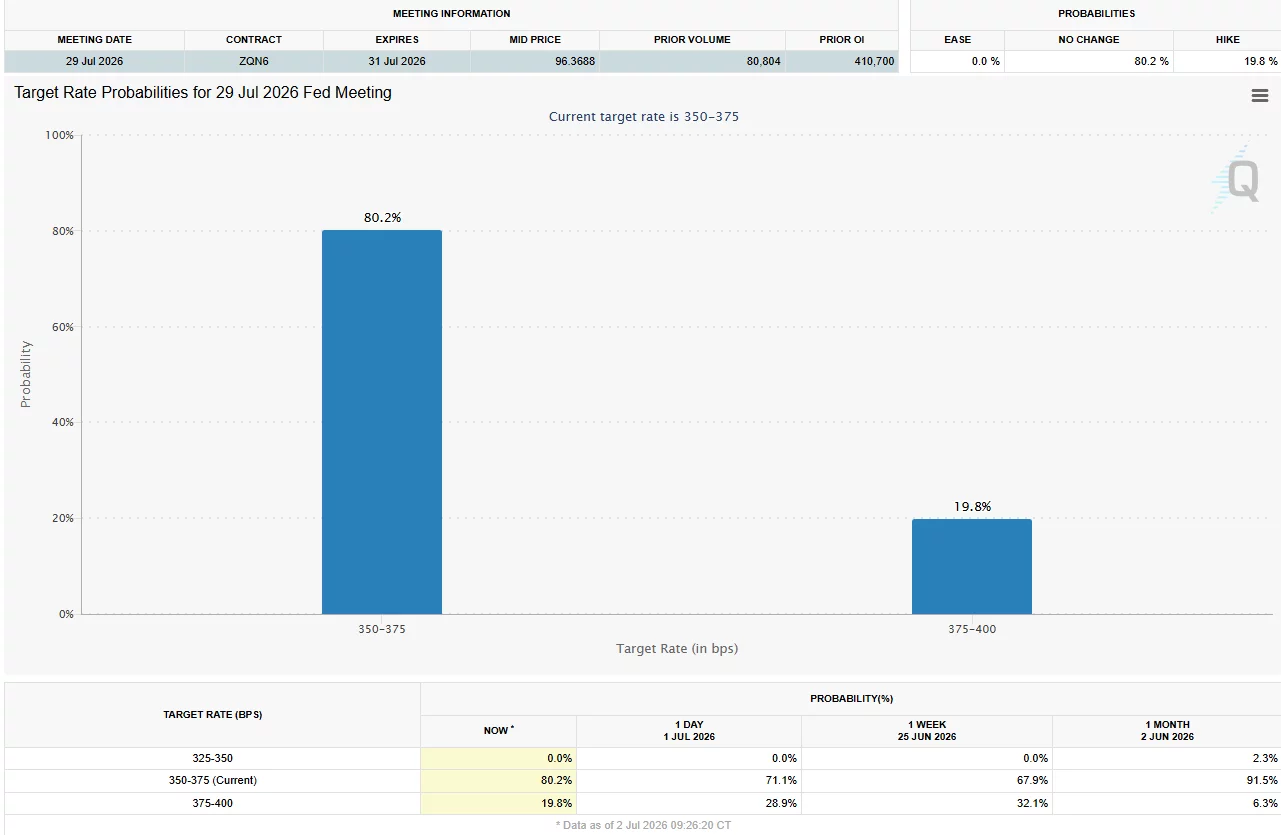
Expectations for the upcoming July policy meeting shifted as well. CME FedWatch data showed an 80.2% probability that the Federal Reserve will leave interest rates unchanged, up from roughly 72% a day earlier, indicating traders now see policymakers waiting for additional economic data before making their next move.
Bitcoin faces a critical technical test after the rebound
The macro-driven rally has pushed Bitcoin into an area that several technical analysts consider pivotal for confirming whether the recent rebound can develop into a sustained recovery.
According to analyst Ardi, Bitcoin is approaching a decisive point where reclaiming both a long-standing descending trendline and the $62,500 horizontal resistance could alter the market structure that has dominated for the past month.
“If BTC can reclaim the trendline and 62.5k horizontal resistance, that would be the first structural break from this month-long pattern. This would also be the strongest structural base throughout this entire correction, confirming the 57k low as the mid-cycle bottom.”
Bitcoin’s own chart now shows the market moving toward that test. On the 4-hour timeframe, the cryptocurrency has reclaimed the 23.6% Fibonacci retracement near $60,065 and climbed above the 38.2% retracement around $61,444 after briefly trading beyond $62,000. The next resistance levels sit near the 50% Fibonacci retracement at $62,559, followed by the 61.8% level around $63,673, while the 78.6% retracement near $65,260 represents the next major upside hurdle if buyers maintain momentum.
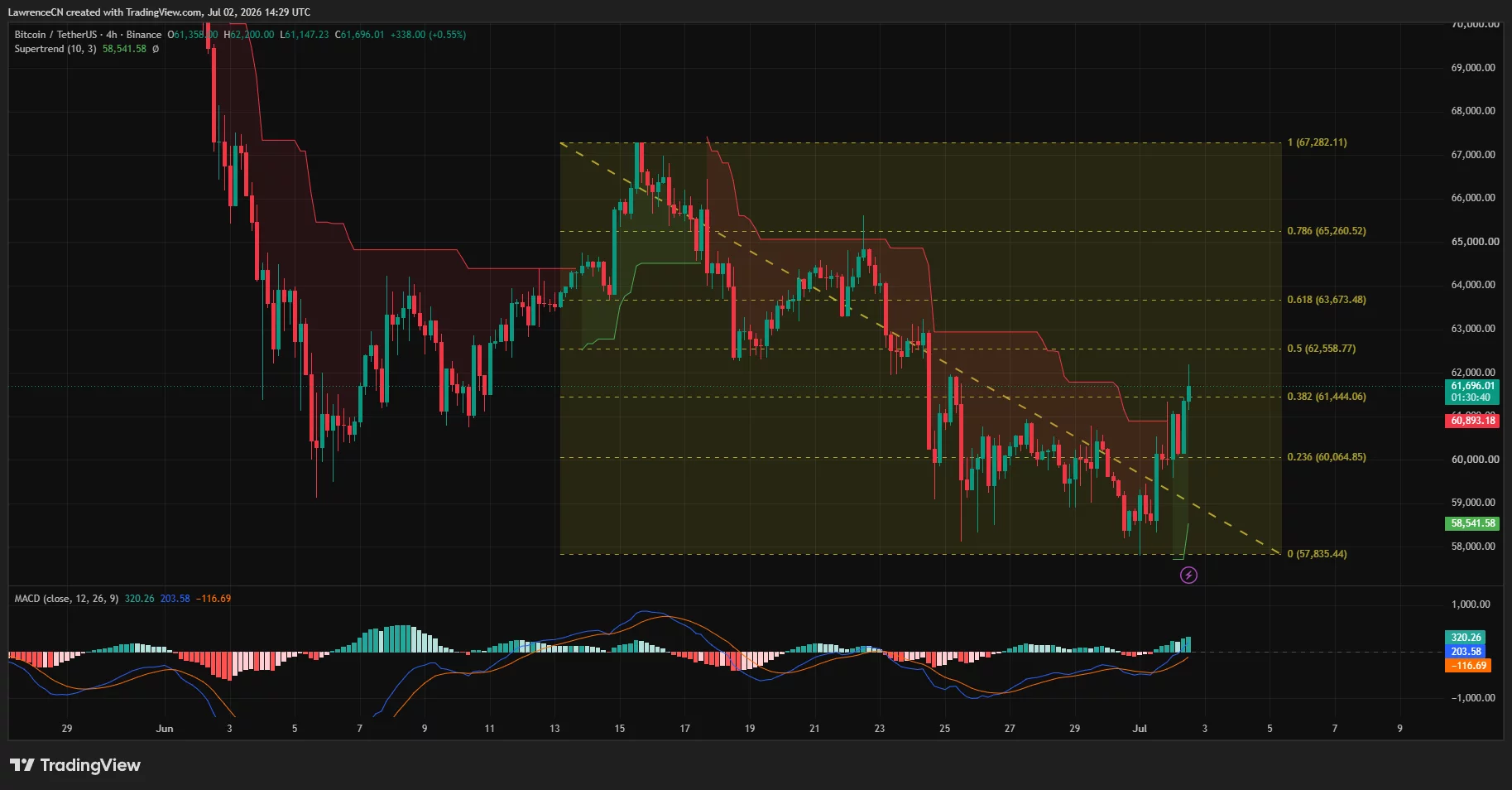
Momentum indicators have also improved. The MACD has completed a bullish crossover, with the histogram turning increasingly positive, while the Supertrend indicator remains in bullish territory around $58,541, suggesting the recent rebound continues to hold technical support.
Other market observers have also pointed to improving conditions beneath the surface. Commenting on order-flow activity, crypto analyst Ted Pillows said aggressive Bitcoin buying was taking place on Binance and OKX, while selling pressure on Coinbase had cooled, indicating stronger spot demand was emerging across major exchanges.
Not everyone, however, believes the correction is over. Crypto trader Altcoin Sherpa said Bitcoin looks constructive on lower time frames and expects altcoins to continue performing well as long as Bitcoin remains healthy. Yet, he cautioned that the current move still resembles a relief rally and said he would only become confident that the correction has ended after Bitcoin reclaims the $65,000-$70,000 range on higher time frames.
Disclosure: This article does not represent investment advice. The content and materials featured on this page are for educational purposes only.
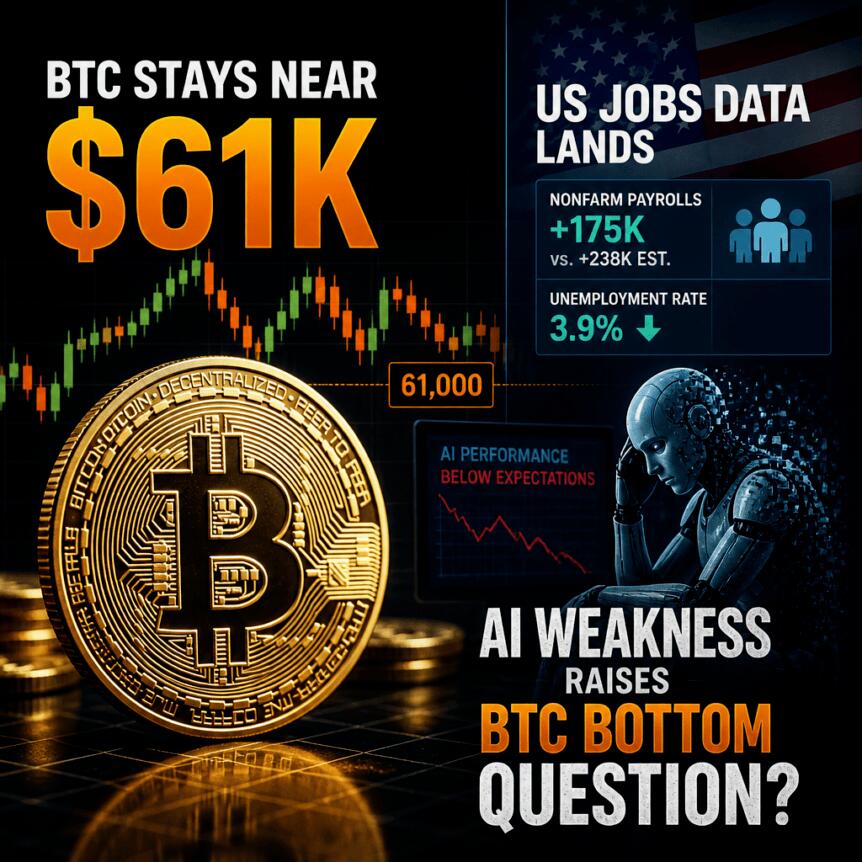
Bitcoin pushed back above $61,000 after a weaker-than-expected US labor report revived expectations that the Federal Reserve may stay flexible on rates. The selloff in US tech—particularly Nasdaq-linked exposure—also helped traders frame Thursday’s move as a potential rotation away from crowded risk assets and toward traditionally scarce stores of value such as Bitcoin and gold.
According to Yahoo Finance, US non-farm payrolls rose by 57,000 in June, missing the 113,000 expected figure. The Labor Department also revised April and May totals downward by a combined 74,000 jobs, adding to the pressure on rate-hike assumptions ahead of September.
Key takeaways
- Disappointing June jobs data reduced near-term rate-hike odds, supporting Bitcoin’s rebound after a dip toward $57,750.
- CME FedWatch moved to 54% odds of rate hikes by September, down from 64% the prior day, highlighting a shift in expectations.
- Gold strengthened alongside Bitcoin, reinforcing the “scarce assets” narrative as investors priced a potentially less tight policy path.
- Onchain indicators cited by CryptoQuant author gaah_im suggest seller exhaustion and a profit-to-loss ratio at levels not seen since 2022.
Jobs data shifts rate expectations and markets follow
The immediate catalyst for crypto’s bounce was the labor market surprise. With non-farm payroll growth coming in well below consensus—and previous months revised lower—traders recalibrated how much economic strength the Fed could rely on to justify additional tightening.
That recalibration showed up in the probability market. CME data via its FedWatch Tool indicated the odds of a rate hike by September fell to 54% from 64% the day before. In practice, that means traders were less convinced the Fed would need to move rates higher despite inflation-related concerns.
At the same time, risk assets that depend on steady growth and low discount rates came under pressure. The Nasdaq 100 erased gains that had built over the prior three sessions, offering a clear macro-throughline: weaker labor prints can compress the appetite for high-multiple equities, while increasing interest in assets perceived to benefit from looser or more supportive liquidity conditions.
Gold steadies as oil slips, reinforcing “liquidity” expectations
Gold prices responded positively on Thursday, which traders often read as a signal that investors are increasingly preparing for a less restrictive policy stance. The article’s framing also connects this to the behavior of crude oil. WTI crude stabilized below $70, while the broader complex had been affected by geopolitical developments.
Oil fell after the Qatar Foreign Ministry said there was “positive progress” in the latest round of discussions between US and Iranian representatives. The move matters less for its headline and more for what it implies for inflation pressure: if energy costs ease, markets may feel less compelled to price aggressive tightening.
In the context of the Fed, attention also turned back to its balance sheet. The Federal Reserve balance sheet was described as stagnating at $6.73 trillion, although the Fed’s mandate allows for $40 billion monthly purchases in short-term Treasuries and bonds. The combination of softer labor data and reduced inflation pressure is commonly interpreted as the backdrop for accelerated liquidity injection—a dynamic that can lower yields and improve conditions for investment flows into assets with limited supply.
AI weakness and “rotation” talk put Bitcoin back in focus
Beyond macro, there was also sector-specific pressure. Traders pointed to weakness in the AI complex—particularly chip-related names—as evidence that capital may be looking for alternatives. Shares of SanDisk, Seagate, Western Digital, and Applied Materials reportedly fell intraday by 9% or more on Thursday.
That disparity between AI-heavy equity exposure and Bitcoin’s price action fed the rotation narrative. While Bitcoin had recently been rejected around $82,500, the rebound followed a broader risk re-pricing after the jobs report. The article notes Bitcoin had been distancing itself from Wednesday’s $57,750 low, suggesting that the market’s downside momentum was losing steam.
If AI-linked selling persists, the logic is straightforward: portfolio managers and traders who reduce high-beta exposures may seek other avenues for returns and hedging—especially those assets that benefit when liquidity expectations improve. In that scenario, the same investors watching Nasdaq futures also become natural readers of Bitcoin’s onchain and macro sensitivity.
Onchain signals: seller exhaustion and a 2022-style profit/loss reset
CryptoQuant author and onchain analyst gaah_im highlighted a set of metrics intended to measure where the market stands in its cycle. In a post referenced in the article, the analyst said Bitcoin’s realized profit-to-loss ratio has reached its lowest level since 2022. The “net percentage of supply in profit” also reportedly turned negative—an outcome gaah_im said historically marks cycle bottoms with “extreme precision.”
For investors, this is the part of the story that matters most if you’re looking beyond the next headline. Onchain indicators can’t guarantee timing, but they can help frame whether the selling pressure that often drives drawdowns has already run its course. A negative shift in profit distribution implies more holders are effectively under water, reducing the likelihood that the market is still populated by large, confident profit-takers poised to dump into strength.
The article also links part of Bitcoin’s recent weakness to disappointment around Strategy (commonly discussed in the market context of its Bitcoin-related capital strategy). Even though the piece describes holders as facing dilution tied to accelerated MSTR share issuance used to buy back some debt and cover dividends on preferred stocks, the takeaway for market observers is that supply dynamics and capital flows around major corporate players can influence short-term volatility.
Finally, the combination of weaker labor data, easier expectations for policy over the coming months, and onchain readings suggesting seller exhaustion is why a near-term rebound toward $70,000 is being discussed. The upside case here is not just “macro improves,” but that the market may already be close enough to a capitulation-like condition that further stabilization in rates and liquidity could quickly translate into renewed demand.
What to watch next is whether labor-market weakness continues to dominate rate expectations—or whether investors start to re-price the Fed back toward a more hawkish stance. Onchain metrics may point to exhaustion, but the market will likely decide the pace of any recovery based on incoming macro data, the path of oil and inflation expectations, and whether AI-linked weakness broadens into sustained rotation rather than a one-day drawdown.
Ripple spent $1.25 billion to buy a prime broker that clears trillions of dollars a year, then wired it into the XRP Ledger and RLUSD. Here is what a prime broker actually does, what Ripple Prime offers, and whether any of it reaches XRP.
Summary
- Ripple Prime is Ripple’s institutional prime brokerage arm, built from its $1.25 billion acquisition of Hidden Road, offering clearing, financing, and trading across digital assets, foreign exchange, derivatives, swaps, and fixed income.
- A prime broker is the plumbing behind professional trading: it gives hedge funds and trading firms one account for execution, clearing, settlement, financing, and custody, with cross-margining that improves capital efficiency.
- The acquisition made Ripple the first crypto company to own and operate a global, multi-asset prime broker, and the business has grown roughly threefold since the deal was announced.
- Ripple has wired its own products into the platform: RLUSD is used as collateral, some derivatives clients hold balances in it, and Ripple plans to move post-trade activity onto the XRP Ledger.
- For XRP the token, the benefit is indirect and unproven, because Ripple Prime is institutional infrastructure, not a retail venue, and the token has not tracked the platform’s growth.
Ripple Prime is Ripple’s institutional prime brokerage platform, a one-stop service that lets large trading firms clear, finance, and trade across both traditional and digital assets through a single account. It exists because in 2025 Ripple paid $1.25 billion to acquire Hidden Road, one of the largest non-bank prime brokers in the world, and rebranded it. That deal turned Ripple from a payments and stablecoin company into an operator of the kind of core market infrastructure that hedge funds and banks have relied on for decades. This explainer covers what a prime broker is, how Ripple Prime works, how Ripple has connected it to RLUSD and the XRP Ledger, and the honest answer to the question every XRP holder asks: does it help the token?
First, what is a prime broker?
Before Ripple Prime makes sense, the underlying concept has to. A prime broker is a firm that sits behind professional trading operations and bundles together the services those operations need to function. In traditional finance, a hedge fund does not open a separate relationship with every exchange, lender, and custodian it uses. Instead it routes much of that activity through a prime broker, which provides trade execution and access to markets, clearing and settlement of those trades, financing and securities lending so the fund can use leverage, and custody of the assets. The prime broker becomes the single hub through which capital and positions flow.
The reason this matters is capital efficiency. A prime broker can look at all of a client’s positions together and net them, so the client posts collateral against the combined risk of the book instead of against each trade in isolation. This is called cross-margining, and it frees up capital that would otherwise sit idle backing individual positions. A fund running many strategies at once can therefore do more with the same balance sheet. Prime brokers also extend credit, letting clients borrow to amplify positions, and manage the risk of that credit in real time.
In short, prime brokers are the professional-grade infrastructure that makes large-scale, multi-strategy trading possible. They bring credibility, credit, and operational scale, the things institutions expect from legacy finance. For years, crypto largely lacked a prime broker of this caliber, which was one reason big institutions hesitated to trade digital assets at scale. Filling that gap is exactly what Ripple set out to do.
From Hidden Road to Ripple Prime: the $1.25 billion deal
Ripple did not build a prime broker from scratch. It bought one. In April 2025, at Paris Blockchain Week, Ripple announced an agreement to acquire Hidden Road for $1.25 billion, one of the largest deals the digital-asset industry had seen. Hidden Road was a fast-growing non-bank prime broker that cleared roughly $3 trillion a year across markets and served more than 300 institutional clients, including hedge funds, proprietary trading firms, and major liquidity providers. Ripple had been an investor in Hidden Road and a customer of its platform, so it knew the business from the inside before buying it.
The acquisition closed in October 2025, and Hidden Road was immediately rebranded as Ripple Prime. The move made Ripple the first crypto company to own and operate a global, multi-asset prime broker, giving it a financing and clearing engine of a type that had previously belonged only to traditional financial firms. Ripple committed to inject significant capital into the business to expand its capacity, and by its own account the platform grew roughly threefold in activity between the announcement and the close. Hidden Road founder Marc Asch stayed on to work alongside Ripple leadership through the integration.
The strategic logic was that core infrastructure is what unlocks the next phase of institutional crypto adoption. Payments and custody move value and store it, but a prime broker is where institutions actually trade and finance positions at scale. By owning one, Ripple positioned itself to sit at the center of institutional digital-asset activity instead of at the edges, and to bring its own assets, XRP and the RLUSD stablecoin, into that flow.
What Ripple Prime actually does
Ripple Prime offers the full prime-brokerage stack across an unusually broad range of markets. Its services span clearing, prime brokerage, and financing across foreign exchange, digital assets, precious metals, exchange-traded derivatives, over-the-counter swaps, and fixed income repo. Clients can access markets through over-the-counter desks, sponsored access, and direct market access, with real-time risk management, cross-margining across their positions, and risk-based margin financing. That breadth is the point: an institution can manage exposures across traditional and digital assets from one platform instead of stitching together many providers.
In November 2025, shortly after the deal closed, Ripple launched digital-asset spot prime brokerage for the United States market under the Ripple Prime brand. This let US-based institutional clients execute over-the-counter spot transactions across dozens of major digital assets, including XRP and RLUSD, and cross-margin those spot positions alongside swaps and exchange-listed futures and options. It combined Ripple’s regulatory licenses with Hidden Road’s prime-brokerage infrastructure into a single US offering, complementing the derivatives services the platform already ran.
The platform has kept adding connectivity. Ripple Prime enabled support for Hyperliquid, a high-performance decentralized derivatives protocol, letting institutional clients reach on-chain derivatives liquidity while cross-margining their decentralized-finance exposure against all other asset classes on the platform. That combination, a regulated institutional prime broker reaching directly into on-chain markets, is a concrete example of the bridge between traditional finance and decentralized finance that Ripple describes as its goal.
RLUSD as collateral: the cross-margining hook
One of the most important features of Ripple Prime is how it uses RLUSD, Ripple’s dollar-backed stablecoin. RLUSD is being used as collateral across a range of prime-brokerage products, and Ripple has positioned it as the first stablecoin to enable efficient cross-margining between digital assets and traditional markets. In practice, an institution can post RLUSD as margin and have it recognized across both its crypto and its traditional exposures, which is exactly the kind of capital efficiency prime brokers exist to provide.
Adoption of this feature has been concrete instead of theoretical. Some derivatives customers have chosen to hold their balances in RLUSD, and Ripple expects that to grow. RLUSD has been approved as margin collateral on the OKX exchange across more than 280 trading pairs, and Ripple Prime clients can trade Bitcoin options on the Bullish exchange using RLUSD as collateral. To support the stablecoin’s institutional credibility, Bank of New York Mellon serves as the primary reserve custodian of RLUSD, a signal aimed squarely at the compliance expectations of large institutions.
The reason this matters is that it gives RLUSD a real institutional job to do. Many stablecoins circulate mostly among crypto traders; RLUSD, through Ripple Prime, is being embedded into the margin and settlement plumbing that professional firms use. That is a more durable form of demand than speculative trading, because it ties the stablecoin to the operational needs of institutions rather than to market sentiment. It is also the clearest way that Ripple Prime strengthens one of Ripple’s own products, as distinct from the broader industry.
The XRP Ledger connection
Ripple has also linked Ripple Prime to the XRP Ledger, the blockchain whose native asset is XRP. The plan Ripple has described is to migrate parts of Hidden Road’s post-trade activity, the clearing and settlement that happens after a trade is agreed, onto the XRP Ledger. The goal is to streamline settlement and lower operational costs, while showcasing the ledger as institutional-grade infrastructure for decentralized finance. If that migration proceeds at scale, real institutional settlement volume would run across the XRP Ledger.
That connection took a further step through traditional clearing infrastructure. Ripple Prime, still listed under the Hidden Road name in the relevant notice, was integrated into the participant directory of the Depository Trust and Clearing Corporation’s National Securities Clearing Corporation, the backbone of US securities clearing. Ripple’s chief technology officer at the time flagged the development as significant, because it connects a crypto-owned prime broker to the same clearing rails that settle Wall Street’s equity trades. Ripple Prime also received an investment-grade rating from Kroll in April 2026, a distinction Ripple says no other crypto-affiliated prime broker holds, which opens the door to conservative institutions such as pension funds, banks, and insurers.
Taken together, these moves position the XRP Ledger and RLUSD as pieces of institutional market infrastructure instead of purely retail crypto assets. The migration of post-trade activity, the DTCC connection, and the investment-grade rating are all steps toward embedding Ripple’s technology into the machinery of regulated finance. Whether that machinery ends up generating meaningful demand for XRP the token is a separate question, and an important one.
Why Ripple Prime matters for crypto
Zooming out, Ripple Prime matters because it imports a missing layer of financial infrastructure into digital assets. Crypto has never lacked exchanges or wallets, but it has lacked a large, credible, multi-asset prime broker of the kind institutions take for granted in traditional markets. By acquiring one that already cleared trillions of dollars a year and serving 300-plus institutional clients, Ripple gave the industry a bridge between the way hedge funds and banks already operate and the way digital assets trade and settle.
For Ripple itself, the deal marked a transformation. The company had been known primarily for cross-border payments and, more recently, for its RLUSD stablecoin and custody services. Ripple Prime added institutional trading and financing to that stack, so Ripple now spans payments, custody, a stablecoin, and a prime broker. That makes it one of the more vertically integrated firms in crypto, able to offer institutions a connected suite instead of a single product. It also gives Ripple multiple ways to weave XRP and RLUSD into institutional workflows.
The broader significance is about legitimacy. Institutional adoption of digital assets has been held back partly by the absence of familiar, trusted infrastructure. A prime broker with an investment-grade rating, a connection to DTCC clearing, and bank-grade custody speaks the language institutions understand. If Ripple Prime succeeds, it lowers a real barrier to large-scale institutional participation in crypto, which is a meaningful development regardless of what happens to any single token’s price.
Does Ripple Prime actually help XRP?
Here is the question that matters most to XRP holders, and it deserves a straight answer instead of a hopeful one. The connection between Ripple Prime and XRP is infrastructure-driven, not retail-facing. Ripple Prime is a service for institutions; it does not change how ordinary users buy or trade XRP, which still happens on exchanges. The potential benefit to XRP is indirect: if institutional settlement volume grows on the XRP Ledger through Ripple Prime, that could raise network usage, and XRP, as the ledger’s native asset used for transaction fees and liquidity, might see more demand over time.
The trouble is that this benefit has not shown up in the token’s price. Over the year following the acquisition, Ripple Prime delivered on its roadmap, earning an investment-grade rating, launching US spot prime brokerage, and integrating RLUSD as collateral, while XRP fell rather than rose. The token dropped sharply even as the platform executed, which underlines a recurring pattern with Ripple news: the company’s commercial progress and the token’s price are only loosely connected. Much of the value Ripple Prime creates accrues to Ripple the company, to RLUSD, and to the institutions using the platform, not automatically to XRP.
That does not mean Ripple Prime is irrelevant to XRP. The post-trade migration to the XRP Ledger, if it reaches scale, is a genuine potential channel of demand, and a maturing institutional ecosystem around the ledger could matter over a long horizon. But the honest framing is that Ripple Prime is a strong development for Ripple and its institutional ambitions, an indirect and unproven one for XRP, and no substitute for the broad demand that actually moves the token. As with most Ripple news, the wise approach is to separate the company’s execution from the token’s price and to watch for real ledger usage rather than announcements.
The risks and open questions for Ripple Prime
For all its promise, Ripple Prime is not a finished story, and a balanced view has to weigh what could go wrong or fail to materialize. The first question is integration. Merging a large prime broker into a crypto company is complex, and the value of the deal depends on combining Hidden Road’s infrastructure and client relationships with Ripple’s licenses, custody, and stablecoin without friction. Integrations of this size take time, and the benefits Ripple describes assume the two businesses knit together smoothly.
Prime brokerage itself carries inherent risks that Ripple now owns. A prime broker extends credit and holds client assets, which means it takes on counterparty and credit risk: if a large client fails or a market move is violent enough, the broker can be exposed. Managing that risk in real time is the core discipline of the business, and it is why prime brokers live or die on their risk engines and capital buffers. The business is also cyclical, tied to trading volumes and market conditions that rise and fall, so revenue is not guaranteed to grow in a straight line.
Competition is intensifying as well. Other crypto-native firms and incumbent traditional players are building or expanding their own institutional prime services, so Ripple Prime has to win and keep clients in a crowded field. Its differentiators, an investment-grade rating, a connection to traditional clearing, and the integration of RLUSD, are meaningful, but competitors will not stand still, and institutions can multi-home across several prime brokers.
The largest open question for XRP holders specifically is execution on the XRP Ledger. Ripple has said it plans to migrate post-trade activity onto the ledger, but plans and delivery are different things. The scale, timing, and real economic impact of that migration remain to be seen, and much of the token-level thesis rests on it actually happening at volume. Until the ledger is carrying meaningful institutional settlement, the connection between Ripple Prime’s growth and XRP demand stays more potential than proven. None of this makes Ripple Prime a weak business; it makes it a young one whose full impact, on Ripple and on XRP, will be judged over years, not announcements.
Frequently Asked Questions
What is Ripple Prime in simple terms?
Ripple Prime is Ripple’s institutional prime brokerage platform. It gives large trading firms and institutions a single service for clearing, financing, and trading across digital assets, foreign exchange, derivatives, swaps, and fixed income. It was created when Ripple acquired the prime broker Hidden Road for $1.25 billion in 2025 and rebranded it. It is built for professional institutions, not retail traders.
What is a prime broker?
A prime broker is a firm that bundles the services professional traders need into one relationship: trade execution and market access, clearing and settlement, financing and lending for leverage, and custody. Its key advantage is cross-margining, which lets a client post collateral against the combined risk of all their positions instead of each trade separately, freeing up capital and improving efficiency.
How much did Ripple pay for Hidden Road?
Ripple agreed to acquire Hidden Road for $1.25 billion, announced in April 2025 and closed in October 2025. Hidden Road was a non-bank prime broker that cleared roughly $3 trillion a year across markets and served more than 300 institutional clients. After closing, Ripple rebranded it as Ripple Prime, becoming the first crypto company to own and operate a global, multi-asset prime broker.
How does Ripple Prime use RLUSD?
RLUSD, Ripple’s dollar-backed stablecoin, is used as collateral across Ripple Prime’s products, positioned as the first stablecoin to enable cross-margining between digital assets and traditional markets. Some derivatives clients hold balances in RLUSD, it is approved as margin collateral on OKX across 280-plus pairs, and Ripple Prime clients can trade Bitcoin options on Bullish using RLUSD. Bank of New York Mellon is its primary reserve custodian.
Does Ripple Prime run on the XRP Ledger?
Not entirely, but Ripple plans to migrate parts of the platform’s post-trade activity, its clearing and settlement, onto the XRP Ledger to lower costs and showcase the ledger for institutional use. Ripple Prime has also been integrated into the DTCC’s securities clearing directory and received an investment-grade rating from Kroll, steps that position the ledger and RLUSD within regulated financial infrastructure.
Is Ripple Prime good for the XRP price?
The benefit to XRP is indirect and, so far, unproven. Ripple Prime is institutional infrastructure, not a retail venue, so it does not change how people trade XRP. If settlement volume grows on the XRP Ledger through the platform, XRP demand could rise over time. But XRP fell during the year Ripple Prime executed its roadmap, showing how loosely Ripple’s progress and the token’s price are connected.
How is Ripple Prime different from a crypto exchange?
An exchange is a venue where users, including retail traders, buy and sell assets directly. A prime broker sits behind professional institutions, providing credit, clearing, settlement, custody, and cross-margining across many venues and asset classes. Ripple Prime serves hedge funds, trading firms, and other institutions with portfolio-level financing and risk management, not everyday retail trading. The two operate at different layers of the market.
Why does Ripple Prime matter for crypto?
It imports a missing layer of financial infrastructure into digital assets. Institutions rely on prime brokers in traditional markets, and crypto had lacked a large, credible one. By acquiring Hidden Road, Ripple gave the industry an investment-grade prime broker connected to traditional clearing rails and bank-grade custody, lowering a real barrier to institutional participation and transforming Ripple into a firm spanning payments, custody, a stablecoin, and prime brokerage.
Disclaimer: This article is for information and educational purposes only and does not constitute financial, investment, or trading advice. Details of Ripple Prime’s services and integrations may change over time. Nothing here is a recommendation to buy or sell any asset. Always do your own research and consult a qualified professional before making financial decisions. Information is accurate as of July 2, 2026, and may change.


Bitcoin has climbed while oil has dropped to a 125-day low after progress in U.S.-Iran negotiations and weaker-than-expected U.S. jobs data boosted risk appetite across financial markets.
Summary
- U.S.-Iran talks in Doha showed positive progress, sending oil to a 125-day low as both sides agreed to resume negotiations on July 18.
- Bitcoin gained about 2.5% after easing geopolitical tensions and weaker-than-expected U.S. jobs data reduced Fed rate hike expectations.
- Bitcoin is approaching the key $62,500 resistance, where a long-term descending trendline aligns with the 50% Fibonacci retracement.
According to Pakistan’s Ministry of Foreign Affairs, indirect talks between U.S. and Iranian negotiators concluded in Doha with mediation from Qatar and Pakistan, producing what the ministry described as “positive progress.”
The ministry said both sides agreed to resume negotiations after the funeral of former Iranian supreme leader Ali Khamenei, with July 18 indicated as the target date for the next round.
The diplomatic update followed comments from President Donald Trump, who wrote on Wednesday that the U.S.-Iran talks had been “going well” and that Iran’s denuclearization process was progressing.
As previously reported by crypto.news, Trump’s remarks had already improved investor confidence before the official confirmation from Pakistan.
Oil slides as geopolitical tensions ease
Energy markets reacted quickly after signs that negotiations would continue. West Texas Intermediate crude fell to $67.34 per barrel, while Brent crude declined to $70.39. WTI also slipped below $67.50 for the first time in 125 days, trading beneath the level seen before the U.S. launched strikes against Iran.
The move extended oil’s decline from above $100 in May, with prices breaking through several support areas around $70, $67.50 and now $67. Gasoline prices have also fallen by roughly 70 cents over the past month, adding to expectations that easing geopolitical tensions could continue to weigh on energy markets if negotiations advance further.
Although negotiators have not reached a final agreement, the scheduled July 18 meeting gives markets a window of relative stability to assess diplomatic progress. Analysts cited in the original report cautioned that negotiations remain incomplete, meaning any setback could quickly change investor sentiment.
Bitcoin targets key resistance after jobs data
Crypto markets strengthened alongside the decline in oil prices, with Bitcoin rising about 2.5% over the past 24 hours to trade near $61,542. The rally also gained support after weaker-than-expected U.S. labor market data reduced expectations that the Federal Reserve would deliver another interest rate hike this year.
According to the U.S. Bureau of Labor Statistics, the U.S. economy added 57,000 nonfarm payroll jobs in June, well below economists’ forecast of 115,000. The agency also revised May’s payroll growth lower by 43,000 jobs, ending a three-month period in which employment gains had consistently exceeded expectations. Meanwhile, the unemployment rate came in at 4.2%, slightly below the expected 4.3%, indicating that hiring slowed while the labor market remained relatively resilient.
On the technical side, Bitcoin has climbed about 2.5% over the past 24 hours to trade near $61,542 at press time. As previously reported by crypto.news, Bitcoin is approaching a decisive technical level near $62,500, where a long-standing descending trendline meets the 50% Fibonacci retracement drawn from the June 15 high to the July 1 low.
As per the report, a move above both the trendline and horizontal resistance would break the pattern that has defined the market over the past month, while failure to reclaim that area could leave the recent corrective structure intact as investors continue watching both the July 18 diplomatic talks and incoming U.S. economic data.
TLDR
- Robinhood CEO Vlad Tenev said crypto’s future growth depends on real-world assets rather than memecoins.
- Robinhood launched Stock Tokens to let eligible users trade tokenized equities around the clock.
- Tenev said tokens need underlying utility to become productive assets in financial markets.
- Robinhood plans to connect tokenized equities with DeFi lending pools and collateral use.
- Tenev said traditional financial rails will eventually move onchain through tokenization.
Robinhood CEO Vlad Tenev said crypto’s next growth phase depends on real-world assets, not speculative memecoins. His comments followed Robinhood’s launch of Stock Tokens for eligible users. The product expands tokenized equities trading and supports the company’s wider onchain finance strategy.
Robinhood Pushes Tokenized Real-World Assets
Tenev told CNBC that real-world assets will define crypto’s future. He said assets need underlying utility to become productive. He also questioned the value of creating many memecoins.
“The future of crypto is in real-world assets,” Tenev said. He added that tokens without utility lack productive value. Therefore, Robinhood wants tokenized finance tied to existing market assets.
Robinhood launched Stock Tokens on Wednesday for eligible users. The service allows 24/7 trading of tokenized equities. It also supports plans for lending pools and trading collateral.
Bitcoin Weakness Contrasts With Robinhood’s RWA Push
Bitcoin traded at $61,601.41 on Thursday morning. The asset fell 30% year to date as broader crypto markets weakened. Meanwhile, Tenev pointed to real-world assets as a stronger growth driver.
The crypto market has lost about $1 trillion in value this year. However, Robinhood sees tokenization as a bridge between crypto and markets. Tenev said real-world assets can move traditional products onto blockchain rails.
He said Bitcoin would not lose relevance despite current market pressure. Yet he argued crypto’s next phase needs more than major tokens. As a result, real-world assets remain central to Robinhood’s expansion plan.
Ethereum and DeFi Fit Robinhood’s Tokenization Plans
Ethereum also declined this year as major digital assets faced pressure. Still, DeFi remains important to Robinhood’s tokenization roadmap. The company plans to use tokenized shares in lending pools.
Robinhood wants users to deploy tokenized equities as collateral. That plan could connect real-world assets with broader DeFi trading systems. It also shows how tokenized products may support market activity.
The company is also exploring exposure to private companies like OpenAI. This move would extend real-world assets beyond public equities. Tenev said traditional rails will eventually move onchain through tokenization.
Wall Street Adoption Supports the Onchain Shift
Institutional adoption has become a bright area for the crypto industry. Wall Street firms and payments companies now test blockchain systems. Many of those efforts focus on tokenized real-world assets.
Tenev said crypto is becoming infrastructure for financial markets. “Everything that is running on traditional rails will eventually become onchain,” he said. He called tokenization “a freight train that can’t be stopped.”
Robinhood started as a retail stock trading app. However, it now uses tokenized real-world assets to expand its crypto business. Its latest launch strengthens its push into onchain market infrastructure.
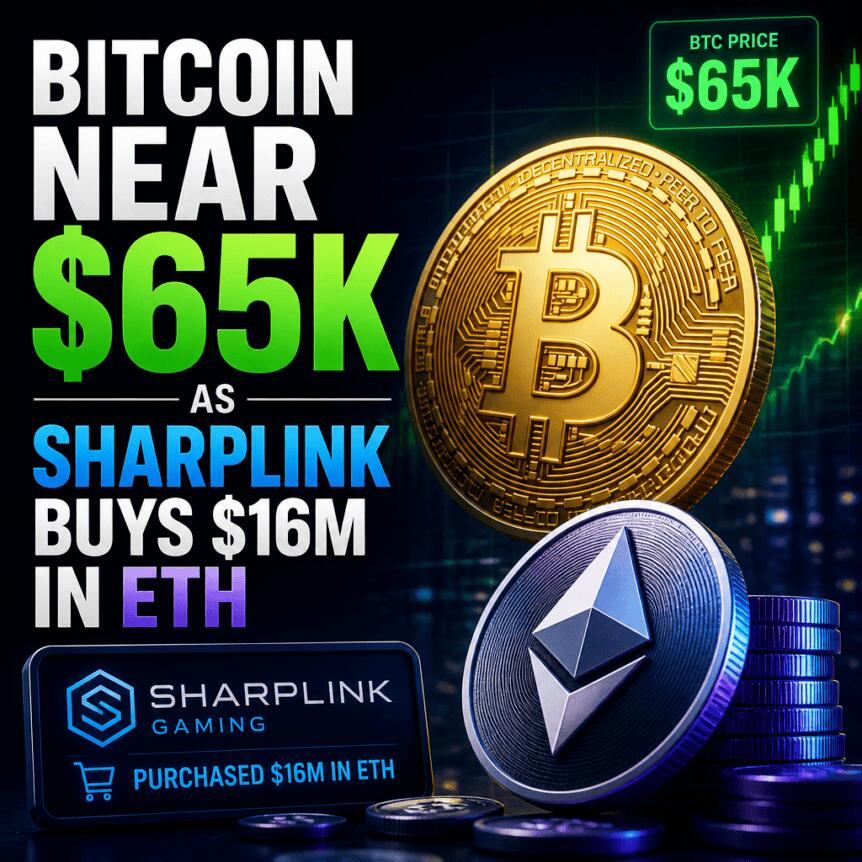
Bitcoin rebounded on Wednesday as attention turned to Federal Reserve commentary on stubborn inflation. The move came alongside a rise in US Treasury yields—an environment that typically makes investors more selective about assets that don’t provide ongoing yield, including cryptocurrencies.
Still, the bounce does not appear to have fully erased underlying caution. Bitcoin recently traded near $61,490 after dipping to a 21-month low of $57,737, while institutional flows into spot Bitcoin ETFs have remained under pressure and analysts continue to debate whether recent weakness marks a durable bottom.
Key takeaways
- Bitcoin climbed after remarks tied to persistent US inflation, but higher bond yields reinforce why “non-yield” assets face ongoing scrutiny.
- Bitcoin bounced from a 21-month low, yet broader sentiment remains in “Extreme Fear” territory based on a fear/greed tracker.
- Spot Bitcoin ETFs have seen large outflows in recent weeks, with June reported as the worst month since launch for net withdrawals.
- On-chain and chart-based signals cited by analysts suggest the market may not have reached a bear-market bottom if price stays below longer-term benchmarks.
- Crypto liquidity and leverage look thinner heading into Q3 after Q2 liquidations, potentially dampening forced-selling cascades but increasing price swing risk.
Fed inflation focus meets a rate backdrop that still pressures crypto
Bitcoin’s recovery followed remarks linked to persistent inflation, reported through coverage of US Federal Reserve Chair Kevin Warsh’s comments. The positive reaction was tempered by the broader macro picture: the US five-year Treasury yield reportedly rose to 4.22%, reflecting investor demand for higher returns on government bonds.
In the same window, oil prices fell—WTI reportedly touched a four-month low—yet market participants still anticipate eventual monetary expansion. The key tension for crypto is that, regardless of how the Fed ultimately handles interest rates or balance-sheet policy, Treasury issuance and yields influence the opportunity cost of holding assets without yield.
BTC rebounds from $57,737 low, but “Extreme Fear” persists
At the time of publication, Bitcoin was trading around $61,490 after earlier trading as low as $57,737 on Wednesday, according to the same market coverage. Ether and Solana also posted gains, with ETH up about 3% and SOL up roughly 4.85%.
However, the rebound took place under an unusually cautious market mood. A fear and greed sentiment tracker cited in the coverage placed the crypto market at roughly 11 out of 100—labeled “Extreme Fear.” That matters because extreme caution can support sharp rallies, but it also suggests many investors remain positioned for downside risk rather than confident recovery.
From a longer perspective, the article noted Bitcoin remains down about a third since the start of the year, and the institutional picture has not improved. Reported flows show US spot Bitcoin ETFs experiencing significant withdrawals, including a total outflow of $4.5 billion in June—described as the largest since the ETFs launched. When institutional allocation confidence lags during a bounce, traders often treat rallies as fragile until inflows return.
PlanB: June weakness and 200-week levels imply the bottom may not be in
Beyond sentiment and ETF flows, at least one widely followed analyst argued the market has more room to fall. PlanB, referenced in the coverage, warned that Bitcoin could drop further after closing June below its 200-week moving average while still trading above its realized price.
The specific setup highlighted is that Bitcoin ended June 20.5% lower to close at $58,526—its worst monthly performance since June 2022. The same coverage placed that close below the 200-week moving average near $62,000, while still above a realized price figure around $52,000.
“All previous bear market bottoms were below realized price,” PlanB said, according to a post attributed to the analyst.
The article further cited PlanB adding that Bitcoin could still decline toward $52,000, framing the current price relationship to those two benchmarks as evidence the bear-market bottom may not yet be confirmed. For traders and portfolio managers, the practical takeaway is that technical “bounce” narratives may remain vulnerable if realized-price confirmation is not reached and ETF outflows continue to weigh on demand.
Sharplink restarts ETH accumulation, while leverage resets change Q3 dynamics
While Bitcoin-focused signals leaned cautious, one notable development in Ethereum accumulation came from Sharplink, a crypto treasury company. The coverage states Sharplink resumed buying Ether after an eight-month pause, and that it purchased $16 million worth of ETH since June 25.
On-chain data from Arkham cited in the report showed Sharplink buying 5,000 ETH on June 25 and another 5,000 ETH on June 26, with the report noting those amounts were worth about $8.5 million per day at the time of the purchases. The company also confirmed the buys in an announcement, saying it paid an average price of $1,611 per ETH.
The same coverage said Sharplink’s latest buys bring its total Ether holdings to 866,725 ETH, and quoted the company’s position that the purchases reflect a continued commitment to growing its ETH treasury as a long-term reserve asset.
Liquidity and positioning are also becoming a key story as markets move into Q3. A market update from institutional data provider Talos, cited in the article, described thinner liquidity but less leverage after Q2. According to Talos, Bitcoin and Ether long liquidations totaled $8.35 billion in Q2—an episode that coincided with spot Bitcoin ETF outflows, reduced Bitcoin buying by Strategy, and a contraction in stablecoin supply.
Talos’ framework suggests the deleveraging may reduce the likelihood of a forced-selling chain reaction heading into Q3. Yet the firm also warned that reduced order-book depth can weaken the market’s ability to absorb renewed selling pressure. In other words: the market may be less fragile in one sense, while simultaneously becoming more prone to sharper swings because there is less trading activity to buffer large orders.
What to watch next as macro pressure and positioning collide
With bond yields still elevated, ETF outflows still shaping institutional demand, and liquidity thinner after Q2’s deleveraging, the next moves in Bitcoin may hinge on whether buying interest returns alongside improved market depth—or whether rallies fade into another test of longer-term technical levels. Investors and traders should watch ETF flow data, Treasury yield direction, and whether stablecoin supply and order-book depth continue to shift as Q3 unfolds.
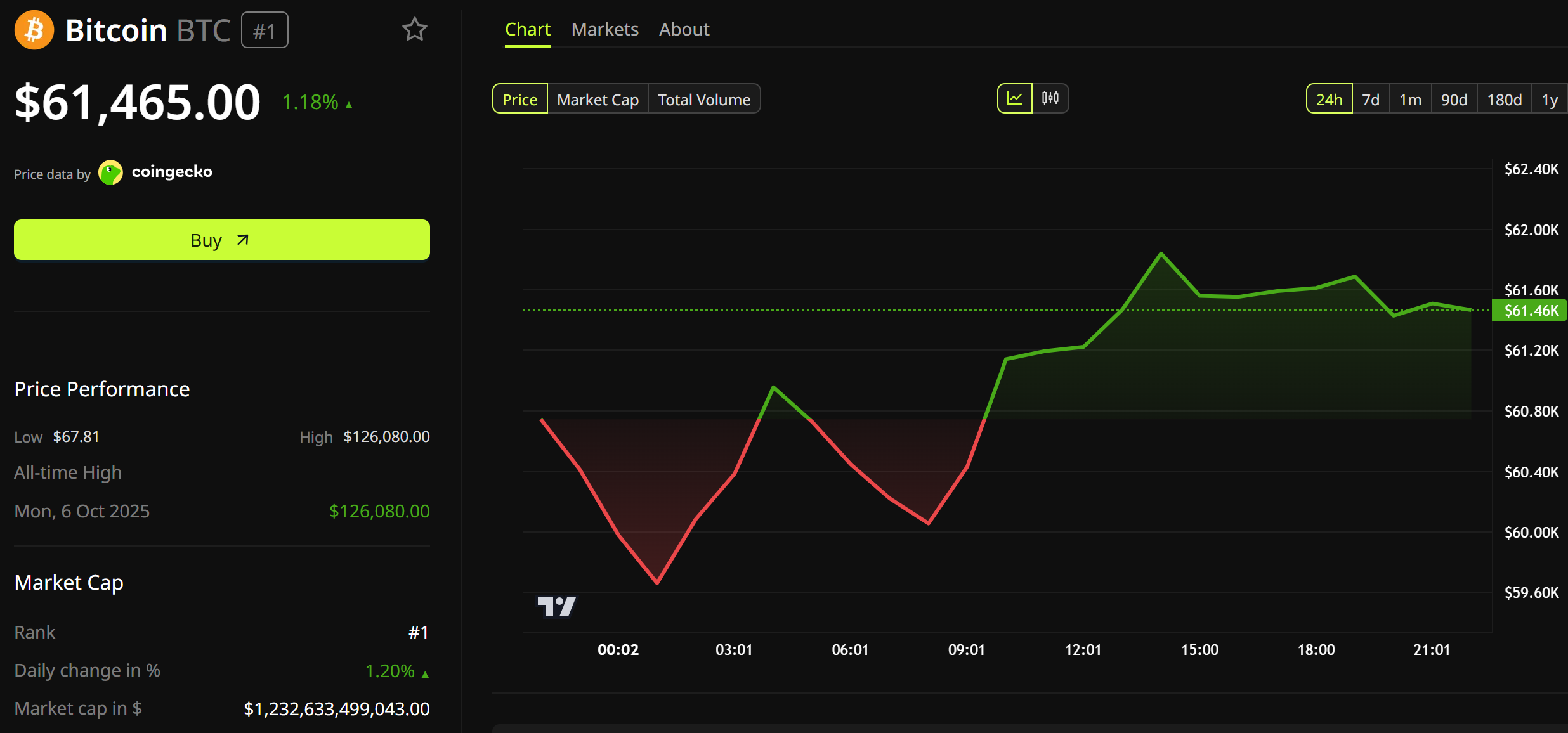
Bitcoin (BTC) nearly topped $62,000 on Thursday after US payrolls grew by just 57,000 in June, roughly half of what economists expected. The miss revived Federal Reserve rate cut hopes and forced bearish traders to exit crowded short positions.
The rebound arrived days after Bitcoin closed its worst month since June 2022, a 20.5% drop. Whether the bounce extends to $70,000 now hinges on Fed policy, ETF flows, and whale activity on exchanges.

Weak Jobs Data Explains Why Bitcoin Jumped towards $62,000
The Bureau of Labor Statistics counted 57,000 new jobs for June, far below the 113,000 consensus. According to the report, April and May payrolls were also revised down by a combined 74,000, while labor force participation slid from 61.8% to 61.5%.
Consequently, traders cut the odds of further Fed rate hikes and rotated back into risk assets. The data also landed a day after Fed Chair Kevin Warsh said inflation risks had eased, remarks that helped Bitcoin reclaim the $60,000 level on Wednesday.
Derivatives amplified the move. Roughly $450 million in crypto short positions were liquidated within 24 hours, CoinGlass data shows, as bears rushed to cover.
Bitcoin now trades near $61,465, up 1.18% over 24 hours, but even so, BTC sits 51% below its October 2025 record of $126,080 and down 44% over the past year.
ETF Outflows and Whale Deposits Cloud the Road to $70,000
Institutional demand has not confirmed the bounce. Spot Bitcoin ETFs posted $294 million in net outflows on Wednesday, market data shows, even as prices climbed. The redemptions extended June’s record $4.5 billion exit, the products’ worst month on record.

Sentiment is thawing nonetheless. CoinMarketCap’s Fear and Greed Index improved from Extreme Fear to Fear.

Similarly, Tiger Research said it has turned more constructive, arguing the market is likely in the final stage of its bear cycle.
In contrast, however, CryptoQuant flagged fresh warning signs on exchanges.
“Bitcoin is testing $60K support, and exchange deposits are flashing warning signs. BTC inflows jumped above 50K/day, ETH inflows spiked above 1.25M, and altcoin deposits hit a two-month high. Whales appear to be leading the move. Incoming volatility,” the analysts wrote in a post.
The firm added that the average deposit size doubled from 1 BTC to 2 BTC, a pattern driven by whales rather than retail. Its warning follows deepening capitulation signals tracked across on-chain data this week.
Historically, similar deposit spikes preceded sharp moves, including June’s slide when Bitcoin fell to $58,000. A failure to hold $60,000 could expose the realized price near $53,000, which CryptoQuant calls the key on-chain valuation floor.

A sustained push to $70,000 likely requires ETF flows to turn positive and July’s FOMC meeting to validate rate cut bets.
Until then, reclaiming the 20-day EMA remains the first test for bulls, while $60,000 stays the line the whole market is watching.
RSI Rebound Suggests Selling Pressure Is Fading
The daily Relative Strength Index (RSI) has climbed to 43.76, holding above its signal line at 35.59. The indicator bottomed near oversold territory in mid-June, and its recovery suggests bears are losing control.
A push above 50 would confirm the shift, especially if the broader market keeps climbing.
BTC faces a resistance cluster at $62,000, reinforced by the 20-day EMA at $62,148 and Parabolic SAR at $62,523. A daily close above it could send the price toward the 50-day EMA near $66,200, a 7.7% gain.

However, record ETF outflows may cap demand, even as long-term models point higher. Rejection here risks a retest of $58,115, and losing that floor would invalidate the recovery.
The post Why Bitcoin Jumped towards $62,000 and What Could Carry It to $70,000 appeared first on BeInCrypto.


Robinhood shares have climbed more than 6% after multiple Wall Street firms reaffirmed bullish ratings and projected further upside as the brokerage expands its global business and AI offerings.
Summary
- Robinhood shares rose over 6% as Wall Street firms reiterated Buy ratings and projected upside to $135.
- Analysts cited global expansion, AI-powered products, and crypto initiatives as key drivers of future growth.
- Robinhood expanded into Canada, the UK, and Singapore while launching its blockchain and AI trading features.
According to recent research notes from Piper Sandler, BTIG, and Mizuho, confidence in Robinhood’s long-term growth story has strengthened even after the stock’s strong rally. According to Yahoo Finance data, shares briefly traded above $115 after the Wall Street opening bell, extending their monthly gain to about 31% as investors responded to a series of new product launches and international expansion plans.
Piper Sandler maintained its Buy rating and kept a $135 price target on Robinhood, suggesting the stock still has room to appreciate. BTIG also reiterated its Buy recommendation with a $125 target. Meanwhile, Mizuho raised its target price to $130 from $115 while maintaining a Buy rating, making it one of the latest firms to increase expectations for the brokerage.
Global expansion continues to support Robinhood’s growth story
Mizuho’s latest research note argued that Robinhood could become the first true “hyperscaler” among online brokerage platforms. The firm pointed to Robinhood’s base of more than 27 million funded accounts, its easy-to-use trading platform, and its popularity among younger investors as reasons for its positive outlook.
The brokerage also believes Robinhood’s opportunity extends well beyond the United States. According to Mizuho, the company is expected to deepen its presence across Europe before eventually expanding further into Asian markets.
Recent announcements from Robinhood have added support to that outlook. The company said it now serves more than 1 million funded customers in Europe while confirming plans to launch Robinhood Crypto in the UK as part of its regional expansion.
Outside Europe, Robinhood officially introduced its crypto platform in Canada with zero trading fees for the first 90 days. The company also disclosed that it had secured a brokerage license in Singapore, giving it another foothold in the Asian market.
AI products and blockchain strategy attract fresh investor attention
Alongside its international rollout, Robinhood has continued expanding its technology offerings. The company recently introduced Robinhood Chain, a blockchain network designed to support AI-assisted token swaps, liquidity discovery, and access to tokenized real-world assets.
The blockchain launch followed the rollout of Robinhood’s Agentic trading tools, which use artificial intelligence to help users analyze markets and manage investments. According to the company, those AI-native features have gained traction among traders since their introduction.
The combination of blockchain infrastructure, AI-powered products, and expansion into new markets has coincided with stronger optimism from Wall Street analysts. Their latest forecasts suggest these initiatives could open additional revenue streams while helping Robinhood diversify beyond its traditional retail brokerage business.
Even with analysts maintaining bullish targets, short-term trading could still be affected by broader market volatility. For now, however, brokerage firms including Piper Sandler, BTIG, and Mizuho continue to argue that Robinhood’s international expansion, growing crypto business, and investment in AI technology provide a favorable foundation for further growth in the months ahead.

Michael Saylor’s Strategy has long served as the dominant corporate force behind Bitcoin buying, but that may be changing.
Bitwise Chief Investment Officer Matt Hougan believes that the company will play a much smaller role in driving the crypto asset’s demand in the next market cycle.
Next Wave of BTC Buyers
In his latest market analysis, Hougan said that Strategy’s role in the Bitcoin market has changed after the company adopted a new framework for STRC, which allows it to periodically sell the crypto to fund dividend obligations. While Hougan acknowledged that he does not expect Strategy to become a major BTC seller, he did say that the company could now buy or sell the crypto depending on market conditions rather than acting as a constant source of demand.
He added that there is no mechanism forcing Strategy to sell more than a few billion dollars’ worth of Bitcoin annually, and if the crypto asset’s prices recover, the exec still expects the company to remain a net buyer. Even so, Hougan said Strategy is unlikely to carry the same market influence it did during the previous cycle.
Instead, he expects institutional investors to emerge as the dominant force behind Bitcoin accumulation. Looking at BTC’s history, Hougan said market leadership has repeatedly shifted between different groups of buyers, moving from cypherpunks to Asian investors, then US retail participants, followed by the Grayscale Investments Bitcoin Trust and later Strategy.
The Bitwise CIO now believes the next phase will be led by institutions with significantly larger pools of capital. These include global banks, asset managers, pension funds, endowments, sovereign wealth funds, and financial advisers. According to him, this transition is already underway.
For instance, Morgan Stanley has launched proprietary Bitcoin ETFs, while Wells Fargo has started adding BTC exposure to model portfolios. He also highlighted that Texas became the first US state to fund a strategic BTC reserve, while several sovereign wealth funds and sovereign banks either already hold the crypto asset or have begun evaluating allocations.
Despite Bitcoin ETF outflows during 2026, Hougan noted that the products have attracted more than $50 billion since launching in 2024 and are now available on most major financial adviser platforms.
Strategy Slowdown May Benefit Bitcoin
A slowdown in Strategy’s Bitcoin purchases would not necessarily be bearish for the market, according to HashKey Group’s Senior Researcher Tim Sun. Speaking to CryptoPotato, Sun said that if the company is forced to slow or pause its accumulation, it would help unwind the distortion in supply and demand created by its financing-driven buying model.
Rather than relying heavily on Strategy’s purchases and ETF inflows, Bitcoin would have an opportunity to establish a stronger price floor based on genuine market demand, resulting in what Sun views as a healthier market structure.
The post Why Bitwise’s Matt Hougan Thinks Strategy’s Bitcoin Era Is Fading appeared first on CryptoPotato.

Trump Says He Did Not Know About 1.4 Billion Crypto Earnings

Lucas Glover, Zac Blair share early lead at John Deere Classic

iFixit Shows How Replacement iPhone Batteries Take Shape Inside a Chinese Factory


-

 Fashion6 days ago
Weekend Open Thread: Staud – Corporette.com
-

 Politics7 days ago
The House | Manchesterism won’t survive the painful trade-offs unless it gets citizens on board
-

 Crypto World3 days ago
Strategy authorizes up to $1.25B in Bitcoin sales under new capital plan
-

 Politics7 days ago
Potential 2028er World Cup attendee leaderboard
-

 Business7 days ago
Asia stock markets slide as tech shares slump
-

 News Videos4 days ago
MAJOR BITCOIN & MARKET UPDATE!!!! (MUST WATCH ASAP!!!)
-

 Crypto World5 days ago
Coinbase, Circle Deepen Crypto Stock Losses Despite Resilient S&P 500
-

 Tech3 days ago
Anonymous researcher drops 0-day ‘exploitarium’ repo
-

 Business3 days ago
Australia treasurer says alleged access of prime minister’s bank data ’incredibly concerning’
-

 Crypto World6 days ago
Kraken's xStocks Opens Bending Spoons IPO Registration to EEA Retail
-

 Sports6 days ago
FIH Pro League: India defeat Pakistan 7-1, register biggest win of campaign | Other Sports News
-

 Crypto World7 days ago
Bitcoin Sparks $600M Hourly Liquidations With $65,000 Set To Become Resistance
-

 Tech5 days ago
Bluekit phishing kit adopts browser-in-the-middle for login theft
-
Crypto World6 days ago
Hyperliquid Named on Singapore MAS Investor Alert Register
-

 Tech6 days ago
Russian hackers now target Signal backup recovery keys
-

 Crypto World7 days ago
Tether (USDT) Passes Ether in Market Cap as ETH Drops Toward $1.5K
-

 Crypto World6 days ago
RTX holders must register wallets before token distribution begins
-

 Sports2 days ago
Broncos roster: OL Ben Powers (No. 74) entering final year of contract
-
 Business3 days ago
The AI boom won’t burst all at once. It will pop in ‘rolling bubbles’: Macquarie
-

 Tech5 days ago
Claude Code turned every engineer into three. Now companies need more product thinkers
You must be logged in to post a comment Login