

Crypto World
Open-Source Blockchain Devs Outside SEC Rule Scope


US Securities and Exchange Commission (SEC) Commissioner Hester Peirce argued that publishing open-source blockchain and DeFi code should not automatically subject software developers to federal securities regulations, addressing a long-standing question about liability in decentralized finance. Speaking at the IC3 Blockchain Camp at Princeton University, Peirce emphasized that open-source software publication is often a First Amendment-protected activity and should not automatically render developers as securities intermediaries simply because others use their code.
“Many blockchain projects involve publishing open-source software, which is generally a protected activity under the First Amendment,” Peirce said, underscoring a view that decentralized protocols can operate without traditional intermediaries. She added that responsibility for securities law violations should generally rest with the individuals who engage in unlawful conduct, not the developers who publish code that others may utilize.
Peirce’s remarks reflect a broader stance within the SEC that questions the applicability of centralized regulatory constructs to decentralized networks. She warned against extending rules designed for traditional intermediaries—such as brokers, dealers, exchanges, clearinghouses, transfer agents, investment advisers, and investment companies—to blockchain infrastructure that can function independently of those entities.
“The SEC’s rulebook is full of intermediaries: brokers, dealers, exchanges, clearinghouses, transfer agents, investment advisers and investment companies,” she said. “As a result, we see the crypto world teaming with brokers, dealers, exchanges, clearinghouses, transfer agents, investment advisers, and investment companies.”
However, Peirce cautioned that these questions are not a blanket rejection of regulation but a call to calibrate the scope of securities laws to the realities of decentralized systems that serve purposes beyond securities transactions. She emphasized the need to distinguish between publication of open-source code and active participation in unlawful conduct within securities markets.
Source: Cointelegraph
Key takeaways
- The publication of open-source blockchain and DeFi code should not automatically trigger securities intermediary status for developers, according to Commissioner Hester Peirce.
- Open-source software publication is argued to be a First Amendment-protected activity in the context of decentralized networks.
- Regulatory considerations should avoid blanket application of centralized intermediary rules to distributed protocols with non-traditional models of operation.
- The SEC is moving away from “regulation by enforcement,” signaling a more nuanced approach to how existing securities laws apply to digital assets and decentralized systems.
- Recent SEC signals—broker-dealer interface guidance and strategic planning through 2030—underline continued regulatory focus on digital assets, while recognizing the unique structure of decentralized networks.
Open-source governance, liability, and the regulatory lens
Peirce’s remarks center on a practical tension: developers who publish open-source code can enable widely used protocols without participating in traditional market intermediation. In her view, liability for securities-law violations should trace to unlawful acts by individuals or entities rather than to the mere distribution of software. This stance aims to reduce unnecessary regulatory friction for developers who contribute to open ecosystems, while preserving accountability for bad actors who misuse technology.
The discussion highlights a broader policy question: how to balance innovation and investor protection in an environment where code and networks operate without conventional gatekeepers. For institutional researchers and compliance teams, the core implication is a potential narrowing of the risk surface for open-source contributors, coupled with a continued emphasis on identifying and addressing actual illicit activity within the system.
Regulatory alignment and the broader shift in oversight
Peirce’s comments align with a broader SEC recalibration away from what some officials have described as “regulation by enforcement.” Since its inception, the Crypto Task Force has explored how existing securities laws should apply to digital assets and decentralized infrastructure, seeking clearer boundaries between what constitutes a security and what falls outside traditional regulatory purview.
In parallel, SEC staff recently issued guidance addressing broker-dealer registration questions for certain user interfaces. The guidance suggested that some front-end websites and software interfaces that merely provide access to decentralized protocols may not fall within the traditional definition of a broker. That development signals a more nuanced approach to how compliance obligations are mapped onto user experiences that connect investors with crypto networks.
At the same time, the SEC has signaled that digital assets and blockchain technology will remain a central focus in the coming years. In its draft Strategic Plan through fiscal 2030, the agency highlighted blockchain and crypto assets as technologies with the potential to reshape financial markets—an articulation that reinforces ongoing regulatory attention and investment in regulatory clarity for firms operating in the space. As noted by Cointelegraph coverage of related developments, the plan framed these technologies as capable of transforming America’s financial infrastructure.
Related: Paxos becomes first crypto firm to win SEC clearing agency registration — highlighted in coverage that underscores how the SEC is leaning into specialized, regulated infrastructure providers within the crypto ecosystem.
According to Cointelegraph, these signals reflect a pattern: regulators are seeking to craft precise guardrails that protect investors without stifling innovation, particularly in areas where decentralized protocols operate without traditional intermediaries. The evolving regulatory toolkit includes clearer criteria for what constitutes a broker or intermediary, while recognizing that front-end interfaces may not always bear the same regulatory heft as the underlying protocol.
Implications for firms, banks, and compliance programs
The evolving stance has practical implications for crypto firms, exchanges, banks, and institutional investors. Compliance teams must monitor the regulatory boundary lines between open-source development and active market intermediation, ensuring procedures focus on identifying unlawful activity rather than penalizing legitimate software publication. This stance could affect licensing approaches, oversight frameworks, and cross-border regulatory strategies as firms navigate divergent national standards in a multi-jurisdictional environment.
In practice, this means: developers may benefit from clearer protections when contributing to open-source code, while businesses must remain vigilant against actual securities violations and ensure robust KYC/AML controls, appropriate disclosures, and risk monitoring for user interactions with decentralized protocols. The SEC’s ongoing dialogue with industry participants is likely to yield additional clarifications on where to draw the line between software publication and regulated activity.
What to watch next
Observers should monitor how the SEC translates these high-level considerations into concrete policy guidance for developers, platforms, and infrastructure providers. Key questions include how future enforcement actions would delineate permissible open-source contributions from activities that cross into regulated territory, what constitutes sufficient governance for decentralized networks, and how cross-border differences will be harmonized with U.S. policy aims. As the SEC advances its strategic priorities through 2030, the balance between safeguarding investors and fostering innovation remains a central point of focus for regulators, market participants, and compliance professionals alike.
Closing perspective: the evolving dialogue around open-source development and regulatory coverage will shape how crypto ecosystems grow, how firms structure their governance and licensing, and how supervisors enforce rules in a technology-neutral, risk-based manner.

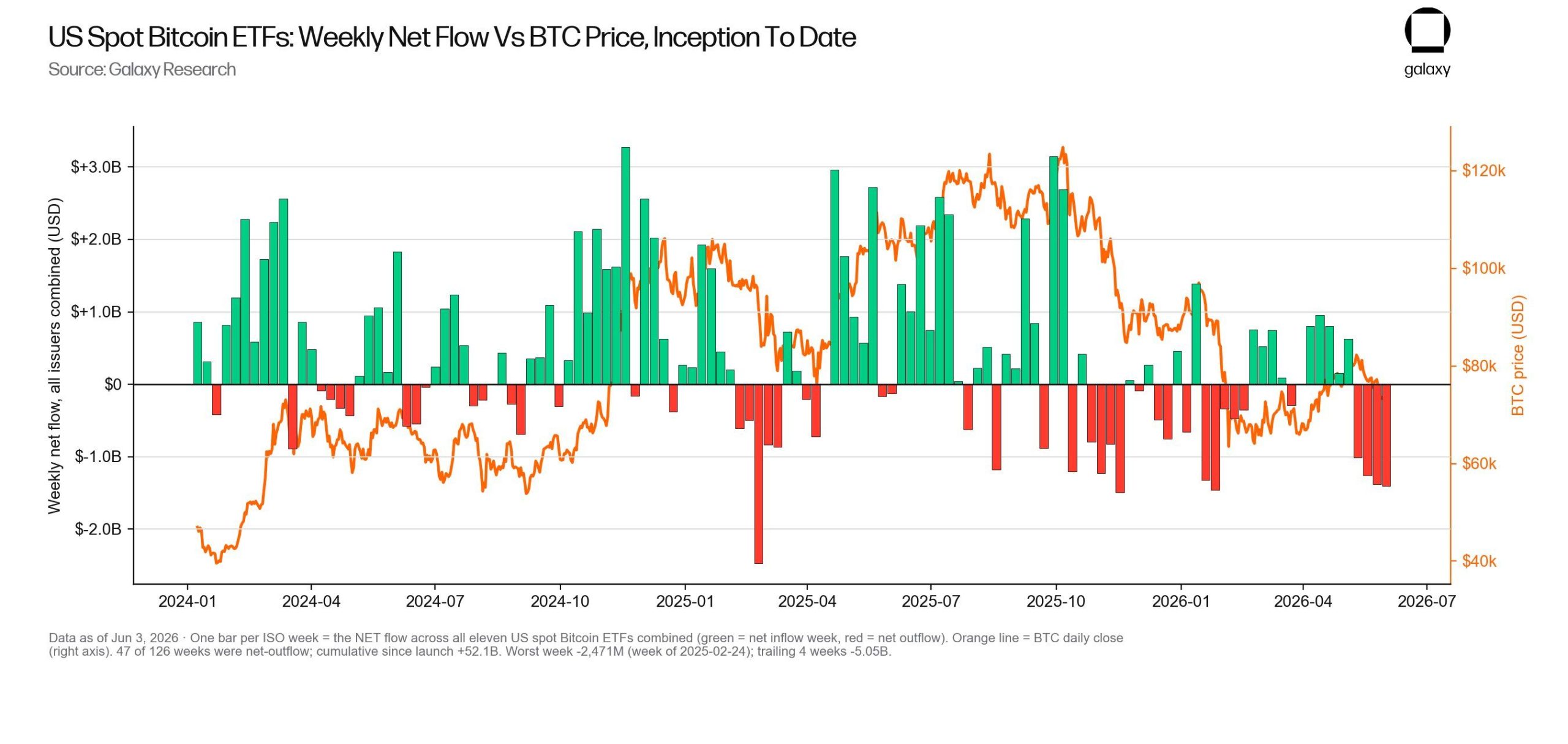
Spot Bitcoin (BTC) exchange-traded funds (ETFs) have recorded 13 consecutive days of net outflows from May 15 to June 3, the longest such streak since the products launched in early 2024.
The funds shed $4.33 billion and 59,351 BTC over that span, according to Galaxy Research. The selling marks a sharp reversal from April, the funds’ strongest month of 2026, when inflows hit $1.97 billion.
The Records Mount as Bitcoin Exits Pile Up
The intensity is more noticeable in coins than in dollars. Galaxy Research found the 20-day trailing window reached $5.42 billion and 73,080 BTC, the heaviest reading ever in both measures.
The 7-day and 10-day windows each set new records for the most Bitcoin outflows, at 39,338 BTC and 42,941 BTC, respectively.
Follow us on X to get the latest news as it happens

Bloomberg senior ETF analyst Eric Balchunas said the roughly $4.4 billion that exited over the past month dragged year-to-date flows back into negative territory, undoing a recovery the funds had worked to achieve.
However, Balchunas noted a silver lining. BlackRock’s IBIT and a few peers remain positive year-to-date, and total lifetime net inflows still sit near $55 billion, less than $10 billion below the high-water mark.
“Not bad at all for this type of drawdown and negative sentiment, gold went down like this a few yrs after GLD debuted and 40% of the assets left, much stronger holders here so far). But yeah, to quote Henry Hill, this is the bad times,” he added.
A Market-Wide Retreat
The pressure extends beyond Bitcoin. Ethereum (ETH) ETFs have also posted 17 straight outflow days, their longest streak on record.
Performance among newer products is mixed. Hyperliquid (HYPE) funds have continued drawing inflows since their mid-May debut, while the recently launched BNB ETF has seen only one positive day. XRP and Solana (SOL) products show scattered inflows and outflows, with flat sessions.
The matching records across the two largest crypto ETFs point to a broad risk-off shift. Whether June flows stabilize will signal how durable institutional conviction remains.
Subscribe to our YouTube channel to watch leaders and journalists provide expert insights
The post Bitcoin ETF Outflows Hit 13-Day Streak as $4.3 Billion Exits the Funds appeared first on BeInCrypto.


White House adviser Patrick Witt defended the CLARITY Act as a law-enforcement-friendly crypto bill, even as lawmakers face a shrinking window to pass the legislation before midterm politics slow the process.
Summary
- Witt defended CLARITY Act crime rules as critics questioned anti-money laundering safeguards in Senate negotiations.
- Lummis warned crypto rules could stall until 2030 if lawmakers miss this Senate window now.
- DeFi protections remain central as banks, police groups, and crypto advocates pressure Senate lawmakers.
White House crypto adviser Patrick Witt used a Blockchain Association town hall to defend the CLARITY Act against criticism from law enforcement groups. The legislation strengthens regulatory oversight while supporting law enforcement efforts in the digital asset sector.
His comments came as debate over the bill’s anti-money laundering language grew sharper in Washington. Critics argue that parts of the bill could make it harder to trace illicit finance. Supporters say the measure would bring more crypto activity under federal supervision and give agencies clearer rules.
Lummis warns the Senate clock is closing
Senator Cynthia Lummis also urged lawmakers to move quickly. She said Congress may not get another clear chance to pass broad digital asset rules until 2030 if the current effort fails. That warning has turned the CLARITY Act into one of the most time-sensitive crypto bills in the Senate.
Recent market updates said Lummis now sees a vote before the August recess as more likely than a vote before July 4. The bill has already cleared the Senate Banking Committee in a 15-9 vote and has moved onto the Senate Legislative Calendar. Senate leaders have not set a floor vote date, leaving negotiators to keep working on changes. The timing keeps pressure on both parties.
DeFi protections remain a flashpoint
A key dispute centers on the Blockchain Regulatory Certainty Act language inside the latest Senate version. The provision seeks to protect non-custodial software developers from being treated as money transmitters when they do not control user funds or move assets for customers.
DeFi advocates support that protection, saying developers should not face liability for how others use open-source tools. Some lawmakers and law enforcement groups take a different view. They argue that loose language could weaken efforts to prosecute illicit fund transfers and recover stolen money.
Supporters race to build pressure
The Blockchain Association has added pressure by releasing a letter backed by 160 former national security, intelligence, and law enforcement officials. The group said the bill would support enforcement, improve oversight, and help the U.S. set digital asset standards.
The latest push also follows broader conflict between banks and crypto firms. JPMorgan analysts recently warned that the bill’s passage window is narrowing as Congress faces a crowded calendar. Stablecoin rewards, anti-money laundering rules, DeFi protections, and political ethics concerns remain central hurdles before the bill can reach President Donald Trump’s desk.

A bipartisan group of Senate Republicans is pressing U.S. financial regulators to clarify how capital standards should apply to crypto-related activities. Led by Senator Cynthia Lummis, the lawmakers sent a May 27 letter to Federal Reserve Vice Chair for Supervision Miki Bowman, Federal Deposit Insurance Corp. Chairman Travis Hill, and Comptroller of the Currency Jonathan Gould. The outreach comes as the regulatory framework for digital assets remains a central focus of congressional and supervisory deliberations.
The letter acknowledges the March guidance that clarified the capital treatment of tokenized securities, but urges regulators to extend the same clarity to the on-balance sheet handling of digital assets more broadly. According to Cointelegraph, the move signals lawmakers’ intent to shape how crypto activities are capitalized within the banking system as part of broader regulatory reform efforts.
The Senators contend that current international standards for capitalizing crypto holdings—most notably the Basel Committee on Bank Supervision’s framework—impose a 1,250% risk weight on crypto assets, describing it as a “de facto ban” on banks holding crypto. They argue that any capital framework should reflect the actual risk profile of digital assets and be technology-neutral to preserve banks’ ability to participate meaningfully in crypto markets.
The letter was signed by Senator Cynthia Lummis and colleagues including Dan Sullivan, Bill Hagerty, Bernie Moreno, Ted Budd, and Jon Husted. It arrives as lawmakers prepare to advance a broader crypto bill, the CLARITY Act, which would delineate how federal agencies regulate crypto platforms and activities. The current version envisions banks using digital assets and blockchain technology for payments, lending, custody, and trading, among other functions, and is a focal point of legislative activity ahead of the November midterm elections.
The group urged regulators to begin work on a new capital framework for crypto that would underpin on-balance sheet activities while maintaining a robust safety net for the banking system. They also emphasized the need for a calibrated approach that aligns with the opportunities and risks intrinsic to digital assets, rather than applying a one-size-fits-all treatment borrowed from legacy asset classes.
Key takeaways
- A coalition of Senate Republicans is urging U.S. regulators to clarify capital standards for crypto-related on-balance sheet activities.
- The push centers on extending March guidance for tokenized securities to a broader, clear framework for digital assets held on banks’ balance sheets.
- Criticism is directed at the Basel Committee’s 1,250% risk weight for crypto assets, with lawmakers urging a calibrated, technology-neutral approach.
- The CLARITY Act is advancing in the Senate and would define federal regulatory roles for crypto, including permitting banks to use digital assets for payments, lending, custody, and trading.
- Lawmakers stress the need for early, practical capital guidance to avoid barriers to bank participation in crypto markets, even as the midterm timeline increases the urgency of passage.
Regulatory push and governance dynamics
The core objective of the lawmakers’ letter is to push for a capital framework that accurately reflects the risk profile of digital assets and enables banks to engage with crypto markets without facing prohibitive capital charges. By explicitly commending the March guidance on tokenized securities while urging broader application, the Senators signal a preference for progress that can be scaled across asset types, rather than piecemeal, asset-specific rules.
The Basel Committee’s current stance—particularly the high risk weights assigned to crypto holdings—has been a point of contention for U.S. regulators and the banking sector. The lawmakers describe the 1,250% figure as not calibrated to the actual risk profile of digital assets, arguing that an effective framework should balance safety with the economy-wide benefits of the digitization of finance. They emphasize a technology-neutral approach that preserves banks’ authority to participate in digital asset markets and avoid unnecessarily restrictive capital requirements.
Beyond capital adequacy, the letter stresses that any capital treatment for digital assets should be compatible with a broader, technology-neutral policy environment that supports safe, scalable innovation in the financial system. This stance sits within a larger regulatory conversation about how to align U.S. rules with evolving international standards, and how to reconcile a rapidly digitizing financial landscape with traditional prudential safeguards.
Legislative trajectory and cross-agency oversight
The CLARITY Act currently under consideration in the Senate would delineate the authorities of the Securities and Exchange Commission and the Commodity Futures Trading Commission in relation to crypto markets and service providers. The bill envisions a framework for how regulators oversee exchanges, wallet providers, custody services, and other crypto-enabled activities, while also addressing core issues such as stablecoins, ethics, and developer standards as part of its broader policy architecture.
Regulatory and legislative dynamics remain complex. The Senate Banking and Agriculture Committees have each advanced companion versions addressing securities and commodities, and the full Senate will need to reconcile the differing approaches before final passage. With the midterm elections approaching, lawmakers are prioritizing timely action to avoid the prospect of reintroducing substantial crypto legislation in the next session. As cross-committee work progresses, the debate will increasingly hinge on issues such as stablecoins, risk management, consumer protection, and the appropriate scope of regulatory oversight for developers and platforms within the digital-asset ecosystem.
Lawmakers also flagged that any final bill would need to address licensing and regulatory oversight in a coherent manner—elements that are critical for institutions seeking to deploy or expand crypto activities within compliant frameworks. The interplay between capital standards and licensing requirements will shape how banks and crypto firms plan governance, risk programs, and third-party arrangements in the years ahead.
Institutional implications and broader policy context
The push for capital clarity matters for banks contemplating crypto activities, fintechs evaluating tokenized offerings, and crypto firms seeking custody and settlement capabilities within regulated, insured institutions. A clarified capital framework could reduce uncertainty around asset classes that have historically faced punitive capital treatment, potentially lowering barriers to participation while preserving the core safety functions expected by supervisors and taxpayers.
From a compliance and enforcement standpoint, clearer capital guidance would support more consistent risk assessment and reporting practices across banks that interact with digital assets. This, in turn, could impact internal capital planning, liquidity management, and the design of risk-weighting methodologies within financial institutions. Regulators would still need to monitor emerging products, evolving custody solutions, and the resilience of settlement rails as the asset class expands, but a more predictable framework would help align day-to-day operations with supervisory expectations.
Contextually, the ongoing CLARITY Act debate occurs alongside parallel regulatory developments in other major markets. While the U.S. seeks to codify a domestic framework for digital assets, global standards—ranging from prudential norms to anti-money-laundering controls—continue to evolve. The regulatory landscape remains uncertain in certain areas, such as explicit definitions of digital asset custody, disclosure requirements, and the delineation of responsibilities among banking supervisors, securities regulators, and commodities authorities. Analysts and compliance teams should monitor how these tensions resolve as the CLARITY Act’s provisions are refined and as Basel-related capital discussions influence U.S. rulemaking timelines.
Regardless of the eventual outcome, the episode underscores a broader policy objective: to create a robust, implementable regime that allows financial institutions to participate meaningfully in digital-asset markets while maintaining strong risk controls, consumer protections, and market integrity. The stakes extend beyond market structure, touching licensing, cross-border cooperation, and the regulatory certainty that institutions rely on for long-term strategic planning.
Closing perspective: As the Senate returns from recess and the CLARITY Act moves forward, the balance between prudent prudential safeguards and practical capital treatment will shape how banks, exchanges, and crypto firms operate within a compliant U.S. financial system. The next steps will reveal how regulators translate high-level principles into concrete capital rules, and how lawmakers reconcile competing objectives before the midterm window closes.


Bitcoin (BTC) has fallen into bear-market territory after a sharp overnight selloff, while Michael Saylor framed the decline as a temporary capital rotation into artificial intelligence rather than a loss of confidence in the asset.
Summary
- Bitcoin fell into bear-market territory after dropping 22.7% from its four-week high.
- Michael Saylor said that AI infrastructure funding caused capital to rotate away from Bitcoin ETFs.
- The strategy’s small Bitcoin sale raised concern because the company had not sold BTC since 2022.
Strategy Executive Chairman Michael Saylor said Thursday on X that capital markets have directed about $400 billion into AI infrastructure over the past six months, while spot Bitcoin ETFs have recorded about $4 billion in outflows since May 14. Saylor said the withdrawals have placed pressure on bitcoin, but he described the move as “a capital rotation, not a Bitcoin impairment.”
Bitcoin dropped as low as $61,400 overnight before cutting part of the decline to trade near $62,400 in premarket hours Thursday. The asset was down 7% over 24 hours and more than 14% over the past week. Based on the recent move, Bitcoin has now fallen 22.7% from its four-week high. The decline has also erased more than $600 billion from the total crypto market value, according to the figures cited in the market report.
Saylor links Bitcoin pressure to AI spending
Saylor’s explanation framed the sell-off as part of a larger capital move toward AI infrastructure. Wall Street consensus estimates put hyperscaler capital expenditures above $600 billion for 2026, while CreditSights estimates that about $450 billion of that amount will go into AI hardware, servers, and networking equipment.
According to Saylor, the bitcoin decline does not show damage to the investment case for the asset. He said volatility creates opportunity, while ETF outflows have added pressure during a period when institutions are funding AI-related projects at historic levels.
At the same time, the timing of his comments drew attention because Strategy recently sold a small portion of its bitcoin holdings.
Strategy’s Bitcoin sale draws market attention
Strategy disclosed in a June 1 Form 8-K that it sold 32 Bitcoin between May 26 and May 31 at an average price of $77,135 per coin. The company said the sale raised $2.5 million net of expenses and would help fund dividend payments on its STRC preferred shares.
The sale was small compared with Strategy’s total holdings. The company remains the largest corporate bitcoin holder, with 843,706 BTC valued at roughly $61 billion based on the figures in the report.
However, analysts cited in the report said the transaction affected market sentiment because Strategy had not sold bitcoin since late 2022. Saylor’s public image as a steady Bitcoin accumulator had become part of the company’s market identity, and the sale gave bearish traders a new point of focus during the selloff.
Balance sheet moves came before the decline
One week before the sale, Strategy had already changed its financial focus. The company repurchased $1.5 billion of its 0% convertible notes due 2029 for about $1.38 billion in cash.
According to Strategy, the transaction cut its debt obligations by about $120 million and reduced outstanding convertible debt from $8.2 billion to $6.7 billion. The company also reported an $871 million cash reserve after the repurchase.
At that time, Strategy held 843,738 BTC and said it planned to rebuild its liquidity buffer through future capital raises.The Bitcoin decline also weighed on Strategy’s stock. MSTR has fallen nearly 15% over five trading days, according to the market figures in the report. While Saylor argued that bitcoin faces temporary pressure from AI-driven capital flows, Strategy’s decision to sell even a small amount of bitcoin has complicated the market response.
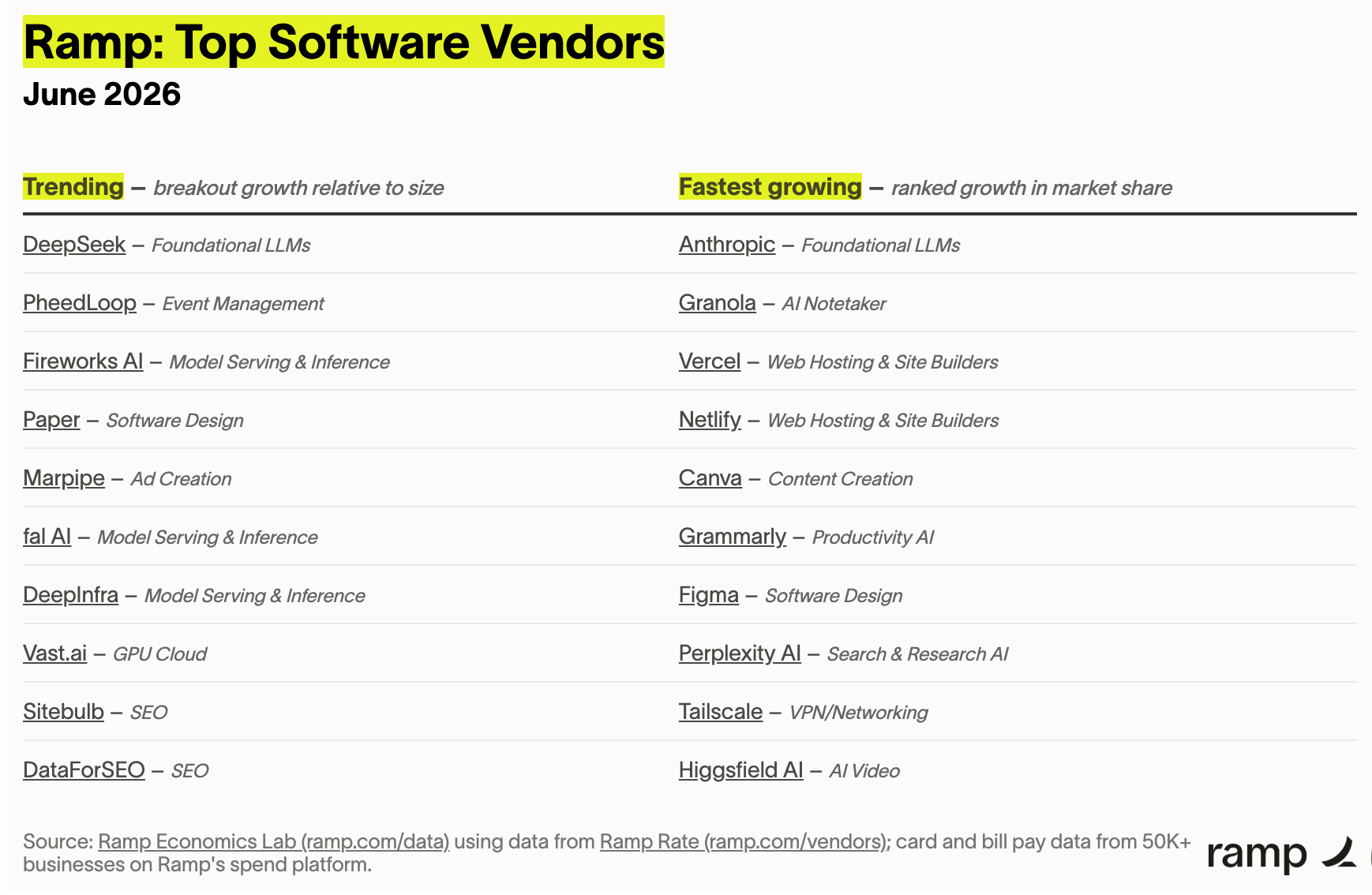
The most popular AI tool among US businesses this month did not come from San Francisco. It came from Hangzhou.
DeepSeek, the Chinese AI startup, is making a real impact and gaining commercial momentum. According to Ramp, a New York-based corporate spending platform tracking payments from more than 50,000 US businesses, DeepSeek topped its June trending vendor index, looking back to May, which measures when companies pay a software vendor for the first time.
The Cost Problem Driving the Switch
It appears Deepseek’s revenue model is shining compared with US rivals. Anthropic’s incentives are structurally misaligned with cost-conscious businesses.
The company makes more money when businesses purchase more tokens, pushing users toward expensive models even when cheaper options would suffice. Uber’s CTO announced the company had already blown through its entire 2026 AI budget.
DeepSeek recently cut its V4 Pro model price by 75%, after which benchmark firm Artificial Analysis ranked it among the world’s best on an intelligence-per-dollar basis. On legal AI benchmarks, it ranked just below GPT-5.5 and was deemed clearly viable for professional workloads.

US Data at Risk from DeepSeek
Crucially, rather than self-hosting DeepSeek’s open-source models, US firms are paying the company directly and sending real business data through its servers in China.
“In probably the biggest sign that companies are looking for cheaper alternatives to OpenAI and Anthropic, some are willing to use cheaper, Chinese models, sending US data back and forth from China-hosted servers,” said Ara Kharazian, lead economist at Ramp Economics Lab.
The IPO Problem Makes It Worse
Anthropic filed for an IPO valued at approximately $965 billion on June 1. OpenAI closed a $122 billion funding round in March at an $852 billion valuation. At those numbers, neither company can realistically compete on price with a startup that just slashed its rates by 75%.
For now, DeepSeek’s overall market share remains a fraction of its American rivals. But when enterprise AI budgets run dry, and a cheaper alternative clears professional benchmarks, the flag on the server stops mattering as much as the bill at the end of the month.
The post This Cheap Foreign AI Is Stealing US Business from OpenAI and Anthropic appeared first on BeInCrypto.


Ripple has expanded access to its RLUSD stablecoin across more than 40 blockchain networks through a new integration with cross-chain interoperability protocol Wormhole.
Summary
- Ripple has expanded RLUSD to more than 40 blockchain networks through Wormhole’s Native Token Transfers infrastructure.
- The rollout brings RLUSD to Ethereum layer-2 networks including Base, Optimism, Ink, and Unichain, as well as the XRP Ledger EVM sidechain.
- Ripple continues to grow RLUSD adoption through new institutional partnerships in Türkiye and planned integrations across XRP Ledger-based financial services.
According to Wormhole, RLUSD is now available through its Native Token Transfers (NTT) framework, allowing the stablecoin to move natively between supported blockchain ecosystems. The rollout extends RLUSD beyond its original availability on the XRP Ledger and Ethereum, bringing it to a range of networks that have adopted Wormhole’s infrastructure.
Among the newly supported chains are Ethereum layer-2 networks including Base, Ink, Optimism, and Unichain. The expansion also includes the XRP Ledger EVM sidechain, giving developers access to RLUSD through Ethereum-compatible tools while maintaining connectivity with the XRP Ledger ecosystem.
The move follows Ripple’s earlier plans to make RLUSD available on additional networks as part of its multichain strategy. Since launching in late 2024, the stablecoin has grown to more than $1.7 billion in market capitalization, making it one of the largest dollar-backed stablecoins in the market.
RLUSD expands support for payments and tokenized assets
Ripple said the Wormhole integration allows RLUSD to move across multiple blockchain environments without relying on wrapped versions of the asset. According to the company, the setup is designed to support cross-border payments, institutional on- and off-ramp services, and tokenization-related activities.
“For developers and institutions building onchain, that expands access to compliant, USD-backed liquidity across supported networks.”
The company has increasingly positioned RLUSD as infrastructure for both crypto-native and traditional financial use cases.
Recent partnerships indicate that the strategy is extending beyond blockchain networks. As crypto.news reported earlier this week, the company made the stablecoin available to institutional users in Türkiye through partnerships with BiLira, Bitexen, and Bitlo. According to Ripple, the collaborations provide Turkish institutions with access to RLUSD for payments, settlement, and other financial use cases.
Academic initiatives have also become part of the rollout. Ripple recently added Istanbul Technical University to its University Blockchain Research Initiative, a program that will support blockchain research, graduate fellowships, and academic projects using RLUSD.
XRP Ledger ecosystem gains another RLUSD use case
Alongside the Wormhole integration, RippleX highlighted the significance of RLUSD becoming available on the XRP Ledger EVM sidechain.
According to the XRPL development team, the sidechain combines compatibility with existing Ethereum development tools while remaining connected to the XRP Ledger.
RippleX said growing RLUSD adoption across smart contract networks points to increasing demand for regulated stablecoins within decentralized finance and multichain financial applications. The team added that XRP can serve alongside RLUSD in functions such as liquidity provision, settlement, collateral management, payments, and asset swaps.
Outside of the stablecoin rollout, Ripple-backed Evernorth Holdings has outlined plans to incorporate RLUSD into its proposed XRP-focused treasury business. Regulatory filings show the company intends to use RLUSD for institutional decentralized finance activities while also supporting tokenized real-world asset initiatives on the XRP Ledger.
The stablecoin’s adoption has also expanded into payments infrastructure. Ripple recently noted that Mastercard launched 24/7 settlement capabilities using RLUSD on the XRP Ledger, adding another use case as the company continues to extend the stablecoin across blockchain networks and financial services platforms.


Russia has sanctioned 17-year-old British student Alexander Browder after his crypto research helped UK officials target a ruble-backed stablecoin network accused of moving funds for Moscow’s war economy.
Summary
- Russia sanctioned 17-year-old Alexander Browder after his crypto research helped UK officials target the A7A5 stablecoin network.
- Browder’s investigation linked A7A5 to alleged sanctions evasion and financial channels connected to Russia’s war economy.
- The UK Foreign Office said A7A5 formed part of a network designed to bypass Western sanctions on Russia.
TASS, Russia’s state news agency, reported Tuesday that Browder was one of five British citizens added to Moscow’s “stop list” after Russia accused them of spreading what its Foreign Ministry called false claims about the country.
Russia targets teen researcher after A7A5 probe
Browder, the son of Kremlin critic Sir Bill Browder, spent 18 months studying A7A5, a ruble-pegged stablecoin issued by Kyrgyzstan-based Old Vector and hosted on the Tron and Ethereum blockchains. According to his Global Cryptocurrency Laundering Database website, his work appeared in a Henry Jackson Society report titled “Confronting the Illicit-Finance Hydra in Crypto Markets,” which reviewed 164 crypto laundering cases across two decades.
The teenager also advised UK ministers before Britain announced fresh sanctions on entities tied to A7A5. In comments to Metro, Browder said the Russian sanctions did not intimidate him and argued that Moscow’s response showed his work had “touched a nerve.” On X, he described himself as the first high school student sanctioned by an authoritarian government for exposing corruption.
UK says A7A5 helped bypass Western sanctions
According to a May 26 UK Foreign Office statement, A7A5 formed part of a network built to bypass Western sanctions and processed more than $90 billion in transactions last year. Foreign Secretary Yvette Cooper said Britain was targeting the “infrastructure that underpins” Russia’s war economy.
Browder’s research estimated that rogue states, including Iran and North Korea, laundered about $350 billion in illegal funds, with roughly half allegedly moving through the A7A5 network. Elliptic, a blockchain analytics firm, reported in January that A7A5 handled more than $100 billion in transactions during its first year.
Western governments expand crypto sanctions
Britain’s May 26 designations targeted 18 entities linked to the alleged network. According to the UK government, the list included a Kyrgyz bank suspected of enabling payments and a crypto exchange accused of sending more than $1.5 billion to Moscow.
At the same time, European authorities have also moved against Russia-linked crypto services. In April, the European Union introduced its 20th sanctions package and banned Russia-based crypto service providers. The EU package, also named A7A5 and another ruble-backed stablecoin, RUBx.
Reuters reported last month that Kyrgyzstan shut down 50 companies over sanctions-evasion concerns. Kyrgyzstan’s Ministry of Justice said the firms posed “high sanctions risk,” but it did not publicly name them.
Moscow adds four other Britons to the stop list
Besides Browder, TASS identified the sanctioned British citizens as Washington Post journalist Catherine Belton, CTG managing director Alice Mary Laugher, Chelsea Group founder Richard Nicolas Westbury, and The i Paper journalist Richard Holmes.
Russia’s Foreign Ministry said the list would keep expanding in response to what it called unfriendly actions by British authorities. Browder told GB News that Moscow’s move could make people more afraid to work with A7A5, although he tied that outcome to how strongly governments enforce the sanctions.


Bitcoin has seen its network use fall to its weakest level in more than seven years as selling pressure and lower on-chain activity weigh on market confidence.
Summary
- Bitcoin active addresses dropped near 2019 bear market levels, according to Bitcoin Magazine’s 60-day moving average data.
- Bitcoin network use has declined since the 2021 bull market, as ETFs reduced direct on-chain transaction demand.
- The Genius Act helped stablecoin activity expand on Ethereum, Solana, and Tron, adding pressure on Bitcoin utilization.
Bitcoin Magazine data showed that the 60-day moving average of active Bitcoin addresses stood slightly above 600,000 on June 4. The reading placed Bitcoin’s address activity near levels last seen during the 2019 bear market, according to the same data.
Bitcoin active addresses return to 2019 levels
According to Bitcoin Magazine, the decline in active addresses has continued since the end of the 2021 bull market. The data showed a steady drop in wallet activity over several years, even as Bitcoin became more accessible through regulated investment products.
Spot Bitcoin exchange-traded funds changed how many investors gain exposure to BTC. After the products received approval, some investors moved toward ETF shares instead of direct on-chain transactions, according to the report. These products offered regulated access and deeper trading liquidity, which reduced the need for some investors to move Bitcoin across the network.
At the same time, Bitcoin has faced stronger competition from other layer-one networks. Ethereum, Solana, and Tron have continued to host stablecoin payments and frequent settlement activity, while Bitcoin remains mostly used as a store-of-value asset.
The report also linked part of the decline to the Genius Act, a U.S. law signed in July 2025 that created federal rules for stablecoin issuers. After the law took effect, institutional stablecoin activity expanded across chains built for faster and cheaper payments.
According to the report, more firms have used Ethereum, Solana, and Tron for stablecoin transfers, while Bitcoin has seen less frequent transactional demand. The trend has added pressure to Bitcoin’s active-address count, which remains one of the key measures used to track network participation.
BTC price slides as sentiment weakens
Bitcoin traded near $63,950 at the time of reporting, down more than 26% since the start of the year. The decline has kept market attention on the February 2026 support area, where traders previously watched for buyer interest.
As previously reported by crypto.news, Bitcoin had rebounded from an intraday low near $61,500 after weaker-than-expected U.S. labor market data raised expectations that the Federal Reserve could still cut interest rates later in 2026.
The U.S. Department of Labor reported that initial jobless claims for the week ended May 30 rose by 13,000 to 225,000. Economists had expected 215,000 claims, while the prior week’s reading was revised higher to 212,000.
Labor data offers limited relief
Additional Labor Department figures showed final labor costs rose 1.8% in the first quarter, below economists’ estimate of 2.5%. Continuing jobless claims fell by 8,000 to 1.777 million for the week ended May 23.
Market participants often view weaker labor data as supportive for risk assets because it can give the Federal Reserve more room to lower interest rates if economic conditions soften further.
However, the report warned that Bitcoin’s network activity may remain under pressure if capital continues moving into artificial intelligence-related stocks. A recovery in active addresses could support bullish sentiment, but Bitcoin’s current on-chain data shows participation remains weak compared with previous market cycles.


Elon Musk rewrote the IPO playbook in almost every direction for SpaceX. The S&P 500 just reminded him there are rules he cannot rewrite.
S&P Dow Jones Indices confirmed Thursday it is keeping its eligibility rules entirely unchanged, effectively shutting out SpaceX from the world’s most important stock index.
To join the S&P 500, a company must be profitable in its most recent quarter and across its prior four quarters combined. SpaceX posted a net loss of $4.94 billion in 2025. The S&P was equally clear on exceptions, stating waivers “should not be granted solely based on market capitalization.”
What This Means for Passive Investors and SpaceX
Passive S&P 500 index funds control trillions in assets and would have been forced to buy SpaceX shares automatically had the rules been relaxed. Without index inclusion, that automatic institutional bid simply does not exist, at least for the next twelve months.
Nasdaq moved in the opposite direction, fast-tracking its own rules to allow SpaceX into the Nasdaq 100 shortly after listing. Index funds tracking the Nasdaq 100 will be forced to buy a sizeable portion of publicly available shares when inclusion is confirmed. This will provide a floor of institutional demand that the S&P 500 will not contribute to.
SpaceX does have a path into less prominent benchmarks. S&P confirmed that it will modify the entry rules for its broader Total Market Index and the Dow Jones US Total Stock Market Index. Moreover, FTSE Russell has already made SpaceX eligible for its global equity indexes under fast-entry rules.
The Crypto Impact
For crypto markets, the S&P exclusion adds an interesting wrinkle. SpaceX’s S-1 disclosed 18,712 Bitcoin at a cost basis of $661 million. This means that every buyer of SpaceX stock gets passive Bitcoin exposure whether they want it or not.
With the Nasdaq 100 forced buy coming and the S&P 500 bid absent, the pool of investors gaining that indirect Bitcoin exposure is smaller than it would have been under a fast-track scenario.
With SpaceX, OpenAI, and Anthropic together expected to pull in more than $240 billion by year-end, analysts warn these megacap listings may drain liquidity from tech, AI, and crypto markets and potentially mark a cyclical peak.
Art Hogan, chief market strategist at B. Riley Wealth, backed the S&P decision.
“Making exceptions because companies are so large and have been private so long yet are still not profitable didn’t make a great deal of sense,” he said.
The biggest IPO in history will begin trading next Friday, June 12. However, the index that defines Wall Street will not list it for at least a year.
The post SpaceX Will Be Worth $1.75 Trillion Next Week but the S&P 500 Won’t Be Adding It appeared first on BeInCrypto.


The chances of passing the CLARITY Act this year have narrowed as lawmakers face a crowded legislative calendar and unresolved disputes over key provisions, according to JPMorgan analysts.
Summary
- JPMorgan analysts said the window for passing the CLARITY Act is narrowing as Congress faces a packed schedule ahead of the 2026 midterm elections.
- Stablecoin reward provisions remain a major point of disagreement between banks and crypto advocates.
- Senator Cynthia Lummis said Senate action on the bill may not occur until August.
According to a report from JPMorgan analysts led by Nikolaos Panigirtzoglou, political timing is becoming one of the biggest obstacles to the crypto market structure bill. The analysts said the approach to the 2026 U.S. midterm elections is reducing the time available for Congress to advance major digital asset legislation, raising the possibility that market structure reforms could be delayed.
The CLARITY Act would establish a federal framework for regulating digital assets and divide oversight responsibilities between the Securities and Exchange Commission and the Commodity Futures Trading Commission.
Although the legislation recently advanced to the Senate calendar, several steps remain before it can become law, including Senate approval, reconciliation with House legislation, and a signature from President Donald Trump.
Adding to the uncertainty, JPMorgan said the final shape of the legislation could depend heavily on political developments over the coming months. The analysts noted that a bill negotiated before the midterm elections could look substantially different from one considered afterward, particularly if control of Congress changes.
Stablecoin provisions remain a sticking point
Alongside concerns over timing, disagreements surrounding stablecoin rules continue to weigh on the bill’s prospects.
In JPMorgan’s view, opposition from parts of the banking industry has intensified because of provisions dealing with stablecoin rewards and interest-like products. The analysts pointed to continuing debates over whether issuers should be allowed to provide returns on stablecoin balances without being subject to the same requirements that govern traditional banks.
Recent comments from banking executives have highlighted those concerns. JPMorgan Chief Executive Officer Jamie Dimon and New York Citi Bank Chairman and CFO David L. Cohen have both criticized aspects of the legislation, arguing that some provisions could create regulatory gaps.
During a CNBC interview, Dimon also criticized Coinbase Chief Executive Officer Brian Armstrong and claimed the legislation would allow crypto firms to offer products similar to bank deposits without equivalent protections. He further argued that the bill does not adequately address Anti-Money Laundering requirements or obligations under the Bank Secrecy Act.
Those claims were challenged by Senator Cynthia Lummis, chair of the Senate Banking Subcommittee on Digital Assets. Speaking to CNBC, Lummis said AML and Bank Secrecy Act requirements already apply to digital assets and are included in the legislation. She also accused Dimon of misrepresenting the legislation, saying the JPMorgan chief “either hasn’t read the bill or he wants to mislead people.”
Senate negotiations continue as August timeline emerges
While debate over stablecoins has attracted significant attention, lawmakers are still working through several other sections of the legislation.
Speaking with journalist Eleanor Terrett, Lummis said a Senate vote before the July 4 recess remains possible but suggested that action before the August recess is more likely.
According to Lummis, lawmakers must still combine provisions from the Senate Banking Committee, the Senate Agriculture Committee, ethics-related measures, and certain changes connected to the GENIUS Act before the final package is ready.
Developer protections have also become part of the negotiations. The Blockchain Regulatory Certainty Act language included within the CLARITY Act would shield developers of decentralized software from being treated as money transmitters when they do not take custody of customer funds.
Support for that provision has grown in recent weeks. Defend Developers recently launched a political action committee focused on supporting blockchain developers, decentralized finance builders, and software engineers.
Separately, the Blockchain Association said 160 former national security, intelligence, and law enforcement officials signed a letter urging Congress to move the legislation forward, describing digital asset regulation as a national security and law-enforcement priority.
Even with that support, Lummis acknowledged that securing the 60 votes needed for cloture and finalizing the legislative package could take longer than initially expected.

Bitcoin ETF Outflows Hit 13-Day Streak as $4.3 Billion Exits the Funds

Parents of Idaho Murder Victim Have 1 Unanswered Question

I asked A.I. to predict the price of XRP until 2026



-

 News Videos7 days ago
This is BROKEN! INSANE 5x MONEY CAR WASH WEEK! The NEW GTA Online UPDATE Today! (GTA5 New Update)
-

 Business3 days ago
Jade Biosciences, Inc. (JBIO) Discusses Positive Interim Results From JADE101 Phase I Healthy Volunteer Study and Development Plans Transcript
-
 Tech6 days ago
SpaceX just won a second Golden Dome contract. This one is $4.16 billion.
-

 News Videos6 days ago
SHE IS KILLING XRP!!! WATCH URGENT AND ACT FAST
-
 NewsBeat6 days ago
FIRST NIGHT REVIEW: Take That bring the Circus back to life in spectacular sun-soaked style
-

 Business6 days ago
Is the Spurs Phenom Already Better Than Prime Diesel?
-

 Sports2 days ago
French Open 2026 results: Alexander Zverev beats Rafael Jodar and will play Jakub Mensik in semi-finals
-
 Crypto World6 days ago
CFTC Has Approved the First Regulated Bitcoin Perpetual Contract in the U.S.
-

 Politics6 days ago
The House | Inside Andy Burnham’s Makerfield Campaign: “Nobody Thinks This Is In The Bag”
-
 NewsBeat6 days ago
Novak Djokovic v Joao Fonseca LIVE: French Open latest scores and results after Jannik Sinner’s shocking collapse
-

 Tech3 days ago
CryZENx Releases Fresh Playable Content Deep Inside Jabu-Jabu for His Ocarina of Time Remake
-
 Entertainment6 days ago
Weak ‘Supergirl’ Box Office Tracking Amid Milly Alcock Backlash
-

 Entertainment7 days ago
Maddox Jolie-Pitt Legally Requests to Drop Brad’s Surname
-
 Crypto World6 days ago
Snowflake (SNOW) Stock Rallies on Strong Q1 Results and AI Product Growth
-

 Business6 days ago
Demand Conditions Improve In Chemicals Sector In April 2026
-
 Entertainment6 days ago
One of the Greatest Sitcoms of All Time Shoots Up Apple TV’s Charts 11 Years Later
-

 Tech7 days ago
This Week In Security: Ubiquiti Fixes, And FreeBSD Joins The Club You Don’t Want To Join
-
 Crypto World6 days ago
MicroStrategy Moves $30 Million in BTC to Coinbase Prime: Is the Bitcoin Sell-Off Already Here?
-
 Entertainment6 days ago
Bruce Willis’ Generosity Resurfaces Amid His Dementia
-
 Crypto World3 days ago
Seagate (STX) Stock Surges to Record High on AI Boom and Legal Settlement
You must be logged in to post a comment Login