

Crypto World
OpenTrade’s $17M Round Highlights Stablecoin Yield Regulation Impact


OpenTrade, the institutional-grade platform integrating on-chain and real-world asset (RWA) backed lending with stablecoin yield products, has closed a $17 million strategic funding round to expand its yield infrastructure. The round, led by Mercury Fund and Notion Capital, underscores a concerted push to scale OpenTrade’s permissioned and permissionless yield rails and to accelerate the growth of its vault-focused offering, Curation+, the company confirmed.
CEO David Sutter said the fresh capital will fuel a broader buildout across asset management and trading teams, lift engineering capacity, and establish a dedicated customer success function to support its expanding client base. “The company also plans to expand its asset management and trading team, increase engineering capacity, and build a dedicated customer success function to support its growing client base,” Sutter told Cointelegraph.
Key takeaways
- The $17 million strategic round was led by Mercury Fund and Notion Capital, adding to OpenTrade’s total funding of about $30 million, with prior backing from a16z Crypto and other investors across earlier rounds.
- The funding will accelerate the expansion of OpenTrade’s yield infrastructure, encompassing both permissioned and permissionless pathways, and will bolster its vault-centric Curation+ service and related product suite.
- The capital infusion arrives amid heightened regulatory scrutiny of stablecoins in the United States, as lawmakers debate how yield-like incentives should be treated under the CLARITY Act. Progress toward a compromise has recently advanced, with implications for how platforms may offer interest-like rewards on stablecoin activity.
- OpenTrade’s architecture centers on tokenized vaults that allocate capital across RWAs such as fixed-income instruments and select DeFi strategies, governed by smart contracts and designed to be compatible with global regulatory standards for traditional finance and digital assets.
- Regulatory tailwinds for the broader stablecoin and digital-asset sector are cited by the company as a positive backdrop for growth, though licensing, compliance, and cross-border considerations remain central for institutional participants.
Strategic funding to scale yield infrastructure
OpenTrade positions itself as a bridge between traditional securities lending concepts and the emerging market for stablecoins backed by real-world assets. The funds will enable broader deployment of its yield infrastructure, both in permissioned environments—where institutional-grade controls and compliance are prioritized—and in permissionless contexts that expand access to liquidity and yield opportunities for a wider base of clients. Sutter emphasized that OpenTrade’s strategy is anchored in a model derived from traditional finance securities lending but adapted to stablecoins, with attention to market-specific nuances that may shape institutional eligibility and participation.
As part of the growth plan, the company intends to scale its asset management and trading capabilities, grow its engineering and product teams, and introduce a dedicated customer success function to support an increasingly diverse roster of fintechs and institutional investors. The capital infusion thus serves not only to broaden product coverage but also to deepen client servicing, risk management, and regulatory compliance processes that are critical for on-chain and cross-border activity.
The round brings OpenTrade’s funding history into clearer focus. The company reported a total of $30 million in committed capital after this raise, reflecting previous rounds that included a $7 million strategic round in June 2025 led by Mercury Fund and Notion Capital, following a $4 million seed extension in November 2024. Earlier investors — including Circle Ventures and Polygon Ventures — participated in 2023, underscoring a broad base of strategic support from traditional and crypto-native backers. OpenTrade’s co-founders, Dave Sutter and Jeff Handler, previously held roles at Centre, the governance consortium associated with the USDC stablecoin, highlighting the team’s deep ties to the stablecoin ecosystem.
Regulatory backdrop: CLARITY Act and stablecoin governance
The fundraising occurs as U.S. policymakers weigh how to regulate stablecoin rewards within a broader market-structure framework. The CLARITY Act, a proposal under discussion in Congress, seeks to clarify the regulatory boundaries for digital assets and related incentives. Recent reporting indicates progress toward a compromise between crypto and banking stakeholders, with a Senate Banking Committee vote anticipated as the deal advances. The emerging framework would allow usage-based rewards—such as cashback or discounts tied to stablecoin activity—but would prohibit yield on idle balances, a distinction that impacts how platforms structure incentive programs and balance-sheet risk.
According to Cointelegraph, the ongoing reform efforts reflect an evolving regulatory approach to stablecoins and on-chain finance. The outcome of CLARITY Act negotiations could significantly influence the design and distribution of yield-bearing products offered by platforms like OpenTrade, as well as the licensing and oversight requirements faced by institutional users, fintechs, and crypto firms operating across U.S. and international markets.
Product architecture and market positioning
OpenTrade’s product envelope centers on tokenized vaults that channel deposits into a diversified set of yield sources, with RWAs playing a primary role alongside carefully selected DeFi strategies. Each vault adheres to a defined allocation strategy and operates through smart-contract-based mechanisms that manage deposits, monitor positions, and distribute returns. This architecture allows institutions to access yield opportunities with a structure designed to meet traditional finance and digital-asset regulatory standards while offering the transparency and auditability valued by compliance teams.
“Our structure is derived from securities lending in traditional finance, but adapted to the lending of stablecoins instead of securities,” Sutter explained, noting that practical access to these offerings may vary based on jurisdiction and investor classification. The platform’s compliance-first approach aims to make cross-border participation feasible for qualified investors while maintaining robust risk controls and reporting capabilities that respond to lender, borrower, and custodian expectations.
As part of the broader strategic vision, OpenTrade’s Curation+ service is positioned to operate as a dedicated vault-focused offering, managing collateral deployment and yield generation with careful attention to risk budgeting, governance, and regulatory alignment. The combination of tokenized vaults and an integrated asset-management framework is designed to deliver scalable, auditable, and compliant yield generation for fintechs and institutional subscribers alike.
Closing perspective
OpenTrade’s $17 million funding round signals an ongoing emphasis on expanding compliant, scalable yield infrastructure at a moment when the regulatory landscape for stablecoins and on-chain finance is becoming clearer, yet still evolving. For institutions, the development highlights a path toward more robust, regulated access to real-world asset-backed yield, while keeping a close watch on licensing, cross-border compliance, and the ongoing policy negotiations shaping the future of digital assets.

Charles Schwab is targeting mid-2027 to bring spot crypto trading, transfers, and custody to the registered-investment-advisor channel that already houses $5.2 trillion of client money on its custody platform, Jalina Kerr, managing director at Schwab Advisor Services, told reporters at the firm's… Read the full story at The Defiant

Zcash (ZEC) briefly climbed above $470 this week from lows of just under $300. The token has since stabilized near $425 amid a broader market retreat.
A specific price region has now been identified that could decide whether the privacy network’s native asset continues recovering or enters another brutal decline phase.
Danger Ahead Below $360
Alphractal founder Joao Wedson said ZEC has reached a crucial point where its next price move could decide whether the token continues recovering or slips back into a deeper bear market. In his latest analysis, Wedson stated that Alphractal’s CVDD model, which is used to identify major market tops and bottoms, currently places ZEC in a very important zone.
He also highlighted the MVRV Z-Score indicator, which recently dropped close to zero after ZEC tested its Realized Price during the latest market correction. According to Wedson, that on-chain level acted as strong support and helped ZEC rebound after the sharp decline.
Even with the recovery, he stressed that bulls now need to defend the $360 level to prevent further weakness in the market. Wedson warned that if ZEC falls below $360, the privacy token could enter a much more aggressive bear market phase and face heavy capitulation pressure.
In that case, Alphractal would turn its attention back to the CVDD Channel to track possible lower support levels between $48 and $170. He added that $48 would represent the most bearish outcome and was also the level where ZEC formed its bottom in the previous market cycle.
Ironwood Upgrade
Zcash is preparing for a major network upgrade to address concerns around the token’s circulating supply. The Ironwood upgrade, which is expected in late July, will introduce a mechanism allowing node operators to independently verify ZEC supply without relying on developers.
The move comes after the discovery of a counterfeiting vulnerability in Zcash’s Orchard shielded pool. Although developers fixed the issue in June, they admitted there was no reliable way to confirm whether attackers had minted counterfeit coins before the patch.
Once activated, Ironwood will transition users from the old Orchard pool into a fresh pool.
The post Why ZEC’s Latest Rally May Depend Entirely on One Support Level appeared first on CryptoPotato.


Binance is trying to enter the Philippines market through a local partner. Regulators are making clear it won’t be simple.
The country’s central bank said neither the world’s largest crypto exchange nor its local partner, BlockShoals Technologies Inc., holds the necessary license to operate as a virtual asset service provider (VASP) in the country, BitPinas media reported.
The license, issued by Bangko Sentral ng Pilipinas, is essential to facilitate crypto payment and transaction rails and is separate from any approval granted by the country’s Securities and Exchange Commission (SEC).
CoinDesk reached out to Binance for a comment.
Binance has previously been active in the country. But in 2023, the SEC noted it was operating without a license. It ordered internet service providers and app stores to block the exchange the following year.
Last month, Binance said it is working with BlockShoals, a local fintech company that received initial SEC clearance in November under the regulator’s sandbox framework. The sandbox, called StratBox (Strategic Sandbox), is a controlled, supervised environment for fintech and crypto firms to test financial services.
According to BitPinas, the central bank has explicitly stated that participation in the sandbox doesn’t substitute for central bank licensing, and entities seeking to operate in the country must comply with both frameworks independently.
The report also says the SEC revised its language in the sandbox deal, describing Binance as a global crypto-asset service provider rather than a global VASP, a narrower designation. The revised terms also require BlockShoals to integrate its systems with a licensed domestic VASP within 90 days before any user onboarding through Binance infrastructure can begin.
Binance is back at the door. Whether it gets in, and on whose terms, remains to be seen.

Delaware lawmakers have advanced House Bill 441. This bill would ban the installation, ownership, and operation of all crypto ATMs across the state.
The bill, sponsored by Representative Cyndie Romer and Senator Spiros Mantzavinos, targets a class of machines that regulators say has become a tool for scammers.
Why Delaware Is Targeting Crypto ATMs
Federal data frames the urgency. The FBI’s Internet Crime Complaint Center recorded more than 13,400 kiosk-related complaints in 2025, with losses totaling more than $388 million. That marked a 23% rise in complaints and a 58% year-over-year increase in losses.
In Delaware alone, residents filed 181 cryptocurrency-related complaints and 255 wallet complaints last year, totaling combined losses of nearly $26.9 million. More than half of those complaints came from people over 50.
Romer argued that the machines offer little to regular crypto traders. She noted that kiosk fees can reach 20% of a transaction, compared with 0.4% to 1% on online exchanges.
“These kiosks reduce digital currency to a predatory cash grab… There is no reason to support a business structure that enables scammers to extort money from our most vulnerable populations,” she stated.
Follow us on X to get the latest news as it happens
A Widening State Crackdown
Delaware would join roughly 30 states that have passed kiosk-related legislation since 2023. Indiana and Tennessee have enacted comprehensive bans.
The regulatory pressure has reshaped the sector. Bitcoin Depot, once the largest US operator, filed for Chapter 11 bankruptcy in May and pulled its network offline, citing state bans and mounting litigation.
Missouri, meanwhile, has sued operator CoinFlip for alleged facilitation of fraud. The crackdown extends beyond US borders, with Canada proposing a national ban in its 2026 Spring Economic Update.
In Delaware, under HB 441, existing machines would go dark immediately, with full physical removal required within 90 days. Operators collecting fees from illegal transactions would face refund obligations or forfeiture to a state fund.
The bill now heads to the Senate. Whether Delaware becomes the next state to clear a full ban may hinge on the chamber’s coming session.
Subscribe to our YouTube channel to watch leaders and journalists provide expert insights
The post Delaware Lawmakers Advance Bill To Ban All Cryptocurrency Kiosks Statewide appeared first on BeInCrypto.


BlackRock is close to launching a bitcoin fund that pays an income.
The world’s largest asset manager filed its fourth amendment for the iShares Bitcoin Premium Income ETF on Tuesday, according to its SEC filing. The fund will trade on Nasdaq under the ticker BITA.
The income comes from options. The fund holds bitcoin and shares of IBIT, BlackRock’s $47 billion spot bitcoin ETF. Each month it sells call options on those IBIT shares.
A call option gives the buyer the right to purchase the shares at a set price. The fund collects a fee, called a premium, for selling that right. That premium is the income it hands to investors.
As such, selling calls caps how much the fund gains if bitcoin rallies hard. Investors take steady income in exchange for giving up part of a big move. The fund plans to write calls on 25% to 35% of its value at a time.
The fee is the edge, however. BlackRock set the sponsor’s fee at 0.65%, which sits below the two largest covered-call bitcoin funds, YBTC and BTCI, which charge 0.95% and 0.99%, Bloomberg analyst Eric Balchunas said in a post on X.
BlackRock just filed a new (and probably final) amendment for their Bitcoin Premium Income ETF $BITA and WE HAVE A FEE: 65bps. Obv higher than $IBIT et al but lower than the two biggest ETFs in ‘covered call’ category which are 95bp and 99bp. My guess is this is going to launch… pic.twitter.com/KBwFrmkdbJ
— Eric Balchunas (@EricBalchunas) June 10, 2026
Balchunas added he expects the fund to launch very soon, noting BlackRock is under pressure to beat Goldman Sachs to market, with Goldman’s own bitcoin fund due to go live around July 1.
BlackRock already has the strongest distribution base in the spot bitcoin ETF market. Its iShares Bitcoin Trust, IBIT, has become the flagship product of the sector, regularly drawing the largest inflows and often absorbing capital even when rival funds see redemptions.
IBIT and Fidelity’s FBTC have increasingly turned the U.S. spot bitcoin ETF market into a two-firm race, with smaller issuers often contributing little to daily flows.
The launch would be another step in turning bitcoin into an income product for mainstream investors. The filing shows the fund is already seeded and has started buying bitcoin and IBIT shares – a sign it is close to being ready.

Bitcoin (BTC) has held above $62,000 on Thursday after a modest 2.3% surge in the last 24 hours. Amid increased investor anxiety, a new analysis suggests that Bitcoin may be moving closer to a potential bottom.
According to the latest CryptoQuant Weekly Report, the asset is currently trading a little over 15% above its Realized Price of $53,600, a level that, in previous market cycles, has often been associated with the formation of major market bottoms.
Mixed Signals
However, current demand conditions remain weak across the market. For instance, “Total Bitcoin,” measured by combining speculative perpetual futures trading and apparent spot buying, declined by around 652,000 BTC over the past week, the largest weekly contraction since January 2022.
At the same time, ETF demand growth has fallen to its lowest level on record, which essentially means that institutional buying, a major driver in the current cycle, is slowing down.
Market cycle analyst Benjamin Cowen has also pointed out that major bottoms are typically confirmed only after key indicators cross and not beforehand, meaning the process can take time. This is in line with CryptoQuant’s view that Bitcoin may be entering a value zone, but a confirmed bottom has not yet formed.
There is still limited panic selling in the market, as on-chain data also shows that realized losses remain well below levels seen in earlier capitulation phases.
However, not all analysts agree that Bitcoin is approaching a bottom, with some expecting further downside ahead. Doctor Profit, for one, recently said that Bitcoin has entered Stage 5 of his six-stage bear market model, which he describes as a period of strong emotional pressure in the market. He warned that thinking the worst is already over is a mistake seen in past cycles, where traders became optimistic too early before another major fall.
According to the analyst, Bitcoin could still fall to the $40,000 to $48,000 range. He called this range the “Confirmed BlackRock Bottom,” while linking it to the price level where BlackRock launched its spot Bitcoin ETF in early 2024.
Capital Outflows
Separate blockchain metrics also point to continued weakness. Another analyst, Axel Adler Jr., flagged ongoing signs of capital outflows and loss realization in the Bitcoin network. He found that Bitcoin’s Realized Cap 30D Change has dropped to -1.1%. The outflows have reached this level for the first time since mid-March.
He noted that Realized Cap has fallen by about $12 billion from its mid-May peak of $1.087 trillion to $1.075 trillion, and the pace of decline has accelerated in recent days. During the same period, Bitcoin also saw a sharp price drop, while adjusted SOPR has remained below 1.0 for 13 consecutive days, which indicates continued selling at a loss and no clear recovery in on-chain profitability.
The post Major Bitcoin Demand Drop Sparks Debate Over Cycle Bottom Formation appeared first on CryptoPotato.
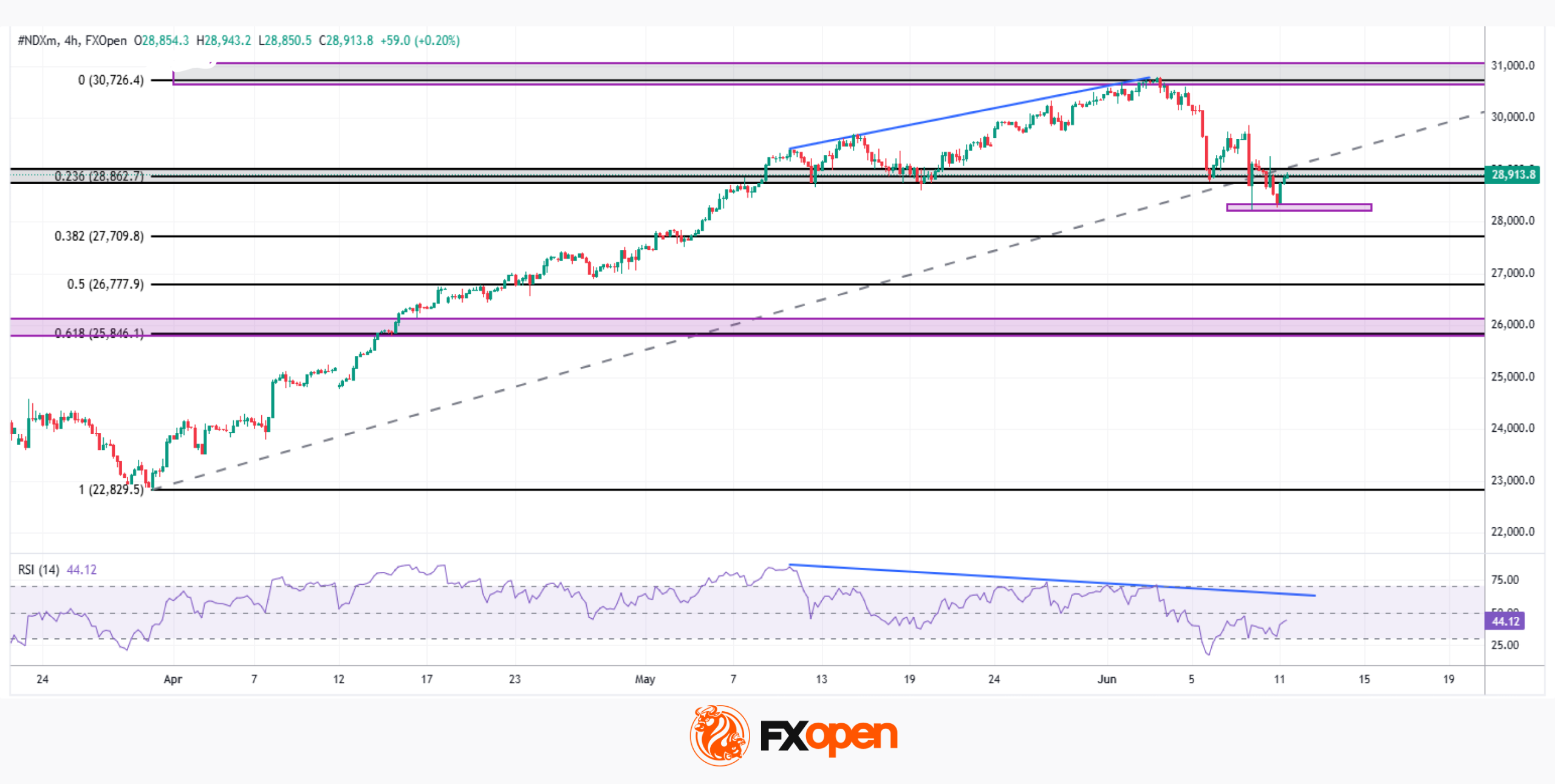
As the chart shows, the Nasdaq 100 (US Tech 100 Mini on FXOpen) is down more than 6% from its recent highs, with Friday, 6 June, standing out as the defining session: a single-day loss of approximately 4.74% marked the worst daily performance of 2026.
The S&P 500 (US SPX 500 Mini on FXOpen) declined around 4% from its highs, while the Dow Jones (Wall Street 30 Mini on FXOpen) posted a more contained loss of approximately 3%. Investors and traders are now asking the same question: Is this the beginning of a deeper correction, or simply an isolated bout of volatility?
Why Did US Markets Sell Off?
The sell-off was driven by a combination of geopolitical, macroeconomic, and technical factors. On the geopolitical front, US/Israel–Iran negotiations have shown signs of escalation in recent days, injecting uncertainty into already fragile risk sentiment.
The primary catalyst, however, was Friday’s Non-Farm Payrolls report, which showed 172,000 jobs added compared with forecasts of just 85,000. The stronger-than-expected reading sent the US dollar sharply higher, putting pressure on all inversely correlated assets, including equity indices, gold, silver, forex pairs, and cryptocurrencies.
Adding further headwinds, Wednesday’s CPI print showed inflation holding at 4.2% (Core CPI: 2.9%), potentially pushing the Fed, now under new Chair Warsh, to keep rates on hold for longer.
Technical Analysis of the Nasdaq 100
The chart presents two contrasting scenarios.
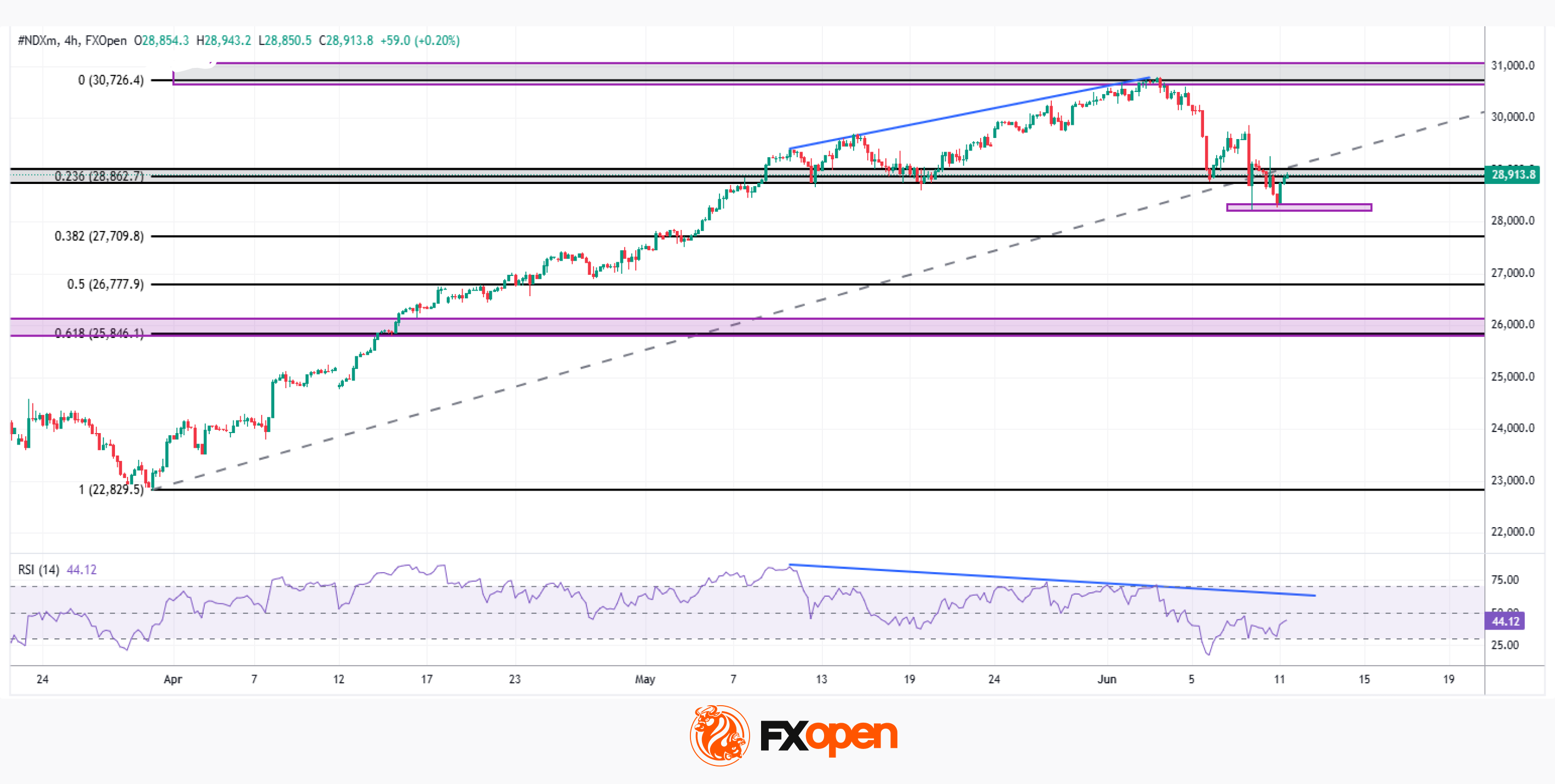
On the bullish side, the price defended the 28,200–28,300 support zone twice, triggering a rebound toward the 28,800–29,000 region, a key former support level now acting as resistance. A clean break above this level could suggest the broader uptrend remains intact, while a rejection might initiate a sequence of lower highs and lower lows.
On the bearish side, a confirmed break below the lows of 9 and 11 June could potentially expose the 25,800–26,000 zone — where a key former resistance and the 0.618 Fibonacci retracement of the late-March rally converge. An RSI divergence on the 4H time-frame, already visible before the sell-off, appears to be playing out in support of this scenario.
With dollar strength, sticky inflation, and geopolitical risk all weighing on sentiment, these levels could prove decisive in the sessions ahead.
Trade global index CFDs with zero commission and tight spreads (additional fees may apply). Open your FXOpen account now or learn more about trading index CFDs with FXOpen.
This article represents the opinion of the Companies operating under the FXOpen brand only. It is not to be construed as an offer, solicitation, or recommendation with respect to products and services provided by the Companies operating under the FXOpen brand, nor is it to be considered financial advice.

Dogecoin could be primed for a major reversal, at least according to the metric that recently predicted its price crash to a 14-month low.
Meanwhile, analysts seem confident that DOGE’s current price range is a “good accumulation zone,” something that whales have taken advantage of lately.
DOGE to Rebound Soon?
The leading meme coin rode the mid-May push wave quite impressively, going from $0.092 to a multi-week peak at almost $0.12 at the time. However, the subsequent market-wide correction and overall weakness led to massive price declines.
One of the indicators that suggested a more notable DOGE drop was the Tom DeMark (TD) Sequential. It flashed a major sell signal for the OG meme coin in early May on the 3-day chart, and although it took some time, the asset indeed dumped hard, going from $0.113 to under $0.08, which became its lowest price tag in over a year.
Now, this same indicator, which is used to determine the underlying asset’s market exhaustion in either direction, has flipped bullish, according to Ali Martinez. The analyst predicted that after the 30% correction, a “rebound could be around the corner” for DOGE.
Meanwhile, fellow analyst MikybullCrypto outlined a similar perspective, indicating that the meme coin currently sits on a “good level for accumulation.” As reported yesterday, Dogecoin whales have started purchasing at these lower levels, accumulating over 200 million tokens in a week.
Some Reaction?
Another popular crypto commentator, Daan Crypto Trades, also weighed in on DOGE’s recent price moves, suggesting that the token typically retraces to the $0.06-$0.08 range in bear markets. History shows, though, that it tends to get “some kind of reaction” once it gets there.
This same level was tested in February, and it held, but he added that “it’s still good to watch.” Daan noted that DOGE has fallen out of investors’ radar lately, but that doesn’t mean that it cannot repeat some of its previous historic rallies, many of which began from the current levels.
$DOGE Not one that many people are trading or looking at, but I do always like to watch high timeframe sweeps/supports on majors like these.
DOGE does tend to move back to this $0.06-$0.08 zone during its bear markets and usually gets some kind of reaction.
Obviously this level… pic.twitter.com/NE9TCJPTm2
— Daan Crypto Trades (@DaanCrypto) June 10, 2026
The post The Indicator That Called DOGE’s Collapse Just Flashed a Rare Buy Signal: Analyst appeared first on CryptoPotato.

The country’s parliament is poised to pass legislation that would bring cryptocurrencies under the same regulatory framework as stocks.
The bill passed the lower house of Parliament today and is expected to take effect next year after going through the upper house.
The proposal could classify cryptocurrencies as financial instruments, subjecting assets such as Bitcoin and Ethereum to stricter trading rules while potentially lowering the tax burden for investors.
It’s important to note that Japan’s government had already approved a bill that granted crypto status of financial instruments, marking an attempt to bring digital assets closer to securities for oversight purposes.
Lower Taxes and ETF Hopes Take Center Stage
One of the most closely watched parts of this particular legislative reform is taxation. Crypto gains in Japan have historically been taxed as miscellaneous income, with rates that can climb as high as 55%. Under the proposed framework, gains could be taxed closer to 20%, which is the rate applied to stocks.
That change would make the local crypto market much more attractive to retail and institutional investors, especially compared to the current system, which industry participants have long criticized as a bit too restrictive.
The move could also open the door for new regulated products, such as spot crypto exchange-traded funds. Bloomberg reported that the bill may help pave the way for ETFs, which give investors a fully regulated way to gain exposure to cryptocurrencies like Bitcoin without having to hold them directly.
Commenting on the matter was Masato Yoshizawa, a representative for the Financial Services Agency, who said:
“We aim to foster more innovation by creating a sound trading environment. We’re not necessarily giving crypto a stamp of approval, but we’re aiming for healthy market growth.”
Japan Also Pushes for More Oversight
But the proposed legislation is not only focused on growth. By bringing cryptocurrencies under the rules that regulate stocks, Japan is also preparing stricter guardrails for trading activity. This means more control over insider trading, stronger disclosure requirements, and more restrictions altogether.
Naturally, this would align crypto much more closely with Japan’s existing financial market structure, where investor protection and market transparency are central in legislation.
That said, the next step is whether the upper house passes the bill and how regulations define all the details before the expected implementation next year.
The post Japan to Regulate Crypto Like Stocks, Could Pave Way for ETFs appeared first on CryptoPotato.
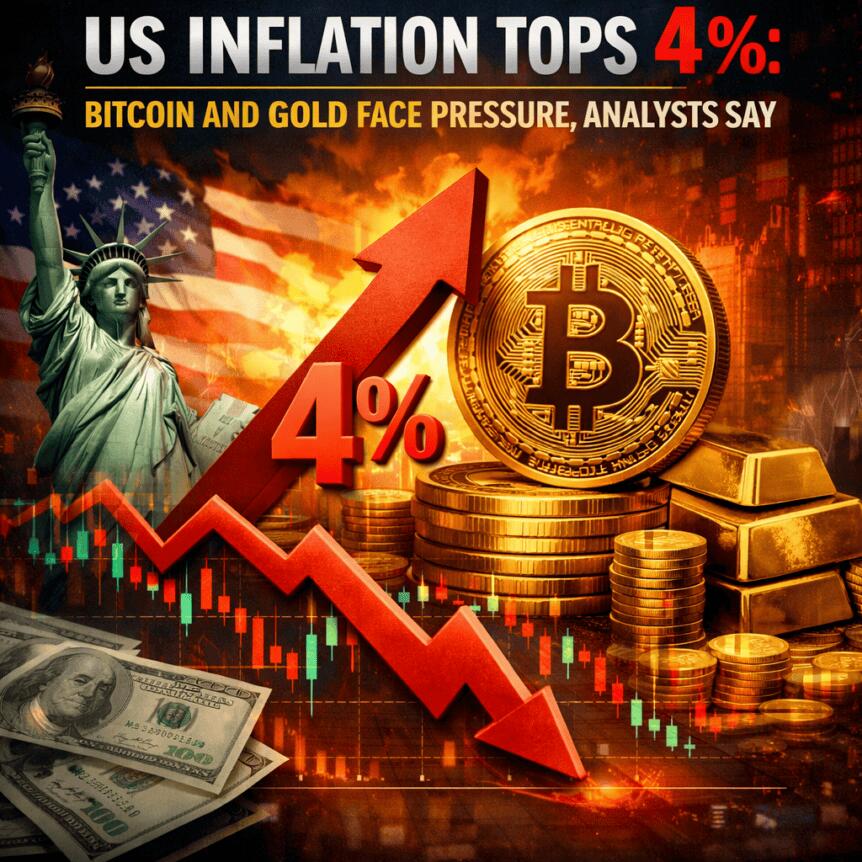
The May read on inflation cooled expectations for rapid monetary easing, as the U.S. consumer price index rose 4.2% year over year. The print reinforced a data-dependent stance from the Federal Reserve and tempered hopes for near-term rate cuts, even as some analysts still anticipate further rate hikes later in the year. The result added headwinds for risk assets, including Bitcoin and gold, while crude oil extended a rebound that has persisted through the year.
Bitcoin has endured a rough start to the year, sliding about 36% since January. Gold has fared no better, retreating roughly 23% from its January peak. In contrast, crude benchmarks have surged, with oil up more than 50% over the same span. The broad inflation backdrop thus remains a litmus test for capital allocation across risk assets and hedges alike.
“Today’s in-line CPI print keeps the Fed cautious, data-dependent, and in no rush to cut,” said Iggy Ioppe, chief investment officer at Theo, reflecting a common view among market participants that policymakers will await clearer signs of easing before altering the policy path. “For Bitcoin, an in-line print is unlikely to be a clean catalyst either way. It keeps liquidity expectations capped and risk assets trading more on positioning than on a fresh dovish impulse.”
Regarding gold, Ioppe noted that real yields remain a central driver. “Without imminent rate cuts, the opportunity cost of holding a non-yielding asset stays elevated,” he said, underscoring why the precious metal has struggled as inflation data points oscillate between hot and not-so-hot readings.
Key takeaways
- The May CPI rose 4.2% year over year, reinforcing a data-dependent Fed stance and delaying expectations for near-term rate reductions.
- Bitcoin has fallen about 36% since January, while gold has declined roughly 23% from its January peak; oil has gained more than 50% in the same period, highlighting divergent macro reactions across assets.
- Institutional appetite for Bitcoin remains cautious. Markus Thielen of 10x Research says the macro setup isn’t yet supportive enough to trigger meaningful reallocations into Bitcoin by Wall Street players.
- Geopolitical and supply concerns—particularly around oil—add an extra layer of uncertainty that could influence inflation expectations and asset mix in the months ahead.
- Market odds on near-term rate moves reflect a wait-and-see approach: CME’s FedWatch tool pointed to a high likelihood—about 98%—of no change at the Fed’s upcoming meeting, underscoring how the inflation path governs risk appetite.
Policy backdrop and the road ahead
On the policy front, inflation dynamics continue to dictate the Federal Reserve’s posture. The latest CPI data align with a narrative of persistent price pressures that require careful monitoring before policymakers consider easing financial conditions. The debate among investors centers on whether inflation will meaningfully slow soon enough to justify rate cuts this year, or whether the data remains too fractious to permit a shift toward looser policy.
As traders parse these signals, the market environment remains fragile. The lack of a decisive shift in policy expectations suggests liquidity conditions may stay constrained for now, especially for assets that do not deliver yields. Tim Sun, a senior researcher at HashKey Group, captured the sentiment: “Only when inflation drops, rate cuts become viable, and liquidity improves alongside lower capital costs, will the overall risk appetite truly reverse.”
In practical terms, this macro tension translates into ongoing caution for digital-asset portfolios. Bitcoin, often viewed as a risk-on proxy in liquidity cycles, is susceptible to declines when macro catalysts loom large or when institutional demand remains tepid. The same backdrop has weighed on gold, despite its traditional role as a hedge, as real yields and the relative attractiveness of yield-bearing assets compete for capital.
Institutional stance and geopolitical risk
In the corporate and financial services sphere, the appetite for Bitcoin appears muted for the moment. Markus Thielen of 10x Research argued that the data released so far do not present a compelling case for a broad reallocation into Bitcoin by big investors. “We do not believe this data is sufficiently encouraging to prompt Wall Street investors to meaningfully reallocate into Bitcoin,” Thielen told Cointelegraph. He highlighted two key frictions: inflation’s persistence as a drag on risk sentiment, and geopolitical tensions—specifically Iran-related developments—that could compound supply-side volatility in oil markets and feed inflation expectations.
Thielen also warned that oil-supply disruptions could become more pronounced during the summer, potentially uplifting inflation expectations and complicating any near-term shift toward higher risk-taking in crypto and other speculative assets. In such an environment, the case for Bitcoin as a hedge or asymmetric bet remains nuanced, with outcomes highly dependent on the trajectory of inflation and the pace of liquidity normalization.
On the rate-front, the market is already looking past the immediate horizon. HashKey’s Sun emphasized that while rate hike expectations were heating up, the probability of a policy move this year remains relatively low unless inflation convincingly converges toward the Fed’s target. The market’s current pricing—reflected in Fed futures—suggests traders see little chance of an immediate policy shift, reinforcing a wait-and-see stance for both traditional and crypto markets.
What to watch next
Looking ahead, two threads are particularly consequential for markets and crypto builders alike. First, the inflation path remains the arbiter of policy and liquidity: sustained deceleration would tilt the balance toward rate cuts and a broader risk-on rally. Second, geopolitical tensions and commodity-market dynamics could reintroduce volatility by injecting uncertainty into inflation expectations and the pace of capital cost reductions.
Investors and developers should monitor upcoming inflation releases and any shifts in the Fed’s communications. Attention will also turn to global oil supply news and potential geopolitical flare-ups, which can ripple across equities, bonds, and crypto markets alike. As the data flush continues, the balance between inflation normalization and policy accommodation will likely shape how Bitcoin, gold, and other risk assets perform in the near term.
For a clearer read on the inflation trajectory, traders often turn to data trackers such as Trading Economics, which notes the CPI’s movement as part of a broader inflation picture, and to policy trackers like the Fed Funds futures market. CME’s FedWatch tool remains a widely cited barometer of policy expectations, currently signaling a minimal near-term likelihood of rate changes absent a sharper shift in inflation trends.
4 Warning Signs of A Financial Disaster

Oil falls as traders digest escalation in US-Iran strikes

Schwab Targets Mid-2027 Crypto Spot Trading and Custody for the $5.2T Advisor Channel

HarrisX Poll Found 52% of Registered Voters Support the CLARITY Act

BloFin War of Whales 2026 Grand Prix opens registration for $5M trading championship

Blockchain.com files with SEC for U.S. IPO

Late night Btc trade #crypto #bitcoin #cryptocurrency #bitcointrading #trading #tradesetup

She Came Here To Fight Me | Financial Audit

Breaking News Inflation Rises Faster! #shorts #money #finance #breakingnews #economy #inflation
-

 Fashion6 days ago
Weekend Open Thread: Evereve – Corporette.com
-
 Crypto World6 days ago
Jensen Huang Approves Samsung, SK Hynix, and Micron for NVIDIA (NVDA) HBM4 Memory Supply
-
 Entertainment4 days ago
The Best Mystery Series of All Time Is Surging on Streaming 30 Years After It Ended
-

 Crypto World3 days ago
Anatomy of the June crypto crash: Fed, Iran, Saylor
-

 NewsBeat3 days ago
Alexander Zverev wins the French Open to finally earn a 1st Grand Slam title
-

 Tech5 days ago
Suspicious Polyfill login prompts pop up on Toshiba, Muji websites
-
 Crypto World5 days ago
Senator Cynthia Lummis Calls CLARITY Act the Most Consequential Financial Legislation of This Generation
-

 Tech4 days ago
Microsoft unveils seven homegrown AI models in new bid for ‘long term self-sufficiency’
-

 Tech6 days ago
Microsoft launches MXC, an OS-level sandbox for AI agents, with OpenAI and Nvidia already on board
-

 Business6 days ago
(VIDEO) Justin Bieber Delivers Surprise Happy Birthday Serenade to Diners at Los Angeles Mexican Restaurant
-
 Business4 days ago
The Pain Points Taking a Fragile Tech Rally Down a Notch
-
 Crypto World3 days ago
Eli Lilly (LLY) Stock Surges 4% Following Breakthrough Sleep Apnea Trial Results
-

 Business3 days ago
High Stakes for Wembanyama as New York Pushes for 3-0 Lead
-

 Tech5 days ago
Von der Leyen’s AI envoy pick draws conflict-of-interest fire
-
Crypto World6 days ago
LBank Surpasses 25 Million Users Worldwide as AFA Partnership Continues to Drive Global Growth
-

 Tech5 days ago
Hackers now exploit SolarWinds Serv-U flaw to crash servers
-

 Tech6 days ago
Meta steals a tactic from Tesla and builds data centers in tents
-

 Crypto World4 days ago
Trump’s AI Ownership Plan Could Benefit Anthropic at OpenAI’s Expense
-
 Sports2 days ago
Bangladesh beat Australia after 20 years in ODIs, register only their second win over six-time world champions | Cricket News
-
 NewsBeat4 days ago
Alexander Zverev conquers demons and outlasts Flavio Cobolli to win French Open for first major title
You must be logged in to post a comment Login