

Crypto World
Peter Schiff rejects Bitcoin real estate strategy from Grant Cardone



Peter Schiff has pushed back against Grant Cardone’s plan to combine real estate income with Bitcoin accumulation, arguing that the structure does not solve a real problem for property investors.
Summary
- Peter Schiff said real estate does not need Bitcoin because rental income can cover costs.
- Grant Cardone uses multifamily rental income to buy Bitcoin inside dedicated investment vehicles for investors.
- Cardone Capital bought 282 BTC recently, adding to a broader real estate-backed treasury strategy plan.
The gold advocate made the comments after Cardone promoted a fund model that pairs income-producing properties with BTC holdings.
“Combining real estate with Bitcoin solves nothing,” Schiff wrote on X.
He said Cardone’s argument rests on the idea that REITs need Bitcoin on their balance sheets so they can sell it later to pay for repairs and maintenance. Schiff rejected that view and said rental income already covers those ongoing costs.
Cardone fund pairs property income with BTC
Cardone Capital has been building a strategy that uses rental cash flow from multifamily properties to buy Bitcoin over time. The firm recently launched the $87.5 million 10X Space Coast Bitcoin Fund, which holds real estate and Bitcoin through a dedicated investment structure.
Cardone has argued that the model gives traditional investors exposure to Bitcoin without asking them to buy the asset directly. He has also said many investors in his Bitcoin-linked real estate funds did not previously hold crypto, making the structure a bridge between property investing and digital assets.
Meanwhile, the disagreement centers on whether Bitcoin adds value to a real estate model that already creates steady rental income. Cardone has criticized traditional real estate investment trusts because they must distribute at least 90% of taxable income to shareholders. In his view, that structure limits their ability to hold Bitcoin as a reserve asset.
Schiff disagrees with the reserve argument. He said property companies can use rental income for repairs, upkeep and maintenance instead of adding a volatile asset to the balance sheet. He also offered to debate Cardone on the topic, showing that the dispute has moved beyond a simple social media reply.
Broader Bitcoin treasury push continues
Cardone Capital has continued buying Bitcoin during market weakness. As previously reported by crypto.news, the firm bought another 282 BTC worth about $18 million as Bitcoin traded near $62,000. The purchase added to a position built through rental income from selected multifamily properties.
Moreover, as earlier reported, Cardone Capital held about 1,000 BTC after a $10 million purchase in January. The firm has targeted 3,000 BTC by the end of 2026 and 10,000 BTC over the longer term across multiple investment vehicles.
Real estate and Bitcoin remain a split topic
The debate reflects a broader split over Bitcoin treasury strategies. Supporters say Bitcoin can serve as a long-term reserve asset and may improve returns if property income funds steady purchases through market cycles.
Critics say the model adds price risk to an asset class that already has its own cash flow, debt, insurance and maintenance needs. For them, Bitcoin does not make real estate more efficient. It simply adds a new source of volatility.

Crypto World
TradFi fund manager Baillie Gifford introduces Solana, Ethereum tokenized fund with BNY


Baillie Gifford, a 118-year-old investment firm based in the Scottish capital of Edinburgh, unveiled a fixed-income tokenized fund in association with global custody giant BNY, the companies said on Monday.
Baillie Gifford Enhanced Yield Fund (BAGEY) is denominated in dollars, and gives eligible investors access to an actively managed, short-duration portfolio of public corporate bonds using the Ethereum and Solana public blockchains, according to a press release.
The fund is operated through a U.K.-regulated Open-Ended Investment Company (OEIC), a type of collective investment fund structured as a limited liability company that spreads capital from multiple investors across equities or bonds.
The fund, which currently offers a yield of around 7%, will be available to eligible investors in the U.K., Switzerland and Cayman Islands, subject to applicable laws, regulations and distribution restrictions.
Tokenization of real-world assets (RWAs) has taken the traditional finance world by storm, but merely wrapping legacy infrastructure in a digital layer will not fundamentally improve finance, said Theo Golden, head of digital assets and tokenization at Baillie Gifford.


- Solana (SOL) is stuck between $72 support and $76 resistance.
- Solana’s price action shows a tight range with possible short-term rejection risk.
- $90 remains the key breakout level for a stronger bullish move.
Solana has moved back above the $74 level after a period of sideways trading, putting the asset close to a key technical zone that traders have been watching for several days.
The latest gains come after a gradual recovery from the lower $70 range, where price repeatedly found support before pushing higher.
Is this a correction within a larger bearish trend?
Recent price action shows Solana compressing inside a well-defined range between $62.08 and $76.00.
This range has become the main battleground for buyers and sellers, with repeated reactions near both ends.
On the lower side, support has been consistently observed around $69.50 and $62.08, where buying interest has prevented deeper declines.
On the upper side, resistance is clustered between $76.00 and $83.00, a zone that has rejected multiple upward attempts in recent sessions.

Some short-term technical analysis, however, suggests that the current upward move may still be part of a broader corrective phase within a larger bearish structure.
Market analysis highlights the possibility of a short squeeze toward the $76 region, followed by a rejection if bulls fail to maintain momentum above resistance.
If price is rejected from this zone, downside pressure could return quickly, with initial support at $69.50, followed by the lower boundary near $62.08.
The $76–$90 range is now the key decision area
While short-term resistance sits near $76, higher timeframe analysis places a more important threshold at the $90 level.
This zone has been highlighted as a structural breakout point that could determine whether Solana transitions into a stronger upward trend or remains in consolidation.
A move above $90 could open room toward the $100 to $114 range, which has been identified as the next liquidity zone on higher timeframes.
However, failure to break this level would likely keep price action trapped in a broader corrective environment.
At the same time, one technical interpretation suggests that the current movement is still part of a countertrend rally within a wider bearish cycle in the crypto market.
Under this scenario, upward moves into resistance zones are viewed as temporary expansions designed to capture liquidity before potential reversals.
This conflict between breakout potential and bearish continuation has created a split in analyst expectations.
The $90 level now acts as the line between the continuation of the recovery and renewed consolidation.
Morgan Stanley’s Solana ETF adds a layer of optimism
Beyond technical levels, institutional developments are also shaping sentiment around Solana.
Morgan Stanley has reportedly advanced filings for proposed spot Solana and Ethereum exchange-traded funds (ETFs, with a proposed management fee of 0.14%, which would place them among the lowest-cost crypto ETF proposals currently under consideration.
The structure of these proposed products includes staking mechanisms, in which a large portion of staking rewards would be returned to investors after operational costs are covered.
Although these ETFs are not yet approved, the filings signal increasing institutional interest in structured Solana exposure through regulated financial instruments.


MoneyGram said Monday it has become a validator on the Solana (SOL) blockchain, the latest step in the remittance firm’s ongoing push into crypto infrastructure as it builds payment services around stablecoins.
By operating a validator, MoneyGram will help process transactions and secure Solana’s proof-of-stake network, becoming a key part of the infrastructure that keeps the network running.
The company also joined Solana Developer Platform, an initiative aimed at helping institutions build financial products on the blockchain.
The move comes weeks after MoneyGram unveiled its MGUSD stablecoin on the Stellar blockchain, a sign of the company’s growing commitment to blockchain-based payments infrastructure. After spending several years integrating crypto into remittances and settlement, MoneyGram is now taking a more active role in the networks that support those services.
“MoneyGram has spent the past several years integrating blockchain into our payment infrastructure, and everything we are building now leverages this foundation,” CEO Anthony Soohoo said in a statement. “We believe the future of global money movement will be built on open, interoperable stablecoin rails that anyone, anywhere can access.”

TLDR
- Strive acquired 759 Bitcoin for approximately $50 million between June 15 and June 21.
- The company paid an average price of $65,850 per BTC for the latest purchase.
- Strive’s total Bitcoin holdings increased to about 19,000 BTC.
- The Bitcoin treasury is valued at more than $1.2 billion at current market prices.
- The purchase price was roughly 11% lower than Strive’s May acquisition cost.
Strive expanded its Bitcoin treasury after purchasing 759 BTC for about $50 million. The company disclosed the transaction in a June 22, 2026, filing, and the purchase increased its total holdings to nearly 19,000 BTC. Those holdings now carry a value exceeding $1.2 billion based on current market prices.
Strive Adds More Bitcoin at a Lower Average Cost
The company acquired 759 BTC between June 15 and June 21, 2026. According to the filing, Strive paid an average price of $65,850 per Bitcoin. As a result, the purchase cost was approximately $50 million.
The latest acquisition came at a lower price than Strive’s previous major Bitcoin purchase. In May 2026, the company bought more than 2,500 BTC for $185.2 million. That transaction carried an average purchase price of $74,092 per coin.
The difference in acquisition prices reflects changing market conditions during the quarter. While the company paid less per coin in June, it continued increasing its Bitcoin position. Consequently, Strive maintained its ongoing treasury accumulation strategy.
Since January 2026, the company has added more than 3,700 BTC to its balance sheet. That figure includes Bitcoin obtained through the Semler Scientific acquisition. It also includes coins acquired through direct market purchases.
Bitcoin Treasury Growth Reaches 19,000 BTC
The latest purchase lifted Strive’s Bitcoin reserves to approximately 19,000 BTC. Therefore, the company remains among the largest public corporate Bitcoin holders. The treasury has grown steadily throughout 2026 through several acquisitions.
Strive has funded part of its Bitcoin strategy through SATA perpetual preferred stock. The company describes the instrument as non-dilutive because it does not require issuing common shares. This structure allows the firm to raise capital while preserving existing shareholder ownership levels.
The company recently increased the dividend rate on SATA preferred stock to 13%. Strive has continued using the instrument to support treasury expansion. At the same time, the company has avoided common equity issuance for these purchases.
Corporate Bitcoin accumulation remains a central part of Strive’s capital allocation strategy. The company has repeatedly used structured financing tools to acquire additional Bitcoin. The June filing confirmed that the latest purchase added 759 BTC to the balance sheet.
The filing also confirmed the transaction period and average acquisition price. Strive reported that it purchased the Bitcoin between June 15 and June 21. The company paid an average of $65,850 per coin during that period.

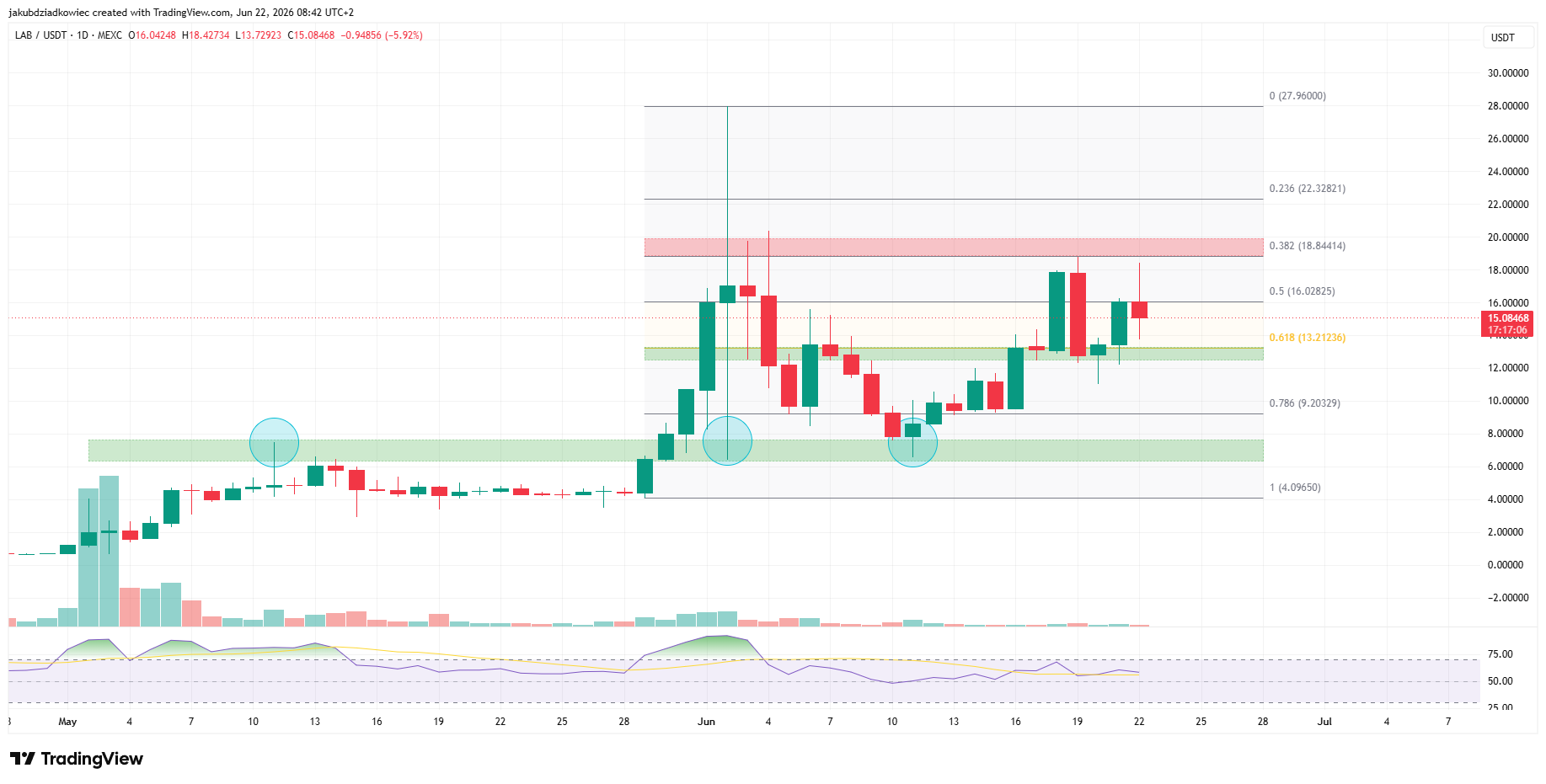
Three altcoins enter the fourth week of June 2026 with bullish-to-neutral chart setups. All 3 altcoins to watch are ranked among last week’s biggest gainers.
Each token now sits near a pivotal Fibonacci or channel level. Their daily charts show how momentum, volume, and support could shape the next directional move.
LAB Defends the 0.618 Fibonacci Level Near $13
LAB (LAB) trades around $14.97, up about 1.7% on the day, with a market cap near $4.7 billion. The token has printed higher highs and higher lows since early May.
Price recently retested resistance at the 0.382 Fibonacci level near $19. It also confirmed support at the 0.618 Fibonacci level near $13. Earlier, the former $7 resistance flipped to support twice (blue circles), in early June and again on June 11.

The move follows a violent crash that wiped billions from its value in early June. The RSI now reads near 60 and rises slowly, yet it has not entered bullish territory. A daily close above $19 would open room toward higher Fibonacci bands.
Uniswap (UNI) Bounces at the 0.382 Fibonacci Near $3
Uniswap (UNI) changes hands around $3.01, up roughly 0.6% on the day. The token gained almost 16% over the past week, one of the strongest moves in the large-cap group.
The daily chart attempts a bounce and tries to confirm the 0.382 Fibonacci level near $3 as support. If that level holds, resistance sits at the 0.5 Fibonacci near $3.30 and the 0.618 Fibonacci near $3.50.

Volume spiked sharply in mid-June (blue ellipse), which signaled renewed momentum. However, the June 17 candle carried strong selling pressure.
The RSI tried to reach bullish territory, got rejected, and now reads a neutral 53. A recent $100 target from Standard Chartered for 2030 has kept attention on the token.
Stellar (XLM) Tests $0.20 Support After Channel Breakout
Stellar (XLM) trades around $0.21, down about 0.8% over 24 hours, yet still up close to 12% on the week. For most of 2026, XLM moved inside a horizontal channel.
The upper band rejected price four times before the breakout (red arrows). The token finally broke out on May 28 with a sharp volume spike, then reclaimed its long-term channel structure. Volume has since declined, which points to a compression phase.

The former channel resistance flipped to support between June 10 and June 15 (blue circle). Price then turned higher toward resistance near $0.23. It now tries to hold $0.20 as support and extend the upturn. The RSI reads a neutral 54.
Centrifuge brought real-world assets to Stellar on June 20, adding a fresh catalyst.
Altcoins to Watch for Week Ahead
All three altcoins share a similar message. Momentum has improved, yet none of the RSI readings confirm a strong trend.
LAB looks the most extended after its sharp rebound, UNI the most reactive around its Fibonacci pivot, and XLM the most structurally clean after the channel breakout.
Holding their respective support levels could decide whether the rallies continue or stall into the new week. Traders may also watch broader market conditions, since altcoin moves often track Bitcoin closely during fast trend shifts.
The post 3 Altcoins to Watch in the Fourth Week of June 2026 appeared first on BeInCrypto.

Key Takeaways
- JPMorgan boosted its WDC price target to $650 from $530, keeping an Overweight rating on improved HDD pricing trends
- Wells Fargo increased its target to $575 from $500, also maintaining an Overweight rating
- Fiscal Q3 2026 results showed 45% year-over-year revenue expansion, with sequential growth of 11%
- The company projects Q4 fiscal 2026 revenue of $3.65 billion, representing 9.4% quarter-over-quarter growth
- WDC shares have climbed 333% year-to-date, currently trading near $746.93
Western Digital (WDC) is delivering the kind of performance that turns heads across Wall Street. With shares climbing 333% year-to-date and hovering around $746.93, the storage giant has emerged as one of the most compelling beneficiaries of AI infrastructure expansion — even as Sandisk (SNDK) captures attention with its staggering 820% rally.
Western Digital Corporation, WDC
Major financial institutions are responding with upgraded expectations. On June 12, JPMorgan elevated its price target for WDC to $650 from $530, maintaining its Overweight recommendation. The investment bank cited improved earnings projections for hard disk drive manufacturers, pointing to strengthening pricing power and expanding profit margins.
According to JPMorgan, year-over-year pricing momentum across the HDD sector is expected to accelerate in upcoming quarters, with sequential price improvements staying within the low- to mid-single digit range. These incremental gains compound into significant margin expansion.
Wells Fargo followed suit, raising its price objective to $575 from $500 on June 1, while confirming its Overweight stance on the stock.
Financial Performance Validates Bullish Sentiment
The wave of analyst optimism isn’t unfounded speculation — Western Digital‘s recent financial results provide solid justification. The company delivered 45% year-over-year revenue growth during fiscal Q3 2026. Quarter-over-quarter, revenue expanded by 11%, a growth rate typically associated with companies riding major technology shifts.
Looking ahead to Q4 fiscal 2026, management has guided for $3.65 billion in revenue, implying 9.4% sequential expansion. This kind of consistent growth trajectory tends to attract long-term institutional capital.
CEO Irving Tan articulated the fundamental driver in the Q3 earnings release: “Virtually every AI workload, from training, inference, agentic AI to physical AI, creates data that is stored persistently and cost-efficiently on HDDs.”
This statement captures Western Digital’s strategic positioning. As AI applications multiply, data generation accelerates exponentially. That data requires storage infrastructure. Western Digital manufactures the high-capacity drives that provide it.
AI Infrastructure Buildout Fuels HDD Demand
Cloud hyperscalers continue deploying AI accelerators at unprecedented scale, and those computing resources generate massive data volumes requiring persistent storage. Western Digital’s enterprise HDD portfolio addresses precisely this need.
Grand View Research projects a 30.6% compound annual growth rate for the storage market through 2033. Currently, 809 data centers are in various planning and construction phases globally. Each facility will require extensive storage capacity.
Western Digital shares reached a 52-week peak of $799.87, with current levels around $746.93. The company’s market capitalization now stands at $257 billion.
Micron Technology recently achieved a $1 trillion valuation milestone, while Sandisk maintains its remarkable upward trajectory. Western Digital, with its 333% year-to-date appreciation, ranks among the top-performing stocks across the entire market this year.
Crypto World
OKX and NYSE partner to bridge Tradfi and crypto markets in joint venture led by Andrew Cuomo


Former New York Governor Andrew Cuomo is leading an OKX and New York Stock Exchange owner Intercontinental Exchange (ICE) joint venture to build infrastructure to bridge traditional and digital financial markets.
“The ICE-OKX joint venture is a step towards building the infrastructure that will define how global markets operate in the decades ahead,” said Trabue Bland, senior vice president at ICE in a statement Monday morning.
Subject to regulatory approvals, the OKX and ICE project is expected to operate as a registered broker-dealer and a futures commission merchant, the statement noted.
The goal of the joint venture is to enable OKX’s 120 million users in the U.S. and overseas to access ICE futures and NYSE tokenized equities markets. It will also explore adjacent opportunities for the regulatory-compliant blockchain-enabled market, it added.
Cuomo, who served as New York’s 56th governor, New York State Attorney General, and Secretary of Housing and Urban Development, began working with OKX in 2023.

South Korea’s Financial Intelligence Unit (FIU) has pressed for tighter global reporting standards for cryptocurrency transfers, urging a broader application of the FATF “Travel Rule” to reduce gaps in cross-border anti-money laundering (AML) controls. The push reflects concerns that current implementation leaves smaller transactions and counterparties outside meaningful compliance coverage.
During a FATF plenary session in Paris last week, the FIU proposed expanding the Travel Rule obligations to smaller crypto transfers and called for more comprehensive coverage across both originating and receiving crypto asset service providers (CASPs). The FIU also highlighted the continuing policy divergence that can enable regulatory arbitrage, while FATF approved additional work related to decentralized finance (DeFi) risk.
Key takeaways
- South Korea’s FIU urged expanding FATF Travel Rule requirements to cover smaller crypto transfers, not only large-value movements.
- The FIU recommended that Travel Rule obligations apply to both originating and receiving CASPs to reduce cross-border compliance gaps.
- FIU officials called for tougher scrutiny of offshore and unregistered crypto platforms, citing increased misuse in illicit finance cases.
- FATF approved a DeFi-focused report, while South Korea’s FIU warned that jurisdictional licensing and supervision differences continue to drive regulatory arbitrage.
Expanding the Travel Rule: from thresholds to broader coverage
The FIU’s proposal focuses on the practical operation of the FATF Travel Rule, an AML standard intended to improve traceability for crypto transfers by requiring exchanges and other CASPs to transmit relevant sender and recipient information when transfers exceed defined thresholds. According to FIU materials, the goal is to ensure that the compliance perimeter is not limited to large transactions that may be more likely to be detected under existing frameworks.
South Korea already applies Travel Rule obligations to crypto transfers above 1 million won (approximately $650). The FIU’s latest recommendation seeks to extend those requirements downward, which would likely increase the number of transfers subject to information-sharing expectations and create additional operational and compliance burdens for regulated firms.
For institutional compliance programs, this matters because threshold-based controls can create exploitable boundaries. Reducing the value cutoffs can change how monitoring systems are configured, what data fields are required, and how firms document and evidence compliance during audits and supervisory reviews.
Closing cross-border gaps: originating and receiving CASPs
Beyond lowering transaction thresholds, the FIU argued that Travel Rule requirements should cover both sides of a transfer. Specifically, it called for obligations to apply to originating and receiving CASPs, reflecting an emphasis on end-to-end information flows rather than fragmented compliance limited to only one entity in a transaction chain.
The FIU’s position is aligned with a broader policy objective: AML regimes are only as effective as the continuity of controls between jurisdictions. If receiving CASPs do not have compatible obligations—or if counterparties in different regulatory environments are not required to provide or obtain the same information—then traceability can be lost even when rules exist at the point of origin.
The FIU also tied its recommendations to the broader problem of cross-border regulatory fragmentation. It warned that differences in licensing structures, supervisory approaches, and offshore oversight can produce inconsistent enforcement outcomes—an environment in which regulatory arbitrage becomes a systemic risk rather than an edge case.
Enforcement emphasis: unregistered platforms and offshore activity
In addition to tightening data-sharing expectations, the FIU called for stronger action against offshore and unregistered crypto platforms. The FIU linked this to what it characterized as heightened misuse in illicit finance cases, as well as the risk that criminals can shift activity to venues with weaker oversight.
For regulated market participants, this direction suggests greater compliance attention not only to transaction monitoring but also to counterparty risk management. Institutional firms typically implement controls to assess whether counterparties are properly licensed or subject to effective supervision, and proposals like this can raise the expectation that those controls remain robust even when counterparties are operating abroad.
From a compliance and legal perspective, stronger action against unregistered platforms can also increase pressure on regulated entities to demonstrate due diligence regarding onboarding, ongoing monitoring, and contractual safeguards. It may affect how firms interpret “compliance reach” when interacting with cross-border service providers whose regulatory status or supervision quality is uncertain.
FATF also advances work on DeFi risk and implementation unevenness
Alongside the Travel Rule discussion, FATF approved a new report examining risks associated with decentralized finance (DeFi), according to FIU reporting. FIU Commissioner Lee Hyung Ju welcomed adoption of the DeFi-related work but emphasized that much of the regulatory arbitrage seen across jurisdictions stems from structural differences—particularly the divergence in licensing, supervision, and offshore oversight.
The Travel Rule debate also comes against the backdrop of FATF’s broader assessment of implementation. The FIU referenced FATF’s update indicating that compliance with parts of Recommendation 15 remains inconsistent globally, even years after FATF extended its AML framework to cover crypto assets and CASPs.
According to a FATF-targeted update cited by the FIU for April 2025, 49% of jurisdictions were assessed as only partially compliant with requirements for CASPs, 21% were rated non-compliant, and roughly 29% were rated largely compliant or compliant. The unevenness is significant because global standards depend on coordinated implementation to be effective in practice—especially for cross-border activity where regulated and less-regulated actors may interact.
This gap also matters for supervised entities operating in multiple markets. When compliance expectations differ across jurisdictions, firms may face higher compliance costs and greater legal uncertainty in determining which standard applies to particular counterparties and transaction pathways.
Policy context: seven years after FATF expanded the framework
The FIU’s proposals are part of ongoing discussions on implementing FATF Recommendation 15, the international standard updated in 2019 to bring AML measures to crypto assets and CASPs. Seven years on, FATF has continued to refine its understanding of how the Travel Rule should be applied operationally and what gaps remain in implementation.
For South Korea’s regulated sector, the FIU’s stance indicates a move toward closer alignment with stronger, more expansive interpretations of the Travel Rule. Since South Korea already implements Travel Rule controls for transfers above a defined threshold, expanding coverage to smaller transfers would represent an escalation in the scope of information-sharing obligations.
However, the policy question that remains open is how jurisdictions will calibrate thresholds and practical implementation requirements without creating disproportionate operational friction. Differences in data availability, transaction routing mechanics, and system interoperability can influence whether the compliance intent of the Travel Rule translates into consistent implementation at scale.
Closing perspective
With FATF’s continued work on Travel Rule implementation and DeFi risk, regulators are signaling that AML expectations for digital-asset activity will likely tighten over time—particularly around information-sharing coverage and supervision of cross-border counterparties. For compliance leaders and legal teams, the next developments to monitor include how FATF operational guidance evolves and whether South Korea and other jurisdictions move toward lower thresholds and broader CASP-to-CASP obligations.

The Bank of England (BoE) has released a policy statement and draft rule framework for “systemic” pound-backed stablecoins, setting out how regulated issuers would operate under a proposed UK-wide regime. The publication is a significant step toward a dedicated stability-and-payments approach, reflecting policymakers’ view that certain stablecoins could materially affect the UK financial system through widespread use in payments.
In the BoE’s framework, systemic stablecoins are those broadly used for payments and therefore capable of generating risks to financial stability. Responsibility for classifying whether a given token falls within this category is assigned to HM Treasury, aligning the model with the UK’s broader approach to regulating activities deemed systemic or prudential in nature.
Key takeaways
- The BoE proposes a reserve structure for systemic pound-backed stablecoins, allowing up to 70% of reserves in interest-bearing government debt.
- A prior proposal’s reserve/holding restrictions have been replaced by a temporary issuance cap of £40 billion.
- The BoE aims to finalize its rulebook by end-2026, with a planned 2027 rollout.
- Only tokens designated systemic would fall under the BoE-led regime; non-systemic stablecoins would remain under the Financial Conduct Authority (FCA) for relevant activities.
- The BoE links the regime’s “guardrails” to ongoing assessment of how stablecoin arrangements may affect the provision of credit.
BoE’s systemic stablecoin rules: reserves, issuance limits, and timing
Under the BoE’s policy statement, systemic stablecoin issuers would be permitted to back reserves with a substantial allocation of interest-bearing government debt. Specifically, the limit has been set at 70%, increased from an earlier 60% proposal. The central bank also indicated that a key constraint on supply will take the form of a temporary issuance cap rather than individual or category-level holding limits.
Concretely, the BoE has proposed replacing prior holding-limit ideas with a £40 billion temporary cap on issuance. The BoE described this “guardrail” as something that would be reviewed regularly and removed once authorities determine that credit-provision risks have been adequately addressed.
The BoE’s documents also signal an implementation path designed to reach operational clarity for regulated participants before any rollout. The central bank’s stated objective is to conclude its rulebook by the end of 2026, ahead of a planned 2027 system.
Why the change matters: credit provision and payment-market structure
A central policy concern driving stablecoin regulation in the UK has been the potential for large-scale shifts of funds away from traditional banking channels. If stablecoins become a widely used alternative settlement mechanism, regulators may worry about deposit outflows and the resulting impact on credit availability for households and businesses.
In this context, the BoE’s shift away from earlier holding limits is framed as an attempt to balance financial stability goals with practical usability. In previous consultations, the BoE argued that restrictions were needed to reduce the likelihood of outsized transfers that could weaken the banking system’s role in funding the real economy.
However, feedback received during the earlier consultation raised concerns about feasibility and competitiveness. Respondents warned that tight restrictions could limit user adoption and complicate issuers’ operational and compliance models—particularly if UK-issued stablecoins faced disadvantages compared with dollar-backed alternatives.
By moving to an issuance cap and updating reserve permissions, the BoE appears to be trying to preserve a macroprudential control point (overall system size through issuance limits) while allowing normal retail and business usage without imposing user-by-user constraints.
From the 2025 consultation to the updated guardrails
The framework represents a measurable departure from the BoE’s November 2025 consultation proposal. At that time, the BoE suggested caps tied to user holdings: £20,000 per individual and £10 million per business per stablecoin. The rationale was to prevent rapid and large-scale relocation of deposits out of the banking system—an outcome that could ultimately reduce credit provision.
Industry respondents to that earlier consultation cautioned that such limits could undermine stablecoins’ utility for everyday payments and impose constraints that could deter growth. They also highlighted potential operational burdens for issuers trying to manage compliance at scale in response to changing user behavior.
In Monday’s policy statement, the BoE characterized the updated approach as intended to achieve the same underlying objective—guarding against credit-provision risks—while allowing households and businesses to use systemic stablecoins without the previously proposed restrictions. The net effect for compliance teams is a shift in the compliance focus from granular user limits toward system-level parameters such as reserve composition and issuance ceilings.
Regulatory boundaries: HM Treasury classification and FCA coverage for non-systemic tokens
The BoE’s systemic framework would apply only to stablecoins that meet the systemic designation. HM Treasury, rather than the BoE, is described as responsible for deciding whether a particular stablecoin enters the systemic regime.
For market participants, the operational consequence is that compliance obligations may diverge sharply depending on systemic status. The BoE-led regime is targeted at systemic stablecoins with payment relevance and potential financial stability implications. Meanwhile, stablecoins that are not categorized as systemic—particularly those used primarily for crypto trading—would remain within the FCA’s regulatory supervision for the relevant conduct and regulatory perimeter.
This division matters because it determines which regulator sets the prudential-style expectations around reserves, issuance, and systemic risk controls, and which regulator governs other aspects of market behavior. It also introduces cross-regulatory coordination considerations for firms seeking to serve both systemic and non-systemic use cases.
Separately, the BoE’s updated direction follows earlier signals from officials. In May, Deputy Governor Sarah Breeden stated that the BoE was reconsidering proposed holding limits and reserve requirements in response to feedback from digital asset companies. Those stakeholders argued that strict restrictions could hamper adoption and leave UK-issued stablecoins less competitive relative to dollar-backed alternatives.
Closing perspective: implementation, review triggers, and open questions
The BoE’s draft rules and policy statement mark a move from consultation concepts to a more structured stablecoin regime tied to systemic risk controls, with the issuance cap and reserve limits acting as the principal levers. As the rulebook is finalized by end-2026, market participants and compliance functions will likely focus on how systemic designation will be determined in practice by HM Treasury, what the review process will look like for removing the issuance guardrail, and how obligations will be coordinated across the BoE and FCA as firms operationalize the split between systemic and non-systemic stablecoins.

The rough market conditions and the global uncertainty have failed to faze the Tom Lee-chaired Ethereum buying machine, as Bitmine has spent approximately $90 million to acquire 52,203 ETH over the past week.
Lee remains highly bullish on the industry, despite the repeated rejections at key price levels and the fact that Bitmine is still billions of dollars in the red on its ETH position.
Closer to 5%
With the latest acquisition, Bitmine’s total ETH holdings have grown to 4.7% of the asset’s entire supply. Thus, the company is 94% of the way toward its 5% goal within less than a year since it began its Ethereum acquisition spree. It remains at the forefront of ETH accumulation.
The press release from this week informed that the firm’s total holdings consist of $10.7 billion across crypto assets, cash, marketable securities, and strategic investments in Eightco and Beast Industries.
“The best years for crypto remain ahead, in our view. Tokenization and the rapid progress in AI are expected to drive exponential demand growth for blockchain and decentralized crypto,” said Lee, Chairman of Bitmine.
He doubled down on his previous assertion that the current market environment, albeit quite sluggish and bearish at times, is in the early stages of “crypto spring.”
Staking Going Well
Although Bitmine continues to be deep in the red on its entire ETH position, it has managed to increase its annualized revenues due to staking. As of yesterday, the firm has staked 4,718,677 ETH (valued at over $8.2 billion at today’s prices), which has increased its annualized staking revenue to a projected $223 million.
“Bitmine has staked more ETH than other entities in the world. At scale (when Bitmine’s ETH is fully staked by MAVAN and its staking partners), the projected ETH staking reward is $268 million on an annualized basis (using 2.73% 7-day BMNR yield),” added Lee.
Aside from being the undisputed leader in Ethereum corporate holdings, Bitmine is the second-largest crypto accumulator after Michael Saylor’s Strategy. The latter announced another bitcoin acquisition today, albeit a more modest one for just 520 BTC.
The post Bitmine Buys 52K ETH as Tom Lee Believes the Best Years for Crypto Are Still Ahead appeared first on CryptoPotato.

Airbus U145 Turns a Proven Helicopter Into a Pilotless Cargo Machine

My First 2 Lessons About Money

Gabby Logan left speechless as BBC co-host corrects her over World Cup claim


![Finance Case Study Example | SaaS Startup Financial Model [Template Included]](https://wordupnews.com/wp-content/uploads/2026/06/1782137607_maxresdefault-80x80.jpg)

-

 Fashion3 days ago
Weekend Open Thread: Miami – Corporette.com
-
 Tech6 days ago
The Adder At The Heart Of Intel’s 8087 FPU
-

 Entertainment2 days ago
Renter of Home in Anne Heche Crash Denies Settlement With Son
-

 Business2 days ago
Soccer-U.S. defends Iran World Cup travel restrictions, says discussions ongoing
-
 Business2 days ago
Wall Street Week Ahead: Investors see Micron earnings as pulse check of AI rally momentum
-

 Politics4 days ago
BBC Reporter Discusses Cross Party Criticism Of Trumps Iran Deal
-

 Crypto World2 days ago
HIVE shares jump as $220M AI deal speeds Bitcoin mining pivot
-

 Crypto World2 days ago
Jake Chervinsky accuses CME of protecting derivatives monopoly
-

 Sports4 days ago
FIFA World Cup 2026: Canada beat 9-men Qatar 6-0 to register first ever win | FIFA World Cup 2026
-
 Crypto World2 days ago
Can Charles Hoskinson Really Rescue Cardano?
-

 Business2 days ago
MHP SE 2026 Q1 – Results – Earnings Call Presentation (OTCMKTS:MHPSY) 2026-06-20
-

 Business4 days ago
Brexit cost 6% of UK economy, Bank of England company data suggests
-

 Crypto World4 days ago
Anthropic’s Dario Amodei Urged AI Unity at G7, Even as US Banned His Models
-

 Tech2 hours ago
Microsoft accidentally kills epic Outlook email threads
-

 Crypto World7 days ago
Robinhood opens AI-powered trading to all users, sending HOOD stock past $100
-

 Tech5 days ago
Weeks Of In-The-Field Testing And A Verdict
-

 Politics2 days ago
Andy Burnham and the meaning of Makerfield
-

 Tech4 days ago
Adobe adds its AI assistant to Premiere, Illustrator and InDesign
-
 Crypto World4 days ago
Iren (IREN) Stock Surges on Jefferies Buy Rating: AI Infrastructure Play Gains Momentum
-

 News Videos4 days ago
IMPACT ON BITCOIN IF NO GOLD IS FOUND IN FORT KNOX
You must be logged in to post a comment Login