

Crypto World
Petition Against South Korea’s 22% Crypto Tax Hits 50K Threshold

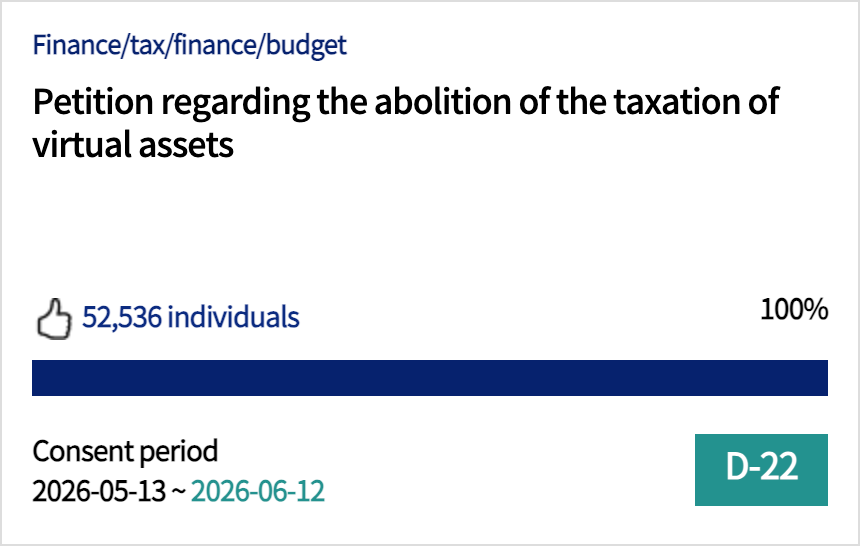
A petition to scrap a 22% tax on crypto investment gains in South Korea reached the 50,000-signature threshold required for the country’s Finance and Economic Planning Committee to review objections to the new tax regime.
The 22% tax, set to take effect in January 2027, imposes financial and reporting “burdens” on investors, while also limiting upward mobility for younger individuals, who are locked out of housing markets due to skyrocketing real estate prices, according to the petition.
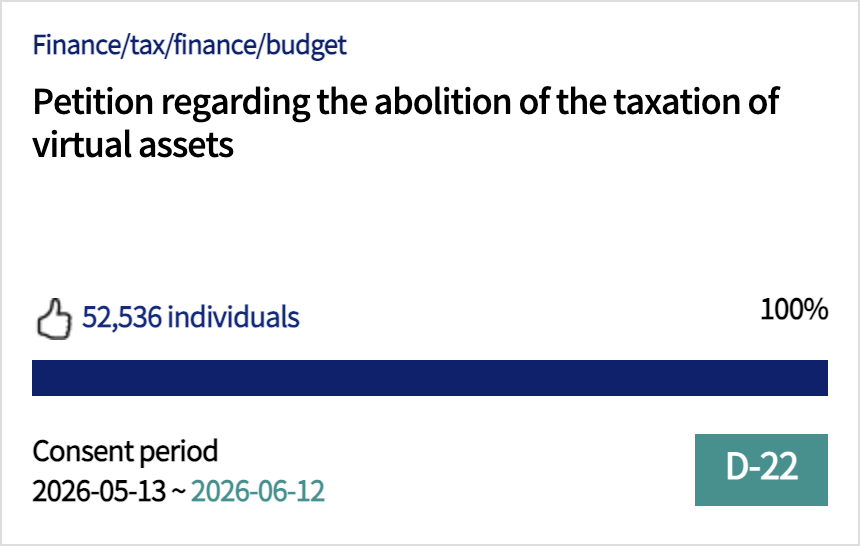
The petition now has more than 52,000 signatures. Source: South Korea Assembly
The petition also said that taxing crypto gains at 22%, while giving other asset classes preferential tax treatment, undermines South Korea’s share of the crypto market. In a translated statement, the authors of the petition wrote:
“If taxation is enforced in order to secure short-term tax revenues, it is likely to lead to greater losses in the long term, namely, a contraction of industry and an outflow of capital and talent abroad.”
South Korea is a key crypto hub in the Asia-Pacific region, and in March 2025, about 32% of the country’s population owned cryptocurrencies, according to local news agency Yonhap. However, ownership has declined so far this year as crypto prices remain under pressure.
Related: South Korea plans July rules for tokenized securities
South Korea’s crypto market contracts as tighter controls are proposed
The total value of crypto held by South Koreans declined from about 121.8 trillion won ($83.3 billion) in January 2025 to about 60.6 trillion won ($41.4 billion) in February 2026, according to industry data.
Daily trading volumes on the five largest crypto exchanges in the country, which include Upbit, Bithumb, Coinone, Korbit and Gopax, also fell from $11.6 billion in December 2024 to just $3 billion in February.
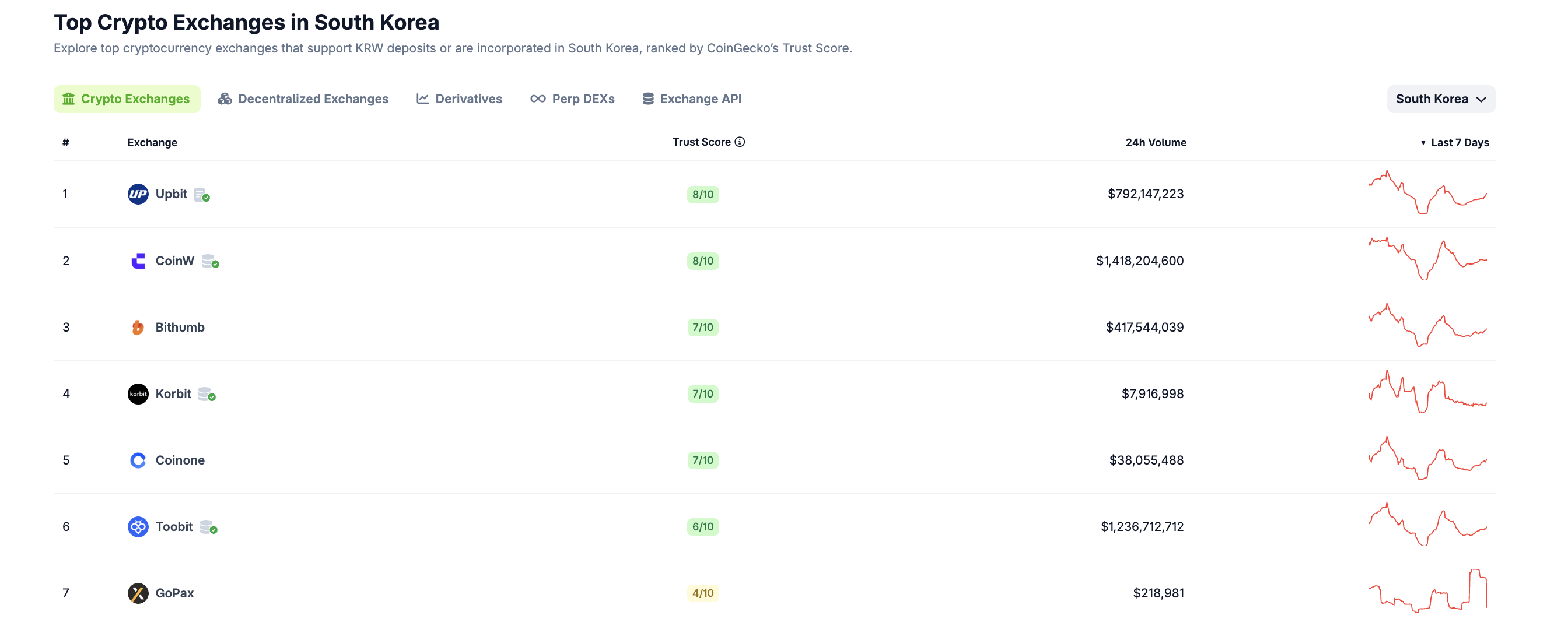
Daily trading volume for South Korea’s largest crypto exchanges. Source: CoinGecko
Tighter Anti-Money Laundering (AML) regulations and Know Your Customer controls in South Korea are also driving investors away from the sector, critics of the policies say.
In March, South Korea’s Financial Services Commission (FSC) and the Financial Intelligence Unit (FIU) proposed that all crypto transactions above 10 million won ($6,630) sent to or from foreign crypto wallets should be automatically flagged as suspicious.
Crypto industry advocacy organizations in the country have pushed back against the new rules, arguing that the reporting requirements would create an operational burden for exchanges.
Magazine: South Korea gets rich from crypto… North Korea gets weapons

Optimism across global financial markets increased after US President Donald Trump announced that planned American strikes on Iran had been canceled.
New data shared by Santiment revealed that discussions on social media about peace talks, ceasefires, agreements, and conflict resolution climbed to their highest level this month following reports that negotiators are nearing a deal.
Iran Ceasefire Optimism
The proposed agreement is said to include an extension of the ceasefire, the reopening of the Strait of Hormuz, and the restart of diplomatic discussions. Santiment said the development triggered a strong reaction in traditional markets within an hour of the news emerging.
Stocks moved sharply higher, while gold and silver also gained as traders adjusted positions in response to expectations of a more stable geopolitical environment and a better economic outlook.
Crypto markets, however, showed a weaker immediate response compared to traditional assets. Bitcoin was back above $63,000, pushing its weekly gains to a modest 1.7%. But the analytics firm believes that if confidence in a finalized deal continues increasing, crypto markets may still have room to recover as traders react to easing geopolitical uncertainty in 2026.
Separately, online interest in crypto has also picked up. Alphractal reported that Google searches related to crypto have started increasing again in June, which indicated renewed interest from retail investors. The platform said more people are searching for different crypto assets as they reconnect with the market and explained that spikes in Google Trends often appear during periods of strong fear or excitement.
Traders Stay Cautious
Other analysts believe the market still needs stronger confirmation. MN Fund founder Michaël van de Poppe said Bitcoin remains largely unchanged, with no confirmed breakout above the crucial $64,000 to $65,000 range. According to him, reclaiming that level is necessary for momentum to return across crypto markets.
He added that a major move immediately after the market open appears unlikely, partly because of the SpaceX IPO taking place today. However, van de Poppe said that if lower timeframes continue holding higher lows and tensions in the Middle East are resolved, the market could see a strong green week ahead in addition to improving liquidity flows into crypto assets.
The post Crypto Could Still Catch Up After Iran De-Escalation Sparks Global Market Rally: Data appeared first on CryptoPotato.


Metaplanet has agreed to acquire Japanese securities firm Siiibo Securities for JPY 2.1 billion, adding a licensed brokerage platform that it plans to use for Bitcoin-linked investment products and yield-focused offerings.
Summary
- Metaplanet will acquire Siiibo Securities for JPY 2.1 billion and rename the firm Metaplanet Securities after the deal closes.
- The acquisition gives Metaplanet a licensed securities platform to distribute Bitcoin linked investment products and yield focused offerings in Japan.
- Backed by its 40,177 BTC treasury, Metaplanet said the transaction is the first major step in its Project Nova financial ecosystem strategy.
According to a June 12 announcement from Metaplanet, the Tokyo-listed company has signed a share transfer agreement to purchase all outstanding shares of Siiibo Securities and convert the firm into a wholly owned subsidiary. The transaction is expected to close on July 13, after which Siiibo Securities will be renamed Metaplanet Securities.
The deal gives Metaplanet direct control of a Type I Financial Instruments Business Operator, a license category that allows the structuring and distribution of securities products in Japan. Company documents describe the acquisition as the first major merger and acquisition transaction under Project Nova, Metaplanet’s long-term plan to build a Bitcoin-focused financial services ecosystem.
As part of that strategy, Metaplanet said it intends to develop and distribute Bitcoin-related financial products to Japanese investors by combining Siiibo’s securities infrastructure with the company’s Bitcoin treasury business.
Company records show Metaplanet held 40,177 BTC as of May 31, 2026, making it Japan’s largest corporate Bitcoin holder and the third-largest corporate holder globally. The company valued those holdings at a net asset value of JPY 457.6 billion.
Metaplanet expands beyond Bitcoin accumulation
While Metaplanet has become widely known for building one of the world’s largest corporate Bitcoin treasuries, the acquisition signals an effort to generate financial products tied to those holdings rather than focusing solely on balance-sheet accumulation.
Under the transaction, Metaplanet will gain access to Siiibo’s online corporate bond platform and existing investor network. Siiibo has supported more than 40 companies and over 100 bond issuances, primarily through private placement corporate bonds and venture debt financing.
Company materials state that the securities firm possesses both the regulatory licenses required to distribute financial products and an established base of retail and corporate investors. Metaplanet said those capabilities will allow it to introduce new income-oriented products, including BTC-linked bonds and other Bitcoin-related investment instruments.
“The acquisition of Siiibo Securities is Metaplanet’s first major M&A transaction and a significant step toward realizing Project Nova,” said Simon Gerovich, Representative Executive Officer, President and CEO of Metaplanet.
“We view Bitcoin not merely as a treasury reserve asset, but as the foundation of the next generation of financial ecosystems,” he added.
Management said future initiatives could include Bitcoin-linked debt products, digital securities offerings, security tokens and financial products built around Bitcoin-related assets.
“Japanese households hold roughly $7.4 trillion in cash, deposits and low-yield products, and as Japan shifts from deflation to inflation, that capital has begun searching for yield. By bringing Siiibo’s Type I registration and online securities platform into the group, we will develop and distribute Bitcoin-related yield products directly to Japanese investors, supported by the 40,177 BTC on our balance sheet, the largest corporate Bitcoin treasury in Asia,” Gerovich said in an X post.
Funding for the Siiibo acquisition is expected to come primarily from cash reserves and borrowings. Metaplanet said it may supplement financing with its Bitcoin-backed credit facilities, which have aggregate borrowing capacity of up to $500 million.
Following completion of the transaction, Metaplanet plans to appoint two company directors to the securities firm’s board. The company said it does not expect the acquisition to have a material impact on consolidated financial results for the fiscal year ending Dec. 31, 2026.
Acquisition follows focus on shareholder returns
The transaction comes days after Metaplanet reiterated that Bitcoin Yield remains its primary performance metric and said share buybacks remain a potential capital allocation tool when its mNAV ratio trades below 1.0x.
In comments published on June 9, Gerovich noted that management would strongly consider repurchasing common shares if the company’s market valuation falls below the value of its underlying Bitcoin holdings. At the time, Metaplanet reported an mNAV ratio of 0.92x based on its 40,177 BTC treasury.
Rather than relying on a single financing approach, the company has previously highlighted multiple capital allocation tools, including buybacks, preferred shares, and additional fundraising to support its Bitcoin strategy.
Recent disclosures also showed Metaplanet is pursuing what it described as Japan’s first listed perpetual preferred share product while building systems capable of supporting recurring dividend distributions.

The U.S. Securities and Exchange Commission has proposed rescinding two core National Market System (NMS) rules, a move that could remove a substantial legal barrier to tokenized US stocks trading in decentralized finance (DeFi). The proposal targets Rule 611, which bans trade-throughs across exchanges, and Rule 610(e), which restricts displaying bids at the same or higher prices elsewhere. If adopted, the change would ease the path for tokenized equities to operate more freely within crypto trading venues.
The SEC said the changes would be considered as part of its ongoing effort to modernize the framework governing digital assets in U.S. markets. The agency opened a 60-day window for public comment on the proposal and will review responses before finalizing any rulemaking. The move follows the SEC’s broader emphasis on integrating crypto and blockchain technologies into existing market structures while safeguarding investors.
Key takeaways
- The SEC proposes scrapping NMS Rules 611 and 610(e), removing trade-through and bid-display constraints that currently apply to U.S. equities trading across exchanges.
- industry observers argue the change could unlock tokenized US stocks on DeFi platforms by eliminating a major regulatory hurdle that has constrained automated markets and cross-venue execution.
- Automated market makers (AMMs) in crypto face inherent alignment challenges with trade-through rules, as they execute at pool prices and cannot always stop a trade when a better quote exists elsewhere.
- Sources expect the SEC to replace the rules with a new best-execution framework, potentially allowing AMMs to operate under the updated regime.
- The proposal arrives amid broader regulatory activity around tokenized assets, including ongoing work under the SEC’s Project Crypto and prior discussions about tokenized stock trading plans.
Unlocking tokenized stocks: what the proposal changes
Industry participants have long argued that traditional guardrails—designed for a world of centralized venues—limit the efficiency and reach of tokenized equity trading. By rescinding Rule 611, which prevents a stock order on one exchange from trading at a worse price than on another venue, the SEC would remove a structural constraint that can hinder cross-platform arbitrage and execution quality. Likewise, eliminating Rule 610(e)’s bid-display prohibition could reduce the friction in displaying competitive quotes across multiple venues.
Galaxy Digital’s head of research, Alex Thorn, framed the potential shift as a major unlocking for tokenized stocks. “One of the biggest unlocks yet for tokenized stocks,” Thorn said, would come from removing a central barrier to trading alternatives on DeFi platforms. Thorn’s assessment highlights how the current rules interact with tokenized equities, where on-chain trading mechanisms operate with price discovery pooled from multiple sources rather than a single centralized order book.
Thorn emphasized that automated market makers (AMMs)—which pool assets to facilitate trades—would struggle under the existing regime, because their execution depends on pool prices rather than a single, live external quote. “AMMs can’t comply with trade-through rules as they are designed today; they ‘trade against whatever the pool price is,’” Thorn explained. He added that an AMM would also struggle to halt a trade if a better quote existed elsewhere, effectively risking constant violation of trade-through protections and potentially categorizing a tokenized stock pool as an illegal trading center under the current framework.
The SEC’s move is not happening in a vacuum. It comes as the agency has signaled a broader push to adapt regulatory structures to digital assets. Earlier coverage noted the SEC’s strategic emphasis on digital assets through 2030, and the agency has been weighing how to balance innovation with investor protection in this evolving space. The current proposal explicitly invites public input during the 60-day comment period, signaling that the agency may refine its approach in response to feedback from industry participants and other stakeholders.
As part of its broader policy arc, the SEC’s work intersects with ongoing discussions about tokenized stock trading plans. Reports from last month indicated the commission was considering a plan to allow tokenized stock trading but postponed release after exchanges raised concerns about execution and implementation. The new proposal could be seen as an alternative pathway toward enabling tokenized equities within a regulated framework, subject to stakeholder input and potential structural adjustments.
For readers tracking the regulatory backdrop, the SEC’s efforts should be viewed alongside ongoing explorations into how best to regulate digital assets while preserving market integrity and investor confidence. In parallel with the rules review, the agency’s broader strategy—often framed under headings like “Project Crypto”—reflects a desire to bring digital-asset activities into closer alignment with traditional market infrastructure where appropriate.
Context and what to watch next
The 60-day comment window is a crucial period for market participants, exchanges, token issuers, and developers building tokenized stock products. Revisions to the proposal could alter the shape of best-execution obligations, potentially adding clarity or constraints that affect how tokenized equities are traded in DeFi environments. Observers will be paying attention to whether the SEC settles on a formal best-execution framework as a successor to the rescinded rules and how that framework would accommodate AMMs and other automated trading mechanisms.
Related coverage confirms that the SEC’s digital-asset agenda has faced practical execution challenges, including discussions about how tokenized stocks will be integrated into regulated markets and the concerns raised by traditional exchanges about how such products would operate. Those discussions underscore the balance regulators seek between enabling innovative access to markets and maintaining protections for investors.
Readers should watch for the agency’s response to public input and any subsequent rulemaking steps. If the best-execution approach is adopted, it could mark a meaningful turning point for the alignment of on-chain trading with established market protections, potentially accelerating the deployment of tokenized stock trading platforms within a regulated ecosystem.
Source: Alex Thorn, Galaxy Digital; coverage of SEC initiatives and tokenized stock discussions referenced in ongoing reporting on Project Crypto and related regulatory developments.
Can Robinhood or Kraken’s tokenized stock offerings ever be truly decentralized? Industry debates continue as regulators weigh how to apply traditional market protections to innovative digital-asset trading formats. For now, the SEC’s latest proposal stands as a meaningful signal that the regulatory landscape for tokenized securities could be reshaped in the coming months, with implications for traders, issuers, and developers building in the tokenized-stocks space.
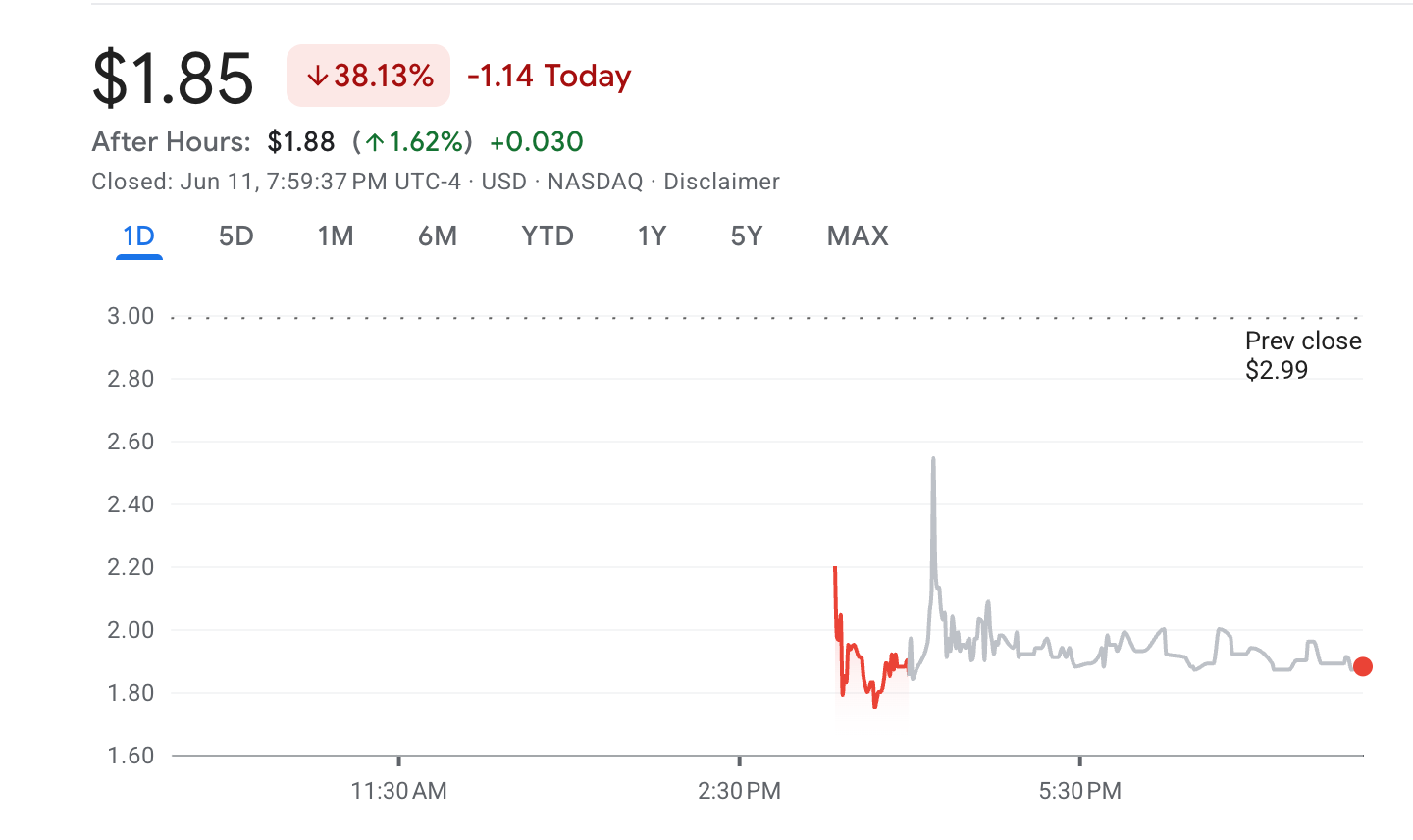
Avalanche Treasury Co’s stock. dropped about 38% to $1.85 on Thursday in a rocky first day of trading on Nasdaq under the ticker AVAT.
The firm reached public markets through a $675 million merger with special-purpose acquisition company (SPAC) Mountain Lake Acquisition Corp., a deal first announced in October.
Follow us on X to get the latest news as it happens

A Tough Market for Crypto Treasury Stocks
Avalanche Treasury Co. is led by former Susquehanna and AllianceBernstein executive Bart Smith. Unlike firms that simply accumulate AVAX on their balance sheets, the company plans to operate as both a digital asset treasury and an operating business.
Smith explained AVAT aims to allocate capital strategically to generate long-term value within the network, likening the approach to that of a corporate treasury.
“It is not a bet on price. We believe it is an investment into Avalanche that represents meaningful potential for the repositioning of institutional finance. Our Nasdaq listing is designed to provide greater access to this infrastructure shift at the ground level,” he said.
The firm’s debut comes during a challenging period for digital asset treasury (DAT) stocks. These companies gained traction when rising cryptocurrency prices made publicly traded shares an accessible way for investors to gain token exposure.
However, that appeal has weakened as major digital assets have entered prolonged downtrends.
Avalanche’s native token, AVAX, trades near $6.6, according to BeInCrypto Markets. The cryptocurrency has fallen 33.8% over the past month and remains more than 95% below its all-time high reached in 2021.

AVAT’s upcoming sessions will show whether buyers separate the firm’s ecosystem model from AVAX’s depressed price.
Subscribe to our YouTube channel to watch leaders and journalists provide expert insights
The post Avalanche Treasury Stock Slides 38% in Rocky Nasdaq Trading Debut appeared first on BeInCrypto.
Key Highlights
- The $H token plummeted 80-90% following a security breach on June 8-9, erasing over $1 billion in market capitalization
- Malware on a developer’s computer compromised private keys, enabling hackers to steal 141M tokens and create 200M additional ones
- Immediate financial damage is calculated between $30M–$36M; $H dropped to $0.05–$0.13 before recovering to approximately $0.20
- Officials suspended bridge operations, announced a $1M USDT reward, and committed recovered assets to token repurchase initiatives
- Speculation about internal complicity has emerged among researchers, with an upcoming token release on June 25 intensifying concerns
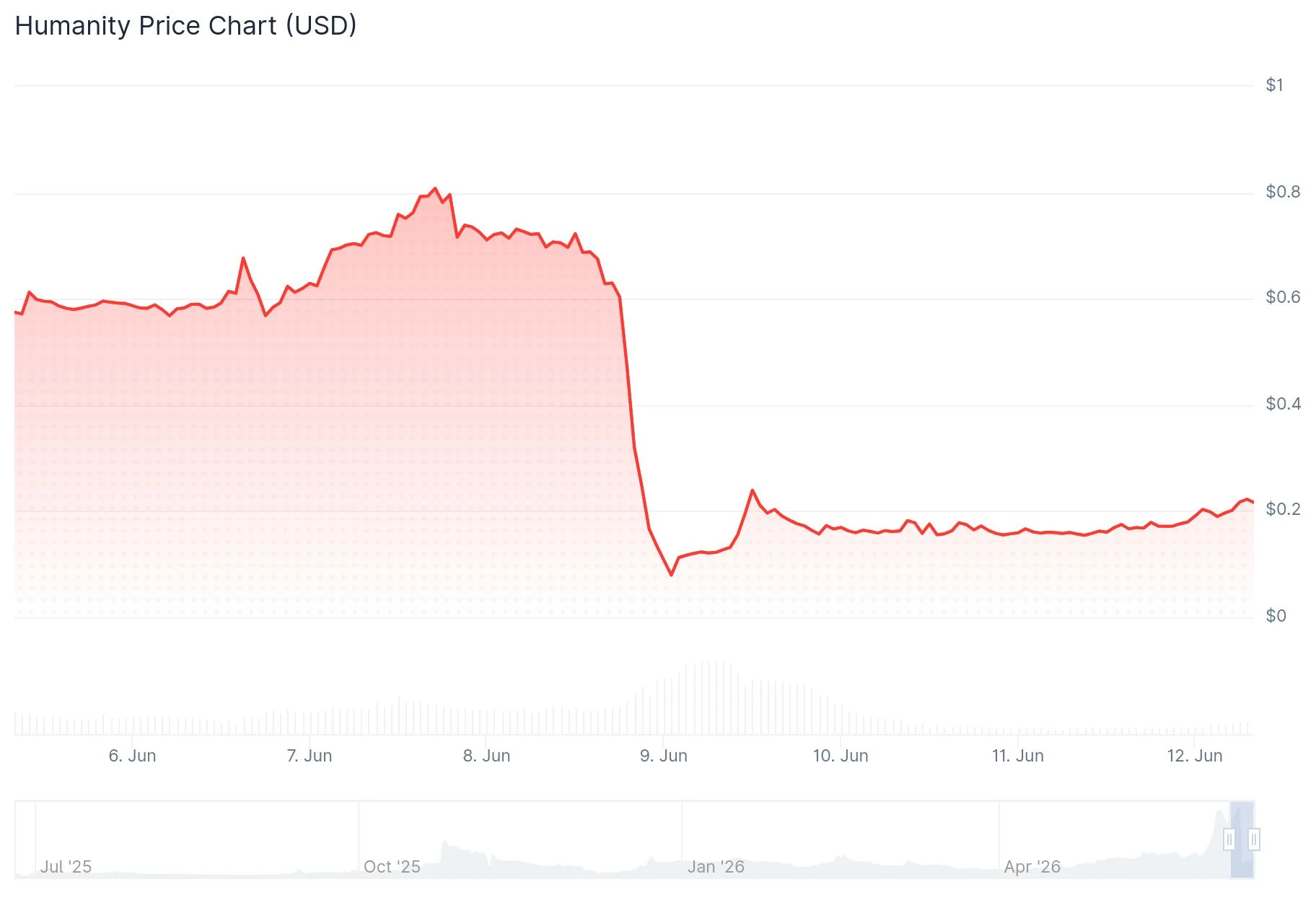
Humanity Protocol’s $H token stood out as a top-performing cryptocurrency in early 2026, delivering returns between 300–800% and climbing to a record peak of $0.8439 on June 2. Yet within mere days, more than 80% of that value evaporated.
A cybersecurity incident on June 8–9 sparked the dramatic downturn. The digital asset plunged from approximately $0.67–$0.74 to depths of $0.05–$0.13. More than $1 billion in valuation disappeared within hours.
Following the crash, $H has mounted a 41% recovery and was changing hands near $0.20 as of June 10–11. The token still shows approximately 74% losses over the seven-day period.
Anatomy of the Security Breach
The vulnerability originated from an infected developer computer. Malicious software on this machine revealed private keys that controlled Humanity Protocol’s Gnosis Safe infrastructure on both Ethereum and BNB Chain.
This wasn’t a sophisticated smart contract vulnerability or an intricate DeFi protocol manipulation. It represented a fundamental operational security breakdown.
On the Ethereum network, three out of six Gnosis Safe keys were compromised. Attackers leveraged these credentials to extract approximately 141.2 million $H tokens through a single transfer.
On BNB Smart Chain, three out of five authorization keys fell into hostile hands. The perpetrators activated unrestricted minting capabilities and generated over 200 million new $H tokens through two separate operations.
Both the stolen and newly fabricated tokens flooded exchanges, destroying price stability and sparking widespread panic selling. The immediate monetary impact from extracted and manufactured tokens ranges from $30 million to $36 million.
Official Actions and Outstanding Concerns
Humanity Protocol responded swiftly following the compromise. Officials verified the incident stemmed from key exposure rather than code vulnerabilities, and immediately suspended all bridging functionality.
They deployed a public monitoring system displaying attacker addresses and transaction flows. A $1 million USDT reward was established for intelligence contributing to fund retrieval.
The organization also pledged that any reclaimed assets would support market purchases of $H tokens. No specific schedule for this buyback initiative has been revealed.
Blockchain investigator ZachXBT and fellow analysts have started reviewing transaction sequences surrounding the incident. Several researchers have floated theories regarding possible internal coordination.
The chronology has attracted attention. A planned token distribution was scheduled for June 25, approximately fourteen days following the security failure. Certain commentators have theorized the breach might represent a coordinated withdrawal ahead of that release.
Market Outlook and Community Focus
The rebound from $0.05–$0.13 to roughly $0.20–$0.21 indicates renewed purchasing interest. However, the asset remains 70–75% beneath pre-attack valuations, with transaction volumes notably subdued.
Limited market depth suggests the current uptick could reverse abruptly. The approaching June 25 distribution compounds existing uncertainty within an already shaken investor base.
Humanity Protocol manages sensitive biometric verification systems, making security lapses particularly destructive to credibility. Critical questions surrounding key custody protocols and potential insider participation await resolution.
The platform’s forthcoming actions — including potential asset recovery and the impact of the June 25 distribution — will likely determine whether this price recovery maintains momentum.


South Korea’s tax authorities are preparing to treat tokenized stocks as securities rather than virtual assets, a move that could bring the rapidly growing sector into the country’s existing taxation framework once financial regulators finalize their legal interpretation.
Summary
- South Korea’s tax authorities said tokenized stocks could face immediate taxation if financial regulators classify them as securities.
- Officials indicated that overseas tokenized stock trades may also fall under existing securities tax rules depending on their economic rights structure.
- The move comes as the global tokenized stock market has grown to nearly $1.5 billion, fueled by rising demand for blockchain-based access to equities such as Tesla and Nvidia.
According to comments from South Korea’s Ministry of Economy and Finance shared with local outlet Bloomberg Bit, the government currently views tokenized stocks as securities in substance despite their blockchain-based structure.
The ministry said that if the Financial Services Commission determines tokenized stocks qualify as securities, taxation could begin immediately under existing capital markets rules without requiring new legislation.
Officials told the publication that tokenized equities may take the form of digital assets, but their economic characteristics more closely resemble traditional securities.
The ministry also pointed to previous guidance from financial regulators, which emphasized that assets meeting the characteristics of securities should be regulated as securities regardless of the technology used to issue them.
Interest in tokenized equities has grown rapidly over the past year as investors seek blockchain-based access to publicly traded companies.
Data from RWA.xyz showed the tokenized stock market reached $1.47 billion as of June 8, up 115% since the start of the year.
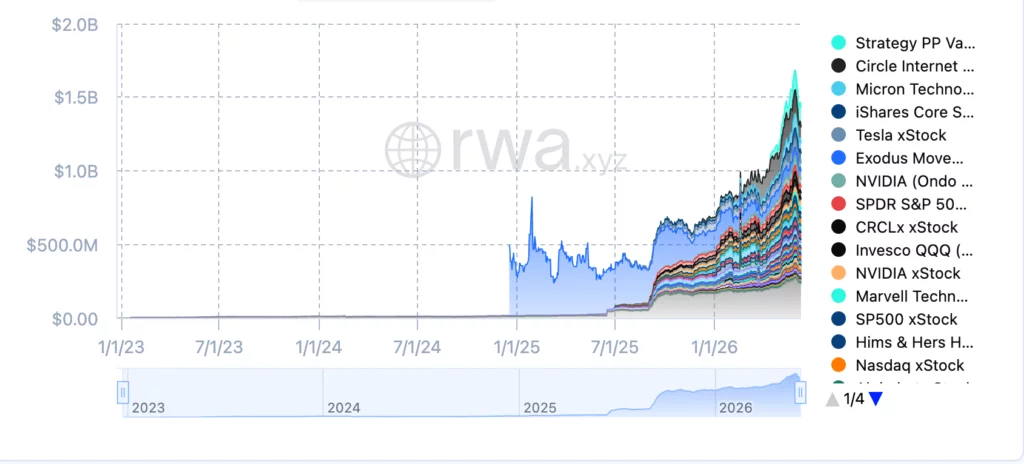
Tokenized stock market value. Source: RWA.XYZ
Demand has been particularly strong among investors seeking exposure to U.S. companies such as Tesla and Nvidia through platforms that offer around-the-clock trading and faster settlement.
Financial regulators move toward legal clarification
Attention is now turning to the Financial Services Commission, which is expected to release revisions to its token securities guidelines and related regulations in July.
Earlier, during the second meeting of a public-private token securities task force in May, the commission said it would develop a detailed roadmap for the tokenization of conventional securities, including listed stocks.
A formal interpretation classifying tokenized shares as securities could clear the way for tax collection during the second half of 2026.
South Korean regulators have already established a foundation for that approach. In its 2023 token securities guidelines, the commission stated that token securities issued in digital asset form fall under the scope of the Capital Markets Act.
However, those guidelines focused largely on fractional ownership products tied to assets such as real estate, artworks, and intellectual property, leaving uncertainty around tokenized versions of ordinary shares.
Because of that uncertainty, many market participants had assumed tokenized stocks would be treated similarly to virtual assets and remain outside the tax net until South Korea’s virtual asset taxation regime takes effect next year.
Overseas trades could also fall under tax rules
The Ministry of Economy and Finance indicated that taxation would not necessarily be limited to domestically issued products.
Officials told Bloomberg Bit that securities taxation under existing law is based on the economic rights attached to an asset rather than where it is issued.
As a result, tokenized stock transactions conducted through overseas platforms could still be subject to South Korean tax rules if the underlying rights are deemed equivalent to securities.
The ministry also noted that future classifications may depend on specific features attached to the tokens. Depending on whether voting rights are included, tokenized stocks could potentially be categorized as ordinary shares, derivative-linked securities, or investment contract securities.
At the same time, South Korea’s tax authorities and the National Tax Service are working to strengthen information-sharing arrangements with foreign tax agencies, including the U.S. Internal Revenue Service, to improve visibility into transactions conducted through overseas platforms.
The regulatory push comes as tokenized finance gains momentum globally.
According to a Binance Research report, tokenized stocks had become the fastest-growing segment of the real-world asset sector, with market value rising 422% since early 2025.
The research firm attributed much of the growth to platforms that provide blockchain-based access to traditional equities and exchange-traded funds.
Growing activity on platforms such as xStocks and Ondo Global Markets has further accelerated investor interest in blockchain-based securities, increasing pressure on regulators to clarify how existing financial and tax laws should apply to the sector.


Bitcoin and Ether options worth about $2.5 billion expire on June 12, putting the $60,000 to $62,000 Bitcoin range back in focus.
Summary
- Bitcoin options worth $2.23 billion expire today as BTC trades close to $63,000 support levels.
- GreeksLive data showed downside dealer exposure concentrated around Bitcoin’s key $60,000 to $62,000 range.
- Ether options worth about $293 million also expire, with ETH still flat near $1,650.
Around 35,000 Bitcoin options contracts expire today, with a notional value near $2.23 billion. The event is slightly larger than last week’s expiry, but still smaller than major monthly or quarterly expiries.
The current Bitcoin options batch has a put/call ratio near 0.66 to 0.68. Deribit data also placed Bitcoin’s max pain level around $66,000 to $67,000, above the current spot price near $63,000.
Max pain is the price where the largest number of options contracts expire worthless. When spot price sits far below that level, many bullish contracts lose value at expiry.
The event comes as crypto markets remain weak after a difficult week. Bitcoin has bounced slightly, but broader selling pressure remains visible across spot and derivatives markets.
Bitcoin $60K to $62K zone stays in focus
GreeksLive said Bitcoin options positioning has tightened around a narrow set of strike prices. The firm pointed to the $60,000 to $62,000 region as the main downside zone for traders.
“The largest short dealer exposure anchored is at $60K. Collectively, downside exposure is heavily concentrated within the $60K to $62K range,” GreeksLive said.
That range matters because it sits close to Bitcoin’s current support area. If BTC falls back into that band, dealer hedging and stop orders could increase short-term volatility.
Deribit also said positioning remains call-heavy despite recent market stress. That shows many traders still hold upside exposure, even as spot markets stay under pressure.
“Despite recent volatility, positioning remains skewed toward calls across both assets,” Deribit said.
Ether options add to expiry total
Ether options also expire today, adding about $293 million in notional value. Around 175,000 ETH contracts are set to expire, with max pain near $1,750.
ETH traded close to $1,650, staying below its max pain level. The token has struggled to recover after losing higher support zones during the latest crypto selloff.
The Ether options put/call ratio stood near 0.58 to 0.62, showing more call exposure than put exposure. Still, spot ETH has not shown a strong rebound yet.
The total crypto options expiry stands near $2.5 billion. That makes today’s event notable, but not large enough by itself to change the wider market trend.
Spot market remains weak
Bitcoin traded near $62,937, while Ethereum traded near $1,656, according to crypto.news market data. BTC held above the $60,000 area, while ETH stayed close to its lower support range.
Total crypto market value remains near multi-month lows after heavy selling earlier in June. The latest bounce has slowed the decline, but buyers have not yet shown strong control.
As previously reported by crypto.news, crypto spot volume fell to $679 billion in April as retail demand weakened. That report showed that the market is not only facing sellers, but also a shortage of active buyers.
SpaceX’s planned IPO has also raised questions about capital rotation from crypto into major technology listings, as previously reported. That pressure sits alongside geopolitical risk, inflation concerns, and weaker risk appetite.
For Bitcoin, the key level remains the $60,000 to $62,000 range. A clean hold above that zone could limit expiry-related pressure, while a break lower may bring the mid-$50,000 area back into discussion.
Disclosure: This article does not represent investment advice. The content and materials featured on this page are for educational purposes only.

An international law enforcement operation among 11 countries has shut down AudiA6, a money laundering ring that processed over 336 million euros ($390 million) in illicit funds between 2022 and 2025.
On Wednesday, authorities arrested two administrators, Russian and Ukrainian nationals, in Georgia, seized 25 domains and more than 30 servers and 80 vehicles and froze roughly $900,000 in cryptocurrency, the European Union Agency for Criminal Justice Cooperation (Eurojust) said Thursday.
The AudiA6 “mixer-as-a-service” was used by cybercriminals involved in ransomware attacks to cash out stolen crypto and conceal the movement of illicit funds from authorities by offering to “clean” crypto within about an hour for a 3% to 10% commission.
Since 2021, AudiA6 wallets received approximately 10,333 BTC, valued at around $389 million at the time the transactions occurred, Chainalysis reported.
The cybercrime syndicate behind the service is also reportedly running a separate marketplace forum known as “Dark2Web”, which is used to advertise illicit services and connect cybercriminals worldwide, according to Eurojust.
The investigation involved agencies from the United States, Australia, France, Poland, Georgia, Iceland, Canada, Germany, Japan, Switzerland and the United Kingdom, coordinated through Eurojust and Europol.
Fake KYC accounts used in scheme
The crypto laundering ring was facilitated by thousands of fraudulent accounts using stolen or purchased identities.
More than 6,000 Know Your Customer (KYC) records linked to “money mule accounts” were identified during the investigation, Eurojust said.
Many of those accounts were connected to Russian-speaking intermediaries recruited specifically to help move criminal proceeds through crypto exchanges, it added.
Related: Ransomware attacks surge 50% in 2025, ransom payments decline
AudiA6 also reportedly laundered part of a ransom paid by an Australian business in 2024 following a ransomware extortion attack, according to the Australian Federal Police, which was part of the investigation.
Both the regular and dark web versions of AudiA6 and Dark2Web domains have been replaced with seizure banners.

A multinational law enforcement effort led to the closure of the platforms. Source: Europol
Ransomware consolidates around a few operators
Ransomware was recorded in 97 countries during the first quarter of 2026, but the distribution of attacks is becoming increasingly concentrated, with the US accounting for 64.7% of all recorded victims, according to Emsisoft.
“The ransomware ecosystem is once again consolidating around fewer, more dominant operators,” with the top 10 ransomware groups accounting for 71% of all Q1 2026 victims, reported Check Point Research in May.
Magazine: Does ‘Paper Bitcoin’ mean there’s an unlimited supply of BTC?

TLDR:
- Michael Selig solely runs the CFTC, gaining unmatched power over crypto markets.
- CFTC approved crypto perpetual futures, triggering CME Group’s stock decline and criticism.
- Lawmakers from both parties push Trump to nominate additional CFTC commissioners.
- Staff buyouts and unrest grow as CFTC’s crypto oversight role expands rapidly.
CFTC Chair Michael Selig is consolidating regulatory control over crypto and prediction markets, drawing both industry praise and rising concern in Washington.
As the agency’s sole commissioner, Selig now holds outsized influence over digital assets, derivatives, and platforms like Kalshi and Polymarket.
Solo Chair Reshapes CFTC Agenda
Selig has served less than six months as CFTC chair, yet his impact is already substantial. He operates as the only sitting member of what should be a five-person bipartisan commission.
This unusual arrangement gives him unilateral authority over crypto products, prediction markets, and oil futures.
His approach favors faster approvals and lighter enforcement than his predecessors. Selig recently approved crypto perpetual futures, a first for U.S. markets. These products let traders bet indefinitely on asset prices without expiration dates.
The approval rattled CME Group, whose stock dropped after the decision. Speaking on CNBC, CME CEO Terry Duffy warned that the move “could be a disaster waiting to happen.” Despite the pushback, the CFTC defended the decision as part of bringing offshore activity onshore.
Selig also backed the Winklevoss twins in their effort to vacate a Biden-era settlement. The CFTC released internal documents tied to the case, unsettling some staff members.
Commenting on the disclosures, attorney Jack Baughman, who represented Gemini, said “this sort of information should be made available in every case, in my view.”
Lawmakers from both parties are now urging Trump to nominate additional commissioners. Senate Agriculture Chair John Boozman and House Agriculture Chair GT Thompson back this push.
Sen. Elissa Slotkin voiced her own concern, stating bluntly, “We’ve got one guy who has clear leanings toward the industry. I’ve got a problem with that.”
Staff Unrest Grows Amid Crypto Bill Push
Internal tension at the CFTC has intensified alongside Selig’s expanding influence. A current official described the agency as lacking the operational capacity to oversee crypto.
CFTC spokesperson Brooke Nethercott rejected that characterization, calling it “a despicable description of our dedicated civil servants.”
A fresh round of buyout offers has hit the Division of Market Oversight particularly hard. This division traditionally handles derivatives exchange oversight and trading venue rules.
Reflecting on the broader pattern, one former official summarized the mood simply: “It’s death by a thousand cuts.”
Notably, a recent prediction market rule proposal bypassed this division entirely. Instead, the general counsel’s office led the drafting process this time.
Nethercott pushed back on suggestions of dysfunction, saying it would be false to “imply anything in the CFTC is done in a vacuum.”
Congress is weighing a digital assets bill that would formally expand CFTC authority. This legislation could make Selig a central regulator for the $2 trillion crypto market. Companies ranging from Coinbase to World Liberty Financial would fall under this oversight.
Former CFTC chair Timothy Massad criticized the agency’s current trajectory sharply, comparing it to a once-reliable engine now running off the rails. Still, industry voices like Chris Perkins remain enthusiastic, declaring of Selig’s approach, “He’s doing God’s work.”
Crypto World
There’s one simple signal for whether the BTC price has bottomed. Right now, it hasn’t.


Crypto traders, having seen bitcoin , the largest cryptocurrency, bounce overnight to $64,000 from recent lows under $60,000, may be wondering whether the bottom has been hit and a fresh bull run has started.
There is a simple signal to get that confirmation. Right now, it is saying the rebound has not started.
That signal comes from the widely followed momentum gauge called the relative strength index, or RSI. The measure can range from 0 to 100. Readings above 70 indicate that an asset is running hot and potentially overbought, while readings below 30 suggest the opposite. Between those extremes, specific levels often emerge as dividing lines between bullish and bearish environments.
For the bitcoin price, the line is at 41.5, according to crypto data analytics platform Material Indicators. Above that level, BTC has historically had a stronger argument for being in a bullish macro trend. Below it, bearish pressure tends to dominate.
“Right now, Bitcoin is below it, and still trending down,” Keith Alan, an analyst at Material Indicators, said in an email. “That does not mean price has to collapse, but it does mean the burden of proof is still on the bulls.”

Should I Sell Crypto To Pay Off Debt?

Black Swan at Burn Bridge near Harrogate to re-open in June

Motilal Oswal shares jump 5% after UBS initiates coverage with ‘Buy’, sets Rs 1,150 target



-

 Fashion7 days ago
Weekend Open Thread: Evereve – Corporette.com
-
 Entertainment5 days ago
The Best Mystery Series of All Time Is Surging on Streaming 30 Years After It Ended
-

 NewsBeat4 days ago
Alexander Zverev wins the French Open to finally earn a 1st Grand Slam title
-
 Crypto World7 days ago
Jensen Huang Approves Samsung, SK Hynix, and Micron for NVIDIA (NVDA) HBM4 Memory Supply
-

 Crypto World4 days ago
Anatomy of the June crypto crash: Fed, Iran, Saylor
-

 Tech6 days ago
Suspicious Polyfill login prompts pop up on Toshiba, Muji websites
-
Crypto World6 days ago
Senator Cynthia Lummis Calls CLARITY Act the Most Consequential Financial Legislation of This Generation
-

 Tech5 days ago
Microsoft unveils seven homegrown AI models in new bid for ‘long term self-sufficiency’
-

 Business7 days ago
(VIDEO) Justin Bieber Delivers Surprise Happy Birthday Serenade to Diners at Los Angeles Mexican Restaurant
-
 NewsBeat5 days ago
Alexander Zverev conquers demons and outlasts Flavio Cobolli to win French Open for first major title
-

 Tech6 days ago
Von der Leyen’s AI envoy pick draws conflict-of-interest fire
-

 Business4 days ago
High Stakes for Wembanyama as New York Pushes for 3-0 Lead
-

 Tech6 days ago
Hackers now exploit SolarWinds Serv-U flaw to crash servers
-
 Business5 days ago
The Pain Points Taking a Fragile Tech Rally Down a Notch
-

 Tech7 days ago
Meta steals a tactic from Tesla and builds data centers in tents
-
 Crypto World4 days ago
Eli Lilly (LLY) Stock Surges 4% Following Breakthrough Sleep Apnea Trial Results
-

 Tech4 days ago
Notion restores access to Anthropic after service disruption
-
Crypto World7 days ago
LBank Surpasses 25 Million Users Worldwide as AFA Partnership Continues to Drive Global Growth
-

 Crypto World5 days ago
Trump’s AI Ownership Plan Could Benefit Anthropic at OpenAI’s Expense
-
 Sports3 days ago
Bangladesh beat Australia after 20 years in ODIs, register only their second win over six-time world champions | Cricket News
You must be logged in to post a comment Login