

Crypto World
Pi Network Price Predictions for This Week as PI Surges 10% in 24 Hours (July 15)

PI crashed 40% this week after a massive sell-off that drove it to consecutive all-time lows. However, it has rocketed by 10% since those lows, begging the question of whether the bottom is in.
PI Network (PI) Price Predictions: Analysis
Key support levels: $0.07
Key resistance levels: $0.10, $0.13, $0.16
PI Crashed to $0.07
PI just had one of the worst weeks in 2026 after the price lost support at $0.10. With this level turned into resistance, sellers rushed for the exits and sent the price into a nose-dive to $0.07, which became its latest record low.
With confidence gone, buyers had vanished. For example, in the past 10 days, only one day closed in the green. This shows that the sentiment is extremely bearish and the downtrend has entered a new phase where a bottom could be found much quicker.
More positive news came in the past several hours, with PI finally rebounding to $0.08 as of press time. However, it remains to be seen whether this is another dead-cat bounce.
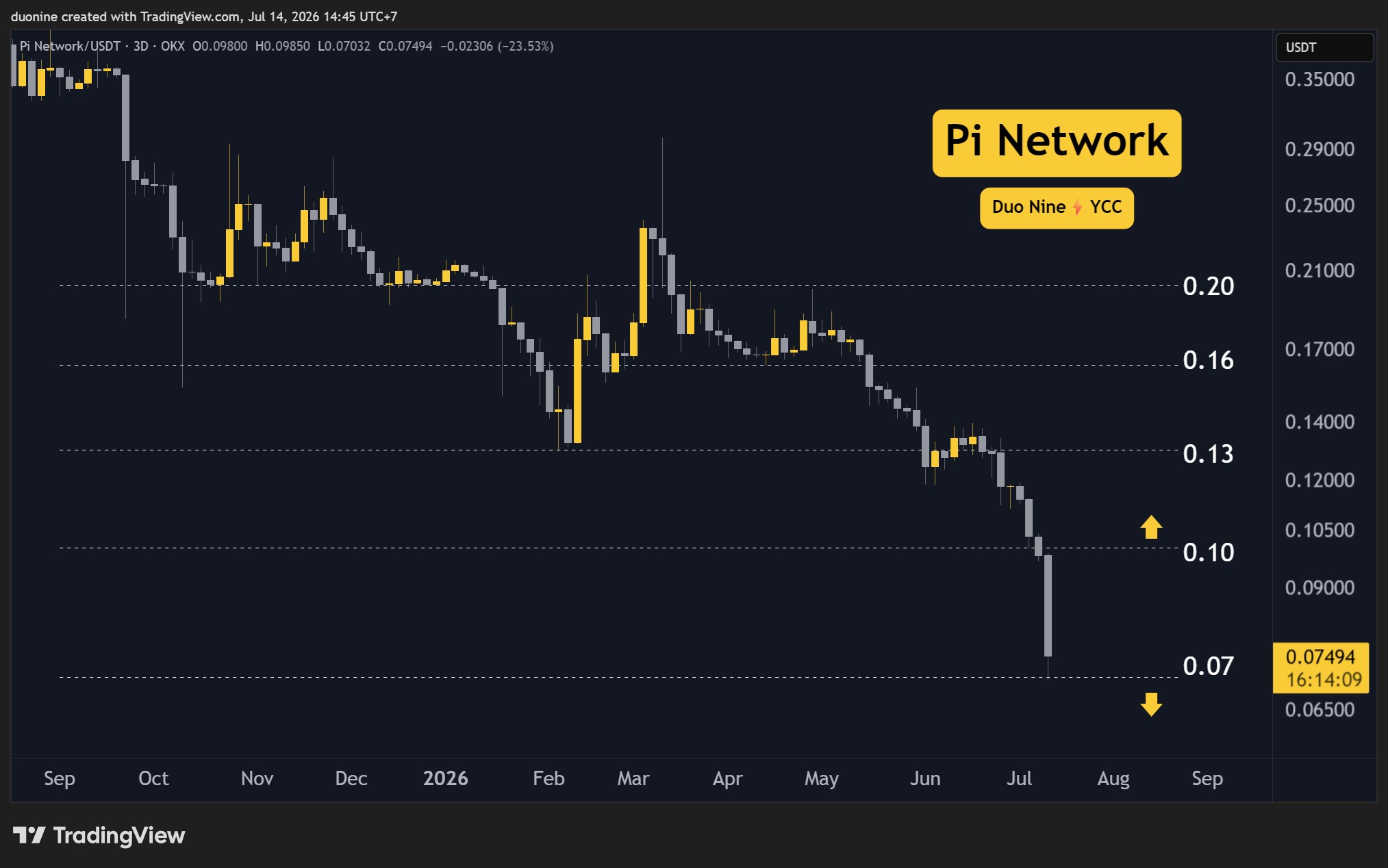
Sell-Side Volume Exploded
As soon as the support at $0.10 was lost, sell volume began to pick up. This only made things worse and likely led to cascade liquidations that put even more pressure on the falling price.
While the sell pressure has decreased compared to yesterday, the day is not over, and this could still change. The price held above $0.07 and bounced to $0.08, but this could very well be just a temporary pause before new lows.

Momentum Indicators Are at Extremes
Due to heavy selling pressure, the momentum indicators have reached extreme levels. For example, the daily RSI is at 12 points, a level never seen before for this cryptocurrency. Extremes are also the place where bottoms are found.
Hopefully, this price action will bring about an end to the downtrend and allow PI to consolidate and confirm a bottom. If the support at $0.07 won’t hold, then buyers will likely retreat to $0.06 or even $0.05. The current resistance is at $0.10.

The post Pi Network Price Predictions for This Week as PI Surges 10% in 24 Hours (July 15) appeared first on CryptoPotato.



Polymarket has been blocked in the Czech Republic after authorities classified the prediction market platform as an unlicensed gambling service, adding another European jurisdiction to the list of countries restricting its operations.
Summary
- Czech authorities have given internet providers 15 days to block access to Polymarket.
- Regulators said the platform must follow gambling rules regardless of how its contracts are described.
- India, Argentina and several European countries have also taken action against Polymarket.
The Czech Ministry of Finance has ordered internet service providers to block access to Polymarket within 15 days of placing the platform on the country’s list of unauthorized internet games.
Officials argued that prediction markets operate like gambling products even when they are presented as investment tools. According to the ministry’s position, the only difference is the terminology, with bets described as “contracts” and winnings presented as “returns on investment.”
The latest move follows similar restrictions introduced in France, Germany, Romania, Spain, and Belgium. Outside Europe, regulators in New Zealand, Australia, and Brazil have also taken action against prediction market platforms.
Czech authorities reject Polymarket’s investment argument
Commenting on the decision, Jan Řehola, director of the Czech Institute for Gambling Regulation, said prediction markets should not be treated differently simply because they are presented as financial products.
“Prediction markets are not harmless technological novelties. They involve betting on real-world events, often without clear accountability to the state, without standard player-protection measures and without the rules that apply to legal gambling,” Řehola said.
He argued that changing the terminology does not alter the nature of the product.
“If something looks like a bet, functions like a bet, and allows people to win or lose money depending on the outcome of an uncertain event, we cannot stop treating it as gambling simply because it is called a contract,” he said.
Řehola added that the Ministry of Finance’s decision confirms that the same regulatory standards should apply to all operators offering betting products.
“This is not about banning innovation. It is about ensuring that the same rules apply to everyone who offers betting for money. Player protection, the prevention of money laundering, and effective market supervision must not depend on what an operator chooses to call its product,” he said.
Europe remains divided over prediction markets
While several European countries have classified prediction markets as gambling, Gibraltar recently introduced a separate regulatory framework for the sector instead of treating such platforms as either gambling products or financial instruments.
The framework was introduced after Gibraltar licensed prediction market operators ADI Predictstreet and Wire Market, becoming the first jurisdiction to establish dedicated rules for the industry.
The Czech decision extends a series of enforcement actions against Polymarket this year.
In May, India blocked access to the platform after the Ministry of Electronics and Information Technology directed internet service providers and VPN operators to restrict access to prediction market websites that authorities classified as illegal online money gaming platforms.
Argentina also ordered a nationwide block in May after a Buenos Aires court concluded that Polymarket operated outside the country’s gambling framework. Authorities there cited consumer protection concerns, crypto-based payments and identity verification standards among the reasons for the decision.
South Korea has taken a different approach. Earlier this month, the Broadcasting, Media and Communications Review Committee postponed any enforcement decision after deciding to hear Polymarket’s response before determining whether its service violates local gambling laws.
The company is also facing scrutiny in the United States, where the CFTC is investigating parts of Polymarket’s business, including its social media operations.


For five consecutive days, a launchpad that did not exist a month ago collected more protocol fees than Pump.fun. On its best day, NOXA took in $2.33 million while the Solana incumbent, the platform that has minted eleven million tokens and defined an entire market cycle, managed $575,500.
Summary
- NOXA briefly out-earned Pump.fun and became Robinhood Chain’s dominant launchpad before its website went offline.
- CASHCAT’s $226 million market capitalization depends less on token mechanics than on attention, discovery, and launchpad infrastructure.
- The outage did not stop CASHCAT from trading, but it threatened the interface that drives creator fees, discovery, and momentum.
- Locked liquidity protects against one kind of rug, but it does not protect a memecoin from losing attention.
- The real test is whether NOXA’s interface, fee claims, and market share recover before competitors absorb its launchpad flow.
NOXA had launched more than 60,000 tokens, captured roughly 75% of all deployments on Robinhood Chain, and pulled 267,642 unique wallets onto a network that went live on July 1. Its flagship asset, a cat themed memecoin named CASHCAT, had run to a market capitalization of $226 million.Then the website went down. It stayed down for two days.Not the chain. Not the pools. Not the tokens. The front end, the thing that made all of it legible, the interface where creators claimed fees and buyers found what was trending and the entire machinery of manufactured urgency lived. It returned an error, and it kept returning an error while the market it had built continued trading without it.
The official explanation is a Cloudflare problem. The team’s account remains active, telling users a new site is in testing and that creator fees will be claimable through the interface once it goes live. Nothing in the public record contradicts that account. Nothing in the public record confirms it either, and in a market where the base rate for launchpad tokens dying is somewhere around 98%, two days of silence from the infrastructure holding a nine figure ecosystem is not a neutral event. It is a live experiment in what a memecoin is actually worth when the machine that made it stops answering.That experiment has a number attached, and the number is $226 million.
What CASHCAT is, and why it exists
Cash Cat was the original name Robinhood’s founders considered for the company, a detail preserved in a decade old tweet from chief executive Vladimir Tenev and in an early mascot the brokerage used before it became a mainstream financial institution. When Robinhood launched its own layer 2 network on July 1, the mascot was sitting there, unclaimed, perfectly formed as a memecoin premise: the discarded name of a company now worth tens of billions, revived on that company’s own chain.
Somebody launched it on NOXA. It worked spectacularly. CASHCAT rose more than 5,530% over seven days and more than 1,400% in a single twenty four hour stretch, hitting an all time high near $0.1418 while bitcoin fell roughly 2% over the same window, which is the clearest possible evidence that nothing macro was driving it. Onchain analysts surfaced the trades that make these markets self sustaining: one wallet turned $838 into $1.05 million over twenty days, another converted $86 into $1.6 million. Tenev himself posted about the chain’s ability to host both memecoins and real world assets, and attention did the rest.
There were no exchange listings. There was no protocol upgrade, no partnership, no treasury, no roadmap, and no team in any conventional sense. There was a joke about a company’s abandoned name, deployed on that company’s chain, at the exact moment the chain became interesting. That is the entire fundamental basis of a $226 million asset, and stating it plainly is not a criticism. It is a description of the category, one that governs the whole meme coins sector and has for years. Attention was the product, and the product sold.
The launchpad that ate Robinhood Chain
NOXA’s rise is the more revealing half of the story, because it exposes how much of a memecoin ecosystem is infrastructure rather than tokens.NOXA Fun is a hybrid launchpad. Where Pump.fun runs a custom bonding curve and migrates liquidity to an open exchange at graduation, NOXA deploys an ERC-20 and adds single sided liquidity to a Uniswap V3 pool in one transaction, making the token tradable on a public exchange from its first block. The liquidity position is locked permanently in a locker contract that never moves and cannot be pulled, which removes the classic liquidity drain rug and eliminates the migration window that has historically been the riskiest moment in a bonding curve launch. On its own terms the design is more conservative than the model it competes with, and understanding why requires knowing how liquidity pools and automated market makers actually work.
The platform layered on protections as it scaled: anti-vampire measures, anti-bundling detection, multi wallet controls, iterating fast enough that observers noted it week by week. Its native token, deployed on a different chain entirely and pending migration, carried a fully diluted valuation of $11 to $12 million after the team burned about 40% of supply, against $11 million in cumulative fees across four days. Pump.fun’s fully diluted valuation, for comparison, sits near $1.5 billion.
That gap is the valuation paradox the market has been arguing about all week. A platform earning at the rate of the category leader, valued at under 1% of it. There are three readings and they cannot all be right. The bullish one says the market has not repriced yet and NOXA is the most obvious mispricing on any chain. The structural one says fee run rates from a chain in its second week are not a business, they are a spike, and pricing a spike at Pump.fun multiples would be insane. The dark one says the discount is the market’s estimate of how likely the whole thing disappears.
Two days of downtime moved that argument out of theory.It is worth noting how quickly the market found the argument in the first place. Traders were circulating the fee-to-valuation gap within days of NOXA’s rise, framing it as an obvious mispricing against Pump.fun. That enthusiasm is itself information: a discount this visible on an asset this liquid is rarely a gift. Markets price launchpad tokens cheaply for the same reason they price mining stocks cheaply during a boom, because everyone can see that the current rate of extraction has nothing to do with the durable rate.
The mechanics of a two week fee explosion
The scale of what NOXA collected deserves unpacking, because the number is doing something other than what it appears to do.Launchpads earn on activity. A creation fee when a token deploys, a share of trading fees on every swap through the pool, and in NOXA’s structure, fees flowing from Uniswap V3 positions at the 1% tier that the platform’s tokens use. None of that revenue depends on any token succeeding. It depends only on churn, and churn is exactly what a brand new chain with a retail audience and 19,000 daily deployments produces in abundance. Across four days the platform booked roughly $11 million against a token valued at $12 million, which reads as an obvious arbitrage until you ask the question underneath: is that four day rate a business or a weather event?
The comparison to Pump.fun cuts both ways here. Pump.fun’s $1.5 billion valuation rests on two years of proven durability across multiple attention cycles, a graduated exchange of its own, a completed billion dollar token sale, and a fee base that survived the collapse of the memecoin mania that created it. NOXA has a fortnight, on a chain with a fortnight, in the single most favorable conditions any launchpad will ever see: a novel network, a mainstream brand halo, no competitors holding entrenched positions, and a flagship token running 5,000% in a week. Annualizing that is not analysis. It is extrapolation from a peak.
Which is why the outage is such an efficient test. If the fee run rate was a business, it survives two days offline and resumes. If it was a weather event, the two days are the whole event, and the rate never returns because the conditions that produced it were never repeatable. The market gets its answer within a week, and it gets it cheaply, which almost never happens in this asset class.
What the outage actually threatens
Here is the part that matters for CASHCAT holders, and it is more subtle than it first appears.The tokens are fine. That is not a reassurance; it is a technical fact with sharp edges. CASHCAT is an ERC-20 on Robinhood Chain, trading against a Uniswap V3 pool whose liquidity is locked in a contract that operates whether or not anyone can load a website. Uniswap does not need NOXA. The chain does not need NOXA. Any wallet can interact with the pool directly, and any aggregator can route to it without the launchpad’s involvement or permission. In the strict sense, a launchpad outage cannot touch the assets it launched, and anyone claiming CASHCAT holders are trapped has confused the interface with the market.
What the outage threatens is everything around the token. Creator fees accrue through the platform, and the team’s own statement acknowledges that claiming them requires the interface, meaning revenue owed to thousands of token deployers currently sits behind a domain that does not resolve. Discovery collapses without the front end: new tokens launch elsewhere, existing tokens lose the trending feeds and progress bars that manufacture the urgency these markets run on. And the flywheel reverses. Onchain data already showed new memecoin creation on Robinhood Chain climbing past 19,500 in a day while competing launchpads including flap.sh, trensh.today, and bankr absorbed share that NOXA could not defend from behind an error page.
So the honest framing of the risk is not that CASHCAT stops trading. It is that CASHCAT stops mattering. A memecoin’s value is the attention flowing through it, the attention is manufactured by an interface, and the interface has been offline for the two most valuable days a two week old ecosystem will ever have.
Is this a rug?
The question is being asked openly, and it deserves a rigorous answer rather than a vibe.Take the case for calm first. The team is publicly communicating during the outage, which is close to disqualifying as rug behavior: the defining feature of an exit is silence, deleted accounts, and vanished channels, not status updates about a staging environment. Liquidity is locked by design and cannot be withdrawn, so the single most common rug mechanism is architecturally unavailable here. The platform burned 40% of its own token supply days before going dark, an odd move for anyone planning to sell the rest. Cloudflare outages are real, routine, and have taken down far larger properties than a two week old launchpad. And the underlying economics are absurd for an exit: a platform earning millions in fees per day has vastly more to gain from staying online than from disappearing with whatever sits in a fee contract.
Now the case for concern. Two days is a long outage for an infrastructure problem that the operator attributes to a third party content delivery network, and it is exactly as long as it takes for competitors to take a market. Creator fees being unclaimable during the outage means real money is unreachable for real users, whatever the cause, and the promise to make them claimable “once the new site goes live” converts a technical failure into a trust exposure with no deadline attached. The platform’s own token lives on a different chain pending migration, which is an added moving part at precisely the wrong moment. And the category’s history is unkind: the industry’s canonical rug taxonomy distinguishes hard rugs, where developers vanish, from soft rugs, where involvement gradually decays while the thing quietly dies, and soft rugs look exactly like an infrastructure problem that never quite resolves.
The evidence, weighed honestly, favors the boring explanation. A team executing an exit does not typically burn its own supply, lock its liquidity permanently, post status updates, and abandon a business printing seven figures a day. But the market is not pricing the probability of a rug. It is pricing the probability of irrelevance, which is a different and much higher number, and two days offline in a launchpad war is how irrelevance starts.
There is also a category error worth naming, because it is corrupting the discourse around this. A rug is an act by an identifiable party who takes something they controlled and should not have taken. A collapse is a market outcome in which nobody did anything wrong and the money disappears regardless. Memecoin markets produce collapses at overwhelming rates without any fraud involved, which means most tokens that go to zero were never rugged, they were simply correct valuations of nothing arriving on schedule. Applying the word rug to a launchpad outage flattens that distinction and, more practically, sets holders up to look for the wrong evidence. They watch for a villain when the thing actually killing their position is indifference.
What would settle it is specific and observable. Watch whether the new interface ships and creator fees actually become claimable. Watch whether NOXA’s fee share recovers or whether flap.sh and its peers keep the ground. Watch the team’s wallets. Watch whether Robinhood Chain’s daily token creation stays near Solana’s or reverts once the novelty burns off. None of those require trusting anyone’s statement.
What the numbers actually say about the ecosystem
Look past the fees at the composition of the activity, and a less flattering picture emerges.More than 60,000 tokens launched through NOXA. Of those, the platform’s own interface displays a handful with meaningful market capitalizations, headed by CASHCAT, with the rest of the visible field clustering in the hundreds of thousands or low millions and the long tail invisible entirely. Peak single day volume of $252.9 million across the platform, with a single project accounting for $224 million of a comparable day, means the flagship was not one asset among many. It was the market, and everything else was noise around it.
That concentration is the ecosystem’s actual risk profile. A launchpad whose fee base is one token’s trading is not a platform, it is a single asset’s plumbing, and its revenue lives or dies with the attention on that one asset. The 640,000 unique holder addresses and 267,000 wallets NOXA brought onto Robinhood Chain are impressive as a distribution achievement and mostly irrelevant as a durability signal, because holders of a token that ran 5,000% in a week are not users, they are a queue.
None of this is unique to NOXA. It describes Pump.fun’s first year, Four.Meme’s ascendancy, LetsBonk’s arrival, and every launchpad that has ever briefly topped a fee chart. What is unique here is the timing: a platform reached that concentration and then lost its interface, in the same fortnight, on a chain that had no proven alternative for anyone to fall back to. The stress test arrived before the structure was finished.
The dependency nobody priced
Strip the specifics away and the CASHCAT situation exposes a structural feature of this entire market that the fair launch ideology obscures.
The pitch for permissionless launchpads is that they remove intermediaries. No gatekeepers, no vetting, no company standing between a creator and a market. Bonding curves and locked liquidity mean the platform cannot rug you, which the industry has treated as the end of the argument about platform risk.
It is not. The platform cannot take your tokens, and it does not have to. It can simply stop generating the attention that gives them value, and the tokens will die exactly as thoroughly as if it had drained the pool. Locked liquidity protects the mechanism and does nothing for the market. A permanently locked Uniswap position holding a token nobody is looking at is a monument, not an asset. The lock guarantees you can always sell. It guarantees nothing about whether anyone will be there to buy, and those are the only two facts that matter, in that order.
This is the same lesson that keeps arriving in different costumes. When a DAO’s treasury drained through a governance process working exactly as designed, the failure was not in the code, a dynamic crypto.news traced in detail in its account of how BonkDAO lost $20 million in a single vote. When BNB Chain’s Four.Meme briefly flipped Pump.fun on daily revenue, the lesson was that launchpad dominance is a function of where attention currently lives and nothing more durable than that. Infrastructure risk in crypto is rarely custodial. It is attentional, and no audit measures it.
CASHCAT holders own an asset with permanently locked liquidity on a chain backed by a publicly traded brokerage, launched through a platform with better rug protections than the category leader, and every one of those facts is true and none of them answers the only question that determines their outcome, which is whether anyone is still looking in a month.
Robinhood’s problem, arriving on schedule
There is a second party to this that has said nothing, and its position gets more uncomfortable by the day.Robinhood Chain launched as infrastructure for onchain finance and real world asset tokenization. What it got in its first fortnight was a memecoin casino, more than $3 billion in decentralized exchange volume, honeypot tokens proliferating fast enough that cross chain provider Relay Protocol began publicly blocking them, and a scam token that used the hijacked accounts of SpaceX and Starlink to rob buyers on its rails, an episode that arrived within weeks of SpaceX joining the Nasdaq-100 with its trade already running on crypto rails. NOXA, the largest single application on the chain, states plainly in its own interface that it is an independent project not affiliated with Robinhood Markets.
That disclaimer is doing an enormous amount of work. It is legally accurate and commercially irrelevant. A retail brokerage’s brand is on the chain, retail users are the audience, and the flagship asset of the ecosystem is literally named after the company’s original name and modeled on its own former mascot. Robinhood did not build CASHCAT, did not endorse it, and under the architecture it chose, cannot remove it. It will nonetheless own every consequence in the public reading, and its silence through both the SCATMAN affair and the NOXA outage suggests a company that has not decided what it wants to say, or has decided that saying anything invites the responsibility it structured the chain to avoid.
The permissionless design that made the chain’s launch explosive is the same design that makes the next fortnight unmanageable. That is not a contradiction anyone has solved, on any chain, including the ones without a brokerage’s name on them.
Where this lands
Three outcomes are live, and the market is currently paying for the middle one.NOXA returns, ships the new interface, unlocks creator fees, and reclaims its share. The outage becomes a footnote, the valuation paradox resolves upward, and CASHCAT trades on whatever attention Robinhood Chain retains once its novelty is priced. This is the likeliest single outcome and the least interesting.
NOXA returns and the market has moved. The fees flowed to flap.sh and the rest during the blackout, the trending feeds rebuilt themselves elsewhere, and NOXA is a large historical fee number attached to a platform nobody defaults to anymore. CASHCAT survives as an artifact of a moment, drifting on whatever residual community persists. This is the outcome that history most often delivers, because attention is the least loyal asset in this market and switching costs between launchpads are effectively zero. A creator chooses a platform in seconds and abandons it just as fast.
NOXA does not return in a form anyone trusts. The creator fees stay unclaimed, the explanation stays thin, and a two week old chain learns that its dominant application was a single point of failure with a status page. CASHCAT’s locked liquidity keeps a market technically alive at a price that reflects nobody caring.
The tokens survive all three scenarios. That is precisely the point that the fair launch pitch never quite says out loud: survival of the contract and survival of the value are unrelated propositions, and the second one depends entirely on infrastructure that owes its users nothing and can go dark for two days without breaking a single promise it ever made.The $226 million question is not whether CASHCAT can still be traded. It is whether $226 million was ever a fact about the token, or a fact about the launchpad, briefly measured through it.
Disclaimer: This article is for informational purposes only and does not constitute investment advice. Figures on protocol fees, token counts, market capitalizations, and wallet activity derive from third party sources including DefiLlama, Dune, Lookonchain, and platform interfaces, not from audited disclosures. No rug pull has been confirmed and the platform attributes its outage to a third party service failure. Details reflect information current as of July 14, 2026, and are subject to change. Always do your own research.

Kalshi says it has been placed in an “impossible position” after the U.S. Commodity Futures Trading Commission (CFTC) moved to prevent the prediction market platform from complying with a Michigan court order. The dispute underscores an ongoing jurisdiction fight over who can regulate prediction markets—federal authorities or state regulators—once bets are already placed and contracts are executed.
In a decision announced Tuesday, the CFTC ordered Kalshi not to follow the state directive to unwind certain trades in Michigan, according to Reuters. The pushback comes shortly after an Ingham County Circuit Court judge required Kalshi to stop offering sports betting contracts to Michigan users while litigation proceeds over whether Kalshi violated state sports betting laws.
Key takeaways
- Michigan’s court order required Kalshi to stop offering sports-betting contracts to state users and unwind already-executed trades.
- The CFTC instructed Kalshi not to comply with the state order, citing federal authority under the Commodity Exchange Act.
- Both sides frame the conflict as a question of jurisdiction—states vs. the CFTC—over prediction market derivatives.
- The CFTC warned that canceling executed trades could create broader market uncertainty.
- Kalshi said it is reviewing the federal order and weighing its next steps, citing conflicting obligations.
Michigan order vs. federal instruction
The conflict traces back to June 29, when Ingham County Circuit Court Judge Rosemarie Aquilina ordered Kalshi to cease offering sports betting contracts to Michigan users. The ruling was issued while a lawsuit plays out over whether Kalshi’s offerings breach Michigan’s sports betting framework.
On Tuesday, the CFTC said it would not allow Kalshi to comply with that state directive. The agency ordered Kalshi not to take steps to cancel trades that had already been executed. Earlier coverage noted that the Michigan court order targeted both ongoing offerings and the effect of prior contracts.
Kalshi’s head of enforcement and legal counsel, Robert DeNault, said the company is “disappointed” by the CFTC’s decision, arguing it places the firm in an untenable position: complying with a state court order could conflict with federal regulatory obligations. DeNault added that Kalshi had already acted and unwound trades as the Michigan court order required, and said the company “did not have a choice” at that time.
CFTC’s rationale: executed trades and market certainty
At the center of the CFTC’s argument is the idea that canceling already-executed derivatives trades is destabilizing. CFTC Chair Michael Selig said the agency views the attempted state interference as unprecedented, and warned of potential knock-on effects across prediction markets.
In remarks quoted in the reporting, Selig said canceling trades already executed risks “a cascading effect on the entire marketplace” and undermines the contracting certainty needed for a functioning market.
Selig further argued that the CFTC will not allow states or state courts to pressure CFTC-registered entities into violating the Commodity Exchange Act and CFTC regulations. The statement reflects the agency’s view that once markets are registered and operate within the federal framework, states cannot retroactively negate contractual outcomes through orders aimed at executed derivatives.
Kalshi’s position and what comes next
Kalshi indicated it is reviewing the CFTC’s Tuesday order and considering its next steps, according to Reuters. The company’s public response emphasizes how the two legal directives collide: state courts seeking to enforce local sports betting limits versus the federal regulator insisting on continued compliance with its framework.
While the details of how Kalshi will proceed were not spelled out in the provided reporting, DeNault’s comments point to a core dilemma. If Kalshi acts to satisfy the state court’s directive, it could potentially violate federal requirements. If it does not, it risks further legal exposure in Michigan. That tension is likely to remain a focal point for both sides as proceedings continue.
Tuesday’s move also highlights how quickly such disputes can escalate from parallel legal actions into direct operational instructions—particularly when the instructions concern whether previously executed contracts should be undone.
A broader jurisdiction battle with state regulators
Beyond Kalshi and Michigan, the episode reflects a larger and unresolved regulatory divide. The CFTC has previously said that states attempting to interfere with executed derivative transactions create systemic risks, and it has characterized Michigan as the first state to attempt interference of that kind.
This dispute sits inside a broader pattern in which prediction market operators and derivatives regulators face differing approaches from state authorities. In the reporting, Selig said the CFTC has “sued nine states” and indicated it would continue legal action against states that try to impose criminal or civil fines on CFTC-registered exchanges.
The practical implication for users and investors is that prediction market participation may be increasingly shaped by legal geography. Even if a platform believes it is compliant with federal derivatives rules, state litigation and orders can still create uncertainty around market operations, particularly around the validity or enforceability of contracts once bets are placed.
For builders and market participants, the immediate question is not only who has final authority, but how quickly orders can be issued and enforced—especially when they conflict. For regulators, the question is whether a unified federal approach can prevent fragmentation of contractual certainty across states.
Readers should watch closely for how Kalshi responds procedurally—whether it challenges the CFTC order, seeks clarification, or pursues legal steps in parallel jurisdictions. The case will also be important for the industry at large because it tests what happens when federal registration meets state-level enforcement pressure, particularly after trades have already been executed.
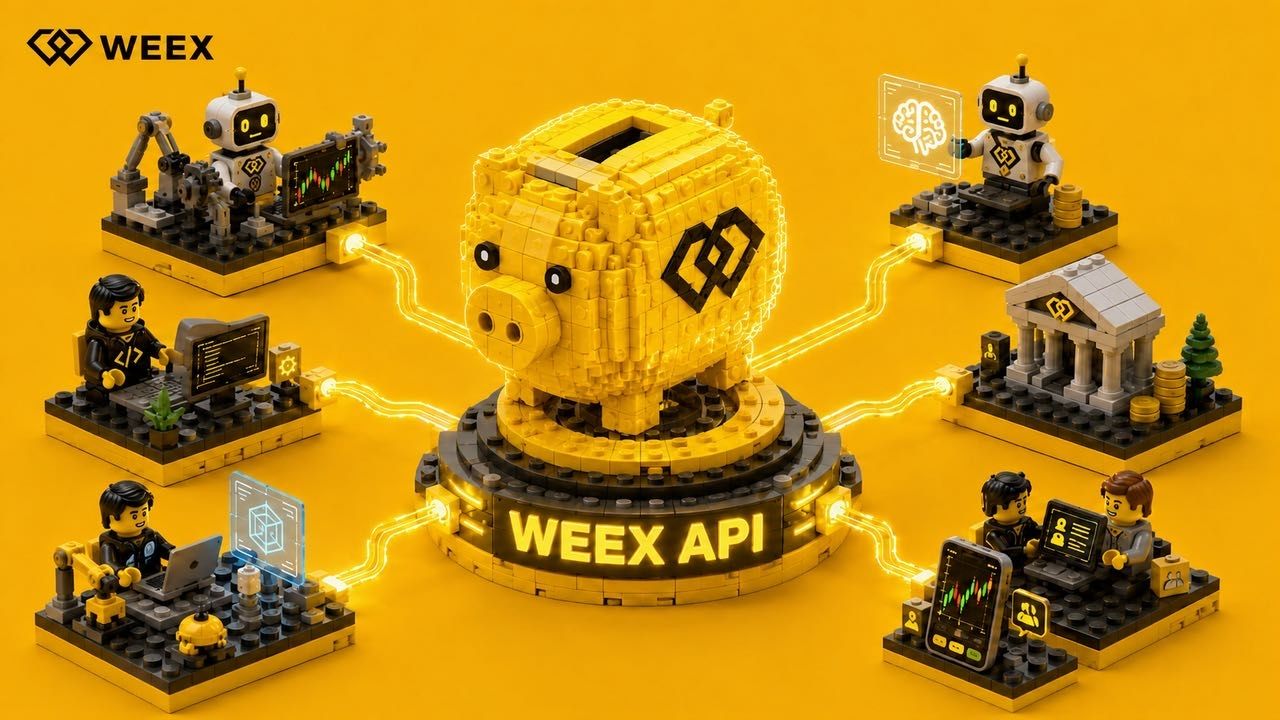

WEEX today announced the launch of its API Broker Program, giving partners access to up to 70% trading fee sharing through a fast, streamlined integration process.
Designed for AI trading platforms, trading bots, and signal communities, the program provides direct access to institutional-grade liquidity paired with OAuth Fast Connect, enabling most partners to complete full integration in just 4–5 business days.
With this launch, WEEX continues to lower the barrier for technical partners to build on top of its infrastructure — turning what has traditionally been a complex, multi-week integration process into a matter of days.
TL;DR
- What it is: The WEEX Broker program lets you embed institutional-grade crypto trading execution directly into your own product — AI trading assistant, quant platform, bot, or signal community — without building your own exchange infrastructure.
- What you earn: Commission tiers from 50% up to 70% trading fee sharing, with a faster path to top tiers than most exchanges require.
- Proven results: Partners have seen measurable growth in API trading volume and new user registrations after integration.
- What you get: 400+ spot pairs, 270+ futures pairs, $5B+ daily futures volume, OAuth Fast Connect, REST API, WebSocket, and a 99.99% SLA.
- How fast: Most partners go from signup to live trading in 4–5 business days.
- Bottom line: You build the user experience and the brand. WEEX powers the execution. Every trade becomes recurring revenue for your business.
👉 Apply to become a WEEX Broker
Every crypto cycle reshapes the industry — and crowns a new generation of builders. This cycle belongs to the builders creating the layer above exchanges: AI trading assistants, quantitative platforms, trading bots, signal communities, and intelligent trading tools. They’re not building another exchange. They’re building the future of trading itself.
WEEX powers the infrastructure. You build what users remember. The next generation of crypto trading is already taking shape.
The only question left is: who’s ready to capture the value?
Who is WEEX Broker Program For?
The WEEX Broker Program is built for teams that already have users trying to trade — but not yet the infrastructure to execute those trades themselves. This typically includes:
- AI trading assistants and signal platforms
- Quantitative strategy and portfolio management tools
- Trading bot developers
- Signal communities and trading education platforms
- Fintech and Web3 apps looking to add trading functionality
If you’re not sure whether you qualify, the fastest way to find out is to apply — the verification process will tell you exactly where you stand.
White-Label Crypto Trading: Your Product, Your Brand, Your Users
Imagine a trader who never has to leave your platform — they open your app, discover opportunities through your AI, follow your signals, run your strategies, manage their portfolio, and execute every trade, all without stepping outside your ecosystem.
Behind the scenes, WEEX provides the institutional-grade liquidity and execution that makes it all work. To your users, it’s entirely your product. To your business, every single trade becomes recurring revenue. That’s the shift that happens when you become a WEEX Broker.
WEEX Broker Case Studies: Real API Trading Volume Growth
CryptoMind, a professional crypto trading tools platform offering real-time market tracking, professional trading signals, and AI-powered market insights, had already built something most platforms struggle to earn: trust.
But there was a gap — receiving a signal was easy, executing it wasn’t, since users still had to manually create API keys and configure exchange connections, and every extra step meant fewer trades completed.
After integrating WEEX OAuth Fast Connect, that friction disappeared.
PSL OmniTrade took it further — instead of treating API trading as a feature, they made it the center of the product. Today, more than half of the platform’s volume runs through API execution.
Metric
CryptoMind
PSL OmniTrade
API Trading Volume
1900%+
3700%+
API Trading Users
1200%+
—
Effective Trading Users
—
1500%+
First-Time Traders
—
800%+
New Registrations
—
200%+
Total Futures Volume
—
140%+
Growth figures reflect internal WEEX partner data measured over a month after integration, compared against each partner’s pre-integration baseline.
That’s the real lesson: WEEX OpenAPI doesn’t just automate trading — it changes how a platform grows.
Why Platforms Choose the WEEX Broker Commission Program
Infrastructure matters. But the business behind it matters even more. WEEX offers commission tiers from 50% up to 70% trading fee sharing — one of the more accessible top-tier structures in the industry.
Compared with several leading exchanges, WEEX generally requires a lower monthly trading volume threshold to unlock top-tier commission rates, making higher tiers reachable for a broader range of partners rather than only the largest brokers.
Commission comparisons with other leading exchanges
Exchange
Commission
WEEX
50%-70%
B*****e
Up to 50%
B****t
25%-50%
B***X
40%-50%
*Based on publicly available broker program information as of July 3. Commission tiers and volume thresholds vary by exchange and are subject to change; partners should confirm current terms directly with each provider.
One API Integration, Multiple Crypto Revenue Streams
The most successful brokers never rely on commissions alone — they build an entire ecosystem around them.
Trading commissions become your foundation. Around that foundation, top Brokers layer AI subscriptions, premium strategy marketplaces, VIP memberships, portfolio management, trading education, and institutional services. Every additional product increases user value. Every trade increases your recurring revenue.
Institutional-Grade Crypto Liquidity for Every Trading Platform
Whatever you’re building, WEEX is the execution layer working underneath it:
- 400+ spot pairs
- 270+ futures pairs
- Deep institutional liquidity, average spreads under 0.01%
- Fast, reliable order matching
- 1,000 BTC Protection Fund for account-level security
You build the product. We make it pay.
Technical Overview: What Your Engineering Team Gets
For the developers who’ll actually be doing the integration, WEEX OpenAPI provides:
- OAuth Fast Connect — users link accounts in a few clicks, no manual API key setup
- REST API & WebSocket — real-time market data and order execution
- 99.99% SLA — uptime your product can depend on
- Ultra-low latency matching engine
- Dedicated integration support — a real engineer, not just documentation
[View the full API documentation]
Most partners are fully integrated within 4–5 business days.
Start Your Revenue Engine in Just 5 Days
- Day 1 — Partner verification and business review
- Days 2–4 — Technical integration with dedicated engineering support
- Day 5 — You go live
From that point on, your users keep trading inside your platform, while WEEX powers every order quietly in the background.
Join WEEX. Build Together. Win Together.
WEEX provides everything underneath. You build everything users remember.
Every trade your users execute through WEEX OpenAPI isn’t just volume — it’s revenue that’s yours to keep.
👉 Apply to become a WEEX Broker today
Disclaimer: Crypto asset trading involves significant risk, including the potential loss of principal. Commission rates, integration timelines, and program terms are subject to change and confirmed during the partner verification process. Past partner results do not guarantee similar outcomes for future partners.
About WEEX
Founded in 2018, WEEX has developed into a global crypto exchange with over 6.2 million users across more than 150 countries. The platform emphasizes security, liquidity, and usability, providing over 1,200 spot trading pairs and offering up to 400x leverage in crypto futures trading. In addition to the traditional spot and derivatives markets, WEEX is expanding rapidly in the AI era delivering real time AI news, empowering users with AI trading tools, and exploring innovative trade to earn models that make intelligent trading more accessible to everyone. Its 1,000 BTC Protection Fund further strengthens asset safety and transparency, while features such as copy trading and advanced trading tools allow users to follow professional traders and experience a more efficient, intelligent trading journey.
Follow WEEX on social media
Instagram: @WEEX Exchange
Tiktok: @weex_global
Youtube: @WEEX_Official
Discord: WEEX Community
Telegram: WeexGlobal Group
The post WEEX API Broker Program: Turn Your Trading Platform Into a Revenue Engine appeared first on BeInCrypto.
Bitcoin’s price was positively impacted by the lower-than-expected US CPI numbers for June and pumped to a three-week peak of $65,000 before it was stopped.
Most altcoins have turned green as well, with ETH climbing toward $1,900. ZEC, CC, LINK, and HYPE have marked big gains daily.
BTC Flies After CPI Numbers
After the intense volatility experienced at the start of the previous business week following Strategy’s biggest BTC sale to date and the broken ceasefire between the US and Iran, bitcoin began its gradual recovery on Wednesday from a then-low at $61,600. The bulls managed to help it rebound to $64,000 during the weekend, where it spent most of its time trading sideways.
However, the quickly intensifying and worsening situation in the Middle East took its toll on Monday morning, and the asset fell below $62,000 once again. All eyes then turned to the US CPI numbers for June, which were scheduled to be announced on Tuesday.
The general expectations showed a significant decline from the May record, but the actual data was even lower, with just a 3.5% increase. Although this number might be more misleading than it sounds, BTC’s price reacted with an immediate surge to just over $65,000 earlier today, which became a three-week peak.
It has retreated to $64,500 as of press time, but its market cap has climbed to almost $1.3 trillion. Its dominance over the alts remains stagnant at 56.7% on CG.

PI Finally Bounces
Pi Network’s native token was the poorest performer over the past couple of days, charting consecutive all-time lows. The latest came yesterday morning at just over $0.07. However, that key support provided the necessary assistance for the asset to bounce hard in the past day. PI now stands with a major 16% daily surge and trades above $0.085.
PUMP is the other double-digit gainer, surging by 14% to $0.0166. ZEC has risen the most from the larger caps, adding 9% of value and trading above $550. CC follows suit, while LINK and HYPE are up by around 5% each.
Ethereum has also posted a similar gain, and now trades above $1,870. BNB, XRP, SOL, and RAIN have marked more modest gains.
The total crypto market cap has increased by over $60 billion in a day and now sits at $2.280 trillion.

The post Pi Network’s PI Finally Rebounds as Bitcoin (BTC) Eyes $65K: Market Watch appeared first on CryptoPotato.
Payments company Stripe and private equity firm Advent International reportedly made a joint offer to acquire PayPal Holdings.
The offer includes about $50 billion in committed financing, Reuters reported Wednesday, citing sources familiar with the matter. The joint offer seeks to acquire PayPal at $60.5 per share, which would value the company at a 28% premium to PayPal’s Tuesday closing price.
This is Stripe’s second attempt to acquire PayPal. According to a February Bloomberg report, the payment processing company held early acquisition talks with PayPal, which was facing growing competition from smartphone-based payment services such as Google Pay and Apple Pay.
Both PayPal and Stripe declined to comment.
Related: Coinbase Ventures tops crypto VC list for H1 2026
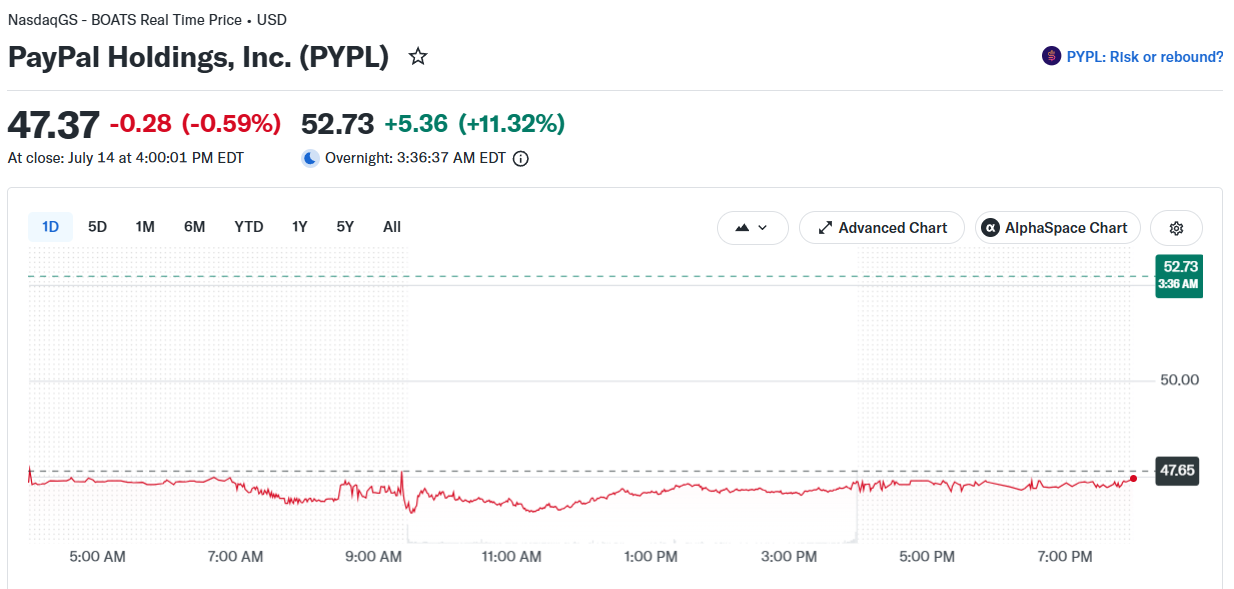
PayPal’s stock rose 11.3% to $52.73 in Wednesday premarket trading, according to Yahoo Finance data. The stock is up 14% over the past month but remains down 35% over the past year.
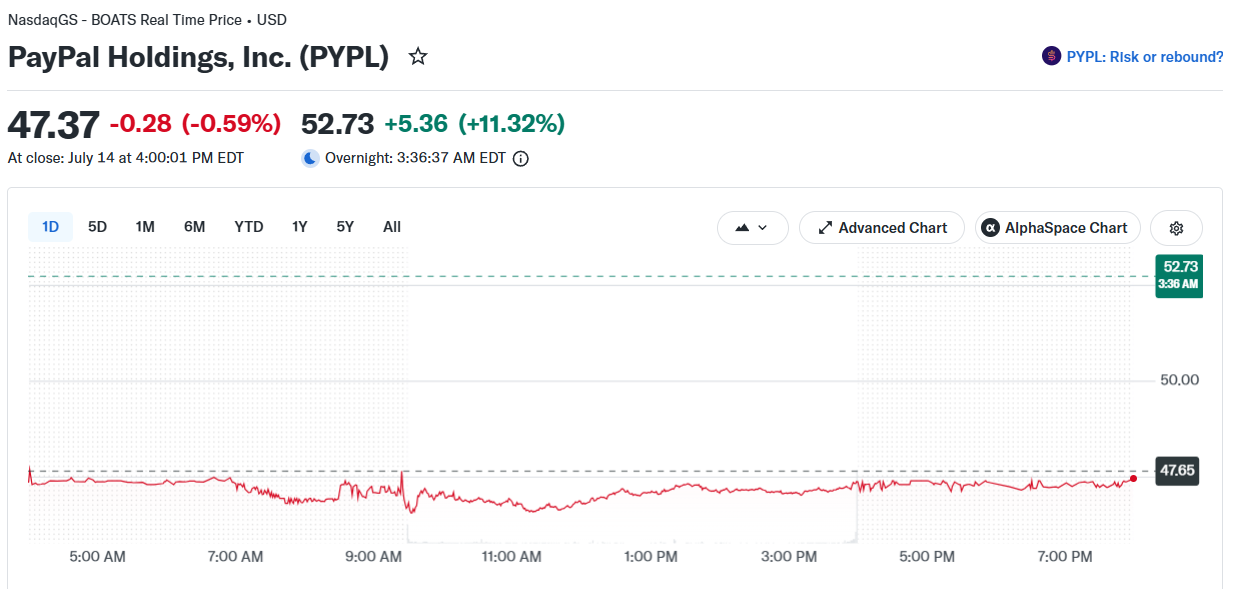
PayPal stock price, 1-day chart. Source: Yahoo Finance
PayPal and Stripe deepen stablecoin push
PayPal and Stripe have both expanded their crypto offerings in recent years. PayPal launched its PYUSD stablecoin in 2023, which peaked at a $4.2 billion market capitalization in February 2026 before retracing to about $2.85 billion, according to CoinMarketCap.
PYUSD ranks among the 10 largest stablecoins, though it remains dwarfed by market leaders Tether’s USDt and Circle’s USDC.
Meanwhile, Stripe has offered stablecoin-based accounts globally since May 2025. Its stablecoin infrastructure platform, Bridge, received conditional approval to operate as a federally chartered national trust bank under the US Office of the Comptroller of the Currency on Feb. 17.
The company has also accelerated its stablecoin payments strategy through partnerships with financial institutions and payment networks. In March, Visa said it would expand its stablecoin card partnership with Stripe-owned Bridge to more than 100 countries across Europe, Asia-Pacific, Africa and the Middle East by the end of the year.
Magazine: Strategy sells $216M Bitcoin, Bollinger bullish on BTC: Hodler’s Digest, June 29-July 6, 2026


U.S. spot bitcoin ETFs took in about $181 million on Tuesday, a day after shedding roughly $425 million, per SoSoValue data. Ether ETFs added about $58 million.
BlackRock’s IBIT drove almost all of it, pulling in roughly $139 million, with Fidelity’s FBTC adding about $21 million. No bitcoin fund lost money. On the ether side, BlackRock’s ETHA accounted for the entire net figure at about $58 million, with every other fund flat.
The swing tracks the price. Bitcoin ETFs rose close to 4% on the day and ether funds about 6%, the strongest single-session move in weeks.
Total bitcoin ETF assets climbed back to roughly $78 billion from about $75 billion, and ether ETF assets crossed $10 billion.
July’s flows have been choppy rather than directional. Bitcoin ETFs have swung between inflows and outflows nearly every other session this month, with July 13’s $425 million redemption the largest of the run and Tuesday’s rebound the second largest inflow. Neither side has held for more than three days.
June 2026 marked a pivotal month for Zoomex, as the platform’s on-chain footprint and trading activity underwent a notable transformation. Building on a stable operational foundation established through the spring, Zoomex saw a dramatic surge in exchange trade volume, sustained multi-chain asset growth, and a diversified pattern of capital inflows that together point to deepening user trust and expanding institutional interest. This report examines Zoomex’s on-chain reserves, token balances, inflow activity, and asset composition throughout June, offering a transparent, data-driven view into the platform’s liquidity health and treasury management during a period of heightened trading activity.
ZOOMEX OVERVIEW
Founded in 2021, Zoomex has grown into a global cryptocurrency trading platform serving over 3 million registered users across more than 35 countries and regions. The platform operates on its core philosophy of “Simple – User-Friendly – Fast,” a guiding principle that informs everything from its matching engine architecture to its user interface design.
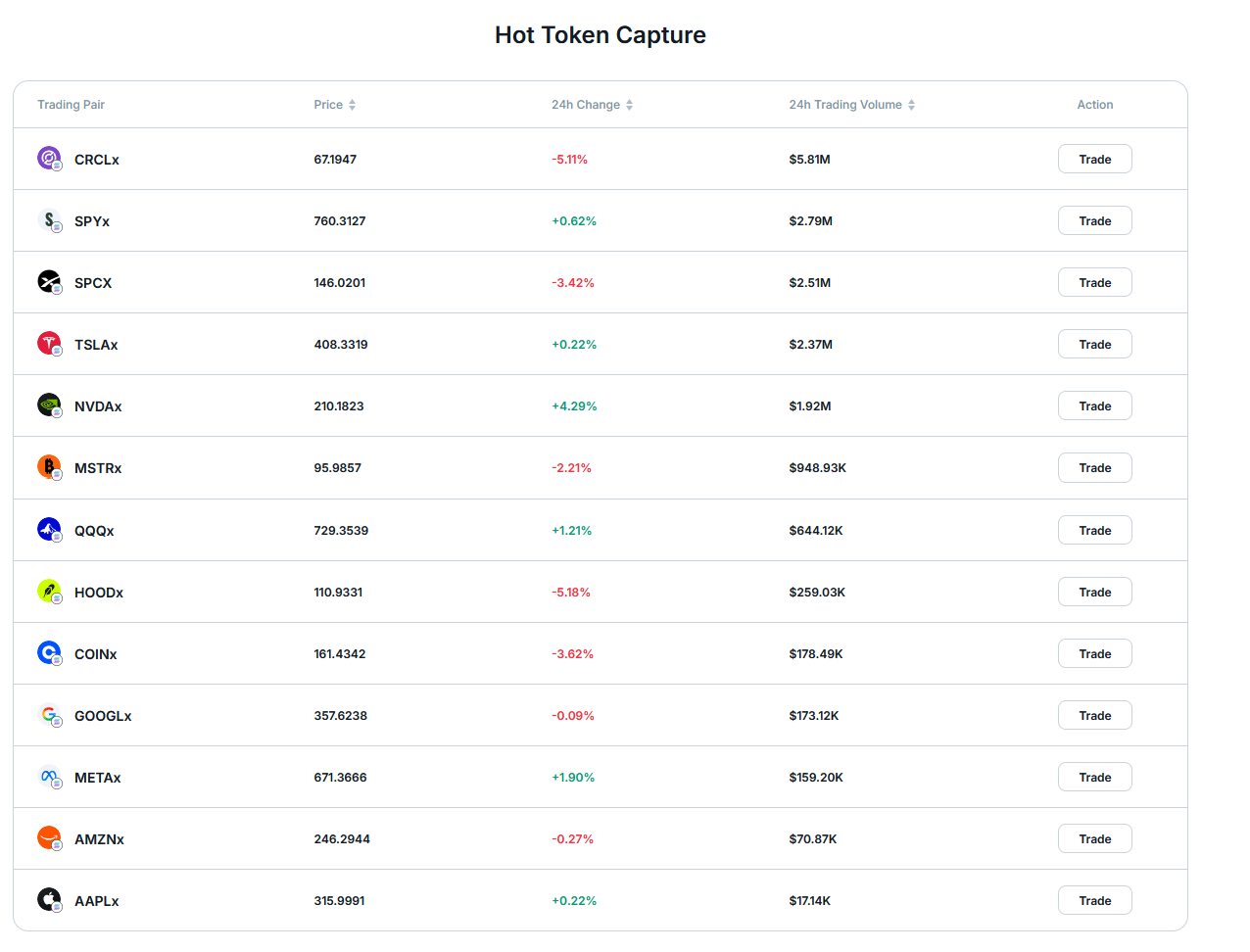
Zoomex’s product scope in June 2026 covers spot trading, perpetual contracts (USDT-margined and inverse), copy trading, and as of this reporting period, ZoomexStocks, a new instrument category giving traders access to U.S. stock-linked perpetuals including TSLA, NVDA, AAPL, META, MSTR, and COIN, all from a single crypto account without fiat conversion. This multi-product approach positions Zoomex not merely as a crypto exchange but as a unified trading ecosystem bridging digital assets and traditional equity markets.

The platform’s technical backbone is engineered for performance. Zoomex maintains sub-10ms order matching latency, and execution tests confirm that a 1 BTC market order on Zoomex results in approximately 0.03% slippage – a figure that competes directly with much larger Tier 1 platforms. This infrastructure maturity, combined with Zoomex’s regulatory registrations and third-party security audits, forms the foundation for everything documented in this report.
EXCHANGE TRADE VOLUME
Zoomex’s exchange trade volume showed a dramatic shift in activity during the three month period tracked, with June standing out as a clear outlier compared to the relatively flat baseline of April and May. Through most of April and May, daily volume hovered in a narrow range of about $0.3B to $1B, reflecting typical trading conditions.
That changed abruptly in early June, when volume spiked to roughly $5.4B around June 5th and 6th, by far the highest point on the chart, before retreating to around $1.8B just a few days later. Rather than settling back into its previous baseline, volume stayed elevated for the rest of the month, oscillating between $3B and $3.5B through mid June, dipping briefly to around $1.2B near June 21st, and rebounding to nearly $2.7B by June 24th. This sustained elevation throughout June, at times five to seven times the pre June baseline, points to a period of unusually high trading interest on the platform, before volume sharply normalized back toward levels of $0.5B to $1B heading into July.
ON-CHAIN RESERVES: CEX TRANSPARENCY TRACKER
Zoomex’s on-chain reserve position as of June 2026 stands at approximately $24,700,000 in verified exchange assets, independently calculated from publicly attributed wallet addresses and cross-referenced against DefiLlama’s CEX Transparency module. These funds are distributed across 14 separate blockchain networks, a multi-chain distribution strategy that reflects Zoomex’s commitment to supporting diverse user bases and asset types, rather than concentrating risk on a single chain.
Source: https://defillama.com/cex/zoomex
DefiLlama’s CEX Transparency module tracks cold and hot wallet addresses that have been publicly attributed to centralized exchanges and verified on-chain. For Zoomex, this means any interested party, trader, researcher, or institutional risk manager can independently confirm reserve figures in real time without relying on Zoomex’s own statements. This is the gold standard for reserve verification in 2026, and Zoomex meets it.
It is important to contextualize these reserve figures correctly. Zoomex’s on-chain reserve balance reflects verifiable cold and hot wallet holdings; it does not represent the full scope of Zoomex’s $50 million insurance fund, which is maintained separately as a dedicated reserve to protect users in extreme market events or operational failures. The combination of publicly verifiable on-chain reserves and a separately maintained insurance fund gives Zoomex a layered capital protection structure that distinguishes it from platforms offering only one or neither.
TOKEN BALANCES
Zoomex’s on-chain token balances tell a clear growth story. Holdings remained stable at roughly 13-14 trillion units through the summer and autumn months, reflecting a mature and well-managed treasury even during quieter market periods.
Then, heading into early 2026, balances more than doubled to approximately 28-30 trillion units in a single, decisive step-change. This kind of sharp, sustained expansion is not typical of organic drift; it points to a deliberate scaling of platform liquidity, likely tied to new asset listings, expanded market-making activity, or the onboarding of larger institutional flows. For traders, deeper reserves translate directly into tighter spreads, better execution on large orders, and greater confidence that the exchange can absorb volatility without slippage. Overall, this trajectory positions Zoomex on strong footing heading into the new year, with a liquidity base that has meaningfully outgrown its prior baseline.
USD INFLOWS
June’s daily inflow data paints the picture of an exchange with genuine, ongoing trading activity rather than passive or stagnant balances. Two days stand out clearly. June 5, which brought in over $2.5M in net inflows, and June 12, which added close to $1.9M, both likely tied to specific market events or large-scale deposit activity. Beyond these peaks, the regular rhythm of smaller positive and negative daily swings, oscillating gently between roughly -$1.4M and +$1M, reflects the kind of normal, healthy two-way capital rotation you’d expect from an actively used derivatives and spot trading venue.

Rather than a one-directional accumulation or a worrying drawdown pattern, this is the natural heartbeat of a liquid, well-trafficked platform, capital moving in and out as traders open and close positions, rebalance, and respond to market conditions. That consistency, day after day, is itself a strong signal of user trust and engagement.
INFLOWS BY TOKEN
Breaking the inflow data down by individual token reveals a platform attracting capital across a genuinely diverse set of assets, rather than depending on any single one. The most dramatic movement is a sharp XRP inflow spike around June 4, exceeding $3M in a single day, a strong vote of confidence from XRP holders moving assets onto the platform.

Alongside this, USDT shows the most consistent recurring inflow activity across the month, underscoring its role as the primary stablecoin of choice for traders. A notable WETH inflow near June 12 further diversifies the picture, and smaller but steady contributions from USDC, SOL, and USDT0 round out a well-rounded inflow base. This mix, spanning majors, stablecoins, and a leading layer-1 asset, is a healthy sign: it shows Zoomex is broadening its appeal across different trader profiles and asset preferences, rather than being reliant on a narrow slice of its user base.
ASSETS BY CHAIN
Zoomex’s chain-level asset distribution highlights a robust and increasingly well-established multi-chain presence. Ethereum and XRPL together anchor the bulk of on-chain holdings, consistently sitting in the $6-8M combined range throughout June, a solid, stable core that reflects the platform’s deep roots on the two most established chains in its portfolio.

What’s especially encouraging is the activity further down the chart: a sharp Solana rally between roughly June 12 and June 20, peaking near $2.5M, shows Zoomex successfully capturing momentum and capital on a fast-growing chain at exactly the right moment. This is complemented by steady, meaningful contributions from Arbitrum, Tron, BSC, and Base, each maintaining a consistent presence rather than fading in and out. Taken together, this spread of assets across seven-plus chains meaningfully reduces single-chain dependency risk and positions Zoomex as a genuinely multi-chain platform, well-placed to capture liquidity wherever trader activity migrates next.
ASSETS VALUES BY TOKEN (USD)
Looking at total on-chain asset value by token over the course of June, the overall trend is one of sustained, encouraging growth.

Total value climbed from around $4M in the first days of June to nearly $7M by mid-month, before settling into a strong and stable $6-6.5M range through the remainder of the month. XRP stands out as a key growth driver, rising from roughly $3.7M to a peak above $7M in its own right, reflecting both price appreciation and continued accumulation on the platform. This is complemented by a steady, reliable WETH holding throughout the month and a well-timed USDT0 injection around June 12 that added a further layer of stability to the asset base. Importantly, the pattern here is one of durable value accumulation rather than a short-lived spike followed by a retracement, the platform’s total on-chain value held its gains well into the back half of June, a good sign of underlying strength rather than fleeting momentum.
ASSETS BY TOKEN
The current composition snapshot confirms that Zoomex maintains a genuinely diversified and well-balanced treasury.

USDC (25.72%), USDT (24.25%), and XRP (23.45%) each account for close to a quarter of total holdings, a healthy three-way balance that avoids over-concentration in any single asset. WETH (10.95%) and ETH (6.31%) round out a solid core of major crypto assets, giving the platform meaningful exposure to Ethereum-based value alongside its stablecoin and XRP holdings. Beyond this core, a long and varied tail of smaller allocations, including SOL, USDT0, TRON, AAVE, MNT, BNB, RENDER, LINK, and CRV, among others, adds further resilience and breadth to the portfolio. This kind of layered structure, blending stablecoins, established majors, and a diverse set of smaller positions, reflects a mature and risk-aware approach to asset management, one that is well-positioned to weather volatility in any single token or chain.
PROOF OF RESERVES
As of the latest on-chain snapshot, Zoomex’s verifiable reserves stand at $21,841,515.06, spread across six major assets and reported directly by the exchange for full transparency. The allocation reflects a treasury structure weighted toward stablecoin liquidity, with strategic exposure to blue-chip crypto assets.
Stablecoins continue to anchor the portfolio, with USDT and USDC together accounting for nearly 60% of total reserves. USDT holdings across two separate wallets total approximately $4.1 million (29.95% of reserves), while USDC, similarly split across two addresses, contributes roughly $4.74 million (29.66%). This dual-wallet stablecoin structure suggests operational segmentation, likely separating hot wallet liquidity from custodial or backup reserves, a practice consistent with institutional-grade treasury management.
Beyond stablecoins, ETH represents the largest single non-stable holding at 1,311.18 ETH (~$2.36 million, 18.97% of total reserves), followed by XRP at nearly 2 million tokens (~$2.21 million, 12.28%) and BTC at 25.66 units (~$1.65 million, 9.14%). Notably, the “Others” category registers at 0.00%, indicating a deliberately concentrated reserve strategy rather than a long tail of speculative or illiquid assets.
This composition, dominated by stablecoins for operational liquidity, complemented by ETH, XRP, and BTC as core crypto reserves, signals a conservative, transparency-first approach to treasury management, reinforcing user confidence in Zoomex’s ability to meet withdrawal obligations at scale.

Source: https://coinmarketcap.com/exchanges/zoomex/
PLATFORM COMMUNITY AND USER METRICS
Zoomex ended June 2026 with over 3 million registered users across more than 35 countries and regions. The platform’s Telegram community has grown from 69,663 members to 70,004, reflecting active engagement among Zoomex’s core retail trading base.
Zoomex’s daily active trader count consistently exceeds 1 million users according to independent review data, TradersUnion, making it one of the most actively used mid-tier exchanges globally by session volume. The platform regularly adds new assets based on market demand combined with rigorous vetting, as of this report, Zoomex lists 486–495 cryptocurrencies and operates across 518–575 trading pairs depending on the market segment (spot or derivatives), a figure that has grown steadily through 2026.
The post Zoomex Monthly On-Chain Report: June 2026 appeared first on BeInCrypto.


The U.K. plans to issue a digital sovereign bond by early 2027, becoming the first of the seven leading industrialized nations to place government debt on a distributed-ledger infrastructure.
Chancellor Rachel Reeves announced the timeline in her annual Mansion House speech to industry leaders. The government plans further issuance after the initial sale.
The Digital Gilt Instrument, known as DIGIT, will be a sterling-denominated government security issued on HSBC’s Orion platform and will operate inside the Bank of England and Financial Conduct Authority’s Digital Securities Sandbox.
The Treasury announced the pilot in 2024 to test whether blockchain infrastructure could reduce settlement times, reconciliation work and operating costs. HSBC was appointed to run the platform in February, having issued over $3.5 billion in digital bonds through its Orion blockchain.
Speaking at the same event, Bank of England Governor Andrew Bailey said the central bank will work to make DIGIT eligible as collateral in its market operations. That could support tokenized repo and allow banks to use the bond in central bank funding transactions.
The Treasury has not disclosed the bond’s size, maturity, coupon, investor eligibility or settlement asset. The initial sale will sit outside the government’s conventional gilt-financing program.
June was a month of contrasts for Zoomex. While broader crypto markets absorbed one of the sharpest macro shocks of the year, the platform kept shipping, a full Prediction Market launch, an expanded World Cup campaign calendar, a run of tokenized equity products, and a five part charity initiative built around its Formula 1 and football partnerships. The month proved that infrastructure discipline matters most precisely when the market gets loud.
Market Overview: June 2026
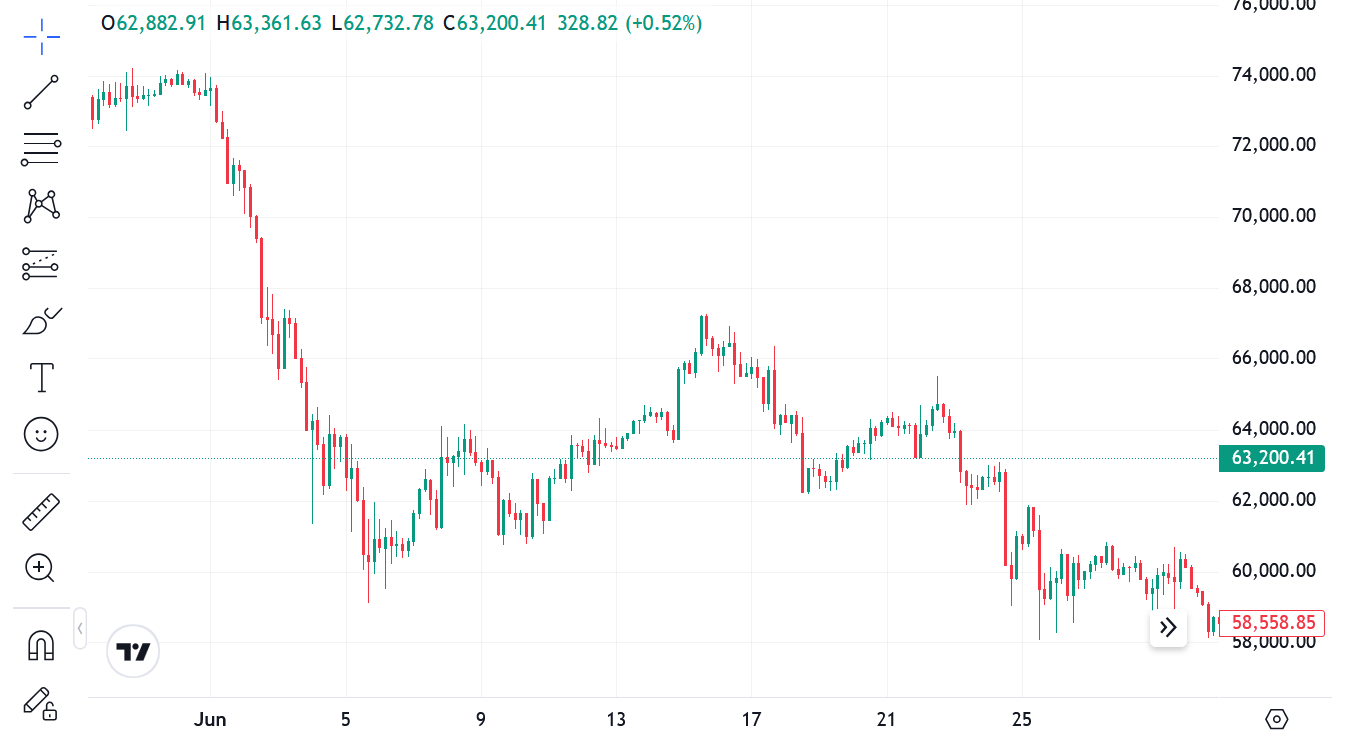
June opened with Bitcoin near $73,600 and closed down roughly 18% for the month, one of the worst monthly candles of the year.

Source: Coinmarketcap
The slide started early, a surprise Strategy sell off of 32 BTC on June 3 rattled leveraged longs, and by June 5, Bitcoin had broken below $62,000, triggering roughly $1.5 billion in liquidations in a single day. U.S. spot Bitcoin ETFs bled about $2.7 billion that same week, pushing 2026 year to date net outflows past $3.1 billion, as institutional capital rotated hard toward AI and semiconductor names instead.

The real inflection point came on June 17, when new Fed Chair Kevin Warsh held his first FOMC meeting. The rate held at 3.50% to 3.75% was fully priced in, but Warsh’s decision to abandon forward guidance and the dot plot’s jump to a 3.8% median year end projection, up from 3.4% in March, caught markets off guard. The hawkish surprise wiped out roughly $2 trillion across stocks, gold, silver, and Bitcoin within minutes, and the Crypto Fear & Greed Index dropped into “Extreme Fear,” touching a low of 13.

Source: Coinmarketcap
Bitcoin spent the rest of the month consolidating in the high $50,000s to mid $60,000s range, closing near $58,500 on June 30, more than $48,000 below where it stood a year earlier. Ethereum tracked the same weakness, sliding toward the $1,700 to $1,750 zone around the FOMC decision.

Source: Coinmarketcap
Against that backdrop, capital rotation became the defining theme of the month rather than a single price level. AI and semiconductor stocks surged roughly 170% over the same stretch that ETFs saw outflows, a divergence sharp enough that a single session saw the Philadelphia Semiconductor Index rise 5.9% as Bitcoin fell around 4%.

For traders who wanted exposure to both stories without leaving a single account, that gap became the argument for the month.
Zoomex by the Numbers
Zoomex’s core value proposition, sub-10ms execution latency, deep liquidity, and a minimalist interface, held up through a month defined by whipsaw price action rather than steady trends. The platform continues to serve 3 million plus registered users across 35+ regions, with a catalogue that has grown past 700 trading pairs spanning Perpetual USDT, Inverse Perpetuals, Spot, and now tokenized equities. Order book depth and dual liquidity pool architecture, combining internal liquidity with aggregated external market depth, remained the platform’s answer to the kind of volatility that broke matching engines elsewhere during comparable stress events.
The month’s real infrastructure test arrived on June 17, when the FOMC’s hawkish surprise triggered a wave of liquidations across the derivatives market. Platforms with thin order books or single source liquidity typically see slippage spike hardest in exactly these windows. Zoomex’s architecture is built for that scenario specifically, minimal spread degradation during high volatility, institutional grade uptime, and a fee and reward structure that keeps user capital moving rather than parked. June’s rotation toward tokenized stocks, discussed below, only reinforced why that infrastructure choice matters when traders are actively moving capital between asset classes inside a single account.
What We Shipped in June
Zoomex Prediction Market: Officially Live

On June 4, Zoomex officially launched its Prediction Market, timed almost exactly with the World Cup kickoff. The product lets users take a position on crypto price movements, sports outcomes, and trending global events using crypto, and its standout feature is flexibility: unlike a traditional pre-match bet, users can sell, increase, reduce, or reverse their prediction shares as a match unfolds, turning static predictions into an in-play trading experience shaped by goals, cards, substitutions, and shifting market sentiment.
Zoomex announce Global Stock-Related Assets Land on Zoomex Perpetual Contracts

Zoomex has officially launched 50 stock-related perpetual contracts covering major global assets across tech, AI, crypto-concepts, and ETFs, offering leverage options up to 20x. While registration for the previous 50% trading fee rebate campaign has closed (fully concluding on June 26, 2026), traders are encouraged to sign up for the newly launched, limited-time campaign to trade these stock perpetuals with zero fees.
Stablecoins Are the New Payment Rails: What It Means for Traders

Stablecoins have officially evolved into mainstream financial infrastructure, with on-chain settlement volumes surpassing $33 trillion and major networks like Visa, Stripe, and PayPal natively integrating them into production. Driven by regulatory clarity from the US GENIUS Act and EU’s MiCA, stablecoins like USDT and USDC provide instant, low-cost cross-border efficiency that completely bypasses legacy banking friction.
For traders, Web3-native platforms like Zoomex capitalize on this shift by operating entirely within a stablecoin-denominated environment, offering 24/7 derivatives trading with deeper liquidity, tighter spreads, and instant capital redeployment. Ultimately, the accelerating velocity of stablecoins marks a permanent upgrade to global payment rails, rendering traditional fiat constraints obsolete.
Zoomex X Space With Ollie Bearman, WallStreetBets, and Nuseir Yassin

The Zoomex X Spaces session, moderated by Fernando Lillo, united Haas F1 driver Ollie Bearman, crypto commentator WallStreetBets, and creator Nuseir Yassin to explore the shared dynamics of high-stakes environments, rapid decision-making, and the psychological traps of success. Bearman highlighted that while rigorous preparation sets a baseline, long-term accumulated instinct is what truly allows someone to navigate unpredictable challenges on the track.
WallStreetBets and Yassin built on this by reframing intense pressure as a powerful drug for growth rather than a symptom to manage, advocating for public accountability and leveraging AI rather than resisting it. Crucially, the speakers warned that success can insulate individuals from reality, creating a dangerous feedback loop—meaning that maintaining ruthless self-discipline and keeping honest people close is vital. Blending these insights with corporate innovation, the session concluded with the announcement of Zoomex’s new prediction market partnership with Polymarket, signaling an expansion into global sports and macroeconomic forecasting.
Zoomex: The Prediction Market

Zoomex held Episode 4 of its panel series, moderated by Fernando Lillo, which took place on June 11th at 15:00 UTC. The session brought together speakers @Teo Mercer, @Xia, and @Moon1lightSt to discuss pressing crypto and sports trends, specifically focusing on the prediction market, the World Cup, and the recent Bitcoin dip. Highlighted by a 500 USDT incentive, the event put a special spotlight on @Moon1lightSt’s insights regarding football dynamics and market forecasting.
Zoomex announce MCP Server

Zoomex has officially launched its new Zoomex MCP Server, allowing users to connect their AI assistants directly to the platform for a more streamlined trading experience. Through a single, unified interface, traders can now enjoy faster access to real-time market data, asset overviews, live positions, and order histories. Aimed at helping users trade smarter with highly organized information, this integration marks the beginning of a broader rollout of advanced AI capabilities promised by Zoomex.
World Cup Prediction Market Campaign

Building directly on the Prediction Market launch, Zoomex opened its dedicated World Cup Prediction Market Campaign on June 16, running through July 18. Users complete tasks to unlock Lucky Spin draws for rewards including World Cup final and semi-final tickets, gift boxes, airdrop rewards, margin deduction coupons, and futures trial funds, extending crypto’s role in fan engagement well beyond simple giveaways.
Zoomex World Cup Pass Challenge

Zoomex hosted its World Cup Pass Challenge, an interactive promotion where users can predict, trade, and climb the leaderboard to win tickets to a FIFA World Cup match. The platform highlighted that the first group of winners and partners, including representatives from Discover Crypto – has already arrived in Kansas to witness football stars Lionel Messi and Emiliano “Dibu” Martínez play for Argentina. For traders looking to secure their own spots, Zoomex emphasized that the event window remains open, offering an ongoing opportunity to join the challenge and win tickets.
Zoomex X Space Recap With Djibril Cissé and the World Cup Trading Panel

Zoomex hosted the first episode of its World Cup Edition X Space as part of the ZoomX World Cup Impact Pledge, bringing together Champions League winner Djibril Cissé and four crypto traders: Dieguito Charts, Bitsofwealth, Mega, and 5.0 Trading. Fernando Aranda hosted the session, which ran across pressure management, football analysis, career philosophy, and the kind of crypto-to-football comparisons that only hold together when neither side takes them too seriously.
Zoomex Stocks
Amidst a notable shift of institutional capital from crypto to artificial intelligence, Zoomex has launched Zoomex Stocks to give traders seamless, 24/7 access to both asset classes from a single account. The launch arrives as U.S. spot Bitcoin ETFs faced $2.7 billion in weekly outflows in early June 2026, while AI and semiconductor stocks surged.
Available under the platform’s Spot section, the product features twelve major tokenized U.S. equities and ETFs (including NVDAx, TSLAx, and QQQx) powered 1:1 by MiFID II-compliant real assets via xStocks. By utilizing the existing Unified Trading Account (UTA), crypto-native traders can instantly rotate their positions into high-momentum equities using USDT, bypassing traditional brokerage barriers, fiat rails, and rigid market hours with a flat 0.50% fee and near-instant on-chain settlement.
Zoomex Monthly On-Chain Report: May 2026

The Zoomex May 2026 Monthly On-Chain Report highlights the platform’s commitment to strict financial transparency, backed by independently verifiable metrics via DefiLlama’s CEX Transparency module. Navigating a high-volume, highly volatile market where Bitcoin peaked near $111,000 before a 20% correction, Zoomex processed $168 billion in total combined volume for the month—a staggering 74% month-over-month growth driven by active retail flows shifting away from traditional crypto ETPs.
Operating with sub-10ms matching latency and a low 0.03% slippage, the exchange reported $23.99 million in verified multi-chain reserves alongside a separate $50 million insurance fund. Furthermore, the report emphasizes Zoomex’s robust spot market structure (dominated by BTC/USDT and an incredibly deep USDC/USDT stablecoin corridor), steady liquidity in its 24/7 macro-hedging XAUT/USDT pair, and the successful traction of ZoomexStocks, a unified feature allowing seamless, crypto-native exposure to major traditional equities like Tesla, NVIDIA, and Apple.
Zoomex X Space With Didi Hamann and the World Cup Trading Panel

Zoomex hosted the second episode of its World Cup Edition X Space as part of the Zoomex World Cup Impact Pledge, bringing together Champions League winner Didi Hamann and three traders: Mario from Forex Trading & Investing, Crank, and Joseph. Fernando Aranda hosted the session, which ran across World Cup analysis, the German squad debate, career philosophy, and the kind of crypto-to-football comparisons that only hold together when neither side takes them too seriously.
Conclusion
June was the month the macro backdrop finally caught up with crypto, and Zoomex’s response was to keep building rather than retreat. A live Prediction Market timed to the World Cup, a full tokenized equities suite answering the AI rotation directly, two World Cup campaigns running in parallel, and a five part charity series pairing football culture with real donations. Not a pause. Continued output through the sharpest drawdown of the year.
The macro numbers explain why that mattered: Bitcoin down roughly 18% for the month, $2 trillion wiped out across risk assets in minutes on June 17, and the Fear & Greed Index sitting in Extreme Fear for most of the back half of the month. Zoomex’s sub-10ms execution infrastructure and dual liquidity pool architecture were built for exactly this kind of stress, and the platform’s regulatory stack, FINTRAC, FinCEN, NFA, AUSTRAC, FATF Travel Rule, stayed unchanged and fully active through it.
No platform token. No VC entanglements. No user funds at risk.
June confirmed what May suggested: reliability compounds precisely when markets don’t cooperate, and the platforms still shipping through a hawkish Fed surprise and an $18 billion monthly drawdown are the ones building for the World Cup final and beyond, not just for the next bull run.
The post Zoomex Monthly Transparency Report: June 2026 appeared first on BeInCrypto.

FREEDOM FROM FINANCIAL CAPTIVITY WITH APOSTLE JOSHUA SELMAN 16||04||2023
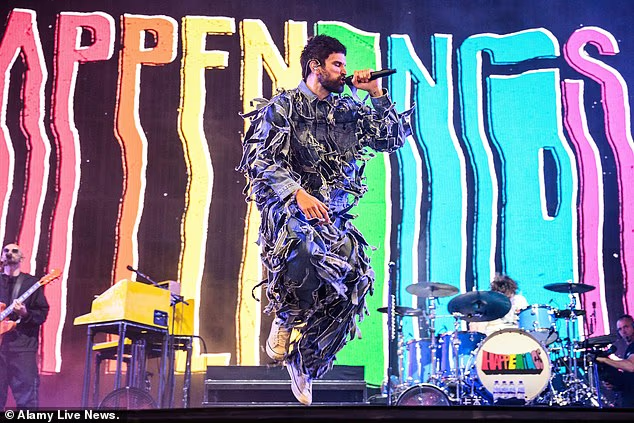
Kasabian’s Serge Pizzorno details ‘dark and horrendous time’ lead singer Tom Meighan left the band following his assault conviction and says they’ve never spoken again

WA truckers, farmers raise concern over proposed trailer safety device


-

 Fashion6 days ago
Loro Piana Fall 2026 Enters Houston’s Art Scene
-

 Fashion4 days ago
Weekend Open Thread: Nutriplenish Leave-In Conditioner
-
 Sports6 days ago
2026 Genesis Scottish Open Thursday TV coverage: Round 1
-

 Sports5 days ago
Super Eagles star Moses Simon opens up on Liverpool transfer regret
-

 Tech6 days ago
Character.AI enters the microdrama arena with its own productions, but there’s a twist
-

 News Videos13 hours ago
XRP BOMBSHELL… XRP OMBOARDED FOR TRANSACTIONS!!!
-

 Tech1 day ago
Get Your ESP32 Sunny Side Up With This Solar Dev Board
-

 Tech13 hours ago
Dark Secrets Emerge When Jailbreaking LLMs
-

 News Videos6 days ago
Crypto Just Entered Its Most Important 6-Month Candle (Could Decide Everything!)
-
 NewsBeat6 days ago
Major update after Huntingdon train attack as man enters plea
-

 News Videos2 days ago
how to make coin bank box with cardboard #scienceproject #money #diy #shorts
-
 Sports7 days ago
39-year-old Djokovic wins five-hour thriller to enter Wimbledon semis | Other Sports News
-

 Tech6 days ago
Level Infinite Launches Gangstar Mirage City in India with Pre-Registrations
-
 Tech2 days ago
Cloudflare Precursor Watches Your Mouse and Keyboard To Decide If You Are Human
-

 Tech6 days ago
Entra passkey enrollment vishing targets Microsoft 365 users
-
 Crypto World6 days ago
DeFi Dashboard Zapper to Shut Down After 7 Years
-
 Crypto World6 days ago
Mark Cuban-Backed DeFi Dashboard Zapper Shuts Down After 7 Years
-

 Tech6 days ago
Claude’s New Reflect Dashboard Wants To Help You Log Off Of Claude
-

 Crypto World6 days ago
Fed minutes June 2026: officials split on rates
-

 Tech7 days ago
Former OpenAI exec Kevin Weil is now on the board of Stoke Space
You must be logged in to post a comment Login