

Crypto World
Piper Sandler says Strait of Hormuz to remain closed for months and oil to hit new highs


Piper Sandler isn’t buying the talk that an Iran deal is nearing, telling clients that the Strait of Hormuz will largely stay closed and oil will hit new highs.
“We think the Strait of Hormuz remains largely closed for months yet, meaning shortages become more urgent and oil hits new highs this Summer,” according to a recent note from the investment bank’s energy and macro teams.
West Texas Intermediate Futures are down since Friday but bounced back some on Tuesday with mixed messaging on a possible Iran deal over the long weekend. The U.S. military said it conducted “self-defense strikes” in southern Iran, which included targeting Iranian missile launch sites and vessels placing mines around the Strait of Hormuz. The news came after President Donald Trump said Saturday that an agreement with Iran has been “largely negotiated“, with details to be announced shortly. Meanwhile, Iran’s foreign ministry has said navigation through the vital shipping channel “will have costs.”
Piper Sandler said it has very little confidence that the commercial traffic through the Strait would return to even 50% of its pre-crisis levels, either next week or next month.
The U.S. has been “unwilling to press the fight” because the scale of Iran’s retaliation could have broader implications for its neighbors and may further disrupt global supply chains, the note said.
The bank also argued that Iran’s leaders are unwilling to settle for any compromise because they believe they have leverage, reinforcing concerns that the Strait closure could extend for months.

WTI crude, YTD
Various economies in the Middle East, Asia and Europe rely heavily on shipment through the Strait, which is particularly important for oil and LNG exports from the Middle East to Asia. The narrow passage that once carried about one-fifth of the world’s seaborne oil has seen historic dips, with tracking data showing vessel traffic falling sharply to near zero since the war escalated.
WTI crude futures neared $120 a barrel during the onset of the conflict, but were last trading around $94 a barrel. If Piper Sandler’s call for a new high comes true, it would send quite a jolt to the global economy and undermine the stock market comeback that has come as oil traded off that war-time high.



Stable, a USDT-focused Layer 1 blockchain, has launched StableEarn, a USDT yield vault tied to Treasuries and gold.
Summary
- Stable launched StableEarn with partners Morpho, Gauntlet, and Theo, offering USDT holders institutional-grade yield backed by Treasuries and real-world assets.
- The product targets USDT’s structural yield gap, as Tether keeps all reserve interest as profit rather than passing any return to token holders.
- Tether’s USDT supply stands at approximately $150 billion across 15 blockchains, the world’s largest stablecoin by circulation, but one that pays zero native yield to holders.
Stable, the USDT-dedicated Layer 1 blockchain, launched StableEarn, an institutional yield vault that lets USDT holders earn returns tied to US Treasuries and gold.
The product was developed in partnership with Morpho for lending infrastructure, Gauntlet for risk modeling, Theo for yield strategy, and Utila.io for enterprise-grade wallet security.
“USDT moves more value than any other stablecoin in the world, but putting it to work always had challenges when it came to competitive yields,” said Brian Mehler, CEO of Stable. “StableEarn changes that by bridging together institutional-grade yield and the chain built around USDT. The world’s largest stablecoin has a new home, and it’s on Stable.”
What StableEarn does and why USDT holders need a yield product
USDT pays no protocol-native yield to its holders. Tether keeps the interest spread between its zero-yield USDT deposits and the US Treasury bill reserves that back them, which is why Tether generated more than $10 billion in profit in 2025 alone.
That structural gap has driven demand for third-party products that bring USDT into productive use without requiring holders to bridge to other stablecoins.
StableEarn routes USDT holdings through real-world asset-backed strategies vetted by Gauntlet’s risk modeling. Returns come from traditional market instruments rather than from DeFi-native mechanisms, positioning it as a lower-risk yield option compared to delta-neutral synthetic stablecoin products.
Iggy Ioppe, CIO of Theo, described the product as “what on-chain dollar yield looks like done right. USDT-native, institutional-grade, with returns generated by real-world markets.”
Tether’s USDT supply stands at approximately $150 billion as of May 2026, having grown from roughly $118 billion at the start of 2025. Crypto.news has covered the ongoing intersection of stablecoin yield products and regulatory progress, as Congress debates yield-bearing stablecoin frameworks under the GENIUS Act.
Why the timing matters as institutional stablecoin yield demand scales
Yield-bearing stablecoins have grown from a niche experiment to a meaningful slice of the $311 billion total stablecoin market. Tokenised Treasury products including Ondo’s USDY and Sky’s sUSDS now serve as default treasury holdings for funds seeking passive dollar yield without managing T-bills directly.
StableEarn is the first vault designed specifically for USDT within its native chain, removing the need for USDT holders to bridge to Ethereum or other networks to access comparable products.
Morpho’s institutional lending architecture, which underpins StableEarn, is already deployed across multiple chains and is widely used by DeFi treasury managers as the risk-standard infrastructure for on-chain lending.
Crypto.news has reported on the US Treasury’s proposed AML rules for stablecoin issuers under the GENIUS Act, which would treat payment stablecoin operators as financial institutions and impose compliance obligations that institutional yield products like StableEarn must be designed to meet.
Crypto.news has also tracked the growth of tokenised Treasuries to $13.4 billion by April 2026, the asset class from which StableEarn draws its underlying returns.


Polkadot's governance has approved a proposal to establish a 10,000 DOT minimum self-stake requirement for validators. The approved upgrade introduces significant changes to the network's staking mechanics, including eliminating slashing risk for nominators and drastically reducing unbonding times… Read the full story at The Defiant


Strive Bitcoin treasury holdings reached 16,500 BTC after an $85.4 million buy that leapfrogged both Coinbase and Riot Platforms.
Summary
- Strive (NASDAQ: ASST) disclosed via 8-K on May 26 that it purchased 1,109 Bitcoin for $85.4 million at an average of $76,988 per coin between May 19 and May 22.
- The purchase pushes Strive past Coinbase’s 16,492 BTC and Riot’s 15,680 BTC holdings, making it the seventh-largest public corporate Bitcoin holder per BitcoinTreasuries data.
- Strive reported a 23.4% year-to-date Bitcoin yield and an amplification ratio of 45.2%, funding purchases through preferred equity SATA shares and at-the-market stock sales.
Strive, Inc. disclosed via an 8-K filing on May 26 that it purchased 1,109 Bitcoin (BTC) between May 19 and May 22 for approximately $85.4 million at an average cost of around $76,988 per coin.
The acquisition brings Strive’s total Bitcoin holdings to 16,500 BTC, pushing the company ahead of Coinbase and Riot Platforms in the public corporate Bitcoin holder rankings.
“Strive acquired an additional 1,109 BTC for ~$85.4 million at an average cost of ~$76,988 per bitcoin,” CEO Matt Cole posted on X alongside an internal snapshot of the company’s performance metrics.
How Strive climbed to seventh place among public Bitcoin holders
The $85.4 million purchase follows earlier May acquisitions of 382 BTC for $30 million on May 18 and 444 BTC for $33.9 million in early May. Strive completed its acquisition of Semler Scientific in January 2026, entering that transaction with 12,798 BTC and ranking eleventh among public corporate holders. It has since added more than 3,700 BTC to climb to seventh.
Strive funds Bitcoin accumulation primarily through at-the-market equity sales and its Variable Rate Series A Perpetual Preferred Stock instrument, the SATA shares, which carry a 13% annual dividend.
The SATA offering raised more than $225 million in an oversubscribed January 2026 round that attracted over $600 million in demand, providing a sustained capital base for continued purchases.
The company reported a year-to-date Bitcoin yield of 23.4%, a quarter-to-date yield of 11.0%, and an amplification ratio of 45.2%. Strive defines Bitcoin yield as the percentage change in Bitcoin per share outstanding, its primary performance metric against a Bitcoin benchmark.
Crypto.news has reported on Strategy CEO Michael Saylor saying a Bitcoin sale is “not unlikely” before year-end, providing context for how corporate Bitcoin treasury strategies are diverging as holdings mature.
What Strive’s position signals about the corporate Bitcoin accumulation landscape
Strive’s 16,500 BTC places it just above Coinbase’s 16,492 BTC and well above Riot’s 15,680 BTC. Strategy remains the dominant corporate holder by a wide margin with 818,334 BTC.
The gap between Strategy and the next-largest holders illustrates how concentrated the corporate Bitcoin (BTC) accumulation story remains, with a handful of firms accounting for the overwhelming majority of publicly held BTC.
Crypto.news has covered MARA Holdings selling $1.5 billion in Bitcoin to fund its AI infrastructure pivot, a contrasting approach to Strive’s pure accumulation model.


Hyperliquid has added validator-settled outcome markets for offchain events under its HIP-4 upgrade, expanding its trading system beyond perpetual futures into prediction markets.
Summary
- Hyperliquid has added offchain outcome markets under HIP-4, allowing validators to deploy and settle prediction markets inside its network.
- The system reduces reliance on external oracle services by letting validators vote on market deployment and final settlement.
- The first offchain market, “May CPI year-over-year,” shows how Hyperliquid plans to support real-world event trading alongside perpetual futures.
Hyperliquid said the new markets will be published through automated newsfeed software that validators run as part of normal chain operations. The exchange said validators will vote on which canonical markets are deployed and how those markets are settled after the event ends.
The system gives Hyperliquid validators a role that other prediction market platforms usually assign to a separate oracle service or an internal settlement process. Hyperliquid said validators will assess market rules, correctness, and market quality before deployment and during settlement.
“Validators vote on deployment and settlement of canonical markets based on a variety of factors, including unambiguous rules, correctness, and subjective quality of the market,” the team said.
Hyperliquid uses Validators for event resolution
Under the HIP-4 design, market resolution happens inside Hyperliquid’s own network. Validators act as the source for settling real-world events, rather than sending disputes or settlement decisions to an outside system.
Hyperliquid developer Yaugourt said on X, “Hyperliquid just removed the need for external oracles on prediction markets. The validator set itself is now the oracle.” In the same post, Yaugourt said Hyperliquid had made real-world event resolution “a native chain function.”
The model differs from Polymarket and Kalshi. Polymarket uses UMA’s Optimistic Oracle, where users can propose outcomes and dispute them through a separate protocol layer. Kalshi, which operates as a regulated exchange, handles settlement through its own exchange framework under regulatory oversight.
For Hyperliquid, the “canonical” label refers to markets vetted and settled by validators. The exchange’s announcements said validators consider whether market rules are clear and whether the market meets quality standards before it becomes part of the official outcome market system.
HIP-4 brings fully collateralized Prediction markets
Hyperliquid said outcome markets went live on mainnet on May 2 through an initial release with limited features. The HIP-4 upgrade extends the exchange’s product range from perpetual futures to event contracts tied to real-world outcomes.
According to Hyperliquid, these outcome contracts are fully collateralized. They settle within a fixed range and do not involve leverage or liquidations. The exchange said this structure separates them from perpetual futures while keeping them within the same trading environment.
On Monday, Hyperliquid launched its first off-chain event market, titled “May CPI year-over-year.” According to its trading page, the market had recorded $11,268 in volume.
The first market shows how the exchange plans to use HIP-4 for public events that happen outside blockchain networks. Economic data releases, such as inflation figures, are one category of events that can be priced by traders before final settlement.
Shared collateral adds trading desk use case
The new market format also gives Hyperliquid users a way to hold event market positions and perpetual contracts in one account. A single account can use shared collateral across different types of positions on the platform.
Sunny Shi, an investor at Syncracy Capital, said, “Sophisticated traders will be able to take advantage of portfolio margin and figure out ways to generate alpha from these two different market types.”
The structure may be relevant for trading desks that compare capital use across standalone prediction markets and derivative venues. Hyperliquid’s setup keeps outcome markets inside the same exchange system that already supports perpetual futures trading.
Several Bitcoin mining stocks rallied Tuesday, reflecting a broader equity surge driven by optimism around artificial intelligence productivity gains as more miners pivot toward AI and high-performance computing workloads.
In addition to TeraWulf (WULF), which rallied by as much as 17% on news of a Kentucky data center acquisition site, Hut 8 (HUT), IREN (IREN) and Riot Platforms (RIOT) closed more than 5% higher on the day.
The rally underscores growing investor enthusiasm for Bitcoin miners that are repurposing parts of their energy infrastructure and data center capacity to support AI and high-performance computing applications — businesses viewed as potentially more stable and lucrative than crypto mining alone.
The gains came as the S&P 500 index hit fresh record highs above 7,500, led by a sharp rally in information technology and semiconductor stocks.
The Philadelphia Semiconductor Index, which tracks the performance of major US chipmakers and semiconductor companies, surged 5.6% on Tuesday and is now up nearly 77% this year.
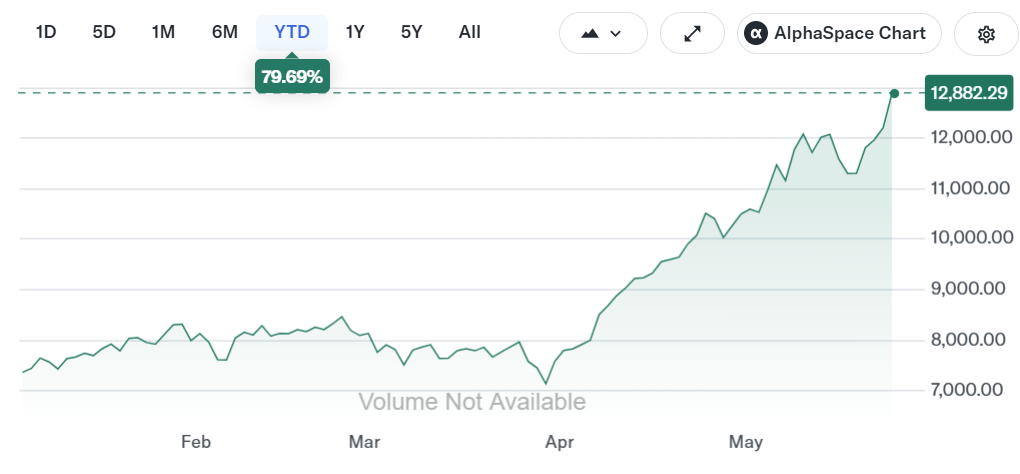
Year-to-date returns for the Philadelphia Semiconductor Index (SOX).
Source: Yahoo Finance
The semiconductor boom has also boosted sentiment around Bitcoin miners expanding into AI infrastructure, given their access to large-scale power capacity and data center operations needed to support high-performance computing.
Related: The real ‘supercycle’ isn’t crypto, it’s AI infrastructure: Analyst
Bitcoin miners emerge as AI infrastructure players
The link between Bitcoin miners and the AI infrastructure buildout is becoming increasingly pronounced as miners leverage their large-scale power access and data center expertise to support high-performance computing workloads.
Recent research from Bernstein found that 11 publicly traded Bitcoin miners control a current and projected power portfolio of roughly 27 gigawatts — a resource analysts believe could become critical as demand for AI data centers accelerates.
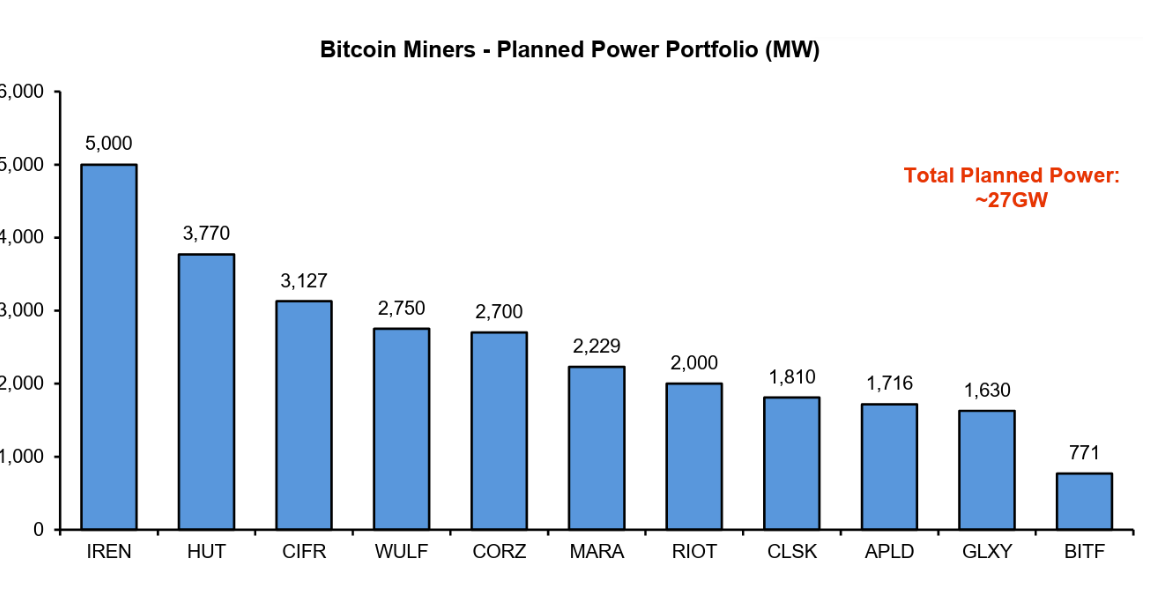
11 public Bitcoin miners have a planned power portfolio of roughly 27 gigawatts. Source: Bernstein
The report posited that access to reliable electricity, rather than semiconductors alone, is emerging as the primary bottleneck for scaling AI infrastructure. That dynamic positions Bitcoin miners as strategic partners for hyperscalers and AI companies seeking ready-made power capacity and operational infrastructure.
In a separate note, Bernstein analysts said the shift is already evident among large-scale miners, citing IREN as an example of a company increasingly pivoting away from Bitcoin mining toward AI infrastructure. The firm pointed to IREN’s recent agreement with Microsoft, which Bernstein estimates could support an annualized revenue run rate of roughly $3.7 billion for the company’s AI cloud infrastructure business.
Related: CoreWeave’s $8.5B loan shows how AI is replacing crypto mining finance


U.S. President Donald Trump said it was “critically important” that the CFTC keep “exclusive authority” over prediction markets, echoing CFTC Chair Michael Selig in a post on Truth Social, his social media platform, late Tuesday afternoon.
“Under my leadership, we are setting ‘rules of the road’ that are the Gold Standard for the States,” he posted. “We cannot have SCUM like Chris Christie, Letitia James, Tim Walz, and JB Pritzker setting the rules!”
Former New Jersey Governor Chris Christie has defended states’ authority to regulate gambling products, which he likened to prediction markets, on various occasions.
New York Attorney General Letitia James filed lawsuits similarly alleging that some prediction markets are violating state gambling laws; Illinois, headed by Governor J.B. Pritzker, sent a cease-and-desist; and Minnesota Governor Tim Walz last week signed a law enforcing criminal penalties for operating prediction markets.
The CFTC, led by Selig as the sole commissioner on the agency, has filed lawsuits and amicus briefs against various states, including the ones tied to the officials mentioned by Trump, defending its jurisdiction over prediction markets.
At the heart of the legal dispute is the question of whether prediction market contracts tied to sports and entertainment are really just gambling products dressed up as a novel financial instrument. The CFTC has taken the position that all prediction market contracts offered by regulated designated contracts markets (DCMs) fall under its jurisdiction, and that states do not have the right to infringe on that.
States, meanwhile, have taken the position that these contracts are actually gambling, and therefore should be supervised by state gaming regulators or banned entirely in states that don’t allow such products.
Court cases have gone up to the federal appellate court level, and the issue is likely to appear before the U.S. Supreme Court at some point.
Beyond states
“Other Countries are after this new form of Financial Market, and we want to remain at the top,” Trump’s post continued.
A number of countries have recently banned prediction markets from operating within their borders, including Indonesia, Spain and India in the past week.
The U.S. government is also probing prediction markets, with a House of Representatives committee investigation being confirmed last week.
Over the weekend, The New York Times reported that the CFTC, under former Acting Chairman Caroline Pham, sidelined officials at the agency who raised concerns about approving crypto and other companies — specifically with ties to Trump’s family businesses — that had applied for DCM approvals.
Neither the CFTC nor a spokesperson for Moonpay, Pham’s current firm, immediately returned a request for comment on the article.
Trump’s family has ties to various prediction market providers, with Donald Trump Jr., one of the president’s sons, acting as an adviser to both Polymarket and Kalshi. Gemini, the crypto exchange launched by Cameron and Tyler Winklevoss, both public Trump supporters, also launched a prediction market platform and filed to self-certify parlay-type contracts late last week.
Trump also referred to his campaign trail pledge to make the U.S. the “crypto capital” in his post on Wednesday.
“Likewise, and even more importantly, where we are currently the Crypto (Bitcoin, etc.) Capital of the World, other Countries are trying diligently to replace us in that capacity, but we won’t let that happen,” he posted.
UPDATE (May 26, 2026, 21:56 UTC): Adds links throughout.
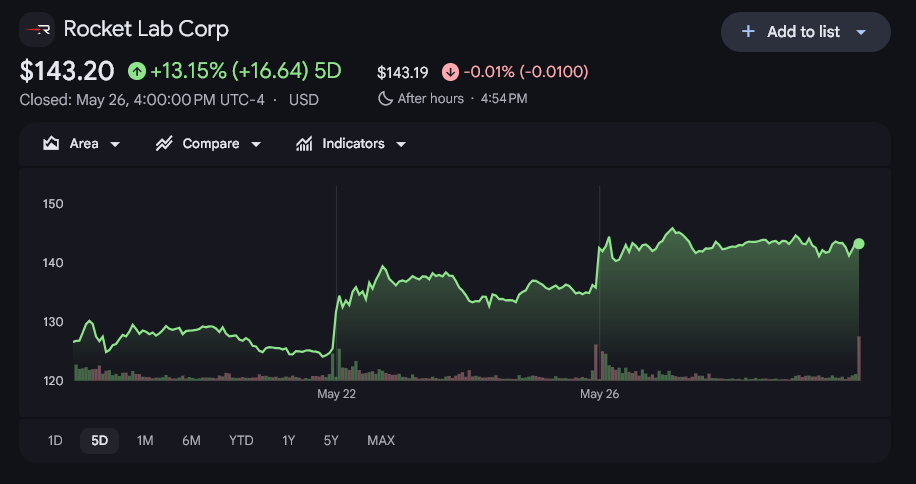
SpaceX has received a $2.29 billion contract from the US Space Force to build a major military satellite communications network known as the “Space Data Network Backbone” (SDN Backbone). The project will create a secure, high-speed system for moving military data around the world using low-Earth-orbit satellites.
The contract requires SpaceX to deliver a working prototype by the end of 2027. According to the Space Force, the network will use optically linked satellites to provide faster and more resilient communications for US military operations.
Elon Musk’s SpaceX Will Build US Military Satellite
The SDN Backbone is part of a broader Pentagon effort to modernize military communications and missile defense systems.
The network is expected to support the US military’s “Golden Dome” defense architecture by connecting satellites, sensors, and interceptors in real time.
The project also shows how deeply SpaceX has become involved in US national security infrastructure. Recent budget documents indicate the Space Force plans to spend billions more on the wider Space Data Network program in the coming years.
Which Stocks Could Benefit?
With SpaceX’s highly anticipated IPO approaching, several publicly traded defense and space companies could benefit from rising military spending on satellites, missile defense, and secure communications.
Some companies may gain directly through future contracts. Others could benefit from investor interest in the growing defense-space sector.
Company
Ticker
Why It Could Benefit
Rocket Lab USA Inc.
RKLB
Strong exposure to military satellites and launch services
Northrop Grumman Corporation
NOC
Major defense-space contractor with satellite communications work
Lockheed Martin Corporation
LMT
Expected to benefit from Golden Dome missile defense programs
RTX Corporation
RTX
Supplies missile defense and military communication systems
The Boeing Company
BA
Has large defense and space operations tied to Pentagon programs
L3Harris Technologies Inc.
LHX
Focused on military communications and tactical systems
Viasat Inc.
VSAT
Provides satellite communication services for defense clients
Iridium Communications Inc.
IRDM
Operates global satellite communication networks
Firefly Aerospace
FLY
Expanding into missile defense and military space systems
York Space Systems
YSS
Builds satellites linked to Space Force projects

Growing Military Space Race
The Space Data Network reflects a larger shift in US defense strategy. Instead of relying on a few expensive satellites, the Pentagon now wants massive networks of smaller connected satellites that can move data faster and survive attacks more easily.
That shift could create long-term opportunities for defense, satellite, and aerospace companies across the US market.
The post SpaceX Wins $2.29 Billion US Space Contract, and 10 Assets Can Benefit appeared first on BeInCrypto.


Former New York Fed President Bill Dudley warned on Tuesday that the central bank risks losing credibility. He pointed to five years of inflation running above the 2% target.
Dudley said inflation expectations could become unanchored. The warning lands as Kevin Warsh begins his first week as Fed Chair under political pressure for lower rates.
Five Years Of Slipping Above Target
The Fed adopted its formal 2% inflation goal in January 2012. The central bank then spent most of the next decade trying to push prices up toward that level.
That picture flipped in early 2021, when pandemic-driven supply shocks and fiscal stimulus drove prices sharply higher.
By March 2026, headline personal consumption expenditures inflation reached 3.5% year over year. The core measure stood at 3.2%. Both readings remain elevated after roughly 60 months of overshoots.
Dudley pointed to the resilience of US growth as the harder problem. Policy rates have stayed above 4% since late 2022 while the labor market remains firm.
Follow us on X to get the latest news as it happens
He questioned whether the current settings are restrictive at all. Bond traders have echoed that doubt as markets defy central bank signals on the path of rates.
Neutral Rate And A New Chair
Dudley made the comment on Bloomberg’s Surveillance program, arguing that structural forces have likely raised the neutral interest rate.
Heavy capital spending tied to artificial intelligence and elevated federal borrowing may be lifting the real return investors demand.
If true, monetary policy is looser than the Fed assumes.
“I think the case for cutting rates now is actually very, very weak,” he said.
Long-run survey measures have ticked up, including the University of Michigan reading on 5 to 10-year expectations.
Governor Chris Waller’s preferred two-year forward gauge has also drifted higher. That signals household and business pricing behavior is shifting.
Kevin Warsh was sworn in as Chair on May 22 after the narrowest Senate confirmation vote on record. He has framed inflation as a choice the central bank can deliver against.
“Yeah. So, I believe what Milton and you just channeled, which is inflation is a choice. Uh, as you said at the beginning of this setup, inflation and ensuring [price stability]…Not only is inflation a choice, but a sound dollar is also a choice…Inflation is a choice, and the Fed must take responsibility for it,” he emphasized.
The Test Ahead
President Donald Trump has pushed openly for lower rates. Warsh’s slim confirmation margin leaves limited room for missteps. Some analysts already warn against rate cuts until the inflation path is clearer.
The next personal consumption expenditures release, due in late June, will be the first read on Warsh’s tenure.
A move toward 2% would buy time. Another miss would put Dudley’s warning at the center of the policy debate.
Subscribe to our YouTube channel to watch leaders and journalists provide expert insights
The post Bill Dudley Has a Warning for the Fed as Kevin Warsh Inherits a Inflation Mess appeared first on BeInCrypto.
Near Protocol’s native token, NEAR, has the potential to grow 20x by 2027, according to Arthur Hayes, co-founder of the crypto derivatives exchange BitMEX.
Key takeaways:
- Hayes said NEAR Intents could make privacy coins like Zcash more usable across blockchains without bridges or multiple wallets.
- NEAR has surged more than 90% since Hayes publicly highlighted the token alongside ZEC and HYPE in May.
NEAR makes privacy coins like ZEC usable: Hayes
Speaking on The Rollup podcast, Hayes said NEAR’s bullish case rests on NEAR Intents, a feature that lets AI agents move assets privately across blockchains without dealing with bridges, multiple wallets or fragmented liquidity.
The same infrastructure also supports NEAR’s broader AI-agent thesis, where autonomous apps can execute payments and trades on-chain.
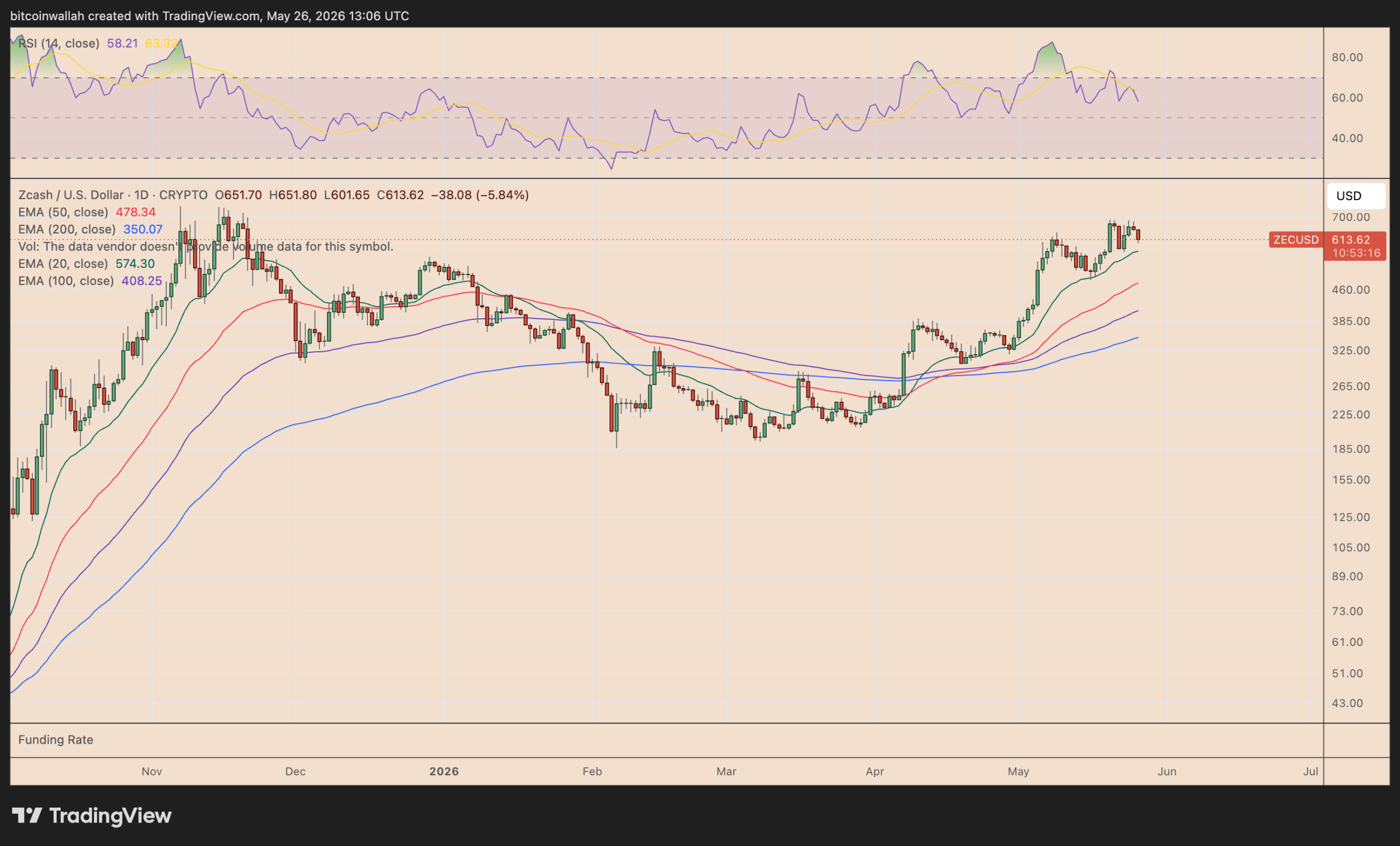
Hayes linked NEAR’s upside to Zcash (ZEC), the privacy-focused cryptocurrency that has rallied more than 1,000% over the past year and revived investor interest in private money.
ZEC/USD daily chart. Source: TradingView
He said Near Protocol could become the next major beneficiary of that trend because it helps make private tokens like ZEC usable beyond a single blockchain, allowing users to move value across the broader crypto economy.
“I can now send any crypto asset I want to anyone across the internet in an anonymous way from shielded Zcash using Near Intents,” Hayes said, adding:
“I think NEAR has a 20x potential, where you know Zcash might have a 5x potential over the next year.”
Hayes’ NEAR calls echo his Zcash rally playbook
Hayes’ remarks add to a string of bullish NEAR endorsements from Hayes.
In a May 11 essay, Hayes explicitly positioned NEAR as one of his top speculative bets alongside ZEC and Hyperliquid’s native token, HYPE.
He reinforced that view in a May 22 post earlier this week, calling HYPE, ZEC and NEAR “the holy trinity.”
NEAR’s price has grown by over 90% since Hayes began publicly highlighting the token, as shown below.
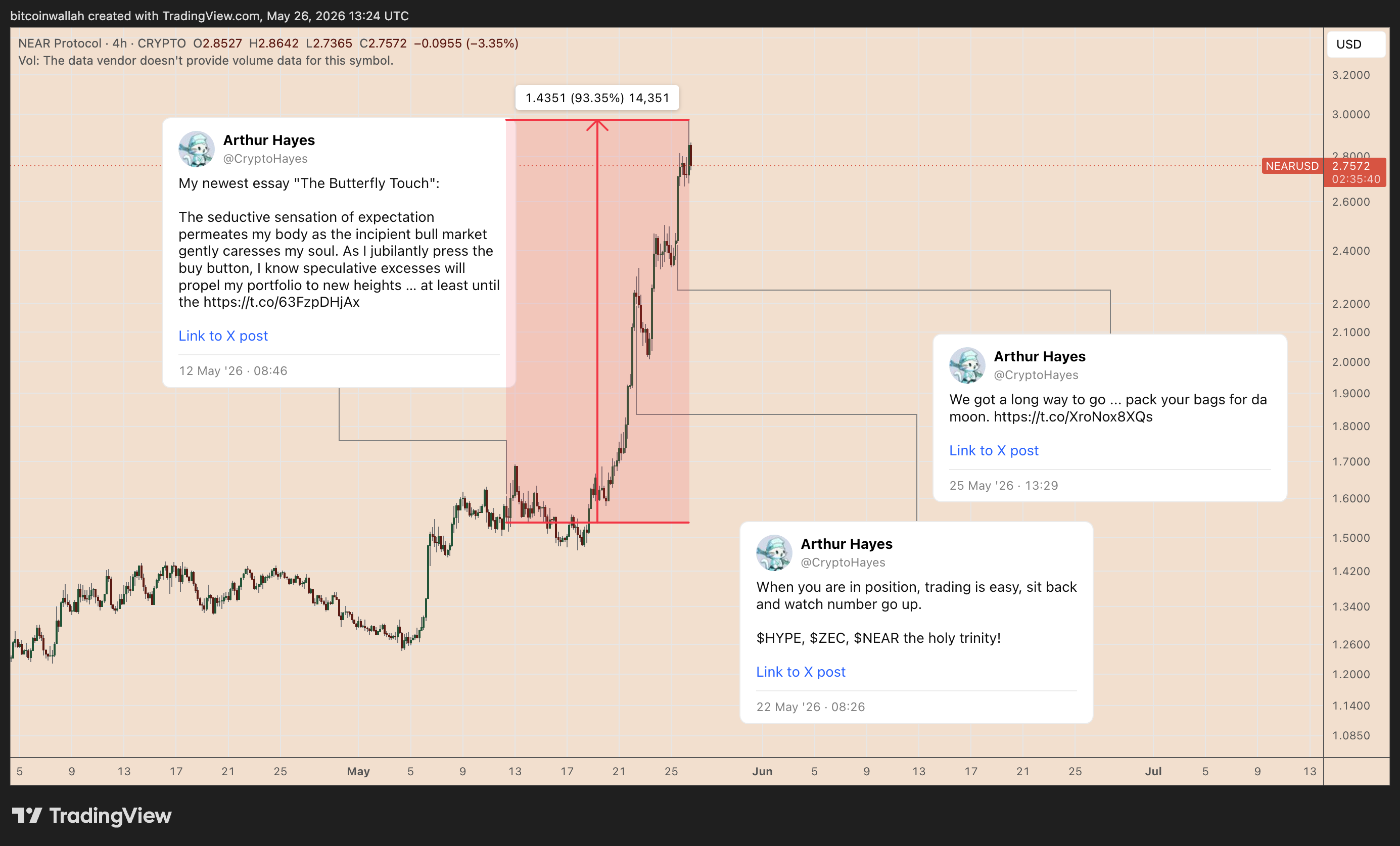
NEAR/USD four-hour chart. Source: TradingView
Hayes’ endorsements have historically attracted significant attention from traders, as evidenced by his 2025 Zcash posts.
Related: Zcash is ‘running its own bull market’ as ZEC price paints 88% rally setup
In October 2025, Hayes’ bullish commentary, including “ZEC to $10k” and naming it a core holding, acted as a major upside catalyst. ZEC delivered over 350% gains in the following weeks.
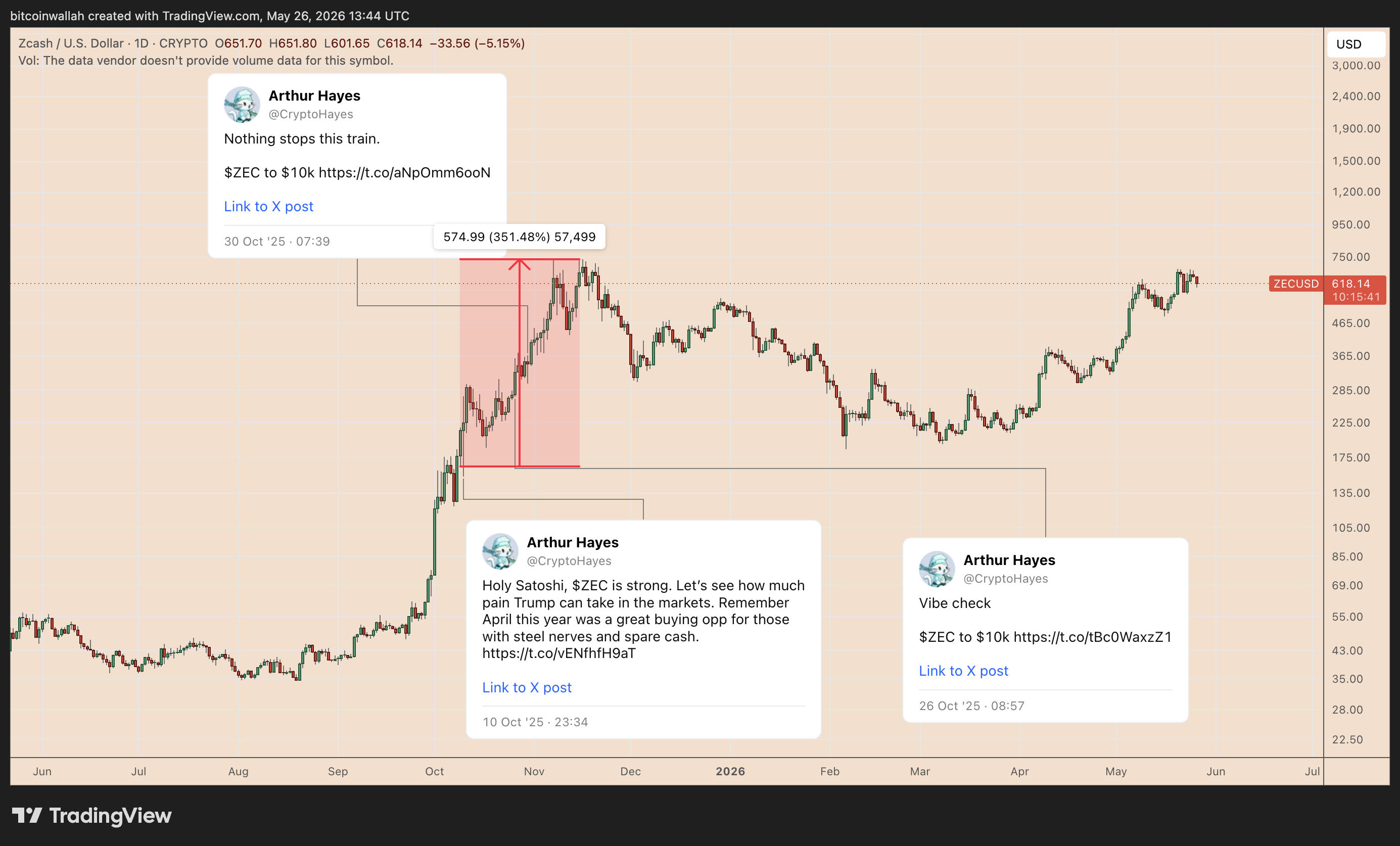
ZEC/USD daily chart. Source: TradingView
NEAR fractal hints at 35% rally next
NEAR’s current breakout is starting to resemble its 2023–2024 recovery setup, when it bounced from the $0.91–$0.99 range before rallying by about 250%.
For instance, in 2026, NEAR has rebounded from the same $0.91–$0.99 bounce zone, while its daily relative strength index (RSI) has surged to around 88, showing aggressive buying pressure.
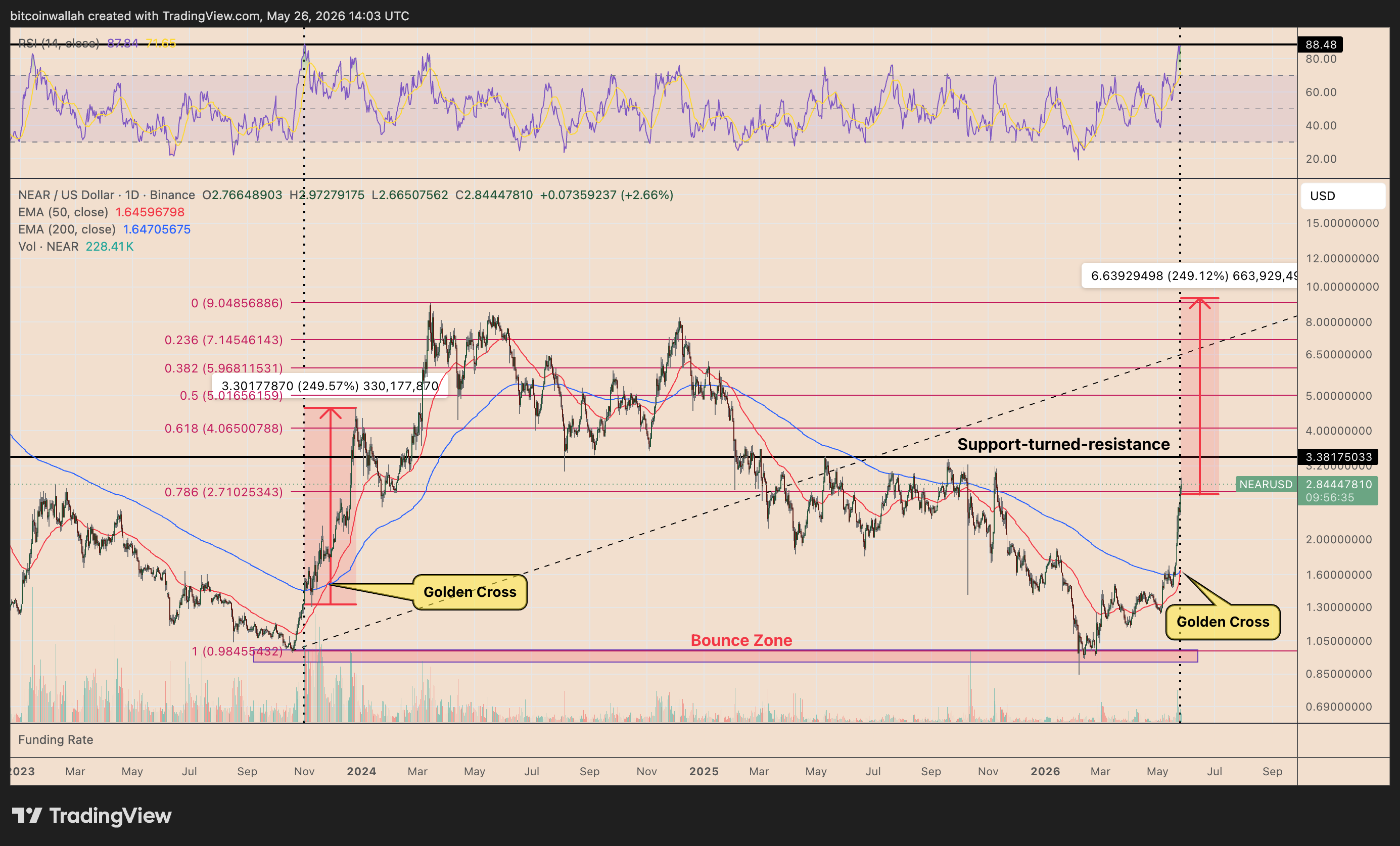
The token has also formed a golden cross, a bullish signal where the shorter-term moving average rises above the longer-term one.
In NEAR’s case, the 50-day exponential moving average (50-day EMA, the red line) at around $1.646 has been moving above the 200-day EMA (the blue line) at around $1.647.
Traders often view this as an early sign that a downtrend may be turning into a sustained uptrend.
The first major upside target sits near $3.38–$4.00, a former support zone that may now act as resistance. The $4 target sits roughly 35% above current prices and could become NEAR’s next test if the breakout holds.
A decisive move above $4.00 would strengthen the 2023–2024 fractal and open the door to a 250% rally toward the $9–$10 area in 2026.
Conversely, failure to reclaim the $3.38–$4.00 zone may lead to a sharp bearish reversal toward the 50- and 200-day EMAs. That would amount to roughly 45% downside from current levels.
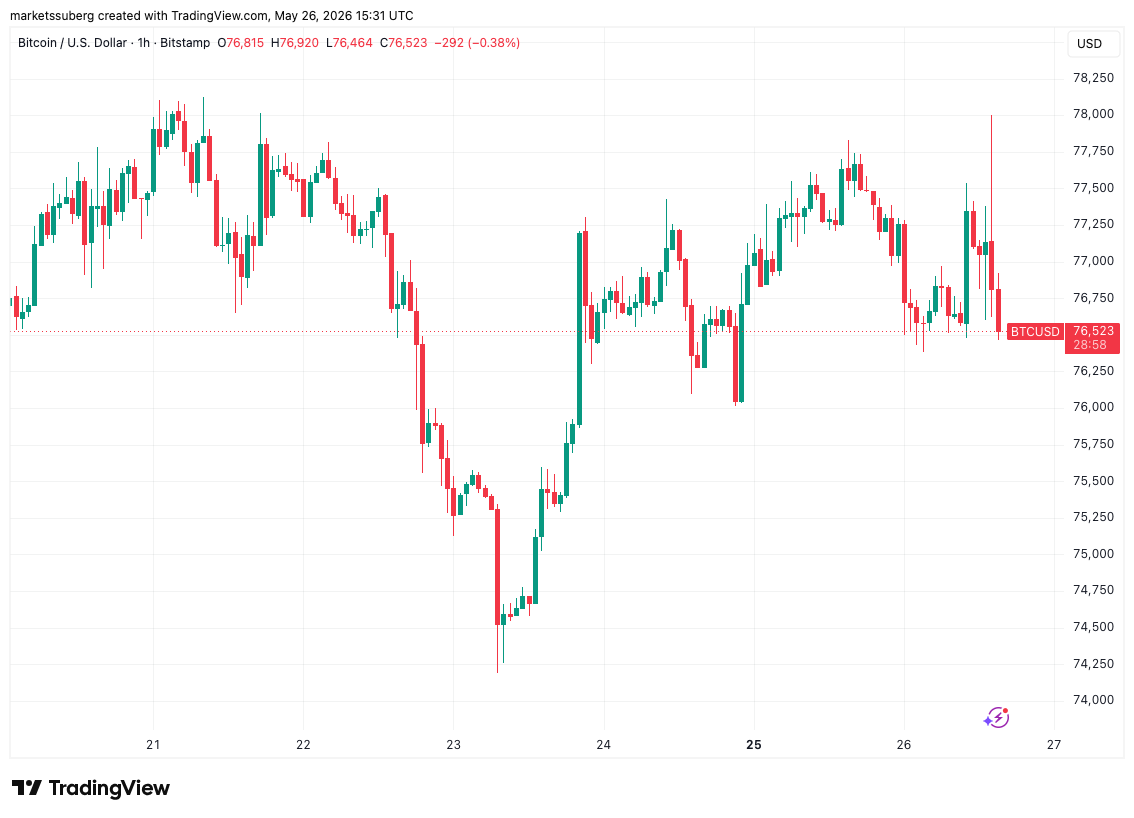
Bitcoin (BTC) saw flash volatility around Tuesday’s Wall Street open as US-Iran nerves rocked risk assets.
Key points:
- Bitcoin briefly taps $78,000 as volatility returns to markets at the Wall Street open.
- US stocks hit new all-time highs, while crypto continues to underperform.
- Positive funding rates spark fresh warnings over Bitcoin’s immediate outlook.
Bitcoin neutralizes longs and shorts in volatile moves
Data from TradingView showed BTC/USD hitting $78,000 — its highest since Thursday — before abruptly heading lower.
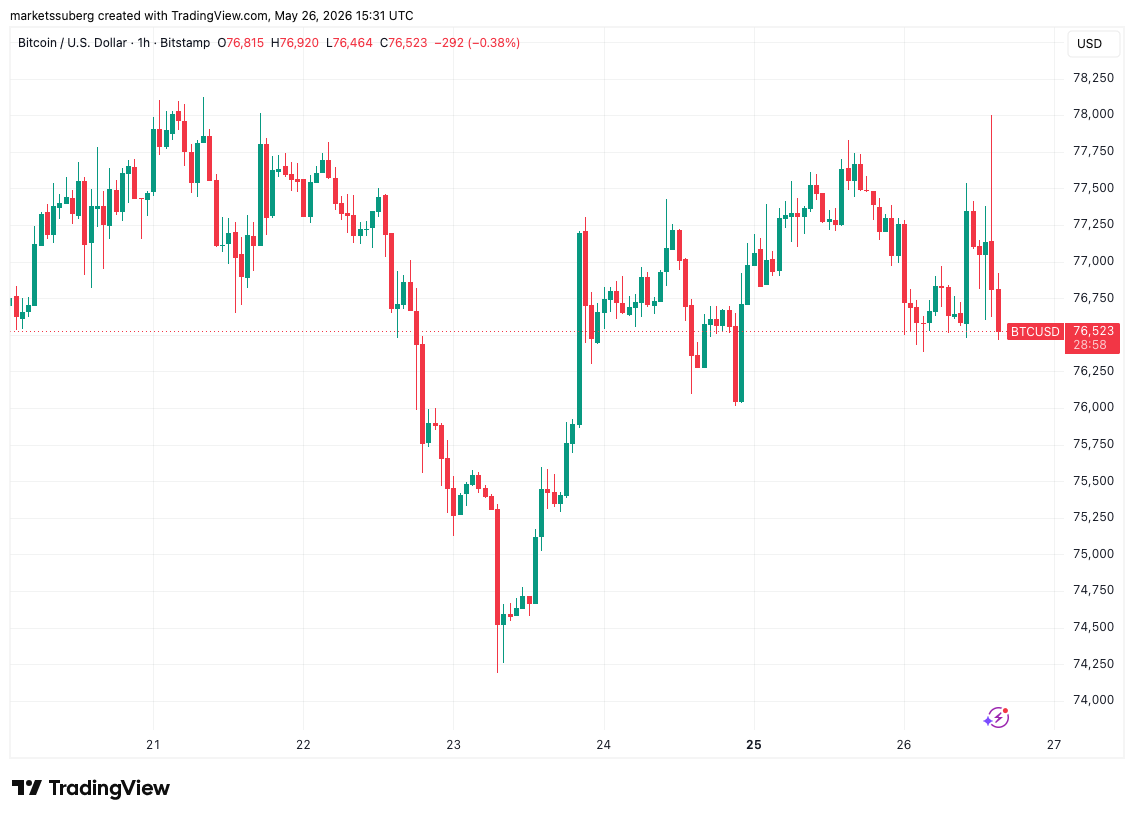
BTC/USD one-hour chart. Source: Cointelegraph/TradingView
In doing so, the pair liquidated both short and long positions, with the 24-hour total at $66 million, per CoinGlass.
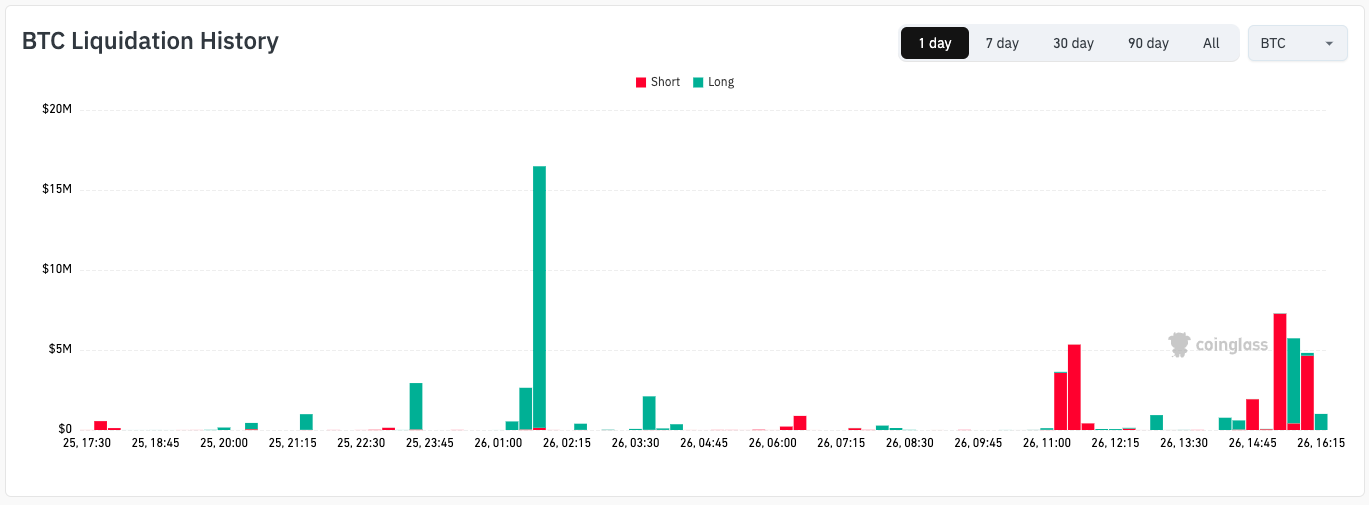
BTC liquidation history (screenshot). Source: CoinGlass
Macro events once again drove the market, with US strikes on Iran calling the latest peace deal attempt into question.
WTI crude oil headed toward $95 per barrel, while US stock markets again shook off the concerns, hitting new all-time highs and continuing a trend of strength seen last week.
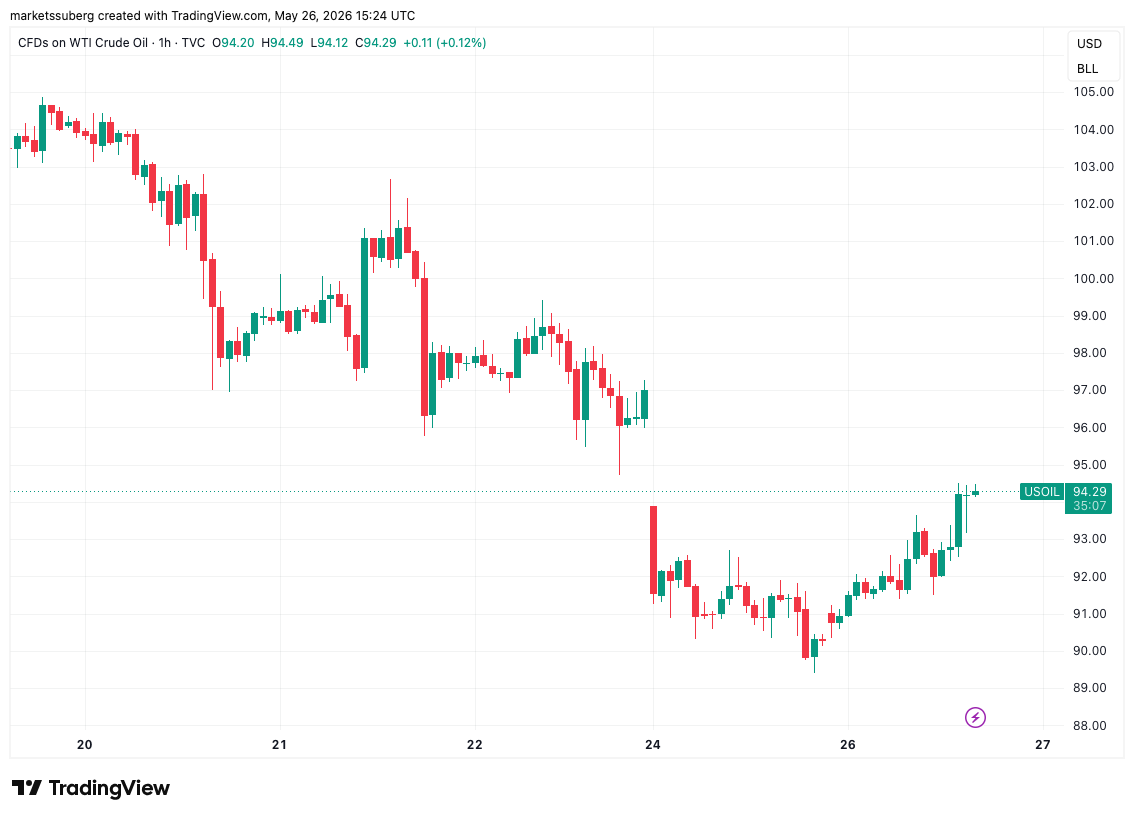
CFDs on WTI crude oil one-hour chart. Source: Cointelegraph/TradingView
Commenting, trading resource Material Indicators said that BTC price action “remains driven by liquidation hunts.”
“Purple Whales are not suddenly flipping macro bullish for fundamental reasons – they are swing trading the range in low timeframes,” it explained in a post on X alongside a chart of Binance order-book liquidity.
“The bid liquidity at ~$75.5k is attempting to protect key support at the 21 WMA.”
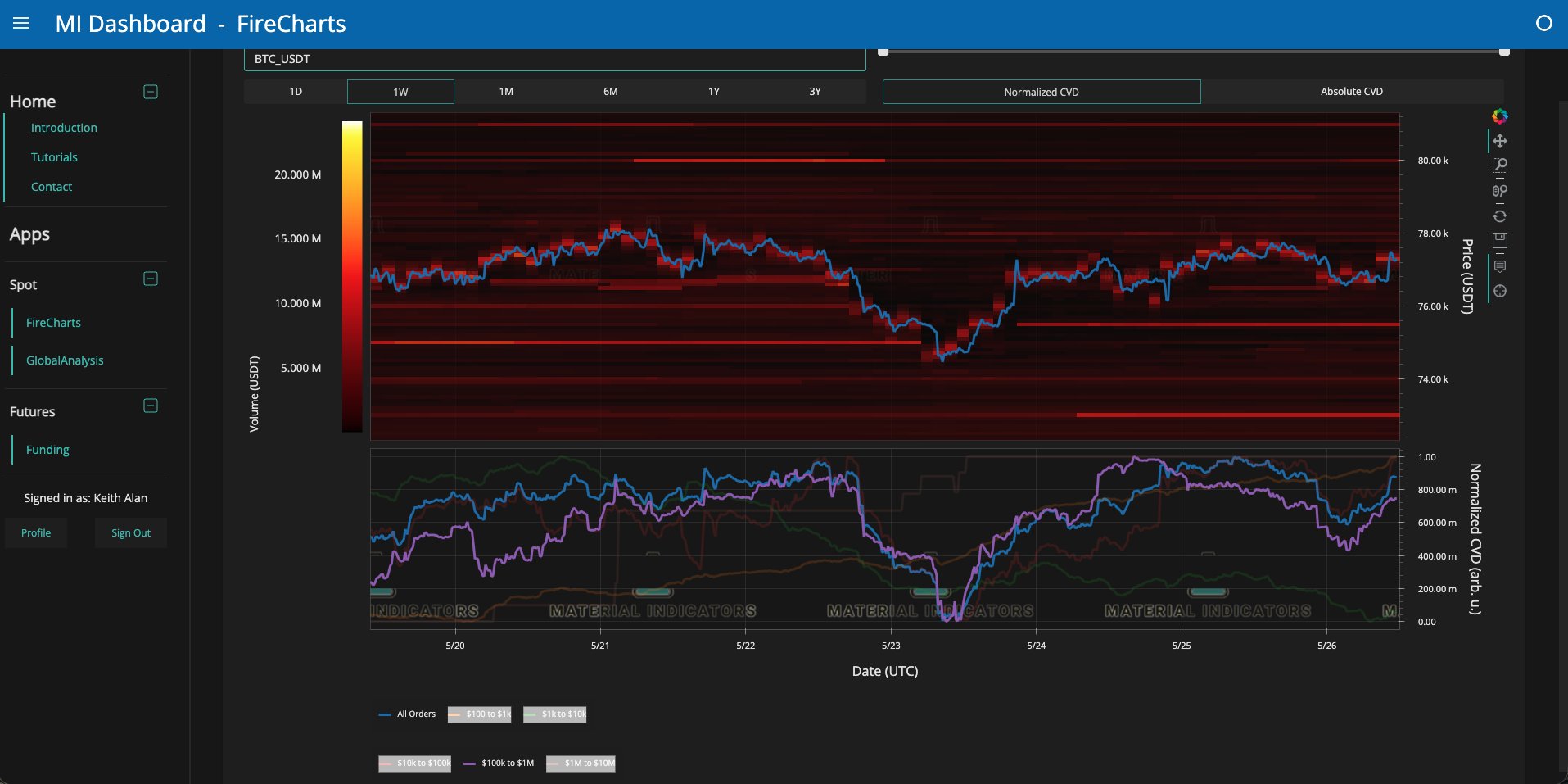
BTC/USDT order-book liquidity data. Source: Material Indicators/X
Material Indicators referenced Bitcoin’s 21-week simple moving average at $75,800, one of several nearby trend lines on the radar.
Continuing on the topic, trader Daan Crypto Trades noted that the “biggest” cluster of liquidity below price was at $74,000.
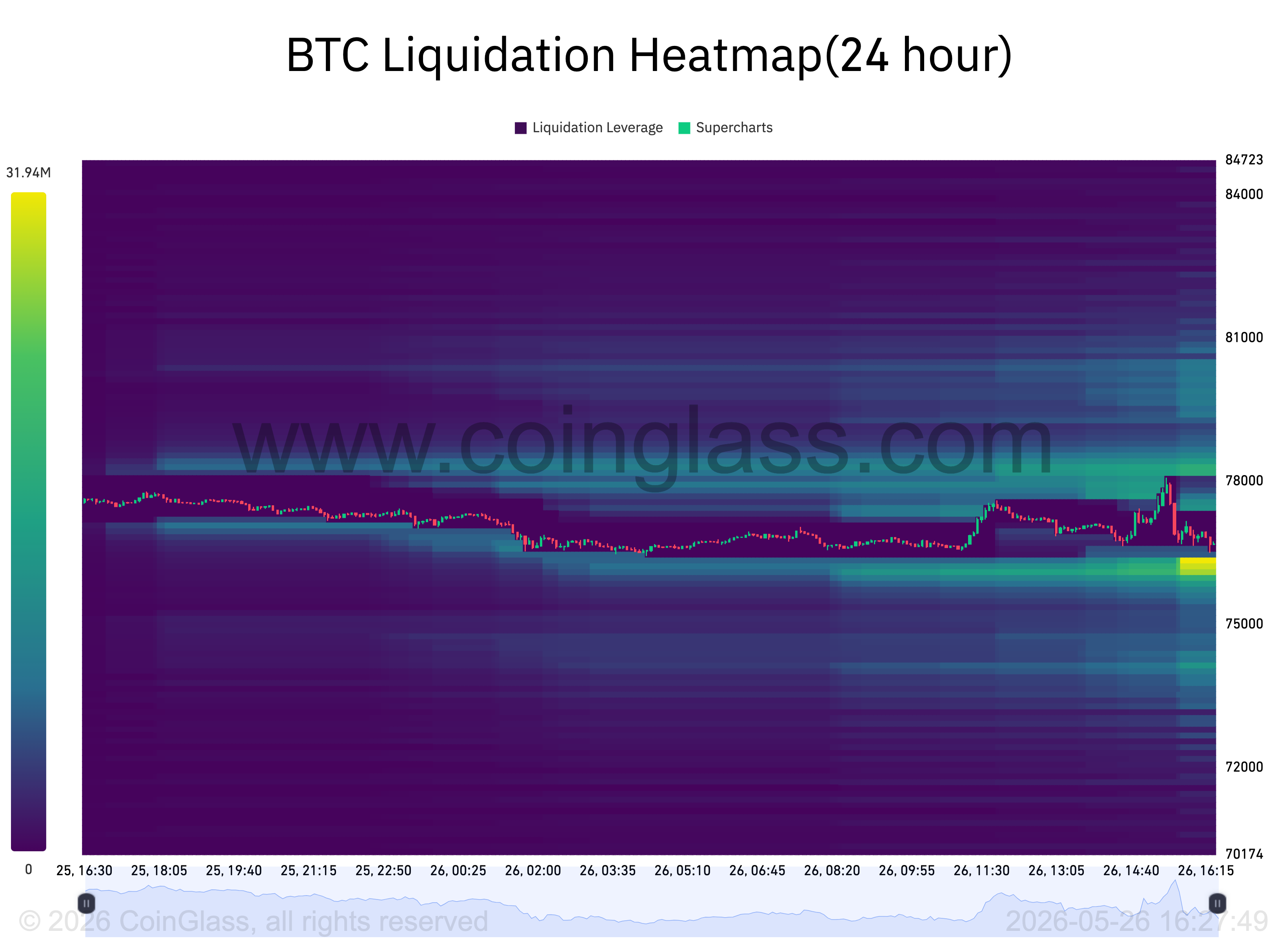
BTC liquidation heatmap. Source: CoinGlass
Funding rates see “sharp reversal” versus April
In a potential warning to bulls, onchain analytics platform Glassnode drew attention to rising funding rates on the day.
Related: Here’s what happened in crypto today
Previously negative, these were now “decisively positive,” it reported, as BTC long interest increased.
“The move marks a sharp reversal from April’s heavily short-biased positioning,” Glassnode told X followers.
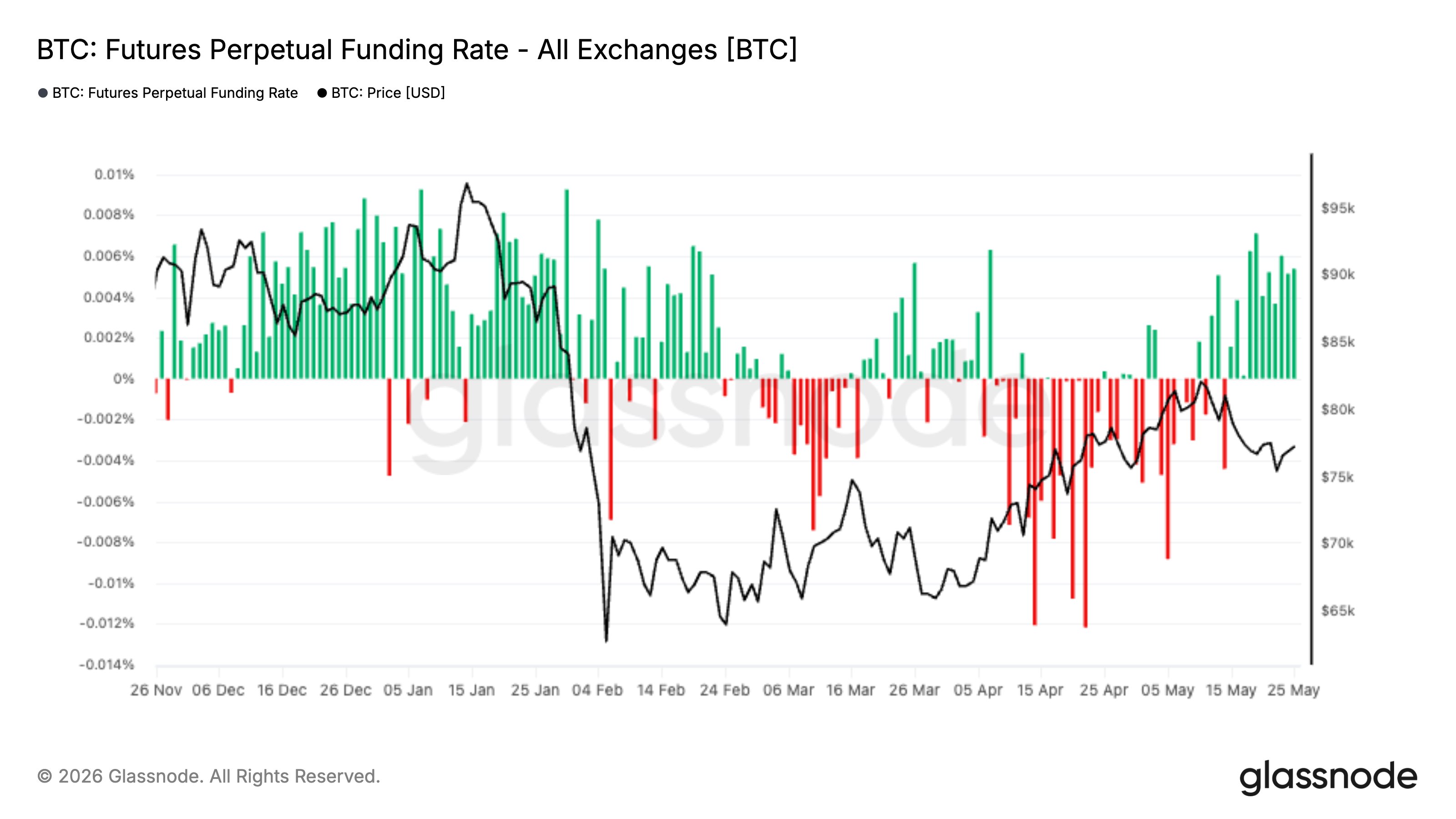
Bitcoin futures funding rates. Source: Glassnode/X
Overall trading activity, however, remained comparatively modest, crypto analytics resource K33 Research noted.
“Bitcoin has spent the past week consolidating and trading broadly flat, while activity across crypto markets remains muted. Weekly spot volumes are approaching yearly lows, derivatives activity continues to decline across both CME and offshore venues, and open interest has largely stagnated,” head of research Vetle Lunde wrote in its latest Ahead of the Curve update.
“At the same time, realized and implied volatility have drifted toward historically low levels, reinforcing a broader wait-and-see environment with subdued participation and limited market conviction.”
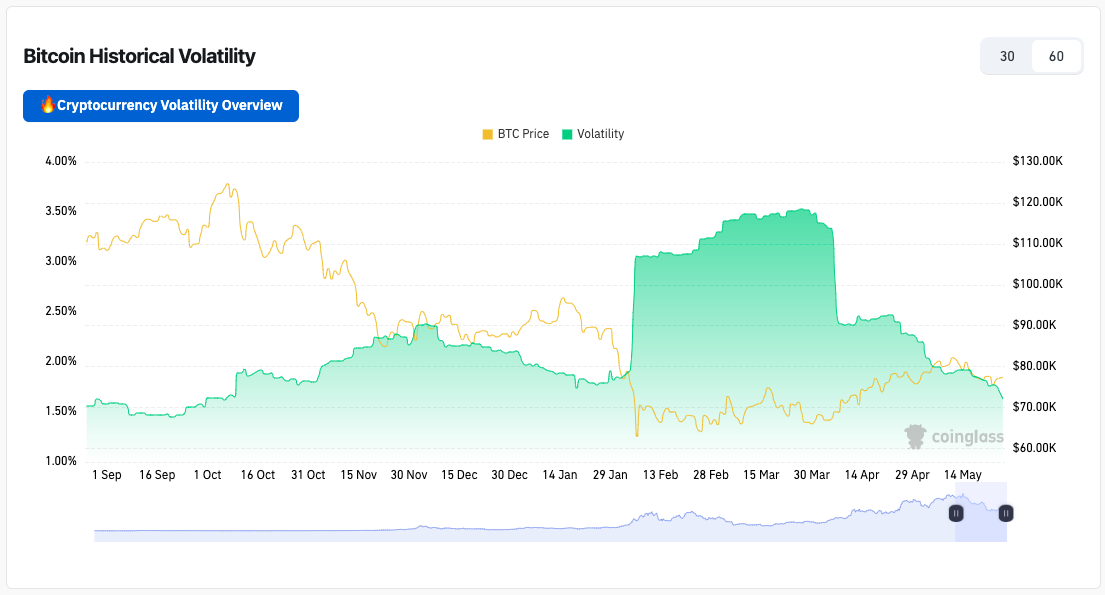
Bitcoin historical volatility (screenshot). Source: CoinGlass
Amazon AWS CEO Matthew Garman divests $4.07m in company stock

USDT yield vault StableEarn goes live on Stable

Woman Found Guilty of Fatally Beating Boyfriend’s Daughter, 4


-

 Crypto World5 days ago
Blockchain.com files with SEC for U.S. IPO
-

 Fashion4 days ago
Holiday Weekend Open Thread – Corporette.com
-

 Business4 days ago
Dell Technologies DELL Stock Surges 15% on AI Server Momentum and Analyst Upgrades in 2026
-

 Crypto World5 days ago
Bitcoin Accumulation Weakens as BTC Realized Losses Hit $600M
-

 Crypto World4 days ago
Robinhood crypto COO Tanya Denisova exits
-

 Crypto World4 days ago
Space X IPO Is ‘Bad News’ for Tech Stocks: But What About Bitcoin?
-

 Politics4 days ago
Makerfield: a tale of two social-media histories
-

 Business2 days ago
NYT Strands Answers May 24 2026 Revealed for Puzzle No. 812 Theme Summer Essentials
-

 Tech1 day ago
Microsoft’s quiet Claude Code retreat and the real cost of enterprise AI
-

 Crypto World5 days ago
MicroStrategy’s Saylor Says Miners No Longer Set Bitcoin Price, Another Force Has Taken Over
-

 Tech5 days ago
WhatsApp ads could make Irish debut after discussions with DPC
-

 Crypto World4 days ago
AI infrastructure race heats up as IREN pitches full-stack strategy, WhiteFiber lands $160M deal
-
 Tech4 days ago
A 0.12% parameter add-on gives AI agents the working memory RAG can’t
-

 Tech5 days ago
You Can Now Add ChatGPT To PowerPoint
-
 NewsBeat5 days ago
Charity run by Reform leader Malcolm Offord accused of ‘law breaking’ over Scottish registration
-

 Business5 days ago
Trump Invests $1M-$5M in Kura Sushi USA Chain With 27 California Locations
-
 Crypto World2 days ago
Nvidia (NVDA) CEO Calls on Super Micro to Strengthen Export Controls Amid Smuggling Probe
-

 Sports5 days ago
2026 CJ Cup Byron Nelson leaderboard: Brooks Koepka finds putting stroke in Round 1
-

 Tech1 day ago
Westone Audio and Etymotic Acquired by Fidelity Collective in Major IEM Market Move
-

 Crypto World6 days ago
Exa Labs raises $250 million in funding led by a16z
You must be logged in to post a comment Login