

Crypto World
Qivalis Signs Up 25 Banks Ahead of Euro Stablecoin Launch


Qivalis, the European banking consortium building a regulated euro stablecoin, expanded its ranks to 37 member institutions on Wednesday by adding 25 banks across 15 countries. Among the new members are ABN AMRO, Rabobank, Nordea and Intesa Sanpaolo. The Amsterdam-based group aims for a launch in the second half of 2026, according to a statement shared with Cointelegraph.
“We are not merely building payment rails; we are ensuring that European principles around data protection, financial stability and regulatory rigour are embedded into the next generation of digital money,” said Howard Davies, chairman of Qivalis’ supervisory board.
The expansion comes as European institutions intensify efforts to offer regulated alternatives to dollar-dominated stablecoins, which CoinGecko data show account for a large majority of the market. The push signals a broader push to embed euro-denominated on-chain infrastructure within the bloc’s regulatory framework.
Key takeaways
- Qivalis expands to 37 member banks, adding 25 institutions across 15 countries, with a targeted launch in H2 2026.
- Notable new members include ABN AMRO, Rabobank, Nordea and Intesa Sanpaolo, reinforcing cross-country participation.
- Spain emerges as the most represented country in the new wave, adding five banks and highlighting early euro-stablecoin adoption in the retail sphere.
- The expansion aligns with the European Union’s MiCA framework, as institutions seek a regulated euro-stablecoin backbone under EU rules.
- ECB President Christine Lagarde recently signaled a cautious stance on euro-stablecoins as Europe’s path to expanding the euro’s global role, illustrating regulatory tensions that accompany the initiative.
A broader push for a regulated euro stablecoin network
With 25 banks joining from 15 countries, Qivalis is accelerating its effort to create a unified, regulated euro-stablecoin infrastructure. The new members broaden the consortium’s geographic footprint, spanning Northern and Southern Europe, and reinforcing the bloc-wide ambition to offer a euro-denominated digital money system governed by European rules. Howard Davies framed the project as more than a payments layer; it is an attempt to embed core European values—data protection, financial stability and regulatory integrity—into a new form of money that can operate across borders and institutions.
In parallel with the expansion, the consortium has been engaging with crypto exchanges to prepare for a broader ecosystem around the euro stablecoin. Cointelegraph has reported that Qivalis has been in dialogue with venues ahead of the planned launch, signaling an intent to foster liquidity, trading access and custody within a compliant, MiCA-aligned framework. The plan is to tokenize, custody and manage on-chain euro-denominated assets with oversight suitable for European markets.
Spain leads the new member wave and euro adoption momentum
Spain stands out in the new roster, providing five additions: ABANCA, Banco Sabadell, Bankinter, Cecabank and Kutxabank. The country’s growing footprint among Qivalis members mirrors broader signs of euro-stablecoin uptake in Spain’s retail space, where data from Brighty has highlighted Spain as a leading market for Circle’s EURC usage. The strong presence from Spain reflects a wider European push to diversify away from USD-centric stablecoins toward euro-denominated on-chain services within a robust regulatory envelope.
In addition to Spain, Italy joined with two new banks, while France, Sweden, Greece, the Netherlands, Finland and Ireland each added two members. The spread across these markets underscores a pan-European appetite to integrate stablecoin rails into existing banking rails, blending traditional financial oversight with the benefits of digital asset rails under MiCA-compliant governance.
Tech backbone, governance and regulatory context
Qivalis is pursuing a covered, regulated pipeline for euro stablecoin issuance, with Fireblocks already chosen in a March collaboration to provide tokenization, wallet infrastructure and custody services, along with tools to support compliance. Jan Sell, the consortium’s CEO, has stressed that the euro should be carried on-chain by European institutions and governed by European rules, a stance that aligns with the bloc’s regulatory ambitions while inviting scrutiny from observers wary of how rapidly the sector evolves.
The push operates in a climate of contested momentum about the role of private sector money inside Europe’s monetary architecture. In early May, European Central Bank President Christine Lagarde suggested that stablecoins might not be Europe’s best route to strengthening the euro’s international reach, cautioning against a reflexive move to euro-backed equivalents in response to US dollar-stablecoins. The Qivalis expansion, therefore, sits at an inflection point: banks are eager to provide a regulated euro stablecoin alternative, but policymakers are weighing how such tools fit into broader monetary and financial stability objectives.
According to Cointelegraph reporting, the consortium has been engaging with crypto exchanges in anticipation of a euro-stablecoin launch, signaling a readiness to build an ecosystem that includes liquidity venues, wallets and custody aligned with European standards. This ecosystem-building effort is paired with MiCA-ready frameworks already shaping custody, identity verification, anti-money-laundering controls and data protection, which are intended to reduce compliance risk while enabling cross-border euro transactions on-chain.
What changes—and what remains uncertain
The most visible change is the accelerated diversification of Qivalis’ member base, bringing more European banks into a shared project that seeks to encode euro-denominated digital money within a carefully regulated perimeter. The heightened country representation suggests that banks across the EU are ready to experiment with on-chain euro rails, potentially unlocking new forms of settlement, cross-border payments and digital asset services for customers who need faster, cheaper and more transparent transactions than traditional correspondent networks offer.
However, the path forward remains cinched with regulatory nuances. Lagarde’s comments frame a cautious stance on the euro-stablecoin thesis as Europe experiments with on-chain money, and MiCA’s ultimate implementation will shape what is permissible, how liquidity is created, and which institutions can participate at scale. The H2 2026 target for launch sets a concrete timeline, but adoption will depend on how quickly member banks can harmonize compliance, risk controls and interoperability with external exchanges and wallets within the EU’s supervisory framework.
For investors and builders, the development signals a persistent appetite among European banks to offer regulated alternatives to dollar-dominated digital assets. The expansion also foreshadows potential competition among regional euro-stablecoin ecosystems, each anchored in national banking standards yet interoperable under EU-wide rules. As the MiCA regime matures and the ECB’s stance evolves, watchers should monitor how liquidity channels develop, how custody and identity standards converge, and whether consumer demand lives up to the regulatory promise of a more stable, transparent euro on the blockchain.
Readers should keep an eye on when Qivalis begins to align more tightly with exchanges and liquidity providers, and how the consortium’s governance evolves as more banks verify and participate in the euro-stablecoin framework. The next steps will reveal whether this is a turning point for euro-denominated digital money or a measured experiment navigating a complex regulatory landscape.


Kalshi has deployed an artificial intelligence agent to help decide which prediction markets to launch as trading activity on the platform has climbed to more than $5 billion in a single week.
Summary
- Kalshi has deployed an AI agent called Harrison to help evaluate and recommend new prediction markets.
- FIFA World Cup betting activity helped push Kalshi’s weekly trading volume to a record $5.1 billion.
- The platform’s expansion comes as U.S. regulators and states continue to dispute oversight of prediction market contracts.
According to a Bloomberg report, the prediction market operator has introduced an internal AI system called Harrison to assist with several day-to-day functions tied to its exchange.
The tool is being used to review news developments, monitor competing platforms, recommend new contracts for listing, and identify where liquidity incentives may be most effective.
Bloomberg reported that Harrison forms part of Kalshi’s internal markets team and contributes to the process of evaluating potential contracts before they reach users.
Speaking to the publication, Kalshi co-founder Luana Lopes Lara said the company also employs an AI engineer whose work includes using AI systems to stress-test certification processes and identify possible weaknesses before markets go live.
The rollout comes as prediction markets continue to draw regulatory attention across the United States. State regulators have argued that some event contracts resemble traditional gambling products, while federally regulated exchanges maintain that they operate under commodities laws overseen by the Commodity Futures Trading Commission.
Sports contracts fuel record activity
Trading volumes have accelerated alongside growing interest in sports-related contracts. According to Bloomberg, demand tied to the FIFA World Cup helped push Kalshi to nearly $18 billion in notional trading volume during May, citing data from Dune Analytics.
The same report stated that Kalshi recorded approximately $5.1 billion in volume during the first week of the tournament this month, setting a new weekly high for the platform. Sports markets have become one of the exchange’s fastest-growing categories, joining election, economic, and entertainment contracts that already attract significant user activity.
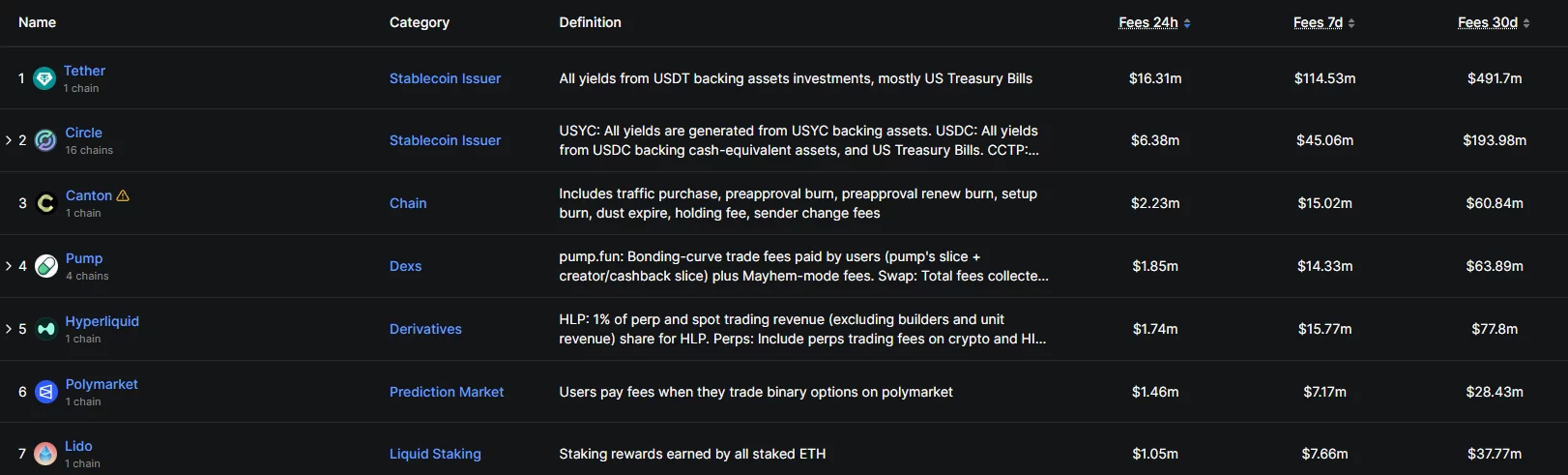
Elsewhere in the sector, sports wagering demand has also boosted activity on prediction market rival Polymarket. According to DefiLlama data, Polymarket generated around $1.46 million in fees over the last 24 hours and roughly $7.17 million during the previous seven days, placing it among the highest fee-generating crypto protocols during those periods.
Federal regulators challenge state enforcement efforts
At the same time, prediction markets remain at the center of an ongoing regulatory debate in the United States. As reported by crypto.news earlier, the CFTC has proposed new rules for prediction market platforms while also defending federally regulated exchanges against enforcement efforts by several states.
According to a lawsuit filed by the CFTC on Friday, the agency has sued New Mexico officials over efforts to apply state gaming laws to federally regulated prediction market exchanges. The regulator argued that event contracts listed on CFTC-registered exchanges fall under federal commodities law and therefore remain subject to its exclusive oversight.
The filing follows New Mexico’s June 4 lawsuit against Kalshi, in which state authorities alleged the platform was offering sports betting without a license and allowing users aged 18 to 20 to participate despite the state’s minimum gambling age of 21.


Paradigm has led a roughly $9 million funding round in El Dorado, a stablecoin-powered payments application built for Latin America. The deal pushes one of crypto's largest venture firms deeper into dollar-rails for emerging markets. The round was reported by The Block, which said Paradigm led the… Read the full story at The Defiant
Crypto World
Charles Hoskinson Stands On $70M BTC Payment From 2016 Manx Entity: Critics Want the Paper Trail

Cardano News: Charles Hoskinson is defending a 1,096 BTC allocation from Cardano’s early foundation structure, an amount worth roughly $454,000 when it was moved in March 2016 and approximately $70 million at current prices.
Hoskinson, speaking in a weekend video AMA focused on governance and treasury management, frames it as payment for a legitimate audit of the original ADA token crowdsale.
The asset appreciation is the problem: a plausible 2016 expense has become a $70 million line item with no public paper trail.
Thomas Braziel, Founder and Managing Partner of 117 Partners, is not accepting the narrative at face value.
BREAKING: Charles Hoskinson appears to disclose that Charles/IOHK received 54,000 BTC from the original Cardano ICO arrangements.
That's:
• ~50% of the entire 108,844 BTC raise
• ~$20-25 million at 2015-16 prices
• ~$3.6 BILLION at today's BTC price
While discussing the… pic.twitter.com/1dk7h8UIl2— Thomas Braziel (@Bkclaims) June 15, 2026
Braziel wants invoices, service agreements, corporate approvals, payment records, and a custody trail showing which entities held the private keys.
His position, stated plainly: “The question was never whether audits cost money. The question was where 1,096 BTC went, who received it, and why.” That gap between Hoskinson’s explanation and verifiable documentation is what’s driving the dispute – and it is becoming one of the most visible crypto governance disputes of 2026.
Discover: The Best Crypto to Diversify Your Portfolio
Cardano News: Hoskinson’s Audit Defense, Three Reviewers, One 2016 BTC Allocation
Hoskinson’s account is specific. He traces the 1,096 BTC to a March 2016 request from Michael Parsons, then-chairman of the Cardano Foundation’s early Isle of Man Foundation structure.
The allocation was meant to cover a comprehensive audit of the ADA crowdsale, a multi-jurisdiction fundraise that ran from October 2015 to January 2017 and raised the bulk of its capital from Japanese investors, totaling roughly 108,844.5 BTC across four rounds.
With Bitcoin closing around $414 on March 13, 2016, the 1,096 BTC translated to approximately $454,000, not an implausible figure for complex, multi-round international compliance work. Hoskinson says the bill was split among three named reviewers: Parsons, John Maguire, and Bruce Milligan.
The steelman version of his position holds: a $454,000 audit fee for a cross-border token sale with significant Japanese retail exposure is within the range of defensible professional fees for that era.
The problem is that 2016 reasonableness doesn’t close a 2026 evidentiary question. Hoskinson has provided a narrative. He has not yet provided documents.
Braziel’s Demands: What the Paper Trail Needs to Show
Braziel’s background matters here. He is a bankruptcy claims investor, someone professionally accustomed to tracing asset flows through dissolved entities and incomplete records.
He began investigating after the Isle of Man Foundation was formally dissolved in December 2025, a dissolution that eliminated one of the primary custodians of relevant historical records.
His demands are concrete: official invoices and service agreements from Parsons, Maguire, and Milligan; board-level approvals authorizing the payment; and on-chain or ledger evidence showing which wallets received the 1,096 BTC and when.
He also questions whether a $454,000 audit bill, paid entirely in Bitcoin, split three ways, aligns with standard corporate audit practice for that period, stating that “the numbers just don’t seem to add up.”
Braziel has been explicit that he is not alleging theft or fraud. This is framed strictly as a transparency and record-keeping inquiry.
That framing is worth taking at face value, but it doesn’t make the evidentiary gap smaller. Former employees have reportedly contacted Braziel privately, which is the detail that signals this isn’t purely an external observer pushing on a closed case.
Isle of Man Foundation, Cardano Governance, and Why the Dissolution Matters
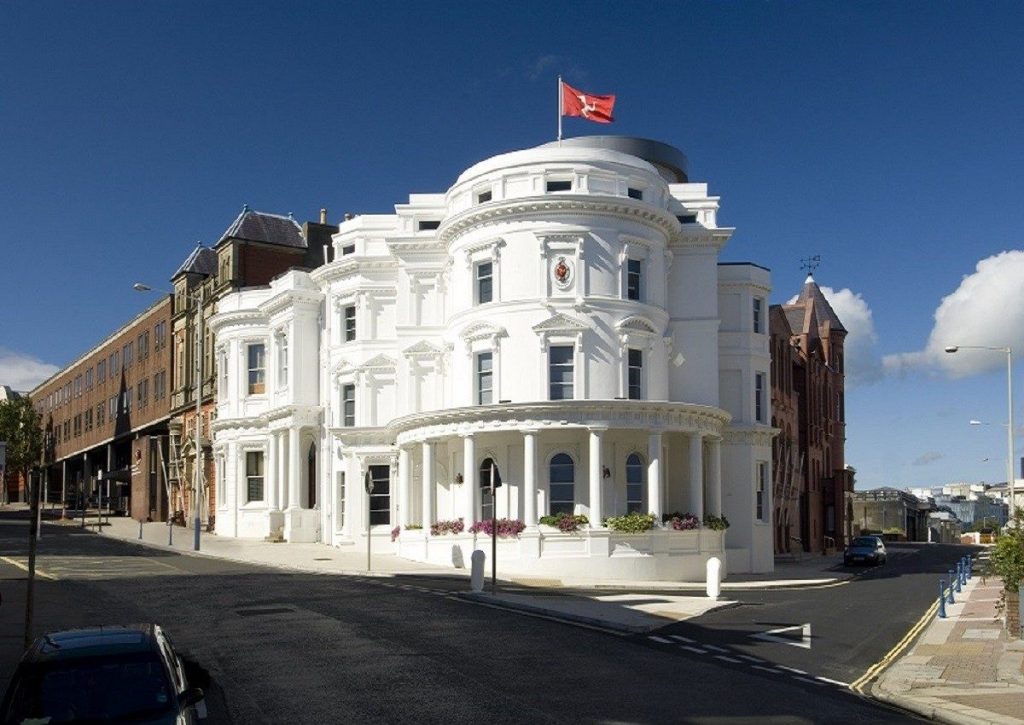
The Isle of Man Foundation served as one of the original holding structures for early Cardano crowdsale proceeds. The Swiss-based Cardano Foundation received a separate tranche, roughly 7,168 BTC, while the Isle of Man entity held the portion that includes the contested 1,096 BTC.
The formal dissolution of the Isle of Man Foundation in December 2025 means the entity that would have been the primary record-keeper no longer exists as a legal structure.
“You can dissolve an Isle of Man foundation under corporate law, but you can’t dissolve blockchain history. The closure of the Manx entity creates a dangerous accountability vacuum regarding the 1,096 BTC,” explained Samuel Cooling, an Isle of Man-based financial journalist.
“As a jurisdiction, the Isle of Man prides itself on compliance and transparency; therefore, seeing a legacy structure wind down without a clear, public handover of historical records is highly unusual. The onus is now entirely on the Swiss Cardano Foundation to prove that this transition wasn’t a corporate rug pull on historical transparency”.
That’s an accountability gap regardless of whether the underlying payments were legitimate. Community members have argued that the Cardano Foundation, which succeeded the Isle of Man structure, now bears responsibility for producing whatever historical records survive.
This dispute is not occurring in isolation: Cardano has already navigated a separate controversy around a 318 million ADA transaction from 2021, which prompted an independent 128-page audit by McDermott Will & Emery and BDO that cleared Hoskinson of misappropriation.
That audit raised the baseline expectation for documentary evidence on historical fund movements.
Hoskinson’s criticism of governance discussions playing out on X is noted; his call for “effective conversation” in Discord and structured forums is reasonable in principle. But telling critics to move off X while declining to publish source documents doesn’t resolve the underlying question.
Discover: The Best Token Presales
The post Charles Hoskinson Stands On $70M BTC Payment From 2016 Manx Entity: Critics Want the Paper Trail appeared first on Cryptonews.
Crypto World
SpaceX IPO leaves retail investors with too few shares and a tough hold-or-sell decision

Billboards in Times Square celebrate the SpaceX IPO debut at the Nasdaq on June 12th, 2026.
Adam Jeffery | CNBC
Retail investors who clamored for shares in SpaceX‘s blockbuster initial public offering received only a fraction of what many had requested, and are already split on what to do with the stock.
Across online investing forums, users complained of allocations as small as a single share despite requesting far larger amounts. Those who did receive stock are taking different approaches, with some selling into the company’s market debut while others are holding for the long haul.
Marvin Jung, a 51-year-old investor who requested 1,000 shares through Robinhood and received just 17, opted to quickly sell his stake after trading began.
“I have exited my position of SpaceX stock at $160,” Jung said. “It’s struggling too much and can’t find its footing. I’ll continue to watch and return in about six months when the lockup period is over.”
SpaceX shares rose another 6% on Monday, extending gains after the company’s record-breaking Nasdaq debut. The stock surged 19% on Friday to close around $161, up from its IPO price of $135 a share, lifting the company’s market value above $2 trillion.

SpaceX since IPO
Ross Cameron, 41, founder of trading education platform Warrior Trading, also came away with far fewer shares than he sought. He initially requested 2,500 shares through Schwab before increasing the order to 4,250 shares ahead of the deadline. He ultimately received 147 shares at the IPO price of $135.
“I would’ve liked to have gotten more shares filled because it would’ve increased my total profit, but I understand the demand was very high,” Cameron said. “My plan is to hold the shares unless they break $150, and take profit if they get closer to $200 a share.”
Cameron is also cautious about the months ahead, expecting a wave of selling pressure once lockup restrictions expire and additional shares become available for trading.
“I still think that the next six months will create a wave of selling due to the lockup expiration period,” Cameron said. “I don’t think there will be enough buying to support the current prices when those shares come onto the market.”
Most subscribed offering
The demand was intense across brokerage platforms. SoFi Technologies said SpaceX was “the largest and most subscribed offering” on its platform to date, adding that all qualified investors who requested shares received an allocation. Even so, many retail investors reported receiving only a fraction of the stock they requested.
Fidelity was also able to allocate shares to all eligible customers who sought to participate in the IPO, according to a source familiar with the matter, though some clients received fewer shares than requested given the SpaceX IPO demand was high relative to the available supply.
Others are taking a longer-term view. Helaine Markham, co-owner of Markham Trading, received all two shares she requested in the IPO and intends to hold the stock.
Markham said she has not added to her position because she views SpaceX’s valuation as “aggressive” and expects additional volatility as lockup restrictions expire and more shares become available for trading. She plans to wait for further price discovery before potentially increasing her stake.
The mixed reactions highlight the challenge facing investors trying to value one of the market’s most closely watched companies. While some see SpaceX as a rare long-term opportunity tied to the growth of Starlink and commercial space exploration, others are wary of the company’s now $2 trillion valuation and are choosing to take profits early.
Symbolic one-share allocations
Justin Sacco, founder of Sacco Financial, received 11 shares through Charles Schwab after requesting 75. Rather than sell, Sacco added to his position after the stock started trading, purchasing four additional shares in the open market and bringing his total holdings to 15 shares.
“I was certainly hoping to receive more than 11 shares after requesting 75,” Sacco said. “At the same time, considering the unprecedented demand for the IPO, I wasn’t shocked by the outcome. The fact that I received a meaningful allocation at all felt like a win.”
Sacco said he plans to hold these shares long term even though he has grown concerned about the lofty valuation.
Sacco’s experience was relatively fortunate compared with some retail investors. On Reddit’s WallStreetBets forum, users posted screenshots showing allocations of just a single share despite requesting hundreds or even thousands. Others joked that the tiny allocations amounted to little more than a souvenir from one of the most anticipated IPOs in recent memory.
CNBC has reached out to Robinhood, ETrade, Schwab for comment on retail allocation.

Crypto World
Warren Buffett AI Agent (WarrenAI) Predicts Incredible Bitcoin Price by The End of 2026
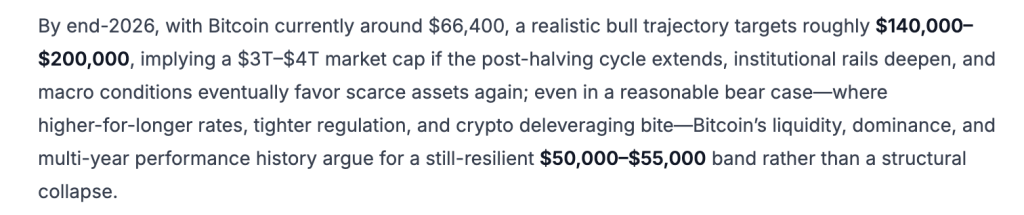
The number that stands out from Warren AI Bitcoin price predicts is not $140,000 or even $200,000. It is $50,000 to $55,000, because that is the bear case floor, and the fact that it frames that level as resilience rather than disaster tells you everything about how it views Bitcoin’s current position in the market cycle.
With BTC at $66,500, the downside scenario is a 17% to 25% pullback. The upside scenario is a 2x to 3x. That asymmetry is the whole argument.
The bull thesis runs on 3 converging forces. The post-halving supply cycle is still playing out, institutional infrastructure keeps deepening with every ETF filing and corporate treasury allocation, and macro conditions that are currently a headwind eventually rotate back to favoring scarce hard assets.
Warren AI is not predicting when those catalysts converge; it is predicting that when they do, the market cap math gets interesting fast.
A $140,000 to $200,000 Bitcoin implies a $3T to $4T market cap, which sounds aggressive until you remember gold alone sits north of $20T.
The bear case earns its place too. Higher-for-longer rates, tighter regulation, and a wave of crypto deleveraging could all conspire to push BTC back into the $50,000 to $55,000 band.
But the word choice is deliberate, resilient floor, not breakdown, not capitulation. Even Warren AI’s pessimistic scenario is framed as a buying opportunity rather than a trend change.

Bitcoin Price Prediction: The Bounce That Could Change Everything
What makes this moment interesting on the chart is that BTC just did something it has not done convincingly in months. It bounced.
Price sits at $66,572 after printing a low near $60,000 earlier this month, and that recovery candle off the June low is the first real sign of demand stepping in at a structurally meaningful level.
The $60,000 to $62,000 zone has now been tested twice this year, held twice, and rejected sellers both times. That is not a coincidence; it is the market telling you where the buyers live.
The overhead picture is less comfortable. Every recovery attempt since the $126,000 peak has rolled over, and the $70,000 to $72,000 region is now loaded with trapped longs from the May selloff who will be looking to exit.
Getting through that supply pocket cleanly is the real test before any conversation about $80,000 or beyond becomes credible.
The RSI is the most compelling piece of this right now. It is reading 44.87 with the signal line way down at 27.16, a gap of nearly 18 points.
That is not a small divergence. RSI spent weeks pinned in the oversold basement while price ground lower, and now it has ripped back through its average with serious velocity.
That kind of momentum recovery, especially when it leads price rather than follows it, tends to precede sustained bounces rather than fakeouts.
It does not guarantee the $140,000 case plays out, but it strongly suggests the $60,000 low is more likely a launchpad than a waystation on the way to $50,000. Warren AI’s end-of-year target starts with surviving this zone, and right now, the chart says the bulls are doing exactly that.
You Might Like What Warren AI Predicts About LiquidChain
The money that wins cycles never announces where it is going.
Large caps are not broken. They are out of the room. Bitcoin, Ethereum, and XRP have been testing the same ceilings for weeks. Every macro catalyst has a new arrival date. Every institutional wave has a new quarter attached. Waiting on someone else’s decision is not a trade. It is a waiting room.
Capital that understands cycles moves before the destination has a name.
Small market cap infrastructure plays operate on physics large caps cannot replicate. A rotation that vanishes as noise at Bitcoin’s scale reprices an undiscovered project by multiples. The opportunity exists in the gap between what something is genuinely worth and what the market has assigned it. That gap closes permanently the moment discovery happens.
Multi-chain fragmentation has never been solved. Bitcoin, Ethereum, and Solana exist as completely isolated systems with no shared architecture and no native interoperability. Every time value crosses those boundaries it pays for that in fees, slippage, and failed transactions. Every single time.
Warren AI predicts LiquidChain makes that crossing free. All 3 networks inside one execution environment. Single deployment. Complete ecosystem access. No tax on any interaction.
The presale is at $0.01454 with just over $830,000 raised. Early and undiscovered.
Execution is unproven. Adoption is unknown. Established assets offer predictability toward a ceiling the market already sees. LiquidChain is an entry point that disappears once the market finds it.
Explore the LiquidChain Presale
The post Warren Buffett AI Agent (WarrenAI) Predicts Incredible Bitcoin Price by The End of 2026 appeared first on Cryptonews.
Bitcoin has staged a notable recovery over the past few days after a sharp correction drove the asset toward a major demand zone around $60K.
The rebound appears to have been fueled in part by improving macro sentiment following the preliminary peace agreement between the U.S. and Iran, which significantly reduced geopolitical uncertainty and boosted risk appetite across global markets.
The easing of tensions triggered a broad rally in risk assets while supporting Bitcoin’s recovery from recent lows.
Bitcoin Price Analysis: The Daily Chart
On the daily timeframe, BTC remains within a broader corrective structure despite the recent bounce from the $60K psychological support zone.
This area once again attracted substantial demand, producing a strong reaction and allowing buyers to regain some control in recent sessions. However, Bitcoin is now approaching its first significant resistance cluster around $65K-$67K, which previously acted as support before turning into supply following the breakdown.
The current rebound appears constructive, but the broader structure remains bearish in the short term. BTC continues to trade below the broken channel and beneath the major resistance region around $72K-$74K. As a result, the ongoing move could still be interpreted as a relief rally unless buyers manage to reclaim higher supply levels.
Should Bitcoin face rejection from the current $65K-$67K supply zone, another corrective move toward the $62K support area remains a realistic scenario. Conversely, a successful breakout above this region would expose the next resistance zone around $72K-$74K.
BTC/USDT 4-Hour Chart
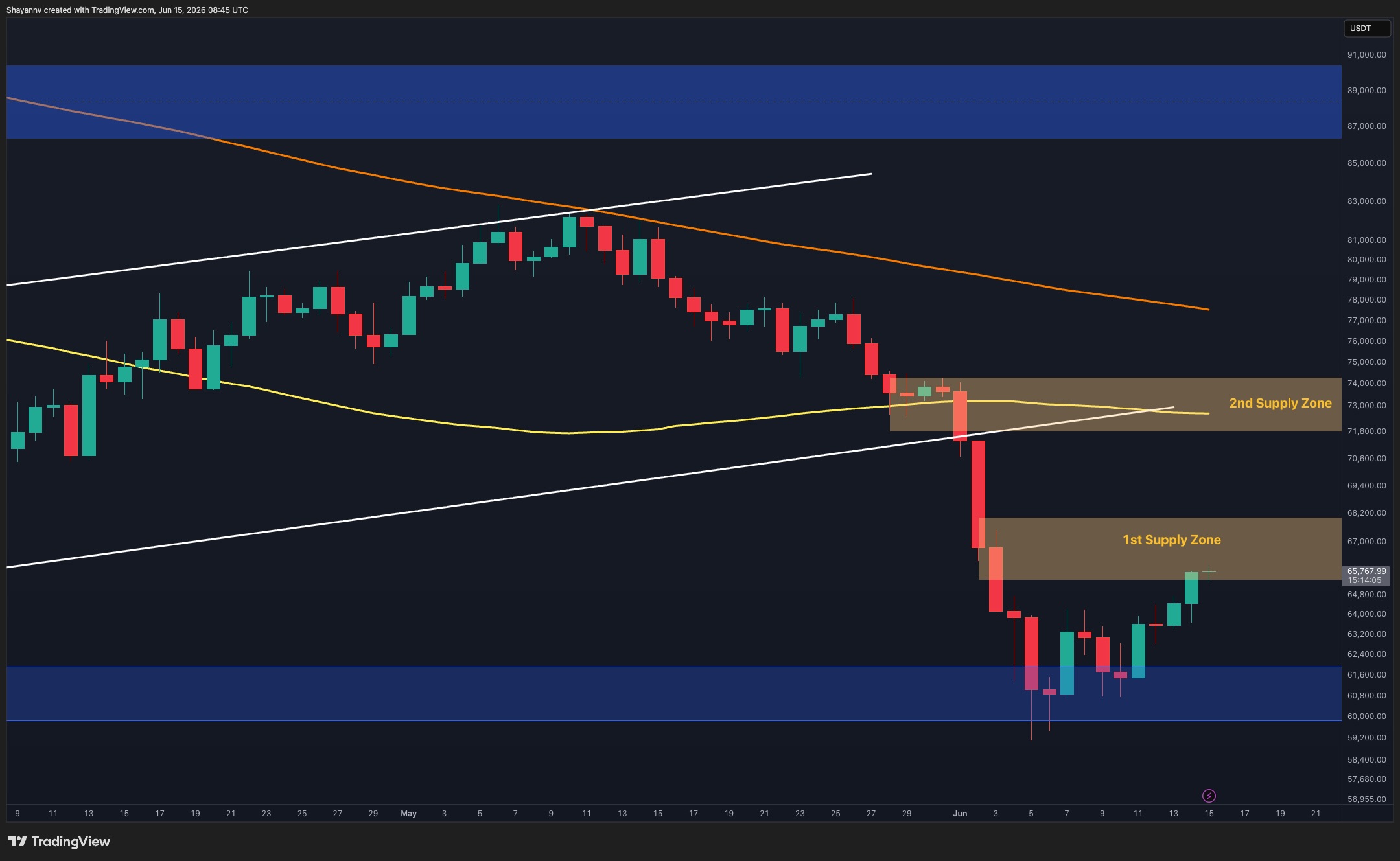
The 4-hour chart reveals that Bitcoin has recovered steadily from the recent bottom near $60K, forming a rising wedge/flag pattern while climbing from the lower boundary of the demand zone.
The latest surge has pushed the asset directly into the first supply zone between roughly $65.5K and $68K. This area represents the most important short-term obstacle for bulls, as it coincides with a previous consolidation range that eventually triggered the sharp breakdown.
Although momentum has improved considerably following the geopolitical developments, the market is now testing a region where sellers may attempt to regain control. A rejection from the current supply zone could lead to a pullback toward the wedge support and potentially the $62K-$63K area.
If buyers manage to absorb the supply and establish acceptance above $68K, the probability of a deeper recovery toward the higher resistance cluster near $72K-$74K would increase significantly. Until then, the price remains vulnerable to short-term retracements after the recent impulsive move.

Onchain Analysis
The UTXO Age Bands Realized Price chart provides an interesting view of investor positioning during the recent correction.
Bitcoin is currently trading below the realized price of the 1M-3M holder cohort, which is positioned around $75K, while remaining above the realized price of the 18M-2Y cohort near $74K. These levels often act as important psychological zones because they represent the average acquisition cost of different groups of market participants.
The recent decline below the short-term holders’ cost basis suggests that many newer investors are currently holding unrealized losses, a condition that typically weighs on market sentiment during corrections.
The continued upward trend in both realized price cohorts also suggests that capital entered the market aggressively throughout the previous advance. While this does not eliminate the possibility of additional downside volatility, it supports the view that the current phase resembles a correction within a larger cycle rather than a complete trend reversal.
For now, on-chain data remains constructive, but from a technical perspective, Bitcoin is approaching a critical resistance area where the recent relief rally may face its first meaningful challenge. A temporary pullback from the $65K-$68K region would therefore not be surprising before the market attempts a larger recovery.

The post Bitcoin Price Analysis: Can BTC Extend Its Rally After Reclaiming $66K? appeared first on CryptoPotato.

Moonrock Capital founder Simon Dedic has said that if the United States and Iran actually sign a peace deal on June 19 as has been reported, it could mark the start of a major rally across risk assets, considering how they behaved when past conflicts ended.
His argument is that, as the most volatile major asset class, crypto would be the first to benefit once the macro pressure from the situation in the Middle East eases.
The Case for a Crypto Rally
In a post on X published on June 15, Dedic started off with a disclaimer, saying that trying to predict anything based on what US President Donald Trump says or does was “a fool’s game.”
He compared the head of state’s unpredictability to that of his Official Trump meme coin (up over 20% in the past week), but he argued that if indeed the Iran deal gets signed as planned this coming Friday, the setup looks a lot like previous moments when conflict-related uncertainty cleared out of markets all at once.
For example, when the Korean War ended, the S&P 500 gained 44% in the following year, according to Dedic. It was the same after the Iraq war, with the S&P 500 rising 25% in the year after the guns went quiet. The analyst also pointed out that in 19 out of 20 conflicts that came after the Second World War, markets took an average of just 28 days to fully recover the minute hostilities stopped completely.
Per his assessment, the Iran war has been the biggest reason why risk appetite has been so low lately. He noted that Bitcoin (BTC) was sitting near $65,000, down almost 48% from its all-time high, with many altcoins faring even worse. But if that overhang gets removed, Dedic expects crypto to reprice quickly, considering how closely it follows changes in risk sentiment.
“Everyone who’s been looking like an idiot for the last few months will soon look like a genius,” he wrote.
Trump confirmed the “Great Deal” in a post on Truth Social, with market commentary account The Kobeissi Letter saying that the proposed agreement would extend the current ceasefire, reopen the Strait of Hormuz, and kick off negotiations around Iran’s nuclear program. It will also reportedly lead to discussions regarding the lifting of sanctions against the Islamic Republic as well as unfreezing its funds, including about $1 billion in crypto seized under Operation Economic Fury.
Markets Are Already Rebounding
Indeed, there was a reaction in the market soon after Trump’s post, with S&P 500 futures going up 0.8% and their Nasdaq counterparts gaining 1.3%, while BTC moved to its highest level in almost two weeks.
Ethereum (ETH) also climbed back above $1,800 after languishing below that level since June 5, only briefly coming up for air on June 9 when it hit $1,700, per CoinGecko data, before promptly diving back under.
Others like XRP, Solana, and Cardano also posted notable results following news of the peace deal, but among the majors, Hyperliquid had the best uptick, with its price just above $68 at the time of writing representing a 10% increase in one day.
The post Analyst Predicts ‘Massive Bull Rally’ if US-Iran Peace Deal Is Signed appeared first on CryptoPotato.


Standard Chartered’s head of digital assets research Geoffrey Kendrick says bitcoin may have already put in its low for the current market cycle, arguing that a combination of improving investor flows, corporate buying and easing macroeconomic pressures points to a stronger recovery ahead.
The latest call marks a shift in sentiment after several months in which crypto markets struggled with rising geopolitical tensions, concerns about inflation and persistent outflows from U.S. spot bitcoin exchange-traded funds (ETFs.)
Last Friday, Kendrick told clients he believed bitcoin’s decline to roughly $59,000 represented the cycle low. At the time, however, he outlined three developments he wanted to see before gaining more confidence in that view: renewed bitcoin purchases by Strategy (MSTR), a return to positive ETF inflows and continued weakness in oil prices.
By Monday, all three had materialized.
Strategy, the largest corporate holder of bitcoin, disclosed that it purchased another 1,587 BTC last week. U.S. spot bitcoin ETFs posted net inflows of $86 million on Friday after a stretch of notable redemptions. Oil prices also continued to move lower, reducing concerns that higher energy costs could push inflation and bond yields upward.


An attacker drained roughly $2.1 million from a deprecated Aztec Connect smart contract on Sunday, three years after the privacy bridge was shut down, by abusing a flaw in how the contract verified zero-knowledge proofs. The exploit hit the RollupProcessorV3 contract at around 8:26 a.m. ET Sunday,… Read the full story at The Defiant
Crypto World
Bitcoin Tops $67,000 to Two-Week High After Trump Declares US-Iran Deal Complete and Hormuz Reopening
Bitcoin pushed above $67,000 on Monday, its highest level in roughly two weeks, after President Trump said the US-Iran deal was "complete" and that he had authorized reopening the Strait of Hormuz. The largest cryptocurrency traded around $67,170, up 4.9% over 24 hours, touching an intraday high… Read the full story at The Defiant

Monster Beverage sees ‘gigantic opportunities’ in China and India

Kalshi assigns AI agent to pick markets as volume tops $5B

Dips It Low For A$AP Rocky At Magic City (WATCH)


-

 Business1 day ago
No Jackpot Winner as $257 Million Prize Rolls Over to $269 Million Monday Draw
-

 Crypto World4 days ago
Oppenheimer backs SpaceX as $70 billion retail frenzy builds
-

 Crypto World4 days ago
Markets Rally as SpaceX IPO Looms Amid Iran Tensions and Inflation Surge
-

 Fashion3 days ago
Weekend Open Thread: Tuckernuck – Corporette.com
-
 Crypto World18 hours ago
Zimbabwe Requires Crypto Businesses to Register Annually Under New FIU Regulations
-

 Entertainment6 days ago
The Ryan Gosling True Crime Thriller On Netflix That Gets Even Stranger, Stream It Now
-
 Sports6 days ago
Bangladesh beat Australia after 20 years in ODIs, register only their second win over six-time world champions | Cricket News
-

 Tech3 days ago
NanoClaw integrates JFrog registries to secure AI agent downloads
-

 Tech3 days ago
This Week In Security: Microsoft On Microsoft, Register Your Domains, Linux On ARM, And FreeBSD Joins The File Cache Club
-

 Crypto World2 days ago
Bitget enters Argentina’s regulated crypto market through PSAV registration
-

 Politics4 days ago
Politics Home | Healey Resignation Is “Colossal Failure Of Government”, Says Former Labour Defence Secretary
-
 Tech4 days ago
Dutton Ranch star claims they ‘didn’t see any disruption’ on set following Chad Feehan’s exit from Yellowstone spinoff fueled by Taylor Sheridan clash rumors
-

 NewsBeat4 days ago
El Nino has formed in the Pacific and could set records, forecasters say
-
 Tech5 days ago
‘This is Seattle’s position on AI’: City Council votes unanimously to pause big new data centers
-
 Entertainment4 days ago
Donnie Wahlberg & More Heat Up Las Vegas at Circa’s Barry’s Downtown Prime
-

 Sports4 days ago
First Time Since 1971: Australia Register Historic Low In ODI Cricket
-
 Tech4 days ago
Opendoor Ends India Operations, Fueling a Bigger Conversation About AI and Outsourcing
-

 Politics4 days ago
Belfast burns, while Met chief points finger at Iran and Russia
-

 Business6 days ago
Thailand Ranks Second Worldwide for AI Adoption Growth, Microsoft Reports
-

 NewsBeat3 days ago
FBI searches office of Ohio voter registration group
You must be logged in to post a comment Login