

Crypto World
Radiant Capital to wind down after $50 million North Korea-linked hack



Radiant Capital has announced plans to wind down operations after failing to recover from a $50 million exploit that devastated the lending protocol and left it without sufficient funding to continue.
Summary
- Radiant Capital said it will wind down operations after failing to recover from a $50 million exploit and secure new funding.
- The protocol will remain online in a maintenance state, allowing users to withdraw funds and manage positions while development work ends.
- Investigations linked the 2024 attack to North Korea-aligned threat actors, while recovery efforts were hindered after portions of the stolen funds moved through Tornado Cash.
According to a statement published Monday by Radiant’s decentralized autonomous organization, the protocol could no longer identify a viable route forward after unsuccessful attempts to recover stolen assets, raise fresh capital, and maintain the resources needed to operate responsibly.
In a separate update shared on X, the DAO said contributors and community members had continued supporting the platform under increasingly challenging circumstances. The organization stated that without recovered funds, new investment, or renewed growth, the protocol could not remain sustainable.
The decision closes a difficult chapter for a project that once ranked among the largest cross-chain lending platforms.
Launched in 2022, Radiant sought to unify liquidity across multiple blockchains and grew rapidly during 2023. Data from the protocol shows its total value locked reached $386.8 million in December 2023.
Fortunes changed sharply after an October 2024 exploit that security researchers and later investigations linked to North Korean threat actors. Following the breach, Radiant’s total value locked fell to roughly $75 million and dropped to about $5 million within weeks, according to protocol data.
Recovery efforts failed to restore the protocol
While operations are being scaled back, Radiant said the protocol will not disappear entirely. Instead, it will move into what it described as a maintenance state.
Under that arrangement, the frontend will remain online, smart contracts will stay accessible, and users will still be able to withdraw assets, repay loans, and manage existing positions. Development work, protocol upgrades, and expansion efforts, however, will cease as DAO contributors step away from active operations.
Radiant also urged users to manage their exposure carefully while the protocol enters its final phase.
Remaining recovery initiatives connected to the hack will continue. The DAO said its remediation portal will stay open and any assets recovered in the future will be returned to affected users.
Previous recovery efforts have produced limited results. In October 2025, blockchain security firm CertiK reported that wallets linked to the attacker deposited 2,834 ETH into Tornado Cash after moving funds through multiple addresses and swaps involving DAI.
CertiK estimated that approximately $10.8 million worth of Ethereum had already been laundered through the mixer, complicating efforts to trace and recover the stolen assets.
North Korea-linked attack became a turning point
Radiant said in December 2024 that an attacker posing as a former contractor distributed malware through Telegram. According to the protocol, a malicious ZIP file circulated among developers for feedback, creating an entry point that ultimately led to the compromise.
A post-mortem investigation from cybersecurity firm Mandiant later linked the incident to the AppleJeus hacking group, which it identified as part of North Korea’s cyber ecosystem.
According to Mandiant, the attackers gained control of three of Radiant’s eleven multisig signer permissions and replaced the lending pool’s implementation contract, allowing them to steal approximately $53 million from the Arbitrum and BNB Chain deployments.
The tactics used in the attack later surfaced in other major crypto incidents. In April 2026, Drift Protocol said it had medium-high confidence that the same actors behind the Radiant breach were responsible for a separate exploit against its platform. Drift’s investigation concluded that the group spent months building trust with contributors through conference meetings and professional contacts before deploying malicious tools and links.
Market reaction to Radiant’s closure announcement remained negative. The protocol’s RDNT token fell 4.2% after the news.

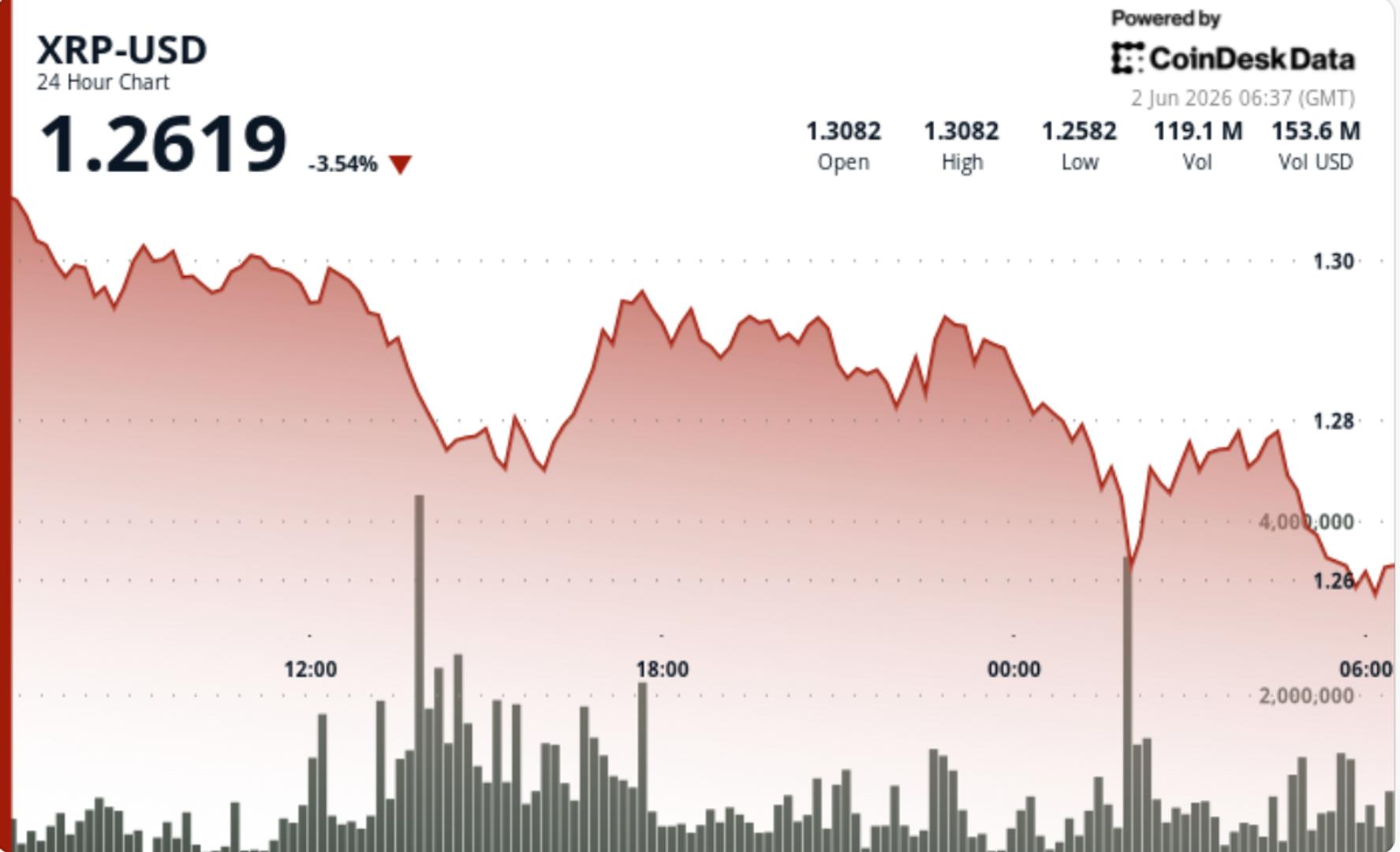
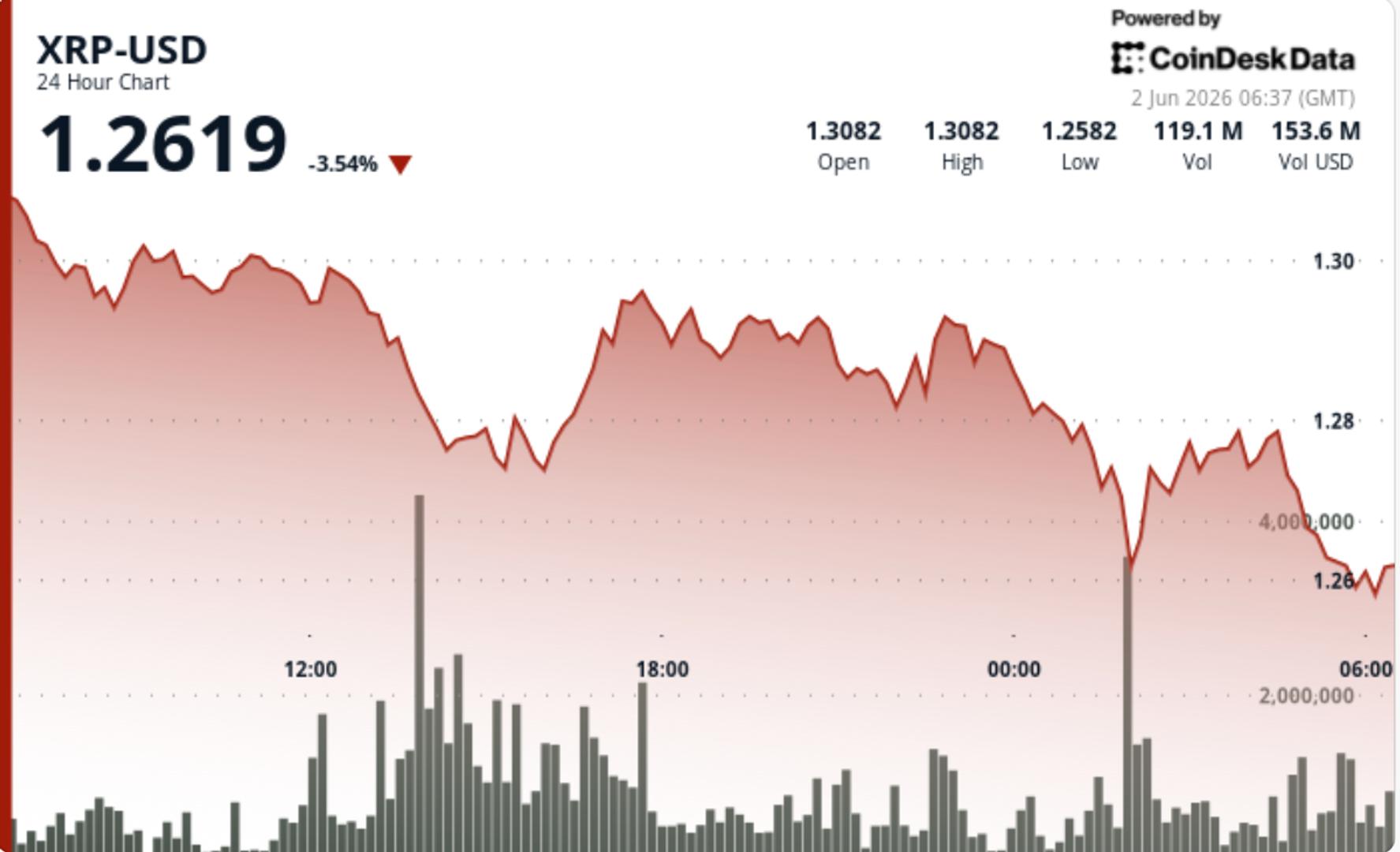
XRP finally lost the $1.30 area traders had been defending for weeks, and the breakdown came on the heaviest volume of the session. Tokens continue leaving exchanges, which normally points to accumulation, but the market is still treating rallies as selling opportunities, leaving price stuck in a clear downtrend.
News Background
• More than 25 million XRP moved off exchanges in recent days after the largest single-day inflow of 2025, suggesting some investors are accumulating into weakness.
• Despite those outflows, XRP continues to track broader crypto sentiment closely, showing little evidence of asset-specific demand driving price higher.
• Analysts remain focused on whether the recent selloff is a temporary washout or the start of a deeper move toward support levels last tested earlier this year.
Price Action Summary
• XRP fell from $1.3109 to $1.2668 during the 24-hour session, posting a 3.4% decline.
• The key breakdown came during the June 1 13:00 UTC session, when volume surged to 96.26 million and pushed price below support at $1.2960.
• XRP later attempted a recovery toward $1.2791, but sellers quickly regained control and forced price back toward session lows.
Technical Analysis
• The break below $1.30 matters because it removes one of the most closely watched support levels on the chart.
• Exchange outflows remain constructive beneath the surface, but they are not yet translating into stronger price action.
• Failed recovery attempts near $1.2730-$1.2750 suggest sellers remain active on even modest rallies.
• The broader structure continues to show lower highs and lower lows, keeping momentum firmly tilted to the downside.
What traders should watch
• $1.2650-$1.2670 is now the immediate support zone after the latest selloff.
• $1.2730-$1.2750 becomes the first resistance area XRP needs to reclaim before downside pressure can ease.
• A recovery above $1.30 would improve sentiment materially, but until then traders are likely to focus on whether support near $1.26 can hold.
• If current support breaks, attention shifts toward the $1.20 area as the next major downside target.


U.S. spot bitcoin ETFs have suffered their largest and longest withdrawal streak on record, with investors pulling roughly $3.45 billion across 11 consecutive trading sessions as bitcoin slid toward $70,000, according to data provider SoSoValue.
The 11-session run, which began May 15, marks the longest stretch of net redemptions since the funds debuted in January 2024, surpassing the eight-day record set in February 2025.
However, Wall Street’s appetite for risk remains strong, with Nvidia up 6%, and other stocks linked to semiconductors and AI attracting the interest of investors.
The latest session saw investors withdraw another $484 million from the funds, helping push down BTC’s price by 4% during the Asian trading day.
Meanwhile, Strategy (MSTR), the largest corporate holder of bitcoin, disclosed on Monday that it sold 32 BTC, worth roughly $2.5 million, to fund distributions on one of its preferred stock offerings.
While the sale represented a tiny fraction of the company’s holdings, it marked Strategy’s first bitcoin sale since December 2022 and came after months of Executive Chairman Michael Saylor championing a buy-and-hold approach.
The move also comes as other measures of institutional demand are beginning to weaken.
In its most recent weekly report, CryptoQuant warned that bitcoin is increasingly becoming a market of holders rather than buyers.
CryptoQuant noted that ETF and corporate treasury accumulation has slowed markedly in recent months, making the current record ETF withdrawal streak another sign that one of the primary sources of demand underpinning bitcoin’s rally may be fading.
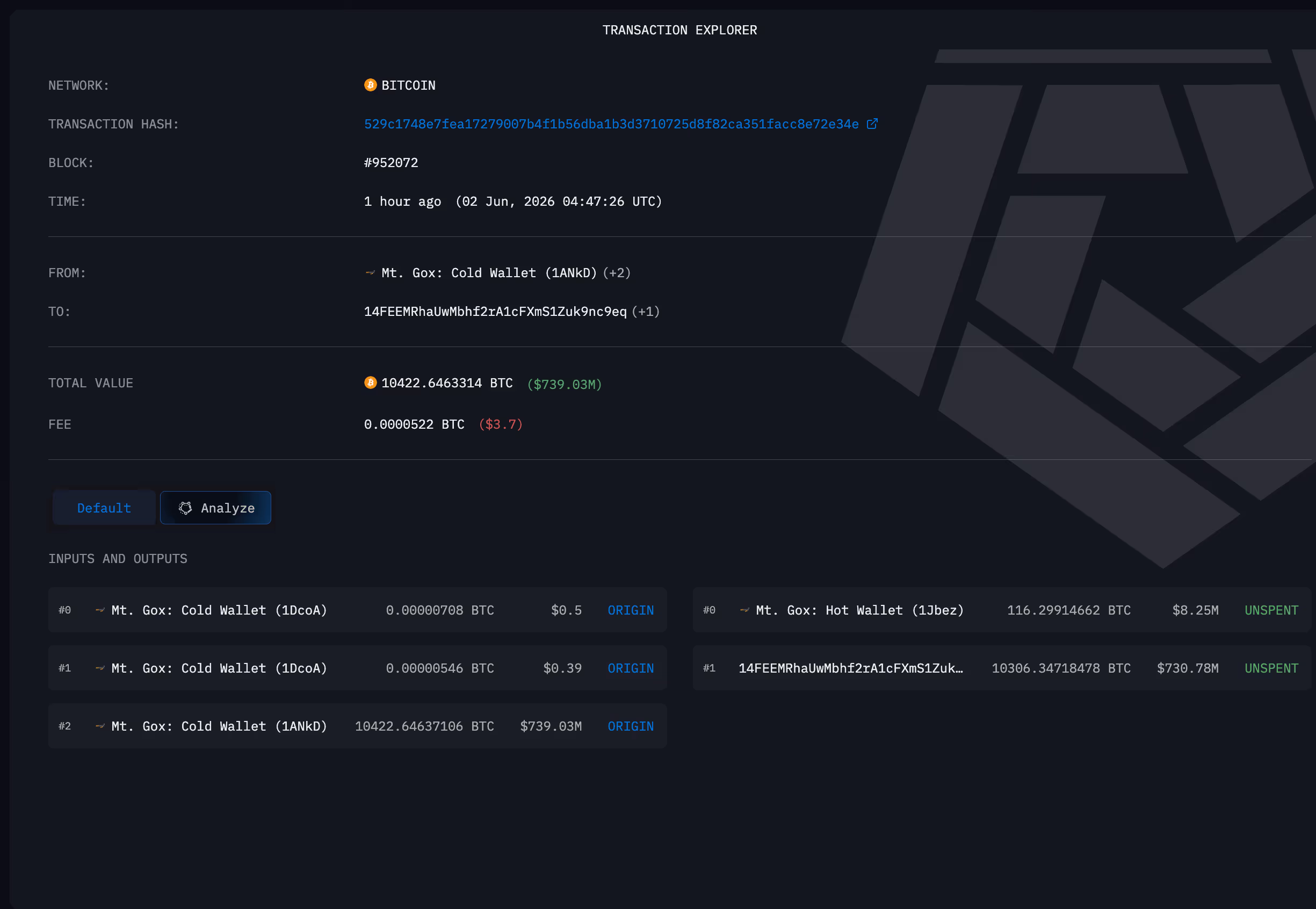
Defunct bitcoin exchange Mt. Gox moved 10,422.65 bitcoin worth roughly $739 million to a new wallet at 04:47 UTC on Tuesday, marking the largest single transfer in months and its biggest move ahead of the October 31, 2026 deadline to complete creditor repayments.
The transaction, recorded on Bitcoin block 952,072, sent 10,306.35 BTC ($730.78 million) to a previously unseen address starting with 14FEEM, while a smaller 116.30 BTC ($8.25 million) slice routed to Mt. Gox’s known hot wallet at 1Jbez, per Arkham Intelligence.

The split pattern mirrors earlier administrative transfers that preceded creditor distributions, though none of the coins has yet been forwarded to a custody provider or exchange.
Mt. Gox still holds roughly 34,504 BTC valued at $2.43 billion, the largest unresolved holding tied to any failed crypto exchange.
Repayments officially began in mid-2024 and around 19,500 creditors have received funds, though trustee Nobuaki Kobayashi has pushed back the final deadline twice.
The most recent extension, approved by a Tokyo court in October 2025, moved the deadline from October 31, 2025 to October 31, 2026, with the trustee citing incomplete creditor procedures and pending processing issues.
The movement comes during a sharp bitcoin slide that has taken BTC below $71,000 for the first time in weeks, with Strategy’s first publicized bitcoin sale, a record 10-session spot ETF outflow streak, and stalled U.S.-Iran ceasefire talks all weighing on the market.
Mt. Gox creditor coins were largely acquired before the 2014 collapse, meaning any distribution would meet sellers ready to realize substantial gains at current prices.
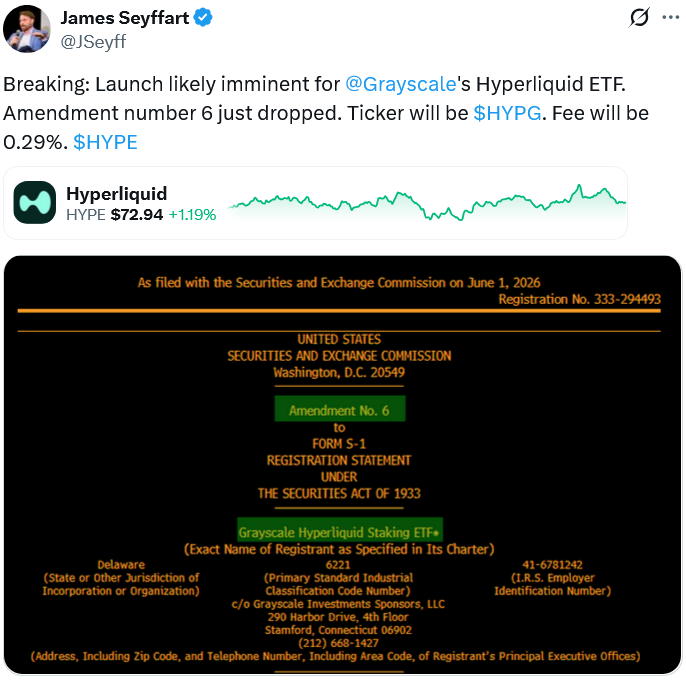
Crypto asset manager Grayscale could launch its exchange-traded fund tied to the Hyperliquid token in the US as soon as this week after it amended a regulatory filing for the fund, an analyst says.
Bloomberg ETF analyst James Seyffart posted to X on Monday that the launch of Grayscale’s ETF was “likely imminent” and was “expecting the launch this week” after the company amended the fund’s filing for the sixth time to add its ticker and fee.
Grayscale’s amended filing added that the ETF would trade under the ticker HYPG with a 0.29% management fee, which Seyffart noted “slightly undercuts” rival Hyperliquid (HYPE) ETFs from 21Shares and Bitwise that launched in mid-May.
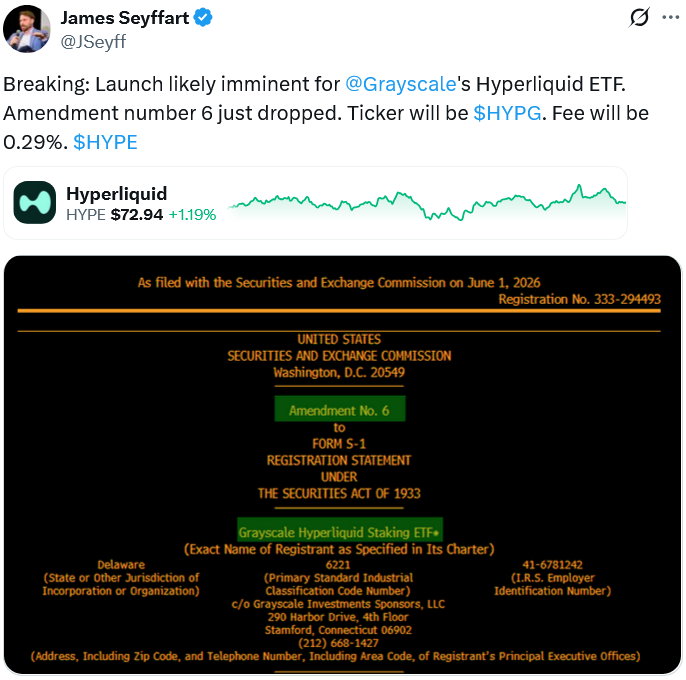
Source: James Seyffart
21Shares ETF has a fee of 0.3%, while Bitwise charges 0.34%. Together, the ETFs have recorded nearly $140 million in net inflows since launch as investors looked to get exposure to HYPE, the token for the layer 1 blockchain and perpetual futures platform, Hyperliquid.
Hyperliquid has become one of the most popular trading platforms for crypto traders in recent months, with blockchain data showing that it now consistently facilitates over $170 billion in monthly trading volume across a broad range of asset classes.
Grayscale’s HYPG is also seeking to follow 21Shares and Bitwise by staking HYPE to earn yield, an offering that asset managers have added to similar crypto ETFs to attract investors.
Related: Hyperliquid launches prediction markets for real-world events
The Hyperliquid ETFs have helped push HYPE to a new all-time high of $75.3 on Monday.
Its market capitalization has risen to $16.7 billion as a result, making it the 10th largest cryptocurrency by market value.
Grayscale’s potential launch comes as US-listed Bitcoin (BTC) ETFs have recorded net outflows over 10 consecutive trading days, bleeding nearly $3 billion.
US Ether (ETH) ETFs are also on a 14-day net outflow streak, as investors are reducing positions faster than fresh capital is flowing into the market.
Magazine: HYPE chases $100 target, ETH could dump below $1800: Market Moves
Crypto World
A Whale Just Opened a $44 Million ETH Short: Why Hyperliquid Traders Are Moving Against It
Ethereum (ETH) price is playing hide-and-seek with the $2,000 psychological level after Strategy’s first Bitcoin sale in years rattled the market, and the on-chain reaction split in two: large holders pressing the short side, and Hyperliquid traders quietly fading them.
ETH is down more than 13% month-on-month. What makes the past few hours a scoop is not the selling itself but who is leaning against it. Here is how the chain of events connects.
The Trigger: ETH Whales Turn Bearish on Bitcoin’s Bad News
The catalyst was Bitcoin’s, not Ethereum’s. When Strategy disclosed it had sold Bitcoin for the first time in years, breaking its long-held never-sell stance, the reflex across large holders was to de-risk the whole complex, and ETH caught the spillover.
The bearish positioning showed up fast and from two directions. On-chain tracker Onchain Lens flagged a whale opening a 21,948 ETH short worth roughly $44 million at 10x isolated leverage, entered near $2,004 with a liquidation price at $2,339.76.
Want more token insights like this? Sign up for Editor Harsh Notariya’s Daily Crypto Newsletter here.
Hours later, EyeOnChain spotted a second wallet capitulating: a trader who bought about 5,003 ETH near $1,999 across March and April, roughly $10 million, moved around 5,000 ETH worth $9.8 million into Kraken as the price slid toward $1,960. Moving coins to an exchange typically precedes a sale, and a full exit here would lock in a loss of nearly $200,000.
One pressed a fresh leveraged short, the other abandoned a two-month dip-buy. Same instinct, opposite tools, both bearish.
The Confirmation: Reserves Slip and Longs Get Flushed
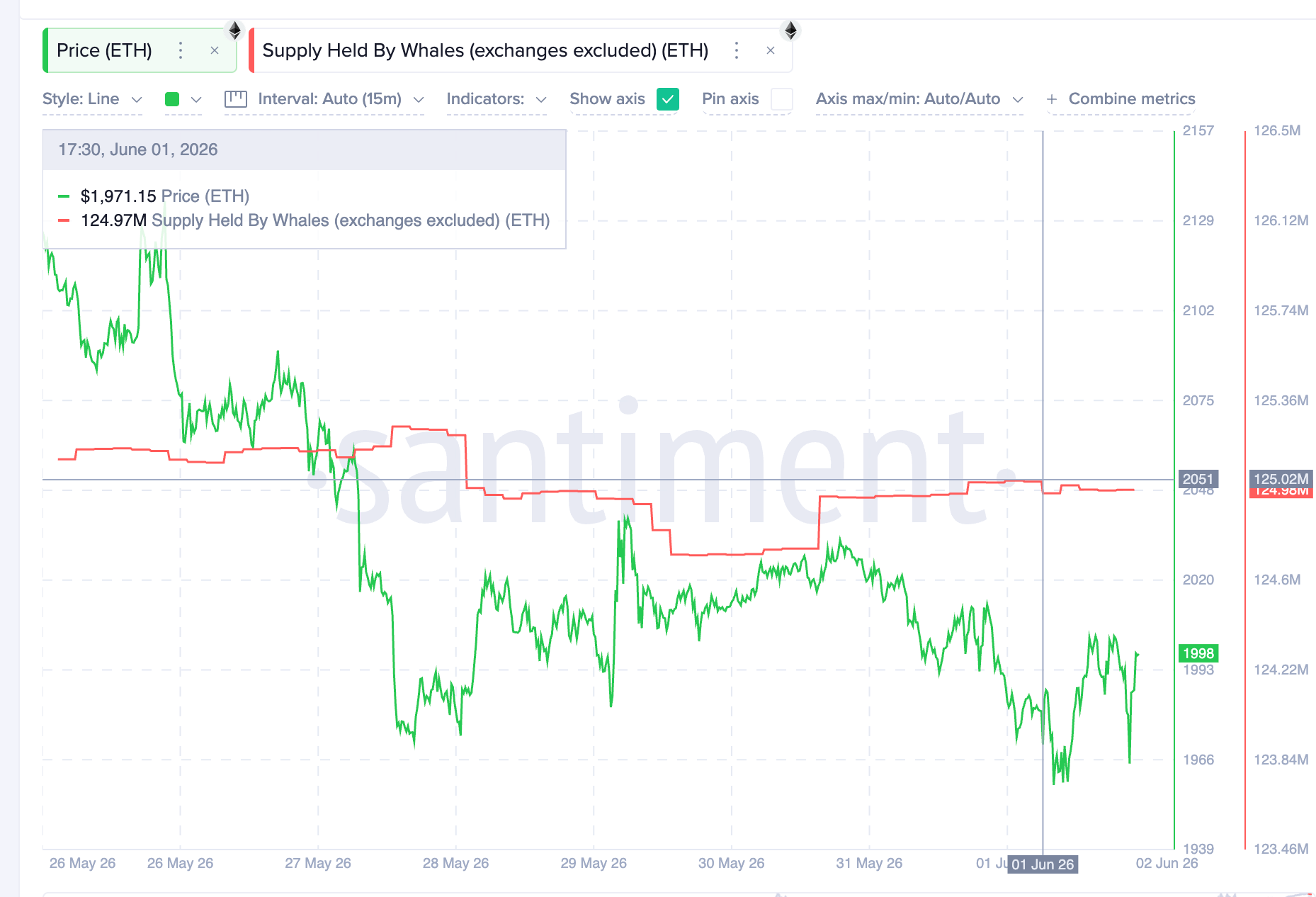
The aggregate data agrees, and the price mechanics explain why the Ethereum price of $2,000 keeps breaking. Per Santiment, the supply held by ETH whales excluding exchanges edged down from 125.02 million ETH on June 1 to 124.98 million a day later. The move is small, but combined with the dip buyer’s Kraken deposit, it reads as distribution rather than accumulation at these levels.

The leverage picture is where the pressure becomes visible. On the Binance ETH/USDT perpetual, a contract with no expiry that tracks spot price, the 7-day Coinglass liquidation map shows about $1.82 billion in cumulative short liquidation leverage stacked against roughly $781.93 million on the long side.

The book is positioned bearish overall.
Yet the immediate could affect the longs: as price weakens toward $1,930, that zone that still holds about $523.96 million in long leverage could still get liquidated. The persistent weakness could be the reason why the massive short position was opened earlier today.

That is also the mechanical reason ETH keeps losing $2,000. The drops are not only whales hitting bids, but they are also long liquidations cascading into thin support. On the obvious read, the story ends here, bearish and done.
The Divergence: Hyperliquid Money Fades the Selloff
Then the tape turns against itself. Over the past six hours, after the Strategy sale, perpetual flows have split Ethereum away from Bitcoin. Bitcoin absorbed net selling pressure worth about $15.61 million, while ETH drew net buying pressure worth roughly $9.10 million.
That is the contrarian tell. When the headline shock is Bitcoin-specific, a Bitcoin treasury firm selling Bitcoin, the reflexive trade is to sell the whole market. Instead, flow data shows traders using the correlated weakness to bid the asset that was never the story. ETH is being favored on Bitcoin’s bad news.

The two readings now sit in direct tension. A $44 million short and a fresh wave of distribution says down.
Hyperliquid flow says someone is fading that move with conviction. And the over-shorted book sharpens the stakes: with $1.82 billion in short leverage stacked above, a sustained bid that drags ETH back through $2,000 would put those shorts, including the $44 million position with its $2,339.76 liquidation, directly in the firing line. The setup, from a distance, hints at a short-squeeze setup.
The Hyperliquid positioning data could be front-running it.
For now, the Ethereum price sits on the line between the two. The whales have made their bet. The question the next sessions answer is whether the quiet buyers on the other side are early or wrong.
The post A Whale Just Opened a $44 Million ETH Short: Why Hyperliquid Traders Are Moving Against It appeared first on BeInCrypto.


Stablecoins nearing a $300 billion market value have prompted fresh warnings from the European Central Bank, whose officials say a digital euro is needed to protect financial stability and maintain the role of central bank money in the payments system.
Summary
- ECB board member Isabel Schnabel warned that stablecoins could create financial stability risks as the sector approaches a $300 billion market value.
- Schnabel said dollar-backed stablecoins could strengthen the U.S. dollar’s global position, while euro-denominated stablecoins remain a small part of the market.
- The ECB continues to back a digital euro project, with a pilot expected in 2027 and potential issuance readiness targeted for 2029.
According to Isabel Schnabel, a member of the European Central Bank’s Executive Board, the rapid growth of stablecoins has introduced risks that could affect financial stability, monetary policy, and the international monetary system.
Speaking at the 2026 Bank of Korea International Conference in Seoul on Monday, Schnabel said stablecoins remain vulnerable to runs if users lose confidence in the assets backing them.
Schnabel told conference participants that stablecoins face liquidity mismatches and can become unstable when trust in reserve assets deteriorates. She also warned that the sector’s heavy reliance on dollar-denominated tokens could reinforce the U.S. dollar’s position in global finance.
“The growing use of stablecoins may further cement the international dominance of the U.S. dollar. Today, virtually all stablecoins in circulation are denominated in dollars, with other currencies playing a negligible role,” – Isabel Schnabel.
ECB figures cited by Schnabel show that the stablecoin market has grown to almost $300 billion, even though expansion has slowed compared with earlier periods. She said Tether’s USDT and Circle’s USDC together account for about 90% of the market.
ECB points to digital euro as policy response
Rather than opposing technological innovation, Schnabel said central banks should establish safeguards that preserve trust in money and maintain effective monetary control.
“The appropriate response is therefore not to resist innovation but to ensure that it develops within a framework that preserves stability, monetary control and trust in the currency.”
Within Europe, Schnabel argued that a digital euro would help preserve public access to central bank money while reducing dependence on foreign payment providers. She said a retail central bank digital currency could serve as a pan-European payment option with legal tender status and help address fragmentation across the region’s payments market.
Her comments build on the ECB’s ongoing digital euro project. Back in March, ECB Executive Board member Piero Cipollone told European lawmakers that the central bank expects to publish digital euro technical standards in 2026, allowing banks, payment firms, and merchants to prepare their systems before any final issuance decision.
Under agreements announced in April, the ECB partnered with the European Card Payment Cooperation, nexo standards, and the Berlin Group to reuse existing European payment standards for digital euro transactions. The ECB said the approach would reduce implementation costs and allow payment providers to integrate digital euro services through existing infrastructure rather than building entirely new systems.
According to Cipollone, the digital euro would complement cash and bank deposits rather than replace them and argued that maintaining a European payment infrastructure could help retain payment revenues within the region and reduce reliance on international payment networks.
Launch readiness targeted for 2029
As work on the project continues, the ECB’s website states that the digital euro is currently in a technical preparation phase. The central bank expects digital euro legislation to be adopted in 2026, followed by a 12-month pilot beginning in the second half of 2027 that will test person-to-person and point-of-sale payments.
Provided the legal framework is approved, the ECB has said it wants to be technically ready for a potential issuance by 2029.
Elsewhere, Schnabel contrasted Europe’s approach with that of the United States. Her remarks came just days after U.S. Treasury Secretary Scott Bessent reiterated that the current administration does not support the creation of a U.S. central bank digital currency while encouraging Congress to advance the Clarity Act.

Bitcoin is on “the edge of a breakdown,” reported onchain analytics firm Swissblock on Monday.
The analysts noted that the loss of the “Cost Basis Zone” has already triggered a decisive drawdown.
Consolidation inside this zone appeared constructive, but there was no confirmation, and BTC failed to hold it, showing little strength when trying to reclaim it, they said.
“That shifted the framework from consolidation into breakdown risk.”
BTC Needs to Re-enter The Battlefield
The Cost Basis Zone is currently between around $72,000 and $79,000, according to the Swissblock chart.
It measures the price range where recent Bitcoin buyers, especially short-term holders, acquired their BTC on average and acts as a key support/resistance level based on the actual purchase prices of coins in circulation.
“The only way BTC recovers its bullish posture is by re-entering the Cost Basis Battlefield with strength.”
Bitcoin is on the edge of a breakdown.
The loss of the Cost Basis Zone has already triggered a decisive drawdown.
At first, consolidation inside the cost-basis battlefield looked constructive.
But consolidation was not confirmation.
BTC failed to hold the zone, then showed… pic.twitter.com/6qGc0nYKYn— Swissblock (@swissblock__) June 1, 2026
Bitcoin is “under growing pressure,” stated Glassnode on Monday. “Sellers dominate spot, ETF outflows accelerate to $1.3 billion, and fresh capital has stalled,” it added.
“Structure has broken, and momentum favours the downside near-term.”
Bitcoin ETP provider Bitcoin Capital echoed the sentiment, stating that the recovery stalled exactly at the short-term holder cost basis and rolled over.
Key on-chain metrics have broken down at current price levels, which are a “contained drawdown and failed recovery.”
“Bitcoin’s weakness against the wider market has reached its highest point ever,” commented the usually bullish ‘Sykodelic’. “It is now the only macro asset not in expansion.”
“At this moment, Bitcoin has completely decoupled from every other macro asset, for the first time since it was created.”
It will also be the first time any macro asset has “created its own unique path and ignored the underlying forces that govern financial markets,” he added.
Bitcoin Dumps to $70K
Bitcoin fell to $70,000 in early Asian trading on Tuesday morning, marking a 3.8% daily decline.
The asset is currently down 8% on the week and is poised to fall back into the $60,000 zone, returning to levels last seen in early April.
It is still largely range-bound, as it has been since early February, but could now fall to the bottom of that range, around $65,000.
A recent SEC filing revealed that Michael Saylor’s Strategy sold 32 BTC in late May for around $2.5 million, compounding the overwhelmingly bearish sentiment.
The post Bitcoin Hits $70K After Losing Key Cost Basis Zone as Analysts Warn of Deeper Drawdown appeared first on CryptoPotato.


Gnosis Pay users were urged to withdraw funds after an active exploit linked to the platform’s Zodiac delay module, according to posts from Gnosis co-founder Martin Köppelmann and blockchain security firm PeckShield.
Summary
- Gnosis Pay users were told to withdraw EURe and GNO after a delay module exploit.
- Köppelmann said the bug lets an attacker initiate transactions from Safes using the module.
- Gnosis said it would cover user losses while asking bridge validators to pause activity.
“If you are a Gnosis Pay user – unfortunately I have to recommend: withdraw all funds (EURe and GNO),” Martin Köppelmann said on X.
He said the delay module has a bug and warned that users “might be affected.” The post told users to move both EURe and GNO from Gnosis Pay while the team worked on the issue.
“Users are strongly urged to withdraw all funds (EURe and GNO),” PeckShield said in a separate alert.
The blockchain security firm said Köppelmann had warned about an active exploit related to Gnosis Pay. It also told users to check their exposure because they may be affected.
Zodiac delay module bug tied to attack
“The bug is related to the Zodiac delay module,” Köppelmann said in a later update.
He said the attacker can initiate transactions from Safes that use the delay module. The update gave more detail on the technical source of the exploit after the first warning referred only to a delay module bug.
Gnosis Pay uses Safe-based accounts with smart contract modules. Its own documentation says Gnosis Pay accounts use a Delay Module and a Roles Module to support card payments while keeping users in control of their accounts.
The Delay Module is designed to place a short wait before outgoing transactions can execute. In normal use, that gives users time to react before certain transfers are completed.
Gnosis moves to contain damage
“We are doing various measures to contain the damage like asking bridge validators to pause,” Köppelmann said.
The statement shows that Gnosis is working with outside infrastructure providers while it responds to the exploit. Bridge validators can play a role in cross-chain movement, so a pause may help slow further movement of affected funds.
“Rest assured, Gnosis will cover all user losses,” Köppelmann said.
No final loss figure had been published at the time of writing. The team has also not released a full post-mortem explaining how many accounts were affected or whether all attacker activity has stopped.
Wider payment security context
As previously reported by crypto.news, Gnosis Pay launched a self-custody card for crypto spending at Visa merchants. The product was built to connect blockchain wallets with real-world payments.
That design places Gnosis Pay in a growing group of crypto payment tools that use smart contracts to support everyday spending. It also puts more attention on the code that controls wallet permissions and transaction timing.
The latest warning does not describe Gnosis Pay as shut down. It says users should withdraw EURe and GNO while the team works to contain the exploit.

Anchorage Digital launched a settlement platform that allows institutions to trade on crypto venues while keeping assets in custody at its federally regulated bank, which it said will help manage counterparty and operational risks.
According to Monday’s announcement from the company, Coordinated Multiparty Settlement (CMS) connects trading venues, prime brokers and institutional clients through a shared settlement layer while keeping assets at Anchorage Digital Bank throughout the trade lifecycle.
Anchorage said CMS verifies funding obligations and coordinates settlement across participants, reducing the number of asset transfers needed to complete trades. The company said the system is designed to reduce the need for pre-funded exchange accounts, a common practice in crypto markets.
In a Monday X post, Anchorage said much of crypto trading still takes place on offshore platforms where “a single platform acts as exchange, custodian, and settlement agent” and client assets are often commingled and titled to the exchange.

Source: Anchorage Digital on X.com
Under the CMS model, prime brokers manage client balances and credit relationships, trading venues act as matching engines and Anchorage provides custody and settlement services.
The rollout will begin with foreign exchange trading platform Spotex, which Anchorage said processes billions of dollars in daily volume, with additional venue integrations under development.
Related: Anchorage Digital, Mexico’s Grupo Salinas partner on stablecoin cross-border settlement
Institutional trading infrastructure continues to evolve
Financial institutions and digital asset companies are fast expanding infrastructure for tokenized assets and institutional trading, with the Canton Network emerging as one focal point for those efforts as firms explore blockchain-based settlement.
In December, DTCC partnered with Digital Asset and the Canton Network to support the tokenization of DTC-custodied US Treasury securities, with plans to expand the initiative to additional asset classes. Two months later, Fireblocks integrated the network, enabling banks, custodians and asset managers to custody and settle assets on a blockchain built for regulated financial markets.
Banks are also investing in digital asset custody and market infrastructure. In May, Standard Chartered agreed to acquire Zodia Custody while spinning out Zodia Solutions, a standalone platform serving institutional digital asset clients. The transaction consolidates the bank’s custody operations while creating a separate company focused on services for financial institutions.
Magazine: ETH bears growling, Tom Lee’s buying, XRP to ‘explode’: Market Moves
The Open Network says it is planning to rebrand its Toncoin (TON) token to Gram (GRAM), the original name of the network’s cryptocurrency in its first white paper.
“Gram was the original name of TON’s currency in the first white paper,” Telegram and TON founder Pavel Durov posted to Telegram on Monday. “We’re returning to our roots — and starting a new chapter.”
The rebranding will “pave the way for what comes next,” and the transition will take around three weeks, he added.
The change revives the original token name from TON’s 2018 whitepaper, which Telegram abandoned after the US Securities and Exchange Commission blocked its $1.7 billion initial coin offering (ICO) in 2020.
The move follows Telegram’s takeover from the TON Foundation as the network’s primary driver and largest validator in May.
The Open Network launched a vote on the proposal on Monday, explaining that there is no swap, migration, bridge, claim or conversion, and every balance, address, contract and position stays exactly as it is currently.
At the time of writing, there were 1.8 million TON, or almost 80%, pledged in favor of the rebrand.
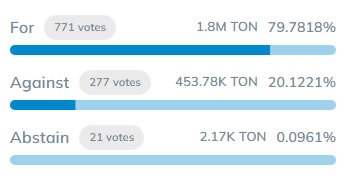
Voting for TON rebranding is underway. Source: The Open Network
Durov has positioned the token rebrand as part of the “Make TON Great Again” roadmap. The rebrand is the fourth stage of the roadmap, with the first three coming earlier this year that included an upgrade to Catchain in April to boost blockchain speed, a decrease in transaction fees, and the Telegram takeover.
“These changes mark a milestone for the network — and a natural moment to refresh how the token is known publicly,” TON stated.
The endgame is to power a seamless Web3 “super app” experience inside Telegram for its one billion users, turning the messenger into a global platform for payments, mini-apps, digital ownership, AI agents, and more.
Related: TON Pay aims to turn Telegram into a crypto checkout layer for TON
TON prices reacted strongly to the announcement, surging more than 15% from around $1.95 to top $2.25 in late trading on Monday.
The token had retreated by Tuesday morning, falling back to $2.07, and it remains down 75% from its June 2024 all-time high of $8.25, according to CoinGecko.
Magazine: HYPE chases $100 target, ETH could dump below $1800: Market Moves

Lioness Jill Scott cycle and run 388-miles for Sport Relief
Pulsar Helium reports Q2 results, plans production wells

Ripple-linked token falls 4% on bitcoin-led market weakness

Steven Gerrard disagrees with Gary Neville over ‘shock’ Chelsea and Arsenal claim | Football

US brings back mandatory military draft registration

Register Renaming | Hackaday

Crypto Gold Live Trading 01 June | Crypto Trading LIVE | BTC Live Trading | XAUUSD LIVE | #gold #btc

FINANCIAL ACCOUNTING | EXPECTED QUESTION| NON PROFIT ORGANISATION | FYUG BCOM CALICUT UNIVERSITY 2ND

Most vs least financially literate US states #usa #california #colorado #minnesota #finance #hawaii
-

 NewsBeat6 days ago
Israel says it has killed new Hamas military leader in Gaza City airstrikes
-

 Tech6 days ago
NASA taps Blue Origin to deliver lunar rovers for Moon Base initiative
-

 News Videos4 days ago
This is BROKEN! INSANE 5x MONEY CAR WASH WEEK! The NEW GTA Online UPDATE Today! (GTA5 New Update)
-

 News Videos6 days ago
XRP *JUST* SUCCEEDED!!!! CLARITY ACT EXPOSED!!! (SHE EXPOSED IT)
-
 Crypto World6 days ago
Micron Crosses $1 Trillion Market Cap as AI Demand Reshapes Memory Sector
-

 Business6 days ago
Selena Gomez Reportedly Upset Over Benny Blanco’s Comments on Her ‘Terrible’ Diet
-
 Tech3 days ago
SpaceX just won a second Golden Dome contract. This one is $4.16 billion.
-

 Tech4 days ago
Waymo dominates autonomous vehicle registrations as Tesla trails behind
-

 Entertainment6 days ago
Days of our Lives 2-Week Spoilers May 25-June 5: Gwen Rages, Abe Confesses & 2 Tragic Anniversaries!
-

 News Videos3 days ago
SHE IS KILLING XRP!!! WATCH URGENT AND ACT FAST
-
 NewsBeat3 days ago
FIRST NIGHT REVIEW: Take That bring the Circus back to life in spectacular sun-soaked style
-

 Tech6 days ago
The Samsung pay deal is the moment Korean unions changed register
-

 Tech6 days ago
Millions of AI agents imperiled by critical vulnerability in open source package
-

 Business10 hours ago
Jade Biosciences, Inc. (JBIO) Discusses Positive Interim Results From JADE101 Phase I Healthy Volunteer Study and Development Plans Transcript
-
Crypto World6 days ago
SpaceX’s $2 Trillion IPO: Why Tech Giants Nvidia (NVDA), Apple (AAPL), and Microsoft (MSFT) May Face Pressure
-
Crypto World4 days ago
CFTC Has Approved the First Regulated Bitcoin Perpetual Contract in the U.S.
-

 NewsBeat7 days ago
Family pay tribute to Eston ‘murder’ victim Peter Phillips
-

 Crypto World6 days ago
Spain blocks prediction markets Polymarket Kalshi
-
 Crypto World7 days ago
Bitcoin’s April recovery showed signs of structural accumulation
-
 Entertainment6 days ago
The Most Misunderstood Sci-Fi Horror Movie of the Last 10 Years Just Took Over Netflix
You must be logged in to post a comment Login