

Crypto World
Retail Bitcoin Demand Slides 73% as Futures Shorting Surges to $2B

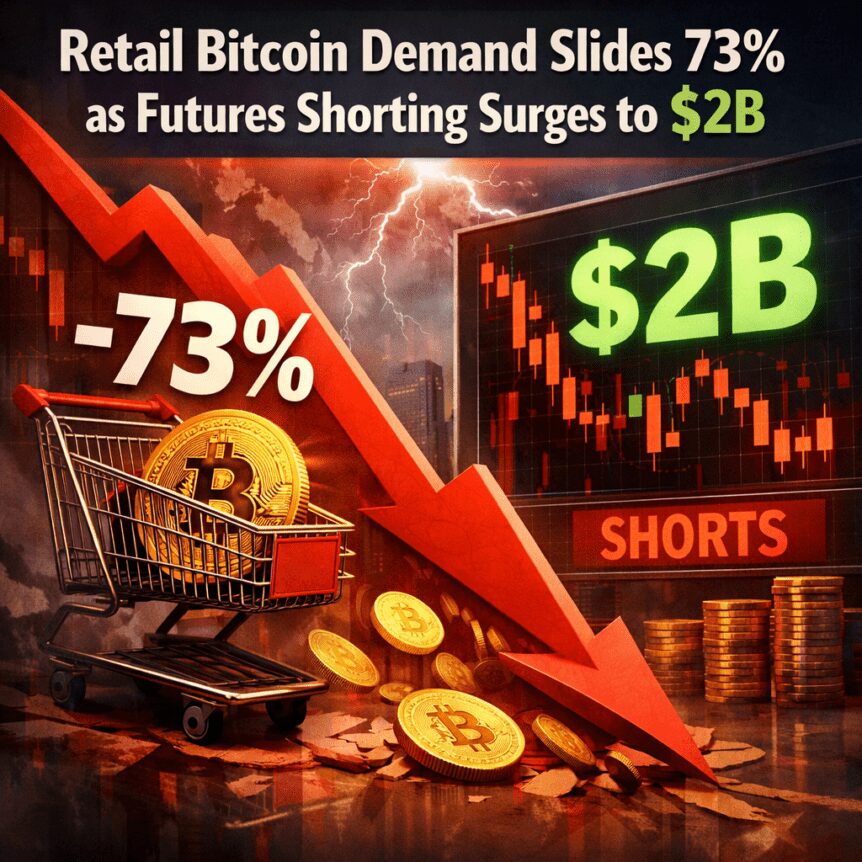
Bitcoin retail investor activity on Binance has slid to its weakest point on record, according to CryptoQuant metrics. Retail BTC inflows to the exchange are averaging roughly 314 BTC per month in 2026, a sharp drop from the around 1,200 BTC seen during Bitcoin’s March 2024 local top. The May recovery also cooled as spot inflows waned, with the 30-day net demand growth slipping 73% over the past three weeks.
Key takeaways
- Binance’s retail BTC inflows have collapsed to about 314 BTC per month in 2026, versus roughly 1,200 BTC at the March 2024 peak.
- The 30-day change in retail demand cooled from earlier levels, with growth at 3.12% this week versus 7.39% the prior week, indicating a thinning pace of retail buying activity.
- Market dynamics show a mismatch between futures and spot demand: futures demand remained positive while spot demand stayed negative, contributing to a more tepid recovery.
- Binance’s dominance in USDT-margined futures has waned, dropping to 21.1% in May 2026 as OKX rose to 26.3%, marking a notable leadership shift in the exchange landscape.
- Sharp taker-sell spikes during the May decline, underscoring ebbing retail participation even as price volatility persisted.
Retail activity cools on Binance as ETF drift considerations intensify
In recent months, observers have noted a shift in the behavior of retail-focused Bitcoin inflows. Darkfost, a CryptoQuant analyst, pointed out that retail inflows to Binance have remained near their historical lows, a condition that has persisted even as prices recovered from recent dips. The data tracks deposits from wallets holding less than 1 BTC, a conventional proxy for everyday retail participation. The current trajectory suggests a sustained reduction in the number of smaller investors actively adding BTC to spot positions on the exchange.
Historically, retail participation was far stronger during prior cycles, with inflows peaking well above current levels (notably around 5,400 BTC in 2018 and 2,600 BTC in 2021). The recent pattern—an extended period of subdued inflows and a halting price recovery—aligns with reports that some market participants may be shifting focus away from direct exchange holdings toward other exposure channels, including spot Bitcoin ETFs, where available. CryptoQuant’s data has also highlighted a cooldown in the pace of retail demand expansion, tempering the sense of a broad-based return to demand that characterized earlier rebound phases.
Evidence of a market mismatch: spot vs. futures demand
Analysts tracking Binance’s order book and flow dynamics have highlighted a notable split between futures and spot activity during the latest rebound. Amr Taha of CryptoQuant noted two sizable spikes in taker sell volume during the May decline, with one around $1.5 billion on May 15 and another exceeding $1.1 billion as Bitcoin traded under $77,000. The takeaway: large-scale price moves coincided with significant sell pressure from active traders, even as overall demand signals remained mixed.
Meanwhile, a broader narrative from market analysts centers on the absence of a balanced demand signal that typically accompanies healthy recoveries. Crazzyblockk, another CryptoQuant commentator, pointed out that the current rally diverges from prior episodes—October 2024, November 2024, and May 2025—when spot and futures demand moved higher in tandem. In the latest cycle, futures demand stayed positive, tallying around +193,000 BTC over 30 days, while spot demand stayed negative at roughly -28,000 BTC and remained subzero for 65 consecutive days. The overall 30-day demand growth declined sharply from about 232,000 BTC in early May to approximately 62,000 BTC by May 16, signaling a 73% drop in momentum.
The pattern matters because it hints at how sustainable the rebound might be. When spot and futures participation rise together, Bitcoin often enjoys stronger and more durable rallies. The current configuration—futures exposure still in positive territory while spot demand remains weak—suggests a fragility in the dip-recovery dynamic that could keep volatility elevated and limit upside unless spot participation improves.
Derivatives leadership shifts shape the market backdrop
The reshuffling of who dominates Bitcoin’s futures landscape adds another layer of complexity. Data cited by analysts show a clear shift in exchange leadership for USDT-margined futures over the past year and a half. Binance, which had commanded roughly 40% to 44% of global USDT-margined futures volume from October 2024 through March 2026, saw its share compress to 21.1% in May 2026.OKX stepped up to 26.3% in the same period, marking the first sustained reversal in exchange leadership for the cycle.
These dynamics matter for traders and liquidity providers because futures market structure often amplifies price moves and influences hedging activity. A decline in Binance’s dominance could reallocate risk and liquidity across venues, potentially affecting funding rates, order book depth, and the speed at which wholesale flows can move BTC across markets. For market participants, the shift underscores the evolving balance of power in the crypto derivatives space and the importance of monitoring cross-exchange flow interactions as price action unfolds.
Related coverage from the industry has underscored the broader context: as retail participation cools, institutional and ETF-linked channels may play an increasingly influential role in determining BTC’s price trajectories, especially if spot demand remains constrained. The market is watching for fresh data on ETF filings, regulatory developments, and any renewed retail appetite that could re-align the spot and futures curves.
In the near term, observers will be watching whether spot demand can recover in tandem with futures activity or whether the current pattern persists, with futures driving price moves while spot participation remains muted. The coming weeks could reveal whether the ETF channel and broader macro liquidity conditions will re-energize retail buying or whether the market settles into a more measured, less enthusiastic phase of recovery.
Across the board, the data points to a market that is transitioning in its participation mix. The interplay between ETF-driven exposure, exchange-specific inflows, and the evolving derivatives landscape will continue to shape Bitcoin’s liquidity profile and price dynamics as traders weigh the evolving risk environment.


Kevin Warsh is poised to be sworn in as the next chair of the U.S. Federal Reserve Board of Governors this Friday, a pick that could tilt policy toward a more accommodative stance in the eyes of President Donald Trump. The Senate voted to confirm Warsh largely along party lines, setting the stage for a leadership change that has already sparked debate about whether the Fed will lower interest rates in the near term despite current market expectations for a hold.
Trump has repeatedly argued that the central bank should be cutting rates, a drumbeat that has shaped both political rhetoric and investor sentiment. As Warsh steps into the chair’s role, market watchers will be watching not only for formal policy signals but also for how the new leadership interprets the Fed’s mandate in a way that could influence borrowing costs and risk asset pricing in the months ahead. The next major policy decision point remains the Federal Open Market Committee’s (FOMC) meeting scheduled for June 16, when traders will scrutinize new guidance in the context of a potentially shifting rate path.
Key takeaways
- Warsh is set to take the helm of the Federal Reserve, with expectations that his leadership could influence the direction of U.S. monetary policy.
- Markets express a cautious split: prediction markets place the odds of a rate cut before 2027 at roughly 38.2%, down from near certainty earlier this year.
- In contrast, the CME FedWatch tool continues to signal a high likelihood that the policy rate, currently 3.50%–3.75%, remains unchanged through the summer, with expectations of little to no movement into July.
- During Warsh’s confirmation process, concerns were raised about potential conflicts of interest, highlighted by remarks from lawmakers about his proximity to crypto and tech interests, underscoring the broader scrutiny of top financial regulators’ disclosures.
- With Warsh’s swearing-in imminent, lawmakers are pressing for timely CFTC nominations as part of a broader push to clarify U.S. market structure for digital assets and to address regulatory questions around prediction markets and crypto platforms.
Warsh’s ascent and policy outlook
Warsh’s confirmation signals a transition at the helm of U.S. central banking. While the Fed has navigated a complex inflation and growth backdrop in recent years, the new chair’s approach will be closely watched for how aggressively policy levers could be adjusted in response to evolving economic data. The immediate policy question, however, remains whether the Fed will pivot toward rate relief in the near term or maintain a cautious stance while inflation and growth readings come into sharper focus. The FOMC’s next meeting on June 16 will be a critical moment for readers seeking to gauge how a Warsh-led Fed might balance price stability with the need to support a slowing economy.
Market sentiment ahead of the swearing-in reflects a tension between political expectations and monetary policy signals. The president’s public commentary has consistently urged rate cuts, creating a frame in which Warsh’s chairmanship could be interpreted as a commitment to more dovish policy. Yet investors must weigh this against the Fed’s broader objective of inflation containment and the possibility that a new leadership approach could still hinge on incoming data, not political timing alone. That cross-currents dynamic is why traders will be attuned not just to the Chair’s statements, but to the committee’s communicate-and-respond style as data evolves.
Markets, bets, and the rate-path debate
Two analytical channels offer contrasting pictures of where policy might head. On the one hand, prediction markets have priced in a materially lower probability of an imminent rate cut, reflecting a more cautious or data-driven outlook. Kalshi’s market for a rate cut before 2027 shows roughly 38.2% odds, a significant pullback from February’s near-certainty levels. This reflects a broader recalibration among traders who treat rate-path expectations as sensitive to the incoming data and the Fed’s evolving narrative under a new leadership regime. For context, Kalshi’s rate-cut market is publicly accessible and used by participants to hedge or speculate on policy moves as the cycle unfolds. Kalshi.
Meanwhile, the CME Group’s FedWatch tool remains more sanguine about the status quo in the near term. The current reading assigns a 98.8% probability that the Fed does not change policy rates through June, with a similar likelihood (>94%) continuing through July. In practical terms, traders are still largely expecting rates to hold at 3.50%–3.75% at the next few meetings, even as a new Fed chair takes the helm. The juxtaposition highlights how markets can price in different trajectories depending on whether they prioritize the idea of a policy pivot or the commitment to a patient, data-responsive approach. CME FedWatch.
What this means for investors in the crypto and broader risk-asset space is nuanced. A potential shift toward easier financial conditions could buoy sentiment for higher-beta assets, including crypto, but the trajectory will still be tethered to inflation data, employment trends, and the Fed’s confidence in its inflation framework. Traders should watch for how Warsh’stone in forthcoming communications aligns with the data flow from upcoming inflation readings and growth indicators.
Disclosures, conflicts, and regulatory tensions
Warsh’s confirmation hearing touched on questions of conflicts of interest and insider risk. Massachusetts Senator Elizabeth Warren voiced concern that confirming Warsh could lead to favorable regulatory accommodations if connections to crypto or Wall Street circles were construed as a risk to impartial policy. Warsh had disclosed assets exceeding $100 million ahead of the hearing, including holdings in AI and crypto-related ventures, underscoring the ongoing scrutiny surrounding regulators’ personal investments. The discussion underscores a broader theme in crypto governance: the delicate balance between expertise, independence, and the perceived risk of regulatory capture. Cointelegraph coverage of the disclosure outlines the context of such concerns.
The same moment also features a country-wide focus on the U.S. commodities regulator, the CFTC, and its stance on new market structures for crypto. Since December, the CFTC has been led by Michael Selig, Trump’s nominee, who has taken a relatively aggressive posture toward predicting-market platforms like Kalshi and Polymarket, even as state authorities challenge advances in sports betting regulation. The leadership gap at the CFTC has left lawmakers pressing for a broader panel to address urgent regulatory issues as the Digital Asset Market Clarity Act (CLARITY) moves through the legislative process. Lawmakers on the House Committee on Agriculture urged Trump to nominate a full slate of CFTC commissioners to provide clarity and a steady hand on rulemaking as the crypto and prediction-market ecosystems continue to evolve. Cointelegraph coverage.
The regulatory storyline matters for crypto users, developers, and investors not only because it shapes how digital-asset markets may be structured in the future, but also because it frames the risk and compliance environment in which innovative platforms operate. Kalshi and similar prediction-market venues have become flashpoints for regulatory debates, with questions about whether such markets fall under securities, commodities, or a bespoke category for digital-asset-based markets. The CLARITY act’s fate and any CFTC decisions will influence market design, listing standards, and the degree of federal oversight that crypto markets face in the coming years.
What readers should watch next
As Warsh steps into the chair, all eyes will be on how the Fed’s policy narrative evolves in the face of incoming data and political expectations. The June 16 FOMC meeting will be the immediate inflection point, but the longer arc will hinge on how the new leadership interprets inflation signals and growth momentum. On the regulatory front, the pace of CFTC nominations and any progress on the CLARITY framework will shape the structural context for crypto markets and prediction platforms alike. For market participants, the tension between rate-path expectations and the regulatory timetable will frame how crypto and other risk assets move in the weeks and months ahead. Investors should stay tuned to official communications from the Fed and to updates on CFTC leadership and CLARITY-related discussions as the regulatory landscape continues to tighten around the digital asset space.
Bitmine Immersion Technologies added 71,672 Ethereum in one week, raising its holdings to 5.28 million ETH as the company moves closer to its 5% supply target.
Summary
- Bitmine now holds 5.28 million Ethereum tokens, equal to 4.37% of total ETH supply.
- The company added 71,672 ETH in one week as prices traded below its cited $2,200 level.
- Bitmine has staked 4.71 million ETH, creating estimated annualized staking revenue of $289 million.
Bitmine said its Ethereum holdings reached 5,278,462 ETH as of May 17 at 4:00 p.m. ET. The company valued the position at $2,191 per ETH and said the total represented 4.37% of Ethereum’s 120.7 million token supply.
Chairman Thomas “Tom” Lee said the company bought 71,672 ETH over the past week. He said “the recent pullback” below $2,200 made the asset attractive for Bitmine’s treasury plan.
The latest update shows Bitmine is now 87% of the way to its “Alchemy of 5%” target. The company wants to acquire 5% of Ethereum supply over time, making ETH its main treasury reserve asset.
How much Ethereum has Bitmine staked?
Bitmine also said it has staked 4,712,917 ETH, valued at about $10.3 billion using the same $2,191 ETH price. That means more than 89% of its 5.28 million ETH position is now staked.
Lee said annualized staking revenue has reached $289 million. He also said projected staking rewards could reach $324 million a year if Bitmine fully stakes its ETH through MAVAN and partner platforms, using a 2.80% seven-day annualized yield.
Additionally, Bitmine launched MAVAN, its Made in America Validator Network, as an institutional-grade staking platform. The company said the platform was first built for its own Ethereum treasury but may later serve institutions, custodians and ecosystem partners.
Earlier crypto.news coverage reported that Bitmine had already staked 4,712,917 ETH as of May 10, making it the largest ETH staker among public companies globally. That report also said the firm’s total crypto, cash and equity holdings stood at $13.4 billion at the time.
What is the wider Ethereum market context?
Bitmine remains the largest Ethereum treasury and the second-largest global crypto treasury behind Strategy, according to the company’s latest statement. The firm also held 202 Bitcoin, $685 million in cash, a $200 million Beast Industries stake and an $83 million Eightco stake.
The update comes while Ethereum faces wider market pressure. crypto.news reported that ETH fell near $2,100 after Lee linked selling pressure to rising oil prices, while ETF outflows, whale deposits and higher exchange reserves added more near-term pressure.
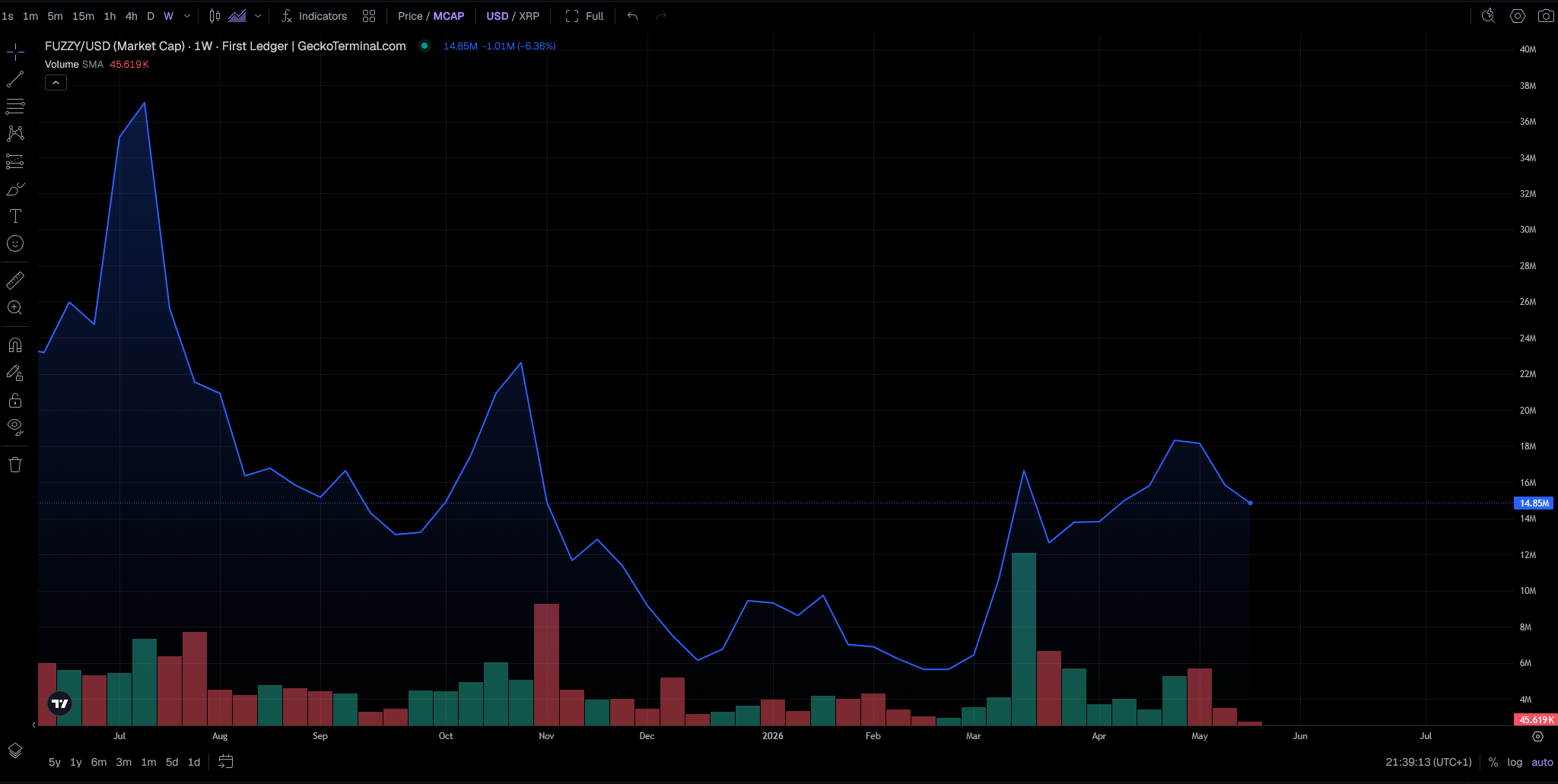
Ripple Chief Technology Officer Emeritus David Schwartz said treating a meme coin as an investment feels distasteful. The Ripple veteran brushed aside XRP holders who urged him to endorse the FUZZY token on the XRP Ledger.
Schwartz, known on X as JoelKatz, made the remark during a weekend exchange about FUZZY. The meme coin references a wallet Ripple activated when the XRP Ledger launched in 2013.
Schwartz Pushes Back on FUZZY Endorsement Pressure
The conversation started after Schwartz opened a technical trust line for FUZZY. Some community members read the move as a quiet signal of approval.
The token’s name nods to the historic Fuzzybear wallet. That wallet placed a famous trade of 1 XRP for 1 BTC in the early days of the ledger.

Schwartz rejected that interpretation. He told followers that opening a trust line is a routine network step. It is not a vote of confidence in any specific project. He added that he has no direct involvement with FUZZY and knows no more about it than any other observer.
The Ripple veteran also explained why he avoids public endorsements even when nothing negative surfaces about a project. He said the risk of unintentionally promoting bad actors keeps him cautious. He also stressed he has no reason to think poorly of FUZZY itself.
Meme coin Skepticism Cuts Across XRP Ledger Token Surge
His comments arrive as the meme coin scene on XRP Ledger continues to draw retail attention. Tokens such as ARMY, PHNIX, and RIPPY have posted sharp gains over the past few months. The activity has driven heavier trading on platforms like First Ledger and Magnetic.
Other users argued that meme coins lack intrinsic value and trade purely on the hope of a higher bidder. Schwartz agreed. He said attempts to build a serious portfolio around such tokens look ridiculous. Meme coins themselves still have a place in internet culture, he added.
The skepticism aligns with how Schwartz has framed his wealth and Ripple’s broader posture. He has drawn a line between community tokens built for fun and assets that warrant serious position sizing.
The post drew sharp reactions from XRP supporters. Some argued that meme coin liquidity tied to XRP supports the wider ecosystem regardless of their personal view. Others backed his caution and asked influencers to stop pressuring developers into public endorsements.
The post Former Ripple CTO Talks About Meme Coins as Investment appeared first on BeInCrypto.


Echo Protocol suffered an exploit on Monad, with an attacker minting 1,000 eBTC worth roughly $76.64 million.
Curvance paused the affected market while Echo Protocol suspended all cross-chain transactions. The incident raised May’s running tally of crypto hacks to 14.
How the Echo Protocol Exploit Unfolded
On-chain analyst dcfgod first flagged the incident. PeckShield mapped the laundering path. The attacker minted 1,000 eBTC.
The exploiter deposited 45 eBTC worth $3.45 million into Curvance, borrowed 11.29 wrapped Bitcoin (WBTC), bridged the assets to Ethereum, and swapped them for Ethereum (ETH).
The wallet then sent 384 ETH to Tornado Cash. Curvance posted a status update on X about the situation.
“At approximately 6:00 PM EST, we were made aware of an anomaly detected in the Echo eBTC market on Curvance. At this time, there is no indication of any compromise with Curvance’s smart contracts. Due to Curvance’s fully isolated market architecture, no other markets are impacted. Out of an abundance of caution, the affected market has been paused while our team actively investigates the situation alongside ecosystem partners,” the post read.
Echo Protocol also confirmed the incident on X and suspended all cross-chain transactions while it investigates. The team said it would post updates through its official channels.
Follow us on X to get the latest news as it happens
In addition, Monad CEO Keone Hon clarified that the breach did not impact the Monad network.
“Security researchers in their review have determined that ~$816,000 appears to have been stolen as a result of this exploit of@EchoProtocol’s eBTC,” Hon said.
The Echo Protocol exploit is the third major DeFi hack in five days. THORChain confirmed a vault breach on May 15 that drained more than $10 million.
Three days later, security researchers flagged an exploit of the Verus-Ethereum Bridge, in which attackers drained roughly $11.58 million in digital assets. The string of breaches highlights ongoing security risks across the decentralized finance (DeFi) sector.
Subscribe to our YouTube channel to watch leaders and journalists provide expert insights
The post Echo Protocol Joins THORChain, Verus as May Hack Count Reaches 14 appeared first on BeInCrypto.
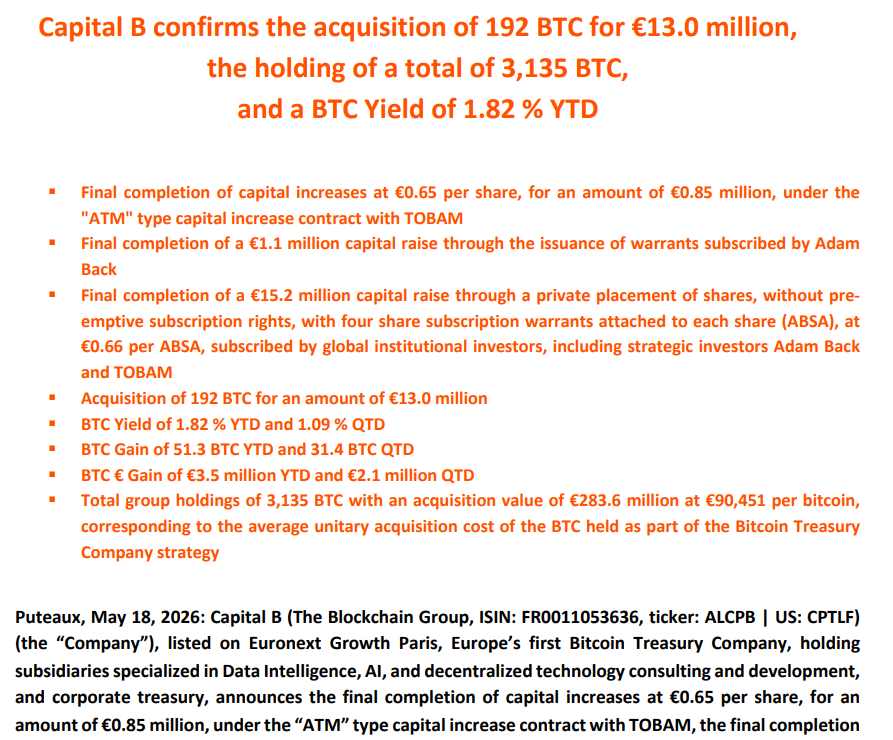
France-listed Bitcoin treasury company Capital B announced Monday that it acquired 192 BTC for 13 million euros ($15.2 million), bringing its total holdings to 3,135 BTC.
Capital B purchased its latest tranche at an average price of about $78,948 per Bitcoin, Alexandre Laizet, Bitcoin strategy director at Capital B, said on X.
The acquisition comes a week after the company announced a $17.8 million raise from strategic investors, including Blockstream CEO Adam Back and Paris-based asset manager TOBAM. Capital B also raised $1.28 million from Back on May 4.
Capital B is one of four crypto treasury companies to publicly disclose Bitcoin purchases in May so far.
Strategy, the largest publicly traded Bitcoin holder, announced it acquired $43 million last Monday, while Strive added $33 million in BTC on May 4 and The Smarter Web Company purchased $4.9 million in BTC.
The purchase reflects continued interest in Bitcoin treasury strategies by a handful of public companies, even as Bitcoin remains well below its October 2025 all-time high.
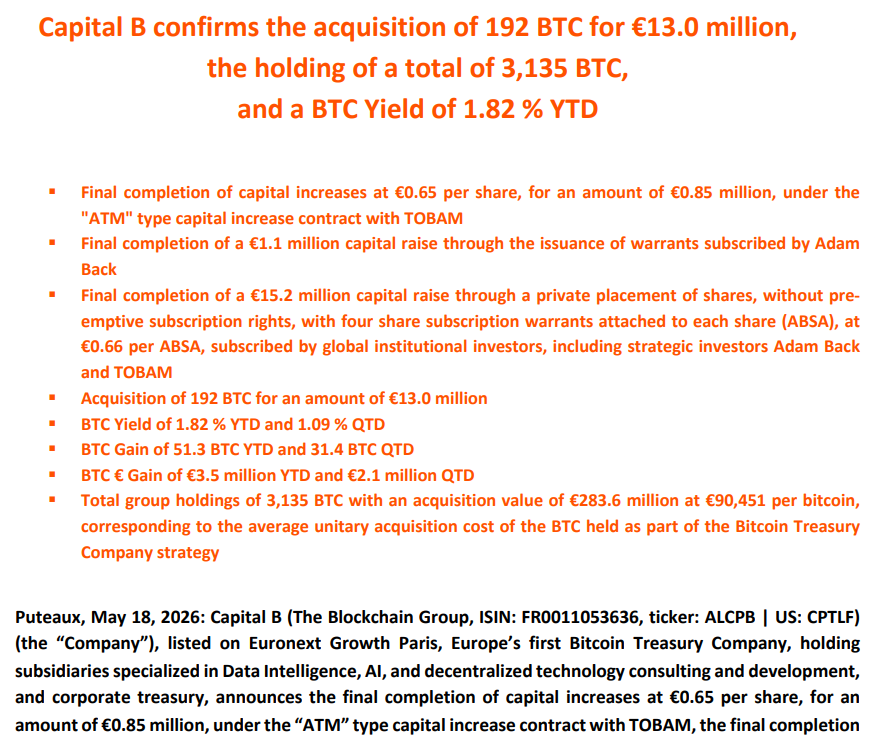
Capital B acquired 192 BTC. Source: Capital B
Capital B shares fall after Bitcoin acquisition announcement
Capital B shares fell around 2.4% after the announcement Monday and traded at about 0.62 euros at the time of writing.
The company’s shares are down 17% year-to-date and more than 68% over the past year, according to data from Yahoo Finance.
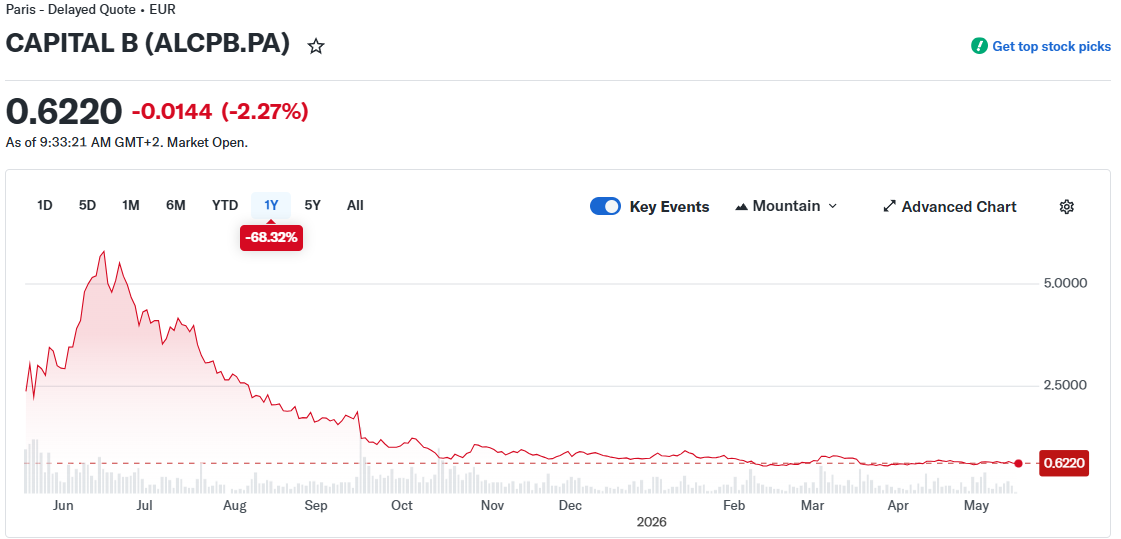
Capital B shares price in euros, 1-year chart. Source: Yahoo Finance.
Capital B ranks as the 25th-largest Bitcoin treasury firm by holdings and as Europe’s second-largest following Germany’s Bitcoin Group SE, which holds 3,605 BTC, currently worth about $277 million, according to BitcoinTreasuries data.
Related: Strategy’s Bitcoin engine faces $28B STRC ceiling: Delphi Digital
Some Bitcoin treasury firms turn defensive amid downturn
Other Bitcoin treasury companies are seeking to reduce the balance sheet risks associated with Bitcoin, which is currently down 39% from its $126,198 all-time high.
On April 24, Nasdaq-listed Bitcoin treasury company Nakamoto announced an actively managed Bitcoin derivatives program aimed at generating recurring income from volatility and hedging part of its corporate BTC holdings against downside exposure. The company reported it sold 284 Bitcoin (worth about $20 million at the time) in a March 30 filing.
In February, Genius Group reported the sale of its remaining treasury holdings of 84 BTC for about $5.7 million to repay an $8.5 million debt obligation.
Magazine: Bitcoin vs. the quantum computer threat — Timeline and solutions (2025–2035)


Tether’s undisclosed LemFi investment wires USDT into African and Asian remittance corridors, swapping slow SWIFT transfers for near‑instant, low‑fee stablecoin settlement.
Summary
- Tether has made a strategic, undisclosed investment in LemFi, a cross-border money transfer platform serving African and Asian diaspora users across the UK, US, Canada, and Europe.
- The partnership aims to integrate USDt as a settlement layer in key remittance corridors, replacing slow, costly SWIFT transfers with near‑instant, low‑fee stablecoin rails.
- CEO Paolo Ardoino has repeatedly framed such deals as part of Tether’s broader financial inclusion strategy in emerging markets, as the company channels its profits into real‑world payments infrastructure.
Tether has announced a strategic investment in LemFi, a UK‑headquartered cross‑border financial platform used by African and Asian diaspora communities to send money home from the UK, US, Canada, and Europe. According to coverage from Foresight News relayed via ChainCatcher, the deal will see USDt embedded as a core settlement asset in LemFi’s main remittance corridors into Africa and Asia, although financial terms of the transaction were not disclosed.
USDT to sit at the core of LemFi’s remittance rails
LemFi already offers multi‑currency wallets and instant transfers to more than 30 countries, handling KYC, real‑time FX, and instant disbursement through its own infrastructure and partners. By wiring USDt into those existing pipes, the company can route transfers over stablecoin rails under the hood, while end users continue to interact in local currencies like naira or shilling on the front end.
For Tether, the LemFi deal is another step in a deliberate strategy to push USDT into high‑friction payments use cases, after earlier investments in t-0 Network and other settlement platforms aimed at turning international payments into something that “functions like local transactions.” In announcing a prior emerging‑markets investment, CEO Paolo Ardoino said such deals “underscore Tether’s commitment to advancing financial inclusion and economic empowerment in underserved regions,” language that clearly maps onto the LemFi expansion.
Replacing SWIFT’s delays with stablecoin settlement
The core pitch behind the partnership is that USDt can collapse settlement times in major remittance corridors from days to seconds while cutting costs, a model already demonstrated in other USDT‑powered payment deployments where SWIFT wires were replaced with stablecoin payouts. In those case studies, businesses reported settlement dropping to under one minute and payment costs falling by roughly 45%, benefits that are particularly acute for low‑income migrants sending frequent, small‑ticket transfers.
This latest move also fits into Tether’s broader attempt to use its more than $185 billion USDT float and roughly $15 billion in annual profit to build a surrounding ecosystem of real‑world infrastructure, ranging from payments networks to telecoms and even metals exposure. As Ardoino recently put it in an interview reported by Fortune, Tether is using its balance sheet to build “a business ecosystem that can survive a future breakdown” in legacy financial rails, effectively betting that stablecoins will become the default settlement layer for both consumer remittances and institutional flows.
From the perspective of the African and Asian diaspora that LemFi serves, integrating USDt into the back end of remittances could mean fewer failed transfers, more transparent FX, and faster access to funds back home, even if many users never directly touch a stablecoin wallet. If the LemFi integration scales, it will add yet another live corridor where USDT is not just a trading chip on exchanges but a working replacement for SWIFT‑era cross‑border banking.
Crypto World
Trump’s visit to China triggered volatility in global financial markets. XRP/BTC could continue to rise after the US-China summit
Disclosure: This article does not represent investment advice. The content and materials featured on this page are for educational purposes only.
XRP Power gains attention as global market shifts revive interest in AI-driven crypto platforms.
Summary
- Trump-China talks boost crypto sentiment as XRP Power gains attention with AI-driven digital asset solutions.
- Bitcoin and XRP activity rise after Trump’s China visit, driving interest in AI-powered XRP Power systems.
- XRP Power attracts investors with AI automation, risk control, and smarter crypto participation tools.
Trump’s recent visit to China has once again become the focus of global financial markets. As the two sides discussed issues such as trade, artificial intelligence, and global economic stability, market risk sentiment has begun to shift significantly. Affected by this, digital assets such as Bitcoin and XRP have seen renewed activity, and the overall trading volume of the cryptocurrency market has continued to recover.
Against the backdrop of global capital seeking new growth opportunities, more and more investors are beginning to pay attention to new trends in the digital asset field. Compared to traditional high-volatility short-term trading, some users are turning to more intelligent and structured participation methods. AI technology, automated systems, and transparent operating models are gradually becoming new focuses in the industry.
In this market environment, XRP Power is beginning to attract more users. As a platform focusing on AI intelligent systems and the digital asset ecosystem, XRP Power attracts more and more users interested in digital finance and intelligent technology through automated management, real-time risk control monitoring, and global APP services. As market sentiment gradually recovers, attention is turning to XRP Power, with an increasing number of investors flocking to it amidst the global financial upheaval and crypto market recovery.
XRP Power AI intelligent system’s five core advantages:
1. Employs an intelligent AI automation system, enabling real-time data analysis and automated operation, further improving overall efficiency.
3. Introduces a multi-layered AI risk control monitoring mechanism, combined with a real-time security system, ensuring more stable and transparent operation.
4. Reduces the barriers to entry for traditionally complex operations through intelligent computing power scheduling and automated management, enhancing user experience.
5. Integrates AI technology with the digital asset ecosystem, continuously optimizing platform competitiveness through a transparent system and global services.
XRP Power intelligent AI participation process:
2. Users can freely choose intelligent AI solutions with different periods based on their needs, each corresponding to a different return model.
3. XRP Power fully supports participation in mainstream cryptocurrencies, offering greater flexibility and convenience.
4. Daily earnings will be automatically synchronized to your account balance via an intelligent AI system. Users can choose to withdraw directly or configure other earnings plans.
Popular AI-powered earning contracts
Contract Name: DOGE [AI Intelligent Quantification] Investment Amount: $10,000, Period: 20 days, Daily Earnings: $153, Total Earnings: $3,060, Principal Refund at Maturity: $10,000
Contract Name: BTC/BCH [AI Global Smart Ecosystem] Investment Amount: $50,000, Period: 27 days, Daily Earnings: $860, Total Earnings: $23,220, Principal Refund at Maturity: $50,000
Click to view more detailed contracts
About XRP Power
Faced with the continued volatility of the global financial market and the rapid development of AI technology, more and more users are beginning to rethink how they participate in digital assets. Compared to traditional high-frequency trading models, intelligent, automated, and more transparent and convenient digital financial ecosystems are becoming the new direction for industry development.
As market attention continues to rise, XRP Power is gradually gaining more user and market attention thanks to its AI intelligent system, global services, and more efficient digital asset experience.
For details, visit the official website.
Risk warning
Digital assets, stocks, gold, and other global financial markets are subject to volatility. Their prices may be affected by various factors such as the international economic environment, market sentiment, policy adjustments, and industry changes. Before participating in any digital asset or smart contract, users should fully understand the relevant rules and market characteristics and participate rationally according to their own risk tolerance.
Compared to traditional high-frequency trading models, XRP Power places greater emphasis on AI intelligent management, real-time risk control, and system stability. The platform continuously optimizes overall operational efficiency through intelligent data analysis, multi-layered risk control mechanisms, and real-time monitoring systems.
Meanwhile, users are advised to thoroughly understand the platform rules, contract periods, and related instructions before participating, rationally plan their capital allocation, enhance their risk awareness, and participate in the digital financial market in a long-term and rational manner.
Disclosure: This content is provided by a third party. Neither crypto.news nor the author of this article endorses any product mentioned on this page. Users should conduct their own research before taking any action related to the company.
Bitcoin (BTC) starts a new week under pressure as support levels fade and macro gloom intensifies.
Key points:
- Bitcoin falls below a key 21-week trend line after the weekly close, but hopes of a “bear trap” rebound remain.
- US-Iran war rhetoric continues to push oil higher, pressuring crypto markets.
- Those tensions could still be countered by strong PMI and Nvidia earnings data in the coming days.
- Bitcoin whales are acting as if the bottom is already in, per new analysis.
- Despite this, a surge in exchange inflows from a key investor cohort raises alarm over “capitulation.”
BTC price analysis sees relief bounce after sub-$77,000 dip
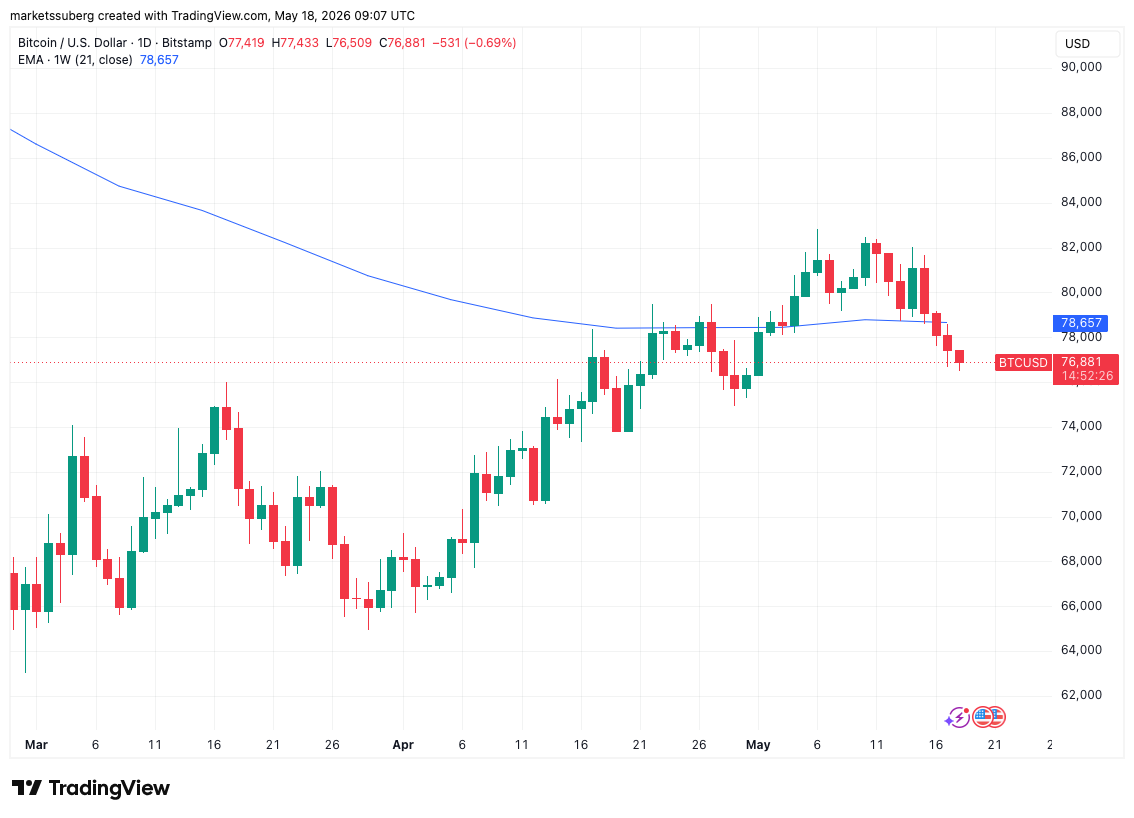
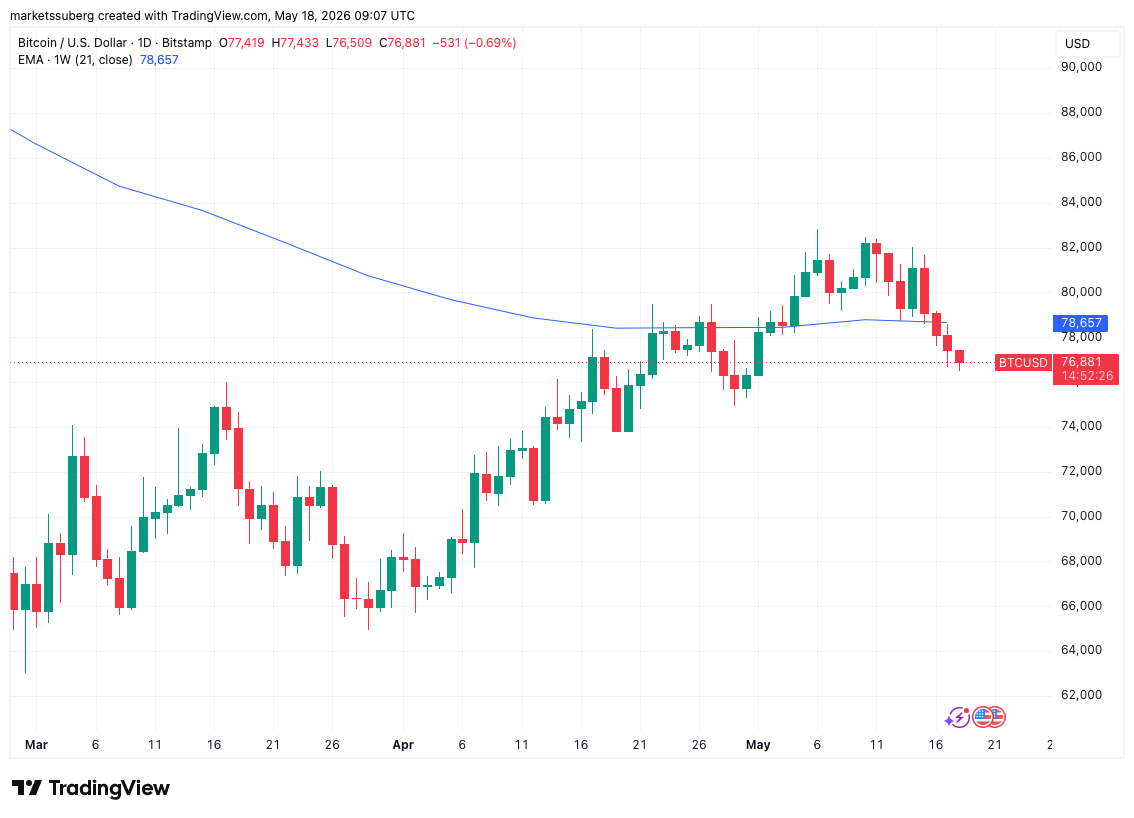
Bitcoin felt the pressure as the new weekly candle began, dropping to $76,500 — its lowest levels since May 1, per data from TradingView.
After several support retests, BTC/USD began to fall through recently recovered ground, which included the 21-week exponential moving average (EMA) at $78,660.
BTC/USD one-day chart with 21-week EMA. Source: Cointelegraph/TradingView
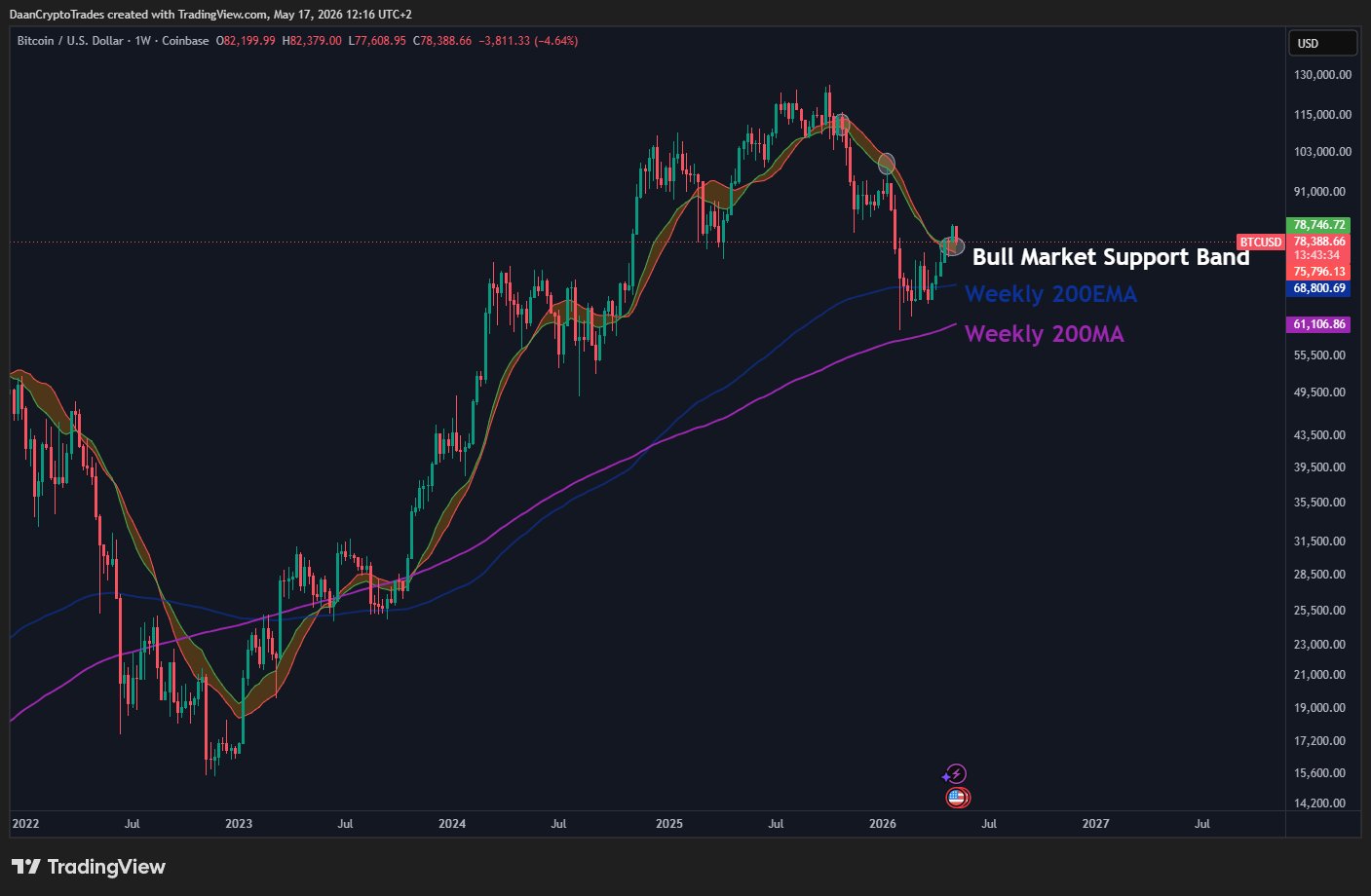
With it, price fell back below the bull market support band.
“Another weekly close at it for now, but to confirm a proper breakout you’d need to see a bounce now,” trader Daan Crypto Trades wrote in X analysis before the trip toward month-to-date lows.
“If this ends up falling back below that $75K-$76K area and closes there on the weekly, then this was just a big deviation/dead cat bounce in my eyes.”
BTC/USD one-week chart. Source: Daan Crypto Trades/X
The downside cost BTC long positions, with cross-crypto long liquidations for the 24 hours to the time of writing passing $670 million.
Data from CoinGlass also shows potential liquidations building either side of spot price, providing fuel for liquidity grabs both up and down.
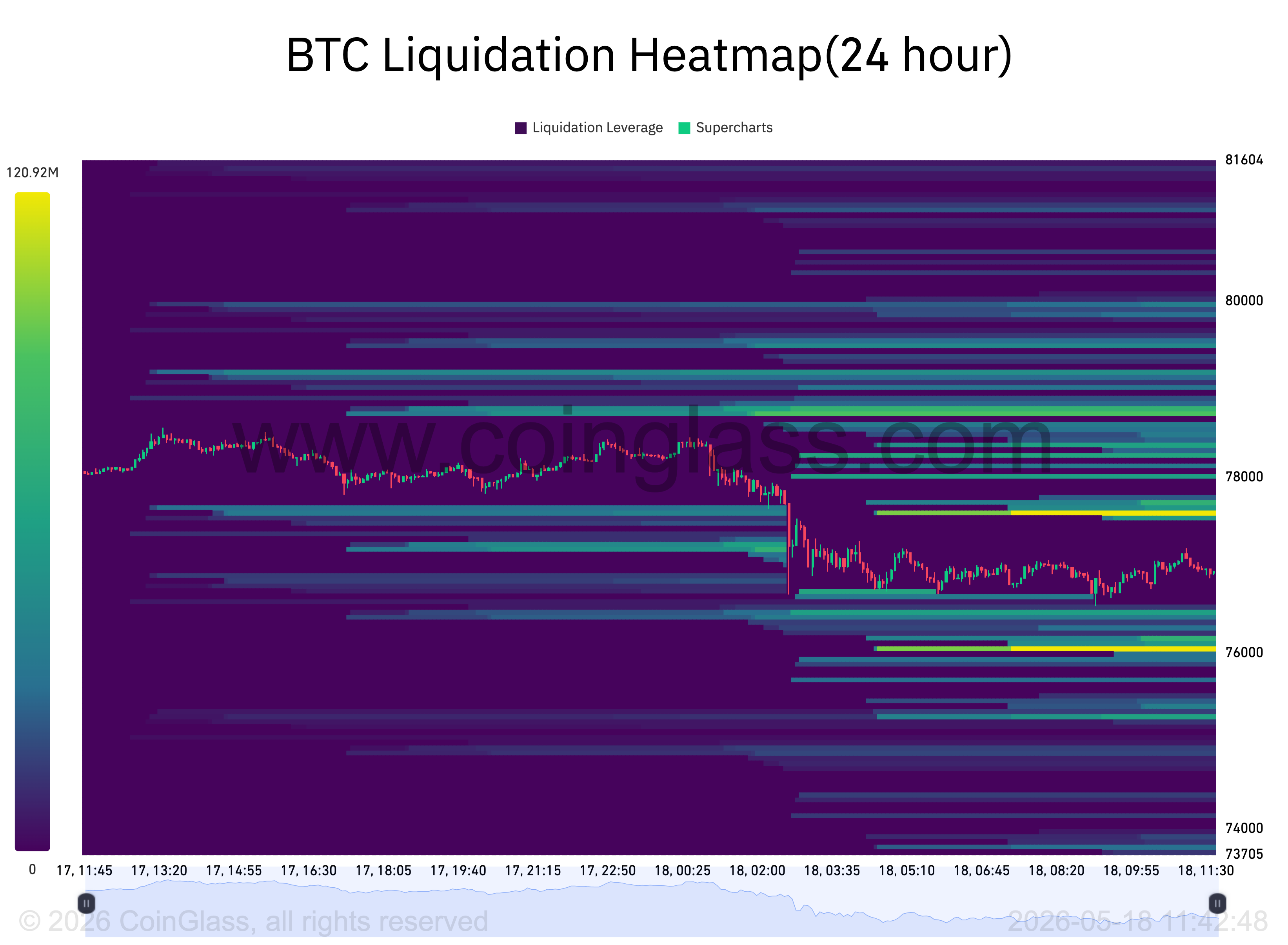
BTC liquidation heatmap. Source: CoinGlass
Commenting, trading account Cryptic Trades saw a bounce coming next due to the magnitude of liquidated longs.
“$BTC has just tapped into the prior Breakout Zone at $75K-$76K,” it told X followers.
“Expecting a bounce here, as the longs I covered in my prior alert also got flushed.”
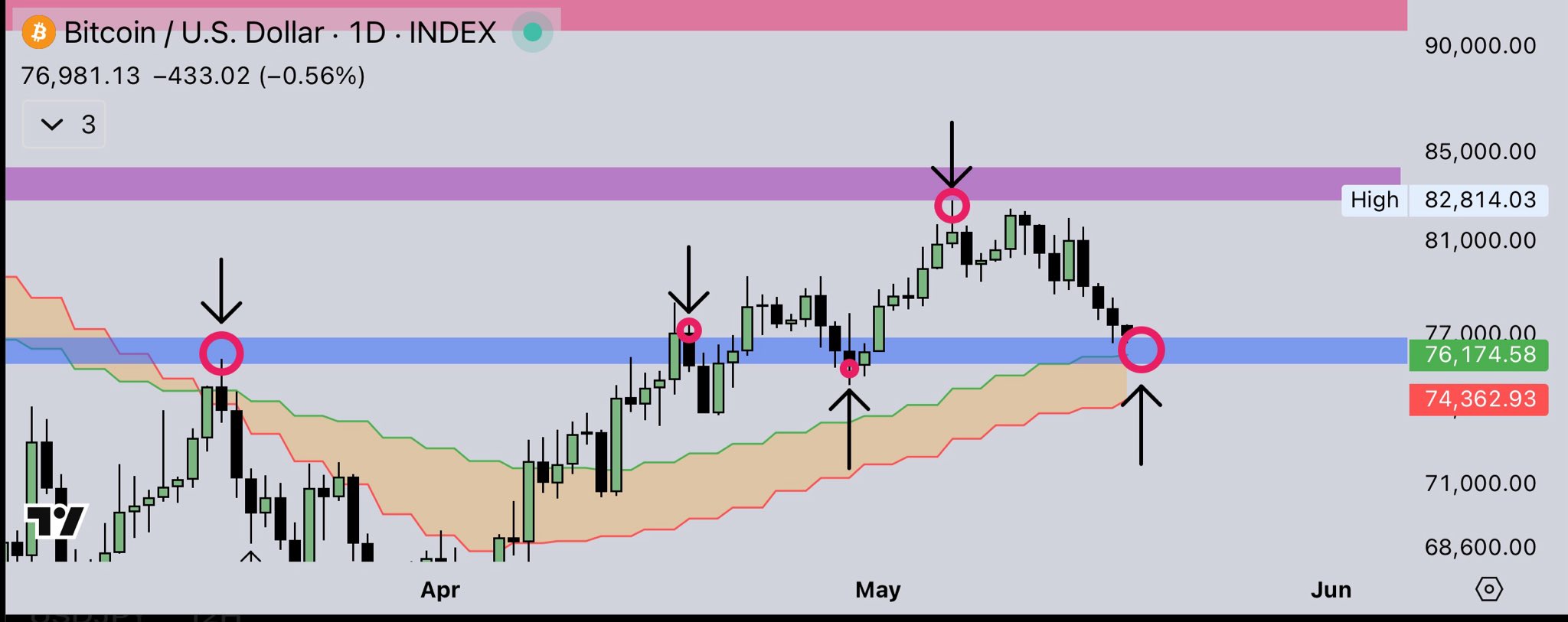
BTC/USD one-day chart. Source: Cryptic Trades/X
At the weekend, Cryptic Trades suggested that any downmove would have the markings of a classic “bear trap,” given rising open interest and negative funding rates.
“This shows us that bears are DOUBLING DOWN right now and betting on a breakdown,” it wrote.
“It also shows that even though the market structure remains intact, bears are shorting as if a breakdown already happened. That’s generally how bear-traps are formed.”
US bond markets “collapsing in real time”
While light on US macro data, the coming week is already shaping up to be a tricky one for crypto traders.
Tensions over the US-Iran war are returning, with the prospect of the Strait of Hormuz oil route fully opening still absent.
In a post on Truth Social over the weekend, US President Donald Trump wrote that the “clock is ticking” for Iran, without giving specific details.
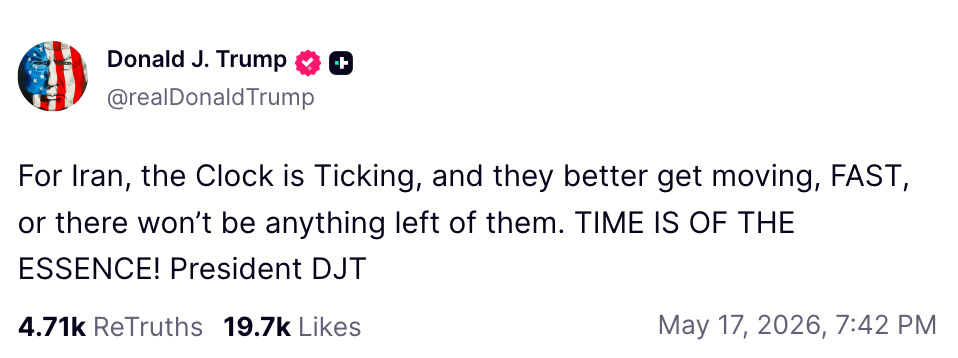
Source: Truth Social
Additional reports claimed that Trump was convening a security meeting to discuss “military options in Iran,” per trading resource The Kobeissi Letter.
Oil futures reacted sharply at the weekly open, with WTI crude reaching near two-week highs of $104.45.
“The impact on energy prices from the war in the Middle East is pushing inflation to its highest level in years,” analytics resource Mosaic Asset Company commented in the latest edition of its regular newsletter, The Market Mosaic.
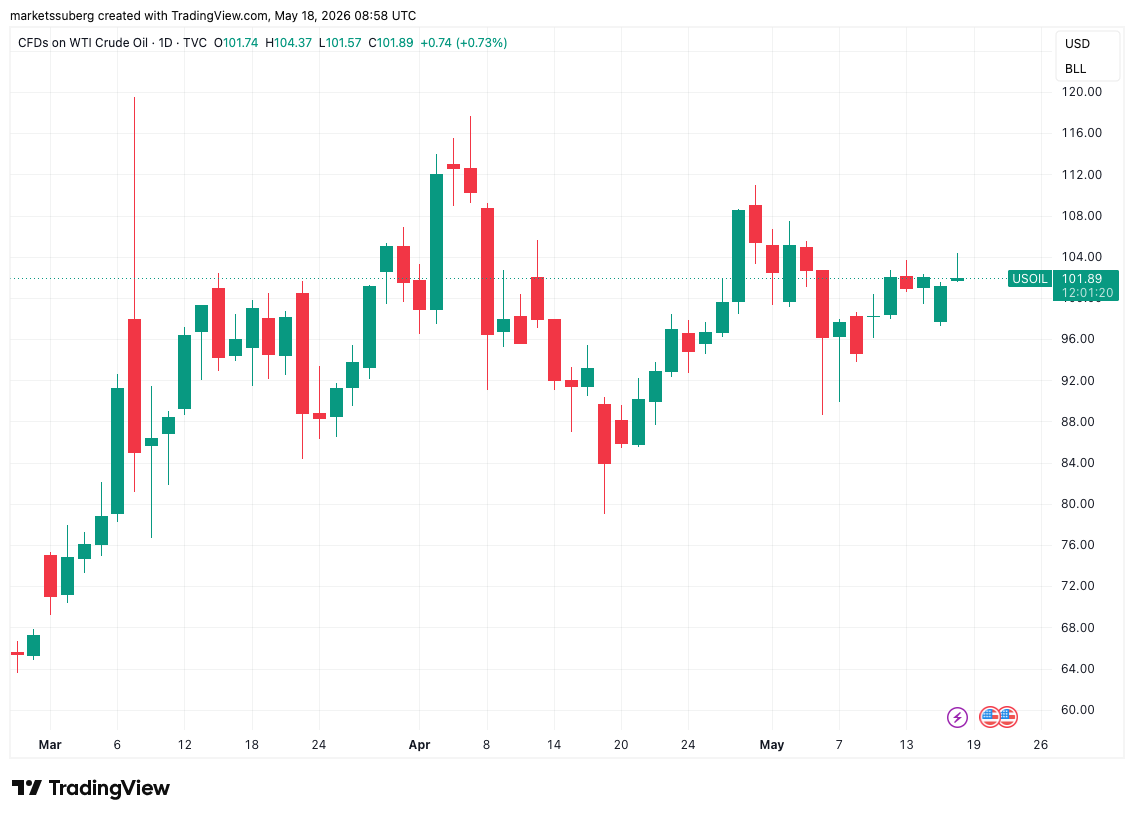
CFDs on WTI crude oil one-day chart. Source: Cointelegraph/TradingView
Like others, Mosaic tied high oil prices to surging US inflation prints.
“While a spike in energy prices are helping drive inflation higher, the most recent reports continue a trend of growing price pressures,” it continued.
US bond markets, meanwhile, continue to sum up the about-turn in market sentiment, as “unsustainable” yield growth wipes out the odds of interest-rate cuts by the Federal Reserve.
“On Friday, the 30-year Treasury yield jumped above the 5% level which is the high tested several times over the past couple years. A sustained breakout could have serious implications at a time when federal debt and deficit spending is surging,” Mosaic warned.
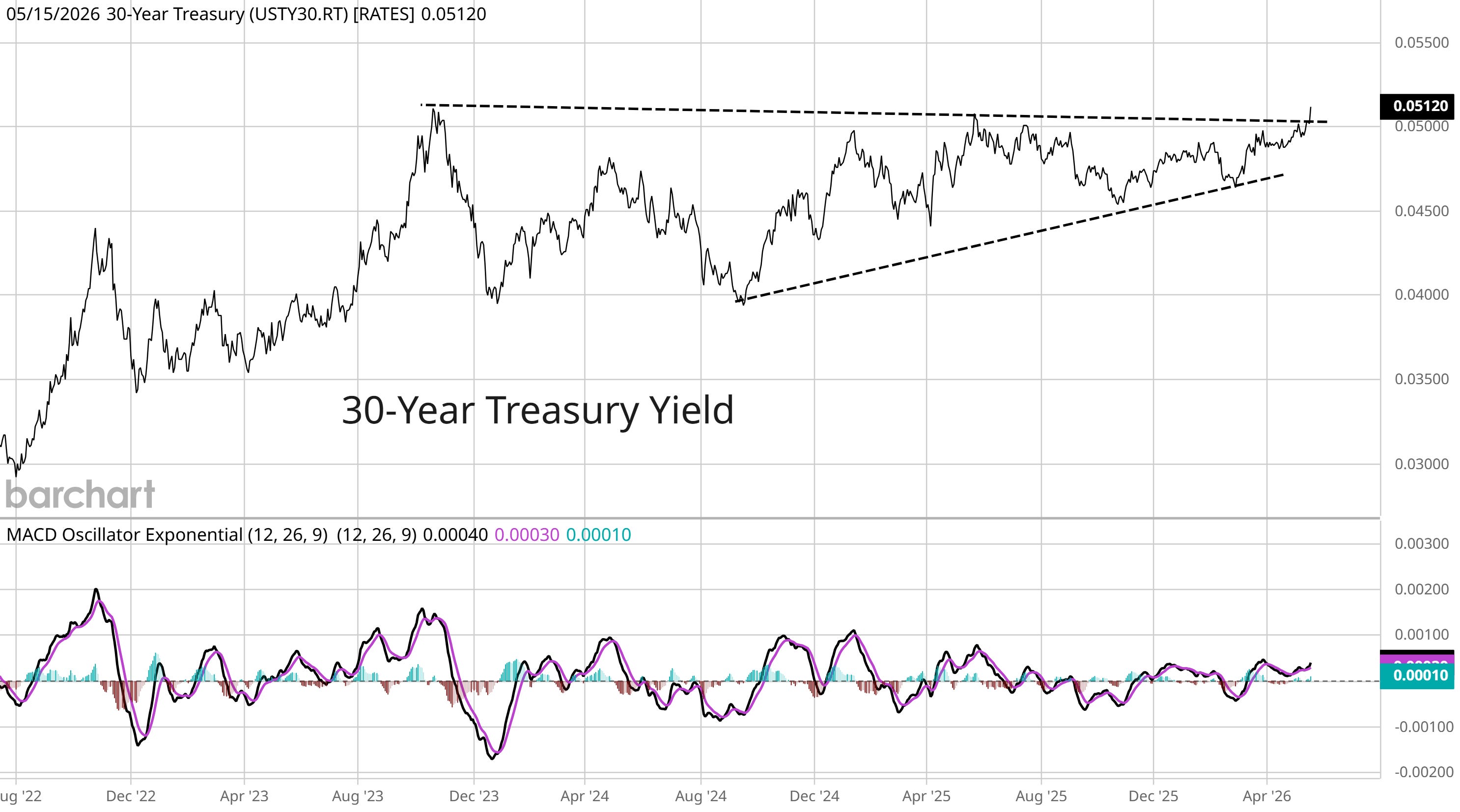
US 30-year treasury yield chart. Source: Mosaic Asset Company
Kobeissi described the US bond market as “collapsing in real time.”
“And, in a sudden turn of events, the odds of rate cuts have collapsed to 2% this year and US inflation is nearing 4%+,” it noted on X.
PMI, Nvidia earnings give crypto bulls hope
Amid the chaos, a silver lining could come in the form of manufacturing data.
The latest S&P Manufacturing Purchasing Managers Index (PMI) report, due out on Thursday, should ideally continue a breakout that began earlier in 2026.
Bitcoin and risk assets reacted positively to the development, which ended several years of PMI contraction.
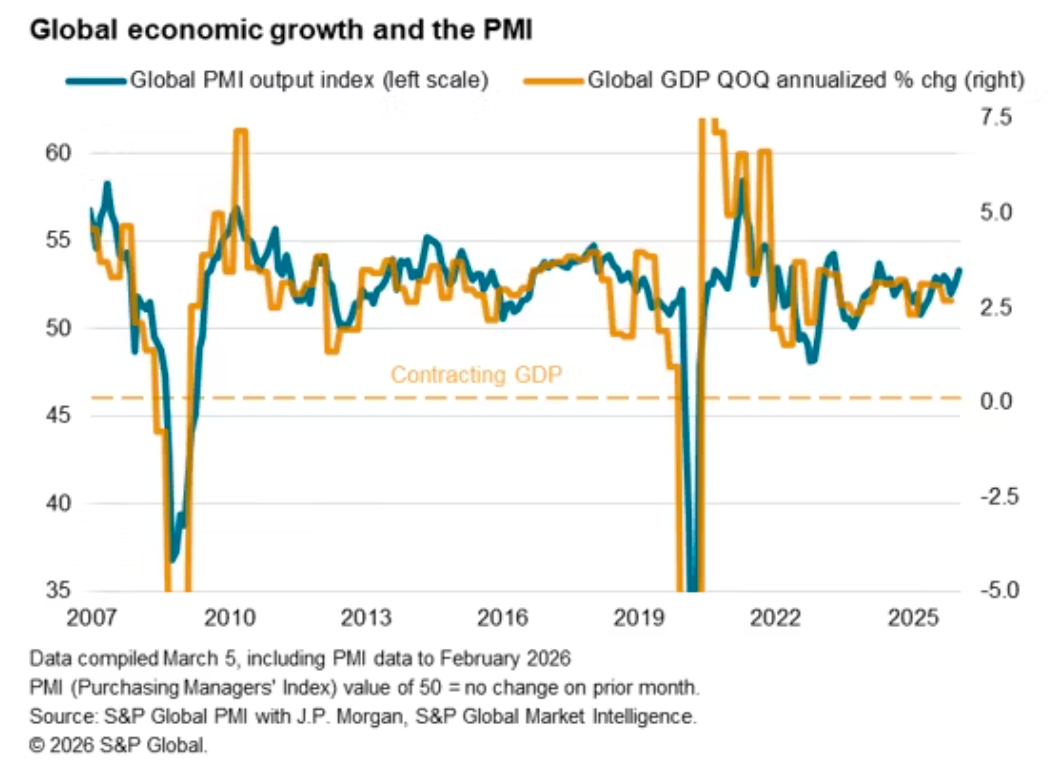
Global PMI versus GDP data (screenshot). Source: S&P Global
Major tech earnings are also lining up to potentially offer markets a boost in the event that they surpass expectations. Nvidia will report on Wednesday — something that Kobeissi even calls the “biggest earnings event of the quarter.”
Commenting on the outlook for market volatility, independent macro and market strategist Michael J. Kramer cautioned that bulls may ultimately suffer.
“NVIDIA once again finds itself heavily overloaded with call positioning, and unless the stock sees a meaningful pullback ahead of earnings that helps reengage put demand, I think the most likely outcome is another post-earnings sell-off,” he wrote in an X thread on Sunday.
Kramer predicted a surge in implied volatility toward Friday’s options expiry event.
“So unless NVIDIA is able to truly blow traders away with its results, the stock likely faces the usual ‘sell-the-news’ reaction, or, as I like to call it, the mechanical unwind,” he reiterated.
Bitcoin whales brush off hawkish Fed signals
In its latest market overview, onchain analytics platform CryptoQuant examined the relationship between Fed policy and the actions of Bitcoin whales.
These large-scale investors, often tied to “smart money” and a key yardstick for long-term market trajectory, could be signalling that the outlook is not as bad as sentiment shows.
“Tracking their moves offers us a backdoor view into how the biggest players are reading the room, which in turn helps us stress-test and refine our own market thesis,” contributor Joohyun Ryu wrote in a QuickTake blog post this week.
“To cut straight to the chase, the good news is that whale wallet balances haven’t shown any dramatic shifts.”
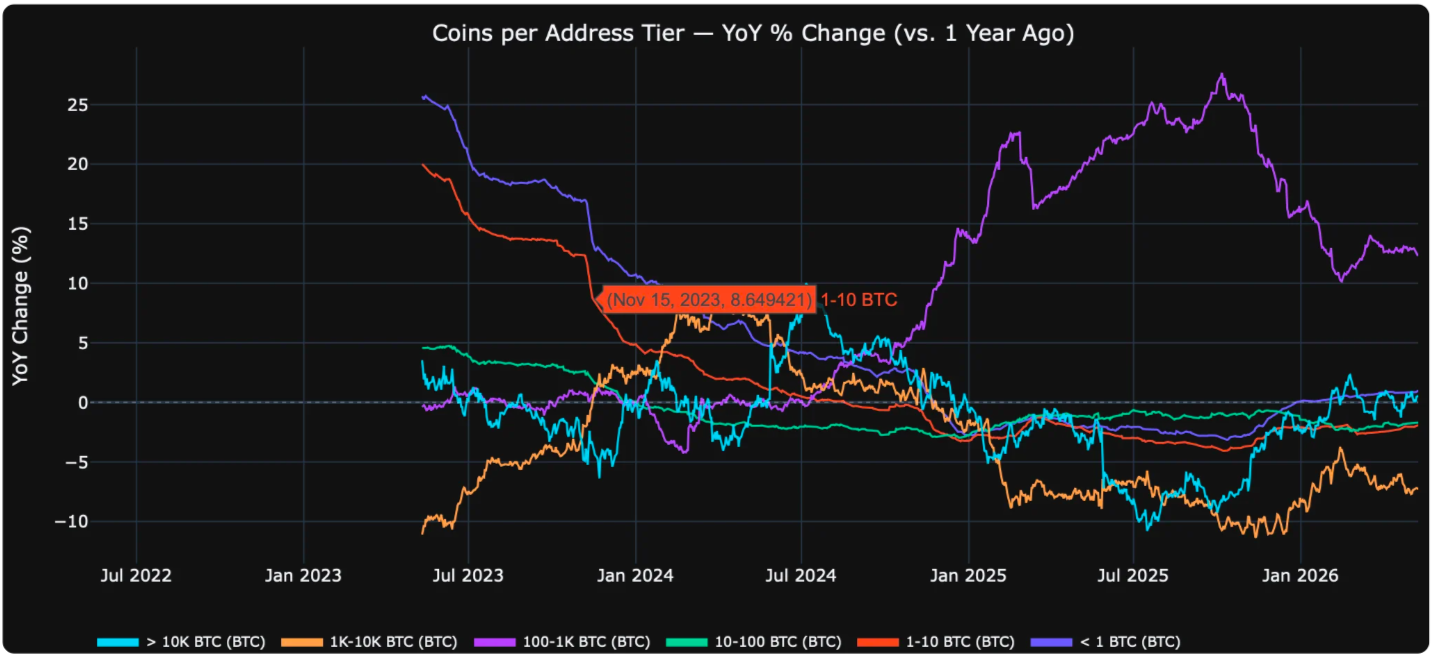
BTC holdings per address tier (screenshot). Source: CryptoQuant
Analyzing whale holdings, Joohyun argued that despite the odds of rate cuts disappearing for both 2026 and 2027, there appears to be no real cause to reduce risk exposure. Some cohorts are even adding to their holdings.
“On top of that, the ultimate mega-whales—those holding over 10K—are finally seeing their bags recover to levels we haven’t seen since last year,” he continued.
“Judging by these trends, it looks like the whales are betting that the market has officially bottomed out. That said, this isn’t a full-blown buying frenzy just yet, so it’s still wise to proceed with caution.”
Traditionally, financial tightening and an inflationary environment pressure crypto prices — a phenomenon most recently seen during the 2022 bear market.
Long-term holders lose their nerve
For the time being, however, sell-side pressure remains a key threat to Bitcoin.
Related: Bitcoin price history suggests 77% odds of new all-time high within a year
Specifically, CryptoQuant notes a pronounced uptick in exchange inflows from wallets that bought BTC between six and 12 months ago.
“Bitcoin is not facing a simple short-term correction, but a structurally driven crisis fueled by cascading leverage liquidations and deep spot-market fear.,” contributor Easy OnChain warned.
“On-chain data shows a clear ‘cascading dumping’ pattern, where capitulation from long-term holders triggers panic selling among short-term investors.”
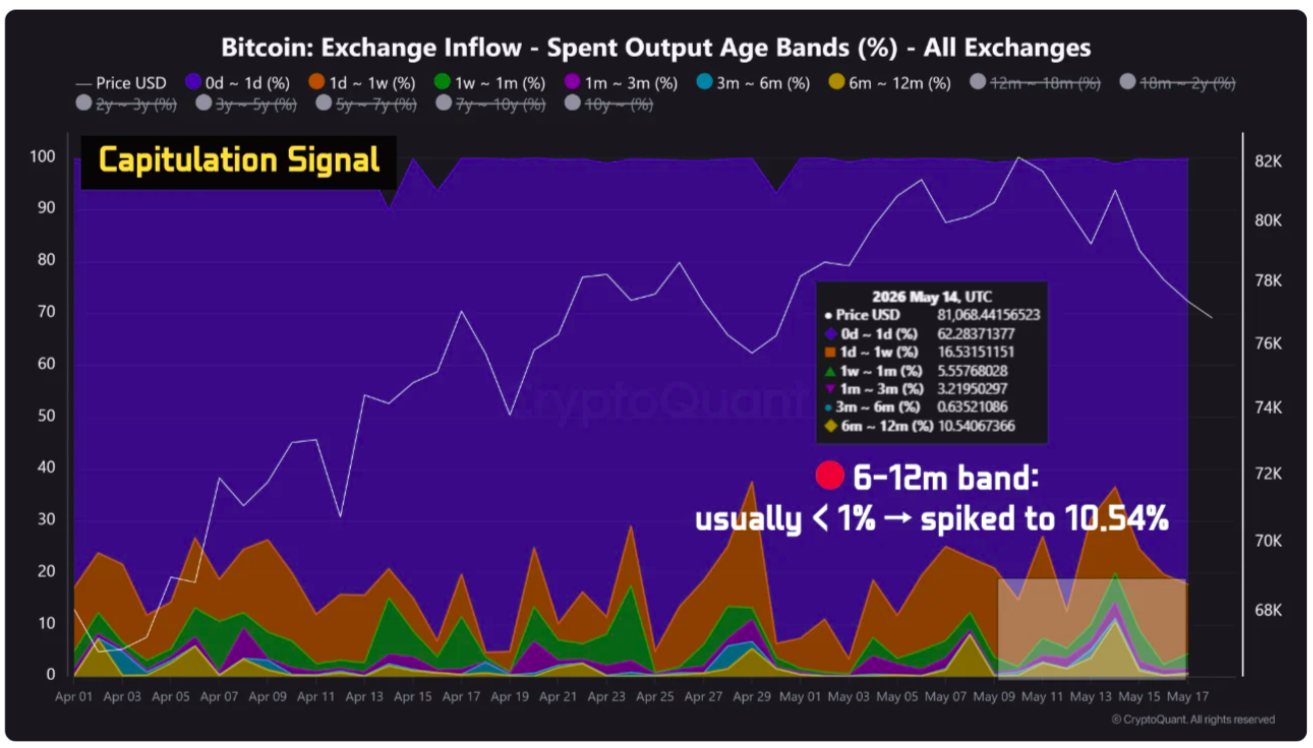
Bitcoin exchange inflows data (screenshot). Source: CryptoQuant
The former cohort, hodling for up to 12 months, has accounted for 10.54% of exchange inflows since May 14 — more than 10 times normal levels.
For CryptoQuant, this signals “large-scale capitulation.”
“Historically, this reflects investors locking in major losses and exiting the market, creating severe spot-market selling pressure,” Easy On Chain continued, noting contagion spreading to speculators.
“The current decline is therefore an internally driven market crisis caused by derivative liquidations, large-scale long-term holder capitulation, and cascading panic from short-term participants,” it added.
“Until this toxic supply is fully absorbed and sentiment stabilizes, a rapid V-shaped recovery remains unlikely.”
Crypto World
AFX launches sovereign Layer 1, providing an optimized execution environment for on-chain perp DEXes
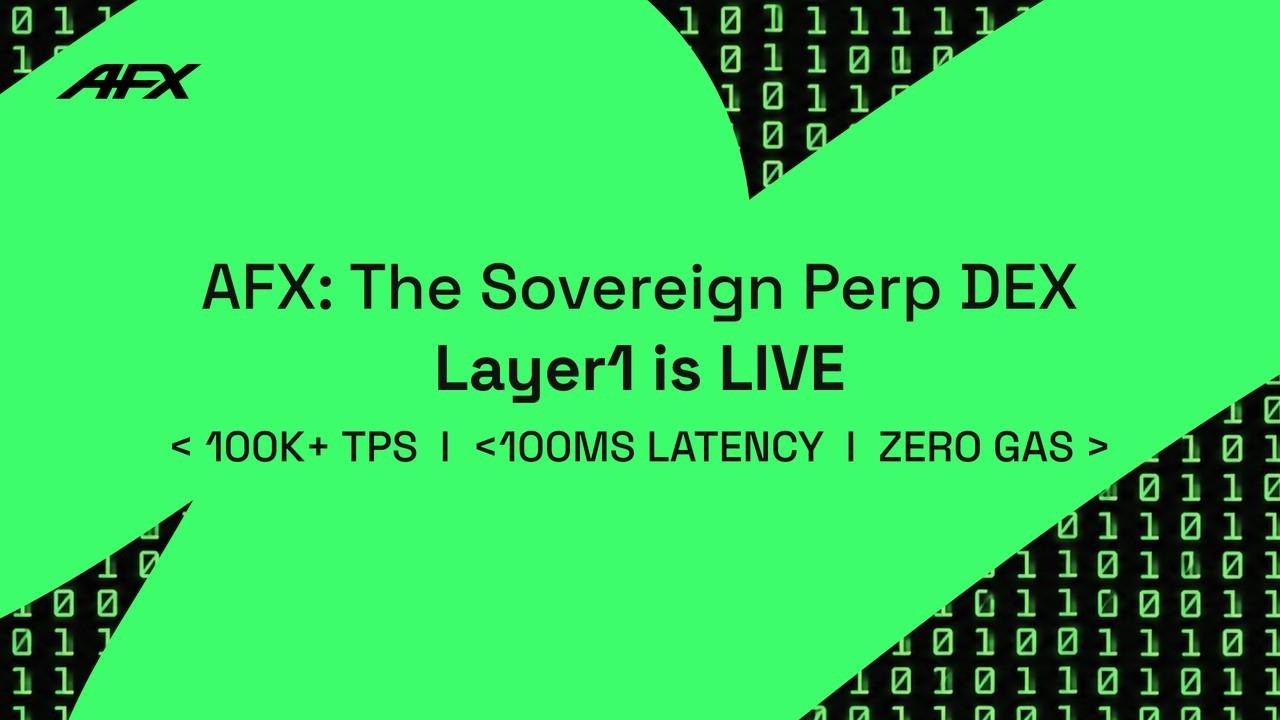
Road Town, BVI, May 18, 2026 — AFX, a sovereign Layer 1 purpose-built for decentralized derivatives trading, has officially commenced the operation of its L1 Mainnet, signaling a definitive end to the era of trade execution compromised by general-purpose blockchain congestion. Engineered for the world’ s most demanding participants, AFX introduces the Sovereign Trading Layer—a dedicated financial environment where the non-custodial transparency of a Perp DEX meets the uncompromising speed and depth traditionally reserved for institutional-grade centralized entities.
At launch, the protocol supports a high-liquidity suite of perpetual markets across both digital and traditional macro assets, featuring BTC, ETH, Gold (XAU), and Crude Oil (CL), with up to 40x leverage to ensure peak capital efficiency from the first block.
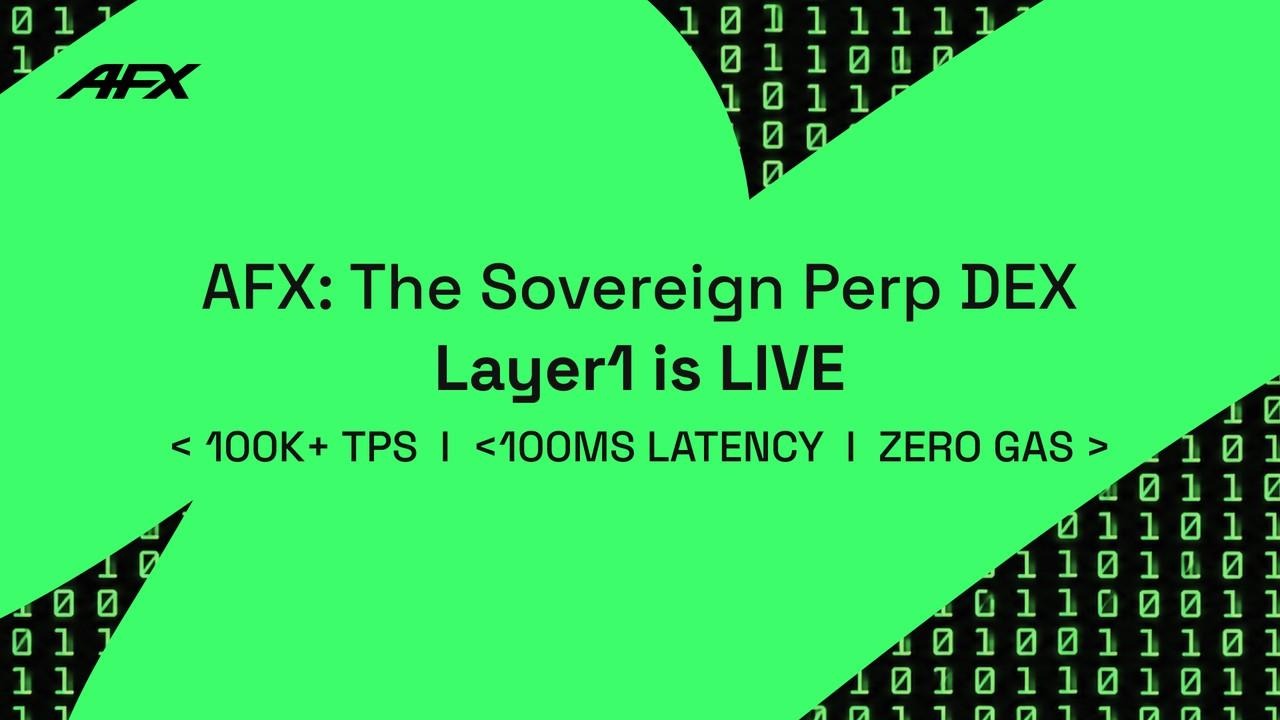
The architectural foundation of AFX represents a radical departure from legacy decentralized platforms that remain tethered to the high latency and structural bottlenecks of shared networks. By operating on a custom-built execution layer powered by DAG-based consensus and an ABCI modular architecture, AFX transforms the perpetual trading experience, achieving a specialized environment where execution is decoupled from consensus. This synergy provides a dedicated mempool optimized exclusively for high-frequency order flow and protocol-level MEV resistance, allowing for a 100ms median latency and a capacity exceeding 100,000 transactions per second.
Crucially, the AFX Mainnet introduces a Zero Gas execution model, removing the friction of network fees and allowing data-driven discipline, rather than gas costs, to dictate market success.
The Mainnet launch simultaneously debuts the Pro-Trader Suite, an institutional-caliber engine designed for the “0.1%” of traders who prioritize precision. This suite features a Hyper-Efficiency Margin Engine that mandates a mere 1.25% maintenance margin—delivering four times the capital efficiency of industry incumbents—while providing native support for the real-time re-utilization of unrealized profits. Furthermore, as the first decentralized derivatives exchange to offer native FIX protocol support, AFX provides Tier-1 quantitative firms a seamless, plug-and-play gateway to decentralized liquidity, bridging the gap between sophisticated algorithmic trading and on-chain sovereignty without the need for extensive code refactoring.
Beyond technical dominance, AFX is redefining the social contract of decentralized finance through a community-first economic model. In a deliberate move to preserve total sovereignty, the protocol was launched without venture capital, private rounds, or predatory unlock schedules, ensuring that the network’ s evolution is driven purely by its active participants. This commitment is solidified by a 100% Revenue Pass-through model, where the entirety of the network’ s generated value is directed back to the ecosystem’ s contributors and traders.
The AFX Mainnet is now live, offering a sanctuary for those who demand the transparency of a Perp DEX with the sovereign precision of a dedicated L1. Traders are invited to experience the next stage of on-chain evolution at https://app.afx.xyz/trade.
About AFX
AFX is a high-performance sovereign L1 purpose-built for decentralized derivatives. By synthesizing the rapid execution of a centralized exchange with the immutable sovereignty of the blockchain, AFX delivers a professional-grade Perp DEX environment characterized by sub-100ms finality, institutional liquidity, and unmatched capital efficiency.
MemeCore (M), 币安人生 (BinanceLife), and Gigachad (GIGA) sit at decisive technical levels heading into the third week of May. Daily charts show each token compressing or consolidating after weeks of volatile price action.
Each setup tells a different story. One token coils above a key Fibonacci floor, another nears a triangle breakout, and the third holds gains after a sharp weekly rally.
MemeCore Compresses Above $3.02 Fibonacci Support
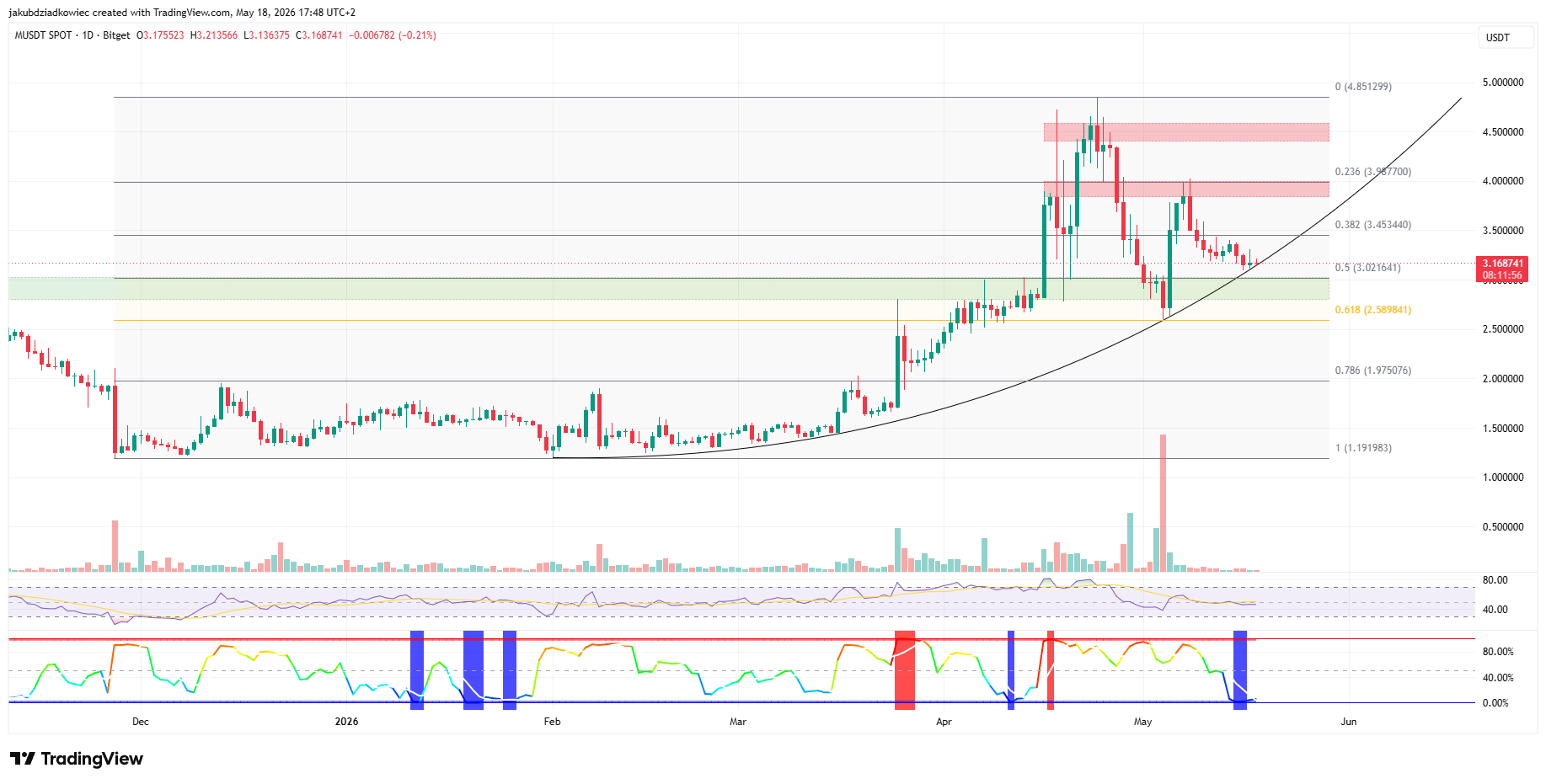
MemeCore (M) trades near $3.16 after a 2.16% decline over the past seven days. The token sits just above the 0.5 Fibonacci retracement at $3.02 on the daily chart.
The Relative Strength Index (RSI) prints at roughly 50, indicating neutral momentum. Meanwhile, volatility, as measured by the BBWP indicator, has collapsed to extreme lows, suggesting an accumulation phase.
Price has also bounced off an ascending exponential curve that has held every dip since February 1. A previous BeInCrypto rebound report tracked the same Fibonacci structure during the prior leg up.

Two horizontal supply zones remain in play above. The first sits near $4.00, with a heavier band stretching to $4.50.
A deeper correction would shift attention to the 0.618 Fibonacci retracement at $2.59. That level would serve as the first bearish target if the exponential curve cracks.
BinanceLife Coils Inside a Triangle Targeting $0.68
币安人生 (BinanceLife) trades at $0.43 after a 5.54% advance over the past week. In contrast with MemeCore, BinanceLife has been trending higher since the March 29 low.
The token printed an all-time high at $0.5595 in April. After pulling back to the 0.382 Fibonacci retracement at $0.36, the price resumed posting higher highs and higher lows.
Daily candles now coil within a horizontal triangle close to resolution. The earlier 3,000% surge reported by BeInCrypto set the stage for the current consolidation.

A break above $0.46 resistance would open a measured move toward $0.68 as the first bullish target. Strong support sits at the previous January 14 swing high near $0.26, which coincides with the 0.618 Fibonacci level.
The RSI hovers near 61, leaning neutral to bullish. Volatility remains compressed, reinforcing the case for a directional move once the triangle resolves. Broader BNB meme coin flows could determine the direction.
Gigachad Consolidates Below $0.0047 After Weekly Rally
Gigachad (GIGA) trades at $0.00435 after a sharp 13.91% weekly gain. However, the token has slipped 5.08% over the past 24 hours and now sits just below resistance at $0.0047.
A clean break above $0.0047 could open the path toward $0.0057, with a second resistance near $0.0072. Therefore, the next move from this consolidation will likely set the short-term tone.
The setup echoes earlier meme coin sector-watchlist coverage that tracked similar pauses after fast rallies. If the rally stalls, the first support area sits near $0.0035, marked by the November 17 and December 2025 lows.

A deeper flush would expose $0.0024, which capped price during the February to May accumulation range. The RSI prints near 70, holding firmly in bullish territory.
Volatility has cooled from recent extremes, suggesting a phase of reactivation rather than exhaustion. The next directional move will likely follow either a $0.0047 breakout or a retest of the $0.0035 floor.
The post Top 3 Meme Coins to Watch in the Third Week of May 2026 appeared first on BeInCrypto.

Pete Davidson’s Ex-Neighbors Reveal What He Was Really Like

Buying Iphone Can Kill Your Business #money #motivation #tips #success #mantra #business #iphone

Trump says he’s called off Iran strike planned for Tuesday

Manchester United reach agreement with Casemiro over contract clause amid transfer speculation

US brings back mandatory military draft registration

Steven Gerrard disagrees with Gary Neville over ‘shock’ Chelsea and Arsenal claim | Football


-

 Crypto World3 days ago
BloFin War of Whales 2026 Grand Prix opens registration for $5M trading championship
-

 Fashion3 days ago
Weekend Open Thread: Theory – Corporette.com
-

 Crypto World3 days ago
E-Estate Announces 1 Year Live: Washington DC Summit as Real Estate Tokenization Enters Its Next Phase
-

 Tech4 days ago
Tech Moves: Microsoft AI leader jumps to OpenAI; former AI2 exec joins Meta; and more
-
Crypto World6 days ago
Bitcoin Suisse expands with Digital Asset License and Investment Business Act Registration Approval in Bermuda
-

 Politics6 days ago
Pakistan to enter Chinese capital market as war inflation bites
-

 Crypto World6 days ago
Bitcoin Suisse expands with Digital Asset License and Investment Business Act Registration Approval in Bermuda
-
 Crypto World5 days ago
Google’s Gemini AI Predicts Incredible Solana Price by the End of 2026
-

 Business4 days ago
H&R Real Estate Investment Trust (HR.UN:CA) Q1 2026 Earnings Call Transcript
-

 Tech3 days ago
Google reimburses Register sources who were victims of API fraud
-

 Sports3 days ago
Napoleonic enters 2026 Doomben 10,000 field via Abounding withdrawal
-

 NewsBeat6 days ago
Comment on Keir Starmer surviving the day as Prime Minister like a turd that wont flush
-

 Fashion6 days ago
The Best-Kept Makeup Secret for a More Defined Face
-
 Entertainment4 days ago
Zara Larsson Has Blunt Response To Chris Brown Diss
-

 Politics6 days ago
Palestine’s flag becoming a regular sight at European football stadiums
-

 Politics7 days ago
The Trial of Majid Freeman, Verdict
-
 Tech6 days ago
Why AI is making typography a boardroom conversation
-
 Crypto World5 days ago
Two AI Tokens Lead May Rally, But Risks Are Rising
-

 Fashion2 days ago
On the Scene at Gucci’s Cruise Show in New York City: Mariah Carey, Kim Kardashian, Lindsay Lohan, Iman, and More!
-

 Politics6 days ago
The 81 MPs (so far) who have demanded tick-like Starmer out
You must be logged in to post a comment Login