
Crypto World
Riot extends Bitcoin selling spree with fresh 500 BTC move

Riot Platforms has sent another 500 BTC to an NYDIG deposit address, according to on-chain data cited by Lookonchain. The transfer was worth about $39 million at the time of reporting.
Summary
- Riot Platforms transferred 500 BTC worth about $39 million to an NYDIG deposit address.
- The miner sold 3,778 BTC in Q1 2026, generating $289.5 million in proceeds.
- Post-halving pressure and rising mining difficulty have pushed more public miners to sell Bitcoin.
The latest move adds to a series of Bitcoin transfers from Riot over the past two weeks. The miner has reportedly sent regular batches of 60 BTC to 125 BTC to NYDIG execution wallets almost daily.
Riot also made another 500 BTC deposit two weeks earlier. The repeated transfers show that the company has continued to reduce part of its Bitcoin reserves through institutional trading channels.
Q1 report showed large Bitcoin sales
Riot had already disclosed Bitcoin sales in its first-quarter 2026 operational report. The company sold 3,778 BTC during the quarter and generated $289.5 million in proceeds.
The firm reported an average sale price of $76,626 per Bitcoin. These sales placed Riot among the major public miners using Bitcoin reserves to support business needs.
Riot remains one of the largest listed Bitcoin mining companies. Its recent activity comes as miners manage tighter margins after the latest Bitcoin halving.
Moreover, the Bitcoin halving cut miner block rewards by 50%, reducing the amount of new BTC miners receive for each block. This has raised pressure on companies with high energy and infrastructure costs.
Mining difficulty has also continued to rise. Higher difficulty means miners need stronger and more efficient machines to produce the same amount of Bitcoin.
Many firms are upgrading ASIC fleets and expanding facilities to stay competitive. These costs can push miners to sell Bitcoin, especially when they need cash for operations, debt, or equipment.
Other public miners also sell BTC
Riot is not the only miner selling Bitcoin this year. MARA has sold more than 15,000 BTC for about $1.1 billion after revising its 2026 treasury policy to allow ongoing sales for operational needs.
CleanSpark also sold 405 BTC at spot prices and another 500 BTC. Core Scientific announced the sale of 1,900 BTC earlier this year and said it planned to exit its Bitcoin holdings by the end of the first quarter.
The sales show a broader shift among miners after years of holding Bitcoin reserves. Public mining firms now appear more willing to convert BTC into cash as market and operating conditions change.


TLDR
- XRP added about $900 million in tokenized real-world assets within 24 hours.
- The total RWA value on the XRP Ledger reached $3.53 billion after the surge.
- Justoken’s JMWH product increased from $861 million to $1.763 billion on-chain.
- JMWH now accounts for nearly half of the total RWA value on XRPL.
- RWA.xyz data reflected the sudden rise in value on its public dashboard.
XRP recorded a sharp rise in tokenized real-world assets within 24 hours. The network added about $900 million in value, pushing total RWA holdings to $3.53 billion. Data from RWA.xyz shows that the increase came from an existing product on the XRP Ledger.
XRP Sees Rapid Growth in Tokenized Assets on XRPL
RWA.xyz reported that XRP Ledger held $2.616 billion in tokenized assets as of April 22. That figure included $491 million in stablecoins and showed steady growth since January. However, the total climbed to $3.53 billion within a day, reflecting a 35% increase.
The data shows that Justoken’s JMWH product drove the entire rise. JMWH increased from $861 million to $1.763 billion on-chain during the same period. As a result, JMWH now accounts for nearly 49.9% of total RWA value on XRPL.
RWA.xyz confirmed the updated figures on its public dashboard. The platform tracks represented and distributed real-world assets across major blockchain networks. The sudden jump marked one of the largest single-day changes recorded for XRP’s RWA ecosystem.
Justoken’s JMWH Product Drives XRP Ledger Expansion
Justoken, based in Buenos Aires, developed the JMWH digital energy token. Each JMWH token represents one real megawatt-hour of electricity backed by energy providers. The company deployed the product exclusively on the XRP Ledger.
The recent increase appears linked to a new deployment or value update. However, Justoken’s official platform still lists JMWH at about $860 million. The company has not yet confirmed the higher $1.763 billion valuation reflected on RWA.xyz.
Following the update, XRPL moved higher in global RWA rankings. The ledger now ranks third by represented real-world assets with about $2.5 billion recorded. XRP’s market share rose 71.78% over 30 days to 0.71%.
When including both represented and distributed assets, XRP ranks fifth globally. The network now hosts $3 billion in total RWA, excluding stablecoins. This marks a 60.33% rise over the past 30 days.
JMWH currently represents about 70% of the represented value on XRPL. The product remains the largest single tokenized asset hosted on the network. RWA.xyz continues to display the updated figures at press time.
Justoken has not issued a public statement regarding the change. Its website still reflects the earlier $860 million value. The discrepancy remains unresolved as of the latest available data.



Binance has unveiled a new wallet that merges AI with decentralized finance. “Agentic Wallet,” a keyless crypto wallet that enables AI agents to execute transactions on behalf of users within predefined parameters.
Announced just today, the new wallet operates as a separate, isolated account within a user’s Binance Wallet, enabling AI-powered agents to trade, transfer, and manage digital assets without directly accessing a user’s primary funds. This is a push by Binance to expand AI capabilities beyond trading tools and into on-chain activity across Web3 ecosystems.
Binance positions Agentic Wallet as a solution to one of the emerging challenges in crypto automation. By isolating balances and allowing configurable permissions, Binance aims to give users oversight while still benefiting from automation.
“At Binance, we see AI as key to making digital asset opportunities more accessible,” said Winson Liu, Global Head of Binance Wallet. “Agentic Wallet is designed to give users and developers a secure, practical way to let AI agents take action on-chain.”
He added that the product extends Binance’s AI ecosystem beyond its exchange. “With Agentic Wallet, we’re extending the Binance AI experience beyond the exchange and into Web3, while bringing the agent, the wallet, and the exchange experience together in one app,” Liu said. “The result is a more intuitive, secure, and self-custodial way for users to let their AI agents operate on-chain within clear boundaries.”
Discover: The best pre-launch token sales
What Does The New Binance AI Wallet Do?
According to the Binance press release, Agentic Wallet introduces a structured framework for AI-driven activity, incorporating features such as spending limits, token restrictions, and predefined transaction rules. Transfers are restricted to whitelisted addresses saved in a user’s address book, while a dedicated monitoring dashboard provides real-time visibility into agent activity.
The wallet supports a range of operations at launch, including balance checks, transfers, trading via market and limit orders, and order management. We know AI agents have been making headlines here and there, with them recording a huge profit from pure automation.
The wallet itself uses keyless technology, eliminating the need for users to manage private keys directly. This eliminates one of the major friction points in self-custody crypto solutions. Instead, it relies on enterprise-grade infrastructure combined with Binance’s “Secure Auto Sign,” which allows pre-approved transactions to execute without repeated confirmations.
The product is compatible with multiple AI agent frameworks that support tool-use protocols, including OpenClaw, Claude Code, and Cursor. This interoperability suggests Binance is targeting not just retail users but also developers building AI-native financial applications.
Discover: The best crypto to diversify your portfolio with
Expansion Across Chains and Incentives at Launch
At launch, Agentic Wallet supports several major blockchain networks, including BNB Smart Chain, Solana, Base, and Ethereum, with plans to expand to additional chains over time. Each user is currently limited to creating one Agentic Wallet.
To encourage adoption, Binance is rolling out a 15-day promotional campaign offering up to 20 gas-free transactions per user, capped globally at 200,000 transactions. The company is also waiving service fees for trades executed via Agentic Wallet during the promotion period.
Cryptonews readers also have the chance to get a $10 bonus from Binance. The exchange is giving new users a straight $10 USDC just for making their first trade until May 16.
The post Binance AI Wallet Unveiled: Keyless ‘Agentic Wallet’ for Web3 Automation appeared first on Cryptonews.
The European Central Bank (ECB) said Friday it has signed agreements with three European standards bodies to reuse existing open payment standards for digital euro transactions, as it seeks to reduce integration costs for banks, merchants and payment service providers.
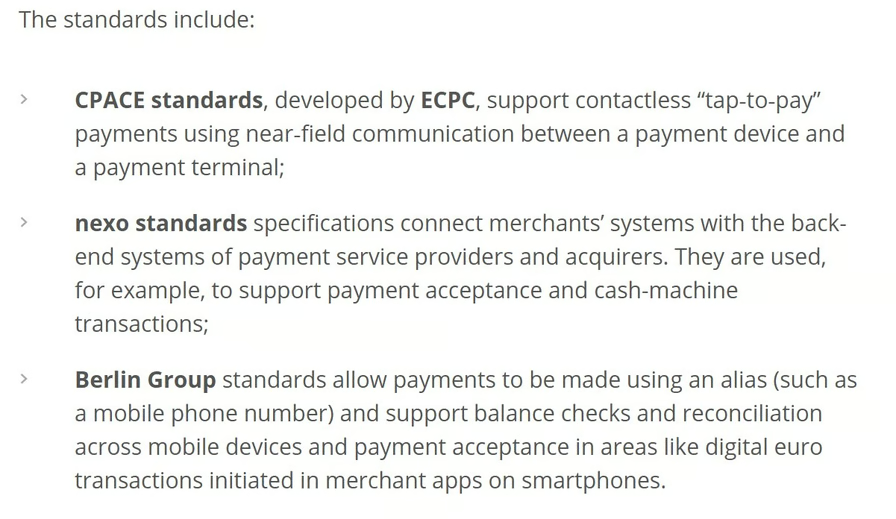
According to the ECB, the agreements with the European Card Payment Cooperation, Nexo standards and the Berlin Group will allow the ECB to use standards covering contactless tap-to-pay payments, merchant-to-payment-provider connections and alias-based payments, such as transactions using a mobile phone number.
The ECB said using existing open standards would minimize adoption costs for the market and help create a uniform digital euro user experience across the euro area. However, the standards agreements remain a cost-mitigation step, not confirmation that the digital euro will be cheap to implement.
An earlier ECB analysis reported by Reuters estimated that the digital euro could cost European Union banks between 4 billion euros and 6 billion euros over four years.
The agreements show that the ECB is trying to reduce one technical barrier to digital euro adoption. However, the move does not directly resolve the broader cost question facing banks that may still need to spend billions of euros preparing systems, staff and compliance processes for a possible launch.
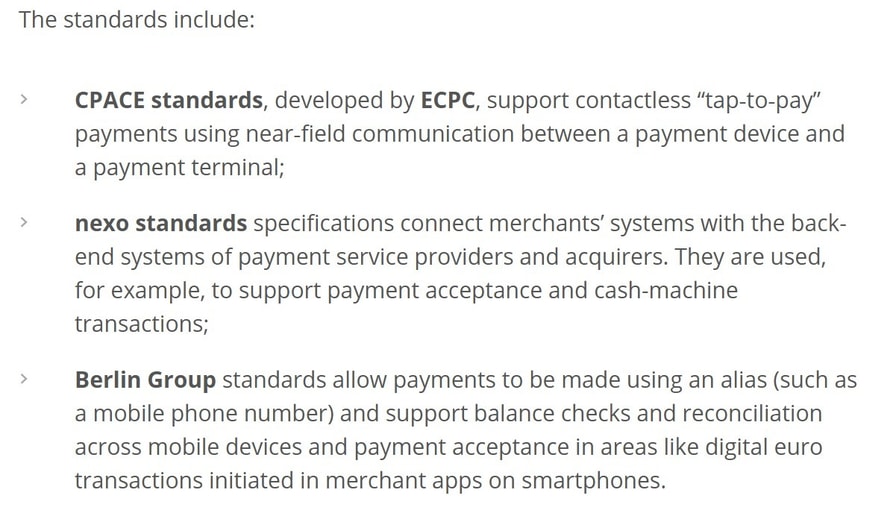
The standards to be included. Source: ECB
ECB prepares technical layer ahead of pilot
The ECB said the agreements are intended to encourage early coordination among payment service providers, standardization bodies and other market participants before a possible digital euro launch.
The central bank said Europe currently lacks a universally available open standard supported across payment terminals and remains heavily dependent on proprietary standards owned by international card schemes and global digital wallets.
Related: ECB backs tokenized EU capital markets with strict guardrails
The standards push follows earlier signals that the ECB wants the digital euro’s technical framework clarified so banks and merchants can begin preparing their systems. On March 25, ECB Executive Board member Piero Cipollone said the central bank expected to announce key technical standards by the summer.
The ECB is also separately recruiting payment service providers for a 12-month digital euro pilot expected to start in the second half of 2027. On Feb. 18, the ECB said the pilot will involve a limited number of payment service providers, merchants and Eurosystem staff, with PSPs playing a central role in digital euro distribution.
Magazine: Ripple joins Singapore sandbox, Bhutan’s big Bitcoin selloff: Asia Express

China’s new online marketing rules tighten an already sweeping crypto ban and place fresh pressure on financial influencers, echoing parallel crackdowns in Europe, Australia and the UK.

Bitget has launched IPO Prime, a platform offering tokenized exposure to private companies before they go public, with SpaceX as the first listing via a derivative token called preSPAX minted on the Solana blockchain.
The offering is issued through Republic, a private markets investment platform, and began trading after a brief subscription window, giving retail investors near-immediate liquidity on a pre-IPO name that has been off-limits to almost everyone outside Sand Hill Road.
The core question this raises: whether tokenized pre-IPO derivatives represent a genuine democratization of private market access, or a new category of structured risk that regulators have not yet caught up with.
Key Takeaways
- Product launch: Bitget’s IPO Prime platform offers tokenized exposure to private companies ahead of public listings.
- First listing: preSPAX, a derivative token tracking SpaceX’s economic performance, issued via Republic on Solana.
- Token structure: preSPAX is a derivative – not equity – designed to mirror financial outcomes tied to SpaceX’s post-IPO valuation.
- Mechanics: Users commit stablecoins into a pool and receive tokens proportional to total demand; tokens trade on a spot market immediately after distribution.
- Chain: Solana, increasingly positioned as a settlement layer for tokenized real-world assets.
- Watch item: Whether the SEC or equivalent regulators classify preSPAX-style instruments as unregistered securities will determine how fast IPO Prime can scale globally.
Discover: The best pre-launch token sales
How IPO Prime Actually Works, and What a preSPAX Buyer Actually Holds
The mechanics are straightforward but the product structure deserves precision. Users deposit stablecoins into a subscription pool during a defined window; token allocations are then distributed based on total pool demand rather than fixed lots.
Once distributed, preSPAX trades on Bitget’s spot market, letting holders enter and exit as sentiment around a SpaceX IPO shifts.
What a buyer actually holds is a derivative, not a share, not a convertible note, not a SAFE. preSPAX is structured to mirror the financial outcomes tied to SpaceX’s valuation at the point of a public debut.
Republic, which specializes in private market access, issues the token; Solana handles settlement and custody of the on-chain instrument.
The distinction from equity ownership is not a footnote, it is the entire legal architecture of the product.
This structure breaks the traditional pre-IPO lock-up model, where venture stakes in private firms can sit illiquid for three to seven years.
IPO Prime’s spot market creates an exit valve that did not previously exist for retail participants. That is genuinely new. What it does not provide is voting rights, pro-rata rights, or any direct claim on SpaceX assets.
What the SpaceX Hook Reveals About Retail Demand for Pre-IPO RWA Exposure
Tokenization of real-world assets has expanded rapidly across bonds, money market funds, and commodities, but pre-IPO equity exposure has remained structurally inaccessible to retail.
SpaceX is not an arbitrary first listing. The company has reportedly filed confidentially for an IPO, making it one of the most anticipated market debuts in years, with retail demand that has no conventional outlet.

Bitget’s choice of Solana as the settlement chain aligns with a broader trend. Solana has absorbed an increasing share of RWA tokenization activity in 2025 and 2026, drawn by throughput and low transaction costs relative to Ethereum mainnet.
Republic’s involvement adds a layer of private market credibility that a pure crypto-native issuer would lack.
The competitive pressure here is real. Exchanges are racing to extend product surface area beyond spot and derivatives into structured exposure products.
Bitget’s IPO Prime is a direct response to that dynamic, and a signal that pre-IPO tokenization is moving from niche experiment to exchange-tier product category.
Explore the top RWA presale projects now
The post Bitget Launches Pre-IPO Token Trading Starting With SpaceX on Solana appeared first on Cryptonews.
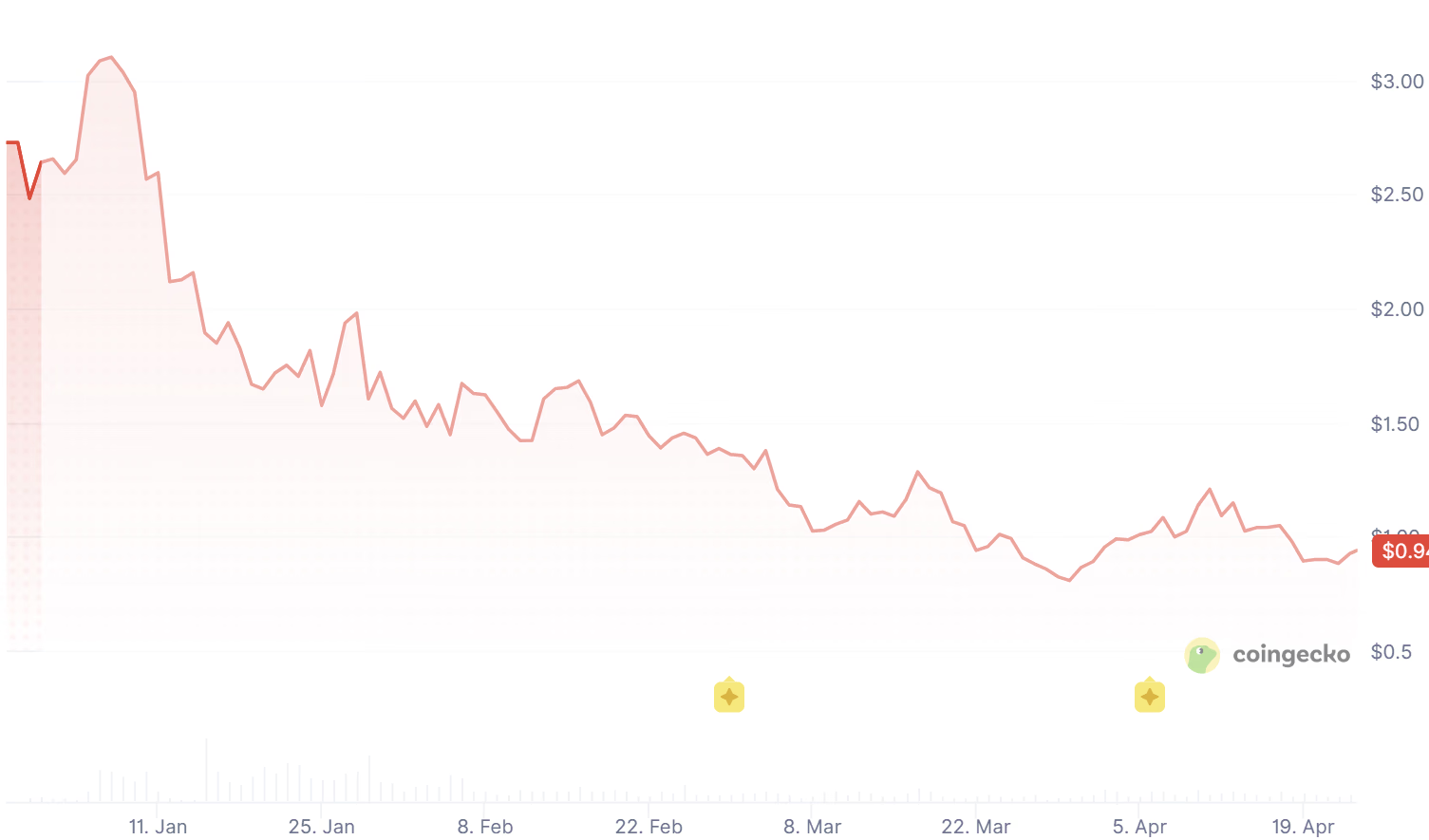
Traders can post non-USDC assets as collateral for perps through Unified Trading Accounts, with conservative supply caps at launch.
Decentralized perpetuals exchange Lighter is rolling out Multi-Asset Margin today, enabling traders to post non-USDC assets as collateral for perps trading.
The feature debuts with ETH as the first supported collateral asset, according to Lighter’s documentation. Users deposit a supported asset into their margin balance, and its value, discounted by a loan-to-value haircut, counts toward the account’s margin balance and can be used to open perpetual positions. The upgrade is limited to perpetual futures at launch, with USDC spot trading collateralized by non-USDC assets slated to follow.
Lighter is rolling out the feature with conservative per-user and global supply caps as it onboards additional assets over time, per the docs. Access is restricted to accounts with Unified Trading Accounts enabled, which the team rolled out in February and described at the time as the first phase of a push to allow arbitrary tokens to be used as collateral on the platform.
The documentation highlights two potential use cases. The first is a delta-neutral basis trade, where a user deposits ETH as margin, shorts ETH perps against it, and earns funding. The second is leveraged spot, where deposited ETH is used as margin to buy more spot ETH.
Account risk is tracked through a single unified health check covering both perp positions and spot collateral.
The upgrade arrives as Lighter has lost ground in the perp DEX race since its token launch. The platform currently ranks fourth by 24-hour perp volume at roughly $1.35 billion, per DefiLlama, behind Hyperliquid, Aster, and EdgeX, after leading the market in November and December.
The platform’s LIT token has underperformed since its Dec. 29 debut as airdrop farmers rotated to pre-token competitors, and currently trades at a roughly $930 million valuation.

This article was written with the assistance of AI workflows. All our stories are curated, edited and fact-checked by a human.
Zondacrypto’s crisis intensified as Polish prosecutors opened a criminal investigation into alleged fraud and investor losses, with CEO Przemysław Kral reportedly fleeing to Israel. According to the Polish outlet Onet, Kral has been in Israel for about a week and holds Israeli citizenship, a detail that could complicate any potential extradition. The probe was opened last Friday and centers on customer complaints and possible losses tied to the platform. According to Onet.
Cointelegraph confirmed that Kral’s email address previously used to communicate with him has become unavailable, and last week he acknowledged that Zondacrypto’s cold wallet holding 4,500 BTC was inaccessible. Prosecutors have identified hundreds of potential victims and losses of at least 350 million Polish zloty (roughly $97 million), notes from Poland cited by prosecutor spokesperson Michał Binkiewicz. Notes from Poland reported the figure.
The mounting controversy has also put pressure on Zondacrypto’s governance. This week, resignations were reported from BB Trade Estonia OÜ, the Estonian entity that operates the exchange. Former supervisory board member Georgi Džaniašvili said the board learned about the scale of the crisis through media reports rather than through internal channels, highlighting “material inconsistencies” between public statements and information available to the board.
Key takeaways
- Polish prosecutors opened a fraud investigation into Zondacrypto last Friday, with losses identified at a minimum of 350 million PLN and hundreds of potential victims, per prosecutor statements cited by Notes from Poland.
- CEO Przemysław Kral reportedly relocated to Israel, where he holds citizenship, a detail that could complicate extradition proceedings; Onet notes he has been in Israel for about a week.
- Resignations from the supervisory board of BB Trade Estonia OÜ, the Estonian operator of Zondacrypto, point to governance strains and concerns about transparency, as described by former board member Georgi Džaniašvili.
- Although registered in Estonia, Zondacrypto maintains a sizable Polish user base, fueling broader regulatory and political scrutiny within the EU’s evolving MiCA framework.
Why Poland and the MiCA context matter for Zondacrypto
The case centers not only on missing access to a substantial cold-storage wallet but also on the jurisdictional complexity of a company registered in Estonia with a large Polish market. Zondacrypto traces its roots to Katowice, where it was founded in 2014 as BitBay. The public narrative from CEO Kral in recent days includes a claim that the company’s founder, Sylwester Suszek, who disappeared in 2022, was responsible for the lack of access to the cold wallet. The backdrop to this crisis has become a flashpoint in Polish politics. Prime Minister Donald Tusk has drawn connections between Zondacrypto’s origins and Russian capital and influence, arguing that up to 30,000 users may have been affected and noting Poland’s delay in implementing a robust investor-protection framework aligned with the EU’s MiCA regime. gov.pl quoted Tusk on the matter.
The broader regulatory setting underscores a central question for the EU: should crypto oversight be centralized at the EU level under MiCA, or primarily implemented at the national level? The debate is intensified by cases like Zondacrypto, which expose gaps in investor protection and cross-border enforcement. While MiCA aims to harmonize standards, enforcement and timely action remain points of contention among member states as EU regulators push for stronger, more consistent oversight of smaller crypto platforms.
What happens next for investors and the market
With investigators probing potential fraud and a missing founder, the path to restitution for affected users remains uncertain. Authorities will likely pursue asset tracing, potential fund recovery, and accountability for executives and board members, all while grappling with cross-border jurisdictional questions. The political dimension—spotlighting national responses to MiCA and centralized oversight—could influence future regulatory posture across Central and Eastern Europe. As the investigation unfolds, readers should monitor updates from Polish authorities and EU regulators for signs of policy shifts that could affect both consumer protections and the operating risk profile of cross-border crypto platforms.
Investors and users should watch for new disclosures about the custody of the 4,500 BTC, developments in extradition or international cooperation, and any formal steps taken by regulators to clarify investor protections for Polish users and the wider EU market.
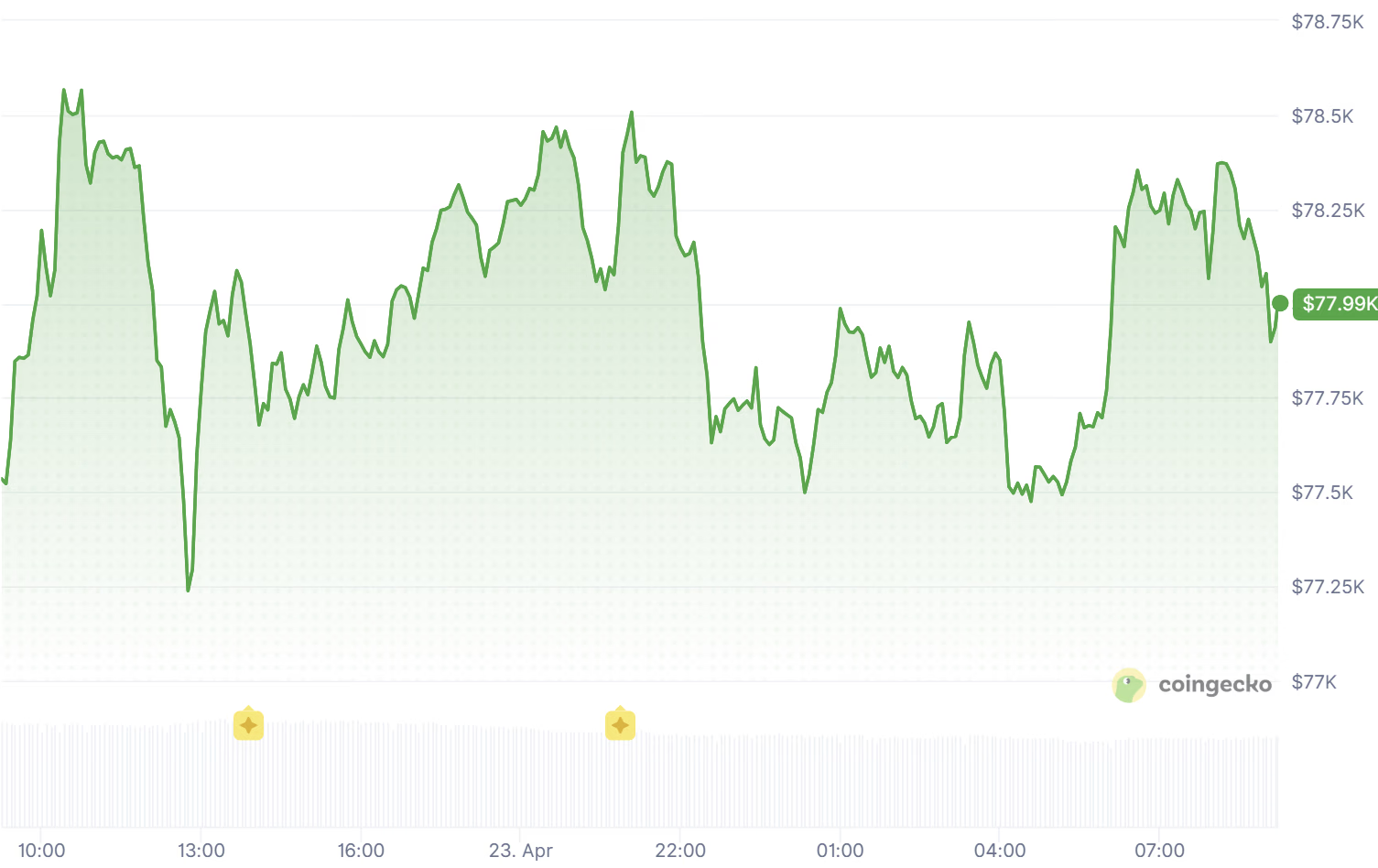
Major altcoins traded sideways on Friday after Trump ordered the Navy to fire on Iranian mine-laying boats.
Crypto markets were relatively calm on Friday as the largest Deribit options settlement of the month cleared roughly $9.87 billion in notional exposure, with traders now turning their attention to next week’s Federal Reserve meeting and a renewed escalation in the Strait of Hormuz.
BTC is changing hands at $78,088, up 0.8% on the day, 2.5% on the week, and 9% on the month. Ether trades at $2,316, flat on the day and down 2.3% over the week. Total crypto market capitalization stands at $2.68 trillion, with $93.8 billion in 24-hour trading volume, per CoinGecko. XRP was held at $1.44, BNB at $638, and Solana at $86.

The April monthly settlement covered 109,000 BTC contracts with $8.55 billion in notional and 563,000 ETH contracts worth $1.32 billion, per Deribit data. The expiry cleared roughly 25% of total Deribit open interest. Heavy call positioning was concentrated at the $75,000 and $80,000 strikes heading into settlement, according to CoinGlass.
ETF Flows Diverge
U.S. spot Bitcoin ETFs logged $223 million in net inflows Thursday, extending their winning streak to eight consecutive sessions, per SoSoValue. BlackRock’s IBIT continued to anchor the flows.
Spot Ether ETFs broke a 10-day inflow run with $75.9 million in Thursday outflows.
Meanwhile, CoinShares’ weekly report pegged total digital asset fund inflows for the week ended April 17 at $1.4 billion, the strongest weekly print since mid-January.
Hormuz Escalation Resets Risk Backdrop
President Donald Trump posted on Truth Social Thursday that he had ordered the U.S. Navy to “shoot and kill any boat, small boats though they may be, that is putting mines in the waters of the Strait of Hormuz,” and directed minesweeping operations to triple in pace. Iran’s Revolutionary Guard Corps laid fresh mines this week and seized two commercial vessels on Wednesday, per a subsequent statement from U.S. Central Command.
Iran’s Foreign Ministry spokesperson Esmail Baghaei said Tehran’s measures in the strait are “entirely lawful,” according to IRNA. Tanker transits through the waterway, which in peacetime handles roughly 20% of global oil flows, have collapsed since the conflict began.
Fed Meeting Ahead
The Federal Open Market Committee meets April 28 to 29, with CME FedWatch pricing in a near-certainty of an unchanged federal funds rate. The Bureau of Economic Analysis will release Q1 GDP and March PCE on April 30.
Crypto World
Weekly Market Insights with Gary Thomson: The Week of Central Banks and Earnings Reports

In this video, we’ll explore the key economic events and market trends, shaping the financial landscape. Get ready for insights into financial markets to help you navigate the week ahead. Let’s dive in!
In this episode of Market Insights, Gary Thomson unpacks the strategic implications of the most critical events driving global markets.
👉 Key topics covered in this episode:
✔️ BoC Interest Rate Decision
The Bank of Canada will announce its rate decision on 29 April, with rates expected to remain unchanged. However, the focus will be on its updated outlook for inflation and growth. With energy prices pushing inflation higher while underlying pressures ease, the tone of the Monetary Policy Report could drive volatility in the Canadian dollar.
✔️ Fed Interest Rate Decision
The Federal Reserve will also announce its rate decision on 29 April. Although rates are forecast to stay unchanged, the press conference may be important. Shifting expectations towards a prolonged pause could drive volatility in the USD and global markets. Will the Fed maintain a cautious tone, or surprise markets with a shift in outlook?
✔️ BoE Interest Rate Decision
The Bank of England’s interest rate decision will be released on 30 April, with no changes expected. However, the vote split could influence sterling, especially as inflation rises but policymakers remain cautious. Will the Bank signal future tightening, or maintain a wait-and-see approach?
✔️ ECB Interest Rate Decision
The European Central Bank will deliver its monetary decision on 30 April. As rates are anticipated to hold, guidance from Christine Lagarde and the tone of the press conference could drive euro volatility. Will the ECB maintain a cautious pause, or signal readiness to tighten policy soon?
✔️ Earnings Reports
On 29–30 April, major earnings from the so-called Magnificent Seven corporations — including Alphabet, Microsoft, Amazon, Meta, and Apple — could drive equity market movements, with investors focusing on AI, cloud, advertising, and consumer demand trends. Will earnings support US equity indices, or trigger a broader reassessment of tech valuations?
Heading into the week, geopolitics, central bank decisions, and major earnings could drive markets. With several key events clustered together, volatility may stay elevated, making risk management essential.
Gain insights to strengthen your trading knowledge.
💬 Don’t forget to like, comment, and subscribe for more market insights every week.
Watch it now and stay updated with FXOpen.
This article represents the opinion of the Companies operating under the FXOpen brand only. It is not to be construed as an offer, solicitation, or recommendation with respect to products and services provided by the Companies operating under the FXOpen brand, nor is it to be considered financial advice.
Cryptography company Succinct has launched Zcam, an iPhone camera app that cryptographically signs photos and videos at the moment of capture to help prove their authenticity.
The company said Thursday that Zcam embeds a tamper-evident record linking media to the device that captured it, allowing viewers to verify that content was not digitally altered or generated by artificial intelligence.
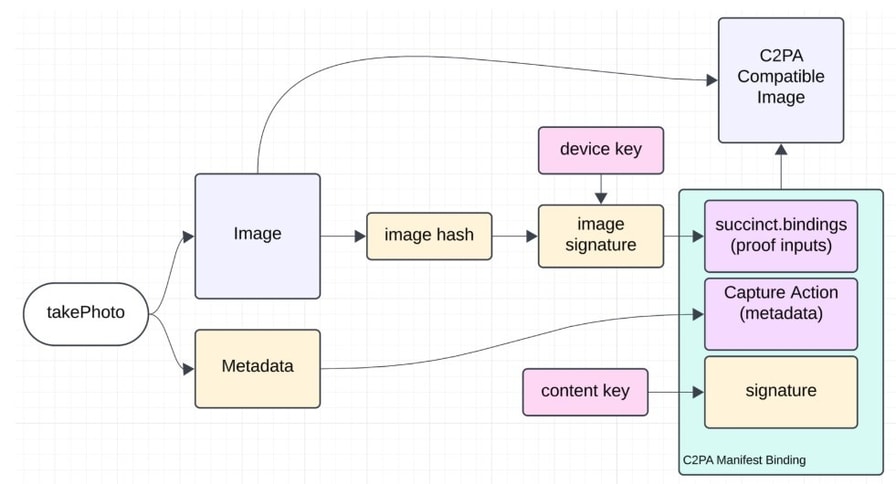
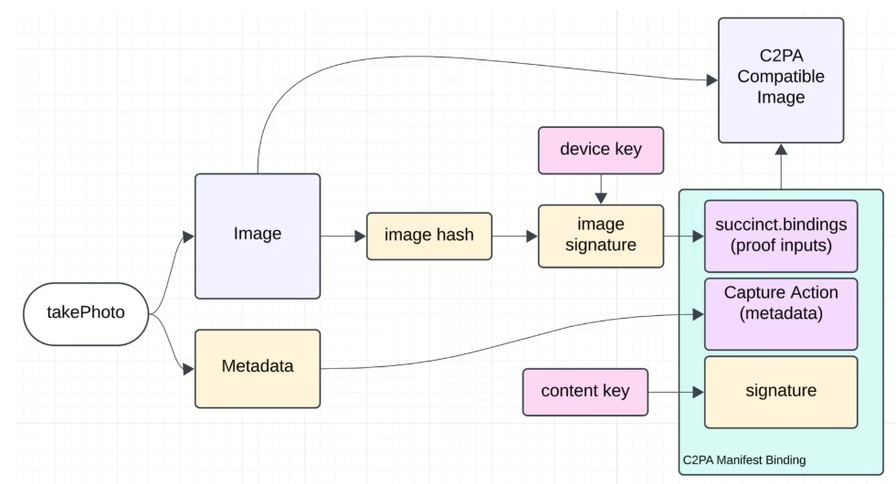
How the Zcam application works. Source: Succinct
According to Succinct, the app works by hashing raw image data and signing it using keys generated inside Apple’s Secure Enclave, a hardware-based security module. The resulting signature, along with capture metadata and attestation, is embedded into the file using the Coalition for Content Provenance and Authenticity (C2PA) standard, a framework for attaching tamper-evident provenance data to digital media.
Standards such as C2PA are designed to establish the origin and edit history of digital content by embedding signed provenance metadata into files. According to the C2PA, its open technical standard lets publishers, creators and consumers establish the “origin and edits” of digital content. It allows users to record how the content was created, which tools were used and how it changed over time.
Related: Spain seizes crypto cold wallets in illegal manga piracy raid
The launch pushes Succinct’s applied cryptography work beyond blockchain infrastructure and into media provenance, as companies look for ways to authenticate digital content at creation rather than rely only on after-the-fact AI detection tools.
The launch comes as security concerns in crypto increasingly include AI-driven fraud. On Thursday, blockchain security firm CertiK warned that deepfakes, phishing attacks and AI-assisted social engineering are likely to drive some of the largest crypto hacks in 2026. The report highlighted how attackers are using convincing synthetic media to deceive users and bypass security checks.
Crypto security expands beyond code as AI threats rise
Succinct said Zcam is an early step toward broader adoption of cryptographic provenance tools, which could be used in areas such as journalism, insurance claims and identity verification, where trust in digital media is increasingly critical.
The company acknowledged limitations in its current implementation, noting that the Zcam software development kit is unaudited and not production-ready. It also said secure enclaves have been compromised in the past and that ensuring a fully tamper-proof capture-to-signing process remains an active area of research.
Magazine: AI-driven hacks could kill DeFi — unless projects act now

The GMC Jimmy May Be Coming Back To Battle The Bronco

XRP – OVER 100! (You Can’t Miss This NEWS!)

How to start a conversation on a dating app

Manchester United reach agreement with Casemiro over contract clause amid transfer speculation

US brings back mandatory military draft registration

Steven Gerrard disagrees with Gary Neville over ‘shock’ Chelsea and Arsenal claim | Football
XRP – OVER 100! (You Can’t Miss This NEWS!)

Bloomberg Live: Business, Finance, Earnings & Investment News | Watch 7AM – 6PM ET Weekdays

BITCOIN PRICE SQUEEZE: Everyone is WRONG (Again)!!! – Bitcoin News Today, Ethereum & Altcoins
-

 Fashion7 days ago
Weekend Open Thread: Theodora Dress
-

 Business5 days ago
Powerball Result April 18, 2026: No Jackpot Winner in Powerball Draw: $75 Million Rolls Over
-

 Politics7 days ago
Palestine barred from entering Canada for FIFA Congress
-
Entertainment5 days ago
NBA Analyst Charles Barkley Chimes in on Ice Spice McDonald’s Fiasco
-

 Tech6 days ago
Auto Enthusiast Scores Running Tesla Model 3 for Two Grand and Turns It Into Bare-Bones Go-Kart
-

 Politics5 days ago
Zack Polanski demands ‘council homes not luxury flats for foreign investors’
-

 Crypto World7 days ago
Russia Pushes Bill to Criminalize Unregistered Crypto Services
-

 Politics4 days ago
Gary Stevenson delivers timely reminder to register to vote as deadline TODAY
-

 Business2 days ago
Rolls-Royce Voted UK’s Most Iconic Trade Mark as IPO Register Hits 150
-

 Politics2 days ago
Disabled people challenge government SEND proposals over segregation concerns
-

 Politics2 days ago
Making troops accountable for war crimes threatens US alliance, ex-SAS colonel warns
-

 Crypto World7 days ago
Russia Introduces Bill To Criminalize Unregistered Crypto Services
-

 Politics2 days ago
Starmer handler McSweeney to be dragged from shadows by Foreign Affairs Committee
-
Politics2 days ago
Wings Over Scotland | How To Get Away With Crimes
-

 Politics2 days ago
Zack Polanski responds to home secretary’s taser threat
-
Crypto World6 days ago
Kelp DAO rsETH Bridge Hack Drains $292M as DeFi Losses Top $600M in Two Weeks
-

 Politics2 days ago
‘Iran is still a nuclear threat’
-

 Crypto World3 days ago
New York sues Coinbase, Gemini over prediction market offerings
-

 News Videos7 days ago
AP Politics, Buggana Analyzes Reasons For Financial Instability Due To Amaravati
-

 Business2 days ago
The Job Benefits Most Men Don’t Know to Negotiate
You must be logged in to post a comment Login