
Crypto World
Robinhood stock tests $89 support before Q2 earnings

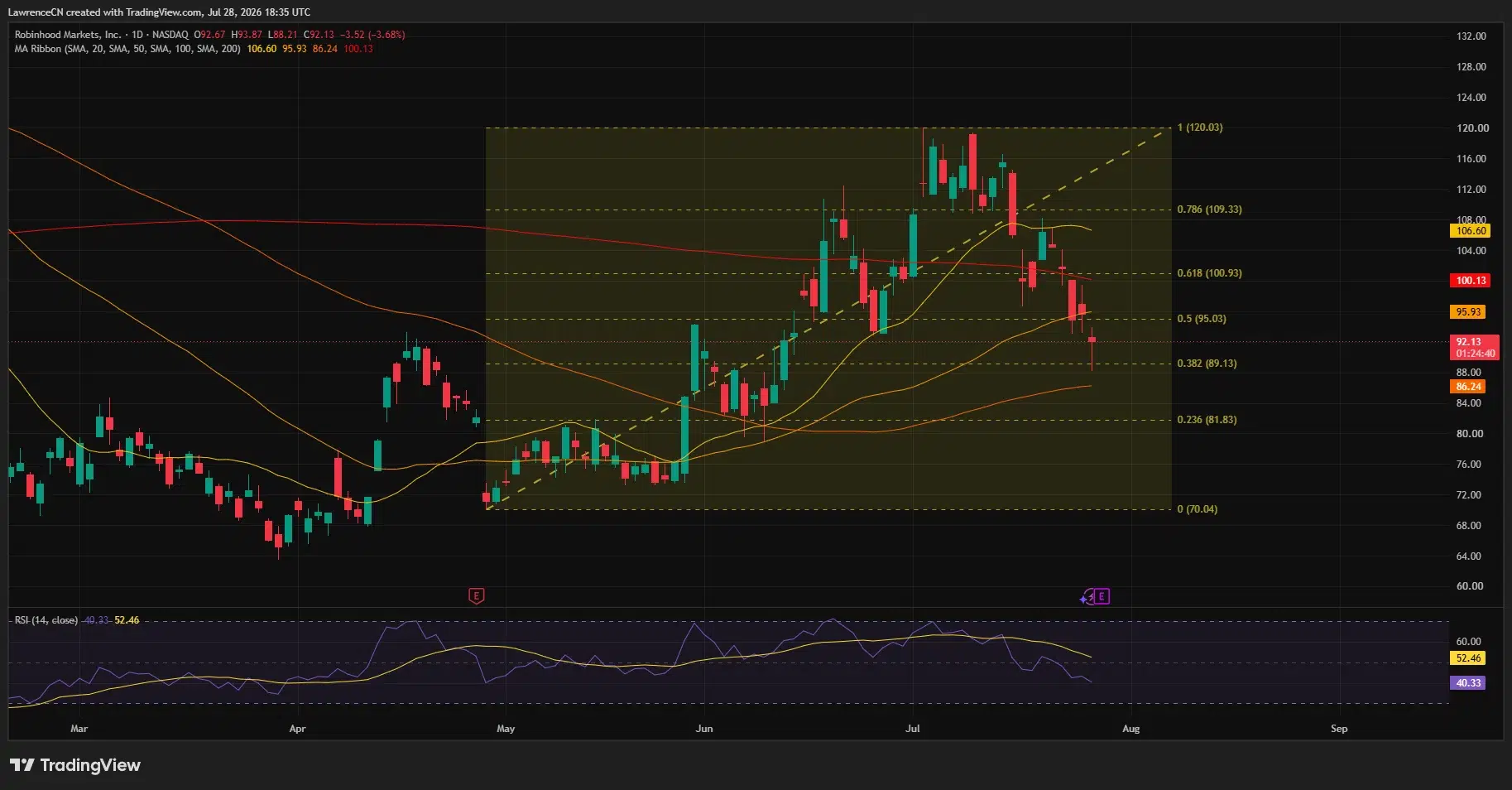
Robinhood stock extended its decline on July 28 as investors weighed regulatory uncertainty, weaker trading activity and the company’s upcoming second-quarter earnings.
Summary
- HOOD fell 3.68% to $92.13, extending its decline from the July peak near $120.
- Analysts expect Robinhood to report $1.24 billion to $1.28 billion in second-quarter revenue.
- The stock has fallen below its 50-day moving average and $95 Fibonacci support.
- $89.13 is the next support level, while earnings could determine HOOD’s short-term direction.
Robinhood stock extends its July decline
Robinhood Markets (HOOD) traded around $92.13 on July 28, down 3.68% during the session. The stock opened at $92.67, reached an intraday high of $93.87, and fell as low as $88.21 before recovering part of the loss.
The latest decline left HOOD about 23% below its July peak near $120. Shares had rallied sharply from approximately $70 in late April before reversing course during the second half of July.
Uncertainty surrounding US crypto legislation has added pressure across crypto-linked stocks. The pullback also comes before Robinhood reports its second-quarter results after the market closes on July 29.
Investor attention will center on whether crypto, equity, and options trading activity remained strong enough to support transaction-based revenue. Trading volumes weakened during the bearish market conditions seen between April and June, potentially limiting growth in Robinhood’s core brokerage operations.
Robinhood Chain has also failed to translate into immediate stock gains. HOOD traded near $100 when the blockchain was unveiled on July 1 but has since fallen below $93.
Robinhood earnings could show 24% revenue growth
Wall Street analysts expect Robinhood to report between $1.24 billion and $1.28 billion in second-quarter revenue. Reaching the lower end of that range would represent growth of roughly 25% from the $989 million reported for the same quarter in 2025.
The results will follow a weaker-than-expected first quarter. Robinhood reported $1.07 billion in revenue for the period, below analysts’ estimate of $1.14 billion. Earnings per share reached $0.38, also missing the expected $0.40.
That earlier miss triggered an over 10% decline in HOOD stock. A similar reaction remains possible if second-quarter revenue falls below Wall Street forecasts, particularly now that the share price is approaching several technical support levels.
Prediction markets could offset some weakness in conventional trading volumes. Bernstein estimates that the business could generate $586 million in revenue for Robinhood during 2026. The firm has set a $160 target for HOOD, although achieving that valuation would depend on continued growth and regulatory conditions.
Robinhood will report alongside Microsoft and Meta, making July 29 an important earnings session for US technology stocks. Guidance for the rest of 2026 may be as important as the reported revenue figure because it could reveal whether recent market weakness has affected customer activity.
HOOD price breaks below the 50-day average
The daily chart shows that Robinhood stock has fallen below the 50% Fibonacci retracement level at $95.03. HOOD has also slipped under its 50-day simple moving average at $95.93, indicating that short-term momentum has turned bearish.
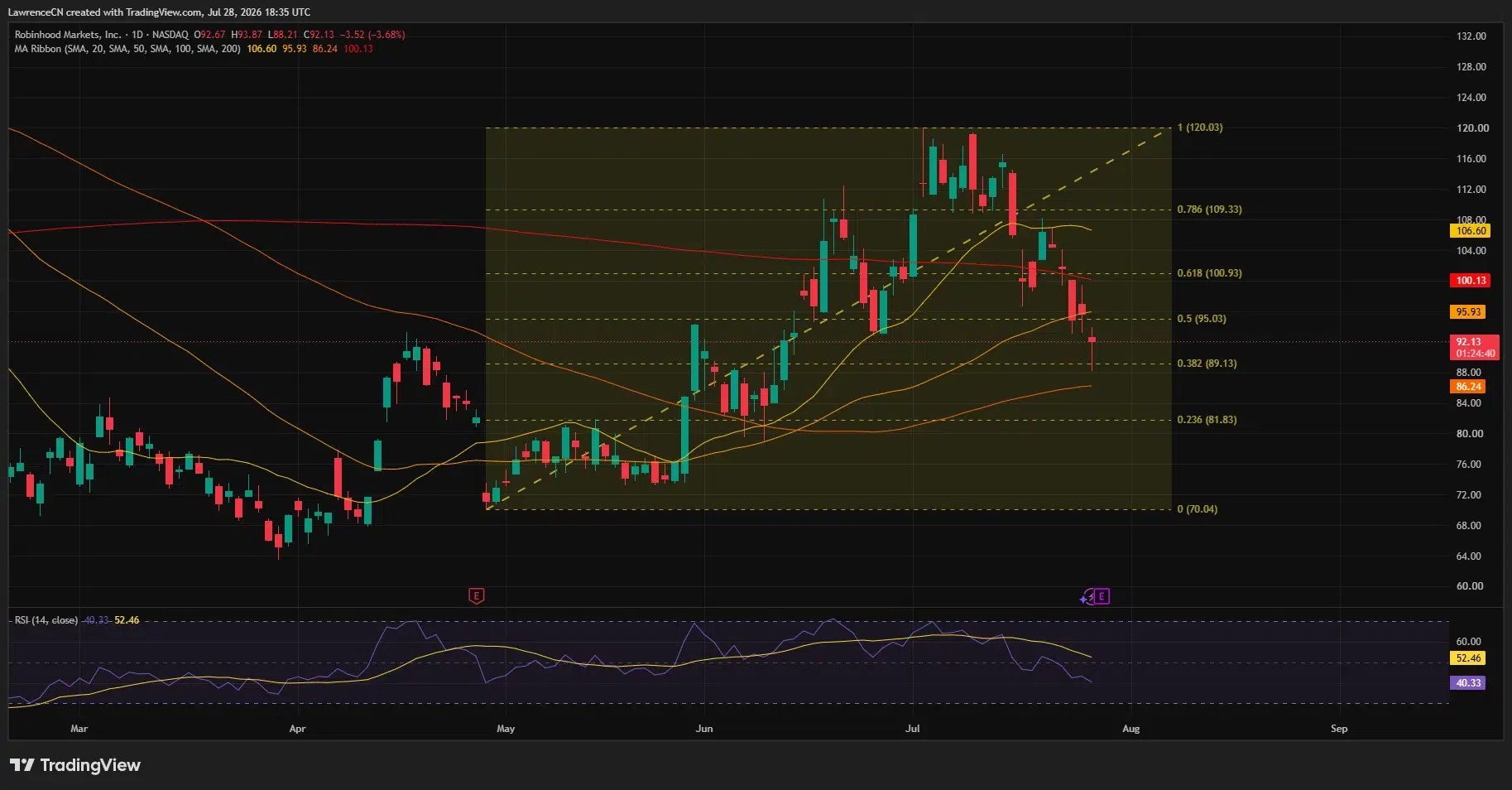
Price action has broken below an ascending trendline drawn from the late-April low. That breakdown weakens the uptrend that carried HOOD from approximately $70 to its July high near $120.
The daily relative strength index has dropped to 40.33, below its signal average of 52.46. A reading below 50 points to fading momentum, but HOOD has not yet reached the conventional oversold threshold of 30.
The chart supports the broader rounded-top risk identified after the stock repeatedly failed to hold its July gains. However, the pattern does not guarantee a fall toward the earlier $74 level. HOOD must first break through several intermediate support zones.
$89 and $86 are the next HOOD support levels
Immediate support sits at the 38.2% Fibonacci retracement level of $89.13. HOOD briefly fell below that price during the July 28 session but recovered above $92, showing that buyers remain active near $89.
A daily close below $89.13 could expose the 100-day moving average at $86.24. Below that level, the next major Fibonacci support stands at $81.83, corresponding to the 23.6% retracement of the April-to-July rally.
The bearish target near $74 would become more credible only if the stock loses both $86 and $81.83. That scenario would erase most of the gains recorded since late May.
On the upside, HOOD must first reclaim the $95.03-to-$95.93 range. A move above that zone would place the psychological $100 level and the 200-day moving average at $100.13 back in focus.
Further resistance sits at $109.33, followed by the July high around $120.03. An earnings beat paired with strong guidance could support a recovery, while another miss may increase pressure on the lower support levels.
Robinhood Chain growth contrasts with HOOD weakness
Token Terminal data shows that Robinhood Chain has become the largest blockchain by the number of tokenized-stock holders. The milestone comes less than a month after Robinhood unveiled the network.
DeFiLlama data places the chain’s total value locked at $334 million, making it the 15th-largest blockchain by that measure. That adoption has not prevented HOOD from falling since the network’s launch.
For US investors, the July 29 results may help separate Robinhood’s operating performance from broader concerns surrounding crypto regulation. Revenue growth, prediction-market activity and management’s outlook will determine whether the company’s expanding blockchain business can support its valuation.
Until then, $89 remains the key downside level, while a recovery above $96 would be the first sign that selling pressure is easing.
Disclosure: This article does not represent investment advice. The content and materials featured on this page are for educational purposes only.

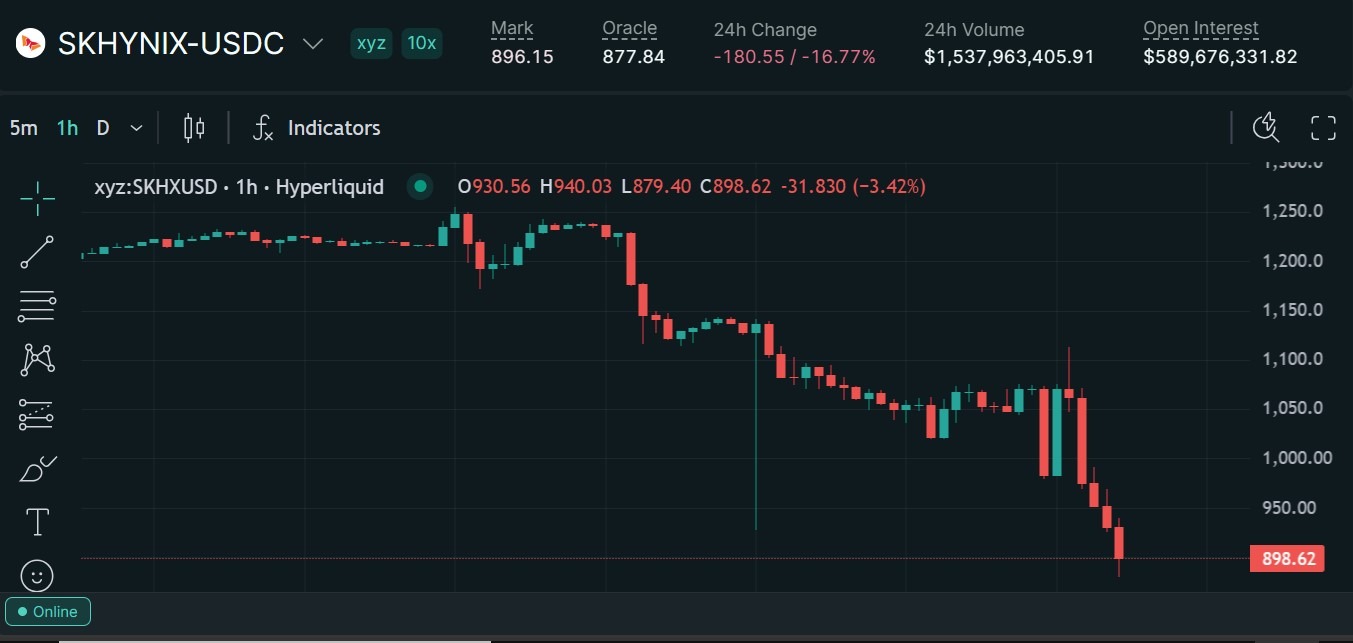
Trade.xyz, an operator of onchain perpetual markets on Hyperliquid, said it will cover eligible liquidation losses after a price anomaly hit its contract tracking SK Hynix, a South Korean chipmaker and producer of high-bandwidth memory for artificial intelligence.
Trade.xyz said the SKHYNIX contract’s mark price fell to $917.25 from $1,127.90 at 23:01 UTC on Monday after an executed trade was relayed by multiple independent data providers. Eligibility requirements will be announced soon, with distributions expected in the coming days.
The SK Hynix contract ranks among Hyperliquid’s most active markets. On Wednesday, Hyperliquid data showed the contract had generated over $1.5 billion in 24-hour volume and held nearly $600 million in open interest at the time of writing.
Trade.xyz said its oracle was tracking the external venue used as the primary South Korean pre-market and had “worked as intended according to its specification.” It acknowledged traders’ frustration and described the reimbursement as a “one-time discretionary decision,” adding that it would review how prices are formed during extreme market events.
The platform did not disclose how many traders would qualify for reimbursement or the total amount it expects to distribute.
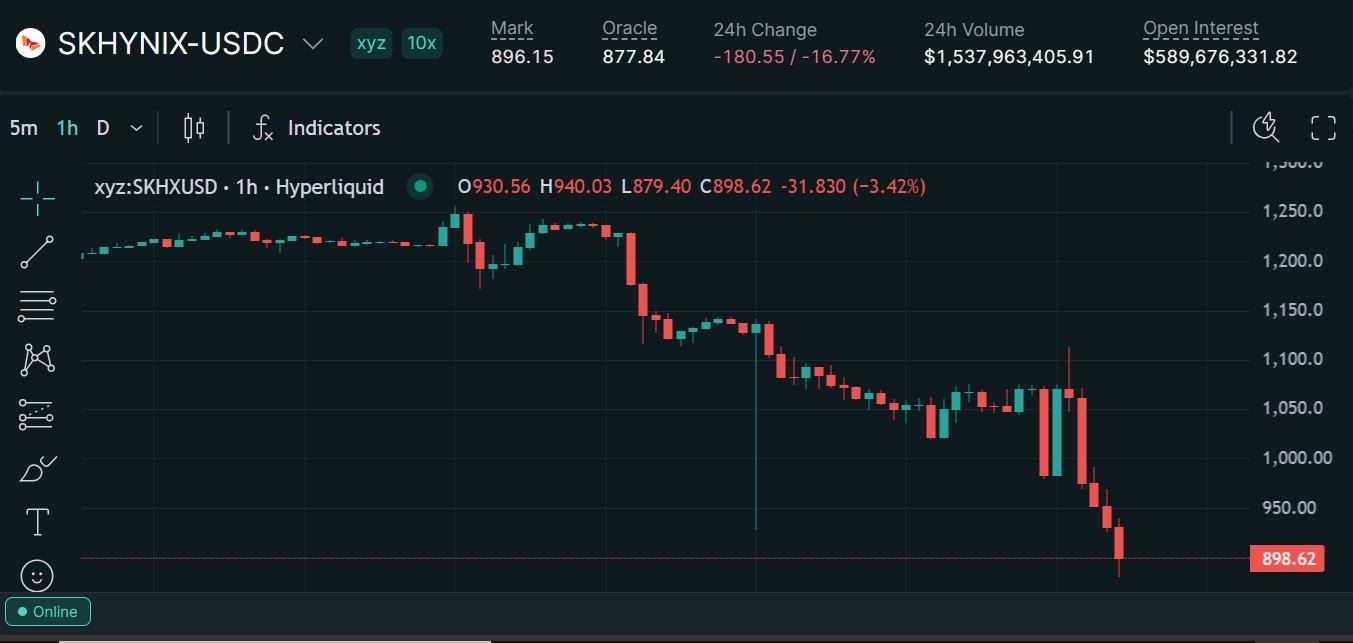
SK Hynix trading chart. Source: Hyperliquid
How the anomaly reached the perpetual market
Trade.xyz said the sharp move originated from an executed transaction on an external market rather than its own order book. Its SK Hynix oracle tracks the US dollar value of one SKHX common share by converting the underlying Korean won price using the prevailing exchange rate, according to its documentation.
The external print fed into the oracle and contributed to the contract’s mark-price move. Hyperliquid uses the mark price to value positions for margin purposes and determine when leveraged positions should be liquidated.
The platform said it is considering giving more weight to prices formed on its own order books, which it said now provide meaningful liquidity and market signals.
Related: Onchain commodity trading is here to stay, but liquidity remains an issue
Trade.xyz operates under Hyperliquid’s HIP-3 framework, which allows builders to launch perpetual contracts tied to assets with external price feeds.
The platform accounted for more than $22 billion of HIP-3’s first $25 billion in cumulative volume and later launched an officially licensed S&P 500 perpetual using S&P Dow Jones Indices data.
Magazine: How Hong Kong is turning tokenized bonds into real market infrastructure

Bitcoin dipped below $63,000 yesterday ahead of the FOMC meeting today but has recovered well over a grand since then.
Prominent analyst Joao Wedson identified on-chain data that suggests BTC is nearing a historically significant accumulation zone.
Long-Term Holders Take Control
In his latest tweet, Wedson explained that he divided the Long-Term Holder Realized Cap by the Short-Term Holder Realized Cap to track where the market’s realized capital is concentrated. According to the Alphractal founder, Bitcoin formed major price bottoms on two previous occasions when this ratio moved above 4. The metric currently stands at 3.9, which means the market is approaching that historically important threshold.
The reading indicates that a much larger share of realized capital is now held by Long-Term Holders than by Short-Term Holders, which demonstrates a shift toward investors with stronger conviction while short-term speculative participation remains relatively limited.
Wedson added that this type of market structure has previously emerged during “advanced” accumulation phases, when weaker hands exit, and ownership moves to long-term investors. Alphractal stated,
“It does not confirm that the exact bottom is already in. However, it shows that Bitcoin is approaching a zone that previously appeared during major cycle-bottom formations.”
A similar view was echoed by Santiment, which found that wallets holding between 10 and 10,000 BTC increased their stash by 19,696 during the eight-day period it tracked. Meanwhile, wallets with less than 0.01 BTC displayed weaker dip-buying activity. On the institutional front, Bitcoin ETFs recorded around $172 million in inflows in July. These factors, combined, make the overall setup “constructive” as supply continued shifting toward stronger hands, Santiment noted.
MVRV Differs From Past Cycles
All eyes are on Bitcoin’s current position in the market cycle. Trader Ardi said the asset’s MVRV ratio currently stands at 1.21, well above the levels seen at previous bear market lows of 0.69 in 2018 and 0.75 in 2022. The metric compares BTC’s market value with its realized value to show how far the price trades above or below the network’s aggregate cost basis.
Based on those historical levels, Ardi said that it has not reached the same degree of capitulation seen in the last two cycles. However, he added that volatility is compressing and cycle extremes are becoming less severe. Because of that, he believes MVRV could form a higher low during this cycle.
The post What Does Bitcoin’s 3.9 Holder Ratio Tell Us About the Market Right Now? appeared first on CryptoPotato.


Pascal Caversaccio joins the Ethereum Foundation’s four-member board as the organization elevates privacy and security in its protocol strategy.

Ten European financial institutions have formed a jointly owned blockchain cooperative called Regulated Layer One (RL1), aiming to provide shared infrastructure for tokenized assets and regulated market workflows. The initiative positions RL1 as a “permissioned” network built for institutional use rather than public, open participation.
RL1 announced that it has been established as a European Cooperative Society in Luxembourg and has started operations with founding members including ABN AMRO, Cecabank, Chartered Investment, Crédit Mutuel Alliance Fédérale, DekaBank, DZ BANK, LBBW, Natixis CIB, SC Ventures, and Seturion. The group says governance is structured so that each member holds equal decision-making rights over the network’s development and direction.
Key takeaways
- RL1 is launching as a European Cooperative Society in Luxembourg, bringing 10 founding financial institutions into a shared, permissioned blockchain network.
- The network is governed on an equal voting basis among members, with plans to expand participation to additional institutions.
- RL1 is built on infrastructure previously developed by German fintech Secure Worldwide Interbank Asset Transfer (SWIAT).
- SWIAT reported processing more than 50 transactions worth over €700 million during three years of production use.
- The cooperative targets regulated institutional use cases such as tokenized bonds, collateral, and settlement for digital money.
From SWIAT infrastructure to a member-owned cooperative
RL1’s launch centers on a shift in ownership from the previously developed SWIAT platform to the cooperative structure. According to RL1, SWIAT has transferred ownership of the network to the cooperative, effectively moving the project from a vendor-led or sponsor-led stage into a jointly controlled model.
That transition matters because institutional blockchain projects often struggle not only with technology, but also with long-term governance, shared standards, and accountability. By placing decision-making in a cooperative framework, RL1 is attempting to reduce the “single-rail” problem—where multiple institutions build or operate separate ledger systems that may not interoperate cleanly.
For its part, RL1 says the permissioned design is intended to fit regulated environments and institutional processes, rather than trying to replicate the accessibility and openness typical of public blockchain networks.
Reported production usage and the scope of institutional applications
RL1 says its underlying platform has already been used in production for three years. SWIAT reported that the system processed more than 50 transactions with a total value exceeding €700 million (about $808 million). While the report does not specify the exact nature of every transaction type, RL1 frames the technology around institutional patterns such as tokenized bonds, collateral, digital money, and blockchain-based settlement.
RL1 also argues that using a shared network could help address fragmentation across financial markets—especially where banks and other institutions deploy distinct distributed ledger systems. In practical terms, fewer separate ledgers can reduce duplicated development, simplify integration efforts, and potentially speed up cross-institution settlement experiments.
Still, investors and builders will likely want to watch whether RL1’s cooperative model translates into measurable interoperability advantages—such as smoother settlement across participating institutions—rather than remaining primarily a governance and pilot-coordination framework.
Governance, leadership, and expansion plans
Leadership for RL1 will be led by former SWIAT managing director Henning Vollbehr, with KfW and L-Bank continuing to provide support for the initiative. RL1 did not detail the precise structure of ongoing involvement from these backers, but their continued support signals that the project retains institutional and policy-level sponsorship beyond the initial founding members.
On expansion, RL1 said it is already in discussions with additional institutions, including NatWest, about joining the network. The cooperative’s equal decision-making rights among members may become a central factor in future growth: as more institutions join, governance will need to scale without diluting consensus or slowing development.
The network’s success will likely depend on attracting participants with complementary use cases—such as custody, issuance, market settlement, and collateral management—while ensuring that shared standards hold up as the number of stakeholders increases.
Why RL1’s cooperative model could matter for tokenized markets
Tokenization in traditional finance has progressed in bursts, often driven by pilots and consortia, but scaling remains difficult when participants operate on disconnected infrastructures. RL1’s emphasis on reducing fragmentation directly targets one of the sector’s recurring friction points.
At the same time, it’s important to recognize that RL1 is permissioned, meaning access and participation are restricted relative to public networks. That tradeoff can be beneficial for compliance and integration in regulated markets, but it also raises questions about interoperability with other ledgers and token ecosystems—particularly if tokenized assets are expected to move across platforms over time.
For market participants, the key watch item is whether RL1 evolves from “shared infrastructure” into a platform with demonstrable deployment outcomes—such as repeatable settlement flows, standardized token mechanics, and smoother inter-institution operations—rather than limited transaction counts typical of early-stage pilots.
As RL1 begins operations in Luxembourg, the next signals to monitor will be how quickly additional institutions join, what concrete tokenization and settlement workflows are prioritized, and whether the cooperative’s shared governance model leads to faster, more scalable execution compared with earlier, siloed distributed ledger efforts.

XRP price is trading around $1.09, up about 3% over the past 24 hours, as a regulatory catalyst from Hong Kong gives traders a fresh prediction that defends the dollar level. The bounce is real, although whether it continues depends on follow-through buying.
OSL HK, Hong Kong’s first licensed retail crypto exchange, confirmed through its official channels that retail users can now trade XRP against the U.S. dollar on its Flash Trade platform. OTC trading is also available through XRP/USD and XRP/HKD pairs. That puts XRP alongside BTC, ETH, and SOL among the few assets approved for retail trading on the licensed venue.
The wait is over! XRP is now LIVE for retail investors on OSL HK. Whether you're using Flash Trade or OTC, we’ve got you covered with secure, lightning-fast execution. — OSL (@osldotcom) July 29, 2026
Read the details below and start trading right now! https://t.co/iPTbsl6j2N
The approval carries more than symbolic value. Hong Kong’s regulatory framework supports compliant digital asset trading and could attract fresh institutional and retail participation. That gives XRP greater visibility in one of Asia’s leading financial centers and may strengthen demand over time.
Even so, traders are still waiting for stronger confirmation before pushing prices higher. XRP has held near $1.09 despite the positive catalyst, showing buyers are defending support while watching for the next catalyst. For now, the Hong Kong listing improves XRP’s regulatory standing, but sustained gains will still depend on continued buying pressure.
Discover: The Best Crypto to Diversify Your Portfolio
XRP Price Prediction: Reclaim $1.15 After the Hong Kong Catalyst?
XRP is trading around $1.09, with a 24-hour range of roughly $1.06 to $1.09. That fits the current technical picture. The lower boundary near $1.06 continues to attract buyers, while the $1.09 area remains the first resistance traders need to clear.
Three scenarios remain in play. In the bullish case, buying follows the Hong Kong retail listing, XRP closes above $1.09, and momentum extends toward $1.15 to $1.18. The base case sees XRP consolidating between $1.06 and $1.09 as traders digest the catalyst without a decisive breakout.

The bearish case appears if crypto markets lose momentum and XRP falls below $1.06. That would weaken the recent rebound and bring the $1.03 support area back into focus. Even so, buyers have defended the lower end of the range during recent pullbacks.
The OSL listing is a genuine demand-side catalyst. More trading access creates more opportunities for retail participation and potential buying activity. It does not guarantee a breakout, but it strengthens XRP’s long-term market structure. After several days of consolidation, a regulated retail listing in Hong Kong could provide the spark that traders have been waiting for. Watch the $1.09 level closely.
Trade XRP on Bybit and Get a Chance to Win Our $1,000 USDT Airdrop
Bitcoin Hyper Targets Early-Mover Upside as XRP Tests Key Levels
XRP at $1.09 is a recovery, not a revelation. Even a clean break to $1.18 represents just 8% upside from current levels. It’s respectable, but capped by the weight of a 62.47 billion token circulating supply and a market cap already deep in the tens of billions.
For traders eyeing asymmetric early-stage exposure while XRP sorts out its range, Bitcoin Hyper is attracting serious attention in the presale market. Hyper is positioning itself as the first Bitcoin Layer 2 with full Solana Virtual Machine (SVM) integration, sub-second smart contract execution on top of Bitcoin’s security model, without sacrificing BTC’s trust layer.
The presale has raised just a nod below $33 million at a current token price of $0.0136838, with high-APY staking available to early participants. The core thesis is straightforward: Bitcoin’s programmability ceiling is a known constraint, and any infrastructure that credibly removes it. It has fast execution, low fees, a decentralized canonical bridge for BTC transfers that captures value from both the BTC ecosystem and the broader DeFi migration.
Research Bitcoin Hyper’s full terms before committing capital.
Discover: The Best Token Presales
The post XRP Price Bounces as Hong Kong Pushes Ripple Retail Trading appeared first on Cryptonews.
Crypto World
Senators said to strike idea to toughen Trump’s concession on Clarity Act’s crypto limits
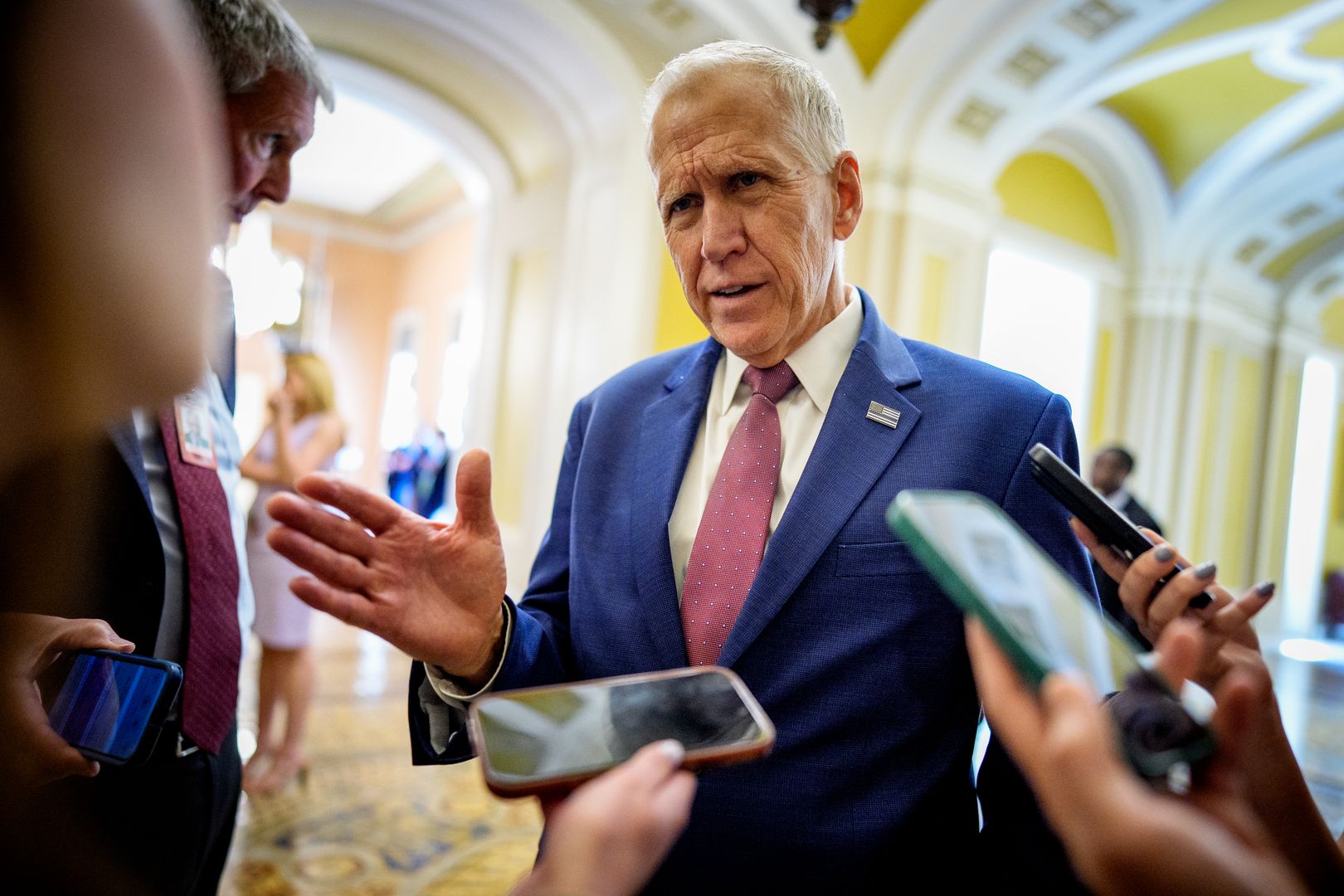
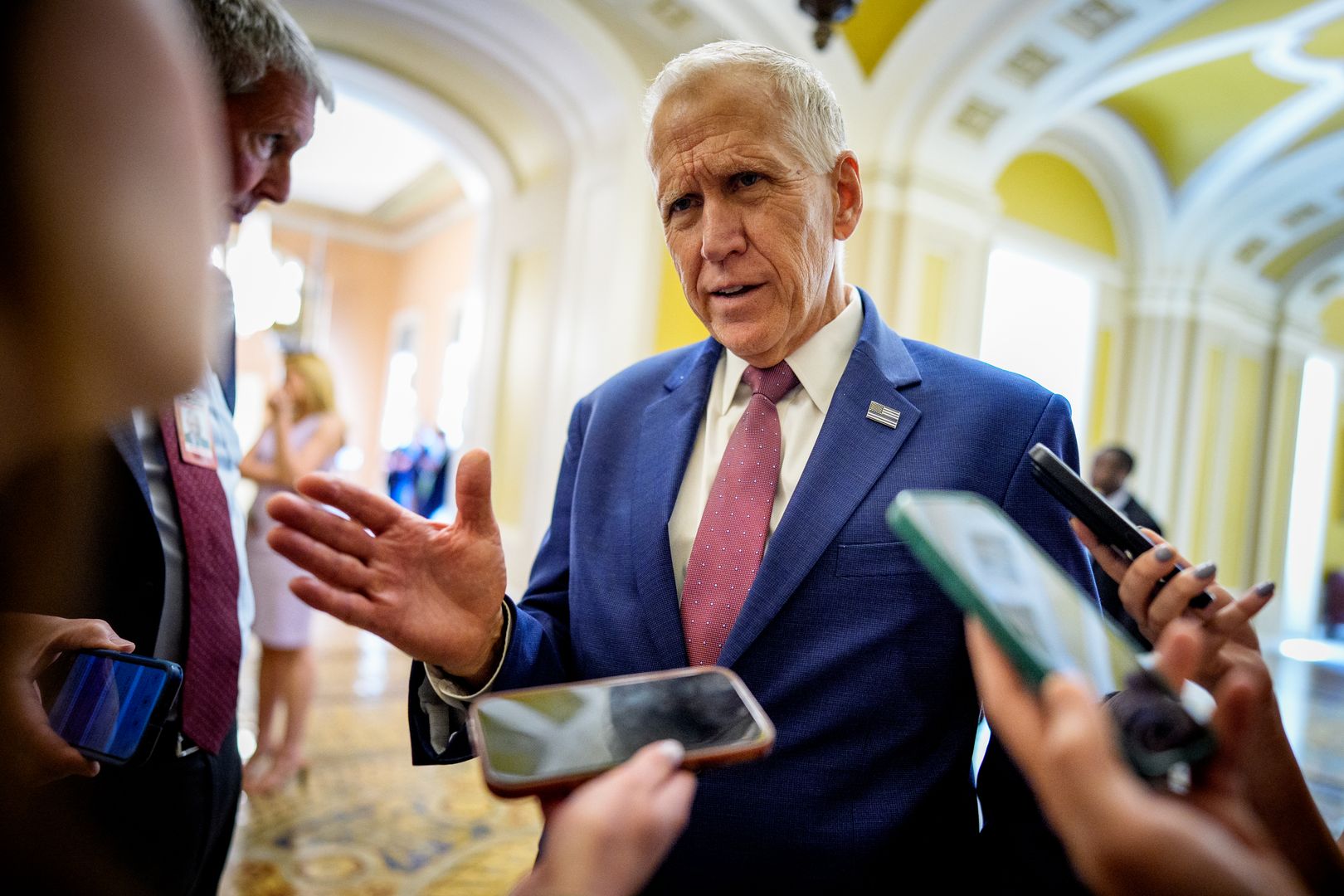
There are two timelines at war, now. First, the Senate’s own calendar is famously difficult to negotiate, with any contentious bill requiring days of floor time. Each passing hour narrows the legislation’s odds as just seven days remain before the recess, when senators will leave Washington and largely shift focus to the consequential midterm elections bearing down on them.
The other time crunch has been the clock ticking on the negotiating table, where the two parties and the White House are still working to round up the necessary 60 votes. Their final effort must win over a lot of resistant Democrats and a few reluctant Republicans.
Crypto lobbyists are fervently hoping that negotiators — especially Tillis and Gallego — can find a workable middle ground, circulate the refurbished bill again and watch it advance through the Senate voting process. At this point, Senate Majority Leader John Thune’s prediction remains sturdy: The bill almost certainly doesn’t have enough time to finish the Senate’s multi-stage process before the break.
But if it were to get started and potentially clear an initial 60-vote hurdle before next week is out, that could be enough to get it on a winning path. To give that possibility its best chance, the industry would want to see Thune roll out the first motion before the end of the week on what’s called “cloture,” the procedure that sets a bill up for votes.
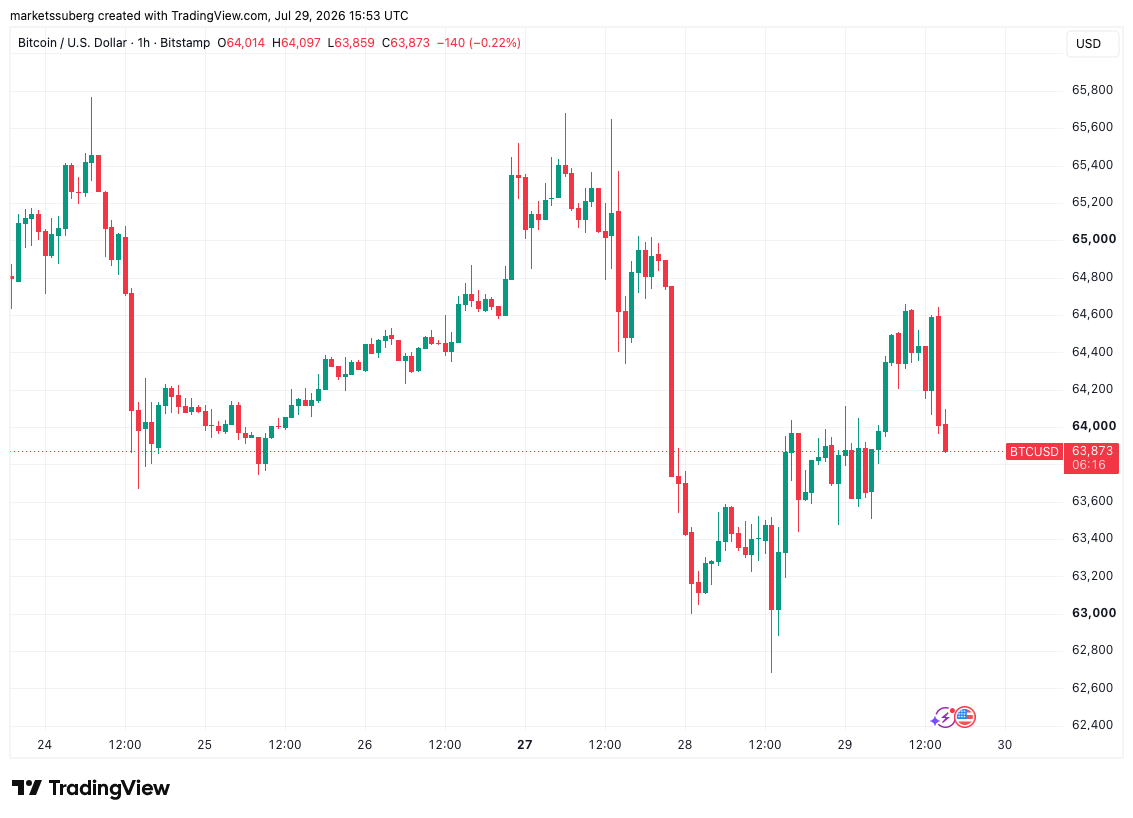
Bitcoin (BTC) whipsawed around $64,000 on Wednesday as geopolitical and macroeconomic tensions pressured US stocks.
Key points:
- Bitcoin constricts near $64,000 as traders contend with multiple macro headwinds.
- Downside in Asian stocks continues to spill over into US markets.
- The US Federal Reserve prepares to release its next interest-rate decision, a potential risk-asset volatility catalyst.
Risk-asset hurdles pile up ahead of FOMC meeting
Data from TradingView showed BTC/USD halting a local rebound at the Wall Street open, having hit 11-day lows of $62,700 the day prior.
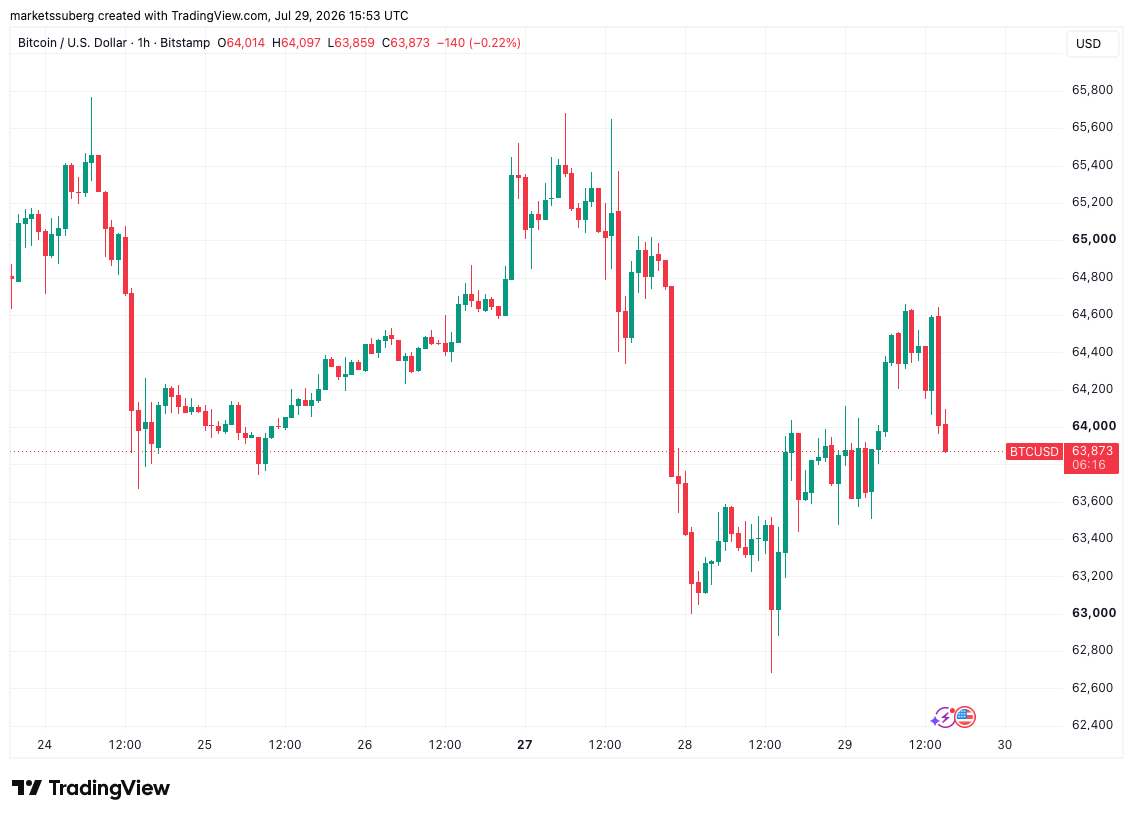
BTC/USD one-hour chart. Source: Cointelegraph/TradingView
These came as part of a risk-asset rout by a selloff in Asian chip-stocks. This trend continued on Wednesday as markets showed increasing concern over the debt obligations by semiconductor and AI giants.
Renewed nerves over escalation in the US-Iran war added to the headwinds, with US President Donald Trump threatening a “beating” as tit-for-tat strikes continued.
“We’ll be hitting them hard. They’re going to get a beating,” he said in an interview with Fox News.
Oil prices snapped higher as a result, with WTI and Brent crude up 7.6% and 5.4%, respectively. Oil-price hikes could significantly impact trends in the Consumer Price Index (CPI), with inflation concerns having a knock-on effect on interest-rate expectations.
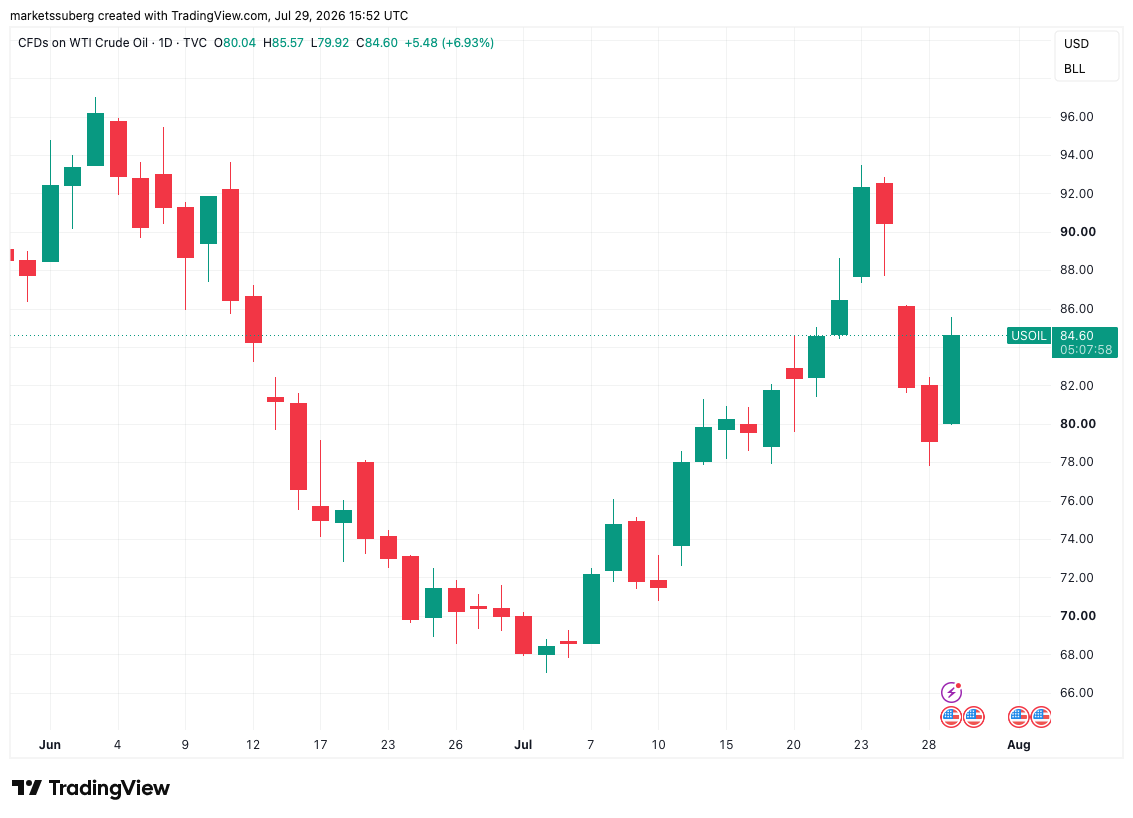
CFDs on US WTI crude oil one-day chart. Source: Cointelegraph/TradingView
Markets are awaiting the result of the Federal Reserve’s latest decision on the federal funds rate. The July meeting of the Federal Open Market Committee (FOMC) will include a statement and press conference by Fed Chair, Kevin Warsh. Though Warsh has given less guidance than his predecessor, traders will watch for cues to future policy shifts.
Commenting, trading resource The Kobeissi Letter noted split opinions as to the Fed’s move on rates. The latest data from CME Group’s FedWatch Tool showed 66.3% odds of current levels of 3.5%-3.75% remaining in place, with a 0.25% hike attracting 33.7%.
“Market expectations for tomorrow’s Fed decision are among the most divided in recent history,” it wrote.
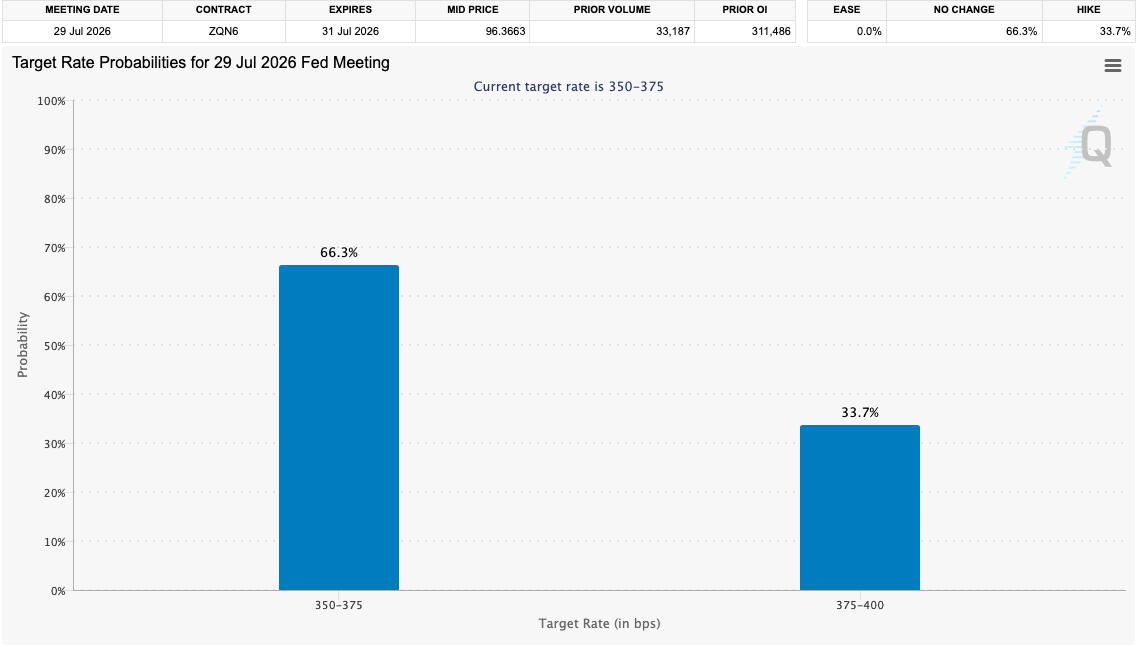
Fed target-rate expectations for July 29 FOMC meeting (screenshot). Source: CME Group
Bitcoin price caught between daily moving averages
Ahead of fresh macro catalysts, BTC price action acted broadly within a range bounded by its 50-day simple (SMA) and exponential (EMA) moving averages.
Related: Markets eye Bank of Japan meeting on Friday as yen repeats 40-year US dollar lows
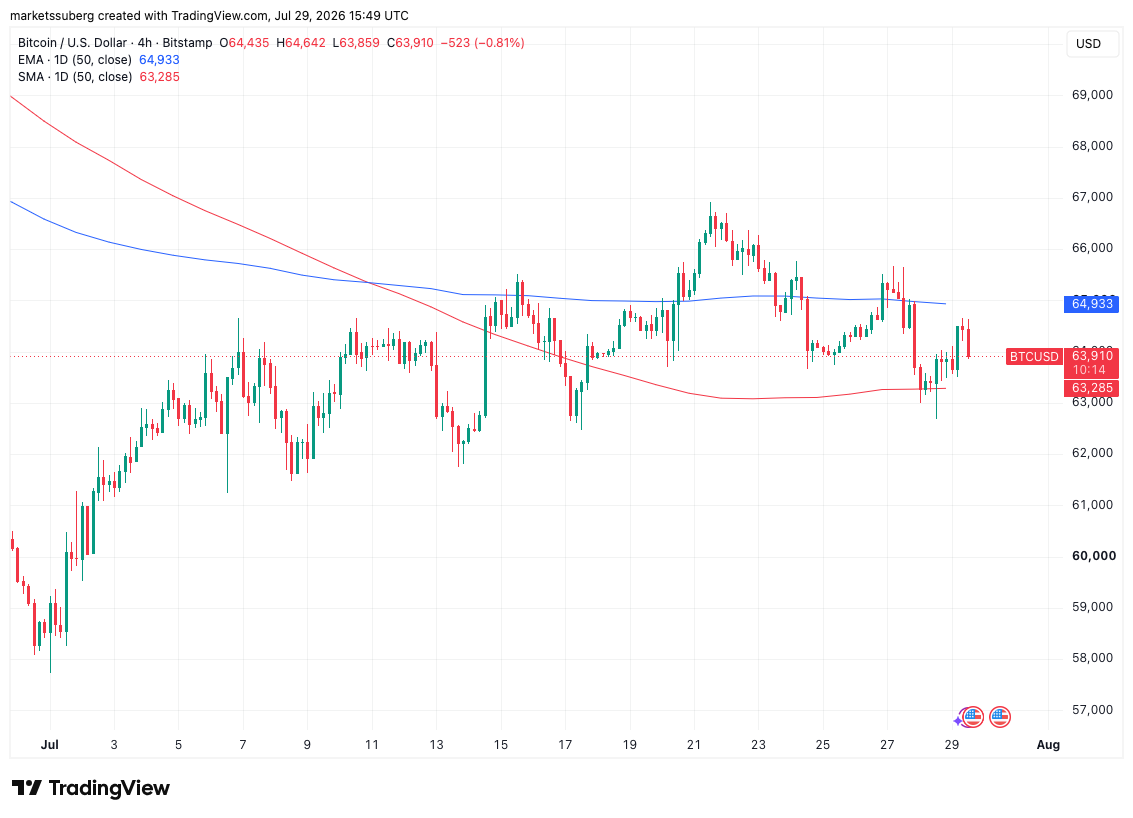
BTC/USD four-hour chart with 21-day, 50-day EMA. Source: Cointelegraph/TradingView
This range had begun in mid-July, with failed breakouts taking advantage of liquidity zones on either side.
The latest data from CoinGlass showed potential liquidations building on either side of the current range, with clusters at $63,500 and $64,900.
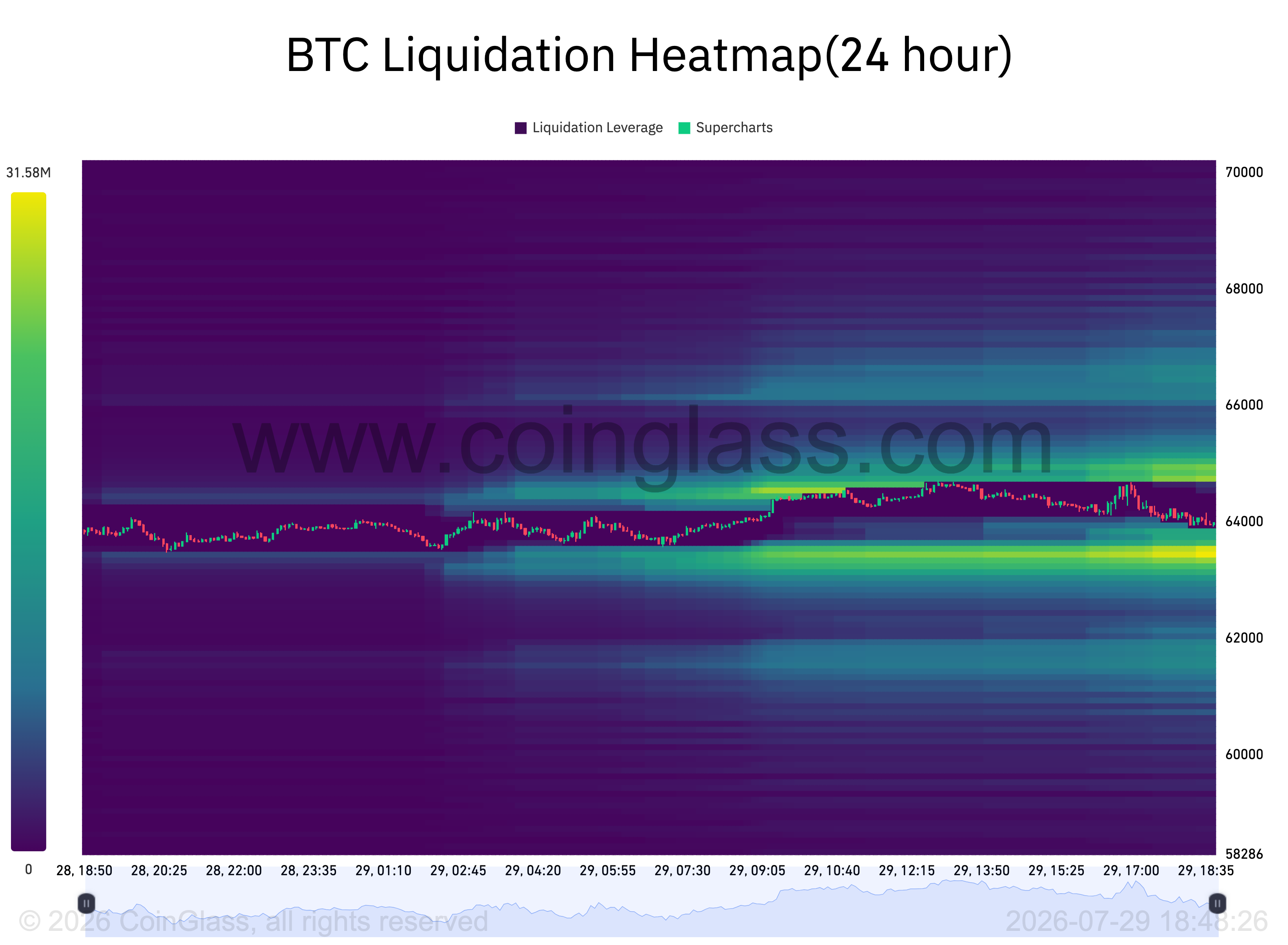
BTC liquidation heatmap. Source: CoinGlass
Trading volumes, however, remained conspicuously low, with spot-market volume at its lowest levels since July 2023.
“CME open interest remains near multi-year lows, perpetual futures open interest has stalled around 300,000 BTC, and average daily spot volume came in at just $2.2 billion for the month,” crypto analytics company K33 Research added in a bulletin on Tuesday.
Retail investor interest in both Bitcoin and the broader crypto market has been in decline since the latter’s October 2025 all-time highs. AI stocks have formed a major destination for the investor pivot.

The American Arbitration Association (AAA), one of the largest providers of private dispute resolution services worldwide, has introduced a specialist panel tailored to blockchain and digital-asset disputes. The initiative is aimed at helping companies resolve disagreements that increasingly arise from automated and decentralized commercial systems, where both legal interpretation and technical detail matter.
In a statement released on Wednesday, the AAA said its new Web3 Panel brings together arbitrators with backgrounds spanning law, technology, academia, litigation, and digital-asset businesses. The move reflects growing demand for dispute resolution frameworks that can handle the intricacies of smart contracts, on-chain records, and cross-border enforcement.
Key takeaways
- The AAA has launched a dedicated Web3 Panel for blockchain and digital-asset arbitration cases.
- The panel targets disputes linked to automated and decentralized commercial arrangements, including contract interpretation and governance disagreements.
- Arbitrators are drawn from a mix of legal, technical, academic, and industry backgrounds to address complex crypto-specific issues.
- The AAA panel is not a regulator: arbitration still depends on the parties agreeing to submit their dispute privately.
Why a specialist arbitration panel is gaining attention
As blockchain-based systems move from experimental use toward everyday commercial activity, the types of disputes companies face have also changed. The AAA describes the panel as designed for disagreements that emerge when agreements are executed through automated or decentralized processes rather than conventional workflows.
Those disputes can involve interpretation of contractual terms, how governance mechanisms should be applied, and questions around asset control. They may also touch cybersecurity incidents, the reliability or meaning of transaction records, and enforcement challenges when parties and assets are located across different jurisdictions.
For investors and operators, the practical importance is straightforward: when the legal stakes include technical behavior that is difficult for a typical court process to interpret quickly, specialized arbitration can reduce friction. It can also help standardize expectations around how evidence—such as on-chain logs—should be understood and applied to the facts of a commercial disagreement.
What kinds of disputes the AAA says the panel will handle
The AAA’s Web3 Panel is positioned to cover a wide range of issues that appear in modern crypto-adjacent contracting and operations. According to the AAA, the scope includes disputes connected to:
- Contract interpretation in highly automated environments, where “what the code does” can be central to the dispute.
- Governance and control questions, including disagreements about how decentralized mechanisms should function.
- Cybersecurity and incident-related failures, which may require both legal assessment and technical understanding.
- Transaction records, where parties may dispute what is recorded on-chain and how that record should be treated.
- Cross-border enforcement, where outcomes may depend on how arbitral awards are recognized and enforced in different countries.
The AAA also highlights a category of emerging commercial behavior it calls “agentic commerce,” where software or artificial intelligence systems may initiate or execute agreements with limited human involvement. As such systems gain capability, the legal questions often shift from standard performance disputes to issues like authorization, responsibility, and how obligations were formed when execution happens with minimal direct human participation.
This focus matters because it signals arbitration providers are preparing for a legal environment where counterparties may be dealing less with traditional “human-to-human” contracting and more with systems acting as participants—raising new questions for risk, documentation, and accountability.
Panel composition and the “technical plus legal” pitch
In outlining the rationale for the panel, the AAA pointed to the unusual combination of legal and technical factors in Web3 disputes. Eric Dill, the AAA’s senior vice president and head of panel relations, said: “Web3 disputes involve familiar commercial questions in a highly technical environment.”
The initial membership includes lawyers specializing in digital-asset and technology disputes, University of Pennsylvania law professor David Hoffman, and Rich Widmann, Google Cloud’s global head of Web3 strategy. The AAA said the panel brings together arbitrators with experience across multiple relevant domains, including academia and litigation, rather than limiting expertise to strictly legal or purely technical backgrounds.
For companies considering arbitration clauses in their contracts, this kind of mixed expertise can be a differentiator. Arbitration outcomes often hinge on how accurately decision-makers can interpret technical evidence and translate it into enforceable legal findings. A panel intended to include that dual competency may be attractive for parties that want more than generic commercial arbitration—especially in disputes where blockchain mechanics and smart-contract behavior are central to the timeline and the facts.
No regulatory power—arbitration still requires party consent
Despite the mainstream profile of the AAA and the breadth of the panel’s scope, the organization’s Web3 Panel does not change the regulatory landscape for crypto. The AAA panel does not grant it authority over the crypto industry, and arbitration generally operates only if both parties agree to submit their dispute to a private arbitrator.
This distinction is important for anyone evaluating the significance of the announcement. The AAA is building procedural and expertise infrastructure, not a new regulator. The practical takeaway is that organizations planning for disputes may increasingly look to arbitration frameworks that anticipate Web3-specific complexities—by adding arbitration clauses that reference appropriate panel structures, or by selecting arbitrators with relevant experience once a dispute arises.
Earlier coverage from Cointelegraph has explored how agentic commerce is pushing the need for a “legal layer” around autonomous transactions, and the AAA’s emphasis on agentic commerce aligns with that broader trend: as automation becomes more capable, dispute-resolution processes may need to evolve in parallel.
What to watch next
With the AAA’s Web3 Panel now live, the key question is how quickly companies incorporate specialist arbitration into real-world contracts—and how frequently parties select this panel for disputes. Observers should also watch whether the panel’s early cases, once they emerge through arbitration processes, reflect the types of conflicts the AAA highlighted: governance, cybersecurity, on-chain records, and authorization in agentic systems.


The American Arbitration Association (AAA), one of the world’s largest providers of private dispute-resolution services, has launched a specialist panel for blockchain and digital-asset cases, giving companies access to arbitrators with expertise in the technical and legal complexities of crypto disputes.
On Wednesday, the AAA said that its new Web3 Panel brings together arbitrators with experience across law, technology, academia, litigation and digital-asset businesses.
The panel is designed to address disputes arising from increasingly automated and decentralized commercial systems, including disagreements over contract interpretation, governance, asset control, cybersecurity, transaction records and cross-border enforcement.
The move signals that mainstream legal institutions are building specialist infrastructure to handle the increasingly complex disputes emerging as blockchain and automated transactions enter commercial use.
“Web3 disputes involve familiar commercial questions in a highly technical environment,” said Eric Dill, the AAA’s senior vice president and head of panel relations.
Initial members include lawyers specializing in digital-asset and technology disputes, University of Pennsylvania law professor David Hoffman and Rich Widmann, Google Cloud’s global head of Web3 strategy.
The panel also covers disputes involving agentic commerce and autonomous transactions, where software or artificial intelligence systems may initiate or execute agreements with limited human involvement.
The panel does not give the AAA regulatory authority over the crypto industry. Arbitration generally requires the parties involved to agree to submit their dispute to a private arbitrator.
Related: US arbitration giant rolls out ‘legal layer’ for agentic commerce

Disclosure: This article does not represent investment advice. The content and materials featured on this page are for educational purposes only.
Amid crypto market uncertainty, Long DeFi highlights AI-driven analytics and automated strategies to help users navigate BTC and XRP market volatility.
Summary
- Long DeFi promotes AI-powered cloud mining, highlighting automated hashrate management and daily crypto reward settlements.
- Long DeFi expands its AI-driven cloud mining platform with automated contracts, renewable energy, and multi-crypto support.
- The AI-powered cloud mining platform highlights automated mining services and renewable energy infrastructure for investors.
Amidst the impact of inflation, major cryptocurrencies like BTC and XRP have been sluggish recently. Countless investors have watched their assets shrink, feeling utterly lost.
However, crisis often presents an opportunity! Long DeFi, leveraging its top-tier AI-powered precise computing power, through intelligent network-wide judgment and multi-dimensional analysis, provided real-time, accurate advice before the storm hit: hold (hashrate hedging) or sell (high-point hedging). This successfully helped users worldwide lock in funds and recover immeasurable wealth losses.

Founded in 2020 and headquartered in the UK, Long DeFi operates 150 data centers globally, serving nearly 5 million registered users in 180 countries and regions.
In 2026, the platform completely redefined how digital assets are acquired, making mining incredibly simple, sparking a global investor frenzy!
Achieve financial freedom with just 3 steps to start a smart mining contract:
- Click “Register Now” (Receive a $17 USD starter bonus upon registration; no service/management fees)
- Choose a smart mining contract that fits a particular budget and instantly start passive income!
Green New Energy Profits: Long DeFi’s over 100 top-tier global mining farms are all located in regions with abundant solar and wind resources, powered by 100% solar and wind energy. This not only reduces mining costs to near zero but also allows for grid connection of surplus electricity to generate secondary income, maximizing the potential for every investment!
- Military-Grade Security: Impeccable fund security behind the stable operation of tens of thousands of professional devices worldwide is the dual military-grade security protection of McAfee and Cloudflare, coupled with 24/7 customer service, ensuring a worry-free journey to wealth!
- Blockbuster Wealth Creation Plan: Real, rapidly growing digital value in the account! Long DeFi doesn’t just offer empty promises; digital wealth grows exponentially every day. The platform supports settlement in multiple mainstream cryptocurrencies, including BTC, ETH, XRP, SOL, and USDT. All earnings are settled daily, and funds can be withdrawn to a personal wallet anytime once they reach $100! Users can either secure their profits or leverage compound interest for exponential wealth growth!
Mining contract options
Beginner Experience (Starting Point): Invest just $100, and after a 2-day contract, the principal is fully refunded, netting $8!
Steady Progression (Mainstream Choice): Invest $500 and reap a pure profit of $31.25 in just 5 days!
Accelerated Growth (Wealth Driving Force): Invest $3000, lock in a 17-day contract, and earn an additional $698.70 in passive income!
Wealth Upgrade (Elite Exclusive): Invest $10,000 and earn passively for 35 days. $5,530 Super Return!
Supreme Strategy (Capital Frenzy): Invest $50,000, and after 40 days, accumulate a net profit of $34,200!
Zero-Cost Transformation: The craziest zero-cost profit opportunity on the entire internet in 2026! Even if someone doesn’t want to invest a single penny today, Long DeFi still opens up a golden channel to make a fortune every day!
Simply share an exclusive link: Unconditionally receive up to 5% cash referral commission for every friend who registers and participates! Reaching team activity user milestones will unlock a one-time super cash prize of up to $50,000! The more people are invited, the more the user earn, with no upper limit!
The frenzy is counting down; don’t let wealth slip away
The bull market window in the crypto market never waits for anyone; wealth always belongs to those who are prescient and decisive. When XRP’s big rally is poised to take off, when Long DeFi. All technical and capital barriers have been cleared. The only thing separating anyone from financial freedom is the decision to start!
From $100 to tens of thousands of dollars, it’s not a myth, but the absolute inevitability of choosing the right path, timing moves perfectly, and reaping steady rewards! Take action now and start the wealth-creating miracle!
For more information, visit the official website.
Disclosure: This content is provided by a third party. Neither crypto.news nor the author of this article endorses any product mentioned on this page. Users should conduct their own research before taking any action related to the company.

Andy Burnham ‘told Donald Trump he will open up North Sea oil’ during phone call

Lidl recalls cookies over undeclared allergens in 9 states

Trade.xyz to Reimburse SK Hynix Perp Traders After Price Anomaly


-

 Fashion5 days ago
Weekend Open Thread: Brooks Brothers
-
 Sports3 days ago
Commonwealth Games boxing: Jadumani Singh seals dominant 5-0 win over Pakistan’s Sumama Rehman to enter quarter-finals | Commonwealth Games News
-

 Tech3 days ago
Intel is reversing course and bringing hyper-threading back to its server chips
-

 Business5 hours ago
Why Trees Belong on the Risk Register
-

 Politics3 days ago
Luke Littler dismantles Gerwyn Price to retain title in Blackpool
-

 Crypto World4 days ago
Ripple bought a bank in pieces. The $4 billion audit
-
 Entertainment6 days ago
A New Post-Apocalyptic Gundam Anime Series Blasts Into SDCC
-

 News Videos3 days ago
BITCOIN JUST ENTERED THIS CRITICAL ZONE…
-

 Politics2 days ago
The Part of the Electric Transition Nobody Wants to Discuss
-

 Sports6 days ago
2026 3M Open leaderboard: Scottie Scheffler finds putter in Round 1, sits three back
-

 Fashion6 days ago
16 Dresses for the High Summer Event
-

 News Videos6 days ago
The Peugeot Family: How 200 Years of an “Old Money” Dynasty Died in A Boardroom
-

 Business21 hours ago
Major shareholder moves on Canyon
-

 Crypto World4 days ago
XRP Ledger adds $2.6B as RWA inflows rank second
-

 Politics4 days ago
Spain sweeps the board at 2026 World Cup with individual awards
-

 Crypto World6 days ago
Uniswap (UNI) pushes deeper into tokenized RWAs with permissioned trading pools
-
 Entertainment1 day ago
‘Stargate’ Creator’s New Sci-Fi Series Returns for Season 3 Tomorrow
-
Crypto World7 days ago
SEC Agrees to Overhaul Recordkeeping After Settling Coinbase Lawsuit Over Gensler’s Lost Texts
-

 Tech5 days ago
Anthropic launches Claude Opus 5, a cheaper AI model for coding, agents and enterprise workflows
-

 Entertainment4 days ago
Sara Gilson Killed By Husband After Viral “Pedophile” TikTok Video
You must be logged in to post a comment Login