
Crypto World
Scammers Hit Strait of Hormuz Ships With Crypto Demands

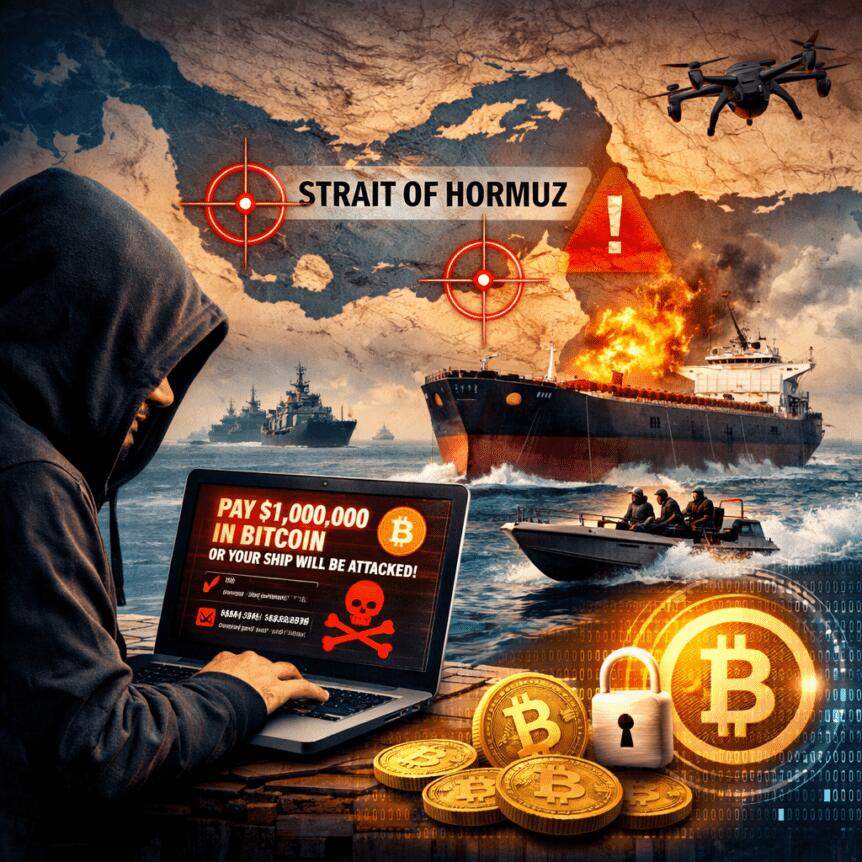
Fraudsters posing as Iranian authorities have targeted shipping firms with crypto-based demands to secure passage through the Strait of Hormuz, according to maritime risk outfit Marisks.
Marisks said unknown groups contacted shipowners claiming to represent Iran’s security services and demanded payment in Bitcoin or USD Tether in exchange for transit clearance, after requesting verification documents first. Reuters reported on the scam messages, noting they did not originate from Iranian authorities; Tehran has not publicly commented.
The warnings come as the Strait of Hormuz remains largely closed amid regional hostilities. The strait, a critical conduit for global energy shipments, previously handled roughly one-fifth of the world’s oil and LNG before the latest flareups. Earlier this month, Cointelegraph reported that Iran was considering tolls payable in BTC for ships passing through Hormuz, with empty tankers allowed free passage while others could be charged about $1 per barrel of oil.
Key takeaways
- Marisks warns that scams impersonating Iranian security services are soliciting crypto payments (BTC or USDT) for Hormuz transit, accompanied by requests for verification documents.
- The messages are not sourced from official Iranian authorities, according to Marisks and Reuters; Tehran has not publicly commented on the claims.
- The Strait of Hormuz remains largely closed amid Middle East hostilities, underscoring the vulnerability of global energy flows at this chokepoint.
- Sanctions risk looms large: payments tied to Iranian waterways could be treated as material support, with potential violations of US and international sanctions.
- This episode highlights the broader debate about crypto’s role in sanctioned regimes and the regulatory risks for shipping and crypto actors alike.
Crypto tolls, scams and the geopolitics of Hormuz
The messages described by Marisks present a classic manipulation: a supposed security clearance tied to a crypto payment, followed by a claim that transit will be allowed at a pre-arranged time once verification steps are completed. In at least one cited instance, the channel suggested Iranian security services would assess eligibility before determining the crypto payment in BTC or USDt. Marisks noted that a vessel recently targeted by gunfire while attempting to exit the strait may have received such instructions, though this has not been independently verified. Cointelegraph reached out to Marisks for comment but did not receive an immediate reply.
The episode arrives against a backdrop of wider geopolitical tension around Hormuz. Al Jazeera reported the Strait’s continued closures amid the conflict, a development that raises the stakes for insurers, operators and lenders who rely on predictable access to global energy markets. The strategic chokepoint remains a focal point for policy and risk assessment as regional dynamics evolve.
In earlier reporting, Iran was described as weighing crypto-based tolls to monetize navigation through Hormuz—an approach that would tilt the balance between open sea lanes and sanctioned finance. Cointelegraph’s coverage noted debates over BTC and USDt as potential toll instruments, reflecting a broader conversation about crypto’s utility in sanctioned economies and the practical risks for those who accept crypto payments under duress or misrepresentation. See the prior analysis on Iran’s crypto toll discussions for additional context.
Sanctions risk and what it means for operators
Beyond operational risk, industry analysts warn of serious compliance implications. Chainalysis senior intelligence analyst Kaitlin Martin told Cointelegraph that any payments tied to Iranian-controlled waterways could constitute “material support,” potentially violating US and international sanctions targeting entities linked to the Islamic Revolutionary Guard Corps. The warning underscores that crypto payments conditioned on access to strategic corridors can create exposure well beyond the immediate toll itself.
These developments sit at the intersection of geopolitical maneuvering and evolving crypto policy. Iran’s interest in leveraging digital currencies for energy transit has been debated in crypto policy circles, with discussions weighing potential benefits against the entrenched sanctions regime. For readers seeking deeper background, coverage exploring Iran’s BTC and USDt toll dynamics remains a pertinent companion piece.
As authorities surveil illicit use of crypto in restricted corridors, shipowners, operators and their counterparties will be watching for official guidance on sanctions enforcement and any regulatory clarifications related to crypto-enabled tolls. The risk environment around Hormuz—already shaped by conflict, insurance considerations and the reliability of communications—adds another layer of complexity for the global maritime and crypto communities.
Watch for formal statements from regulatory bodies and industry associations as this situation unfolds. The next steps will likely hinge on how sanctions enforcement perspectives evolve and whether crypto-based toll proposals advance or recede amid ongoing geopolitical tensions.

The UK Treasury wants stablecoins and tokenized deposits regulated like payment services, backing the push with new rules, BoE coordination and £1m for fintech pilots.
Summary
- The UK Treasury plans a single framework covering stablecoins, tokenized deposits, and traditional payment services.
- Stablecoins used for payments will sit under a new issuance and payments regime aligned with Bank of England and FCA oversight.
- The government is earmarking £1 million to support fintech innovation in regulated digital payment assets.
The UK Treasury used London Fintech Week to signal its most ambitious push yet to bring digital money inside the country’s mainstream payments perimeter. According to reporting on recent Treasury evidence sessions and policy briefings, published on Tuesday, ministers now want fiat‑backed stablecoins and tokenized bank deposits regulated under the same umbrella as existing payment services, rather than treated as a parallel crypto niche.
London targets post‑Brexit payments edge
Economic Secretary to the Treasury Lucy Rigby told the House of Lords Financial Services Regulation Committee that including stablecoins directly in payments rules would allow the UK to design “a payments framework that facilitates both traditional payments and tokenized payments in a coherent and comprehensive way.” That stance effectively revives a 2022–23 plan—first floated under the previous government—to amend the Payment Services Regulations so that sterling‑backed stablecoins used in UK payment chains are explicitly captured by law.
Under the emerging model, stablecoins used as payment instruments will sit within an issuance regime that ties into the broader Financial Services and Markets Act cryptoasset framework, while systemic pound‑denominated stablecoins will fall under joint Bank of England and FCA supervision. In parallel, tokenized deposits—commercial bank money issued on blockchain rails—are being treated as a complementary pillar, giving banks a path to on‑chain money that preserves the existing two‑tier system.
Bank of England officials have already started expanding the Digital Securities Sandbox to include both tokenized deposits and regulated stablecoins as settlement assets, allowing regulators to observe real‑world use cases before locking in a permanent regime. The Treasury’s new integration plan builds on that work, with around £1 million in fresh funding earmarked for fintech experiments that use these instruments in payments, treasury management, and cross‑border flows.
Policy analysts note that, while global debates often pit central bank digital currencies against private stablecoins, the UK is quietly advancing a “third path” that leans heavily on tokenized deposits as programmable, 24/7 extensions of traditional bank money. As one recent industry brief put it, tokenized deposits are “not a new form of money” but a new infrastructure layer, designed to keep credit creation and deposit guarantees inside the banking system even as settlement moves on‑chain.
Taken together, the Treasury’s unified framework, the Bank of England’s systemic stablecoin consultation, and the FCA’s 2026 focus on stablecoin payments suggest a coordinated bid to make the UK a preferred jurisdiction for regulated digital payment assets in the post‑Brexit landscape. If regulators can balance prudential safeguards with genuine room for experimentation, London’s fintech sector may end up setting templates other financial hubs copy rather than compete against.
RAVE crypto is refusing to die quietly. After Web3 investigator ZachXBT lobbed manipulation allegations at the RaveDAO team mid-rally, the token staged a 138% rebound that has short-sellers and skeptics scrambling to reassess.
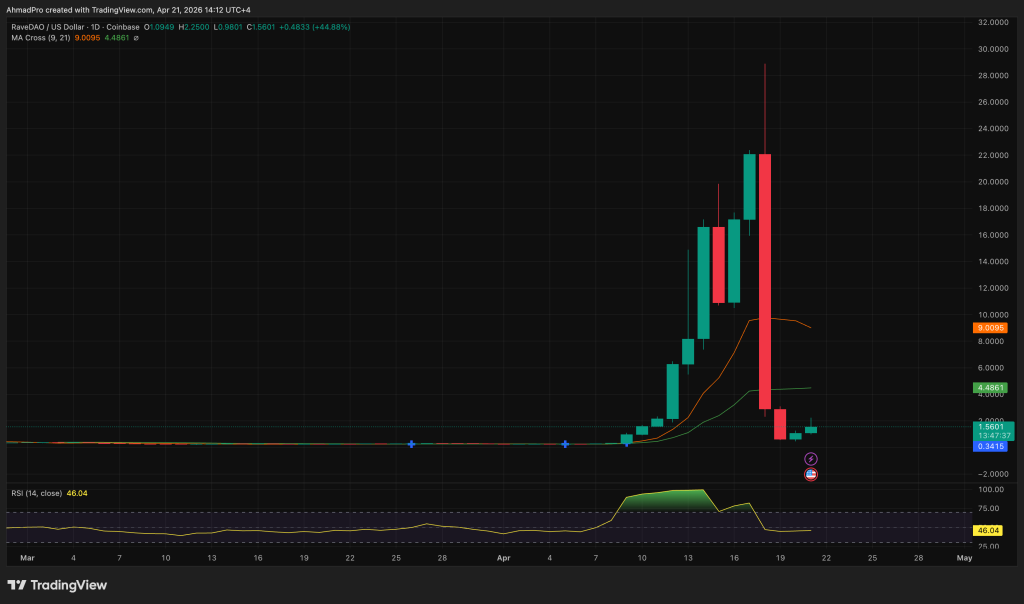
Current pricing sits near $1.61, down hard from the April 15 peak of $22, but the bounce off cycle lows tells a more complicated story than the “confirmed rug” narrative suggests.
The sequence of events reads like a case study in chaos: RAVE rocketed over 6,000% from $0.25 lows to a $27.94 peak, then cratered 95% as ZachXBT alleged coordinated pump-and-dump activity during a 10,383% rally in under 30 days.
Community calls for investigations into Binance and Bitget followed. Yet instead of a death spiral, on-chain activity showed renewed accumulation, and a 44% snapback turned into something considerably larger. Previous Cryptonews coverage flagged the manipulation risk early.
The broader altcoin market is watching closely: when a token survives this kind of public hit job, it either confirms resilience or sets up a second, more brutal trap.
Can RAVE Crypto Price Recover to $2.50 or Is a Deeper Crash Still Incoming?
This is not a clean recovery; it looks way more like a dead cat bounce than anything else, and those usually do not last.
Price is messy, data is inconsistent, and volatility is extreme, which already tells you this is not stable demand; it is unstable momentum.
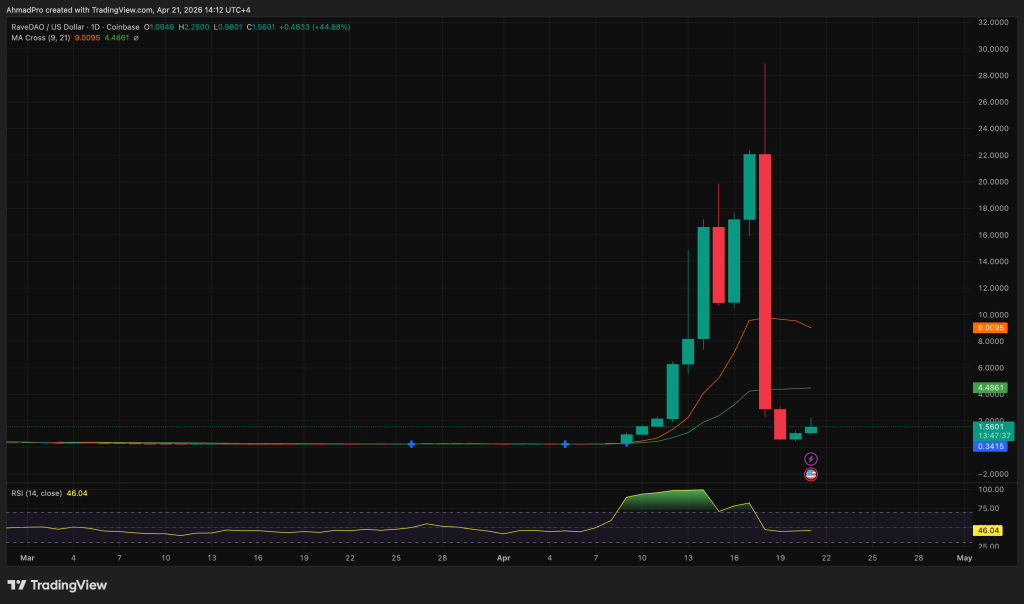
The move up is happening in thin conditions with heavy concentration, meaning a few wallets can move the entire market, and that is not something you want to rely on for continuation.
RSI already hit absurd levels during the spike, which historically does not lead to sustained trends; it leads to sharp reversals once the momentum fades.
So instead of treating this like the start of something bigger, it makes more sense to see it for what it is, a bounce inside a weak setup that can unwind quickly once the fuel runs out.
LiquidChain Targets Early-Mover Upside as RAVE Tests Structural Credibility
RAVE’s story illustrates the ceiling problem for high-mcap tokens post-parabola: even a legitimate recovery from $0.25 to $0.65 still means entry at a fully diluted valuation that discounts most future upside. Traders burned by the RAVE crash, or priced out of meaningful position sizing, are rotating attention toward infrastructure plays at seed-stage pricing.
LiquidChain is one of the more technically distinct projects currently in presale. Positioned as a Layer 3 infrastructure protocol, it fuses Bitcoin, Ethereum, and Solana liquidity into a single execution environment, what the team calls a Unified Liquidity Layer with Single-Step Execution and Deploy-Once Architecture. The pitch to developers: write once, access all three ecosystems without bridging friction or fragmented liquidity pools.
Presale price is $0.01451, with $690,005.61 raised to date. Early-stage infrastructure tokens carry substantial risk, most fail to achieve meaningful adoption post-launch, but the cross-chain liquidity thesis is one of the few narratives with confirmed developer demand heading into 2026.
Traders researching alternatives to high-volatility meme plays can explore LiquidChain’s presale details here.
The post ZachXBT Called It a Pump and Dump: So Why Did RaveDAO Crypto Just Bounce 138% Again? appeared first on Cryptonews.
Crypto World
Bitmine Buys 101,627 Ethereum Worth Over $230M in Its Biggest Weekly Accumulation of 2026
BitMine Immersion Technologies purchased 101,627 Ethereum last week for approximately $230 million, its largest single-week haul since December 15 and the biggest weekly accumulation of 2026.
The buy lifts total holdings to 4.97 million tokens, pushing the firm within striking distance of 5% of Ethereum’s circulating supply.
The real story is in the trajectory. BitMine has accelerated its acquisition pace for four consecutive weeks, scaling from a prior average of 45,000–50,000 ETH per week to more than double that rate. That is textbook accumulation behavior, not distribution.
- Weekly Purchase: 101,627 ETH worth approximately $230 million
- Record Context: Largest weekly haul since December 15, 2025
- Total Holdings: 4.97 million ETH across the treasury
- Total Assets: $12.9 billion in crypto and cash combined
- Staking Revenue: 3.33 million ETH staked, generating ~$221 million annualized
- Consecutive Weeks of Accelerated Buying: Four straight weeks of increased pace
Discover: The best pre-launch token sales
What 101,627 Ethereum Removed from Spot Supply by Bitmine Actually Signals
At roughly $2,263 per ETH implied by the $230 million price tag, BitMine’s single-week purchase represents a material withdrawal from available spot liquidity.
Ethereum daily spot volume on centralized exchanges typically ranges between $8 billion and $14 billion, but persistent directional demand at this scale compresses the effective float, particularly as two-thirds of BitMine’s stack is locked in staking and off the market entirely.
ETH has rebounded sharply from its early February lows, and Chairman Tom Lee is not subtle about the firm’s read on timing. “BitMine has maintained the increased pace of ETH buys in each of the past four weeks, as our base case ETH is in the final stages of the ‘mini-crypto winter,’” Lee said. He cited ETH’s outperformance of equities since the Iran conflict began February 28, alongside demand tied to tokenization and AI infrastructure running on Ethereum.
If buying continues at this pace – or accelerates toward the 5 million ETH milestone – the supply overhang shrinks further and resistance levels above current prices become harder to defend for sellers. If accumulation stalls or reverses, the absence of that steady bid will be felt quickly in order book depth. The honest answer on near-term price: the bid from one buyer at this scale is structural, not speculative.
The post Bitmine Buys 101,627 Ethereum Worth Over $230M in Its Biggest Weekly Accumulation of 2026 appeared first on Cryptonews.
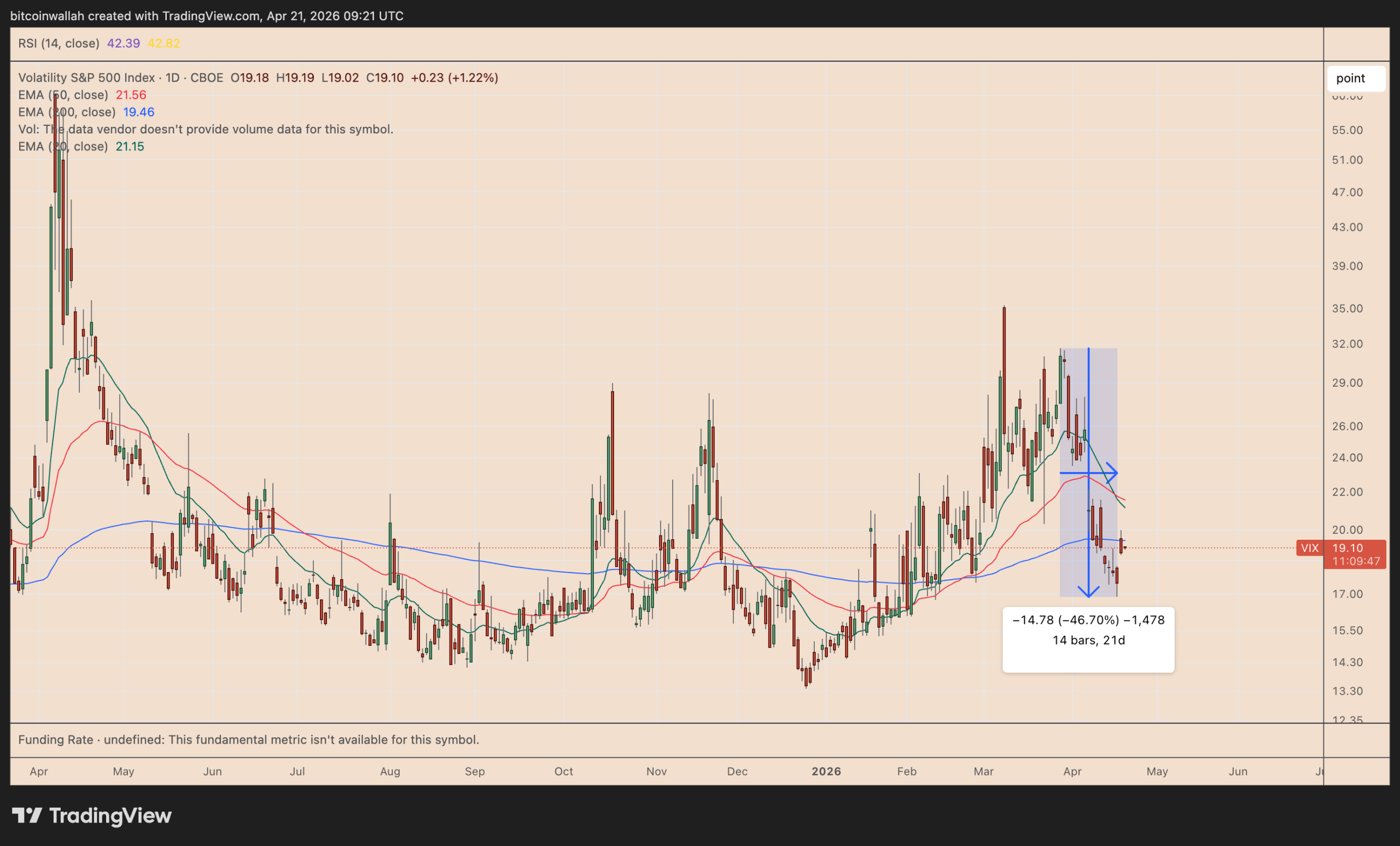
The CBOE Volatility Index (VIX), a preferred Wall Street metric to measure investor sentiment and market risk, dropped by over 45% in under a month. For Bitcoin (BTC), this could be a significant bullish signal.

Key takeaways:
-
Bitcoin may rise toward $82,700 if VIX keeps underperforming.
-
BTC’s upside outlook gets a boost from Strategy’s BTC buying spree.
Weakening VIX hints at BTC rising to $82,700
Often called Wall Street’s “fear gauge,” the VIX tracks how much volatility traders expect in the S&P 500 index over the next 30 days.
When the index rises, it usually signals rising stress and risk aversion across markets. When it falls, it suggests investors are becoming more comfortable owning riskier assets such as stocks and crypto.
History suggests that a VIX drop of 40% or more is bullish for Bitcoin.
For instance, BTC rallied approximately 40% during April 2025–May 2025, with its gains aligning with the VIX’s 70% dip.

Similarly, a 46% VIX drop during the October–November 2025 period coincided with a 12% BTC gain.
Even the recent 42%–47% VIX decline has coincided with an 8%–9% BTC price rebound, improving the bullish backdrop for Bitcoin in the coming days.
BTC’s next upside target appears to be around the 200-day exponential moving average (200-day EMA, the blue line) at around $82,700 by early May.
What happens to Bitcoin if VIX starts rising?
A rising VIX is typically bearish for risk assets like Bitcoin. However, that correlation broke briefly in March, according to a chart highlighted by wealth management firm Swissblock.
BTC and VIX rose in tandem during the US–Iran escalation in March. In comparison, the broader risk market, including US equities, underperformed.

One potential catalyst behind Bitcoin’s resilience may have been Strategy’s aggressive BTC buying, which has absorbed the equivalent to nearly 30 weeks of new coin supply since March.
Related: Saylor teases ‘bigger’ BTC buy days after floating semi-monthly dividends
“Bitcoin has already shown inherent strength in a very complex environment”, Swissblock said, adding:
“Do not be surprised if it starts to outperform on its own again.”
Nonetheless, any slowdown in Strategy’s buying could weaken Bitcoin’s support during periods of rising VIX, increasing the risk of downside.
Multiple analyses suggest BTC may drop below $50,000 in 2026.
This article is produced in accordance with Cointelegraph’s Editorial Policy and is intended for informational purposes only. It does not constitute investment advice or recommendations. All investments and trades carry risk; readers are encouraged to conduct independent research before making any decisions. Cointelegraph makes no guarantees regarding the accuracy or completeness of the information presented, including forward-looking statements, and will not be liable for any loss or damage arising from reliance on this content.
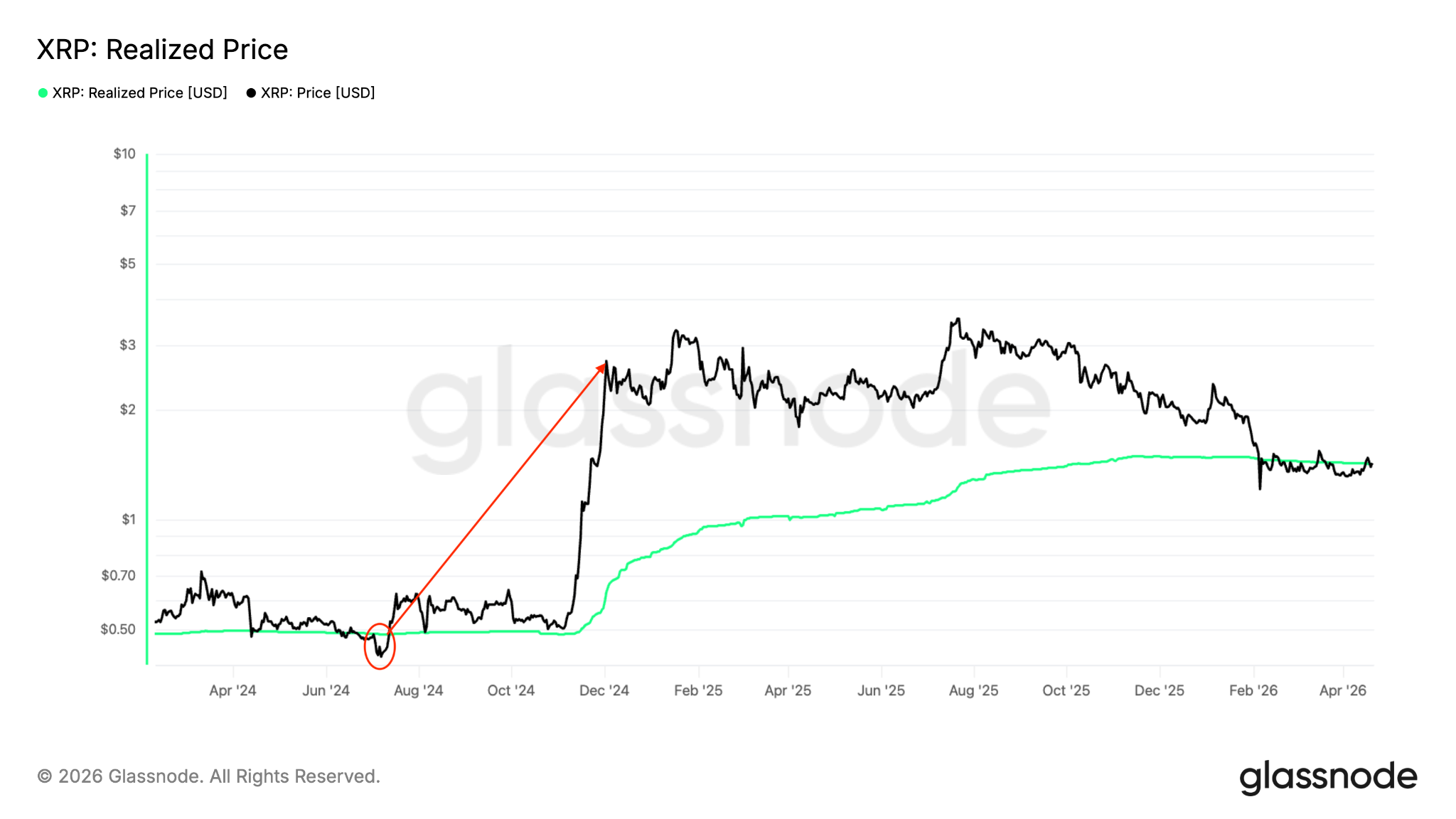
Most XRP investors are back in profit, increasing the chance for a rally to $2.24, but bulls must first hold the price above $1.40.
XRP’s (XRP) 28% rebound from its macro low at $1.12 pushed it above its realized price. In other words, the average XRP holder is no longer in the red.
Is this enough fuel for the bulls to push the altcoin’s price to $2.24?
Key takeaways:
XRP trades above its cost basis
Data from TradingView shows the XRP/USD pair trading at $1.44, up 1.6% over the last 24 hours and 5% over the last seven days.
This means XRP is holding above its realized price, the average cost of all coins based on when they last moved, currently at $1.41, according to data from Glassnode.
The average XRP holder returning to profit after unrealized losses provides meaningful financial relief for many holders, signaling a bullish outlook.
Related: XRP price bottom signals emerge after the altcoin holds key support level
Historically, breaking above this level shifted market sentiment from “fear,” reducing sell pressure from underwater holders and encouraging holding.
The chart below shows that when the price reclaimed its realized price after hovering below it for a few months in mid-2024, it rallied 460% to $2.90 from $0.52.

Holding above $1.40 is crucial for the bulls to ensure a potential upward breakout.
On the upside, the key levels of resistance to watch out for are the 111-day moving average (MA) at $1.57, the 200-day MA at $1.88 and the 365-day MA at $2.22, based on XRP’s technical pricing model.

XRP’s symmetrical triangle targets $2.40
XRP has been consolidating within a symmetrical triangle for more than two months, as shown in the chart below.
The XRP/USD pair must break and close above the upper trend line of the triangle at $1.46 to continue the upward trajectory.
The measured target of the pattern, calculated by adding the triangle’s height to the breakout point, is $2.24, 55% above the current price.

Technical analyst and trader ChartNerd said the moving averages between $1.35 and $1.40 “need to be held” to keep the bullish outlook in play.

As Cointelegraph reported, buyers will have to achieve a daily candlestick close above the upper trendline of a descending parallel channel at $1.60 to confirm a potential trend change.
This article is produced in accordance with Cointelegraph’s Editorial Policy and is intended for informational purposes only. It does not constitute investment advice or recommendations. All investments and trades carry risk; readers are encouraged to conduct independent research before making any decisions. Cointelegraph makes no guarantees regarding the accuracy or completeness of the information presented, including forward-looking statements, and will not be liable for any loss or damage arising from reliance on this content.

Volkswagen shows off a prototype of its ID.Aura T6 in Beijing, China, in April 2026.
Picture Alliance | Picture Alliance | Getty Images
German auto giant Volkswagen announced it’s incorporating AI voice commands into its cars for the Chinese market.
Starting in the second half of this year, all vehicles based on Volkswagen’s China car system will feature AI agents that allow humans to control car features with voice commands, the company said on Tuesday.
“The car should be like a companion,” Volkswagen China CTO Thomas Ulbrich told CNBC’s Eunice Yoon.
He said the company’s in-car AI agent would draw on tech from Tencent, Alibaba and Baidu, among others, to create a tool with “personality” that can anticipate a driver’s needs.
The AI uses a locally trained large language model and runs entirely on the car, rather than the cloud.
Volkswagen revealed four cars in Beijing on Tuesday, including the ID. UNYX 09, which the company claimed it co-developed with EV maker Xpeng in two years.
The move is part of the company’s strategy to recoup lost market share as China has rapidly turned to electric cars from ones powered by internal combustion engines.
Over the last few years, Volkswagen has invested heavily in China, with stakes in Xpeng and automotive chipmaker Horizon Robotics.
With those partnerships, the German automaker is not using Nvidia chips in its cars in China. Instead, Volkswagen is using Xpeng’s Turing chip in an electric SUV set to begin deliveries by the end of June, while an advanced automotive chip project with Horizon Robotics remains under development.
Volkswagen also announced Tuesday that, starting next year, it will use agentic AI to power a unified driver-assist and cockpit control system.
In November, the German automaker announced its research center in Hefei could independently develop and approve technology for its Chinese cars, reducing the time to market.
Over the last two years, German automotive industry companies in China have significantly increased their research and development activities in the country, with the aim of serving both the local and global market, according to a report released Tuesday by the German Chamber of Commerce in China.
Nearly 80% of automotive companies surveyed by the chamber said that localizing R&D in China has lowered those costs versus Germany over the last two years, while about 43% of respondents said their innovation speed has increased by more than 40%, the report said.
TLDR
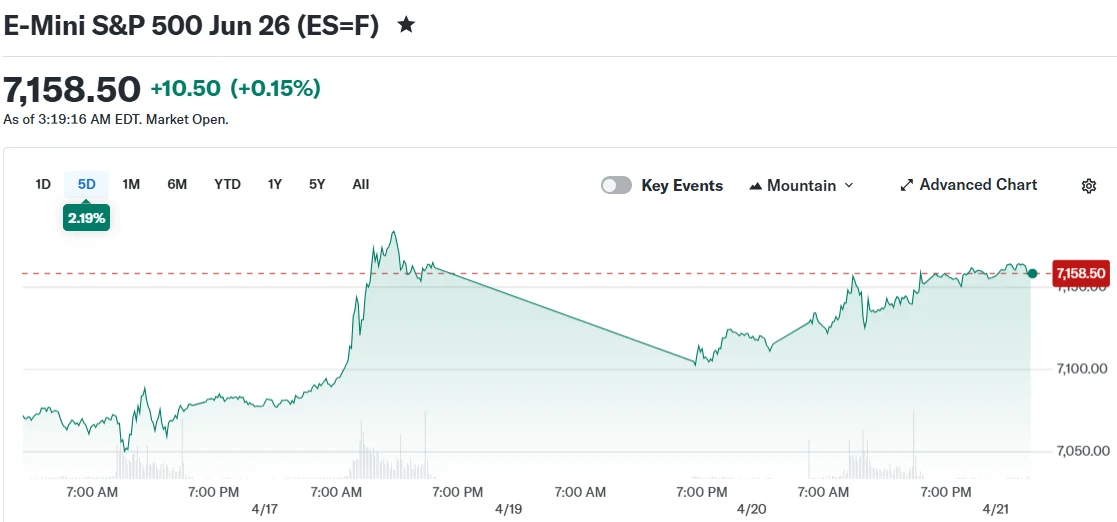
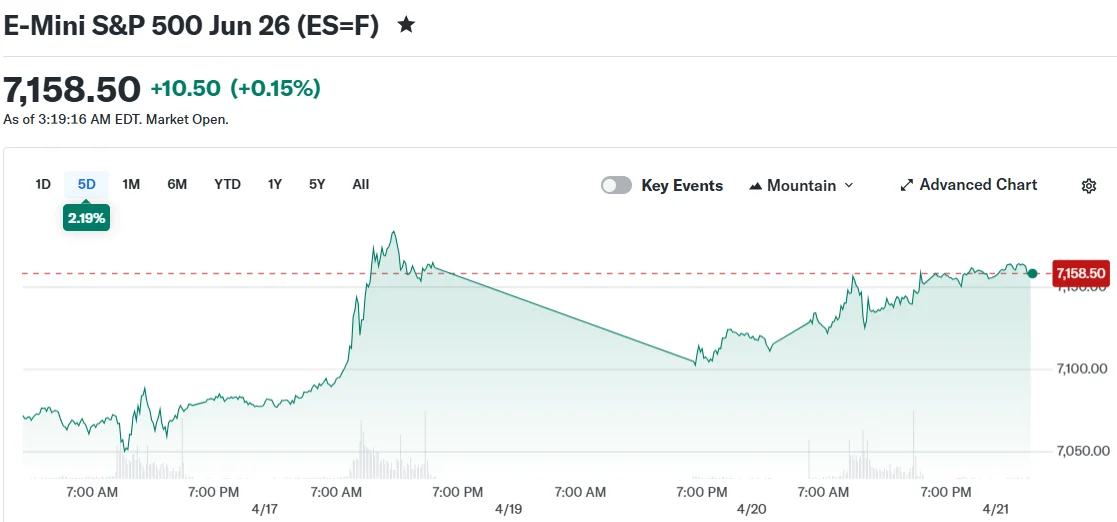
- Futures for the Dow advanced 301 points (0.6%), while S&P 500 and Nasdaq futures posted gains during early trading
- Current U.S.-Iran ceasefire set to conclude Wednesday; Tehran indicates possible diplomatic team deployment to Pakistan
- Apple announces Tim Cook’s departure as CEO, with hardware division leader John Ternus designated as successor
- Bitcoin advanced toward the $76,000 level, bolstered by substantial Strategy acquisition
- Federal Reserve chair nominee Kevin Warsh scheduled for Senate confirmation hearing Tuesday; explicit rate guidance unlikely
Equity futures posted solid gains Tuesday morning as market participants monitored progress in diplomatic negotiations between the United States and Iran while digesting significant leadership changes at Apple.
Futures tied to the Dow Jones Industrial Average advanced 301 points, representing a 0.6% increase. Futures linked to the S&P 500 climbed 0.3%, while Nasdaq 100 futures registered a 0.4% gain. These advances followed Monday’s session, which saw declines across all three major benchmarks, ending a robust recent uptrend.
The temporary ceasefire agreement between Washington and Tehran is scheduled to lapse late Wednesday evening. President Trump confirmed that American negotiators stand prepared to travel to Pakistan to continue diplomatic discussions. Iranian officials suggested they would dispatch a negotiating delegation, although formal confirmation remained pending as of Tuesday morning.
“The working assumption for most market participants is that we see an extension of the current ceasefire,” said Michael Brown, strategist at Pepperstone.
Oil prices retreated on growing optimism surrounding diplomatic progress. Brent crude declined 0.5% to reach $95.02 per barrel. West Texas Intermediate decreased 0.6% to settle at $86.87 per barrel. Reduced geopolitical tensions could alleviate concerns about supply chain disruptions affecting shipping routes through the Strait of Hormuz.
Gold retreated 0.6% to $4,801 per ounce. The U.S. dollar index registered a modest 0.1% increase against major trading currencies. The benchmark 10-year Treasury yield remained unchanged at 4.26%.
Apple Leadership Transition Impacts Shares
Apple announced Monday evening that Tim Cook would relinquish his position as chief executive. John Ternus, currently overseeing the company’s hardware engineering division, has been named as his replacement. Apple shares declined 0.5% during premarket activity following the revelation.
Market observers are simultaneously focused on Kevin Warsh, President Trump’s nominee for Federal Reserve chair. Warsh is scheduled to testify before the Senate Banking Committee Tuesday. His prepared testimony contained no definitive signals regarding monetary policy direction. Current market expectations favor no interest rate reductions throughout 2026.
March retail sales figures are scheduled for release later Tuesday, providing crucial insights into consumer expenditure patterns during the period of heightened Middle East tensions.
Bitcoin Advances Toward $76,000 Threshold
Bitcoin climbed toward the $76,000 mark Tuesday, receiving support from a substantial acquisition by Strategy, the business intelligence company recognized for its assertive Bitcoin accumulation approach. The transaction provided momentum across cryptocurrency markets more broadly.
United Airlines is scheduled to release quarterly earnings Tuesday. Financial analysts will scrutinize how elevated fuel expenses, stemming from Middle East instability, impacted the airline’s financial performance.
The Nasdaq ended its longest consecutive winning streak since 1992 during Monday’s trading session. Both the S&P 500 and Nasdaq Composite had recently established new record peaks before experiencing the recent downturn.
Warsh’s Senate testimony represents a significant market catalyst Tuesday, with investors seeking any indications regarding Federal Reserve policy direction under potential new leadership.



Securitize has appointed Sunil Sabharwal to its board of directors as the tokenization firm moves ahead with expansion plans.
Summary
- Securitize appointed Sunil Sabharwal, a former IMF representative, to its board of directors this week.
- The company manages over $4 billion in on-chain assets for major financial institutions globally.
- Securitize continues pursuing a public listing through its planned merger with Cantor Equity Partners II.
The company said the appointment adds experience in global finance, payments, and public policy at a time when tokenized asset platforms are drawing more institutional attention.
Sabharwal is a business executive and investor with a background in payments and financial services. He also served as a Senate-confirmed U.S. representative to the International Monetary Fund from 2016 to 2018.
Securitize chief executive Carlos Domingo said Sabharwal brings experience from both the private and public sectors. Domingo said “Sunil’s career is defined by building and scaling financial infrastructure at a global level.”
He added that Sabharwal’s background in payments and international finance would support the company’s next phase of growth. Domingo said tokenization is moving from concept to market infrastructure, and that Sabharwal’s perspective would be useful as the firm expands.
Sabharwal currently serves on the boards of Thunes and TookiTaki. He also previously chaired payment companies Earthport and Ogone, which were later acquired by Visa and Ingenico.
His background includes work across payments, cross-border finance, and strategic growth. That track record gives Securitize a board member with experience in both financial infrastructure and regulated markets.
Sabharwal also received the U.S. Treasury’s Distinguished Service Award during his public service. He was nominated by former President Barack Obama in 2016 and served mainly during President Donald Trump’s first term until 2018.
Since 2021, he has worked as an advisor and operating partner for the Blackstone Growth Equity Fund, according to LinkedIn. He also previously advised SpiceVC, an early backer of Securitize.
Securitize expands tokenized asset business
Securitize manages more than $4 billion in on-chain assets. Its platform supports tokenized products tied to firms including BlackRock, Apollo, BNY, Hamilton Lane, KKR, and VanEck.
Among its best-known products is BlackRock’s BUIDL fund. The company has positioned itself as one of the larger players in the tokenized real-world asset market as institutions explore blockchain-based fund structures.
The board appointment comes as the company continues to build out that business. It also comes as market participants pay closer attention to firms that offer tokenized versions of traditional financial products.
Public listing plan remains in focus
Securitize is also pursuing a public market listing through a merger with Cantor Equity Partners II, a Cantor Fitzgerald-sponsored firm. The companies entered into a definitive acquisition agreement in October.
The deal would value Securitize at $1 billion. The combined company is expected to trade on Nasdaq under the ticker CEPT.
The transaction would also give Securitize access to the $240 million raised by CEPT in its initial public offering. That planned listing remains a key part of the company’s growth strategy as it expands its presence in tokenized finance.


- Arbitrum froze 30,766 ETH before it could be bridged out.
- Attacker moved 75,701 ETH and began routing funds to Bitcoin.
- Over $176 million is being laundered through multiple parallel flows.
Arbitrum has frozen a significant portion of funds linked to the KelpDAO exploit, even as the attacker moves to push the remaining assets beyond reach.
The Arbitrum Security Council confirmed it froze 30,766 ETH, valued at over $70 million at the time of action.
The funds were tied to an address associated with the KelpDAO attacker and were secured before they could be bridged out of the network.
The intervention came after coordination with law enforcement, suggesting authorities may already have leads on the exploiter’s identity.
The Arbitrum Security Council has taken emergency action to freeze the 30,766 ETH being held in the address on Arbitrum One that is connected to the KelpDAO exploit. The Security Council acted with input from law enforcement as to the exploiter’s identity, and, at all times,…
— Arbitrum (@arbitrum) April 21, 2026
A race against time
Blockchain investigators, including PeckShield, had flagged that the attacker was already attempting to move the funds off Arbitrum using a native bridge.
Had that transfer been completed, the ETH would likely have joined a much larger pool of stolen assets already in circulation across other chains.
By intervening when it did, Arbitrum prevented roughly 29% of the stolen funds from entering the laundering pipeline. However, the remaining assets were not as fortunate.
The KelpDAO exploit itself is estimated at around $290 million, making it one of the largest decentralized finance breaches of 2026.
The attacker moved quickly after the initial exploit, splitting funds across multiple wallets and chains in an effort to reduce traceability.
Laundering shifts to Bitcoin
Following the freeze, the attacker accelerated efforts to move the remaining funds.
Data shows that approximately 75,701 ETH, worth about $175 million, was transferred to Ethereum mainnet.
From there, the funds began moving into Bitcoin through decentralized protocols like THORChain, Chainflip, and Umbra Cash, which allow direct cross-chain swaps without relying on centralized exchanges.
#PeckShieldAlert The @KelpDAO exploiter has begun laundering stolen funds (~$176M).
They have started bridging small batches of funds from #Ethereum to $BTC via @THORChain, @UmbraCash, @chainflip, and @BitTorrent. pic.twitter.com/4cm8dOjTWL
— PeckShieldAlert (@PeckShieldAlert) April 21, 2026
PeckShield analysts observed that the attacker left only about 0.7 ETH in some wallets, just enough to cover transaction fees, while draining the rest into new routes.
This pattern reflects a high level of operational discipline and planning.
Another $176 million portion of the stolen funds has also been actively moved in parallel transactions.
Rather than laundering everything in a single flow, the attacker appears to be running multiple streams at once.
This staggered approach reduces the risk of a single point of failure and makes recovery efforts more difficult.
Is the infamous North Korea’s Lazarus Group linked to the KelpDAO exploit?
The scale and coordination of the operation have led investigators to link the exploit to North Korea’s Lazarus Group, specifically a subgroup known as TraderTraitor.
This attribution is based on transaction patterns and laundering techniques that match previous operations tied to the group.
Lazarus has a long history of targeting crypto platforms and using complex cross-chain strategies to obscure stolen funds.
The use of decentralized bridges and rapid asset conversion seen in the KelpDAO case fits that pattern closely.
Crypto World
Coinbase Expands x402 With AI Agent App Store, Pushing Crypto Payments Into AI Infrastructure
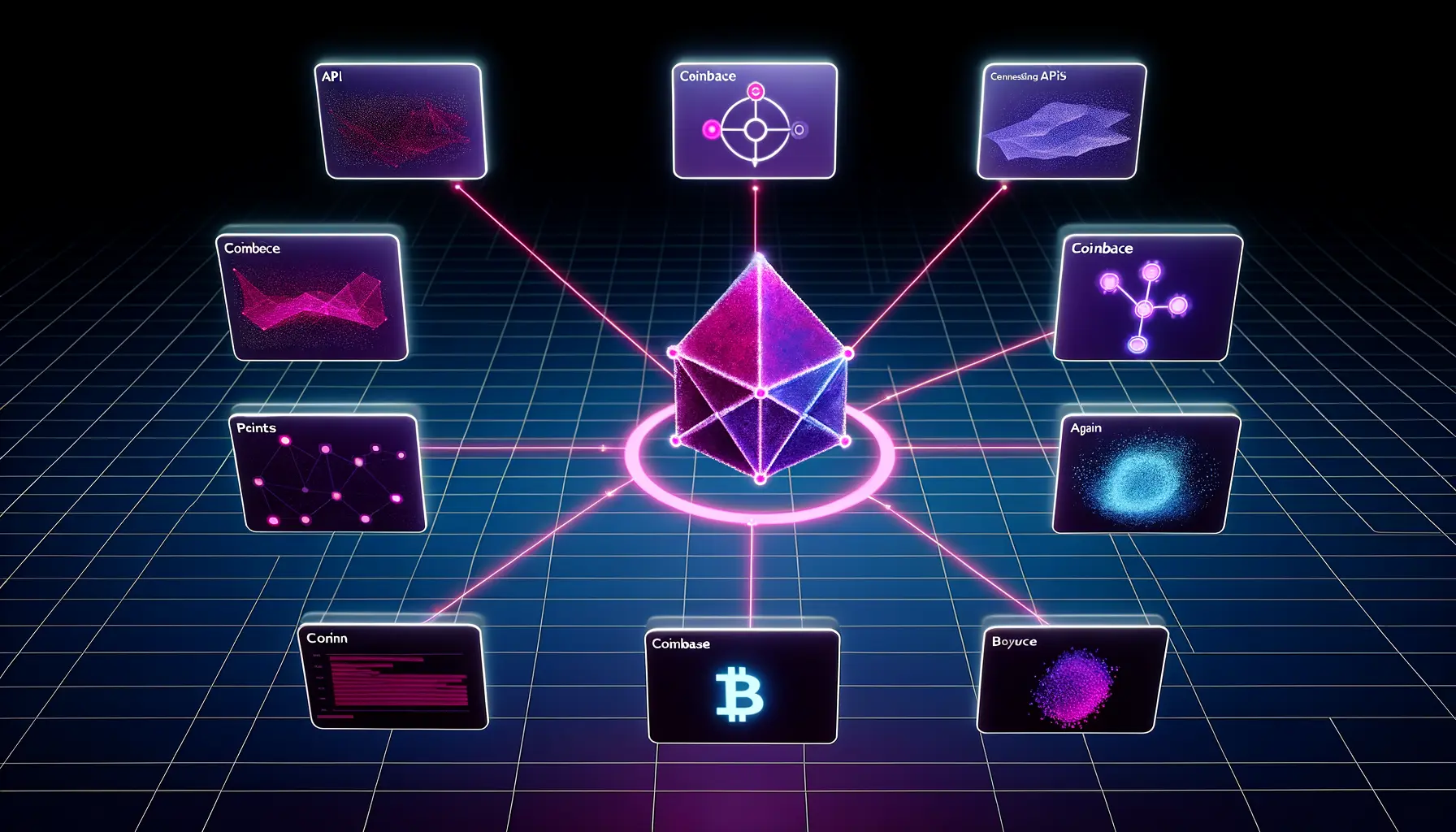
Coinbase has launched Agent.market, an AI agent app store built on its x402 payment protocol, embedding permissionless stablecoin rails directly into AI infrastructure across seven service categories. As of April 21, 2026, approximately 69,000 active AI agents on x402 have already processed over 165 million transactions totaling $50 million in volume, figures that frame this as an infrastructure play, not a speculative product launch.
The core question now: whether Agent.market can become the default discovery and payment layer for autonomous AI agents, or whether fragmented developer ecosystems blunt adoption before the rails gain critical mass.
Key Takeaways:
- What x402 is: An open payment protocol named after the unused HTTP 402 status code, enabling instant stablecoin micropayments over HTTP for APIs, apps, and AI agents – no accounts or subscriptions required.
- What Agent.market adds: A permissionless app store spanning seven categories – reasoning, data, media, search, social, infrastructure, and trading – with providers including OpenAI, Bloomberg, CoinGecko, AWS Lambda, and Coinbase RAT.
- What AI agents can now do: Autonomously discover, pay for, and chain together services using Agentic Wallets, without developer-preset API keys or manual billing setup.
- Payment rail: USDC stablecoins on Base, with Coinbase’s Payments MCP enabling LLMs including Anthropic’s Claude and Google’s models to access blockchain wallets via x402.
- Backing: The x402 Foundation, incubated under the Linux Foundation, counts over 20 institutional backers including Cloudflare, Stripe, AWS, Google, Visa, Circle, and the Solana Foundation.
- Watch item: Google’s agentic payments protocol integration with x402 for single-tap USDC retail transactions – a signal that could accelerate volume materially.
Discover: The best crypto to diversify your portfolio with
How Coinbase x402 Agent.market Actually Works – and Why the Architecture Matters
x402 was designed around a structural gap in the existing web: the HTTP 402 status code has existed since the early internet as a placeholder for payment-gated content, but was never implemented at scale.
Coinbase built x402 to fill that gap. When an AI agent hits a payment-required endpoint, x402 handles the USDC micropayment over HTTP instantly, without redirecting to a billing portal or requiring a pre-negotiated API key relationship.
Agent.market operationalizes that mechanic into a browsable catalog. Service providers can list without permission, which directly reduces the setup friction that has historically limited API commerce: x402 creator Erik Reppel stated the protocol “is reshaping customer acquisition activation costs for businesses, as robots can now access services at a very low setup cost without needing API keys.”
That framing matters; it redefines cost-of-acquisition for AI-facing businesses from human onboarding flows to machine-readable price discovery.
The seven-category structure – reasoning, data, media, search, social, infrastructure, and trading – maps directly onto what autonomous agents need to chain multi-step tasks. An agent could pull financial data from CoinGecko, process it through an OpenAI reasoning endpoint, execute a trade via Bankr, and log the transaction through QuickNode infrastructure, with every handoff settled in USDC on Base without human authorization at each step.
If adoption follows the arc of prior API marketplaces, the trading and data verticals will see volume concentration first – they carry the highest per-call value and the most time-sensitive payloads.
The failure mode to watch is latency and settlement finality at scale. x402’s prior 165 million transactions represent an average call value under $0.31 – the architecture is calibrated for micropayments, not bulk settlements. Whether it holds throughput as agent complexity and chain length increase is the open engineering question.
Discover: The best pre-launch token sales
The post Coinbase Expands x402 With AI Agent App Store, Pushing Crypto Payments Into AI Infrastructure appeared first on Cryptonews.

UK lays unified rails for stablecoins and tokenized deposits

Kilkenny Design New Beauty Arrivals for Spring 2026

Desperate Labour double down on Green Party antisemitism smear

Manchester United reach agreement with Casemiro over contract clause amid transfer speculation

Steven Gerrard disagrees with Gary Neville over ‘shock’ Chelsea and Arsenal claim | Football

US brings back mandatory military draft registration

Maryam Ko Batayn App Mein Apply Karne Ka Tarika | Financial Grant Mein Application Kaise Likhen

Three of the craziest things found in goodwills #ytshorts #money

Raoul Pal :”My NEW Prediction For The 2026 Crypto Bull Run (Prepare Now)” | Bitcoin Price 2026
-

 News Videos6 days ago
Secure crypto trading starts with an FIU-registered
-

 Fashion4 days ago
Weekend Open Thread: Theodora Dress
-

 Sports4 days ago
NWFL Suspends Two Players Over Post-Match Clash in Ado-Ekiti
-

 Politics4 days ago
Palestine barred from entering Canada for FIFA Congress
-

 Business2 days ago
Powerball Result April 18, 2026: No Jackpot Winner in Powerball Draw: $75 Million Rolls Over
-

 Crypto World4 days ago
Russia Pushes Bill to Criminalize Unregistered Crypto Services
-

 Politics17 hours ago
Gary Stevenson delivers timely reminder to register to vote as deadline TODAY
-

 Tech2 days ago
Auto Enthusiast Scores Running Tesla Model 3 for Two Grand and Turns It Into Bare-Bones Go-Kart
-
 Business5 days ago
Creo Medical agree sale of its manufacturing operation
-

 Politics2 days ago
Zack Polanski demands ‘council homes not luxury flats for foreign investors’
-

 Tech6 days ago
‘Avatar: Aang, The Last Airbender’ Leaked Online. Some Fans Say Paramount Deserves the Fallout
-

 Crypto World4 days ago
Russia Introduces Bill To Criminalize Unregistered Crypto Services
-

 Tech6 days ago
Microsoft adds Windows protections for malicious Remote Desktop files
-
 Entertainment6 days ago
Dave Portnoy Slams Dianna Russini: ‘Makes Zero Sense’
-

 Crypto World6 days ago
X Launches New Cashtag Feature for Stocks and Crypto: X
-

 Sports5 days ago
British climbers complete new route in Swiss Alps
-

 Entertainment7 days ago
Prince Carter Brings Fans Front Row and Backstage at Boys 4 Life Tour
-
 Crypto World7 days ago
Bitcoin surpasses halfway mark in current halving cycle
-
Entertainment2 days ago
NBA Analyst Charles Barkley Chimes in on Ice Spice McDonald’s Fiasco
-
 Crypto World7 days ago
Paxos Labs Raises $12M to Launch Crypto Yield and Lending Platform
You must be logged in to post a comment Login