

Crypto World
SEALSQ (LAES) Stock Surges on WISeRobot.ch Quantum-Secure AI Platform Launch


Key Highlights
- WISeRobot.ch platform launched with integrated post-quantum cryptographic security for AI robotics systems.
- Platform emphasizes secure human–machine collaboration for enterprise and government deployment.
- January 2026 CNBC Davos demonstration showcased authentic engagement and protected AI communication protocols.
- Company progresses quantum-resistant cryptography across silicon chips, firmware layers, and complete systems.
- Share price recovered to $2.75 as WISeRobot.ch opens doors to high-priority AI market segments.
SEALSQ (LAES) experienced pre-market gains following the introduction of WISeRobot.ch, a comprehensive platform dedicated to post-quantum secured artificial intelligence robotics. The organization seeks to integrate quantum-proof technology throughout autonomous platforms serving governmental agencies, medical facilities, and intelligent infrastructure networks. Market participants responded positively to the news, pushing shares to $2.75 following a prior 2.87% drop.
WISeRobot.ch Platform Ushers in Quantum-Protected AI Robotics
SEALSQ alongside parent organization WISeKey revealed WISeRobot.ch as a centralized resource for product features, implementation scenarios, and collaborative opportunities. The digital hub presents a comprehensive development timeline highlighting post-quantum encryption within AI-powered robotic systems. Through combining digital identification credentials and network defense competencies, WISeRobot.ch pursues authenticated human–machine communication and durable infrastructure protection.
The program expands upon presentations conducted at CNBC Davos during January 2026, where the robotic platform demonstrated organic interaction and protected exchanges. Attendees engaged with the robot as a genuine dialogue companion, underscoring human-focused AI capabilities. WISeRobot’s prototype implementation incorporated protected machine-to-machine connectivity utilizing SEALSQ’s post-quantum chip architecture and public key infrastructure framework.
WISeRobot.ch functions as a knowledge center for organizations pursuing AI capabilities with quantum-proof safeguards. The resource delivers intelligence on conversational AI progression, broadened use cases, and incorporation of post-quantum cryptographic methods. Its architecture strives to reconcile intelligent automation with human confidence and digital security benchmarks.
Quantum-Proof Protection Built into Robotic Systems
SEALSQ advances hardware, software, and architectural implementations to guarantee quantum-resistant safeguards throughout vital industries. The organization concentrates on embedding chip-based security foundations and protected algorithms throughout robotics platforms. Through this approach, SEALSQ confronts developing threats from quantum computation against AI frameworks.
The development schedule encompasses conversational AI improvements and comprehensive post-quantum technology incorporation. These initiatives target securing AI-powered functions within government installations, medical networks, and intelligent infrastructure. As artificial intelligence grows increasingly fundamental to public and commercial operations, the platform reinforces confidence and functional dependability.
WISeRobot merges WISeKey’s digital verification and network protection knowledge with SEALSQ’s post-quantum semiconductor technology. This partnership produces robotics systems equipped for protected, verified exchanges within high-stakes settings. Organizations can utilize WISeRobot.ch for implementation direction, technical collaborations, and availability of quantum-secured AI capabilities.
Market Performance and Forward Strategy
SEALSQ captured upward movement during pre-market activity, demonstrating investor enthusiasm regarding the platform’s commercial prospects. The organization frames WISeRobot as a connector between AI evolution and comprehensive security frameworks. Market observers can track subsequent acceptance across enterprise, governmental, and healthcare sectors to evaluate expansion influence.
SEALSQ pursues broader post-quantum technology deployment, with continuous validation throughout robotics settings. The company stresses incorporating reliability and human-focused architecture alongside AI functionality. WISeRobot.ch signifies a tactical advancement in positioning quantum-secured AI as infrastructure for autonomous platforms worldwide.


It used to be easy to estimate how many Bitcoin full nodes were easily reachable over the internet, but almost all of those counters have gone offline this month.
As of Tuesday, Coin Dance’s node counter reported a last-updated time of 476 hours ago. Indeed, the page displays 23,795 reachable nodes as of its latest update last month.
Bitcoin node estimates plastered across dashboards, glossaries, and other webpages haven’t moved in roughly three weeks.
The main culprit seems to be Bitnodes.io, a popular crawler that ran continuously since 2013 yet went dark after its domain expired on May 3, 2026. A single developer, Addy Yeow, ran the project with early financial support from Balaji Srinavasan’s 21 Inc, once the best-funded company in the Bitcoin industry.
Neither Srinavasan nor Yeow have issued public statements on the GitHub repository or anywhere else about the outage.
NewHedge used Bitnodes’ API and, therefore, has taken its counter offline. Another Bitnodes API user, SatoshiDashboard, also went down.
Clark Moody’s dashboard simply re-posts Bitnodes’ old cached number.
Navigating to bitnodes.io itself returns a DNS error.
Bitnodes was a fan favorite
Two weeks into the outage, BitMEX Research proposed a rudimentary replacement crawler, Bitnod.es, using off-the-shelf tooling.
With sincere modesty, BitMEX Research conceded that the substitute is significantly inferior to the original.
Indeed, Bitnodes ran continuously for 13 years. The well-capitalized 21 Inc sponsored it at first, including under 21 Inc’s 2017 rebrand to Earn.com.
The timing of the outage is particularly unfortunate given widespread uncertainty about how many nodes are operating the Bitcoin network currently.
How many Bitcoin nodes are online, 14,000 or 350,000?
IP and onion addresses of nodes have become particularly hard to crawl over the last month.
For example, Jameson Lopp recently flagged a roughly four-fold spike in IP-like addresses propagating across Bitcoin’s ADDR (address) gossip messages.
Prior to this month, a research group of the Karlsruher Institut für Technologie in Germany found roughly 60,000 daily unique IPs operating the Bitcoin network. By early May, they detected a spike to roughly 250,000.
Their same dashboard has continued to skyrocket with an estmate now near 350,000.
Read more: Bitcoin needs a $970K wick in the next 62 days for Balaji Srinivasan
Amid outages at mainstream counters, users are finding alternatives with wildly different numbers than Bitnodes.
Luke Dashjr’s tracker, for example, shows 72,682 Bitcoin Core nodes and 18,724 Bitcoin Knots nodes — far higher than Bitnodes’ combined estimate in the 20,000s in April.
Another indie tracker actually estimates a sharp decline in Bitcoin listening nodes in April from roughly 18,000 in March to less than 15,000 in April and under 14,000 this month. Bitnod.es finds less than 2,500.
Estimating Bitcoin nodes by oneself
Bitcoin’s node-counting infrastructure was always thin, but it’s now entirely stale and poorly maintained.
As billionaire Srinivasan became preoccupied with acquiring an island near Singapore instead of supporting Bitnodes, and indie developers ran short on funds for operating public reporting of Bitcoin infrastructure, the only way to find out how many nodes are online has become DIY.
Anyone can run a Bitcoin node, start connecting to peers, and gossip with other operators to guess about additional IP, onion, or IP-like addresses that might be online.
Although connecting over the mesh network to conduct an estimate takes time and will yield a different absolute number than anyone else, due to the voluntary and random nature of global participation, it’s possible to arrive at a reasonable estimate with sustained effort.
Unfortunately, there’s no financial incentive other than reporting for the public good to extensively and diligently connect to as many peers as possible.
Most node operators are entirely content to have a couple hundred or thousand connections, which are sufficient for validating blocks and forthe purposes of receiving and broadcasting the majority of mempool-queued transactions.
Got a tip? Send us an email securely via Protos Leaks. For more informed news and investigations, follow us on X, Bluesky, and Google News, or subscribe to our YouTube channel.
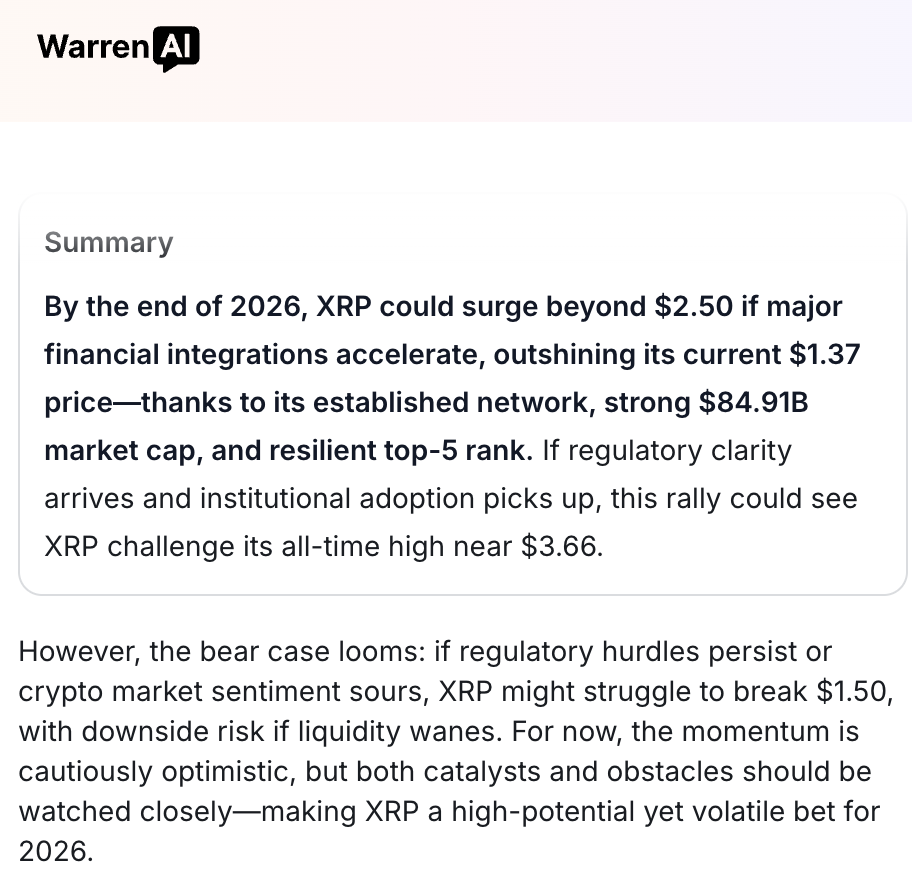
Warren Buffett built his fortune by avoiding assets he did not understand. An AI agent replicating his name and theories was asked about it XRP price prediction anyway. Warren Buffett AI predicts was more bullish than the Oracle of Omaha would ever say out loud.
Warren AI sees XRP challenging its all-time high near $3.66 by the end of 2026.
The framework is grounded in the kind of fundamental metrics Buffett actually respects. XRP is not a speculative micro-cap; it is a top-5 asset with an $84.91B market cap and an established network that has been processing real payment volume for years.
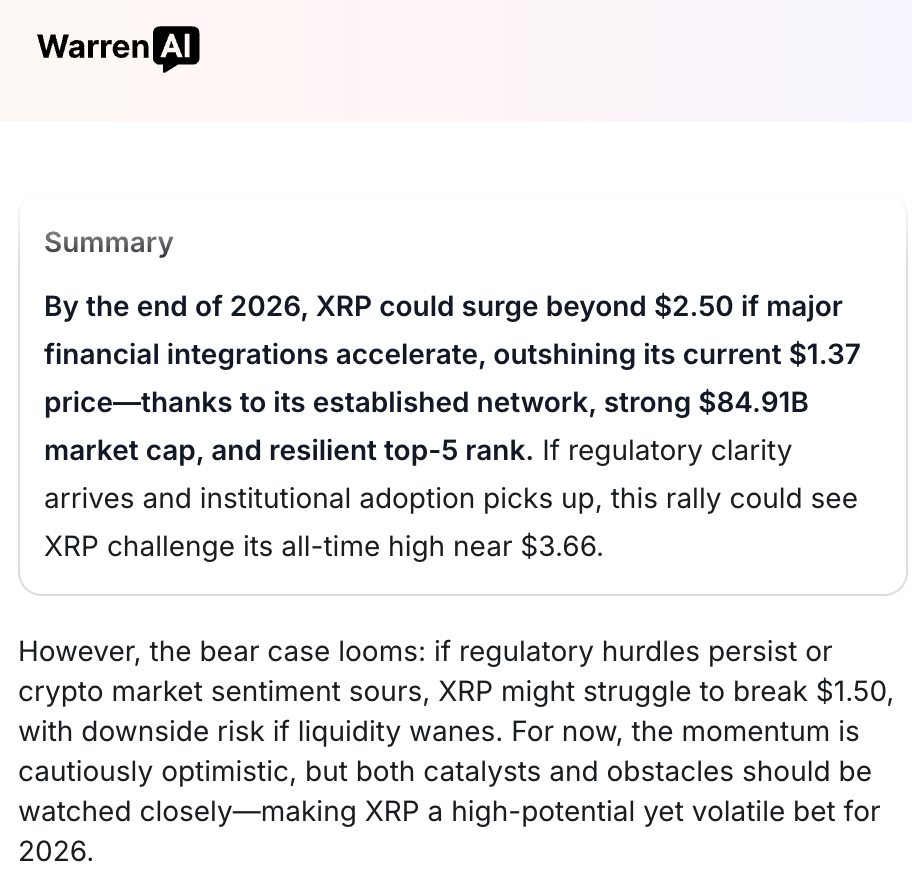
Warren AI’s base case of $2.50 is built on major financial integrations accelerating, which is a demand driver that is already partially in motion rather than hypothetical.
Regulatory clarity arriving and institutional adoption picking up are the 2 catalysts that push the prediction into ATH territory.
The AI frames XRP as a high-potential bet precisely because the infrastructure is already built and the market is underpricing what happens when institutional capital finally has both the legal clarity and the access vehicle to commit at scale.
The bear case is the most honest part of the prediction. If regulatory hurdles persist or crypto market sentiment sours, XRP might not even break $1.50, with additional downside risk if liquidity wanes.
Warren AI closes with a verdict that sounds exactly like something Buffett would say about any asset: catalysts and obstacles should both be watched closely. The momentum is cautiously optimistic, not blindly bullish.

XRP Price Prediction: After Months of Stalling, Warren AI Just Put a Predicts on What Happens When That Changes
Ripple XRP price is trading at $1.3704 on the daily, and the chart is a 10-month story of peak to trough with no convincing recovery in between.
Price peaked around $3.70 in August 2025, spent the rest of the year in a grinding descent through every attempted bounce, crashed to $1.20 in February 2026, and has been stuck in a $1.20 to $1.60 range ever since.
4 months of sideways action after a 63% drawdown is what accumulation looks like before it becomes obvious in hindsight.
The structure since February has been building quietly. Higher lows have printed consistently across March, April, and May, and each dip has found buyers at progressively higher levels.
The problem is that the ceiling has not moved. Every push toward $1.50 to $1.55 has been sold and price keeps returning to the $1.35 to $1.40 zone where it sits now.
Resistance is $1.50 to $1.55, the level that has defined the top of this recovery range for 4 months. Above it $1.60 is the next reference and $2.00 is the psychological level that separates the recovery trade from the reversal trade.
Support is $1.20 to $1.25, the February crash low and the only real floor in place. At $1.37 current price is closer to that floor than to any meaningful resistance, which is the uncomfortable reality underneath Warren AI’s bullish outlook.
Warren Buffett famously said the stock market is a device for transferring money from the impatient to the patient. Warren AI applied that same logic to XRP and came out with $3.66. The chart is asking holders to prove they are the patient ones.
Warren AI Says Liquidchain Could Be The Next Big Thing
Every cycle has a graveyard of obvious plays that stopped working right when everyone piled in.
Right now Bitcoin is consolidating, Ethereum is going nowhere, and XRP has been one senate vote away from its next leg for longer than anyone wants to admit. The upside that used to feel inevitable at these market caps is getting harder to find. The trade is crowded. The easy money is gone.
This is not pessimism. It is pattern recognition. Capital does not disappear when large caps stall. It relocates. And it always relocates before most people realize it is moving.
The projects that capture that rotation never look ready when the money starts flowing in. They look like early presales with small raise totals, teams that have not been proven yet, and solutions to problems that the entire industry acknowledges but nobody has actually fixed.
Cross-chain liquidity is exactly that problem. Bitcoin, Ethereum, and Solana are the 3 dominant ecosystems in crypto and they cannot natively communicate with each other.
LiquidChain is building above all of it. A single execution layer that treats all 3 ecosystems as one connected environment. One deployment. Full reach. No cross-chain tax on every interaction.
The presale is at $0.01454. Just over $700,000 raised.
That number means one thing. The market has not found this yet. That window has a closing date.
The risk profile is what you would expect at this stage. Nothing is proven. Adoption, liquidity, and execution are all still unknowns. That is not a disclaimer. That is the nature of the bet.
The projects that return 10x or 100x are not the ones that looked safe at entry. They are the ones who solved a real problem before the rest of the market understood it.
LiquidChain is still in that window.
The post Warren Buffet Agent (WarrenAI) AI Predicts XRP Price By End of 2026 appeared first on Cryptonews.
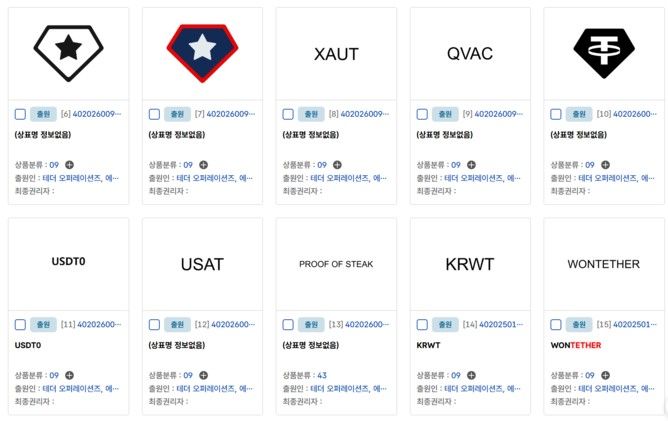
Tether, the company behind USDT, filed seven trademark applications with the Korea Intellectual Property Rights Information Service (KIPRIS). Two of the marks, KRWT and WONTETHER, point to a possible Korean won-pegged stablecoin.
The filings appeared in the KIPRIS database, with no public statement from the company. Observers read the two won-themed marks as the strongest hint yet that Tether wants a localized stablecoin in South Korea.
KIPRIS Filings Hint at a Won-Linked Token
Reports citing KIPRIS list seven Tether marks. The KRWT and WONTETHER applications have drawn the most attention.
KRW is the standard code for the South Korean won. WONTETHER reads as a direct fusion of the local currency and the company brand.
Both marks sit under Classification 09, which covers software and crypto-related digital products. Tether also registered Tether Gold (XAUT), QVAC, USDT0, USAT, and its shield logo under the same class.

Why a Won-Pegged Tether Could Matter
South Korea is preparing a Digital Asset Basic Act for stablecoins. The bill would force foreign issuers to set up a local branch before selling tokens to domestic users. That requirement has pushed major stablecoin firms to stake legal ground early.
A won-pegged Tether product would compete directly with a planned won stablecoin from a consortium of major South Korean banks. It would also pressure Circle and local fintech players testing similar designs.
Tether currently dominates stablecoin activity in South Korea by a wide margin. A locally branded won product could deepen that lead, or set up a direct collision with home-grown issuers.
Trademark filings are not products. Tether has not confirmed a launch, a partner, or any regulator dialogue tied to the marks.
One Filing Sits Outside the Crypto Frame
Among the applications, one stands apart. ‘PROOF OF STEAK’ was submitted under Classification 43, which covers food service and hospitality rather than software.
The phrase plays on the proof-of-stake consensus mechanism used by Ethereum (ETH) and other networks. Its commercial purpose has not been disclosed. The mark may link to merchandise, an event, or a side venture.
For now, the question of whether KRWT or WONTETHER becomes a real product sits with Tether. The coming regulatory cycle in Korea should reveal whether the marks signal a true rollout or a defensive legal hedge.
The post Tether Files 7 South Korea Trademarks, Sparking Won-Pegged USDT Speculation appeared first on BeInCrypto.
XRP failed its breakout and is now under $1.4. How low will sellers take it?
Ripple (XRP) Price Predictions: Analysis
Key support levels: $1.2, $1
Key resistance levels: $1.4, $1.6, $2
Breakout Failure Led to Reversal
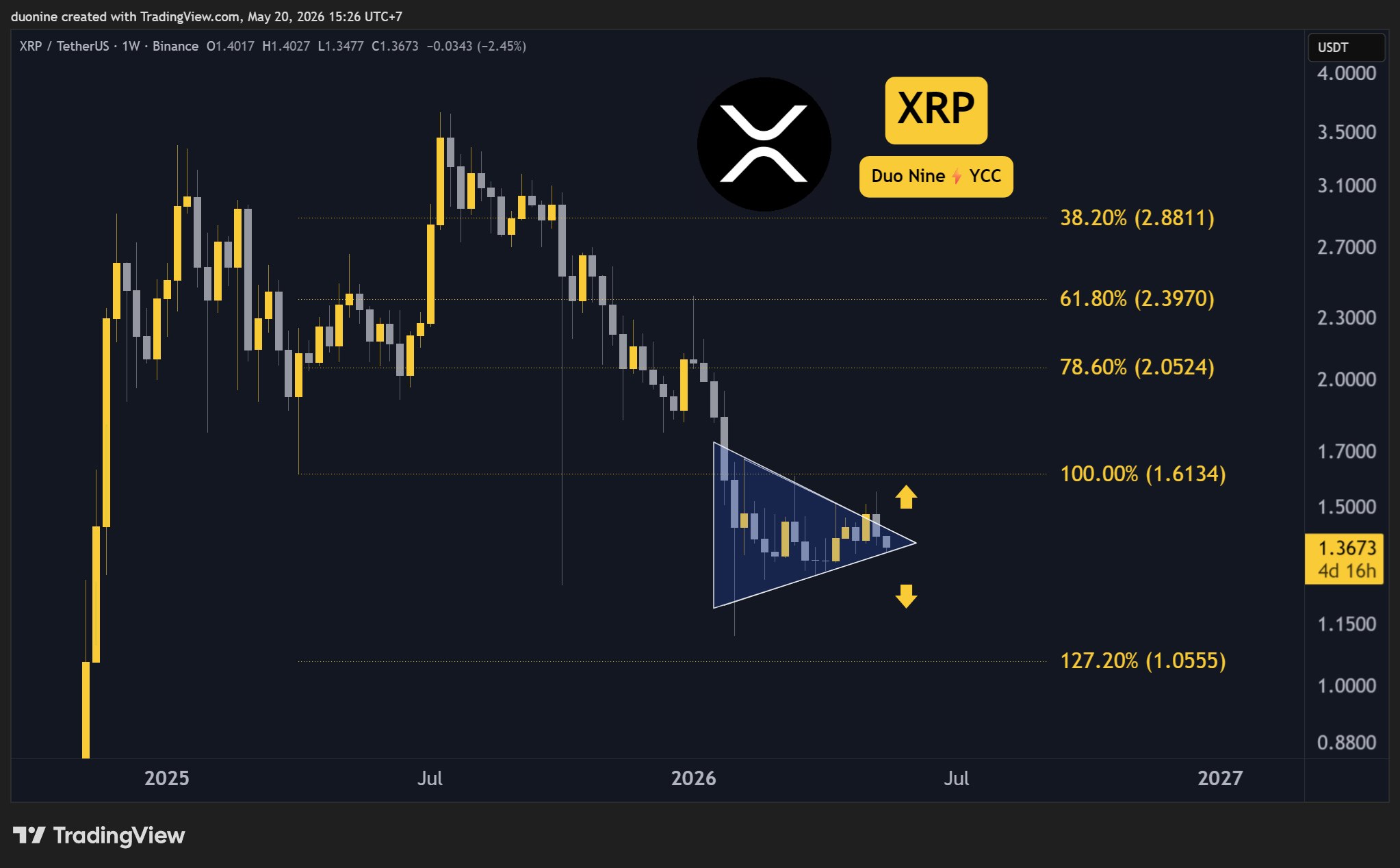
Initially, XRP broke above the blue pennant, triggering a bullish move and optimism. However, since then, the price fell back into the pennant and also broke below the key support at $1.4.
This price action could be interpreted as a bullish trap with a full reversal that puts sellers in charge. As long as $1.4 acts as resistance, lower lows are likely with $1.2 and $1 as key targets for bears.
Sellers Return
With the price unable to hold above $1.4, the chart turned bearish, and sellers have the upper hand right now. The drop under $1.4 was due to increasing sales volume, which gives confidence in this move.
If the price falls below the blue pennant, XRP is likely to make new lows and will probably struggle to contain selling pressure. Buyers could, however, make a stand around $1.2. Any failure there would open the way to $1.

MACD Showed Weakness
During the initial rally, the MACD formed lower histogram highs. This was an early bearish divergence, showing buyers don’t have the strength to sustain this uptrend.
This weakness was now exposed by the price, which failed to hold above $1.4. Moreover, the MACD moving averages are curving down and may soon do a bearish cross, which could keep the chart in a downtrend for some time.

The post Ripple (XRP) Price Predictions for This Week appeared first on CryptoPotato.


Bitget, the world’s largest Universal Exchange (UEX), has introduced a market framework aimed at strengthening oversight across listed assets, project teams, and market makers. The framework improvises post-listing surveillance, tightens project-side obligations, and accelerates action when abnormal trading behavior or suspicious wallet activity is identified.
It creates clearer accountability for listed projects and market makers, ensuring they operate responsibly, cooperate during risk reviews, and avoid conduct that could mislead users or disrupt market fairness.
Project and Market-Maker Accountability
Under the framework, newly listed projects remain subject to contractual obligations that prohibit price manipulation, artificial volatility, abusive liquidity practices, and conduct that may damage market integrity. Where violations are identified, action may be taken under applicable platform rules and legal agreements.
These measures may include applying or maintaining Special Treatment labels, displaying high-risk warnings, restricting token visibility, suspending deposits or withdrawals, freezing accounts suspected of manipulation, pausing trading pairs, revoking market-maker status, banning related projects, or proceeding with delisting where necessary.
Stronger Spot Risk Analysis
Spot trading risk analysis is being strengthened through a more structured asset review model. The system evaluates listed tokens across on-chain activity, technical fundamentals, community sentiment, and liquidity conditions, creating a traceable scoring structure that supports post-listing monitoring.
The model is designed to help identify contract-level concerns, abnormal wallet behavior, high holder concentration, weak liquidity, order-book imbalance, negative sentiment, and sudden deterioration in asset health.
Faster Escalation and User Warnings
When abnormal activity is detected, reviews will be escalated across project teams, market makers, wallet flows, and trading behavior. Promotional activity may also be paused for tokens under review where continued marketing could expose users to heightened risk.
The objective is to ensure that warnings and platform-side actions appear earlier, especially when a listed asset shows signs of deterioration or potential misconduct.
Regulatory Reporting and Industry Coordination
Following internal investigation, suspected project abuse, insider dumping, market-maker misconduct, wash trading, or other forms of market manipulation may be reported to relevant authorities in jurisdictions where the platform operates or is registered.
The framework also supports wider industry coordination among major exchanges to share verified market-abuse cases and reduce repeat misconduct across platforms.
Bitget will continue strengthening asset review, post-listing surveillance, and enforcement procedures so users can trade in an environment where listed projects, market makers, and the platform itself are held to higher standards.
Read the full announcement here.
About Bitget
Bitget is the world’s largest Universal Exchange (UEX), serving over 125 million users and offering access to over 2M crypto tokens, 100+ tokenized stocks, ETFs, commodities, FX, and precious metals such as gold. The ecosystem is committed to helping users trade smarter with its AI agent, which co-pilots trade execution. Bitget is driving crypto adoption through strategic partnerships with LALIGA and MotoGP™. Aligned with its global impact strategy, Bitget has joined hands with UNICEF to support blockchain education for 1.1 million people by 2027. Bitget currently leads in the tokenized TradFi market, providing the industry’s lowest fees and highest liquidity across 150 regions worldwide.
Risk Warning: Digital asset prices are subject to fluctuation and may experience significant volatility. Investors are advised to only allocate funds they can afford to lose. The value of any investment may be impacted, and there is a possibility that financial objectives may not be met, nor the principal investment recovered. Independent financial advice should always be sought, and personal financial experience and standing carefully considered. Past performance is not a reliable indicator of future results. Bitget accepts no liability for any potential losses incurred. Nothing contained herein should be construed as financial advice. For further information, please refer to our Terms of Use.
The post Bitget Introduces Market Integrity and Token Accountability Framework appeared first on BeInCrypto.


Newly unsealed filings detail a private chat dubbed ‘Bryce’s Secret’ that Terraform’s estate says gave Jane Street an informational edge before UST’s collapse.

Qivalis, the European banking consortium building a regulated euro stablecoin, expanded its ranks to 37 member institutions on Wednesday by adding 25 banks across 15 countries. Among the new members are ABN AMRO, Rabobank, Nordea and Intesa Sanpaolo. The Amsterdam-based group aims for a launch in the second half of 2026, according to a statement shared with Cointelegraph.
“We are not merely building payment rails; we are ensuring that European principles around data protection, financial stability and regulatory rigour are embedded into the next generation of digital money,” said Howard Davies, chairman of Qivalis’ supervisory board.
The expansion comes as European institutions intensify efforts to offer regulated alternatives to dollar-dominated stablecoins, which CoinGecko data show account for a large majority of the market. The push signals a broader push to embed euro-denominated on-chain infrastructure within the bloc’s regulatory framework.
Key takeaways
- Qivalis expands to 37 member banks, adding 25 institutions across 15 countries, with a targeted launch in H2 2026.
- Notable new members include ABN AMRO, Rabobank, Nordea and Intesa Sanpaolo, reinforcing cross-country participation.
- Spain emerges as the most represented country in the new wave, adding five banks and highlighting early euro-stablecoin adoption in the retail sphere.
- The expansion aligns with the European Union’s MiCA framework, as institutions seek a regulated euro-stablecoin backbone under EU rules.
- ECB President Christine Lagarde recently signaled a cautious stance on euro-stablecoins as Europe’s path to expanding the euro’s global role, illustrating regulatory tensions that accompany the initiative.
A broader push for a regulated euro stablecoin network
With 25 banks joining from 15 countries, Qivalis is accelerating its effort to create a unified, regulated euro-stablecoin infrastructure. The new members broaden the consortium’s geographic footprint, spanning Northern and Southern Europe, and reinforcing the bloc-wide ambition to offer a euro-denominated digital money system governed by European rules. Howard Davies framed the project as more than a payments layer; it is an attempt to embed core European values—data protection, financial stability and regulatory integrity—into a new form of money that can operate across borders and institutions.
In parallel with the expansion, the consortium has been engaging with crypto exchanges to prepare for a broader ecosystem around the euro stablecoin. Cointelegraph has reported that Qivalis has been in dialogue with venues ahead of the planned launch, signaling an intent to foster liquidity, trading access and custody within a compliant, MiCA-aligned framework. The plan is to tokenize, custody and manage on-chain euro-denominated assets with oversight suitable for European markets.
Spain leads the new member wave and euro adoption momentum
Spain stands out in the new roster, providing five additions: ABANCA, Banco Sabadell, Bankinter, Cecabank and Kutxabank. The country’s growing footprint among Qivalis members mirrors broader signs of euro-stablecoin uptake in Spain’s retail space, where data from Brighty has highlighted Spain as a leading market for Circle’s EURC usage. The strong presence from Spain reflects a wider European push to diversify away from USD-centric stablecoins toward euro-denominated on-chain services within a robust regulatory envelope.
In addition to Spain, Italy joined with two new banks, while France, Sweden, Greece, the Netherlands, Finland and Ireland each added two members. The spread across these markets underscores a pan-European appetite to integrate stablecoin rails into existing banking rails, blending traditional financial oversight with the benefits of digital asset rails under MiCA-compliant governance.
Tech backbone, governance and regulatory context
Qivalis is pursuing a covered, regulated pipeline for euro stablecoin issuance, with Fireblocks already chosen in a March collaboration to provide tokenization, wallet infrastructure and custody services, along with tools to support compliance. Jan Sell, the consortium’s CEO, has stressed that the euro should be carried on-chain by European institutions and governed by European rules, a stance that aligns with the bloc’s regulatory ambitions while inviting scrutiny from observers wary of how rapidly the sector evolves.
The push operates in a climate of contested momentum about the role of private sector money inside Europe’s monetary architecture. In early May, European Central Bank President Christine Lagarde suggested that stablecoins might not be Europe’s best route to strengthening the euro’s international reach, cautioning against a reflexive move to euro-backed equivalents in response to US dollar-stablecoins. The Qivalis expansion, therefore, sits at an inflection point: banks are eager to provide a regulated euro stablecoin alternative, but policymakers are weighing how such tools fit into broader monetary and financial stability objectives.
According to Cointelegraph reporting, the consortium has been engaging with crypto exchanges in anticipation of a euro-stablecoin launch, signaling a readiness to build an ecosystem that includes liquidity venues, wallets and custody aligned with European standards. This ecosystem-building effort is paired with MiCA-ready frameworks already shaping custody, identity verification, anti-money-laundering controls and data protection, which are intended to reduce compliance risk while enabling cross-border euro transactions on-chain.
What changes—and what remains uncertain
The most visible change is the accelerated diversification of Qivalis’ member base, bringing more European banks into a shared project that seeks to encode euro-denominated digital money within a carefully regulated perimeter. The heightened country representation suggests that banks across the EU are ready to experiment with on-chain euro rails, potentially unlocking new forms of settlement, cross-border payments and digital asset services for customers who need faster, cheaper and more transparent transactions than traditional correspondent networks offer.
However, the path forward remains cinched with regulatory nuances. Lagarde’s comments frame a cautious stance on the euro-stablecoin thesis as Europe experiments with on-chain money, and MiCA’s ultimate implementation will shape what is permissible, how liquidity is created, and which institutions can participate at scale. The H2 2026 target for launch sets a concrete timeline, but adoption will depend on how quickly member banks can harmonize compliance, risk controls and interoperability with external exchanges and wallets within the EU’s supervisory framework.
For investors and builders, the development signals a persistent appetite among European banks to offer regulated alternatives to dollar-dominated digital assets. The expansion also foreshadows potential competition among regional euro-stablecoin ecosystems, each anchored in national banking standards yet interoperable under EU-wide rules. As the MiCA regime matures and the ECB’s stance evolves, watchers should monitor how liquidity channels develop, how custody and identity standards converge, and whether consumer demand lives up to the regulatory promise of a more stable, transparent euro on the blockchain.
Readers should keep an eye on when Qivalis begins to align more tightly with exchanges and liquidity providers, and how the consortium’s governance evolves as more banks verify and participate in the euro-stablecoin framework. The next steps will reveal whether this is a turning point for euro-denominated digital money or a measured experiment navigating a complex regulatory landscape.

Shortly before a wave of resignations by senior contributors, the Ethereum Foundation published a bizarre governance document.
Obviously influenced by Vitalik Buterin’s beloved NFT collection Milady, whose floor price has declined 90% from its December 2024 peak, the illustrated “Mandate” PDF features lingerie-clad archers, a cartoon pledge carrying a penalty of death by suicide, and a headline on its front page, “HOPE SPRINGS ETERNAL IN THE HUMAN BREAST.”
The Ethereum Foundation Mandate document arrived on March 13, 2026. Its board signed it, crediting two artists for their artistic rendering of the text.
On the cover, an anime girl asks, “Ever dream this girl?” Random text bubbles assert, “My heart glitches for you” and “divinely guided and protected.”
A Milady e-girl on page 34 declares, “I can’t believe we all won forever.”
No departing contributor actually named the document as the reason for their exit, but the timing spoke loudly enough to draw widespread blame on social media.
All three Ethereum Foundation protocol leads have left within the past few months, and over half a dozen contributors announced resignations after Ethereum’s Mandate document.
EthereumDaily, with over 100,000 followers on X, blamed the 38-page Mandate for “intentionally shrinking” the workforce. “Forgot about the ‘sign or leave’ the new EF mandate. Seems to be the real reason behind departures?” wrote DefiIgnas.
Another fund manager blamed resignations on the document.
‘May the foundation fall on its own sword’
Page 11 features an illustration of the infamous seppuku (also known as hara-kiri) suicide pledge. Its version reads, “May the Foundation fall on its own sword if it fails to uphold its solemn promise to Ethereum.”
The license shown inside that illustration is the Source Seppuku License, a satirical software license hosted on the Remilia wiki.
Remilia is the collective that created the Milady Maker NFT collection. Buterin uses a Milady NFT for his profile photo on X.
The second clause of this “license” requires the actor to take his or her own life with a sword upon failure to uphold any of the pledges in the license, or upon modification or removal of any part of the license.
According to Cryptopolitan and reblogged elsewhere, Ethereum Foundation staff were asked to sign off on the Mandate document or face termination. Protos was unable to verify whether the foundation publicly commented on that allegation.

Milady, controversial to say the least
The Mandate’s visual vocabulary openly borrows from Milady, whose NFTs once traded above 7.3 ether (ETH) in December 2024 yet now trade below 1.2 ETH, an 84% decline in ETH or 91% decline in USD.
Unfortunately, value destruction for holders hasn’t been Milady’s only failure.
Milady’s founder Charlotte Fang (real name Krishna Okhandiar) resigned as Milady Maker CEO in May 2022 after investigators exposed him as the operator of a 4chan-connected suicide cult account, Miya.
Archived essays attributed to the Miya account used antisemitic and anti-black racism.
Okhandiar, posting as Fang, later admitted to being Miya. Floor prices of Milady NFTs halved during his resignation.
Eight days before the Mandate dropped, someone asked Vitalik on X, “why milady? (linked to kaliacc, miya, suicide cult, seppuku license, online abuse).”
“Kaliacc” references Kali Yuga Accelerationism, the white-supremacist accelerationist movement that Fang’s Miya account propagated.
Read more: Fresh Ethereum Foundation drama flares following core devs departure
Mass resignations from Ethereum Foundation
Tomasz Stańczak resigned as co-executive director in February 2026. He was less than a year into the role. The new mandate document followed in March.
Within weeks, more contributors stepped back from Ethereum Foundation roles: Josh Stark, Tim Beiko, Barnabé Monnot, and Trent van Epps, who departed to the Ethereum Protocol Guild.
Ethereum Foundation researchers Carl Beekhuizen and Julian Ma also resigned in mid-May. Alex Stokes started an open-ended “sabbatical.”
Got a tip? Send us an email securely via Protos Leaks. For more informed news and investigations, follow us on X, Bluesky, and Google News, or subscribe to our YouTube channel.


Ireland’s Criminal Assets Bureau and Europol have secured another 500 BTC tied to Clifton Collins, bringing recovered funds from the dormant wallet cluster to 1,000 BTC.
Summary
- Bitcoin seizure grew after Ireland and Europol secured another 500 BTC from Clifton Collins-linked wallets.
- Arkham data shows 1,000 BTC have moved from the dormant entity since March 2026 now.
- About 5,000 BTC remain labeled as lost keys, keeping the Irish case under market watch.
Ireland’s Criminal Assets Bureau said it secured another cryptocurrency wallet linked to an earlier criminal case, with support from Europol’s European Cybercrime Centre. The wallet held 500 Bitcoin, worth about $38.7 million at the time of the reported move.
The bureau said Europol hosted operational meetings in The Hague and supplied “highly complex technical expertise and decryption resources” that helped investigators access the wallet. Earlier related coverage reported that CAB had already seized 500 Bitcoin from a Collins-linked wallet in March.
Collins Bitcoin cache returns to focus
The case traces back to Clifton Collins, an Irish drug dealer who bought 6,000 Bitcoin in late 2011 and early 2012 using proceeds from cannabis sales. The Guardian reported that Bitcoin traded near $5 when Collins acquired the coins.
Collins printed the private keys on paper and hid them inside the aluminum cap of a fishing rod case at a rented home in County Galway. After his 2017 arrest, the property was cleared, and the fishing gear was believed to have been taken to a dump.
Arkham tracks 1,000 BTC in movements
Arkham said a wallet linked to Collins moved another 500 BTC, worth about $38 million. The blockchain analytics firm said the move followed an earlier 500 BTC transfer to Coinbase Custody in March, bringing total funds moved from the entity to 1,000 BTC.
The latest 500 BTC did not follow the same route. Arkham said the new transfer went to a Wintermute-linked Binance deposit address, while the March transfer went to Coinbase Custody.
Lost-keys case remains active
Arkham’s public Clifton Collins page tracks wallets, holdings, inflows, outflows and counterparties tied to the entity. The page confirms the blockchain analytics label, though full transaction tables require login.
Arkham said Collins bought 6,000 BTC in 2011 and 2012, and that the private keys were long assumed lost after the fishing rod case was discarded. The firm added that another 500 BTC leaving the wallets shows the once-dormant stash is active again.
Moreover, the latest movement also comes as on-chain watchers track other government-linked crypto wallets. Arkham maintains a U.S. Government entity page that tracks holdings, wallets, inflows, outflows and counterparties.
For Ireland, the Collins case now stands as a rare example of authorities gaining access to Bitcoin once widely viewed as unreachable. Around 5,000 BTC still appear tied to the broader lost-keys cache, leaving the case open for further wallet activity.
XRP exchange-flow activity is beginning to show a different pattern after several weeks of steady deposit pressure centered on Bybit, according to new analysis from CryptoQuant.
Data from the XRP Multi-Exchange Daily Depositing/Withdrawing Transactions Delta shows that Bybit’s transaction delta moved back close to neutral around May 16 and ended a stretch of strong positive readings that had continued from mid-April through mid-May.
XRP Exchange Behavior Flips
Persistent deposit-side activity is often viewed as a sign of possible selling pressure because assets transferred onto exchanges are generally more accessible for trading or liquidation. This indicates that the pressure has now eased, at least based on transaction count data.
While Bybit’s earlier deposit imbalance appears to have faded, Binance and Coinbase are now showing the opposite trend, as withdrawal transactions overtook deposits on both exchanges. This is a major change from the earlier exchange-flow structure dominated by Bybit deposits.
The setup for XRP has therefore changed, as the market is no longer displaying the same broader exchange-deposit activity seen over the past month. Instead, exchange behavior now points to a rotation in flows, as Bybit cools off while Binance and Coinbase experience stronger withdrawal-side activity.
CryptoQuant stated that the metric tracks transaction delta rather than the total amount of XRP being transferred, meaning it does not reveal the exact volume of tokens entering or leaving exchanges. Even so, the directional change remains important because it highlights a clear shift in transaction behavior across several major trading platforms.
Tightening Price Range and Strong Inflows
Alongside the changing exchange activity, technical indicators are starting to point toward a possible increase in XRP volatility.
Recently, crypto analyst Ali Martinez found that XRP’s Bollinger Bands on the 3-day chart have tightened to their narrowest level in over a year, in what appears to be a potential major price move ahead. The crypto asset has traded between $1.29 and $1.50 for months. Martinez said a close above $1.50 could push XRP toward $1.80, while a drop below $1.29 may end up triggering deeper downside pressure.
On the institutional side of things, XRP appears to have defied market panic. As reported by CryptoPotato, even as both investment products dedicated to Bitcoin and Ethereum faced significant sell pressure, XRP managed to rake in inflows of over $67 million last week.
The post Key XRP Metrics Signal Bullish Shift After Weeks of Heavy Sell-Offs appeared first on CryptoPotato.

Stellantis stock under pressure as automaker tries to woo Wall Street

Bitcoin node counters go dark following Bitnodes expiry

2027 NFL Draft: Steelers, Browns among teams most likely to need QB


-

 Crypto World4 days ago
BloFin War of Whales 2026 Grand Prix opens registration for $5M trading championship
-

 Fashion5 days ago
Weekend Open Thread: Theory – Corporette.com
-

 Crypto World5 days ago
E-Estate Announces 1 Year Live: Washington DC Summit as Real Estate Tokenization Enters Its Next Phase
-

 Tech5 days ago
Tech Moves: Microsoft AI leader jumps to OpenAI; former AI2 exec joins Meta; and more
-

 Tech5 days ago
Google reimburses Register sources who were victims of API fraud
-
 Crypto World6 days ago
Google’s Gemini AI Predicts Incredible Solana Price by the End of 2026
-

 Business5 days ago
H&R Real Estate Investment Trust (HR.UN:CA) Q1 2026 Earnings Call Transcript
-

 Sports5 days ago
Napoleonic enters 2026 Doomben 10,000 field via Abounding withdrawal
-
 Entertainment6 days ago
Zara Larsson Has Blunt Response To Chris Brown Diss
-
 Crypto World7 days ago
Two AI Tokens Lead May Rally, But Risks Are Rising
-

 Crypto World5 days ago
BeInCrypto 100 Institutional Awards Nomination: KAST for Best Digital Assets Neobank and Best Digital Assets Fintech
-

 Fashion3 days ago
On the Scene at Gucci’s Cruise Show in New York City: Mariah Carey, Kim Kardashian, Lindsay Lohan, Iman, and More!
-
 Crypto World4 days ago
Bitcoin Battles US Bond Nerves With BTC Price Dip Toward New May Lows
-
 Crypto World5 days ago
Wall Street’s Boldest Gold Prediction Has Russians Rushing to Buy
-

 Fashion4 days ago
Trending Western Style Vests Perfect for Summer
-

 Politics6 days ago
DWP PIP Timms review continues to be an absolute farce
-

 Entertainment5 days ago
David Letterman Returns to Late Show, Blasts Cancellation
-

 Crypto World5 days ago
ICE and CME urge US regulators to curb Hyperliquid energy trading
-

 Fashion3 days ago
Amazon Sundays: Memorial Day Hosting
-
 Crypto World6 days ago
Lido Finance Selects Chainlink CCIP as the Official Cross-Chain Infrastructure for wstETH Security
You must be logged in to post a comment Login