

Crypto World
SEC proposal could open crypto markets to tokenized public stocks



The U.S. Securities and Exchange Commission has reportedly prepared an “innovation exemption” that could allow blockchain platforms to offer tokenized versions of publicly traded stocks, including tokens issued without direct approval from the underlying companies.
Summary
- The SEC is reportedly preparing an exemption that could allow tokenized trading of public company shares on blockchain platforms.
- Bloomberg reported that the proposal may require tokenized stocks to carry the same rights as traditional shares, including dividends and voting access.
Bloomberg reported on Monday, citing people familiar with the discussions, that the exemption could be introduced as early as this week as the agency explores ways to expand tokenized securities trading beyond conventional stock exchanges and into crypto-based markets.
Under the proposal, the SEC has discussed rules that would require tokenized shares issued by third parties to provide the same rights attached to traditional common stock, including voting privileges and dividend access. Sources cited in the report said tokens that fail to meet those standards could face delisting requirements.
People familiar with the matter also told the media outlet that SEC Commissioner Hester Peirce has played a central role in advancing the exemption effort, although the report noted that final details are still being negotiated and could change before any formal announcement.
Wall Street firms are pushing tokenization plans
Across the financial industry, tokenization has gained traction as firms explore blockchain systems that could support round-the-clock trading and faster settlement processes.
Earlier this year, Intercontinental Exchange, the parent company of the New York Stock Exchange, said it was preparing a blockchain-based platform designed for 24/7 trading and settlement of stocks and exchange-traded funds. The company described the project as part of its effort to modernize post-trade infrastructure using distributed ledger technology.
Elsewhere in the sector, crypto exchange Bullish strengthened its tokenization business earlier this month after acquiring transfer agent platform Equiniti in a $4.2 billion deal. Bullish is led by former NYSE president Tom Farley.
Supporters of tokenized equities have argued that blockchain-based shares could allow investors outside the United States, or users without access to traditional brokerage services, to gain exposure to public companies such as Nvidia, Google, and Tesla through crypto platforms.
Concerns emerge over issuer involvement
Even as the SEC considers the exemption, Bloomberg reported that some officials inside the agency remain opposed to allowing tokenized stock trading without direct issuer participation.
“If third parties can tokenize Apple or Amazon without the issuer at the table, there’s no theoretical limit on how many wrappers of the same company exist at once. This could create a whole new level of market fragmentation and could leave investors less certain what their shares are actually worth at any moment,” Brett Redfearn, president of crypto-native tokenization platforms, Securitize, said in a comment.
Tokenized investing has also expanded into private markets, where blockchain platforms have started offering exposure to high-profile startups before public listings.
Several companies tied to those offerings have already objected to the practice. According to previous public statements, both OpenAI and Anthropic have opposed unauthorized tokenized products linked to their valuations.
The SEC’s reported discussions around tokenized securities have surfaced only days after the Senate Banking Committee advanced the CLARITY Act, legislation that would establish a federal framework for parts of the digital asset market before heading to a Senate floor vote next month.


SBI Holdings has filed for Japan’s first spot Ripple XRP ETF, deliberately skipping Ethereum and targeting $32 billion in institutional assets. It is seen as a structural decision that reflects Japan’s regulatory environment and SBI’s decade-long XRP infrastructure investments as much as it does pure market preference.
The filing reveals two distinct products: a Crypto-Assets ETF tracking Bitcoin and XRP together, and a Digital Gold Crypto ETF allocating more than 50% to gold with added crypto exposure for risk-sensitive investors. Neither product includes Ethereum.
Japan’s Financial Services Agency has been advancing a framework that would reclassify crypto more explicitly as financial products. A shift that makes regulated ETF wrappers structurally viable for pension funds and insurance capital for the first time ever.
Why Ripple Over Ethereum? The Regulatory and Infrastructure Logic Behind SBI’s Decision
SBI’s choice is not an endorsement of XRP’s technology over Ethereum’s. It is a product of institutional infrastructure and regulatory fit that has been building in Japan for years.
SBI Ripple Asia, a joint venture between SBI Holdings and Ripple, has operated in Japan since 2016, giving SBI deep XRP liquidity access, established custody rails, and pre-existing compliance frameworks tied to Ripple’s payment network. Ethereum carries none of that domestic institutional weight in Japan’s specific market structure.
WHY ASIA GOES HARD ON XRP — 𝗕𝗮𝗻𝗸XRP (@BankXRP) May 17, 2026


Fiona Murray, Ripple APAC VP: "Low interest rate economies like Japan and Korea push retail toward ALTERNATIVE ASSETS the same way Japan built the world's biggest RETAIL FX CULTURE searching for yield."
when your savings account pays 0%… you find… https://t.co/ZmaMvijs8A pic.twitter.com/MRm6YnTG5G
Yoshitaka Kitao, SBI Holdings’ CEO, has been one of Ripple’s most visible corporate advocates in Asia, and is making the XRP ETF filing a logical extension of a strategic relationship. SBI isn’t launching a Japan Crypto product opportunistically; it is converting existing infrastructure into a regulated investment wrapper.
The U.S. market moved from Bitcoin ETF to Ethereum ETF approval in sequence, partly driven by SEC precedent and Ethereum’s regulatory classification as a commodity. Japan’s FSA is navigating a different framework, one where XRP’s deep local adoption and SBI’s Ripple partnership make it a more straightforward regulatory argument than Ethereum would be.
Which crypto should President Trump add to this taxonomy next? — X Finance Bull (@Xfinancebull) May 18, 2026

The SEC/CFTC taxonomy listed 16 digital assets as digital commodity examples.
These are the leaders:$BTC store of value. $ETH smart contracts. $XRP cross-border payments. $LINK oracle network. $HBAR… pic.twitter.com/qE8aPOT8n3
If approved, the XRP-linked ETF would be a first for Japan, giving local investors regulated spot-style exposure without the risk of offshore exchange.
The regulatory clarity developing in major markets has accelerated institutional timelines globally, and Japan is moving on its own terms.
Discover: Top Crypto Assets for Portfolio Diversification in 2025
XRP Price Impact: $32 Billion Institutional Demand
The SBI filing is a medium-term demand catalyst, not an immediate price trigger. ETF approval timelines in Japan are measured in months, and the FSA’s reclassification framework is still in process. But the directional signal for institutional investment in XRP is unambiguous.

Japan’s FSA could advance the crypto reclassification framework by this year, so the $32 billion addressable market begins converting.
Broader altcoin ETF momentum is also building globally. Grayscale and VanEck are both advancing BNB ETF filings in the U.S., confirming that regulated altcoin exposure is now a product category, not an experiment. SBI is positioning Japan at that frontier.
Discover: Best Crypto Presales With Early-Mover Upside in 2025
The post The Ripple Factor: Why SBI Is Prioritizing XRP Over Ethereum for Japanese ETFs appeared first on Cryptonews.
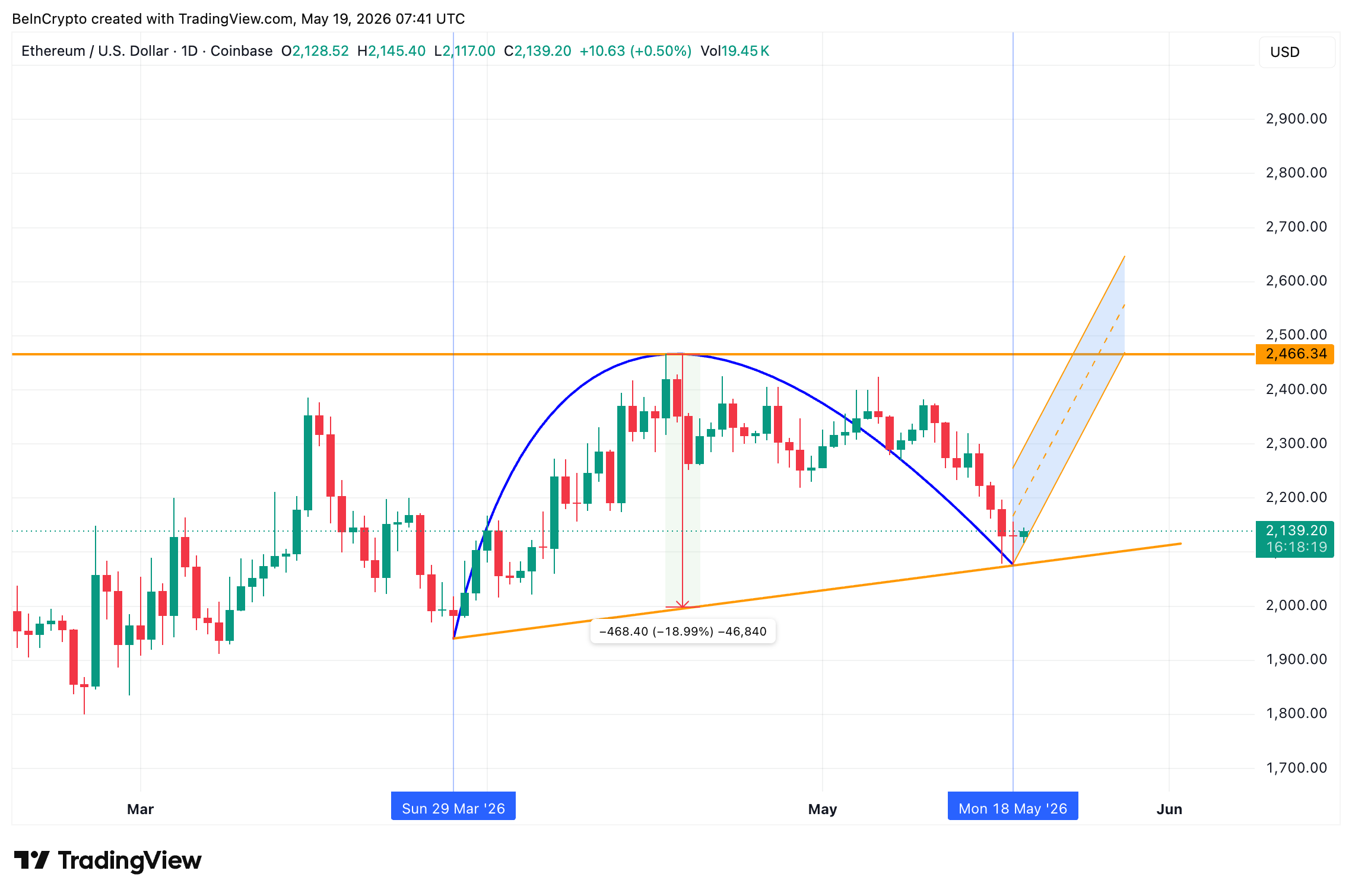
Ethereum (ETH) price is stalling near $2,140 as a sharp DeFi erosion since January now matches a bearish chart structure carved out over the past seven weeks.
The lag against Bitcoin and a sliding holder cohort suggest the price weakness may be more than a routine pullback. The structure on the daily chart and the on-chain data tell the same story from different angles.
Ethereum Price Mirrors DeFi TVL Collapse Since January Peak
Ethereum has carved an inverted cup pattern on the daily chart between March 29 and May 18. The current rebound looks more like a handle of the inverted cup.
Want more token insights like this? Sign up for Editor Harsh Notariya’s Daily Crypto Newsletter here.
The formation is a bearish setup where price peaks in the middle of a rounded top and then forms a brief recovery handle. The pattern signals continuation lower if the cup’s neckline breaks.

The price structure tracks the network’s deteriorating DeFi position. Ethereum DeFi TVL has fallen from $106.687 billion on January 15 to $62.957 billion as of May 18, a drop of nearly 41% in four months.
The damage extends into the same window that produced the bearish pattern. Around late March, just before the inverted cup began forming, the network’s DeFi TVL stood near $80.32 billion. It has shed roughly $17 billion since, mirroring the cup’s descent on the price chart. This fundamental erosion could be the reason why Bitcoin is up 2% month-on-month but ETH is down 8%. That explains the 10% lag between the top two cryptocurrencies.

The handle now forming shows a brief bounce. Whether this rebound has legs depends on whether the underlying network activity stabilizes, or whether other holder cohorts confirm the same caution.
Mid-Term Holders Cut Stake as DeFi Stress Spreads
On-chain data from Glassnode reinforces the weakness. The HODL Waves indicator, a metric that tracks the share of Ethereum supply held across different age buckets, shows the 3-month to 6-month cohort has dropped sharply.
The cohort held 18.63% of total ETH supply on April 7, when the inverted cup was still forming its right side. As of May 18, the same cohort holds just 12.73%, a roughly six-percentage-point decline in six weeks.
The drop matters because the 3m-6m bucket captures mid-term holders, often a steadier base than short-term speculators. Their decision to either spend ETH or let them age out without rebuilding the bucket suggests possible loss of conviction, tied to the same DeFi erosion playing out across the network.

With both Ethereum DeFi TVL and a steady holder cohort sliding together, the case for a deeper move has built quietly underneath an ETH price chart that still looks indecisive. The chart now becomes the decider.
Ethereum Price Levels That Decide the 19% Risk
Ethereum price needs to clear $2,132 immediately to keep the handle’s bounce alive. A break above $2,210, the 0.382 Fibonacci level drawn from the $1,799 swing low to the $2,464 swing high, would mark the first sign of returning strength.
The pattern only begins to weaken if ETH reclaims $2,307. It is fully invalidated above $2,464, the prior peak that defines the cup’s rim.
On the downside, a failure at $2,132 exposes $2,087, the neckline of the formation. A daily close below $2,087 would confirm the breakdown.
The measured-move target then sits at $1,690. This level is roughly 19% below neckline and carries the full risk built up by the cup’s depth.

The pattern nuance worth flagging is that inverted cup and handle setups only confirm on a clean break below the neckline. Until that happens, the handle bounce remains in play. The $2,087 floor separates a recovery toward $2,210 from a measured slide toward $1,690.
The post Ethereum Price Slips 10% Behind Bitcoin as DeFi Engine Loses $43 Billion appeared first on BeInCrypto.
Fundamental Background
As a result of the military conflict between the United States and Iran, the combined volume of halted oil production in Iraq, Saudi Arabia, Kuwait, the UAE, Qatar and Bahrain reached 10.5 million barrels per day in April, triggering record declines in global oil inventories. The U.S. Energy Information Administration forecasts a drop in global inventories of 8.5 million barrels per day in the second quarter of 2026 before supplies through the strait begin to recover.
An additional structural factor came from the UAE’s withdrawal from OPEC, which took effect on 1 May 2026 and reduced the cartel’s available spare production capacity. On the diplomatic front, negotiations continue without clear progress: according to available reports, Iran is prepared to accept a long-term nuclear freeze, but not the full dismantling of its nuclear programme, while both sides continue discussing conditions through intermediaries.
Technical Picture
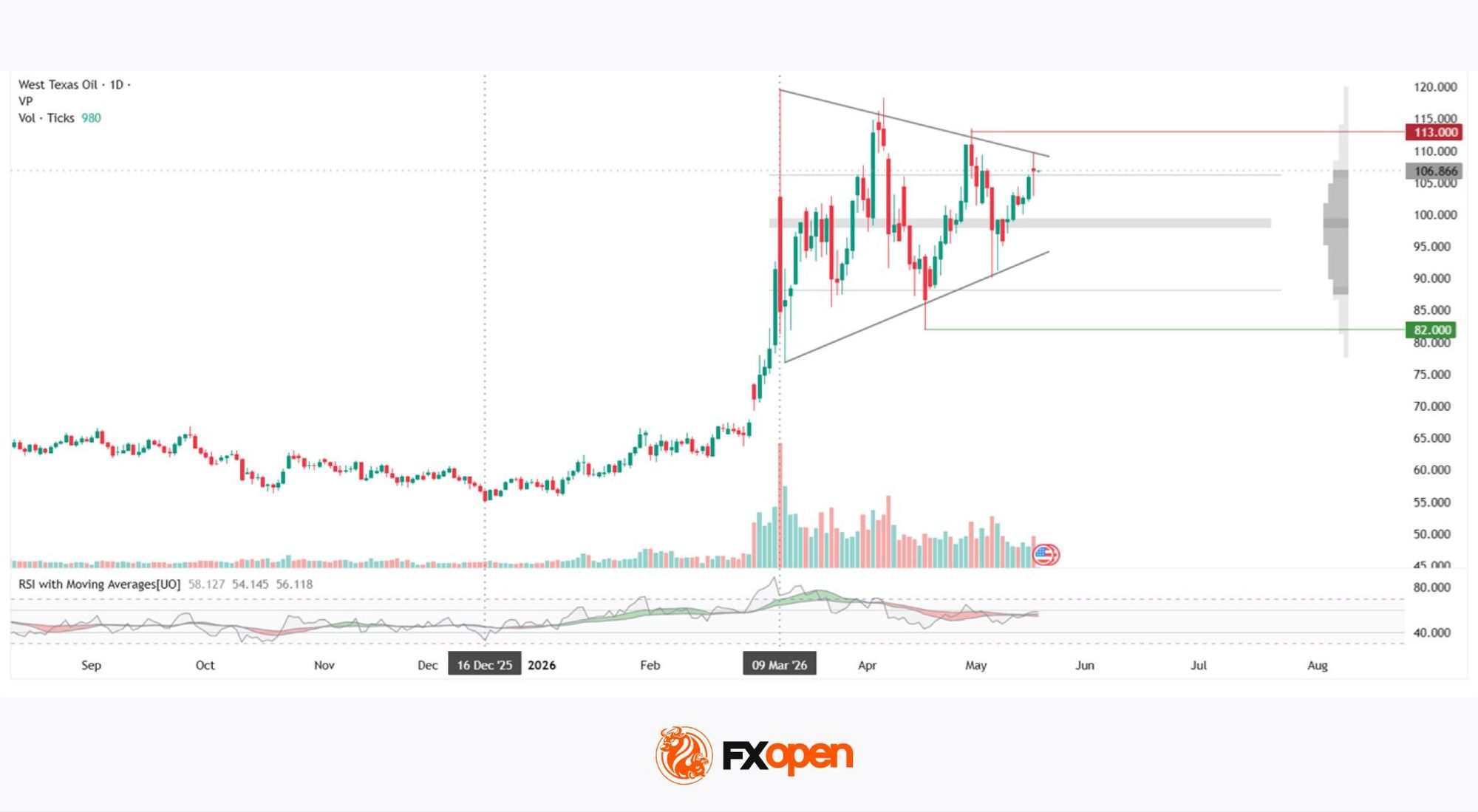
Since the sharp acceleration recorded on 9 March 2026 amid a peak surge in vertical volume, WTI crude has formed a symmetrical contracting triangle on the daily timeframe. The upper boundary of the pattern extends from the March high near 120 and continues to be actively tested by price action. The triangle boundaries are gradually converging, creating conditions for a future impulsive breakout from the formation.
At present, the price is testing the upper boundary of the triangle above the upper edge of the profile. The market volume profile covers the 88–106 range.
The point of control (POC) is located within the 98–99.5 range and remains the main obstacle for sellers. Current vertical trading volume remains moderate and continues to decline relative to the March peaks. The nearest resistance level stands at 113, while the key support level is located at 82.
The RSI + MAs indicator shows readings of 58, 54 and 56 — all readings remain above the neutral 50 level, although without a strong directional impulse. All three lines are clustered together, with neither buyers nor sellers holding a clear advantage.
Key Takeaways
The current price structure is shaped by a balance between the risk premium linked to potential supply disruptions through the strait and uncertainty surrounding the timing of supply restoration. The flat RSI dynamics and the fact that price remains trapped within the triangle continue to support a wait-and-see market stance.
Start trading commodity CFDs with tight spreads (additional fees may apply). Open your trading account now or learn more about trading commodity CFDs with FXOpen.
This article represents the opinion of the Companies operating under the FXOpen brand only. It is not to be construed as an offer, solicitation, or recommendation with respect to products and services provided by the Companies operating under the FXOpen brand, nor is it to be considered financial advice.

Bitcoin price is holding its $77,000 support in a brutal week that sees it falling from $83,000 to as low as $76,000 despites analysts calling for a single bullish prediction. However, for now, Iran has launched a state-backed, bitcoin-settled maritime insurance platform for cargo transiting the Strait of Hormuz.
It’s a move that could redefine how sanctioned economies interact with crypto infrastructure. The full operational details remain thin at the moment, but the implications for Bitcoin’s role in global trade finance are anything but.
Iran’s Ministry of Economic Affairs and Finance rolled out a platform called Hormuz Safe around May 16–18. The service allows Iranian shipping companies and cargo owners to pay insurance premiums in Bitcoin, with policies described as “cryptographically verifiable” and activating upon on-chain confirmation.
The report notes that coverage is initially restricted to Iranian entities, explicitly excluding vessels linked to states involved in the US-Israeli conflict. Officials cite potential annual revenues exceeding $10 billion if Hormuz Safe captures meaningful traffic through a chokepoint handling roughly 20% of global seaborne crude.
Discover: The best pre-launch token sales
Bitcoin Price Prediction: $80,000 Before Summer With The Help Of Geopolitical Demand
Bitcoin current price is consistent with a coiling consolidation pattern that has been flagged across multiple desk notes. Volume remains moderate, suggesting the move hasn’t yet attracted a decisive wave of momentum buying.
Key support sits in the $75,000 zone, a region that served as hard resistance through March and April before flipping to a base. Overhead resistance clusters between $80,000–$81,000, just below its local high this month.

Bitcoin’s price action has already shown sensitivity to geopolitical headlines, and Iran’s Hormuz Safe announcement injects a new demand narrative for sovereign-level Bitcoin adoption in energy trade settlement.
What bulls want is for ETF inflows to remain supportive, macro conditions to hold, and the Hormuz Safe story to drive institutional FOMO. If all those happen, BTC could re-tests $80,000 resistance soon
Longer-horizon price models point toward the $80,000–$100,000 range for the next impulse leg if the bull cycle resumes. However, the path there depends heavily on whether catalysts like Hormuz Safe translate into sustained demand or regulatory noise.
Discover: The best crypto to diversify your portfolio with
Bitcoin Hyper to Run as BTC Tests Institutional Limits
Here’s the uncomfortable truth for Bitcoin bulls: the Hormuz Safe announcement exposes exactly what holds Bitcoin back at scale. Slow settlement, high fees during congestion, and near-zero programmability make raw BTC a clunky rail for complex financial products like insurance contracts.
Bitcoin Hyper ($HYPER) is positioning itself as the infrastructure fix of Bitcoin. It is billing itself as the first-ever Bitcoin Layer 2 with full Solana Virtual Machine (SVM) integration, designed to deliver faster smart contract execution than Solana itself while preserving Bitcoin’s security and trust model.
The project has raised $32 million in its ongoing presale, with tokens currently priced at $0.0136. A Decentralized Canonical Bridge handles BTC transfers natively, while high 35% APY staking rewards early participants for locking tokens.
Hyper’s use case is precise: fast, low-cost, programmable Bitcoin. It offers exactly what an insurance settlement rail requires.
Research Bitcoin Hyper before the next price tier comes.
The post Bitcoin Price Prediction: Iran Starts BTC-backed Shipping Insurance for Hormuz appeared first on Cryptonews.
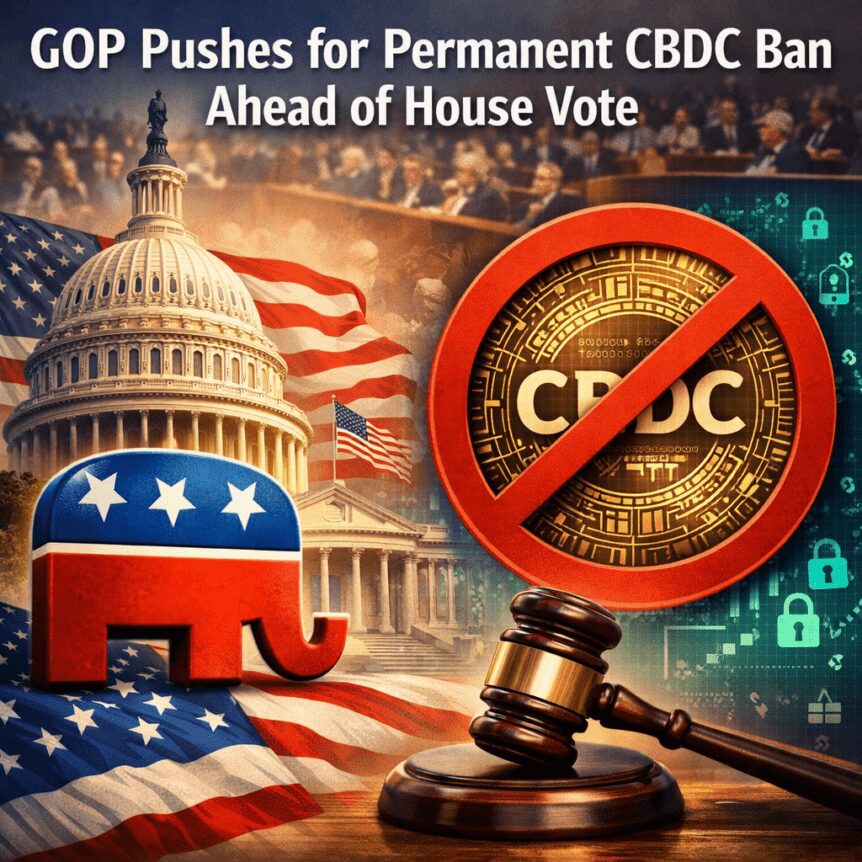
A bipartisan push in the U.S. Congress aims to permanently block a Federal Reserve-issued central bank digital currency (CBDC), with House lawmakers preparing to vote on amended language this week. The initiative comes as the Senate previously included a 2030 sunset on any CBDC issuance in a housing-focused bill, a measure now facing a parallel path in the House that would enshrine the ban for good. If approved, the House version would send the legislation back to the Senate for potential revisions before it could reach President Donald Trump’s desk for signature.
Key takeaways
- The House is set to vote on an amended bill that would make a permanent ban on a U.S. CBDC, reversing what its sponsors call a “backdoor” path to a central bank digital currency.
- The Senate’s version, contained in a housing bill introduced by the Banking Committee, would ban the Fed or any Federal Reserve bank from issuing a CBDC or similar instrument through December 31, 2030.
- Alternatives to the House measure exist in Congress, including the Anti-CBDC Surveillance State Act, which would block a CBDC outright, and a separate No CBDC Act proposed by another senator; both have faced stalled or partial progress.
- Global context remains limited: the Atlantic Council tracker counts only three countries with official CBDCs deployed and about 41 more in pilots, underscoring a fragmented international landscape amid domestic policy debates.
House moves toward a permanent CBDC ban
In its amended form, the House bill is positioned as a corrective measure to “stop” a CBDC before it could be launched. Supporters contend that the language would seal off any potential path to a federally issued digital currency and would tone down concerns about privacy, surveillance, and central control over monetary policy. The amended legislation is expected to go to a vote in the House this week. If it passes, the bill would return to the Senate, where it could undergo further amendments before facing the White House pathway.
Representative Warren Davidson, a Republican member of the House, has been a vocal advocate for a permanent CBDC ban. He argued that the House should not accept a staged rollout or a sunset framework, insisting that the “2030 sunset works a pre-launch development period.” In comments carried by his public posts, he framed the House vote as a potential bipartisan win on housing affordability by rejecting what he described as a go-live date for a central bank digital currency “using housing as the Trojan Horse.”
Senate’s 2030 CBDC ban and the housing bill context
The Senate version of the CBDC ban emerged from the Banking, Housing and Urban Affairs Committee’s March release. While the broader bill targets federal housing programs, a dedicated section prohibits the Federal Reserve System or any Fed bank from issuing a CBDC or similar instrument through December 31, 2030. The aim appears to be a temporary prohibition rather than an open-ended policy shift, though the House’s amendments shift the debate toward permanence. As with any congressional maneuver, the path forward remains contingent on floor votes and potential reconciliations between chambers.
Alternative bills and the broader CBDC debate
Beyond the main House and Senate tracks, lawmakers have pushed rival proposals that emphasize privacy protections and a more comprehensive rejection of CBDCs. Tom Emmer, the House majority whip, has pressed forward with the Anti-CBDC Surveillance State Act. The measure, which passed the House on July 17 but has yet to clear the Senate, would block the Federal Reserve from creating or issuing a CBDC. Emmer has framed the bill as a bulwark against what he calls surveillance-oriented monetary policy, arguing that a U.S. CBDC could mirror the Chinese model and erode financial privacy.
In a separate strand, Senator Mike Lee introduced the No CBDC Act to prohibit the Fed or Treasury from issuing a CBDC, though it has stalled in Congress. The dispersion of bills reflects a broader ideological split over whether the United States should develop a digital dollar at all, and under what safeguards or privacy protections.
Where the world stands on CBDCs
Context outside the United States continues to evolve at a varied pace. The Atlantic Council’s CBDC tracker shows that only Nigeria, Jamaica, and the Bahamas have officially deployed a CBDC as of now, while a larger group—41 countries—are reportedly in some stage of pilot testing. The domestic debate in Washington unfolds against this uneven global backdrop, with lawmakers weighing the implications for financial inclusion, privacy, and the future of monetary sovereignty.
Watching the middle ground and the next steps
Even as the House and Senate pursue their respective paths, the legislative process remains dependent on cross-chamber negotiations. If the House passes its amended bill, lawmakers will face a new set of questions in the Senate about timing, scope, and potential revisions. Any final version would then require presidential approval to become law. In the nearer term, observers should monitor whether the Senate moves to accept or alter the House language, and how those choices influence the broader policy discourse around digital currencies and financial privacy in the United States.
As advocates push for or against a U.S. CBDC, the policy debate is likely to sharpen questions about how a digital dollar could impact users, developers, and financial institutions. The discussions touch on practical concerns—like access to banking services and the usability of digital payments—and larger questions about state power, data privacy, and the role of central banks in a digitized economy.
The next few weeks could reveal whether lawmakers coalesce around a single approach or continue to test multiple, sometimes conflicting, visions for a U.S. CBDC—and what those choices mean for the broader crypto and fintech ecosystems that ride alongside traditional financial rails.


The partnership underscores both the rapid growth of equity perpetuals in onchain markets and Nasdaq’s broader strategy to support tokenized equity trading infrastructure.

Key Takeaways
- OpenAI and its leadership team successfully defended against Musk’s legal challenge after a California jury determined his claims were time-barred.
- Musk’s central argument alleged OpenAI illegally “stole a charity” through its nonprofit-to-for-profit transformation.
- The decision eliminates approximately $134 billion in potential liability that had been looming over OpenAI.
- Microsoft stock edged higher following the announcement, while Tesla stock dropped 3% on Monday trading.
- Despite Musk’s intention to appeal, legal analysts indicate the likelihood of reversal is minimal.
A California jury has ruled against Elon Musk in his lawsuit targeting OpenAI and its co-founders Sam Altman and Greg Brockman. The Monday decision found the defendants bore no liability, determining that Musk’s legal action was filed beyond the applicable statute of limitations.
The proceedings unfolded over three weeks at the US District Court for the Northern District of California in Oakland. Judge Yvonne Gonzalez Rogers formally accepted the jury’s determination.
Musk’s complaint centered on accusations that OpenAI‘s transformation from nonprofit to for-profit entity resulted in improper financial gain for Altman and Brockman. He maintained his financial contributions were made with the explicit expectation the organization would maintain its nonprofit status.
The AI research company was established in 2015 by Musk, Altman, and additional co-founders. Musk departed the organization in 2018, years before its corporate restructuring occurred.
Courtroom Proceedings and Arguments
Throughout the proceedings, Musk’s legal representative Steven Molo attempted to undermine Altman’s credibility. He highlighted Altman’s temporary removal from OpenAI’s board in 2023, when directors cited concerns about his lack of consistent candor. The CEO was returned to his position within days.
“Sam Altman’s credibility is directly at issue in this case,” Molo addressed the jury. “If you cannot trust him, if you don’t believe him, they cannot win.”
OpenAI’s defense attorneys countered these assertions, presenting testimony from numerous witnesses who verified that Musk never imposed nonprofit conditions on his financial contributions. The defense further emphasized the timing issue, asserting the lawsuit was initiated beyond permissible time limits.
Musk declared his appeal intentions on X. “There is no question to anyone following the case in detail that Altman and Brockman did in fact enrich themselves by stealing a charity,” he posted. “The only question is WHEN they did it.”
Carl Tobias, a law professor at the University of Richmond, informed Barron’s that appeal prospects appear unfavorable. “I think the case is pretty much over,” he stated. “It’s all fact specific, so I don’t think there’s any legal question there.”
Financial Implications for OpenAI and Key Stakeholders
The ruling represents a significant victory for OpenAI and its investment partners. According to Wedbush analyst Dan Ives, the decision eliminates roughly $134 billion in potential damages that had been casting uncertainty over the company.
Microsoft, having committed over $10 billion to OpenAI, stands to gain considerably from this outcome. Microsoft stock showed modest gains, trading at $423.33 on Monday. Other major investors including Amazon, SoftBank, and Nvidia also benefit from the resolution, with OpenAI’s current valuation hovering near $1 trillion.
Amazon revealed a $50 billion multi-year commitment to OpenAI this past February. The artificial intelligence firm is aggressively pursuing plans to become publicly traded and is considered among the most anticipated IPO candidates for 2026.
Tesla stock declined 3% Monday in response to the verdict.
The litigation may ultimately be recalled not for its judicial resolution but for exposing a highly visible relationship breakdown between tech titans. “When billionaires break up it can be expensive and nasty,” Tobias observed.

XRP is trading in a razor-thin price band around $1.38 as the token absorbs every sell wave without cracking. After Goldman Sachs exited yesterday, XRP is doing surprisingly well.
Two macro catalysts are now converging. One is the CLARITY Act’s Senate Banking Committee timeline, and the other is a brewing weekly Ichimoku cloud breakout.
WATCH THIS $XRP Holders — X Finance Bull (@Xfinancebull) May 19, 2026
 The CLARITY Act is the fork in the road for OUR FINANCIAL FUTURE
One path? CBDCs. Government surveillance money. Permission-based. Programmable control over your wallet.
The second path? open blockchain networks. XRP style settlements. Self-custody.… https://t.co/lUG24aneJa pic.twitter.com/f7gmsIsLsD
There is a near-term breakout odds at 60%, and 40% for a clean breakout, a split that explains the indecision: RSI sitting at the 50 level, a flat MACD histogram, and open interest down to $430 million as some smart money quietly trims exposure despite whales running 75% long. The buy/sell ratio of 0.87 confirms the tension. Something has to give.
Discover: The best crypto to diversify your portfolio with
Can XRP Price Break $1.40 Resistance?
XRP currently trades at approximately $1.38, hugging the upper Bollinger Band that could start a sharp directional move. The 20-EMA sits at $1.41 as our prediction model projects a 24-hour range of $1.37–$1.39.
Resistance is stacked and tested. $1.40 is the immediate ceiling; $1.51 has been rejected three times and remains the line that matters most. Clear that, and $1.65 opens up on the medium-term chart. Support is thinner: $1.35 is the first defense, $1.32 is the line bulls cannot lose.
However, if the CLARITY Act advances through the committee before the month-end, it could spark a weekly close above $1.50.
Right now, net-sell taker flow dominates, and open interest has been dropping, further as price retests $1.38, which invalidates the near-term breakout thesis.
The CLARITY Act Senate markup deadline is the single biggest binary event on XRP’s calendar. Institutional interest via ETF structures adds another demand layer — but institutions wait for regulatory certainty before deploying size.
Discover: The best pre-launch token sales
LiquidChain Targets Early-Mover Upside as XRP Battles Supports
XRP is a known asset, a known market cap, and a known risk profile. The upside math at current prices requires moving billions in market cap to deliver multiples. That’s the ceiling that early-stage infrastructure plays are built to sidestep.
LiquidChain ($LIQUID) is a Layer 3 infrastructure protocol doing something structurally different: fusing Bitcoin, Ethereum, and Solana liquidity into a single execution environment.
Three Thrones for Three Kings. — LiquidChain (@getliquidchain) May 19, 2026

All wrapped in the world's greatest L3. ⟁ https://t.co/vqvBcdSQYC pic.twitter.com/j6dG8ZoHZd
Its Unified Liquidity Layer enables single-step cross-chain execution with verifiable settlement. With Liquid, there’s no bridging friction nor fragmented capital pools. Developers deploy once and access all three ecosystems simultaneously.
The presale is currently priced at $0.01461, with more than $770K raised to date. Not to forget, Liquid offers something that no coin could, a huge 1,400% APY bonus for early buyers.
For traders watching XRP consolidate and weighing where asymmetric upside still exists in this market cycle, researching LiquidChain is worth the time.
The post XRP Price About To Break Out? CLARITY Act and XRPL Upgrade Change Everything appeared first on Cryptonews.


- Echo Admin key compromise enabled $76.7M unauthorized eBTC minting.
- The attacker used fake eBTC to borrow and bridge real crypto assets.
- ECHO token dropped sharply as panic selling hit the market fast.
The ECHO token came under severe pressure after a major security breach tied to the Echo Protocol led to the unauthorized minting of roughly $76.7 million worth of eBTC, triggering a sharp loss of confidence across the ecosystem.
The exploit centered on a compromise of privileged access controls, allowing an attacker to bypass normal minting restrictions and generate synthetic assets without collateral.
The exploit quickly escalated from a technical breach into a full-scale market disruption.
Within hours of the attack becoming known, the ECHO token recorded a steep double-digit decline as traders rushed to exit positions amid uncertainty over the protocol’s stability and the status of the inflated eBTC supply.
Admin key compromise enabled unlimited minting of eBTC
The core of the exploit was a compromise of an admin-level private key, which granted the attacker control over minting permissions inside the Echo Protocol system.
With that access, the attacker was able to mint approximately 1,000 eBTC tokens without depositing any collateral.
These tokens were not backed by real Bitcoin reserves, meaning they functioned as artificially created supply inside the system.
The sudden expansion of eBTC supply to roughly $76 million in value created immediate imbalance risks across any integrated lending or trading platforms that accepted the asset as collateral.
Once minted, the attacker began routing the assets through decentralized finance applications.
A portion of the fake eBTC was deposited into lending markets such as Curvance, where it was used to borrow wrapped Bitcoin (WBTC).
From there, the borrowed funds were bridged across networks, converted into ETH, and partially routed through privacy tools, including Tornado Cash, in an attempt to obscure transaction trails.
Blockchain investigators tracking the movement of funds noted that approximately 955 eBTC remained under attacker control, representing the vast majority of the illicitly minted supply.
Only a small fraction of the stolen value was successfully converted into liquid assets during the early stages of the exploit.
ECHO token drops sharply as panic spreads across the market
As the exploit became public, the ECHO token reacted with a rapid sell-off.
The price dropped by over 11% within a short period, reflecting immediate market concern over the protocol’s security and the potential impact of the inflated eBTC supply on the broader ecosystem.

The market reacted to two key risks.
The first was the possibility of further minting or continued exploitation if access controls were not fully secured.
The second was the uncertainty surrounding potential bad debt created in lending markets where the unbacked eBTC had already been used as collateral.
Liquidity conditions tightened as participants reduced exposure to both ECHO and related assets.
The sudden exit of capital intensified downside pressure, accelerating the token’s decline and amplifying volatility across connected trading pairs.
Echo Protocol halts operations and begins investigation
In response to the breach, Echo Protocol moved to pause cross-chain operations, aiming to limit further movement of stolen funds and prevent additional exploitation pathways.
The suspension affected bridging and cross-chain functionality, which had been used by the attacker to move assets between networks during the laundering process.
The incident did not affect the underlying Monad blockchain, which continued operating normally.
The issue was isolated to Echo Protocol’s access control layer, specifically the privileged permissions tied to minting authority.
Security researchers assessing the breach have pointed to the admin key compromise as the central failure point.
Rather than a flaw in token mathematics or smart contract logic, the attack exploited centralized control privileges that allowed unrestricted issuance of synthetic assets once the key was exposed.


- Serious investors are prioritizing tokenized real-world assets, stablecoins, institutional trading systems, and AI-linked compute networks.
- Allocators still face major friction around custody, banking access, compliance, legal structure, due diligence, and internal reputation risk.
- Platforms like Arcanum aim to support capital entry through investor control, real-time reporting, documented strategies, and exchange-based fund access.
In an exclusive interview with BeInCrypto during Hong Kong Web3 Festival, Michael Ivanov, CEO of Arcanum, Ciara Sun, founder and managing partner of C² Ventures, and Ivan Ivanov, founder of UVECON.VC and RWA SUMMIT, discussed how capital enters crypto in 2026.
The conversation covered family offices, allocator demand, operational friction, tokenized real-world assets, and the trust gap still slowing institutional participation.
Let’s open up the topics.
What Serious Investors Want in 2026
BeInCrypto: What does the capital journey into crypto look like from your side of the market?
Michael Ivanov: It is a thorny road full of rocks and holes.
Ciara Sun: A few years ago, many investors entered crypto mainly for exposure and upside. Today, they are looking for real demand and a better understanding of how liquidity works.
BeInCrypto: What kind of crypto opportunities are serious investors looking for in 2026?
Ciara Sun: Serious investors in 2026 are looking at sectors where crypto solves real problems rather than creating new narratives. From my experience in exchanges and venture investing, the strongest interest is around tokenization, stablecoins, institutional trading systems, and the intersection of AI, compute, and energy.
BeInCrypto: Ivan, what types of capital are showing the most interest now?
Ivan Ivanov: It depends on which kind of crypto you mean. We should separate BTC, ETH, altcoins, and tokenized real-world assets. It also depends on the region.
I am based in Hong Kong, so I am familiar with the Asian market. Family offices here are quite conservative when it comes to digital assets. One of the largest Asian multi-family offices says less than 5% of the capital its clients invest is allocated to crypto, and most of that goes into BTC, ETH, and ETFs.
Funds are a different story. The most active are hedge funds focused on crypto asset management. Investors usually select those that are licensed and well known in the market.
Institutions are definitely interested in digital asset investments, but they remain cautious. Tokenized RWAs will lead over the next couple of years because they are regulated, have substance, and are protected by law.
What Happens When Capital Enters a Platform Like Arcanum
BeInCrypto: When a family office allocates into a platform like Arcanum, what actually happens operationally?
Michael Ivanov: Every user, retail or institutional, can run our product with ease. With Pulse, the user adds API keys to our Telegram Mini App, and the process is done. We do not ask offices to sign unnecessary documents to use our products.
For clients who want to delegate full control of funds to Arcanum, we accept two main structures. The first is a license agreement with proper profit-sharing terms. The second is a joint company for operating the required amount of capital. With this type of client, flexibility is essential.
What Gives Investors Confidence
BeInCrypto: What gives investors enough confidence to deploy capital into crypto today?
Ciara Sun: Investors need proof that the team can execute with discipline. Confidence usually comes from real traction, clean token and cap table design, and a path to liquidity or revenue.
The right question for investors is whether the team can survive, manage risk, and continue growing when the cycle turns.
BeInCrypto: Ivan, what makes a crypto project investable for allocators?
Ivan Ivanov: Substance, track record, the right legal structure, and protected investor rights. The times of ICOs are gone. The market now looks much closer to traditional finance and venture capital.
How Arcanum Helps Allocators Enter Crypto
BeInCrypto: How does Arcanum help allocators and investors enter crypto more efficiently?
Michael Ivanov: We provide clear strategies and methodologies where the key points are simple. With Pulse, there is strong historical data for potential profit, an almost fully automated process, and real-time tracking. It gives clarity.
Pulse runs on Bybit subaccounts controlled by allocators, so the money always remains in their hands. Users can access it at any time.
The next step is a wider ecosystem with our own broker, new algorithms such as Wave, our own terminal with lower commissions, and early access to new products. We give investors an easy entry point through one of the largest exchanges, with an ecosystem designed to keep them active after that.
Where Capital Gets Stuck
BeInCrypto: Where does capital get stuck between investor interest and actual deployment?
Michael Ivanov: For projects like ours, there are four main blockers: custody, mandate, due diligence, and sizing.
Custody is a challenge because institutions will not hand assets to a counterparty they cannot audit. Mandate is another issue because many funds simply do not have a crypto allocation category, and adding one can take months.
Due diligence is also difficult because many crypto products fail institutional review when the strategy is poorly documented or lacks independent validation. Sizing is the final barrier. Without a clear risk model, allocators cannot decide how much capital to deploy.
BeInCrypto: Ivan, what is the hardest part for allocators bringing traditional capital into crypto?
Ivan Ivanov: Compliance, for sure, and the reliability of the systems around it. Recent DeFi exploits damaged trust. Centralized exchanges and providers look more reliable, especially when they are licensed.
Traditional banks are also a barrier. Dealing with crypto assets remains a serious issue for any company. Try to open a bank account in Hong Kong and say you want to invest company funds in crypto. You will likely be rejected, even if you work with licensed providers.
The key issues are banking, investor protection, and compliance.
BeInCrypto: Ciara, where do strong crypto projects still lose investor confidence?
Ciara Sun: Details. The idea may be strong, but confidence weakens when the token design is unclear, the go-to-market plan is vague, or the team cannot explain how liquidity, revenue, and risk will be managed.
Why Platforms Like Arcanum Interest Allocators
BeInCrypto: Why can platforms like Arcanum be interesting for allocators in the current market?
Ivan Ivanov: The track record is key. Arcanum also works with one of the market leaders, Bybit, and has official partner status.
If Arcanum can build the right compliant setup with strong security, privacy, investor protection, and a good market reputation, capital will flow in.
BeInCrypto: Ciara, would you view a platform like Arcanum as access, capital management, or market technology?
Ciara Sun: To me, Arcanum is both access and technology. It gives users a simpler way to access trading strategies through trading bot services, while also sitting on top of execution and risk management. Traders care a lot about risk management and transparency, aside from profits.
BeInCrypto: Michael, how do you position Arcanum for B2B partners, allocators, and private investors?
Michael Ivanov: I do not think positioning is the right word. Each audience has a different problem we work with.
B2B partners can use a white-label model that helps them reduce the cost of running their own branded product. Allocators get clear real-time statistics and instant fund management. Private investors get the product as well as access to a warm community of traders we work with.
Control, Reporting, and Transparency
BeInCrypto: How does Arcanum handle control, reporting, and transparency for investors?
Michael Ivanov: For us, this is quite simple. Part of it is solved by architecture, and part of it is solved by UX.
In the base scenario, clients have full control over their funds on their own exchange subaccounts. Arcanum operates and monitors the strategy through its solutions. We sit above the exchange with intuitive functionality.
Transparency is where we put the most effort, because this is where crypto products often fail institutional review. We provide a clear history of every trade and documented strategy data.
BeInCrypto: Ciara, how important is operational transparency when investors assess crypto opportunities?
Ciara Sun: Very important. In crypto, investors can accept risk, but they cannot accept a black box. Transparency turns performance into trust.
Investors want to know where the money is, how decisions are made, what risks are being taken, and whether the numbers can be verified.
BeInCrypto: Ivan, what do family offices still need to understand before they feel comfortable allocating?
Ivan Ivanov: They need to understand how they are protected legally and make sure everything is structured properly.
The Most Expensive Blocker
BeInCrypto: What is the most expensive blocker for institutional capital entering crypto today?
Michael Ivanov: The most expensive blocker is reputational inside the institution itself.
Every allocation has to go through boards and committees. There is still limited trust in information from crypto projects, especially with new projects and strategies. Even when interest is real, no one wants to be the first person to stake their reputation on it.
The cost is huge but invisible. It shows up as deals that never close and allocations that keep getting pushed to the next quarter.
BeInCrypto: Ciara, what is the biggest hidden cost for serious investors entering the market?
Ciara Sun: The biggest hidden cost is the operational burden behind every decision. Serious investors need custody, compliance, reporting, risk control, liquidity planning, and sometimes token unlock management. Many people underestimate this part.
BeInCrypto: Ivan, what needs to change for allocators to move capital faster?
Ivan Ivanov: Banking infrastructure, for sure. With the latest regulations in multiple jurisdictions, I believe regulated and compliant stablecoin systems will solve many issues.
Where Demand Goes Next
BeInCrypto: Which crypto sectors are most likely to attract serious capital in 2026?
Ciara Sun: Serious capital in 2026 will go to sectors where crypto becomes real financial or operating technology. The main areas are tokenization, stablecoins, institutional trading and liquidity systems, and AI-related compute and energy networks.
BeInCrypto: Ivan, where do you expect the strongest allocator demand over the next year?
Ivan Ivanov: Definitely tokenized RWAs. This is where traditional investors will follow banks and institutions.
BeInCrypto: Michael, where do you expect Arcanum’s strongest demand to come from?
Michael Ivanov: We expect the strongest demand to come from Asian allocators and funds of funds.
They have already been active in crypto for a while, and they are used to putting part of their capital with quant trading funds running different strategies. What we build fits a workflow they already understand.
In the US, even with anticipated legislation, the picture still lacks enough transparency for decisions at that level to happen at size. Asia is further along in the process.
Trust Comes First
BeInCrypto: What needs to improve first for more capital to enter crypto?
Ivan Ivanov: Trust in the crypto market and market players. There are still too many bad actors.
Ciara Sun: Trust. More capital will enter when crypto has better transparency, cleaner risk management, and more reliable systems around custody, compliance, liquidity, and reporting.
What needs to improve is the confidence that capital can enter, operate, and exit safely.
Michael Ivanov: Trust is the new gold in crypto. We still need to earn it, even when the whole project is clear and transparent.
The post How Capital Really Moves Into Crypto in 2026 appeared first on BeInCrypto.

Gloucestershire Airport sale back on the table as options for site weighed up
The Ripple Factor: Why SBI Is Prioritizing XRP Over Ethereum for Japanese ETFs

Prime Video’s 4-Part Jack Ryan Thriller Quietly Beats Every Movie Version in 1 Major Way

Manchester United reach agreement with Casemiro over contract clause amid transfer speculation

US brings back mandatory military draft registration

Steven Gerrard disagrees with Gary Neville over ‘shock’ Chelsea and Arsenal claim | Football


-

 Crypto World3 days ago
BloFin War of Whales 2026 Grand Prix opens registration for $5M trading championship
-

 Fashion4 days ago
Weekend Open Thread: Theory – Corporette.com
-

 Crypto World4 days ago
E-Estate Announces 1 Year Live: Washington DC Summit as Real Estate Tokenization Enters Its Next Phase
-

 Tech4 days ago
Tech Moves: Microsoft AI leader jumps to OpenAI; former AI2 exec joins Meta; and more
-
Crypto World6 days ago
Bitcoin Suisse expands with Digital Asset License and Investment Business Act Registration Approval in Bermuda
-

 Politics6 days ago
Pakistan to enter Chinese capital market as war inflation bites
-

 Crypto World6 days ago
Bitcoin Suisse expands with Digital Asset License and Investment Business Act Registration Approval in Bermuda
-

 Crypto World5 days ago
Google’s Gemini AI Predicts Incredible Solana Price by the End of 2026
-

 Business4 days ago
H&R Real Estate Investment Trust (HR.UN:CA) Q1 2026 Earnings Call Transcript
-

 Tech3 days ago
Google reimburses Register sources who were victims of API fraud
-

 Sports3 days ago
Napoleonic enters 2026 Doomben 10,000 field via Abounding withdrawal
-

 NewsBeat7 days ago
Comment on Keir Starmer surviving the day as Prime Minister like a turd that wont flush
-
 Entertainment5 days ago
Zara Larsson Has Blunt Response To Chris Brown Diss
-

 Fashion6 days ago
The Best-Kept Makeup Secret for a More Defined Face
-
 Crypto World6 days ago
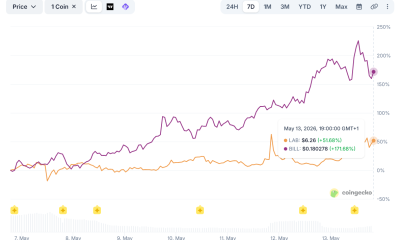
Two AI Tokens Lead May Rally, But Risks Are Rising
-

 Fashion2 days ago
On the Scene at Gucci’s Cruise Show in New York City: Mariah Carey, Kim Kardashian, Lindsay Lohan, Iman, and More!
-

 Politics7 days ago
The Trial of Majid Freeman, Verdict
-

 Politics6 days ago
Palestine’s flag becoming a regular sight at European football stadiums
-
 Tech6 days ago
Why AI is making typography a boardroom conversation
-

 Crypto World3 days ago
BeInCrypto 100 Institutional Awards Nomination: KAST for Best Digital Assets Neobank and Best Digital Assets Fintech
You must be logged in to post a comment Login