

Crypto World
SEC’s Blockchain Trading Rule Could Transform Stock Markets This Week


Key Takeaways
- An SEC “innovation exemption” could authorize blockchain-based platforms to trade tokenized versions of traditional stocks within days.
- The proposal would permit third-party entities to digitize publicly traded shares without requiring approval from the underlying companies.
- Financial giants like DTCC, Nasdaq, and ICE (NYSE’s parent) are already developing tokenized securities systems.
- Securitize’s Brett Redfearn cautioned that the approach risks market fragmentation and confusion over share valuations.
- Some SEC commissioners have expressed opposition to the exemption, while the CLARITY Act moves forward in the Senate.
The Securities and Exchange Commission is on the verge of implementing a transformative regulatory change that would permit stock trading via blockchain technology. Reports indicate the agency is finalizing an “innovation exemption” designed for tokenized securities, with a potential announcement expected within days.
The proposed framework would enable third-party platforms to generate digital representations of shares from publicly listed corporations—remarkably, without securing consent from those companies. These tokenized securities would be required to maintain identical rights to conventional shares, encompassing voting privileges and dividend distributions, or face removal from trading platforms.
According to individuals with knowledge of internal discussions, SEC Commissioner Hester Peirce championed the exemption initiative. The specific terms remain subject to modification before any official release.
Financial Industry Prepares Infrastructure
Numerous heavyweight financial players have already begun constructing systems for a tokenized securities marketplace.
The Depository Trust and Clearing Corporation, commonly referred to as DTCC, intends to initiate limited-scale production trading of tokenized instruments in July, followed by comprehensive deployment in October. Their architecture would support tokenized equities and exchange-traded funds using assets currently housed within DTCC’s established infrastructure.
Nasdaq has been engineering a structure that would allow corporations to create blockchain-native shares while maintaining conventional ownership protections. The securities regulator greenlit Nasdaq’s tokenized securities blueprint in March.
Intercontinental Exchange, which operates the New York Stock Exchange, has similarly revealed intentions to enter the tokenized stock space through a collaboration with cryptocurrency platform OKX. ICE disclosed in January its plan to construct a system enabling round-the-clock trading and settlement via blockchain technology.
Cryptocurrency exchange Bullish, under the leadership of former NYSE chief Tom Farley, strengthened its tokenization position by purchasing transfer agent service Equiniti for $4.2 billion this month.
Internal and External Opposition Emerges
The proposed exemption faces resistance from multiple quarters.
Multiple commissioners within the SEC harbor reservations about the initiative, according to informed sources. The agency declined to provide commentary when contacted.
Brett Redfearn, who serves as president of tokenization platform Securitize, articulated concerns regarding the authorization of third-party stock tokenization without participation from the issuing entities. He cautioned that this methodology could generate market fragmentation and create ambiguity for investors regarding the true value of their holdings.
Certain privately held enterprises have also voiced objections. Both OpenAI and Anthropic have resisted unauthorized creation of tokenized securities that track their valuations in secondary pre-IPO markets.
Potential Implications of the Regulatory Shift
Proponents of blockchain-based trading argue the technology could democratize access to American capital markets for individuals currently excluded from traditional brokerage systems. Prominent companies such as Nvidia, Google, and Tesla have been cited as examples of corporations whose shares could attract expanded international participation through tokenization.
SEC Chairman Paul Atkins has noted that existing securities regulations were not designed to accommodate blockchain architectures that consolidate exchange functions, clearing operations, and settlement processes into unified protocols. He has advocated for comprehensive rulemaking procedures instead of regulatory approaches driven by enforcement actions.
This tokenization initiative arrives as the Senate Banking Committee approved the CLARITY Act last week, positioning it for consideration during a full Senate vote scheduled for next month. Investor Kevin O’Leary and other market participants have emphasized that institutional finance will remain hesitant to embrace tokenization absent definitive legal guidelines.


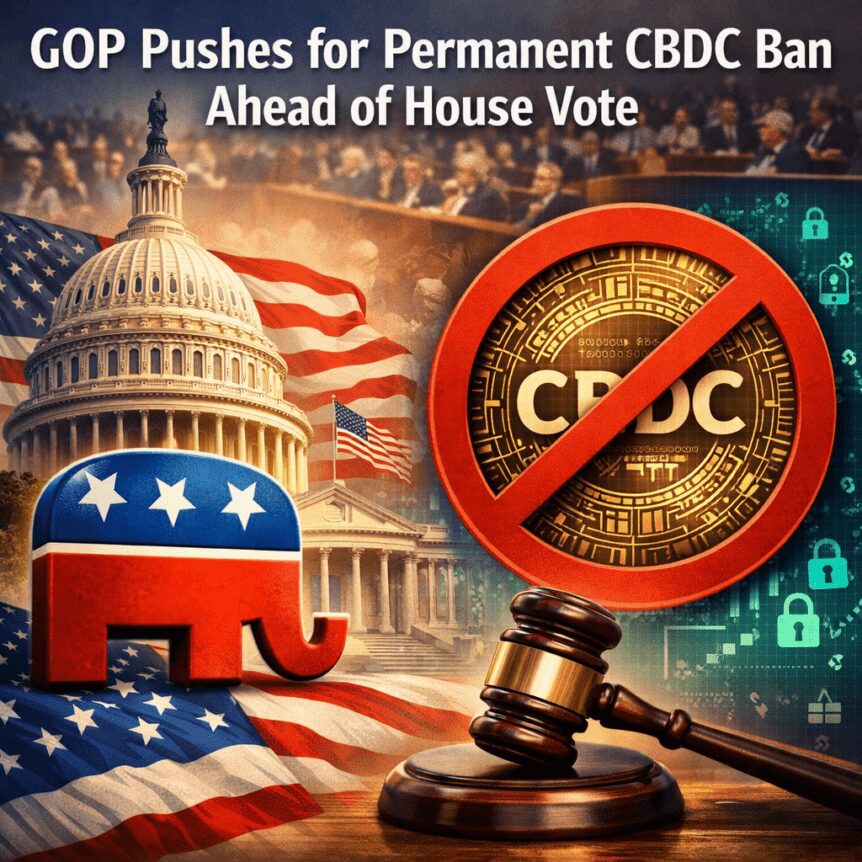
A bipartisan push in the U.S. Congress aims to permanently block a Federal Reserve-issued central bank digital currency (CBDC), with House lawmakers preparing to vote on amended language this week. The initiative comes as the Senate previously included a 2030 sunset on any CBDC issuance in a housing-focused bill, a measure now facing a parallel path in the House that would enshrine the ban for good. If approved, the House version would send the legislation back to the Senate for potential revisions before it could reach President Donald Trump’s desk for signature.
Key takeaways
- The House is set to vote on an amended bill that would make a permanent ban on a U.S. CBDC, reversing what its sponsors call a “backdoor” path to a central bank digital currency.
- The Senate’s version, contained in a housing bill introduced by the Banking Committee, would ban the Fed or any Federal Reserve bank from issuing a CBDC or similar instrument through December 31, 2030.
- Alternatives to the House measure exist in Congress, including the Anti-CBDC Surveillance State Act, which would block a CBDC outright, and a separate No CBDC Act proposed by another senator; both have faced stalled or partial progress.
- Global context remains limited: the Atlantic Council tracker counts only three countries with official CBDCs deployed and about 41 more in pilots, underscoring a fragmented international landscape amid domestic policy debates.
House moves toward a permanent CBDC ban
In its amended form, the House bill is positioned as a corrective measure to “stop” a CBDC before it could be launched. Supporters contend that the language would seal off any potential path to a federally issued digital currency and would tone down concerns about privacy, surveillance, and central control over monetary policy. The amended legislation is expected to go to a vote in the House this week. If it passes, the bill would return to the Senate, where it could undergo further amendments before facing the White House pathway.
Representative Warren Davidson, a Republican member of the House, has been a vocal advocate for a permanent CBDC ban. He argued that the House should not accept a staged rollout or a sunset framework, insisting that the “2030 sunset works a pre-launch development period.” In comments carried by his public posts, he framed the House vote as a potential bipartisan win on housing affordability by rejecting what he described as a go-live date for a central bank digital currency “using housing as the Trojan Horse.”
Senate’s 2030 CBDC ban and the housing bill context
The Senate version of the CBDC ban emerged from the Banking, Housing and Urban Affairs Committee’s March release. While the broader bill targets federal housing programs, a dedicated section prohibits the Federal Reserve System or any Fed bank from issuing a CBDC or similar instrument through December 31, 2030. The aim appears to be a temporary prohibition rather than an open-ended policy shift, though the House’s amendments shift the debate toward permanence. As with any congressional maneuver, the path forward remains contingent on floor votes and potential reconciliations between chambers.
Alternative bills and the broader CBDC debate
Beyond the main House and Senate tracks, lawmakers have pushed rival proposals that emphasize privacy protections and a more comprehensive rejection of CBDCs. Tom Emmer, the House majority whip, has pressed forward with the Anti-CBDC Surveillance State Act. The measure, which passed the House on July 17 but has yet to clear the Senate, would block the Federal Reserve from creating or issuing a CBDC. Emmer has framed the bill as a bulwark against what he calls surveillance-oriented monetary policy, arguing that a U.S. CBDC could mirror the Chinese model and erode financial privacy.
In a separate strand, Senator Mike Lee introduced the No CBDC Act to prohibit the Fed or Treasury from issuing a CBDC, though it has stalled in Congress. The dispersion of bills reflects a broader ideological split over whether the United States should develop a digital dollar at all, and under what safeguards or privacy protections.
Where the world stands on CBDCs
Context outside the United States continues to evolve at a varied pace. The Atlantic Council’s CBDC tracker shows that only Nigeria, Jamaica, and the Bahamas have officially deployed a CBDC as of now, while a larger group—41 countries—are reportedly in some stage of pilot testing. The domestic debate in Washington unfolds against this uneven global backdrop, with lawmakers weighing the implications for financial inclusion, privacy, and the future of monetary sovereignty.
Watching the middle ground and the next steps
Even as the House and Senate pursue their respective paths, the legislative process remains dependent on cross-chamber negotiations. If the House passes its amended bill, lawmakers will face a new set of questions in the Senate about timing, scope, and potential revisions. Any final version would then require presidential approval to become law. In the nearer term, observers should monitor whether the Senate moves to accept or alter the House language, and how those choices influence the broader policy discourse around digital currencies and financial privacy in the United States.
As advocates push for or against a U.S. CBDC, the policy debate is likely to sharpen questions about how a digital dollar could impact users, developers, and financial institutions. The discussions touch on practical concerns—like access to banking services and the usability of digital payments—and larger questions about state power, data privacy, and the role of central banks in a digitized economy.
The next few weeks could reveal whether lawmakers coalesce around a single approach or continue to test multiple, sometimes conflicting, visions for a U.S. CBDC—and what those choices mean for the broader crypto and fintech ecosystems that ride alongside traditional financial rails.


The partnership underscores both the rapid growth of equity perpetuals in onchain markets and Nasdaq’s broader strategy to support tokenized equity trading infrastructure.
Key Takeaways
- OpenAI and its leadership team successfully defended against Musk’s legal challenge after a California jury determined his claims were time-barred.
- Musk’s central argument alleged OpenAI illegally “stole a charity” through its nonprofit-to-for-profit transformation.
- The decision eliminates approximately $134 billion in potential liability that had been looming over OpenAI.
- Microsoft stock edged higher following the announcement, while Tesla stock dropped 3% on Monday trading.
- Despite Musk’s intention to appeal, legal analysts indicate the likelihood of reversal is minimal.
A California jury has ruled against Elon Musk in his lawsuit targeting OpenAI and its co-founders Sam Altman and Greg Brockman. The Monday decision found the defendants bore no liability, determining that Musk’s legal action was filed beyond the applicable statute of limitations.
The proceedings unfolded over three weeks at the US District Court for the Northern District of California in Oakland. Judge Yvonne Gonzalez Rogers formally accepted the jury’s determination.
Musk’s complaint centered on accusations that OpenAI‘s transformation from nonprofit to for-profit entity resulted in improper financial gain for Altman and Brockman. He maintained his financial contributions were made with the explicit expectation the organization would maintain its nonprofit status.
The AI research company was established in 2015 by Musk, Altman, and additional co-founders. Musk departed the organization in 2018, years before its corporate restructuring occurred.
Courtroom Proceedings and Arguments
Throughout the proceedings, Musk’s legal representative Steven Molo attempted to undermine Altman’s credibility. He highlighted Altman’s temporary removal from OpenAI’s board in 2023, when directors cited concerns about his lack of consistent candor. The CEO was returned to his position within days.
“Sam Altman’s credibility is directly at issue in this case,” Molo addressed the jury. “If you cannot trust him, if you don’t believe him, they cannot win.”
OpenAI’s defense attorneys countered these assertions, presenting testimony from numerous witnesses who verified that Musk never imposed nonprofit conditions on his financial contributions. The defense further emphasized the timing issue, asserting the lawsuit was initiated beyond permissible time limits.
Musk declared his appeal intentions on X. “There is no question to anyone following the case in detail that Altman and Brockman did in fact enrich themselves by stealing a charity,” he posted. “The only question is WHEN they did it.”
Carl Tobias, a law professor at the University of Richmond, informed Barron’s that appeal prospects appear unfavorable. “I think the case is pretty much over,” he stated. “It’s all fact specific, so I don’t think there’s any legal question there.”
Financial Implications for OpenAI and Key Stakeholders
The ruling represents a significant victory for OpenAI and its investment partners. According to Wedbush analyst Dan Ives, the decision eliminates roughly $134 billion in potential damages that had been casting uncertainty over the company.
Microsoft, having committed over $10 billion to OpenAI, stands to gain considerably from this outcome. Microsoft stock showed modest gains, trading at $423.33 on Monday. Other major investors including Amazon, SoftBank, and Nvidia also benefit from the resolution, with OpenAI’s current valuation hovering near $1 trillion.
Amazon revealed a $50 billion multi-year commitment to OpenAI this past February. The artificial intelligence firm is aggressively pursuing plans to become publicly traded and is considered among the most anticipated IPO candidates for 2026.
Tesla stock declined 3% Monday in response to the verdict.
The litigation may ultimately be recalled not for its judicial resolution but for exposing a highly visible relationship breakdown between tech titans. “When billionaires break up it can be expensive and nasty,” Tobias observed.
XRP is trading in a razor-thin price band around $1.38 as the token absorbs every sell wave without cracking. After Goldman Sachs exited yesterday, XRP is doing surprisingly well.
Two macro catalysts are now converging. One is the CLARITY Act’s Senate Banking Committee timeline, and the other is a brewing weekly Ichimoku cloud breakout.
WATCH THIS $XRP Holders — X Finance Bull (@Xfinancebull) May 19, 2026
 The CLARITY Act is the fork in the road for OUR FINANCIAL FUTURE
One path? CBDCs. Government surveillance money. Permission-based. Programmable control over your wallet.
The second path? open blockchain networks. XRP style settlements. Self-custody.… https://t.co/lUG24aneJa pic.twitter.com/f7gmsIsLsD
There is a near-term breakout odds at 60%, and 40% for a clean breakout, a split that explains the indecision: RSI sitting at the 50 level, a flat MACD histogram, and open interest down to $430 million as some smart money quietly trims exposure despite whales running 75% long. The buy/sell ratio of 0.87 confirms the tension. Something has to give.
Discover: The best crypto to diversify your portfolio with
Can XRP Price Break $1.40 Resistance?
XRP currently trades at approximately $1.38, hugging the upper Bollinger Band that could start a sharp directional move. The 20-EMA sits at $1.41 as our prediction model projects a 24-hour range of $1.37–$1.39.
Resistance is stacked and tested. $1.40 is the immediate ceiling; $1.51 has been rejected three times and remains the line that matters most. Clear that, and $1.65 opens up on the medium-term chart. Support is thinner: $1.35 is the first defense, $1.32 is the line bulls cannot lose.

However, if the CLARITY Act advances through the committee before the month-end, it could spark a weekly close above $1.50.
Right now, net-sell taker flow dominates, and open interest has been dropping, further as price retests $1.38, which invalidates the near-term breakout thesis.
The CLARITY Act Senate markup deadline is the single biggest binary event on XRP’s calendar. Institutional interest via ETF structures adds another demand layer — but institutions wait for regulatory certainty before deploying size.
Discover: The best pre-launch token sales
LiquidChain Targets Early-Mover Upside as XRP Battles Supports
XRP is a known asset, a known market cap, and a known risk profile. The upside math at current prices requires moving billions in market cap to deliver multiples. That’s the ceiling that early-stage infrastructure plays are built to sidestep.
LiquidChain ($LIQUID) is a Layer 3 infrastructure protocol doing something structurally different: fusing Bitcoin, Ethereum, and Solana liquidity into a single execution environment.
Three Thrones for Three Kings. — LiquidChain (@getliquidchain) May 19, 2026

All wrapped in the world's greatest L3. ⟁ https://t.co/vqvBcdSQYC pic.twitter.com/j6dG8ZoHZd
Its Unified Liquidity Layer enables single-step cross-chain execution with verifiable settlement. With Liquid, there’s no bridging friction nor fragmented capital pools. Developers deploy once and access all three ecosystems simultaneously.
The presale is currently priced at $0.01461, with more than $770K raised to date. Not to forget, Liquid offers something that no coin could, a huge 1,400% APY bonus for early buyers.
For traders watching XRP consolidate and weighing where asymmetric upside still exists in this market cycle, researching LiquidChain is worth the time.
The post XRP Price About To Break Out? CLARITY Act and XRPL Upgrade Change Everything appeared first on Cryptonews.


- Echo Admin key compromise enabled $76.7M unauthorized eBTC minting.
- The attacker used fake eBTC to borrow and bridge real crypto assets.
- ECHO token dropped sharply as panic selling hit the market fast.
The ECHO token came under severe pressure after a major security breach tied to the Echo Protocol led to the unauthorized minting of roughly $76.7 million worth of eBTC, triggering a sharp loss of confidence across the ecosystem.
The exploit centered on a compromise of privileged access controls, allowing an attacker to bypass normal minting restrictions and generate synthetic assets without collateral.
The exploit quickly escalated from a technical breach into a full-scale market disruption.
Within hours of the attack becoming known, the ECHO token recorded a steep double-digit decline as traders rushed to exit positions amid uncertainty over the protocol’s stability and the status of the inflated eBTC supply.
Admin key compromise enabled unlimited minting of eBTC
The core of the exploit was a compromise of an admin-level private key, which granted the attacker control over minting permissions inside the Echo Protocol system.
With that access, the attacker was able to mint approximately 1,000 eBTC tokens without depositing any collateral.
These tokens were not backed by real Bitcoin reserves, meaning they functioned as artificially created supply inside the system.
The sudden expansion of eBTC supply to roughly $76 million in value created immediate imbalance risks across any integrated lending or trading platforms that accepted the asset as collateral.
Once minted, the attacker began routing the assets through decentralized finance applications.
A portion of the fake eBTC was deposited into lending markets such as Curvance, where it was used to borrow wrapped Bitcoin (WBTC).
From there, the borrowed funds were bridged across networks, converted into ETH, and partially routed through privacy tools, including Tornado Cash, in an attempt to obscure transaction trails.
Blockchain investigators tracking the movement of funds noted that approximately 955 eBTC remained under attacker control, representing the vast majority of the illicitly minted supply.
Only a small fraction of the stolen value was successfully converted into liquid assets during the early stages of the exploit.
ECHO token drops sharply as panic spreads across the market
As the exploit became public, the ECHO token reacted with a rapid sell-off.
The price dropped by over 11% within a short period, reflecting immediate market concern over the protocol’s security and the potential impact of the inflated eBTC supply on the broader ecosystem.

The market reacted to two key risks.
The first was the possibility of further minting or continued exploitation if access controls were not fully secured.
The second was the uncertainty surrounding potential bad debt created in lending markets where the unbacked eBTC had already been used as collateral.
Liquidity conditions tightened as participants reduced exposure to both ECHO and related assets.
The sudden exit of capital intensified downside pressure, accelerating the token’s decline and amplifying volatility across connected trading pairs.
Echo Protocol halts operations and begins investigation
In response to the breach, Echo Protocol moved to pause cross-chain operations, aiming to limit further movement of stolen funds and prevent additional exploitation pathways.
The suspension affected bridging and cross-chain functionality, which had been used by the attacker to move assets between networks during the laundering process.
The incident did not affect the underlying Monad blockchain, which continued operating normally.
The issue was isolated to Echo Protocol’s access control layer, specifically the privileged permissions tied to minting authority.
Security researchers assessing the breach have pointed to the admin key compromise as the central failure point.
Rather than a flaw in token mathematics or smart contract logic, the attack exploited centralized control privileges that allowed unrestricted issuance of synthetic assets once the key was exposed.


- Serious investors are prioritizing tokenized real-world assets, stablecoins, institutional trading systems, and AI-linked compute networks.
- Allocators still face major friction around custody, banking access, compliance, legal structure, due diligence, and internal reputation risk.
- Platforms like Arcanum aim to support capital entry through investor control, real-time reporting, documented strategies, and exchange-based fund access.
In an exclusive interview with BeInCrypto during Hong Kong Web3 Festival, Michael Ivanov, CEO of Arcanum, Ciara Sun, founder and managing partner of C² Ventures, and Ivan Ivanov, founder of UVECON.VC and RWA SUMMIT, discussed how capital enters crypto in 2026.
The conversation covered family offices, allocator demand, operational friction, tokenized real-world assets, and the trust gap still slowing institutional participation.
Let’s open up the topics.
What Serious Investors Want in 2026
BeInCrypto: What does the capital journey into crypto look like from your side of the market?
Michael Ivanov: It is a thorny road full of rocks and holes.
Ciara Sun: A few years ago, many investors entered crypto mainly for exposure and upside. Today, they are looking for real demand and a better understanding of how liquidity works.
BeInCrypto: What kind of crypto opportunities are serious investors looking for in 2026?
Ciara Sun: Serious investors in 2026 are looking at sectors where crypto solves real problems rather than creating new narratives. From my experience in exchanges and venture investing, the strongest interest is around tokenization, stablecoins, institutional trading systems, and the intersection of AI, compute, and energy.
BeInCrypto: Ivan, what types of capital are showing the most interest now?
Ivan Ivanov: It depends on which kind of crypto you mean. We should separate BTC, ETH, altcoins, and tokenized real-world assets. It also depends on the region.
I am based in Hong Kong, so I am familiar with the Asian market. Family offices here are quite conservative when it comes to digital assets. One of the largest Asian multi-family offices says less than 5% of the capital its clients invest is allocated to crypto, and most of that goes into BTC, ETH, and ETFs.
Funds are a different story. The most active are hedge funds focused on crypto asset management. Investors usually select those that are licensed and well known in the market.
Institutions are definitely interested in digital asset investments, but they remain cautious. Tokenized RWAs will lead over the next couple of years because they are regulated, have substance, and are protected by law.
What Happens When Capital Enters a Platform Like Arcanum
BeInCrypto: When a family office allocates into a platform like Arcanum, what actually happens operationally?
Michael Ivanov: Every user, retail or institutional, can run our product with ease. With Pulse, the user adds API keys to our Telegram Mini App, and the process is done. We do not ask offices to sign unnecessary documents to use our products.
For clients who want to delegate full control of funds to Arcanum, we accept two main structures. The first is a license agreement with proper profit-sharing terms. The second is a joint company for operating the required amount of capital. With this type of client, flexibility is essential.
What Gives Investors Confidence
BeInCrypto: What gives investors enough confidence to deploy capital into crypto today?
Ciara Sun: Investors need proof that the team can execute with discipline. Confidence usually comes from real traction, clean token and cap table design, and a path to liquidity or revenue.
The right question for investors is whether the team can survive, manage risk, and continue growing when the cycle turns.
BeInCrypto: Ivan, what makes a crypto project investable for allocators?
Ivan Ivanov: Substance, track record, the right legal structure, and protected investor rights. The times of ICOs are gone. The market now looks much closer to traditional finance and venture capital.
How Arcanum Helps Allocators Enter Crypto
BeInCrypto: How does Arcanum help allocators and investors enter crypto more efficiently?
Michael Ivanov: We provide clear strategies and methodologies where the key points are simple. With Pulse, there is strong historical data for potential profit, an almost fully automated process, and real-time tracking. It gives clarity.
Pulse runs on Bybit subaccounts controlled by allocators, so the money always remains in their hands. Users can access it at any time.
The next step is a wider ecosystem with our own broker, new algorithms such as Wave, our own terminal with lower commissions, and early access to new products. We give investors an easy entry point through one of the largest exchanges, with an ecosystem designed to keep them active after that.
Where Capital Gets Stuck
BeInCrypto: Where does capital get stuck between investor interest and actual deployment?
Michael Ivanov: For projects like ours, there are four main blockers: custody, mandate, due diligence, and sizing.
Custody is a challenge because institutions will not hand assets to a counterparty they cannot audit. Mandate is another issue because many funds simply do not have a crypto allocation category, and adding one can take months.
Due diligence is also difficult because many crypto products fail institutional review when the strategy is poorly documented or lacks independent validation. Sizing is the final barrier. Without a clear risk model, allocators cannot decide how much capital to deploy.
BeInCrypto: Ivan, what is the hardest part for allocators bringing traditional capital into crypto?
Ivan Ivanov: Compliance, for sure, and the reliability of the systems around it. Recent DeFi exploits damaged trust. Centralized exchanges and providers look more reliable, especially when they are licensed.
Traditional banks are also a barrier. Dealing with crypto assets remains a serious issue for any company. Try to open a bank account in Hong Kong and say you want to invest company funds in crypto. You will likely be rejected, even if you work with licensed providers.
The key issues are banking, investor protection, and compliance.
BeInCrypto: Ciara, where do strong crypto projects still lose investor confidence?
Ciara Sun: Details. The idea may be strong, but confidence weakens when the token design is unclear, the go-to-market plan is vague, or the team cannot explain how liquidity, revenue, and risk will be managed.
Why Platforms Like Arcanum Interest Allocators
BeInCrypto: Why can platforms like Arcanum be interesting for allocators in the current market?
Ivan Ivanov: The track record is key. Arcanum also works with one of the market leaders, Bybit, and has official partner status.
If Arcanum can build the right compliant setup with strong security, privacy, investor protection, and a good market reputation, capital will flow in.
BeInCrypto: Ciara, would you view a platform like Arcanum as access, capital management, or market technology?
Ciara Sun: To me, Arcanum is both access and technology. It gives users a simpler way to access trading strategies through trading bot services, while also sitting on top of execution and risk management. Traders care a lot about risk management and transparency, aside from profits.
BeInCrypto: Michael, how do you position Arcanum for B2B partners, allocators, and private investors?
Michael Ivanov: I do not think positioning is the right word. Each audience has a different problem we work with.
B2B partners can use a white-label model that helps them reduce the cost of running their own branded product. Allocators get clear real-time statistics and instant fund management. Private investors get the product as well as access to a warm community of traders we work with.
Control, Reporting, and Transparency
BeInCrypto: How does Arcanum handle control, reporting, and transparency for investors?
Michael Ivanov: For us, this is quite simple. Part of it is solved by architecture, and part of it is solved by UX.
In the base scenario, clients have full control over their funds on their own exchange subaccounts. Arcanum operates and monitors the strategy through its solutions. We sit above the exchange with intuitive functionality.
Transparency is where we put the most effort, because this is where crypto products often fail institutional review. We provide a clear history of every trade and documented strategy data.
BeInCrypto: Ciara, how important is operational transparency when investors assess crypto opportunities?
Ciara Sun: Very important. In crypto, investors can accept risk, but they cannot accept a black box. Transparency turns performance into trust.
Investors want to know where the money is, how decisions are made, what risks are being taken, and whether the numbers can be verified.
BeInCrypto: Ivan, what do family offices still need to understand before they feel comfortable allocating?
Ivan Ivanov: They need to understand how they are protected legally and make sure everything is structured properly.
The Most Expensive Blocker
BeInCrypto: What is the most expensive blocker for institutional capital entering crypto today?
Michael Ivanov: The most expensive blocker is reputational inside the institution itself.
Every allocation has to go through boards and committees. There is still limited trust in information from crypto projects, especially with new projects and strategies. Even when interest is real, no one wants to be the first person to stake their reputation on it.
The cost is huge but invisible. It shows up as deals that never close and allocations that keep getting pushed to the next quarter.
BeInCrypto: Ciara, what is the biggest hidden cost for serious investors entering the market?
Ciara Sun: The biggest hidden cost is the operational burden behind every decision. Serious investors need custody, compliance, reporting, risk control, liquidity planning, and sometimes token unlock management. Many people underestimate this part.
BeInCrypto: Ivan, what needs to change for allocators to move capital faster?
Ivan Ivanov: Banking infrastructure, for sure. With the latest regulations in multiple jurisdictions, I believe regulated and compliant stablecoin systems will solve many issues.
Where Demand Goes Next
BeInCrypto: Which crypto sectors are most likely to attract serious capital in 2026?
Ciara Sun: Serious capital in 2026 will go to sectors where crypto becomes real financial or operating technology. The main areas are tokenization, stablecoins, institutional trading and liquidity systems, and AI-related compute and energy networks.
BeInCrypto: Ivan, where do you expect the strongest allocator demand over the next year?
Ivan Ivanov: Definitely tokenized RWAs. This is where traditional investors will follow banks and institutions.
BeInCrypto: Michael, where do you expect Arcanum’s strongest demand to come from?
Michael Ivanov: We expect the strongest demand to come from Asian allocators and funds of funds.
They have already been active in crypto for a while, and they are used to putting part of their capital with quant trading funds running different strategies. What we build fits a workflow they already understand.
In the US, even with anticipated legislation, the picture still lacks enough transparency for decisions at that level to happen at size. Asia is further along in the process.
Trust Comes First
BeInCrypto: What needs to improve first for more capital to enter crypto?
Ivan Ivanov: Trust in the crypto market and market players. There are still too many bad actors.
Ciara Sun: Trust. More capital will enter when crypto has better transparency, cleaner risk management, and more reliable systems around custody, compliance, liquidity, and reporting.
What needs to improve is the confidence that capital can enter, operate, and exit safely.
Michael Ivanov: Trust is the new gold in crypto. We still need to earn it, even when the whole project is clear and transparent.
The post How Capital Really Moves Into Crypto in 2026 appeared first on BeInCrypto.


The Bitcoin-focused DeFi protocol suffered an attack whereby about 1,000 unauthorized eBTC $77 million were minted on the Monad blockchain

Wall Street’s blockchain pivot just got regulatory rocket fuel. The U.S. Securities and Exchange Commission, or SEC, is preparing an “innovation exemption” that could allow trading platforms to offer digital versions of publicly traded stocks under a lighter regulatory structure. The proposal is expected as early as mid-May, according to Bloomberg Law.
According to Bloomberg Law’s report, the SEC’s framework would let platforms trade blockchain-based versions of equities around the clock with faster settlement than traditional shares. The agency already approved Nasdaq’s proposal to trade tokenized stocks in March, covering Russell 1000 components and benchmark ETFs.
NYSE’s equivalent proposal also cleared in April. The DTCC, which processes the bulk of U.S. securities, has announced limited production trades of tokenized assets beginning in July, with a broader rollout in October. SEC Chair Paul Atkins has explicitly signaled support for formal rulemaking covering onchain trading systems and blockchain settlement infrastructure, framing it as part of a sweeping “Project Crypto” initiative.
The combined weight of institutional momentum from DTCC, Nasdaq, NYSE, and ICE points to a structural shift in how the $126 trillion global equity market settles and trades.
Discover: The best crypto to diversify your portfolio with
SEC Tokenized Stock Momentum Could Reprice Blockchain Infrastructure
That regulatory clarity cuts both ways: it validates compliant onchain infrastructure while squeezing offshore synthetic structures. The winners in this environment are settlement rails, smart contract platforms, and Layer 2 networks capable of handling high-frequency, low-latency financial transactions at institutional scale.
Crypto-native infrastructure tokens with real throughput, such as sub-second finality, programmable settlement, and deep liquidity, are the logical beneficiaries of a world where equities trade onchain 24/7, benefiting RWA tokens.
— CryptosRus (@CryptosR_Us) May 19, 2026
TOKENIZED REAL WORLD ASSETS ARE GOING PARABOLIC
$1.43B on-chain. Up 26% in 30 days. $3B in monthly transfer volume.
SEC innovation exemption coming this week. DTCC live in July. NYSE and Nasdaq building on-chain settlement.
The chart doesn't lie. RWAs are just getting… https://t.co/eFgt86aurx pic.twitter.com/lPptRxPMt6
The Senate’s advancing crypto market structure bill compounds the regulatory tailwind. Compliant infrastructure platforms could re-rate significantly as institutional volume migrates onchain through H2 2025.
However, this could not always be a fast pump for the crypto market. The price is in a multi-year adoption curve; gains would be real but gradual.
The data points to infrastructure, not specific synthetic equity tokens, as the cleaner trade. But tokens like Chainlink and Ondo could benefit.
Discover: The best pre-launch token sales
Bitcoin Hyper Targets Early-Mover Upside as Institutional Blockchain Demand Builds
Infrastructure is the trade, but established L1 valuations already reflect significant institutional optimism. Early-stage infrastructure presales offer a different upside entirely.
That’s the context for Bitcoin Hyper ($HYPER), currently raising at $0.0136 per token with more than $32 million already committed. Hyper is the first Bitcoin Layer 2 with Solana Virtual Machine (SVM) integration, combining Bitcoin’s security and trust with throughput that, by design, targets performance faster than Solana itself.
Hyper is a direct play on the programmable settlement infrastructure that tokenized securities markets will need and require. It has features like extremely low-latency Layer 2 processing, SVM-based smart contract execution, and a Decentralized Canonical Bridge for BTC transfers. Basically, it has the kind of stack that matters when institutions need fast, cheap, auditable settlement.
Staking is now live with a high 35% APY reward. Over $32.7 million raised signals a serious early conviction.
Research Bitcoin Hyper before the next price tier locks in.
The post SEC Pushes Tokenized Stocks: Wall Street’s Onchain Era Begins appeared first on Cryptonews.
Republican lawmakers in the U.S. House have pushed to turn a temporary restriction on a central bank digital currency into a permanent ban as Congress prepares to vote on a major housing bill later this week.
Summary
- House Republicans have pushed to make the proposed U.S. CBDC ban permanent in the revised 21st Century ROAD to Housing Act.
- Representative Warren Davidson said the Senate’s 2030 expiration date could create a future pathway for a Federal Reserve-issued digital dollar.
- House Majority Whip Tom Emmer has continued urging the Senate to pass his Anti CBDC Surveillance State Act after it cleared the House earlier this year.
According to Congressman Mike Flood, House lawmakers revised the Senate’s version of the 21st Century ROAD to Housing Act to remove what he described as a “backdoor green light for a CBDC” by making the prohibition indefinite rather than allowing it to expire in 2030.
The Senate Banking Committee first introduced the housing package in March as a sweeping reform bill focused on housing supply, affordability programs, mortgage access, and manufactured housing rules. Senators Tim Scott and Elizabeth Warren led the legislation, which later advanced through the Senate with an 84 to 6 bipartisan procedural vote.
Buried within the housing proposal was a provision preventing the Federal Reserve or regional Federal Reserve banks from issuing a U.S. central bank digital currency without congressional approval. Under the Senate version, the restriction would have remained in place only until Dec. 31, 2030.
House Republicans are now trying to remove that sunset clause altogether before the legislation heads back to the Senate for further consideration.
Among those backing the revised language, Representative Warren Davidson argued that the existing deadline effectively creates a future launch window for a government-issued digital dollar.
“The US House of Representatives could deliver a unifying win this week with bipartisan housing affordability legislation. Instead, they currently plan to deliver a go-live date for Central Bank Digital Currency, using housing as the Trojan Horse,” Davidson said.
In a separate statement, Davidson added that the “2030 sunset works a pre-launch development period,” while calling for a full and lasting prohibition on CBDCs in the United States.
Republicans revive anti-CBDC push in Congress
Elsewhere on Capitol Hill, House Majority Whip Tom Emmer has continued lobbying senators to pass his Anti-CBDC Surveillance State Act after the measure cleared the House in July.
The proposal would block the Federal Reserve from creating or issuing a central bank digital currency, with supporters framing the issue as one tied to privacy and financial freedom.
“The Chinese Communist Party uses a central bank digital currency (CBDC) to surveil and control its people,” Emmer said while urging Senate approval of the bill. He added that his legislation “BANS our government from ever creating this Orwellian tool.”
Previous efforts to stop a digital dollar through standalone legislation have struggled to gain traction. Senator Mike Lee earlier introduced the “No CBDC Act,” which sought to prohibit both the Federal Reserve and the Treasury Department from issuing a CBDC, though the proposal stalled in Congress.
Outside government, criticism of CBDCs has frequently centered on surveillance and state control concerns. At the same time, the Human Rights Foundation has argued that digital currencies issued by central banks could improve financial access for underserved populations while also creating risks tied to privacy and government abuse.
Data tracked by the Atlantic Council currently shows that only Nigeria, Jamaica, and the Bahamas have fully launched CBDCs, while dozens of other countries remain in pilot programs or research stages.
Crypto World
Moving Beyond HODL: ZOOMEX Launches Global “Pizza Week” Campaign Honoring Bitcoin’s First Real-World Trade


On the cusp of the global 16th anniversary of Bitcoin Pizza Day, ZOOMEX, one of the leading global digital asset exchanges, today officially announced the launch of its Pizza Week campaign. This initiative honors the historic milestone of Bitcoin’s first real-world transaction. ZOOMEX’s campaign directly targets the original vision of cryptocurrency. By showcasing its core product matrix—including ZoomCard, ZoomexStocks, and the 0-Cost Trading Competition — the platform aims to drive a comprehensive ecosystem transition for digital assets, shifting them from speculative tools to practical, everyday applications.
On May 22, 2010, a Florida programmer named Laszlo Hanyecz posted a message on the BitcoinTalk forum offering 10,000 Bitcoins for two large pizzas. A British forum user accepted, and the transaction was completed. At the time, those 10,000 BTC were worth roughly $41. At Bitcoin’s all-time high in May 2025, they would have been worth over $1.1 billion.
But the dollar value is not the story ZOOMEX is telling this week.
“The industry has spent sixteen years fixating on what that pizza would be worth today, and in doing so, it walked straight past the more interesting question,” said Fernando Lillo, Marketing Director at ZOOMEX. “Laszlo wasn’t making a trade. He was running a test. And the result of that test wasn’t a loss — it was proof that the entire idea could work. A technology that cannot interact with daily life remains a technology, not a currency. That distinction is what Pizza Week is about.”
That question has been answered repeatedly over the past 16 years. MicroStrategy, the world’s largest corporate Bitcoin holder, now holds 818,869 BTC — nearly 4% of all Bitcoin that will ever exist — acquired at a total cost of over $68 billion. The U.S. government maintains a strategic Bitcoin reserve. Sovereign wealth funds have disclosed exposure. Global crypto market capitalization stands between $2.5 trillion and $2.7 trillion, with Bitcoin representing roughly 60%. What began as a pizza order has become an asset class that governments can no longer ignore.
ZOOMEX argues that the industry has, in some ways, drifted from Laszlo’s original intent. The dominant message for years has been to hold and accumulate — to never repeat the “mistake” of spending Bitcoin. That is now changing. Monthly transaction volumes for crypto payment cards grew from approximately $100 million in early 2023 to over $1.5 billion by late 2025, posting another 211% year-over-year increase as of March 2026. A quarter of U.S. Adults now use crypto for everyday transactions, payments, and financial management.
ZOOMEX has built a comprehensive product ecosystem to address the modern era’s need for utility:
- Arena 0-Cost Trading Competition: Now open with a 600,000 prize pool. Arena provides every participant with $100–$200 in platform-funded trial capital. Zero entry cost. Same starting line. Results determined by trading volume and ROI — not by who brought the deepest pockets.
- ZoomexStocks: U.S. stock-linked assets — including Apple, Tesla, and Nvidia — accessible directly from a crypto account. No fiat conversion required. No separate brokerage account needed. The same idea as Laszlo’s pizza, evolved for 2026: crypto as a gateway, not a walled garden.
- ZoomCard: A multi-currency virtual Mastercard built in partnership with licensed financial institution UR. Supports USD, EUR, CHF, SGD, HKD, and JPY. Zero card issuance fees. Zero annual fees. Compatible with Apple Pay, Google Pay, and Samsung Pay. Crypto that leaves the chart and enters the checkout line.
The Pizza Week campaign will run across ZOOMEX’s global social media channels and include a dedicated space panel. To drive ecosystem adoption, ZOOMEX is launching a dedicated community reward pool featuring thousands of dollars in USDT incentives alongside exclusive trading coupons for all participants. The company is also producing localized content with teams in Spain and a ZoomCard promotional video demonstrating real-world crypto payments.
You can join Zoomex here
About Zoomex
Founded in 2021, Zoomex is a global cryptocurrency trading platform with over 3 million users across more than 35 countries and regions, offering 600+ trading pairs. Guided by its core values of “Simple × User-Friendly × Fast,” Zoomex is also committed to the principles of fairness, integrity, and transparency, delivering a high-performance, low-barrier, and trustworthy trading experience.
Powered by a high-performance matching engine and transparent asset and order displays, Zoomex ensures consistent trade execution and fully traceable results. This approach reduces information asymmetry and allows users to clearly understand their asset status and every trading outcome. While prioritizing speed and efficiency, the platform continues to optimize product structure and overall user experience with robust risk management in place.
As an official partner of the Haas F1 Team, Zoomex brings the same focus on speed, precision, and reliable rule execution from the racetrack to trading. In addition, Zoomex has established a global exclusive brand ambassador partnership with world-class goalkeeper Emiliano Martínez. His professionalism, discipline, and consistency further reinforce Zoomex’s commitment to fair trading and long-term user trust.In terms of security and compliance, Zoomex holds regulatory licenses including Canada MSB, U.S. MSB, U.S. NFA, and Australia AUSTRAC, and has successfully passed security audits conducted by blockchain security firm Hacken. Operating within a compliant framework while offering flexible identity verification options and an open trading system, Zoomex is building a trading environment that is simpler, more transparent, more secure, and more accessible for users worldwide.
For more info: Website | X | Telegram | Discord
The post Moving Beyond HODL: ZOOMEX Launches Global “Pizza Week” Campaign Honoring Bitcoin’s First Real-World Trade appeared first on BeInCrypto.

DWP benefit and pension payment changes spring Bank Holiday 2026

Small & midcaps rally! Coforge, Ola Electric, FirstCry & other stocks jump up to 7%

GOP Pushes for Permanent CBDC Ban Ahead of House Vote

Manchester United reach agreement with Casemiro over contract clause amid transfer speculation

US brings back mandatory military draft registration

Steven Gerrard disagrees with Gary Neville over ‘shock’ Chelsea and Arsenal claim | Football

Mining machine kya hota hai || Bitcoin Mining Machine In India || Crypto Mining

you’ll never feel rich if you do this #finance #comparison

Earn Monthly Passive Income from Stocks: SLBM Strategy Explained #finance #dhan #stockmarket
-

 Crypto World3 days ago
BloFin War of Whales 2026 Grand Prix opens registration for $5M trading championship
-

 Fashion4 days ago
Weekend Open Thread: Theory – Corporette.com
-

 Crypto World4 days ago
E-Estate Announces 1 Year Live: Washington DC Summit as Real Estate Tokenization Enters Its Next Phase
-

 Tech4 days ago
Tech Moves: Microsoft AI leader jumps to OpenAI; former AI2 exec joins Meta; and more
-
Crypto World6 days ago
Bitcoin Suisse expands with Digital Asset License and Investment Business Act Registration Approval in Bermuda
-

 Politics6 days ago
Pakistan to enter Chinese capital market as war inflation bites
-

 Crypto World6 days ago
Bitcoin Suisse expands with Digital Asset License and Investment Business Act Registration Approval in Bermuda
-
 Crypto World5 days ago
Google’s Gemini AI Predicts Incredible Solana Price by the End of 2026
-

 Business4 days ago
H&R Real Estate Investment Trust (HR.UN:CA) Q1 2026 Earnings Call Transcript
-

 Tech3 days ago
Google reimburses Register sources who were victims of API fraud
-

 Sports3 days ago
Napoleonic enters 2026 Doomben 10,000 field via Abounding withdrawal
-

 NewsBeat7 days ago
Comment on Keir Starmer surviving the day as Prime Minister like a turd that wont flush
-
 Entertainment5 days ago
Zara Larsson Has Blunt Response To Chris Brown Diss
-

 Fashion6 days ago
The Best-Kept Makeup Secret for a More Defined Face
-
 Crypto World5 days ago
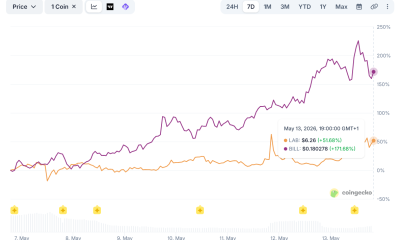
Two AI Tokens Lead May Rally, But Risks Are Rising
-

 Fashion2 days ago
On the Scene at Gucci’s Cruise Show in New York City: Mariah Carey, Kim Kardashian, Lindsay Lohan, Iman, and More!
-

 Politics7 days ago
The Trial of Majid Freeman, Verdict
-

 Politics6 days ago
Palestine’s flag becoming a regular sight at European football stadiums
-
 Tech6 days ago
Why AI is making typography a boardroom conversation
-

 Crypto World3 days ago
BeInCrypto 100 Institutional Awards Nomination: KAST for Best Digital Assets Neobank and Best Digital Assets Fintech
You must be logged in to post a comment Login