

Crypto World
Sharplink Buys ETH for First Time in 8 Months

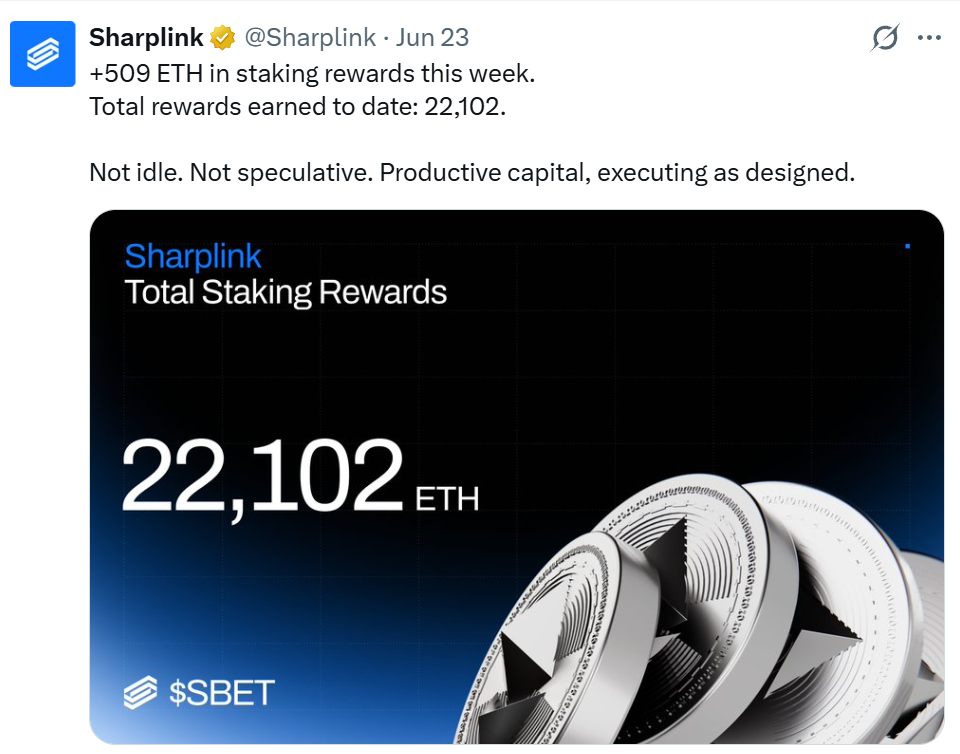
Ether treasury company Sharplink has bought Ether for the first time in eight months as the token sank to its lowest price this year on Thursday.
On-chain data from Arkham shows a wallet associated with Sharplink received 5,000 Ether (ETH), worth $7.85 million, from crypto prime brokerage FalconX on Thursday. The last time it received Ether from FalconX was on Oct. 26, when it bought $78.3 million worth of ETH.
The purchase comes as Ether hit $1,537 on Thursday, its lowest price in 2026. The latest purchase could suggest a revival of the company’s active Ether accumulation strategy.
“I’m seeing genuine corporate accumulation conviction holding strong amid subdued price action,” Andri Fauzan Adziima, the research lead at Bitrue Research Institute, told Cointelegraph.
Sharplink CEO Joseph Chalom told Cointelegraph in May that he saw three catalysts that could spur growth in the price of Ether.
The first was the passage of the CLARITY Act in the US, while the second was a return to market risk appetite, which will depend on an easing in geopolitical tension and cooling of the artificial intelligence investment thesis. Chalom’s third catalyst was the continued growth of real-world asset tokenization.
The Senate is yet to vote on its version of the CLARITY Act, and the House Financial Services Committee said it would hold a hearing on the bill on July 17. The US and Iran are working toward a final peace agreement to end months of conflict and tokenized real-world assets have now reached a distributed asset value of $31.55 billion, close to its highest level this year.
Sharplink now holds 876,285 ETH
Sharplink was founded in 2019 as an affiliate marketing service provider to the sports betting and gambling industries, but pivoted to become an Ethereum treasury company in June 2025, with Consensys co-founder and CEO Joe Lubin named as chairman.
It became the largest publicly traded corporate holder of ETH, but lost the title to Bitmine in August, just two months after Bitmine launched its own Ether buying strategy.
Related: Bitmine, Sharplink and Joe Lubin back Ethereum R&D nonprofit
The company now holds 876,285 ETH and ETH equivalents, which it has accumulated over time through active ETH purchases and staking rewards. Its competitor, Bitmine, holds 5.67 million ETH after acquiring another 52,203 ETH last week.
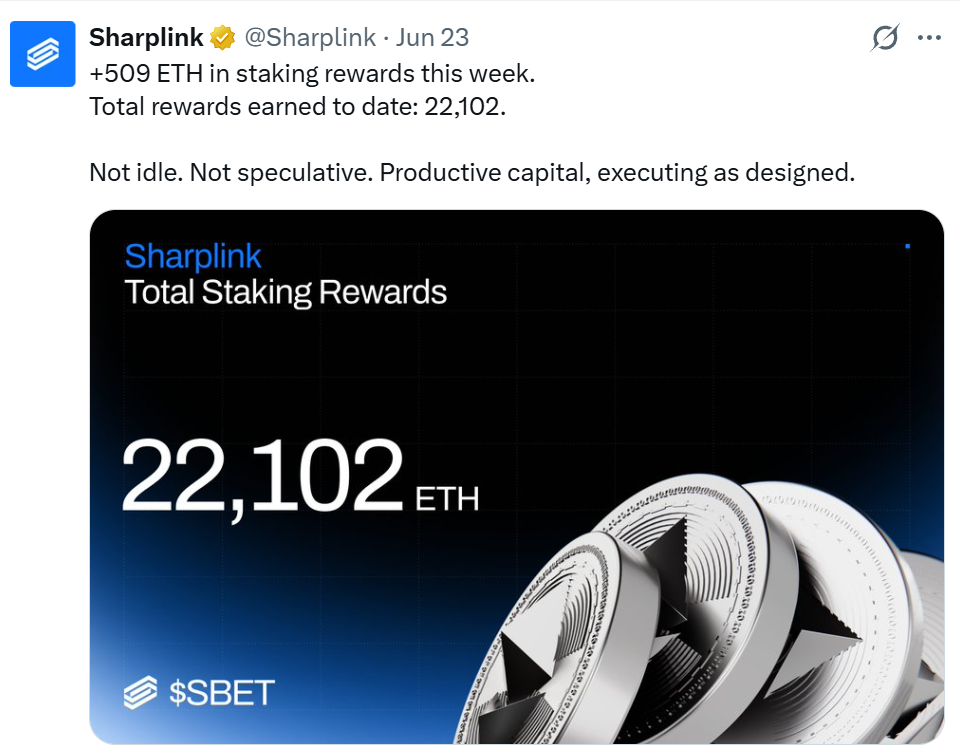
Source: Sharplink
“We continue to maintain a steady pace of accumulation throughout 2026. We believe we are in the early stages of crypto spring,” Bitmine chairman Tom Lee said.
Sharplink added to the Russell indexes
The purchase also comes just days before Sharplink is expected to join the Russell 2000 and Russell 3000 indexes on Monday.
Inclusion in the indexes is widely viewed as positive because many active and passive funds, including exchange-traded funds, typically buy stocks from them.
Chalom in May said that joining the Russell indexes would broaden the company’s shareholder base and strengthen its access to capital markets.
Magazine: Guide to the top and emerging global crypto hubs: Mid-2026



A wave of crypto firms, from Ripple to Circle, have won national trust bank charters, and several are chasing a Federal Reserve master account. This guide explains what a crypto trust bank actually is, what a charter does and does not grant, and why the real prize sits at the central bank.
Summary
- A crypto trust bank is a chartered trust institution that custodies digital assets and manages stablecoin reserves, bringing crypto custody inside the regulated banking system without being a full retail bank.
- A national trust charter lets a crypto firm custody its own assets and reserves and obviate the patchwork of state money-transmitter licenses, but it cannot take ordinary deposits or carry federal deposit insurance.
- In 2025 and 2026, a wave of crypto firms, including Ripple, Circle, Paxos, Fidelity Digital Assets, and others, won conditional national trust charters.
- The bigger prize is a Federal Reserve master account, which would give direct access to the central bank’s payment rails and let a firm hold reserves at the Fed itself, something no crypto-native firm has yet achieved.
- Charters and master accounts primarily benefit stablecoins and custody businesses by deepening their regulatory standing, marking crypto’s convergence with traditional banking.
A crypto trust bank is a chartered financial institution, supervised like a bank, whose purpose is to custody assets and provide fiduciary services rather than to take deposits and make loans, and which a crypto firm uses to hold digital assets and manage stablecoin reserves inside the regulated banking system. That definition contains the key to understanding the whole subject: a trust bank is a real, regulated bank, but a specialized kind, built around safekeeping and trust services rather than the deposit-taking and lending that define ordinary retail banks.
In 2025 and 2026, a remarkable wave of crypto firms obtained or pursued these charters, transforming companies once seen as outside the financial system into federally supervised institutions, a shift that marks one of the clearest signs yet of crypto converging with traditional banking. This guide explains what a trust bank is, what a national trust charter actually grants a crypto firm and what it pointedly does not, why so many crypto companies suddenly wanted one, the even larger prize of a Federal Reserve master account, and what the whole development means for stablecoins, for the industry, and for users.
The reason this matters is that the relationship between crypto and the banking system has been one of the defining tensions of the industry’s history. For years, crypto firms depended on traditional banks to hold their customers’ money and connect them to the financial system, a dependence that became a serious vulnerability during periods of regulatory pressure and bank failures, when crypto companies found their accounts closed or their banking partners collapsing.
The move to obtain trust charters is, in large part, an effort to end that dependence by bringing crypto firms inside the regulated banking system on their own terms. This guide covers what a trust bank is, the powers and limits of a charter, the 2025-2026 wave of approvals, a worked example of how a charter changes a stablecoin issuer’s position, the central-bank master account that is the ultimate goal, what it all means for stablecoins, and the genuine limits and risks that the headlines often gloss over.
What a trust bank is
Start with the institution itself, because the word “bank” carries assumptions that a trust bank does not always meet. In traditional finance, a trust bank is a bank that specializes in custody and fiduciary services rather than in the deposit-taking and lending that most people associate with banking. Its core business is holding assets on behalf of clients, safeguarding them, and managing them in a fiduciary capacity, meaning with a legal duty to act in the client’s interest.
Trust banks have long existed to custody securities, manage estates and trusts, and provide safekeeping for institutions, and they are regulated as banks, but their activities are narrower and, in important ways, less risky than those of a full-service commercial bank, because they are not lending out customer money or running the maturity mismatches that make ordinary banking risky.
This specialization is exactly what makes the trust bank model attractive to crypto firms. A crypto company’s central regulated need is custody: safely holding digital assets and, for stablecoin issuers, holding and managing the reserve assets that back their tokens. A trust bank charter is purpose-built for precisely this kind of safekeeping and fiduciary activity, which is why crypto firms gravitated to it instead of to a full commercial banking charter that would saddle them with powers and obligations they neither need nor want.
By becoming a trust bank, a crypto firm gains the regulated standing and supervisory oversight of a banking institution while staying within the narrower scope of custody and trust services that match its actual business.
Understanding that a trust bank is a custody-and-fiduciary institution, not a deposit-and-lending one, is the foundation for understanding everything a crypto trust charter does and does not provide.
What a national trust charter grants, and what it does not
A national trust charter, granted in the United States by the federal regulator that oversees national banks, gives a crypto firm a specific and valuable set of capabilities, and it is important to be precise about both what it includes and what it excludes. On the positive side, the charter allows the firm to operate as a federally supervised trust bank, custodying digital assets and, under expanded rules, managing stablecoin reserves and providing certain payment-related services.
Crucially, it lets the firm custody its own assets and reserves directly, instead of depending on a third-party bank, and it can obviate the need for the patchwork of separate state money-transmitter licenses that crypto firms have historically had to collect state by state, replacing a fragmented compliance burden with a single federal charter. It also confers the legitimacy and oversight of a banking institution, which matters enormously to the institutional clients a crypto firm wants to serve.
The exclusions are just as important, and they are where headlines often mislead. A national trust charter does not make a crypto firm a full bank in the everyday sense. It does not permit the firm to take ordinary deposits, the way a retail bank accepts checking and savings accounts. It does not come with federal deposit insurance, the government protection that backs ordinary bank deposits up to a limit, because trust banks generally do not hold the kind of deposits that insurance covers.
And it does not authorize the firm to lend, to run the credit business at the heart of commercial banking. So when a crypto firm “becomes a bank” via a trust charter, it gains custody, reserve management, and regulated standing, but it does not gain the ability to take insured deposits or make loans. This distinction is not a quibble; it is central to understanding what these charters actually mean, because a customer who assumes a chartered crypto trust bank offers the same protections as an insured retail bank would be mistaken, and that misunderstanding could matter a great deal in a crisis.
Why crypto firms suddenly want them
The sudden rush of crypto firms toward trust charters in 2025 and 2026 was not coincidental, and understanding the motivations explains the strategic logic. The first and most fundamental driver is independence from third-party banks. For most of crypto’s history, firms relied on partner banks to hold customer funds, custody reserves, and connect to the financial system, and that dependence proved dangerous: during periods of regulatory pressure and amid a series of bank failures, crypto companies found their banking relationships severed or their partner banks collapsing, threatening their operations through no fault of their own. A trust charter lets a firm custody its own assets and reserves directly, removing that single point of failure and the strategic vulnerability it created.
The second driver is regulatory tailwind. A shift in the political and regulatory environment toward a more accommodating posture on crypto opened a path for these charters that had been effectively closed before, and the federal regulator approved a cluster of crypto firms in a coordinated wave, signaling a broader acceptance of crypto-native institutions in the banking system.
The third driver is the rise of stablecoin regulation: as comprehensive rules for stablecoins took shape, holding a trust charter aligned a firm with the likely requirements, particularly around the custody and management of reserves, positioning compliant issuers ahead of the curve. The fourth is simple competitive and reputational advantage: a federally chartered trust bank carries a legitimacy that a lightly regulated startup cannot match, and for firms courting banks, asset managers, and corporations as clients, that regulated standing is a powerful selling point.
Together, these drivers, independence, regulatory opening, stablecoin alignment, and legitimacy, explain why a long list of major crypto firms pursued charters at once, turning what had been a fringe idea into an industry-wide movement.
A worked example: a stablecoin issuer with and without a charter
To see why a charter matters in practice, compare a stablecoin issuer’s position before and after obtaining one, because the contrast makes the abstract benefits concrete.
Without a charter, a stablecoin issuer must rely on third-party banks to hold the reserve assets that back its tokens, the cash and short-term government securities that give the stablecoin its value. This dependence creates several vulnerabilities. The issuer is exposed to the health of its partner banks, so if one of them fails or freezes the account, the reserves and the stablecoin itself are jeopardized, a danger that became vividly real when a stablecoin temporarily lost its peg after a bank holding part of its reserves collapsed. The issuer must also navigate a patchwork of state-by-state money-transmitter licenses, a costly and fragmented compliance burden, and it lacks the regulated standing that would reassure cautious institutional users.
With a national trust charter, the same issuer’s position is transformed. It can custody its own reserve assets directly through its chartered trust bank, under federal supervision, removing the dependence on potentially fragile third-party banks. In some cases the firm gains oversight at both the federal and state level, a dual-supervision structure that few stablecoin issuers can match and that serves as a strong signal of credibility to institutions evaluating whether to trust the stablecoin.
The single federal charter can replace much of the state-by-state licensing burden, simplifying compliance. And the regulated standing of a trust bank reassures the banks, asset managers, and corporations the issuer wants as customers, lowering the barrier to adoption. The worked comparison shows the charter’s real value clearly: it converts a stablecoin issuer from a firm dependent on outside banks and a fragmented license patchwork into a federally supervised institution that controls its own reserves and carries banking-grade legitimacy. That transformation is precisely why stablecoin issuers were among the most eager pursuers of these charters.
The real prize: a Federal Reserve master account
As valuable as a trust charter is, it is a stepping stone to something larger, and the ultimate goal for the most ambitious crypto firms is a Federal Reserve master account. A master account is the account a financial institution holds directly with the central bank, and it represents the deepest possible integration into the financial system. It grants direct access to the central bank’s payment rails, the core networks through which money moves between institutions, and access to base money held at the central bank itself, instead of balances held at a commercial bank. For most of the financial system, this kind of direct central-bank access is reserved for traditional banks, and obtaining it is the difference between operating at the edge of the system and operating at its core.
For a crypto firm, particularly a stablecoin issuer, the appeal of a master account is profound. It would allow the firm to hold the reserves backing its stablecoin directly at the central bank, the safest possible place to keep them, eliminating the counterparty risk of relying on commercial banks and giving institutions unparalleled confidence in the stablecoin’s solvency and the safety of its redemptions. It would also allow direct settlement through the central bank’s payment systems, a powerful capability for a payments-focused firm.
The obstacle is that the bar is extraordinarily high, and no crypto-native firm has yet been granted a master account. The central bank has historically been cautious about extending this access to non-traditional institutions, uninsured trust banks face the most stringent review, and previous attempts by crypto-adjacent firms to win access have been denied. Several chartered crypto firms have applied and are waiting, with no guaranteed outcome and no clear timeline. The master account is the real prize precisely because it is so hard to win and so transformative if won, marking the moment a crypto-native firm would plug directly into the heart of the financial system.
What it means for stablecoins and the industry
Stepping back, the trust-charter wave is, more than anything, a stablecoin story, and seeing why clarifies the whole development. The firms most eager for charters were heavily those with stablecoin businesses, because the charter speaks directly to a stablecoin issuer’s central regulated needs: custodying and managing the reserve assets that back the token, doing so under credible supervision, and removing the dependence on third-party banks that has repeatedly threatened stablecoins in the past.
As comprehensive stablecoin regulation took shape, a trust charter became close to a prerequisite for operating a serious, institutionally trusted stablecoin in the United States, and the firms that obtained charters positioned their stablecoins as the most credible and best-supervised in the market. The dual oversight some of them gained, federal and state, became a competitive selling point, a way to signal to institutions that the stablecoin’s reserves are held to banking-grade standards.
The broader significance is the convergence of crypto and traditional banking. The trust-charter wave marks the moment when crypto firms stopped operating outside the regulated banking system and began entering it as supervised institutions, accepting the obligations of banking regulation in exchange for its legitimacy and stability. This is a profound shift from crypto’s early ethos of operating apart from, and often in opposition to, the traditional financial system. It signals a maturing industry in which the leading firms seek the same regulated standing as banks, and in which the line between a crypto company and a financial institution blurs. For the industry, this convergence brings legitimacy, stability, and access, the ability to custody assets safely, serve institutional clients, and integrate with the financial system.
It also brings the constraints of regulation, the compliance burdens, capital requirements, and supervision that come with a banking charter. The trust-charter wave is, in essence, crypto’s leading firms choosing to join the financial system instead of replacing it, which is one of the most consequential shifts in the industry’s trajectory.
Risks and limits to understand
For all the significance of the trust-charter movement, several risks and limits deserve clear attention, because the headlines tend to overstate what these charters mean. The most important point for any user is the one already emphasized: a crypto trust bank is not a full, insured retail bank. It does not carry federal deposit insurance, so assets held with a chartered crypto trust bank do not enjoy the government protection that backs ordinary bank deposits up to a limit.
A customer who assumes a “crypto bank” offers the same safety net as an insured retail bank is mistaken, and in a failure scenario, that misunderstanding could be costly. The charter brings supervision and legitimacy, which are real, but it does not transform custody into an insured deposit, and that distinction must not be lost.
Other limits and risks are substantial. The Federal Reserve master account that many firms seek remains unattained by any crypto-native firm and is far from assured, so the deepest integration into the financial system, and the reserve-safety benefits that come with it, are still aspirational instead of achieved. The charters themselves are often conditional, meaning the firms must still satisfy capital, governance, and risk-management standards before operating fully, and conditional approval is not the same as a fully operational bank.
Traditional banking groups have opposed extending charters and central-bank access to crypto firms, citing systemic-risk concerns, and that opposition could shape how far the privileges extend. There is also regulatory and political risk: the accommodating posture that opened the path to these charters could shift, and supervisory expectations could tighten. And the convergence itself carries a subtler risk, that bringing crypto firms inside the banking system concentrates new kinds of risk within the regulated perimeter in ways regulators are still learning to assess.
None of this negates the genuine progress the charters represent, but anyone evaluating a chartered crypto trust bank, whether as a user, an investor, or an observer, should hold a clear view of what the charter does and does not provide, treat the master account as a hope instead of a fact, and never mistake banking-grade supervision for deposit insurance.
Frequently Asked Questions
What is a crypto trust bank in simple terms?
A crypto trust bank is a chartered, bank-supervised institution built around custody and fiduciary services instead of deposits and lending, which a crypto firm uses to hold digital assets and manage stablecoin reserves inside the regulated banking system. It is a real, regulated bank, but a specialized kind: its job is safekeeping and trust services, not taking checking accounts or making loans. Crypto firms pursue this model because their central regulated need is custody, and a trust charter is purpose-built for exactly that, giving them banking-grade standing without the powers and obligations of a full commercial bank.
What does a national trust charter let a crypto firm do?
It lets the firm operate as a federally supervised trust bank, custodying digital assets and, under expanded rules, managing stablecoin reserves and providing certain payment-related services. Crucially, it lets the firm custody its own assets and reserves directly instead of depending on third-party banks, and it can replace the patchwork of state money-transmitter licenses with a single federal charter. It also confers the legitimacy and oversight of a banking institution. What it does not grant is the ability to take ordinary insured deposits or to make loans, so it is not a full retail bank.
Does a crypto trust bank have deposit insurance?
No, and this is one of the most important things to understand. National trust charters generally do not come with federal deposit insurance, the government protection that backs ordinary bank deposits up to a limit, because trust banks do not hold the kind of deposits that insurance covers. So assets held with a chartered crypto trust bank do not enjoy the safety net that an insured retail bank provides. A customer who assumes a “crypto bank” offers the same protection as an insured bank is mistaken, and that distinction could matter greatly in a failure. The charter brings supervision and legitimacy, not deposit insurance.
Why did so many crypto firms get charters in 2025 and 2026?
Several reasons converged. The biggest was independence from third-party banks, since crypto firms had repeatedly been hurt when partner banks closed their accounts or failed, and a charter lets a firm custody its own assets directly. A more accommodating regulatory environment opened a path that had been effectively closed, and the regulator approved a cluster of firms together. The rise of comprehensive stablecoin regulation made a charter close to a prerequisite for a serious stablecoin. And the legitimacy of a federal charter is a powerful selling point to institutional clients. Together these drove an industry-wide rush.
What is a Federal Reserve master account and why does it matter?
A master account is an account held directly with the central bank, granting direct access to its payment rails and to base money held at the central bank itself, instead of balances at a commercial bank. For a stablecoin issuer, it would allow holding reserves directly at the central bank, the safest possible place, eliminating commercial-bank counterparty risk and giving institutions strong confidence in the stablecoin’s safety. It is the real prize because it represents the deepest integration into the financial system, but the bar is extremely high, no crypto-native firm has yet been granted one, and applications remain pending with uncertain outcomes.
What does the trust-charter wave mean for the crypto industry?
It marks the convergence of crypto and traditional banking. The leading crypto firms are choosing to enter the regulated banking system as supervised institutions, accepting banking regulation in exchange for its legitimacy, stability, and access, a profound shift from crypto’s early ethos of operating apart from the traditional system. It is largely a stablecoin story, since charters speak directly to issuers’ need to custody reserves credibly. The convergence brings legitimacy and integration but also the constraints of regulation, and it signals a maturing industry whose leading firms increasingly resemble, and seek to operate alongside, traditional financial institutions.
This article is educational information, not legal, financial, or investment advice. Charter approvals, master account decisions, and regulations are evolving, and details reflect reporting available as of June 26, 2026, which can change quickly. Crucially, a chartered crypto trust bank is generally not covered by federal deposit insurance. Verify current information from primary sources before relying on anything described here.
Crypto World
Framework Ventures Raises $400M Fourth Fund to Expand Beyond Crypto into AI, Robotics, Energy
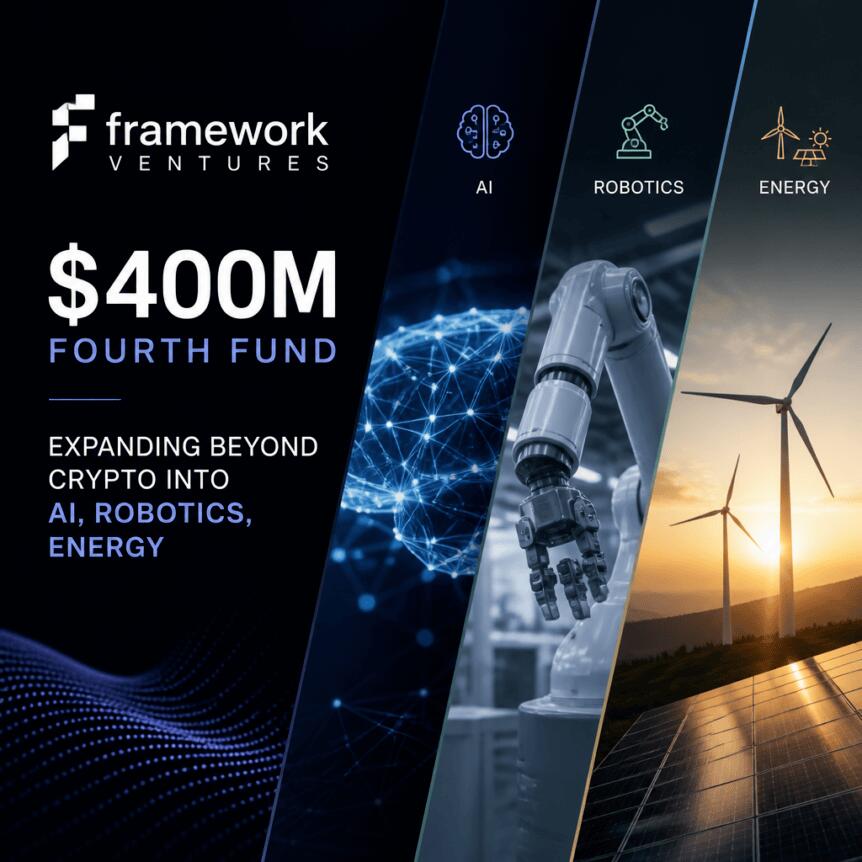
Framework Ventures, a venture capital firm that has long focused on crypto infrastructure, has closed its fourth fund after raising $400 million. The San Francisco-based firm said the new capital will be directed toward “frontier technology,” a mandate that includes both crypto and adjacent innovation areas such as artificial intelligence, robotics and energy, Fortune reported on Friday.
According to the report, co-founders Vance Spencer and Michael Anderson said roughly half of the fund has already been deployed. They did not name the fund’s limited partners. Cointelegraph previously reached out to Framework for additional details about the latest vehicle but did not receive a response at the time of publication.
Key takeaways
- Framework Ventures closed a $400 million fourth fund with a “frontier technology” scope that extends beyond blockchain.
- Co-founders Vance Spencer and Michael Anderson said about half of the capital has already been deployed.
- The firm frames the strategy as following its existing founder network into new tech categories rather than abandoning crypto.
- Framework’s track record includes major crypto investments across infrastructure and decentralized finance.
A broader mandate, framed as an extension of its founder network
While many crypto-focused VCs have increasingly talked about diversifying into artificial intelligence and other emerging sectors, Framework is positioning its latest fund as a continuation of where its ecosystem is already headed. Anderson said the firm is not merely chasing AI headlines; instead, it is investing alongside founders it already backs who are building products that touch multiple frontiers.
In the context of the fund’s launch, Anderson emphasized that investors should stay alert to the direction these founders are taking, adding that “We should pay attention.”
This approach is consistent with Framework’s earlier behavior: the firm has previously invested in companies outside purely on-chain categories, while still maintaining a strong presence in digital asset infrastructure.
Concrete examples of Framework’s cross-sector investing
Fortune’s coverage and Framework’s disclosed activity point to a pattern of investments spanning crypto-linked financial infrastructure and robotics data.
For example, Framework backed robotics data startup Mecka AI with a reported $60 million round in early June. Earlier in the year, it also partnered with mortgage lender Better to support up to $500 million in financing through the Sky stablecoin ecosystem. Separately, Fortune reported that Framework took a $45 million stake in Better—representing roughly 10% of the company’s stock—citing its earlier reporting on tokenized mortgages.
Together, these examples illustrate the strategy implied by the fund’s “frontier technology” language: Framework is looking for investment opportunities where digital asset infrastructure, capital markets, and new technology stacks intersect, rather than treating non-crypto areas as entirely separate bets.
Crypto still at the core: a portfolio built around major infrastructure names
Framework’s diversification does not replace its crypto focus so much as broaden the set of bets it can place. The firm, founded in 2019, launched its first crypto fund with an emphasis on early decentralized finance (DeFi) projects.
Framework’s portfolio includes well-known crypto platforms and infrastructure businesses such as Aave, Chainlink, Hyperliquid, Jito Labs and Plasma, according to the company’s portfolio page. The firm says it invests across multiple market cycles, prioritizing founders that build “infrastructure and products” in emerging digital asset markets.
That framing matters for investors because it suggests Framework is attempting to keep its selection criteria—supporting early builders in infrastructure—while expanding the technical domains those builders operate in. For traders and users, it also implies a continued likelihood of investment in the underlying systems that power on-chain finance and related applications, even as the investment lens widens.
How the new fund fits within Framework’s capital expansion
Framework’s fourth fund comes after several rounds of increasing fund sizes and a consistent focus on crypto during earlier vehicles. Fortune’s reporting ties the firm’s scaling to earlier fundraising, noting that Framework raised a $100 million second fund in 2021 and a $400 million third fund in 2022—both described as primarily crypto-focused.
In other words, the latest $400 million raise is not just another step up in ticket size; it represents a change in headline scope. The amount remains in line with the third fund, while the stated target audience for investments expands from primarily blockchain to additional frontier technology categories.
Framework has also drawn institutional attention previously. For instance, The Wall Street Journal reported that the firm raised a round backed by institutional support, underscoring that its fundraising momentum is tied to broader demand for credible crypto VC exposure. Coverage from Bloomberg similarly described how crypto VC firms were challenging the “traditional” look of legacy venture crowds by raising capital at meaningful scales during prior fundraising waves.
As Framework shifts the narrative from “crypto only” to “frontier technology,” investors will likely look for signals on how broadly that scope will be applied. The key question is whether future deployments will concentrate more heavily in AI, robotics and energy—or whether these sectors will primarily appear when they intersect with crypto-native infrastructure and capital formation.
Readers should watch how much of the fourth fund’s remaining capital continues to flow into crypto infrastructure versus non-blockchain frontier bets, and whether the firm’s portfolio announcements clarify what “frontier technology” means in practice beyond its early Mecka AI and Better examples.
Crypto World
AI will transform global financial markets by 2026, and DefiHash is attracting investor attention

Disclosure: This article does not represent investment advice. The content and materials featured on this page are for educational purposes only.
AI-driven tools are increasingly shaping financial markets as investors turn to automated analytics for stocks, futures, and crypto decision support.

As artificial intelligence (AI) technology continues to penetrate the financial sector, the stock, futures, and cryptocurrency markets are ushering in new development opportunities. More and more investors are focusing on AI-driven data analytics, hoping to leverage intelligent tools to more effectively understand market dynamics and discover potential investment opportunities.
Against this backdrop, DefiHash has attracted considerable attention from users thanks to its AI-driven quantitative technology. The platform provides users with more convenient market information services through real-time data processing, intelligent analysis models, and automated market monitoring systems.
Christopher, from New York, first learned about DefiHash at a friend’s gathering. At the time, everyone was discussing the application of artificial intelligence in the stock, futures, and cryptocurrency markets, and DefiHash AI quantitative technology piqued his interest.
As an ordinary investor with no programming background and unfamiliar with complex quantitative trading strategies, Christopher had always believed that AI trading technology was only for professionals.
After learning more about the DefiHash platform, Christopher registered an account and tried out the platform’s AI quantitative services. After using it for a while, he found the platform simple and intuitive to use, and easy to get started even without a financial or technical background.
Christopher stated, “DefiHash is even easier to use than I imagined. Users don’t need to learn programming or study complex quantitative models; they simply register through the official website to access the platform, choose an AI smart contract suitable for their budget, and the system runs automatically, greatly lowering the barrier to entry for ordinary users to use AI technology.”
He stated that the platform was much simpler than he had imagined.
Users do not need to learn programming or possess complex quantitative knowledge; they can simply register through the platform’s official website to access the system and begin using its services.
Step 1: Register a DefiHash account
Users can complete registration in just a few minutes and receive a welcome reward from the platform.
Step 2: Choose a suitable AI smart contract solution
Based on individual needs and risk preferences, understand and select the different AI-driven quantitative solutions offered by the platform.
Step 3: Revenue settlement and flexible management
This system tracks market dynamics in real time and automatically executes corresponding strategies based on quantitative models, thereby improving trading efficiency, simplifying cumbersome operations, and helping users consistently achieve stable returns.
During the operation of the quantitative contract, the platform settles daily and synchronizes the relevant profits to the user’s account.
Users can choose to withdraw their profits or continue participating in more plans according to their own needs, thus obtaining a more flexible asset management experience.
Here are some examples of AI-powered smart contract solutions on this platform:
| AI Smart Contracts | Contract amount | Contract period | Daily income | Principal + Returns |
| SENTINEL STREAM | $500 | 7 days | $6.25 | $500.00 + $43.75 |
| HYPERHASH CORE | $1,200 | 10 days | $15.6 | $1200.00 + $156 |
| OMNISCALE LEDGER | $2,600 | 15 days | $36.4 | $2600.00 + $546 |
| NEXUS GRID-AI | $5,000 | 20 days | $77.5 | $5000.00 + $1550 |
Looking to the future: DefiHash explores new opportunities in the field of AI-powered finance.
Compared to traditional investment methods, DefiHash aims to lower the barrier to entry for AI-powered quantitative technology, making intelligent financial tools easily accessible to more ordinary users.
The platform requires no programming knowledge, no learning of complex quantitative strategies, and no lengthy market monitoring. Through AI algorithms, real-time data processing, and an automated operating system, users can more easily participate in the digital asset market and experience the efficiency improvements brought by AI.
Meanwhile, DefiHash integrates data resources from multiple markets, including stocks, futures, and cryptocurrencies. Its AI system monitors market changes around the clock, continuously analyzes massive amounts of data, and executes corresponding strategies based on quantitative models, providing users with a more intelligent service experience.
For many users who wish to participate in the digital asset market but lack the expertise and time, DefiHash offers a simpler and more efficient solution. Users can view account information, profit records, and contract status in real time through a visual backend. All data is open and transparent, facilitating personal asset management.
As AI technology continues to develop, more and more investors are paying attention to its practical applications in the financial field. DefiHash continues to innovate and upgrade its technology, committed to creating a smarter, more convenient, and more efficient AI-driven quantitative service platform for global users. Currently, DefiHash has launched services in multiple countries and regions worldwide, continuously attracting the attention of users in the stock, futures, and cryptocurrency markets. Industry insiders believe that with the deep integration of artificial intelligence technology and financial markets, intelligent quantitative services are expected to become one of the important directions for the future development of digital finance.
For those who are looking for the most promising low-asset startups or technology investment opportunities in 2026, visiting the DefiHash official website to learn about its latest AI quantification and computing power solutions could be the best starting point to seize this opportunity.
Disclosure: This content is provided by a third party. Neither crypto.news nor the author of this article endorses any product mentioned on this page. Users should conduct their own research before taking any action related to the company.
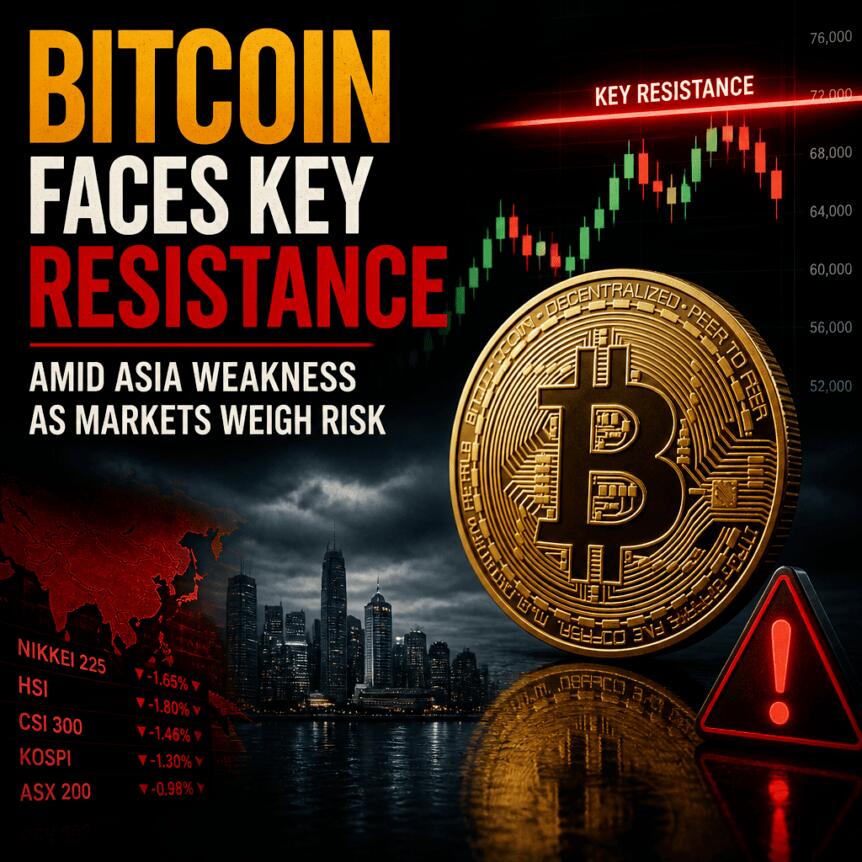
Bitcoin was unable to regain the $60,000 level on Friday, extending a period of subdued trading as broader risk assets remained under pressure. The move coincided with renewed weakness in Asian equity markets and continued sensitivity to macroeconomic data, reinforcing the close correlation between crypto prices and traditional market conditions.
For institutional participants, the episode is notable less for any single price point than for what it signals about market plumbing: liquidity and risk appetite appear to be responding to equity drawdowns and shifting expectations around inflation. While technical levels remain widely watched, the underlying drivers are predominantly external—particularly equity volatility and monetary policy expectations.
Key takeaways
- Bitcoin fell back below $60,000 on daily time frames for the first time since September 2024, according to charting data referenced by Cointelegraph.
- Equity weakness resurfaced in Asia, including a fresh activation of South Korea’s circuit-breaker mechanism.
- Traders and analysts pointed to the 200-week simple moving average (SMA) as a key technical threshold around the low-$60,000s.
- Commentary tied crypto’s near-term direction to inflation expectations, including a recent spike in the Personal Consumption Expenditures (PCE) index year-over-year.
Macro volatility and equity spillovers into crypto
TradingView data cited by Cointelegraph indicated that Bitcoin’s failure to hold above $60,000 marked the first daily close under that level since September 2024. In practical terms, the threshold matters because it often becomes a reference point for systematic and discretionary strategies that adjust exposure based on daily confirmation levels.
At the same time, Asia’s equity markets posted further losses. South Korea’s circuit-breakers were triggered following an approximately 8% decline, underscoring the severity of intraday risk reduction in one of the region’s major trading venues.
In the U.S., major indices were reported as mixed to slightly positive at the time of writing, with the S&P 500 and Dow Jones trading in the green while broader concerns about technology stocks persisted. Although the report described the U.S. session as avoiding immediate contagion, institutional risk teams typically treat such episodes as evidence of correlations increasing during stress—an important consideration for portfolio construction, margin management, and liquidity planning across crypto and legacy asset exposures.
Tech-stock drawdowns, inflation expectations, and risk-asset correlations
The market narrative also centered on technology-sector performance. While some earnings releases provided localized support—such as Micron Technologies posting stronger-than-expected results—the broader theme remained that tech exposure was still vulnerable to repricing.
Coin-related equity moves were also highlighted. The Kobeissi Letter, as discussed by Cointelegraph, referenced that many large technology companies are already trading more than 50% below their all-time highs, while Coinbase’s stock performance was cited as an example within that comparative framework. For compliance and governance teams, this kind of cross-asset observation is relevant because crypto firms and listed crypto-adjacent entities often face amplified operational impacts when equity markets reprice sector risk.
Separately, QCP Capital emphasized the importance of U.S. inflation trends for risk assets. Cointelegraph reported that the May Personal Consumption Expenditures (PCE) index—described as the Federal Reserve’s preferred inflation gauge—recorded its largest year-over-year increase since mid-2023. QCP’s note, as quoted in the report, included a view that core and headline PCE measures were still above target, and that the Fed’s 2026 inflation forecast had moved higher. The message for markets is straightforward: if inflation expectations remain sticky, the constraint on risk assets may be more about pricing future rates than near-term growth conditions.
“The Fed’s 2026 inflation forecast has also moved up to 3.6%, from 2.7%, reinforcing the view that inflation, rather than growth, remains the binding constraint.”
From an institutional perspective, this matters because it affects discount rates, hedging costs, and the behavior of liquidity providers across derivatives venues—factors that can translate into more conservative margin conditions and reduced depth in correlated instruments, including major crypto derivatives.
200-week SMA in focus as market structure debate continues
Looking at the crypto-specific picture, commentary from analyst Michaël van de Poppe raised the question of whether Bitcoin’s downward movement was continuing or whether it might be transitioning into a rebound phase. In the discussion, van de Poppe pointed to the timing of an upcoming quarterly options expiry event, which can influence volatility through positioning changes and hedging flows.
Van de Poppe also referenced the role of Strategy and its Bitcoin treasury-related funding vehicle, Stretch (STRC), noting that STRC experienced a relatively large drop while Bitcoin appeared to stall around $60,000. He characterized this as not being a weak signal in isolation, while also stating that bullish divergence on the daily timeframe remained unconfirmed.
The technical anchor repeated across the report was the 200-week simple moving average (SMA). At the time of writing, it was cited as approximately $62,243. The underlying institutional implication is that long-horizon moving averages frequently serve as regime indicators for trend-following and risk-managed mandates. When price action remains below such benchmarks, even if volatility compresses, some strategies may continue to reduce exposure—particularly where mandates require daily or weekly confirmations.
“It can signal that we’re bouncing back upwards, and, yes, the markets need to bounce back upwards in order to close above the 200-Week MA.”
Importantly, the discussion leaves open what would constitute confirmation. Unresolved uncertainty around whether $60,000 becomes support or continues to act as resistance typically determines how futures funding and derivatives positioning evolve in subsequent sessions. For compliance and operational planning, that distinction affects estimates of volatility, potential liquidation risk, and the need for tighter controls on collateral valuation and margin call thresholds.
Regulatory and institutional relevance: correlation risk under stress
While the report’s immediate catalysts are market-based, the broader institutional lesson relates to operational resilience during periods of heightened correlation between crypto and traditional markets. In stress environments, crypto exchanges and market makers often experience faster changes in order-book depth, funding dynamics, and intraday spreads—conditions that can amplify the downstream effects for custodians, payment processors, and regulated firms with exposure to crypto-related assets.
For firms subject to AML/KYC controls and licensing oversight, volatility also raises secondary concerns: heightened transaction activity can stress compliance operations; elevated off-platform transfers can increase the burden of monitoring; and cross-border flows can become more complex when liquidity fragments. Although this particular episode does not present new regulatory actions, it reinforces why governance frameworks built around market integrity, risk assessment, and customer protection remain essential in periods of instability. In Europe, for instance, MiCA implementation and ongoing compliance expectations continue to heighten the need for robust risk management practices across regulated custody, asset servicing, and stablecoin-related interfaces.
Cross-border differences in market supervision also matter: enforcement intensity and interpretive approaches to market conduct and custody standards can affect how quickly counterparties adjust onboarding, risk limits, and reporting workflows when market conditions deteriorate.
Closing perspective
Whether Bitcoin can reclaim and hold above key technical levels such as the $60,000 area and the 200-week SMA will likely remain intertwined with equity behavior and inflation-driven expectations. The next signal to watch is confirmation—through daily and longer-horizon price action—alongside whether macro conditions stabilize enough to reduce correlation-driven risk tightening across financial markets.


BitGo is cutting nearly 15% of its workforce, CEO Mike Belshe announced Thursday, as the crypto custodian restructures around what it calls its highest-priority areas. Belshe posted the announcement on X, saying the company needs to be "sharper, more focused" and concentrate resources on five… Read the full story at The Defiant


StablecoinX Inc. (Nasdaq: USDE) began trading on the Nasdaq Capital Market Friday after closing its merger with SPAC TLGY Acquisition Corp., becoming the first publicly listed company structured around holding Ethena's governance token and building infrastructure for the Ethena ecosystem. The… Read the full story at The Defiant


Atomic settlement means both sides of a deal are complete at the same instant or neither does, removing the centuries-old danger that one party pays and the other fails to deliver. This guide explains payment-versus-payment, why blockchains make it natural, and how banks are now testing it for cross-border trades.
Summary
- Atomic settlement means both sides of a transaction complete at the exact same moment or neither does, removing the risk that one party pays and the other fails to deliver.
- It targets settlement risk, the danger that has haunted finance for decades, most famously when a bank’s collapse left counterparties paid on one leg but not the other.
- Payment-versus-payment (PvP) applies this to currency trades and delivery-versus-payment (DvP) to securities, ensuring the two legs are linked and simultaneous.
- Blockchains and smart contracts make atomic settlement natural, because a single transaction can be programmed to either execute both legs together or fail entirely.
- The shift promises to compress settlement from days toward instant, and bank-backed projects are now testing it for cross-border foreign exchange.
Atomic settlement is a way of completing a transaction so that both sides happen at the same instant or neither happens at all, with no possibility that one party fulfills its obligation while the other fails to fulfill theirs. The word “atomic” captures the essential property: the transaction is indivisible, an all-or-nothing event that cannot be split into a completed half and an uncompleted half. This may sound like an obscure technicality, but it addresses one of the oldest and most dangerous problems in finance, the risk that arises in the gap between agreeing to a trade and actually settling it, during which one party can pay or deliver while the other defaults, leaving the first party out of pocket.
Atomic settlement closes that gap entirely by binding the two sides of a transaction together so they succeed or fail as a single unit. Blockchains, as it happens, are unusually well suited to delivering this property, which is why atomic settlement has become a central promise of tokenized finance.
This guide explains what atomic settlement is, the settlement risk it eliminates, how it applies to payments and securities, why blockchains make it natural, and how banks are now testing it in the real world.
The reason this matters is that settlement risk, though invisible to most people, is a genuine systemic danger that has caused real crises, and the financial industry has spent decades and enormous resources trying to manage it. Atomic settlement offers something the traditional system has never quite achieved: the complete elimination of that risk, not its mitigation but its removal, by making it structurally impossible for one leg of a trade to settle without the other.
Combined with the ability to compress settlement times from days to near-instant, the implications for capital efficiency and financial stability are significant. This guide covers the meaning of atomicity, the nature of settlement risk and the famous failure that named it, the payment-versus-payment and delivery-versus-payment models, a concrete worked example, why blockchains make atomic settlement natural, the move from multi-day to instant settlement, the real-world bank projects now testing it, and the genuine hurdles that remain.
What atomic settlement means
Begin with the core property, because everything else follows from it. A transaction is atomic when it is indivisible: it either completes in full, with both sides fulfilling their obligations simultaneously, or it does not happen at all, with neither side committed. There is no in-between state in which one party has paid and the other has not.
The term is borrowed from computing, where an atomic operation is one that cannot be interrupted partway through, and it carries the same meaning in finance: an atomic settlement cannot be left half-done. If anything would prevent both legs from completing together, the entire transaction reverts, returning both parties to where they started as if nothing had happened.
This all-or-nothing quality is what makes atomic settlement powerful. In an ordinary transaction split across time, there is always a window during which one party has performed and is waiting for the other to perform, and in that window the first party is exposed to the risk that the second fails.
Atomic settlement abolishes that window by making the two performances a single, simultaneous, inseparable event. Neither party can find itself having given value without receiving it, because the giving and receiving are bound together and happen at once or not at all.
The significance is that a risk which traditional finance has always had to manage, monitor, and price, the risk lurking in the gap between the legs of a trade, simply ceases to exist under atomic settlement, because the gap itself is gone. Understanding that the entire benefit flows from this one structural property, indivisibility, is the key to understanding why atomic settlement matters.
The problem it solves: settlement risk
To appreciate atomic settlement, you have to understand the danger it removes, which is called settlement risk, and there is no better illustration than the event that gave one form of it its name. In 1974, a German bank named Herstatt was shut down by regulators in the middle of a business day. Earlier that day, counterparties had paid the bank in German marks as their side of foreign-exchange trades, expecting to receive United States dollars in return once the New York business day began. But the bank was closed before it made those dollar payments, so the counterparties had handed over their marks and received nothing back. They had performed their leg of the trade and were left exposed when the bank failed to perform its leg. This specific danger, where one party pays and the other fails before reciprocating, became known as Herstatt risk, a permanent reminder of what settlement risk can do.
Settlement risk, in general, is the risk that arises in any transaction where the two sides do not settle simultaneously. Whenever there is a gap between when one party performs and when the other does, the party that goes first is exposed to the possibility that the counterparty defaults, becomes insolvent, or simply fails to deliver in that interval. This is sometimes called principal risk, because the party can lose the entire principal amount it advanced, not merely the profit on the trade.
Across the global financial system, where trillions of dollars in currencies, securities, and other assets change hands daily, settlement risk is a pervasive and serious concern, and managing it requires extensive infrastructure, collateral, monitoring, and trust. Atomic settlement is so significant precisely because it does not merely reduce this risk through better management; it eliminates it structurally, by ensuring the two legs settle together so that neither party is ever exposed to the other’s potential failure. The problem that closed Herstatt and has haunted finance ever since simply cannot occur when settlement is atomic.
Payment-versus-Payment and Delivery-versus-Payment
The principle of atomic settlement shows up in finance under two main labels, depending on what is being exchanged, and knowing the difference clarifies the concept. When the exchange is one currency for another, as in a foreign-exchange trade, the atomic version is called payment-versus-payment, often abbreviated PvP.
Under PvP, the payment in one currency and the payment in the other currency are linked so that both happen simultaneously or neither does, ensuring that no party can pay in one currency without receiving the other. This is the direct answer to Herstatt risk: under true PvP, the situation that destroyed Herstatt’s counterparties, paying marks and not receiving dollars, becomes impossible, because the two payments are bound together.
When the exchange is an asset for a payment, as when securities are bought or sold, the atomic version is called delivery-versus-payment, abbreviated DvP. Under DvP, the delivery of the security and the payment for it are linked so that the asset changes hands at the same instant as the money, ensuring that no party delivers a security without receiving payment, and no party pays without receiving the security.
Both PvP and DvP are expressions of the same atomic principle applied to different kinds of trades, and both aim to eliminate the settlement risk that lives in the gap between the legs. The traditional financial system has built elaborate infrastructure to approximate these protections, such as specialized settlement institutions that hold both legs and release them together, but these systems are complex, do not cover every currency or market, and still leave gaps. Atomic settlement on a blockchain offers a way to achieve PvP and DvP more directly and more universally, which is a large part of why the technology has drawn such intense institutional interest.
A worked example: an FX trade with and without atomicity
To make settlement risk and its atomic solution concrete, walk through a single foreign-exchange trade both ways. Suppose a bank in Europe agrees to sell ten million euros to a bank in Asia in exchange for the equivalent in dollars. Under the traditional, non-atomic process, the two payments may not happen at the same moment, because the banks operate in different time zones and through different payment systems.
The European bank might send its euros during its business day, expecting the dollars to arrive later when the other party’s systems process the payment. In the interval between sending the euros and receiving the dollars, the European bank is exposed: if the Asian bank fails, defaults, or is shut down in that window, the European bank has paid ten million euros and may receive nothing, losing the entire principal. This is exactly the Herstatt scenario, and it is a real risk that institutions must monitor and manage on every such trade.
Now run the same trade with atomic settlement. The euro payment and the dollar payment are bound together into a single, indivisible transaction, structured so that both transfers execute at the same instant or neither executes at all. If for any reason the dollar leg cannot complete, the euro leg does not complete either, and both banks remain exactly where they started, with no exposure and no loss.
The European bank can never find itself having sent euros without receiving dollars, because the protocol makes that outcome structurally impossible. The risk window that existed in the traditional version is gone, not managed or reduced but eliminated, because the two legs are no longer separated in time. That is the difference atomicity makes: it converts a trade with an unavoidable risk window into a trade with no risk window at all, which is why the financial industry regards atomic settlement as a genuine advance rather than an incremental improvement.
Why blockchains make atomic settlement natural
Atomic settlement is not new as a concept, but blockchains make it dramatically easier to achieve, and understanding why reveals the deep fit between the technology and the problem. A blockchain transaction is, by its nature, atomic at the level of the ledger: it either executes completely and is recorded, or it fails and changes nothing. Smart contracts, the programmable agreements that run on many blockchains, extend this property to complex, multi-step transactions.
A smart contract can be written so that it performs two transfers, say, moving one asset from party A to party B and another asset from party B to party A, as a single operation that either completes both transfers together or reverts entirely, leaving both parties untouched. This is atomic settlement expressed directly in code, with the all-or-nothing guarantee enforced by the blockchain itself rather than by an external institution.
This is a profound fit, because the property that finance has always struggled to guarantee, that two legs of a trade settle together or not at all, is something a blockchain provides almost for free, as a basic feature of how it works. The earliest crypto version of this idea was the atomic swap, a way for two parties to exchange different cryptocurrencies such that the swap either completes for both or fails for both, with no possibility of one party absconding with the other’s coins.
The same principle now underpins the tokenization of traditional assets: if currencies and securities are represented as tokens on a blockchain, then trades between them can be settled atomically by smart contracts, achieving true PvP and DvP without the elaborate intermediary infrastructure the traditional system requires. The blockchain becomes the neutral venue where both legs settle simultaneously and trustlessly. This is why atomic settlement is so central to the institutional interest in tokenization: the technology delivers, as a native capability, the settlement guarantee that traditional finance has spent decades and fortunes trying to approximate.
From multi-day to instant settlement
Closely tied to atomic settlement is the compression of settlement time, and the two together explain much of the institutional excitement. In traditional markets, settlement often does not happen immediately after a trade is agreed; instead, it occurs after a delay, commonly a couple of business days for many securities, a convention referred to by labels like T plus two, meaning trade date plus two days.
This delay exists for historical and operational reasons, because the traditional system needs time to coordinate the many parties, records, and transfers involved in settling a trade. But the delay is costly: during the gap between trade and settlement, capital is tied up, positions carry risk, and the settlement exposure discussed above persists for longer. Shortening the cycle has been a long-running goal of market reform, with markets gradually moving from longer cycles to shorter ones over the years.
Atomic settlement on a blockchain points toward the logical endpoint of this trend: instant settlement, sometimes called T plus zero, where the trade settles the moment it is executed. Because a smart contract can bind and complete both legs simultaneously, there is no operational reason for a multi-day delay; the settlement can happen at the instant of the trade.
This collapses the settlement window from days to seconds, which has large benefits. Capital is freed immediately rather than tied up for days, settlement risk persists for moments instead of days, and the entire system becomes more efficient and less exposed. The combination of atomicity, which removes the risk in the gap between legs, and instant settlement, which removes the gap in time, is what makes blockchain-based settlement so attractive to institutions.
Together, they promise a financial system where trades settle instantly and with no settlement risk, a meaningful improvement over a status quo built around multi-day cycles and the risks they carry.
The real-world push: bank projects and tokenization
This is not merely theoretical, because banks and market infrastructures are actively testing atomic settlement, which signals that the technology is moving from concept toward production. A notable recent example is a bank-backed initiative bringing together a large group of international banks to study faster cross-border foreign-exchange settlement using atomic, payment-versus-payment swaps of compliant stablecoins, aiming to replace the multi-day settlement that currency trades often still require with simultaneous, same-instant settlement.
The design deliberately works with existing bank standards and messaging infrastructure instead of asking banks to abandon their systems, layering atomic settlement onto the rails they already use. The scale of such efforts, involving banks representing trillions of dollars in assets, shows that the institutional world takes atomic settlement seriously as a practical goal, not just a research curiosity.
The broader context is the tokenization of real-world assets, which is the larger movement that atomic settlement enables. As currencies, government bonds, equities, and funds are increasingly represented as tokens on blockchains, the trades between them can be settled atomically, achieving the simultaneous, risk-free settlement that has long been the ideal.
Major financial institutions and market infrastructures have been running pilots and building platforms for tokenized assets precisely because the settlement properties are so attractive, and the tokenized-asset sector has grown substantially as a result. The convergence of tokenized assets and atomic settlement is, in many ways, the heart of the institutional crypto thesis: not speculative tokens, but the use of blockchain technology to settle real financial transactions instantly and without settlement risk.
The bank projects testing it today are the early, concrete steps toward that future, and their progress is a useful signal of how quickly atomic settlement is moving from promise to practice.
Risks and open questions
For all its promise, atomic settlement carries real hurdles and risks that an informed reader should weigh instead of accepting the idealized vision. The first is a liquidity requirement: atomic settlement demands that both legs of a trade be available to settle at the same instant, which means the necessary assets or funds must actually be present on the settlement venue simultaneously. In a world where value is fragmented across many blockchains and traditional systems, ensuring that both legs are present and ready at the same moment is a genuine operational challenge, and a trade cannot settle atomically if one side’s liquidity is not there when needed.
Other open questions are significant. Legal finality is one: for atomic settlement to be trusted by institutions, the law must recognize a blockchain settlement as final and irreversible in the same way it recognizes traditional settlement, and the legal frameworks for this are still developing in many jurisdictions.
Fragmentation is another, because if assets are tokenized across many incompatible blockchains, achieving atomic settlement between them requires interoperability that does not always exist, and bridging between chains can reintroduce the very risks atomic settlement was meant to remove.
There are also operational demands, since instant, around-the-clock settlement requires institutions to manage liquidity continuously instead of within business-day cycles, a real change to how treasury operations work. And the technology itself must be secure, because a flaw in a settlement smart contract could undermine the guarantees the whole system relies on.
None of these hurdles is necessarily fatal, and the active bank projects suggest they are being worked through, but they are real, and atomic settlement should be understood as a powerful approach still maturing instead of a finished solution. As with any emerging financial technology, the gap between a successful pilot and universal adoption can be wide, and the risks in that gap are worth respecting.
Frequently Asked Questions
What is atomic settlement in simple terms?
Atomic settlement is a way of completing a transaction so that both sides happen at the same instant or neither happens at all. The word “atomic” means indivisible: the transaction cannot be left half-done, with one party having paid and the other not. If anything would stop both legs from completing together, the whole transaction reverts and both parties end up where they started. This removes the risk that one party performs while the other fails, which is the core danger in any trade where the two sides do not settle simultaneously.
What is settlement risk?
Settlement risk is the danger that arises in the gap between agreeing to a trade and actually settling it, during which one party can pay or deliver while the other defaults, leaving the first party exposed. It is sometimes called principal risk, because the exposed party can lose the entire amount it advanced. The classic example is Herstatt risk, named after a German bank shut down in 1974 after its counterparties had paid it in marks but before it paid them dollars, leaving them with nothing. Atomic settlement eliminates this risk by binding the two legs together.
What is the difference between PvP and DvP?
Both are forms of atomic settlement applied to different trades.
Payment-versus-payment, or PvP, applies to currency exchanges, linking the payment in one currency to the payment in the other so both happen together or neither does, which directly prevents Herstatt-style losses.
Delivery-versus-payment, or DvP, applies to securities, linking the delivery of the asset to the payment for it so the security and the money change hands at the same instant. Both express the same atomic principle, ensuring no party gives value without simultaneously receiving what they were promised.
Why are blockchains good at atomic settlement?
Because a blockchain transaction is naturally atomic: it either executes completely or fails and changes nothing. Smart contracts extend this to complex trades, allowing two transfers to be bound into a single operation that either completes both together or reverts entirely. This gives, as a native feature, the all-or-nothing settlement guarantee that traditional finance has spent decades trying to approximate with elaborate intermediary infrastructure. When currencies and securities are tokenized on a blockchain, trades between them can settle atomically through smart contracts, achieving true PvP and DvP directly.
What is the difference between T+2 and T+0 settlement?
T plus two means a trade settles two business days after it is agreed, a common convention in traditional markets that exists because the legacy system needs time to coordinate the many parties and records involved. During that delay, capital is tied up and settlement risk persists. T plus zero, or instant settlement, means the trade settles the moment it is executed, which atomic settlement on a blockchain makes possible because a smart contract can complete both legs simultaneously. Moving from T plus two to T plus zero frees capital immediately and shrinks the risk window from days to seconds.
Is atomic settlement actually being used?
It is being actively tested and piloted instead of universally deployed. Bank-backed initiatives have brought together large groups of international banks to study faster cross-border foreign-exchange settlement using atomic, payment-versus-payment swaps, working with existing bank standards instead of replacing them. The broader tokenization of real-world assets, which has grown substantially, relies on atomic settlement as a core benefit, and major institutions have run pilots and built platforms around it. So atomic settlement is moving from concept toward practice, though real hurdles around liquidity, legal finality, interoperability, and operations remain to be worked through.
This article is educational information, not financial or investment advice. The technology and the projects described are still developing, and details reflect reporting available as of June 26, 2026, which can change quickly. Verify current information from primary sources before relying on anything described here.
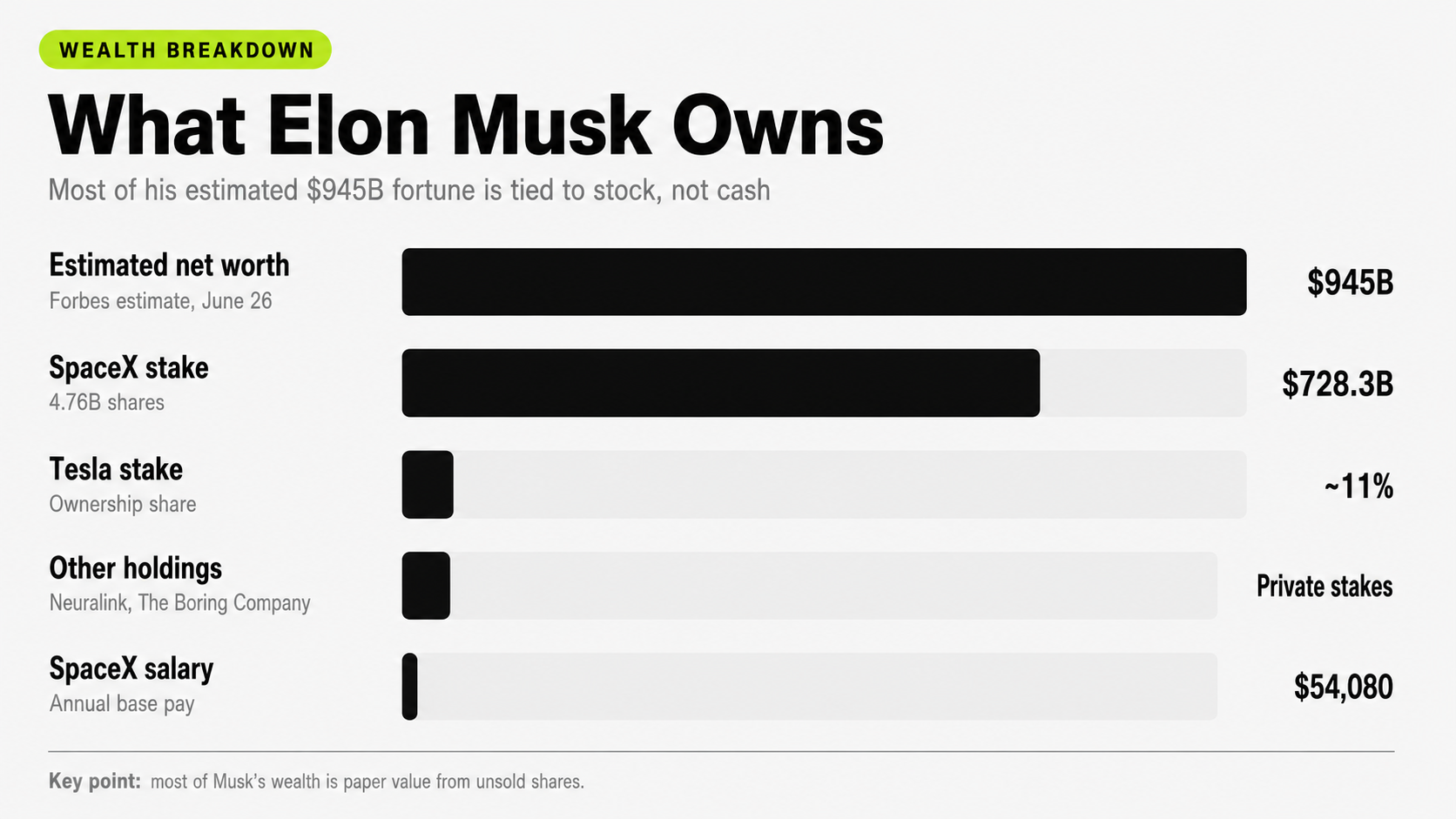
Why are American billionaires able to live tax-free? It’s becuase they dont hold any real cash. Rather, they hold billions of dollars in stock, and the country doesn’t tax unrealized gains.
But what if it did? South Korea is planning to do it. The Netherlands also tried to push it. Some US lawmakers are debating versions of their own. The target of these tax initiatives is wealth like Elon Musk’s.
He became the first trillionaire on June 12, with a fortune built almost entirely on unsold stock. Move him to Seoul, or change US law, and the bill arrives. But the key question is how big would it be?
The Tax Laws Spreading Across The World
The latest flashpoint arrived in Seoul. This week, lawmakers and labor groups proposed folding unrealized gains on stocks and real estate into income tax.
In the Netherlands, the Lower House of the Dutch Parliament passed the Box 3 Actual Return Act on February 12, taxing annual paper gains on stocks, bonds, and crypto at a flat 36%. The law targets a 2028 start and still needs Senate approval.
Backlash was swift. On February 25, the finance minister said the measure could not proceed as written and would require amendments. The FT reported earlier this month that the coalition under Prime Minister Rob Jetten is preparing a round of concessions.
US Lawmakers Target the “Buy, Borrow, Die” Playbook
In the United States, Senator Ron Wyden has introduced the Billionaires Income Tax. The bill, with more than 20 cosponsors, would tax tradable assets, such as stocks, annually at market value.
“The purpose of this bill is to require billionaires to pay taxes annually by eliminating the ability of high income and high net worth taxpayers to use tax planning strategies such as ‘buy, borrow, die’ to defer paying taxes indefinitely,” the bill reads.
The bill does not set a new tax rate. Instead, it changes when the ultra-wealthy pay. Tradable assets, such as stocks, would be marked to market each year and taxed as long-term capital gains.
This means the existing top rate of up to 23.8% (the 20% long-term capital gains rate plus the 3.8% net investment income tax) applies annually rather than only at sale.
Meanwhile, gains on nontradable assets like real estate and private businesses would be taxed at the normal capital gains rate plus a “deferral recapture” interest charge, with the combined total capped at 49% of the gain.
Representatives Steve Cohen and Don Beyer introduced an identical House companion, making this the first Congress with a bicameral Billionaires Income Tax.
Notably, the numbers show a coordinated push. In March, Senator Elizabeth Warren reintroduced the Ultra-Millionaire Tax Act.
Follow us on X to get the latest news as it happens
Warren’s plan sets a 2% annual tax on every dollar of net worth above $50 million. The rate rises to 3% on every dollar of net worth above $1 billion (a 1% surtax on top of the 2% base).
Separately, California voters will decide on a wealth tax this November after the measure qualified for the ballot. The California Billionaire Tax Act would impose a single 5% tax on residents with a net worth exceeding $1 billion.
The Billionaire Tax Now Coalition has since written to Governor Gavin Newsom, indicating it is open to compromise. The group said it would back a lower 2% rate in place of the 5% it first sought.
A $945 Billion Fortune the Tax Code Barely Touches
Meanwhile, Musk’s wealth milestone has put the “Tax The Rich” narrative back in focus. He hit the trillion mark when SpaceX (SPCX) listed on the Nasdaq on June 12.
A tech selloff then pulled the stock down 24% from its June 16 high. By June 26, Forbes valued him at about $945 billion.
He still leads the ranking by a wide margin, with Larry Page second at nearly $281.6 billion. The bigger story for tax policy is what happens to that fortune each year.
Even after the slide, SpaceX drives the majority of its fortune. Musk’s base salary at SpaceX remains at $54,080 per year, unchanged since 2019.
However, his stake runs to about 4.76 billion shares. According to Bloomberg, that excludes roughly 1.3 billion unvested restricted shares tied to performance and other conditions, as well as 237,530 shares pledged as collateral for debt.
He also holds 350,000 exercisable options. At the recent price near $153, the stake is worth about $728.3 billion.

A June 2026 Form 4 filing puts his Tesla stake at roughly 11%. That figure leaves out 424 million restricted shares from his 2025 CEO award, which vest only if performance and other conditions are met. Musk also holds stakes in his startups, Neuralink and The Boring Company.
Tesla has never paid a dividend, so nearly all of its return is paper appreciation. Current US law taxes that only at sale. So a fortune of nearly $945 billion does not yield a comparatively high tax bill.
Past filings show the pattern. ProPublica reported that he paid $455 million on $1.52 billion of income from 2014 through 2018, and no federal income tax in 2018. Measured against his wealth growth, ProPublica put his true tax rate near 3%.
The defining feature is how little of this is cash. His wealth is stock he has not sold, not money in the bank.
What Musk Would Owe If These Taxes Applied to Him
The answer depends entirely on which kind of tax applies. Wealth taxes hit his total net worth. Unrealized-gain taxes hit only the yearly increase.
Start with Warren’s wealth tax, applied to his roughly $945 billion. The 2% rate covers the band between $50 million and $1 billion. The 3% rate covers every dollar above $1 billion. Together, they produce about $28.3 billion a year.
Wyden’s bill works differently, taxing the gain rather than the stock of wealth. Assuming a negligible cost basis, roughly his entire fortune could be treated as an unrealized gain.
Year one is the outlier. With no prior mark, the first assessment captures his entire built-up gain. At 23.8%, that catch-up amounts to about $220 billion, which the bill allows him to pay over five years.
After that, his basis resets, so each year, taxes only that year’s new gain. A $100 billion increase in revenue would cost about $24 billion. A flat year brings almost nothing, and a down year books a loss he can carry back.
California’s measure is a single levy, not an annual one. A 5% tax on his net worth would come to about $47 billion. The 2% compromise floated by backers would still take about $19 billion.

The figures above are hypothetical. Musk lives in Texas, and none of these proposals is law. They show what each plan would collect if it were to reach its fortune.
What That Money Could Do
The sums are easier to grasp in relation to global needs. The UN World Food Programme estimates that ending world hunger by 2030 would cost about $93 billion a year. Its entire 2026 plan to feed 110 million people costs $13 billion.
Warren’s tax on Musk alone, about $28.3 billion a year, would more than double that annual budget. It would also cover roughly 30% of the yearly cost to end world hunger, from one person.
Wyden’s $220 billion first-year catch-up would fund the global hunger goal for more than two years. California’s $47 billion would cover about half of a single year.
Bring it home, and the gap holds. The National Alliance to End Homelessness put a number on it in 2025.
It suggested that about $9.6 billion would be enough to provide a Housing First placement to households who used a US shelter in a single year. Warren’s yearly tax on Musk alone would cover the figure with room to spare.
The Bill Could Vanish as Fast as It Appears
The numbers carry a catch, and the past month exposed it. Most of Musk’s wealth is in stock he cannot sell quickly, and its value can swing by hundreds of billions in a single day. The stock is already down 24% from its June 16 high.
That volatility cuts both ways. A tax on paper gains only collects when the paper shows a gain. In a down year, Musk would post unrealized losses instead, owe nothing on them, and could carry them forward to offset gains in other years. The same swing that creates a huge bill in one year can erase it the next.
Liquidity is the other limit. A large annual bill could force him to sell shares to cover it, but his SpaceX lockup currently prevents him from doing so.
Mobility adds a third. California has already lost billionaires before its deadline, and the Dutch plan raised emigration concerns.
For now, the gap holds. It is real enough to rank him first in the world, yet untaxed until the day he chooses to sell.
Subscribe to our YouTube channel to watch leaders and journalists provide expert insights
The post How Much Tax Would Elon Musk Pay If This US Bill Passes? appeared first on BeInCrypto.


Securitize, the tokenization platform behind BlackRock's BUIDL fund, will begin trading on the New York Stock Exchange on July 2 under the ticker SECZ after a SPAC merger that closed with more than $400 million in cash. Securitize CEO Carlos Domingo confirmed the terms Friday morning on his… Read the full story at The Defiant
Crypto World
Bipartisan Senators Ask CFTC Chair Whether Agency Is Investigating Polymarket's Fake-Bet Campaign


— title: Bipartisan Senators Ask CFTC Chair Whether Agency Is Investigating Polymarket's Fake-Bet Campaign excerpt: Senators Adam Schiff and John Curtis sent a letter to CFTC Chair Michael Selig Thursday asking whether the agency is investigating Polymarket's paid influencer scheme, putting the… Read the full story at The Defiant

THIS IS DANGEROUS FOR BITCOIN…

Wales breaking news plus weather and traffic updates (Saturday, June 27)

TrueBlue: Short-Term Improvement Is Offset By Longer-Term Headwinds


-

 Entertainment6 days ago
Renter of Home in Anne Heche Crash Denies Settlement With Son
-
 Sports3 days ago
Two goals and an assist by sheer aura: Cristiano Ronaldo just entered the World Cup chat
-

 Tech5 days ago
Microsoft accidentally kills epic Outlook email threads
-

 Fashion13 hours ago
Weekend Open Thread: Staud – Corporette.com
-

 Business6 days ago
Soccer-U.S. defends Iran World Cup travel restrictions, says discussions ongoing
-

 Politics24 hours ago
The House | Manchesterism won’t survive the painful trade-offs unless it gets citizens on board
-

 Politics7 days ago
Andy Burnham and the meaning of Makerfield
-

 Politics1 day ago
Potential 2028er World Cup attendee leaderboard
-

 Business23 hours ago
Asia stock markets slide as tech shares slump
-

 Tech1 day ago
A Look At A Gaggle Of Transputer Boards
-
Crypto World3 days ago
Bitcoin (BTC) Dips Below $62K, Ethereum (ETH) Plunges 6% Daily: Market Watch
-

 Crypto World3 days ago
Securitize Wraps Roubini's SEC-Registered ETF as Dubai VARA Digital Security
-
 Crypto World2 days ago
Dell (DELL) Shares Tumble Over 5% Following Analyst Downgrade to Hold
-
Business3 days ago
Entergy settles forward sale agreements, raises $672 million in cash proceeds
-
 Crypto World7 days ago
Can Charles Hoskinson Really Rescue Cardano?
-

 Sports9 hours ago
FIH Pro League: India defeat Pakistan 7-1, register biggest win of campaign | Other Sports News
-

 Crypto World13 hours ago
RTX holders must register wallets before token distribution begins
-
 Crypto World16 hours ago
Hyperliquid Named on Singapore MAS Investor Alert Register
-

 Crypto World7 days ago
Jake Chervinsky accuses CME of protecting derivatives monopoly
-

 Sports2 days ago
India vs Bangladesh LIVE Score, Women’s T20 World Cup: Bangladesh Opt To Bat; India Enter ‘Do-Or-Die’ Stage As Semi-Final Race Heats Up
You must be logged in to post a comment Login