

Crypto World
Silicon Valley Firm’s ‘Massive HYPE Buy’ May Trigger 55% Hyperliquid Rally

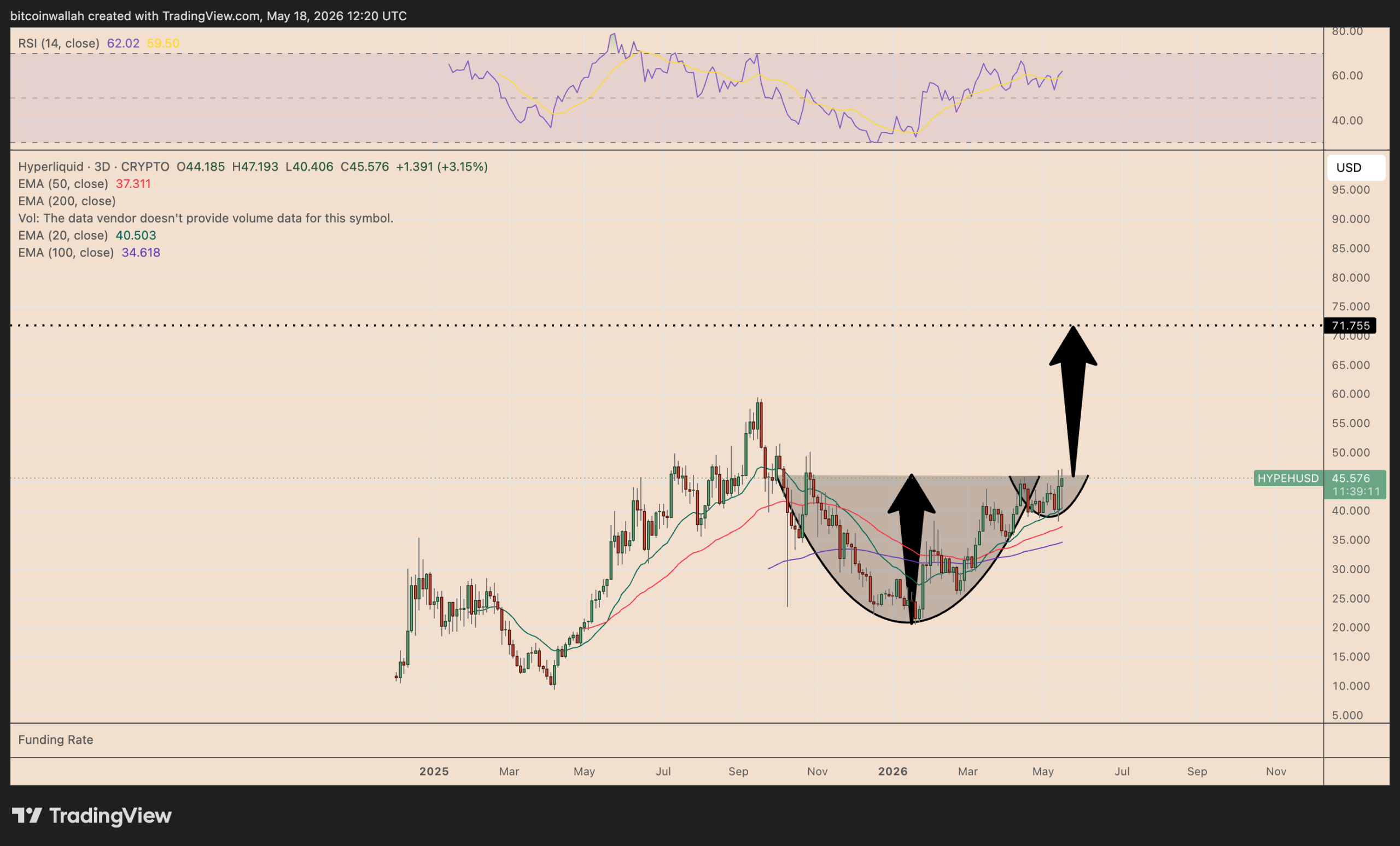
Hyperliquid DEX’s native token, HYPE, is showing potential for a 55% rally after a wallet reportedly tied to Silicon Valley-based venture capitalist, a16z, accumulated $90.87 million worth of tokens in just over a month.
Key takeaways:
- HYPE’s three-day chart shows a potential cup-and-handle breakout, with the neckline sitting near $45–$47.
- ETF launch, Coinbase-Circle USDC roles, and potential US regulatory clarity may expand Hyperliquid’s institutional demand base.
HYPE cup-and-handle setup eyes record highs
HYPE appears to be forming a cup-and-handle pattern, a classic bullish continuation setup.
A cup-and-handle forms when price makes a rounded recovery, pauses near resistance, and then breaks higher. Traders calculate the upside target by measuring the cup’s depth and adding that distance to the breakout level.
In HYPE’s case, the “cup” developed after its price fell from around $46 to nearly $21, then gradually recovered in a rounded structure back toward the $45–$47 resistance zone. That area now acts as the pattern’s neckline.
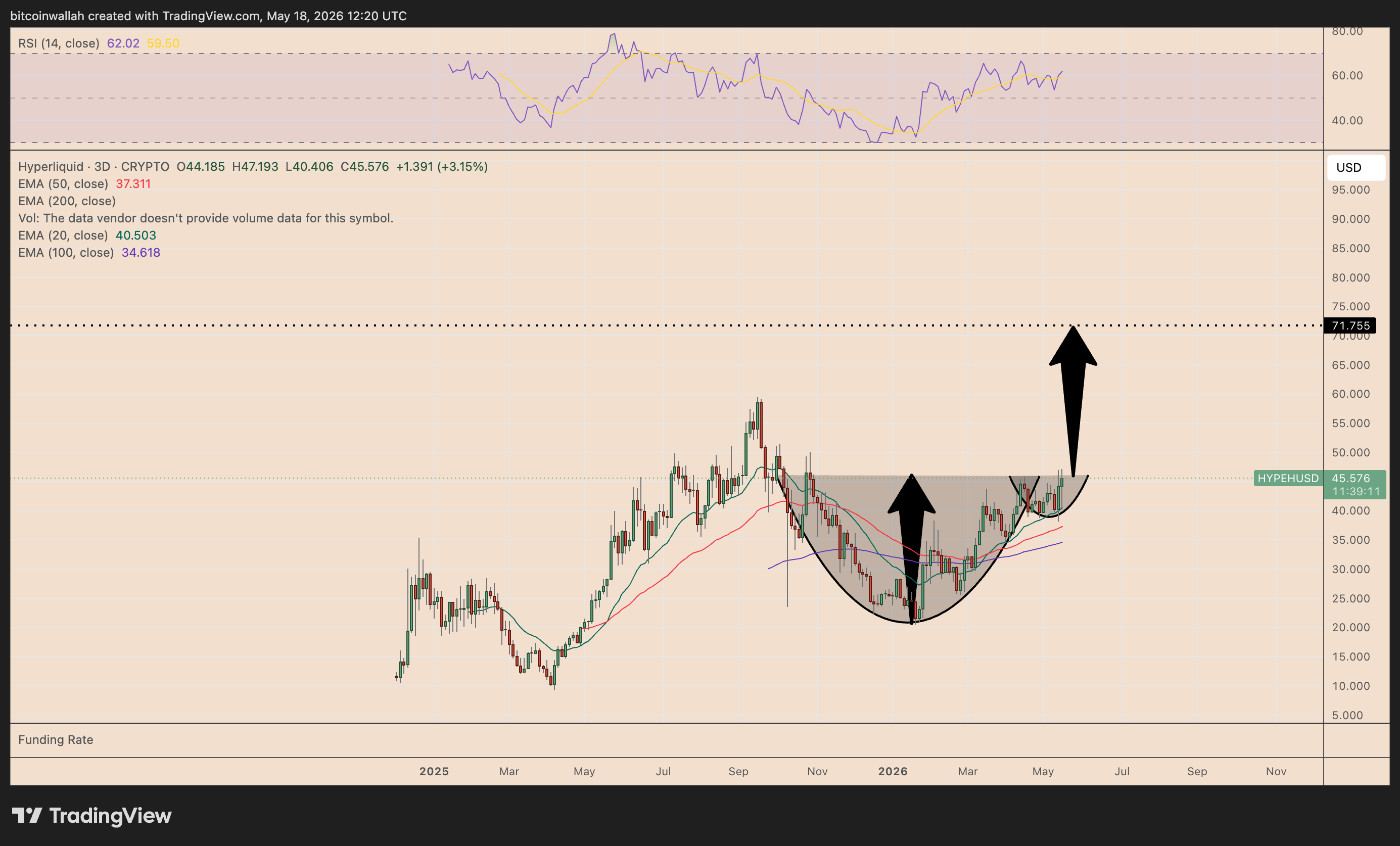
HYPE/USDT three-day price chart. Source: TradingView
As of Monday, HYPE was forming the structure’s “handle” part, confirmed by its slightly downward consolidation. The token may climb toward the $71–$72 range in 2026 if the breakout above the $45–$47 neckline area plays out as intended.
That would mean about 55% rise from current prices, a new record high for the token.
a16z-linked wallet accumulates $90.87M HYPE
HYPE’s bullish technical setup has gained support from a fresh on-chain accumulation signal.
On Monday, wallet 0xb5E4, which Lookonchain describes as linked to Andreessen Horowitz, or a16z, bought another 372,000 HYPE worth about $16.91 million in three hours.
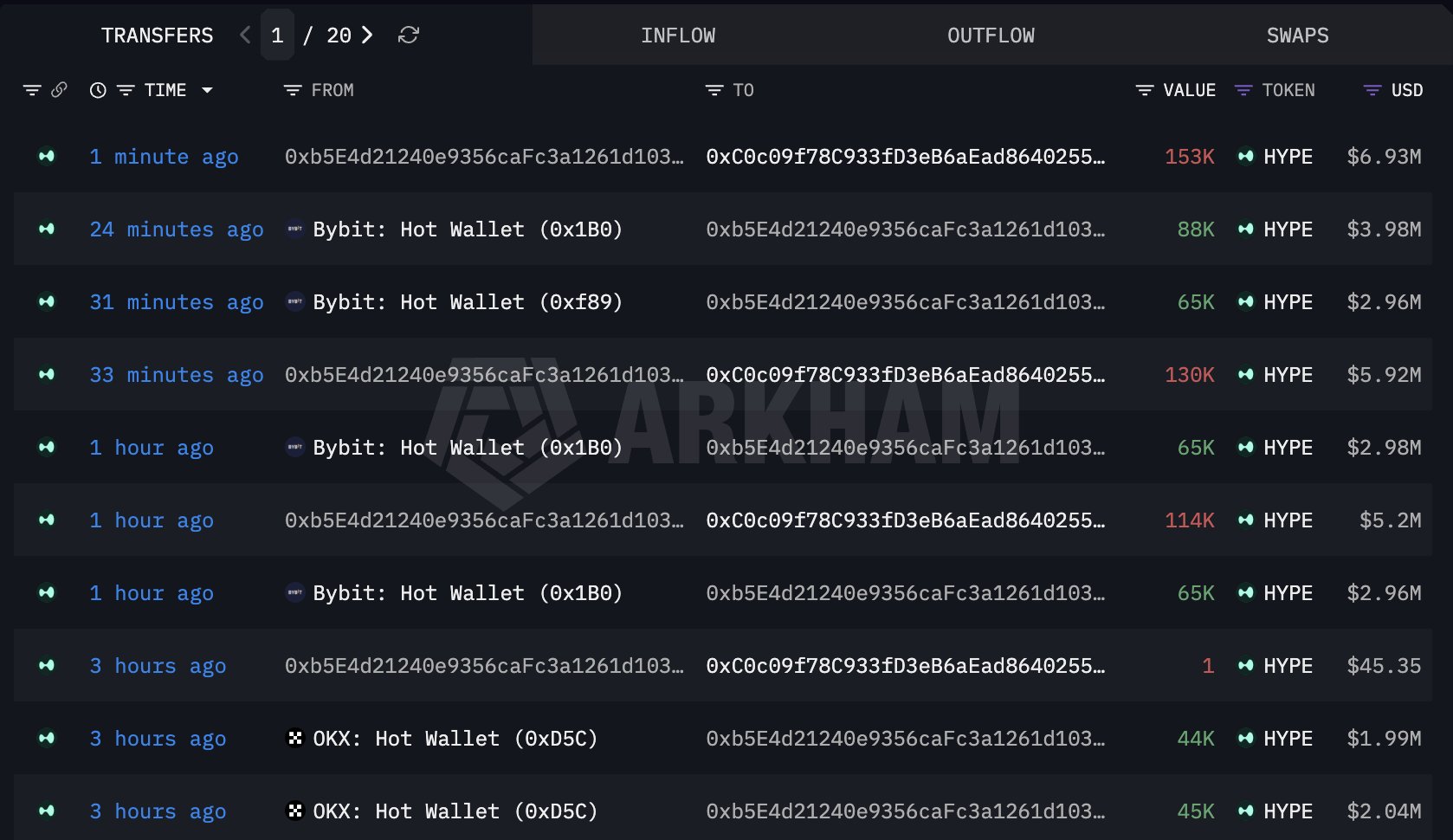
Transaction records of the wallet ‘0xb5E4.’ Source: Arkham Intelligence
HYPE stood out in an otherwise weaker crypto market, gaining roughly 7% over 24 hours as Bitcoin (BTC) slipped 1.22% and Ether (ETH) lost 2.22%. On a year-to-date timeframe, HYPE was up 80% compared to BTC’s and ETH’s losses of nearly 12.5% and 28.3%.
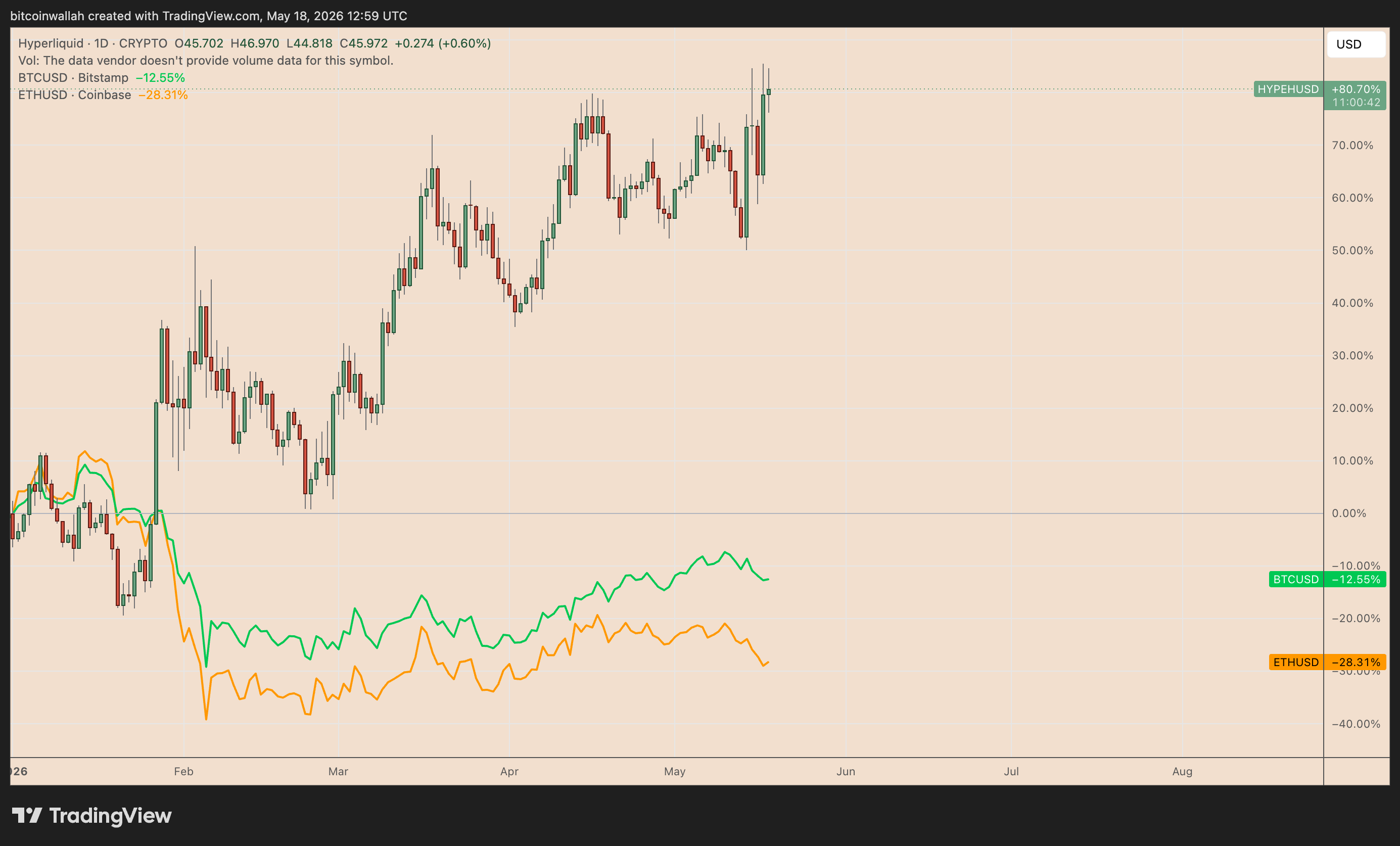
HYPE/USDT year-to-date price performance vs. BTC/USD and ETH/USD. Source: TradingView
The latest “massive HYPE buy” lifted the a16z-linked wallet’s total accumulation since April 14 to 2.11 million HYPE, valued at roughly $90.87 million.

Source: X
Large venture-linked accumulation may strengthen market confidence, especially when it occurs while the price is already testing a major resistance zone.
The reported a16z-linked purchases add to a strong catalyst run for Hyperliquid.
Last week’s US spot HYPE ETF launches opened a regulated access point for traditional investors, while Coinbase and Circle’s USDC deployment roles strengthened Hyperliquid’s stablecoin infrastructure capabilities.
Trader Pentoshi said Hyperliquid’s revenue could “grow 5x–10x” if a compliant US framework, such as the CLARITY Act, allows hedge funds, prop desks, and asset managers to trade on the platform.
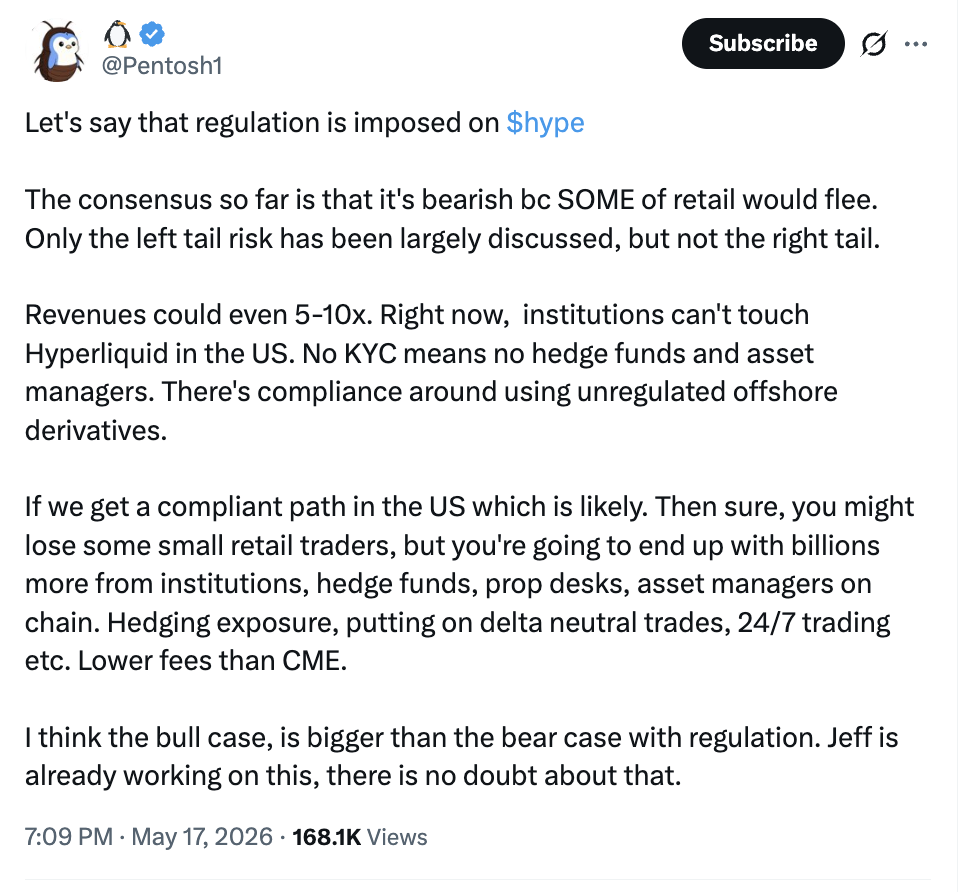
Source: X
Higher institutional activity may boost HYPE demand through stronger volume, revenues, and confidence in Hyperliquid’s growth.


The Reserve Bank of India (RBI) has reiterated its support for a crypto policy, which is “leaning towards prohibition,” according to internal government documents reviewed by Reuters.
They show that the institution continues to be concerned about financial stability, monetary sovereignty, and the role of privately issued stablecoins.
RBI Wants Crypto Outside Regulated Finance
According to the report, the RBI said that banks and financial institutions should be prohibited from holding, trading, or gaining any exposure to cryptocurrencies and to privately issued stablecoins (such as USDT and USDC). The bank also considers a prohibition a means of keeping digital assets outside the regulated financial system and reducing further risks.
RBI also flags stablecoins as a specific concern. The main stance is that foreign currency-pegged coins could pose a risk to domestic monetary sovereignty, while rupee-backed stablecoins could affect the government’s income from issuing fiat currency and create problems for financial stability during periods of stress.
It’s important to note that India hasn’t fully banned crypto trading. However, the sector remains in a regulatory grey zone. Major lenders generally avoid direct crypto exposure after receiving multiple warnings from the central bank, even though there is no direct prohibition on dealing in digital assets.
But that’s not all.
Tax Department Also Piles On
The country’s tax department also warned that crypto transactions are becoming a lot harder to track – in a separate statement. This is particularly true when transactions are routed through offshore exchanges, peer-to-peer rupee trades, or originate from private self-custody wallets.
The department found that fewer than a quarter of 645,000 individuals who made crypto transactions who made any kind of crypto transactions back in 2023 reported them on their tax returns.
India currently taxes crypto gains at 30%. However, overseas platforms, valuation gaps, and unclear ownership tend to complicate compliance, according to officials.
The post India’s Central Bank Renews Push for Crypto Ban: Report appeared first on CryptoPotato.
Futures for the Dow Jones Industrial Average and the other major stock indexes traded mixed ahead of Tuesday’s open. Nasdaq-100 futures dropped in overnight trading after South Korean memory giant Samsung Electronics reported preliminary earnings. Astera Labs (ALAB), Bloom Energy (BE), Nvidia (NVDA) and Tesla (TSLA) were winners Monday. Space Exploration Technologies (SPCX), known as SpaceX, dropped ahead of its…
Copyright ©2026 Investor’s Business Daily, LLC. All rights reserved. 87990cbe856818d5eddac44c7b1cdeb8
Crypto World
Apple (AAPL) Inks Massive $30B+ Chip Deal with Broadcom (AVGO) for Domestic Manufacturing

Key Highlights
- Apple has entered into a major multiyear partnership with Broadcom exceeding $30 billion in value, focused on custom semiconductor components and wireless connectivity solutions.
- Over 15 billion chips will be manufactured domestically as part of this arrangement.
- Broadcom plans to commit $1.5 billion toward upgrading its Fort Collins, Colorado production plant.
- The agreement centers on FBAR radio frequency filtering technology, a product line the two companies have jointly engineered since 2023 at minimum.
- This represents Apple’s most substantial American Manufacturing Program (AMP) initiative yet, contributing to its comprehensive $600 billion domestic investment plan spanning four years.
Apple has finalized its most significant U.S.-based manufacturing partnership to date, entering into a multiyear collaboration with Broadcom valued at over $30 billion to manufacture specialized semiconductors and wireless components domestically.
Revealed this Wednesday, the partnership will lead to the domestic fabrication of no fewer than 15 billion semiconductor units, creating employment opportunities for hundreds of Americans throughout the manufacturing ecosystem.
Shares of Apple (AAPL) declined 0.64% during trading, while Broadcom (AVGO) dropped 0.83%, though neither movement seemed directly connected to the partnership reveal.
Broadcom initially revealed the extended supply arrangement this past Monday, verifying it had finalized a contract with Apple extending to 2031. Wednesday’s statement provided the comprehensive specifics.
The semiconductors forming the partnership’s foundation are FBAR filters — specialized radio frequency elements that enable wireless connectivity in Apple’s product lineup. The two technology giants have jointly developed these components since 2023 or earlier.
This partnership falls under Apple’s American Manufacturing Program, an initiative the corporation introduced previously to strengthen domestic supply chain capabilities. This latest agreement represents Apple’s most significant undertaking within that framework.
To accommodate the increased manufacturing capacity, Broadcom will allocate $1.5 billion for renovating and enhancing its Fort Collins, Colorado manufacturing campus. This location will manufacture the FBAR filters alongside other sophisticated wireless connectivity solutions.
Tim Cook described the Fort Collins-produced components as “essential to delivering the incredible performance and connectivity our customers expect.” He additionally expressed appreciation to the Trump administration for backing the initiative.
Broadcom’s CEO Hock Tan stated the company is “pleased to expand our manufacturing footprint in Fort Collins,” emphasizing that the facility manufactures technology that “connects people around the world.”
Apple’s $600 Billion Domestic Investment Strategy
The Broadcom deal forms part of a broader financial pledge Apple has undertaken regarding the American economy. The technology leader has committed to directing $600 billion domestically across four years, encompassing manufacturing operations, employment generation, and technological advancement.
Wednesday’s revelation furthers Apple’s declared objective of establishing a comprehensive silicon supply infrastructure within U.S. borders — an initiative that has gained increased importance amid continuing trade tensions and tariff considerations.
A Multi-Decade Collaboration
Apple and Broadcom have maintained a collaborative relationship spanning many years, with Broadcom furnishing wireless semiconductor solutions utilized throughout iPhone models and additional Apple hardware. This latest agreement substantially strengthens that partnership and prolongs it considerably into the coming decade.
The supply contract running through 2031 provides Broadcom with demand forecasting certainty and validates the capital expenditure in Colorado. From Apple’s perspective, it secures a reliable domestic supplier for critical components during a period when American semiconductor production capacity ranks as a strategic imperative.
Apple verified the partnership on Wednesday, July 8, 2026, with manufacturing of the Fort Collins-produced components anticipated to expand across multiple Apple product categories moving forward.

Ethereum has weakened for a second straight session as a bearish rounding-top pattern and renewed selling pressure threaten a move toward $1,650.
Summary
- Ethereum fell below $1,750 after failing to break above key resistance near the 50-day EMA around $1,800.
- A bearish rounding-top pattern, weakening momentum indicators, and liquidation clusters point to $1,650 as the next support.
- Despite four straight days of spot ETF inflows, analysts say the recent rally has been driven mainly by spot demand rather than leverage.
According to data from crypto.news, Ethereum (ETH) was trading near $1,737 at press time, down nearly 2% over the past 24 hours after a wallet linked to a large holder transferred roughly $26.9 million worth of Ether to a centralized exchange.
The move triggered fresh profit-taking after Ethereum’s recent recovery stalled just below a major technical resistance zone between $1,800 and $1,806, where the daily Supertrend indicator and the 50-day exponential moving average converged.
Geopolitical tensions have added another layer of pressure. Oil prices climbed after fresh U.S. military action targeting Iranian energy infrastructure, reviving inflation concerns and lifting Treasury yields. Risk assets weakened across global markets as technology stocks retreated, with cryptocurrencies moving lower alongside equities.
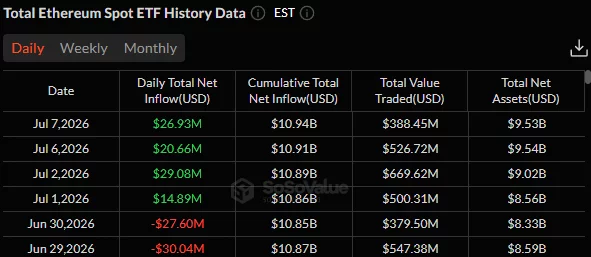
Exchange-traded fund demand has nevertheless remained constructive. U.S. spot Ethereum ETFs have now posted four consecutive days of net inflows, while Coinbase Premium has continued recovering from recent lows, suggesting institutional demand has improved even as price struggles to reclaim overhead resistance.
Derivatives positioning also paints a mixed picture. According to analyst Rain, Ethereum’s recent advance has come primarily from spot buying rather than leveraged speculation.
“$ETH is up 10% this week and open interest barely moved: the actual signal,” Rain wrote on X. “Leverage ratio hasn’t recovered from June, this bounce comes from spot demand.”
Rain added that net taker volume turned positive on June 28, while roughly $76.2 million in positions were liquidated over the past day, with long traders accounting for most of the losses after ETH failed to hold above $1,800.
Ethereum technical structure favors a move toward $1,650
Ethereum’s 4-hour chart has formed a bearish rounding-top pattern after the recovery from late June stalled near $1,830. Price has already broken below the ascending trendline that supported the rally and slipped beneath the 61.8% Fibonacci retracement level around $1,724 after repeated rejection near the 78.6% level at roughly $1,772.
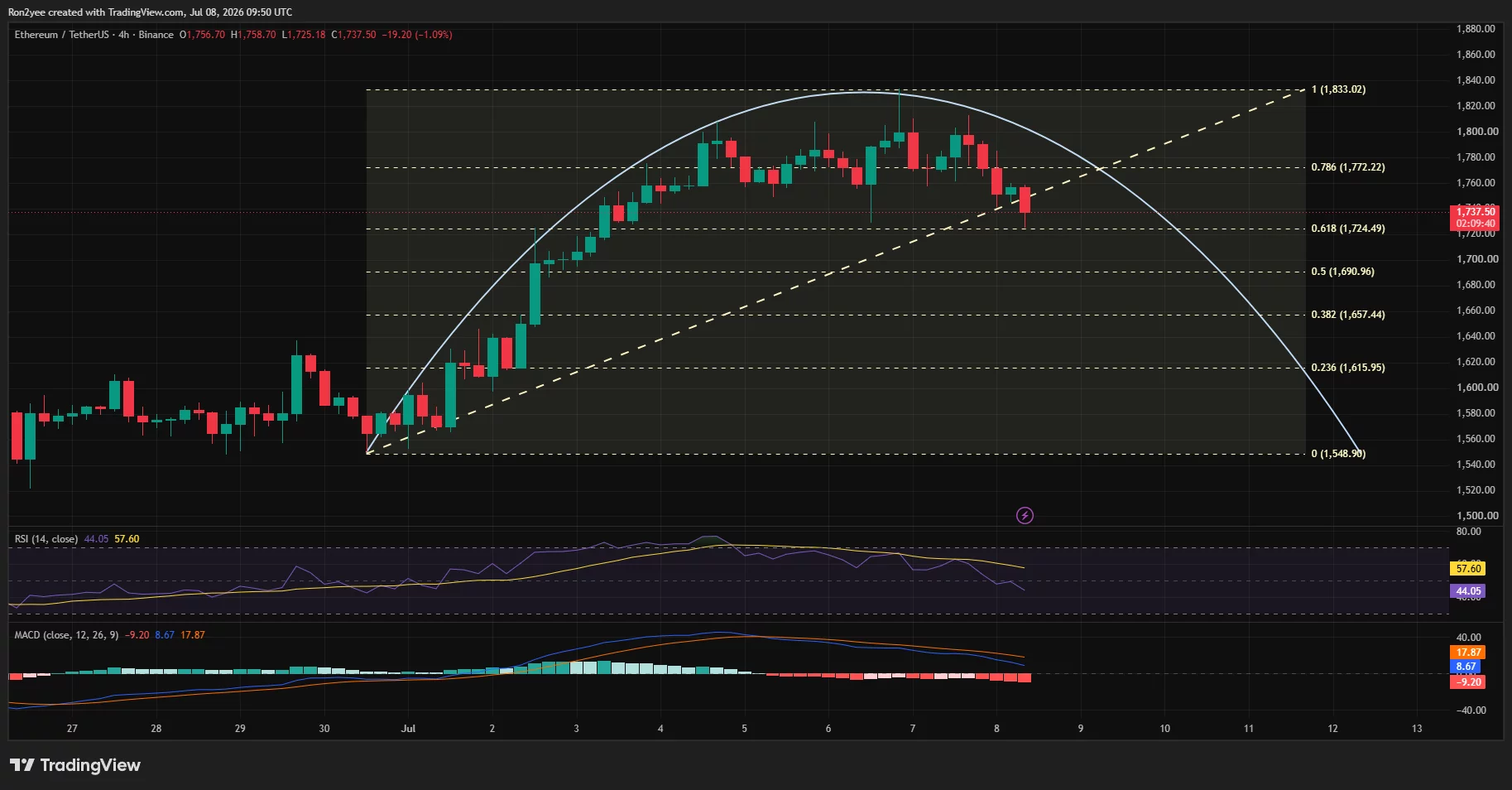
Momentum indicators have also turned weaker. The 4-hour RSI has fallen to around 44 after approaching overbought territory earlier this week, while the MACD remains below its signal line with expanding negative histogram bars. If sellers maintain control, the next major technical objective sits near the 0.382 Fibonacci retracement at approximately $1,657, aligning closely with the projected rounding-top target around $1,650.
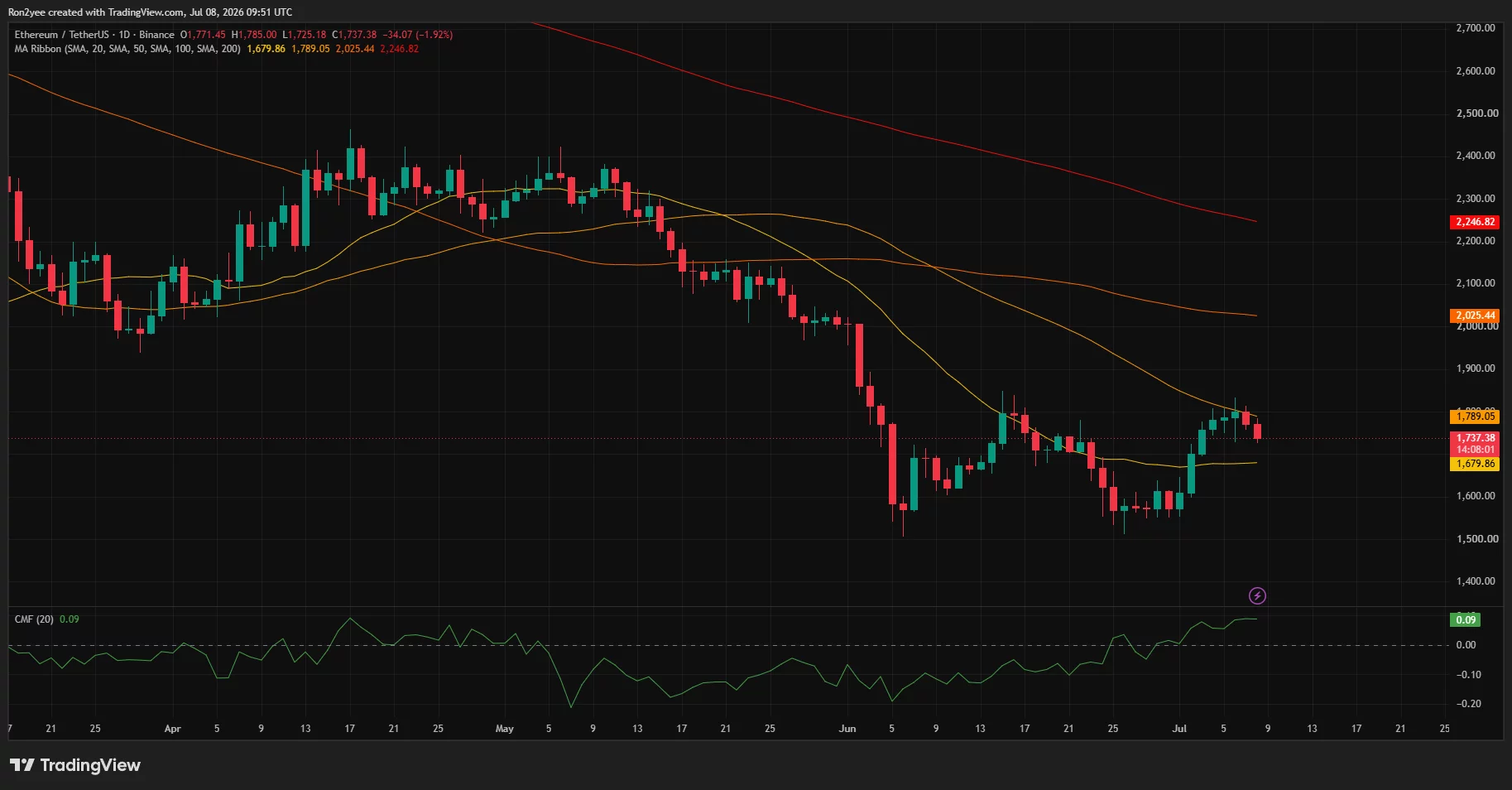
The daily chart offers little relief for bulls. Ethereum remains below the 50-, 100-, and 200-day moving averages near $1,789, $2,025, and $2,247, respectively, keeping the medium-term trend under pressure. Chaikin Money Flow has stayed slightly above zero, suggesting spot demand has not disappeared entirely, but buyers have yet to generate enough momentum to reclaim key moving averages.
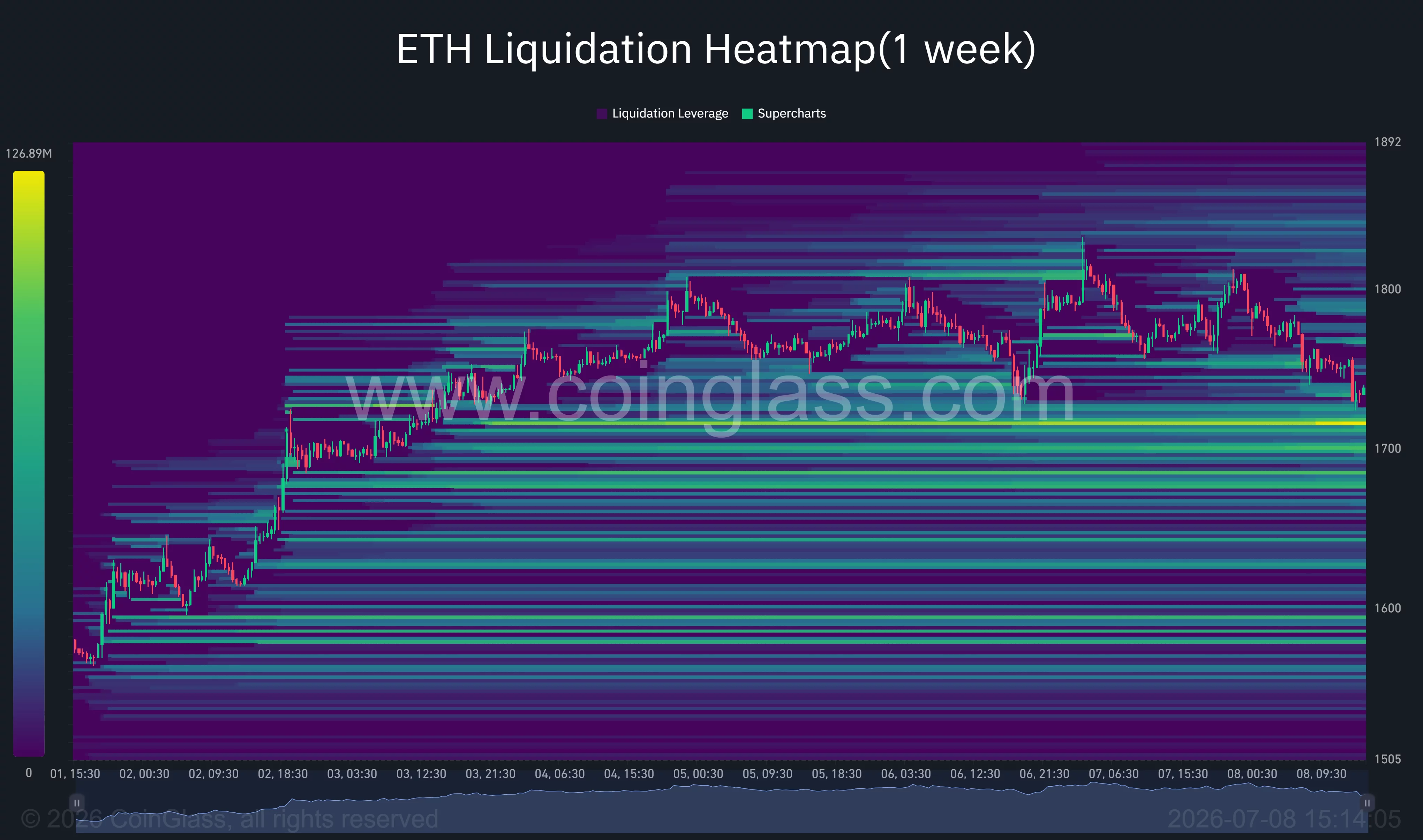
CoinGlass liquidation data also identifies an important support zone between $1,700 and $1,720, where a large concentration of leveraged long positions remains. A decisive break below that range could force another wave of liquidations and accelerate a decline toward the $1,650 region.
Holding above $1,700 remains critical for bulls
Analyst Ted Pillows believes Ethereum has already lost an important technical level.
“$ETH has lost the $1,750 support zone. A daily close below the level would be really bad for Ethereum.”
A sustained close below the $1,700-$1,720 support band would strengthen the bearish setup and expose Ethereum to additional losses toward $1,650, with the June low near $1,550 becoming the next major support. Renewed geopolitical tensions, elevated bond yields, or another wave of whale selling could add further pressure if risk appetite weakens again.
The bearish outlook would lose momentum if ETH quickly reclaims the $1,800-$1,806 resistance area. A breakout above that zone would invalidate the rounding-top pattern, shift attention back to the recent high near $1,833, and improve the chances of another attempt toward the psychological $1,900 level, particularly if ETF inflows continue and leverage returns to the futures market.
Disclosure: This article does not represent investment advice. The content and materials featured on this page are for educational purposes only.


The Reserve Bank of India (RBI), the country’s central bank, has reiterated its support for a cryptocurrency policy that favors a prohibition-oriented approach.
The RBI wants banks and financial institutions barred from any exposure to crypto assets and privately issued stablecoins.
Why India’s Central Bank Leans Toward Crypto Prohibition
The RBI has warned about crypto risks repeatedly and now argues for policies “leaning towards prohibition,” according to documents reviewed this week by Reuters. It wants digital assets kept outside the regulated financial system. Officials say the aim is to limit contagion risks to lenders.
The stance revives a fight the RBI lost in 2018, when a court struck down policies that had effectively banned crypto dealings. Since then, digital assets have existed in a grey zone.
Indian banks are currently allowed to engage with cryptocurrencies. However, most major lenders have stayed away from the sector after repeated cautionary statements from the RBI.
The containment line echoes caution seen across global frameworks, though most now favor regulation over isolation.
Government figures put the number of crypto traders at nearly 39 million. They held about $2.1 billion in digital assets at the end of May, according to the tax department estimates.
Follow us on X to get the latest news as it happens
Stablecoins and Offshore Trading Raise the Stakes
The RBI extended its warning to stablecoins, tokens pegged to fiat currencies. It said foreign-currency versions threaten monetary sovereignty. Rupee-backed tokens could cut the government’s currency income and strain stability during market stress.
It added that permitting stablecoins could make it harder to identify and tax cryptocurrency profits, as users would have less need to convert their holdings into fiat currencies.
Moreover, the tax department flagged offshore exchanges and private wallets as issues for tracking. Those channels make it harder to identify beneficial owners. Peer-to-peer trades in rupees also make taxable income difficult to trace.
Compliance already lags. Fewer than a quarter of the 645,000 people who traded crypto in the year ending March 2023 reported it on tax returns. India taxes crypto gains at 30% and levies a 1% tax on each trade.
The coming months will show whether the government turns the RBI’s prohibition lean into law or keeps crypto in limbo.
Subscribe to our YouTube channel to watch leaders and journalists provide expert insights
The post India’s Central Bank Renews Push to Keep Crypto Out of the Financial System appeared first on BeInCrypto.
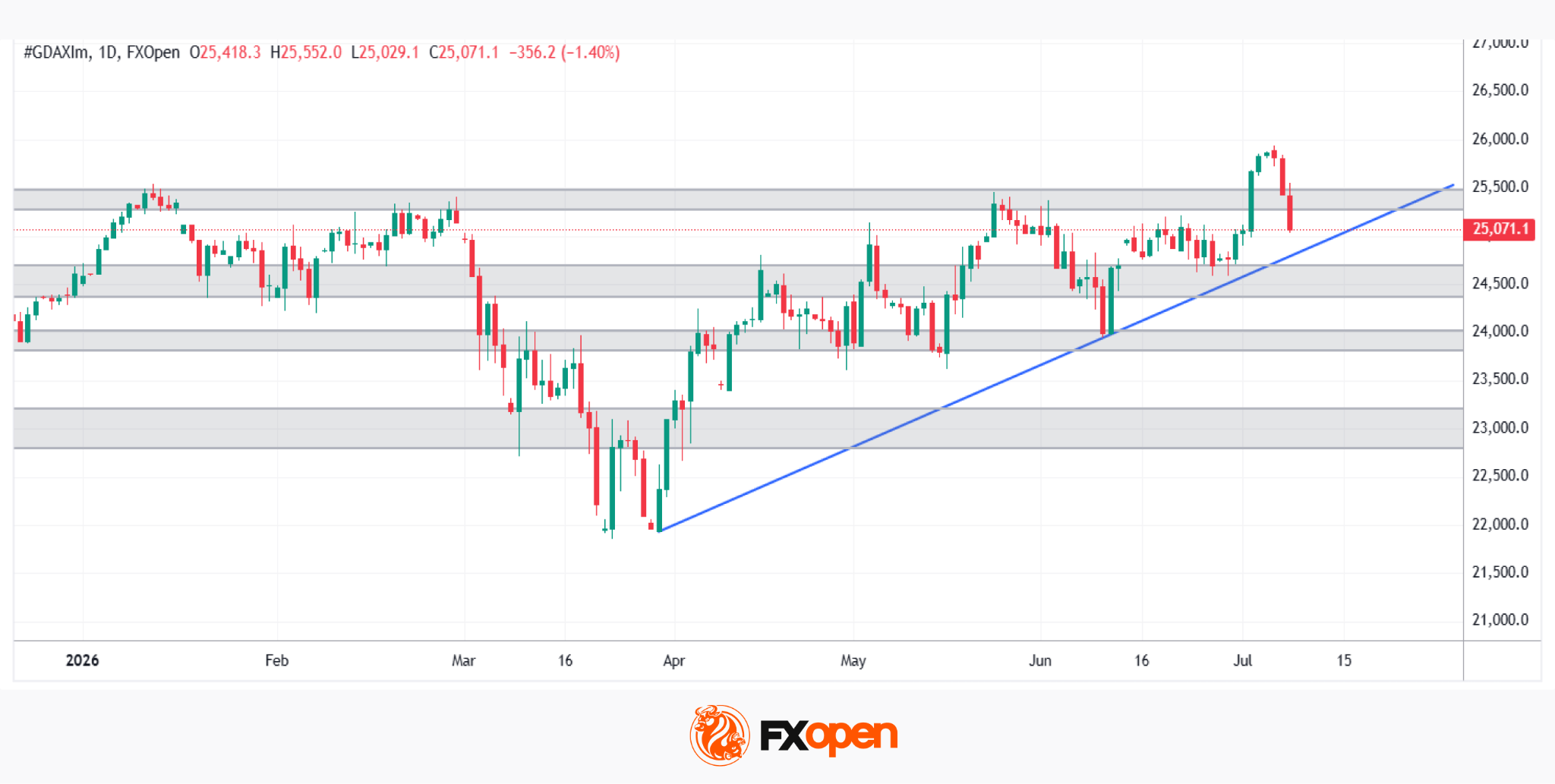
The DAX 40 has shed more than 2% over the past several sessions, breaking a rally that had pushed the index to record highs on the back of Germany’s fiscal pivot toward defence, infrastructure and climate spending. The pullback raises a legitimate question: is this a healthy pause within an intact uptrend, or the start of a deeper correction?
On the macro front, the picture remains mixed but constructive. German durable goods orders surprised meaningfully to the upside, hinting that domestic industry may finally be turning a corner. That said, a portion of this year’s projected GDP growth stems from calendar effects rather than genuine demand recovery.
Monetary policy offers the clearest explanation for the recent weakness. The ECB delivered its first hike since 2023 in June, and the shift in tone alone unsettled rate-sensitive DAX sectors like Financials and real estate, while a firmer euro added pressure on export-driven industrials.
Technical Analysis
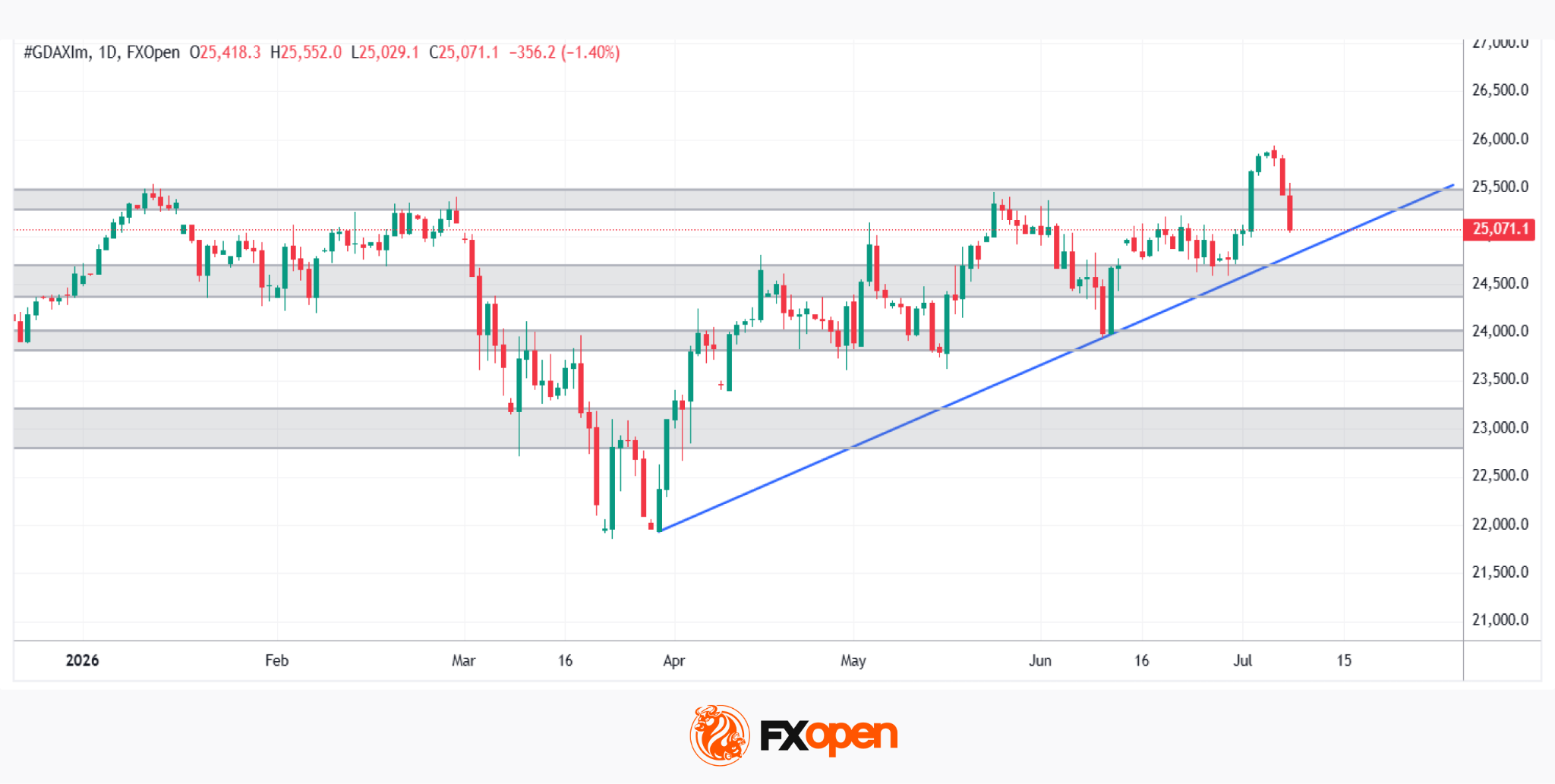
As the chart shows, DAX 40 (GDAXI on FXOpen) has climbed steadily from April’s lows along a well-respected ascending trendline, recently pushing to new record highs near 26,000 before the sharp two-session pullback that triggered this correction. Price has now retraced heading to that same trendline, which converges with the 24,500-24,600 support zone—making this an important decision point for the index.
Bullish Scenario
If buyers step back in and defend the trendline together with the 24,500-24,600 zone, the broader uptrend structure remains intact. In this case, the recent drop would look more like a routine shakeout than a genuine reversal. From there, a renewed push back above the 25,400-25,550 resistance area—where the index broke down during the pullback—would be the first sign that momentum is returning. A clean break above that zone would put fresh record highs firmly back on the table, extending the rally that has defined the DAX since April.
Bearish Scenario
On the other hand, a decisive daily close below the trendline and the 24,500-24,600 support would be a meaningful technical signal, suggesting the correction has more room to run. Losing this zone would likely trigger further selling, as it has acted as a springboard for the rally since spring. In that scenario, the index would probably drift toward the 24,000 area first, with 23,000-23,200—the last major support tested back in April—becoming the key downside target if selling pressure intensifies.
With price now sitting exactly on this critical trendline, the coming sessions look set to decide whether the DAX’s record-breaking run continues, or whether this correction has only just begun.
Trade global index CFDs with zero commission and tight spreads (additional fees may apply). Open your FXOpen account now or learn more about trading index CFDs with FXOpen.
This article represents the opinion of the Companies operating under the FXOpen brand only. It is not to be construed as an offer, solicitation, or recommendation with respect to products and services provided by the Companies operating under the FXOpen brand, nor is it to be considered financial advice.


Middle East de-escalation now looks severely threatened. US President Donald Trump declared the memorandum of understanding with Iran “is over,” sending Bitcoin below $62,000 and oil sharply higher within minutes.
Here is what Trump said, how markets reacted, and why Bitcoin moved in the opposite direction to oil.
What Trump’s Iran MoU Statement Actually Means
A memorandum of understanding, or MoU, is a formal but non-binding agreement outlining shared intentions between two parties before a permanent deal. Trump declared the Iran MoU “is over” after both sides failed to reach a lasting agreement, according to CNN.
The collapse followed a fresh wave of airstrikes. Both parties resumed attacks across the region, shattering the fragile calm. Furthermore, the breakdown reignited fears of a wider and prolonged conflict in the Middle East.
Follow us on X to get the latest news as it happens.
The escalation stems from recent military action. The Islamic Revolutionary Guard Corps said it responded to US attacks by striking American targets. Moreover, it hit an air base in Bahrain hosting US forces, plus targets in Kuwait.
The United States began its assault earlier in the standoff. Washington also reimposed sanctions on Iranian oil sales as punishment for attacks on ships near the strategically vital Strait of Hormuz.
Trump left little room for renewed diplomacy. Speaking at the NATO summit in Ankara, he said he does not want to re-engage Tehran for further peace talks after the previous rounds collapsed entirely.
Why Did Bitcoin Fall While Oil Soared?
The market reaction split sharply along risk lines. Oil surged immediately after the news, while Bitcoin sank. This classic divergence reflects how each asset responds to geopolitical shocks and supply fears.
Starting with oil, USOIL jumped to $75 for the first time since June 22. The rally reflects fears of supply disruption near the Strait of Hormuz. Notably, prices had fallen below $67.50 days earlier as markets priced in de-escalation.
Turning to Bitcoin, the asset moved in the opposite direction as tensions flared. It had peaked above $64,000 earlier in the session. However, it gradually lost value after the initial attacks rattled global risk sentiment.
Trump’s message accelerated the slide. The cryptocurrency dipped below $62,000 within minutes of the statement going live, according to BeInCrypto data. As a result, traders rushed toward safety as uncertainty gripped the broader market.
The pattern is familiar during conflict. Bitcoin typically behaves as a risk asset during geopolitical shocks, falling alongside stocks. Meanwhile, oil rises on supply concerns, creating the mirror-image move seen across markets today.
The post Donald Trump Declares the Iran MoU “Is Over”: Bitcoin Plunges and Oil Soars appeared first on BeInCrypto.

Arkham Intelligence reported today that a SpaceX-tagged wallet has made a small test transaction after roughly six months of being inactive.
The address, identified as SpaceX (15atF), sent about $88 worth of BTC to another wallet that begins with bc1q9.
The transaction itself is very minor, but the market is starting to pay attention because corporate-linked Bitcoin wallets rarely move BTC without a reason. Small transactions are usually used to test address control or custody setup.
SPACEX JUST MOVED BITCOIN
A tagged SpaceX address just moved Bitcoin for the first time in 6 months. SpaceX (15atF) made a test transaction of $88 of BTC to SpaceX (bc1q9).
Is SpaceX about to move more BTC? pic.twitter.com/vQITSDKtGI
— Arkham (@arkham) July 8, 2026
There is no confirmation that the company is preparing to sell. The fact that it sent the BTC to another one of its own wallets could also suggest that this is simply a matter of rotation.
That said, SpaceX currently holds 18,712 BTC worth around $1.16 billion, making it the 8th-largest corporate holder.
It’s also worth noting that the firm recently went public in a historic IPO and joined the Nasdaq 100 index yesterday. The index is one of the world’s most widely-followed technology benchmarks, and is also serving as the foundation of countless funds and investment products designed to track its performance.
The post SpaceX Bitcoin Wallet Wakes Up With a Tiny Transaction: What’s Next? appeared first on CryptoPotato.


Tax authorities, meanwhile, are concerned about widespread underreporting. In the financial year ended March 2023, fewer than a quarter of the 645,000 individuals who transacted in crypto actually declared those gains on their tax returns.
Transactions executed on offshore exchanges and peer-to-peer platforms, especially those denominated in rupees, remain difficult to track, trace and tax.
Indian crypto investors have been operating in a regulatory grey zone since the Supreme Court struck down the RBI’s 2018 ban. It is neither outright illegal nor clearly regulated. A 2021 draft bill to ban private cryptocurrencies was never presented and policy discussions have been repeatedly delayed.
While the government has spoken of balancing innovation with risk management, the latest internal documents suggest key agencies are still not ready to embrace digital assets.
India’s reluctance can partly be explained by its heavy dependence on energy imports and persistent current account deficits. The fragility of this position was recently exposed when tensions with Iran drove oil prices higher, inflating the energy import bill and pushing the rupee to record lows. Authorities are concerned that widespread crypto adoption could accelerate capital outflows, bypassing traditional banking channels and worsening the external deficit.
The US dollar has entered a period of consolidation following last week’s sharp price swings, as market participants turn their attention to the release of the Federal Reserve’s latest meeting minutes. Investors are looking for additional guidance on the future path of interest rates and whether support for a hawkish monetary policy stance remains widespread within the Fed.
Further uncertainty was created by last week’s mixed US labour market data, which raised concerns about the resilience of the US economy but did not trigger a significant reassessment of Federal Reserve policy expectations. Attention has now shifted to the FOMC minutes, with traders focusing on the Fed’s assessment of inflation risks and its outlook for future interest rate decisions. Confirmation of a hawkish stance could provide fresh support for the US dollar, while a more cautious assessment of economic conditions may strengthen expectations of future policy easing.
USD/JPY
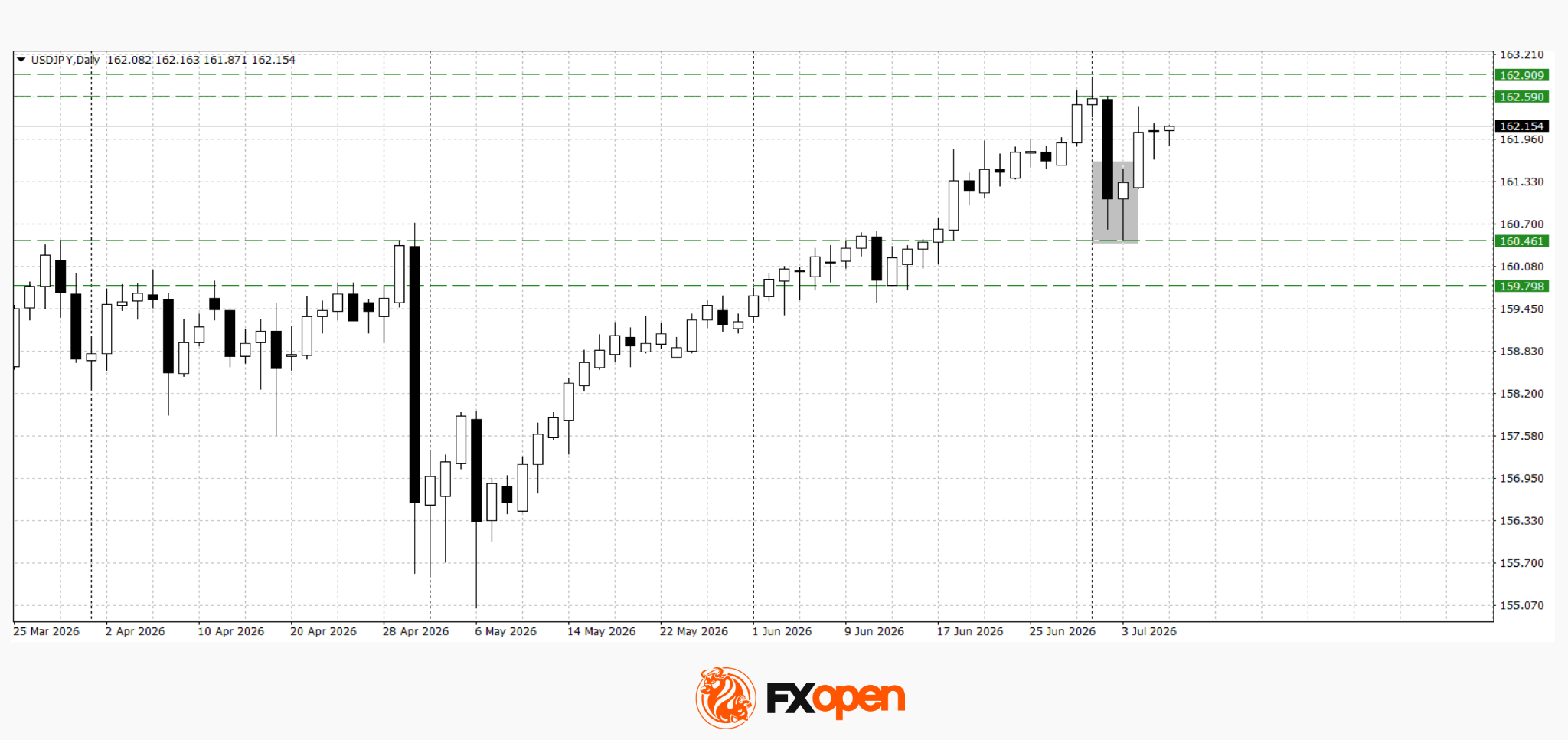
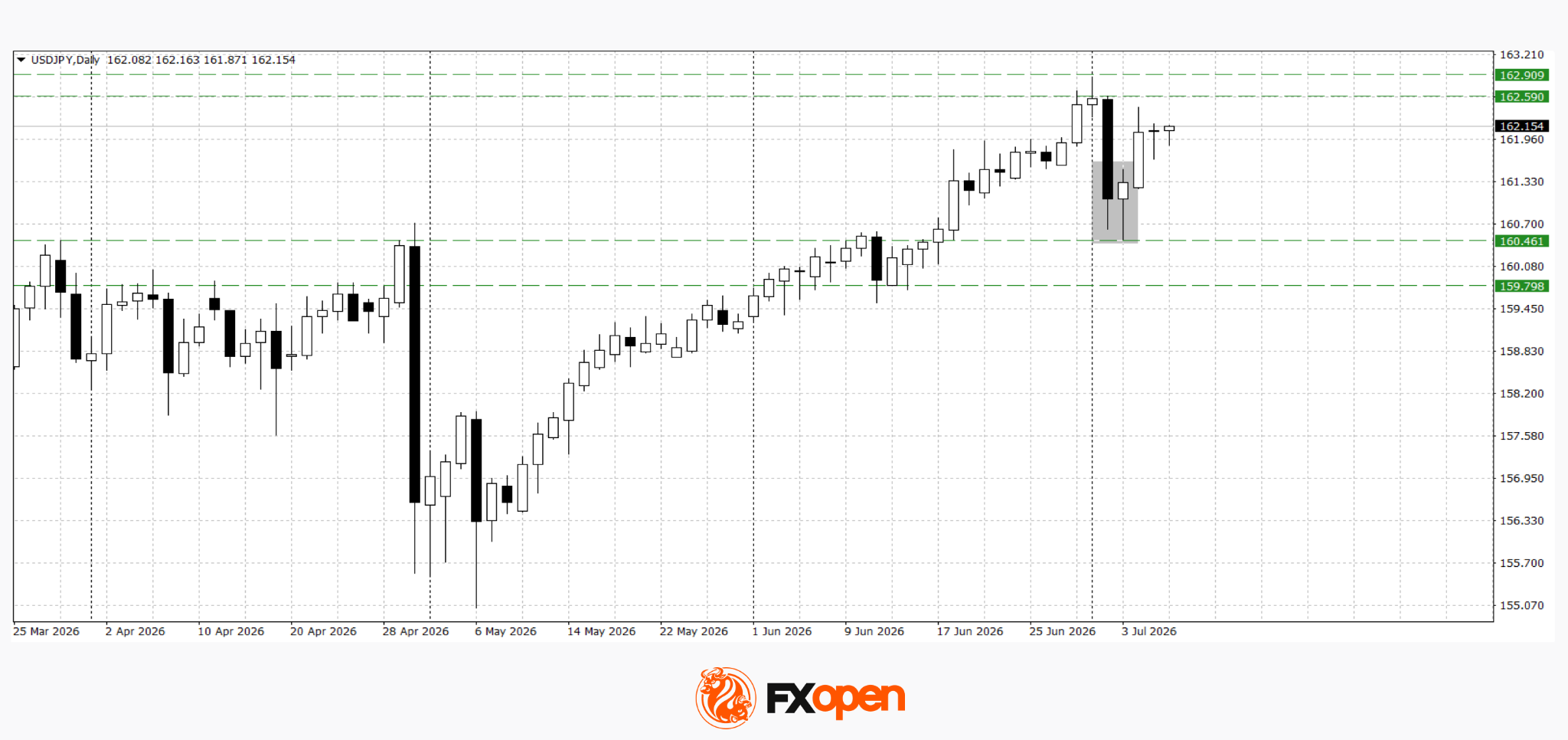
Against this backdrop, USD/JPY is consolidating after retreating sharply from multi-year highs. The yen remains under pressure due to the wide interest rate differential between the United States and Japan. However, with the pair trading close to multi-year highs, concerns over possible intervention by the Japanese authorities continue to limit further upside.
From a technical perspective, USD/JPY may retest the 162.60–162.90 area after forming a Piercing Line candlestick pattern on the daily chart following the recent pullback. A deeper correction would become more likely if the pair closes decisively below 160.50.
Key events for USD/JPY:
- Today, 14:00 (GMT+3): MBA Weekly Mortgage Applications (US)
- Today, 21:00 (GMT+3): FOMC meeting minutes
- Tomorrow, 02:50 (GMT+3): Japan Foreign Bond Investment
USD/CAD
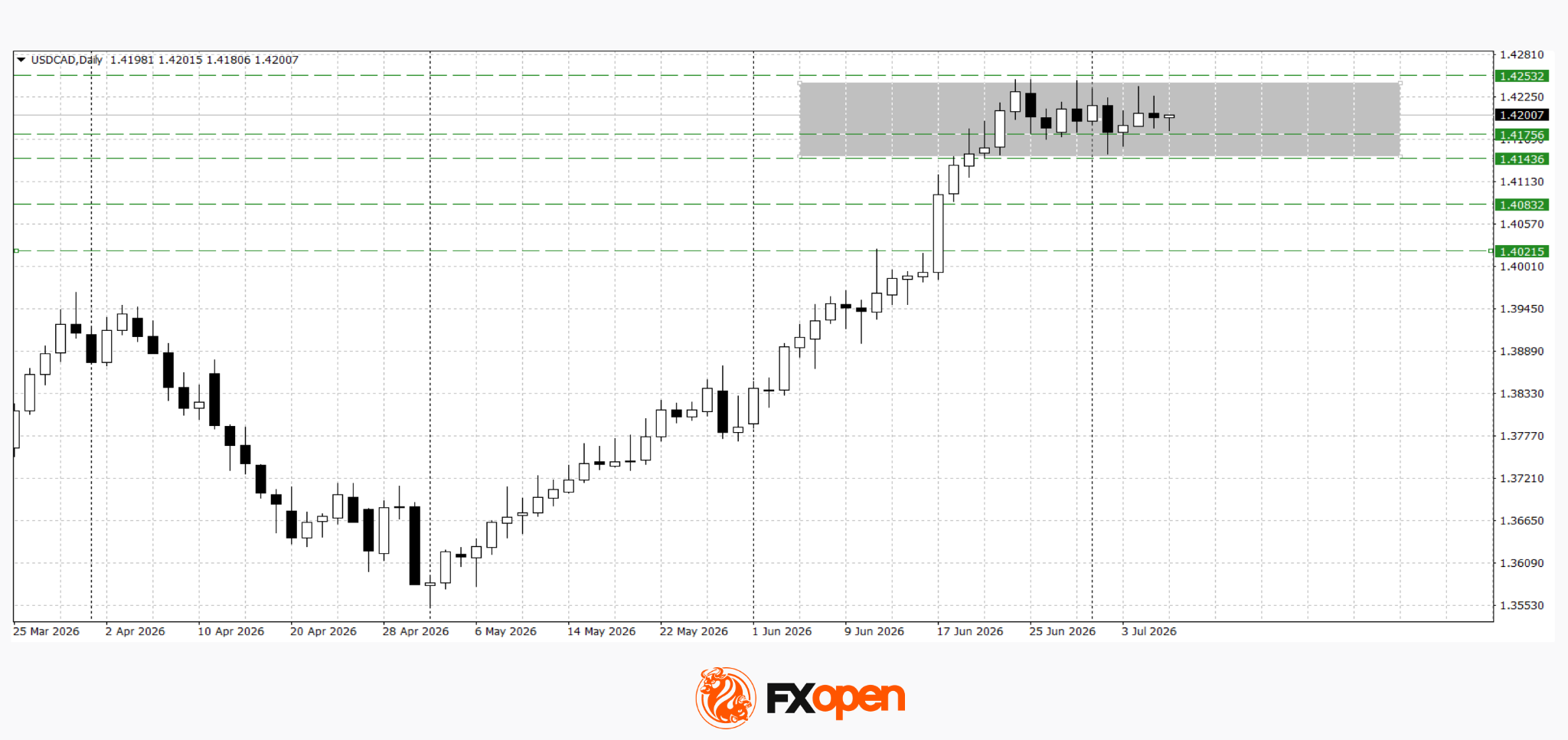
USD/CAD continues to trade sideways within the 1.4140–1.4250 range, suggesting the market is building momentum for a potential breakout. A sustained move above 1.4250 would open the door for further gains towards 1.4300–1.4400. Conversely, a break below 1.4140 could trigger a deeper correction towards the 1.4020–1.4080 region.
Key events for USD/CAD:
- Today, 17:30 (GMT+3): US Crude Oil Inventories
- Tomorrow, 15:30 (GMT+3): US Initial Jobless Claims
- Tomorrow, 17:00 (GMT+3): US Existing Home Sales
The US dollar remains in a holding pattern ahead of the release of the FOMC minutes, which could become the key catalyst for its next move. If the document confirms that Fed officials remain concerned about persistent inflation and continue to favour a hawkish policy stance, the dollar could receive renewed support. On the other hand, a more cautious assessment of the economy and the monetary policy outlook may encourage profit-taking on long dollar positions and lead to a broader corrective move.
Trade over 50 forex markets 24 hours a day with FXOpen. Take advantage of low commissions, deep liquidity, and spreads from 0.0 pips (additional fees may apply). Open your FXOpen account now or learn more about trading forex with FXOpen.
This article represents the opinion of the Companies operating under the FXOpen brand only. It is not to be construed as an offer, solicitation, or recommendation with respect to products and services provided by the Companies operating under the FXOpen brand, nor is it to be considered financial advice.
India’s Central Bank Renews Push for Crypto Ban: Report

Egypt Cry Foul After Dramatic World Cup Exit as Hassan Slams ‘Unfair’ Officiating

Android’s background data habit is now written into Google Play’s fine print


-

 Fashion5 days ago
Weekend Open Thread: High Hopes
-
 NewsBeat3 days ago
Taylor Swift and Travis Kelce wedding staffer hilariously struggles to keep her cool while checking in megastars
-
 Crypto World7 days ago
Airdrop Registration Becomes Key Focus For Remittix As RTX Launch Updates Approach
-

 Fashion2 days ago
Open Thread: What Great Books Have You Read Recently?
-

 Politics5 days ago
The House | “Reframing the debate from a binary discussion of winners and losers”: Yuan Yang reviews ‘We Are Not Machines’
-

 Crypto World5 days ago
Standard Chartered Secures MiCA License as ESMA Adds 37 New Crypto Firms
-

 Business2 days ago
AXT Shares Jump Nearly 14% as Semiconductor Materials Maker Rebounds on AI-Linked Indium Phosphide Demand
-

 Sports7 days ago
Broncos roster: OL Ben Powers (No. 74) entering final year of contract
-

 Crypto World6 days ago
Binance stock trading tops $1B in first month after launch
-

 News Videos1 day ago
Whats Hidden Inside This Cash Register? #treasure #reselling #money
-

 Crypto World6 days ago
Alibaba-affiliate Ant Group enters the humanoid robot market with 12 deals
-

 Crypto World3 days ago
South Africa proposes crypto tax guidance under existing rules
-
Crypto World2 days ago
SK hynix (000660.KS) Stock Dips as $28B Nasdaq ADR Offering Drives AI Memory Expansion
-

 News Videos2 days ago
Best Time to Enter Small Caps Right Now? Another Bull Run? | Financially Free
-
 Tech1 day ago
Anthropic’s new “J-lens” reveals a silent workspace inside Claude that mirrors a leading theory of consciousness
-

 Tech3 days ago
Lenovo laptops are now shipping with YMTC SSDs, a sign of Chinese NAND entering the mainstream
-

 Business6 days ago
Meta Platforms Stock Jumps 7% Today as Bloomberg Reports Company Plans to Enter the Cloud Business
-
 NewsBeat6 days ago
New exhibition reflects five decades of movement between island of Ireland and GB
-

 Business5 days ago
What a 10 Percent Drop Means for Buyers, Sellers and Renters
-

 Crypto World6 days ago
Binance Re-Enters Philippines As EU MiCA Rules Restrict Access
You must be logged in to post a comment Login