
Crypto World
SNDK stock perpetuals hit $1.73B open interest



Sandisk-linked perpetual futures have become the crypto market’s largest equity perpetual trade, with aggregate SNDK open interest reaching $1.73 billion on Aug. 17 across 32 tracked venues.
Summary
- SNDK stock perpetual open interest reached $1.73 billion, ranking first among equity-linked perpetual contracts globally.
- Twenty-four-hour SNDK perpetual volume reached $2.51 billion, nearly eight times Micron’s comparable $320 million volume.
- SKHX open interest climbed to $1.35 billion, narrowing SNDK’s lead from earlier reported comparisons substantially.
- Jane Street disclosed 7.41 million Sandisk shares, representing exactly 5.0% beneficial ownership in July 2026.
- Cboe and MIAX records identify major market makers supporting SNDK-related options across multiple traditional venues.
The position puts SNDK ahead of other stock-linked contracts including SK Hynix and SpaceX as crypto exchanges expand around-the-clock derivatives tied to traditional assets. Loris Tools’ latest data was updated at 02:57 UTC.
Trading activity has accelerated even faster. Aggregate 24-hour SNDK perpetual volume reached $2.51 billion, up 248% from the previous 24-hour period and ranking fourth among all perpetual assets tracked by Loris behind only Bitcoin, Ethereum and Solana. Micron-linked perpetuals generated about $320 million over the same snapshot, meaning SNDK volume was nearly eight times higher.
SNDK open interest leads a fast-changing stock perp market
SNDK’s $1.73 billion in open interest was followed by SKHX at about $1.35 billion and SpaceX-linked SPCX at $967.7 million. Micron stood at roughly $499.6 million. That makes SNDK approximately 1.3 times the size of SKHX and 1.8 times SPCX based on the latest synchronized snapshot.
Those figures update an earlier WuBlockchain Data comparison that placed SKHX around $493 million and SPCX near $928 million. The sharp increase in SKHX means the previously cited claim that SNDK was 3.51 times larger is already outdated, although SNDK remains the largest stock perpetual by open interest. The rapid changes illustrate how quickly leveraged positioning can shift in these markets.
The growth fits a broader trend. As crypto.news previously reported, open interest in perpetuals tied to stocks, commodities and other traditional assets had already climbed above $2 billion by July, after sitting between roughly $350 million and $500 million during spring.
Sandisk’s stock rally adds fuel to derivatives activity
The derivatives surge follows a sharp move in the underlying Sandisk shares. SNDK closed the Aug. 14 U.S. session at $1,641.11, up 7.37% for the day, with roughly 21 million shares traded. That price move preceded the latest weekend increase in crypto perpetual activity. There is no evidence that any single corporate announcement directly caused the rise in perpetual open interest.
Sandisk has nevertheless delivered several major corporate updates this month. The company reported fiscal fourth-quarter revenue of $8.97 billion, up 51% sequentially, with GAAP net income of $6.90 billion. Fiscal-year revenue reached $20.25 billion, while the board expanded its share repurchase authorization by another $14 billion.
At its Aug. 13 investor day, Sandisk said eight new business model agreements now cover approximately 50% of expected fiscal 2027 bit volumes and about two-thirds for fiscal 2028. Management also projected mid-to-high-teens revenue growth for fiscal 2028 through 2030 and said it “expects to return 100 percent of excess cash” after investing in the business. Those longer-term figures are company targets, not guaranteed results.
Jane Street disclosed a 5% Sandisk position
Traditional market makers are also heavily present around the underlying equity and its derivatives. Jane Street Group filed a Schedule 13G on Aug. 5 showing beneficial ownership of 7,409,437 Sandisk shares as of July 30, equal to exactly 5.0% of the company’s common stock. The filing states the securities were not acquired for the purpose of changing or influencing control of Sandisk.
The stake should therefore not automatically be interpreted as a directional investment thesis. Jane Street Capital accounted for 5.89 million of the reported shares, while other affiliated entities held the remainder. Jane Street is also a large electronic market maker across traditional securities and digital asset markets.
Cboe’s current symbol directories identify Susquehanna Securities as the designated primary market maker for SNDK on Cboe Options and IMC Financial Markets for SNDK on EDGX Options. Those assignments establish liquidity-provision roles on the listed-options venues; they do not establish that either firm is making markets in crypto SNDK perpetuals.
MIAX provides another link to the broader SNDK derivatives ecosystem. Its May 26 notice named Citadel Securities as primary lead market maker for options on the T-REX 2X Long SNDK Daily Target ETF, or SNDU.
What happens next for SNDK perpetuals
The immediate metric to watch is whether SNDK can maintain its lead as open interest rotates among equity contracts. SKHX has already closed much of the gap indicated by earlier figures, while SPCX remains close to $1 billion. High open interest also does not indicate whether traders are predominantly bullish or bearish because it measures outstanding positions on both sides.
The contracts also do not represent Sandisk shares. As crypto.news reported in its examination of stock perpetuals moving traditional equity exposure onchain, these instruments provide synthetic price exposure through derivatives rather than voting rights, dividends or ownership in the underlying company. With SNDK now generating $2.51 billion in daily perpetual volume, that distinction becomes increasingly important as crypto and traditional equity markets converge.



Pi Network tops crypto social dominance rankings while trading 97% below its all-time high. The gap between the project’s 60 million users and its $0.09 price reveals a structural disconnect between community attention and market demand.
Summary
- Santiment data shows Pi Network leading crypto social dominance rankings for multiple weeks in mid-2026, yet PI trades near $0.09, down more than 97% from its February 2025 all-time high of $3.00.
- Roughly 1.21 billion PI tokens are scheduled to unlock across 2026 at a rate of approximately 6.5 million per day, all mined at zero cost, creating persistent sell pressure that social buzz alone cannot absorb.
- Binance and Coinbase have not listed PI despite an 86.8% community vote in Binance’s case, leaving the token without access to the two largest retail order books in crypto.
- Historical precedents from ICP, EOS, and XRP show that large communities can sustain social noise indefinitely without translating it into price appreciation when structural supply and liquidity barriers remain in place.
- The ESMA white paper registration and the approaching Protocol 27 “final planned upgrade” remove specific objections but do not address the core disconnect: social activity measures attention, not demand.
Pi Network has spent much of 2026 as one of the most discussed tokens in crypto. By several on-chain social metrics, it is the most discussed. Santiment’s social dominance tracker, which measures the share of total crypto conversation that a single asset captures, has shown PI at or near the top for multiple weeks running. The project’s Telegram groups remain among the largest in crypto. Its X mentions routinely outpace tokens with ten times its market capitalization. On Reddit, Pi Network threads generate more engagement than coverage of most top-20 assets.
None of this has moved the price.
PI sits near $0.09 as of mid-August 2026, roughly 97% below the $3.00 peak it reached during the euphoria of its open mainnet launch in February 2025. The market capitalization hovers just below $1 billion. Daily trading volume rarely exceeds $15 million, a number that would be unremarkable for a token ranked in the 200s, let alone one that claims 60 million users. The gap between Pi’s social presence and its market performance is not a mystery waiting to be solved. It is a case study in the mechanics of why attention, community size, and online engagement do not automatically convert to buying pressure.
This article examines those mechanics. For readers looking for the regulatory and protocol upgrade picture, crypto.news has covered that angle separately in a feature on Protocol 27 and its implications. The focus here is narrower and, for holders, possibly more uncomfortable: what specifically breaks the transmission mechanism between social buzz and token price, and whether Pi’s version of this problem is fixable.
The social dominance paradox
Social dominance in crypto analytics refers to the percentage of total social media mentions across the industry that a single token captures. When Santiment shows Pi Network at number one, it means more people are talking about PI on Twitter, Telegram, Reddit, and other tracked platforms than about Bitcoin, Ethereum, or Solana. That is a remarkable achievement for any asset, and it is especially notable for one trading under ten cents.
The instinct is to treat social dominance as a leading indicator. If enough people are talking about a token, the logic goes, some of them will buy it, and price follows attention. This model works in specific conditions: when the token is liquid, when it trades on exchanges that the audience actually uses, and when the social activity reflects new interest from participants who do not already hold the asset. Pi meets none of these conditions cleanly.
The 60 million Pioneers who make up Pi’s user base are not passive observers discovering a new token. They are existing holders, many of whom have been mining PI on their phones for years. When they post about Pi on social media, they are not signaling fresh demand. They are expressing existing conviction. The social dominance metric captures the volume of their voices without distinguishing between a thousand new buyers researching a token and a million existing holders defending their position.
This distinction matters because social dominance correlates with price only when it reflects capital rotation. When Bitcoin’s social dominance spikes during a halving cycle, it typically coincides with new retail and institutional money entering the market. When a meme token trends on X, it often reflects a burst of speculative buying from traders who did not hold the asset before. Pi’s social activity is structurally different. It is a closed loop of community engagement that rarely intersects with the order books where price is actually determined.
Supply at zero cost: the 1.21 billion token overhang
The most direct explanation for why social buzz does not move PI’s price is mechanical: the supply side overwhelms any demand the community generates.
Pi Network’s token unlock schedule for 2026 releases roughly 1.21 billion tokens into circulation over the course of the year. That works out to approximately 6.5 million new tokens per day, every day, regardless of whether anyone is buying. An additional 775 million tokens are expected to enter the market as three-year lockup periods expire. The total circulating supply already exceeds 11 billion tokens.
The critical detail is the cost basis. Every one of these tokens was mined for free on a mobile phone. The holders paid nothing to acquire them. In any market, when a large number of participants hold an asset at zero cost, the rational behavior is to sell at any price above zero. Not all holders will sell. But enough will sell, consistently, to create a permanent headwind that requires substantial new buying to overcome.
Consider the math. At $0.09 per token, 6.5 million daily unlocks represent approximately $585,000 in potential new sell pressure every single day. That is $4 million per week, $17 million per month. For a token with daily trading volume between $10 million and $15 million, absorbing even a fraction of that sell flow requires buyers who are actively choosing to purchase PI on an exchange. Social media posts, no matter how enthusiastic, do not place buy orders.
The first year of Pi’s open mainnet proved this dynamic conclusively. Despite sustained community engagement and multiple protocol upgrades, the price fell from $3.00 to under $0.10 as unlocks flooded the market. The community grew louder as the price fell, which is exactly what you would expect from holders defending an underwater position. The social metrics improved. The price did not.
The exchange gate: why Binance and Coinbase matter more than volume
If social dominance does not convert directly to price, the natural follow-up question is: where does buying pressure actually come from? In crypto, the answer is almost always exchange listings. When a token gains access to a major exchange, it gains access to that exchange’s entire user base, millions of potential buyers who could not previously purchase the asset even if they wanted to.
Pi has made partial progress here. Kraken listed PI for spot trading in March 2026, and OKX extended access to U.S. users in May. Both were meaningful milestones. But as crypto.news detailed in its price prediction analysis, the token kept falling after both listings. The reason is that Kraken and OKX, while reputable, are not where most retail crypto buyers live.
Binance and Coinbase together account for a disproportionate share of global retail trading volume. Binance’s user base exceeds 200 million registered accounts. Coinbase serves as the default entry point for American retail investors. A token listed on both platforms has access to a liquidity pool that is qualitatively different from one available only on mid-tier exchanges.
Binance held a community vote in February 2025 in which 86.8% of roughly 226,000 participants supported listing PI. The exchange never acted on the result. The stated concerns, code transparency, insufficient independent security audits, questions about decentralization, and token concentration risk, remain unresolved as of August 2026. Coinbase has been even quieter, offering no public commentary on PI at all.
The absence of these two platforms creates a structural ceiling on demand. Pi’s community can generate all the social buzz in the world, but if the exchanges where most buyers transact do not offer PI, that buzz has no on-ramp to the order book. The community is loud. The order book is thin. And price is set by the order book.
How social buzz without liquidity traps price
The interaction between high social activity and low liquidity creates a specific kind of trap. In a liquid market, social attention leads to order flow, which leads to price discovery. In an illiquid market, social attention leads to frustration, which leads to more social activity, which still does not generate order flow. The feedback loop amplifies noise without amplifying signal.
Pi’s trading volume tells this story clearly. Daily volume sits between $10 million and $15 million, with occasional spikes above $20 million during catalyst events. For context, Dogecoin, a meme token with a fraction of Pi’s claimed user base, routinely trades $500 million to $1 billion per day. Shiba Inu, another community-driven token, regularly sees $200 million or more. The difference is not community size. It is exchange access and speculative capital flow.
When Pi spikes on a catalyst, the pattern is consistent. Protocol v25 triggered a 39% rally in July 2026, pushing PI briefly above $0.10. Within days, the rally lost steam as open interest collapsed to $9.6 million and sellers absorbed the move. The CPI data release on August 12 pushed PI up 5% in a single session, then the token drifted back toward $0.088. Each spike attracts social media celebration, which registers as rising social dominance, which commentators interpret as bullish, which does not produce a sustained bid.
The thin order books mean that even modest selling, a few hundred thousand dollars, can push the price down noticeably. Conversely, thin books also mean that a genuine demand shock, a Binance listing, for example, could move price dramatically upward. But that is a statement about potential, not current reality. In the current structure, PI is caught in a low-liquidity trap where social engagement circulates within the community without reaching the exchange infrastructure that determines price.
Historical precedent: large communities, thin markets
Pi is not the first token to have a massive community and a declining price. The history of crypto is littered with projects that built enormous social followings only to watch price detach from engagement. The patterns are instructive.
Internet Computer (ICP) launched in May 2021 at a peak near $700, backed by a sophisticated technical vision and a community of developers who had followed the project for years. Within three months it had fallen to $30. Within two years it was under $5. Throughout that decline, the ICP community remained one of the most vocal in crypto, producing constant content about the project’s technical merits. Social activity stayed high. Price kept falling. The mechanism was the same as Pi’s: massive token unlocks from early participants who had received allocations at low or zero cost, combined with a market that had already priced in the best-case scenario before the fundamentals could catch up.
EOS raised $4 billion in the longest ICO in crypto history, launched with one of the largest and most engaged communities in the industry, and spent the next five years losing more than 95% of its value. The EOS community produced more governance proposals, more social media content, and more developer advocacy than most projects in the top 100. None of it translated to sustained buying pressure because the token’s supply dynamics and competitive position deteriorated faster than community enthusiasm could compensate.
XRP presents a different but related lesson. Ripple’s community, often called the XRP Army, has been one of the most active social media forces in crypto for nearly a decade. During the SEC lawsuit years from 2020 to 2025, XRP’s social dominance routinely spiked to levels comparable to Bitcoin and Ethereum. Price moved only when external catalysts, court rulings, exchange re-listings, provided structural changes to accessibility and regulatory risk. The social activity itself was noise. The signal was the legal and exchange infrastructure underneath it.
The common thread across all three cases is that community engagement sustains attention but does not create the structural conditions for price appreciation. Those conditions require some combination of reduced supply growth, expanded exchange access, and genuine on-chain utility. Pi has the attention. It is still working on the rest.
The opposing case: when community mass did convert
Not every large community fails to move price. Dogecoin and Shiba Inu both started as community-driven projects with minimal technical differentiation and achieved market capitalizations in the tens of billions. Understanding what made them different from Pi clarifies what Pi would need to change.
Dogecoin’s 2021 rally was driven by a specific set of conditions that Pi does not share. First, DOGE was listed on every major exchange, including Binance, Coinbase, and Robinhood, giving its community direct access to the deepest liquidity pools in crypto. Second, the community’s social activity attracted new capital from outside the existing holder base, driven in part by endorsements from Elon Musk and viral TikTok campaigns. Third, DOGE’s supply inflation, while perpetual, was low relative to its market cap, meaning the dilution did not overwhelm incoming demand.
Shiba Inu followed a similar pattern. Its community generated enough social momentum to force exchange listings, which created the liquidity infrastructure that allowed social buzz to convert to order flow. The token was listed on Binance within months of its initial surge and on Coinbase shortly after. Each listing unlocked a new pool of retail buyers.
The critical difference is the sequence. For DOGE and SHIB, community energy led to exchange listings, which led to liquidity, which led to price appreciation. For Pi, the sequence is stalled at the second step. The community energy exists. The exchange listings, at least on Binance and Coinbase, have not followed. Without the liquidity bridge, the community’s energy circulates internally without converting to market demand.
The opposing thesis for Pi bulls is straightforward: if Binance or Coinbase lists PI, the dynamic could reverse rapidly. Pi’s community is larger than Dogecoin’s was at the time of its 2021 breakout. If that community gains access to deep order books, the pent-up demand could produce a price move that dwarfs anything Pi has seen since its mainnet launch. This thesis is invalidated if both Binance and Coinbase continue to decline PI after Protocol 27 stabilizes the protocol and the ESMA registration removes the EU regulatory question, because at that point the community will have run out of structural excuses. It is also invalidated if a major listing occurs and the price still falls, which would confirm that the supply overhang is simply too large for any amount of retail demand to absorb.
What Protocol 27 and the ESMA filing change, and what they do not
Two recent developments have renewed optimism within the Pi community: the approaching Protocol 27, which the Core Team has called the “final planned upgrade,” and the ESMA registration of Pi’s MiCA white paper (entry 549, filed by PiBit Ltd). Both are real milestones. Neither directly addresses the social-to-price disconnect.
Protocol 27 matters for exchange listings because a stable, finalized protocol is easier to audit than one undergoing frequent breaking changes. Exchanges cite code transparency and security audit concerns as reasons for not listing PI. A protocol that stops changing gives independent auditors a fixed target, which could eventually produce the third-party security review that Binance and Coinbase appear to require. But Protocol 27 itself is not an audit. It is a precondition for one.
The ESMA registration matters because it provides legal standing for PI to be offered within the European Union. For exchanges considering EU markets, this removes a regulatory blocker. But dozens of tokens have registered MiCA white papers. The registration makes Pi compliant with a baseline requirement. It does not differentiate the project from competitors.
Neither development changes the supply schedule. The 6.5 million daily token unlocks will continue after Protocol 27 and after ESMA registration. Neither development forces Binance or Coinbase to list PI. And neither development converts social media engagement into exchange order flow.
What these milestones do is narrow the list of valid objections. Before Protocol 27, critics could argue that the protocol was too immature for serious exchange integration. After Protocol 27, that argument weakens. Before the ESMA filing, critics could argue that Pi lacked regulatory standing in major markets. After the filing, that argument is gone for the EU. The community’s task shifts from generating noise to forcing a decision from the exchanges that control access to retail liquidity. Whether that decision comes in Pi’s favor depends on factors, independent audits, governance reform, token concentration analysis, that social dominance cannot influence.
What to watch
Four metrics will determine whether Pi’s social dominance eventually converts to demand or remains permanently decorative.
First, watch the Binance and Coinbase response to Protocol 27. If the protocol stabilizes and both exchanges still decline to list PI within six months, the structural barrier to demand conversion is likely permanent under current conditions. Every month without a listing is a month where 195 million new tokens enter circulation without a matching increase in buyer access.
Second, watch daily trading volume relative to daily unlocks. If volume consistently stays below $20 million while 6.5 million tokens per day enter circulation, the sell-side math remains unfavorable. A sustained rise above $30 million to $50 million in daily volume, even without a major listing, would suggest that organic demand is beginning to absorb supply.
Third, watch on-chain transaction activity distinct from exchange trading. Pi’s claimed 13 million active wallet addresses and 51,800 Pioneer-built applications represent potential utility. If those applications generate real transaction volume, measured by contract calls, not just wallet counts, Pi would have a demand source independent of exchange listings. The KYC validator workforce that completed 526 million tasks is an example of real on-chain utility, but its scale, roughly $2 million in total payouts, is too small to move a billion-dollar token’s price.
Fourth, watch the composition of social activity. If Pi’s social dominance begins to include mentions from institutional accounts, exchange research desks, and DeFi protocols, that signals a broadening of interest beyond the existing holder base. If social dominance remains driven entirely by Pioneers defending their position, the metric is measuring conviction, not demand. Conviction without liquidity is a community. Conviction with liquidity is a market.
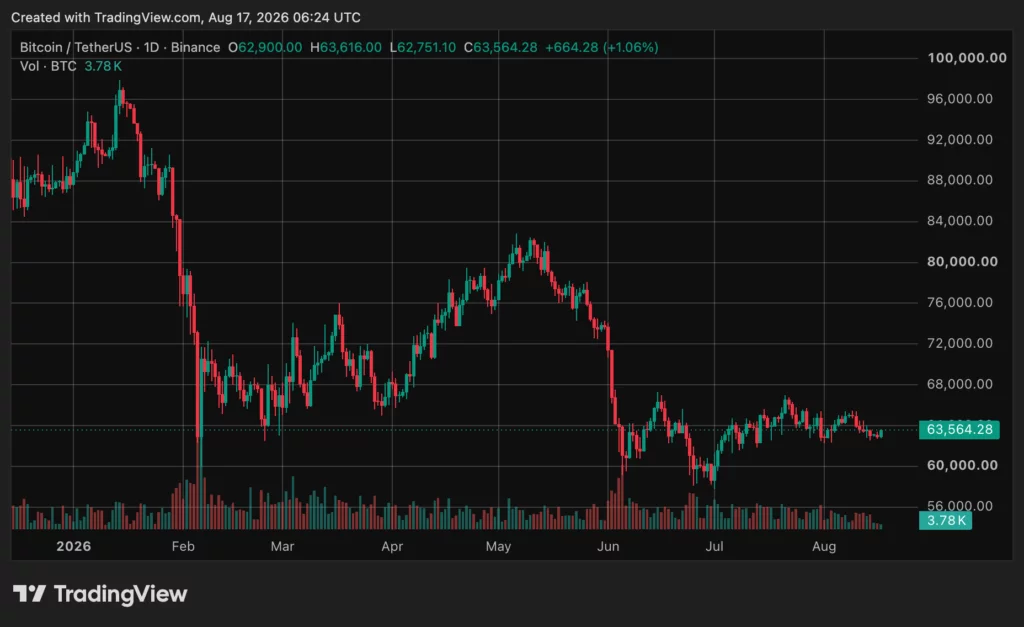
Bitcoin is facing renewed criticism from investment adviser Ross Gerber, who questioned the cryptocurrency’s practical utility on Aug. 16 and argued that physical gold remains easier to use in many places.
Summary
- Bitcoin drew fresh criticism from Ross Gerber, who said gold remains easier to use globally.
- Gerber questioned Bitcoin’s practical utility despite previously supporting the cryptocurrency and offering exposure to clients.
- Strategy’s first 2026 Bitcoin sale occurred in late May, not April, SEC filings confirm officially.
- Strategy later sold 1,638 Bitcoin worth $104.7 million during the week ending August 2, 2026.
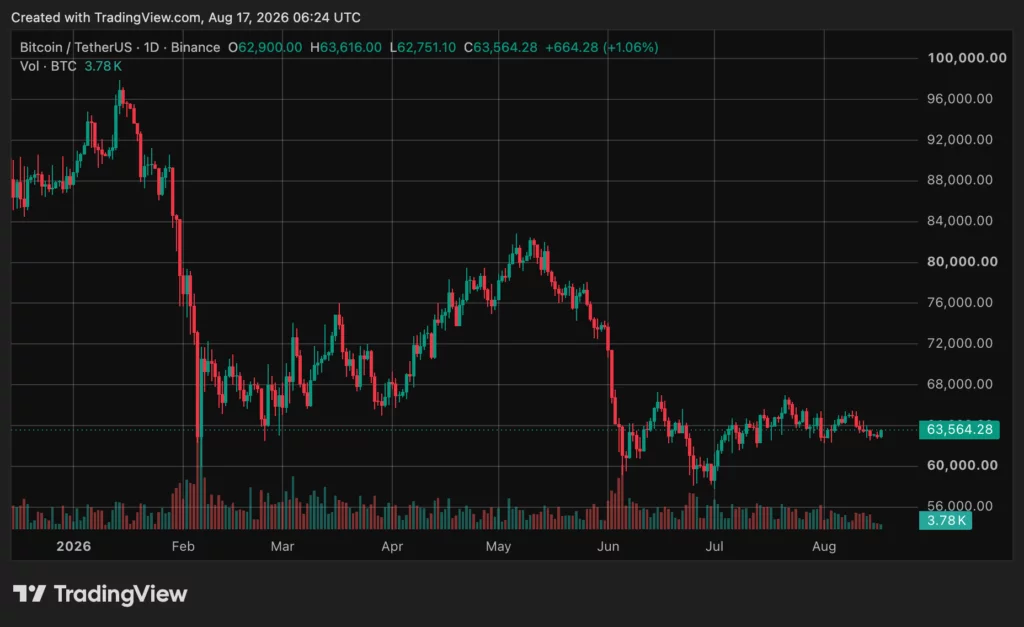
- Bitcoin traded near $63,528 Monday as Gerber renewed criticism of its utility against physical gold.
Gerber wrote in an X post that it was “probably easier to use gold than bitcoin in most places still.” He also questioned what lasting products the crypto industry had built despite years of claims about Bitcoin’s monetary use cases. The comments represent Gerber’s opinion and do not establish that gold is objectively more useful than Bitcoin.
Bitcoin criticism marks a shift for Gerber
Gerber’s stance is notable because his firm has previously embraced digital assets. Gerber Kawasaki says it partnered with Gemini in April 2021 to provide digital asset exposure to clients, while Gerber himself spent years speaking positively about Bitcoin.
His tone has become increasingly skeptical in 2026. Gerber recently wrote that Michael Saylor “kinda makes me over Bitcoin” and said the asset was becoming difficult for him to take seriously. Those remarks are personal assessments rather than evidence that Strategy’s activity has damaged Bitcoin’s network or long-term value proposition.
As crypto.news previously reported, Gerber accused Saylor’s leveraged Bitcoin strategy of hurting the market, although he provided no data showing Strategy alone caused Bitcoin’s price declines.
Strategy has continued selling Bitcoin in 2026
One detail in earlier coverage requires correction. Strategy did not sell 32 BTC in April. Its SEC filing shows the company sold 32 BTC between May 26 and May 31 for roughly $2.5 million at an average price of $77,135. It was Strategy’s first disclosed Bitcoin sale since December 2022.
The company has since made larger disposals. Strategy sold another 1,638 BTC for $104.7 million during the week ending Aug. 2, then sold 1,690 BTC for $108.6 million between Aug. 3 and Aug. 9. The latter proceeds funded repurchases of its STRC preferred stock. Strategy held 840,447 BTC as of Aug. 9 at an aggregate purchase cost of $63.36 billion.
In related coverage, crypto.news reported that Strategy’s first 32 BTC sale broke a nearly four-year accumulation streak.
Bitcoin miners are shifting capacity toward AI
Gerber has also questioned Bitcoin mining as companies redirect infrastructure toward artificial intelligence workloads. That shift is real among several listed miners, although it does not mean Bitcoin mining is disappearing.
Core Scientific, for example, said in April that it was converting a Pecos, Texas facility with 300 megawatts then used for Bitcoin mining into an AI data-center campus. Its second-quarter filing showed colocation revenue rising to $136.7 million while digital asset self-mining revenue fell to $21.5 million.
As crypto.news reported, Bitcoin miners are increasingly converting power infrastructure into AI data centers as demand for high-performance computing grows. That business shift supports part of Gerber’s observation about miners, but it does not prove his broader claim that Bitcoin’s strongest period has passed.
Bitcoin traded around $63,528 on Monday, up roughly 0.8% from the previous close. There is no evidence that Gerber’s remarks caused the move.
Gerber’s comments instead add to an ongoing debate over whether Bitcoin should primarily be judged as a payment network, store of value or investment asset. His criticism also comes as Strategy continues managing Bitcoin alongside preferred-stock obligations and major miners increasingly weigh Bitcoin economics against AI infrastructure revenue.


Volume, meanwhile, is dead simple as it measures the number of contracts that changed hands during a given period. Think of it as measuring how many times the front door of that exclusive club opened and closed over a given period, regardless of who stayed. It thus represents the degree of churn or liquidity available to manage positions.
So, the latest case of volume falling far behind OI is like a large club with a tiny exit door. What happens if a large number of people try to rush out?
Because overall investor positioning is massive, a sudden catalyst could trigger a wave of contract closures, such as forced liquidations due to margin shortages. Without the underlying daily volume to provide liquidity, the market may not be able to absorb the rush smoothly, leading to volatile, exaggerated price swings.
“The risk is mechanical. When open interest towers over daily volume, liquidations meet little resting flow to absorb them, and adverse moves extend further than they otherwise would. Traders have added substantial risk, most of it long, into a market that shows no matching demand,” blockchain analytics firm Glassnode said in a report.
The risk of an exaggerated move is particularly likely to the downside because of weakening demand and a lack of resting bids or buy orders at lower price levels.
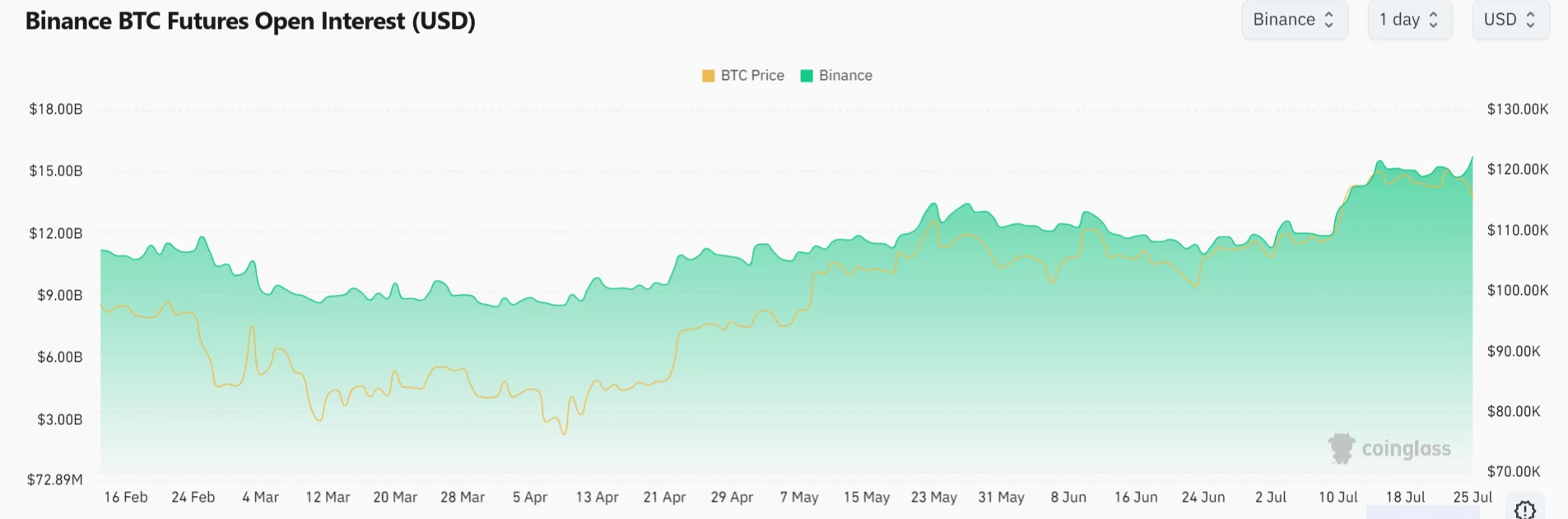
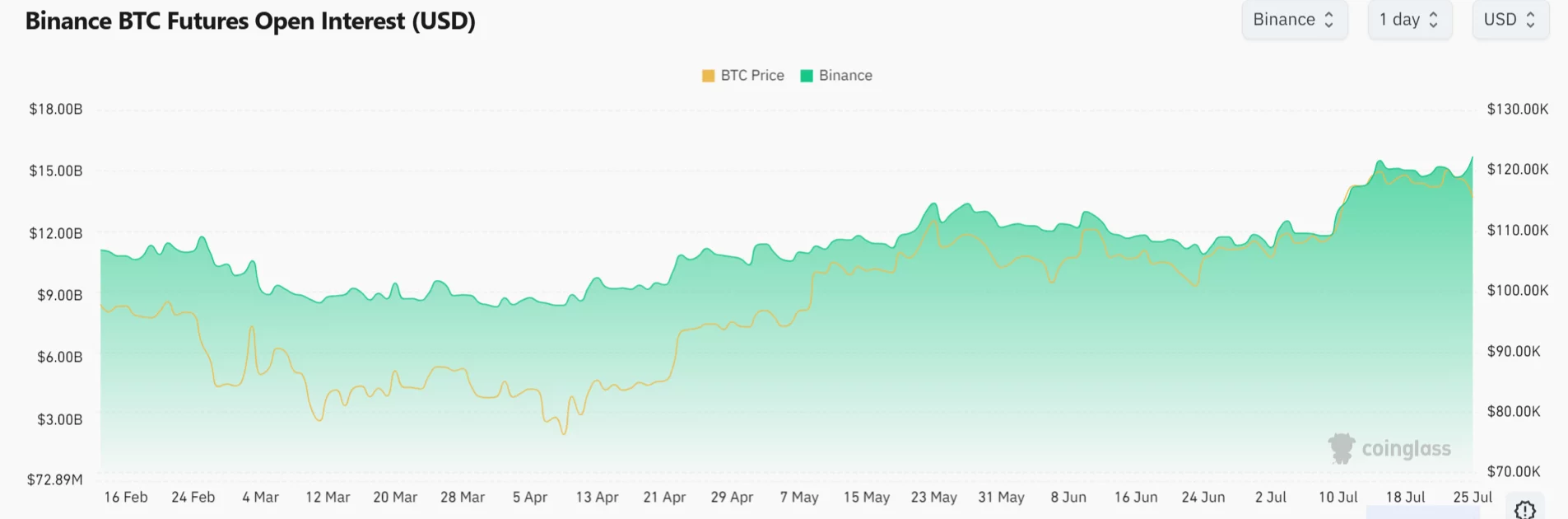
Binance has overtaken CME Group in Bitcoin futures open interest for the first time since late 2023, holding roughly 148,500 BTC against CME’s 102,840. The reversal unwinds two years of institutional dominance narrative and raises questions about whether traditional finance is retreating from crypto derivatives or simply relocating.
Summary
- Binance has surpassed CME Group in Bitcoin futures open interest for the first time since late 2023, holding roughly 148,500 BTC ($9.6 billion) compared with CME’s 102,840 BTC ($6.7 billion).
- CME open interest has fallen to its lowest level since February 2024 after five consecutive months of decline, driven largely by the unwinding of the cash and carry basis trade.
- The annualized Bitcoin futures basis has compressed to roughly 3%, falling below the 3.8% yield on two year U.S. Treasuries, eliminating the arbitrage incentive that fueled institutional CME positioning.
- Market makers and hedge funds are migrating toward offshore perpetual contracts on Binance, Bybit, and OKX, while a parallel regulatory shift is bringing perpetual futures onshore through CFTC approved venues like Kalshi.
- The reversal raises fundamental questions about whether the “institutional adoption” narrative built on CME dominance was always more fragile than it appeared, and whether traditional finance is retreating or simply relocating.
For two years, a single chart told the story of Bitcoin’s institutional coming of age. CME Group, the Chicago exchange where pension funds, sovereign wealth managers, and hedge funds trade everything from corn to crude oil, held more Bitcoin futures open interest than any venue on Earth. That lead over Binance, the offshore exchange synonymous with retail speculation, became the most cited proof point for the “institutions are here” thesis.
That chart has now flipped. Binance holds roughly 148,500 BTC in open interest, worth approximately $9.6 billion. CME has dropped to around 102,840 BTC, or $6.7 billion, its lowest reading since February 2024. The gap is not narrow. It is roughly 45,000 BTC wide and growing.
The shift did not arrive overnight. CME open interest has fallen for five consecutive months, accelerating through the second quarter of 2026 as the profitability of the basis trade collapsed and institutional appetites shifted. What looked like a permanent structural change in Bitcoin market microstructure may have been, at least in part, an arbitrage play dressed in institutional clothing.
Understanding what happened, why it matters, and where it leads requires following the money through a maze of basis spreads, regulatory upheaval, and the evolving definition of what “institutional” even means in crypto.
The basis trade machine and how it broke
The centerpiece of CME’s rise to the top of the Bitcoin futures leaderboard was not directional conviction. It was the cash and carry basis trade, a delta neutral strategy older than most of the people trading it.
The mechanics are straightforward. Buy spot Bitcoin, or more commonly after January 2024, buy shares of a spot Bitcoin ETF like BlackRock’s IBIT. Simultaneously sell Bitcoin futures on CME at a premium to the spot price. The difference between the futures price and the spot price, the basis, represents annualized yield. When Bitcoin was rallying through 2024 and the first half of 2025, that basis regularly exceeded 15% to 20%, dwarfing anything available in traditional fixed income.
Hedge funds, proprietary trading desks, and institutional players rotated capital into this trade at scale. According to CFTC Commitments of Traders data, leveraged funds held persistent net short positions on CME Bitcoin futures throughout most of 2024 and 2025, the signature footprint of the basis trade. They were not bearish on Bitcoin. They were harvesting yield from the contango.
The problem is that the basis trade is self limiting. As more capital enters, competition compresses the spread. As Bitcoin’s price declined from its highs above $120,000 to the $60,000 to $80,000 range through the first half of 2026, futures premiums collapsed alongside it. By mid 2026, the annualized three month basis on CME had fallen to roughly 3%, below the 3.8% yield on two year U.S. Treasuries.
At that point, the math stopped working. Why lock up capital in a trade that earns less than risk free government debt, while carrying counterparty risk, margin requirements, and the operational complexity of rolling quarterly futures contracts? The answer, for most institutional desks, was to unwind.
The unwinding was not panic. It was arithmetic. The Block reported that CME Bitcoin futures activity slumped to a 14 month low in April 2026, with average daily open interest falling below $8 billion and daily trading volume dropping under $3 billion. Each month since has continued the decline.
The scale of the exodus is visible in the raw numbers. CME began 2026 with approximately 175,000 BTC in open interest. By April, that figure had dropped to roughly 120,000 BTC. By August, it sat near 103,000 BTC, a decline of more than 40% in eight months. For context, the open interest that CME lost over this period, roughly 72,000 BTC, represents more than $4.5 billion in notional value at current prices. That is not a rounding error. It is a structural repricing of where institutional derivatives capital lives.
Where the money went
The capital that exited CME did not vanish from the Bitcoin derivatives market. Some returned to direct spot holdings, simplifying portfolios and removing the futures leg entirely. But a meaningful share migrated to offshore perpetual contracts, the instrument that dominates crypto derivatives trading and has for years.
Perpetual futures, which have no expiration date and use a funding rate mechanism to stay tethered to spot prices, account for roughly 90% of all crypto derivatives volume globally. Binance alone controls approximately 33% of the centralized perpetual futures market, followed by OKX and Bybit. In the first quarter of 2026, Binance tightened its grip even as overall crypto trading volume declined, capturing a 40% share of perpetual futures activity.
The appeal for institutional market makers is not mysterious. Perpetuals offer continuous liquidity without the friction of quarterly roll dates. Margin requirements on offshore exchanges are more flexible. And for desks that are genuinely market neutral, providing liquidity on both sides, the funding rate on perpetuals can generate yield similar to the old basis trade, often with better capital efficiency.
What has changed is not the existence of these benefits, which offshore venues have offered for years, but the willingness of institutional participants to act on them. As the basis trade on CME became unprofitable and the regulatory climate around perpetuals began to shift, the stigma of trading on offshore venues appears to have softened for a segment of the institutional market.
This does not mean Goldman Sachs is opening a Binance account. The migration is concentrated among crypto native market makers, quantitative trading firms, and smaller hedge funds that operate across jurisdictions. Many of these firms are registered in Singapore, Dubai, or the British Virgin Islands and face no regulatory barrier to trading on Binance or similar platforms. For them, the question was never whether they could trade offshore but whether the economics justified staying on CME. Once the basis spread vanished, the answer changed.
These participants were a significant share of CME’s open interest, and their departure has been measurable. CoinGecko data from the first quarter of 2026 shows that Binance and OKX together dominate the perpetual futures landscape, with decentralized perpetual exchanges also nearly quadrupling their share of open interest year over year, adding another layer of competition that CME cannot match.
CME’s countermove and why 24/7 was not enough
CME did not sit idle while its Bitcoin futures franchise eroded. On May 29, 2026, the exchange launched 24/7 trading for cryptocurrency futures and options, eliminating the weekend gap that had been a persistent structural disadvantage against crypto native venues.
The inaugural weekend saw more than 7,200 contracts traded, roughly $50 million in notional value. Average daily volume across CME’s crypto complex reached 407,200 contracts, up 46% year over year. The exchange also introduced Bitcoin volatility futures on June 1, expanding the toolkit available to institutional traders.
These moves addressed genuine pain points. Corporate treasury desks, asset managers, and hedge funds running Bitcoin positions had long struggled with the inability to adjust hedges during weekends when spot markets kept moving. The CME gap, a visible discontinuity in Monday’s opening price relative to Friday’s close, was a real source of basis risk.
But 24/7 trading arrived too late to reverse the basis trade exodus. The open interest decline continued through June, July, and August, suggesting that the forces driving capital away from CME were more fundamental than trading hours. The basis trade collapse was a yield problem, not an access problem, and extending trading hours does not restore the contango.
The perpetual futures revolution comes onshore
While CME was losing open interest to offshore venues, a parallel regulatory development was reshaping the competitive landscape from the other direction. On May 29, 2026, the same day CME went 24/7, the CFTC approved Kalshi’s BTCPERP contract, the first Bitcoin perpetual futures product listed on a regulated U.S. exchange.
The approval represented a watershed moment for American crypto derivatives trading. Perpetual futures had existed exclusively offshore for nearly a decade, generating trillions of dollars in annual volume on exchanges beyond the reach of U.S. regulators. The CFTC’s decision to allow them onshore, initially through Kalshi and with additional applications from Coinbase and others in the pipeline, opened a new front in the competition for institutional flow.
CME’s response was to sue. The exchange filed a federal lawsuit against the CFTC and its chairman, arguing that the agency had overstepped its authority and that perpetual futures should be classified as swaps, not futures, which would subject them to different regulatory treatment and potentially restrict their availability. The legal argument centers on whether a contract that never expires and settles through continuous funding rate payments meets the statutory definition of a futures contract or whether it more closely resembles a swap, which carries heavier compliance obligations including mandatory clearing and reporting. The case remains pending, and its outcome could reshape the regulatory framework for crypto derivatives in the United States for years to come.
Kalshi’s early traction has been notable. Within weeks of launch, the platform generated more than $5.5 billion in cumulative perpetual futures volume. It subsequently added Ethereum, Solana, and XRP perpetuals, broadening its product lineup beyond Bitcoin.
The implications for CME are significant. If regulated perpetual futures gain a foothold in the United States, they could siphon volume not only from offshore venues but from CME’s own quarterly futures contracts. The instrument that CME is fighting in court may ultimately become the instrument that defines the next phase of institutional crypto derivatives trading.
Was institutional adoption ever what it seemed?
The Binance CME flip forces a reexamination of the “institutional adoption” narrative that has underpinned much of the bullish thesis for Bitcoin since 2024. That narrative rested on several pillars: the approval of spot Bitcoin ETFs, the growth of CME open interest, the expansion of custody solutions from banks like Citi, and the entry of traditional brokerages like Charles Schwab into crypto trading.
Each of those pillars remains standing. Spot Bitcoin ETFs control more than $100 billion in assets, even as the institutional rotation into other products accelerates. Schwab launched Bitcoin and Ethereum trading on its $13 trillion platform in May 2026. Citi is building $30 trillion custody rails scheduled for deployment later this year.
But the CME open interest decline reveals that a meaningful portion of what was counted as “institutional demand” was actually basis arbitrage, mechanically long spot and short futures, with no directional view on Bitcoin’s price. When the basis compressed, the demand disappeared.
This distinction matters for how markets interpret institutional flow. A pension fund buying IBIT because its investment committee believes in Bitcoin as a long term asset is fundamentally different from a prop trading desk buying IBIT and shorting CME futures to harvest a 15% annualized spread. Both show up as ETF inflows. Both contribute to CME open interest. But only one represents genuine conviction in Bitcoin’s value proposition.
The first half of 2026 exposed this ambiguity. U.S. spot Bitcoin ETFs recorded $5.4 billion in net outflows, the first negative half year since the products launched in January 2024. A significant portion of those outflows traced directly to basis trade unwinding, as desks closed the spot leg alongside the futures leg. The headline, that institutions were dumping Bitcoin, obscured the more nuanced reality that arbitrageurs were simply closing a trade that no longer paid.
The opposing case: why this reversal may be temporary
Not everyone reads the Binance CME flip as a structural shift. Several factors could reverse the trend and restore CME to the top of the open interest rankings within months.
First, the basis trade is cyclical. When Bitcoin enters its next sustained rally and futures premiums expand back into double digit contango, the cash and carry trade will become profitable again. Institutional capital will return to CME for the same reason it arrived: risk adjusted yield. A move above $100,000 in spot Bitcoin, combined with renewed ETF inflows, could compress the timeline for this reversal to weeks rather than months.
Second, CME’s 24/7 trading is still new. The exchange needs time to build liquidity around the clock, particularly on weekends when crypto markets are often most volatile. As that liquidity deepens, the structural advantages of trading on a CFTC regulated exchange, counterparty clearing through CME Clearing, standardized margin, and regulatory certainty, may draw institutional flow back.
Third, the regulatory crackdown on offshore exchanges could intensify. Binance has operated under scrutiny from U.S., European, and Asian regulators for years. Any enforcement action, licensing restriction, or counterparty event affecting Binance could rapidly shift open interest back toward regulated venues.
The invalidation criteria for the structural shift thesis are clear: if Bitcoin’s three month annualized basis on CME returns above 8% for a sustained period, if CME regains the open interest lead from Binance, or if U.S. spot ETF flows turn decisively positive again, the reversal narrative loses its foundation.
What the hedge fund positioning data reveals
One of the most telling signals in the CME data is not the decline in overall open interest but the shift in how hedge funds are positioned. For most of 2024 and 2025, leveraged funds on CME held persistent net short positions, the signature of the basis trade. In recent weeks, CFTC Commitments of Traders data shows that hedge funds have flipped to a net long position, a rare and significant shift.
This flip suggests that the remaining institutional participants on CME are no longer running delta neutral arbitrage. They are taking directional bets on Bitcoin’s price. The nature of institutional demand on CME is changing from yield extraction to conviction, which is arguably a healthier and more durable form of institutional participation.
The flip also means that the next phase of CME open interest growth, when it comes, may be driven by genuine directional flow rather than arbitrage. This could produce a CME open interest profile that is smaller in absolute terms but more meaningful as a signal of institutional sentiment.
Whether this transition is complete or merely in its early stages remains unclear. The net long positioning could reverse if Bitcoin’s price declines further, triggering stop losses and margin calls among the remaining directional traders. But for now, the data suggests a qualitative change in the type of institution that trades Bitcoin futures on CME.
There is a parallel signal worth noting. JPMorgan analysts have observed that institutional participation in perpetual futures skews heavily toward speculative trading instead of hedging, a dynamic that differs from traditional commodity futures markets where commercial hedgers anchor open interest. If CME’s remaining participants are increasingly directional while perpetual venues remain speculative, the two markets may be evolving toward different functions entirely: CME as a venue for macro conviction bets, and perpetuals as the infrastructure for short term trading and market making.
What to watch
The Binance CME flip is not the end of institutional Bitcoin adoption. It is, however, the end of a specific chapter in which CME open interest served as the primary scoreboard for measuring it.
Several developments will determine whether this shift is temporary or permanent. The Bitcoin futures basis is the single most important variable: if annualized yields return above 8% to 10%, expect the basis trade and the CME open interest it generates to come back quickly. The trajectory of U.S. spot ETF flows will signal whether institutional appetite for Bitcoin exposure, independent of arbitrage, is growing or contracting.
The onshore perpetual futures market deserves close attention. Kalshi’s volume trajectory, CME’s lawsuit against the CFTC, and whether additional regulated venues launch competing perpetual products will shape the competitive landscape. If perpetuals win regulatory acceptance in the United States, the quarterly futures contract that made CME the center of institutional crypto trading may become an increasingly niche product.
Binance’s regulatory status is equally critical. The exchange is operating under a monitored compliance agreement with U.S. authorities and faces ongoing scrutiny in multiple jurisdictions. Any deterioration in Binance’s regulatory position could rapidly redistribute open interest toward CME and other regulated venues.
Finally, watch the CFTC Commitments of Traders data for shifts in hedge fund positioning. The recent flip from net short to net long is a meaningful signal, but it needs confirmation over multiple reporting periods to constitute a trend.
The market structure that emerges from this transition will look different from what came before. A world in which CME, Kalshi, Binance, and decentralized perpetual protocols each serve distinct segments of the institutional and retail spectrum is more fragmented but potentially more resilient than one in which a single venue dominates. The risk is that fragmentation reduces transparency, making it harder for regulators and market participants alike to gauge total leverage in the system.
The story of Bitcoin’s institutional market is not the story of one exchange winning and another losing. It is the story of capital finding the most efficient venue for each strategy at each moment. Right now, that search is pulling capital away from CME and toward offshore perpetuals, onshore innovations, and direct spot holdings. Where it goes next depends on basis spreads, regulation, and whether the next Bitcoin rally reignites the machine that made CME dominant in the first place.
Disclaimer: This article is for informational purposes only and does not constitute financial, investment, or trading advice. Cryptocurrency markets carry significant risk, and past performance does not guarantee future results. Always conduct your own research before making investment decisions. Published August 16, 2026.


Higgsfield has raised $400 million at a $5.4 billion valuation, with Goldman Sachs, Intel, and DST Global as new backers. The AI video startup said the round will fund enterprise expansion and computing power.
The deal follows an $80 million raise in January that valued the company at $1.3 billion. That marks a four-fold jump in eight months. Founder Alex Mashrabov confirmed the terms to the Financial Times.
Enterprise Demand Drives the Valuation Jump
Higgsfield was founded in 2023 by former Snap executive Alex Mashrabov. The platform turns text prompts into marketing videos for businesses. It launched publicly in 2025 and now serves more than 30 million users across 238 countries.
Annualized revenue reached $700 million in August, up from $20 million a year earlier, according to the company. Business customers now generate most of that revenue. That marks a sharp shift from January, when they made up less than a quarter of sales.
That enterprise pivot mirrors a broader pattern across AI cloud providers like Nebius. Usage-backed revenue has drawn premium valuations from growth investors this year.
“At Snapchat, the face filters I built were primarily used by teenagers for entertainment. At Higgsfield, we are transforming how larger businesses run marketing campaigns,” Mashrabov said.
Mashrabov said brands including Dollar Shave Club now use Higgsfield to produce several videos a day, not one campaign asset. That reduces reliance on outside creative agencies.
AI Video’s Cost Problem Sank a Bigger Rival
Higgsfield’s rise stands in sharp contrast to the retreat seen elsewhere in AI video, after OpenAI shut down its Sora video app in 2026 following just $2.1 million in lifetime revenue against heavy cash burn.
OpenAI discontinued the app in April, then confirmed it would close the underlying API in September. The company cited runaway compute costs against just a small fraction of that in lifetime revenue.
Reports pegged Sora’s daily inference costs at an estimated $15 million, far outpacing the app’s total revenue. Generating video demands far more computing power than producing text or images, making costs difficult to control. Other video-generation rivals have also pulled back this year as the same cost pressure squeezes the sector.
Goldman and Intel Join a Crowded Field
Goldman Sachs invested through its Equity Growth fund. Intel’s own AI-linked bets have grown this year as chipmakers chase stakes beyond core hardware sales. Other backers include Tribe Capital, Fifth Wall, and NTT DOCOMO Ventures.
Goldman estimates the global creator economy could grow from $250 billion in 2023 to $480 billion by 2027. Digital ad spending is forecast to reach $1.1 trillion by 2030, according to The Business Research Company.
Mashrabov said scarce computing power was a driving reason behind the raise. The new funding will let Higgsfield reserve compute capacity as it builds out enterprise products and security.
Whether Higgsfield can sustain its pace as larger labs push into video generation remains the next test for its valuation.
The post Higgsfield Hits $5.4 Billion Valuation: Is AI Video Back? appeared first on BeInCrypto.

The new business week has started on the right foot, as after a highly dull and sluggish weekend, bitcoin has finally charted a minor increase to $63,500. The following days have some important macro events in the United States that can further impact the market, albeit not as notable as the CPI data from last week or the actual FOMC meetings.
Although the calendar is considerably lighter, the Federal Reserve will return to the spotlight as investors attempt to determine what comes next for interest rates and the September meeting.
Fed Minutes in Focus
CryptoPotato reported at the end of July that the US Fed maintained the interest rates unchanged for a fifth consecutive meeting, even though this one was the most uncertain since the COVID-19 outbreak in early 2020. The decision, though, exposed a growing divide among policymakers, as three officials favored a rate hike.
Consequently, investors are now expecting the minutes for additional details about the central bank’s concerns over inflation and whether more policymakers will join the call for higher rates in the coming months. Risk assets like cryptocurrencies tend to be affected the most by the Fed’s plans as expectations for tighter monetary policy typically put pressure on speculative investments.
The latest economic data cast another shadow on the broader picture. US retail sales unexpectedly declined by 0.6% in July, which was the first drop in nine months. Recent unemployment and inflation readings reduced the expectations for a September rate hike.
More interesting data comes on Thursday with the release of the weekly initial jobless claims, which could provide further insight into the US labor market. The August Philadelphia Fed Manufacturing Index will also be released on that day, which can offer an early indication of changes in economic activity.
The rest of the macro releases in the US are unlikely to have any impact on crypto. They include the August S&P Global Manufacturing and Services PIM readings.
Key Events This Week:
1. July Housing Starts data – Tuesday
2. July Pending Home Sales data – Tuesday
3. Fed Meeting Minutes – Wednesday
4. August Philly Fed Manufacturing Index – Thursday
5. August S&P Global Services PMI data – Friday
6. August S&P Global Manufacturing…
— The Kobeissi Letter (@KobeissiLetter) August 16, 2026
Price Updates
Crypto prices stayed quiet over the weekend, but most assets have marked minor increases on Monday morning. Bitcoin is up to $63,400, while ETH has challenged the $1,900 level again. XRP continues to fight for the psychological $1.00 support.
HYPE and RAIN have surged the most from the larger caps, gaining 3.5% and 2.5%, respectively. WLFI is in the green again after the recent bank charter license received by the project behind it.
The post A Quiet Macro Week? These US Events Could Still Spark Bitcoin Volatility appeared first on CryptoPotato.

Blockchain analytics firm Chainalysis Government Solutions has filed a lawsuit against the United States government after Immigration and Customs Enforcement (ICE) awarded a sole-source contract to its competitor, TRM Labs.
In a filing made July 27 and posted publicly via CourtListener’s RECAP archive on Sunday, Chainalysis challenged the ICE procurement decision in the US Court of Federal Claims, arguing that the award process and outcome were not justified under federal contracting rules.
Key takeaways
- Chainalysis Government Solutions sued ICE in the US Court of Federal Claims over ICE’s sole-source award to TRM Labs.
- The contract is valued at about $94.6 million and covers forensic software and support services for Homeland Security Task Force investigations.
- Chainalysis says it responded to ICE’s notice of intent with its own capability statement, but the award still went to TRM.
- TRM Labs intervened in the case, with government and TRM responses due Friday and oral argument scheduled for Sept. 2.
The procurement dispute and contract scope
The federal award notice listed on SAM.gov values the contract at approximately $94.6 million. It specifies that the agreement covers forensic software and support services tied to Homeland Security Task Force investigations. The one-year performance period runs from July 1, 2026, through June 30, 2027.
Both Chainalysis and TRM Labs sell blockchain analytics and investigative tools used by government agencies to trace crypto-related activity and support law enforcement cases. That overlap is central to the dispute: Chainalysis argues the government’s decision to move forward through a sole-source pathway was inconsistent with the procurement approach implied by its earlier submissions.
Chainalysis alleges ICE acted “arbitrarily”
In its motion and related court filings, Chainalysis described ICE’s decision as “arbitrary, capricious, and unreasonable.” The company’s position is that it responded to ICE’s notice of intent to acquire forensic software and support services from TRM by submitting a capability statement.
According to the motion, the case complaint is under seal because it includes Chainalysis’s confidential and proprietary information, including trade secrets. The Court of Federal Claims granted Chainalysis permission to keep the complaint sealed on July 31.
While the public documents indicate the complaint itself remains confidential, the filing also frames the legal challenge around the procurement decision process—suggesting the company believes it had a reasonable basis to compete for the work but was sidelined when ICE proceeded with a sole-source award to TRM.
TRM intervenes as the case moves to scheduled arguments
TRM Labs intervened in the lawsuit on July 28, moving from being the recipient of the contract to an active participant in the court proceedings.
Court scheduling shows that responses from the government and from TRM are set for Friday, and oral argument is scheduled for Sept. 2. The government, according to the docket activity, requested a decision by Sept. 10.
The publicly available filings do not, in the excerpts currently accessible, spell out Chainalysis’s exact objections in granular detail or what specific remedy it seeks. As a result, observers cannot yet determine whether the claim focuses purely on legal grounds for sole-source contracting, on evaluation of capabilities, or on the procedural handling of submissions. The under-seal status also limits what can be confirmed from outside the case record.
What this means for crypto analytics procurement
This dispute highlights a recurring tension in government crypto-investigation technology: blockchain analytics vendors compete on technical capability, but procurement pathways—especially sole-source decisions—can compress or eliminate the opportunity for additional vendors to formally vie for awards. When companies believe they were improperly excluded, bid protests and contract challenges become the primary route to scrutiny.
For investors and builders in the crypto analytics sector, the timing also matters. The contract period begins July 1, 2026, meaning the court’s handling of the challenge could influence whether the award proceeds as planned or whether the government is required to revisit aspects of its procurement approach. Even if the case ultimately does not overturn the contract, litigation can still affect expectations around vendor selection and evaluation standards used by federal agencies for forensic crypto tooling.
At the same time, the lack of publicly detailed objections in the accessible record—and the fact that the complaint remains under seal—means market participants should be cautious about assumptions. The outcome will depend on what the court ultimately reviews in the sealed materials and in the arguments that will be presented at the Sept. 2 hearing.
Calls for comment and current status
TRM Labs declined to comment. Chainalysis and ICE did not respond to requests for comment before publication.
With the government and TRM filings due Friday and oral argument set for Sept. 2, the next public updates from the docket may clarify what specific procurement steps Chainalysis claims were unlawful and whether the company is seeking an injunction, a contract revision, or another form of relief.
If the court’s decision provides more detail about the justification for sole-source contracting in this context, it could offer a broader signal to other analytics vendors about how federal agencies evaluate readiness, performance risk, and competing capability statements during similar procurements.


Ripple shipped zero-knowledge privacy for tokenized assets on the XRP Ledger. The feature encrypts balances and transfer amounts while keeping accounts visible, a design that separates it from every privacy coin on the market and raises a question regulators have not yet answered.
Summary
- XRP Ledger version 3.3.0, released on August 6, 2026, includes the Confidential MPT amendment (XLS-0096), which uses EC-ElGamal encryption, Pedersen commitments, and Bulletproof range proofs to hide Multi-Purpose Token balances and transfer amounts while keeping sender and receiver accounts fully visible on the public ledger.
- The amendment sits alongside four other proposals in the same release: BatchV1_1 for atomic multi-account transactions, Sponsor for third-party fee delegation, DynamicMPT for mutable token properties, and Permission Delegation for granular account access, collectively representing the largest single protocol expansion in XRPL history.
- More than $530 million in tokenized real-world assets already live on the ledger, issued by firms including Ondo Finance ($212.6 million), VERT Capital ($116.1 million), and Archax ($55.4 million), all of which could opt into encrypted balances once validators activate the amendment.
- A $550,000 Sherlock security contest identified 96 vulnerabilities across the five amendments before any code reached mainnet, including two critical flaws: a signature-validation bypass in Batch that would have allowed unauthorized transactions, and a Permission Delegation bug enabling silent balance drainage through repeated fee charges.
- Activation requires at least 80 percent support from trusted validators, sustained continuously for two weeks, meaning the code is live in the software but not yet enforced on the network.
Ripple has spent most of 2026 building infrastructure that major financial institutions are willing to touch. JPMorgan settled a tokenized Treasury redemption on the XRP Ledger in under five seconds. Deutsche Bank deepened its integration with Ripple Payments. SBI launched RLUSD, Ripple’s dollar-pegged stablecoin, in Japan after securing regulatory approval. The stablecoin itself has grown to a $1.6 billion market cap, making it the third-largest regulated dollar stablecoin in the United States.
None of those milestones solved a problem that institutional treasurers and compliance officers keep raising: every token balance and every transfer amount on the XRP Ledger is visible to anyone with a block explorer. For a bank moving $50 million in tokenized bonds, that transparency is not a feature. It is a competitive liability.
The XRP Ledger 3.3.0 release is Ripple’s answer. It ships five amendments in a single package, but the one that matters most for institutional adoption is Confidential MPT, a cryptographic layer that encrypts token balances and transfer sizes while preserving the public, auditable nature of the ledger itself. What makes this design unusual is not just the privacy it offers, but the privacy it deliberately withholds.
What confidential MPT actually does
The Confidential MPT amendment, formally specified as XLS-0096, replaces plaintext per-account Multi-Purpose Token balances with EC-ElGamal ciphertexts. When a user sends tokens, the transfer amount is encrypted on-chain, and both the sender and receiver balances update as ciphertext values that cannot be read by third parties scanning the ledger.
Validators do not need to decrypt anything to confirm a transaction is valid. Instead, the protocol relies on a layered zero-knowledge proof system. Each confidential transfer includes a compact sigma proof binding all ElGamal ciphertexts under a single Fiat-Shamir challenge, a pair of Pedersen commitments that encode the transfer amount and the remaining balance, and an aggregated Bulletproof range proof confirming that no balance has gone negative and that the total supply remains intact.
The cryptographic payload is not trivial. A Ripple research paper authored by Murat Cenk, Aanchal Malhotra, and Joseph Ayo Akinyele, published through the International Association for Cryptologic Research (IACR) in 2026, details the mathematical foundations. The system includes a linkage proof that binds the ElGamal ciphertext used for the transfer to the Pedersen commitment used for the range proof, preventing a class of attacks where a malicious sender could submit valid proofs for a different amount than the one actually transferred.
The proof system is designed to prevent two specific attack vectors that plague simpler confidential transaction schemes. First, without the linkage proof, a sender could generate a valid range proof for one amount while the ElGamal ciphertext actually encrypts a different amount, effectively creating tokens out of thin air. Second, the protocol requires a proof of knowledge during account registration to prevent rogue key attacks, where a malicious party registers a public key derived from another user’s key to manipulate aggregate ciphertexts.
Validators process these proofs without learning anything about the underlying values. The verification cost is logarithmic in the range size thanks to Bulletproofs, keeping transaction validation efficient even as the proof payload grows. According to the IACR paper, a single confidential transfer proof adds roughly 1.5 kilobytes to the transaction, a manageable overhead for a ledger that already handles thousands of transactions per second.
Critically, the amendment is opt-in at the issuer level. A token issuer creating a new MPT can choose whether balances and transfers should be confidential. Issuers who opt in retain the ability to designate authorized parties, such as auditors, regulators, or compliance officers, who can decrypt and verify the underlying amounts. Freeze and clawback controls, the same mechanisms issuers already use for standard MPTs, remain fully functional.
What stays visible is equally important. Sender and receiver account addresses are public. The token type being transferred is public. The fact that a transaction occurred is public. Only the amount and the resulting balances are hidden.
How this differs from Monero and Zcash
The comparison to privacy coins is inevitable, but the architecture is fundamentally different in ways that matter for both regulators and users.
Monero treats privacy as a default that cannot be turned off. Every transaction hides the sender, receiver, and amount using ring signatures, stealth addresses, and RingCT. After the FCMP++ upgrade in early 2026, tracing a Monero transaction requires analyzing the entire unspent output set, more than 1.8 million outputs, making it computationally infeasible. No blockchain analytics firm has publicly shown reliable XMR tracing at scale since that upgrade.
Zcash offers privacy as an option through zk-SNARKs, but adoption has been uneven. Shielded transaction usage reached an all-time high of 59.3 percent in February 2026, meaning roughly 40 percent of ZEC transactions remain fully transparent. The network hides sender, receiver, and amount in shielded-to-shielded transfers, but the optional nature creates a metadata leakage problem: the act of choosing privacy can itself be informative.
XRPL’s Confidential MPT occupies a third category entirely. Privacy is neither mandatory nor user-selected. It is issuer-controlled. The token creator decides at issuance whether balances are encrypted, and that decision applies uniformly to all holders of that token. Individual users cannot opt in or out. This means the privacy model is determined by the entity with the compliance obligation, not the entity with the privacy preference.
The scope of concealment is also narrower. Monero and Zcash hide who is transacting. Confidential MPT does not. Account addresses remain visible on every transaction, preserving the ability to map transaction flows even when amounts are hidden. For an analytics firm or a regulator, this is a meaningful distinction: they can see that Account A sent tokens to Account B, they simply cannot see how many.
Sponsored fees and the enterprise onboarding problem
The Confidential MPT amendment gets the headlines, but the Sponsor amendment (XLS-68) may have a more immediate impact on adoption. It addresses a friction point that has blocked enterprise deployment on every account-based blockchain: the requirement that end users hold the native token before they can do anything.
On the current XRP Ledger, every account must hold a minimum reserve of XRP and pay transaction fees in XRP. For a bank onboarding thousands of customers to a tokenized money market fund, this means either distributing XRP to every participant or building a custodial layer that abstracts the requirement away. Both approaches add cost, complexity, and regulatory surface area.
The Sponsor amendment lets a third party, whether a bank, an issuer, or a platform operator, cover transaction fees and reserve requirements on behalf of its users. Sponsors can co-sign individual transactions or pre-fund a sponsorship pool that covers costs automatically. Users retain full control of their accounts and private keys throughout.
The design is straightforward. A sponsor includes a signature in the user’s transaction indicating willingness to pay. The network charges the sponsor’s account for the fee and, if the transaction creates new on-chain objects, applies the reserve requirement to the sponsor’s balance. Users can transact with zero XRP in their wallets.
For institutional tokenization, this changes the deployment calculus significantly. A fund administrator issuing tokenized shares on the XRP Ledger can now guarantee that investors never need to interact with a cryptocurrency exchange, never need to acquire XRP, and never need to understand gas mechanics. The entire fee layer becomes invisible, handled by the issuer as a cost of doing business, the same way traditional brokerages absorb settlement costs.
Combined with Confidential MPT, the picture becomes clearer. An institution can issue a token where balances are encrypted, transfers are private, and users never touch XRP. The ledger handles settlement, the cryptography handles privacy, and the sponsor handles fees.
This combination addresses a complaint that has echoed through every institutional blockchain pilot since 2017: public chains expose too much, and private chains sacrifice interoperability. The XRPL approach threads the needle by keeping the chain public and permissionless while making specific asset classes opaque at the issuer’s discretion. Whether this hybrid model satisfies the compliance teams at firms like BlackRock and BNY Mellon, both of which already work with Ripple through RLUSD partnerships, remains to be seen.
Batch transactions and atomic settlement
The BatchV1_1 amendment completes the institutional toolkit by allowing up to eight transactions across different accounts to execute atomically within a single ledger close. Every transaction in the batch either succeeds or the entire group fails.
This is a corrected version of an earlier Batch implementation that was disabled after the Sherlock security audit found 96 vulnerabilities across the five proposed amendments. The original Batch code contained a critical signature-validation flaw that could have allowed attackers to execute transactions from any account without holding its private key. The rewritten version, designated V1_1, addresses this and other issues identified during the $550,000 community security contest.
Atomic batching matters for regulated finance because it enables delivery-versus-payment, the simultaneous exchange of a security for cash that reduces counterparty risk. On traditional rails, this coordination requires intermediaries, clearing houses, and settlement windows measured in days. On a ledger with atomic batches, the swap happens in one operation: the buyer’s payment and the seller’s delivery either both complete or neither does.
The $530 million already on the ledger
These amendments are not being built for a hypothetical future. The XRP Ledger already hosts approximately $1.38 billion in tokenized real-world assets. Excluding RLUSD’s $845.7 million contribution, more than $530 million in other tokenized assets sit on the ledger today, issued by firms that have a direct commercial interest in balance privacy.
Ondo Finance leads with $212.6 million in tokenized products, followed by VERT Capital at $116.1 million and Archax at $55.4 million. These are not experimental deployments. Ondo is one of the largest tokenized Treasury issuers in the industry. Archax is an FCA-regulated digital asset exchange based in London. Their presence on the XRP Ledger represents real capital with real compliance requirements.
For these issuers, the current transparency of MPT balances creates a problem that grows with scale. When a single fund holds $200 million in tokenized Treasuries, every subscription, redemption, and rebalance is visible to competitors, front-runners, and the public. Confidential MPT gives issuers the option to encrypt those movements while retaining the ability to share decrypted data with authorized auditors.
Version 1 of the amendment supports only direct MPT payments between accounts. Decentralized exchange trades, escrow arrangements, and payment channels are excluded from the initial scope. This means privacy, for now, applies to bilateral transfers, not to on-chain trading.
The regulatory question: does privacy help or hurt
Ripple has built one of the strongest institutional partnerships in the industry, including relationships with JPMorgan, Deutsche Bank, and SBI. The company holds a full MiCA authorization through Luxembourg’s CSSF, opening regulated access across all 30 European Economic Area countries. In the United States, Ripple received conditional OCC approval for a national trust bank in December 2025 and applied for a Federal Reserve master account.
Adding privacy features to a ledger this embedded in the regulated financial system is a calculated move. The timing coincides with two regulatory developments that pull in opposite directions.
The Digital Asset Market Clarity Act, which would classify XRP as a digital commodity under CFTC jurisdiction, is scheduled for a Senate procedural vote on September 15, 2026, after delays caused by partisan disagreements over ethics rules. A March 2026 joint SEC-CFTC classification already named XRP among 16 assets classified as digital commodities, but statutory codification would provide stronger legal certainty. The Clarity Act does not specifically address privacy features on commodity-classified ledgers, leaving an interpretive gap.
In Europe, Ripple’s MiCA license does not explicitly cover privacy-enhanced tokens. MiCA’s travel rule requirements mandate that transfer information, including sender, receiver, and amount, accompany crypto-asset transactions above certain thresholds. Confidential MPT’s design, where amounts are encrypted but issuer-designated parties can decrypt them, may satisfy this requirement if the issuer grants access to the relevant financial intelligence unit. But that interpretation has not been tested.
The European Union’s Anti-Money Laundering Regulation (AMLR) adds another layer. The regulation, set to restrict privacy coins at licensed exchanges by July 2027, targets assets where sender, receiver, or amount information cannot be obtained by authorities. XRPL’s issuer-controlled disclosure model may fall outside this definition, since authorized parties can always access the underlying data, but the regulatory text has not been applied to issuer-gated confidential tokens.
A March 2026 US Treasury report explicitly backed legitimate blockchain privacy use cases, recognizing that commercial confidentiality and financial privacy are valid objectives. This report is frequently cited by Ripple’s regulatory team as evidence that privacy features, when designed with compliance controls, are not inherently suspicious.
The opposing case: why confidential MPT may not matter
The strongest argument against Confidential MPT’s significance is adoption. The feature is opt-in at the issuer level, and issuers face no penalty for ignoring it. If Ondo Finance, VERT Capital, and Archax choose not to enable encryption on their existing tokens, the amendment becomes dead code sitting on the ledger.
There are reasons they might hesitate. Encrypted balances add computational overhead to every transaction, increasing the proof-generation burden on sending clients. Compliance teams at regulated issuers may prefer the simplicity of transparent balances, where auditors can verify holdings by scanning the ledger, over a system that requires key management and authorized decryption workflows.
The privacy this amendment offers is also partial. Account addresses remain visible, which means transaction graphs, the patterns of who transacts with whom, are fully exposed. For sophisticated analytics firms, amount-hidden but graph-visible transactions can still reveal significant information through frequency analysis, timing correlation, and known-address mapping. A competitor monitoring an issuer’s on-chain activity could infer approximate volumes from transaction counts alone.
Version 1’s scope limitation, excluding DEX trades, escrow, and payment channels, further narrows the practical utility. Institutional workflows that involve secondary market trading would need to fall back to transparent mode for any on-chain exchange activity, creating a two-tier visibility system that may confuse more than it conceals.
There is also a competitive angle. Ethereum, Polygon, and Avalanche all offer confidential transaction solutions through third-party protocols like Railgun and Aztec. These solutions operate at the application layer, meaning any token on those networks can be routed through a privacy pool without issuer permission. For institutions that want compliance-friendly privacy, this permissionless approach is a liability. But for institutions that simply want to move assets without broadcasting positions, application-layer privacy on a more liquid chain may be sufficient, and it does not require waiting for a validator vote.
The invalidation criteria for the bull case are clear. If fewer than three of the top ten XRPL asset issuers enable Confidential MPT within six months of activation, the feature has failed its market test. If validators reject the amendment outright, failing to reach 80 percent support, the privacy thesis for XRPL is shelved indefinitely. And if MiCA enforcement agencies rule that issuer-gated encryption does not satisfy travel rule requirements, European issuers, the fastest-growing segment of XRPL’s RWA market, cannot use the feature at all.
What active accounts and XRP demand tell us
The broader context for these amendments is a ledger searching for renewed activity. Active XRPL accounts fell 51 percent in 2026, declining from 15,571 on January 1 to 7,630 on July 20. XRP trades near $1.00, down more than 65 percent from its January high of $3.40. Weekly net inflows into US spot XRP ETFs collapsed 93 percent in the week ending August 8, falling from $14.86 million to just $1.01 million.
Ripple continues to release 1 billion XRP from escrow monthly, re-escrowing 600 to 800 million and allowing 200 to 400 million XRP to enter circulation. This supply schedule means the escrow releases tokens two to four times faster than the entire ETF complex absorbs them.
The Sponsor amendment has a direct bearing on this dynamic. By removing the requirement for end users to hold XRP, it potentially reduces organic demand for the token. Users of sponsored accounts interact with the ledger without ever acquiring XRP. The network fees are still paid in XRP, but they flow from the sponsor’s holdings, concentrating demand among a smaller set of institutional sponsors.
For XRP as an investment asset, the combination of privacy features and sponsored fees creates a paradox. The amendments make the ledger more useful for institutions but do not necessarily make XRP more valuable. Institutional activity settles through RLUSD, not XRP. Fees are paid by sponsors, not retail holders. And the privacy features apply to MPTs, not to XRP itself, which remains fully transparent.
The most direct path to XRP price recovery, as Ripple’s own community has noted, would be requiring RLUSD transactions to settle through XRP as a bridge asset. No such requirement exists in the current protocol.
What to watch
– Validator voting threshold: the Confidential MPT amendment needs 80 percent support from trusted validators, sustained for two consecutive weeks, before activation. Track the amendment vote count at xrpl.org once the two-week window opens.
– Issuer opt-in rate: whether Ondo Finance, VERT Capital, and Archax enable encrypted balances on existing or new token issuances within the first quarter after activation signals real demand for on-chain privacy.
– MiCA enforcement guidance: the European Banking Authority’s interpretation of whether issuer-gated encrypted amounts satisfy travel rule obligations will determine whether European issuers can use Confidential MPT at all.
– Clarity Act floor vote: the Senate procedural vote scheduled for September 15, 2026, will either codify XRP’s commodity classification or leave its regulatory status dependent on executive-branch guidance that could change with administrations.
– Sponsored-account adoption: the number of accounts operating under third-party fee sponsorship will indicate whether the Sponsor amendment succeeds in lowering onboarding barriers for institutional deployments.
This article is for informational purposes only and does not constitute financial, investment, or legal advice. Cryptocurrency markets are volatile and unpredictable. Always conduct your own research and consult a qualified professional before making any financial decisions. Information is accurate as of August 16, 2026.
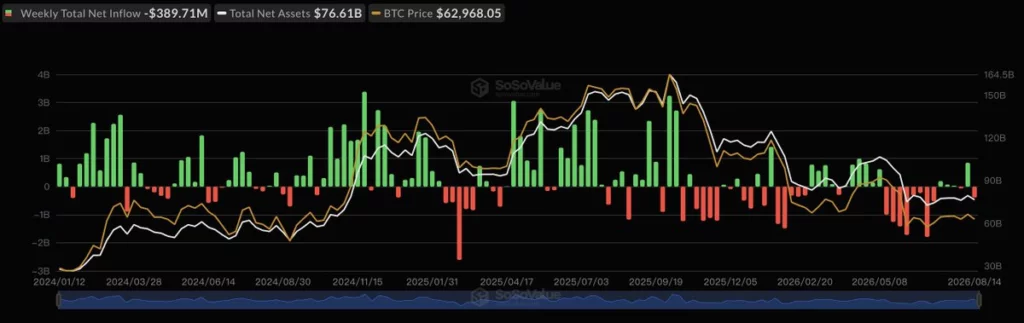
Bitcoin traded around $63,460 during Asian hours on Monday, Aug. 17, recovering 0.7% over 24 hours but remaining 2.3% lower over seven days as the cryptocurrency market entered another week with limited momentum.
Summary
- Bitcoin traded near $63,460 Monday, gaining 0.7% daily while remaining 2.3% lower across the week.
- Hyperliquid rose 3.4% daily and 8.7% weekly, outperforming most major cryptocurrencies during Monday morning trading.
- Monero traded near $413.84, gaining 4.9% weekly as momentum improved toward its $420–$430 resistance zone.
- U.S. spot Bitcoin ETFs recorded $390 million in net outflows across last week’s five sessions.
- Bitway led top-100 gainers with 22.3%, while Stable and Quant posted the largest daily declines.
Bitcoin’s market capitalization stood near $1.27 trillion.
The broader crypto market was valued at roughly $2.24 trillion, while Bitcoin dominance remained close to 57%. Most large-cap cryptocurrencies posted modest daily gains, but weekly performance remained mixed after Bitcoin fell from above $65,000 during the previous week.
Bitcoin price remains below last week’s highs
Bitcoin’s latest rebound has yet to erase the decline from last week’s $65,400 area. BTC fell as low as roughly $62,500 on Friday before stabilizing through the weekend and moving back above $63,000.
Ethereum was trading around $1,900.64, up 1% in 24 hours but 0.8% lower over seven days. XRP remained near $1.00 and was down 2.8% for the week. Solana traded around $75.47, down 0.1% daily and 1.4% weekly. BNB held near $605.63 and was 0.6% higher over seven days.
TRON changed hands near $0.332, gaining 0.4% daily and 0.7% weekly, while Dogecoin rose 0.6% to about $0.070.
The subdued Bitcoin performance follows another reversal in U.S. institutional flows. Spot Bitcoin ETFs recorded roughly $390 million in combined net outflows between Aug. 10 and Aug. 14, with Fidelity’s FBTC accounting for about $153 million. Spot Ethereum ETFs recorded a smaller $2.26 million weekly net outflow.
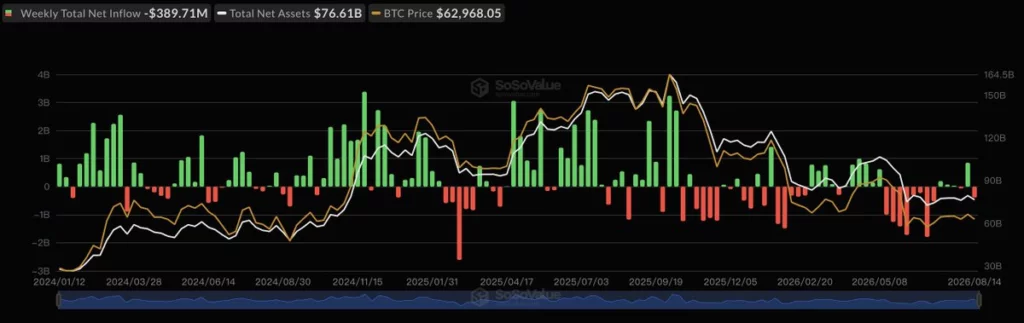
That marked a sharp change from the previous week, when, as crypto.newspreviously reported, Bitcoin ETFs attracted $853.5 million across five consecutive inflow sessions.
HYPE and LINK outperform major altcoins
Hyperliquid’s HYPE remained one of the strongest large-cap performers. The token traded around $58.81, gaining 3.4% over 24 hours and 8.7% during the past seven days. Its market capitalization stood near $13.1 billion.
Chainlink posted an even larger weekly increase among the top 20 cryptocurrencies. LINK traded near $9.45, gaining 0.7% on the day and 15.7% over seven days. Monero also outperformed Bitcoin, rising 4.9% weekly to around $413.84.
HYPE’s performance follows a period of renewed activity around Hyperliquid. In related coverage, crypto.newsreported that Hyperliquid generated $169 million in second-quarter revenue and directed $141 million toward HYPE buybacks.
Among the broader top-100 market-cap group, Bitway was the strongest daily performer in the latest crypto.news snapshot, rising 22.3%. Ether.fi followed with a 7.9% increase.
On the downside, Stable fell 3.7%, Quant lost 3.6%, and Canton declined 2.7%. Uniswap remained one of the weakest weekly performers among larger assets, falling 18.4% over seven days despite gaining 1.3% Monday.
Bitcoin tests resistance after steady recovery
Bitcoin’s daily chart shows BTC consolidating after its sharp June pullback, with price hovering near $63,490 and posting a modest 0.94% intraday gain. Despite the short-term uptick, BTC continues to trade below the key resistance band around $65,000–$66,000, keeping the broader structure tilted to the downside compared with earlier cycle highs. In the near term, price action remains confined to a range, with $60,000 acting as the main support floor.
The Aroon Oscillator sits in positive territory at 42.86, suggesting that recent upward moves are currently outweighing recent lows. This points to mild bullish momentum in the short term, though the signal is not strong enough to indicate a confirmed trend shift.
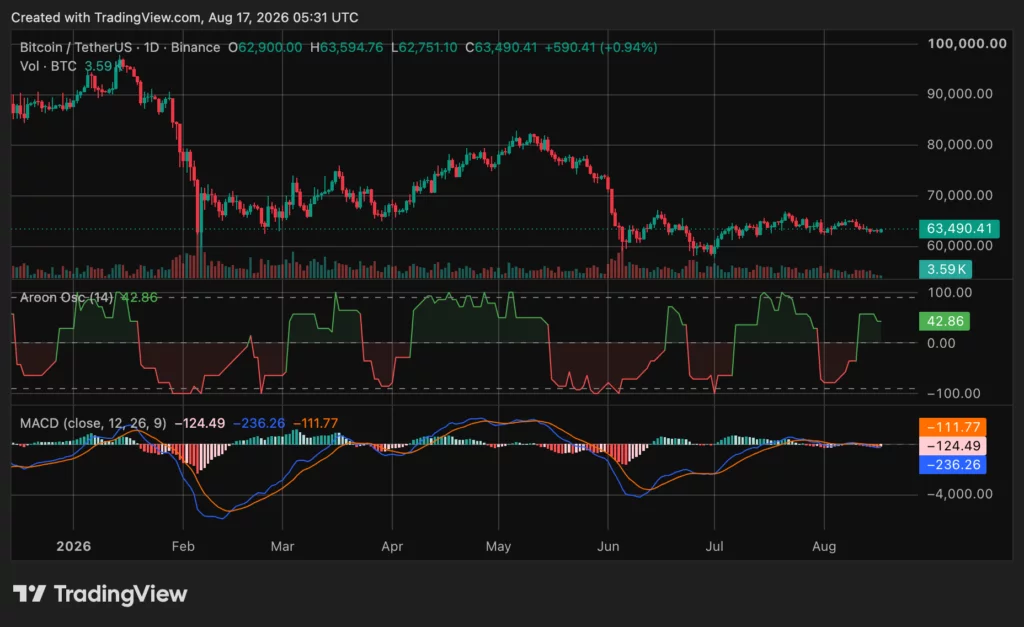
Momentum indicators, however, remain weak. The MACD continues to reflect bearish conditions, with the histogram at approximately -124.49 and the MACD line near -236.26, still positioned below the signal line around -111.77. This setup indicates that downside momentum has not fully dissipated despite the recent price recovery.
Overall, Bitcoin is stabilizing after its decline but has yet to establish a convincing bullish reversal. A sustained breakout above the $65,000–$66,000 resistance zone would strengthen the recovery case, while a breakdown below $60,000 would likely reintroduce stronger bearish pressure.
Fed minutes and White House meeting come into focus
Macro policy returns to the foreground this week. The Federal Reserve will publish minutes from its July 28–29 meeting on Wednesday, Aug. 19, at 2 p.m. ET. Officials voted 9–3 to maintain the federal funds target range at 3.5%–3.75%, with three members preferring a quarter-point increase.
Markets have since reduced expectations for another rate increase. Futures pricing pointed to roughly a 30% probability of a September hike heading into Monday, according to the Financial Times.
Crypto traders will also watch Washington. As crypto.news reported, Coinbase, Ripple and other crypto and prediction-market executives are expected at an Aug. 19 White House meeting as policymakers continue discussing digital asset regulation.
For Bitcoin, the immediate question is whether Monday’s move can extend beyond the $64,000 region and recover last week’s highs. Until then, BTC remains below its recent range peak while selected altcoins, notably LINK, HYPE and XMR, continue to outperform.
Disclosure: This article does not represent investment advice. The content and materials featured on this page are for educational purposes only.
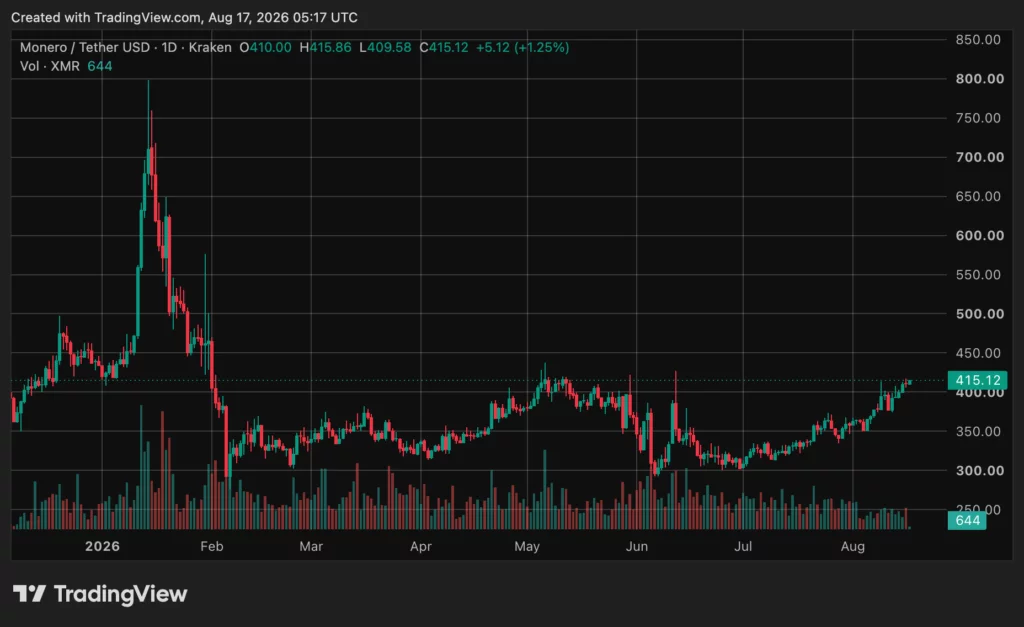
Apple has patched a critical macOS Screen Sharing vulnerability after attackers exploited internet-facing Macs to gain root access and install Monero mining software, according to an updated warning from the Netherlands’ National Cyber Security Centre.
Summary
- Apple patched CVE-2026-65400 after attackers exploited Mac Screen Sharing services to install Monero miners remotely.
- Dutch cybersecurity officials confirmed compromised Macs had root access and unauthorized Monero mining software installed.
- CISA now scores the authentication flaw 9.8 critical, up from its earlier 7.1 assessment overall.
- Huntress found tens of thousands of potentially exposed Macs, especially internet-hosted bare-metal Apple systems worldwide.
- Changing Screen Sharing passwords cannot fix the flaw; affected Macs require Apple security updates immediately.
The Dutch NCSC updated its advisory on Aug. 12 to confirm active exploitation of CVE-2026-65400 on multiple systems with port 5900 exposed to the internet. In every reported case, attackers obtained root access and installed a Monero miner. The agency did not disclose how many Macs were compromised or identify the attackers.
Apple Screen Sharing flaw bypasses authentication
Apple patched CVE-2026-65400 on Aug. 6 in macOS Tahoe 26.6.1, Sequoia 15.7.9 and Sonoma 14.8.9. The company described it as an authentication flaw caused by improper state management that could allow an attacker on the network to access Screen Sharing without valid credentials.
Security firm Huntress found that the flaw affects the Secure Remote Password authentication process used by macOS Screen Sharing. Its analysis showed an attacker could cause the service to treat an unauthenticated connection as authenticated and obtain privileged access.
Because exploitation occurs before normal authentication, Huntress said changing a Screen Sharing password, disabling legacy VNC authentication or removing authorized user accounts does not address the vulnerability. The recommended fix is installing Apple’s latest security update or disabling Screen Sharing until the system can be patched.
Tens of thousands of Macs may have been exposed
Huntress researcher Ryan Dowd said a Censys search identified “tens of thousands of potentially vulnerable hosts.” That estimate covers Macs that appeared exposed to the internet and should not be interpreted as tens of thousands of confirmed compromises.
The risk is particularly relevant to hosted bare-metal Macs, including Mac minis rented for remote workloads. Huntress said some hosting environments expose Screen Sharing services on newly provisioned machines, increasing the attack surface when systems have not yet received Apple’s Aug. 6 patches.
The flaw now carries a 9.8 critical CVSS score from CISA’s vulnerability analysis, with no privileges or user interaction required under its current assessment. The National Vulnerability Database shows that CISA upgraded the scoring on Aug. 14 after initially assigning a lower severity assessment.
Hackers used compromised Macs to mine Monero
The Dutch cases involved cryptojacking rather than reported theft of wallet credentials. Attackers used the compromised Macs’ computing resources to mine Monero after obtaining root control. The NCSC has not disclosed the mining software, pool addresses, attacker wallets or resulting XMR proceeds.
Monero has repeatedly appeared in cryptojacking campaigns because it can be mined using general-purpose computing hardware. As crypto.news previously reported, a Darktrace investigation found malware quietly deploying cryptocurrency mining software after attackers gained access to Windows systems.
Apple devices have also faced other crypto-related malware campaigns. In related coverage,North Korean hackers targeted macOS users with malware aimed at crypto companies using fake meetings and malicious software updates.
Meanwhile, Monero (XMR) traded at around $414 at press time, indicating less the 1% increase in the past 24 hours and almost 5% in the past 7 days (according to crypto.news market data)
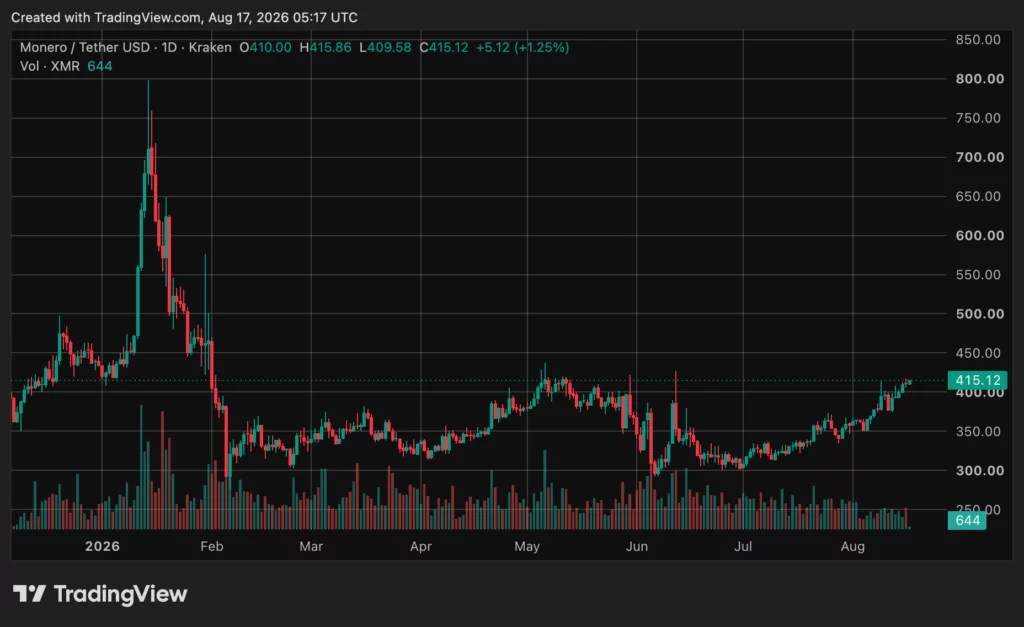
What happens next
The immediate priority is patching Macs running vulnerable versions of Sonoma, Sequoia and Tahoe. Systems exposed directly to the internet through Screen Sharing face the clearest documented risk, although Huntress recommends updating Macs even when administrators believe the service is disabled.
The Dutch NCSC has confirmed exploitation but has not attributed the campaign or published indicators identifying the Monero mining infrastructure. Further disclosures from incident responders could clarify how widespread the attacks became before Apple’s Aug. 6 fix.

why Pi Network’s social dominance is not converting to demand

Stars Celebrate Palisades Village Reopening After L.A. Fires
![BITCOIN: CRAZY!!!! THIS IS CRAZY!!!! [trades]](https://wordupnews.com/wp-content/uploads/2026/05/1778214197_maxresdefault-80x80.jpg)
BITCOIN: CRAZY!!!! THIS IS CRAZY!!!! [trades]


-

 Fashion3 days ago
Weekend Open Thread: Ann Taylor
-
 NewsBeat5 days ago
Communication cards help banking customers access services or report scams
-
 Business6 days ago
Oil Price Today (August 11): Crude oil rises to $88 after Trump’s compensation demand dents Hormuz opening. Here’s why
-
 Sports3 days ago
This U.S. Amateur is a glimpse into golf’s future in more ways than you think
-

 Crypto World6 days ago
Revolut wins French banking licence, creates second EU banking hub
-
 Crypto World6 days ago
Why Did Nvidia Stock Fall on Monday Despite a $500 Billion Wall Street AI Deal?
-

 Sports2 days ago
Birmingham 2026: Day 6 Timetable for Irish Athletes
-
 Entertainment5 days ago
Keke Palmer Subtly Hints At Sean Evans Drama With Cryptic Post
-
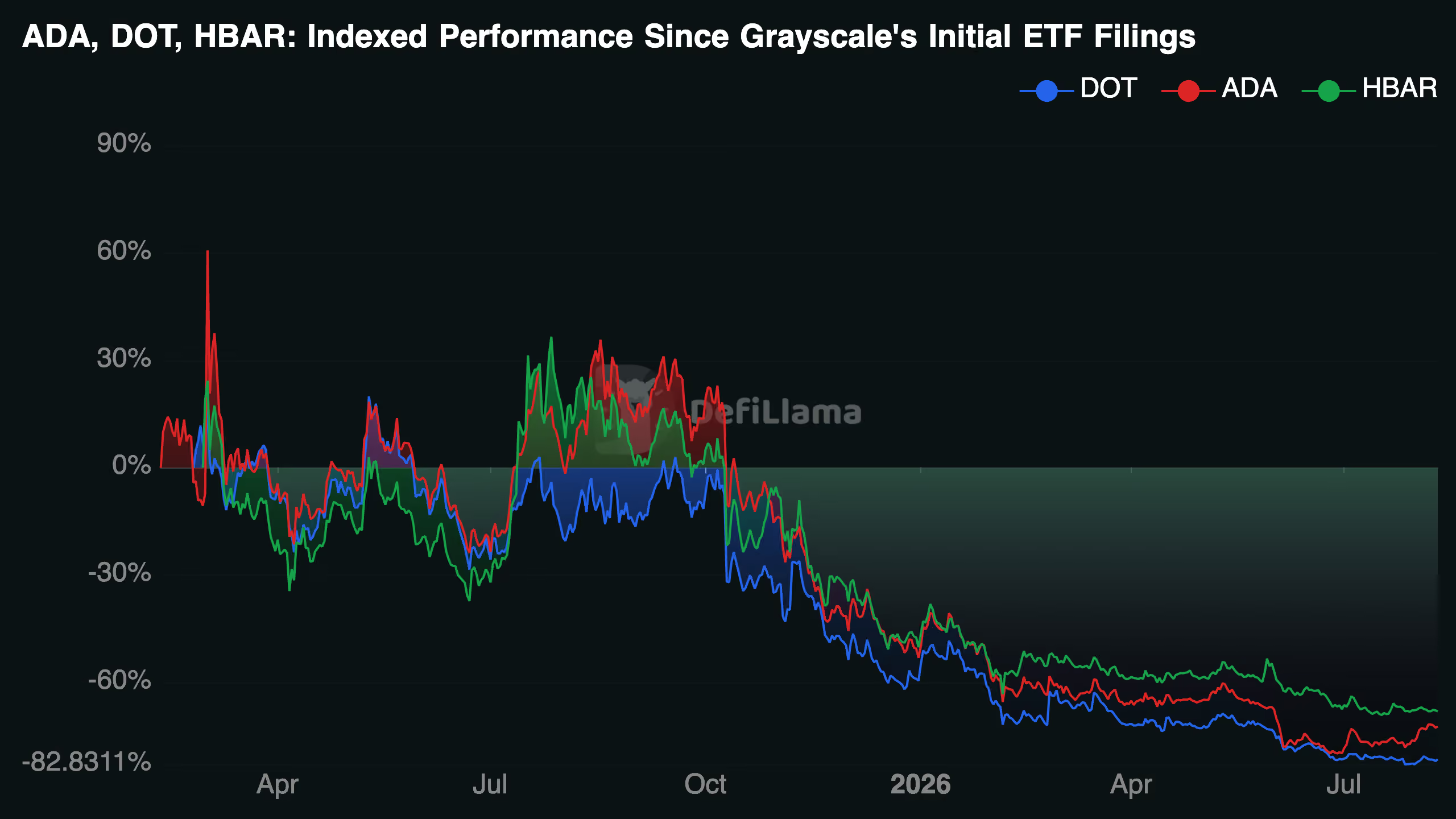 Crypto World7 days ago
Grayscale quietly drops Cardano, Polkadot and Hedera ETF plans
-
 NewsBeat2 days ago
Myanmar says over 300,000 Rohingya refugees verified for repatriation as exodus enters ninth year
-

 Politics2 days ago
SEQ Code: The Three Letter Boarding Pass Code That Could Give You The Worst Seat
-
 Entertainment6 days ago
57 Years Later, the Best Sitcom Ever Made Still Deserves a Reboot
-

 Tech5 days ago
Zoom Screen-Sharing Bug Let People Fully Take Over Other Devices On A Call
-
 Crypto World7 days ago
Hormuz Nerves Cost Bitcoin $65,000 Mark Despite Solid Institutional Flows
-

 Fashion7 days ago
Can You Wear Double Cloth Gauze Clothing To Your Office?
-

 Fashion6 days ago
Should you refinance your debt? Pros, cons, and real numbers
-

 Crypto World6 days ago
Bitcoin's BIP Editors Remove Luke Dashjr Two Days After BIP-110 Fork Stalled
-

 Fashion6 days ago
Claire Life: Kicking Off MVAAFF With the C Suite Luncheon Featuring Phylicia Rashad, Letoya Luckett, and More!
-

 Fashion6 days ago
Coffee Break: The Fonteyn Jane Flat
-

 Fashion6 days ago
How to Mix Diamond Rings With Gold & Silver Jewelry
You must be logged in to post a comment Login