

Crypto World
Solana Foundation Rolls Out Custom Privacy Framework


TLDR
- The Solana Foundation released a report outlining a customizable privacy framework for institutions.
- The report presents privacy as a spectrum with four distinct operational modes.
- The framework includes pseudonymity, confidentiality, anonymity, and fully private systems.
- The Solana Foundation said enterprises can combine privacy tools within one blockchain network.
- The report links privacy controls with compliance tools such as auditor keys.
The Solana Foundation has released a new report that outlines a customizable privacy framework for institutions. The document states that enterprises require flexible disclosure controls rather than full transparency. The foundation said privacy options can operate on Solana without reducing network performance.
The report, titled “Privacy on Solana: A Full-Spectrum Approach for the Modern Enterprise,” sets out a structured model for privacy. It states that companies need control over data visibility and counterparties. The foundation presented privacy as a configurable feature within one blockchain system.
Solana Foundation Outlines Privacy Spectrum for Enterprises
The Solana Foundation defined four privacy modes within its proposed framework. These modes include pseudonymity, confidentiality, anonymity, and fully private systems. The report stated, “For enterprises, privacy is a spectrum, not a switch.”
The foundation explained that pseudonymity hides identities behind wallet addresses while keeping transaction data public. It said confidentiality allows known participants to encrypt balances and transfer amounts. It added that anonymity conceals identities but keeps transaction records visible on-chain.
The report described fully private systems as shielding both identity and transaction data. It cited zero-knowledge proofs and multiparty computation as supporting technologies. The foundation stated that companies can combine these methods within a single network.
The document argued that no single model fits all enterprise needs. It stated that firms may select privacy levels based on operational and regulatory requirements. It emphasized that each privacy level remains compatible with the broader Solana ecosystem.
Framework Links Privacy Controls With Compliance Tools
The report stated that financial institutions often must verify transactions without exposing counterparties. It added that payroll processors cannot publish employee salary data on public ledgers. The foundation positioned its framework as a response to these operational constraints.
The Solana Foundation said its high throughput and low latency enable advanced encryption methods at near-web speeds. It argued that network performance supports encrypted order books and private credit assessments. The report described these features as practical under current network conditions.
The document also addressed regulatory requirements tied to anti-money laundering rules. It introduced “auditor keys” that allow approved parties to decrypt transaction details when required. The report stated that wallets can prove compliance status without disclosing full identity data.
The foundation wrote, “Privacy is a market requirement. Customers expect it and applications require it.” It added that enterprises can choose encrypted balances, zero-knowledge anonymity, or multiparty confidential computing.
The report stated that each privacy mode maps to a defined compliance path. It explained that companies can mix tools such as hidden transaction amounts or selective data access. The Solana Foundation released the report on Monday as part of its institutional outreach efforts.


Ripple CTO Emeritus David Schwartz has explained how XRP Ledger uses the Negative Unique Node List to handle validator failures.
Summary
- Schwartz said XRPL’s Negative UNL helps the network keep moving when trusted validators go offline.
- The mechanism can ignore failed validations without removing a validator’s wider role in network decisions.
- The debate comes as XRPL adds lending tools, security upgrades and wider XRP market activity.
The discussion followed fresh debate over XRPL’s architecture after Charles Hoskinson called the design “very elegant.”
Schwartz said XRPL needs a validator set that includes reliable operators and smaller independent participants. The issue is that large firms often have stronger uptime because they can pay for better servers and support teams.
Meanwhile, the Negative UNL is a list of trusted validators believed to be offline or not working properly. XRPL.org says the remaining validators can agree to ignore those validators when deciding whether a new ledger has enough support.
The system does not remove the validator forever. If the validator comes back online and sends matching validation votes, it can be removed from the Negative UNL after a short period.
Smaller validators keep their voice
Schwartz said the key point is that the Negative UNL does not silence a validator’s wider role. A validator placed on the list may lose its active confirmation role during an outage, but it does not lose its voice in transaction ordering, fee voting or amendment voting.
XRPL’s own documentation says a UNL is the group of validators a server trusts not to collude. It also says each UNL entry should be an independent entity, including businesses, universities, organizations or individuals.
XRPL security remains part of wider updates
The debate comes as XRPL prepares more technical upgrades. Crypto.news reported that the ecosystem is working on native lending and programmable escrow tools aimed at expanding XRPL beyond payments and settlement.
Ripple is also planning a four-phase roadmap to make XRPL more resistant to future quantum risks by 2028. The plan includes 2026 testing, validator checks, custody prototypes and a final native amendment.
XRP market activity adds attention
The validator discussion also comes during a busy period for XRP. Crypto.news reported that XRP wallets holding at least 10,000 tokens reached a record 332,230, based on Santiment data shared on X.
Separate crypto.news coverage said XRP open interest on Binance rose to about $475.4 million, above its 30-day average. The same report placed XRP near the $1.45 to $1.50 resistance area watched by traders.

Key Highlights
- Partnership with Dongfeng secures electric vehicle manufacturing for Peugeot and Jeep brands beginning 2027.
- Pre-market trading shows STLA declining despite strategic China expansion announcement.
- Wuhan-based production facility will serve both Chinese domestic and international export markets.
- Agreement provides Stellantis enhanced access to China’s growing electric vehicle sector.
- Combined investment exceeds $1 billion for new electric Peugeot and Jeep vehicle development.
Stellantis unveiled a significant manufacturing alliance with Dongfeng Group as shares declined in early pre-market trading. This strategic partnership centers on electric vehicle production for both Peugeot and Jeep brands at Wuhan facilities beginning 2027. The collaboration represents a major step in the automaker’s push into China’s competitive electric vehicle landscape.
Strategic Alliance Builds on Decades of Cooperation
The automotive giant and Dongfeng Group formalized a strategic cooperation framework that expands their relationship spanning more than three decades. Under this arrangement, both parties will leverage shared manufacturing capabilities for Peugeot and Jeep vehicle lines throughout China. Additionally, they executed a non-binding memorandum exploring further collaborative opportunities.
This framework specifically targets Dongfeng Peugeot Citroën Automobile (DPCA). The joint venture controls the Wuhan manufacturing complex that will anchor the upcoming production initiative. Full implementation remains contingent upon finalized contracts and regulatory clearances.
The arrangement provides the European automaker an additional pathway for expansion within Chinese markets and beyond. Dongfeng contributes extensive local market knowledge, robust production infrastructure, and advanced electric powertrain technology. Both organizations seek to revitalize DPCA’s market position through this collaboration.
Electric Vehicle Manufacturing Timeline Set for 2027
DPCA will manufacture two entirely new Peugeot-branded electric vehicles at its Wuhan production complex. Manufacturing operations are scheduled to commence in 2027, pending necessary approvals and contractual finalization. These vehicles will serve both domestic Chinese consumers and carefully selected international markets.
The upcoming Peugeot models will incorporate styling elements previewed through concept vehicles displayed at the 2026 Beijing Auto Show. The automaker positions these offerings as critical components of Peugeot’s worldwide expansion strategy. Both vehicles will showcase the brand’s evolving design philosophy.
The manufacturing program additionally encompasses two Jeep-branded electric off-road vehicles. DPCA anticipates producing these models at the same Wuhan location starting 2027. The company intends to distribute these Jeep vehicles throughout worldwide markets.
Share Performance Weakens Following Announcement
STLA finished regular trading at $7.84, advancing 3.16% during the session. Nevertheless, shares retreated to $7.64 during pre-market hours. This movement represented a 2.55% pullback following an initial decline from approximately $7.75.
The manufacturing initiative encompasses total investment exceeding 8 billion Chinese yuan. That figure translates to approximately 1 billion euros according to company calculations. The European automaker anticipates contributing roughly 130 million euros toward the overall program.
The partnership receives backing from governmental authorities in Hubei province and Wuhan city. Consequently, this initiative synchronizes with China’s comprehensive strategy promoting electric vehicle manufacturing. For the multinational automaker, this agreement reinforces its Chinese market presence while broadening its worldwide electric vehicle portfolio.
Australia’s proposed changes to capital gains tax could lead to smaller profits for cryptocurrency traders, especially low-income earners, and could discourage “patient investing,” according to several crypto executives.
The proposed reform, announced by the ruling Labor Party on Tuesday as part of its fiscal year 2027 budget, will bring in a minimum 30% tax on capital gains and scrap the 50% capital gains tax discount on assets held for more than 12 months.
Robin Singh, CEO and founder of crypto tax platform Koinly, told Cointelegraph the proposed changes are a mixed bag: The new system “theoretically” protects investors from being taxed on purely inflationary gains, but in practice, most crypto investors will pay more tax, with low-income earners hit the hardest.
“A lower-income earner who would have paid around $3,800 under the old rules, 19% on a $20,000 discounted gain, will pay $10,200 under the new ones. That’s nearly triple. For students, part-time workers and anyone without significant other income, this is the biggest shift,” Singh added.
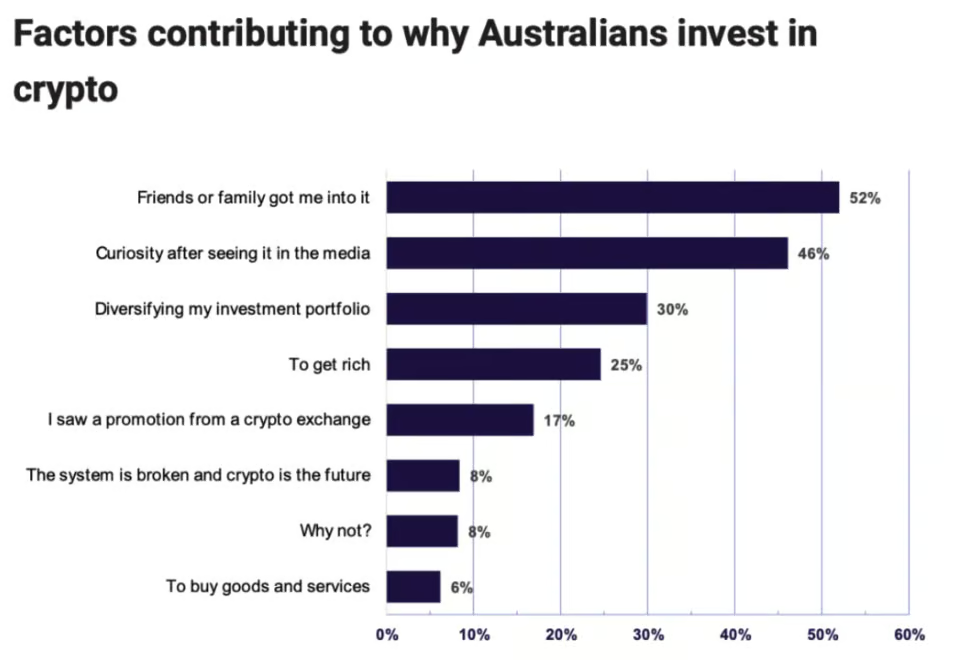
Many investors, particularly Gen Z and Millennials, have seen crypto as a way to create wealth and long-term financial well-being. The new tax changes could impact that notion. A 2025 report from crypto exchange Independent Reserve found that 30% of people were investing in crypto to diversify their portfolio, while 25% were trading to get rich.
“For retail and mid-sized holders, the hodl tax incentive is effectively gone. Crypto has historically grown much faster than inflation, so the inflation adjustment doesn’t come close to offsetting the loss of the 50% discount. With no tax reward for sitting on positions, expect more frequent trading and shorter holding periods.”

A quarter of people are trading crypto to get rich. Source: Independent Reserve
“That said, the market has always adapted. Investors will rework their strategies, advisors will rework their advice, and the dust will settle,” Singh added.
Crypto trader behavior will likely shift
Jonathon Miller, the Australian general manager for crypto exchange Kraken, agreed that the changes will make long-term crypto holding less attractive.

Source: Crypto Tax Made Easy
“The bigger risk is that reducing the benefit of long-term holding makes patient investing less attractive, particularly in a market where assets can be traded around the clock. That could push some investors toward shorter-term behavior, which is not necessarily the best strategy for long-term wealth building,” Miller said.
“The sector will continue to mature, but policy settings can influence whether that maturity is built around long-term confidence or shorter-term activity.”
Andrea Yuen, the co-CEO of Australian crypto trading platform Swyftx, said the tax changes could prompt crypto traders to shift to other avenues for long-term wealth creation.
“The change is likely to act as a catalyst for patient capital over the next few years. We expect a significant trend toward crypto allocations within retirement portfolios and self-managed super funds. Investors are essentially being incentivized toward structured, long-term wealth creation,” Yuen added.
Related: Coinbase launches crypto service for Australian retirement funds
Australian crypto exchange BTC Markets reported in its Investor Study Report that SMSF registrations increased 69% year-on-year during the 2024–2025 financial year.
New CGT rules need to pass through Parliament
The Australian government has argued that the changes will curb investor appetite for property purchases because, without tax incentives, property is less attractive as an investment and that could free up supply.
The new measures will apply only to gains accrued after July 1, 2027, and new homes are exempt. Critics argue that it will instead push up housing prices, stifle investment, impact business and add pressure to the new housing supply, The Australian reported on Friday.
The tax reforms will still need to pass through the Australian Parliament. Angus Taylor, the leader of Australia’s other major political party, the Liberals, has reportedly vowed to oppose the measures and repeal them if they form government after the next federal election in 2028.

Source: Pete Wargent
The Labor Party will also need to get the tax reforms through the House of Representatives, with 76 votes required to pass, and through the Senate with 39 votes. Labor holds 94 seats in the House and 30 in the Senate.
Magazine: eToro founder timed Bitcoin top perfectly due to belief in 4 year cycles


- XRP surged to intraday highs near $1.55 on renewed optimism.
- Senate Banking Committee approved the Digital Asset Market Clarity Act in a 15-9 vote.
- XRP price could target a breakout as the market cheers the regulatory milestone.
XRP price rose to near $1.55 on Friday as the cryptocurrency market cheered the Senate Banking Committee’s passage of the Digital Asset Market Clarity Act.
Other crypto assets also notched gains, with Hyperlquid, Flare, and XDC Network leading the top 100 coins by market cap.
Bitcoin also reclaimed the $80,000 level, with intraday highs coming as major altcoins held key levels.
CLARITY Act approval buoys crypto
The US Senate Banking Committee approved the bipartisan Digital Asset Market Clarity Act in a 15-9 vote, marking a significant step toward comprehensive crypto market structure legislation.
The measure will now move to a procedural merger with a similar bill in the Senate Agriculture Committee, advancing the legislative pathway for federal regulation of digital assets.
Senate Banking Committee Chairman Tim Scott engineered a last-minute maneuver to accept amendments he had previously rejected, winning over two Democratic senators after several hours of partisan debate.
While the legislation addresses a range of market structure issues, lawmakers and stakeholders acknowledged outstanding questions.
These include provisions related to law enforcement access and ethics safeguards.
Market participants nonetheless received the vote as a positive signal, interpreting it as the first major bipartisan movement on crypto market structure in months and a reduction of regulatory uncertainty ahead of a full Senate consideration.
Why could XRP price explode?
Ripple’s token XRP has struggled to climb above $1.50 in recent weeks, but tested the level late Thursday with an intraday surge to near $1.55.
While this aligned with broader market gains, the uptick largely reflected exuberance from the “XRP Army”, which views the regulatory tailwind as a major boost to the cryptocurrency.
The cryptocurrency traded around $1.47 early Friday.
🚨 JUST IN: The CLARITY Act has officially cleared the U.S. Senate Banking Committee, pushing ripple:native one step deeper into the U.S. federal regulatory process. 🇺🇸
For ripple:native, what happens next:
1. The CLARITY Act now moves beyond the Senate Banking Committee and… https://t.co/VXiaHuH47o pic.twitter.com/r8HgVcSCBs
— RippleXity (@RippleXity) May 14, 2026
XRP’s retest of the $1.50 level comes amid signs of renewed whale accumulation, with on-chain data showing growth in large-wallet holdings and rising concentration among long-term holders.
On-chain data indicates that this cohort holds a combined 45.83 billion XRP tokens, the biggest haul since May 2018.
A more definitive market-structure framework could ease compliance burdens and encourage fresh adoption of Ripple’s payment solutions, a dynamic that might translate into accelerated demand for XRP.
Risk remains though, with the path to the final vote including further legislative negotiations and potential amendments that might delay enactment into law.
Changes could also dilute near-term benefits for market participants. Nevertheless, analysts view the regulatory backdrop as one that could support sharper price moves.
The token’s price was roughly 5% up in the past week, but it has witnessed a 20% drawdown year-to-date and hovers 61% from its all-time peak.


Bit Digital has reported lower first-quarter revenue and another steep quarterly loss as the Nasdaq-listed company continues redirecting capital from bitcoin mining into Ethereum staking and treasury operations.
Summary
- Bit Digital reported a $146.7 million net loss as revenue from ETH staking, cloud services, and crypto mining declined in Q1.
- The company held more than 154,000 ETH at the end of March while continuing to reduce exposure to bitcoin mining.
- Bit Digital said future capital deployment will continue focusing on Ethereum operations and infrastructure businesses.
According to Bit Digital’s earnings report released Thursday, first-quarter revenue came in at $27.9 million, down 13.6% from the final quarter of 2025, after weaker results across its cloud services, ETH staking, and crypto mining businesses.
Cloud services remained the company’s largest revenue segment at $16.8 million, though the figure slipped 13.1% quarter-on-quarter. Co-location services added another $4.8 million, while crypto mining revenue dropped 32.9% to $3.7 million after lower bitcoin production and softer BTC prices weighed on returns during the period.
Ethereum staking income also weakened. Bit Digital said staking revenue fell 29.4% from the previous quarter to $2.3 million as average ether prices declined and the amount of natively staked ETH decreased. During the quarter, the company moved nearly 70,000 ETH into liquid staking arrangements to preserve treasury flexibility.
At the same time, the company posted a net loss of $146.7 million for the quarter, improving from the $185.3 million loss recorded in Q4 2025. Bit Digital said non-cash mark-to-market adjustments tied to digital assets continued affecting earnings results.
Ethereum treasury strategy expands
By the end of March, Bit Digital held approximately 154,444 ETH, valued at roughly $327 million at the time, with an average acquisition cost of $3,045 per token, according to the earnings filing.
The latest treasury figure comes months after Bit Digital disclosed in November 2025 that its Ethereum holdings had climbed to roughly 153,547 ETH valued at around $590.5 million at the end of October. In that earlier update, the company said it acquired more than 31,000 ETH during the month while staking nearly 86% of its holdings to generate yield.
Back in June 2025, Bit Digital publicly confirmed it had started moving away from bitcoin mining in favor of an Ethereum-focused treasury and staking model. Chief Executive Officer Sam Tabar previously described Ethereum as a foundational settlement layer tied to tokenized real-world assets and stablecoin activity, contrasting it with bitcoin’s role primarily as a store of value.
Thursday’s report showed the company continuing along that path. Bit Digital stated that bitcoin mining still generates cash flow but no longer represents its primary expansion strategy, adding that future capital deployment would continue leaning toward Ethereum and infrastructure-related businesses.
Speaking in the earnings release, Tabar said the company believes it is positioned early around the intersection of artificial intelligence infrastructure and Ethereum-based financial rails. He pointed to WhiteFiber, Bit Digital AI’s high-performance computing subsidiary, alongside the company’s Ethereum treasury and staking operations as part of that thesis.
WhiteFiber previously raised nearly $160 million through an initial public offering in August 2025. As of March 31, Bit Digital held about 27 million WhiteFiber shares and retained majority ownership in the business.
Meanwhile, Ethereum prices remained under pressure during the quarter. Ether fell roughly 29% to $2,104 by March 31 before trading near $2,245 on Friday, according to pricing data cited in the report.
Investors reacted cautiously after the earnings release. Bit Digital shares declined 3.7% in after-hours trading on Thursday after gaining 4.9% during the regular session. Despite the pullback, the stock has still advanced 39% over the past month, although it remains down 7% across the last six months.


Privacy messaging app Signal has said it may exit Canada if forced to comply with the country’s proposed lawful access bill, which would require companies to build technical surveillance capabilities that some argue could threaten end-to-end encryption.
In an interview with Canadian news outlet The Globe and Mail on Thursday, Signal’s vice president of strategy and global affairs, Udbhav Tiwari, argued that the bill could threaten encryption and leave private messaging services vulnerable to potential cyberattacks.
Bill C-22 is part of a regulatory package introduced in March. It would require electronic service providers to build surveillance capabilities and retain certain user metadata for up to a year as part of a broader push to help law enforcement investigate crimes such as terrorism and child exploitation.
Some have criticized the bill because of its implications for user privacy, echoing concerns of the EU’s controversial chat control proposal, which posed threats to encryption by pushing for client-side scanning of private messages.
In an X post on Thursday, Canadian Conservative Party Member of Parliament Jacob Mantle claimed that “every member of Parliament in the country” uses Signal primarily for its safety and privacy features, arguing that the bill would contradict that and allow the government to read everyone’s messages.
Tiwari said the firm “would rather pull out of the country” than comply with the law and compromise on the “privacy promises” it has made to users.
“Bill C-22 could potentially allow hackers to exploit these very vulnerabilities engineered into electronic systems, with private messaging services serving as an ideal target for foreign adversaries,” he added.
The bill is not yet law, as it still has to pass through parliamentary review and receive royal assent before taking effect. Committee hearings began on May 7 and are ongoing.
Tech giants such as Meta have welcomed certain aspects of the bill, noting that it would “provide law enforcement with an effective legal framework to obtain critical evidence and protect public safety,” while also raising concerns that certain parts negatively affect “Canadians’ privacy and cybersecurity.”
Related: US Senate Banking Committee votes to advance CLARITY Act
Signal isn’t the only company feeling pressure from the proposed regulation. In an X post on Thursday responding to The Globe and Mail article, VPN service provider Windscribe said it would follow Signal out of Canada, arguing that the law poses a threat to user privacy.
“We won’t be far behind if C-22 passes. In its current state, VPNs would almost certainly require us to log identifying user data,” Windscribe said.
“Signal isn’t headquartered in Canada so they can just shut off Canadian servers, but our HQ is. We pay an ungodly amount of taxes to this corrupt government, and in return they want to destroy the entire essence of our service to basically spy on its own citizens,” Windscribe added.
Cointelegraph reached out to Signal for comment and will update the article if the company responds.
Magazine: eToro founder timed Bitcoin top perfectly due to belief in 4 year cycles


Australia’s proposed capital gains tax reform could raise tax bills for crypto investors who hold assets for more than 12 months.
Summary
- Australia’s tax plan could remove the long holding discount that helped crypto investors reduce bills.
- Koinly says lower earners may face bigger tax jumps than wealthier crypto traders under reforms.
- Kraken expects weaker holding incentives could move some investors toward shorter trading cycles after 2027.
The plan would replace the current 50% CGT discount with an inflation-indexed model from July 1, 2027.
Under current rules, individuals can reduce taxable capital gains by half after holding an asset for more than one year. The proposed model would adjust the cost base for inflation and tax the remaining real gain, with a 30% minimum tax applying to net capital gains.
Crypto holders may lose a key tax benefit
The change matters for crypto because digital assets can rise much faster than inflation during strong market cycles. Crypto.news previously reported that the new model could leave many long-term crypto and share investors with higher tax bills than under the current discount system.
Koinly CEO Robin Singh said lower-income crypto investors could feel the change most. He said “that’s nearly triple” when comparing a lower earner’s possible tax bill under the old rules with the proposed system, based on a $20,000 discounted gain.
Meanwhile, Singh said the reform could reduce the tax reward for holding crypto over long periods. In his view, the loss of the 50% discount may lead some investors to trade more often instead of waiting for long-term gains.
Kraken Australia general manager Jonathon Miller gave a similar warning. He said weaker long-term tax benefits could make patient investing less attractive in crypto, where markets run every hour of the day and assets can move quickly.
Retirement crypto demand adds context
The debate comes as crypto firms build more products for Australian long-term investors. Crypto.news reported that Coinbase Australia recently launched support for self-managed super funds, giving trustees a local route to add crypto exposure to retirement portfolios.
That report said Australian SMSFs held about AU$1.06 trillion in assets at the end of 2025. It also noted that Coinbase’s local push followed its Australian Financial Services License approval, while other exchanges were also targeting the SMSF market.
Parliament still needs to approve reforms
The CGT proposal is not yet law. The measures still need to pass through Australia’s Parliament before they can take effect. Transitional rules would apply only to gains arising on or after July 1, 2027.
BDO said gains realized before that date would still qualify for the current 50% CGT discount. The firm also noted that income support recipients, including Age Pension recipients, would be exempt from the 30% minimum tax rate.
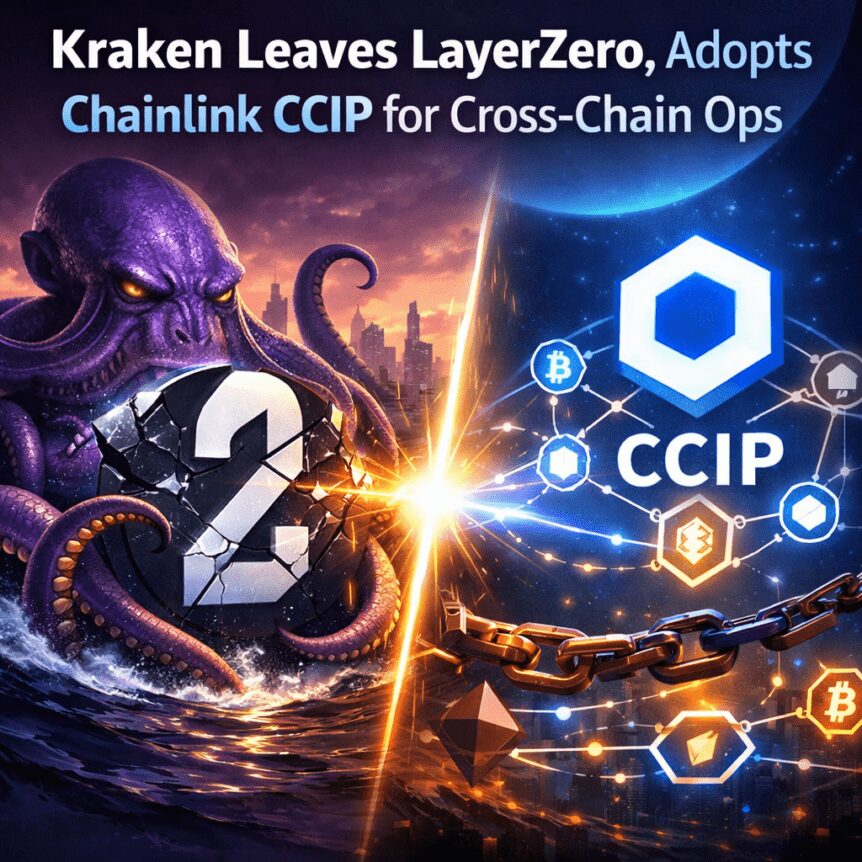
Kraken has decided to migrate its cross-chain infrastructure from LayerZero to Chainlink’s Cross-Chain Interoperability Protocol (CCIP), designating CCIP as the exclusive cross-chain backbone for Kraken Wrapped Bitcoin (kBTC) and all future wrapped assets. The move places Kraken among a growing group of protocols re-evaluating their cross-chain security posture in the wake of a major DeFi incident earlier this spring.
The exchange said the transition to CCIP reflects a preference for what it describes as enterprise-grade security and risk management. Kraken highlighted CCIP’s certifications, secure-by-default design, 16 independent nodes, and native rate limits as core advantages in reducing cross-chain risk for the firm’s wrapped assets.
The shift comes amid heightened scrutiny of LayerZero following the Kelp DAO exploit in April, in which roughly $292 million in liquid restaking tokens were siphoned by actors suspected to be linked to North Korea’s Lazarus Group. LayerZero subsequently issued an “overdue apology” on May 9, acknowledging communication failures in the weeks after the attack. The company attributed the breach to a combination of compromised internal RPCs—described as the “source of truth” being poisoned—and a targeted denial-of-service assault on external RPC providers, while noting that the vulnerability was tied in part to Kelp’s configuration of its single-DVN (decentralized verifier network). LayerZero maintained that the incident did not affect other applications and that more than $9 billion in bridged assets had been moved using the protocol since April 19.
Key takeaways
- Kraken commits to Chainlink CCIP as its exclusive cross-chain infrastructure for kBTC and future wrapped tokens, citing enterprise-grade security features and risk controls.
- The Kelp DAO exploit has accelerated a broader migration away from LayerZero, as multiple protocols reassess cross-chain infrastructure.
- Industry momentum toward CCIP is evident: Kelp DAO, Solv Protocol, and Re.xyz are migrating, with total cross-chain TVL migrating to CCIP rising into the billions of dollars.
- Chainlink CCIP’s adoption is accompanied by a price backdrop where major tokens have shown muted immediate reactions to the cross-chain shift, while LayerZero’s native token has faced notable declines.
LayerZero under pressure after the Kelp DAO incident
The April attack on Kelp DAO set off a wave of reconsiderations across the cross-chain landscape. In addition to the estimated $292 million stolen from liquid restaking tokens, LayerZero’s communications team issued an apology for a communications lag during the crisis, while officials described the breach as a consequence of compromised internal RPCs and a distributed denial-of-service attack on external RPC providers. LayerZero asserted that the problem did not spread beyond the targeted chain and that the rest of its ecosystem remained secure. The protocol has still faced heightened scrutiny as activity on bridges linked to LayerZero continues to be re-evaluated by projects across DeFi.
Despite the setback, LayerZero reported that more than $9 billion in assets had been bridged using its protocol since the April incident, underscoring the continued reliance on cross-chain liquidity even amid security concerns. The episode has prompted several protocols to consider or implement alternative cross-chain infrastructure to diversify risk and reduce single-vendor exposure.
CCIP adoption accelerates across DeFi
Kraken is not alone in shifting away from LayerZero in response to the incident. Kelp DAO has stated it is in the process of migrating to Chainlink CCIP and, as part of its recovery steps, burned 117,132 rsETH issued during the attack. The move to CCIP is part of a broader realignment as DeFi projects reassess cross-chain reliability and risk controls.
Other notable migrations include Solv Protocol, which announced on May 7 that it would move from LayerZero to CCIP as the official cross-chain infrastructure for about $700 million in tokenized Bitcoin. Re.xyz followed suit on May 8, signaling a transfer of its $475 million in total value locked from LayerZero to CCIP. Industry data compiled after the Kelp incident show more than $3 billion in total value locked (TVL) migrating to CCIP, as several protocols suspended bridging using LayerZero while the ecosystem reevaluated its options. In parallel, Lido, the world’s largest Ethereum liquid staking protocol, has publicly endorsed CCIP, praising Chainlink’s defense-in-depth model as a guiding standard for cross-chain interoperability.
The rapid pace of migrations underscores a broader market shift toward multi-layer cross-chain safety, with CCIP emerging as a leading option for secure asset transfers across chains. This trend aligns with a growing emphasis on governance, reliability, and resilience in cross-chain infrastructure, as DeFi projects weigh the costs and benefits of single-vendor dependencies against the potential upside of diversified security models.
Market backdrop and what to watch next
In the wake of these developments, market prices for core cross-chain players painted a cautious picture. Chainlink’s native token, where available, remained around bear-market levels near ten dollars, with no clear, immediate price reaction tied to the CCIP migrations. LayerZero’s ZRO token has faced a pronounced drawdown since the April breach, down more than 30% and well below its 2024 highs, reflecting a broader risk-off sentiment toward cross-chain infrastructure bets during a period of heightened scrutiny.
As CCIP gains traction among major DeFi protocols, observers will be watching for any further migrations, new security measures, and potential regulatory or governance updates that could influence cross-chain interoperability. The coming weeks will likely clarify whether CCIP can sustain rapid adoption while delivering the security guarantees that investors and users increasingly demand.
For readers, the key question is whether this momentum signals a durable reconfiguration of cross-chain trust or if additional incidents could temper the pace of migration. The next steps—more protocol migrations, governance decisions on cross-chain risk, and tangible improvements in cross-chain security—will reveal how the market recalibrates in response to a rapidly evolving multi-chain landscape.


Strategy has recorded a new trading volume high for its STRC perpetual preferred stock, adding fresh attention to the company’s use of structured equity products to finance Bitcoin purchases.
Summary
- Strategy’s STRC preferred stock recorded a new daily trading volume high of $1.53 billion on Thursday.
- The company could theoretically raise enough capital through STRC activity to purchase about 9,066 Bitcoin, according to STRC.live data.
According to a post from Michael Saylor, Strategy’s Variable Rate Series A Perpetual Stretch Preferred Stock, trading under the ticker STRC, reached $1.53 billion in daily liquidity on Thursday, the largest volume recorded for the instrument since launch.
“All-time high volume. $1.53B of liquidity,” Saylor said while referring to the company’s Stretch preferred stock product, which pays investors an 11.5% dividend without diluting Strategy’s common equity.
Data from the STRC.live tracker showed the trading activity could theoretically allow Strategy to raise roughly $735.4 million through its at-the-market issuance structure, enough to acquire about 9,066 Bitcoin at current prices. No announcement confirming a new Bitcoin purchase has been made by the company.
Since March, Strategy has accelerated the pace of its Bitcoin accumulation campaign after a relatively quieter February. Company disclosures show the firm has acquired 101,147 Bitcoin since March, including 56,770 Bitcoin purchased after April alone.
Structured products tied to Bitcoin buying
Over the past few months, perpetual preferred stocks have started gaining traction among corporate Bitcoin treasury firms as traditional fundraising routes become harder to access during the current crypto downturn. Senior convertible notes and at-the-market equity sales have faced weaker investor appetite, pushing several companies toward income-focused instruments linked to Bitcoin exposure.
Earlier in May, during Strategy’s Q1 earnings call, Saylor said the company intends to turn Stretch into the “biggest credit instrument in the world,” while continuing to use proceeds from the product to support Bitcoin acquisitions.
A May 14 report from K33 Research director Vetle Lunde stated that STRC’s structure may already be influencing Bitcoin liquidity cycles around the middle of each month. According to the report, the preferred stock’s dividend schedule and ex-dividend timing create recurring periods where Strategy can issue shares above par value and redirect proceeds into Bitcoin purchases.
K33 data cited in the report showed Strategy-linked purchases through STRC climbed from 4,467 Bitcoin in January to nearly 46,872 Bitcoin in April. Lunde also noted that the pace of STRC returning to its $100 par value had slowed recently, with only around 1 Bitcoin added through the mechanism in the latest observed period, a sign that investor demand for the instrument may be cooling.
Outside Strategy, other Bitcoin treasury firms have also started experimenting with similar financing structures.
On Thursday, Strive announced that investors in its Variable Rate Series A Perpetual Preferred Stock, SATA, would begin receiving daily dividend payments starting June 16. The schedule differs from Strategy’s monthly payout structure tied to Stretch.
Meanwhile, Tokyo-based Metaplanet has raised funds through perpetual preferred stock offerings, including MARS and MERCURY, as part of its Bitcoin acquisition strategy.
Nearly 200 public companies currently hold Bitcoin on their balance sheets. Strategy still controls the largest corporate treasury position, with 818,869 Bitcoin valued at roughly $66.5 billion based on current market prices.
Bitcoin’s recent recovery above $81,000 has also pushed the asset beyond Strategy’s average purchase price of $75,543, leaving the company’s holdings up about 7.2% on paper.
Key Highlights
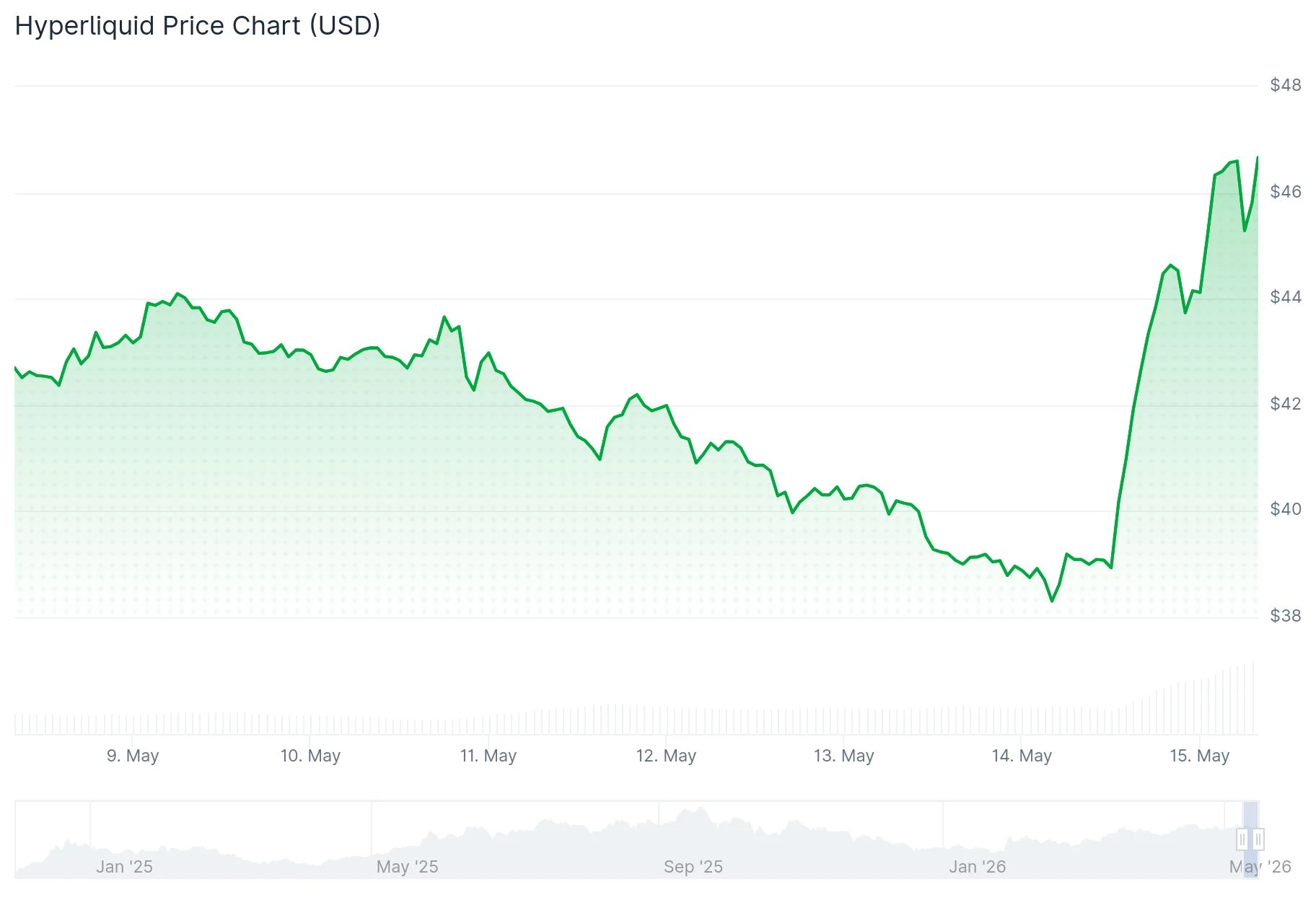
- HYPE rallied 21% over 24 hours to reach $46.64, with daily trading volumes exceeding $716 million.
- 21Shares launched the THYP ETF on Nasdaq May 12 — marking the first U.S. spot product offering direct HYPE exposure.
- Coinbase was designated as the official USDC treasury deployer on Hyperliquid, phasing out the native USDH stablecoin.
- Circle pledged 500,000 HYPE tokens for validator operations as part of the partnership agreement.
- Technical analyst Crypto Patel warns of possible retracement to $30–$33 range unless HYPE sustains a close above $50.
Hyperliquid’s HYPE token experienced a sharp 21% surge over the last 24 hours, climbing to $46.64 by Friday’s close. This upward movement elevated its market capitalization to approximately $11.14 billion, securing its position back among the top 10 largest cryptocurrencies.
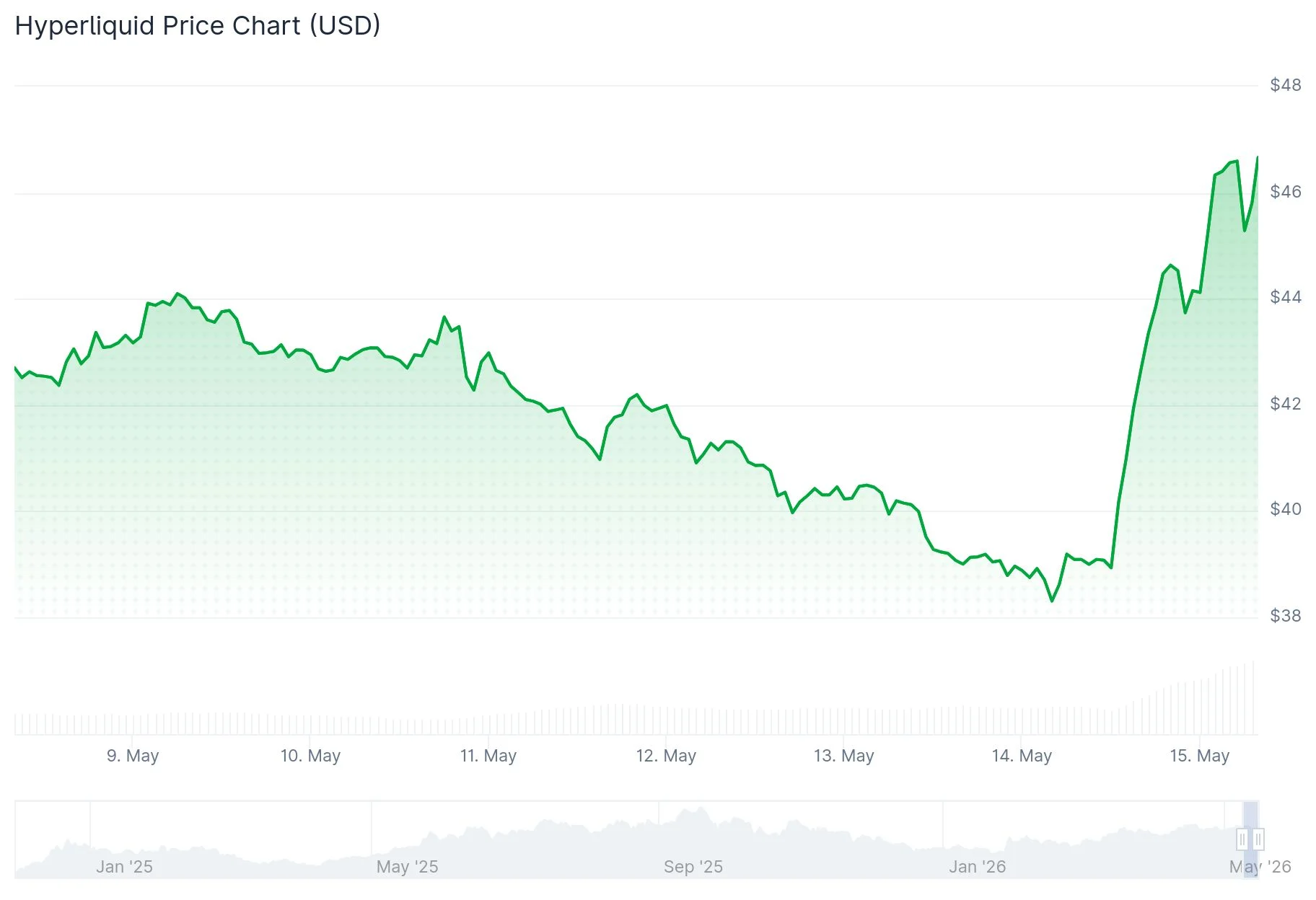
The token experienced significant intraday volatility, moving from a low of $38.45 to a peak of $46.93. Daily trading activity surged to $716.7 million — representing more than a twofold increase from the prior session — based on CoinMarketCap statistics.
However, HYPE remains approximately 21% beneath its record high of $59.37, which was recorded in September 2025.
The price explosion came after two significant announcements: the introduction of a regulated investment vehicle and a fundamental transformation in stablecoin operations.
Regulated ETF Provides Institutional Gateway
On May 12, 21Shares introduced the THYP ETF on the Nasdaq exchange. This marks the inaugural U.S. spot exchange-traded fund that provides direct exposure to HYPE tokens. The product maintains physical token holdings, stakes a percentage for rewards, and applies a 0.30% management fee.
First-day trading recorded $1.8 million in volume, accompanied by approximately $1.2 million in net inflows. Pending applications from Bitwise and Grayscale indicate that additional HYPE-focused investment products could emerge soon.
The ETF structure enables conventional investors to gain HYPE exposure without managing cryptocurrency wallets or navigating blockchain protocols.
Coinbase and Circle Forge Strategic Alliance
On May 14, Coinbase revealed its new role as the official treasury deployer for USDC on Hyperliquid through the platform’s Aligned Quote Asset program. USDC will supplant USDH as the dominant settlement and collateral instrument.
Circle will oversee the cross-chain technical operations. This transition aims to minimize liquidity division between the two stablecoin options.
USDC circulating on Hyperliquid currently stands at approximately $5 billion, representing a year-over-year doubling. The bulk of reserve income will be channeled back into Hyperliquid’s ecosystem through its Assistance Fund, which facilitates automatic HYPE token buybacks.
Circle has also allocated 500,000 HYPE tokens to support validator activities.
Technical Analysis and Market Outlook
Analyst Crypto Patel posted a measured assessment on X, noting that the rejection near $46 aligns with a rising wedge breakdown formation. He identified potential support zones at $33, $30, and $27, highlighting his primary interest area between $30–$31. He emphasized that his outlook would shift bullish only with a daily close surpassing $50.
Meanwhile, analyst Ali Charts pointed out that the TD Sequential indicator — which accurately predicted the bounce from $22 to $44 — is currently displaying a sell signal. He suggested this could prompt profit-taking activity targeting $36 or $33.
Hyperliquid presently captures approximately 60% of worldwide perpetual futures trading volume and produces over $2 million in daily protocol fees, with nearly 97% allocated toward HYPE token buybacks and burns.

Mira Murati Wants Her AI to ‘Keep Humans in the Loop’

Wealth Transfer: Don’t Miss This Financial Reset! #shorts

Pensions expert shares ‘start early’ message for people in twenties

Manchester United reach agreement with Casemiro over contract clause amid transfer speculation

US brings back mandatory military draft registration

Steven Gerrard disagrees with Gary Neville over ‘shock’ Chelsea and Arsenal claim | Football
![Why Bitcoin Won’t Stop! [Even With 3.8% CPI Shock]](https://wordupnews.com/wp-content/uploads/2026/05/1778835689_maxresdefault-80x80.jpg)

-
 Crypto World7 days ago
HarrisX Poll Found 52% of Registered Voters Support the CLARITY Act
-

 Fashion7 days ago
Weekend Open Thread: Marianne Dress
-

 Fashion4 days ago
Coffee Break: Travel Steam Iron
-

 Fashion4 days ago
What to Know Before Buying a Curling Wand or Curling Iron
-

 Tech5 days ago
Auto Enthusiast Carves Functional Two-Stroke Engine from Solid Metal
-

 Politics3 days ago
What to expect when you’re expecting a budget
-
 Business6 days ago
Ignore market noise, India’s long-term story intact, say D-Street bulls Ramesh Damani and Sunil Singhania
-

 Politics6 days ago
Politics Home Article | Starmer Enters The Danger Zone
-

 Tech4 days ago
GM Agrees To Pay $12.75 Million To Settle California Lawsuit Over Misuse Of Customers’ Driving Data
-

 Crypto World6 days ago
PROS explodes 48% as Upbit and Bithumb listings ignite demand
-

 Crypto World5 days ago
CZ says US crypto rivals tried to block Trump pardon
-

 Tech3 days ago
GM agrees to $12.75M California settlement over sale of drivers’ data
-

 Entertainment7 days ago
YNW Melly Denied Bond Again Ahead Of Double Murder Retrial
-

 Crypto World6 days ago
Kraken Parent Seeks OCC Charter, Signaling Regulated Banking Access
-
Crypto World7 days ago
The Hantavirus Danger: Can a Potential Outbreak Spark a New Meme Coin Frenzy?
-

 Sports7 days ago
After Waka Waka, Shakira now drops first teaser for FIFA WC 2026 song | FIFA World Cup 2022
-
 Crypto World6 days ago
Solana UFO Meme Coins Surge After Pentagon Reveals Alien Files
-

 Entertainment6 days ago
Bethenny Frankel Says She Loves ‘Torturing’ Men
-

 Sports7 days ago
Why Nathan Mackinnon Remains the Hart Trophy Favourite over Connor McDavid and Nikita Kucherov | NHL
-
Crypto World2 days ago
Bitcoin Suisse expands with Digital Asset License and Investment Business Act Registration Approval in Bermuda
You must be logged in to post a comment Login