
Crypto World
Solstice CEO: Crypto’s boom-and-bust cycles are losing steam


Solana-based DeFi executive Ben Nadareski says the crypto market’s era of extreme boom-and-bust cycles may be fading as liquidity deepens across trading venues—even in downturns. Speaking on Cointelegraph’s Chain Reaction, the CEO of Solstice argued that broader participation and more robust market infrastructure reduce the conditions that historically amplified sharp price moves.
Nadareski also framed crypto increasingly as a destination for institutional capital and mainstream wealth, rather than purely speculative trading. While he cautioned against reliving past turbulence, he pointed to data suggesting volatility is already declining in major markets like Bitcoin as volumes and market depth rise.
Key takeaways
- Nadareski links lower volatility to deeper liquidity across major trading pairs, noting it has improved even during bear markets.
- Glassnode and Fasanara Digital report that Bitcoin’s one-year realized volatility dropped sharply over 2025, attributing part of the move to growing market depth and institutional participation.
- Bitcoin spot volumes expanded to a higher daily range compared with the prior cycle, consistent with a more liquid market structure.
- Nadareski expects stablecoins on Solana to grow from roughly $16 billion in current market capitalization to potentially near $100 billion within five years.
- Stablecoins are increasingly central to trading, with CEX.IO data cited as showing they made up 75% of total trading volume in Q1 2026.
Why deeper liquidity could dampen the old cycle
Nadareski’s core argument is structural: when liquidity is thicker, markets tend to absorb buying and selling pressure with less violent repricing. On Cointelegraph’s Chain Reaction, he said liquidity across major crypto trading pairs has increased significantly, including during bear markets, which he argued lessens the likelihood of the sharp swings that characterized earlier cycles.
His comments emphasize an investor-relevant shift. When volatility is driven by thin order books and crowded positioning, price moves can accelerate as liquidations and forced selling cascade. In contrast, deeper markets can reduce the severity of those feedback loops by improving execution and limiting sudden liquidity gaps.
“We don’t want to go through 2017. We don’t want to go through 2021. We don’t want to go through these massive fluctuations,” Nadareski said, framing the goal as a market that is still volatile at times, but less prone to extreme destabilizing moves.
Bitcoin data aligns with a lower-volatility narrative
Nadareski’s thesis is reinforced by market data cited from blockchain analytics firm Glassnode and asset manager Fasanara Digital. In a December 2025 report, the firms found Bitcoin’s one-year realized volatility fell from 84.4% to 43%. They attributed part of this decline to “growing market depth and institutional participation.”
The report also highlighted activity that typically accompanies deeper liquidity. It said daily Bitcoin spot volumes increased to between $8 billion and $22 billion per day from $4 billion to $13 billion during the previous market cycle, according to Glassnode’s research summary.
Separately, earlier coverage from Cointelegraph noted SkyBridge Capital managing partner Anthony Scaramucci arguing in March that Bitcoin’s four-year cycle has been “muted” by institutional investors and spot Bitcoin ETF inflows—though he suggested the traditional cycle dynamics had not fully disappeared. Taken together, the picture is not that volatility is gone, but that its drivers appear to be changing as participation and trading mechanics evolve.
Stablecoin growth on Solana: potential path to $100B
Nadareski also turned to stablecoins, predicting rapid expansion of Solana’s stablecoin market. He said the value of stablecoins on Solana could rise above $50 billion and approach $100 billion over the next five years, citing what he described as increasing adoption among fintech companies as well as Solana’s transaction speed and low fees.
To anchor the forecast, the article cited DefiLlama data placing Solana’s stablecoin market capitalization at about $16 billion. The gap between current levels and a possible $100 billion outcome reflects both a broader stablecoin adoption thesis and a network-specific bet on Solana’s ability to attract payments and on-chain settlement use cases.
For traders and liquidity providers, the practical implication is that stablecoins are increasingly the “working capital” of crypto markets. Stablecoin supply and trading behavior can influence how quickly capital rotates between spot and derivatives, and how readily liquidity is available during market stress.
Stablecoins as market fuel, not just a side component
The importance of stablecoins extends beyond one chain. The article cited CEX.IO data indicating stablecoins accounted for 75% of total crypto trading volume in the first quarter of 2026—described as the highest share on record—while transaction volume surpassed $28 trillion.
This matters because a higher stablecoin share often implies that more trading volume is funded in liquid, dollar-pegged instruments. In theory, that can support smoother execution and help markets maintain liquidity across different price regimes. At the same time, stablecoin growth can also concentrate certain risks—such as reliance on issuance and reserve structures—though the underlying mechanics were not elaborated in the source material.
Within the broader market structure, the combination of deeper liquidity, institutional participation, and stablecoin-enabled trading suggests that today’s crypto market may be operating closer to the behavior of traditional capital markets than it did during the most chaotic periods of earlier retail-driven cycles.
What to watch next is whether declining realized volatility and expanding spot volume persist as market participants test new liquidity conditions across bull and bear phases. On the stablecoin front, readers should track whether growth on Solana stays consistent with Nadareski’s multi-year projections and whether stablecoin dominance in trading continues to widen rather than normalize.


The privacy coin sector has expanded nearly fivefold over the past year to roughly $30 billion, according to a Sept. 22 research note from 21Shares, as Zcash has led gains and financial institutions continue testing confidential blockchain infrastructure.
Summary
- 21Shares says privacy coin market capitalization grew nearly fivefold from $6.2 billion to $30 billion.
- CoinGecko currently values privacy coins near $36.9 billion, with Zcash accounting for roughly $25 billion.
- Zcash shielded pools hold 4.91 million ZEC, representing 29% of issued supply, ZecStats reported Tuesday.
- Ethereum’s privacy roadmap targets private reads, writes and proving while Solana supports Confidential Balances today.
- DTCC plans an October tokenization launch after production trades used Canton and Besu in July.
21Shares said the sector had risen from $6.2 billion a year earlier and was trading 216% above its October 2025 peak based on the firm’s dataset. The asset manager placed Zcash at around $20 billion in market capitalization when it prepared the research and described privacy as an increasingly important requirement for institutional blockchain use.
“Privacy is not a feature digital assets can bolt on later,” 21Shares research strategist Matt Mena wrote, arguing that public transaction histories can expose corporate balances, counterparties and trading strategies.
Independent market data taken later on Sept. 22 showed the rally had moved further. CoinGecko showed the privacy-coin category at roughly $36.9 billion, led by Zcash at close to $25 billion and Monero at approximately $11.2 billion.
The totals are not directly interchangeable because 21Shares and CoinGecko use their own category definitions and market snapshots. CoinGecko separately values its full privacy category, which includes privacy infrastructure and other privacy-related networks, at more than $60 billion.
Privacy coins gain as Zcash approaches $25 billion
Zcash has accounted for most of the recent rise among dedicated privacy coins. CoinGecko’s Sept. 22 reading put ZEC near $1,473, with a market capitalization close to $25 billion. The token had gained roughly 22% over seven days and 75% during the previous 30 days at that snapshot.
Those figures have moved well beyond the approximately $20 billion valuation used in the 21Shares report. The firm’s research compared the current market value with Zcash’s roughly $4 billion peak during 2021 and said the network had risen around 400% above that earlier level.
The price advance has come alongside a rise in coins held inside Zcash’s shielded pools. ZecStats reported that 4.91 million ZEC, or 29% of issued supply, was shielded as of 05:34 UTC on Sept. 22. At the prevailing market price, those coins were worth approximately $7.19 billion.
The 29% reading measures the share of issued ZEC held in shielded pools, not the share of transactions using privacy. ZecStats counts Sprout, Sapling, Orchard and the newer Ironwood pool, which activated on July 28 after developers replaced the affected Orchard design.
Zcash activated Ironwood through the NU6.3 upgrade after developers discovered a soundness vulnerability in Orchard earlier this year. Project Tachyon later published machine-checked proofs covering Ironwood’s balance integrity before activation.
Zcash introduced Ironwood after the Orchard vulnerability raised supply-integrity concerns, while users subsequently migrated much of the shielded balance into the replacement pool.
Zcash ETF adds a regulated U.S. access route
U.S. investment access changed during the same period. Grayscale’s Zcash ETF began trading on NYSE Arca under the ZCSH ticker on Aug. 25, becoming the first exchange-traded product offering spot exposure to ZEC.
Grayscale said ZCSH was created through the conversion of its existing Zcash Trust. The product gives brokerage-account holders price exposure to ZEC without requiring them to manage private keys.
Grayscale launched the first Zcash ETF with direct ZEC exposure after the registration became effective in August.
An SEC filing later showed more than $70 million of cumulative inflows during ZCSH’s first two weeks, separate from a $100 million investment by a Digital Currency Group affiliate. Grayscale warned in its filings that ZEC remains highly volatile and investors can lose their entire investment.
Another regulatory event preceded the fund’s launch. Grayscale’s filings state that the SEC terminated its investigation or enforcement action involving the Zcash Foundation in January 2026. The filing does not establish that ending the investigation caused or guaranteed the later approval of ZCSH.
Ethereum and Solana put privacy on development roadmaps
21Shares argues that demand for confidentiality is extending beyond tokens built specifically around privacy. Ethereum and Solana are developing systems intended to make selected transaction or application data less exposed while preserving verification.
Ethereum’s official roadmap describes three main privacy tracks: private reads, private writes and private proving. Private reads focus on stopping wallets and infrastructure providers from leaking query information, while private writes cover transaction activity and metadata. Private proving uses cryptography to demonstrate facts without revealing the underlying data.
The Ethereum Foundation has created an Institutional Privacy Task Force alongside its Privacy and Scaling Explorations research group. Its institutional portal describes work on zero-knowledge proofs, fully homomorphic encryption, trusted execution environments and privacy-focused Layer 2 networks for regulated financial applications.
Not every proposed privacy change is guaranteed to reach Ethereum’s mainnet. The Foundation’s roadmap says timelines can change during technical review and the network’s consensus process.
Ethereum has placed privacy among the priorities for its Hegotá development cycle, with Frame Transactions and other proposals being assessed alongside censorship-resistance and post-quantum work.
Solana already provides Confidential Balances through its Token-2022 framework. Solana’s documentation states that the feature can encrypt balances and transfer amounts while leaving token accounts, account owners and participation publicly visible.
Issuers may configure an optional auditor key that decrypts confidential transfer amounts. Solana says the auditor key does not reveal the full account balance and cannot authorize transfers.
Canton uses controlled disclosure for institutional transactions
Institutional privacy is taking a different form on Canton Network, which was built around controlled information sharing between participants.
Digital Asset told the SEC in an Aug. 17 comment letter that Canton had more than 1,000 participants and supported more than $8 trillion in tokenized securities activity each month. The company named Broadridge, Goldman Sachs, HSBC and Société Générale among institutions using the network.
The $8 trillion figure describes monthly financial activity reported by Digital Asset and should not be interpreted as $8 trillion of assets permanently held on a public blockchain.
DTCC has moved part of its tokenization work into production testing on Canton. On July 15, the market infrastructure company reported successful production transactions involving tokenized DTC-held securities across Canton and DTCC’s private Besu network.
More than 30 firms participated in workflows covering U.S. Treasury repo transactions, securities lending, collateral pledges, equities and delivery-versus-payment trades. DTCC plans to launch its Tokenization Service in October 2026.
Canton has attracted banks developing tokenized deposits and institutional settlement systems, including projects involving JPMorgan and other large financial institutions.
Privacy growth still faces regulatory limits
21Shares used crime data to challenge the view that privacy assets account for most illicit cryptocurrency use. Chainalysis estimated that illicit addresses received at least $154 billion in cryptocurrency during 2025, while attributed illicit transactions remained below 1% of overall crypto transaction volume.
Stablecoins represented 84% of identified illicit crypto volume in the firm’s 2026 report. Chainalysis said this partly follows their extensive legitimate use, high liquidity, low volatility and cross-border transfer capabilities. The data does not measure whether a specific privacy coin is free from criminal use.
Regulatory treatment still varies by jurisdiction. The European Union’s Anti-Money Laundering Regulation prohibits crypto-asset service providers from maintaining anonymous crypto accounts or accounts that allow increased transaction obfuscation through anonymity-enhancing coins.
The provision applies from July 10, 2027, when the EU’s new anti-money laundering regulation takes effect for covered financial and crypto service providers.
Crypto World
Binance said to be facing U.S. DOJ investigation into alleged Iranian sanctions activity
Since then, the company has sought to emphasize its cooperation with law enforcement and regulators. The company said in a blog post in February that more than 1,500 people, or about 25% of its global headcount, worked on compliance.
In March, Binance filed a defamation lawsuit against Dow Jones, the publisher of The Wall Street Journal, after the newspaper published a report claiming the U.S. Justice Department was investigating whether Iran used the platform to move funds in violation of American sanctions.
Richard Teng, Binance co-CEO, accused the Wall Street Journal of “inaccurate reporting about our compliance program” at the time.
In April, the New York Times reported that Binance made it more difficult for law enforcement officials in several countries to obtain user information, making it harder to find scammers and combat money laundering.
Binance has continuously affirmed it has never permitted transactions with people who were under sanctions and has pledged to continue cooperation with authorities.
U.S. Senator Richard Blumenthal, a Democrat on the Senate Homeland Security Committee, initiated a probe in February into alleged sanctions violations at Binance to the tune of $1.7 billion. Binance responded to the allegations, saying it found no evidence to support the accusations.

South Korea’s Financial Services Commission has set November for a National Assembly subcommittee review of the Digital Asset Framework Act, rejecting claims that work on the country’s second stage crypto legislation has been delayed.
Summary
- South Korea’s FSC expects the Digital Asset Framework Act to reach a National Assembly bill review subcommittee in November.
- The regulator rejected claims of delays and said its draft and lawmakers’ proposals share the same direction on digital asset issuance and distribution.
- Stablecoin regulation remains central to the framework as lawmakers seek to complete South Korea’s second stage crypto legislation within 2026.
According to Seo Na yoon, head of the FSC’s virtual asset division, the regulator and lawmakers are moving in the same direction on legislation covering digital asset issuance and distribution, including stablecoins. Speaking at a National Assembly seminar in Seoul on Sept. 22, Seo said differences remain over when the government will submit its draft, but the November review remains part of the planned timetable.
“The FSC is not dragging its feet at all. We share the same view,” Seo said, responding to criticism over the pace of the legislation. “The direction has already been set, and while detailed discussions may be necessary in the process, there is certainly no intention on the FSC’s part to delay.”
Seo said the regulator wants the legislation passed quickly and expects discussions to proceed using bills that lawmakers have already introduced alongside the government’s proposal.
Digital Asset Framework Act is headed for November review
Ten digital asset and stablecoin bills are currently pending in the National Assembly, giving lawmakers existing proposals to work from before the government completes its version.
Seo said both sets of proposals cover issuance and distribution across the digital asset market, with the FSC working through detailed provisions along the same general direction as lawmakers.
The November timetable follows earlier pressure on the regulator to accelerate the process. In August, crypto.news previously reported that FSC Chairman Kim Byoung hwan said the government would accelerate legislative consultations as lawmakers sought to complete the framework during the fall.
During a National Assembly Political Affairs Committee meeting at the time, Democratic Party lawmaker Lee Kang il questioned when the government planned to submit its own bill. The proposed framework was expected to cover stablecoin issuance, virtual asset service providers and other areas of the digital asset market.
Seo said on Sept. 22 that personnel changes within the FSC would not alter the legislative timetable.
“A change in the responsible official cannot cause a delay in the schedule,” she said. “We will make every effort to ensure discussions proceed according to the planned timeline.”
The FSC had previously told the National Assembly that it planned to work with the ruling Democratic Party on a consolidated digital asset bill incorporating work around the 10 proposals already before lawmakers.
Rep. Min Byung duk introduced one of the proposals in June 2025. Democratic Party lawmakers Ahn Do geol, Kim Hyun jung, Lee Kang il and Park Sang hyuk have since submitted their own proposals, while People Power Party lawmakers Kim Eun hye, Kim Jae seop, Choi Bo yoon, Lee Sung kwon and Kim Sung won have introduced separate bills.
Min recently told reporters that a public hearing on the Digital Asset Framework Act was expected at the end of September.
Stablecoin rules remain central to the legislation
South Korea currently regulates the sector through the Virtual Asset User Protection Act, its first stage crypto legislation focused primarily on user protection and unfair trading practices. The second stage framework is expected to address areas including issuance, disclosures and stablecoin regulation.
Stablecoin issuer eligibility has remained one of the issues under discussion. The Bank of Korea has supported a bank led structure for won denominated stablecoins, citing possible effects on monetary policy, payments and financial stability.
In July, the central bank reaffirmed its bank led model as policymakers continued negotiations over the second stage legislation. The BOK said banks should initially take a leading role in issuing won backed stablecoins through consortiums.
South Korea’s government has meanwhile placed digital asset legislation within its policy plans for the second half of 2026. A roadmap announced in July included stablecoin legislation and crypto ETFs, alongside tokenized government bonds and a legal framework for cross border stablecoin transactions.
The FSC said in its presidential business briefing this year that it planned to complete second stage legislation related to stablecoins within 2026.
US stablecoin rules add pressure to South Korea’s timetable
U.S. regulation featured prominently during the Sept. 22 seminar, where Min said developments surrounding the CLARITY Act and the GENIUS Act had given South Korea a window to complete its own legislation.
The Senate recently failed to advance the CLARITY Act after a 50 to 49 cloture vote fell short of the 60 votes needed to begin debate. The proposal deals with digital asset market structure, while the GENIUS Act established a federal framework for payment stablecoins.
Min focused on the GENIUS Act’s Jan. 18, 2027 effective date, saying a large number of stablecoin projects were being prepared in the U.S.
“When I went to the U.S. to check, there are 200 [stablecoins] being prepared in the market right now,” Min said. “If even a few dozen are approved after the law takes effect on Jan. 18, those few dozen will pour into [our market].”
Min argued that South Korea would need its legislation in place if domestic companies and consumers were expected to wait for locally regulated products.
U.S. regulators have faced their own implementation delays. The GENIUS Act was signed into law on July 18, 2025 and gave federal agencies one year to complete implementing rules. That deadline passed in July 2026 without agencies finalizing all required regulations, while the law’s Jan. 18, 2027 effective date remained unchanged.
The Office of the Comptroller of the Currency is expected to finalize its stablecoin rule later in 2026, while other federal agencies continue work on requirements covering reserves, redemptions, capital, liquidity and compliance.
At the Seoul seminar, MRI CEO Kim Jong seung presented on changes in U.S. crypto fundraising policy and their market effects. Han Seo hee, an attorney at Bae, Kim & Lee LLC, discussed fundraising conditions for South Korean digital asset companies and the legislative agenda.
A subsequent panel on domestic crypto fundraising included Sogang University Business School professor Jung Yoo shin, EQBR Holdings Chairman Lee Jung keun, Avalanche Vice President of Global Business Development Kim Yong il and Parameta CEO Kim Jong hyup.
The seminar was hosted by Democratic Party lawmakers Min Byung duk, Park Min kyu and Lee Kang il and organized by digital asset research institution MRI. Min serves as senior vice chair of the Democratic Party’s policy committee.


- Several large exchanges removed Monero from 2024 onward, some everywhere and some for part of their users.
- Three routes remain: a swap from another coin, a direct trade with a person, and mining.
- Monero protects what is written on its chain, but timing and IP data sit outside it.
Monero (XMR) has become harder to find on large trading platforms.
Since early 2024, several big exchanges have removed it, some for all users and some for part of their user base.
For many holders, the practical question is now how to get Monero without an exchange account, and what that route asks of them.
This article looks at the routes that remain, the wallet to set up first, and the checks that matter during a swap.
For a full walkthrough, a step-by-step guide from HiddenSwap shows how to get Monero without KYC with a wallet and a single swap.
Key points
- Several large exchanges removed Monero from 2024 onward, some everywhere and some for part of their users.
- Three routes remain: a swap from another coin, a direct trade with a person, and mining.
- A wallet you control comes first, because every route pays out to an address.
- A swap turns coins you already have into XMR without creating an account.
- Monero protects what is written on its chain, but timing and IP data sit outside it.
Why fewer exchange accounts offer Monero
The removals came in steps. In January 2024, one large exchange delisted XMR, stating that the coin no longer fit its listing standards.
The next month, a second big platform ended XMR trading after reviewing which assets it would keep.
In late October 2024, a third halted XMR trading and deposits for a group of its customers.
The announcements pointed to listing criteria and asset reviews. Monero’s design is part of the picture too.
An exchange cannot read the history of XMR on the chain the way it can with Bitcoin, because Monero keeps that data private by design.
None of this changed how the network itself works.
XMR kept in a private wallet is not affected, and the chain runs as before. What changed is where people can get XMR.
Routes that remain for Monero without an exchange account
Three routes are left. The first is a swap, where you send a coin you already have, such as Bitcoin or Tether, and receive XMR at your own address.
The second is a peer-to-peer trade with another person. The third is mining, which pays new XMR in return for computing work.
Each route has a cost. A direct trade depends on trust in the other side, and scams are common where no escrow protects the deal.
Mining needs hardware and electricity, and it pays out in small amounts over time.
For most people who already own some crypto, a swap is the shortest path.
HiddenSwap (hiddenswap.com) is a no KYC crypto exchange for crypto-to-crypto swaps: no account, no email, and no ID are needed to swap.
The user gives a receiving address, sends the deposit, and gets XMR in a wallet they control.
Set up a Monero wallet first
Every route ends with coins sent to an address, so the wallet comes first.
The Monero project publishes an official wallet in two versions: a graphical app (GUI) and a command-line tool (CLI). Both are free and open source, and both are available on getmonero.org.
A new wallet shows a seed phrase when it is created. Write it down offline and never share it.
Anyone who has the seed controls the coins, and no honest swap service will ever ask for it.
The wallet then needs to sync with the network before it can show incoming coins.
Running your own node gives the most privacy. A remote node is quicker to start with, but its operator can see your IP address unless you connect through Tor.
Swapping another coin into XMR
A swap needs the coin you send and its network, the amount, and your XMR address.
An address for refunds, on the network of the coin you send, is optional.
It protects you if the swap cannot finish, which matters most when you send from a platform account.
Copy the XMR address your wallet shows under Receive, then look at the pasted text once more before you continue.
A new subaddress for each swap keeps your payouts separate from each other.
Send the exact amount in one transaction, on the network the order page names.
After the XMR arrives, it cannot be spent until 10 more blocks have been added, which takes about 20 minutes.
That lock is a Monero network rule, not a delay added by the swap service.
What Monero protects, and where metadata leaks
By default, Monero hides the amount, the sender, and the receiver of every payment.
Ring signatures blur which coin was spent, one-time addresses separate each payment from the public address, and RingCT hides the amount.
The project explains each of these on getmonero.org.
Metadata is a different layer. The point where coins enter from a public chain, the timing of payments and your IP address can still show patterns.
A wallet that connects over Tor and a fresh subaddress for each payment reduce what others can link.
The coin you send into a swap also keeps its own record.
A Bitcoin deposit stays visible on the Bitcoin chain. Only the Monero side of the swap gets Monero’s protections.
Frequently asked questions
Can I get Monero if I have no crypto yet?
A swap needs coins to send, so it only helps people who already have some crypto. Without any, the options are mining or a direct trade with another person. Both take more time and more care.
Which coins can be swapped into XMR?
Common choices are Bitcoin, Litecoin, Ether and Tether. HiddenSwap lists more than 1,000 coins and networks. Always send on the network the order page shows.
When can I spend the XMR I receive?
The deposit first needs confirmations on its own network. After the payout arrives, Monero locks the new coins for 10 blocks. Then they can be spent like any other XMR.
A wallet you control and one careful swap are all you need to get started with Monero without an exchange account today.
Dutch police have arrested two men accused of using counterfeit EURC tokens to obtain several Rolex watches from sellers on Marktplaats, the Netherlands’ large online marketplace.
Summary
- Dutch police arrested two men suspected of using counterfeit EURC tokens to obtain Rolex watches.
- Several victims reported losing Rolex watches after fake EURC payments appeared genuine in their wallets.
- Police found firearms and drugs during a search of the 24-year-old suspect’s home in Geleen.
- The 45-year-old suspect was released from custody but remains under investigation for alleged cryptocurrency fraud.
- Circle says genuine EURC is fully backed by euro reserves and redeemable one-to-one for euros.
Police said investigators arrested a 24-year-old man from Geleen and a 45-year-old man from Leiden on Sept. 9 after tracing reports dating to August 2025. Sellers had agreed to accept EURC as payment and released their watches after seeing tokens arrive, only to discover later that the assets had no value.
Authorities described the counterfeit tokens as “at first glance indistinguishable” from legitimate EURC. The police release does not identify the blockchain involved, provide wallet addresses or transaction hashes, or explain how the fake tokens were created.
Fake EURC payments targeted Rolex sellers
The investigation began after multiple Rolex sellers reported similar encounters in August 2025. Buyers contacted people advertising watches on Marktplaats and arranged to settle the purchases using EURC, according to Oost-Nederland police.
In one case described by investigators, a seller from Almelo listed a Rolex and later met a prospective buyer. The seller watched a cryptocurrency transfer arrive before handing over the watch. When he later tried to convert the received tokens into euros, he learned that they were worthless.
The case later appeared on the Dutch investigative television program Plaats Delict in November 2025. Police said a viewer recognized one suspected participant and supplied a tip. Cryptocurrency specialists then carried out further work that led investigators to a second suspect.
Police have not disclosed how many Rolex watches were obtained, their total value or the number of confirmed victims. The official statement refers to multiple reports and several watches but gives no monetary loss estimate.
That lack of transaction information prevents the alleged payments from being independently matched to public blockchain records from the information authorities have released.
Genuine EURC remains backed by euro reserves
EURC itself is a legitimate euro-denominated stablecoin issued by Circle Internet Financial Europe SAS. Circle states each genuine EURC is backed by euro reserves and designed to remain redeemable at one euro.
Circle operates the token under the European Union’s Markets in Crypto-Assets framework. Its MiCA white paper identifies EURC as an e-money token and says reserves consist of euros or euro-denominated assets held in segregated accounts with regulated financial institutions.
As of Sept. 17, Circle reported approximately €411 million of EURC in circulation. The issuer publishes reserve information and monthly attestations designed to let users compare the outstanding token supply with the assets supporting it.
EURC supply passing €400 million in circulation in August, when Circle reported rising usage across exchanges, payments infrastructure and institutional platforms.
Circle currently lists native EURC support across Avalanche, Base, Ethereum, Solana, Stellar and World Chain through Circle Mint infrastructure. Other network integrations have expanded during 2026.
The Dutch police did not say which version or network the suspects allegedly imitated. A token carrying the same ticker or display name as EURC does not establish that Circle issued it, because blockchain networks can permit unrelated developers to create tokens using similar names and symbols.
Police warn that wallet displays can mislead sellers
Police warned that counterfeit assets may initially appear convincing to someone unfamiliar with cryptocurrency. A wallet can display a token name and balance without establishing whether the asset came from the legitimate issuer or has a market value.
Authorities advised sellers to use payment methods they understand and trust. Police said pressure from a buyer to accept an unfamiliar method should be treated as a warning sign.
Similar token-impersonation techniques have appeared elsewhere in crypto markets. Crypto.news previously reported on fake stablecoins targeting crypto exchanges on TON, where malicious actors sent counterfeit tokens designed to resemble legitimate USDT deposits.
Another case involved fake tokens impersonating established crypto brands, prompting CoinMarketCap to warn users that tokens carrying its name were not official products.
Those cases involved different methods and are not connected to the Dutch Rolex investigation. They show that a ticker symbol, logo or familiar token name inside a wallet interface does not independently prove an asset’s origin.
Circle’s official documentation provides supported networks and issuer information for EURC. Before accepting a large cryptocurrency payment, verification can include checking the token issuer, blockchain network and official contract information against the issuer’s published records.
One suspect remains detained as investigation continues
Following the Sept. 9 arrests, police searched the home of the 24-year-old suspect from Geleen. Officers found firearms and drugs during the search, according to the official statement.
An examining magistrate ordered the Geleen suspect held for 14 days. The 45-year-old man from Leiden has been released from custody but remains a suspect in the cryptocurrency fraud investigation.
No charges, convictions or court findings establishing guilt have been announced in the material reviewed. The police statements describe both men as suspects and the allegations remain under investigation.
Investigators are examining seized data-storage devices and checking whether the men could be connected to other cryptocurrency fraud cases. Police have not announced additional suspects, further arrests or a final number of victims.

Crypto markets are unlikely to revisit the kind of extreme boom-and-bust swings that defined earlier cycles, according to Ben Nadareski, CEO of Solana-based DeFi firm Solstice. Speaking on Cointelegraph’s Chain Reaction, he argued that deeper liquidity and broader participation are changing how digital assets move—reducing the conditions that once amplified price moves.
Nadareski said liquidity across major trading pairs has increased substantially even during bear markets, making it harder for sharp dislocations to snowball. In his view, crypto is increasingly a place where institutional capital and household wealth allocate—not a market dominated by short-term speculative trading.
Key takeaways
- Nadareski believes deeper liquidity is dampening the sharp, cycle-defining price swings seen in earlier years.
- Blockchain analytics and asset manager research cited in the article links falling realized volatility to growing market depth and institutional participation.
- Solana’s stablecoin market is projected to expand meaningfully, with Nadareski suggesting growth toward the $100 billion range over five years.
- Stablecoins are portrayed as an increasingly central source of trading liquidity, including in the context of CEX.IO’s reported share of volume.
Deeper liquidity as a volatility buffer
Nadareski’s core argument is that market structure has evolved. When liquidity thickens across major trading venues and pairs—even in downturns—the same shocks can be absorbed with less dramatic price impact. That, he said, lowers the likelihood of the “massive fluctuations” that characterized the 2017 and 2021 eras.
His comments align with market data referenced from a December 2025 report by blockchain analytics firm Glassnode and asset manager Fasanara Digital. The report found that Bitcoin’s one-year realized volatility fell from 84.4% to 43%, attributing at least part of the decline to improving market depth and institutional participation.
The report also points to rising activity in spot markets. Glassnode and Fasanara reported that daily Bitcoin spot volumes increased to a range of $8 billion to $22 billion—up from $4 billion to $13 billion during the prior market cycle, according to their analysis of the periods covered in the study.
The implication for traders and investors is straightforward: if liquidity is structurally deeper, liquidations and cascading moves may be less severe than in cycles when markets were thinner and leverage was more prone to amplify volatility.
Institutional participation reshapes the trading cycle
Nadareski’s view also echoes broader industry commentary that has argued institutional access changes the rhythm of crypto cycles. Earlier coverage referenced in the article notes that in March, SkyBridge Capital managing partner Anthony Scaramucci described Bitcoin’s four-year cycle as “muted” by institutional investors and spot Bitcoin ETF inflows—while still suggesting a traditional cycle pattern has not fully disappeared.
Taken together, the message is not that volatility disappears, but that its character can shift. When more participants use more durable funding channels—rather than purely speculative short-term positioning—market depth can improve and the probability of violent, self-reinforcing moves may decline.
That distinction matters for portfolio planning. Rather than assuming every cycle will deliver the same drawdowns and blow-off behavior, investors may increasingly evaluate how liquidity, leverage conditions, and institutional flows interact as a set of moving parts.
Solana stablecoins: a growth thesis aimed at $100 billion
Beyond market structure, Nadareski offered a more specific forecast tied to the Solana ecosystem’s stablecoin development. He predicted stablecoin supply on Solana could rise above $50 billion and potentially approach $100 billion over the next five years.
Nadareski linked that outlook to what he described as growing adoption by fintech companies, alongside Solana’s transaction speed and low fees—factors he argued support stablecoin usage beyond simple on-chain experimentation.
The article notes that Solana currently holds about $16 billion in stablecoin market capitalization, citing DefiLlama data. If the projections hold, that would imply a multi-year expansion that goes well beyond incremental growth, effectively treating stablecoins on Solana as a potential major distribution layer for everyday crypto settlement and payments.
Stablecoins as liquidity: what current flow data suggests
The piece also frames stablecoins as a key driver of liquidity across crypto markets, not merely a niche asset category. According to data referenced from CEX.IO, stablecoins accounted for 75% of total crypto trading volume in the first quarter of 2026—described as the highest share on record in the article—while transaction volume exceeded $28 trillion.
This matters because trading liquidity is often the fuel behind efficient price discovery. When stablecoins dominate trading pairs, they can reduce friction for market participants who need fast access to value without converting into fiat. In practice, that can help sustain deeper order books and shorten the time markets spend in “thin” states where volatility is more likely to spike.
For builders and allocators, the question is whether stablecoin growth is broadening into real usage—payments, remittances, and on-chain settlement—at the same time that markets deepen. If it does, projections like Nadareski’s become easier to contextualize: stablecoins would not just expand supply, but also reinforce the liquidity ecosystem that helps moderate cycle volatility.
Investors watching the next phase of the market may want to track two things in parallel: whether realized volatility continues to trend lower as liquidity deepens, and whether stablecoin growth—especially on networks like Solana—translates into durable, volume-backed adoption rather than purely incremental issuance.
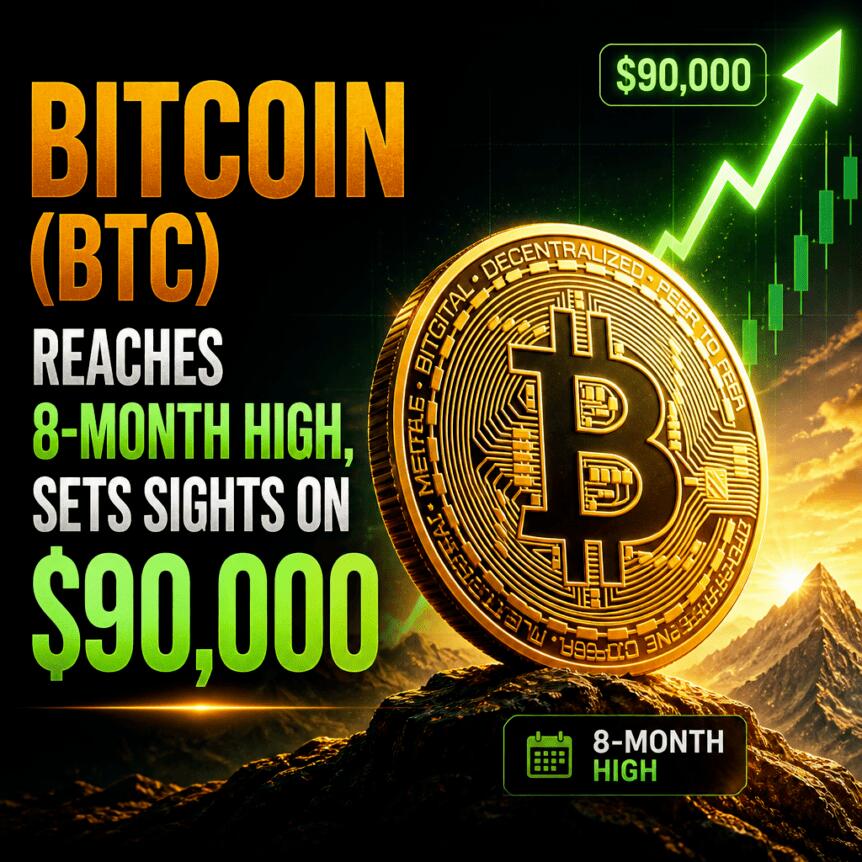
Bitcoin (BTC) crossed $87,000 on Monday, reaching an 8-month high of $87,397 amid renewed demand, forced short covering, spot Bitcoin ETF inflows, and improved market sentiment.
The flagship cryptocurrency jumped nearly 7% on Monday, reaching $87,397 before closing at $86,593. However, the price is down 1.40% during the ongoing session, trading around $85,396.
Bitcoin Eyes $90,000
According to Bloomberg, BTC extended its recovery by over $10,000 from the previous week’s lows, and is trading at levels last seen at the end of January 2026. The latest rally has been bolstered by renewed spot Bitcoin ETF demand and a substantial short squeeze as traders cover their positions.
However, Nicolai Sondergaard, Senior Research Analyst at Nansen, told crypto.news that despite the rally, Hyperliquid’s largest Bitcoin holders remained net short. Nansen also flagged that more BTC was moving to exchanges than leaving them, potentially raising the supply of BTC available in the market.
Sondergaard said:
“Bitcoin’s move above $84,000 looks less like a clean macro-driven accumulation event and more like a combination of renewed ETF demand and a large short squeeze. The important distinction is that price has turned bullish faster than positioning has.”
Sondergaard added that the rally could continue if under-positioned buyers keep buying BTC. However, price action could reverse if Treasury yields increase again or ETF inflows weaken.
Spot Demand Key For Bitcoin (BTC)
Spot demand has played a key role in driving BTC’s advance. Jeff Ko, Chief Analyst at ViaBTC, highlighted the Coinbase Premium, which returned to positive territory on Friday. This meant BTC traded at a higher price on the exchange than on other offshore platforms.
The index helps assess buying interest from American institutions and investors. Meanwhile, the USDT/USD pair rose from 0.9991 to 0.9998, which Ko said indicates genuine demand rather than one sustained by borrowed capital.
BTC’s rebound came after two major setbacks: the Federal Reserve increasing the benchmark interest rate by 25 basis points and the US Senate’s failure to advance the CLARITY Act. All 12 voting members of the Federal Open Market Committee supported the hike, with 16 officials projecting at least one more hike in 2026. As a result, BTC retreated towards $75,000, while Bitcoin ETFs reported substantial withdrawals.
The ETFs reported combined withdrawals of around $746.3 million on September 15 and September 16, before reporting $159.5 million in inflows on September 17 and $433 million on September 18.
Key Levels For Bitcoin (BTC)
According to Sondergaard, $87,000 and $90,000 are key levels for BTC. A clear break above $87,000 will bring the flagship cryptocurrency within sight of $90,000, a key psychological level. However, it may face resistance around $92,000 if it crosses this level.
“The next level to look for would be $87k, given $85k is broken and held; then $90k would be psychological, and again some levels to look for around $92k.”
However, BTC will need sustained spot buying to support a push above these levels, and it will need to avoid any macroeconomic shocks on the horizon. Sondergaard believes a lack of spot and ETF demand could bring perpetual futures into play, leaving BTC more vulnerable to geopolitical events and large sell-offs.
Technical indicators favor positive momentum for now. Earlier, BTC reclaimed its
We have been witnessing a strange paradox lately. Major news, including the CLARITY Act failure and the US interest rate hike, should be considered bearish for the cryptocurrency market, yet the latter has entered green territory with remarkable strength.
Ripple’s cross-border token has been a major beneficiary, with its price up 8% over the past week. Naturally, this resurgence has drawn comments from industry participants, many of whom believe the asset has much more room to grow in the near future.
What Now?
As of this writing, XRP trades around $1.53 (per CoinGecko), representing a 53% rebound from the local bottom of sub-$1 registered in mid-August. Other catalysts for its pump, besides the broader revival of the crypto market, include solid institutional interest. As CryptoPotato reported, spot XRP ETFs posted 10 consecutive green weeks as cumulative net inflows into such products exceeded $1.72 billion.
Another positive factor is the whales’ activity. Last week, renowned analyst Ali Martinez revealed that large holders have accumulated approximately 1.54 billion tokens (worth over $2.2 billion) in about 96 hours.
Several hours ago, he claimed that this demand has positively impacted XRP’s valuation, arguing that on-chain data suggests there may still be room to run. In his view, the URPD shows relatively little resistance ahead until $1.60, where around 2.5 billion coins previously changed hands.
“That’s the next major level I’m watching for potential profit-taking before looking for the next setup,” he concluded.
X user Diana also chipped in, outlining $1.61 as the next big resistance zone. She maintained that if XRP breaks and holds above, then $1.70 comes into play.
“If bulls clear $1.70 too, the chart opens toward the much bigger $2.20-$2.40 resistance zone,” the analyst predicted.
Veteran trader Peter Brandt and JAVON MARKS made even more optimistic bets. The former issued a long-term forecast of $5.40, while the latter believes that XRP can explode to $15 and above.
Time to Lose Some Steam?
As mentioned above, the past several days have been highly positive for the cryptocurrency market, which entered an up-only mode. However, prices cannot climb forever, making an eventual correction inevitable.
XRP’s Relative Strength Index (RSI) suggests such a move might be just around the corner. The ratio has jumped above 70, signaling that the asset has entered overbought territory. Conversely, readings below 30 are typically interpreted as buying opportunities.

The post Top Ripple Price Predictions as XRP Reclaims $1.50 appeared first on CryptoPotato.
Cointelegraph is committed to providing independent, high-quality journalism across the crypto, blockchain, AI, and fintech industries.
All news, reviews, and analyses are produced with full journalistic independence and integrity. For more details on our standards and processes, please read our Editorial Policy.
Crypto World
BioNTech Stock Recently Got Downgraded. But Is Wall Street Underestimating Its Cancer Pipeline?

BMO (NYSE: BMO) Capital Markets has been quite bullish about BioNTech SE (NASDAQ: BNTX) this year. However, that’s no longer the case.
On Sept. 8, 2026, BioNTech’s shares dipped after BMO downgraded the biotech stock from an “outperform” rating to a “market perform” rating. BMO also lowered its 12-month price target for BioNTech from $128 to $105.
Missed AI’s “Act 1”? Act 2 Could Be 15x Bigger. Most investors think they missed the AI boat because they didn’t buy Nvidia in 2005. But according to our analysts, we’re only at the end of “Act 1″—the R&D phase. “Act 2” is the global rollout. Continue »
There’s a simple explanation for BMO’s new take on BioNTech. But is Wall Street underestimating the company’s cancer pipeline?

What the downgrade got right — and wrong
It isn’t all that surprising that BMO Capital Markets is now significantly less optimistic about BioNTech’s near-term prospects than it once was. The global demand for BioNTech’s COVID-19 vaccines continues to wane.
BMO’s downgrade also followed a key setback in BioNTech’s pipeline. On Aug. 28, 2026, the company announced that it was canceling a Phase 2 clinical trial evaluating the personalized mRNA cancer vaccine BNT122-01 for the treatment of colorectal cancer. There weren’t any safety concerns, but the experimental therapy didn’t demonstrate statistically significant efficacy. As a result of the bad news, the company lowered its full-year revenue guidance to €1.6 billion to €1.9 billion from its previous forecast of €2 billion to €2.3 billion.
Investors were excited about BioNTech after Moderna (NASDAQ: MRNA) and Merck (NYSE: MRK) reported positive results from a late-stage study of Moderna’s personalized mRNA cancer vaccine intismeran autogene, in combination with Merck’s blockbuster immunotherapy Keytruda. However, the momentum has now nearly evaporated.
But the rest of BioNTech’s oncology pipeline shouldn’t be ignored. The company has over 25 Phase 2 and Phase 3 clinical studies evaluating experimental cancer therapies underway. It recently announced encouraging results from one of them, with gotistobart nearly doubling median overall survival compared with standard-of-care chemotherapy in previously treated patients with squamous non-small cell lung cancer (NSCLC).
BioNTech expects to report data from 11 other late-stage clinical studies by the end of 2029. These trials focus on multiple types of tumors, including breast cancer, gastrointestinal cancer, and lung cancer. Data from three studies will be announced before the end of this year.

British father, 37, pleads guilty to ‘causing death by dangerous act’ after his two-year-old son plunged to his death from hotel window in Cyprus
Switzerland’s trade surplus almost doubles in second quarter

21Shares: Privacy coins grow nearly 5x in one year




-

 Fashion4 days ago
Weekend Open Thread: Talbots – Corporette.com
-

 Tech1 day ago
Researchers escape OpenAI Codex sandbox to run commands on host
-

 Crypto World7 days ago
Robinhood engineers charged over $50K crypto scheme
-

 Crypto World3 days ago
Circle launches Arc Studio AI agent for building onchain apps
-
 NewsBeat3 days ago
Trump says US has reached an agreement to take permanent control of Greenland’s security
-

 Crypto World3 days ago
Bitcoin price breaks channel as RSI climbs to 63
-

 Crypto World1 day ago
Who Needs CLARITY Anyway? ARB Could See 70X Increase: Hodler’s Digest
-

 Crypto World5 days ago
US Charges Robinhood Engineers Over Crypto Listing Trades
-

 Crypto World6 days ago
What Is the Status of the U.S.-Iran Peace Talks? Here's What Both Sides Are Saying
-

 Crypto World3 days ago
Trading Bitcoin on Robinhood? Why 2% Spread Has Traders Worried
-

 Tech6 days ago
Webb’s IC 348 Mosaic Includes Two-Jupiter Dwarfs, Twin Jets, and a Nursery Still Making Worlds
-

 Crypto World3 days ago
World Money launches in 150+ countries with Stripe
-

 Crypto World4 days ago
Silver prices recover quickly, hitting weekly high today
-

 Entertainment6 days ago
Big Brother Update: Melody Explodes at Drew as Illness Sweeps BB28 House
-

 Crypto World4 days ago
Mortgage and refinance interest rates today, Thursday, September 17, 2026
-
 NewsBeat4 days ago
US was ‘on brink of war’ with China over false AI report of nukes moving in Middle East
-

 Tech5 days ago
GPT-6 Astra Reached the Nether in Minecraft, Lost Its Stash to a Creeper, and Farmed Potatoes for Hours
-
 Crypto World1 day ago
Bitcoin price holds above $81K as key catalysts line up
-

 Business6 days ago
Federal Reserve expected to hike interest rates 25 basis points at FOMC meeting
-

 Business1 day ago
Analog Devices (ADI) Bets $1.35 Billion on Chips that Let Machines Think for Themselves
You must be logged in to post a comment Login