
Crypto World
South Korea proposes new FIU powers to investigate unregistered crypto firms



South Korean lawmakers have introduced legislation that would give the Financial Intelligence Unit direct authority to investigate suspected unregistered crypto businesses instead of relying mainly on police referrals.
Summary
- South Korean lawmakers have proposed giving the FIU direct powers to investigate unregistered crypto businesses.
- The FIU could analyze suspected violations, file complaints and request criminal investigations under the bill.
- Police suspended inquiries into 23 of 25 unregistered crypto operators referred by the FIU between August 2022 and August 2025.
- The FIU said in June that 28 crypto providers were registered and 40 suspected illegal operators had been referred to authorities.
Yonhap reported that People Power Party lawmaker Eom Tae-young and nine other lawmakers filed the amendment on Thursday, proposing new powers under the Act on Reporting and Using Specified Financial Transaction Information, commonly known as the Specific Financial Information Act.
Under the bill, any person could report a suspected violation of the law directly to the FIU. Once a report is received, the financial intelligence agency would be allowed to investigate and analyze the suspected conduct before deciding whether further action is required.
The proposal would also allow the FIU to file complaints with relevant authorities, request criminal investigations, and hand information gathered during its review to investigators. Such powers would change the current process, under which the FIU can identify suspected unregistered operators but must depend on police and other investigative agencies to pursue most cases.
The bill has only been introduced and must pass the National Assembly before the proposed changes can take effect.
FIU could directly investigate unregistered crypto businesses
Lawmakers proposed the additional powers after enforcement data raised questions over how effectively cases involving overseas crypto operators were being pursued once they left the FIU.
According to Yonhap, police suspended investigations or preliminary inquiries into 23 of the 25 unregistered virtual asset service providers referred by the FIU between August 2022 and August 2025.
The companies and people connected to the cases were reportedly located outside South Korea, making investigations more difficult for domestic law enforcement agencies.
Giving the FIU investigative and analytical powers at an earlier stage would allow the agency that first identifies suspected registration violations to collect information before a case moves to another authority.
South Korea requires companies providing virtual asset services to residents of the country to register with the FIU, including foreign companies that actively serve South Korean customers.
As crypto.news previously reported, the FIU said in June that only 28 virtual asset service providers were registered at the time, while about 40 suspected illegal operators had been referred to investigative authorities.
The regulator said foreign businesses must follow the same registration requirements when they provide services to South Korean residents. Companies seeking registration must also meet local compliance requirements, including Information Security Management System certification.
Overseas operators have remained a key FIU enforcement problem
The FIU’s June enforcement warning provided details on how some unregistered foreign crypto businesses were reaching South Korean customers while attempting to limit their visible presence in the country.
According to the agency, some overseas operators recruited customers through Telegram and KakaoTalk open chat rooms while offering customer service in English, a setup regulators said could make their domestic activities less obvious.
Authorities also identified private currency exchange businesses selling stablecoins and other virtual assets to international students, tourists, foreign workers and people seeking transactions without disclosing their identities.
Some operators exchanged digital assets directly for Korean won or other fiat currencies, while promoters were paid to advertise foreign crypto services through YouTube channels, Telegram groups and online communities, the FIU said.
The agency warned that customers using unregistered services could face exposure to fraud, hacking and personal data leaks. Because such businesses operate outside the registered system, the FIU also said users could have difficulty recovering funds when an operator failed to deliver purchased assets.
Money laundering has remained another concern for regulators. The FIU said unauthorized crypto platforms and private exchange services could be used to conceal criminal proceeds or facilitate transfers that avoid standard checks applied by registered financial firms.
The newly introduced bill would allow the agency to pursue suspected violations of the Specific Financial Information Act itself before requesting assistance from another investigative body.
South Korea has tightened AML rules for registered exchanges too
Regulatory attention has not been limited to companies operating without registration.
Earlier this year, domestic exchanges objected to proposed changes that would require them to report overseas-linked crypto transfers worth at least 10 million won as suspicious transactions.
A May regulatory proposal drew objections from the Digital Asset Exchange Alliance, which represents registered virtual asset service providers in South Korea.
DAXA estimated that the rule could increase annual suspicious transaction reports at Upbit, Bithumb, Coinone, Korbit and Gopax from about 63,000 to more than 5.4 million.
The association argued that applying an automatic monetary threshold could cause large numbers of ordinary overseas transfers to be reported regardless of the risk attached to the customer or counterparty.
The dispute also involved the treatment of foreign platforms. Regulators have sought stricter controls on transactions involving overseas virtual asset service providers, while local exchanges have asked authorities for clearer standards for determining which foreign businesses should be treated as high risk.
Enforcement decisions under the same financial information law have already produced court challenges. In April, a Seoul court overturned a three-month partial suspension imposed on Dunamu, the operator of Upbit, after the FIU alleged 44,948 transactions involving 19 unregistered overseas platforms.
Bithumb separately secured a court stay against a six-month partial suspension after regulators accused it of customer verification failures and dealings with unregistered foreign companies. Coinone also obtained temporary court relief from enforcement measures connected to anti-money laundering and customer verification requirements.
Cross-border crypto transfers face separate registration rules
South Korea has also created another regulatory route for businesses moving digital assets across national borders.
Under amendments to the Foreign Exchange Transactions Act, companies handling cross-border virtual asset transfers will have to register with the Ministry of Economy and Finance when the framework takes effect in December.
A June licensing report detailed how authorities were preparing enforcement regulations that could allow eligible fintech companies, alongside crypto businesses, to provide blockchain-based cross-border remittance and foreign exchange services.
The South Korean government promulgated the revised law on June 2 with a six-month grace period. Once implemented, virtual asset transfers involving South Korea and another country will fall under the country’s regulated foreign exchange system.
Companies seeking to provide the service will need to register with the finance ministry and report qualifying overseas transfers through the Bank of Korea’s foreign exchange reporting network.
Authorities have said crypto transfers previously operating outside the formal foreign exchange reporting system created risks involving illicit foreign exchange transactions and money laundering.
Applicants under the new framework must first complete virtual asset service provider registration, connect their systems to institutions responsible for transmitting foreign exchange and digital asset transaction data, and satisfy additional requirements covering facilities and qualified personnel.



The rally in hard assets isn’t necessarily about what the Treasury is doing, but what its move signals to the market.

Bitcoin pushed to fresh highs on Friday, revisiting the $77,000 area and trading at levels not seen since late May. The rally coincided with renewed confidence around Strategy’s corporate treasury position, which had been under scrutiny after the firm’s earlier BTC sales.
According to TradingView data cited in the report, BTC/USD posted local highs above $77,400 before the week’s final Wall Street session. The move also placed Strategy’s holdings back above its stated cost basis, a threshold that matters to investors watching whether the company’s Bitcoin-backed capital strategy remains sustainable.
Key takeaways
- Bitcoin reached about $77,000, its highest level since May 26, after trading above key resistance and reclaiming important technical levels.
- Strategy’s Bitcoin treasury returned to profit versus its reported cost basis of $75,385 for 840,447 BTC.
- On-chain analytics from Glassnode highlighted a dense realized-price cost-basis cluster forming below $70,000, with roughly 11% of BTC supply in the $58,000–$67,000 band.
- Support is forming around a technical and on-chain overlap near $68,000, after BTC broke above levels including the 200-day simple moving average around $68,967.
Bitcoin revisits $77,000 as Strategy turns the corner
The latest upswing appears to have been driven by a mix of market momentum and a specific corporate timing factor: Strategy’s reported treasury economics improved as BTC rose back above its cost basis.
Data referenced from BitcoinTreasuries indicates that Strategy’s cost basis for its BTC holdings—840,447 BTC—stands at $75,385. With Bitcoin now trading above that figure, the report states Strategy has returned to a year-to-date gain of roughly $450 million. For traders, corporate treasury profitability can influence market narratives around large holders; for Strategy-watching investors, it reduces the immediate pressure tied to “mark-to-market” concerns during drawdowns.
In the same broader context, TradingView monitoring cited in the coverage shows BTC/USD briefly pressing above $77,400 on its way toward Friday’s close. The article notes that BTC did not meaningfully consolidate in the immediate run-up, underscoring how quickly sentiment can shift once price clears prior levels.
Earlier BTC sales and the buyback structure
Strategy’s improving position did not occur in a vacuum. Earlier in August, Cointelegraph previously reported that between Aug. 3 and Aug. 9, Strategy sold a portion of its Bitcoin holdings—1,690 BTC—then used the proceeds to repurchase 1.15 million shares of its STRC preferred stock for $108.6 million. That was described at the time as the company’s fourth Bitcoin sale of 2026.
Those transactions raised questions among some observers about the long-term durability of Strategy’s Bitcoin investment thesis. In response to such concerns, analyst William Clemente argued that the subsequent BTC price strength should reduce the urgency of those fears. On X, Clemente wrote that the “Saylor/Strategy fears” should have been less relevant after Michael Saylor indicated willingness to sell BTC to fund STRC buybacks, and that with the current price impulse Strategy is now “even more over-collateralized” by its BTC holdings.
The corporate backdrop also included comments from Strategy’s current CEO, Phong Le, in an earlier August Fox News interview. Le said Strategy would return to buying Bitcoin before the end of the year—an assertion that, if followed through, would be consistent with the idea that sales have been used tactically rather than signaling an exit.
On-chain “buy wall” forms below $70,000
Beyond Strategy-specific developments, the report points to a broader market support structure visible in on-chain data. During a period when investors have been assessing whether Bitcoin’s upside can hold, Glassnode analysis highlighted a growing “safety net” below $70,000 based on realized cost basis distribution.
As summarized in the article, some 3.44 million BTC now have an on-chain cost basis between $58,000 and $67,000. Of that amount, 2.23 million BTC—approximately 11% of total supply—was added over the past 11 weeks. Glassnode cofounder Rafael Schultze-Kraft described this concentration as the “densest cost-basis cluster below spot,” calling it a key potential support zone should price retrace.
In practical terms, realized cost-basis clusters can matter because they represent coins bought (or last moved/realized) near specific price levels. When price falls back toward those areas, supply behavior often changes: holders may be more inclined to defend those positions or, conversely, may be more likely to sell if they were waiting for confirmation to exit. The article’s framing suggests that, for now, the market is developing a cushion rather than a void.
Technical levels reclaimed: $68,000 and the 200-day SMA
The week’s price action also included important technical confirmation. The report notes that BTC/USD broke through several key resistance levels, including the 200-day simple moving average (SMA) around $68,967—described as a “key target to reclaim” to end the long-term downtrend.
This technical reclaim lines up with the on-chain support narrative. The on-chain cluster discussed by Glassnode sits below $70,000, while the article specifically references a “new band of support” forming around the $68,000 area. It’s the overlap between these two kinds of signals—an SMA that tends to influence longer-horizon positioning, and a realized-price cluster that may anchor dip demand—that can strengthen market conviction during volatility.
Still, the report emphasizes that volatility remains part of the equation, with investors looking for whether the move can translate from a breakout to sustained consolidation above reclaimed levels.
Going forward, traders and long-term holders will likely watch whether Bitcoin can hold above the reclaimed resistance zone near $68,000–$69,000 and whether on-chain support beneath $70,000 continues to grow; Strategy’s treasury also remains a focal point, since continued BTC purchases (as CEO Phong Le indicated) would further shape market sentiment about large-holder intent.


Key takeaways
- Bitcoin, Ethereum, and XRP have gained nearly 20%, over 25%, and almost 30%, respectively, this week.
- Expanded U.S. Treasury debt buybacks have improved liquidity expectations and boosted demand for risk assets.
- Bitcoin trades around $76,800 after breaking above its 50-day, 100-day, and 200-day exponential moving averages.
Bitcoin, Ethereum, and XRP extended their rallies Friday as improving liquidity expectations continued to lift the broader cryptocurrency market.
Bitcoin has gained nearly 20% this week, while Ethereum has risen more than 25% and XRP has advanced almost 30%.
The rally gained momentum after the U.S. Treasury announced plans to double the size of certain debt buyback operations.
The decision eased liquidity concerns and strengthened demand for risk-sensitive assets.
With the three cryptocurrencies trading firmly higher, investors are now watching whether Bitcoin can reach $80,000, Ethereum can reclaim $2,500, and XRP can advance toward $1.50.
Treasury buyback expansion strengthens crypto rally
The U.S. Treasury’s decision to expand its debt buyback program has helped improve sentiment across financial markets.
Larger buybacks can support liquidity in the market for longer-dated Treasury securities, easing financial pressures and encouraging investors to increase their exposure to riskier assets.
Cryptocurrencies responded strongly to the announcement, with Bitcoin, Ethereum, and XRP recording double-digit weekly gains.
Short liquidations also accelerated the rally as bearish traders were forced to close their positions, adding further buying pressure.
Bitcoin was trading around $76,800 on Friday after decisively breaking above its major exponential moving averages.
The 200-day EMA stands at $71,545, while the 100-day and 50-day EMAs are located at $66,727 and $65,286, respectively.
BTC’s position above all three indicators supports a bullish near-term outlook and suggests the market’s broader technical structure has improved considerably.
The breakout was accompanied by strong trading volume, adding credibility to the latest upward move.
Sustained trading above the 200-day EMA would reinforce the case for further gains and could establish the level as new support.
BTC bulls target the $80,000 resistance
Bitcoin’s next major resistance lies near the psychological and horizontal barrier at $80,000.
A move from $74,700 to $80,000 would represent an additional gain of approximately 7.1%.
However, the $80,000 level could attract profit-taking and fresh selling pressure following Bitcoin’s rapid weekly advance.
A decisive break and daily close above the barrier would strengthen the bullish outlook and potentially open the way to higher levels.
Failure to clear $80,000 could lead to a period of consolidation as traders digest the recent gains.
Bitcoin’s momentum indicators remain bullish but increasingly stretched. The relative strength index is hovering near 83, placing BTC firmly in overbought territory. Such an elevated reading does not guarantee an immediate reversal, but it indicates that the rally may be vulnerable to a corrective pause.
The moving average convergence divergence remains strongly positive, showing that upward momentum is still intact.
Together, the indicators suggest bulls remain in control, although the risk of short-term profit-taking has increased.
If Bitcoin retreats, initial support sits at the 200-day EMA near $71,545. Holding above this indicator would preserve the immediate bullish structure and could provide a foundation for another attempt at $80,000.

A deeper correction could bring the 100-day EMA at $66,727 and the nearby horizontal level at $66,500 into focus.
Below that region, the 50-day EMA at $65,286 offers another layer of support, followed by the structural floor at $62,300.
A sustained decline below $62,300 would weaken the broader bullish outlook, while continued trading above the 200-day EMA would keep the $80,000 target within reach.
There was a big speculation in the past few days, which, unfortunately for the vast Pi Network community, turned out to be false, at least according to the latest reports.
Nevertheless, we will explore in great detail what it was for, and we will take a look at all the recent news, updates, incoming changes, and PI token movements, so let’s dive in.
PayPal and PI?
Starting with the aforementioned rumor that rocked the Pi community a few days ago, one of the unofficial channels dedicated to covering Pi Network news noted that PayPal might add the project’s native token to its Crypto Payment Ecosystem. The report informed that PayPal’s developer ecosystem listed PI among the supported assets, which would have allowed users to spend it at eligible US merchants with PayPal handling real-time crypto-to-fiat conversions.
However, the same news channel refuted its own statement just a day later. The update reads that “PayPal is not currently listed as a KYB-verified business on Pi Network,” unlike verified platforms such as OKX and MEXC.
Save The Date: August 24
In contrast to the unconfirmed rumors from above, the official X channel behind the project announced earlier this week a major change for certain Pioneers that will come into effect on August 24. Until now, the team charged just 0.25 PI to create an application and another 0.25 PI to edit one.
This meant that the project had to cover the difference between that amount and the higher actual cost of the underlying service. The new approach that will commence on Monday will reflect more closely the standard prices and AI costs and may vary depending on the resources required for each action.
There’s an exception, though. Creators whose apps showcase real utility and usage from users will remain eligible for the previous subsidized pricing, and all of those will be reviewed regularly to determine whether they qualify. In other words, if some developers hadn’t met the necessary criteria at first, they have the chance to update their app and make it more usable to qualify later.
The upcoming model will also remove the option of allowing creators to develop apps meant only for experimentation, testing, or spam.
Version 0.6.2
The Core Team also outlined the introduction of Pi Node version 0.6.2 in mid-August. It came with improvements to SoloHost, node connectivity, and the Pi Desktop user experience. The team explained that five volunteer Node operators participated in the initial distributed computing test and all received jobs, performed the required computations, and returned the results to a Pi coordinator.
In a subsequent post, the team noted that the test validated the “end-to-end flow of tasks across real devices,” which included the connection to the Pi coordinator.
PI Price Update
The native token of the Pi Network ecosystem has experienced some intense volatility over the past few days alongside the rest of the market. Recall that it started the month on the right foot, surging from around $0.08 to almost $0.10 before it was rejected again and dipped to $0.085 within days.
The rebound was halted at $0.09, and the asset returned to its starting position but managed to remain above for a while. Then came the Wednesday market-wide revival in which BTC began its massive uptrend from $64,000 to just under $80,000 on Friday morning.
PI also joined the ride, but in a more modest manner. It jumped by 11% from its $0.086 starting level to almost $0.096 minutes ago, which became its highest price tag in two weeks. However, it was stopped there and has slipped toward the coveted $0.09 support as of press time.
Nevertheless, its market cap has reached $1 billion once again, even though the asset remains 97% away from its all-time high of $2.99 marked in February 2025.

The post Important Pi Network News and PI Price Update: August 21 appeared first on CryptoPotato.


Benjamin Cowen’s call that Bitcoin (BTC) would bottom in the back half of 2026 and accumulation would follow is holding up so far, with the asset’s July 1 low still standing more than seven weeks later.
The call mattered because Cowen made it in public, in real time, rather than in hindsight. He had spent the first half of 2026 telling followers to sit out Bitcoin entirely, a stance that drew plenty of skepticism as the asset ground lower through the spring.
From Call to Confirmation
With Bitcoin’s price climbing rapidly now, rather than retesting that low, Cowen’s midterm cycle thesis has now moved past its call stage and into confirmation. Cowan notes that he called Bitcoin accumulating as of July 1, and that this recent rally seems to have erased fears of a further low in the minds of most; but not necessarily Cowan.
The accumulation phase he flagged on July 1 is the phase Bitcoin appears to be rapidly reveling in today, not a forecast still waiting on price action to catch up. However, there is still speculation that this could be a bull trap, even from Cowan.
A Floating Warning, Not a Forecast Change
Cowen has not dropped his caution entirely. He still puts a “decent chance” on one more leg down in the fourth quarter, with a floor near $44,000 if prior midterm years repeat.
That pattern comes from 2014, 2018, and 2022, the three prior cycles where Bitcoin ground through a rough first half before finding its footing later in the year.
Cowen has put a rough timeline on that scenario too, pointing to a window that stretches into late October.
But he does not treat the Q4 scenario as make-or-break for his outlook. Asked directly what happens if nothing bad materializes in the fourth quarter, Cowen answered in three words.
“life goes on”
Attribution: Benjamin Cowen
The reply captures how he is framing the risk, as a possible dip to watch for rather than a condition his broader thesis depends on.
Whether or not the fourth quarter delivers a fresh low, Cowen maintains Bitcoin should perform well heading into 2027, and his accumulation call already has price action behind it.
The post Benjamin Cowen’s Midterm Cycle Thesis Proved Right After Bitcoin’s July Low appeared first on BeInCrypto.
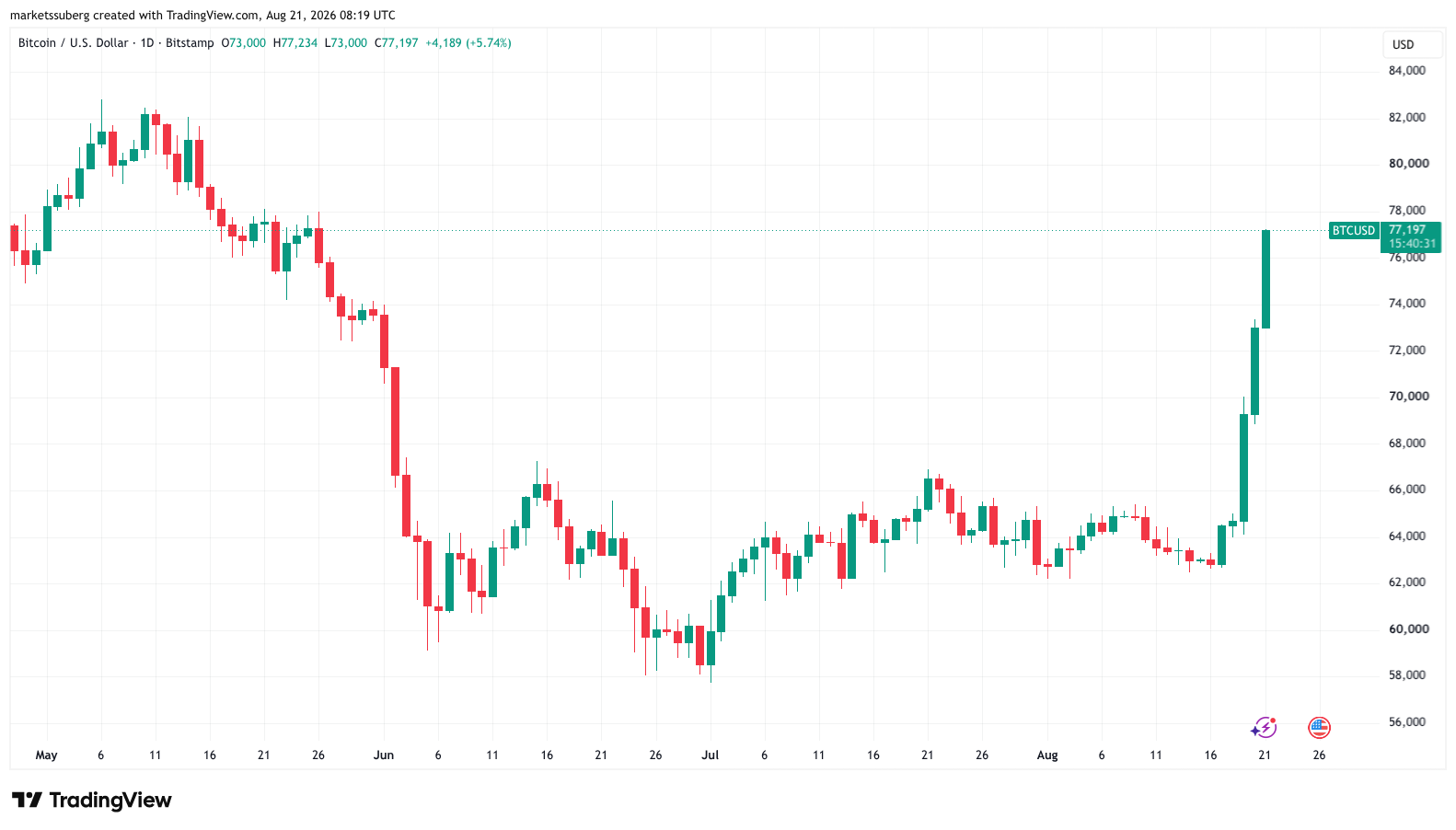
Bitcoin (BTC) hit $77,000 on Friday as business intelligence company Strategy’s corporate treasury returned to profit.
Key points:
- Bitcoin reaches its highest level since May 26 as it revisits $77,000.
- Price returns above the cost basis for Strategy’s BTC corporate treasury at $75,385.
- Around 11% of the BTC supply constitutes a new band of support below $68,000.
Strategy out of the red with Bitcoin at highest since May
Data from TradingView showed new local highs above $77,400 prior to the week’s final Wall Street open.
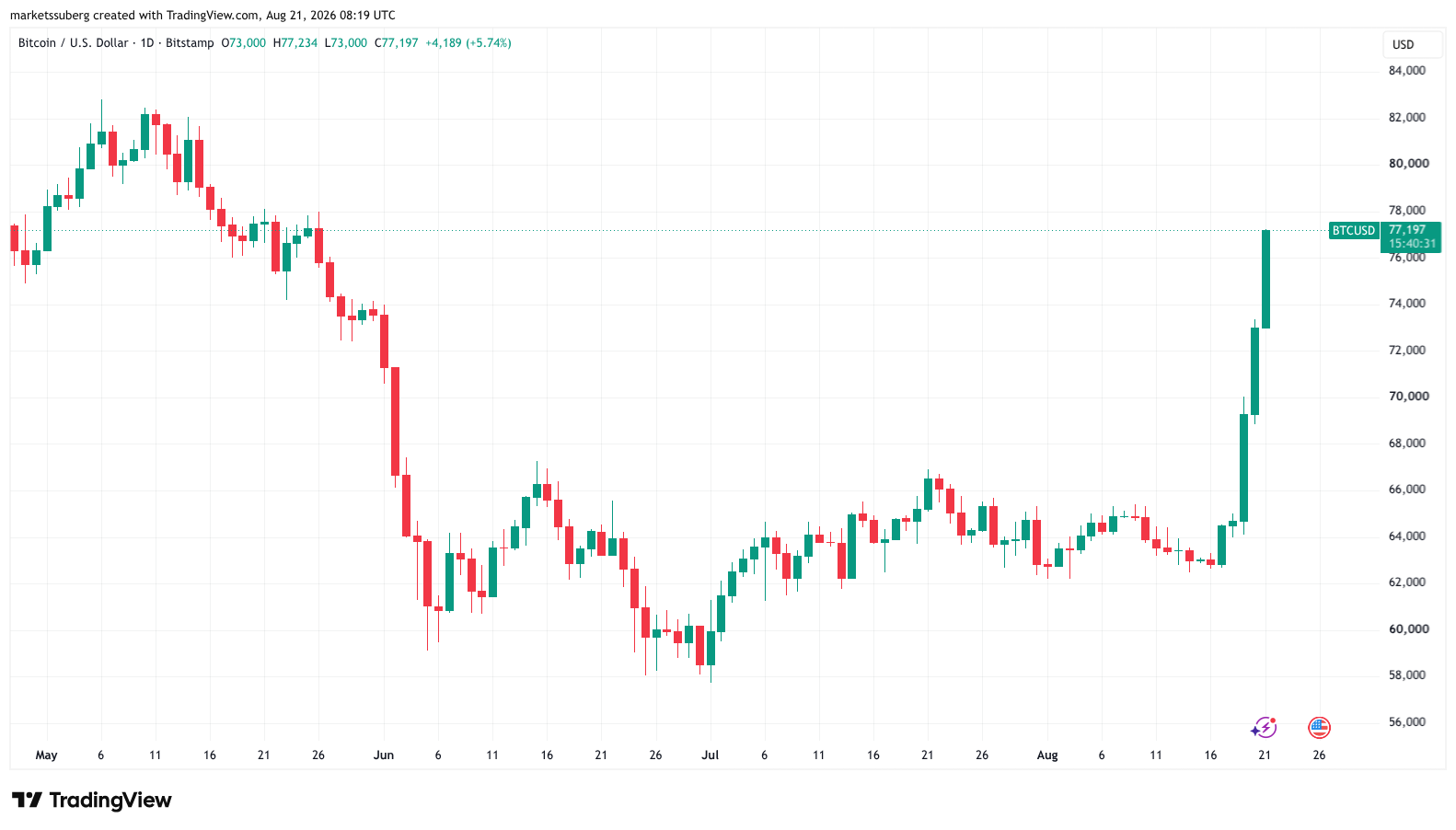
BTC/USD one-day chart. Source: Cointelegraph/TradingView
Now up around 20% in 48 hours, BTC/USD saw little by way of consolidation as it reclaimed a key level for Strategy, the world’s largest corporate Bitcoin treasury company. Data from monitoring resource BitcoinTreasuries puts the cost basis for Strategy’s holdings of 840,447 BTC at $75,385, currently with a year-to-date gain of approximately $450 million.
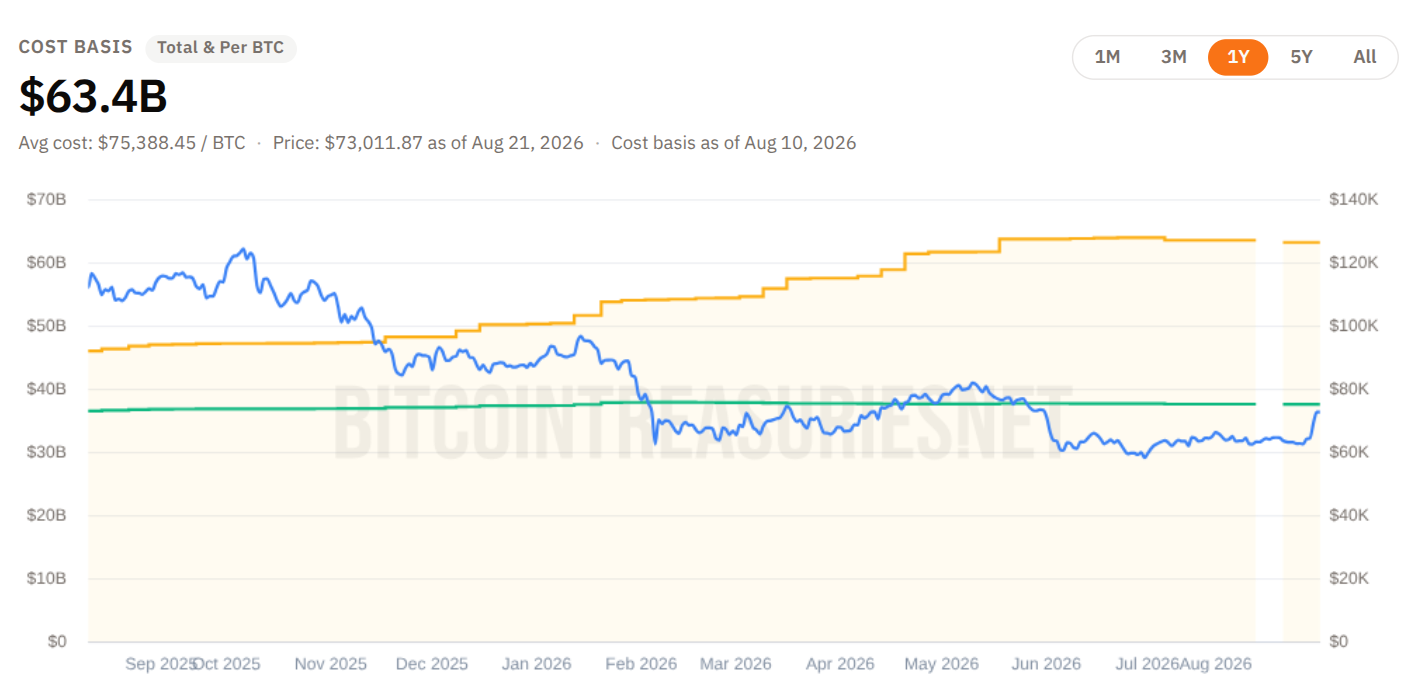
Strategy Bitcoin treasury cost basis data. Source: BitcoinTreasuries
As Cointelegraph reported, between Aug. 3 and Aug. 9, Strategy opted to sell a small portion of its treasury worth 1,690 BTC to repurchase 1.15 million shares of its STRC preferred stock for $108.6 million. The move represented the company’s fourth Bitcoin sale of 2026.
Concerns over the long-term viability of the company’s Bitcoin investment thesis accompanied the sales, something that the subsequent BTC price run-up should help alleviate, independent crypto analyst William Clemente suggested.
“Not only should Saylor/Strategy fears have been abated for a while once he showed that he was willing to sell BTC to rebuy STRC, but now after this price impulse they are even more over-collateralized by their BTC holdings,” he wrote on X, referring to former CEO Michael Saylor.
In an interview with Fox News earlier in August, current CEO Phong Le stated that Strategy would return to buying Bitcoin before the end of the year.
New BTC buy wall sits below $68,000
Amid misgivings over the durability of Bitcoin’s volatile upside move, analysis from onchain analytics platform Glassnode revealed a new safety net forming below $70,000.
Related: Bitcoin has ‘largely purged’ froth that preceded 50% drop from $126K: BlackRock
Some 3.44 million BTC now have an onchain cost basis, also known as realized price, between $58,000 and $67,000. Of this, 2.23 million BTC — equal to around 11% of the total supply — was added over the past 11 weeks.
“It’s the densest cost-basis cluster below spot — a key potential support zone on any retracement,” Glassnode cofounder Rafael Schultze-Kraft commented on X.
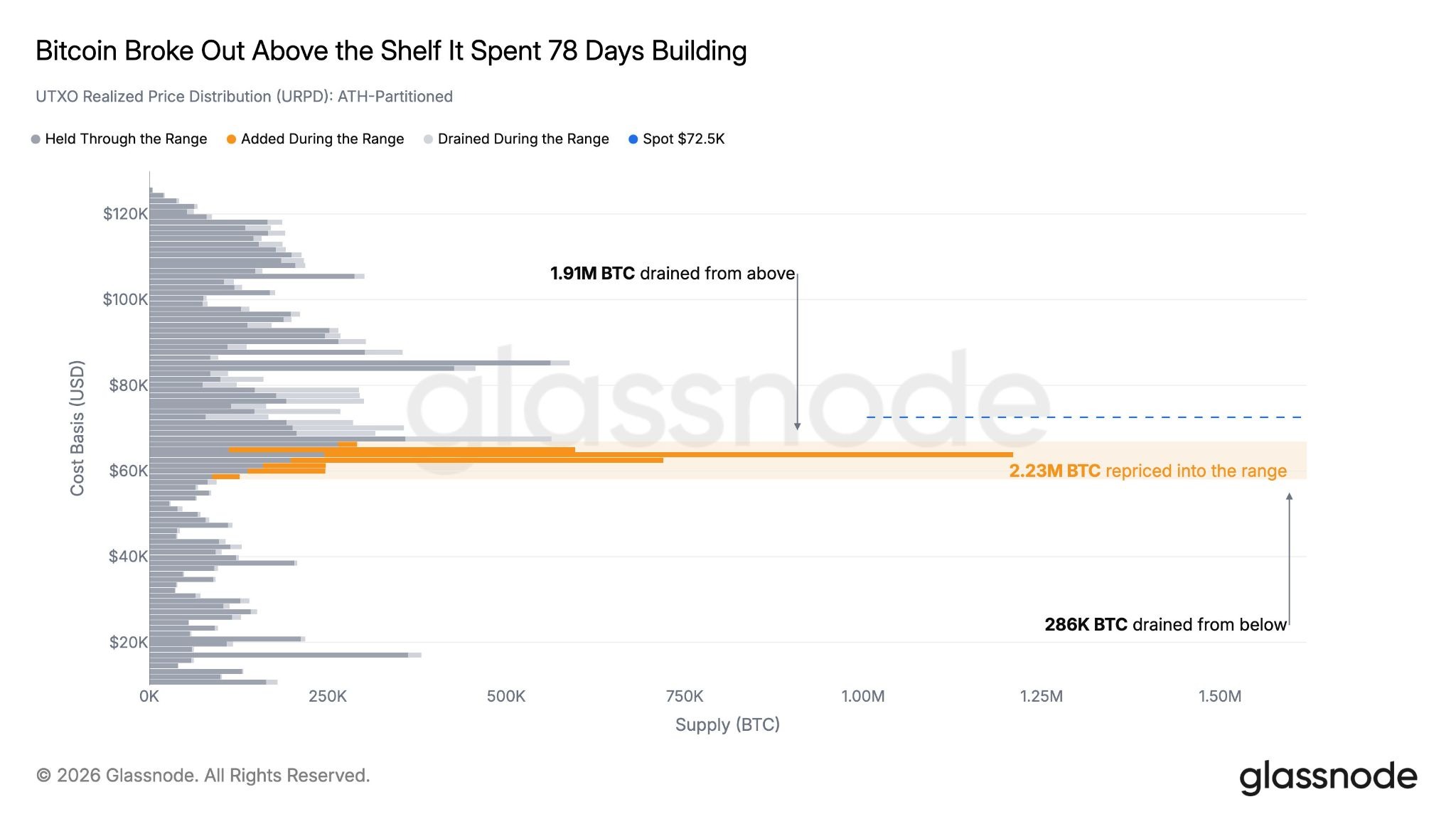
Bitcoin UTXO realized price distribution data. Source: Rafael Schultze-Kraft on X.com
BTC/USD broke through several key resistance levels this week, including its 200-day simple moving average (SMA) at $68,967, a key target to reclaim to end the long-term BTC price downtrend.


Key takeaways
- Pepe has gained 25% this week, including a combined 22% advance over the previous two days.
- Seven whale transactions worth more than $1 million each occurred Thursday, the highest number since March 16.
- Exchange supply fell by 1.45 trillion PEPE, while top non-exchange wallets added 3.54 trillion tokens since August 12.
Pepe maintained its bullish momentum Friday after gaining a combined 22% over the previous two trading days.
The frog-themed meme coin is up approximately 25% this week as whale accumulation, declining exchange supply, and rising speculative activity strengthen its near-term outlook.
PEPE has also reclaimed several important technical levels, opening a potential path toward its 200-day exponential moving average at $0.00000363.
Whale transactions reach highest level since March
Large investors appear to be returning to Pepe as its price recovers from recent lows. Santiment recorded seven PEPE transactions worth more than $1 million each Thursday, the highest daily total since March 16.
The increase in high-value transfers indicates renewed activity among whales, although large transactions can represent either accumulation or distribution.
Changes in wallet balances, however, suggest that major holders are accumulating tokens while the amount of PEPE available on exchanges declines.
The supply of PEPE held on cryptocurrency exchanges has fallen to 81.30 trillion tokens from 82.75 trillion on August 12.
The 1.45 trillion-token decline reduces the amount of PEPE immediately available for trading and potential sale.
Meanwhile, leading non-exchange addresses increased their combined holdings to 84.04 trillion PEPE from 80.50 trillion over the same period.
That represents an increase of 3.54 trillion tokens, reinforcing signs of fresh demand from large-wallet investors.
Whale accumulation near a market swing low can indicate that influential holders expect a recovery. Continued buying and declining exchange balances could therefore support further gains, provided broader market sentiment remains favorable.
Demand is also increasing in the derivatives market. PEPE futures Open Interest climbed to a three-month high of $250 million, up from $209 million the previous day, according to CoinGlass.
The $41 million increase represents growth of approximately 19.6% and indicates that traders are opening new positions or adding exposure to existing contracts.
PEPE’s Open Interest-weighted funding rate stands at 0.0095%. The positive reading shows that long-position holders are paying short traders, reflecting a bullish bias.
However, rising Open Interest and positive funding can also increase liquidation risks if the price reverses sharply. Meme coins are especially vulnerable to volatility when speculative positioning becomes crowded.
Pepe price targets the 200-day EMA
PEPE’s near-term technical outlook has improved after its latest rally pushed the token above the 50-day EMA at $0.00000283 and the 100-day EMA at $0.00000300.
The meme coin has also surpassed its June 15 high of $0.00000314, clearing another important resistance level.
The next major barrier sits at the 200-day EMA near $0.00000363. Because PEPE remains below this long-term trend indicator, the broader technical structure has not yet turned decisively bullish.
A confirmed breakout and sustained close above $0.00000363 could strengthen the recovery and open the path toward the May 10 high at $0.00000459.

The Moving Average Convergence Divergence line has crossed above its signal line and moved further into positive territory.
A bullish histogram has also emerged above the zero line, indicating that buying momentum is strengthening.
If PEPE fails to overcome the 200-day EMA, traders may begin taking profits following the sharp weekly advance.
The 100-day EMA at $0.00000300 and the 50-day EMA at $0.00000283 could provide initial support during a pullback. A decisive decline beneath both indicators would weaken the bullish outlook and expose the July 8 low at $0.00000255.
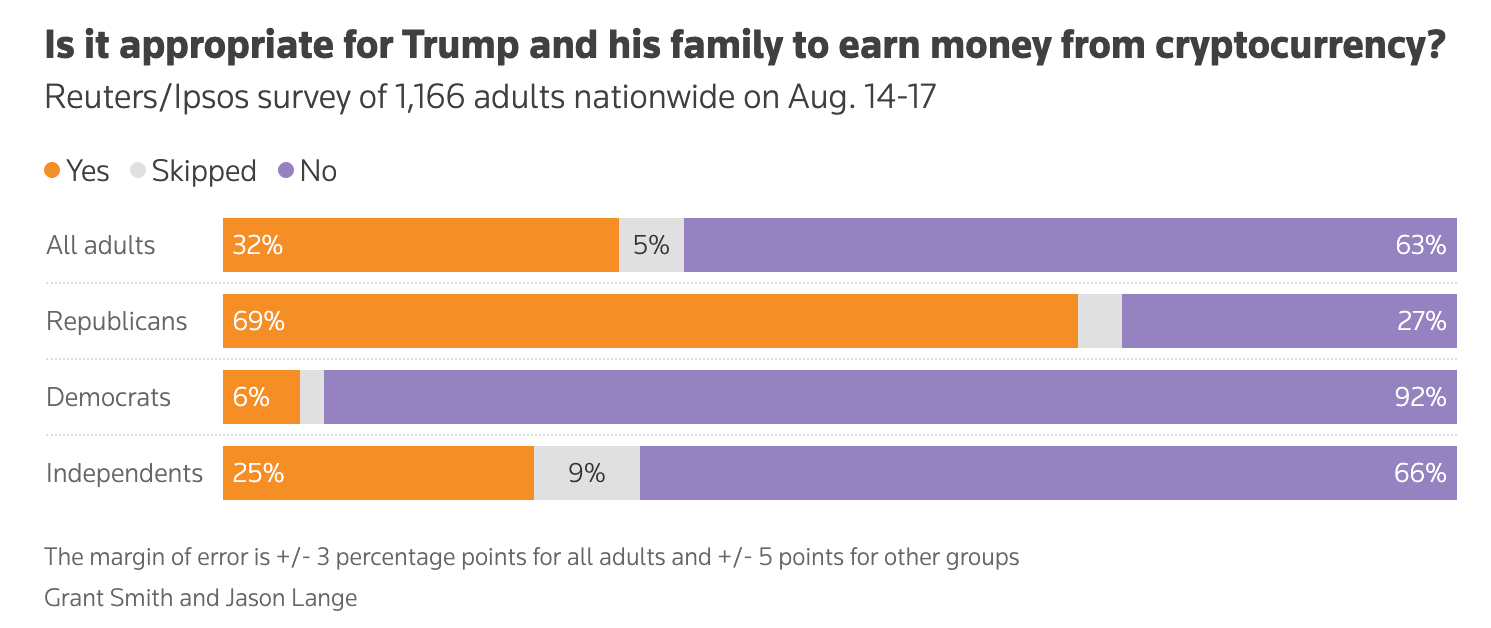
Most Americans view President Donald Trump’s crypto earnings as improper, according to a Reuters/Ipsos poll in which 63% of respondents called the profits his family drew from digital assets inappropriate.
The same survey found that 69% believe his private business interests shape his presidential decisions. Half of Republican respondents shared that view.
Poll Puts Trump’s $1.4 Billion Crypto Income Under Scrutiny
The online survey covered 1,166 US adults between August 14 and August 17. It carried a margin of error of 3 percentage points for all Americans and 5 points for each party group.
About 32% of respondents defended the family’s crypto earnings. Among Republicans, roughly 69% described it as appropriate, while 27% did not.

The sums involved are large. Trump reported more than $1.4 billion last year from family crypto ventures, according to his financial filings. Those ventures included World Liberty Financial (WLFI) and his self-branded meme coin.
Richard Painter, chief ethics lawyer under President George W. Bush, noted that the mix of business and office has no modern parallel.
“We have seen nothing like this before, even the first Trump administration did not have as many complex business interests as the second,” he said.
Follow us on X to get the latest news as it happens
White House Rejects Conflict Claims as Midterms Near
White House has repeatedly dismissed the criticism, affirming that independent financial institutions manage the President’s investments and that no conflicts exist.
“There are no conflicts of interest…The President only acts in the best interests of the American public,” White House spokeswoman Anna Kelly said in a statement.
Congressional pressure has grown regardless. Senate Democrats requested committee hearings in July into the national security implications of the President’s crypto holdings.
Token performance complicates the political argument. Official Trump (TRUMP) trades near $1.7, down about 81% over the past year, and Trump-endorsed tokens sit below their pre-endorsement prices.

Public dissatisfaction stretches beyond his digital asset ventures. A separate Financial Times poll this month found 53% of registered voters said their finances had worsened under his presidency.
Democrats led Republicans 44% to 39% in that survey. Whether that translates into seats will be settled in November.
Subscribe to our YouTube channel to watch leaders and journalists provide expert insights
The post Trump Crypto Profits of $1.4 Billion Draw Disapproval From 63% of Americans appeared first on BeInCrypto.
This Friday, we examine Ethereum, Ripple, Cardano, Binance Coin, and Hyperliquid in greater detail.
Ethereum (ETH)
In a major reversal, ETH has pumped 27% this week after sentiment turned positive, with Bitcoin leading and pulling most of the market higher. Ethereum shot up from $1,800 and did not stop until the resistance at $2,400.
This is an impressive price action that has reverberated across most altcoins. Now, the ETH price is at a key level. If $2,400 turns into support, and the price makes a higher high, this cryptocurrency will turn bullish for the first time in over a year!
Looking ahead, sellers risk losing control. Bulls are coming back in force, and they are inches away from starting a sustained uptrend. Watch $2,400 and $2,800 as key levels if the rally continues.

Ripple (XRP)
XRP painted a monster candle on the weekly chart after a 31% pump! This has completely reversed the losses since June in one week and opens the way for buyers to take over.
At the time of this post, this cryptocurrency is testing the $1.3 resistance. If this fails to hold, the ongoing rally, then XRP has a good shot at $1.6. Such a price would end the downtrend that dominated most of 2026.
Looking ahead, the last time XRP rallied so hard was in 2024, and back then, the price did a 5x in quick succession. While this appears unlikely here, this is an impressive start and could send this cryptocurrency much higher still.

Cardano (ADA)
Cardano also had a good week after closing 14% higher. This recent pump reconfirms the bullish trend that started in June and places ADA on a collision course with the resistance at $0.23.
Hopefully, this recent impulse from buyers is exactly what this cryptocurrency needs to break the resistance and return to an uptrend. Still, sellers could return at $0.23, making that a difficult ask.
Looking ahead, Cardano shows promise, and this price action could indicate that the drop under $0.15 may have been the bottom. If so, expect the price to grind higher from here until the end of the year.

Binance Coin (BNB)
Binance Coin closed the week 10% higher and is determined to test the resistance at $690. After the price found good support at $580, buyers took over and have not let go ever since.
The biggest challenge right now is to turn $690 into support. That would allow BNB to aim for $900 next and beyond. Nevertheless, sellers could show their face at the key resistance as they did in June when they pushed the price back down.
Looking ahead, the BNB chart is turning bullish with a clear rounded bottom around $550. To confirm this, the price has to make a higher high beyond $750 later on. That implies $690 won’t stop buyers.

Hype (HYPE)
Hyperliquid was a major winner this week after closing 30% higher. This impressive performance has taken the price back to the key resistance at $76, which is also the current all-time high.
At the time of this post, buyers appear to hesitate at the ATH and did not make a higher high, at least not yet. Some selling here is normal, and it will be interesting to see if HYPE can break higher or not.
Looking ahead, this most recent price action has placed HYPE in a wide range between the ATH of $76 and support around $50. The price could bounce between these levels a few more times before a decisive breakout.

The post Crypto Price Analysis August-21: ETH, XRP, ADA, BNB, HYPE appeared first on CryptoPotato.


A Hong Kong appeals court has upheld a 56-month prison term for Ma Zhihao after investigators linked ransom payments from a human trafficking operation to a crypto exchange account registered in his name.
Summary
- Hong Kong’s Court of Appeal upheld Ma Zhihao’s 56-month prison sentence.
- Police traced 8,127 USDT from a victim’s ransom to an exchange account registered to Ma.
- The USDT was converted into about HK$63,000 and transferred to Ma’s HSBC account.
- The trafficking network lured victims to Southeast Asia using fake high-paying job offers.
Caixin reported on Aug. 20 that the Hong Kong Court of Appeal rejected Ma’s request for a reduced sentence, leaving intact the punishment imposed over his role in a scheme that lured victims to Southeast Asia with fake job offers before some were confined and forced into scam operations.
Blockchain transaction records became a key part of the prosecution after Hong Kong police traced a ransom paid by the family of one victim. Investigators found that roughly 9,527 Tether (USDT) had been transferred to a cryptocurrency wallet specified by the criminals.
Police then tracked 8,127 USDT from the ransom to an exchange account opened using Ma’s real name and Hong Kong identity documents, according to Caixin. The funds were converted into roughly HK$63,000 and sent to Ma’s personal HSBC bank account.
The Court of Appeal said the transaction trail supported the finding that Ma had participated in the scheme and received proceeds from it. Judges also said his punishment would have been substantially heavier had the District Court not been restricted by its seven-year sentencing limit.
Blockchain records tied the ransom directly to Ma
The case involved five victims who were recruited between 2021 and August 2022 through false employment and business offers circulated on platforms including Facebook, Telegram and Instagram.
Recruiters advertised jobs at Cambodian casinos, assignments involving the purchase and transport of luxury handbags from Thailand, and work carrying expensive watches, according to case details reported by Hong Kong media. Some offers promised payments reaching tens of thousands of Hong Kong dollars.
Once a victim accepted an offer, members of the network helped arrange passports and airline tickets. After arriving in Southeast Asia, victims could instead have their phones and travel documents taken before being moved to compounds controlled by criminal groups.
One 20-year-old victim responded to a Telegram advertisement offering HK$20,000 for travelling to Thailand and buying luxury goods for resale in Hong Kong. After arriving in August 2022, he was transported to Myanmar’s KK Park, where criminals told him that he had been purchased and demanded $20,000 for his release.
His girlfriend eventually transferred more than 9,500 USDT, worth about HK$75,000 at the time, to secure his return. Investigators later followed most of that cryptocurrency through the blockchain to the exchange account associated with Ma.
The transparent transaction history gave police a record connecting the ransom wallet, the exchange account and the subsequent withdrawal into the traditional banking system.
Hong Kong police have since developed more specialized tools for such investigations. As previously covered by crypto.news, the Cyber Security and Technology Crime Bureau unveiled its CryptoTrace system in May 2025 after developing the platform with the University of Hong Kong.
CryptoTrace uses blockchain analytics and transaction visualization to help officers follow suspected illicit funds and identify connections between wallets. Police had already trained frontline officers on the system before its public unveiling, according to the earlier report.
Fake jobs sent victims into Southeast Asian scam compounds
Ma and his associates used several recruitment methods depending on the victim, with high pay serving as a recurring lure.
One man was offered work at a Cambodian casino for $300 per day with accommodation and airfare included. Another victim was persuaded to travel after receiving an offer connected to luxury goods, while a man with mild intellectual disabilities was drawn to Thailand through an online relationship and a promise involving a large cash payment.
Victims who reached the compounds faced different forms of coercion. Court proceedings described confiscated passports, threats, confinement and physical abuse, while some victims were forced to participate in online scams.
The man with an intellectual disability suffered particularly severe treatment after refusing to join fraud operations. Case details presented in Hong Kong court proceedings said he was handcuffed to a bed, subjected to electric shocks and later confined in a cage for several days. His family eventually paid HK$35,000 through Alipay before he was able to return to Hong Kong.
Another victim taken to Cambodia initially refused to conduct online scams, but Ma repeatedly pressured him and threatened the safety of the victim and his family, according to the agreed facts of the case. Cambodian authorities eventually rescued him after his mother contacted Hong Kong law enforcement.
Similar recruitment methods remain in use across Southeast Asian cybercrime compounds. On July 4, an investigation in India was opened after the family of a 24-year-old man said he had accepted a graphic design and data-entry job in Thailand before being taken to a scam compound near the Myanmar border.
Police in that case said the advertised job offered roughly 70,000 Indian rupees a month. After crossing into the compound, the man allegedly had his passport and travel documents confiscated and later told his family that captives were being forced to work long hours in online fraud operations.
Hong Kong human trafficking case followed years of recruitment scams
The Hong Kong prosecution emerged from a wave of cases reported from 2022 onward involving people recruited for supposed jobs in Thailand, Cambodia and other parts of Southeast Asia before being moved into guarded compounds.
Ma and another defendant, Cheung Man-wai, later admitted conspiracy to defraud in connection with the recruitment of five people.
During sentencing in November 2024, the District Court imposed a 56-month prison term on Ma for conspiracy to defraud after using seven years as the starting point before applying a reduction for his guilty plea. He also received a 28-month sentence after admitting a money-laundering charge, bringing his total imprisonment to 84 months, according to local court reporting.
Cheung, whose role was described as less central, received a 36-month prison sentence. The sentencing judge found that he nevertheless knew the operation involved human trafficking when he helped take one of the victims to the airport.
The District Court treated Ma as an important participant in a planned operation connected with an international criminal organization. All five victims eventually returned to Hong Kong after periods of confinement or coercion abroad.
Crypto payments have remained common in investigations involving Southeast Asian trafficking and scam networks. A February 2026 Chainalysis report found that crypto-linked trafficking payments increased 85% in 2025 across services tracked by the blockchain analytics firm, including labor recruiters associated with Southeast Asian scam compounds.
Chainalysis said tracked activity involved hundreds of millions of dollars across identified services, with stablecoins forming part of the payment infrastructure used by criminal networks and related laundering channels.
Authorities continue tracing crypto across scam networks
Law enforcement agencies have increasingly followed cryptocurrency transfers alongside bank accounts and other payment channels when investigating transnational fraud.
A July 2026 INTERPOL operation blocked illicit crypto transfers during a crackdown spanning 97 countries and territories. The operation resulted in 5,811 arrests, more than 31,000 blocked bank accounts and the interception of $293 million in illicit assets.
Thai investigators involved in the operation uncovered a laundering network suspected of processing romance-scam proceeds through cross-chain token swaps. One identified wallet had handled more than $122.5 million, according to INTERPOL data cited in the report.
Authorities identified more than 142,000 victims during the operation and used payment-blocking mechanisms to freeze suspicious fiat and cryptocurrency transfers before some funds could move further through laundering networks.
In Ma’s case, the blockchain trail led investigators from the USDT ransom payment to an exchange account carrying his identity information and then to the HK$63,000 transferred into his HSBC account, evidence the appeals court relied on when rejecting his request for a lighter sentence.

Nevada Allows Uber, Tesla And Waymo To Start Paid Robotaxi Service

Crypto’s Public Market Disaster

Rory McIlroy takes aim at Phil Mickelson for ‘blowing up’ golf with LIV decision





-

 Fashion7 days ago
Weekend Open Thread: Ann Taylor
-

 Sports6 days ago
Birmingham 2026: Day 6 Timetable for Irish Athletes
-
 NewsBeat6 days ago
Myanmar says over 300,000 Rohingya refugees verified for repatriation as exodus enters ninth year
-

 Politics6 days ago
SEQ Code: The Three Letter Boarding Pass Code That Could Give You The Worst Seat
-

 Tech3 days ago
Qwen3.8-27B runs frontier-class coding agents and reasoning locally, no cloud API required
-

 Business3 days ago
SMA Solar Technology AG (SMTGY) Q2 2026 Earnings Call Transcript
-

 Crypto World6 days ago
Pi Network Protocol 27 endgame: last upgrade before what?
-

 Crypto World3 days ago
OCC Greenlights Trump Family Crypto Firm for Trust Charter
-
 Tech6 days ago
Every fusion startup that has raised over $100M
-
 Entertainment6 days ago
Marvel Studios Reveals New X-Men Cast Including Adam Driver and Sadie Sink
-
 Entertainment7 days ago
10 Netflix Shows That Quietly Became Modern Classics
-
 Business6 days ago
Monarch Mutual Fund set to enter MF space with maiden overnight fund; files draft with Sebi
-

 Fashion7 days ago
Weekly News Update, 8.14.26 – Corporette.com
-

 News Videos1 day ago
Don’t Leave Your Financial Future To Chance | August 19, 2026
-

 Fashion7 days ago
Silver bangles for women – Newbridge Silverware
-

 Business6 days ago
Facebook Down Now? Users Report Login And Loading Problems As Outage Trackers Monitor Ongoing Issues
-

 Business6 days ago
Cristiano Ronaldo’s Secret Wedding Deepens As Presenter Claims Family Learned ’30 Seconds’ Before
-

 Fashion7 days ago
Cart Confidential Vol. 44 – Julia Berolzheimer
-

 Crypto World3 days ago
NAVI Prime launches institutional lending framework on Sui
-

 Crypto World4 days ago
Data of 54K Wallet Users Leaked, Clarity Odds Just 10%: Hodler’s Digest, Aug. 16
You must be logged in to post a comment Login