

Crypto World
S&P 500 Could Hit 9,000 by End of 2026: Evercore ISI’s Bull Case Scenario

Key Takeaways
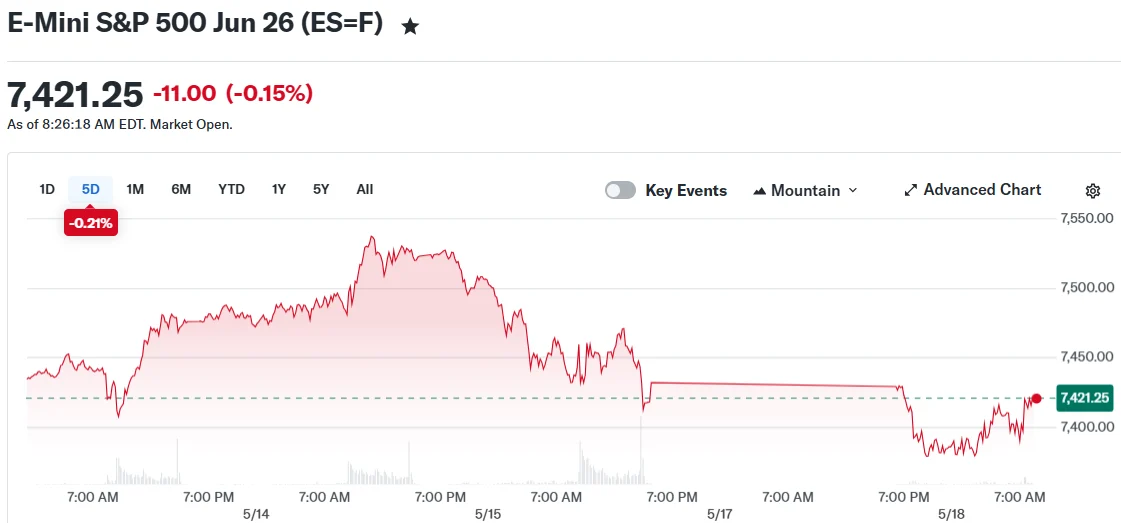
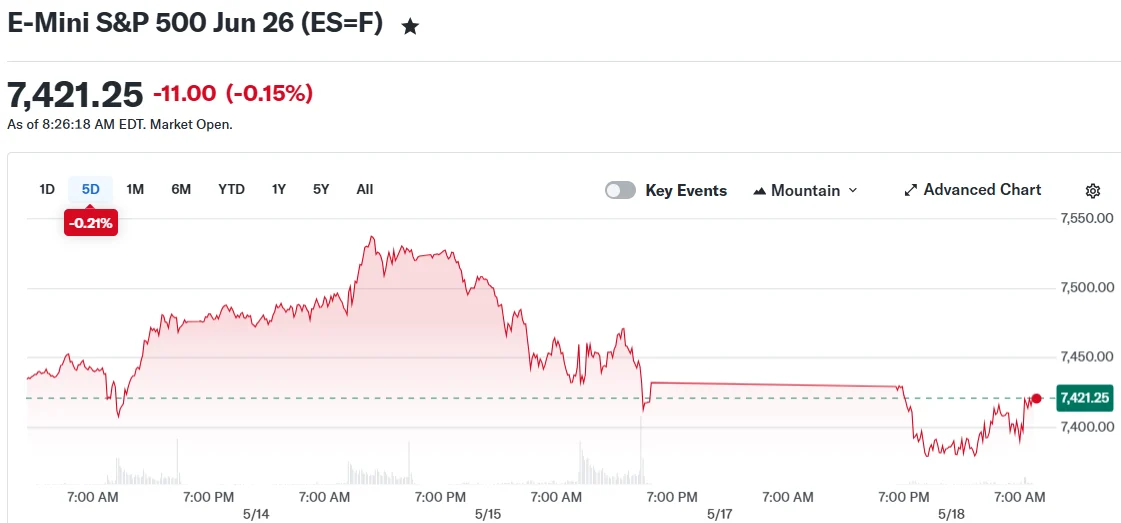
- Evercore ISI projects an S&P 500 base target of 7,750 by the conclusion of 2026, while assigning a 30% probability to a bullish scenario of 9,000.
- Technology, communication services, and consumer discretionary sectors are expected to benefit most from AI advancements in the bull scenario.
- RBC Capital has established a 7,900 target over the next 12 months, suggesting approximately 7.7% appreciation from early May price levels.
- RBC anticipates market corrections to remain moderate at 5–10%, with more severe downturns only emerging if recession concerns resurface.
- Artificial intelligence creates a dramatic earnings divide: RBC forecasts 28% growth for AI-linked companies compared to just 6% for traditional index components.
Two prominent Wall Street research houses have published their S&P 500 projections through 2026. While both maintain optimistic outlooks, each acknowledges potential volatility ahead.
Evercore ISI: Multiple Scenarios Point Higher
Julian Emanuel, analyst at Evercore ISI, has established a year-end 2026 base case projection of 7,750 for the S&P 500. However, he assigns a significant 30% likelihood to a bull scenario that could propel the benchmark index to 9,000.
According to Emanuel, the market faces an intersection of two powerful dynamics: a technology boom powered by artificial intelligence innovations and fundamental shifts in international geopolitical structures. This convergence, he argues, expands the spectrum of potential market outcomes beyond historical norms.
Emanuel drew parallels to the 1920s and 1990s eras, highlighting what he described as “wartime-scale economic stimulus, accelerating M2 money supply, and a transformative productivity surge” coinciding with the AI transformation. His analysis suggests productivity expansion could reach 3% annually before the decade closes.
The firm advises clients to purchase long-dated call options targeting the “AI Class of 2026” portfolio companies and the QQQ exchange-traded fund to maximize exposure to potential gains. Simultaneously, Evercore recommends implementing collar strategies on S&P 500 index funds to protect against short-term volatility stemming from crude oil fluctuations and interest rate movements.
Emanuel also noted an inherent constraint within AI technology itself. He observed that large language models frequently gravitate toward consensus predictions and fail to account for tail-risk events. Consequently, sustainable competitive advantages will emerge from specialized industry knowledge and comprehensive workflow ownership rather than simple AI tool adoption.
RBC Capital: Gradual Ascent With Intermittent Volatility
Lori Calvasina, who leads U.S. equity strategy at RBC Capital, has positioned her 12-month S&P 500 price objective at 7,900. This target represents roughly 7.7% potential upside from valuation levels observed in early May.
Calvasina emphasized that the anticipated advance will include periodic setbacks. She projects corrections in the 5–10% range as likely, though she doesn’t foresee more substantial declines of 14–20% unless recessionary concerns reemerge.
RBC’s analytical framework centers on what the firm characterizes as an “AI acceleration, Middle East deceleration” environment. Their calculations assume 28% earnings expansion for AI-centered enterprises in 2027, contrasted with merely 6% growth across remaining index constituents.
The model incorporates a 5% reduction to consensus earnings expectations and projects inflation stabilizing near 3.3%, with the Federal Reserve maintaining current policy and 10-year Treasury yields hovering around 4.5%. Should inflation climb to 3.8% and prompt Fed rate increases, RBC estimates fair value would decline to the 7,400–7,500 territory.
Immediate headwinds identified by the firm include potential earnings revisions linked to geopolitical conflict effects, profit-taking activity in semiconductor equities, midterm election-related uncertainty, and elevated borrowing costs.
RBC continues to favor growth-oriented equities over value stocks, and maintains its overweight stance on U.S. markets relative to international alternatives.


Alleged human trafficker Andrew Tate has been liquidated 108 times on decentralized perpetual futures exchange Hyperliquid and he’s now also facing fresh trafficking charges from Romania.
Tate’s combined losses are now almost $890,000, and have been on this downward trajectory since December last year.
Crypto analyst Lookonchain noted that he opened another 40x LONG bitcoin (BTC) position today worth $3.75 million, and that he had so far been liquidated 107 times.
This position was set to liquidate at $65,215.
However, BTC’s price fell to $64,500 today, and his LONG was liquidated.
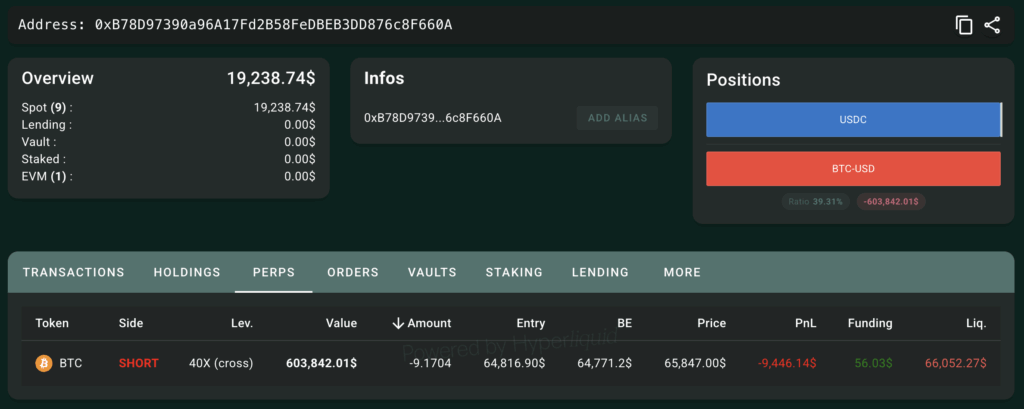
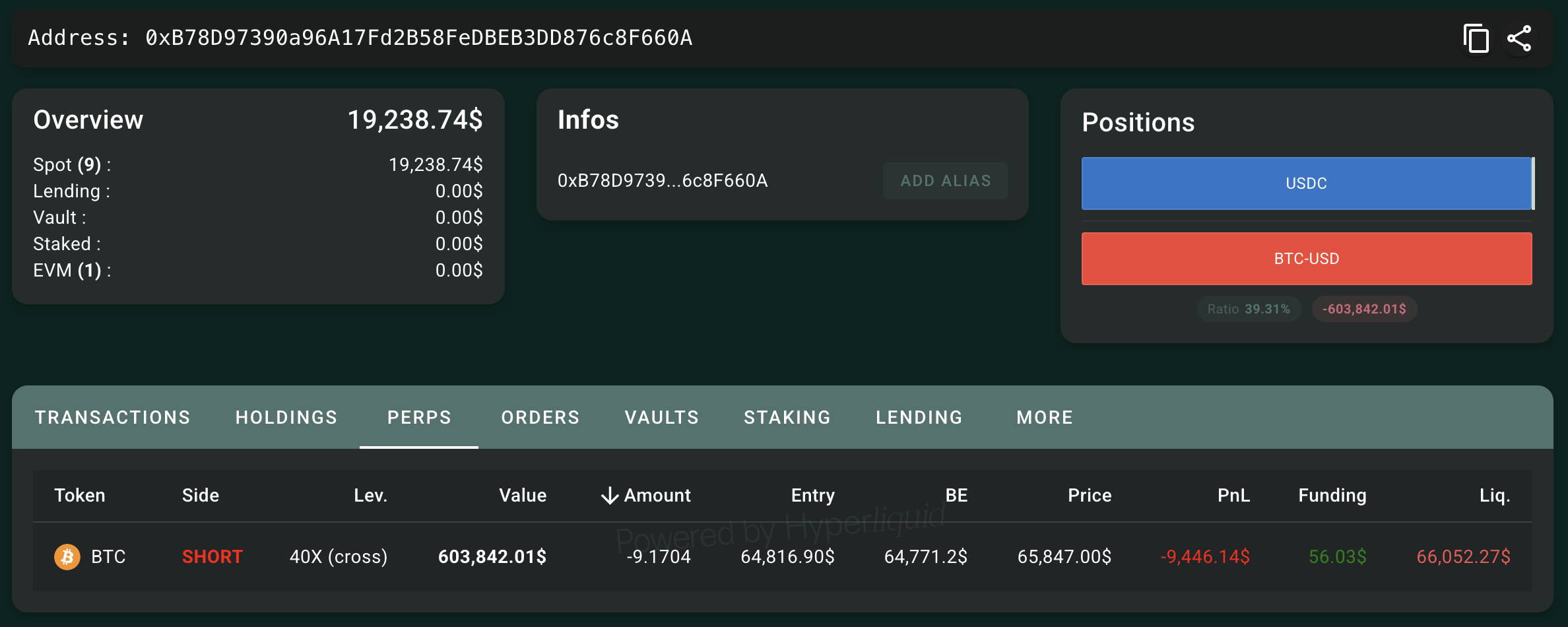
Tate has since opened a 40x SHORT BTC position. At the time of writing, this is down $9,400 and is set to liquidate when BTC hits $66,052.
Read more: Why was crypto so quick to embrace Andrew Tate?
The controversial influencer and self-proclaimed misogynist has previously bragged online about highly leveraged bets on ether before being subsequently liquidated and deleting his posts in embarrassment.
Romania expands Tate investigation
On Wednesday, Romanian prosecutors announced further investigations into the 39-year-old, who is already charged with human trafficking, rape, sexual intercourse with a minor, and forming a criminal gang focused on sexually exploiting women.
The latest allegations involve a Romanian woman who claims Tate trafficked her into his pornographic webcam operations in 2017.
Prosecutors say he used “emotional blackmail” and misleading relationship promises to coerce the vulnerable woman, who lacked any family support or material resources, and had suffered psychological trauma, into his porn business.
Read more: Andrew Tate struggles to pump memecoin amid Florida criminal inquiry
The UK has charged the brothers with 21 similar offences, including human trafficking, rape, and bodily harm.
They can only be extradited to the country once their proceedings in Romania conclude.
Got a tip? Send us an email securely via Protos Leaks. For more informed news and investigations, follow us on X, Bluesky, and Google News, or subscribe to our YouTube channel.


Fed Chair Kevin Warsh held rates steady in his debut FOMC meeting but delivered a sharply hawkish surprise, with nine of 18 participants projecting a 2026 rate hike and the statement stripping out its easing bias.
The Federal Reserve left the federal funds rate unchanged at 3.50%-3.75% on June 17, 2026 — the fourth consecutive hold, fully priced by markets.
Statement Shifts to Neutral
The FOMC removed previous references to “additional rate adjustments,” adopting a purely data-dependent neutral stance.
This marks a clear policy pivot amid persistent inflation hovering around 4.2% YoY.
Nine of 18 FOMC participants now pencil in at least one rate hike for 2026, a dramatic shift from prior projections that leaned toward cuts or extended holds.
This validates warnings from Citadel Securities about rising September hike risks fueled by strong wages, resilient demand, supply strains, and AI-driven investment.
Warsh’s Debut Under Scrutiny
In his first press conference, Warsh leaned into his preference for a “quieter” Fed with reduced forward guidance.
Fidelity managers had warned of potential bond market volatility from tone uncertainty, early reactions showed higher Treasury yields and USD gains.
The outcome challenges dovish expectations tied to Warsh’s appointment and highlights a vigilant committee focused on inflation control.
Market Impact: Stocks and Bonds Sell Off
Wall Street turned lower after the decision as investors digested the more hawkish tone.
The S&P 500 fell 0.6%, the Nasdaq Composite dropped 0.7%, and the Dow Jones Industrial Average lost 160 points (0.3%) by mid-afternoon.
Treasury yields climbed on the news. The 2-year yield rose nearly 11 basis points to 4.153%, while the 10-year yield increased 4 basis points to 4.469%.
The outcome highlights ongoing division risks at the Fed amid the Iran-related energy shock, which is driving both higher inflation and growth uncertainty.
The post Warsh Hawkish Shock: 9 Fed Officials Signal 2026 Rate Hike appeared first on BeInCrypto.
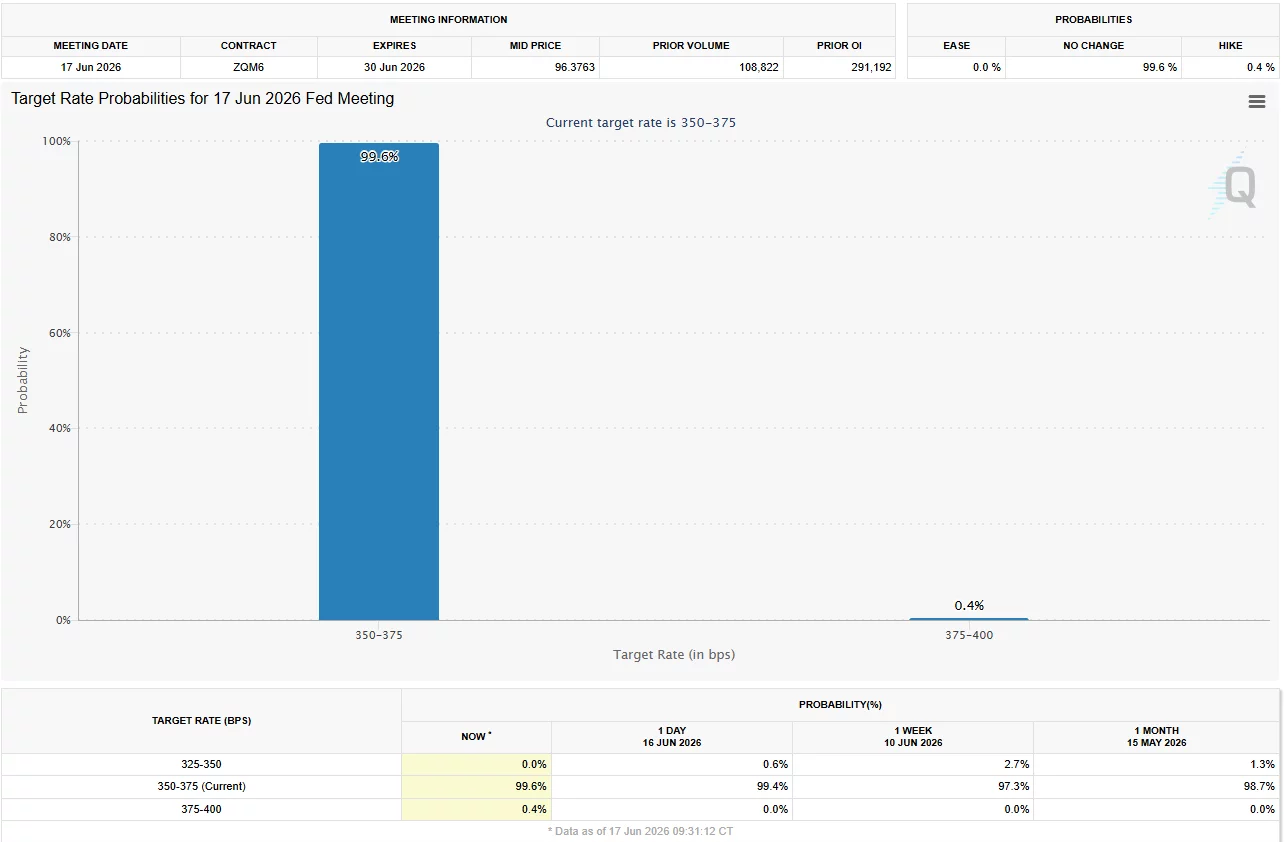
Citadel Securities has warned that the Federal Reserve may need to resume monetary tightening later this year as inflation pressures remain elevated across the U.S. economy. The firm’s latest outlook suggests that Fed rate hikes could begin as early as September 2026 if inflation continues to exceed policymakers’ targets.
The forecast comes ahead of the Federal Open Market Committee meeting on June 17. Market participants widely expect officials to leave interest rates unchanged. However, Citadel believes investors should focus on future policy signals rather than the immediate decision.
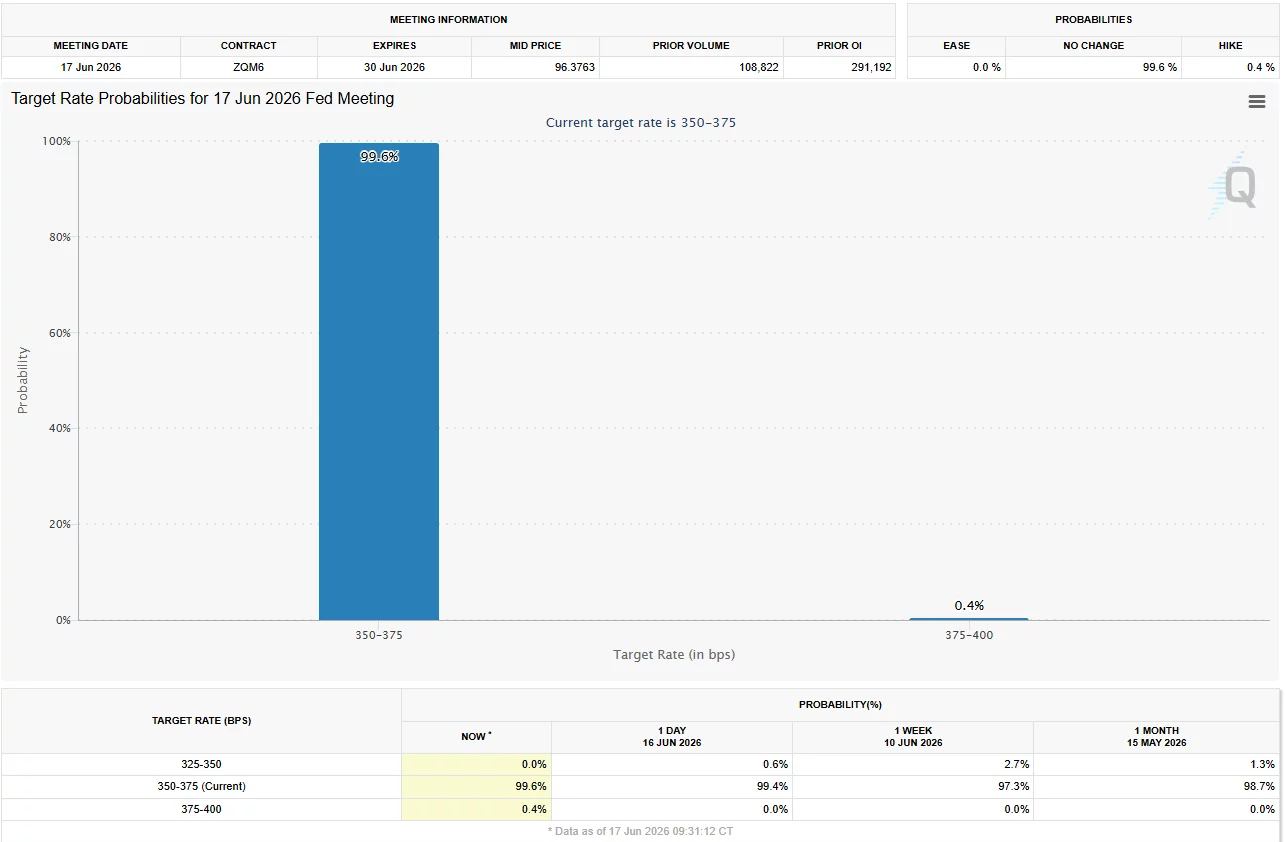
Source: FedWatch
Persistent Inflation Raises Policy Concerns
Citadel’s Head of Macro Strategy, Frank Flight, stated that inflation risks continue to build despite lower energy prices. According to the firm’s analysis, inflation has spread into broader sectors of the economy rather than remaining concentrated in commodities.
Flight wrote that the economy faces the risk of entering a “hysteretic equilibrium,” where temporary shocks create lasting inflationary effects. Citadel identified strong labor markets, accommodative financial conditions, and supply-chain disruptions as major factors supporting price growth.
Recent economic indicators support those concerns. Headline Consumer Price Index inflation reached 4.2% in May, while Producer Price Index inflation climbed to 6.5%. Citadel also noted that a larger share of core CPI components now records annual increases above 3%, suggesting inflation remains widespread.
AI Investment Boom Adds New Demand Pressure
Citadel also highlighted the growing impact of artificial intelligence spending on the economy. The firm estimates AI-related capital expenditures could reach approximately $750 billion in 2026 before rising to $1.25 trillion in 2027.
Large investments by companies such as OpenAI, Anthropic, and SpaceX continue to increase demand for infrastructure, computing resources, and skilled labor. As a result, AI development may contribute additional inflationary pressure during the coming years.
Against this backdrop, Citadel expects Federal Reserve officials to maintain a hawkish stance. Flight stated, “We think the risks skew to a rate hike at the September meeting.” The firm also expects policymakers to remove any remaining easing bias from future projections.
Markets Increase Bets On Fed Rate Hikes
Citadel’s forecast aligns with shifting market expectations. Kalshi prediction market data currently assigns a 60% probability that the Federal Reserve will raise interest rates before July 2027. Expectations for tightening have increased steadily in recent months.
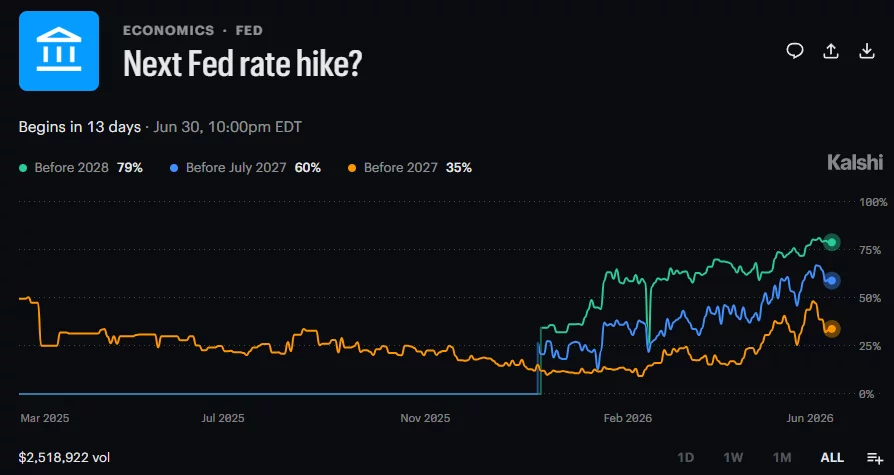
Source: Kalshi
Meanwhile, a recent Bank of America fund manager survey found that nearly 40% of respondents expect at least one rate increase within the next year. That figure stood at just 16% one month earlier.
BNP Paribas has also revised its outlook. The bank now expects three Fed rate hikes beginning in December, citing persistent inflation and continued labor market strength.
Citadel projects potential rate increases in September and December 2026, followed by another move in March 2027. The firm warned that higher borrowing costs and tighter liquidity conditions could create challenges for risk assets, including Bitcoin and the broader cryptocurrency market, if investors increasingly price in future Fed rate hikes.


Congressional negotiators have folded a statutory ban on a Federal Reserve central bank digital currency into a bipartisan housing package, blocking any Fed-issued retail digital dollar until December 31, 2030. The text is the most durable legislative CBDC prohibition yet assembled in Washington…. Read the full story at The Defiant

HYPE – the native token of the decentralized crypto exchange Hyperliquid – has been on a tear lately, hitting a new all-time high even as most digital assets continue to struggle in the prolonged bear market.
It recently surpassed Dogecoin (DOGE) to become the 10th-biggest cryptocurrency, so we decided to ask three of the most popular AI-powered chatbots whether flipping Ripple’s XRP is also plausible sometime this year. Here are their answers.
Low Probability
Earlier this week, HYPE’s price soared to a historic peak of around $77, while its market cap pumped to approximately $16 billion. Despite the substantial increase, it remains far below XRP, whose capitalization currently stands at around $74 billion.
Given the huge gap, ChatGPT described the scenario in which HYPE surpasses its rival as a low probability. At the same time, OpenAI’s platform outlined several catalysts that could help the asset explode to such levels. Some of those include the rising popularity of Hyperliquid and its future expansion to the point where it becomes a Binance competitor, and backing from prominent industry figures.
Recall that Arthur Hayes (co-founder of BitMEX) was heavily invested in the token, yet he recently sold all his positions. Shortly after, the blockchain-tracking platform Lookonchain suggested he might have spent over $2 million to buy back nearly 34,000 HYPE. However, Hayes rejected the claim.
According to ChatGPT, another factor that may have a positive influence is the institutional interest in the coin. Data show that inflows into spot HYPE ETFs have exceeded outflows recently, with cumulative net inflows of approximately $180 million. Still, this figure is far below the $1.44 billion that exchange-traded funds with XRP as the underlying token have attracted since their launch in late 2025.
Perplexity shared a similar theory, saying that such a rise by HYPE is only possible in “a narrow sense.” It noted that, in addition to its market-cap lead, XRP has a vast and devoted community, which could make a potential flip even harder.
“In 2026, HYPE can plausibly flip XRP on price momentum, narrative strength, or even short-term market cap at times, but XRP has a much larger base to overtake, so a full sustained flip is less likely without a major rotation in capital,” it added.
‘A Massive Uphill Battle’
Google’s Gemini was even less optimistic, claiming that the biggest hurdle for HYPE isn’t its utility but pure math. It praised XRP for being “a highly liquid, large-cap legacy asset,” whose market cap hovers in the tens of billions of dollars even during market corrections, “sustained by deep institutional plumbing and international remittance use cases.”
“For HYPE to flip XRP, it would need to see an astronomical influx of capital, multi-billion-dollar daily trading volumes, and massive speculative retail FOMO – all while XRP would have to severely stagnate or decline,” it concluded.
The post Can Hyperliquid (HYPE) Flip Ripple (XRP) in 2026? 3 AIs Weigh in appeared first on CryptoPotato.
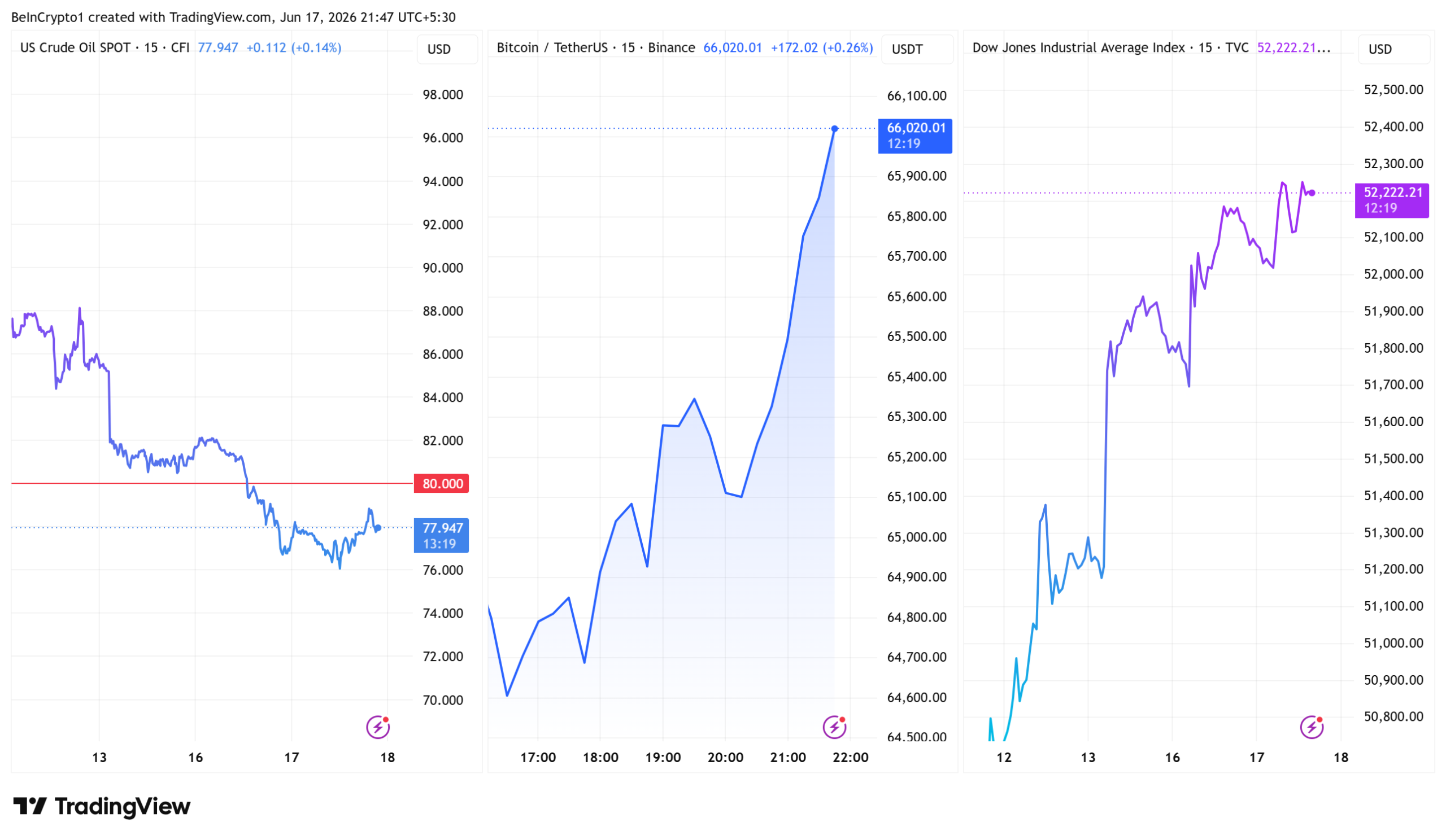
The Bitcoin price moved past the $66,000 threshold on Wednesday as US President Trump explained the Iran deal in his press address at G7 Summit.
Meanwhile, the oil price slid lower as Trump’s remarks shed more light on the US-Iran deal ahead of the formal signing in Switzerland.

Trump Addresses Iran Deal In G7 Summit Press
President Trump delivered a high-stakes update on the U.S.-Iran Memorandum of Understanding during the G7 summit press conference on June 17, 2026, driving immediate market moves across risk assets.
Trump confirmed the framework includes a ceasefire, full reopening of the Strait of Hormuz, limited sanctions relief, and Iran’s pledge against nuclear weapons.
A formal signing is expected soon in Switzerland.
“If Iran doesn’t honor the agreement, back to bombing them,” Trump stated bluntly. He added that some understandings remain unwritten and praised the impact of recent U.S. strikes: “Amazing what bombs can do.”
Follow us on X to get the latest news as it happens
President Trump also highlighted market surges tied to Iran peace signals during the G7 summit press conference.
“Every time we talked about possibility of peace, market shot up like a rocket ship,” Trump declared. “Never really went down. The stock market is more brilliant than anybody.”
He linked these rallies to the U.S.-Iran MOU, which includes a ceasefire, Strait of Hormuz reopening, and limited sanctions relief, while warning of renewed strikes if Iran fails to comply.
The “peace through strength” narrative, backed by explicit military leverage, has reduced short-term volatility premiums.
The post Trump G7 Summit Press Pumps Bitcoin as Oil Crashes appeared first on BeInCrypto.
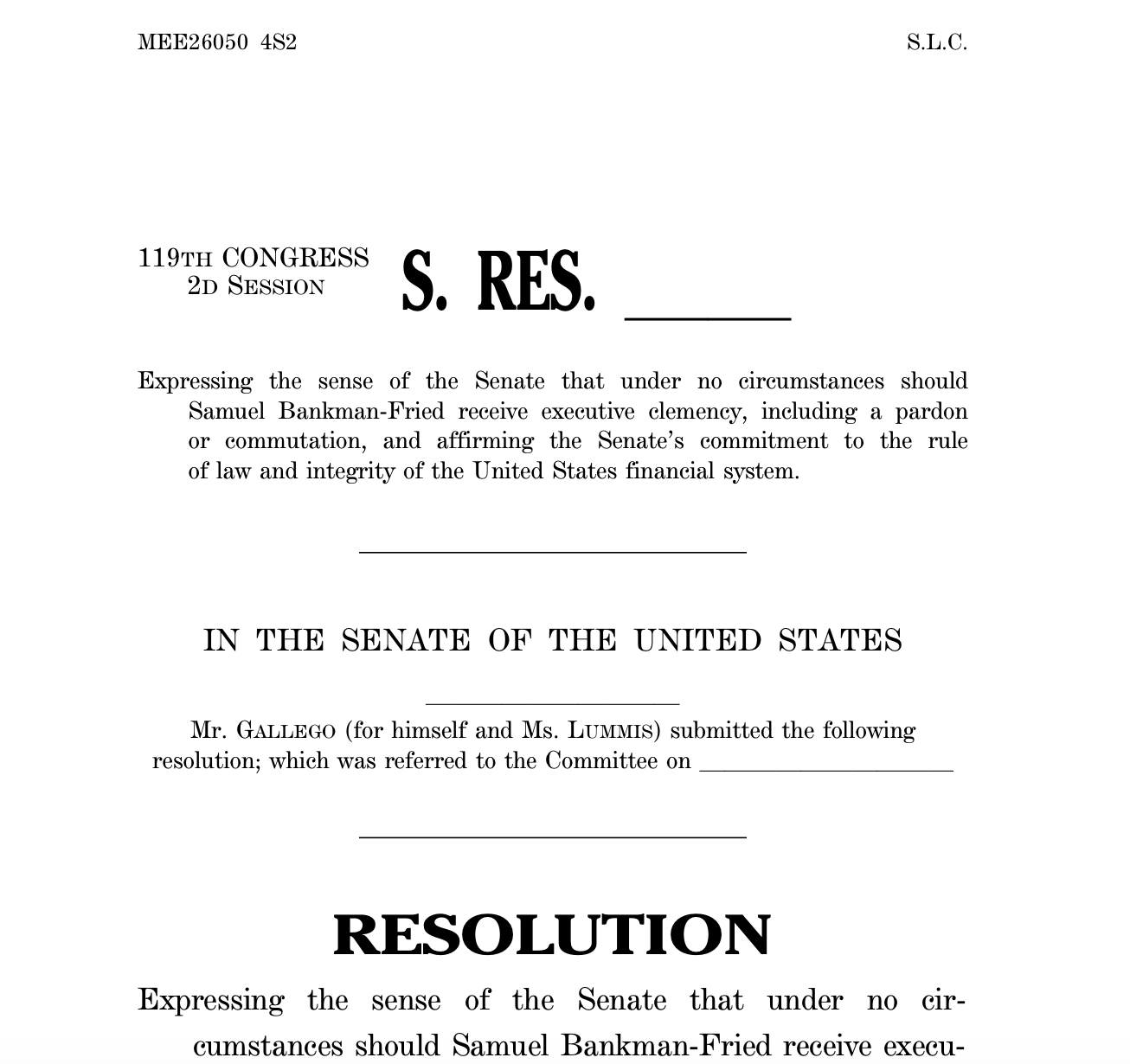
Two US lawmakers on opposite sides of the political aisle are backing a resolution that “under no circumstances should Samuel [SBF] Bankman-Fried receive executive clemency, including a pardon or commutation.”
In a resolution to be introduced Wednesday, Republican Senator Cynthia Lummis and Democratic Senator Rubén Gallego warned that should US President Donald Trump grant SBF’s request for a pardon, it would “erase [his] conviction […] weaken deterrence, and send a deeply damaging message that perpetrators of large-scale financial fraud can escape permanent accountability.” The resolution would be non-binding, as a US president’s pardon power is enshrined in the Constitution.
“[The US Senate] affirms that the 25-year sentence imposed upon Bankman-Fried reflects the extraordinary scale and deliberateness of his crimes, his lack of remorse, and the catastrophic harm inflicted upon millions of victims, and that such a sentence serves the interests of justice,” read the resolution.
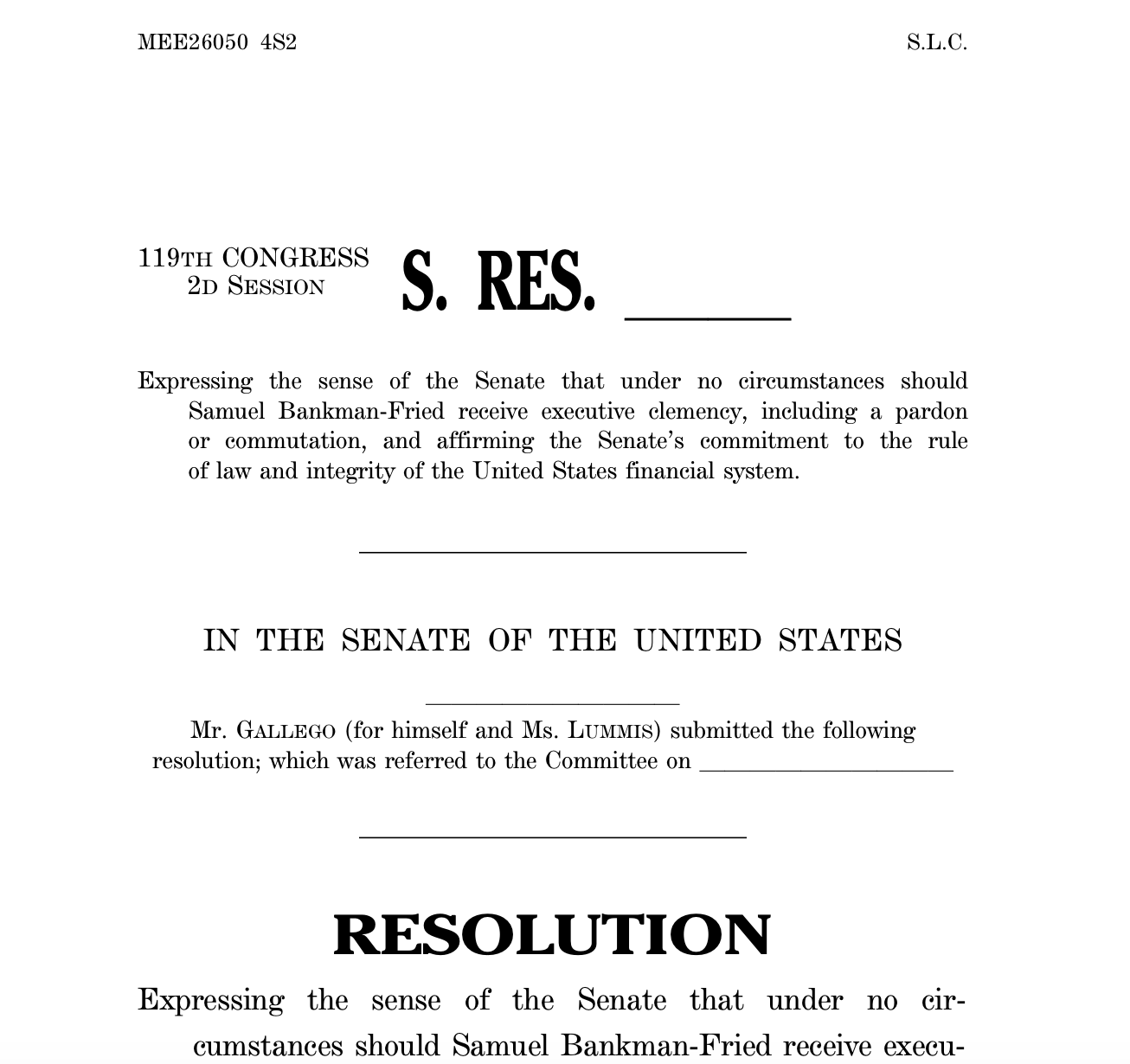
Source: Senator Rubén Gallego
The resolution came after Bankman-Fried formally applied for a pardon from Trump of his conviction on seven felony counts related to the misuse of FTX user funds. Last week, a federal appeals court upheld that conviction and sentence, leaving his only legal path forward a presidential pardon or an appeal to the US Supreme Court.
Bankman-Fried was convicted in November 2023 following the collapse of cryptocurrency exchange FTX a year earlier, which resulted in investor losses totaling billions of dollars. He was later sentenced to 25 years in prison.
Related: Onchain, in court: What happened in crypto legal news this week
Following his sentencing in March 2024, the former CEO posted several messages to social media aligning with Trump’s political agenda, including US military actions in Venezuela and Iran. However, in a January interview with the New York Times, the president said he had no plans to pardon Bankman-Fried.
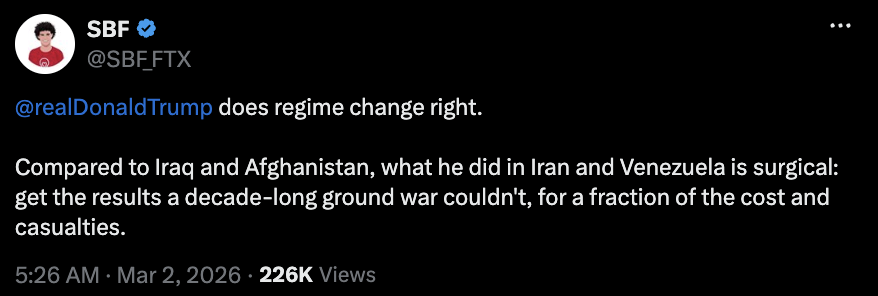
Source: Sam Bankman-Fried
Cointelegraph sought comment from Gallego’s office but did not receive an immediate response. A spokesperson for Lummis said that the senator “wants him to know that her and her colleagues think Mr. Fried is right where he belongs” by introducing the resolution.
Other FTX figures still serving time
Although some of the former executives of the defunct cryptocurrency exchange were sentenced to time served in exchange for their cooperation and testimony at SBF’s trial, one is still in federal prison, and another was released earlier this year.
Caroline Ellison, the former CEO of Alameda Research, received a two-year sentence in 2024 and was given an early release in January after 14 months. FTX former engineering director Nishad Singh and co-founder Gary Wang were both sentenced to time served. All testified against SBF at trial.
Ryan Salame, the co-CEO of FTX Digital Markets, was sentenced to 90 months in prison related to unlawful political contributions and conspiracy to operate an unlicensed money-transmitting business. His wife, Michelle Bond — though not an FTX employee — was recently indicted on charges related to her 2022 run for Congress allegedly financed with illegal campaign contributions from the crypto exchange.
Magazine: The end of anon? AI could unmask crypto’s hidden identities
Crypto World
Coinbase Stakes Out Brokerage Territory With SEC-Registered AI Advisor and Stock Options Push
Coinbase used its latest "System Update" on Tuesday to push deep into territory long held by retail brokerages, rolling out an SEC-registered AI investment advisor, stock and ETF trading on its professional platform, and options markets for both equities and crypto. The bundle moves the exchange's… Read the full story at The Defiant


After generating $5.5 billion in trading volume in two weeks, Kalshi is pushing to extend its CFTC-regulated perpetual futures beyond crypto into a wider range of asset classes. Kalshi's perpetual futures business crossed $5.5 billion in trading volume in its first two weeks, according to… Read the full story at The Defiant
Grayscale Research has named five decentralized finance tokens it believes offer real value as crypto markets reward revenue and cash flow over speculation.
The asset manager flagged Hyperliquid (HYPE), Aave (AAVE), Uniswap (UNI), Sky (SKY), and Maple (MAPLE) in a research report published June 16. Each shows strong relative value based on fundamentals.
Why Grayscale Sees Value in DeFi
Crypto markets have fallen since January. Grayscale argues in its report that investors can now value many tokens like financial assets rather than commodities.
The firm sorts tokens on a spectrum. Bitcoin trades like a commodity, while protocols with recurring revenue resemble cash flow businesses.
Since 2023, DeFi protocols have generated nearly $25 billion in cumulative fees from real users. That activity has driven rising on-chain fee revenue across exchanges, lending, staking, and derivatives.
Price multiples across DeFi lending have also compressed. Grayscale reads that as maturing business models now trading at attractive valuations.
Revenue Now Drives Token Value
Protocol revenue alone does not set token value. Grayscale says burns, buybacks, rebates, and staking decide how much reaches holders.
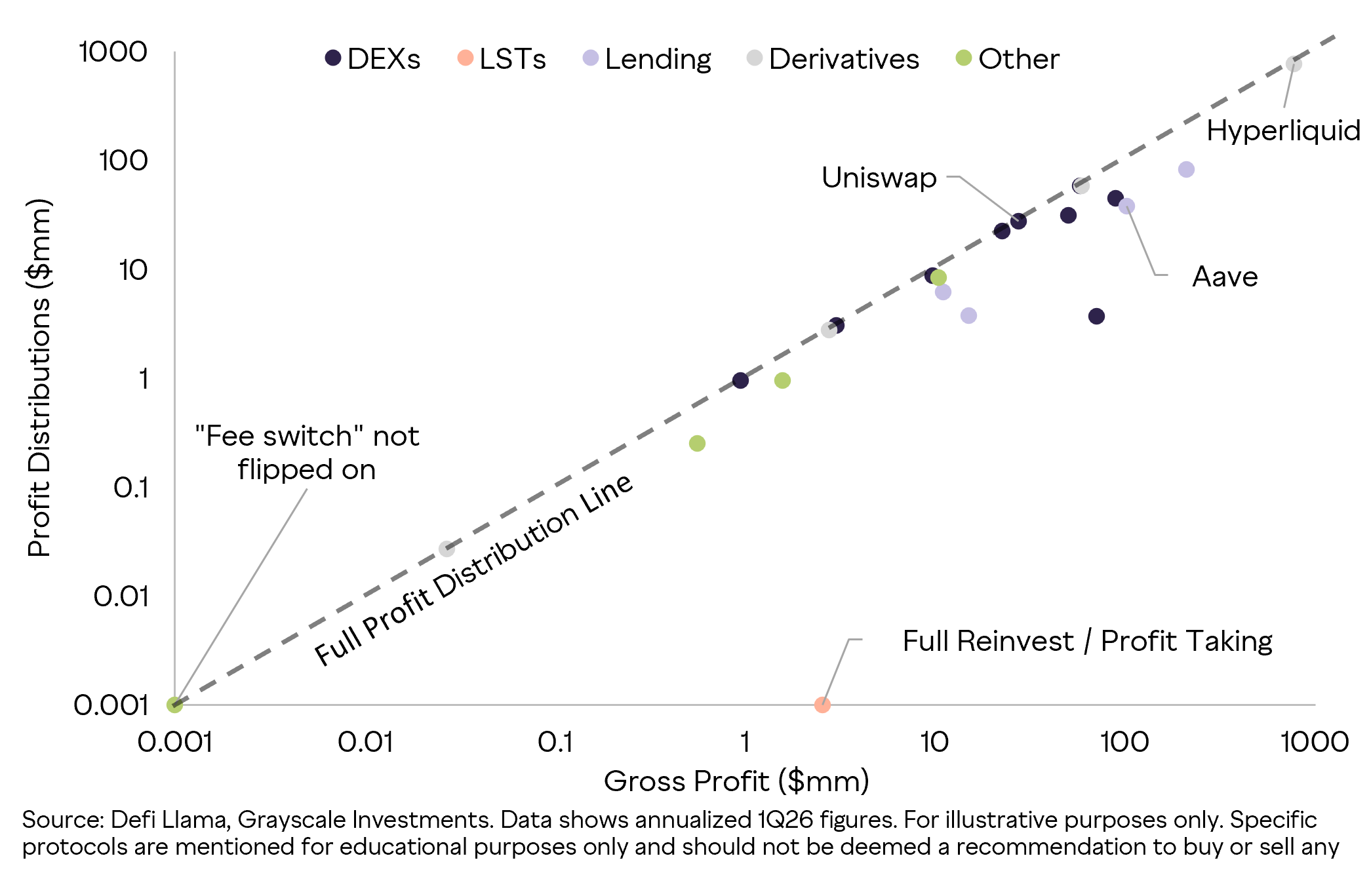
By that test, Uniswap and Hyperliquid stand out. The report says both return almost all earnings to holders through transparent DeFi payout models.

Hyperliquid routes trading fees straight into buying and burning HYPE. That model helped lift it into the top 10 by market cap this year.
Aave sits alongside them as the largest DeFi lender, after Grayscale called the AAVE token undervalued near $75.
How the Tokens Stack Up
HYPE trades near $72, ranking as the 10th-largest crypto and well ahead of its peers over the past year.
UNI sits around $3.30 after a 9% daily gain, with its value tied to fee distributions back to holders.
SKY trades near $0.06, where Grayscale says its onchain collateral-backed stablecoin keeps finding product-market fit.
Maple rounds out the list through institutional lending, which the firm says has delivered strong risk-adjusted returns.
“…crypto is repricing from narrative → fundamentals Protocols with real revenue, disciplined capital allocation, and transparent token economics are outperforming Grayscale flags HYPE, AAVE, UNI, SKY, and MAPLE as showing strong relative value on this basis,” Grayscale stated.
Follow us on X to get the latest news as it happens
The throughline is a market repricing from narrative to fundamentals.
Grayscale says protocols that turn real revenue into token value are pulling ahead.
The post Grayscale Names 5 DeFi Altcoins With Real Utility appeared first on BeInCrypto.

Andrew Tate liquidated again amid fresh trafficking charges

Faith And Fame Collide In Jelly Roll Divorce Claims

England vs New Zealand: Home side start well despite Ben Stokes’ asbence


-

 Business3 days ago
No Jackpot Winner as $257 Million Prize Rolls Over to $269 Million Monday Draw
-

 Crypto World6 days ago
Oppenheimer backs SpaceX as $70 billion retail frenzy builds
-

 Fashion5 days ago
Weekend Open Thread: Tuckernuck – Corporette.com
-

 Crypto World6 days ago
Markets Rally as SpaceX IPO Looms Amid Iran Tensions and Inflation Surge
-
 Crypto World3 days ago
Zimbabwe Requires Crypto Businesses to Register Annually Under New FIU Regulations
-

 Tech5 days ago
NanoClaw integrates JFrog registries to secure AI agent downloads
-

 Crypto World4 days ago
Bitget enters Argentina’s regulated crypto market through PSAV registration
-

 Tech5 days ago
This Week In Security: Microsoft On Microsoft, Register Your Domains, Linux On ARM, And FreeBSD Joins The File Cache Club
-
 Tech6 days ago
Dutton Ranch star claims they ‘didn’t see any disruption’ on set following Chad Feehan’s exit from Yellowstone spinoff fueled by Taylor Sheridan clash rumors
-

 NewsBeat6 days ago
El Nino has formed in the Pacific and could set records, forecasters say
-

 Politics6 days ago
Politics Home | Healey Resignation Is “Colossal Failure Of Government”, Says Former Labour Defence Secretary
-
 Entertainment6 days ago
Donnie Wahlberg & More Heat Up Las Vegas at Circa’s Barry’s Downtown Prime
-
 Tech6 days ago
Opendoor Ends India Operations, Fueling a Bigger Conversation About AI and Outsourcing
-

 Politics6 days ago
Belfast burns, while Met chief points finger at Iran and Russia
-

 Sports6 days ago
First Time Since 1971: Australia Register Historic Low In ODI Cricket
-

 NewsBeat5 days ago
FBI searches office of Ohio voter registration group
-

 Business6 days ago
AT&T: Verizon's 27% Outperformance Sets Up A Solid Entry Point
-
 Tech6 days ago
Anthropic is spending $150M to embed 1,000 AI fellows inside nonprofits. No degree required.
-

 Politics6 days ago
Modi thanks Trump for wishes as US attacks Indian seafarers
-
 Entertainment6 days ago
‘The Pitt’s Fan-Favorite Doctor Confirms Noah Wyle Gave His Blessing to Return [Exclusive]
You must be logged in to post a comment Login