

Crypto World
SpaceX IPO banks yell ‘buy’ as stock craters

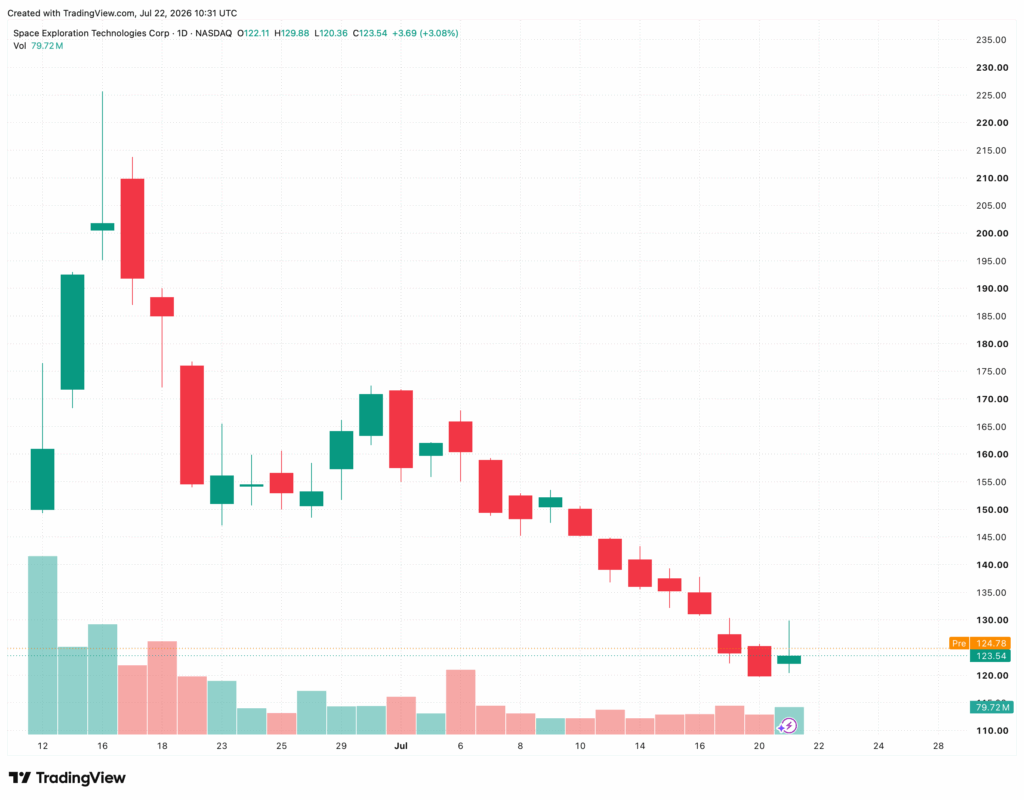
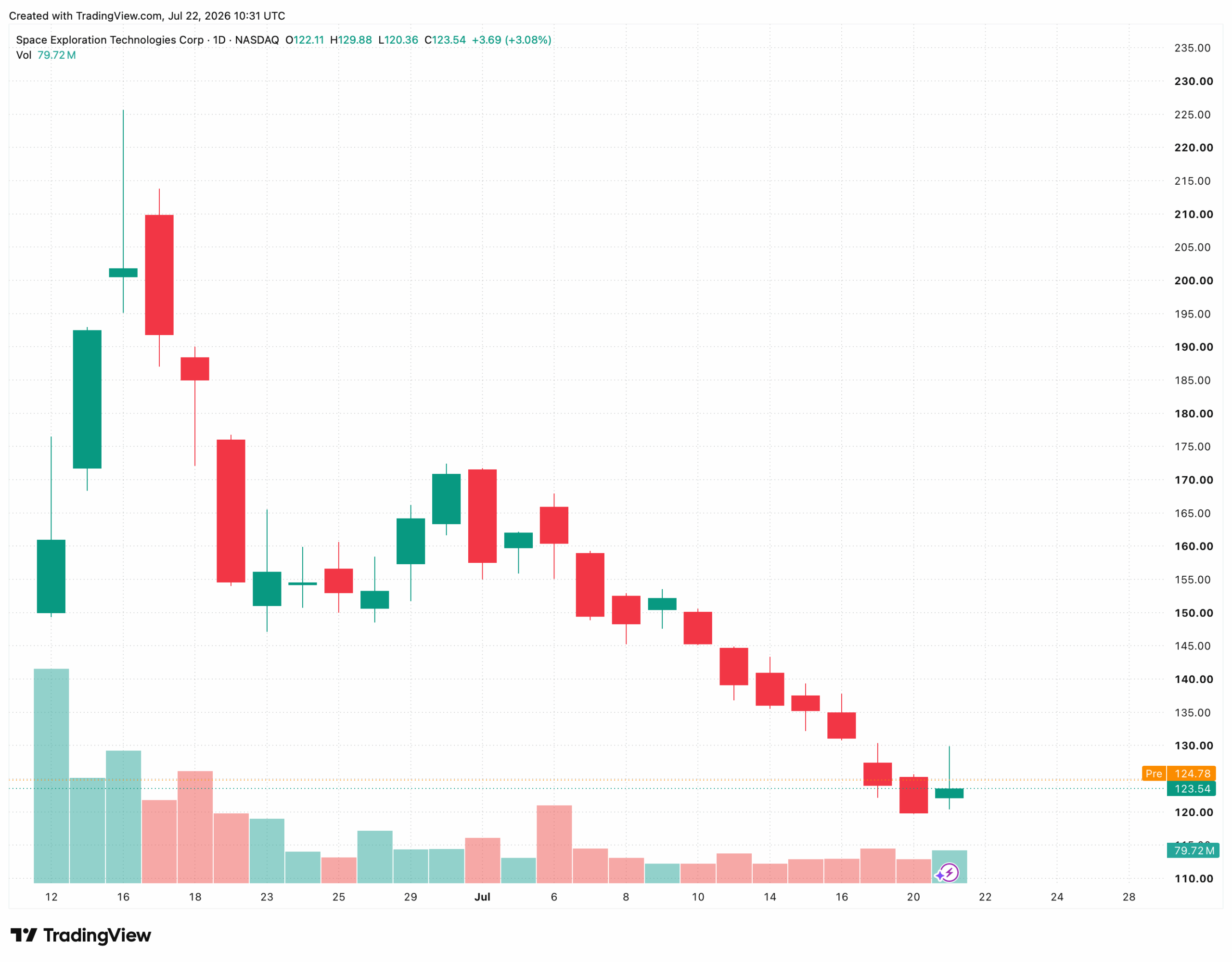
Wall Street analysts are trying to rescue Elon Musk’s floundering IPO, SpaceX after the stock erased $1.1 trillion of market capitalization in five weeks.
Almost every Wall Street analyst has a price target (PT) higher than the stock price, with reiterations and upgraded forecasts arriving by the day, and all 12 IPO underwriters whose analysts have published research on SPCX rated it a “buy” or equivalent.
Bullish analyst ratings have showered Musk’s company with weeks of praise as the stock price has crashed. Yesterday, Macquarie reiterated its “outperform” rating with a PT 100% higher than SPCX’s closing price.
Last week, Piper Sandler initiated coverage with a $156 PT, $32 higher than yesterday’s close. The same week, Needham maintained its buy rating and increased its PT 25% to $250, Evercore ISI Group initiated at outperform with a $230 PT, and Zephirin Group initiated coverage at buy with a $310 PT.
The tone around these ratings has been one-sided for weeks. Ratings by the investment banks that actually helped sell the stock during the IPO have sustained a sound wall shouting nothing but buy.
Raymond James initiated coverage at “strong buy” and an $800 PT. Eight hundred dollars.
The stock closed yesterday below $125, down 45% from its June 16 high.
Hiking PTs and buys since the SpaceX IPO
Goldman Sachs led a record-shattering, 23-bank syndicate that priced SpaceX’s record $75 billion IPO at $135 a share on June 11. It would open for trading on the Nasdaq at $150.
For that one day in the sun, the banks split roughly $500 million in fees, with Goldman and fellow lead Morgan Stanley collecting about $100 million apiece.
Their gratitude showed. Bank of America crowned SpaceX the “King of the Cosmos” alongside a $235 PT. Deutsche Bank called the company the “apex of civilizational ambition” and set a $255 PT.
Citi described its $200 target as a “milestone along the path to $900.” Morgan Stanley titled its SPCX analysis “AI’s Final Frontier,” attaching a $300 PT.
Gushing affirmations reeked of conflicts of interest.
Raymond James, a co-manager on the IPO, called SpaceX “one of the defining industrial infrastructure companies of the 21st century.” Its $800 PT, Wall Street’s highest, is more than six times the current share price.
Read more: Some SpaceX bonds have already sunk to junk-like territory
Analysts without conflicts of interest have lower PTs
Firms that didn’t directly benefit from the IPO saw a different, far more accurate future.
MoffettNathanson initiated at neutral with a $131 PT and wrote, “There is simply no credible financial model that can support what is at the time of this writing a roughly $2 trillion valuation. Our own certainly does not.”
CFRA issued Wall Street’s only outright “sell” rating and a $115 PT on the stock’s first day of trading. It was the most accurate PT to date, with shares falling to within $5 of that forecast this week.
Another IPO outsider, KeyBanc, added the first “hold-equivalent” analyst rating on June 22, a session in which the shares dropped 16%.
So far, the stock price is rewarding skeptics, not the conflicted banks and Wall Street giants that SpaceX compensated to remain permabullish.
SpaceX peaked at $225.64 on June 16, when the company was briefly worth more than $2.9 trillion. The shares broke below their $135 IPO price on July 15 and closed under it a day later.
This week, they traded below $120 after SpaceX delayed its highly-anticipated Starship test flight when some of its engines failed to start.
Meanwhile, some SpaceX bonds have already declined to 90.7 cents on the dollar with junk-like, 7.5% yields. Yet 29 analyst ratings still average a $236 PT, as though the stock has a realistic chance of nearly doubling from Tuesday’s close near $124.
Whatever the stock does next, Wall Street’s IPO fees settled weeks ago.
Got a tip? Send us an email securely via Protos Leaks. For more informed news and investigations, follow us on X, Bluesky, and Google News, or subscribe to our YouTube channel.

Cardano’s native token is among the best-performing cryptocurrencies (from the top 100 club) over the past week, with its price rising by 8% to around $0.17.
Two key developments suggest the uptrend might be just at its starting point, while another factor hints that an upcoming correction is just as likely.
Bulls vs. Bears
Earlier this month, the large ADA investors, known across the crypto space as whales, increased their total holdings to 25.6 billion coins. This represents almost 70% of the token’s circulating supply and is the highest level since February 2023. At the same time, retail investors have reduced their exposure to ADA, with Santiment explaining that this combination could create a healthy setup for the asset.
Just recently, the renowned analyst Ali Martinez revealed that whales have purchased 30 million units (worth over $5 million at current rates) over the last month. The obvious revival of this cohort of investors signals that they are positioning for the next potential price upswing.
There is a common theory in the crypto world that whales have access to inside information about events or news that could impact the valuation of a certain asset and that they rarely jump on the bandwagon out of pure intuition. That said, their efforts may encourage smaller players to join the ecosystem and distribute fresh capital.
The second bullish element is ADA’s Relative Strength Index (RSI). The technical analysis tool measures the latest speed and magnitude of price changes to evaluate whether the token is poised for a trend reversal. Readings below 30 put ADA in oversold territory and due for a possible rally, while anything above 70 serves as a warning for an impending correction. Currently, the RSI stands at around 28.

However, there is also a bearish factor to be considered. Lately, exchange inflows have surpassed outflows, meaning that investors have abandoned self-custody and flocked toward centralized platforms: a development that increases immediate selling pressure.

Recent Predictions
Several analysts on X have noted ADA’s rebound, expecting a much more substantial push north in the short term. Master of Crypto claimed that if the positive trend continues, the price could surge to $0.219.
Others like JAVON MARKS are even more bullish, envisioning hard-to-believe explosions (at least from the current perspective). The analyst opined that ADA moves towards “a key convering/breaking point” which could open the door to an increase to as high as $2.90. Celal Kucuker also chipped in lately, predicting a major ascent to $5.
The post 2 Bullish and 1 Bearish ADA Signals: Where Is Cardano’s Price Going Next? appeared first on CryptoPotato.
The most recent data show that the self-proclaimed Dogecoin killer has almost 1.7 million holders. However, less than 1,000 wallets own the vast majority of the supply: a concentration hard to ignore and which raises eyebrows.
Shiba Inu’s price has been in a major decline over the past several months, yet some analysts believe a rebound could be on the way while certain factors support their bullish outlook.
How Many Whales and Shrimps?
Earlier this month, the total number of SHIB addresses reached an all-time high of 1,676,535 after a sudden one-day increase of 75,000 new holders. The figure kept climbing and currently stands at 1,678,502.
According to Etherscan, nearly a million of those are investors known as shrimps: wallets holding up to $10 worth of the meme coin. The second-largest group is crabs (477,871), who own between $10 and $100 in SHIB. Coming up next are fish, dolphins, and sharks.
Interestingly enough, there are only 703 whales (addresses that hold more than $100K worth of the token each). They make up only 0.04% of the total figure but control staggering 94.5% of Shiba Inu’s supply.
Such an extreme concentration means that theoretically a small group of investors could move the market with their actions. A coordinated sell-off, for instance, could lead to a substantial price crash, while sudden accumulation might have the opposite effect.
SHIB at a ‘Critical Stage’
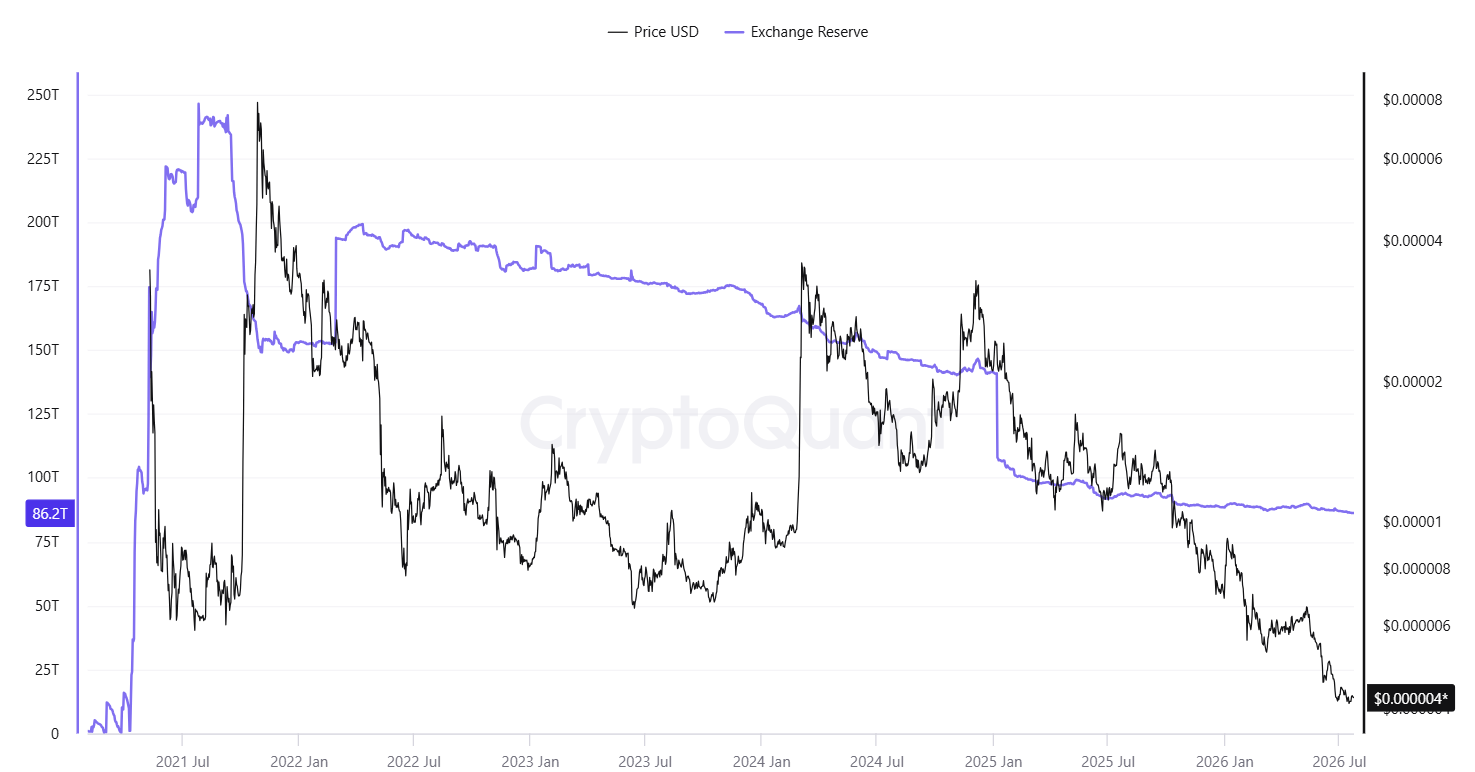
As of press time, the token is worth around $0.000004235 (per CoinGecko), translating into a massive 72% decline on a yearly scale. X user CRYPTO SHERIFF noted that the asset has been consolidating below a 5-year downtrend, arguing that it is in “a critical stage” which could actually be a precursor to a huge pump.
“There is an unwritten rule in crypto: the longer the consolidation lasts, the bigger the breakout! SHIB is at a critical stage! Unless there is a market downturn in the coming days, we could see a new rally for SHIB,” they stated.
The declining amount of tokens stored on exchanges reinforces the bullish scenario. According to CryptoQuant, there are now approximately 86.2 trillion SHIB held on centralized platforms, a new five-year low that typically reduces immediate selling pressure.
At the same time, there are some warning signs. X user SHIBMortal said that analysts have spotted a 91% match between SHIB’s recent performance and the 2023 bearish pattern, which could lead to a 20% drop to the $0.0000032–$0.0000033 range.
The post Shiba Inu Holders Breakdown: Here’s How Many Whales Control 95% of the Supply appeared first on CryptoPotato.


Coinbase is expanding its push into AI-powered finance, enabling businesses to accept USDC payments from autonomous AI agents as part of a broader expansion of its payment, trading and developer tools.
According to a Thursday X post, Coinbase Business users will be able to accept USDC (USDC) payments from AI agents through the x402 payment standard, which Coinbase first introduced in May 2025 to enable stablecoin payments over HTTP for AI agents, applications and APIs.
The post also announced AI trading tools that let users monitor orders, access live market data, and execute actions based on predefined conditions, as well as a software development kit for developers building agent-powered applications.
Coinbase said the products are designed to support the “agentic economy,” where AI agents can make payments, manage finances and complete other tasks on behalf of users.
The company said adoption of AI agents is accelerating, noting that agent-generated traffic surpassed human traffic on its Base documentation pages for the first time last month. However, it added that the internet’s financial infrastructure was built with “one assumption: a human clicking the button,” which has left businesses, developers and users without tools designed for AI agents.
The rollout comes as companies increasingly position stablecoins and blockchain-based payments as infrastructure for AI agents, an emerging use case that several exchanges and payment companies are targeting.
Magazine: Here’s why the CLARITY Act’s ethics deal may be so hard to reach
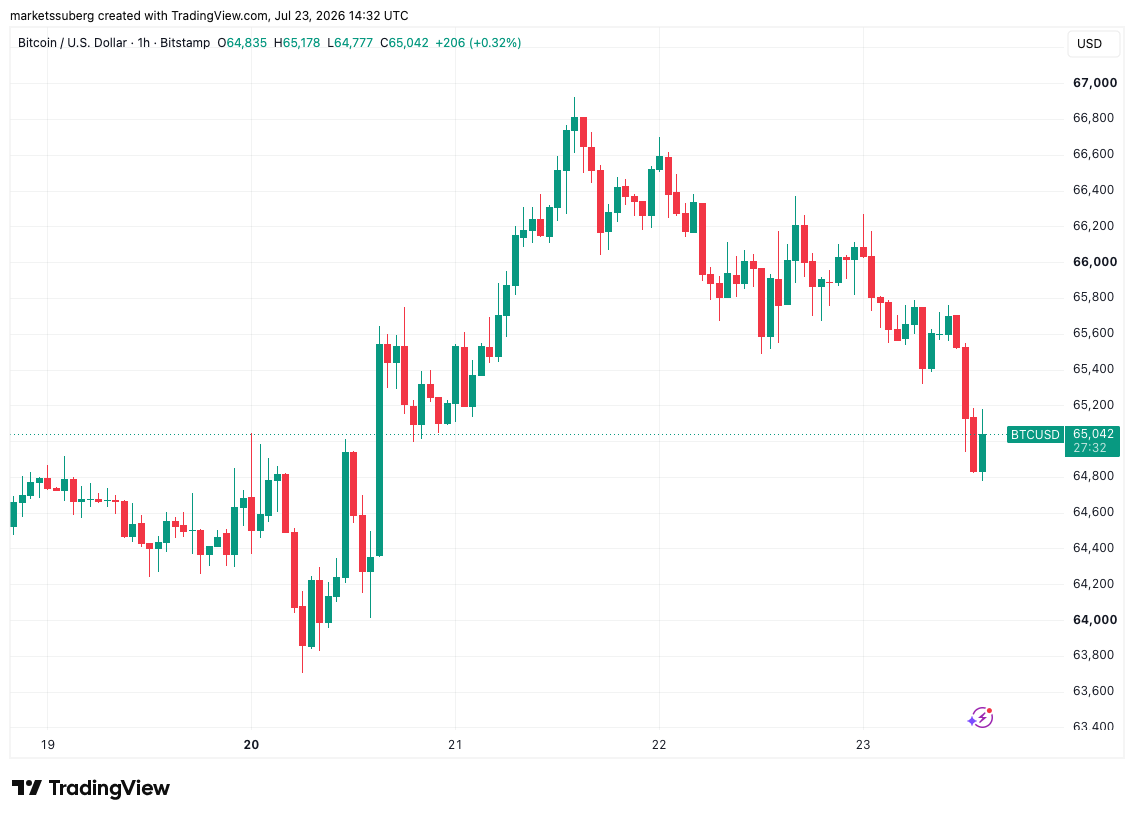
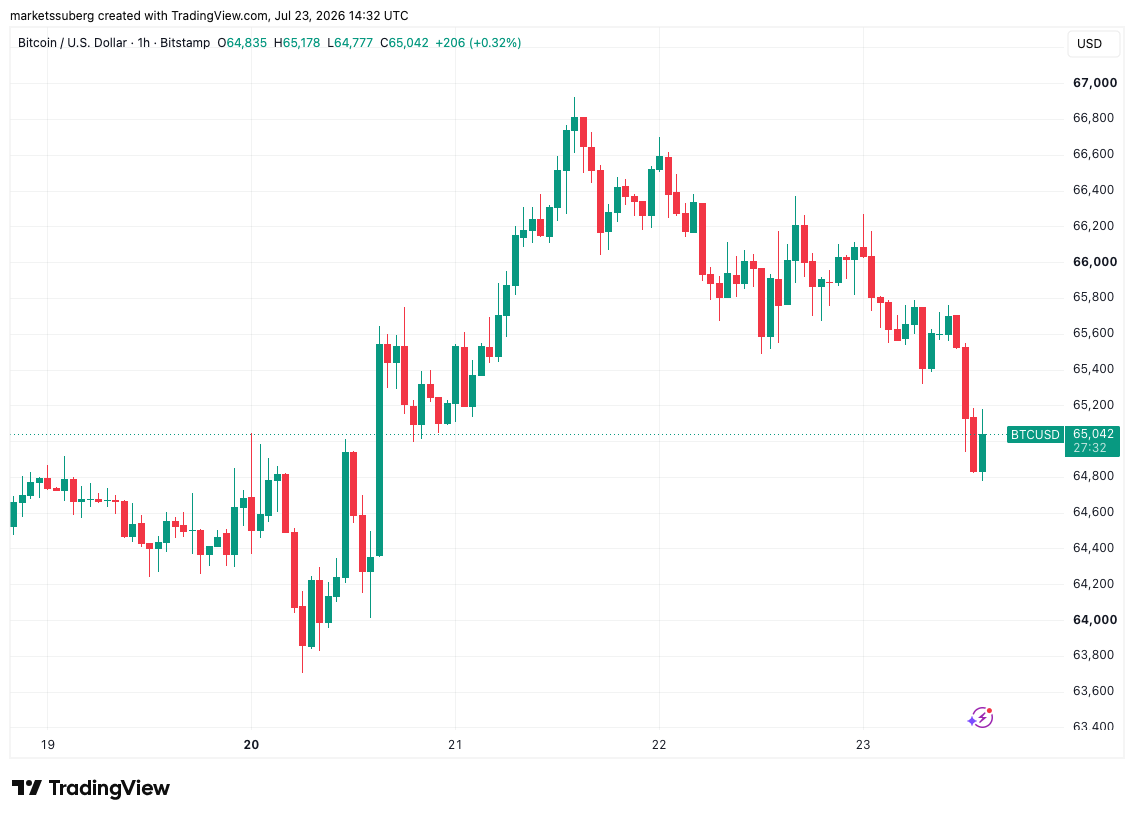
Bitcoin (BTC) fell below $65,000 on Thursday as US stocks slid amid another round of escalation in Iran.
Key points:
- Several days of US-Iran escalation are beginning to take their toll on crypto and stock market performance.
- Bitcoin sees three-day lows under $65,000 as traders diverge on the near-term outlook.
- A 21-day moving average trend line becomes important nearby support.
Bitcoin wobbles as Iran destabilizes stocks, oil and US bond yields
Data from TradingView showed BTC/USD hitting three-day lows of $64,799 on Bitstamp.
BTC/USD one-hour chart. Source: Cointelegraph/TradingView
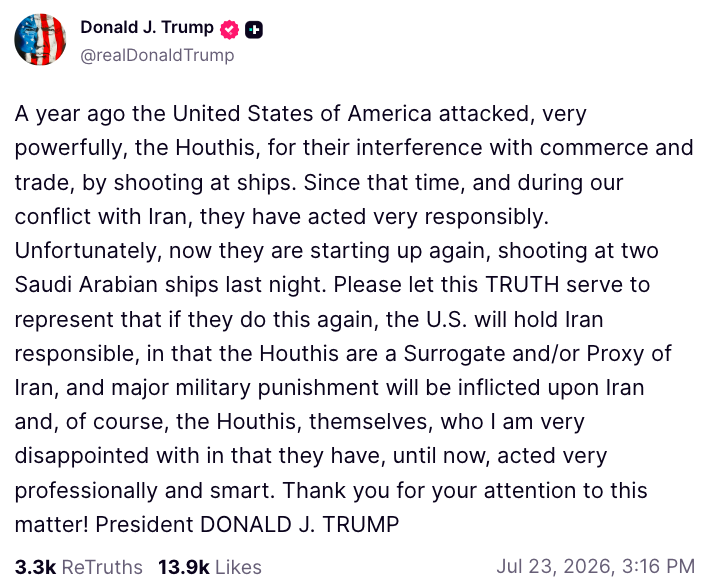
Risk assets felt the strain on the day as US President Donald Trump warned that he would blame Iran for recent Houthi strikes on Saudi Arabian commercial vessels.
In a post on Truth Social, Trump said that he was “very disappointed” in the Houthis, referencing attacks on US ships from 2025.
Source: Donald Trump on Truthsocial.com
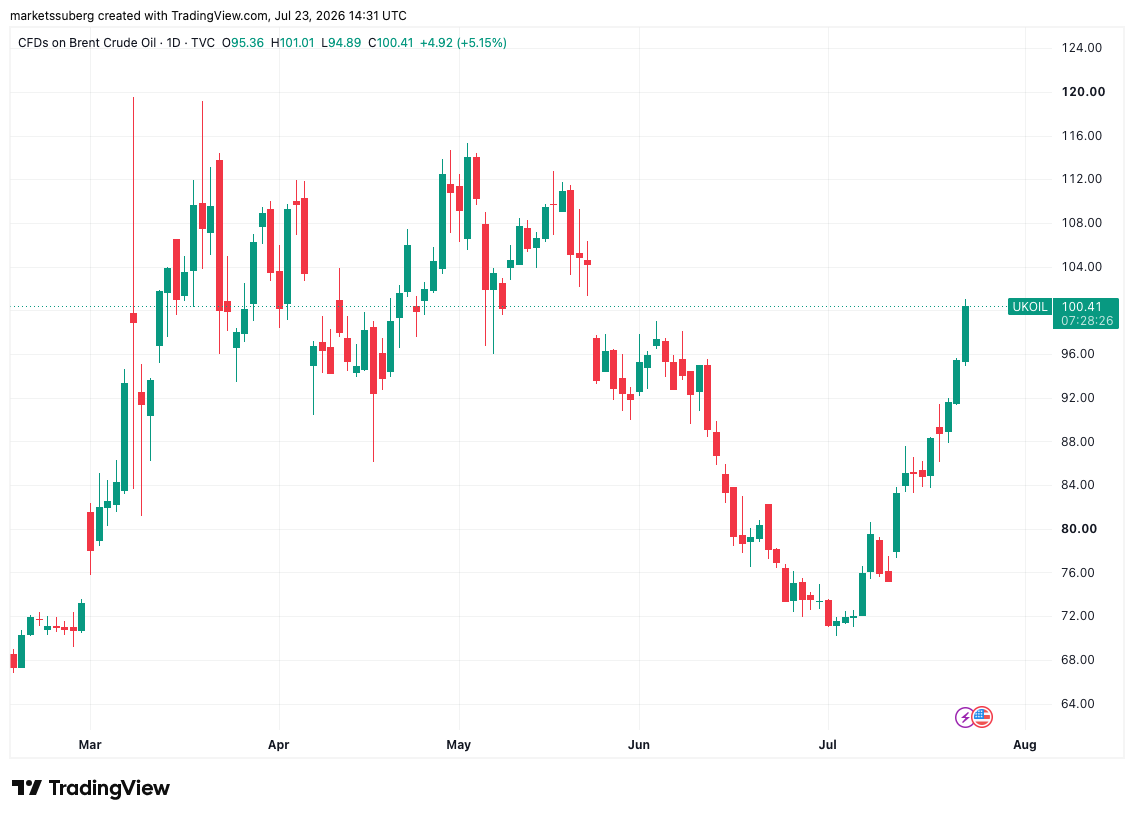
By the close of New York trading, the S&P 500 had fallen 1.2% and the Nasdaq had shed 2.2%, while oil prices rallied to their highest since early June, with Brent crude topping $100 a barrel.
CFDs on Brent crude oil one-day chart. Source: Cointelegraph/TradingView
“Inflation expectations and interest rates are rising sharply again,” trading resource The Kobeissi Letter wrote in a response on X.
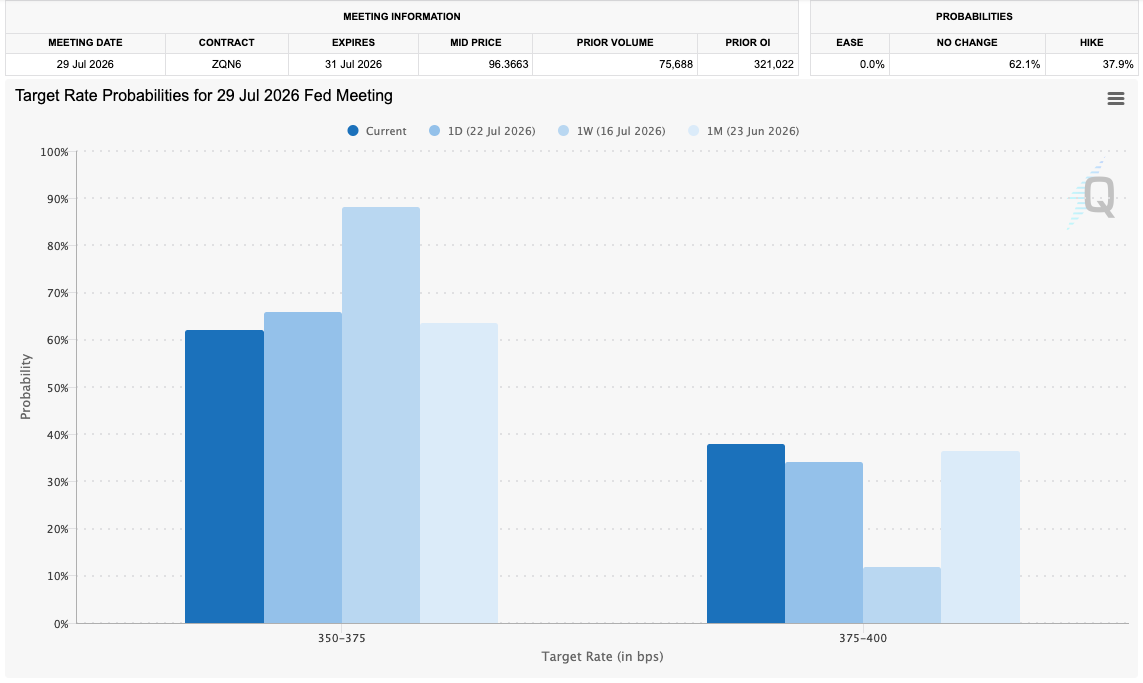
Ahead of the Federal Reserve’s next interest-rate decision, data from CME Group’s FedWatch Tool showed an increasing chance of officials hiking by 0.25% — traditionally a headwind for crypto markets. Odds neared 40% on Thursday, while a week prior, they were closer to 12%.
Fed target-rate probability comparison for July FOMC meeting. Source: CME Group
Kobeissi, meanwhile, noted 18-month highs in US 10-year bond yields in a sign of fresh economic strain.
Related: Bitcoin will get ‘lift’ from Hyperliquid, Robinhood in next crypto bull market: Bitwise exec
BTC price analysis offers hope of $73,000
Bitcoin traders showed an increasing split over what short-term BTC price action would bring.
Commentator Exitpump argued that the Bitcoin relief rally is likely to end by late July, reinforcing an established theory that has already gained traction.
“July rally is coming to end, price is at resistance, close your longs, go short once price breaks below 65K,” they told X followers late on Wednesday.
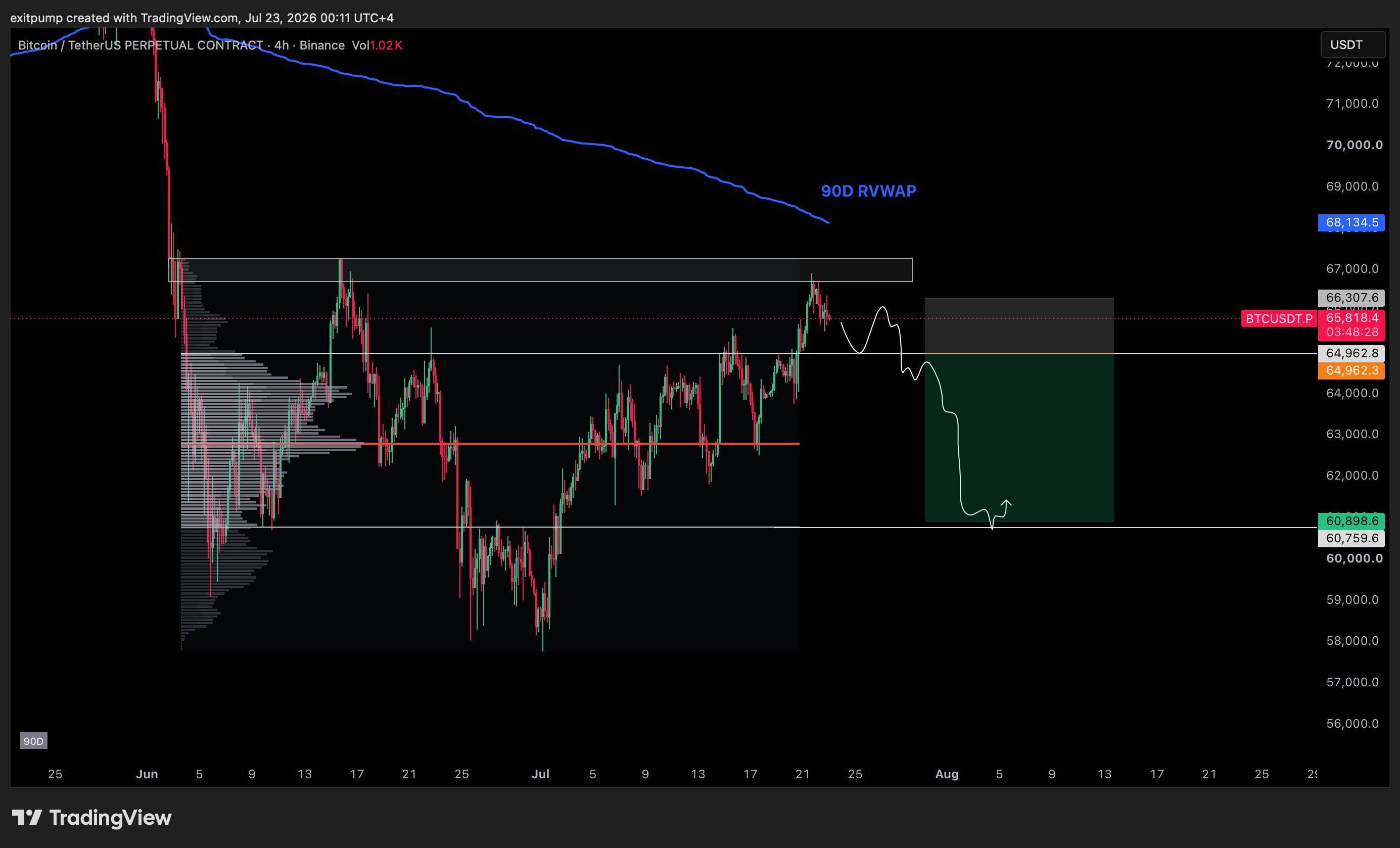
BTC/USDT perpetual contract four-hour chart. Source: Exitpump on X.com
Others were more hopeful, with trader Jelle arguing that price was “still making progress.”
“Clear this local area and that void towards $70k opens up – could be a quick move to form the new range. Patience remains my game,” he reported.
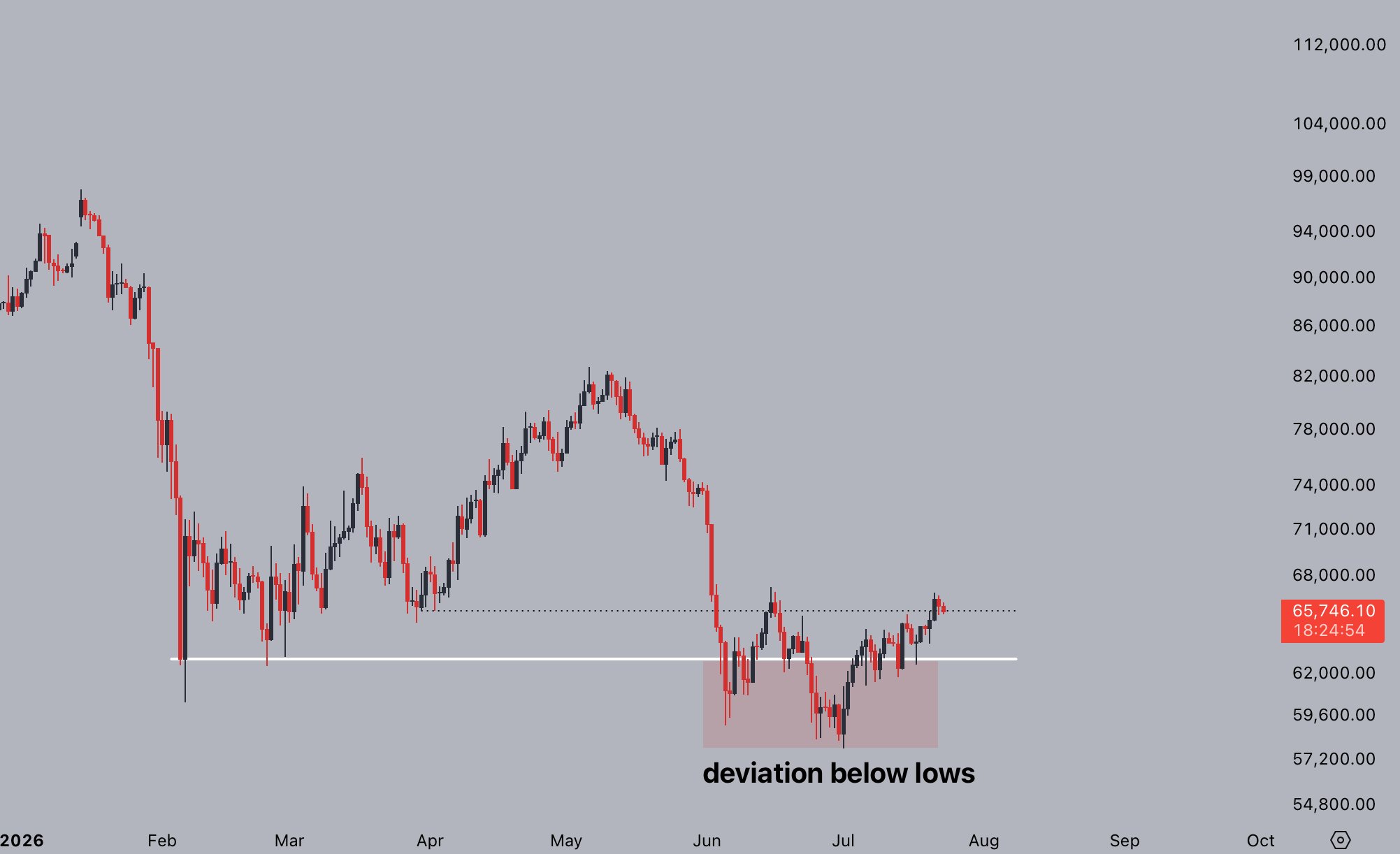
BTC/USD chart. Source: Jelle on X.com
According to crypto trader and analyst Michaël van de Poppe, the 21-week simple moving average (SMA) at $64,073 was key.
“Theoretically, the target area for Bitcoin is reached. However, as long as this stays above the 21-Day MA, I’m sure there will be a higher valuation for Bitcoin in the near-term,” an X post on the day stated, adding:
“It’s facing the final hurdle for a big breakout, which is the $68,000 resistance zone. It’s been tested once, and this is the second test that we’ll be facing.”
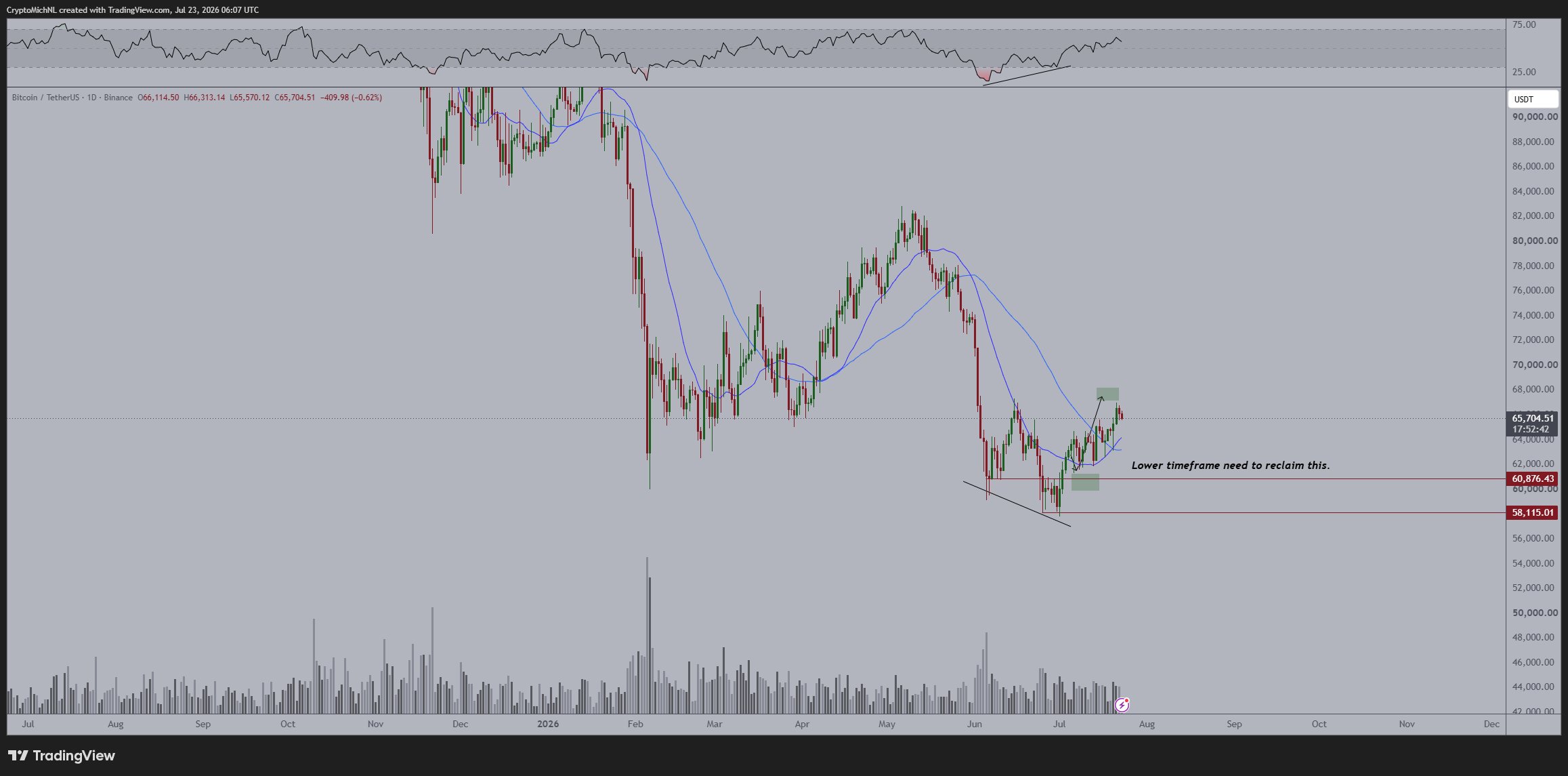
BTC/USDT one-day chart. Source: Michaël van de Poppe on X.com
Van de Poppe gave a $73,000 target should bulls successfully break through resistance.


Gate founder and CEO Dr. Han has backed a human-led approach to crypto trading as millions of digital assets and tens of thousands of decentralized applications make Web3 increasingly difficult for users to navigate.
Summary
- Gate CEO Dr. Han says AI will support traders without replacing human judgment.
- Gate is integrating AI tools to simplify trading and lower Web3 entry barriers.
- U.S. scrutiny of Chinese AI models could complicate the technology’s global adoption.
In the latest episode of the Gatecast podcast, Dr. Han argued that artificial intelligence could help traders gather information, study market signals, and make decisions without removing the need for human judgment.
According to the Gate CEO, the combination of AI tools and human intelligence could offer a more effective model for trading than relying entirely on automated systems. AI can process large volumes of market information quickly, he noted, but traders must still assess that information before acting.
“AI + human intelligence” will become a more effective approach in the future, Dr. Han said.
His comments place AI in an assistant role at a time when exchanges and traders are using automated tools to scan prices, track market activity and filter information. Rather than presenting the technology as a replacement for users, Dr. Han described it as a way to reduce the effort required to find and understand crypto products.
Gatecast’s discussion also covered the difficulty of entering Web3 when users must choose among millions of tokens and tens of thousands of DApps. Dr. Han identified those choices, along with the learning required to use decentralized products, as barriers that keep potential users outside the sector.
Under his assessment, AI could become a gateway between users and the Web3 ecosystem by helping them locate relevant services and understand how those products work. Intelligent interfaces could also reduce the time users spend researching separate protocols, assets and trading tools, according to Dr. Han.
AI tools will support trader decisions
Gate is already developing several products under what the exchange calls its Intelligent Web3 strategy. Dr. Han identified Gate AI, GateClaw and Gate for AI Agent as parts of a product system designed to integrate artificial intelligence into the company’s trading ecosystem.
Through these services, Gate is using AI to simplify product interactions and reduce the amount of knowledge required before users can begin exploring Web3, according to the CEO. Dr. Han added that the exchange plans to continue developing intelligent products that make decentralized services easier to access.
His position differs from predictions that increasingly capable models could eventually remove people from financial decision-making. While Dr. Han credited AI with improving research and signal analysis, he maintained that the technology cannot fully reproduce the judgment traders apply when interpreting market conditions.
Earlier this week, Binance founder Changpeng Zhao also separated AI’s economic role from that of Bitcoin. In an X post, CZ argued that artificial intelligence can raise productivity, improve business efficiency and support technological development, while Bitcoin offers a scarce asset that cannot be expanded beyond its 21 million-coin limit.
The comparison followed JPMorgan CEO Jamie Dimon’s forecast that the AI investment cycle could attract $725 billion this year. According to CZ, companies developing AI products can issue more shares or raise capital to finance expansion, potentially diluting existing investors, whereas no company or government can increase Bitcoin’s programmed supply.
CZ also rejected the idea that rapid progress in artificial intelligence gives investors the same protection that Bitcoin may offer when fiat currencies lose purchasing power. His comments focused on the difference between investing in productivity-driven businesses and holding an asset designed around fixed supply.
Political pressure could complicate AI adoption
Dr. Han’s case for AI-assisted Web3 access comes as Washington considers how foreign models should operate in the U.S. market. As previously reported by crypto.news, parts of the Trump administration have discussed de facto restrictions on Chinese open-source models after Moonshot AI’s 2.8-trillion-parameter Kimi K3 topped a major coding leaderboard.
Axios reported that American companies have shown interest in Chinese systems because they can provide capable performance at lower prices. Open-weight models also allow businesses to download trained parameters, operate models on private servers and modify them without depending on the original developer’s platform.
People involved in the U.S. policy debate have previously considered placing Chinese AI laboratories on the Commerce Department’s Entity List, according to the crypto.news report. Such a designation could restrict access to American technology without government licenses, although earlier proposals were paused amid concerns that the restrictions could slow AI development in the United States.
Political scrutiny increased on July 22 when Michael Kratsios, director of the White House Office of Science and Technology Policy, accused Moonshot AI of using Anthropic technology to develop Kimi K3. In an X post, Kratsios claimed that information obtained by the U.S. government linked K3’s development to Anthropic’s Fable model.
Kratsios alleged that Moonshot created an internal platform capable of extracting knowledge from American models through large-scale distillation. He also claimed that the platform could change its access methods quickly, making the alleged activity harder for U.S. developers to identify.
However, the White House official did not release technical records or other evidence supporting the allegations. Moonshot AI had not publicly responded at the time of the report, while the White House had not provided material that independent researchers could use to determine whether K3 incorporated Anthropic’s proprietary technology.
Despite those policy disputes, Dr. Han expects AI to play a growing role in how users discover and operate crypto products. Gate’s strategy keeps traders responsible for the final decision while assigning AI the task of organizing information, identifying signals, and lowering the technical barriers surrounding Web3.
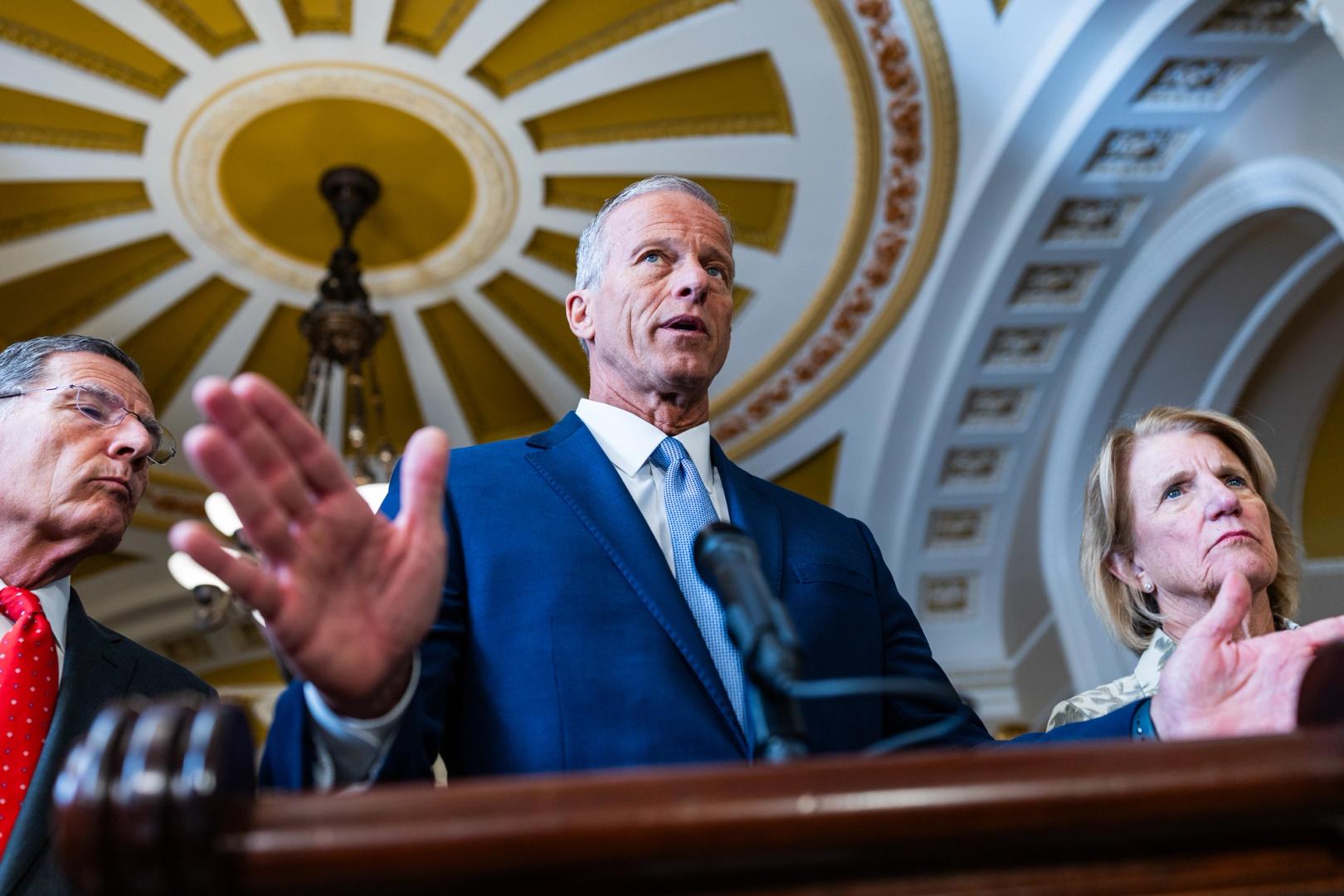

The crypto industry had held out optimism that the Senate could finish the wide-ranging Clarity Act in the next couple of weeks. Dragging it into the later months of the year sharply reduces its odds for passage in 2026.
Clarity — even more than last year’s Guiding and Establishing National Innovation for U.S. Stablecoins (GENIUS) Act — is the crypto industry first priority in crypto policy, with the hope it finally secures a permanent legal foundation for U.S. crypto activity.
The Senate’s floor process is a multi-stage affair that can take a few days or even longer to advance legislation past the 60-vote threshold needed in that chamber. At this stage, the crypto bill is hardly guaranteed to muster even a majority, as some Republican senators have also raised concerns with its treatment of stablecoin yield and the language of the government-ethics provision.
Senator Cynthia Lummis, a Wyoming Republican who has been a lead Clarity Act negotiator, told CoinDesk in a Wednesday interview that the most contentious sections are still open for revision that she said could bring Democrats to support it.
Republicans and industry insiders had hoped that getting the bill to the Senate floor might sharpen its urgency and help drive deals among the lawmakers to iron out the final disagreements. That could still happen if Thune can find some floor time before recess.


Bitcoin has fallen below $65,000 after U.S. President Donald Trump threatened a “massive attack” on Iran, with the cryptocurrency losing about 1.5% on Thursday.
Summary
- Bitcoin fell below $65,000 after Trump threatened a massive military attack against Iran.
- Houthi strikes on Saudi oil tankers pushed Brent crude above $100 per barrel.
- Binance Research expects macroeconomic pressure to restrain Bitcoin through the third quarter.
According to data from crypto.news, Bitcoin (BTC) was trading at $64,885 on July 23, extending its retreat after an attempt to recover earlier in the week. The price later touched about $64,831 as traders responded to another escalation in the Iran war and a sharp rise in crude oil prices.
Speaking to Axios on Thursday, Trump confirmed that he was considering restarting large-scale military operations against Iran. His comments came after Iranian forces struck U.S. targets in the region and Iran-backed Houthi fighters attacked Saudi oil tankers in the Red Sea.
“I am considering a massive attack. Bigger than ever before. I am close to making a decision. We are all set for it.”
Despite the warning, Trump gave no deadline for deciding whether to launch another operation. Two U.S. officials told Axios that the White House had not made a final decision or issued new military orders.
War risks have renewed pressure on Bitcoin
Discussing possible support from Israel, Trump told Axios that the country “would join in two minutes if I ask them to.” He maintained that Washington did not need assistance to conduct the operation, while acknowledging that Israeli involvement could carry “consequences” through Iranian retaliation.
Trump also claimed that Iranian officials wanted negotiations but were not prepared to accept an agreement. Two regional sources familiar with the mediation process told Axios that Iran’s leadership had rejected the latest proposal submitted through intermediaries.
“They haven’t received enough pain yet,” Trump said while questioning Tehran’s approach to the negotiations.
Military activity has intensified during the past 12 days as Washington has tried to stop Iranian attacks on commercial vessels in the Strait of Hormuz. According to Axios, Iran has continued its regional operations despite repeated U.S. strikes, leaving the two countries without a clear path toward a ceasefire.
Bitcoin’s decline followed a familiar risk-off response to the conflict. Earlier in July, the cryptocurrency dropped more than 3% to around $61,691 after Trump declared that a tentative Iran ceasefire was over.
Binance Research analysts told Barron’s that macroeconomic pressure could limit Bitcoin’s performance through the third quarter. The analysts noted that BTC ended the first half of 2026 near $59,500, about 53% below its record high of more than $120,000 reached in October 2025.
According to Binance Research, the decline places Bitcoin within a possible historical bottoming period heading into the fourth quarter, although the firm stressed that the signal had not been confirmed. BTC’s inability to hold $65,000 on Thursday has kept attention on whether sellers can push the price back toward its July lows.
Surging oil prices have added an inflation threat
Energy markets faced fresh pressure after Yemen’s Iran-aligned Houthis claimed attacks on two Saudi oil tankers, Encelia and Layla, in the Red Sea. The group said it used ballistic missiles, cruise missiles and drones because the vessels had violated its naval blockade on Saudi Arabia.
Saudi state news agency SPA confirmed that an attack caused a fire on Encelia’s bow, although all crew members were safe.
Ship-tracking data reviewed showed that five tankers changed course after the Houthis warned vessels to avoid Saudi ports. Two of those tankers indicated the Suez Canal as their new destination, while the Houthis separately claimed they had forced about 10 ships to turn back.
Those attacks have placed the Bab el-Mandeb Strait, a key route connecting the Red Sea and Gulf of Aden, at the center of the conflict. Reuters reported that the passage provides Saudi Arabia with an alternative export route while traffic through the Strait of Hormuz remains heavily disrupted.
Brent crude futures climbed 7% to $100.66 per barrel on Thursday, crossing $100 for the first time since late May, according to Reuters. West Texas Intermediate rose 6.3% to $92.28, while Brent’s monthly gain approached 40%.
UBS analyst Giovanni Staunovo estimated that Gulf oil-loading activity had dropped to 2.5 million barrels per day over the previous seven days, compared with a 30-day average of 6 million. Staunovo also estimated that Iranian oil loadings may have fallen to zero from between 1.5 million and 2 million barrels per day at the start of July.
Goldman Sachs warned that Brent could exceed $120 during the fourth quarter if disruption in the Strait of Hormuz persists and spreads further across the Bab el-Mandeb Strait and Suez Canal. Higher energy costs could complicate the U.S. inflation outlook, while Binance Research expects macro pressure to keep Bitcoin’s recovery limited through the third quarter.
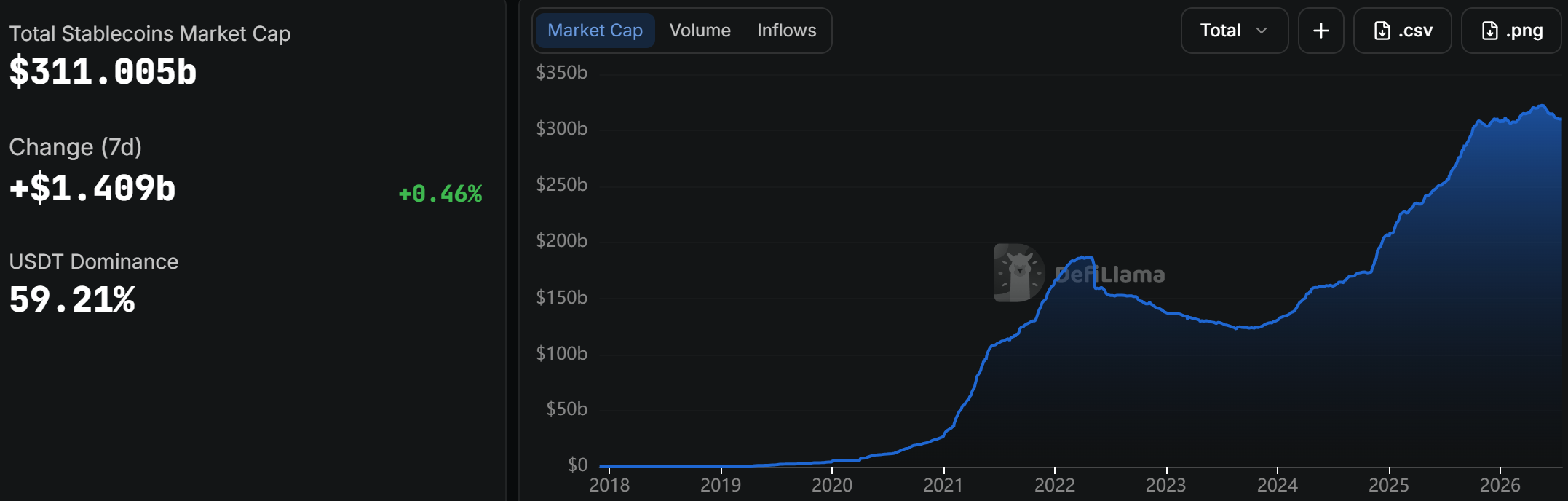
Changpeng Zhao (CZ) missed one of crypto’s biggest markets. The Binance founder now admits he misjudged the stablecoin market for years.
He told the Talking Tokens Podcast that he wrote them off. Today those tokens are worth more than $311 billion.
CZ Says He Missed the Stablecoin Boom
Zhao spoke on the Talking Tokens podcast. He looked back at the calls he got wrong. Leaving Binance gave CZ time to study the market again.
Stablecoins are crypto tokens tied to the US dollar. Each one aims to stay worth about a dollar. Traders use them to move money fast, day or night.
He is blunt about what he got wrong.
“when I was running Binance, I actually kind of missed stablecoins. I didn’t think stablecoins will get that big, but they actually have.”
Follow us on X to get the latest news as it happens
A Temporary Patch Job That Became a Giant
Changpeng Zhao saw stablecoins as a quick workaround. He thought they only moved money between exchanges. He was wrong.
“I thought that was a temporary patch job technology just to bridge some transactions between crypto exchanges, but then got big…”
Stablecoins were tiny when Binance launched in 2017. Now the market tops $311 billion. Tether (USDT) leads with about $184 billion.

That is nearly 60% of the sector. It makes Tether the third-biggest crypto, behind only Bitcoin (BTC) and Ethereum (ETH). Circle’s USDC ranks second, with about $77 billion.
That is a huge market to miss.
The technology he doubted is now US law. The US passed the GENIUS Act in July 2025. It set the first national rules for stablecoins.
Weeks earlier, Circle listed on the New York Stock Exchange. Its shares jumped more than 160% on day one.
Why CZ Now Watches the Stablecoin Market He Missed
Changpeng Zhao does not want to miss the next big thing. He says leaving the CEO job gave him room to learn. Now he studies new areas he once ignored.
“when I’m forced to step back, I kind of look at the industry more as a whole.”
He blames how busy he was at Binance.
“as the CEO of Binance, when I was running it, I was so busy that I couldn’t even learn new things in crypto that well.”
The lesson stuck. Zhao says early doubts can cost a lot. Stablecoins are his proof.
The post Changpeng Zhao Ignored This One Market, Now It Is Worth Over $311 Billion appeared first on BeInCrypto.
Key points:
- Funds queue ~$150M of HYPE for unstaking, $116M from Multicoin
- HYPE falls 8% to ~$58; withdrawals dwarf thin spot market
- Sale intent unclear — Jain denies selling, Selini exit tied to HIP-3 shutdown
Hyperliquid’s HYPE token slid to around $58 on Wednesday in the face of large unstaking events initiated by crypto funds. Data obtained from hedge fund and analytics platform Block Liquidity shows Multicoin Capital holding a combined $138.78 million in staked HYPE, of which roughly 83% — about $116 million — sits in pending withdrawal.
That’s as Selini Capital and Galaxy Digital have queued HYPE tokens worth $4.4 million and $29.4 million, respectively, for withdrawal. In addition, a Multicoin-linked wallet also deposited roughly 167,000 HYPE, worth $11.2 million, to Coinbase, possibly to be sold.
As of publication, the price had recovered some of its decline, last trading hands at $59.19, according to CoinGecko data. Trading volume in the past 24 hours was more than $415.4 million.
Withdrawal queue dwarfs daily spot turnover
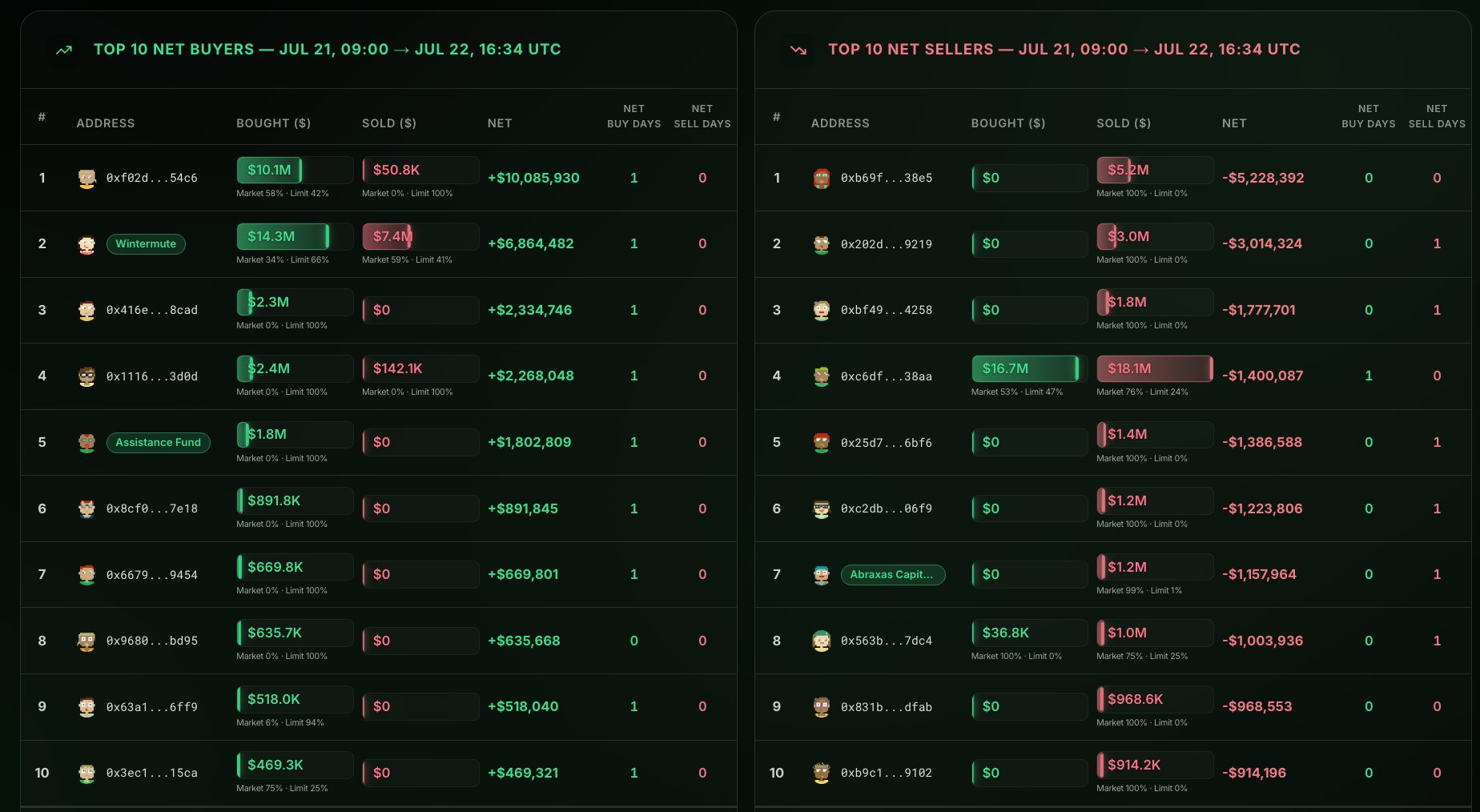
These bulk unlocks will be processed in five to seven days and will result in a nearly $150 million overhang in HYPE’s liquid supply. While perpetuals for the tokens trade around $400 million daily, the spot market for HYPE is significantly smaller. Block Liquidity’s flow tracker recorded just $72.8 million in HYPE spot volume across the roughly 28 hours to Wednesday morning, with 1,463 unique buyers against 982 sellers. Wintermute was the largest net buyer at over $9 million, while the top net seller offloaded $5.2 million.
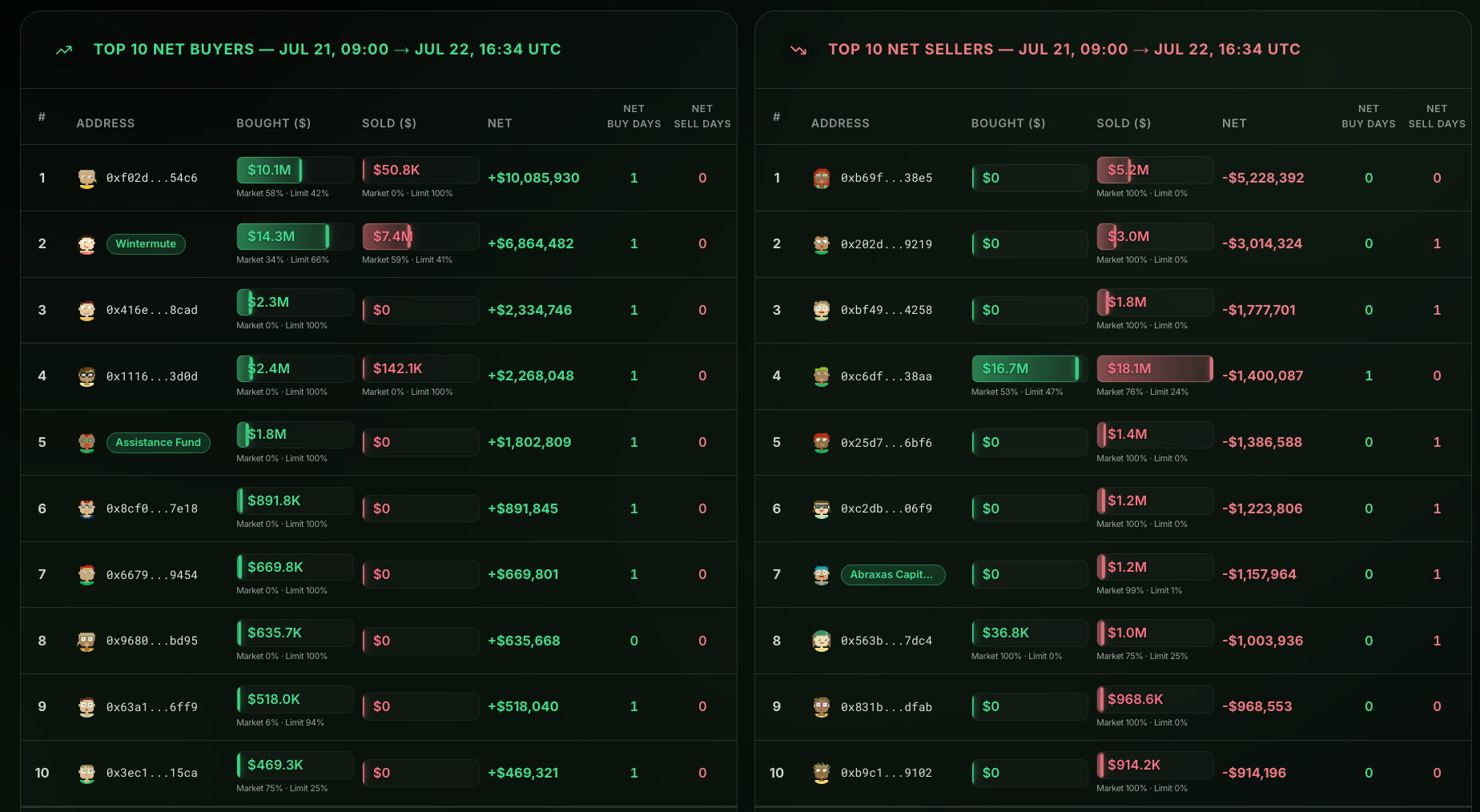
Top buyers and sellers during HYPE’s plummet to as low as $57.39.
Source: Blockliquidity.xyz
A withdrawal queue nearly double the daily spot turnover helps explain the recent apprehension in the market. HYPE has fallen about 11% over the past week. However, whether the unlocked tokens are about to be sold into the market is far from clear.
The unstaking by Selini Capital appears to be linked to the shutdown of the HIP-3 CASH perpetuals markets run by DreamCash. Like many recent HIP-3 deployments, DreamCash’s USDt (USDT)-based markets struggled to attract liquidity, especially as USDC (USDC) became more deeply entrenched in the Hyperliquid ecosystem.
Recent: Bitcoin analysis eyes ‘serious volume’ after Binance sees 9K BTC daily outflow
Launching a builder-deployed perpetuals marked under HIP-3 requires staking 500,000 HYPE as a slashable security bond, which can be refunded when the market goes defunct. Selini Capital may decide to sell this HYPE allocation through an OTC desk.
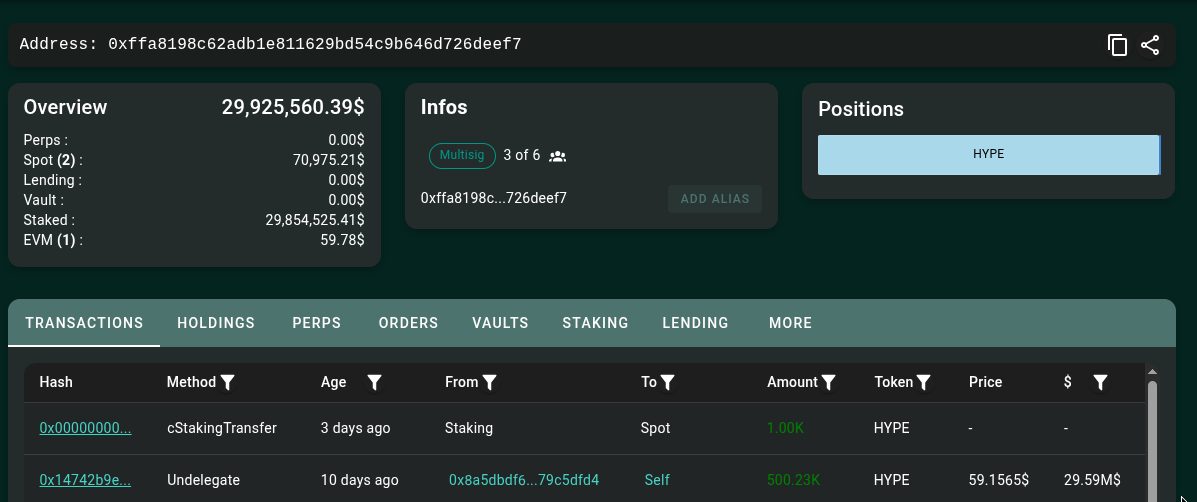
Wallet associated with Selini Capital invoking StakingTransfer Method.
Source: HypurrScan.io
Sale or HIP-3 war chest?
While Selini’s recent HYPE unlock represents the shutdown of a HIP-3 market, Multicoin’s HYPE may at least partially be headed for a new deployment. Last week, the firm made its first Hyperliquid ecosystem venture bet by leading a $1.75 million seed round into Trasia. The latter is an Asia-focused, noncustodial trading platform that plans to launch perpetuals for Asian equities.
Managing partner Tushar Jain said on X that Trasia is targeting “net new users” unfamiliar with Hyperliquid. He claimed in an X post later on Wednesday night that the unstaked HYPE was not intended for selling. The market will watch where funds will flow on the July 28 unlock. Although absorption by new HIP-3 deployments or mere asset reallocation remains the base case, HYPE has not yet recovered to its recent highs.
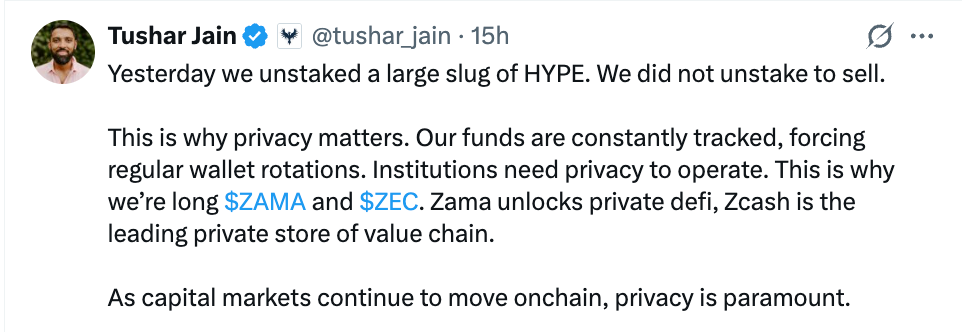
Multicoin Capital managing partner Tushar Jain issues clarification.
Source: X.com
The closure of crypto derivatives exchange BitMEX is prompting fresh questions about whether the industry is entering a new phase of consolidation, as analysts point to market-share concentration and rising regulatory costs squeezing smaller platforms.
While BitMEX helped pioneer perpetual swaps that became a cornerstone of digital asset derivatives trading, its daily Bitcoin futures volume began declining around May 2021 and never recovered to its 2020 daily peak of between $1 billion and $5 billion, according to data from CryptoQuant.
Restructuring adviser Roshan Dharia told Cointelegraph the exchange’s demise reflects structural pressures facing mid-sized centralized exchanges, where liquidity has increasingly concentrated among the industry’s largest players and regulatory compliance costs continue to rise. He said:
The top five platforms now control an estimated 80% of global spot volume, leaving mid-tier and regional exchanges with shrinking margins and no viable path to scale… The headwinds are structural, not cyclical.
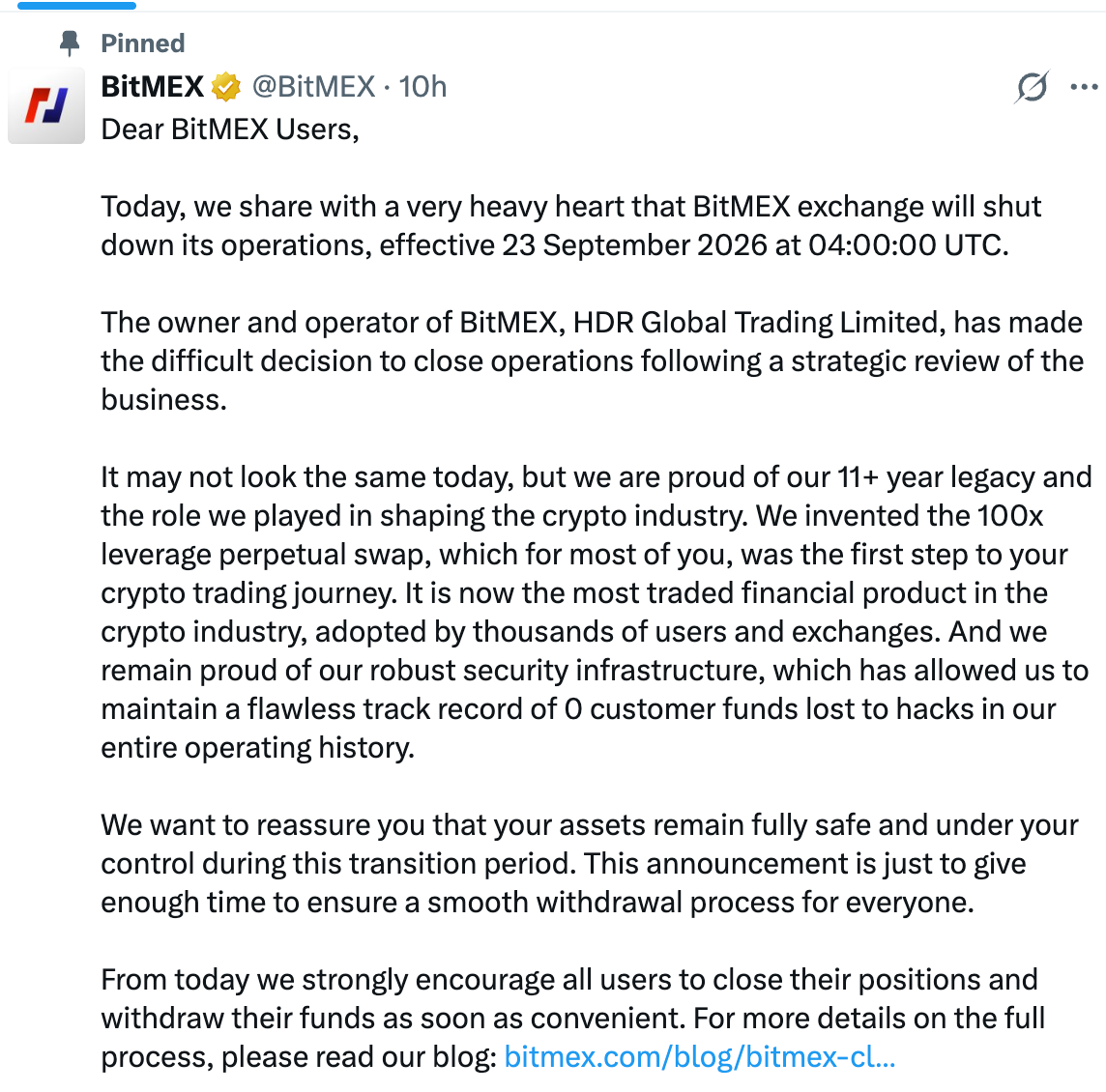
Source: BitMEX
Related: BitMEX pitches ‘canary fund’ alternative to Bitcoin quantum coin freeze
The fall of BitMEX
BitMEX, the crypto derivatives exchange founded in 2014 by Arthur Hayes, Ben Delo and Samuel Reed, announced on Thursday that it will shut down. Trading is scheduled to end on Sept. 23 following a strategic review by parent company HDR Global Trading.
The shutdown announcement also triggered a sharp sell-off in BitMEX’s utility token, BMEX, which plunged more than 90% after the exchange revealed plans to wind down operations.
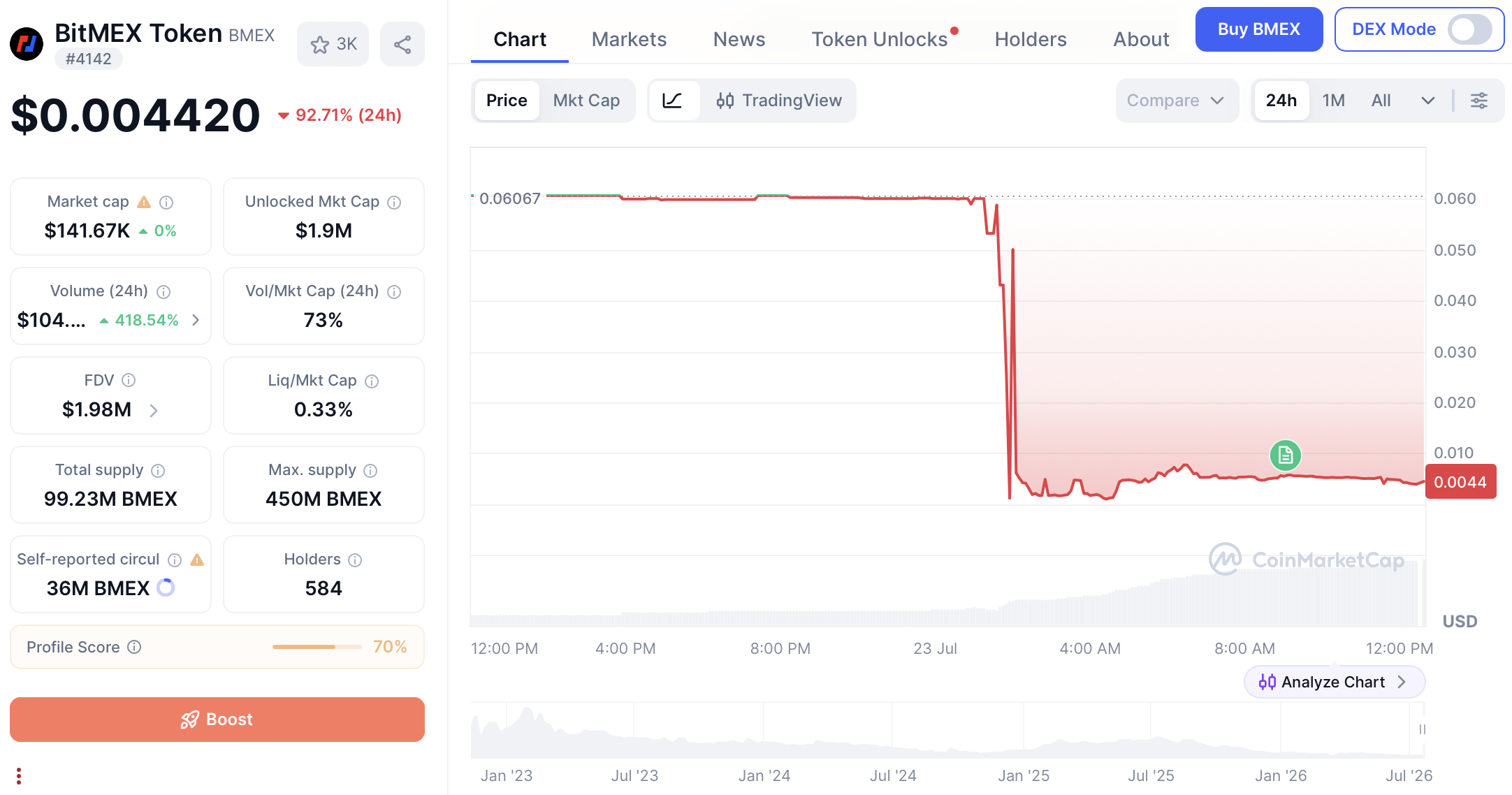
BMEX token drops over 90%. Source: CoinMarketCap.
The announcement came after years of declining market share. CoinGecko ranked BitMEX ninth among derivatives exchanges in August 2023 with a 0.9% share of trading volume. By 2025, it no longer appeared among the firm’s top 10 perpetual exchanges, even as annual perpetual trading volume across those platforms climbed 47.4% to a record $86.2 trillion.
Related: Arthur Hayes dumps WLD days after Maelstrom’s AI IPO pitch
The rise of regulated competitors
BitMEX rose to prominence by offering offshore perpetual derivatives years before similar products became available through regulated venues. Today, those same products are increasingly offered through licensed exchanges in jurisdictions including the United States and the United Kingdom.
In the US, Coinbase launched perpetual-style futures through a Commodity Futures Trading Commission-regulated exchange in May after receiving no-action relief from the regulator. The CFTC also approved Bitcoin perpetual futures for Kalshi. In June, Kraken followed with CFTC-regulated perpetual futures for eligible US traders through its recently acquired Bitnomial exchange.
The trend has also extended beyond the United States. This month, Coinbase secured a UK investment services license allowing it to expand its derivatives business ahead of the country’s new crypto regulatory regime.
Magazine: Here’s why the CLARITY Act’s ethics deal may be so hard to reach

Pumpkin Tree Recalls 380,000 Kids’ Fruit Pouches Sold at Target, Kroger and Meijer Over Plastic Risk
2 Bullish and 1 Bearish ADA Signals: Where Is Cardano’s Price Going Next?

BITCOIN CAPITULATION IS HERE!


-

 Fashion6 days ago
Weekend Open Thread – Corporette.com
-

 Politics5 days ago
The House | The City of London can help the new chancellor deliver growth in every postcode
-

 Crypto World5 days ago
Ripple Payments Joins MiCA With 14 Firms, Does It Mean Anything For XRP?
-
 Crypto World6 days ago
Two July Windows Left: The CLARITY Act’s Senate Fight and What Failure Means
-

 Politics4 days ago
Democrats look to World Cup watch parties to register thousands of voters
-

 Crypto World6 days ago
Ripple wins EU-wide access as ESMA adds it to MiCA register
-

 Crypto World3 days ago
Grayscale Files For Worldcoin ETF, WLD Registers Sharp Rise
-

 NewsBeat3 days ago
Unregistered fitter used Gas Safe logo on business flyers
-

 Tech3 days ago
Sail Virtually Aboard The “Itanic” With IA-64 Emulator
-
 Tech3 days ago
Turtle Beach Command Series KB7 review: a nifty screen-equipped gaming keyboard
-

 NewsBeat6 days ago
Registration is now open for March for Men with Kev 2026
-
 Business2 days ago
New Jersey voter registration controversy explained: How 6,600 noncitizens got on the rolls, and what happens next
-

 Crypto World7 days ago
Claude Fable 5 Slips to Second in AI Coding Leaderboard
-

 News Videos7 days ago
Money | Class 12 Economics | CBSE Board Exam 2026-27
-

 Business7 days ago
Banco Bilbao Vizcaya Argentaria, S.A. (BBVA) Discusses Global Macro Environment and Economic Outlook for Core Markets Transcript
-

 Crypto World5 days ago
Kaspersky exposes OkoBot’s 20-module crypto wallet attack
-

 News Videos4 days ago
Big Money Is Entering XRP
-

 Business6 days ago
Airlines warn Sunshine Protection Act could disrupt flight scheduling
-

 NewsBeat6 days ago
Durham County Council to send out electoral registration emails
-
 Entertainment2 days ago
Johnny Depp’s R-Rated Gothic Cult Classic Gets New Release Ahead of Sydney Sweeney Remake
You must be logged in to post a comment Login